

Submitted:
09 July 2026
Posted:
13 July 2026
You are already at the latest version
Abstract
The taxonomic composition and zoogeographic characteristics of the malacofauna of the upper Konda River basin, a major left tributary of the Irtysh River within the taiga zone of Western Siberia, were identified. A total of 27 species of freshwater mollusks were recorded, including 19 bivalves and 8 gastropods. In terms of taxonomic structure and species composition, the malacofauna of the upper Konda differs significantly not only from most local freshwater mollusk faunas of Western Siberia but also from the middle reaches of the same river system. This indicates the impossibility of directly applying the River Continuum Concept in this case. The greatest genetic relationship between the populations of the studied species in the study area and populations from European Russia and Europe is demonstrated. Not all populations had similar haplotypes; in some cases, intrapopulation haplotypes differed significantly. The results of testing the a priori classification of water bodies based on the composition of malacocenoses indicate a lack of reliable support. A typology of freshwater mollusk habitats in the upper reaches of the Konda River basin is proposed, based on patterns of their distribution across environmental gradients.
Keywords:
river continuum concept
; freshwater malacofauna
; Western Siberia
; riverine ecology
; species composition
; fauna formation
; habitat typology
1. Introduction
The Ob’-Irtysh basin, a major part of which is situated within the Western Siberian region of Russia, is one of the world’s largest riverine systems. Despite the long history of studying the freshwater malacofauna of this basin, which spans approximately 200 years [1], a significant portion of Western Siberia territory remains unexplored in this regard. This is due to the vastness of the West Siberian Plain and the paucity of professional malacologists in the Russian Federation (compared to the country’s vast territory), as well as the inaccessibility of many areas lacking land transport routes. Furthermore, much of the primary faunistic information available in the malacological literature is outdated, as it does not correspond to modern state of mollusk taxonomy, which is based primarily on molecular genetic methods.
Since 2021, our research group has been conducting a detailed study of species composition and spatial distribution of freshwater mollusks of the Konda River basin, a typical lowland river of the taiga zone of Western Siberia and one of the main left-bank tributaries of the Irtysh River in its lower reaches. Prior to our research, freshwater mollusks of the Konda River basin remained unstudied. The nearest areas of the central part of Western Siberia examined by malacologists are located to the north, in the Malaya Sos’va River basin [2], and to the east, in the Bolshoy Yugan River basin [3,4,5]. The study of freshwater mollusks of the Irtysh River basin in terms of their phylogeographic relationships also remains extremely limited. Research in this area has been conducted only in the south of the region on a few neobiotic species [6,7,8,9].
This report presents faunistic and ecological data for only the upper Konda River basin. Inventorying the malacofauna of the entire Konda basin and identifying spatial patterns of distribution and phylogeographic relationships of individual species is a challenging task. However, we believe that focusing specifically on the upper Konda River basin provides information that may be important not only for malacologists. These primary data can be used to test various methods and approaches applied in modern river ecology.
Limnologists working in Western Siberia traditionally use classifications of waterbodies based on their origin and hydrological features [10,11,12,13]. However, these classifications are constructed on a rather small scale and may not take into account the mosaic nature of biotopes and other environmental factors that become apparent upon closer examination. To more accurately characterize the distribution of species and communities, which is necessary for assessing and predicting ecosystem changes, including those resulting from human economic activity, it is necessary to test a priori classifications of waterbodies and identify patterns in the distribution of mollusks using statistical algorithms. Such studies in Western Siberia are still rare [5,14,15].
The River Continuum Concept (RCC), formulated almost 50 years ago [16], has become widely accepted in modern hydrobiology and has had a profound impact on the study of fluvial ecosystems [17,18]. Its individual aspects, as well as the areas and scale of applicability, are still being discussed in the scientific literature [19,20,21,22]. Importantly, in the river continuum model, continuity in community distribution is combined with a pattern of discontinuity arising from the fact that changes in physicochemical conditions within a stream may not change smoothly, but abruptly [23], as a result of which the actual picture of community distribution may represent a punctuated gradient. Thus, the continuum in the distribution of river communities can be quite zonal, that is, subdivided into groups identifiable by their qualitative and quantitative composition, as well as those with a certain spatial localization within the basin [24,25,26]. This discontinuity was also acknowledged by Vannote et al. [16], the authors of the RCC, who distinguished three types of communities associated with headwaters, medium-sized streams, and large rivers, correspondingly. As the authors noted, the headwaters of river basins have certain ecological peculiarities. In particular, they are strongly influenced by the riparian vegetation, which reduces autotrophic production by shading and contributes large amounts of allochthonous detritus [16]. These and other features of the headwaters of river systems have a significant impact on the species composition of macrozoobenthos, its relative richness, and distribution characteristics. It is likely that this will be evident not only in the lotic communities themselves, but also in waterbodies adjacent to the river channel, with a permanent or temporary (during floods) connection to the river. In other words, the influence of the headwaters should affect waterbodies throughout the river basin.
If we shift our focus from macrozoobenthos communities as a whole to communities represented by a particular invertebrate taxon of higher rank (phylum, class, or order), then, depending on the biological specificity of the group, other factors, such as river water mobility, may also contribute to the formation of a discontinuous gradient. Since this mobility is normally directed from the river’s source towards its mouth, it should represent a powerful barrier to the dispersal of organisms unable to actively move against the current or travel by other means (for example, by air). Therefore, for passively dispersing freshwater invertebrates, such as gastropods or most freshwater bivalves (except for pearl mussels and similar mollusks, which use their parasitic larval stage for upstream dispersal with their motile fish hosts), a more pronounced continuity in their distribution along the riverbed should be expected than for others (such as dragonflies, chironomids, and other winged insects whose larvae develop in freshwater bodies). For most mollusks, the upper reaches of rivers may represent the most difficult part of the river basin to reach, which should be reflected in a significantly reduced species and even generic diversity of these groups in the upper reaches of watercourses compared to the lower let alone middle reaches. Similar data on a decrease in the species richness of mollusks from the mouth to the upper reaches are known in the literature (e.g., [27]).
Headwater mollusk communities have rarely been the subject of special study; however, their detailed investigation can provide important evidence on the mechanisms of formation of malacofaunal communities of entire river basins, as well as help to assess the contribution of individual environmental factors to their development. A certain obstacle to this is the lack of comprehensive faunistic surveys, compiled in accordance with the latest achievements in malacological systematics, which would focus on a separate river basin or a specific part of it. Studies of this kind are conducted but remain relatively few in number (e.g., [27,28,29,30,31,32,33]).
The objectives of this research are threefold: 1) to determine the species composition and taxonomic structure, and to provide a zoogeographic characteristic of the freshwater mollusk fauna of the upper reaches of the Konda River basin; 2) to study the phylogeographic relationships of mollusk populations from the study area with populations of the same species from other regions, to determine the most likely pathways for the formation of the malacofauna of the upper reaches of the Konda River; 3) to test an a priori classification of waterbodies based on the similarity of their malacocenoses and to identify patterns in the distribution of mollusks in the gradients of environmental factors of the study area.
2. Material and Methods
Study Area. Primary material for the study was collected by the authors in July and August 2021 and 2023 in the Konda River basin. Most of the surveyed water bodies are located within the boundaries of legislatively protected natural areas: the “Kondinskiye Lakes” Regional Nature Park and the “Verkhne-Kondinsky” Federal Nature Reserve; samples were also taken from a small number of habitats situated in close proximity to these areas.
The Konda River basin is situated in the western part of the West Siberian Plain (Figure 1) within the middle and southern taiga landscape zones. According to the current administrative division of the Russian Federation, the study area is located in the Sovetsky and Kondinsky districts of the Khanty-Mansi Autonomous Okrug – Yugra. The river is 1,097 km long, and its catchment area is 72,800 km2. The basin is 70% wetland-rich, and 5% lake-rich [34]. In the Konda basin there are more than 1.4 thousand watercourses and about 44 thousand lakes [35].
The Konda River differs from other rivers of this region by its unique water level regime. Namely, its flow is regulated without human intervention by the enormous number of lakes and swamps of the Konda Lowland. Starting from Lake Tursuntsky Tuman to its mouth, the Konda River and its tributaries flow through a series of huge floodplain flow-through lakes, up to 10 km wide and up to several tens of kilometers long. In this, the longest section of the river, the water content increases significantly compared to the upper reaches, and the floodplain widens [36]. Distinctive features of the upper reaches of the Konda River from its source to Lake Tursuntsky Tuman over a distance of more than 300 km are: strongly developed meandering, a high degree of sinuosity, and weak development of the floodplain [36]. In addition, the summer-autumn low water on the Konda is clearly expressed only in the upper reaches [34]. These features of the upper reaches of the Konda form a very peculiar habitat of freshwater Mollusca that is likely different from those found throughout the rest of the river, which determined the choice of the study area.
Sampling of malacological material and its processing. Freshwater mollusks were collected using standard methods for sampling benthic invertebrates (see [31,33,37], and references therein), directly by hand, using a bottom dredge or scraper from the water surface, aquatic plants, submerged pieces of wood, and bottom substrates. The collected animals were preserved in 96% alcohol immediately in the field. During the fieldwork, we aimed to examine all types of potential freshwater mollusk habitats or otherwise suitable biotopes present in the study area. A total of 101 such habitats (stations) were examined in water bodies of various types; they differed in the type of substrates (macrophytes, bottom deposits) from which the mollusks were collected, the presence and velocity of water current, and the physicochemical composition of the water (see Supplementary materials, Table S1, Table S2). All mollusks collected from the same station were considered a single sample in subsequent analyses. Mollusks were found in 78 samples, with a total of 1,266 specimens collected.
Species identification of mollusks was conducted using taxonomic keys [37,38,39,40,41,42,43,44] based on conchological and anatomical characteristics of the animals. Molecular genetic diagnostics was used in all possible cases. Zoogeographical analysis was based on information on mollusk ranges taken from specialized literature and online resources [45,46,47], as well as our own published [48] and unpublished data.
The nomenclature of species and other taxa of Mollusca is given in accordance with MolluscaBase (https://www.molluscabase.org/), except for Valvata frigida Westerlund, 1873, which we consider as an independent species, not a synonym of Valvata sibirica Middendorff, 1851 [49]. The majority of the sampled specimens are stored in the collection of Surgut State University (Surgut City, Russia). A small portion of the gastropods is kept in the collection of the Laboratory of Macroecology and Biogeography of Invertebrates of St. Petersburg State University (St. Petersburg, Russia).
Molecular genetic studies. To confirm the species identification in the most challenging cases of small bivalves of the family Sphaeriidae, DNA barcoding based on a region of the gene encoding the mitochondrial large subunit of 16S ribosomal RNA (16S rRNA) was applied. This marker was chosen because it is the most abundant marker for the Sphaeriidae in the NCBI GenBank.
Genomic DNA was isolated from foot tissues of sphaeriid clams using Extran-2 kit (Syntol Ltd., Russia) in accordance with the manufacturer’s protocol. The marker region of the gene encoding the mitochondrial large subunit of 16S ribosomal RNA (16S rRNA) was amplified by polymerase chain reaction (PCR) with primers 16Sar and 16Sbr [50]. The PCR mixture contained approximately 200 ng of total cellular DNA, 10 pmol of each primer, 200 μmol of each dNTP, 2.5 μl of PCR buffer (with 10 × 2 mmol MgCl2), 0.8 units of Taq DNA polymerase (Syntol Ltd., Russia), and deionized H2O, which was added to a final volume of 25 μl. Thermal cycling was performed using a marker-specific PCR program as follows: 95 °C (5 min), then 35 cycles at 95 °C (45 sec), 47 °C (40 sec), 72 °C (50 sec), and a final elongation step at 72 °C (5 min). Forward and reverse sequencing were performed on an automated sequencer (SeqStudio, Applied Biosystems, USA) using the ABI PRISM BigDye® Terminator v.3.1 reagent kit (Applied Biosystems, USA). The resulting sequences were verified using the BioEdit v.7.2.5 sequence alignment editor [51]. A total of 23 new sequences were obtained during this study and submitted to GenBank (Supplementary materials, Table S3).
Phylogeographic analysis was performed using newly obtained 16S rRNA sequences from specimens collected in the study area. Additional sequences were obtained from the GenBank database. To assess phylogeographic relationships between haplotypes of species of the family Sphaeriidae, we applied a network-based approach using Network v. 4.6.1.3 software [52]. Information on the 16S rRNA sequences used in the analysis is provided in Supplementary materials, Table S3.
The assessment of environmental factors. Simultaneously with the mollusk sampling, we registered the main environmental factors of their habitats (see Supplementary materials, Table S2). Information on the following factors was used in the analyses:
i) Waterbody type. Six main habitat types were delineated during the fieldwork: 1) the Konda River channel, 2) tributaries of the main channel, 3) subsidiary water bodies, 4) floodplain water bodies, 5) large non-floodplain lakes, and 6) temporary water bodies.
ii) Hydrological and hydrologically dependent factors. Average depth (m) at the sampling sites. The presence and velocity of water flow were assessed as follows: 0 – no current or imperceptible; 1 – water current is noticeable, but its velocity is low (laminar flow); 2 – high velocity (turbulent flow). Content (proportion, eastimated visually) of detritus, silt, sand, and aquatic plants (macrophytes) in the composition of the substrates from which the mollusks were collected.
iii) Physicochemical. Specific electrical conductivity, color of water, mass concentration of petroleum products, hydrogen index of natural waters (pH), cation concentration (K+, Na+), anion concentration (SO42-, Cl-), and total concentration of heavy metals (Pb, Zn, Cd, Cr, Cu, Mn). These parameters were determined at the Shared Use Center of Surgut State University, in accordance with standard methods for physicochemical assessment of natural waters [53,54,55,56].
Analysis of mollusk species content and distribution data. Based on information obtained during a survey of 101 localities, a data matrix of freshwater mollusk species occurrences was prepared (Supplementary materials, Table S1). Using this matrix, an analysis of species composition, occurrence, and abundance of mollusks was conducted; a species accumulation curve (Sample rarefaction or Mao’s tau) was generated [57,58] and extrapolation of the total species richness of freshwater mollusks in the study area was performed (according to the Chao 2 algorithm, with and without bootstrapping in 1,000 replicates) [57,59]. Mollusks were found in 78 habitats out of 101 sampled. The frequency of each species was calculated as the ratio of the number of habitats in which it was found to the total number of biotopes surveyed (n = 101), expressed as a percentage. Since quantitative samples of mollusks to determine their abundance in absolute terms were not conducted, the abundance of each species was determined as the ratio of the number of specimens collected to the total number of mollusk individuals collected during the fieldwork (n = 1,266) and expressed as a percentage.
In accordance with the data requirements for multivariate statistical analysis [57], columns with species found in only one habitat and rows with habitats in which only one species was found were removed from the initial data matrix. Sampling sites in which mollusks were not detected were also excluded from the analysis. The resulting matrix was supplemented with data on environmental factors (Supplementary materials, Table S2). Only the binary species absence/presence matrix was used for the analysis.
Each freshwater mollusk habitat in the upper reaches of the Konda River basin, depending on its properties and position within the hydrographic network, was assigned to one of the habitat types (see above). We adopted a priori classification for the study area, in accordance with typologies traditionally used in Western Siberia, based on the origin and hydrological characteristics of waterbodies [10,11,12,13] (see Supplementary materials, Table S2).
Since the PERMDISP test revealed no differences in multivariate variance between habitat types (F = 0.53; p = 0.715), a nonparametric one-way multivariate analysis of variance (One-way PERMANOVA) with 9999 permutations was used to determine the significance of differences in species content of their mollusk communities. Pairwise comparisons between the types were conducted as a post-hoc test with Holm’s correction. To obtain a statistically valid classification, an attempt was made to perform a cluster analysis using the unweighted pairwise mean (UPGMA) method of the surveyed habitats based on the proximity of malacocenoses, using the Jaccard similarity coefficient. Canonical correspondence analysis (CCA) was used to analyze the influence of habitat factors on mollusk distribution. To identify the species that make the highest contribution to the difference between the species composition of mollusks in individual habitat groups, the multivariate SIMPER test was used based on the Bray-Curtis similarity measure. Statistical analysis was performed in Microsoft Excel and PAST 4.10 [57].
3. Results
3.1. Characteristics of the Freshwater Malacofauna of the Upper Reaches of the Konda River Basin
Taxonomic diversity and species composition. We identify 27 species of freshwater bivalves and gastropods in the material from the Upper Konda drainage basin. These species belong to 8 genera and 5 families (Table 1; Figure 2 and Figure 3). The most species rich genera are: Euglesa (11 species), Sphaerium (5 species), and Gyraulus (4 species). 19 species are bivalves, 8 species – snails.
The completeness of the fauna inventory. As a result of extrapolation, the total species richness of freshwater mollusks in the study area was estimated at 30.7±4.2 species, and with bootstrapping, 26.7±4.8 species. Consequently, we have registered at least 77.4–85.6% of the species represented in the upper Konda basin. The species accumulation curve (Figure 4) confirms the high percentage of faunal detection, since, with the actual number of biotopes surveyed (101) it practically reaches a plateau.
Zoogeographical characteristics of the fauna. Almost all mollusk species registered in the study area are characterized by rather wide ranges. Most of them (51.9%) are widespread in the Palearctic or even throughout the Holarctic, while a single species (3.7%), Euglesa casertana, is thought to be nearly cosmopolitan in its distribution [60] (although this taxon most likely represents a complex of cryptic species, none of which are cosmopolitan [48]). The ranges of a significant proportion of species are narrower and cover more or less large parts of the Palearctic region: 25.9% of the species inhabit the northern Palearctic and 11.1% are distributed in the western Palearctic. Only 7.4% of species can be considered endemic to Siberia, the ranges of which may also extend to adjacent regions.
Quantitative characteristics of the molluscan communities. In the upper Konda River basin, freshwater mollusks were found in 77.2% of samples, bivalves in 75.2% of samples (comprising 88.5% of the total collection), and gastropods in 15.8% of samples (11.5% of the total collection). The most frequently encountered species were: Euglesa casertana – 39.6% of samples, E. lilljeborgii – 37.6%, E. henslowana – 31.7%, E. subtruncata – 31.7%, with the remaining species occurring significantly less frequently. These most frequently found species were also the most abundant, comprising a combined 59.4% of the total collection; the remaining 23 species accounted for 40.6% of the total number of collected individuals.
Of the gastropods, Valvata frigida and Gyraulus acronicus were the most common, each found in 5.9% of samples; the most abundant species in the samples was Ampullaceana balthica, comprising 4.6% of the total collection.
3.2. Phylogeography of Selected Bivalve Species of the Upper Konda Basin
Since the bivalve mollusks of the upper reaches of the Konda River basin significantly exceed the abundance and number of species of gastropods, they were chosen by the model group to study the phylogeographic relationships of the malacofauna of this area. The phylogeographic relationships of selected species of the family Sphaeriidae are represented below (Figure 5).
Populations of all sphaeriid species from the upper Konda River basin and the Khanty-Mansi Autonomous Okrug in the whole, for which phylogeographic relationships were examined, appeared to be closely related to populations of the same species of European Russia and Europe. They share the same haplotypes as European individuals or differ from them by no more than one or two nucleotide substitutions. However, relationships of the Konda Rvier populations with those from the Yamalo-Nenets Autonomous Okrug (northern Western Siberia) appeared to be not always so close – E. globularis from these neighboring regions differ by at least four nucleotide substitutions, with the more northern populations closer to those from the Far East and North America. A number of populations had different haplotypes – E. henslowana from the upper and middle Konda River basin differed by five nucleotide substitutions, while the haplotypes of E. casertana from the upper Konda differed by nine.
3.3. Distribution Patterns of Freshwater Mollusks in the Upper Reaches of the Konda River Basin
A priori biotopic distrbution. The highest species richness of freshwater mollusks was recorded in large non-floodplain lakes – 22 species; the lowest in the Konda River – 11 species and temporary waterbodies – 1 species. 17 species were found in floodplain habitats, 16 in tributaries, and 13 in subsidiary water bodies. One-way PERMANOVA analysis revealed significant differences in the composition of malacocenoses between the habitat types (F = 2.25; p = 0.0001). Statistically significant differences were found between the most spatially separated types of waterbodies: main channel tributaries vs. floodplain waterbodies (p = 0.0110), subsidiary waterbodies vs. large non-floodplain lakes (p = 0.0208), floodplain waterbodies vs. large non-floodplain lakes (p = 0.0117). No statistically significant differences were found between the species composition of other habitat types compared.
The results of the cluster analysis of habitats based on their faunal similarity were unsatisfactory, yielding numerous clusters with very weak bootstrap support (not illustrated).
The results of the canonical correspondence analysis (CCA) generally confirmed the results of the one-way PERMANOVA post-hoc test for the a priori identified water body types. However, the point polygons corresponding to the distribution of the surveyed habitats across environmental factor gradients overlapped in the ordination space (Figure 6).
The spatial ordination of the first two CCA axes was statistically significant (axis 1: p = 0.0130; axis 2: p = 0.0110), with their eigenvalues explaining a combined 45.8% of the total variance in the data matrix. The horizontal axis was highly correlated with pH, color of water, chloride ion, and petroleum product concentrations; the vertical axis was highly correlated with the presence and velocity of water flow, the proportion of detritus in the substrate, water electrical conductivity, sulfate ion concentration, and pH (Table 2). These factors had the greatest impact on the distribution of freshwater mollusk species in the upper reaches of the Konda River basin. On the contrary, such factors as habitat depth, the proportion of silt, sand and macrophytes in the substrate, the concentrations of potassium, sodium and heavy metal ions were significantly less correlated with the ordination axes and therefore had less influence on the distribution of mollusks in the study area.
Species centroids in the ordination diagram were not associated with the a priori identified habitat types (see Figure 6). However, CCA allowed us to visualize ecological niches within the gradients of the environmental factors examined, identifying species groups with similar distributions in habitats from different habitat types but with similar conditions. Based on the CCA results, we propose the following habitat typology for freshwater mollusks in the upper reaches of the Konda River basin.
1) Lotic habitats (see Figure 7A), which are characterized by relatively high flow velocities and increased values of conductivity and SO42- concentrations. The species associated with them are: Anodonta anatina, Euglesa henslowana, Pisidium amnicum, and Sphaerium asiaticum.
2) Lentic habitats (see Figure 7B), on the other hand, are marked by decreased flow velocities (or zero velocity), low values of conductivity, and SO42 concentrations. Characteristic mollusks: Euglesa lilljeborgii, E. nitida, E. obtusalis, E. parvula, Sphaerium corneum, Sph. lacustre and species of the genus Gyraulus.
3) In the lentic habitat group, a distinct region in the ordination space was occupied by marshy habitats (see Figure 7C) with dark color of water, a significant proportion of detritus in the bottom substrate, and low pH and conductivity values. The following species are associated with these habitats: Euglesa casertana, E. hinzi, E. milium, and Valvata frigida.
4) In a number of habitats, extreme conditions (see Figure 7D) for freshwater mollusks have been identified: intense water coloration, low pH, high concentrations of Na+ and Cl-, petroleum products, and heavy metals. Under these conditions, only one species finds favorable habitats: Euglesa globularis. Habitats of this type are primarily located outside protected areas, in close proximity to oil fields.
The SIMPER test revealed that the species that contributed the most (up to 80%) to the differences between habitat groups were: Euglesa lilljeborgii, E. casertana, E. globularis, E. henslowana, E. subtruncata, and Pisidium amnicum. The overall mean dissimilarity between waterbody types was 86.8 (Table 3).
4. Discussion
4.1. The Characteristics of the Freshwater Malacofauna of the Upper Konda Basin
According to our data, the freshwater malacofauna of the upper Konda appears to be very poor, both in comparison with other local freshwater mollusk faunas of the taiga zone of Western Siberia, and in comparison with the fauna of the West Siberian region as a whole. The upper courses of the Konda River maintain an impoverished malacofauna compared to the middle part of the same drainage basin. According to our unpublished data based on the recent taxonomic revisions [48,61,62,63], the fauna of the middle Konda basin includes 60 species of freshwater mollusks. Approximately the same number of species (63) was identified by us as a result of long-term studies in the Bolshoy Yugan River basin located at the same latitudes [3,4,5]. Further north, in the Malaya Sosva and Taz river basins, the species richness of freshwater mollusks consistently decreases; 37 and 46 species, respectively, have been identified in these areas [2,49,64]; our unpublished data]. We estimate the total species richness of freshwater Mollusca in Western Siberia at approximately 120 species [45]; our unpublished data]. Some of the estimates presented above are preliminary; the taxonomic revision of some groups of mollusks is not yet complete. Furthermore, to minimize the impact of research efforts of varying intensity, extrapolation of the full species richness of the compared areas is necessary, which is not the purpose of this study. However, our preliminary data and known macroecological patterns of decreasing species richness of freshwater mollusks in the direction from the equator to the poles [65,66,67] and references therein] indicate an abnormal poverty of the malacofauna of the upper reaches of the Konda River basin. In the territory of Western Siberia, the latitudinal gradient of species richness of freshwater mollusks is expressed quite clearly [68], and local faunas characterized by the same poor species composition as in the upper reaches of the Konda River have previously been found only in the north of Western Siberia, close to the Arctic Circle.
Against the background of the general poverty of the freshwater mollusk fauna in the study area, an extremely limited species composition of gastropods stands out – we were able to register only 8 species with a low frequency and reduced abundance. In the river basins of the forest zone of Western Siberia that we previously surveyed, the list of gastropod species is typically 2–5 times larger; in the Middle Konda basin, it is almost 6 times larger; and in Western Siberia as a whole, the list is almost 10 times larger. A revealing fact is that in the upper Konda basin, the malacofauna lacks representatives of a number of gastropod families common in the Ob’-Irtysh basin: Acroloxidae, Bithyniidae, Physidae, and Viviparidae. The fauna is also extremely poor at the genus level. Representatives of the genera Ladislavella B. Dybowski, 1912, Lymnaea Lamarck, 1799, and Stagnicola Jeffreys, 1830 from the family Lymnaeidae, as well as Anisus S. Studer, 1820, Bathyomphalus Charpentier, 1837, Planorbarius Duméril, 1805, and Planorbis O.F. Müller, 1773 from the family Planorbidae, typical of water bodies in the forest zone of Western Siberia, were not recorded in the upper Konda River. The relatively low representation of gastropods in the waterbodies compared to bivalves is also very atypical for the Ob’-Irtysh basin. In our material, they were present in less than a quarter of the sampled habitats (see Results).
The revealed structure of the malacofauna of the upper part of the Konda River, characterized by a more than twofold predominance of bivalves and their higher frequency of occurrence, is also not typical of local and regional freshwater molluscan faunas on a Palearctic scale, where significantly more widespread gastropods usually constitute up to two-thirds of the species composition [45,65].
The physicochemical characteristics and composition of surface waters in the upper reaches of the Konda River basin (see Supplementary materials, Table S2) generally comply with the standards for maximum permissible concentrations of pollutants in the water of aquatic habitats of fishery importance legislatively adopted in Russia (Order of the Federal Agency for Fisheries of Russia dated May 26, 2025, No. 296). The exception was the concentrations of heavy metals (see Supplementary materials, Table S2), namely zinc, copper, manganese and iron, which reached or exceeded the maximum permissible concentrations in almost all surveyed waterbodies. However, for the forest zone of Western Siberia, high content of these metals in surface waters is the norm and is explained by natural landscape-geochemical conditions. Namely, it is caused by the strong swampiness of the region [34,35,69,70,71,72]. At the same time, high content of zinc and copper can also be a consequence of anthropogenic pollution [69,70,71]. It is likely that the combined influence of high concentrations of heavy metals and the increased water acidity in the study area (in 36 of the 56 habitats involved in the CCA, the pH was below 6.5 – see Supplementary materials, Table S2) may have some influence on the composition and structure of the malacofauna, however, further research is still needed in this direction.
Apparently, a certain role in the formation of such a specific structure of the freshwater malacofauna may be played by a combination of geographic and hydrological factors of the study area: the flatness of the territory, significant swampiness, high water levels in the spring and long flood periods as well as long periods of freeze-up [34,35,36]. Also caused by these factors are frequent oxygen deficiency phenomena during the winter – the so-called zamors (winterkills) characteristic of the vast territory of the Ob’-Irtysh River basin [12,35,73]. These threatening phenomena, causing mass deaths of fish and significant changes in the population structure of other aquatic organisms [12,74,75], cannot but affect freshwater mollusks. However, additional research is needed to confirm these assumptions.
It is also unclear what role the limited dispersal potential of these animals, incapable of active upstream dispersal, may have played in the depletion of the gastropod fauna of the upper Konda River. This factor could potentially be quite significant, but the presence of a large number of representatives of the family Sphaeriidae in the fauna that do not show obvious signs of depletion at the species and genus levels indicates that these mollusks, also incapable of active dispersal against the gradient of flowing water, were nevertheless able to penetrate into the upper reaches of the river basin and even dominate there quantitatively. It is possible that the penetration of these mollusks into the upper Konda River was facilitated by their transport by actively moving animals, such as aquatic insects or birds. The instances of this kind have been repeatedly noted in the malacological literature [76,77,78,79,80,81].
4.2. Pathways of Formation of the Freshwater Malacofauna of the Upper Reaches of the Konda River Basin
The close genetic links between populations of sphaeriid clams of the study area and Europe, revealed during the phylogeographic analysis, confirm the known idea on the recent age of the modern fauna of Western Siberia and the colonisation of the region after the Pliocene-Pleistocene glaciations mainly by mollusks from populations located west of the Urals [65,82]. The findings of Euglesa globularis haplotypes in the study area and the Yamalo-Nenets Autonomous Okrug, which differ from each other by at least 4 nucleotide substitutions, and the greater genetic similarity of more northern populations with Far Eastern and North American populations correspond to established ideas about the historical and modern dispersal of freshwater mollusks in the northern latitudes of Western Siberia, mainly in the direction from east to west [65,82,83]. The presence of divergent haplotypes of Euglesa henslowana and E. casertana in the study area may indicate multiple colonization events of Western Siberia by these mollusks, as well as their significant intraspecific genetic variability. As noted previously [48], Euglesa casertana likely represents a complex of cryptic species characterized by a relatively narrow (not cosmopolitan) distribution. The same may also apply to E. henslowana. The high conchological variability of these species, which once served as the basis for their splitting into several independent species [45,84], may indicate the presence of cryptic taxa within them.
Our results allow us to refine our knowledge of the ranges of individual mollusk species. Thus, it was previously believed that the species Sphaerium nucleus is widespread in the waters of Europe, and in Western Siberia it is found only in its southern part [45,47]. However, we found representatives of the species in the central part of the region (see Figure 2 and Supplementary materials, Table S1, Table S2), in addition to morphological identification, the findings were confirmed by DNA barcoding.
4.3. Distribution of Freshwater Mollusks in the Upper Konda River Basin
Our results indicate the presence of significant differences in the composition of mollusk communities only between the most spatially separated and contrasting habitat types. Of ten pairwise comparisons (main channel of the Konda River, tributaries, subsidiary and floodplain waterbodies, non-floodplain lakes), significant differences were found for only three pairs (tributaries vs. floodplain waterbodies, subsidiary waterbodies vs. non-floodplain lakes, floodplain waterbodies vs. non-floodplain lakes).
The results of cluster analysis and CCA also do not support the grouping of water bodies based on the similarity of their malacocenoses into traditional a priori types determined by the most general hydrological features. On the other hand, the ecological niches of species identified by CCA across environmental gradients correspond to specific habitat groups, which statistically significantly characterizes the distribution patterns of freshwater mollusks in the upper Konda River basin. Apparently, due to the minute size of most freshwater mollusks (especially the pea- and fingernail clams) and their limited dispersal, they are primarily influenced by environmental factors at the scale of individual habitats, rather than waterbodies as a whole. Therefore, when studying the fauna and ecology of freshwater mollusks, their habitats should not be classified in strict connection with a priori types of waterbodies. The obtained results are generally consistent with data on the distribution of mollusks in other river basins and regions [5,85] and some other groups of freshwater animals in Western Siberia [86,87,88].
In practical terms, the obtained results can be used in planning and conducting monitoring studies, nature conservation actions, and obtaining assessments of the state of natural ecosystems. In all these cases, for a reliable and rapid assessment of the diversity of freshwater mollusks, and possibly some other groups of invertebrates, it will be sufficient to collect samples from the most common biotopes of lentic and lotic aquatic ecosystems. Significant differences in the formation of aquatic communities of these two types are well known [89,90,91].
The results reported here also reveal some potential of freshwater mollusks as biological indicators. Comparative analysis of the physicochemical characteristics of the surveyed mollusk habitats did not show significant deviations from background values (see Supplementary materials, Table S2). However, a number of surveyed waterbodies and watercourses adjacent to oil infrastructure facilities still had low pH values, high concentrations of Na+ and Cl-, petroleum products and heavy metals. In such habitats, a very poor species composition of freshwater mollusks was found, with only one species, E. globularis, finding more or less suitable living conditions. A reduction in biodiversity and changes in the structure of aquatic communities [92,93,94,95], including freshwater mollusks [82,83,84,85,86,87,88,89,90,91,92,93,94,95,96,97,98], are well-known regular changes that occur in response to unfavorable, extreme environmental changes. Consequently, the composition of malacocenoses can be used to assess the degree of environmental extremeness and identify local disturbances in ecosystems, such as pollution, habitat destruction, and fragmentation, etc.
However, freshwater mollusks cannot always be successfully used for indicator purposes [99,100]. In our example, the group of extreme habitats included not only apparently disturbed habitats located near oil industry facilities, but also pristine wetland habitats unaffected by anthropogenic activity. The low pH values of the latter, along with increased water coloration, on the one hand, promote the destruction of mollusk shells and hinder the development of macrophytes, and on the other, in statistical treatments, they shift wetland habitats closer to habitats negatively impacted by oil industry facilities. Therefore, a detailed analysis of the causes of the faunal poverty of malacocenoses is always necessary, and until this is completed, preliminary judgments about the degree of disturbance of habitats and water bodies should be refrained.
5. Conclusions
The freshwater malacofauna of the upper Konda River basin appears impoverished, both in comparison with other local freshwater mollusk faunas of the taiga zone of Western Siberia and, in comparison with the fauna of the region as a whole. In its species composition and taxonomic structure, it also differs significantly from the malacofauna of the middle part of the Konda River basin. Thus, in the studied case, the river continuum is clearly discontinuous (i.e., it is practically absent), and the upper part of the basin has a distinct faunal specificity. Various factors, both biological (dispersal abilities of individual mollusk groups) and abiotic (water chemistry, hydrological regime), obviously contribute to the formation of this pattern.
The identified structure of the malacofauna of the upper Konda River, with a more than twofold predominance of bivalve species and their higher frequency, is not characteristic of local and regional freshwater mollusk faunas in the Palearctic, where at least two-thirds of the species list is typically occupied by significantly more common gastropods. The probable causes of this unique structure of the freshwater mollusk fauna in the study area may be the significant swampiness and hydrological characteristics of the upper Konda River, which cause winterkills, as well as the poor development of macrophytes.
Based on the patterns of freshwater mollusk distribution across environmental gradients in the upper Konda River basin, we identified four main habitat types, which can be characterized using both hydrological and hydrochemical parameters and by identifying the typical freshwater mollusk species. These types do not correspond to those identified a priori; the a priori classification has not been verified by statistical tests, which most likely indicates that it lacks an objective hydrological and biological basis.
Supplementary Materials
The following supporting information can be downloaded at the website of this paper posted on Preprints.org.
Author Contributions
Conceptualization, E.S,B., M.V.V. Methodology, E.S.B., Y.A.M., M.V.V..; Software, E.S.B.; Literary Survey, M.V.V.; Species identification, E.S.B., D.V.D., M.V.V.; Statistical Analysis, Y.A.M., Z.M.B., A.A.S.; Fieldwork, E.S.B., D.V.D., Z.M.B., Y.A.M., M.V.V.; Writing – Original Draft Preparation, M.V.V..; Writing – Review & Editing, all authors; Visualization, E.S.B.
Funding
The financial support for this research was provided by the Russian Science Foundation and the Khanty-Mansi Autonomous Okrug – Yugra (project No. 25-14-20058).
Institutional Review Board Statement
Not applicable.
Data Availability Statement
The primary materials (gastropod and bivalve samples) for this study are placed in Surgut State University (curated by E. Babushkin) and Laboratory of Macroecology and Biogeography of Invertebrates, St.-Petersburg State University (curated by M. Vinarski). Original data, used and collected during this research, are available (with reservations) upon request from the authors.
Acknowledgments
The authors thank the administration and staff of the “Kondinskiye Lakes” Nature Park, the “Verkhne-Kondinsky” Federal State Nature Reserve, and the “Malaya Sos’va” Federal State Nature Reserve for their assistance in organizing and conducting field research in the protected areas. Analysis of the physicochemical parameters of natural waters (see Material and Methods) from the study area was performed using equipment from the Shared Use Center of Surgut State University.
References
- Vinarski, M.V. A historical outline of study of Siberian freshwater malacofauna (end of XVIII – middle of XX centuries). Ruthenica. Russ. Malacol. J. 2010, 20(1), 45–67, In Russian. [Google Scholar]
- Vinarski, M.V.; Karimov, A.V. Aquatic snails (Gastropoda) of the “Malaya Sos’va” Nature Reserve (Western Siberia). Ruthenica. Russ. Malacol. J. 2015, 25, 25–35, In Russian. [Google Scholar]
- Vinarski, M.V.; Andreev, N.I.; Babushkin, E.S.; Karimov, A.V. Materials on the fauna of freshwater pulmonate mollusks of the Yugansky Nature Reserve and adjacent territories. Environ. Dyn. Glob. Clim. Change 2015, 6, 34–43, In Russian. [Google Scholar] [CrossRef]
- Babushkin, E.S. Freshwater mollusks of the Bolshoy Yugan River basin (fauna and ecology). PhD thesis, Borok, Russia, 2018; 208p. In Russian. [Google Scholar]
- Babushkin, E.S.; Andreeva, S.I.; Nekhaev, I.O.; Vinarski, M.V. The “Minor Water Bodies” and Their Malacofauna: Are Freshwater Gastropod Communities Usable for Habitat Classification? Water 2023, 15, 1178. [Google Scholar] [CrossRef]
- Kondakov, A.V.; Bespalaya, Y.V.; Vikhrev, I.V.; Konopleva, E.S.; Gofarov, M.Yu.; Tomilova, A.A.; Vinarski, M.V.; Bolotov, I.N. The Asian pond mussels rapidly colonize Russia: successful invasions of two cryptic species to the Volga and Ob rivers. BioInvasions Rec. 2020, 9, 504–518. [Google Scholar] [CrossRef]
- Babushkin, E.S.; Vinarski, M.V.; Kondakov, A.V.; Tomilova, A.A.; Grebennikov, M.E.; Stolbov, V.A.; Bolotov, I.N. European freshwater mussels (Unio spp., Unionidae) in Siberia and Kazakhstan: Pleistocene relicts or recent invaders? Limnologica 2021, 90, 125903. [Google Scholar] [CrossRef]
- Babushkin, E.S.; Nekhaev, I.O.; Vinarski, M.V.; Yanygina, L.V. Aliens and Returnees: Review of Neobiotic Species of Freshwater Mollusks in Siberia from the Kazakhstan Steppe to the Arctic Tundra. Diversity 2023, 15, 465. [Google Scholar] [CrossRef]
- Babushkin, E.S.; Vinarski, M.V.; Vikhrev, I.V.; Bolotov, I.N.; Kondakov, A.V.; Gofarov, M.Yu.; Yanygina, L.V.; Kuzmenkin, D.V. Alien Chinese Pond Mussels (Unionidae, Sinanodonta) in Russia: New Records, the Stages of the Invasion and its Current Status. Hydrobiologia 2026. [Google Scholar] [CrossRef]
- Johansen, B.G.; Glazyrina, E.I.; Zalozny, N.A.; Medvedev, F.S.; Novikov, E.A.; Novikova, O.D.; Ruzanova, A.I.; Faizova, L.V. Succession of aquatic ecosystems in the Middle Ob basin. In Successions of animal population in biocenoses of the Ob River floodplain; Nauka Publishers: Novosibirsk, Russia, 1981; pp. 78–99. (In Russian) [Google Scholar]
- Beriozkina, G.V.; Starobogatov, Ya.I. Reproductive ecology and egg clusters of freshwater Pulmonata. Tr. Zool. Instituta Akad. Nauk SSSR 1988, 174, 1–308. (In Russian) [Google Scholar]
- Pavlov, D.S.; Mochek, A.D. Ecological essay on the Ob-Irtysh basin. In Ecology of fishes of the Ob-Irtysh basin; Pavlov, D.S., Mocher, A.D., Eds.; KMK Scientific Publications: Moscow, Russia, 2006; pp. 6–22. (In Russian) [Google Scholar]
- Andreev, N.I.; Andreeva, S.I.; Babushkin, E.S. Fauna and distribution of bivalve mollusks (Bivalvia) in the Maly Yugan River basin (Middle Ob region). Ruthenica. Russ. Malacol. J. 2016, 26, 191–201. (In Russian) [Google Scholar]
- Kuzmenkin, D.V. Biotopic distribution of freshwater mollusks in the flat part of the Upper Ob basin. Bull. Altai. State Univ. Biol. Sci. 2013, 79, 80–85. (In Russian) [Google Scholar]
- Bespalaya, Y.V.; Aksenova, O.V.; Sokolova, S.E.; Shevchenko, A.R.; Tomilova, A.A.; Zubrii, N.A. Biodiversity and distributions of freshwater mollusks in relation to chemical and physical factors in the thermokarst lakes of the Gydan Peninsula, Russia. Hydrobiologia 2021, 848, 3031–3044. [Google Scholar] [CrossRef]
- Vannote, R.L.; Minshall, G.W.; Cummins, K.W.; Sedell, J.R.; Cushing, C.E. The river continuum concept. Can. J. Fish. Aquat. Sci. 1980, 37, 130–137. [Google Scholar] [CrossRef]
- Webster, J.R. Spiraling down the river continuum: stream ecology and the U-shaped curve. J. North Am. Benthol. Soc. 2007, 26(3), 375–389. [Google Scholar] [CrossRef]
- Doretto, A.; Piano, E.; Larson, C.E. The river continuum concept: Lessons from the past and perspectives for the future. Can. J. Fish. Aquat. Sci. 2020, 77, 1853–1864. [Google Scholar] [CrossRef]
- Rosi-Marshall, E.J.; Vallis, K.L.; Baxter, C.V.; Davis, J.M. Retesting a prediction of the River Continuum Concept: autochthonous versus allochthonous resources in the diets of invertebrates. Freshw. Sci. 2016, 35, 534–543. [Google Scholar] [CrossRef]
- Curtis, W.J.; Gebhard, A.E.; Perkin, J.S. The river continuum concept predicts prey assemblage structure for an insectivorous fish along a temperate riverscape. Freshw. Sci. 2018, 37, 618–630. [Google Scholar] [CrossRef] [PubMed]
- Larsen, S.; Bruno, M. C.; Vaughan, I. P.; Zolezzi, G. Testing the River Continuum Concept with geostatistical stream-network models. Ecol. Complex. 2019, 39, 1007732. [Google Scholar] [CrossRef]
- Sánchez-Hernández, J. Fresh perspectives on the River Continuum Concept require trophic ecology approaches focussed on food web structure and energy mobilisation routes. J. Anim. Ecol. 2023, 92, 957–964. [Google Scholar] [CrossRef] [PubMed]
- Perry, J.A.; Schaeffer, D.J. The longitudinal distribution of riverine benthos: A river dis-continuum? Hydrobiologia 1987, 148, 257–268. [Google Scholar] [CrossRef]
- Culp, J. M.; Davies, R.W. Analysis of longitudinal zonation and the river continuum concept in the Oldman-South Saskatchewan River System. Can. J. Fish. Aquat. Sci. 1982, 39, 1258–1266. [Google Scholar] [CrossRef]
- Thorp, J.H.; Thoms, M.C.; Delong, M.D. The riverine ecosystem synthesis: biocomplexity in river networks across space and time. River Res. Appl. 2006, 22, 123–147. [Google Scholar] [CrossRef]
- Jones, N.E.; Schmidt, B.J. Influence of tributaries on the longitudinal patterns of benthic invertebrate communities. River Res. Appl. 2018, 34, 165–173. [Google Scholar] [CrossRef]
- Beran, L. Freshwater molluscs of the Dyje (Thaya) River and its tributaries - the role of these water bodies in expansion of alien species and as a refuge for endangered gastropods and bivalves. Folia Malacol. 2013, 21, 143–160. [Google Scholar] [CrossRef]
- Van Damme, D.; Van Bocxlaer, B. Freshwater Molluscs of the Nile Basin, Past and Present. In The Nile. Monographiae Biologicae; Dumont, H.J., Ed.; Springer: Dordrecht, 2009; vol. 89, pp. 585–629. [Google Scholar] [CrossRef]
- Pérez-Quintero, J.C. Distribution patterns of freshwater molluscs along environmental gradients in the southern Guadiana River basin (SW Iberian Peninsula). Hydrobiologia 2011, 678, 65–76. [Google Scholar] [CrossRef]
- Tomovic, J.; Paunovic, M.; Atanackovic, A.; Markovic, V.; Gacic, Z.; Csanyi, B.; Simic, V. Biotic typology of the Dan- ube River based on distribution of mollusc fauna as revealed by the Second Joint Danube Survey (2007). Acta Zool. Bulg. 2014, 66, 527–537. [Google Scholar]
- Bespalaya, Y.V.; Aksenova, O.V.; Zubrii, N.A. Molluscan fauna of the lower reaches of the Syoyakha River (Yamal Peninsula). Arct. Environ. Res. 2018, 18, 76–81. [Google Scholar] [CrossRef]
- Leal, M. F.; da Silva, L. H. S.; Nunes Santos, M. D. C.; Aguiar, L. A. de S.; Macedo de Lacerda, L. E.; Miyahira, I.C.; Lacerda, A.C.F. Unravelling the diversity of limnic molluscs in the Parnaíba River Basin, Brazil: can ecoregions influence species composition? Stud. Neotrop. Fauna Environ. 2026, 1–11. [Google Scholar] [CrossRef]
- Mikhailov, R.A.; Vinarski, M.V. Riverine Molluscan Communities in the Semi-Arid Zone of the Lower Volga Basin (Southern Russia): Species Richness and Factors Determining It. Diversity 2026, 26, 129. [Google Scholar] [CrossRef]
- Vodogretsky, V.E. (Ed.) Surface Water Resources of the USSR. Vol. 15. Altai and Western Siberia. Issue 3. Lower Irtysh and Lower Ob; Gidrometeoizdat: Leningrad, Russia, 1973; Vol. 15, 424p. (In Russian) [Google Scholar]
- Lezin, V.A. Rivers of the Khanty-Mansi Autonomous Okrug. A reference manual; Vektor Publishers: Tyumen, Russia, 1999; 156p. (In Russian) [Google Scholar]
- Seredovskikh, B.A. Hydromorphology of the Konda River: a retrospective aspect of the dynamics of channel change; Nizshnevartovsk State University: Nizhnevartovsk, Russia, 2022; 155p. (In Russian) [Google Scholar]
- Glöer, P. Die Süßwassergastropoden Nord- und Mitteleuropas: Bestimmungsschlüssel, Lebensweise, Verbreitung; Conchbooks: Hackenheim, Germany, 2002; pp. 1–327. [Google Scholar]
- Khokhutkin, I.M.; Vinarski, M.V.; Grebennikov, M.E. Mollusks of the Urals and the Adjacent Areas. Fasc. 1. The family Lymnaeidae (Gastropoda, Pulmonata, Lymnaeiformes); Goshchitsky Publishers: Yekaterinburg, Russia, 2009; pp. 1–162. (In Russian) [Google Scholar]
- Andreeva, S.I.; Andreyev, N.I.; Vinarski, M.V. Key to Freshwater Gastropods of Western Siberia (Mollusca: Gastropoda). V. 1. Gastropoda: Pulmonata. Fasc. 1. Families Acroloxidae and Lymnaeidae; The Authors: Omsk, Russia, 2010; pp. 1–200. (In Russian) [Google Scholar]
- Khokhutkin, I.M.; Vinarski, M.V. Mollusks of the Urals and the Adjacent Areas. Fasc. 2. The Families Acroloxidae, Physidae, Planorbidae (Gastropoda, Pulmonata, Lymnaeiformes); Goshchitsky Publishers: Yekaterinburg, Russia, 2013; pp. 1–184. (In Russian) [Google Scholar]
- Kijashko, P.V.; Soldatenko, E.V.; Vinarski, M.V. Class Gastropoda. In A Determination Key for Zooplankton and Zoobenthos of the European Russia Freshwaters. Vol. 2. Zoobenthos; Tsalolikhin, S.Y., Ed.; KMK Scientific Press: Moscow, Russia, 2016; pp. 335–438. (In Russian) [Google Scholar]
- Piechocki, A.; Wawrzyniak-Wydrowska, B. Guide to Freshwater and Marine Mollusca of Poland; Bogucki Wydawnictwo Naukowe: Poznań, Poland, 2016; pp. 1–279. [Google Scholar]
- Glöer, P. The Freshwater Gastropods of the West-Palaearctis. Vol. I. Fresh- and Brackish Waters Except Spring and Subterranean Snails; The Author: Hetlingen, Germany, 2019; pp. 1–399. [Google Scholar]
- Vinarski, M.V. Class Gastropoda. In Thorp and Covich’s Freshwater Invertebrates. Vol. IV. Keys to Palaearctic Fauna.; Academic Press: London, UK, 2019; pp. 310–345. [Google Scholar]
- Vinarski, M.V.; Kantor, Y.I. Analytical Catalogue of Fresh and Brackish Water Molluscs of Russia and Adjacent Countries; A.N. Severtsov Institute of Ecology and Evolution of RAS: Moscow; Moscow, Russia, 2016; 544p. [Google Scholar]
- Cummings, K.S.; Lydeard, Ch. (Eds.) Freshwater Mollusks of the World: A Distribution Atlas; Johns Hopkins University Press: Baltimore, 2019; 256p. [Google Scholar] [CrossRef]
- Graf, D.; Cummings, K. The MUSSEL Project Web Site: MUSSELp. 2026. Available online: https://musselpdb.org/index.html (accessed on 21 May 2026).
- Bespalaya, Yu.V.; Vinarski, M.V.; Aksenova, O.V.; Babushkin, E.S.; Gofarov, M.Yu.; Kondakov, A.V.; Konopleva, E.S.; Kropotin, A.V.; Mabrouki, Y.; Ovchankova, N.B.; Palatov, D.M.; Sokolova, S.E.; Shevchenko, A.R.; Travina, O.V.; Taybi, A.F.; Soboleva, A.A.; Zubrii, N.A.; Bolotov, I.N. Phylogeny, taxonomy, and biogeography of the Sphaeriinae (Bivalvia: Sphaeriidae). Zool. J. Linn. Soc. 2024, 201, 305–338. [Google Scholar] [CrossRef]
- Andreeva, S.I.; Andreev, N.I.; Babushkin, E.S. Mollusks of the family Valvatidae Gray, 1840 (Gastropoda, Heterobranchia) of the Taz River basin (Western Siberia). Ruthenica. Russ. Malacol. J. 2021, 31, 7–19. [Google Scholar] [CrossRef] [PubMed]
- Palumbi, S.R. Nucleic acids II: the polymerase chain reaction. In Molecular systematics, second edition; Hillis, D.M., Moritz, C., Mable, B.K., Eds.; Sinauer Associates, Inc.: Sunderland, Massachusetts, 1996; pp. 205–247. [Google Scholar]
- Hall, T.A. BioEdit: a user-friendly biological sequence alignment editor and analysis program for Windows 95/98/NT. Nucleic Acids Symp. Ser. 1999, 41, 95–98. [Google Scholar]
- Bandelt, H.J.; Forster, P.; Rohl, A. Median-joining networks for inferring intraspecific phylogenies. Mol. Biol. Evol. 1999, 16, 37–48. [Google Scholar] [CrossRef] [PubMed]
- Semenov, A.D. (Ed.) Guide to the Chemical Analysis of Land Surface Waters; Gidrometeoizdat: Leningrad, USSR, 1977; pp. 1–542. (In Russian) [Google Scholar]
- Anonymous. Color of Land Surface Waters. Methodology for Photometric and Visual Measurements. Approved by Roshydromet 2005-06-15. Ecol. News 2008, 7, 25–37. (In Russian)
- Collection of Measurement Methods; Akvilon: Moscow, Russia, 2012; 539p. (In Russian)
- Quantitative Chemical Analysis of Water. Methodology for Measuring the Mass Concentration of Petroleum Products in Samples of Natural, Drinking, and Waste Water Using the Fluorimetric Method on the Fluorat-02 Liquid Analyzer. PND F 14.1:2:4.128-98; NPF Lumex: Moscow, Russia, 2012; 25p. (In Russian)
- Hammer, Ø.; Harper, D.A.T.; Ryan, P.D. PAST. Paleontological Statistics Software Package for Education and Data Analysis. Palaeontol. Electron. 2001, 4, 1–9. Available online: https://palaeo-electronica.org/2001_1/past/past.pdf.
- Colwell, R.K.; Mao, C.X.; Chang, J. Interpolating, extrapolating, and comparing incidence-based species accumulation curves. Ecology 2004, 85, 2717–2727. [Google Scholar] [CrossRef]
- Colwell, R.K.; Coddington, J.A. Estimating terrestrial biodiversity through extrapolation. Philos. Trans. R. Soc. (Series B) 1994, 345, 101–118. [Google Scholar] [CrossRef]
- Kuiper, J.G.J. The Sphaeriidae of Australia. Basteria 1983, 47, 3–52. [Google Scholar]
- Aksenova, O.V.; Bolotov, I.N.; Gofarov, M.Y.; et al. Species Richness, Molecular Taxonomy and Biogeography of the Radicine Pond Snails (Gastropoda: Lymnaeidae) in the Old World. Sci. Rep. 2018, 8, 11199. [Google Scholar] [CrossRef] [PubMed]
- Bolotov, I.N.; Kondakov, A.V.; Konopleva, E.S.; et al. Integrative taxonomy, biogeography and conservation of freshwater mussels (Unionidae) in Russia. Sci. Rep. 2020, 10, 3072. [Google Scholar] [CrossRef] [PubMed]
- Vinarski, M.V.; Aksenova, O.V.; Khrebtova, I.S.; Kondakov, A.V.; Spitsyn, V.M.; Alekseev, V.R.; Pešić, V.; Bolotov, I.N. The Pond Snails of the Genus Radix (Gastropoda, Lymnaeidae) in Issyk-Kul Lake (Central Asia), with a Review of Radix in Ancient Tectonic Lakes of the World. Diversity 2025, 17, 112. [Google Scholar] [CrossRef]
- Babushkin, E.S. Materials on the fauna of bivalve mollusks (Mollusca, Bivalvia) of the Taz river basin (Western Siberia). Ruthenica. Russ. Malacol. J. 2020, 30, 13–32. [Google Scholar] [CrossRef] [PubMed]
- Starobogatov, Ya.I. Fauna of mollusks and zoogeographic zoning of continental water bodies of the globe; Nauka: Leningrad, USSR, 1970; 372p. (In Russian) [Google Scholar]
- Vinarski, M.V.; Kramarenko, S.S. How does the discrepancies among taxonomists affect macroecological patterns? A case study of freshwater snails of Western Siberia. Biodivers. Conserv. 2015, 24, 2079–2091. [Google Scholar] [CrossRef]
- Lopes-Lima, M.; Burlakova, L.E.; Karatayev, A.Y.; Mehler, K.; Seddon, M.; Sousa, R. Conservation of freshwater bivalves at the global scale: diversity, threats and research needs. Hydrobiologia 2018, 810, 1–14. [Google Scholar] [CrossRef]
- Vinarski, M.V.; Andreyev, N.I.; Andreyeva, S.I.; Karimov, A.V.; Lazutkina, E.A. Latitudinal changes in the diversity of freshwater gastropods (Mollusca: Gastropoda) in waterbodies of Western Siberia. Inland Water Biol. 2012, 5, 83–90. [Google Scholar] [CrossRef]
- Babushkin, A.G.; Moskovchenko, D.V.; Pikunov, S.V. Hydrochemical monitoring of surface waters of the Khanty-Mansi Autonomous Okrug-Yugra; Nauka: Novosibirsk, Russia, 2007; 152p. (In Russian) [Google Scholar]
- Moskovchenko, D.V.; Babushkin, A.G.; Yurtaev, A.A. The impact of the Russian oil industry on surface water quality (a case study of the Agan River catchment, West Siberia). Environ. Earth Sci. 2020, 79, 355. [Google Scholar] [CrossRef]
- Moskovchenko, D.V.; Purtov, V.A.; Zavyalova, I.V. Hydrochemical characteristics of the catchment basins of the Khanty-Mansi Autonomous Okrug. Bull. Ecol. For. Landsc. Sci. 2008, 8, 141–148. [Google Scholar]
- Savichev, O.G. Background concentrations of substances in river waters of the taiga zone of Western Siberia. Bulletin Tomsk State Univ. 2010, 334, 169–175. (In Russian) [Google Scholar]
- Ioffe, Ts. I. Bottom fauna of the Ob-Irtysh basin and its fishery significance. Izv. VNIORKH 1947, 25, 116–123. (In Russian) [Google Scholar]
- Balayla, D.; Lauridsen, T.L.; Søndergaard, M.; et al. Larger zooplankton in Danish lakes after cold winters: are winter fish kills of importance? Hydrobiologia 2010, 646, 159–172. [Google Scholar] [CrossRef]
- Hilt, S.; Wanke, T.; Scharnweber, K.; et al. Contrasting response of two shallow eutrophic cold temperate lakes to a partial winterkill of fish. Hydrobiologia 2015, 749, 31–42. [Google Scholar] [CrossRef]
- Kew, H.W. The dispersal of shells: An inquiry into the means of dispersal possessed by fresh-water and land Mollusca; UK: Kegan Paul, London, 1893; 291p. [Google Scholar]
- Charlemagne, E.V. To the question of the role of birds in the dispersal of bivalve mollusks. Tr. Dnepr. Biol. Stantsii 1914, 1, 49–51. (In Russian) [Google Scholar]
- Coughlan, N.E.; Stevens, A.L.; Kelly, T.C.; Dick, J.T.A.; Jansen, M.A.K. Zoochorous dispersal of fresh-water bivalves: an overlooked vector in biological invasions? Knowl. Manag. Aquat. Ecosyst. 2017, 418, 42. [Google Scholar] [CrossRef]
- Soldan, T.; Campbell, I.C.; Papacek, M. A study of dispersal phoretic between Sphaerium tasmanicum (Heterodonta: Sphaeriidae) and Sigara truncatipala (Heteroptera: Corixidae). Vestn. Ceskoslov. Spol. Zool. 1989, 53, 300–310. [Google Scholar]
- Zelaya, D.G.; Marinone, M.C. A case of phoresis of Sphaeriids by corixids: first report for the Americas. Malacologia 2012, 55, 363–367. [Google Scholar] [CrossRef]
- Bespalaya, Yu.V.; Aksenova, O.V.; Aksenov, A.S.; Bovykina, G.V.; Kondakov, A.V.; Kropotin, A.V.; Soboleva, A.A.; Sokolova, S.E.; Travina, O.V. Zoochorous dispersal of freshwater peaclams (Bivalvia: Sphaeriidae): potential role of aquatic insects. Ruthenica. Russ. Malacol. J. 2024, 34, 111–116. [Google Scholar] [CrossRef] [PubMed]
- Vinarski, M.V.; Bolotov, I.N.; Aksenova, O.V.; et al. Freshwater Mollusca of the Circumpolar Arctic: a review on their taxonomy, diversity and biogeography. Hydrobiologia 2021, 848, 2891–2918. [Google Scholar] [CrossRef]
- Bespalaya, Y.V.; Travina, O.V.; Tomilova, A.A.; et al. Species Diversity, Settlement Routes, and Ecology of Freshwater Mollusks of Kolguev Island (Barents Sea, Russia). Inland Water Biol. 2022, 15, 836–849. [Google Scholar] [CrossRef]
- Korniushin, A.V. Bivalves of the superfamily Pisidioidea of the Palaearctic (fauna, systematics, phylogeny); I.I. Schmalhausen Institute of Zoology: Kiev, Ukraine, 1996; pp. 1–175. (In Russian) [Google Scholar]
- Andreeva, S.I.; Babushkin, E.S.; Vinarski, M.V. Freshwater Mollusks of the Family Valvatidae (Gastropoda, Heterobranchia) of the Vitimskiy Nature Reserve and Adjacent Areas: Species Composition and Distribution of Species Richness. Inland Water Biol. 2025, 18(4), 821–836. [Google Scholar] [CrossRef]
- Yanygina, L.V.; Burmistrova, О.С.; Volgina, D.D.; et al. Macroinvertebrates of Altai mountain rivers: factors of their formation and features of distribution within altitudinal gradient. Proc. Zool. Inst. RAS 2023, 327(3), 419–429. [Google Scholar] [CrossRef]
- Vdovina, O.N.; Bezmaternykh, D.M. Macrozoobenthos as an Indicator of the Ecological State of Lakes in Altai Specially Protected Natural Areas. Inland Water Biol. 2025, 18, 849–861. [Google Scholar] [CrossRef]
- Yanygina, L.V.; Schletterer, M. Macroinvertebrates reveal environmental gradients: methods and method development in the Ob River basin. Hydrobiologia 2025, 852, 4771–4781. [Google Scholar] [CrossRef]
- Zernov, S.A. General Hydrobiology; Biomedgiz: Moscow, Russia; Leningrad, Russia, 1934; pp. 1–504. (In Russian) [Google Scholar]
- Zhadin, V.I. Fresh- and brackishwater Mollusca of the USSR. Opredeliteli Po Faune SSSR 1952, 46, 1–376. (In Russian) [Google Scholar]
- Dillon, R.T. The Ecology of Freshwater Molluscs; Cambridge University Press: Cambridge, UK, 2004; pp. 1–523. [Google Scholar]
- Balushkina, E.V. Chironomids as indicators of water pollution. In Methods of Biological Analysis of Fresh Waters; Zoological Institute of the USSR Academy of Sciences: Leningrad, USSR, 1976; pp. 106–118. (In Russian) [Google Scholar]
- Semenchenko, V.P.; Razlutskii, V.I. Ecological Quality of Fresh Water; Belaruskaya Navuka: Minsk, Belarus, 2010; pp. 1–330. (In Russian) [Google Scholar]
- Bettinetti, R.; Ponti, B.; Marziali, L.; Rossaro, B. Biomonitoring of lake sediments using benthic macroinvertebrates. Trends Anal. Chem. 2012, 36, 92–102. [Google Scholar] [CrossRef]
- Sumudumali, R.G.I.; Jayawardana, J.M.C.K. A Review of Biological Monitoring of Aquatic Ecosystems Approaches: with Special Reference to Macroinvertebrates and Pesticide Pollution. Environ. Manag. 2021, 67, 263–276. [Google Scholar] [CrossRef] [PubMed]
- Frantsevich, L.I.; Pankov, I.V.; Ermakov, A.A. Mollusks – indicators of environmental pollution by radionuclides. Ecology 1995, 1, 57–62. (In Russian) [Google Scholar]
- Bedova, P.V.; Kolupaev, B.I. Use of mollusks in biological monitoring of water bodies’ condition. Ecology 1998, 5, 410–411. (In Russian) [Google Scholar]
- Oehlmann, J.; Schulte-Oehlmann, U. Chapter 17. Molluscs as bioindicators. In Trace Metals and other Contaminants in the Environment; Markert, B.A., Breure, A.M., Zechmeister, H.G., Eds.; Elsevier, 2003; Volume 6, pp. 577–635. [Google Scholar] [CrossRef]
- Zuykov, M.; Gudkov, D.; Vinarski, M.; Pelletier, E.; Harper, D.A.T.; Demerse, S. Does radioactive contamination affect the shell morphology of the pond snail Lymnaea stagnalis in the exclusion zone of the Chernobyl NPP (Ukraine)? The Environmentalist 2011, 31(4), 369–375. [Google Scholar] [CrossRef]
- Vinarski, M.V. Pulmonate snails (Mollusca: Gastropoda: Lymnaeiformes) of the Ural and Western Siberian water bodies, Tomsk State University Tomsk, 2014; pp. 1–546. (In Russian)
Figure 1.
Map of the study area with sampling points designated (red circles): (A) Overview map of the world, the red rectangle is the Konda River basin; (B) The Konda River basin, the red rectangle is the upper reaches; (C) The upper reaches of the Konda River basin.
Figure 1.
Map of the study area with sampling points designated (red circles): (A) Overview map of the world, the red rectangle is the Konda River basin; (B) The Konda River basin, the red rectangle is the upper reaches; (C) The upper reaches of the Konda River basin.
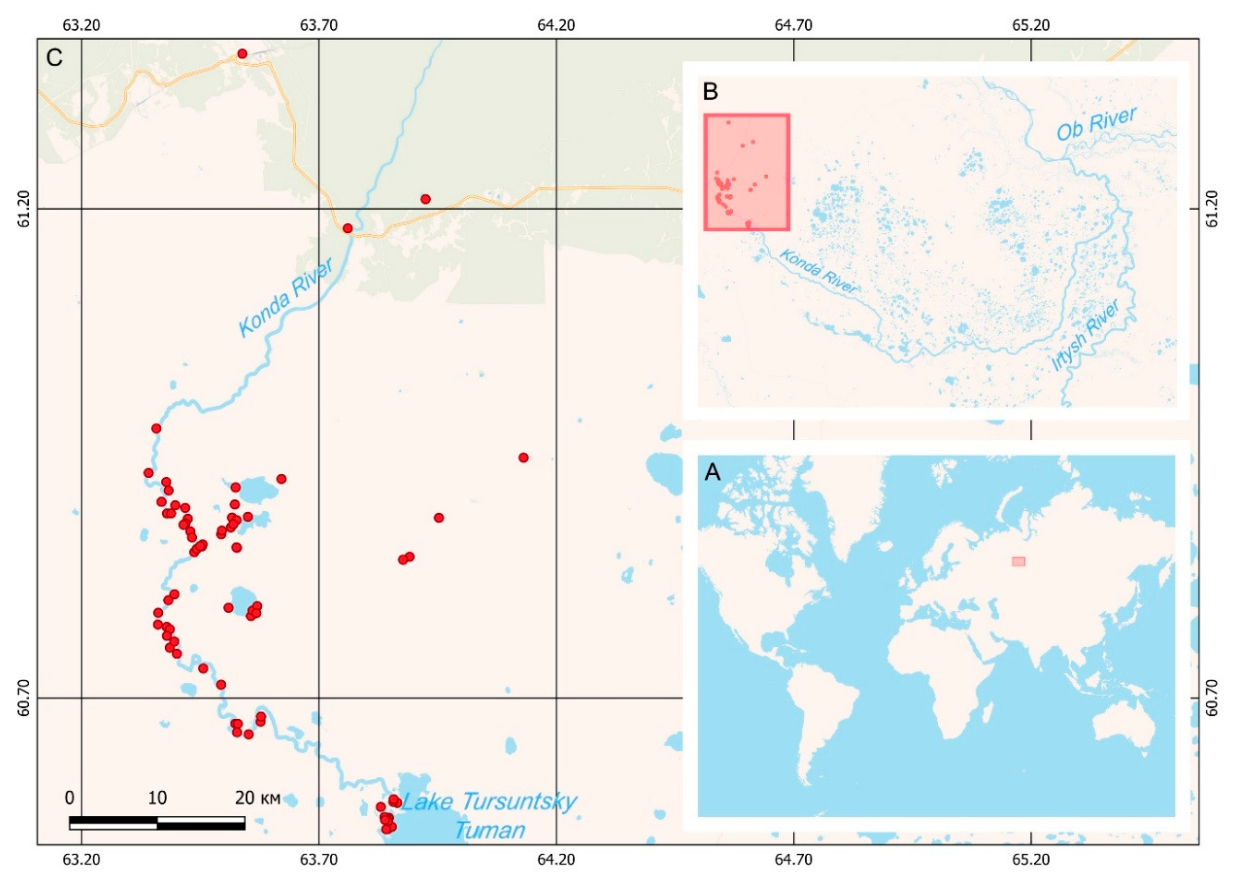
Figure 2.
Freshwater Bivalvia of the studied area. (A) Anodonta anatina (Lake Tursuntsky Tuman, 13.07.2023); (B) Sphaerium asiaticum (Ess River, 04.07.2023); (C) Sphaerium corneum (an oxbow of Akh River, 06.07.2023); (D) Sphaerium lacustre (Lake Tursuntsky Tuman, 11.07.2023); (E) Sphaerium nucleus (a right-bank floodplain waterbody near the Korystya River, 09.07.2023); (F) Sphaerium ovale (a floodplain waterbody near channel from the Vorya River, 08.07.2023); (G) Pisidium amnicum (Oltum River, 09.07.2023); (H) Pisidium dilatatum (an oxbow of the Konda River near the Korystya River, 09.07.2023); (I) Euglesa casertana (Yenyya River, 24.08.2021); (J) Euglesa globularis (unnamed tributary of the Bolshaya Umytya River, 27.08.2021); (K) Euglesa henslowana (Zolotaya River, 25.08.2021); (L) Euglesa hinzi (Korystya River, 09.07.2023); (M) Euglesa lilljeborgii (Lake Tursuntsky Tuman, 11.07.2023); (N) Euglesa milium (the floodplain waterbody No. 2 near Lake Tursuntsky Tuman, 12.07.2023); (O) Euglesa nitida (Zolotaya River, 25.08.2021); (P) Euglesa obtusalis (a floodplain waterbody near channel from the Vorya River, 08.07.2023); (Q) Euglesa parvula (a channel from an oxbow to the Akh River, 06.07.2023); (R) Euglesa pseudosphaerium (Lake Lopukhovoye, 26.08.2021); (S) Euglesa subtruncata (Korystya River, 09.07.2023). Scale bars: 1 mm (B-S), 10 mm (A).
Figure 2.
Freshwater Bivalvia of the studied area. (A) Anodonta anatina (Lake Tursuntsky Tuman, 13.07.2023); (B) Sphaerium asiaticum (Ess River, 04.07.2023); (C) Sphaerium corneum (an oxbow of Akh River, 06.07.2023); (D) Sphaerium lacustre (Lake Tursuntsky Tuman, 11.07.2023); (E) Sphaerium nucleus (a right-bank floodplain waterbody near the Korystya River, 09.07.2023); (F) Sphaerium ovale (a floodplain waterbody near channel from the Vorya River, 08.07.2023); (G) Pisidium amnicum (Oltum River, 09.07.2023); (H) Pisidium dilatatum (an oxbow of the Konda River near the Korystya River, 09.07.2023); (I) Euglesa casertana (Yenyya River, 24.08.2021); (J) Euglesa globularis (unnamed tributary of the Bolshaya Umytya River, 27.08.2021); (K) Euglesa henslowana (Zolotaya River, 25.08.2021); (L) Euglesa hinzi (Korystya River, 09.07.2023); (M) Euglesa lilljeborgii (Lake Tursuntsky Tuman, 11.07.2023); (N) Euglesa milium (the floodplain waterbody No. 2 near Lake Tursuntsky Tuman, 12.07.2023); (O) Euglesa nitida (Zolotaya River, 25.08.2021); (P) Euglesa obtusalis (a floodplain waterbody near channel from the Vorya River, 08.07.2023); (Q) Euglesa parvula (a channel from an oxbow to the Akh River, 06.07.2023); (R) Euglesa pseudosphaerium (Lake Lopukhovoye, 26.08.2021); (S) Euglesa subtruncata (Korystya River, 09.07.2023). Scale bars: 1 mm (B-S), 10 mm (A).
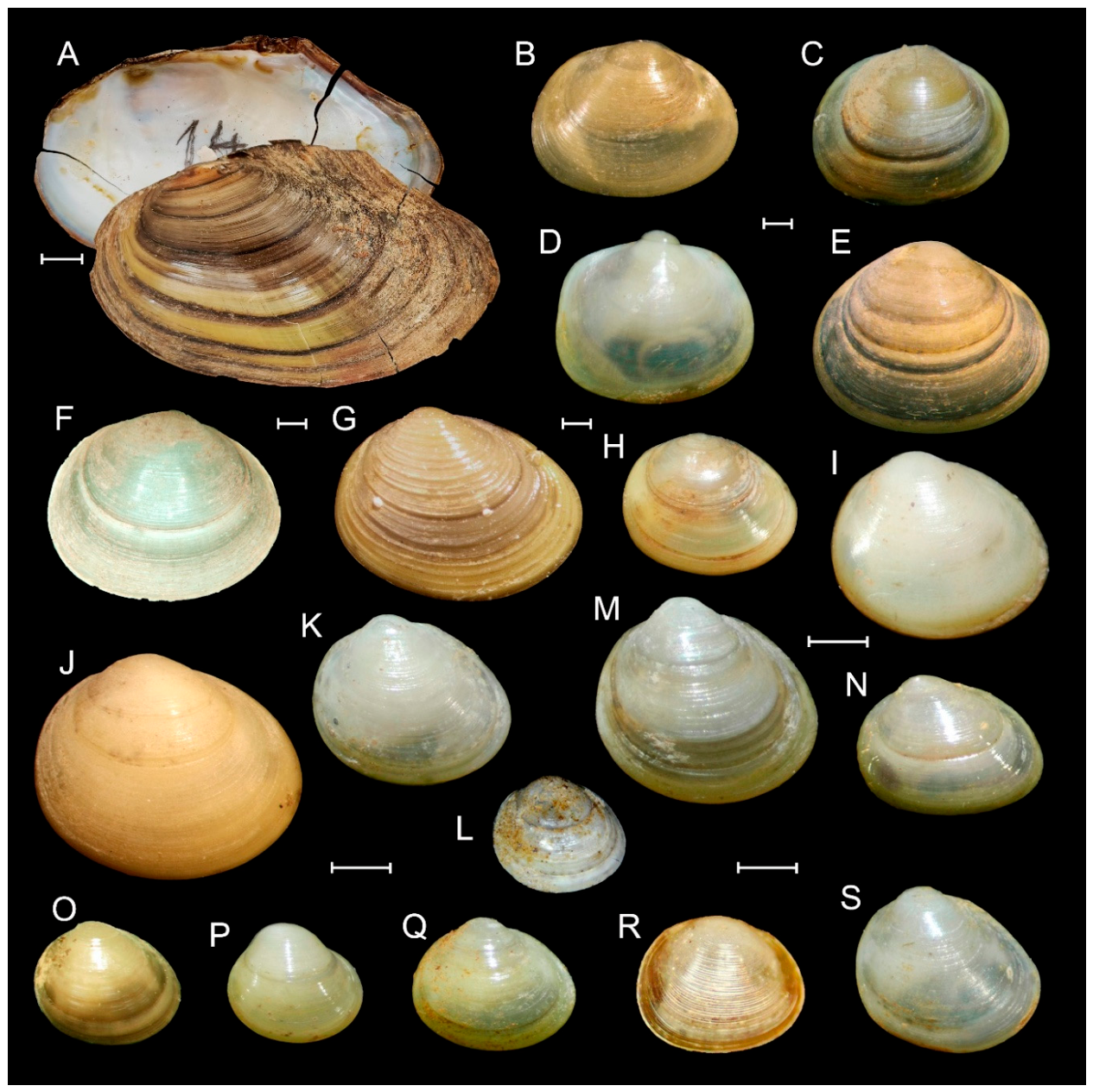
Figure 3.
Freshwater Gastropoda of the studied area. (A) Valvata frigida (Lake Rangetur, 25.08.2021); (B) Ampullaceana balthica (Lake Tursuntsky Tuman, 11.07.2023); (C) Ampullaceana dipkunensis (Lake Tursuntsky Tuman, 11.07.2023); (D) Radix auricularia (Lake Tursuntsky Tuman, 11.07.2023); (E) Gyraulus albus (Lake Pontur, 24.08.2021); (F) Gyraulus acronicus (a floodplain waterbody near channel from the Vorya River, 08.07.2023); (G) Gyraulus parvus (Konda River, near Sovetskiy Town, 27.08.2021); (H) Gyraulus stromi (a left-bank floodplain waterbody No. 1 near the Akh River, 05.07.2023). Scale bars: 1 mm (A, E-H), 5 mm (B-D).
Figure 3.
Freshwater Gastropoda of the studied area. (A) Valvata frigida (Lake Rangetur, 25.08.2021); (B) Ampullaceana balthica (Lake Tursuntsky Tuman, 11.07.2023); (C) Ampullaceana dipkunensis (Lake Tursuntsky Tuman, 11.07.2023); (D) Radix auricularia (Lake Tursuntsky Tuman, 11.07.2023); (E) Gyraulus albus (Lake Pontur, 24.08.2021); (F) Gyraulus acronicus (a floodplain waterbody near channel from the Vorya River, 08.07.2023); (G) Gyraulus parvus (Konda River, near Sovetskiy Town, 27.08.2021); (H) Gyraulus stromi (a left-bank floodplain waterbody No. 1 near the Akh River, 05.07.2023). Scale bars: 1 mm (A, E-H), 5 mm (B-D).
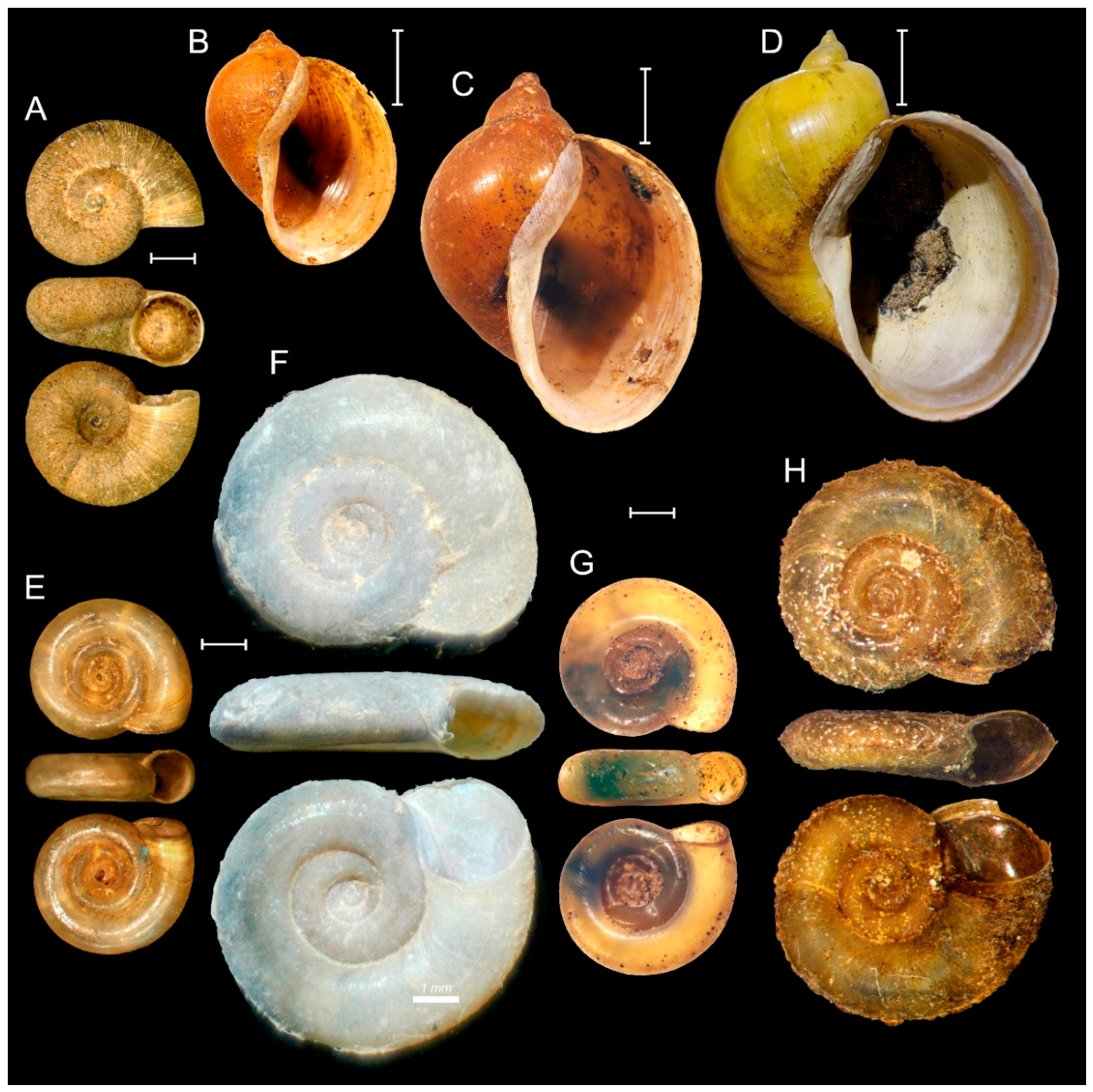
Figure 4.
Species accumulation curve (rarefaction by samples; red) constructed based on the complete dataset on freshwater mollusk occurrences in various biotopes (N = 101) of the upper reaches of the Konda River basin. Blue curves are the boundaries of the 95% confidence interval.
Figure 4.
Species accumulation curve (rarefaction by samples; red) constructed based on the complete dataset on freshwater mollusk occurrences in various biotopes (N = 101) of the upper reaches of the Konda River basin. Blue curves are the boundaries of the 95% confidence interval.
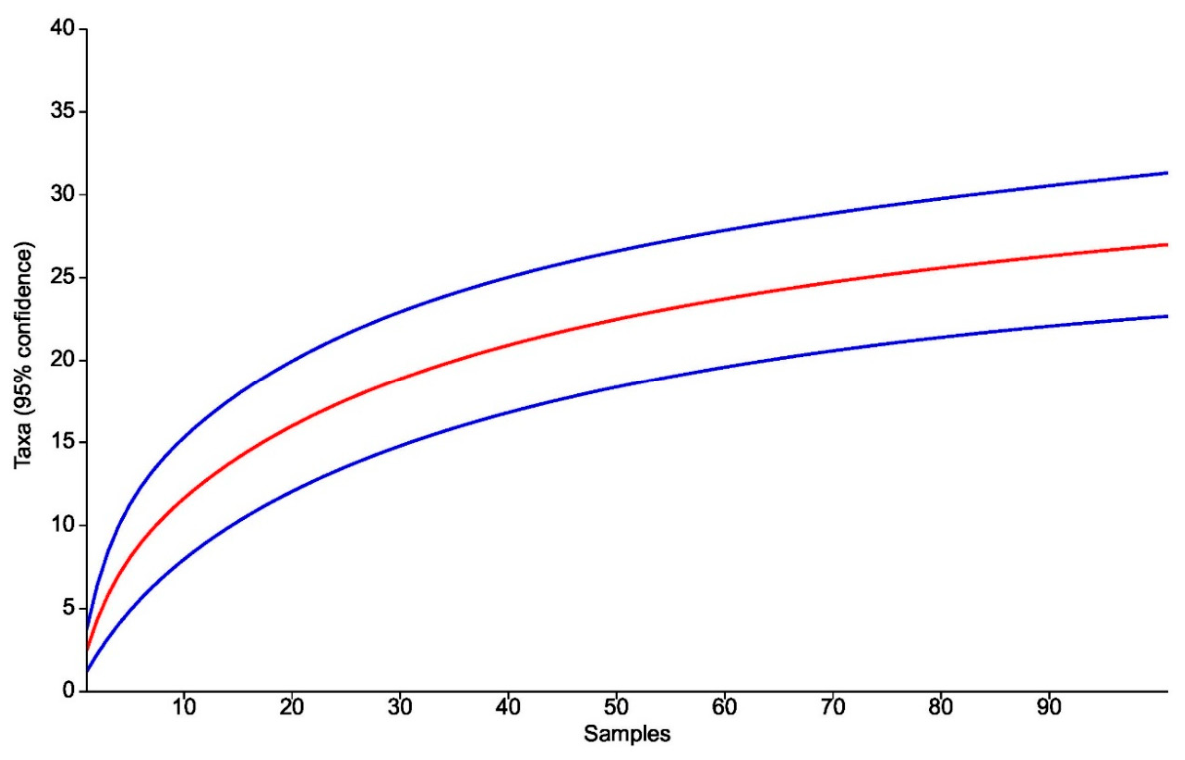
Figure 5.
Median haplotype networks constructed from 16S rRNA gene sequences for the sphaeriid clams. The circle size is proportional to the number of identical sequences. Black dots on the lines represent hypothetical haplotypes. The numbers on the lines represent the number of nucleotide substitutions between haplotypes.
Figure 5.
Median haplotype networks constructed from 16S rRNA gene sequences for the sphaeriid clams. The circle size is proportional to the number of identical sequences. Black dots on the lines represent hypothetical haplotypes. The numbers on the lines represent the number of nucleotide substitutions between haplotypes.
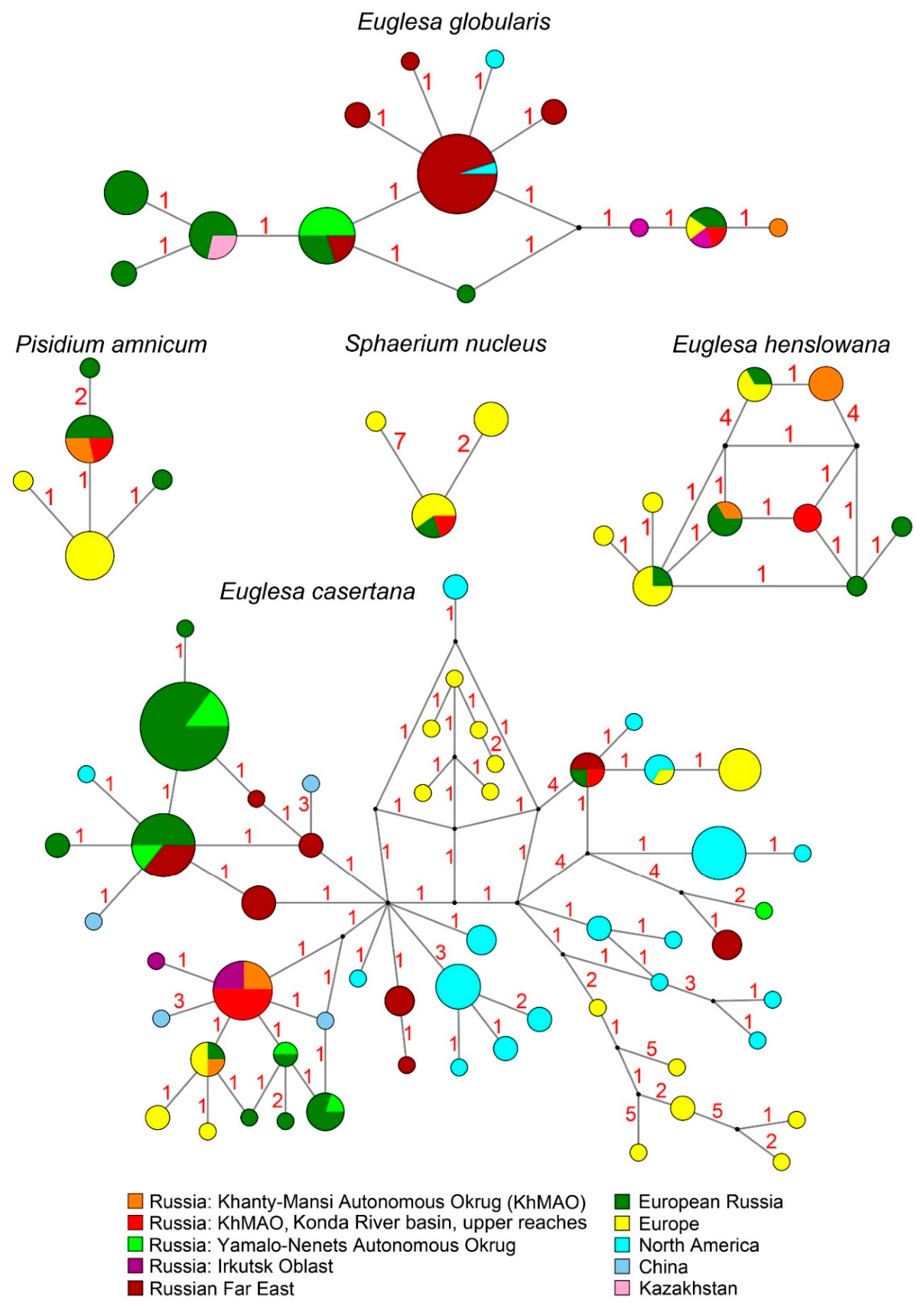
Figure 6.
Ordination diagram of freshwater mollusk species and their habitats in the upper reaches of the Konda River basin. Dots and polygons represent different habitat groups: red – Konda River; orange – tributaries of the Konda River; yellow – subordinate water bodies (backwaters, oxbows, channels); green – floodplain water bodies; violet – large lakes. The association of certain mollusk species with environmental factors is shown by blue codes, each consisting of the first three letters of the genus name and the first three letters of the species name. Environmental factors are shown as vectors and labeled: sand, macrophytes, detritus, and silt indicate their proportion in the substrate from which the mollusks were collected, respectively; current—presence and velocity of water flow; Na+ & K+ – cation concentration; Cl- & SO42- – anion concentration; MCPP – mass concentration of petroleum products; color – water color; HM – total concentration of heavy metals; pH – hydrogen index of natural waters; depth – depth at the mollusk collection site; EC – specific electrical conductivity (for further details see Supplementary materials, Table S1, Table S2).
Figure 6.
Ordination diagram of freshwater mollusk species and their habitats in the upper reaches of the Konda River basin. Dots and polygons represent different habitat groups: red – Konda River; orange – tributaries of the Konda River; yellow – subordinate water bodies (backwaters, oxbows, channels); green – floodplain water bodies; violet – large lakes. The association of certain mollusk species with environmental factors is shown by blue codes, each consisting of the first three letters of the genus name and the first three letters of the species name. Environmental factors are shown as vectors and labeled: sand, macrophytes, detritus, and silt indicate their proportion in the substrate from which the mollusks were collected, respectively; current—presence and velocity of water flow; Na+ & K+ – cation concentration; Cl- & SO42- – anion concentration; MCPP – mass concentration of petroleum products; color – water color; HM – total concentration of heavy metals; pH – hydrogen index of natural waters; depth – depth at the mollusk collection site; EC – specific electrical conductivity (for further details see Supplementary materials, Table S1, Table S2).
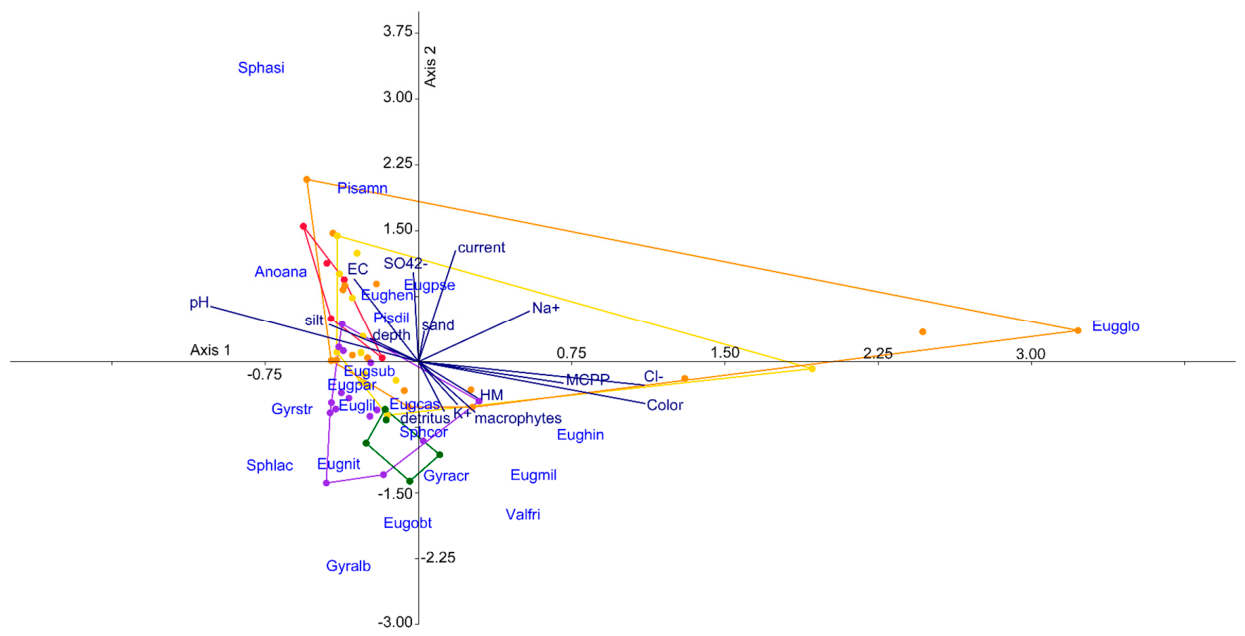
Figure 7.
Examples of habitat types of freshwater mollusks in the upper reaches of the Konda River basin: (A) Lotic habitats – Konda River near the mouth of the Akh River; (B) Lentic habitats – Lake Rangetur; (C) Marshy habitats – an unnamed water body in Sovetskiy town; (D) Habitats with extreme conditions – Vershina River, in close proximity to oil fields. Photos: Maxim V. Vinarski (A) and Evgeniy S. Babushkin (B–D).
Figure 7.
Examples of habitat types of freshwater mollusks in the upper reaches of the Konda River basin: (A) Lotic habitats – Konda River near the mouth of the Akh River; (B) Lentic habitats – Lake Rangetur; (C) Marshy habitats – an unnamed water body in Sovetskiy town; (D) Habitats with extreme conditions – Vershina River, in close proximity to oil fields. Photos: Maxim V. Vinarski (A) and Evgeniy S. Babushkin (B–D).
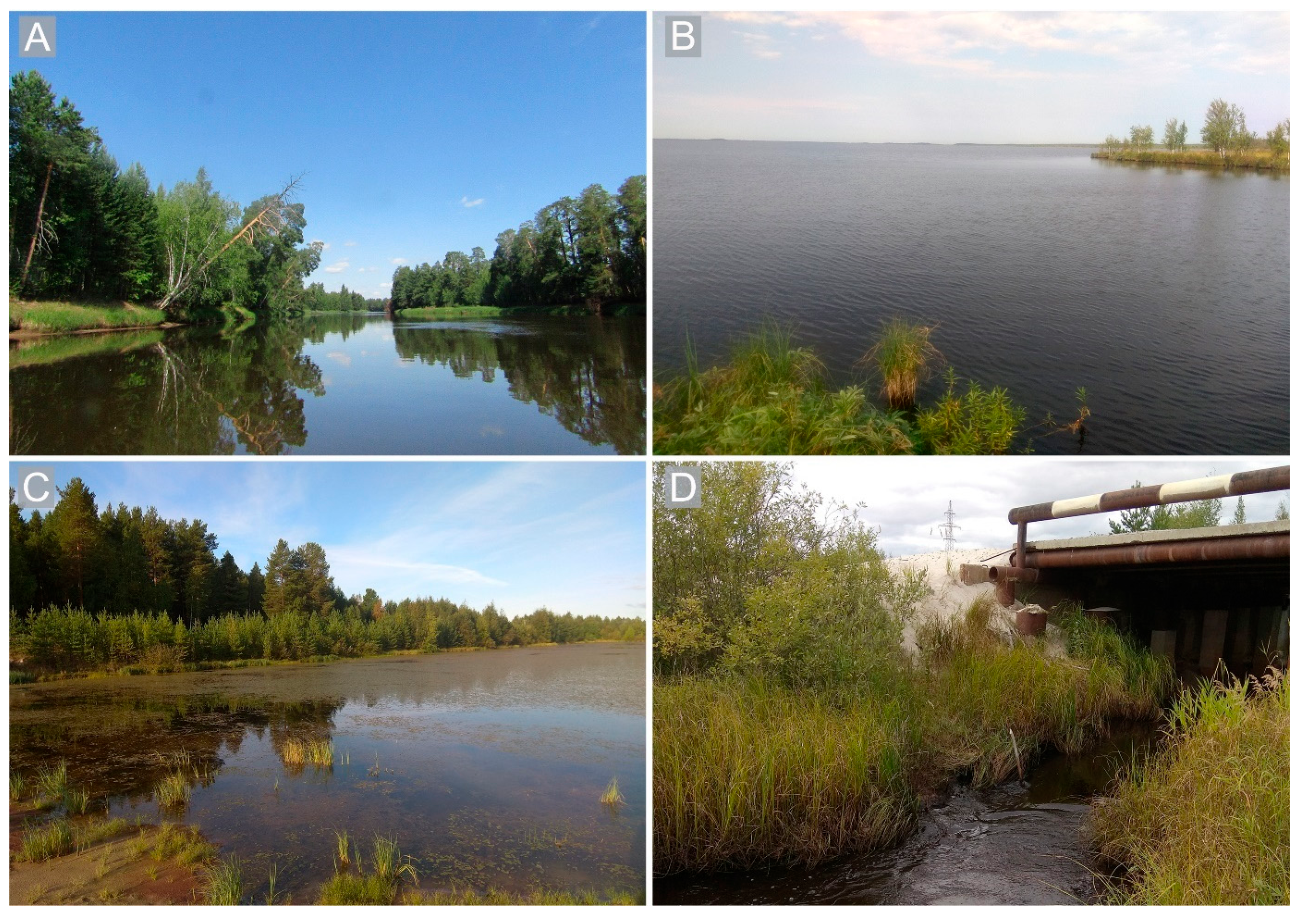

Table 1.
Taxonomic structure and species composition of freshwater malacofauna in the upper reaches of the Konda River basin.
Table 1.
Taxonomic structure and species composition of freshwater malacofauna in the upper reaches of the Konda River basin.
| Class | Family | Genus | Species |
|---|---|---|---|
| Bivalvia | Unionidae | Anodonta | A. anatina (Linnaeus, 1758) |
| Sphaeriidae | Sphaerium |
Sph. asiaticum (E. von Martens, 1864), Sph. corneum (Linnaeus, 1758), Sph. lacustre (O. F. Müller, 1774), Sph. nucleus (Studer, 1820), Sph. ovale (A. Férussac, 1807) |
|
| Pisidium |
P. amnicum (O. F. Müller, 1774), P. dilatatum Westerlund, 1897 |
||
| Euglesa |
E. casertana (Poli, 1791), E. globularis (Clessin, 1873), E. henslowana (Sheppard, 1825), E. hinzi (Kuiper, 1975), E. lilljeborgii (Clessin in Esmark & Hoyer, 1886), E. milium (Held, 1836), E. nitida (Jenyns, 1832), E. obtusalis (Lamarck, 1818), E. parvula (Westerlund, 1873), E. pseudosphaerium (Ehrmann, 1933), E. subtruncata (Malm, 1855) |
||
| Gastropoda | Valvatidae | Valvata | V. frigida Westerlund, 1873 |
| Lymnaeidae | Ampullaceana |
A. balthica (Linnaeus, 1758), A. dipkunensis (Gundrizer & Starobogatov, 1979) |
|
| Radix | R. auricularia (Linnaeus, 1758) | ||
| Planorbidae | Gyraulus |
G. albus (O. F. Müller, 1774), G. acronicus (J. B. Férussac, 1807), G. parvus (Say, 1817), G. stromi (Westerlund, 1881) |
|
| In total | |||
| 2 | 5 | 8 | 27 |
Table 2.
Results of CCA for environmental variables based on the species occurrence matrix in habitats of the upper Konda basin, canonical coordinates (values most correlated with axes 1 and/or 2 are highlighted in color; ≥0.30).
Table 2.
Results of CCA for environmental variables based on the species occurrence matrix in habitats of the upper Konda basin, canonical coordinates (values most correlated with axes 1 and/or 2 are highlighted in color; ≥0.30).
| Environmental Factor | Axis 1 | Axis 2 |
|---|---|---|
| Depth | -0,11 | 0,13 |
| Current | 0,09 | 0,64 |
| Detritus | 0,10 | -0,30 |
| Mud | -0,22 | 0,21 |
| Sand | 0,02 | 0,18 |
| Macrophytes | 0,04 | -0,22 |
| Conductivity | -0,16 | 0,48 |
| Color of water | 0,55 | -0,23 |
| Petroleum products | 0,35 | -0,11 |
| рН | -0,51 | 0,32 |
| K+ | 0,10 | -0,25 |
| Na+ | 0,27 | 0,29 |
| SO42- | -0,02 | 0,51 |
| Cl- | 0,55 | -0,14 |
| Heavy metals | 0,15 | -0,21 |
Table 3.
Results of the SIMPER test.
| Taxon (Abbreviated) | Averadge Dissimilarity | Contribution, % | Cumulative Contribution, % | Mean 3 | Mean 4 | Mean 2 | Mean 1 |
|---|---|---|---|---|---|---|---|
| Euglil | 15,8 | 18,2 | 18,2 | 4,2 | 1,8 | 8,4 | 1,4 |
| Pisamn | 13,0 | 15,0 | 33,2 | 0,2 | 0,3 | 0,2 | 5,7 |
| Eugcas | 12,9 | 14,8 | 48,0 | 14,0 | 2,8 | 2,0 | 1,9 |
| Eugglo | 10,6 | 12,3 | 60,3 | 1,6 | 19,5 | 0,0 | 0,0 |
| Eughen | 9,8 | 11,3 | 71,6 | 0,0 | 0,0 | 0,7 | 4,7 |
| Eugsub | 7,3 | 8,4 | 80,0 | 2,0 | 0,0 | 1,8 | 2,0 |
| Valfri | 2,7 | 3,1 | 83,1 | 2,4 | 0,0 | 0,3 | 0,1 |
| Sphcor | 2,4 | 2,7 | 85,9 | 0,2 | 0,0 | 0,8 | 0,2 |
| Sphasi | 1,8 | 2,1 | 87,9 | 0,0 | 0,0 | 0,0 | 0,8 |
| Gyracr | 1,6 | 1,9 | 89,8 | 0,0 | 0,0 | 0,7 | 0,1 |
| Eugpar | 1,6 | 1,8 | 91,7 | 0,4 | 0,0 | 0,5 | 0,2 |
| Gyralb | 1,2 | 1,4 | 93,0 | 0,0 | 0,0 | 0,6 | 0,0 |
| Pisdil | 1,1 | 1,3 | 94,3 | 0,0 | 0,0 | 0,0 | 0,5 |
| Eugmil | 1,1 | 1,3 | 95,6 | 1,2 | 0,0 | 0,1 | 0,0 |
| Anoana | 0,9 | 1,1 | 96,7 | 0,0 | 0,0 | 0,2 | 0,4 |
| Eugnit | 0,9 | 1,1 | 97,7 | 0,8 | 0,0 | 0,1 | 0,1 |
| Eughin | 0,7 | 0,8 | 98,5 | 0,4 | 0,3 | 0,1 | 0,0 |
| Eugobt | 0,5 | 0,6 | 99,1 | 0,0 | 0,0 | 0,2 | 0,0 |
| Gyrstr | 0,4 | 0,4 | 99,5 | 0,0 | 0,0 | 0,1 | 0,0 |
| Eugpse | 0,3 | 0,4 | 99,9 | 0,0 | 0,0 | 0,1 | 0,1 |
| Sphlac | 0,1 | 0,1 | 100,0 | 0,0 | 0,0 | 0,1 | 0,0 |
Disclaimer/Publisher’s Note: The statements, opinions and data contained in all publications are solely those of the individual author(s) and contributor(s) and not of MDPI and/or the editor(s). MDPI and/or the editor(s) disclaim responsibility for any injury to people or property resulting from any ideas, methods, instructions or products referred to in the content. |
© 2026 by the authors. Licensee MDPI, Basel, Switzerland. This article is an open access article distributed under the terms and conditions of the Creative Commons Attribution (CC BY) license (http://creativecommons.org/licenses/by/4.0/).
Copyright: This open access article is published under a Creative Commons CC BY 4.0 license, which permit the free download, distribution, and reuse, provided that the author and preprint are cited in any reuse.


