
Submitted:
09 July 2026
Posted:
10 July 2026
You are already at the latest version
Abstract
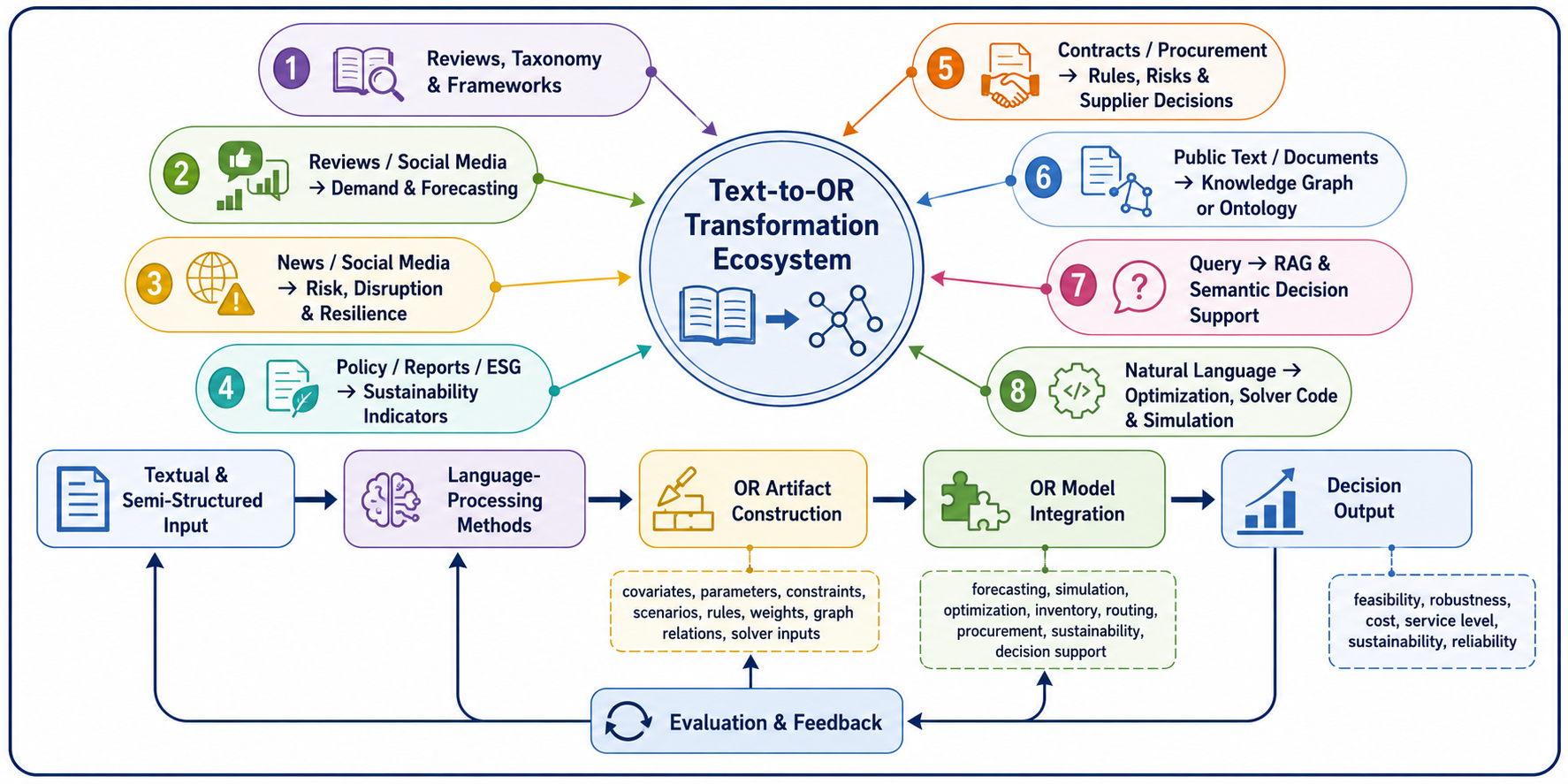
Traditional Operations Research (OR) models incorporate structured numerical inputs, such as demand parameters, costs, emissions, processing times, facility and transport mode capacities, to simulate stochastic behaviors and optimize objective-functions. There is however a vast number of OR-relevant parameters that can be derived from textual and semi-structured sources, such product reviews, social media, news, contracts, procurement documents, ESG reports, policy texts, patents, maintenance records, technical manuals and others. Under this context, the purpose of this study is to develop an artifact and parameter-centered framework for explaining how such textual inputs are transformed into model-ready OR components and incorporated into forecasting, simulation, optimization, logistics, inventory, sustainability, procurement, network analysis, and decision-support models. The main insights derived from the employed framework reveal that: (i) the OR value of textual information lies not in text analysis itself, but in its transformation into validated model-ready artifacts, such as covariates, parameters, constraints, scenarios, rules, weights, graph relations, simulation triggers, and solver inputs; (ii) different textual sources and language-processing methods can generate distinct OR artifacts that enter models through different integration mechanisms, including covariate augmentation, parameter updating, constraint generation, scenario definition, objective-function weighting, graph construction, retrieval support, and solver-code generation; (iii) the same text-derived artifact may play different roles across OR model types, for example a disruption event may update a simulation scenario, increase a lead-time parameter, remove a routing arc, or modify a supplier-risk penalty; and (iv) evaluation must extend beyond NLP accuracy to include artifact validity, parameter validity, model feasibility, mathematical consistency, solver correctness, deployment reliability, and downstream decision usefulness.
Keywords:
operations research
; natural language processing
; large language models
; retrieval-augmented generation
; knowledge graphs
; text mining
; text-to-optimization
Copyright: This open access article is published under a Creative Commons CC BY 4.0 license, which permit the free download, distribution, and reuse, provided that the author and preprint are cited in any reuse.


