

Submitted:
09 July 2026
Posted:
10 July 2026
You are already at the latest version
Abstract
Operational technology (OT) analytics increasingly requires operational meaning without granting enterprise systems direct visibility into, or control authority over, industrial control assets. Conventional telemetry patterns move raw tags, historian data, or protocol messages into enterprise environments, creating reusable operational visibility even when channels are encrypted or nominally read-only. This article proposes Ephemeral Semantic Telemetry (EST), a learning-mediated, commandless data exchange model in which approved OT observations are transformed into temporary, task-bound semantic languages. The model is formalized using information-bottleneck, finite-time inference, transferability, reconstruction-risk, and command-expressivity conditions. A synthetic industrial telemetry experiment compares raw telemetry, stable semantic telemetry, and EST across authorized task utility, unauthorized inference, raw-data reconstruction, inter-batch transferability, and semantic leakage proxies. Results indicate that EST preserved high authorized task performance while reducing unauthorized transfer accuracy to chance-level, increasing reconstruction error, and reducing inter-batch transferability. EST is not a replacement for cryptography, segmentation, or one-way transfer; rather, it introduces semantic exposure reduction: sharing approved operational meaning while limiting raw operational visibility and preventing command-capable representation.
Keywords:
operational technology
; cyber-physical systems
; semantic communications
; artificial intelligence
; data minimization
; industrial analytics
; cybersecurity
; privacy
; commandless telemetry
1. Introduction
Operational technology (OT) environments differ from ordinary enterprise information technology environments because they monitor or control physical processes. NIST Special Publication (SP) 800-82 Revision 3 defines OT broadly as programmable systems and devices that interact with the physical environment by monitoring or controlling devices, processes, and events, and emphasizes that OT security must preserve safety, availability, reliability, and process integrity [1]. These constraints make industrial data exchange a distinct cybersecurity and privacy problem. The issue is not only whether data can be encrypted or transported securely; it is also whether an external consumer should receive reusable operational visibility into live control-system behavior.
Industrial organizations increasingly want OT data for analytics, dashboards, predictive maintenance, energy reporting, compliance, and artificial intelligence (AI). The Cybersecurity and Infrastructure Security Agency (CISA) and international partners have responded to the growing pressure for OT connectivity by issuing secure connectivity principles for OT environments [2]. Existing publish/subscribe technologies such as OPC UA PubSub and Eclipse Sparkplug support scalable industrial telemetry distribution, but they remain communication and integration patterns rather than semantic minimization mechanisms [3,4]. A system can be publish/subscribe, encrypted, and logically read-only while still distributing raw tag structures, operational ranges, timing relationships, and process-state visibility that downstream consumers may not need.
This paper introduces Ephemeral Semantic Telemetry (EST), a learning-mediated data exchange model for OT analytics. EST is built around the idea that many enterprise consumers do not need raw telemetry. They need approved analytic meaning, such as an equipment health class, anomaly state, maintenance priority, or energy-efficiency trend. EST therefore reframes OT data exchange as a semantic minimization problem: how can an OT environment disclose enough meaning for an approved task while reducing disclosure of raw telemetry, stable tag mappings, reusable process structure, and command-capable language?
The proposed model is not cryptography in the conventional sense. It does not claim that a learned or unfamiliar language is inherently secure, nor does it replace encryption, digital signatures, segmentation, one-way transfer, or access control. Instead, EST adds a semantic exposure-reduction layer above those controls. The sender creates a temporary, task-bound semantic language for each batch; an authorized receiver infers the approved output using limited context; the language is discarded; and the next batch uses a different mapping. The security contribution is not secrecy alone. The contribution is semantic exposure reduction: limiting what external systems can meaningfully learn and reuse even after telemetry has left the OT boundary.
This article makes four contributions. First, it formalizes EST as a task-bound semantic communication model for OT data exchange. Second, it defines measurable conditions for authorized utility, semantic leakage, inter-batch transferability, finite-time inferability, and commandlessness. Third, it presents a synthetic industrial telemetry evaluation comparing EST with raw and stable semantic telemetry baselines. Fourth, it identifies suitable and unsuitable industrial analytics use cases for the model.
1.1. Research Questions and Design Propositions
The study is guided by four research questions. RQ1 asks how OT telemetry can be transformed into temporary semantic languages that support approved analytics without exposing reusable tag structures or command-capable protocol access. RQ2 asks whether an authorized receiver can infer task-relevant meaning more accurately than an unauthorized receiver within the batch lifetime. RQ3 asks how inter-batch language rotation affects transferability from one telemetry language to another. RQ4 asks how commandlessness can be defined as a formal property of the message grammar.
The corresponding design propositions are: DP1, task-bound semantic encoding can preserve authorized analytic utility while reducing raw-data exposure; DP2, rotating ephemeral languages can reduce the usefulness of decoders learned from prior batches; DP3, progressive context can improve authorized inference without disclosing raw OT telemetry; and DP4, a telemetry grammar with no command-capable message types can be defined so that command expressivity is zero by construction.
2. Background and Related Work
2.1. OT Connectivity and the Control-Data Boundary
OT connectivity creates a control-data boundary problem. Enterprise consumers may want data for reporting or analytics, while OT operators must prevent the data path from becoming a control path. Industrial cyber-physical systems have become more interconnected, increasing the attack surface and weakening the historic assumption that operational systems remain isolated [5]. Secure-connectivity guidance therefore emphasizes deliberately designed and managed connectivity rather than opportunistic integration [2].
OPC UA PubSub and MQTT/Sparkplug are important because they support message-oriented industrial data distribution. OPC UA PubSub defines publishers, subscribers, and broker-based messaging concepts [3], while Sparkplug standardizes how MQTT clients represent industrial data in MQTT infrastructures [4]. These patterns are useful, but they do not inherently decide which operational meaning should be released, how much raw process structure should be exposed, or whether downstream AI systems should receive raw values rather than task-specific outputs. EST addresses that layer.
2.2. Semantic and Task-Oriented Communication
Semantic communication research shifts attention from bit-perfect reproduction to transmission of meaning. Recent surveys define semantic communication as a paradigm in which meaningful information is extracted from the source and delivered to the receiver in ways that are relevant to the receiver task [6,7]. Deep-learning-enabled semantic communication systems such as DeepSC demonstrate the broader principle that learned encoders and decoders can optimize for semantic recovery rather than conventional symbol recovery [8].
Task-oriented communication is especially relevant to OT analytics because the receiver often needs an inference result rather than a raw data stream. Shao et al. formalized task-oriented edge inference using an information-bottleneck approach, targeting downstream inference rather than full data reconstruction [9]. The original information-bottleneck method defines a compression objective that preserves information about a relevant variable while discarding irrelevant information from the source [10]. EST adapts this logic to OT telemetry: preserve information about the approved analytic task while suppressing reusable information about raw operational data.
2.3. Emergent and Learned Communication
The idea of temporary machine-interpretable languages also draws from emergent communication and adversarial neural communication. Emergent-language research examines how artificial agents develop communication systems to accomplish shared goals, including how such systems can be evaluated [11]. Adversarial neural cryptography has shown that neural networks can learn communication transformations under a secrecy objective, although such work should be treated as inspiration rather than a substitute for conventional cryptographic assurance [12]. EST uses learned communication for semantic minimization, not as a replacement for cryptography.
3. Materials and Methods
3.1. Research Design
This article uses design science, mathematical modeling, and a synthetic computational evaluation. Design science is appropriate because the contribution is an artifact: a new telemetry exchange model and associated evaluation criteria. The mathematical model defines falsifiable properties. The computational evaluation demonstrates feasibility under controlled synthetic conditions and allows comparison with baseline telemetry patterns without connecting to live OT equipment.
No human participants, private operational logs, proprietary industrial data, or live control systems were used. Synthetic telemetry was generated to resemble multivariate industrial signals such as pressure, flow, motor current, vibration, temperature, and alarm state. The use of synthetic data is appropriate for early-stage evaluation because the goal is to test the communication model, not to claim production performance in a particular plant.
During preparation of this manuscript, generative AI assistance was used for drafting support, literature organization, formatting assistance, and code-generation assistance. The author reviewed, edited, verified, and approved the final manuscript, simulation logic, citations, interpretations, and conclusions and remains responsible for all content.
3.2. Formal Model
Let denote raw OT telemetry for batch b, where each observation contains d standardized process features. Let denote an approved analytic task, such as equipment health classification or anomaly scoring. Let denote the approved output. EST does not attempt to transmit . It attempts to transmit enough information for an authorized receiver to infer while limiting information about beyond that task.
For each batch b, the sender generates a temporary semantic language parameter . The encoder maps raw telemetry into an ephemeral representation :
The receiver may receive limited context , where k denotes the context level. The authorized receiver learns a temporary decoder and predicts the approved output:
The utility condition requires the authorized receiver to achieve acceptable task error:
The exposure condition requires limited raw-data leakage beyond the approved task. In information-theoretic terms, the conditional information about raw telemetry remaining in the transmitted representation should be bounded:
The model also requires low inter-batch transferability. If is a decoder learned for batch b, then applying to batch should perform near chance after adjusting for same-batch performance. The transferability coefficient is defined as:
A good ephemeral telemetry language has close to zero. Finally, commandlessness is a grammar property. Let be the language generated by EST and be the set of command-capable payloads, including writes, setpoints, alarm acknowledgments, configuration changes, browsing requests, and remote sessions. EST requires:
This condition does not mean the system is invulnerable. It means the telemetry grammar should be incapable of expressing command authority. EST can therefore complement cryptographic confidentiality and integrity mechanisms while addressing a different problem: how much operational meaning is exposed to external consumers.
Figure 1.
Ephemeral Semantic Telemetry lifecycle. Approved OT observations are transformed under a task-bound authority contract into a temporary semantic language. The receiver infers only the approved analytic output, and the language is discarded after the batch.
Figure 1.
Ephemeral Semantic Telemetry lifecycle. Approved OT observations are transformed under a task-bound authority contract into a temporary semantic language. The receiver infers only the approved analytic output, and the language is discarded after the batch.
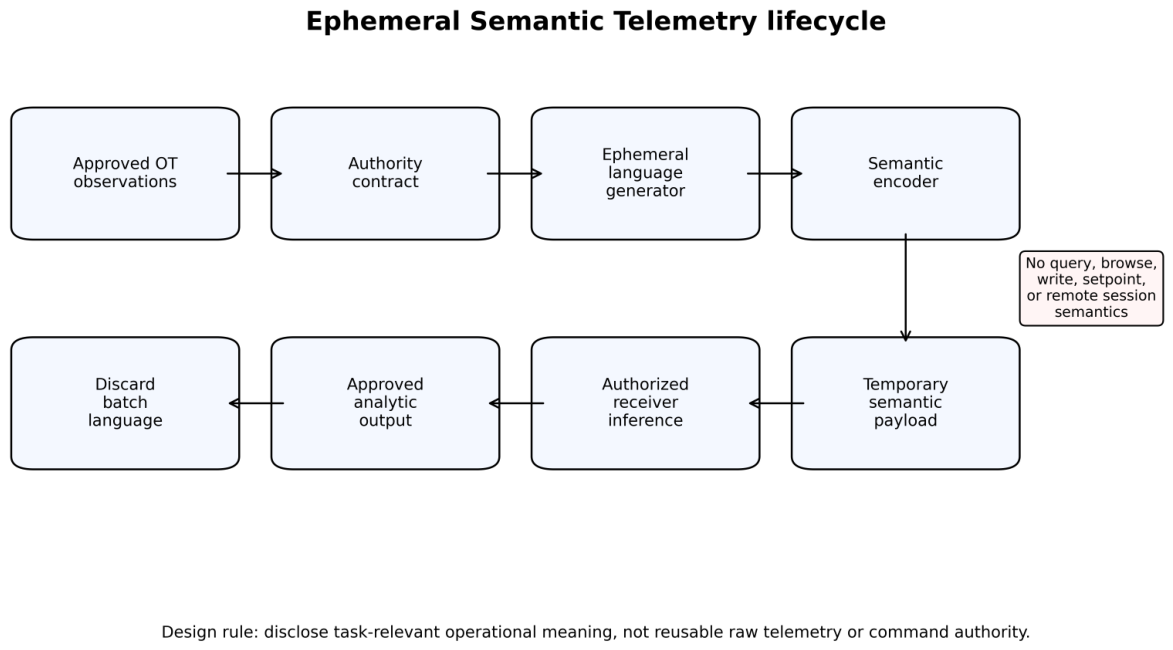
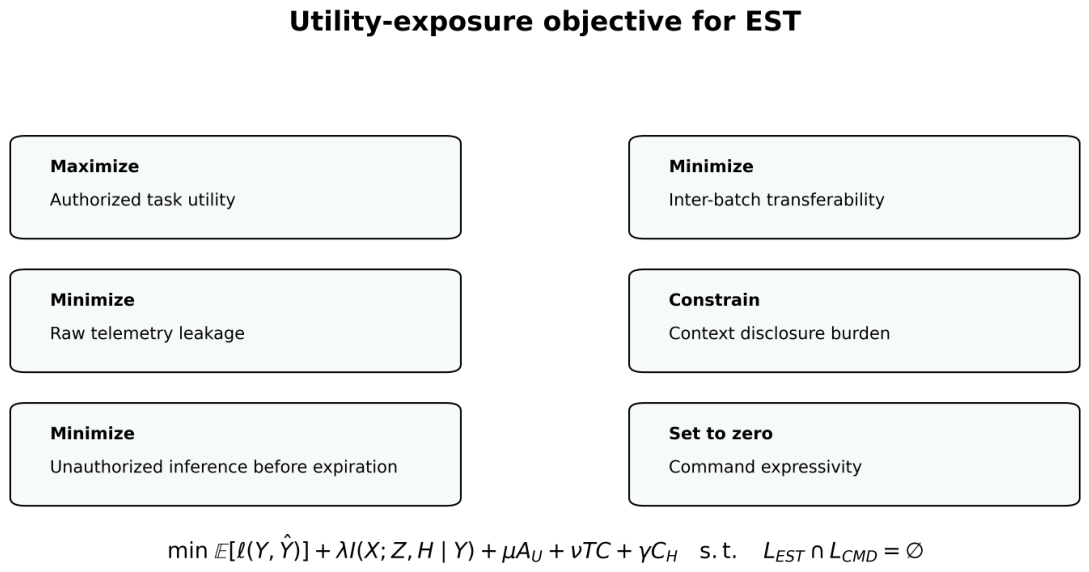
Figure 2.
Utility and exposure model for Ephemeral Semantic Telemetry. The design goal is high authorized task inference with bounded raw-data leakage, low unauthorized inference before expiration, low language transferability, acceptable context burden, and zero command expressivity.
Figure 2.
Utility and exposure model for Ephemeral Semantic Telemetry. The design goal is high authorized task inference with bounded raw-data leakage, low unauthorized inference before expiration, low language transferability, acceptable context burden, and zero command expressivity.
3.3. Synthetic Evaluation Design
A synthetic experiment was implemented in Python 3.13 using NumPy, pandas, scikit-learn, and Matplotlib. Twenty-four batches of OT-like telemetry were generated. Each batch contained 360 observations with six standardized features representing pressure, flow, current, vibration, temperature, and alarm state. Observations were assigned to three process states: normal, degraded, and fault-risk. The approved task was balanced classification of the process state.
Three communication conditions were compared. The raw telemetry condition exposed standardized process features directly. The stable semantic condition transformed telemetry into a fixed latent representation that remained reusable across batches. The EST condition generated a new random nonlinear semantic mapping for each batch and required the authorized receiver to learn the current batch language from limited context anchors. Unauthorized receivers were represented by models trained on prior-batch language-context pairs and applied to the new batch without access to the current language context.
The evaluation used five metrics. Authorized task accuracy measured balanced classification accuracy for the approved receiver. Unauthorized inference accuracy measured whether a prior-language receiver could classify the new batch. Raw reconstruction error measured normalized root mean square error (NRMSE) when a model trained on prior latent/raw pairs attempted to reconstruct current raw telemetry. Transferability coefficient measured whether a decoder learned on one language generalized to the next. Semantic leakage proxy measured reconstructable variance in raw telemetry from the transmitted representation under the attacker model.

Table 1.
Evaluation metrics for Ephemeral Semantic Telemetry.
| Metric | Definition | Interpretation |
|---|---|---|
| Authorized task accuracy | Balanced accuracy for the approved analytic task using current-batch context | Higher values indicate task utility. |
| Unauthorized inference accuracy | Balanced accuracy for a receiver trained on prior-batch language and applied to the current batch | Values near chance indicate low time-limited inferability. |
| Raw reconstruction NRMSE | Normalized reconstruction error for raw telemetry estimated from transmitted representations | Higher values indicate less raw telemetry recovery. |
| Transferability coefficient | Cross-batch accuracy advantage divided by same-batch accuracy advantage | Lower values indicate that learned language does not transfer. |
| Semantic leakage proxy | Variance in raw telemetry reconstructable from the representation under the attacker model | Lower values indicate less raw-data exposure. |
4. Results
4.1. Main Simulation Results
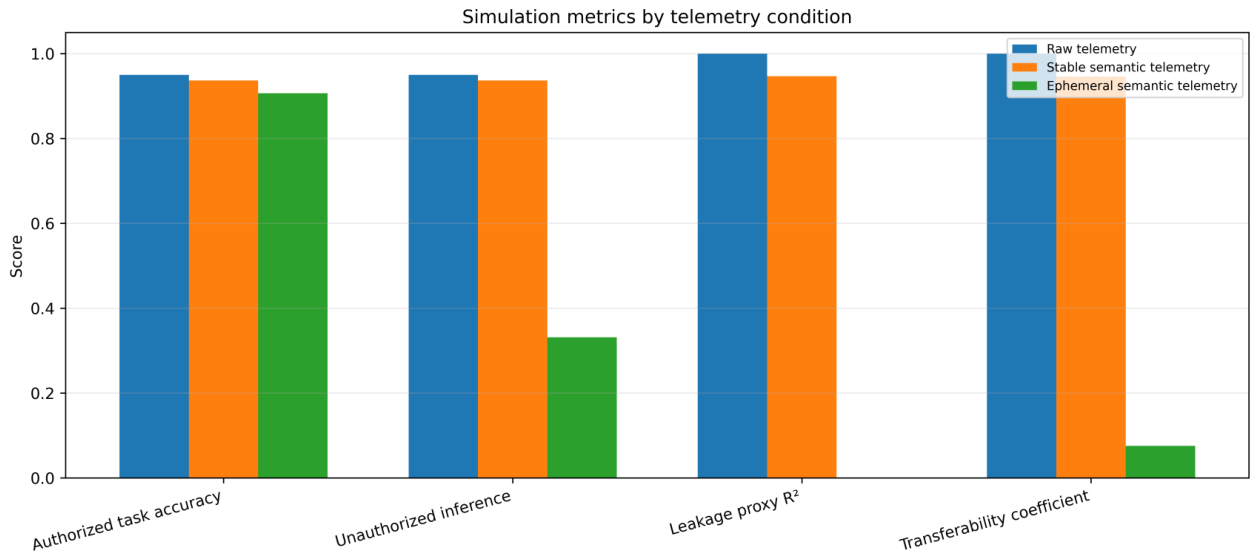
Table 2 summarizes the synthetic evaluation. Raw telemetry preserved task utility but exposed the entire operational data stream. Stable semantic telemetry also preserved task utility, but its fixed representation was reusable across batches and allowed substantial reconstruction of raw telemetry. EST preserved high authorized task accuracy while reducing unauthorized transfer accuracy to chance-level. It also increased raw reconstruction error and sharply reduced inter-batch transferability.
The raw and stable semantic conditions illustrate the central design problem. In both cases, the authorized and unauthorized receivers obtain nearly equivalent utility once the representation is known or stable. EST behaves differently: the authorized receiver learns the current language sufficiently to complete the task, while a prior-language receiver fails to transfer the learned mapping to the next batch. The EST condition therefore trades a modest reduction in authorized balanced accuracy for a large reduction in unauthorized reusable inference and raw reconstruction.
Figure 3.
Simulation metrics comparing raw telemetry, stable semantic telemetry, and Ephemeral Semantic Telemetry. EST preserves authorized task utility while reducing unauthorized transfer accuracy, raw reconstruction, and inter-batch transferability.
Figure 3.
Simulation metrics comparing raw telemetry, stable semantic telemetry, and Ephemeral Semantic Telemetry. EST preserves authorized task utility while reducing unauthorized transfer accuracy, raw reconstruction, and inter-batch transferability.
4.2. Context Burden
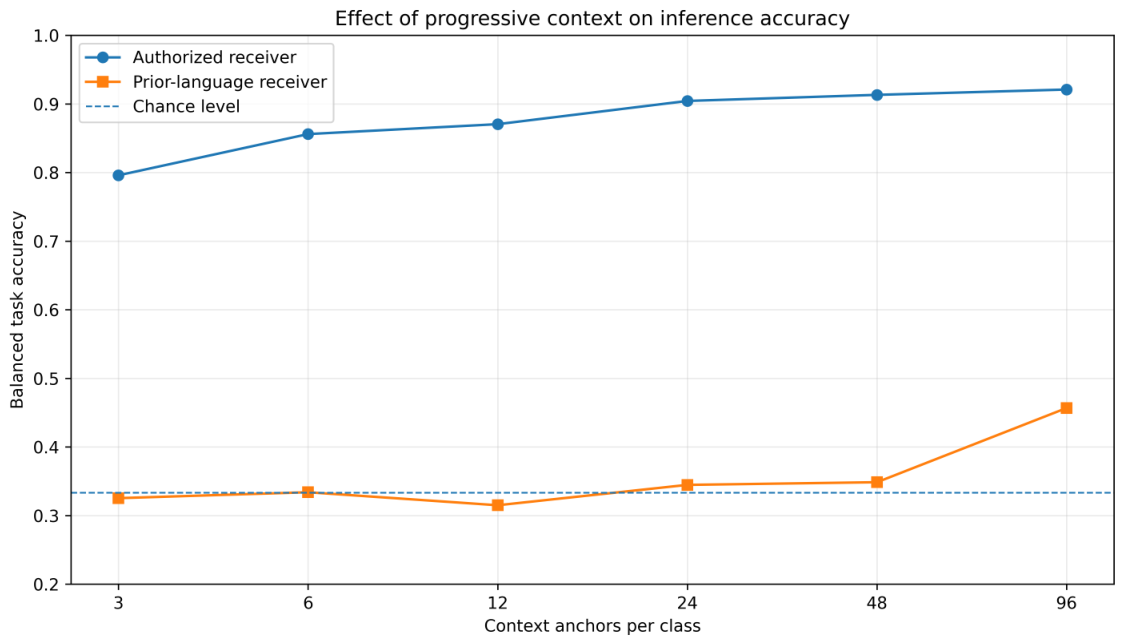
The second evaluation examined progressive context. Context anchors represent limited, task-relevant examples that help an authorized receiver infer the temporary language. As context anchors per class increased, authorized task accuracy improved from 0.796 with three anchors per class to 0.921 with ninety-six anchors per class. Unauthorized prior-language receivers remained close to chance across lower context levels and did not achieve comparable task utility. This result supports the use of controlled context as a tuning mechanism: the sender can reveal only as much context as needed for the approved task.
Table 3.
Context burden and balanced task accuracy.
| Anchors per class | Authorized accuracy | Unauthorized transfer accuracy |
|---|---|---|
| 3 | 0.796 | 0.325 |
| 6 | 0.856 | 0.334 |
| 12 | 0.870 | 0.315 |
| 24 | 0.904 | 0.345 |
| 48 | 0.913 | 0.349 |
| 96 | 0.921 | 0.457 |
Figure 4.
Progressive context learning curve. Current-batch context improves authorized inference, while a prior-language receiver remains close to chance until context becomes broad enough to leak substantial task information.
Figure 4.
Progressive context learning curve. Current-batch context improves authorized inference, while a prior-language receiver remains close to chance until context becomes broad enough to leak substantial task information.
4.3. Commandlessness
The commandlessness property was evaluated analytically rather than experimentally. EST messages were constrained to measurement, state, event, quality, health, summary, metadata, and latent-vector classes. The grammar excluded write, command, setpoint, acknowledge, configure, browse, and remote-session classes. Under the formal language definition in Equation (6), command expressivity is zero if no generated message belongs to the command-capable language. This property is independent of whether the representation is encrypted or whether the receiver can infer the approved task. It is a structural constraint on what the telemetry channel can express.
5. Discussion
5.1. Impact and Utility
The primary utility of EST is not that it outperforms encryption. The primary utility is that it changes what is exposed. Traditional encryption protects data in transit, but authorized consumers eventually receive raw or normalized operational data. EST instead attempts to provide an approved analytic answer while withholding stable tag structures, operational ranges, and reusable process visibility. This is useful for enterprise analytics, AI advisory tools, remote asset health scoring, and low-bandwidth reporting use cases where external systems need operational meaning but not control-system visibility.
The model is best understood as semantic least privilege. Least privilege is usually applied to users, processes, and permissions. EST applies a similar principle to meaning: the receiver should learn only what is necessary for the approved task. The simulation suggests that, under controlled conditions, a temporary semantic representation can preserve authorized task inference while reducing cross-batch reuse and raw reconstruction. The result is not a proof of production security, but it is a falsifiable evidence base for further prototyping.
5.2. Relationship to Existing Industrial Data Patterns
EST does not replace OPC UA PubSub, MQTT/Sparkplug, historians, data diodes, or brokers. Those technologies can serve as transports or infrastructure components. EST operates at a different layer: semantic representation and authorization of meaning. A broker can move data; EST defines how data should be transformed so that the downstream consumer receives a temporary, task-bound representation rather than a stable raw telemetry interface. A data diode can enforce directionality; EST adds a semantic exposure-reduction objective to the content being transferred.
This distinction is important in OT environments because many organizations overdeliver access relative to the business need. A production dashboard does not necessarily need dynamic PLC tag browsing. An energy report does not need a command-capable path. An AI model that produces maintenance recommendations does not need setpoint write authority. EST provides a conceptual and mathematical basis for designing telemetry products that are adequate for analytics but structurally unsuitable for control.
5.3. Suitable and Unsuitable Use Cases
5.4. Security Interpretation
EST should not be presented as a new cryptographic primitive. A learned language can be attacked. A decoder can be stolen. Surrogate models can be trained. Context can leak too much. Therefore, EST must be combined with ordinary cryptographic integrity, confidentiality where required, authentication, key management, network segmentation, and one-way or egress-only transfer designs. Its security contribution is narrower and more measurable: reduce raw-data exposure, reduce the reconnaissance value of intercepted telemetry, reduce cross-batch transferability, and prevent command semantics by grammar design.
Table 4.
Suitable and unsuitable use cases for Ephemeral Semantic Telemetry.
| Use case category | Suitable for EST? | Rationale |
|---|---|---|
| Predictive maintenance scoring | Yes | The consumer needs health state and confidence, not raw tag access. |
| Energy efficiency reporting | Yes | Aggregated semantic trends are sufficient for most business reporting. |
| Anomaly classification | Yes | Task output can be limited to class, confidence, and supporting context. |
| Remote asset health beacons | Yes | Low-bandwidth, one-way, task-bound telemetry is appropriate. |
| Closed-loop process control | No | Requires deterministic, validated control behavior and should not depend on inferred languages. |
| Regulatory metering or custody transfer | Usually no | Auditable raw values may be legally required. |
| Forensic reconstruction | Usually no | Investigators may need original logs and raw telemetry. |
| Remote engineering or configuration | No | Requires privileged OT access and cannot be represented as telemetry. |
The most important security condition is finite-time inferability. The authorized receiver must learn the batch language before expiration, while unauthorized receivers should not. In formal terms, the design target is . If unauthorized receivers achieve useful inference before expiration, the batch language has failed. If authorized receivers cannot infer the task with acceptable accuracy, the technology has failed as an analytics mechanism. These conditions make the model scientifically testable.
5.5. Limitations
This study has several limitations. First, the evaluation uses synthetic telemetry rather than real industrial data. Second, the implemented encoder is a simplified nonlinear random projection rather than a trained production semantic encoder. Third, the attacker model is limited to prior-language transfer and reconstruction from previous paired samples. A stronger adversary with more context, repeated access, compromised models, or side-channel information may perform better. Fourth, information leakage was approximated using reconstruction and variance proxies rather than estimated mutual information. Fifth, the model is unsuitable for deterministic control, safety systems, or applications that require exact raw values.
These limitations define the next research steps. Future work should implement a full EST prototype using public cyber-physical datasets, train task-specific encoders and decoders, evaluate stronger adversary models, compare one-way physical emission against network transport, and quantify semantic leakage using information-theoretic estimators.
6. Conclusions
This article proposed Ephemeral Semantic Telemetry as a learning-mediated, commandless data exchange model for OT analytics. The key contribution is not a new encryption method, but a semantic minimization layer that allows external systems to infer approved operational meaning without receiving reusable raw operational visibility or command-capable protocol access. The formal model defines utility, leakage, transferability, finite-time inferability, and commandlessness conditions. A synthetic evaluation showed that EST can preserve high authorized task performance while reducing unauthorized transfer, raw reconstruction, and inter-batch reuse compared with stable semantic telemetry. These findings support further investigation of EST as a complement to encryption, segmentation, one-way transfer, and secure OT connectivity architectures.
Supplementary Materials
The following supporting information can be downloaded at the website of this paper posted on Preprints.org, Code S1, Python simulation script; Table S1, simulation summary results; Table S2, context learning raw results; Table S3, context learning summary results; Figure 1–4, standalone figure files in PNG and TIFF formats.
Author Contributions
Conceptualization, D.W.; methodology, D.W.; software, D.W.; validation, D.W.; formal analysis, D.W.; investigation, D.W.; resources, D.W.; data curation, D.W.; writing—original draft preparation, D.W.; writing—review and editing, D.W.; visualization, D.W.; project administration, D.W. The author has read and agreed to the published version of the manuscript.
Funding
This research received no external funding.
Institutional Review Board Statement
Not applicable. The study used synthetic telemetry data and did not involve human participants, human data, private organizational data, animals, or live operational technology systems.
Informed Consent Statement
Not applicable.
Data Availability Statement
The synthetic data outputs and Python code used for the computational evaluation are included in the Supplementary Materials. Further inquiries can be directed to the corresponding author.
Acknowledgments
During the preparation of this manuscript, the author used Grammarly for formatting assistance. The author reviewed, edited, verified, and approved the final manuscript and remains responsible for all content, citations, interpretations, and conclusions.
Conflicts of Interest
The author declares no conflict of interest.
Abbreviations
The following abbreviations are used in this manuscript:
| AI | Artificial intelligence |
| CISA | Cybersecurity and Infrastructure Security Agency |
| EST | Ephemeral Semantic Telemetry |
| JCP | Journal of Cybersecurity and Privacy |
| NRMSE | Normalized root mean square error |
| OPC UA | Open Platform Communications Unified Architecture |
| OT | Operational technology |
| PLC | Programmable logic controller |
| TC | Transferability coefficient |
References
- Stouffer, K.; Lightman, S.; Pillitteri, V.; Abrams, M.; Hahn, A. Guide to Operational Technology (OT) Security; NIST Special Publication 800-82 Revision 3; National Institute of Standards and Technology: Gaithersburg, MD, USA, 2023. [Google Scholar] [CrossRef]
- Cybersecurity and Infrastructure Security Agency. Secure Connectivity Principles for Operational Technology (OT). Available online: https://www.cisa.gov/resources-tools/resources/secure-connectivity-principles-operational-technology-ot (accessed on 7 July 2026).
- OPC Foundation. OPC Unified Architecture Part 14: PubSub, PubSub Concepts. Available online: https://reference.opcfoundation.org/specs/OPC-10000-14/5 (accessed on 7 July 2026).
- Eclipse Foundation. Eclipse Sparkplug Specification. Available online: https://sparkplug.eclipse.org/specification/ (accessed on 7 July 2026).
- Kayan, H.; Nunes, M.; Rana, O.; Burnap, P.; Perera, C. Cybersecurity of industrial cyber-physical systems: A review. ACM Comput. Surv. 2022, 54, 1–35. [Google Scholar] [CrossRef]
- Liu, Y.; Wang, X.; Ning, Z.; Zhou, M.C.; Guo, L.; Jedari, B. A survey on semantic communications: Technologies, solutions, applications and challenges. Digit. Commun. Netw. 2024, 10, 528–545. [Google Scholar] [CrossRef]
- Xin, G.; Wang, P.; Lin, K.; Song, Z.; Sun, C.; Chen, X.; Huang, J. Semantic communication: A survey of its theoretical development. Entropy 2024, 26, 102. [Google Scholar] [CrossRef] [PubMed]
- Xie, H.; Qin, Z.; Li, G.Y.; Juang, B.H. Deep learning enabled semantic communication systems. IEEE Trans. Signal Process. 2021, 69, 2663–2675. [Google Scholar] [CrossRef]
- Shao, J.; Mao, Y.; Zhang, J. Learning task-oriented communication for edge inference: An information bottleneck approach. IEEE J. Sel. Areas Commun. 2022, 40, 197–211. [Google Scholar] [CrossRef]
- Tishby, N.; Pereira, F.C.; Bialek, W. The information bottleneck method. In Proceedings of the 37th Annual Allerton Conference on Communication, Control, and Computing, Monticello, IL, USA, 22–24 September 1999; pp. 368–377. Available online: https://arxiv.org/abs/physics/0004057 (accessed on 7 July 2026).
- Peters, J.; Waubert de Puiseau, C.; Tercan, H.; Gopikrishnan, A.; De Carvalho, G.A.L.; Bitter, C.; Meisen, T. Emergent language: A survey and taxonomy. Auton. Agents Multi-Agent Syst. 2025, 39. [Google Scholar] [CrossRef]
- Abadi, M.; Andersen, D.G. Learning to protect communications with adversarial neural cryptography. arXiv. 2016. Available online: https://arxiv.org/abs/1610.06918 (accessed on 7 July 2026).
- Shannon, C.E. A mathematical theory of communication. Bell Syst. Tech. J. 1948, 27, 379–423, 623–656. [Google Scholar] [CrossRef]
- National Institute of Standards and Technology. The NIST Cybersecurity Framework (CSF) 2.0; NIST Cybersecurity White Paper 29; National Institute of Standards and Technology: Gaithersburg, MD, USA, 2024. [Google Scholar] [CrossRef]
- International Electrotechnical Commission. IEC 62443-2-1:2024 Security for Industrial Automation and Control Systems—Part 2-1: Security Program Requirements for IACS Asset Owners. Available online: https://webstore.iec.ch/en/publication/62883 (accessed on 7 July 2026).
- MITRE. ATT&CK for ICS. Available online: https://attack.mitre.org/matrices/ics/ (accessed on 7 July 2026).
- Cybersecurity and Infrastructure Security Agency. Adapting Zero Trust Principles to Operational Technology. Available online: https://www.cisa.gov/resources-tools/resources/adapting-zero-trust-principles-operational-technology (accessed on 7 July 2026).
- Zhang, P.; Xu, W.; Gao, H.; Niu, K.; Wang, X.; Qin, Z.; Xie, H.; Kadoch, M. Advances and challenges in semantic communications: A systematic review. Natl. Sci. Open 2024, 3, 20230029. [Google Scholar] [CrossRef]
- Xu, J.; Ai, B.; Chen, W.; Yang, A.; Sun, P.; Poor, H.V. Deep joint source-channel coding for semantic communications. IEEE Commun. Mag. 2023, 61, 42–48. [Google Scholar] [CrossRef]
- Cybersecurity and Infrastructure Security Agency. Cross-Sector Cybersecurity Performance Goals. Available online: https://www.cisa.gov/cross-sector-cybersecurity-performance-goals (accessed on 7 July 2026).
Table 2.
Synthetic evaluation summary.
| Condition | Authorized accuracy | Unauthorized accuracy | Raw reconstruction NRMSE | Transferability coefficient | Leakage proxy |
|---|---|---|---|---|---|
| Raw telemetry | 0.950 | 0.950 | 0.000 | 1.000 | 1.000 |
| Stable semantic telemetry | 0.937 | 0.937 | 0.230 | 0.946 | 0.947 |
| Ephemeral semantic telemetry | 0.907 | 0.331 | 1.665 | 0.075 | 0.000 |
Disclaimer/Publisher’s Note: The statements, opinions and data contained in all publications are solely those of the individual author(s) and contributor(s) and not of MDPI and/or the editor(s). MDPI and/or the editor(s) disclaim responsibility for any injury to people or property resulting from any ideas, methods, instructions or products referred to in the content. |
© 2026 by the authors. Licensee MDPI, Basel, Switzerland. This article is an open access article distributed under the terms and conditions of the Creative Commons Attribution (CC BY) license (http://creativecommons.org/licenses/by/4.0/).
Copyright: This open access article is published under a Creative Commons CC BY 4.0 license, which permit the free download, distribution, and reuse, provided that the author and preprint are cited in any reuse.


