
Submitted:
09 July 2026
Posted:
10 July 2026
You are already at the latest version
Abstract
Welding of dissimilar metals of aluminum and copper foils is important for electrical batteries and electrical vehicles, and usually results in intermetallic-compound joints with fragile mechanical properties. Continuous-wave lasers are typically used in industry, and the heating effect could result in thermal stresses that break the intermetallic compounds. Here this paper shows pulsed laser shock oscillation welding with balanced mechanical shock wave effect and thermal effect, could generate joints with better mechanical properties and with less energy consumption. The joints achieved by pulsed laser shock welding and pulsed laser shock oscillation welding are compared to reveal the advantages of the proposed method, revealing its great potential for energy storage sectors applications.
Keywords:
pulsed laser
; melt pool
; shock oscillation welding
; dissimilar
1. Introduction
Aluminum alloys are widely used in batteries and energy storage devices due to their high electrical conductivity and low price. However, the conductive connections are typically copper foils. Welding of the aluminum alloys with copper is thus need but has been very challenging due to the large differences between their physical properties and formation of brittle intermetallic compound. Previous studies have been focused on resistance welding techniques [1,2], and continuous-wave (CW) laser welding [3,4]. The power of the CW laser is typically several hundred Watts to compensate the low light absorption coefficient of the metals. To control the thermal effect in laser welding, various spatial energy distributions have been proposed, such as top hat, ring, core-ring [5,6], etc., having side effects of increased equipment complexity. Few has carried out experimental studies on pulsed laser welding of the dissimilar couple [7,8,9].
Nanosecond pulsed lasers are typically used in marking and drilling applications [10]. The ablation effect is strong, resulting in obvious mechanical shock waves [11,12,13]. The thermal effect is reduced, compared to a CW laser, as the laser heating time is the pulse duration. The thermal effect in previous reports on nanosecond laser dissimilar welding is only modulated by the laser parameters and scanning velocities. Although there have been researches on oscillations of CW laser beam in structural material welding [14,15], the performance of pulsed laser oscillation during dissimilar welding has never been reported. Here, based on our research in laser shock modulation of molten pool [16,17,18,19,20,21,22], this paper firstly reported the pulsed laser shock oscillation welding of dissimilar aluminum alloy and copper foils with enhanced performance and with scale-up capability and low cost.
2. Material and Methods
2.1. Materials
The chemical compositions of materials of Al (1080 aluminum alloy) and Cu are shown in Table 1. The foil thicknesses of both foils are around 0.2 mm and that of Al can be increased to other dimensions without changing welding performance. The samples are polished by sandpapers to remove surface oxides and ultrasonically cleaned for 5 minutes. Acetone is then used to further clean the surface before welding.
2.2. Methods
A nanosecond pulsed laser with galvanometer scanners is used for laser beam delivery in this paper. The motions of the scanners are computer controlled. The experimental parameters of the pulsed laser are shown in Table 2. After welding, the cross sections are carefully cut to reveal the interfaces between two metals. Optical microscope and scanning electron microscope are used for morphology observations. Elemental analysis and phase analysis are done in EDS and XRD, respectively. Uniaxial tensile tests are done with 30 mm × 10 mm × 0.2 mm samples with multiple separated welding tracks in the center.
3. Results and Discussions
As the nanosecond laser irradiates the copper-aluminum dissimilar couple, significant localized heating effect is generated, the magnitude of which is dependent on the laser parameters (e.g., pulse energy, frequency, pulse width, etc.) and scan parameters (scanning path and velocity, diameter, etc.). In this paper, oscillation becomes a new parameter. The heating effect could be enlarged and the melt pool size is increased during oscillations. The experimental setup is schematically shown in Figure 1a. Along with the mechanical shock wave effect, the melt pool is disturbed and the interface between Cu and Al could be modulated to form interlocks (schematically shown in Figure 1b), similar to our previous reports on other dissimilar couples [19]. However, when the pulsed laser does not oscillate, the heating effect is not enough, and mechanical shock wave effect on a small melt pool could not be buffered, resulting in pores and ejections of melt pool.
Figure 2a shows the cross-section area morphology of the pulsed laser welding of the Al and Cu couple without oscillation. It can be seen the top surface of Cu is rough, and re-solidified metal exhibits ejection-like behavior around the scanning center of laser beam. Zoom-in observance of the Cu side shows the interface is three-dimensional. EDS analyses of five locations in Figure 2b are shown in Figure 2c. It shows that some intermetallic compounds form. This is also confirmed in the XRD analysis in Figure 2d. However, due to the pulsed laser impulsive heating effect, part of the metal in the scanning track is still in Cu single phase. EDS scanning line analysis in Figure 2e and Figure 2f confirmed the randomness in majority Cu or Al elemental distributions inside multiple tracks, contributing to interface interlocking.
Figure 3a shows the cross-section area morphology of the scanning paths for pulsed laser shock oscillation welding of the dissimilar couple. It has a curved feature, as shown by the dashed lines. This curve nature of the weldment in the cross section perpendicular to the main scanning path has not been reported previously. Typical cross-sectional re-solidified area in welding only has one slope. However, due to pulsed laser oscillation effect and multiple reflections inside the keyhole, the slope of the keyhole varies temporally, resulting in a curved line shown by the dashed lines. Zoom-in view of the cross section is shown in Figure 3b. The top surface of Cu becomes smoother than that in Figure 2a for samples processed by non-oscillation pulsed welding. The re-solidified metal on the top surface does not exhibit obvious ejection-like behavior anymore. Figure 3c and Figure 3d are demonstrations of slight increasement of the amount of intermetallic compound formation. Similar randomness of elemental distributions of the multiple tracks is shown in Figure 3e and Figure 3f.
The mechanical properties are tested by uniaxial tensile tests, and the facture area morphologies are shown in Figure 4. By comparing Figure 4a-c with Figure 4d-f, more dimples and ductile factures are observed in the case of pulsed laser shock oscillation dissimilar welding, agreeing with the more curved 3D interfaces formations in Figure 3. The ultimate shear strength is around 70 MPa for pulsed laser shock oscillation welding, and that for the non-oscillation case is 60 MPa. The ductility is also found to be better in the oscillation case.
4. Conclusions
This study employs pulsed laser shock oscillation welding of Al and Cu dissimilar couple and compares its performances with those from non-oscillation welding. It is found that welding interface become more curved and is three-dimensional in nature. The mechanical properties in terms of shear strength and ductility are found to be better than those in non-oscillation case. Facture area morphology in the oscillation case shows more small dimples, agreeing with the strength and ductility changes by beam oscillation. This study advances the welding technology of Al and Cu dissimilar couple, and has great potential applications in electrical vehicles and energy storage sectors.
Supplementary Materials
The following supporting information can be downloaded at the website of this paper posted on Preprints.org.
Author Contributions
Yaowu Hu: Writing – review & editing, Idea incubation, Resources, Project administration.
Acknowledgments
This work was supported by the Guangdong Basic and Applied Basic Research Foundation (2025A1515011013, 2024A1515240052), and National Natural Science Foundation of China (Grant No. 52575435). The author thanks the Core Facility of Wuhan University for access to analytical equipment. Mr. Yi He’s efforts in the group carrying out the experiments and getting the figures are also acknowledged.
Conflicts of Interest
The authors declare no conflicts of interest to report regarding the present study.
References
- M. Zare, M. Pouranvari, Metallurgical joining of aluminium and copper using resistance spot welding : microstructure and mechanical properties, Sci. Technol. Weld. Join. 26 (2021) 461–469. [CrossRef]
- Y. Zhang, Y. Li, Z. Luo, T. Yuan, J. Bi, Z. Ming, Feasibility study of dissimilar joining of aluminum alloy 5052 to pure copper via thermo-compensated resistance spot welding, JMADE 106 (2016) 235–246. [CrossRef]
- Fortunato, A. Ascari, Laser Welding of Thin Copper and Aluminum Sheets : Feasibility and Challenges in Continuous-Wave Welding of Dissimilar Metals, Lasers Manuf. Mater. Process. 6 (2019) 136–157.
- S. Yan, Z. Li, L. Song, Y. Zhang, S. Wei, A. Al, A.A. Al, Research and development status of laser micro-welding of aluminum-copper dissimilar metals : A review, Opt. Lasers Eng. 161 (2023) 107312. [CrossRef]
- Ullah, K. Azher, T. Liu, P. Kohlwes, D. Herzog, R. Bakhtari, A.E. Medvedev, A. Ur, K. Zhang, A. Molotnikov, I. Kelbassa, M. Brandt, Advancing laser powder bed fusion of metals via tailored laser beam shaping : A critical review ☆, Mater. Des. 268 (2026) 116548. [CrossRef]
- Z. Lai, N. Lee, E. Hew, S. Shang, S. Xu, J. Li, Molten pool dynamics and humping suppression in high-speed laser welding via tailored beam configurations, Manuf. Lett. 49 (2026) 1–5. [CrossRef]
- Q. Cheng, P. Zhang, H. Shi, Z. Yu, Study on Microstructure and Mechanical Properties of Aluminum – Copper Dissimilar Metals Joints by Nanosecond Laser Spiral Welding, Trans. Indian Inst. Met. 75 (2022) 2517–2528. [CrossRef]
- L. Trinh, D. Lee, A Study on Laser Welding for Dissimilar Metals of Aluminum and Copper Using Pulsed Fiber Laser, Int. J. Precis. Eng. Manuf. (2024) 2467–2477. [CrossRef]
- Q. Li, B. Zhu, H. Li, S. Niu, L. Wu, Z. Zeng, H. Xia, B. Chen, C. Tan, Effect of spiral scan distance on the nanosecond-pulsed-laser lap joint of Al / Cu, Opt. Laser Technol. 158 (2023) 108896. [CrossRef]
- V. Veiko, G. Odintsova, E. Ageev, Y. Karlagina, A. Loginov, A. Skuratova, E. Gorbunova, Controlled oxide films formation by nanosecond laser pulses for color marking, Opt. Express 22 (2014) 24342–24347. [CrossRef]
- Y. Hu, Y. Xuan, X. Wang, B. Deng, M. Saei, S. Jin, J. Irudayaraj, G.J. Cheng, Superplastic Formation of Metal Nanostructure Arrays with Ultrafine Gaps, Adv. Mater. 28 (2016) 9152–9162. [CrossRef]
- Y. Hu, J. Li, J. Tian, Y. Xuan, B. Deng, K.L. McNear, D.G. Lim, Y. Chen, C. Yang, G.J. Cheng, Parallel Nanoshaping of Brittle Semiconductor Nanowires for Strained Electronics, Nano Lett. 16 (2016) 7536–7544. [CrossRef]
- Y. Hu, P. Kumar, R. Xu, K. Zhao, G.J. Cheng, Ultrafast direct fabrication of flexible substrate-supported designer plasmonic nanoarrays, Nanoscale 8 (2016) 172–182. [CrossRef]
- Z. Zheng, C. Shao, M. Liu, F. Lu, Formation and migration of bubbles under different laser oscillation paths during laser welding process of medium-thick Al alloy, Int. J. Heat Mass Transf. 239 (2025) 126553. [CrossRef]
- C. Chen, H. Zhou, C. Wang, L. Liu, Y. Zhang, K. Zhang, Laser welding of ultra-high strength steel with different oscillating modes, J. Manuf. Process. 68 (2021) 761–769. [CrossRef]
- H. Lu, Y. He, D. Yang, D. Guo, Y. Hu, Enhanced fluid flow for defects reduction in laser cladding through laser shock modulation of molten pool, Int. J. Heat Mass Transf. 251 (2025) 127413. [CrossRef]
- Z. Lu, Y. Hu, Laser shock modulation in laser remelting: suppressing aggregation of low-density molten substrate fluid and enhancing element homogenization, Mater. Lett. 401 (2025) 139272. [CrossRef]
- Z. Lu, Y. Hu, Molten pool dynamics in laser shock modulated laser melting process: evolutionary processes and mechanism analysis, J. Phys. D. Appl. Phys. 58 (2025) 405302. [CrossRef]
- Y. He, Z. Zhao, S. Zhao, Y. Hu, Study on the formation of anfractuous interlocking interface in laser shock of molten pool, J. Manuf. Process. 134 (2025) 1–13. [CrossRef]
- Y. He, H. Lu, X. Zhang, S. Xu, H. Li, Y. Hu, Study on in situ laser shock modulation of molten pool and defects in wire-feed laser additive manufacturing of steel to aluminum alloy, Thin-Walled Struct. 204 (2024) 112326. [CrossRef]
- J. Liu, S. Zhao, X. Zhang, X. Lin, Y. Hu, A laser-shock-enabled hybrid additive manufacturing strategy with molten pool modulation of Fe-based alloy, J. Manuf. Process. 82 (2022) 657–664. [CrossRef]
- H. Lu, X. Zhang, J. Liu, S. Zhao, X. Lin, H. Li, Y. Hu, Study on laser shock modulation of melt pool in laser additive manufacturing of FeCoCrNi high-entropy alloys, J. Alloys Compd. 925 (2022) 166720. [CrossRef]
Figure 1.
(a) Manufacturing process setup for welding of dissimilar thin aluminum alloy and copper foils. (b) Schematic drawing of the interface formation in the dissimilar welding process.
Figure 1.
(a) Manufacturing process setup for welding of dissimilar thin aluminum alloy and copper foils. (b) Schematic drawing of the interface formation in the dissimilar welding process.
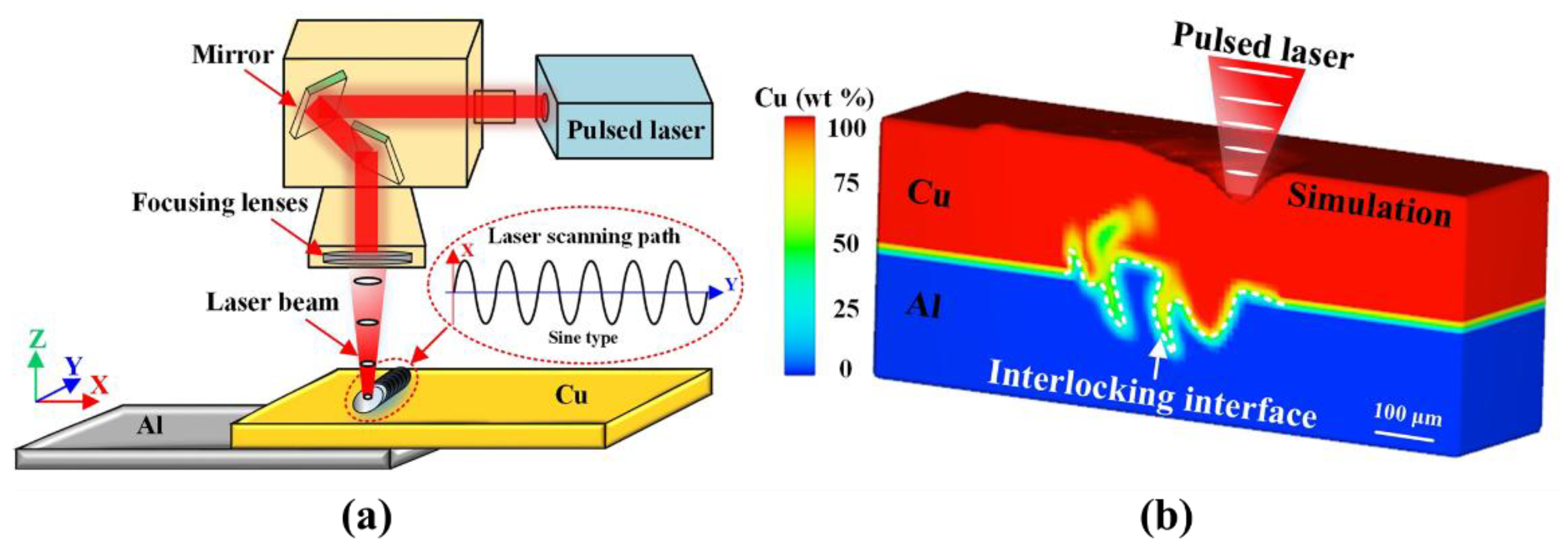
Figure 2.
(a) Cross-sectional welding morphology obtained in pulsed laser welding of the thin aluminum alloy and copper foils without oscillations. (b) Zoom-in view of (a). (c) Point elemental analysis of positions shown in (b). (d) XRD patterns of the cross-section area. (e) Line scan in EDS for Line 1 in (a). (f) Line scan in EDS for Line 2 in (a).
Figure 2.
(a) Cross-sectional welding morphology obtained in pulsed laser welding of the thin aluminum alloy and copper foils without oscillations. (b) Zoom-in view of (a). (c) Point elemental analysis of positions shown in (b). (d) XRD patterns of the cross-section area. (e) Line scan in EDS for Line 1 in (a). (f) Line scan in EDS for Line 2 in (a).
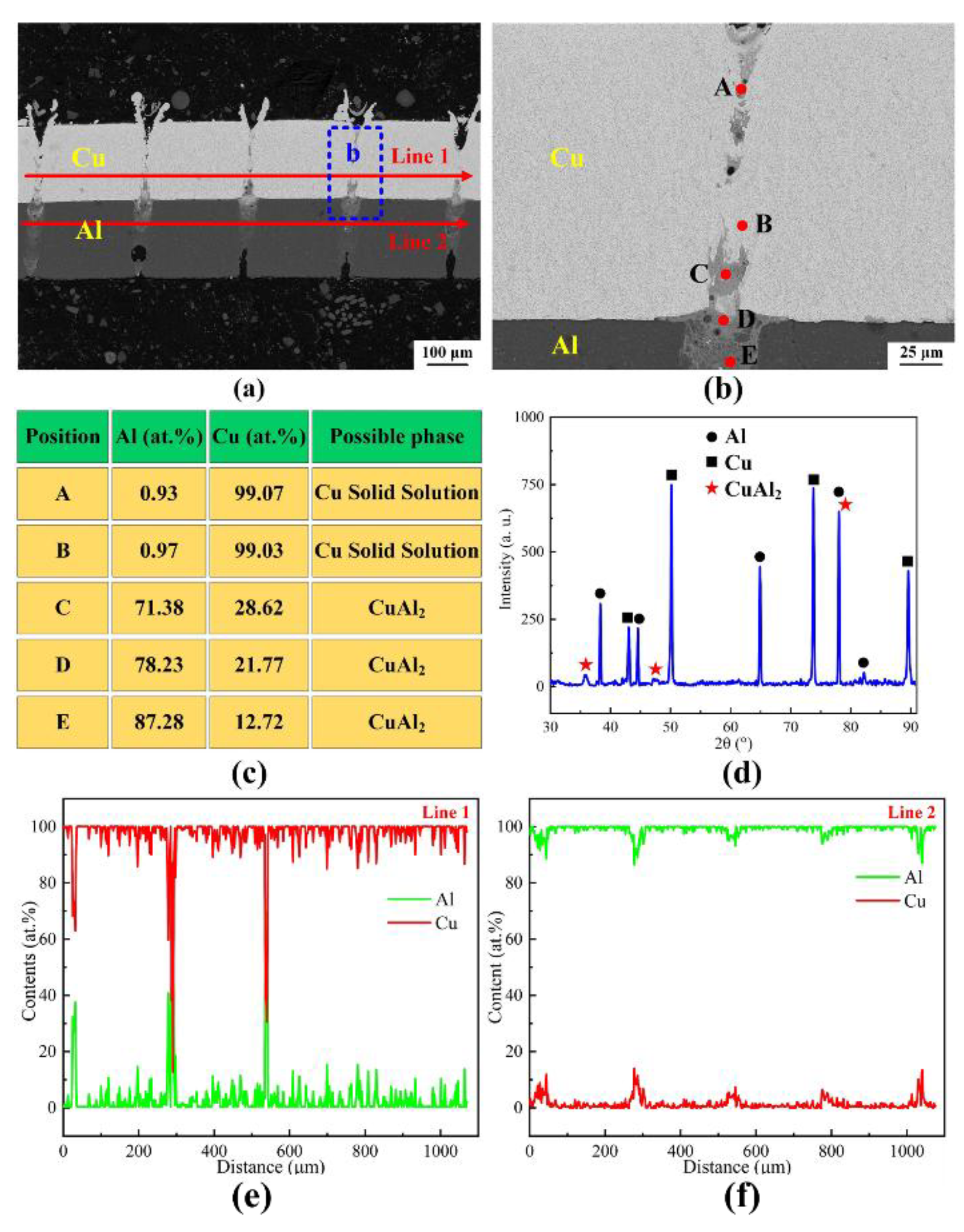
Figure 3.
(a) Cross-sectional welding morphology obtained in pulsed laser welding of the thin aluminum alloy and copper foils with path oscillations. (b) Zoom-in view of (a). (c) Point elemental analysis of positions shown in (b). (d) XRD patterns of the cross-section area. (e) Line scan in EDS for Line 1 in (a). (f) Line scan in EDS for Line 2 in (a).
Figure 3.
(a) Cross-sectional welding morphology obtained in pulsed laser welding of the thin aluminum alloy and copper foils with path oscillations. (b) Zoom-in view of (a). (c) Point elemental analysis of positions shown in (b). (d) XRD patterns of the cross-section area. (e) Line scan in EDS for Line 1 in (a). (f) Line scan in EDS for Line 2 in (a).
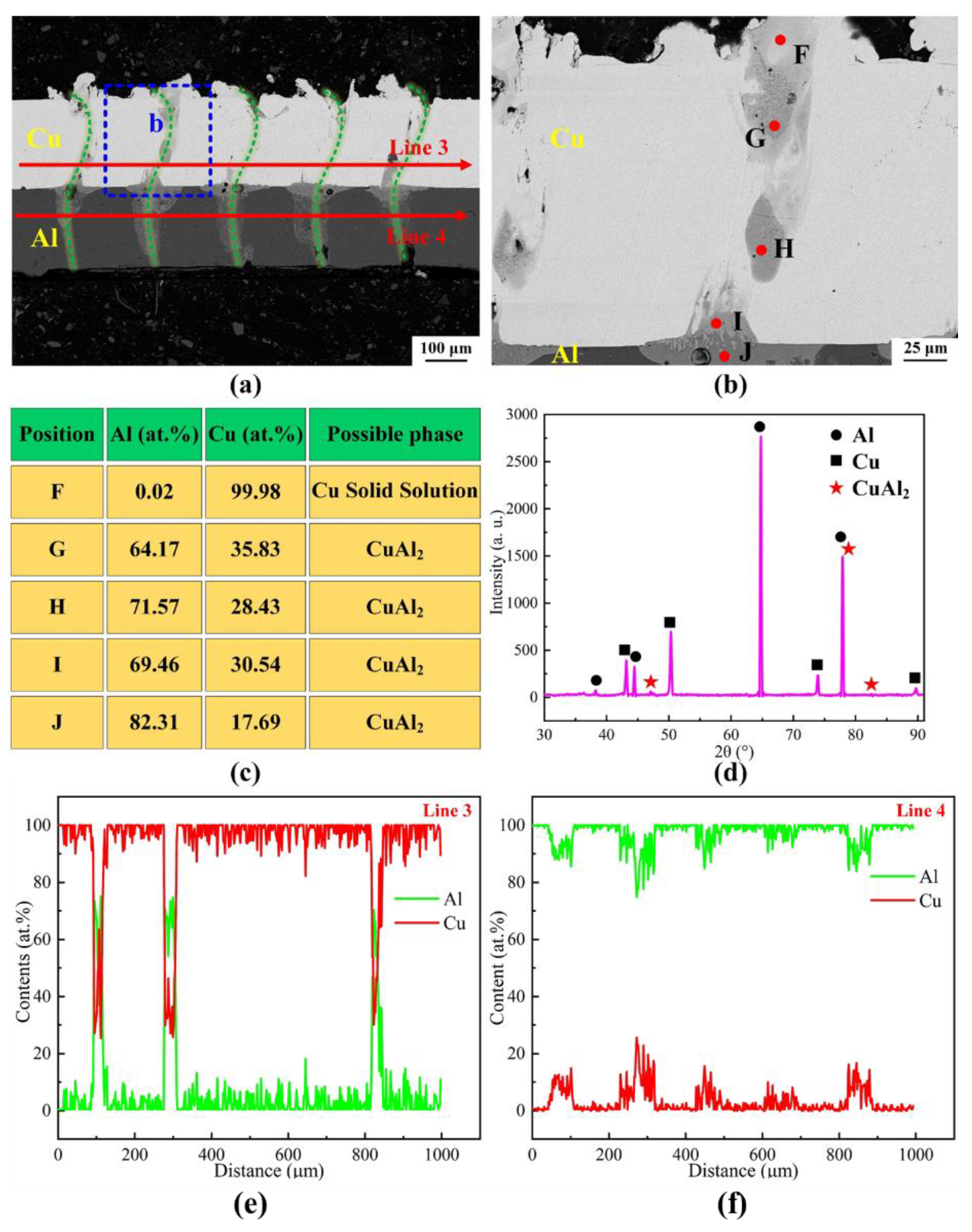
Figure 4.
(a) Fracture area morphology after tensile testing for non-oscillation dissimilar welding. (b) Zoom-in view of the crack in (a). (c) Zoom-in view of the pores in (a). (d) Fracture area morphology after tensile testing for dissimilar welding with oscillations. (e) Zoom-in view of the crack in (d). (f) Zoom-in view of the pores in (d).
Figure 4.
(a) Fracture area morphology after tensile testing for non-oscillation dissimilar welding. (b) Zoom-in view of the crack in (a). (c) Zoom-in view of the pores in (a). (d) Fracture area morphology after tensile testing for dissimilar welding with oscillations. (e) Zoom-in view of the crack in (d). (f) Zoom-in view of the pores in (d).
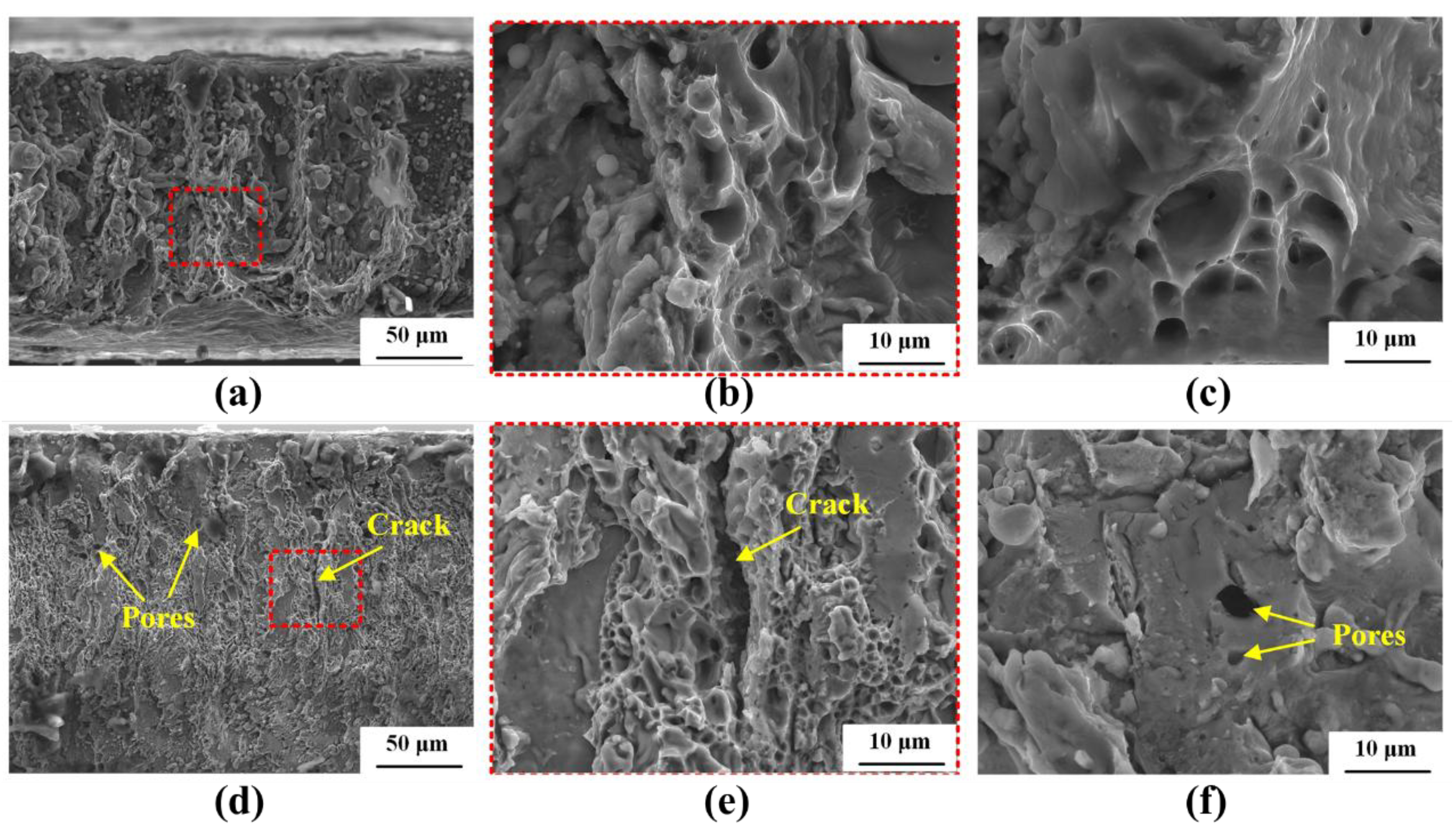

Table 1.
Chemical composition of the Cu-Al dissimilar metals (wt. %).
| Element | Aluminum (Al) | Element | Copper (Cu) |
|---|---|---|---|
| Si | 0.12 | P | 0.001 |
| Fe | 0.11 | Fe | 0.003 |
| Cu | 0.01 | Cu | Bal. |
| Mn | 0.002 | Pd | 0.002 |
| Mg | 0.001 | O | 0.0003 |
| Zn | 0.002 | - | - |
| Ti | 0.012 | - | - |
| Al | Bal. | - | - |
Note that “-“ means none.
Table 2.
Experimental parameters of the pulsed laser.
| Combination mode | non-oscillation shock welding | shock oscillation welding |
|---|---|---|
| Pulsed laser power (W) | 50 | 50 |
| Scanning speed (mm/s) | 10 | 10 |
| Frequency (KHz) | 100 | 100 |
| Pulsed width (ns) | 100 | 100 |
| Spot diameter (μm) | 35 | 35 |
| Defocusing (mm) | 0 | 0 |
| Periodic scanning path | / | sinusoid |
Disclaimer/Publisher’s Note: The statements, opinions and data contained in all publications are solely those of the individual author(s) and contributor(s) and not of MDPI and/or the editor(s). MDPI and/or the editor(s) disclaim responsibility for any injury to people or property resulting from any ideas, methods, instructions or products referred to in the content. |
© 2026 by the author. Licensee MDPI, Basel, Switzerland. This article is an open access article distributed under the terms and conditions of the Creative Commons Attribution (CC BY) license.
Copyright: This open access article is published under a Creative Commons CC BY 4.0 license, which permit the free download, distribution, and reuse, provided that the author and preprint are cited in any reuse.


