

Submitted:
07 July 2026
Posted:
08 July 2026
You are already at the latest version
Abstract
Stachys fontqueri is a strict endemic species of the Moroccan Rif that depends on specific ecological conditions. To understand the effect of climate change on the potential evolu-tion of the species' geographic range under current and future climatic scenarios, ecologi-cal niche modelling was performed using MaxEnt algorithm based on five bioclimatic variables. To model the effect of climate change, four climatic scenarios were used, namely CSM2- SSP1-2.6, CSM2-SSP5-8.5, MIROC6-SSP1-2.6, and MIROC6-SSP5-8.5, for the period 2061–2080. The results demonstrated high model performance, with an AUC ranging from 0.921 to 0.930 and a TSS from 0.81 to 0.83. Three bioclimatic variables contributed significantly to determining the suitable potential distribution area of the species, namely Precipitation Seasonality (Bio15), Temperature Annual Range (Bio7), and Annual Mean Temperature (Bio1). The suitable area covered 3,244 km² under the current climate and is projected to decrease by 23.25% to 29.59% under future climate scenarios. This contraction of suitable habitat due to climate change could be exacerbated by human activities, there-by requiring urgent in situ and ex situ conservation measures to ensure the species' resilience.
Keywords:
bioclimatic variables
; ecological niche modeling
; endemic strict species
; future climate scenario
; habitat loss
; MaxEnt
; cross-validation
; in situ and ex situ conservation
1. Introduction
In 21st century, climate change is one of the major environmental challenges, leading to an increase in the frequency and intensity of extreme climatic events such as heat and cold waves, droughts and floods. It exerts increasing threats to ecosystems and their resources [1,2,3,4,5,6], and altering the distribution and physiological performance of the species [7]. The Mediterranean basin, including northern Morocco (classified as a "Hotspot"), is among the most sensitive to and affected regions by climate change due to rapidly rising temperatures and decreasing precipitation [6,8,9,10].
To address these environmental challenges, ecological niche modeling (ENM) is one of the most important analytical tools in ecology and biodiversity conservation biology. This approach enables the prediction of species distributions by relating occurrence data to environmental variables and has proven effective in identifying suitable habitats under current and future environmental conditions [11,12]. These models also make it possible to understand the climatic and environmental factors that control species distribution [5,13], and to predict potential shifts in their range in response to climate change [5,12,14]. Among the various ENM techniques, MaxEnt is considered one of the most robust and widely applied algorithms owing to its high predictive performance, stability, and sensitivity, particularly when modeling species distributions from presence-only data [3,4,11,15,16,17,18,19].
Medicinal and aromatic plants constitute a plant resource of considerable health and economic importance, given their widespread use in traditional medicine and their content of secondary metabolites with therapeutic properties used in the pharmaceutical and aromatic industries [20,21,22,23]. Studies have shown that these plants are highly sensitive to climate change, as variations in temperature, carbon dioxide, and ozone concentrations, as well as the increase in drought periods, affect their growth, biological production, and geographical distribution [23,24]. Furthermore, the persistence of these environmental pressures, combined with the degradation of natural habitats, threatens many wild medicinal species by altering or reducing their range, particularly in sensitive areas such as the Mediterranean basin [5,21,22,25,26,27].
Stachys fontqueri Pau, an endemic plant species of the Moroccan Rif [28,29], belonging to the genus Stachys L., one of the most prominent genera in the Lamiaceae family, and more precisely within the Lamioideae sub-family. This genus comprises between 275 and 300 species of herbaceous and shrubby plants distributed worldwide [30,31]. This species is characterized by its distinctive morphological traits, notably densely hairy stems, a deeply branched upper corolla lip, and prominent stamens [30]. It inhabits confined and fragile mountainous habitats, making it highly dependent on precise environmental conditions [26,29]. Furthermore, its limited geographical range increases its vulnerability to multiple threats, including habitat degradation, unsustainable exploitation, water drainage, Cannabis cultivation, and accelerating climate change in the Mediterranean region [26,29]. Consequently, Fennane (2018) [28] classified this species as Vulnerable at the national level.
Given the numerous threats facing S. fontqueri and its underrepresentation in botanical garden collections and seed banks on an international and national scales [26,29,32], as well as its promising agro-alimentary, ornamental and medicinal potentials [31,33,34], the conservation of this species is of growing importance. This necessitates monitoring the effects of climate change on the species' potential distribution within its natural habitat, alongside the adoption of ex situ conservation strategies combined with enhanced in situ protection.
Several researches have demonstrated the usefulness of the MaxEnt model in predicting future potential shifts in the geographic distribution of medicinal plant species in Morocco under climate change scenarios (e.g. [5,35,36,37,38]). Nevertheless, no study have yet evaluated the potential impacts of climate change on the potential distribution of S. fontqueri. Furthermore, with the exception of research focusing on its ex situ conservation status and the potential agro-alimentary and ornamental values [29,33,34], little attention has been given to the in situ conservation of this endemic species or to the combined impacts of climate change and human pressures on its potential distribution in Morocco.
Despite its endemic status, restricted geographic distribution, specialized ecological requirements, and conservation importance, the effects of climate change on the current and future distribution of S. fontqueri remain poorly understood. This knowledge gap limits the development of effective in situ conservation and management strategies necessary to ensure the long-term survival of the species.
This study aims to (i) model the current potential distribution of S. fontqueri in the Moroccan Rif, (ii) assess the effects of climate change on its distribution using ecological niche modeling, (iii) identify the most influential environmental factors shaping its distribution, and (iv) provide recommendations for its conservation and management.
2. Materials and Methods
2.1. Study Area
The Moroccan Rif reaches a maximum elevation of 2,440 m and is characterized by a Mediterranean climate [39]. According to the Köppen–Geiger Climate Classification System (2026) [40], this climate is classified as Csa (temperate with hot, dry summers) at low and mid elevations and as Csb (temperate with warm, dry summers) at higher elevations., with an annual mean precipitation of 900 mm and an annual mean temperature of 14.5°C in the study area [41] (https://www.worldclim.org/, accessed on 28 August 2023).
The Moroccan Rif is a geographically distinct region of remarkable uniqueness within both Morocco and the Mediterranean basin. It represents one of the eleven national biogeographic divisions identified by Fennane et al. (1999) [42]. As part of the Mediterranean biodiversity hotspot, the Rif region harbors a significant proportion of Morocco’s plant diversity and is particularly rich in endemic species, many of which are classified as endangered or threatened due to their restricted distribution ranges. These taxa may be exposed to pressures related to overexploitation and/or illegal trade [29,43].
Numerous habitat types were identified within the study area, including coniferous forests dominated by Cedrus atlantica (Endl.) Carrière, Abies marocana Trab., Pinus halepensis Mill., Pinus nigra subsp. mauretanica (Maire & Peyerimh.) Heywood, Tetraclinis articulata (Vahl) Mast., and Taxus baccata L.. Deciduous and evergreen oak forests are represented by Quercus ilex L., Q. canariensis Willd., Q. faginea Lam., Q. pyrenaica Willd., and Q. suber L. The study area also includes Mediterranean matorral communities dominated by Quercus coccifera L., Pistacia atlantica Desf., P. lentiscus L., Myrtus communis L., Cistus spp., Calicotome villosa (Poir.) Link, Chamaerops humilis L., … [5,25,26,27,36].
Stachys fontqueri Pau (Lamiaceae) is a narrow endemic (stenendemic) taxon restricted to the Western Rif Mountains of northern Morocco. It is one of the 17 Stachys species found in the country and is characterized by a greenish appearance with light to moderate hairiness, rarely becoming whitish-tomentose (Figure 2) [44].
Within the Rif biogeographical subdivision, S. fontqueri occurs as small, fragmented populations inhabiting matorral communities dominated by Pistacia lentiscus and Quercus coccifera, Chamaerops humilis steppes, and coniferous forests, where it frequently coexists with other endemic or threatened species such as Abies marocana and various orchid species. The species can grow on both calcareous and acidic substrates and occurs at elevations above 280 m a.s.l. [25,26,45].
2.2. Methods
After removing duplicate, outlier, and/or erroneous records, the final dataset included 70 occurrences of Stachys fontqueri. These data were compiled from field surveys (5 occurrences) and presence data downloaded from the Global Biodiversity Information Facility (GBIF; 65 occurrences) [46]. To guarantee data quality and reliability, the dataset was subjected to manual screening to ensure the availability of precise geographic coordinates within the species' distribution range, along with an accurate recording date for the occurrence site. The occurrence data were spatially filtered using a 1 × 1 km grid, retaining a single occurrence per grid cell to reduce spatial sampling bias [5,47].
The Maxent model (Version 3.4.3, November 2020) was used to predict the ecological niche of S. fontqueri. The climatic data used for the modeling were extracted from the WorldClim database [41] and handled using ArcGIS software (v. 10.8). Initially, a set of 20 environmental and topographic variables were used to build a preliminary MaxEnt model to simulate the current potential distribution of the species, following the approach of Worthington et al. (2016) [48], Wei et al. (2018) [49], and Mechergui et al. (2025a) [3]. Following this initial modeling, four variables were excluded from further analyses due to their lack of contribution to the model (percent contribution = 0) (Table S2).
Following the initial modeling, pairwise Pearson correlation coefficients between environmental and topographic parameters were calculated using IBM SPSS Statistics 23 software. Variables exhibiting strong correlations (|r| > 0.8) were removed to reduce multicollinearity and minimize model overfitting [1,49]. For each pair of correlated variables, the one showing a higher contribution in the preliminary MaxEnt model was retained, while its correlated counterpart was discarded [3]. Following this selection procedure, five bioclimatic variables were retained for the final model, namely: Annual mean temperature (Bio1), Temperature annual range (Bio7), Precipitation seasonality (Bio15), Precipitation of the warmest quarter (Bio18), and Precipitation of the coldest quarter (Bio19) (Table S3).
To assess the potential impacts of climate change on the distribution of S. fontqueri, the same set of selected environmental variables was projected onto future climate conditions derived from General Circulation Model (GCMs). Future climate data were obtained from the BCC-CSM2-MR and MIROC6 models under two Shared Socio-economic Pathways (SSP) scenarios: SSP1-2.6, representing a low-emission pathway, and SSP5-8.5, representing a high-emission pathway, for the period 2061–2080. All climatic datasets were processed at a spatial resolution of 30 arc-second, which is considered suitable for species distribution modeling and provide reliable estimates of habitat suitability [47]. To account for uncertainty in future climate projections, the SSP1-2.6, and SSP5-8.5 scenarios, under two GCMs, were chosen to represent a range of plausible socioeconomic and greenhouse gas emission pathways, spanning from low- to high-emission futures [50].
The MaxEnt model configuration was set to a maximum number of 500 iterations, with a convergence threshold of 0.00001. To generate a different random partition of test data and background points for each model run, the "random seed" option was enabled. Model performance was assessed using a 10-fold cross-validation procedure, and predictions were generated in a logistic output format [51,52]. For the feature classes, the "Auto" setting was applied, while the regularization multiplier was maintained at its default value of 1. This modeling approach, which improves the robustness of performance estimates, is particularly suitable for species with limited occurrence records [51].
Model performance was evaluated using the Area Under the Curve (AUC) of the Receiver Operating Characteristic (ROC) [53]. This parameter reflects the probability that a randomly selected presence site is assigned a higher suitability score than a randomly selected background or absence site [54]. A value of 0.5 indicates a random prediction, whereas a value of 1.0 represents perfect model discrimination [55]. In addition to the AUC, model performance was evaluated using the True Skill Statistic (TSS), a threshold-dependent metric that combines sensitivity and specificity, with −1<TSS<1. Values greater than 0.8 indicate excellent model performance [5]. The TSS was calculated based on Maximum training sensitivity plus specificity Logistic Threshold, using formula: TSS = 1 − Omission Rate − Fractional Predicted Area.
To compare habitat suitability under climate scenarios, MaxEnt outputs were imported into ArcGIS 10.8 and analyzed using the Reclassify tool within the Spatial Analyst extension. MaxEnt predicts habitat suitability for each grid cell on a continuous scale ranging from 0 to 1. To distinguish suitable from unsuitable habitats, the Maximum Test Sensitivity Plus Specificity (MTSPS) threshold, a robust and widely adopted criterion in species distribution modeling, was applied [5,56,57]. Habitat suitability maps were reclassified into two categories: suitable habitat (p > MTSPS) and unsuitable habitat (p ≤ MTSPS) [5].
The response curves generated by MaxEnt, describing the relationship between the species' probability of presence and environmental variables, were analyzed. Those demonstrating strong consistency between the environmental variables and the predicted probability of presence were retained. Their interpretation was based on biological relevance, showing that variations in environmental variables generally induce smooth and predictable responses in the species' probability of presence, without extreme fluctuations [3,4,57].
3. Results
3.1. Model Evaluation
The high values of the AUC of the five models developed to assess the current and future potential distribution of Stachys fontqueri demonstrated excellent predictive performance. The mean AUC values were 0.921 ± 0.027, 0.930 ± 0.027, 0.929 ± 0.044, 0.929 ± 0.035, and 0.926 ± 0.039 for the current climate model and the CSM2-SSP1-2.6, CSM2-SSP5-8.5, MIROC6-SSP1-2.6, and MIROC6-SSP5-8.5 scenarios, respectively. The consistently high AUC values, approaching 1, together with the low standard deviations (0.027–0.044), indicate strong model performance and stability. In addition, the TSS values varied from 0.81 to 0.83, further confirming the high predictive accuracy and reliability of the models.
The models predicted suitable habitats that closely match the currently known geographic distribution of S. fontqueri in northern Morocco. Nevertheless, the four projected scenarios identified additional areas of high habitat suitability in the Ketama–Targuist, Bouhachem, Bab Taza, and Tangier regions, where no occurrences of the species have been documented to date. These areas may represent potential habitats for the species and should be prioritized for future botanical surveys and conservation assessments.
3.2. Bioclimatic Factors
The potential distribution area of S. fontqeuri in Moroccan Rif were mostly affected by Precipitation Seasonality (Bio15), which contribute 61.6%, 43.8% and 38.1% for current, MIROC6-SSP5-8.5, and CSM2-SSP1-2.6 future climatic scenarios respectively. However, the Temperature Annual Range (Bio7) that have the greatest effect on habitat suitability under CSM2-SSP5-8.5 and MIROC6-SSP1-2.6, which contribute 55.8% and 43.6% respectively (Table 1).
3.3. Response Curves
Under current climate, the response curves derived from the ecological niche modeling of S. fontqueri indicated a high probability of species occurrence for Precipitation Seasonality (Bio15) values ranging from 77 to 88 mm, an Annual Mean Temperature (Bio1) below 12.8 °C, and a Temperature Annual Range (Bio7) below 17.4 °C and between 26.4 and 28.4 °C. A similar trend was observed under the CSM2-SSP1-2.6 scenario, where the highest occurrence probabilities were associated with the same key bioclimatic variables identified under current climatic conditions, although with slightly higher values. Specifically, high occurrence probabilities were associated with Bio15 values between 80 and 92 mm, Bio7 values below 19.6 °C and between 27.4 and 29 °C, and Bio1 values below 17.4 °C.
Under the CSM2-SSP5-8.5 scenario, Temperature Annual Range (Bio7) emerged as the most influential factor determining habitat suitability, with optimal values ranging from 28.4 to 30.3 °C. This was followed by Annual Mean Temperature (Bio1) below 16.1 °C and Precipitation of the Coldest Quarter (Bio19) between 460 and 540 mm. In addition, Precipitation Seasonality (Bio15) ranged from 78 to 92 mm.
Under both the SSP1-2.6 and SSP5-8.5 scenarios projected by the MIROC6 model, the highest probabilities of occurrence for S. fontqueri were associated with similar bioclimatic variables and relatively comparable value ranges. Under the SSP1-2.6 scenario, high probabilities of occurrence were linked to a Temperature Annual Range (Bio7) between 28.4 and 30.2 °C, Precipitation Seasonality (Bio15) between 77.5 and 88.5 mm, and an Annual Mean Temperature (Bio1) below 15 °C. In contrast, under the SSP5-8.5 scenario, the highest occurrence probabilities were associated with Bio15 values between 77.5 and 88 mm, Bio7 values between 28.6 and 30.6 °C, and Bio1 values below 17.2 °C.
3.4. Potential Current Distribution Area of Stachys fontqeuri
The modeling of the potential distribution of Stachys fontqueri under current climatic conditions indicates that the species could occupy relatively extensive, although fragmented, suitable habitats concentrated in the mountainous massifs of the Moroccan Rif, particularly in Jbel Moussa, Jbel Kelti, and the Talassemtane National Park. However, the predicted suitable habitat also extends to surrounding areas, including Bouhachem Natural Park, the Tangier region, Bab Taza, Ketama, and Issaguen, covering a total suitable habitat area of approximately 3244.3877 km2 (Table 2, Figure 3)
3.5. Effect of Climate Change on the Potential Distribution Area of Stachys fontqueri
Compared to the current potential distribution, the potential distribution area of S. fontqeuri under all future climate scenarios, was projected to decrease in the study area (23.25% to 29.59% of suitable habitat loss). The CSM2- SSP5-8.5 seems to be the most unfavorable climatic scenario for the endemic species (Table 2).
When considering climatic factors alone and disregarding human influences, S. fontqueri is projected to face a risk of habitat contraction in the Moroccan Rif. Future climate projections indicate a marked decline in the extent of suitable habitats for the species throughout Moroccan Rif by 2070 (Figure 4)
4. Discussion
Climate change is one of the major drivers of biodiversity decline in the Mediterranean Basin [2,6]. Its impacts are particularly severe on endemic and threatened species, especially when combined with human pressures [5]. As an endemic taxon of forest clearings and calcareous scrublands, Stachys fontqueri contributes to local biodiversity and plays an important role in maintaining habitat integrity in the Moroccan Rif [29]. Therefore, modelling the potential habitat changes and the response of the species to climate change are essential to develop effective conservation strategies.
Bioclimatic variables provide valuable predictors for understanding plant distribution patterns and for modeling the potential effects of climate change on habitat suitability, thereby enabling the assessment of current and future species distribution patterns [38,58]. However, the results of ecological niche models should be interpreted with caution, as they do not fully account for important ecological processes such as biotic interactions, dispersal capacity and barriers, evolutionary history, and human activities [5,58,59,60,61,62].
The models applied to analyze the ecological niche of S. fontqueri showed high predictive performance, with AUC values ranging from 0.921 to 0.930 and TSS values between 0.81 and 0.83. These performance metrics are in close agreement with those reported by El Haddouti et al. (2026) [5] and Jaouani et al. (2025) [38] for species distribution models in northern Morocco, further confirming the robustness and reliability of the modeling approach [54]. The resulting habitat suitability maps indicate that most of the currently known populations of S. fontqueri are located within the core of the potential distribution area predicted by the models (Figure 3).
However, the absence of S. fontqueri from several areas predicted to be suitable, including Jbel Bouhachem, Bab Taza, Ketama, Issaguen, and the Tangier region, deserves attention. This discrepancy may be explained by the influence of additional factors that were not incorporated into the models but are known to shape the species' realized distribution, including local abiotic conditions and human disturbances such as overgrazing, wildfires, deforestation, and illegal plant collection [5,63,64]. Alternatively, the apparent absence of the species may simply reflect insufficient botanical investigations, underscoring the need for field validation of habitats identified as suitable by the ecological niche models [5].
Ecological niche modeling of S. fontqueri revealed that its potential geographic distribution is strongly influenced by three key bioclimatic variables: Precipitation Seasonality (Bio15) and the two temperature-related variables, Temperature Annual Range (Bio7) and Annual Mean Temperature (Bio1). These variables consistently emerged as the main predictors under both current climatic conditions and the four future climate scenarios. In contrast, Annual Mean Temperature (Bio1) was identified as the most influential predictor of the potential distribution of Stachys inflata Benth. in Iran [47]. Similarly, in northern Morocco, Bio1 and Bio7 have been reported among the principal determinants of the distribution of two Lamiaceae species, Origanum compactum Benth. and O. elongatum (Bonnet) Emb. & Maire [38].
The high contribution of Precipitation Seasonality (Bio15) to the current potential distribution of S. fontqueri in the Moroccan Rif (61.6%) is biologically consistent with the ecological requirements of the species. S. fontqueri is endemic to the western Rif, a region characterized by a Mediterranean climate with pronounced seasonal variability in precipitation, a key factor for species whose phenology, growth, and survival are closely linked to rainfall patterns [37,38]. In this context, Precipitation Seasonality (Bio15) is an important indicator of seasonal water stress, as increasing contrasts between the wet and dry seasons can create unfavorable conditions for species survival [65]. Precipitation Seasonality (Bio15) remained one of the most influential predictors under future climate scenarios (CSM2-SSP1-2.6 and MIROC6-SSP5-8.5), although its contribution was lower than under current climatic conditions (Table 1). This trend suggests that, under climate change, the predictive importance of precipitation variables tends to decline, whereas temperature-related variables become increasingly influential in determining suitable habitats for species [66,67].
The prominent contribution of Precipitation Seasonality (Bio15) to the ecological niche modeling of S. fontqueri differs from the findings of Hosseini et al. (2024) [18] for Thymus species in Iran, where the most influential environmental variables varied among species. Altitude was identified as the most significant predictor of the distribution of Thymus fedtschenkoi Ronniger and T. pubescens Boiss. & Kotschy ex Čelak., whereas precipitation-related variables, particularly Precipitation of the Driest Month (Bio14), also played an important role, especially for T. fedtschenkoi. In contrast, Shaban et al. (2023) [47] identified a combination of climatic variables, including Annual Mean Temperature (Bio1), Mean Temperature of the Wettest Quarter (Bio8), and Annual Precipitation (Bio12), as the principal determinants of the distribution of Stachys inflata, with relative contributions of 41.1%, 39.06%, and 37%, respectively. This variability indicates that no single environmental variable consistently dominates species distribution models; rather, the relative importance of environmental predictors is determined by the specific ecological requirements of each species and the environmental conditions prevailing within its natural habitat [68].
Under the future climate scenarios CSM2-SSP5-8.5 and MIROC6-SSP1-2.6, Temperature Annual Range (Bio7) emerged as the most influential predictor, with relative contributions of 55.8% and 43.6%, respectively. This shift in the dominant climatic drivers suggests that, under accelerated climate warming, annual thermal constraints are likely to replace precipitation-related constraints as the primary factors regulating habitat suitability for S. fontqueri. Similar transitions have been reported for other Mediterranean plant species that are particularly sensitive to climate change [3,38]. The shift described above indicates that thermal variability plays a key role in regulating the physiological performance and reproductive capacity of the species. Large annual temperature fluctuations may affect the species distribution range and disrupt essential biological processes, including flowering phenology and fruit production [65]. Furthermore, all four future climate scenarios predicted an increase of approximately 1–2 °C in Temperature Annual Range (Bio7) relative to current climatic conditions. Such an increase is expected to exacerbate environmental aridity and intensify thermal stress, thereby imposing greater physiological constraints on the species [7].
Except the CSM2-SSP5-8.5 scenario, Annual Mean Temperature (Bio1) ranked as the third main influential bioclimatic variable determining the potential distribution of S. fontqueri in the Moroccan Rif under future climate scenarios, with relative contributions ranging from 11.9% to 19.9% (Table 1). In contrast, this thermal variable was identified as the primary predictor of the potential distribution of S. inflata in Iran, contributing 41.10% to the MaxEnt model [47], and of Heteromera philaenorum Maire & Weiller in North Africa, contributing 28.9% [4]. Annual Mean Temperature is a fundamental predictor in ecological niche modeling because it provides an estimate of the total energy input available within an ecosystem throughout the year, which can strongly influence the metabolic rates, growth, and physiological performance of the species [65].
Ecological niche modeling under current climate revealed that the predicted suitable habitat of S. fontqueri is mainly distributed across the Rif Mountains, covering an estimated total area of approximately 3,244 km². The most suitable habitats are located around Talassemtane National Park, Jbel Moussa, and Jbel Kelti. This occurrence in the Rif mountains may be attributed to suitable climatic conditions, particularly an Annual Mean Temperature (Bio1) below 12.8 °C, a Temperature Annual Range (Bio7) below 17.4 °C and between 26.4 and 28.4 °C, and Precipitation Seasonality (Bio15) ranging from 77 to 88 mm. Together, these conditions provide a cool and relatively humid environment that is conducive to the growth and persistence of the species [69,70,71].
Future climate projections predicted a contraction of the suitable habitat of S. fontqueri under all four climate scenarios evaluated, with habitat losses ranging from 23.25% to 29.59% under the high-emission scenarios MIROC6-SSP5-8.5 and CSM2-SSP5-8.5. These findings are consistent with the trends commonly reported for endemic and geographically restricted species in the Mediterranean region under the influence of climate change [2,38]. The projected range contraction occurs primarily along the southern and eastern margins of the species' current potential distribution, suggesting a gradual retreat toward the coolest and most humid climatic refugia of the western Rif [72]. It is noteworthy that the low-emission scenarios also predicted substantial habitat losses, with reductions of 29.50% and 26.73% under the CSM2-SSP1-2.6 and MIROC6-SSP1-2.6 scenarios, respectively. These results highlight that, even under ambitious greenhouse gas mitigation pathways, climate change is expected to exert considerable pressure on this narrow endemic species [50].
Overall, the projected contraction of the potential distribution of S. fontqueri is consistent with the findings of Hosseini et al. (2024) [18], who reported substantial reductions in suitable habitats for several Thymus species by 2050 and 2070 as a consequence of increasing thermal and water stress under climate change. Similarly, Shaban et al. (2023) [47] predicted a marked decline in the most suitable habitats for S. inflata under future climate scenarios. Collectively, these studies indicate that climate warming not only leads to a reduction in the extent of suitable habitats but also alters the environmental drivers governing habitat suitability, with temperature-related variables becoming increasingly important under future climate scenarios [73,74].
At the regional scale, previous studies have reported a widespread decline in biodiversity across the Moroccan Rif, driven by both local environmental conditions and increasing human pressures [5,25,26,43,75]. In addition to the impacts of climate change projected in the present study, our field surveys revealed several ongoing threats to the natural habitats of S. fontqueri, including livestock grazing, cannabis cultivation, and water abstraction, even within protected areas such as Talassemtane National Park. Furthermore, the proximity of some populations to urban centers, particularly the cities of Tetouan and Fnideq, may expose the species to increased risks of habitat fragmentation, loss of connectivity among populations, overexploitation, and even complete habitat destruction associated with urban and infrastructure development [76,77].
Although a previous study revealed the presence of a few seed lots of S. fontqueri conserved ex situ in the seed bank of the Scientific Institute (Rabat, Morocco) [32], additional efforts must be made to conserve a sufficient quantity of seeds in seed banks, prioritizing those in Morocco. Furthermore, it is necessary to proceed with germination, propagation, and reintroduction trials of the species into its degraded habitats, as well as the restoration of its natural habitat, as recommended by the Global Strategy for Plant Conservation (GSPC) (http://www.plants2020.net/, accessed 29 Jun 2026) [78].
In parallel, these ex situ conservation measures can be complemented by consultation with local communities to raise awareness about the ecological, socioeconomic, and heritage importance of S. fontqueri and to promote the sustainable management of its natural habitat. Moreover, the promotion of in situ conservation measures, such as the extension of protected areas and/or the implementation of existing laws, such as Law 29-05 of 2 July 2011 designed to protect wild species from illegal collection and trade [79], constitute additional solutions to protect the species. The in situ conservation of this endemic species and its natural habitat, especially near the city of Tetouan, could curb biological invasion and provide opportunities for regional and global biodiversity conservation, restoration, and education [76]. Finally, effective conservation plans should include the management and mitigation of human pressures, notably overgrazing, forest fires, and illegal plant harvesting and trade [43,75].
This study constitutes a valuable contribution to understanding the effects of climate change on the potential distribution of S. fontqueri in the Moroccan Rif. Nevertheless, it presents certain limitations, particularly regarding the use of a limited number of bioclimatic variables for modeling the species' ecological niche. Although the five bioclimatic variables were selected for their contribution and statistical independence, they may not adequately represent all the ecological processes shaping the species’ geographic distribution. Beyond climate, other elements could affect the survival of the species, namely habitat fragmentation, pastoralism, land-use change, and fires [5,25,26]. These factors may constrain the colonization of newly suitable areas projected by the models. Furthermore, the habitat predicted as suitable do not always correspond to the species’ current distribution. This mismatch highlights the importance to conducting additional field surveys to validate the predicted suitable areas and of incorporating additional ecological, biotic, and human factors into future models to enhance predictive accuracy [5,47].
5. Conclusions
This study evaluated the potential impacts of climate change on the distribution of Stachys fontqueri in the Moroccan Rif. Our results identified three key bioclimatic variables as the primary determinants of the species' potential suitable habitat: Precipitation Seasonality (Bio15), Temperature Annual Range (Bio7), and Annual Mean Temperature (Bio1). The most suitable habitats are concentrated within Talassemtane National Park, Jbel Moussa, and Jbel Kelti, which appear to represent climatically stable refugia for the long-term persistence of S. fontqueri. Future climate projections consistently predicted a contraction of suitable habitats under all climate scenarios considered, with habitat losses ranging from 23.25% to 29.59% by 2070. Nevertheless, new potentially suitable habitats may emerge in parts of the eastern Rif, particularly around Ketama and Issaguen.
Considering the combined effects of climate change and the numerous anthropogenic pressures identified during our field surveys, the contraction of suitable habitats for S. fontqueri could be even more severe than predicted if existing environmental regulations are not effectively implemented and if in situ and ex situ conservation measures remain insufficient. Morphological and genetic studies aimed at identifying the most resilient populations, together with investigations of seed germination requirements to support natural regeneration, would contribute significantly to the long-term conservation of this endemic species. In addition, botanical surveys should be intensified in areas predicted to be suitable but not yet inventoried, including Jbel Bouhachem, Bab Taza, Ketama, Issaguen, and the Tangier region, to verify the presence of the species and identify key habitat corridors. Strengthening the ex situ conservation of its genetic resources in support of the objectives of the Global Strategy for Plant Conservation, implementing long-term monitoring of natural populations and land-use dynamics, the adoption of sustainable resource management practices, and community-based awareness initiatives about the ecological and socio-economic importance of S. fontqueri would help mitigate the combined impacts of human activities and climate change while enhancing the species’ resilience in Moroccan Rif.
Supplementary Materials
The following supporting information can be downloaded at the website of this paper posted on Preprints.org, Figure S1. Response curves of the most important bioclimatic variables influencing current and future distribution of Stachys fontqueri in Moroccan Rif.
Author Contributions
Conceptualization, M.L. and A.K.; methodology, M.L.; software, M.L.; validation, H.D., I.E.H., A.K. and M.L.; formal analysis, M.L.; investigation, A.K., M.L.; resources, H.D., I.E.H., O. A. M., A. H., A.K. and M.L.; data curation, H.D., I.E.H., A.K. and M.L.; writing—original draft preparation, H.D., I.E.H., A.K. and M.L.; writing—review and editing, H.D., I.E.H., S. L., Z.B., A.K. and M.L.; visualization, A.K. and M.L.; supervision, A.K. and M.L.. All authors have read and agreed to the published version of the manuscript.
Funding
This research received no external funding.
Institutional Review Board Statement
Not applicable.
Informed Consent Statement
Not applicable.
Data Availability Statement
All floristic and ecological data obtained during the research are included in this study. The original dataset used in the analysis is available upon request.
Acknowledgments
The authors would like to thank the anonymous reviewers for their constructive and valuable comments and the editorial team members for their help in refining this article. .
Conflicts of Interest
The authors declare no conflicts of interest.
References
- Wang, J.; Wang, Y.; Feng, J.; Chen, C.; Chen, J.; Long, T.; Li, J.; Zang, R.; Li, J. Differential responses to climate and land-use changes in threatened Chinese Taxus species. Forests 2019, 10, 766. [Google Scholar] [CrossRef]
- Cruz Román, J. F.; Hernández-Lambraño, R. E.; Rodríguez-de la Cruz, D.; Sánchez-Agudo, J. Á. Climate vulnerability analysis of marginal populations of yew (Taxus baccata L.): The case of the Iberian Peninsula. Forests 2025, 16, 931. [Google Scholar] [CrossRef]
- Mechergui, K.; Jaouadi, W.; Azevedo, C.H.S.; Faqeih, K.Y.; Alamri, S.M.; Alamery, E.R.; Aldubehi, M.A.; Souza, P.G.C. Modeling Habitat Suitability for Endemic Anthemis pedunculata subsp. pedunculata and Anthemis pedunculata subsp. atlantica in Mediterranean Region Using MaxEnt and GIS-Based Analysis. Diversity 2025a, 17, 851. [Google Scholar] [CrossRef]
- Mechergui, K.; Jiang, M.; Qi, Z.; Alamri, S. M.; Alamery, E. R.; Faqeih, K. Y.; Rafi Al Amri, A.; Jaouadi, W.; Yan, X. The effects of climate change on distributions of four endemic and medicinal Species in the North Africa using MaxEnt modeling and GIS tools. Ind. Crops Prod. 2025b, 235, 121766. [Google Scholar] [CrossRef]
- El Haddouti, I.; Karmoudi, Y.E.; Khabbach, A.; Libiad, M. Predicting the Distribution of Taxus baccata L. in Morocco Under Climate Change Using MaxEnt: Implications for Conservation and Sustainable Management. Sustainability 2026, 18, 5544. [Google Scholar] [CrossRef]
- El Hamdouni, Y.; Briak, H.; El Mahdi, E. L.; Beroho, M.; Moussaid, A.; Gourfi, A.; Aboumaria, K. Evaluation of CMIP6-Based Climate Projections in Northern Morocco: A Bias Corrected Assessment of Temperature and Precipitation Trends in Three Mediterranean Watersheds. Enviro. Chall. 2026, 22, 101430. [Google Scholar] [CrossRef]
- Sheldon, K.S.; Tewksbury, J.J. The impact of seasonality in temperature on thermal tolerance and elevational range size. Ecology 2014, 95, 2134–2143. [Google Scholar] [CrossRef] [PubMed]
- Médail, F.; Quézel, P. Biodiversity hotspots in the Mediterranean Basin: Setting global conservation priorities. Conserv. Biol. 1999, 13, 1510–1513. [Google Scholar] [CrossRef]
- Giorgi, F. Climate change hot-spots. Geophys. Res. Lett. 2006, 33, L08707. [Google Scholar] [CrossRef]
- Tramblay, Y.; Badi, W.; Driouech, F.; El Adlouni, S.; Neppel, L.; Servat, E. Climate change impacts on extreme precipitation in Morocco. Glob. Planet Change 2012, 82, 104–114. [Google Scholar] [CrossRef]
- Elith, J.; Graham, C.H.; Anderson, R.P.; Dudík, M.; Ferrier, S.; Guisan, A.; Hijmans, R.J.; Huettmann, F.; Leathwick, J.R.; Lehmann, A.; et al. Novel methods improve prediction of species’ distributions from occurrence data. Ecography 2006, 29, 129–151. [Google Scholar] [CrossRef]
- Gengping, Z.; Qiang, L.; Yubao, G. Improving ecological niche model transferability to predict the potential distribution of invasive exotic species. Biodivers. Sci. 2014, 22, 223–230. Available online: https://www.biodiversity-science.net/EN/10.3724/SP.J.1003.2014.08178. [CrossRef]
- Fuchs, A.J.; Gilbert, C.C.; Kamilar, J.M. Ecological niche modeling of the genus Papio. Am. J. Phys. Anthropol. 2018, 166, 812–823. [Google Scholar] [CrossRef] [PubMed]
- Beck, J. Predicting climate change effects on agriculture from ecological niche modeling: who profits, who loses? Clim. Chang. 2013, 116, 177–189. [Google Scholar]
- Hernandez, P.A.; Graham, C.H.; Master, L.L.; Albert, D.L. The effect of sample size and species characteristics on performance of different species distribution modeling methods. Ecography 2006, 29, 773–785. [Google Scholar] [CrossRef]
- Hernandez, P.A.; Franke, I.; Herzog, S.K.; Pacheco, V.; Paniagua, L.; Quintana, H.L.; Soto, A.; Swenson, J.J.; Tovar, C.; Valqui, T.H.; et al. Predicting species distributions in poorly-studied landscapes. Biodivers. Conserv. 2008, 17, 1353–1366. [Google Scholar] [CrossRef]
- Valavi, R.; Guillera-Arroita, G.; Lahoz-Monfort, J.J.; Elith, J. Predictive performance of presence-only species distribution models: A benchmark study with reproducible code. Ecol. Monogr. 2022, 92, e01486. [Google Scholar] [CrossRef]
- Hosseini, N.; Ghorbanpour, M.; Mostafavi, H. Habitat potential modelling and the effect of climate change on the current and future distribution of three Thymus species in Iran using MaxEnt. Sci. Rep. 2024, 14, 3641. [Google Scholar] [CrossRef] [PubMed]
- Labaioui, A.; Elbakkali, A. Identifying Key Environmental Factors and Modelling of the Potential Distribution of Carob Tree (Ceratonia siliqua L.) in Morocco Using Maximum Entropy Principle. Agric. Conspec. Sci. 2025, 90, 297–307. Available online: https://hrcak.srce.hr/342147.
- Applequist, W.L.; Brinckmann, J.A.; Cunningham, A.B.; Hart, R.E.; Heinrich, M.; Katerere, D.R.; Andel, T.V. Scientistsʼ warning on climate change and medicinal plants. Planta Med. 2020, 86, 10–18. [Google Scholar] [CrossRef] [PubMed]
- Shrestha, U.B.; Lamsal, P.; Ghimire, S.K.; Shrestha, B.B.; Dhaka, S.; Shrestha, S.; Atreya, K. Climate change- induced distributional change of medicinal and aromatic plants in the Nepal Himalaya. Ecol. Evol. 2022, 12, 9204. [Google Scholar] [CrossRef] [PubMed]
- Shruti, S.; Trivedi, A.; Chaudhary, K.B.; Ghadiali, J. Global climate change and its effects on medicinal and aromatic plants: A review Article. Int. J. Environ. Clim. Change 2024, 14, 149–160. [Google Scholar] [CrossRef]
- Hounsou, E.K.; Sonibare, M.A.; Elufioye, T.O. Climate change and the future of medicinal plants research. Bioact. Compd. Health Dis. 2024, 7, 152–169. [Google Scholar] [CrossRef]
- Jangpangi, D.; Patni, B.; Chandola, V.; Chandra, S. Medicinal plants in a changing climate: understanding the links between environmental stress and secondary metabolite synthesis. Front Plant Sci. 2025, 16, 1587337. [Google Scholar] [CrossRef] [PubMed]
- El Karmoudi, Y.; Libiad, M.; Fahd, S. Diversity and conservation strategies of wild Orchidaceae species in the West Rif area (Northern Morocco). Botanica 2025a, 31, 13–24. [Google Scholar] [CrossRef]
- El Karmoudi, Y.; Krigas, N.; Chergui El Hemiani, B.; Khabbach, A.; Libiad, M. In Situ Conservation of Orchidaceae Diversity in the Intercontinental Biosphere Reserve of the Mediterranean (Moroccan Part). Plants 2025b, 14, 1254. [Google Scholar] [CrossRef] [PubMed]
- El Karmoudi, Y.; Libiad, M.; Samartza, I.; Khabbach, A.; Lazarina, M.; Krigas, N. Ecological factors influencing the diversity and distribution of terrestrial orchids in the Intercontinental Biosphere Reserve of the Mediterranean of Northern Morocco. Plant Ecol. 2026, 227:79. [Google Scholar] [CrossRef]
- Fennane, M. Eléments pour un livre rouge de la flore vasculaire du Maroc. Fasc. 7. Fagaceae – Lythraceae; Tela-Botanica: Montpellier, France, 2018. [Google Scholar]
- Libiad, M.; Khabbach, A.; El Haissoufi, M.; Bourgou, S.; Megdiche-Ksouri, W.; Ghrabi-Gammar, Z.; et al. Ex-situ conservation of single-country endemic plants of Tunisia and northern Morocco (Mediterranean coast and Rif region) in seed banks and botanic gardens worldwide. Kew Bull. 2020, 75, 46. [Google Scholar] [CrossRef]
- Bhattacharjee, R. Taxonomic studies in Stachys: II. A new infrageneric classification of Stachys L. Notes From R. Bot. Gard. Edinb. 1980, 38, 65–96. [Google Scholar] [CrossRef]
- Pashova, S.; Karcheva-Bahchevanska, D.; Ivanov, K.; ve Ivanova, S. Genus Stachys-Phytochemistry, Traditional Medicinal Uses, and Future Perspectives. Molecules 2024, 29, 5345. [Google Scholar] [CrossRef] [PubMed]
- Montserrat, J. M.; El Oualidi, J.; Virevaire, M. Une nouvelle banque de germoplasmes à l’Institut Scientifique (Rabat): contribution à la conservation de la Flore Vasculaire du Maroc. Odissea Semina, Réseau inter-régional de banques de semences de la Méditerranée GENMEDOC, Bulletin of the projet SEMCLIMED 2008, 4. [Google Scholar]
- Libiad, M.; Khabbach, A.; El Haissoufi, M.; Anestis, I.; Lamchouri, F.; Bourgou, S.; Megdiche-Ksouri, W.; Ghrabi-Gammar, Z.; Greveniotis, V.; Tsiripidis, I.; et al. Agro-Alimentary Potential of the Neglected and Underutilized Local Endemic Plants of Crete (Greece), Rif-Mediterranean Coast of Morocco and Tunisia: Perspectives and Challenges. Plants 2021, 10, 1770. [Google Scholar] [CrossRef] [PubMed]
- Krigas, N.; Tsoktouridis, G.; Anestis, I.; Khabbach, A.; Libiad, M.; Megdiche-Ksouri, W.; Ghrabi-Gammar, Z.; Lamchouri, F.; Tsiripidis, I.; Tsiafouli, M.A.; et al. Exploring the Potential of Neglected Local Endemic Plants of Three Mediterranean Regions in the Ornamental Sector: Value Chain Feasibility and Readiness Timescale for Their Sustainable Exploitation. Sustainability 2021, 13, 2539. [Google Scholar] [CrossRef]
- Laaribya, S.; Alaoui, A. Modélisation par l’entropie maximale de l’habitat potentiel du cèdre de l’atlas au Maroc (Cedrus atlantica Manetti). Rev. Nat. Et. Technol. 2021, 13, 120–128. Available online: https://www.asjp.cerist.dz/en/Articles/47.
- Ghallab, A.; Boubekraoui, H.; Laaribya, S.; Ben-Said, M. Potential natural vegetation pattern based on major tree distribution modeling in the western Rif of Morocco. IForest 2024, 17, 405–416. [Google Scholar] [CrossRef]
- Ouahzizi, B.; Elbouny, H.; Sellam; Bammou, K.; Alem, M.; Homrani Bakali, C. A. Predicting potential distribution of Thymus atlanticus (Ball) Roussine an endemic species in Morocco using MaxEnt modeling. Ecol. Front. 2024, 44, 966–971. [Google Scholar] [CrossRef]
- Jaouani, M.; Boubekraoui, H.; Ghallab, A.; Saidi, R.; Maouni, A. Ecological niche differentiation and climate change response of Origanum elongatum and Origanum compactum in northern Morocco. Ecol. Eng. Envi-Ronmental Technol. 2025, 26, 60–73. [Google Scholar] [CrossRef] [PubMed]
- Mokhtari, N.; Mrabet, R.; Lebailly, P.; Bock, L. Spatialisation des bioclimats, de l’aridité et des étages de végétation du Maroc. Rev. Mar. Sci. Agron. Vét. 2014, 2, 50–66. [Google Scholar]
- Köppen-Geiger Climate Classification System. 2026. Available online: https://www.arcgis.com/apps/instant/atlas/index.html?appid=0cd1cdee853c413a84bfe4b9a6931f0d&webmap=9966020554ae4b468c5ca9b62739e2a2 (accessed on 16 March 2026).
- Hijmans, R.J.; Cameron, S.E.; Parra, J.L.; Jones, P.G.; Jarvis, A. Very high resolution interpolated climate surfaces for global land areas. Int. J. Climatol. 2005, 25, 1965–1978. Available online: https://www.worldclim.org/ (accessed on 28 August 2023). [CrossRef]
- Fennane, M.; Ibn Tattou, M.; Mathez, J.; Ouyahya, A.; El Oualidi, J. (Eds.) Flore pratique du Maroc-Manuel de détermination des plantes vasculaires.; Trav. Inst. Sc., Sér. Bot. N°36: Rabat, Morocco, 1999; p. 1. [Google Scholar]
- Khabbach, A.; Libiad, M.; El Haissoufi, M.; Bourgou, S.; Megdiche-Ksouri, W.; Lamchouri, F.; et al. Electronic commerce of the endemic plants of northern Morocco (Mediterranean coast-Rif) and Tunisia over the internet. Bot. Sci. 2022, 100, 139–152. [Google Scholar] [CrossRef]
- Fennane, M.; Ibn Tattou, M. I.; Ouyahya, A.; El Oualidi, J. Flore pratique du Maroc: Manuel de détermination des plantes vasculaires . In Angiospermae (Leguminosae-Lentibulariaceae); Institut Scientifique, Université Mohammad V-Agdal Rabat: Morocco, 2007; p. 2. [Google Scholar]
- Mateos, J.L.; Valdés, B. Catálogo de la flora vascular del Rif occidental calcáreo (N de Marruecos). II. Caesalpiniaceae – Compositae. Lagascalia 2010, 30, 47–303. [Google Scholar]
- GBIF (Global Biodiversity Information Facility). GBIF Occurrence Dataset. Available online: https://www.gbif.org/occurrence/search?occurrenceStatus=present&taxonKey=4ZFJM (accessed on 15 May 2026).
- Shaban, M.; Ghehsareh Ardestani, E.; Ebrahimi, A.; et al. Climate change impacts on optimal habitat of Stachys inflata medicinal plant in central Iran. Sci. Rep. 2023, 13, 6580. [Google Scholar] [CrossRef] [PubMed]
- Worthington, T.A.; Zhang, T.; Logue, D.R.; Mittelstet, A.R.; Brewer, S.K. Landscape and flow metrics affecting the distribution of a federally-threatened fish: improving management, model fit, and model transferability. Ecol. Model. 2016, 342, 1e18. [Google Scholar] [CrossRef]
- Wei, B.; Wang, R.; Hou, K.; Wang, X.; Wu, W. Predicting the current and future cultivation regions of Carthamus tinctorius L. using MaxEnt model under climate change in China. Glob. Ecol. Conserv. 2018, 16, e00477. [Google Scholar] [CrossRef]
- O’Neill, B.C.; Kriegler, E.; Ebi, K.L.; Kemp-Benedict, E.; Riahi, K.; Rothman, D.S.; van Ruijven, B.J.; van Vuuren, D.P.; Birkmann, J.; Kok, K. The roads ahead: Narratives for shared socioeconomic pathways describing world futures in the 21st century. Glob. Environ. Change 2017, 42, 169–180. [Google Scholar] [CrossRef]
- Phillips, S.J. A Brief Tutorial on MaxEnt. 2017. Available online: https://biodiversityinformatics.amnh.org/open_source/maxent/Maxent_tutorial_2021.pdf (accessed on 16 January 2026).
- Kolanowska, M.; Kras, M.; Lipinska, M.; Mystkowska, K.; Szlachetko, D.L.; Naczk, A.M. Global warming not so harmful for all plants: Response of holomycotrophic orchid species for the future climate change. Sci. Rep. 2017, 7, 12704. [Google Scholar] [CrossRef] [PubMed]
- Raes, N.; ter Steege, H. A null-model for significance testing of presence-only species distribution models. Ecography 2007, 30, 727–736. [Google Scholar]
- Phillips, S.J.; Anderson, R.P.; Schapire, R.E. Maximum entropy modeling of species geographic distributions. Ecol. Model. 2006, 190, 231–259. [Google Scholar] [CrossRef]
- Fielding, A.H.; Bell, J.F. A review of methods for the assessment of prediction errors in conservation presence/absence models. Environ. Conserv. 1997, 24, 38–49. [Google Scholar] [CrossRef]
- Zhang, K.; Yao, L.; Meng, J.; Tao, J. MaxEnt Modeling for Predicting the Potential Geographical Distribution of Two Peony Species under Climate Change. Sci. Total Environ. 2018, 634, 1326–1334. [Google Scholar] [CrossRef] [PubMed]
- Ramos, R.S.; Kumar, L.; Shabani, F.; da Silva, R.S.; de Araújo, T.A.; Picanço, M.C. Climate Model for Seasonal Variation in Bemisia tabaci Using CLIMEX in Tomato Crops. Int. J. Biometeorol. 2019, 63, 281–291. [Google Scholar] [CrossRef] [PubMed]
- Pearson, R.G.; Dawson, T.P. Predicting the impacts of climate change on the distribution of species: are bioclimate envelope models useful? Glob. Ecol. Biogeogr. 2003, 12, 361–371. [Google Scholar] [CrossRef]
- Peterson, A.T.; Soberón, J.; Sanchez-Cordero, V. Conservatism of ecological niches in evolutionary time. Science 1999, 285(5431), 1265–7. [Google Scholar] [CrossRef] [PubMed]
- Zurell, D. Introduction to Species Distribution Modelling (SDM) . in R. Ecology & Macroecology Categories Inst. of Biochemistry and Biology University of Potsdam. 2020. Available online: https://damariszurell.github.io (accessed on 15 April 2026).
- Jiménez, L.; Soberón, J. Estimating the fundamental niche: Accounting for the uneven availability of existing climates in the calibration area. Ecol. Modell. 2022, 464, 109823. [Google Scholar] [CrossRef]
- Zhang, X.; Huang, X. Human disturbance caused stronger influences on global vegetation change than climate change. PeerJ 2019, 7, e7763. [Google Scholar] [CrossRef] [PubMed]
- Sanz, R.; Pulido, F.; Nogués-Bravo, D. Predicting Mechanisms across Scales: Amplified Effects of Abiotic Constraints on the Recruitment of Yew Taxus baccata. Ecography 2009, 32, 993–1000. [Google Scholar] [CrossRef]
- Linares, J.C. Shifting Limiting Factors for Population Dynamics and Conservation Status of the Endangered English Yew (Taxus baccata L., Taxaceae). For. Ecol. Manag. 2013, 291, 119–127. [Google Scholar] [CrossRef]
- O'Donnell, M.S.; Ignizio, D. Bioclimatic predictors for supporting ecological applications in the conterminous United States. U.S. Geol. Surv. Data Ser. 2012, 691, 1–10. [Google Scholar] [CrossRef]
- Austin, M.P.; Van Niel, K.P. Improving species distribution models for climate change studies: Variable selection and scale. J. Biogeogr. 2011, 38, 1–8. [Google Scholar] [CrossRef]
- Gardner, A.S.; Maclean, I.M.D.; Gaston, K.J. Climatic predictors of species distributions neglect biophysiologically meaningful variables. Divers. Distrib. 2019, 25, 1318–1333. [Google Scholar] [CrossRef]
- Simpson, K. M.; Spalink, D. Niche comparisons reveal significant divergence despite narrow endemism in Leavenworthia, a genus of rare plants. Ann. Bot. 2025, 135, 935–947. [Google Scholar] [CrossRef] [PubMed]
- Ramos, A.; João Pereira, M.; Soares, A.; do Rosário, L.; Matos, P.; Nunes, A.; Branquinho, C.; Pinho, P. Seasonal patterns of Mediterranean evergreen woodlands (Montado) are explained by long-term precipitation. Agric. For. Meteorol. 2015, 202, 44–50. [Google Scholar] [CrossRef]
- Di Nuzzo, L.; Vallese, C.; Benesperi, R.; Giordani, P.; Chiarucci, A.; Di Cecco, V.; Di Martino, L.; Di Musciano, M.; Gheza, G.; Lelli, C.; Spitale, D.; Nascimbene, J. Contrasting multitaxon responses to climate change in Mediterranean mountains. Sci. Rep. 2021, 11, 4438. [Google Scholar] [CrossRef] [PubMed]
- Pérez-Navarro, M.A.; Lloret, F.; Ogaya, R.; Estiarte, M.; Peñuelas, J. Decrease in climatic disequilibrium associated with climate change and species abundance shifts in Mediterranean plant communities. J. Ecol. 2024, 112, 291–304. [Google Scholar] [CrossRef]
- Ruiz-Labourdette, D.; Martínez, F.; Martín-López, B.; Montes, C.; Pineda, F.D. Equilibrium of vegetation and climate at the European rear edge. A reference for climate change planning in mountainous Mediterranean regions. Int. J. Biometeorol. 2011, 55, 285–301. [Google Scholar] [CrossRef] [PubMed]
- Casazza, G.; Giordani, P.; Benesperi, R.; Foggi, B.; Viciani, D.; Filigheddu, R.; Farris, E.; Bagella, S.; Pisanu, S.; Mariotti, M.G. Climate change hastens the urgency of conservation for range-restricted plant species in the central-northern Mediterranean region. Biol. Conserv. 2014, 179, 129e138. [Google Scholar] [CrossRef]
- Wang, J.; Oliveira, B.F.; Moore, F.C.; Kozar, D. J.; Fu, Y.; Dong, X. Climate-induced range shifts support local plant diversity but don’t reduce extinction risk. Science 2026, 392, 648–654. [Google Scholar] [CrossRef] [PubMed]
- Boubekraoui, H.; Maouni, Y.; Ghallab, A.; Draoui, M.; Maouni, A. Spatio-temporal analysis and identification of deforestation hotspots in the Moroccan western Rif. Trees For. People 2023, 12, 100388. [Google Scholar] [CrossRef]
- Aronson, M.F.; La Sorte, F.A.; Nilon, C.H.; Katti, M.; Goddard, M.A.; Lepczyk, C.A.; Warren, P.S.; Williams, N.S.; et al. A global analysis of the impacts of urbanization on bird and plant diversity reveals key anthropogenic drivers. Proc. Biol. Sci. 2014, 281, 20133330. [Google Scholar] [CrossRef] [PubMed]
- Ennabili, A.; Libiad, M.; Khabbach, A. Importance of Wetlands in Maintaining the Richness of Morocco’s Vascular Flora. Wetlands 2021, 41, 121. [Google Scholar] [CrossRef]
- GSPC (Global Strategy for Plant Conservation). 2010. Available online: http://www.plants2020.net/ (accessed on 29 Jun 2026).
- Dahir No 1-11-84; Loi n◦ 29-05 Relative à la Protection des Espèces de Faune et de Flore Sauvages et à leur Commerce. BulletinOfficiel. B.O n◦ 5962. 2011; pp. 1860–1868. Available online: https://ma.chm-cbd.net/sites/ma/files/2022-01/Loi%2029-05%20relaive%20%C3%A0%20la%20CITES.pdf (accessed on 26 May 2026).
Figure 1.
Stachys fontqueri occurrence sites in the Moroccan Rif.
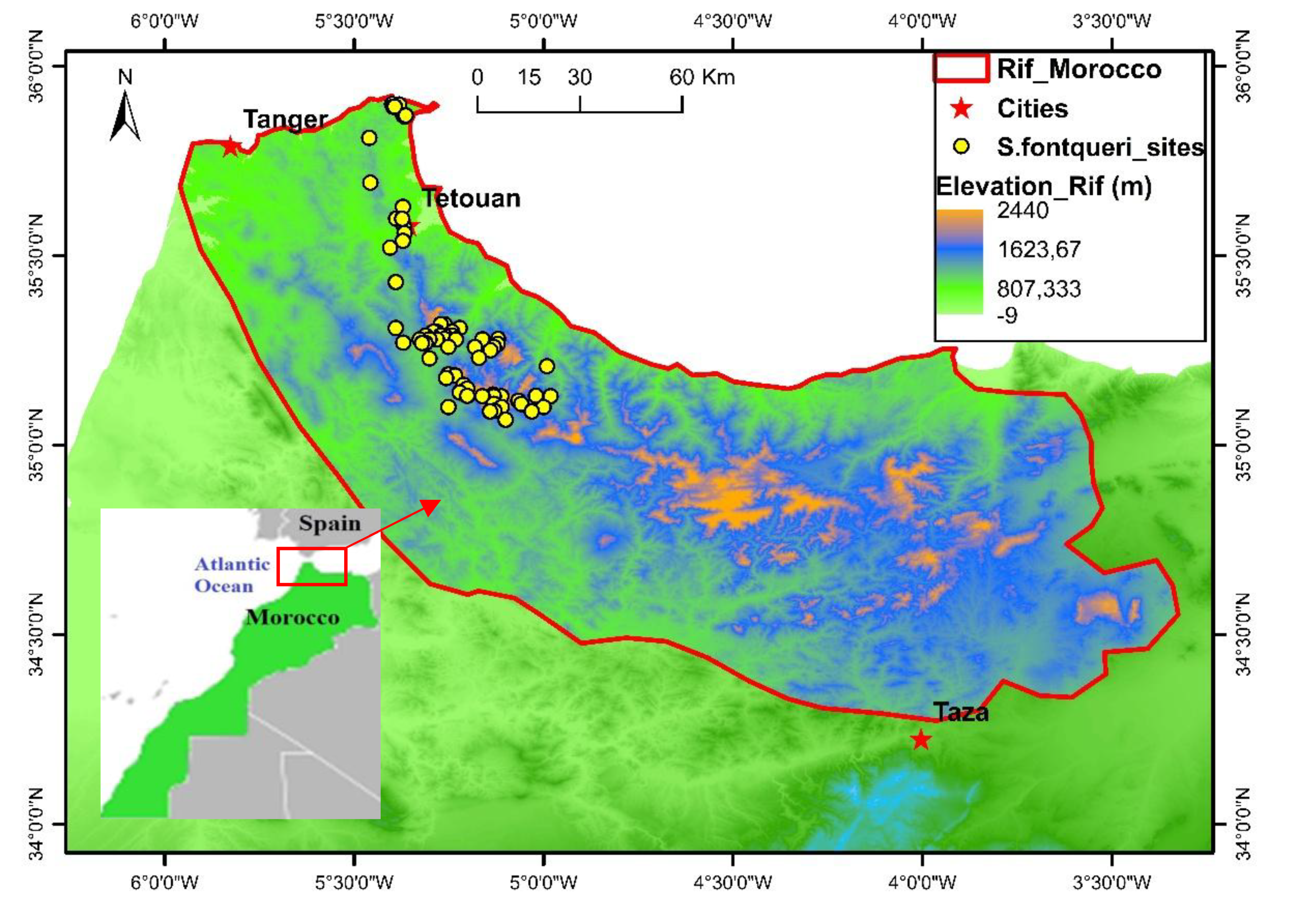
Figure 2.
Natural habitat of Stachys fontqueri: (a) At Jbel Derssa (Northern Morocco); (b) Plant species (b), (a; Photographed by H. Driouech, 23 May 2026, and b; M. Libiad, 19 April 2022).
Figure 2.
Natural habitat of Stachys fontqueri: (a) At Jbel Derssa (Northern Morocco); (b) Plant species (b), (a; Photographed by H. Driouech, 23 May 2026, and b; M. Libiad, 19 April 2022).
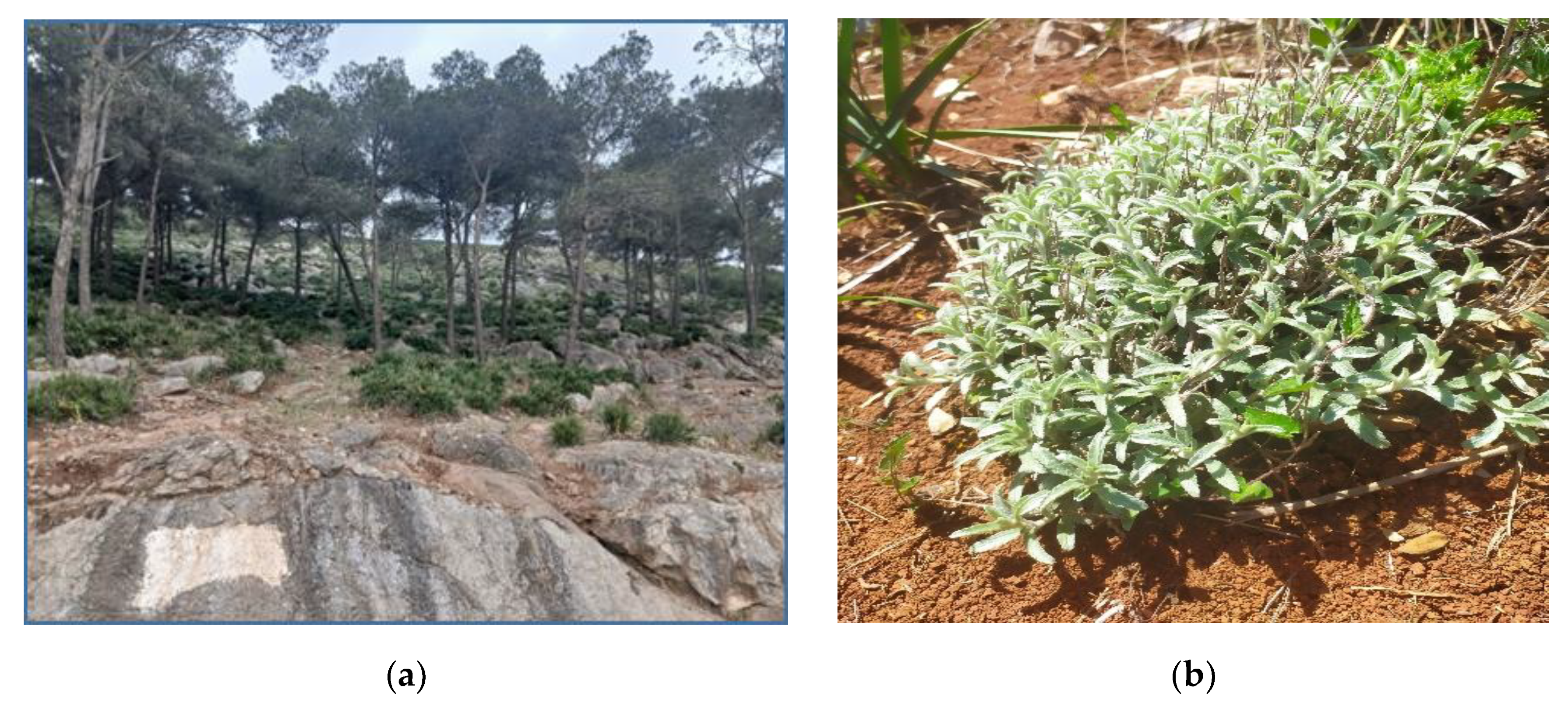
Figure 3.
Potential distribution area of Stachys fontqueri in Moroccan Rif under current climate conditions. Current suitable habitat is represented in yellow, and unsuitable habitat is represented in white.
Figure 3.
Potential distribution area of Stachys fontqueri in Moroccan Rif under current climate conditions. Current suitable habitat is represented in yellow, and unsuitable habitat is represented in white.
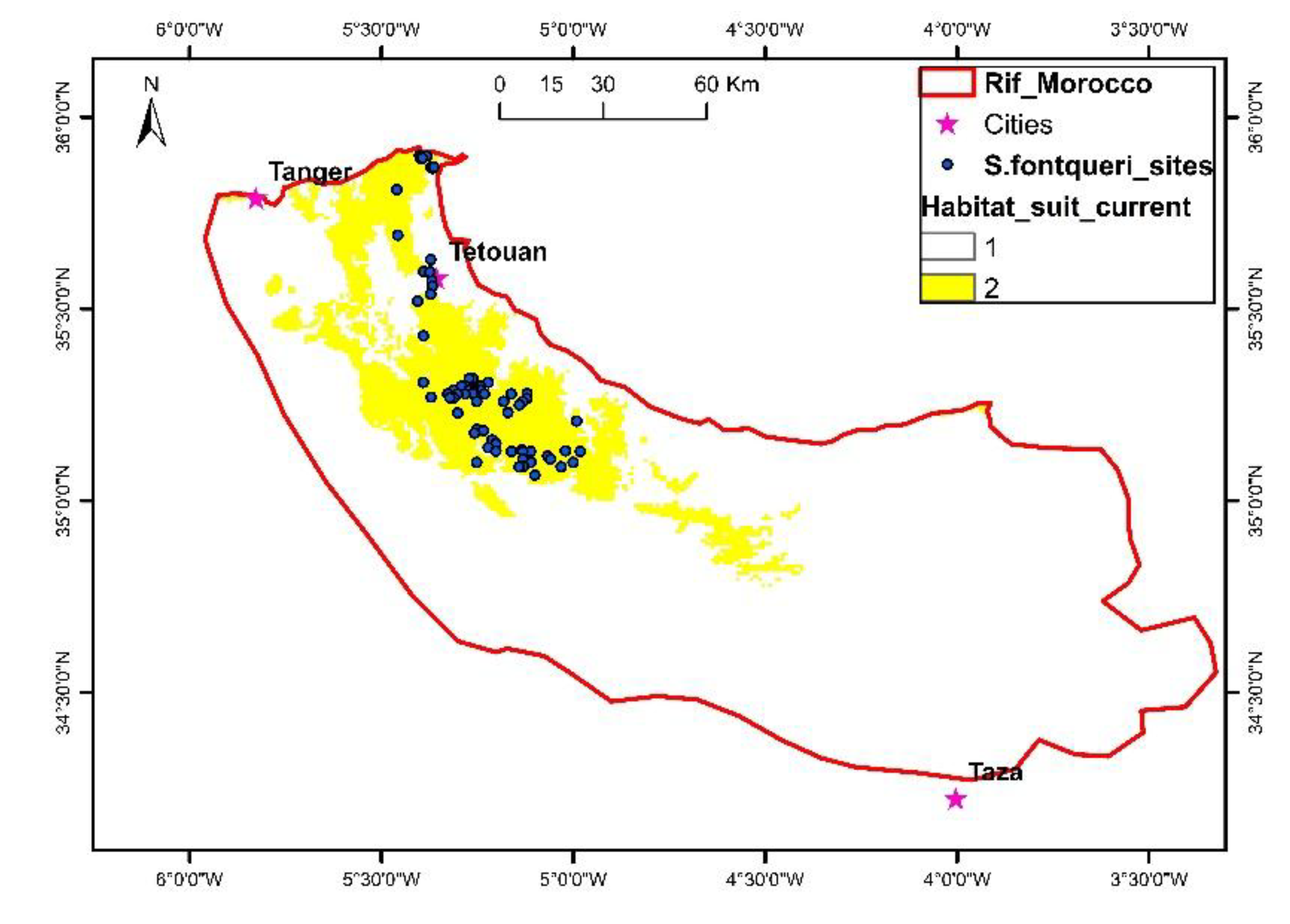
Figure 4.
Potential habitat changes of Stachys fontqueri in Moroccan Rif: (a) Under CSM2-SSP1-2.6 scenario; (b) Under CSM2-SSP5-8.5 scenario; Under MIROC6-SSP1-2.6 scenario; (d) Under MIROC6-SSP5-8.5 scenario. Caption: suitable stable habitat; yellow color, suitable habitat gain; green color, suitable habitat loss; red color, and unsuitable habitat; white color.
Figure 4.
Potential habitat changes of Stachys fontqueri in Moroccan Rif: (a) Under CSM2-SSP1-2.6 scenario; (b) Under CSM2-SSP5-8.5 scenario; Under MIROC6-SSP1-2.6 scenario; (d) Under MIROC6-SSP5-8.5 scenario. Caption: suitable stable habitat; yellow color, suitable habitat gain; green color, suitable habitat loss; red color, and unsuitable habitat; white color.
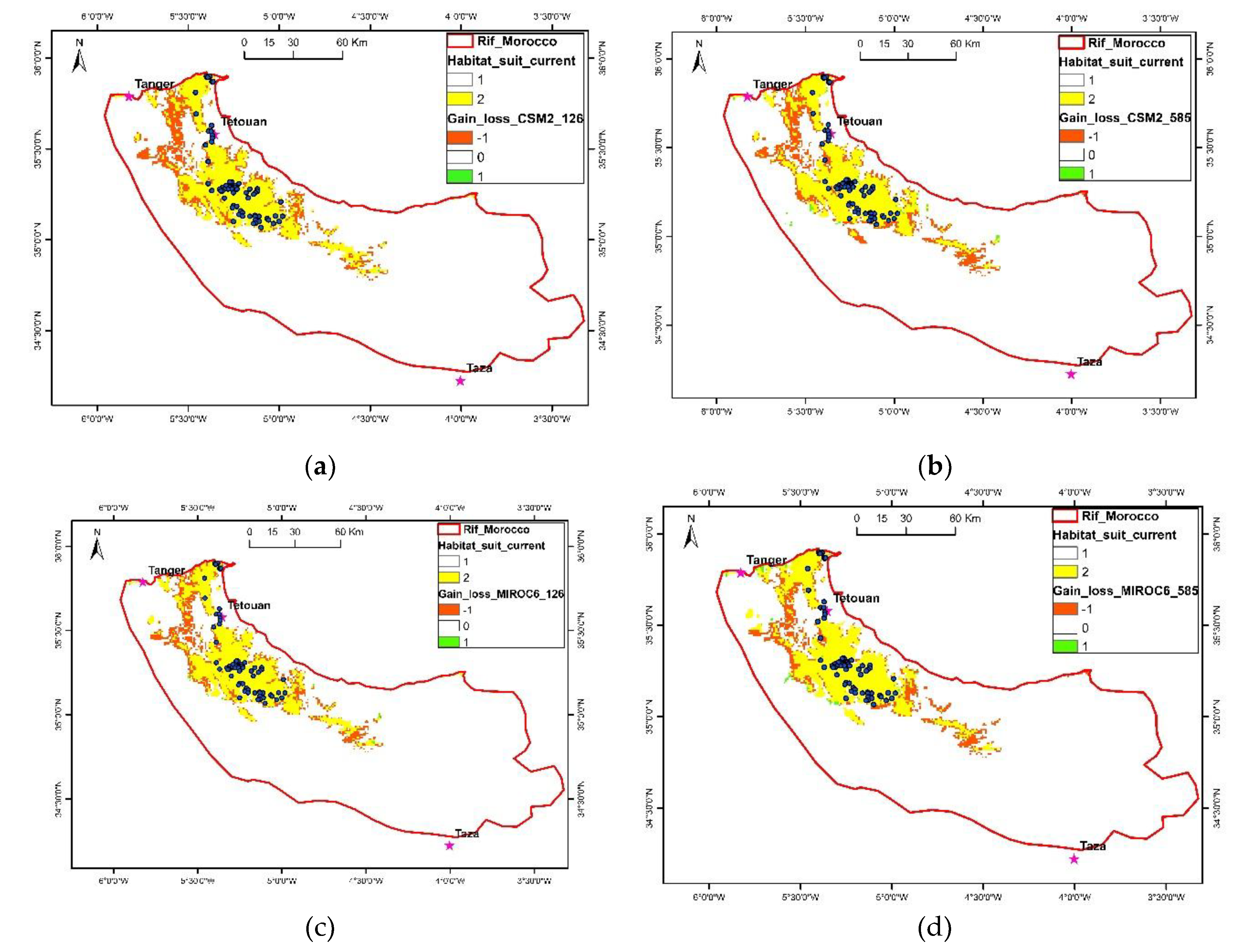

Table 1.
Permutation importance of the bioclimatic variables used to model the potential geographic distribution of Stachys fontqueri in Moroccan Rif.
Table 1.
Permutation importance of the bioclimatic variables used to model the potential geographic distribution of Stachys fontqueri in Moroccan Rif.
| Bioclimatic variables | Current (%) | CSM2-SSP1-2.6 (%) | CSM2-SSP5-8.5 (%) | MIROC6-SSP1-2.6 (%) | MIROC6-SSP5-8.5 (%) |
|---|---|---|---|---|---|
| Annual Mean Temperature (Bio1) | 17.9 | 19.9 | 16.7 | 16.2 | 11.9 |
| Temperature Annual Range (BIO5-BIO6) (Bio7) | 13.7 | 27.3 | 55.8 | 43.6 | 32 |
| Precipitation Seasonality (Bio15) | 61.6 | 38.1 | 9.6 | 28.9 | 43.8 |
| Precipitation of Warmest Quarter (Bio18) | 1.7 | 5.2 | 1.9 | 4.8 | 8.1 |
| Precipitation of Coldest Quarter (Bio19) | 5.1 | 9.6 | 16 | 6.5 | 4.1 |
Table 2.
Probabilities of the suitable and unsuitable habitat area of Stachys fontqueri in Moroccan Rif predicted by the models. Habitat contraction indicated as “% of loss” compared to the current suitable area.
Table 2.
Probabilities of the suitable and unsuitable habitat area of Stachys fontqueri in Moroccan Rif predicted by the models. Habitat contraction indicated as “% of loss” compared to the current suitable area.
| Suitability | Current km2 | CSM2- SSP1-2.6 | CSM2- SSP5-8.5 | MIROC6- SSP1-2.6 | MIROC6- SSP5-8.5 |
|---|---|---|---|---|---|
| MTSPST <P<1 | 3244.3877 km2 | 2287.1922 km2 (Loss: -29.5%) |
2284,313 km2 (Loss: -29.59%) |
2377,154 km2 (Loss: -26.73%) |
2490,146 km2 (Loss: -23.25%) |
| P< MTSPST | 17507,31 km2 | 18464,51 km2 | 18467,39 km2 | 18374,55 km2 | 18261,55 km2 |
Caption: Values of MTSPST: under current climate; 0.2999, under CSM2- SSP1-2.6 scenario; 0.3329, under CSM2- SSP5-8.5 scenario; 0.3294; under MIROC6- SSP1-2.6 scenario; 0.3161, under MIROC6- SSP5-8.5 scenario; 0.3423.
Disclaimer/Publisher’s Note: The statements, opinions and data contained in all publications are solely those of the individual author(s) and contributor(s) and not of MDPI and/or the editor(s). MDPI and/or the editor(s) disclaim responsibility for any injury to people or property resulting from any ideas, methods, instructions or products referred to in the content. |
© 2026 by the authors. Licensee MDPI, Basel, Switzerland. This article is an open access article distributed under the terms and conditions of the Creative Commons Attribution (CC BY) license (http://creativecommons.org/licenses/by/4.0/).
Copyright: This open access article is published under a Creative Commons CC BY 4.0 license, which permit the free download, distribution, and reuse, provided that the author and preprint are cited in any reuse.