
Submitted:
07 July 2026
Posted:
08 July 2026
You are already at the latest version
Abstract
Green buildings (GB) have proven to be an important way to respond to environmental degradation, depletion of resources, climate change caused by rapid urbanization. Due to the increasing rate of urban growth in Nigeria, and the demands for increased infrastructure, there is a growing need to include GB principles in the development of sustainable urban planning. In this study, Nigerian GB Policy Frameworks (GBPFs) are reviewed and analysed concerning their degree of integration within sustainable urban planning. A Narrative Literature Review with systematic elements was using secondary data, including policy documents and international GB standards from 2000 to 2025. The review focused on four primary Nigerian policy documents (the National Building Code (NBC), National Housing Policy (NHP), Energy Efficiency Building Code (EEBC) and the Green Building Council of Nigeria (GBCN)) and provided a comparative analysis between the Nigerian GBPFs and the international frameworks - LEED, BREEAM, EDGE, Green Star and Green Mark. The findings indicate there has been progress in GB construction practices in Nigeria; however, the existing GB policies (GBPs) in Nigeria are largely fragmented, poorly enforced, and poorly integrated into urban planning processes. Institutional overlaps, lack of adequate financial resources, lack of technical capacity, lack of stakeholder engagement and the absence of a nationally sanctioned GB rating system present ongoing barriers to implementation. The comparative analysis indicates that countries which have implemented stronger regulatory frameworks, greater financial incentives, and introduced compulsory certification systems achieve greater success in the integration of GB principles into urban development. The study advocates a legally binding national GB framework that would provide for improved institutional coordination, the provision of financial incentives, the establishment of climate-responsive standards, and robust monitoring mechanisms to support sustainable urban development in Nigeria.
Keywords:
green building
; sustainable urban planning
; policy integration
; National Building Code (NBC)
; Nigeria
; green building framework
1. Introduction
As urbanisation intensifies worldwide, there is a need for cities to evolve in environmentally sustainable ways [1,2]. Green building (GB) and Green Building Policy (GBP) refers to the practice of designing, constructing, and operating buildings in ways that reduces its environmental impacts, enhance occupant well-being, and improve energy and resource efficiency across the entire building’s lifecycle [3]. A Green Building Policy Framework (GBPF) is a regulations of building guidelines-principles, standards, and practice that are integrated and consistent with each other and are aimed at planning, designing, constructing, and maintaining a built environment [4]. The basic idea is to minimize the environmental footprint while promoting resource efficiency and occupant comfort [5]. The concept is grounded on green materials, building performance, life cycle building design and social sustainability in the built environment [6]. Green Building Rating System (GBRS) The concept of GBRS may be described as a system which use independent rating to evaluate the green practice of buildings using life cycle building stage parameters by a GBPF [7]. A high number of parameters is employed for evaluating a building in accordance with a plurality of sustainability scores [8]. Additionally, several country-neutral ratings have been established in response to the socio-economic requirements of diverse nations [9].
The conceptual framework of GB in Nigeria is a vital factor in tackling environmental issues within the built environment [10]. Unegbu [11] said that the problems with the built environment in Nigeria are energy efficiency in buildings and Greenhouse Gas (GHG) emissions. People think that the idea of GB fits with the way Nigerian cities are growing in a sustainable way [12]. Federal Ministry of Works and Housing (FMWH) deals with the construction and building ho new homes for Nigerians [13,14]. Green Building Policy Frameworks (GBPFs) and Green Building Policies (GBP) are a set of rules, laws, strategies, institutions, and standards that affect building plans, processes, and constructions in a way that is good for the environment [15]. GBPFs are policies that help people use building resources in a way that is good for the environment [9]. The policy frameworks of GBPFs encompass building specifications, including material selections, energy conservation, water conservation, and GHG reduction within the building development processes [16]. GBPFs contain the rules that govern the building process in GB, as well as the necessary building provisions [17]. GBPFs can also be seen as a link that connects ecological concerns to the building industry [18,19]. These frameworks remain significant in the development of nations like Nigeria in terms of ensuring a climate-resilient development framework [20]. Nigeria demands the incorporation of GBP into the urban development framework (Atanda & Olukoya, 2019). Nigeria also remains one of the states in Africa that faces significant challenges in the urban sustainability of the country [21]. Some of the urban sustainability challenges in the country include poorly addressed waste management practices in the urban regions of the country [12]. Despite the GBPFs of the Nigerian Energy Efficiency & Green Building Council (NEEBC) and the Nigerian Green Building Council (GBCN) framework, there seems to be a significant lag in the urban plan [22].
This review will try to determine to what extent Nigerian GBPFs have been incorporated into sustainable urban plans. The review will seek to answer these research questions:
- What GBRS have already been adopted in international nations?
- What are the main GBPs in action in Nigeria?
- To what extent are these policies supported by existing urban plans?
Answering these questions, the review aims to search for the gaps and make recommendations concerning the strategic directions for improving the sustainability of Nigerian cities.
2. Materials and Methods
2.1. Research Design
This study adopts a narrative literature review with systematic elements to evaluate the extent to which Nigerian Green Building Policy Frameworks (GBPFs) are integrated into sustainable urban planning. A narrative review was considered appropriate because the subject spans multiple disciplines, including architecture, urban planning, environmental policy, climate governance, and sustainable development. Furthermore, many relevant sources exist in the form of policy documents, government reports, institutional publications, and grey literature that are not always captured in conventional systematic review databases.
To improve transparency and methodological rigor, systematic review procedures were incorporated, including a structured search strategy, predefined inclusion and exclusion criteria, quality assessment analysis. This approach enabled a comprehensive synthesis of both academic literature and policy documents while maintaining analytical flexibility. Mendely cite was used to organize and manage reference which was converted from APA to IEEE reference guide version 11.29.2023 in accordance with journal standards.
2.2. Data Sources and Search Strategy
The review was conducted between January and April 2026 using peer-reviewed literature and policy documents published between 2000 and 2025. The selected timeframe corresponds with the period during which green building concepts, sustainability policies, and climate-responsive urban planning gained increasing attention globally and within Nigeria.
Academic literature was retrieved from major scholarly databases, including:
- Scopus
- Web of Science
- ScienceDirect
- SpringerLink
- Taylor & Francis Online
- Google Scholar
In addition, relevant policy and institutional documents were collected from:
- National Building Code (NBC)
- National Housing Policy
- Energy Efficiency Building Code (EEBC)
- National Adaptation Strategy and Plan of Action on Climate Change for Nigeria (NASPA-CCN)
- Green Building Council of Nigeria (GBCN)
- United Nations Habitat (UN-Habitat)
- World Green Building Council (WGBC)
- International Finance Corporation (IFC)
The search strategy combined keywords and Boolean operators. Examples of search strings included:
- “green building” AND Nigeria
- “green building policy” AND urban planning
- “sustainable urban development” AND Nigeria
- “green building rating system” OR LEED OR BREEAM OR EDGE
- “urban sustainability” AND Africa
- “policy integration” AND “green building”
Truncation and alternative keyword combinations were used where appropriate to maximize retrieval and reduce omission of relevant studies.
2.3. Study Selection Process
Stage 1: Identification
An initial search yielded 347 records from academic databases and institutional repositories.
Stage 2: Screening
About 54 duplicate records were removed, resulting in 293 unique publications. Titles and abstracts were subsequently screened for relevance to green building policies, sustainability governance, urban planning, and implementation frameworks.
Stage 3: Eligibility Assessment
A total of 196 publications were subjected to full-text assessment after 97 records were excluded from the 293 papers during title and abstract screening. Studies that lacked relevance to policy frameworks, urban planning integration, or the Nigerian context were the ones excluded here.
Stage 4: Inclusion
Following the eligibility assessment, 99 sources were further excluded, resulting in 97 sources being included in the final review. These comprised peer-reviewed journal articles, conference papers, policy documents, institutional reports, and international framework publications. Table 1 and Figure 1 explained these stages in summary.
A review flow diagram illustrating the selection process is presented in Figure 1.
2.4. Inclusion and Exclusion Criteria
Studies were selected according to predefined criteria to ensure relevance and consistency.
- Inclusion Criteria
- Published between 2000 and 2025.
- Focused on green building policies, frameworks, standards, or certification systems.
- Addressed sustainable urban planning, environmental governance, or climate-responsive development.
- Examined Nigeria or provided international comparative experiences relevant to developing countries.
- Published in peer-reviewed journals, official policy documents, or reputable institutional reports.
- Exclusion Criteria
- Technical building design studies without policy or planning relevance.
- Studies focused solely on building materials or engineering performance.
- Publications unrelated to urban planning or sustainability governance.
- Editorials, opinion pieces, and non-verifiable online sources.
- Duplicate publications.
2.5. Quality Assessment
To enhance the reliability of the review, all selected sources were subjected to a quality assessment process. Academic articles were evaluated based on publication source, methodological clarity, relevance to the research objectives, and citation credibility. Policy documents were assessed according to institutional authority, policy relevance, implementation significance, and applicability to sustainable urban planning.
Priority was given to peer-reviewed journal articles, official government publications, and reports from internationally recognized organizations. Sources with insufficient methodological transparency or weak relevance to the research questions were excluded.
2.6. Comparative Policy Analysis
A comparative policy analysis was undertaken to benchmark Nigerian green building frameworks against internationally recognized systems, including LEED (United States), BREEAM (United Kingdom), Green Star (South Africa and Australia), EDGE (International Finance Corporation), and Green Mark (Singapore).
The comparison focused on:
- Regulatory enforcement mechanisms.
- Certification requirements.
- Institutional arrangements.
- Financial incentives.
- Urban planning integration.
- Climate responsiveness.
This comparative approach facilitated the identification of transferable lessons and policy opportunities relevant to the Nigerian context.
2.7. Limitations of the Study
The study is limited by its reliance on secondary data sources and the availability of published literature on Nigerian green building policies. Some policy implementation outcomes may not be fully documented in the literature. Furthermore, because the review adopts a narrative approach, the findings depend partly on the interpretation and synthesis of existing evidence. Nevertheless, the inclusion of systematic search procedures, quality assessment, and enhances the reliability and transparency of the review findings. Table 2 presents some sample research articles used in this research in summary.
2.8. Nigeria’s Climatic Diversity and GB Implications
This research is focused on Nigeria owing to the growing rate of urban centers and the varied rate of adoption of GB concepts. Additionally, Nigeria is a diverse country in terms of climate. As a result, this is a critical case study [30]. Nigeria is a country in West Africa that enjoys diverse climates. As a result, Nigeria is divided into different climatic zones. Relating to modern climate classifications, Nigeria is divided into 5 different climatic zones. The zones are:
- Hot and arid Sahelian zone in the north;
- Hot and humid zone in the south;
- Temperate and humid Middle Belt;
- Temperate and dry Northern Plateau; and
- Cool highland zone.
The Sahelian zone includes states such as Borno and Sokoto in the Northern part of Nigeria. Passive cooling is the best GB option in this zone. Passive cooling entails shading, building mass, and reduced glazing. The hot and humid southern zone includes states such as Lagos and Port Harcourt [31]. A hybrid option is necessary in this zone [32]. This option entails better insulations and rainwater harvesting [33]. The Middle Belt includes Abuja, Jos, and other states. Jos Plateau is a highland zone that requires the utilization of solar radiation during the cold season. As a result, GB concepts are applicable to this zone. The diverse climates in Nigeria make a case for a GB policy that is applicable to different zones. As a result, this study supports the argument that a universal GB policy is not applicable to Nigeria [34].
This can be seen in Nigeria’s varying climatic conditions, as depicted in Figure 2. Nigeria has the entire range of tropical climates and can be divided into five major zones of climates. Each zone has unique characteristics in terms of rainfall, temperature, and humidity [36]. This has led to the need to conduct individual zone studies on sustainable and GB practices [35]. In the Sudanian and Sahel savannas, passive-cooling is an integral part of the adaptation and mitigation strategy in Nigeria [37]. This is due to the fact that naturally shaded and ventilated buildings, as well as buildings made of heavyweight materials, will assist in mitigating the heat-stress and provide fascinating cooling strategies ([35,38]. Though, in the Tropical Rainforest Climate zone, buildings has unique characteristics, like the need to use materials suitable for humidity control, like lighter materials [35].
3. Green Building
3.1. Evolution of GBP in Nigeria (2000–Date)
The 1st regulatory development in the built environment in Nigeria was launched with the establishment of the NBC in 2006. The main objective of the NBC was to enhance quality, safety, and sustainable construction works [39]. Although the NBC marked a significant achievement in the built environment, it was not sufficient in addressing sustainability, thus the need to review it [40,41]. Subsequently, various regulatory initiatives in the built environment in Nigeria focused on addressing issues related to the environment [42]. International nations and Non-govental institutions helped Nigeria create the Energy Efficiency Building Code (EEBC) to make buildings more energy efficient and meet global standards for an economy with low emissions [43,44]. The National Adaptation Strategy and Plan of Action on Climate Change for Nigeria 2011 (NASPA-CCN) on global warming also talked about how climate change affects buildings [45]. The Green Building Council of Nigeria (GBCN) was set up in 2010, which was the second most important institutional change [46]. The GBCN’s main goal was to make Nigeria’s built environment more sustainable so that it could meet global standards like BREEAM, LEED, and EDGE [47,48]. The GBCN was created to make the built environment more sustainable, but it didn’t get very far because not many people knew about it [49]. In 2025, people knew more about green certifications, but they still did not have enough resources, governmental or nongovernmental supports [50]. All of these changes show that Nigeria’s builts-paces ought to be more sustainable, which means that they have to be more in line with each other [11,51,52].
3.1.1. Conceptual Framework
It is very important to use building materials that support climate-resilient design. Laterites, bamboo, and adobe are a few construction supplies that have a lot of potential to make buildings more comfortable while also being good for the environment [53]. This potential can lead to better sustainability, lower costs, and more acceptance. It is essential to note, though, that policy frameworks need to be made to allow passive design-based strategies to be effective, as well as reducing global warming by construction supplies [54]. The GBC does not work well in Nigeria because of the country’s different social, economic, and climate conditions [30]. So, GBPFs like the NASPA-CCN, EEBC, and NBC ought to be made. These GBPs significantly influence building practices and contribute to the sustainability of cities by incorporating environmental, social, and economic objectives (Figure 3). This calls for region-specific green design strategies in Nigeria [55]. Adopting context-relevant GBRSs, similar to regional adaptations of LEED, can further support sustainable development across Nigeria.
3.2. Green Building Rating System (GBRS)
GBRS have been defined as “the assessment systems that rate the sustainability of buildings, with a focus on the following categories: indoor environmental quality, energy efficiency, and material utilization” [9]. The scope of the GBRS varies (as shown in Table 3), from global to regional or national, depending on the geographical context in which it is applied. The scope is further varied by the flexibility of the rating systems applied. Various factors are rated by the GBRS in relation to the environmental performance of buildings, and one such important aspect is energy efficiency.
The building sector and its occupant use account for a large share of carbon emissions globally, with the sector also having high emissions density. GBRSs aim to reduce toxic emissions, lessening environmental degradation while improving occupant comfort [62]. Some of the most widely recognized GBRSs around the world include BREEAM and LEED.
3.2.1. Detailed Explanation of BREEAM and LEED GBRS
BREEAM and LEED are two of the most well-known green building rating systems with unique methodologies and sustainability assessment criteria [8,62,63,64]. The methodology of BREEAM, which dates back to 1921 through the British government’s Building Research Establishment, uses a percentage rating system between 30% and 85% and above [58,65], as presented in Table 4. The system is based on the United Kingdom Government’s Standard Assessment Procedure for CO2 emissions and energy costs ratings, with powerful government support and approval of associated software used within the United Kingdom [58].
While LEED follows a points-based rating system, which ranges from 40 to over 80 points, as depicted in Table 4. The most recent edition, LEED v5, indicates a holistic shift to a new paradigm for sustainability, with credits allocated to six major areas, including human health (20%), climate change (35%), the green economy (10%), water resources (15%), community/natural resources (5%) and biodiversity (10%) of particular interest is the recognition of outstanding environmental performance by BREEAM and LEED, where LEED ratings of 80 points or more, denoted by Platinum, and BREEAM ratings of over 100 points, which incorporate renewable energy technologies, indicate a commitment to the global community to enhance innovation and excellence in the field of sustainable building practices [58,64].
3.3. International GBPF
Across the world, GBPFs has been recognized as crucial instrument for ensuring urban development is in line with environmental sustainability goals, like climate-change mitigation [66]. There are many well-known international building assessment tools, such as BREEAM in the UK, Green-Star in Australia, and LEED in the US [67]. These tools have been getting better and better at things like managing materials and water, saving energy, and cutting down on ecological toxins [6]. Different countries have used these tools to make sure that building codes are followed better. Malaysia incorporated statewide GB strategies into urban development in a manner that was supported by the relevant countrywide incentive schemes for compliance [24]. This is similarly seen in South Korea, where the promotion of GB activities was undertaken through comparative analysis for the enforcement of regulations, technological innovation in the adoption process, and collaborations in enforcing international agreements like the Doha amendments and the Kyoto Protocol [68]. Regardless of the disparities in the case of different countries in terms of the adoption of GB strategies in urban development, the main factor in their success lies in their orientation in the country’s urban development framework.
3.4. Nigerian GBPFs
In the case of Nigeria, the application of GB practices is a new trend. At present, the country lacks a mandatory GBC. There have been some documents on the application of GB practices in Nigerian architecture:
- National Adaptation Strategy and Plan of Action on Climate Change (NASPA-CCN) [71]
The comparative analysis in Table 5 shows that Nigeria has several policy instruments that support green building and sustainable development, including the NBC, EEBC, National Housing Policy, NASPA-CCN, and GBCN initiatives. However, these frameworks operate largely in isolation, with weak enforcement, limited institutional coordination, and inadequate integration into urban planning processes. While some policies address energy efficiency, climate resilience, and sustainable housing, none provides a comprehensive and legally binding framework for green building implementation. Consequently, the main challenge is not the absence of policies but the lack of policy integration, effective enforcement, and coordinated governance necessary to mainstream green building practices in Nigerian cities.
Its implementation, however, has been hampered by a lack of political will, enforcement, and awareness [52,73]. Research literature suggests that despite the ratification of international treaties including the Paris agreement and the Kyoto Protocol by the Nigerian government, the country faces challenges in terms of regulatory efficiency, lack of capacity in the required institutions, and inadequately designed financing mechanisms to operationalize GB strategies efficiently [74,75]. There have been recommendations for a Nigerian National Standard for Green Buildings (NNSGB) to reflect the best international practices in the design, material selection, and construction of buildings in a manner in harmony with the Nigerian eco-socio context [76] (Dodo et al., 2014). There have been localized studies to conceptualize the implementation strategies for the application of the framework of green principles to the cities of Abuja to reflect the significance of raising awareness about the program in terms of financial rewards in collaboration with the master plan of the cities [51]. To keep in mind the application of digital innovations in the enhancement of sustainability aspects of the building construction mechanisms in the country related to GB principles in the Nigerian context refers to the evolving trend of utilizing the service of the ‘Green BIM’ tool [77,78] in the Nigerian context to analyze the efficiency of the building in terms of sustainability.
3.5. Gaps and Lessons from Comparative Insights
Contrary to Malaysia and South Korea, the GBPFs in Nigeria are fragmented. This makes the framework less integrated into the urban plan of the country compared to international best practices. The lack of a rating system in the country makes the framework less successful due to a lack of mechanisms for enforcement. This highlights that for a successful GBPF internationally, there is a need for a legal framework in place, governed by urban governance [79].
The following table (i.e. Table 6) summarizes both international and Nigerian GBPF, this indicate the policy framework or the assessment type, the originating country where it is practiced, the purpose of the framework, the implementation status which indicates the area of coverage where the policy or framework is applied, its relevance to urban planning and reference or sources indicating the authors names and the year of its publication.
3.6. International Best Practices in Sustainable Urban Planning
Global best practices in sustainable urban planning demonstrate that integrated policies, stakeholder participation, and adaptive frameworks are central to building resilient and inclusive cities. Across Europe, Asia, and Africa, successful approaches commonly emphasize compact urban form, energy-efficient infrastructure, and coordinated governance. Other nations, like the Netherlands, Italy, and Sweden, use integrated planning tools to link their land use, transport, and energy plans. The Dutch Sustainable City initiates using the back-casting methodology having more than 100 stakeholders, to design long-term spatial integrations and energy saving strategies [84]. In Italy, ISO 14001 certification, sustainability reporting, and Local Agenda 21 have been used to make sure that urban planning and community sustainability are in line with each other [85]. At the city level, energy efficiency has been taken into account in many ways, such as when designing buildings, transportation systems, and green spaces, taking Singapore and Vienna as examples [86,87]. Burgos in Spain has achieved compact urban design with low automobile dependency, leading to improved urban health results [88]. Participatory governance in South Africa and Brazil further illustrates how inclusivity and local knowledge strengthen urban sustainability initiatives [89], while China’s hybrid eco-city models highlight the need to adapt global best practices to local contexts [90]. Table 7 summarizes Nigerian GBPs with global relevance.
It clearly shows that the potential for a Nigerian transition from being a GB policy follower to a GB solution-contributing country. Greater international-local linkage is required. Nigeria can benefit from international best practices in the matters of overall framework coalescence, certifications, and incentive schemes to also export locally developed innovations for improving the malleability of GB frameworks.
4. Sustainable Urban Planning in Nigeria
4.1. Overview of Urban Planning Policy Frameworks
Sustainable urban planning in Nigeria is mostly guided by the Urban and Regional Planning Act, 1992, revised in 2004, which divides responsibilities among federal, state, and local governments [95]. Alongside this act, the National Physical Development Plan and several state master plans theoretically aim at guiding development that is orderly and sensitive to the environment [96]. However, the full provisions of the Federal Planning Law have only been completely integrated into only 11 of Nigeria’s 36 states. This clearly indicates a wide gap in implementation [95,97]. While in theory, national frameworks advance balanced development, zoning, and environmental sustainability, in operation, weak institutional capacity, the duplication of mandates, and a lack of technical know-how at the local level often circumvent progress [11]. This has been evident through sprawl, pressure on infrastructure, and unplanned settlements within Nigeria’s major cities: Lagos, Port Harcourt, and Kano.
4.2. Case Studies of Urban Planning in Practice
Some of the cities in Nigeria that reflect the progress and setbacks in the Many cities in Nigeria that reflect the progress and setbacks in the development of sustainable cities in the country include Lagos [98]. Although the city has a multi-level planning system, there is a wide gap between planning and implementation due to inadequate funds, corruption in the use of land, and lack of enforcement, despite the city’s partnership with other countries of the world [99]. In Port Harcourt, the city’s planners have adequate knowledge about sustainable planning but lack the power to regulate [12]. This city also faces challenges in terms of inadequate infrastructural facilities for sustainable development [100]. Even though Abuja has an articulated master plan, it is facing challenges in terms of informality, inequality, and gentrification, which are all aspects of the recently raised issue of social sustainability in Abuja [101]. Kano, which is one of the fastest-growing cities in Nigeria, is a representation of challenges in terms of rapid urbanization in Nigeria [102]. Even though it has an articulated master plan, rapid development in this city has outgrown its planning capability, leading to urban sprawl, inadequate housing, and inadequate infrastructural facilities [11]. This has led to policy infringement in terms of regulatory policies in this city. As a result, environmental regulations have been infringed upon in this city [103,104,105,106] . Although the city lacks adequate infrastructural facilities, the recent studies on the city reflect the city’s poor ecological protection.
4.3. Major Barriers to Sustainable Urban Planning
Some studies have pointed to the following systemic factors militating against efficient urban planning in the Nigerian environment. Fragmented legal and administrative structure of conflicting responsibilities between the three levels of the Nigerian government [107]. Corruption and speculation in the regime of land allocation and permit schemes (Adisa, 2020). Non-involvement of stakeholders in urban plans and the lack of engagement of the different levels of the Nigerian government in urban plan schemes [29]. Absence or inadequate funds for urban plans in the Nigerian context [11].
4.4. Opportunities and Recommendations
- Despite the challenges, some opportunities exist for the Nigeria urban planning system to align to the sustainability objectives:
- Improve the capabilities of existing institutions: Enact the Urban & Regional Planning Act in all states. Establish well-funded Local Planning Authorities.
- Integrated Data Systems: Enhance spatial and demographic information for planning purposes through the utilization of information technology systems.
- Community inclusion: Use community engagement planning strategies in a manner akin to the Sustainable Cities Programme. This was successful in community problem-solving prioritization [108].
- Policy reform: Align land use, environmental, and infrastructure policies. Also, decentralize the planning powers to make them more responsive.
4.5. Lessons for Nigeria
- In the foregoing international examples, the following transferable lessons have been identified:
- Alignment of the legal and institutional framework: there needs to be clarity in the national plans.
- Public participation and co-design practices promote a sense of localized ownership.
- Multisectoral integration (such as energy + housing + transport) improves resilience.
- Higher urban density and compact urban growth patterns promote less sprawl.
- Monitoring and feedback systems, for example the use of green indicators or sustainability audits.
These strategies differ from the current fragmented approach to urban planning in Nigeria but also offer a guide for possible reforms based on evidence presented in the context of the international best practices (see Table 8 below).
4.6. Weak Enforcement of GBPs in Nigeria
Corruption and weak governance are major entanglements to the enforcement of GB rules in Nigeria [110]. When corruption permeates the public sector, enforcement may be selective, lacking in transparency and accountability [111]. Such policies often become “paper tigers,” existing in name only but with few real teeth. Institutional quality is primarily low, with rent-seeking behavior acting as an impediment in implementing sustainable practices [110]. There are various impediments related to financial issues as well. For example, environmental and urban planning agencies are often underfunded [112]. There is also a lack of capacity and resources on the part of enforcement agencies to monitor compliance, recruit competent personnel, etc. [113] Another problem is that ministries have overlapping responsibilities, which has led to regulatory duplication and conflicts that make it harder to enforce the rules [111,113]. Another big problem is the culture of the institutions. For instance, enforcement agencies often do not have the political will to do their jobs [113]. People are more interested in starting new agencies than making systems that are honest. In some cases, the government has been found to break the laws it makes, which encourages a culture of impunity [30]. Lastly, low levels of public knowledge and professional expertise make it harder to promote green buildings [114]. For instance, developers and even government officials do not know about sustainability standards, which can lead to unintentional noncompliance of GB policies.
5. Result and Discussion
5.1. Key Findings of the Review
The review identified three major findings regarding the integration of Green Building Policy Frameworks (GBPFs) into sustainable urban planning in Nigeria.
5.1.1. Finding 1: Fragmentation of Green Building Policy Frameworks
The analysis revealed that Nigeria possesses several policy instruments that support sustainable building development, including the NBC, the Energy Efficiency Building Code EEBC, the NHP, and the NASPA-CCN [30,40,41,43,71,115]. However, these frameworks operate largely as independent instruments with limited institutional coordination and weak policy integration [11,30,116]. Although each framework addresses specific sustainability objectives, there is no unified national green building framework linking building regulations, climate policies, housing strategies, and urban planning processes [30,76]. Consequently, responsibilities are distributed across multiple institutions, including the FMWH, NESREA, state planning authorities, and the GBCN, resulting in policy overlap and governance fragmentation [13,14,46,107,117].
5.1.2. Finding 2: Weak Enforcement and Implementation Mechanisms
A second major finding is the persistent gap between policy formulation and implementation. While several policies promote environmental sustainability and resource efficiency, enforcement mechanisms remain weak and inconsistent across the country [11,42,52,73,116,118,119]. The NBC and EEBC provide important regulatory guidance, yet compliance remains limited due to inadequate institutional capacity, insufficient technical expertise, weak monitoring systems, and funding constraints [30,44,118]. Evidence from major Nigerian cities, including Lagos, Abuja, Port Harcourt, and Kano, demonstrates that urban growth frequently occurs without adequate sustainability controls, contributing to urban sprawl, infrastructure pressure, and environmental degradation [11,12,95,97].
5.1.3. Finding 3: Absence of a National Green Building Certification and Rating System
The review further revealed that Nigeria lacks a nationally recognized and legally supported green building certification system [30,46,47]. Although international rating systems such as LEED, BREEAM, EDGE, Green Star, and Green Mark have successfully promoted sustainable construction practices globally [8,9,58,62], their adoption within Nigeria remains limited [47,116,118]. Unlike South Africa, Kenya, Malaysia, and Singapore, where certification frameworks are supported through legislation, incentives, and institutional mechanisms [47,67,116,118,120,121], Nigeria continues to rely primarily on voluntary initiatives and awareness campaigns [30,74,118]. The absence of a national certification framework restricts the establishment of measurable sustainability benchmarks and limits the monitoring of environmental performance within the building sector [76].
5.1.4. Finding 4: International Best Practices Highlight the Importance of Integrated Governance
The comparative analysis demonstrated that countries with successful GB transitions share common characteristics, including strong legislative support, institutional coordination, financial incentives, stakeholder engagement, and effective monitoring systems [9,19,20]. South Africa’s Green Star SA framework, Singapore’s Green Mark scheme, and Malaysia’s GBI illustrate how green building policies can be effectively integrated into broader urban development strategies [24,120,122]. These countries have successfully linked building regulations, environmental policies, certification systems, and urban planning objectives within coherent governance frameworks [86,87,88]. In contrast, the Nigerian policy landscape remains fragmented, limiting the integration of GBP into sustainable urban development [11,74,107,123].
5.1.5. Overall Finding
The review concludes that Nigeria’s principal challenge is not the absence of sustainability-related policies, but the lack of an integrated and enforceable framework capable of coordinating green building implementation across the urban development sector. The evidence suggests that stronger institutional coordination, mandatory sustainability standards, enhanced enforcement mechanisms, and the establishment of a national green building certification system are necessary to accelerate the transition toward sustainable and climate-resilient cities in Nigeria [20,30,67,118].
5.2. Discussion
The findings reveal that the primary challenge facing GB development in Nigeria is not the absence of sustainability-related policies but the fragmentation of governance structures responsible for their implementation. Although the NBC, EEBC, NHP, and NASPA-CCN contain provisions that support sustainable development, these frameworks often operate independently and lack effective institutional coordination. This observation is consistent with studies that identify governance fragmentation, weak regulatory enforcement, and limited inter-agency collaboration as major barriers to sustainable building adoption in developing countries [124,125,126,127]. The broader urban sustainability literature further emphasizes that successful GB transitions depend on integrated governance systems that align building regulations, urban planning frameworks, environmental policies, and climate objectives [128,129].
The comparative analysis demonstrates that countries such as South Africa, Kenya, Singapore, and Malaysia have achieved greater progress in green building implementation through coordinated institutional arrangements, legally recognized certification systems, targeted financial incentives, and robust enforcement mechanisms [4,67,130,131,132,133,134]. South Africa’s Green Star certification framework and Kenya’s emerging GBPs illustrate how regulatory support and stakeholder collaboration can accelerate sustainable construction practices, while Singapore’s Green Mark Scheme highlights the effectiveness of mandatory standards and incentive-based approaches in driving market transformation [86,134,135,136,137,138].
These findings also suggest that policy coherence and institutional collaboration are critical determinants of successful green building implementation. In Nigeria, the continued separation of planning, housing, environmental management, and construction regulation has constrained the integration of green building principles into mainstream urban development processes. Consequently, achieving sustainable urban growth will require the establishment of a unified national GBF, stronger regulatory enforcement, climate-responsive building standards, and enhanced collaboration among government agencies, professional bodies, academic institutions, and private-sector stakeholders [76,78,82,139]. Such reforms would align Nigeria’s built environment sector with international best practices and contribute to the achievement of the Sustainable Development Goals (SDGs), particularly SDG 11 (Sustainable Cities and Communities) and SDG 13 (Climate Action) [71,140,141,142,143].
6. Conclusion and Recommendations
6.1. Conclusion
This analysis seeks to assess the present circumstances and incorporation of GBPFs in Nigeria within the broader context of sustainable urban planning. Even though tools like the NBC (2018) [14], the NHP (2016) [13], and other state-level environmental planning laws have helped a lot with making policies, GBP is still broken up and mostly top-down. Comparative studies from South Africa and Kenya have demonstrated that the mainstreaming of GBPs relies on institutional alignment, incentives, and capacity development. Kenya’s green building practice through the Green Building Society shows how important it is to work together to govern, while South Africa’s GBP through Green Star SA is backed by laws and incentives. But Nigeria’s GB efforts are not going well because there is not enough coordination between the government agencies like FMWH, NESREA, and state planning agencies.
The study has shown that it is very important to move toward a policymaking process that is more integrated. To make Nigeria’s green building practices fit with the Paris Agreement and Sustainable Development Goal 11, it is important to combine environmental sustainability with housing and planning policies. Financial incentives like tax breaks, low-interest loans, and approvals, as well as professional training through organisations like the Nigerian Institute of Architects (NIA), the Nigerian Institute of Town Planners (NITP), etc., are very important. Ultimately, it is important to move toward a more comprehensive approach to GB policymaking.
6.2. Recommendations
6.2.1. Policy Recommendations
The results show that Nigeria needs to create a framework to speed up the implementation of GBP. First, there needs to be a binding National GBF that includes the NBC (2018) [14,76], the NHP (2016) [144], and the NASPA-CCN Policy (2021) [71,145]. The framework would be the basis for creating sustainability performance indicators that follow the rules set by SDG 11. The FMWH, the Ministry of Environment, and NESREA would put the framework into action. Secondly, the government could give the private sector incentives to use GBP in Nigeria. The incentives could include things like green tax rebates, low-interest loans, and the Green Construction Fund, which would help green construction projects in Nigeria. The latter would be based on the green tax rebate programs used in Kenya and South Africa [67,131,146,147]. Third, Nigeria needs to improve the skills of its most important groups. The upgrade could be achieved by working with the Nigerian Institute of Architects (NIA), the Nigerian Institute of Town Planners (NITP) [148], and other relevant organizations in Nigeria in collaboration with the World Green Building Council [135]. Fourth, there is a need to enhance enforcement in Nigeria. This can be done by creating a Green Building Compliance and Monitoring Unit, which will be responsible for conducting audits, offering incentives, and imposing penalties. Lastly, the advancement of green buildings in Nigeria can be realized through enhanced cooperation, awareness, and the formulation of policies regarding green buildings in Nigeria. This can be done by embracing globally recognized green building best practices and creating a national research hub on green buildings [135].
6.3. Future Research Direction
Future research should move beyond policy reviews and focus on empirical investigations of green building implementation across Nigerian cities and climatic zones. Studies are needed to evaluate the effectiveness of existing policy frameworks, assess barriers to enforcement, and examine stakeholder perceptions regarding green building adoption. Further research should also explore the feasibility of developing a national green building rating system tailored to Nigeria’s climatic, economic, and socio-cultural conditions. In addition, comparative studies involving other African and developing countries could provide valuable insights into policy integration, governance mechanisms, and incentive structures that support sustainable urban development. Finally, future work should investigate the role of emerging technologies, including BIM, smart city systems, and digital monitoring tools, in enhancing green building performance and policy implementation in Nigeria.
Author Contributions
Mukhtar Sabiu Yahuza is the main author of this paper, with the main idea, concept, and writing the whole article from the beginning to the end, while Assoc. Prof. Dr. Ayten Özsavaş Akçay supervised the work and gave guidance, advice, and edited it to the standard.
Funding
This research received no external funding.
Acknowledgments
I would like to express my deepest gratitude to my father, Hon. Justice Sabiu Yahuza rtd, for his unwavering financial support throughout my academic journey. Special appreciation is also extended to my mother, Haj. Khadijat Sabiu Yahuza, for her constant prayers, encouragement, and moral support, which have been a source of strength and inspiration. The author is profoundly grateful to my beloved wife for her continuous spiritual, emotional, and physical support, patience, and understanding throughout the research and writing process. Sincere appreciation is extended to Associate Professor Dr. Ayten Özsavaş Akçay for her invaluable supervision, academic guidance, constructive feedback, and unwavering support throughout this study. Her expertise and mentorship were instrumental in the successful completion of this work. I also wish to thank Dr. Aminu Jakada for his assistance with proofreading and for his valuable comments, which contributed to improving the quality and clarity of the manuscript. Finally, the author acknowledges all individuals and institutions whose support, encouragement, and contributions directly or indirectly facilitated the completion of this research.
Conflicts of Interest
The authors declare no conflicts of interest.
Abbreviations
The following abbreviations are used in this manuscript:
| GB | Green Building |
| GBPF | Green Building Policy Framework |
| NBC | National Building Code |
| EEBC | Energy Efficiency Building Code |
| GBCN | Green Building Council of Nigeria |
| LEED | Leadership in Energy and Environmental Design |
| BREEAM | Building Research Establishment Environmental Assessment Methodology |
| EDGE | Excellence in Design for Greater Efficiencies |
| NHP | National Housing Policy |
| GBP | Green Building Policy |
| GBRS | Green Building Rating System |
| GHG | Greenhouse Gas |
| FMWH | Federal Ministry of Works and Housing |
| NEEBC | Nigerian Energy Efficiency & Green Building Council |
| NASPA-CCN | National Adaptation Strategy and Plan of Action on Climate Change for Nigeria |
| UN-Habitat | United Nations-Habitat |
| WGBC | World Green Building Council |
| IFC | International Finance Corporation |
| PRISMA | Preferred Reporting Items for Systematic reviews and Meta-Analyses |
| GBCA | Green Building Council of Australia |
| JSBC | Japan Sustainable Building Consortium |
| BCA | Building and Construction Authority |
| EC | Embodied Carbon |
| OC | Operational Carbon |
| NNSGB | Nigerian National Standard for Green Buildings |
| GBI | Green Building Index |
| BIM | Building Information Modelling |
| DIMSUD | Doctoral Program in Interdisciplinary and International Perspectives on Sustainable Urban Development |
| MIT | Massachusetts Institute of Technology |
| ETH | Eidgenössische Technische Hochschule |
| NESREA | National Environmental Standards and Regulations Enforcement Agency |
| SDG | Sustainable Development Goal |
| SA | South Africa |
| NITP | Nigerian Institute of Town Planners |
| NIA | Nigerian Institute of Architects |
References
- A. Kohno, S. Lee, and N. Kondo, “Age-friendly and Environmentally Sustainable Cities and Communities in Japan,” 2026, pp. 1–27. [CrossRef]
- A. N. Qolbi and B. A. Sekti, “Introduction and the Importance of Green Cities,” 2026, pp. 1–32. [CrossRef]
- O. J. Oguntuase and A. Windapo, “Green Bonds and Green Buildings: New Options for Achieving Sustainable Development in Nigeria,” in Green Finance for Sustainable Global Growth , 2021, pp. 193–218. [CrossRef]
- S. M. Sood, K. H. Chua, and L. Y. Peng, “Sustainable Development in the Building Sector: Green Building Framework in Malaysia,” ST-8: Best Practices & SD in Construction, vol. 8, no. 2, pp. 1–8, 2011.
- M. S. Yahuza and Ç. Erçin, “Determination of user’s need and comfort in designing and purchasing green buildings in Kano State, Nigeria,” European Journal of Sustainable Development, vol. 9, no. 3, pp. 127–144, 2020. [CrossRef]
- B. S. Alotaibi et al., “Integrating Renewable-Based Solar Energy into Sustainable and Resilient Urban Furniture Coupled with a Logical Multi-Comparison Study of Cyprus and Saudi Arabia,” 2023.
- M. S. Yahuza and H. Gurdalli, “Learning from Tradition for Future: Green Building in Kano State, Nigeria,” NEU Journal of Faculty of Architecture, vol. 4, no. 2, pp. 31–53, 2023. [CrossRef]
- K. H. D. Tang, C. Y. H. Foo, and I. S. Tan, “A review of the green building rating systems,” IOP Conf. Ser. Mater. Sci. Eng., vol. 943, no. 1, p. 012060, Oct. 2020. [CrossRef]
- D. T. Doan, A. Ghaffarianhoseini, N. Naismith, T. Zhang, A. Ghaffarianhoseini, and J. Tookey, “A critical comparison of green building rating systems,” Build. Environ., vol. 123, pp. 243–260, Oct. 2017. [CrossRef]
- O. Olamide Ilesanmi, A. Emmanuel Oke, J. Aliu, and O. Ruth Oluwaleye, “Post-Occupancy Evaluation for Sustainable Performance of Green Buildings: A Case Study of a Selected Project,” in Sustainable Communities through Digital Transformation, Routledge, 2025, pp. 215–231. [CrossRef]
- H. Unegbu, D. S. Yawas, B. Dan-asabe, and A. A. Alabi, “Sustainable Urban Planning and Development: A Systematic Review of Policies and Practices in Nigeria,” Journal of Sustainable Development Innovations, vol. 1, no. 1, pp. 38–53, 2024. [CrossRef]
- A. J. Echendu, “Urban Planning — ‘It’s All About Sustainability’: Urban Planners’ Conceptualizations of Sustainable Development in Port Harcourt, Nigeria,” International Journal of Sustainable Development and Planning, vol. 15, no. 5, pp. 593–601, Aug. 2020. [CrossRef]
- 13. National Housing Policy, “Federal Republic of Nigeria. Abuja: Federal Ministry of Works and Housing.,” 2016.
- 14. National Building Code (NBC), “Federal Republic of Nigeria: National Building Code. Abuja: Federal Ministry of Works and Housing,” Abuja, Nigeria, 2018.
- M. Hu, K. Zhang, Q. Nguyen, and T. Tasdizen, “The effects of passive design on indoor thermal comfort and energy savings for residential buildings in hot climates: A systematic review,” Urban Clim., vol. 49, no. February, p. 101466, 2023. [CrossRef]
- J. Li and Y. Li, “A mini review of greenhouse gas emissions and mitigation strategies in the building sector,” International Journal of Building Pathology and Adaptation, vol. 44, no. 5, pp. 1302–1328, Jun. 2026. [CrossRef]
- B. S. Alotaibi et al., “Sustainable Green Building Awareness: A Case Study of Kano Integrated with a Representative Comparison of Saudi Arabian Green Construction,” Buildings, vol. 13, no. 9, pp. 1–37, 2023. [CrossRef]
- Z. Li, Y. He, X. Lu, H. Zhao, Z. Zhou, and Y. Cao, “Construction of smart city street landscape big data-driven intelligent system based on industry 4.0,” Comput. Intell. Neurosci., vol. 2021, 2021.
- Y. Li, G. Wang, and J. Zuo, “Assessing Green-Building Policies with Structural Consistency and Behavioral Coherence: A Framework of Effectiveness and Efficiency,” J. Constr. Eng. Manag., vol. 147, no. 11, Nov. 2021. [CrossRef]
- R. Leiringer, S. C. Gottlieb, Y. Fang, and X. Mo, “In search of sustainable construction: the role of building environmental assessment methods as policies enforcing green building,” Construction Management and Economics, vol. 40, no. 2, pp. 104–122, Feb. 2022. [CrossRef]
- E. F. Aransiola, M. O. Daramola, T. V. Ojumu, M. O. Aremu, S. kolawole Layokun, and B. O. Solomon, “Nigerian jatropha curcas oil seeds: Prospect for biodiesel production in Nigeria,” International Journal of Renewable Energy Research, vol. 2, no. 2, pp. 317–325, 2012. [CrossRef]
- H. MATO, Y. H. LABARAN, D. MUKHERJEE, G. SAİNİ, and M. M. FAROUQ, “Achieving Sustainability in Nigerian Households: Investigating Factors Impacting Energy Efficiency Practices,” Journal of Sustainable Construction Materials and Technologies, vol. 8, no. 3, pp. 180–191, Oct. 2023. [CrossRef]
- M. J. Page et al., “The PRISMA 2020 statement: an updated guideline for reporting systematic reviews,” BMJ, p. n71, Mar. 2021. [CrossRef]
- T. S. N. Rachmawati, M. Sari, D. D. Widjaja, and W. T. de Vries, “Navigating Green Building Policies and Incentives: A PRISMA Systematic Review of Trends, Mechanisms, Barriers, and Strategies,” Architecture, vol. 6, no. 1, p. 33, Feb. 2026. [CrossRef]
- A. Alhanouti, “Towards Sustainable Future: Exploring Green Building Initiatives and Strategies for Urban Development: A case study of Gulf Region,” International Journal of Sustainable Rural Development, vol. 1, no. 1, pp. 17–24, Aug. 2024. [CrossRef]
- M. Porcherie et al., “Urban green spaces and cancer: a protocol for a scoping review,” BMJ Open, vol. 8, no. 2, p. e018851, Feb. 2018. [CrossRef]
- J. Affolderbach and C. Schulz, “Green Building as Urban Sustainability Transitions,” 2018, pp. 15–27. [CrossRef]
- N. Zhang and L. Zhao, “A Systematic Literature Review and Research Frontier Analysis of Health Research in Urban Green Space,” Modern Environmental Science and Engineering, vol. 8, no. 4, pp. 214–223, Apr. 2022. [CrossRef]
- A. K. Rasa, “EVALUATING THE ROLE OF STAKEHOLDERS IN IMPLEMENTING GREEN BUILDING SCHEMES FOR SUSTAINABLE URBAN PLANS: INSIGHTS FROM TASHKENT,” The American Journal of Applied Sciences, vol. 5, no. 7, pp. 21–24, Jul. 2023. [CrossRef]
- A. E. Ikudayisi and O. B. Adegun, “Pathways for green building acceleration in fast-growing countries: a case study on Nigeria,” Built Environment Project and Asset Management, vol. 15, no. 3, pp. 450–466, Jun. 2025. [CrossRef]
- D. D. Chiras, The solar house: passive heating in addition which is associated with cooling. Chelsea Green Publishing., 2002.
- D. Al-Shamkhee, A. B. Al-Aasam, A. H. A. Al-Waeli, G. Y. Abusaibaa, and H. Moria, “Passive cooling techniques for ventilation: an updated review,” Renewable Energy and Environmental Sustainability, vol. 7, p. 23, Aug. 2022. [CrossRef]
- C. C. Amos, A. Rahman, F. Karim, and J. M. Gathenya, “A scoping review of roof harvested rainwater usage in urban agriculture: Australia and Kenya in focus,” J. Clean. Prod., vol. 202, pp. 174–190, 2018. [CrossRef]
- O. Oni and D. Akingbohungbe, “Climate change and architectural practice in Nigeria,” Journal of Environment and Earth Science, vol. 3, no. 5, pp. 1–7, 2013.
- D. S. Ragatoa, K. O. Ogunjobi, N. A. B. Klutse, A. A. Okhimamhe, and J. O. Eichie, “A change comparison of heat wave aspects in climatic zones of Nigeria,” Environ. Earth Sci., vol. 78, no. 4, p. 111, Feb. 2019. [CrossRef]
- A. Akinsanola A and K. O. Ogunjobi, “Analysis of Rainfall and Temperature Variability Over Nigeria,” Global Journal of HUMAN-SOCIAL SCIENCE: B Geography, Geo-Sciences, Environmental Disaster Management, vol. 14, no. 3.1, 2014.
- T. Dorcas Mobolade and P. Pourvahidi, “Bioclimatic Approach for Climate Classification of Nigeria,” Sustainability, vol. 12, no. 10, p. 4192, May 2020. [CrossRef]
- D. S. Ragatoa, K. O. Ogunjobi, A. A. Okhimamhe, N. A. Browne Klutse, and B. L. Lamptey, “A predictive study of heat wave characteristics and their spatio-temporal trends in climatic zones of Nigeria,” Model. Earth Syst. Environ., vol. 4, no. 3, pp. 1125–1151, Sep. 2018. [CrossRef]
- A. Sholanke and O. Adisa, “Journal of Accessibility and Design for All,” Journal of Accessibility and Design for All, vol. 15, no. 2, pp. 117–136, Sep. 2008, Accessed: Jun. 11, 2026. [Online]. Available: https://www.jacces.org/index.php/jacces/article/view/630.
- O. M. Adebowale, “The national building code and the construction industry professionals in Nigeria,” International Journal of Social Sciences and Entrepreneurship, vol. 1, no. 12, 2014, [Online]. Available: http://www.ijsse.org.
- D. Dahiru, A. D. Abdulazeez, and M. Abubakar, “An Evaluation of the Adequacy of the National Building Code for Achieving a Sustainable Built Environment in Nigeria,” Research Journal of Environmental and Earth Sciences, vol. 4, no. 10, pp. 857–865, 2012.
- A. E. Oke, J. Aliu, T. M. Akinpelu, O. O. Ilesanmi, and K. T. Alade, “Breaking barriers: Unearthing the hindrances to embracing energy economics principles in Nigerian building projects,” Energy and Built Environment, vol. 6, no. 3, pp. 534–544, Jun. 2025. [CrossRef]
- F. Liu, A. S. Meyer, and J. F. Hogan, “Mainstreaming Building Energy Efficiency Codes in Developing Countries Global Experiences and Lessons from Early Adopters,” 2010. [CrossRef]
- E. M. Erebor, P. S. Nimlyat, H. Emusa, and W. A. Idakwoji, “Energy Efficient Measures In The Development Of The Built Environment In Nigeria: A Review 1*,” International Journal of Innovative Mathematics, Statistics & Energy Policies, vol. 13, no. 2, pp. 133–151, 2025. [CrossRef]
- C. N. Olumba and C. C. Olumba, “Gender and Land Degradation Neutrality (LDN): Evaluating Nigeria’s Legislative Framework for Achieving Gender-Equitable LDN Outcomes,” Land Degrad. Dev., vol. 37, no. 9, pp. 4016–4043, May 2026. [CrossRef]
- R. S. Abdulsalam, S. O. Olawale, and A. H. Nawawi, “Green Building Practice in Nigeria: A Scoping Review and Future Research Needs,” pp. 403–416, 2026. [CrossRef]
- D. O. Nduka and A. S. Sotunbo, “Stakeholders Perception on the Awareness of Green Building Rating Systems and Accruable Benefits in Construction projects in Nigeria.,” Journal of Sustainable Development in Africa, vol. 16, no. 7, pp. 118–130, 2014.
- H. O. Onubi, N. A. Harun, and A. S. Hassan, “Leadership for Sustainability: Understanding How Top Management’s Green Commitment Shapes Organizational Culture and Construction Project Environmental Performance,” J. Constr. Eng. Manag., vol. 152, no. 2, p. 04025258, Feb. 2026. [CrossRef]
- A. Olanrewaju, “Sustainable Construction Management Organisation and Practice,” 2025, pp. 445–478. [CrossRef]
- O. S. Oke, J. O. Aliu, O. M. Duduyegbe, and A. E. Oke, “Assessing Awareness and Adoption of Green Policies and Programs for Sustainable Development: Perspectives from Construction Practitioners in Nigeria,” Sustainability, vol. 17, no. 5, p. 2202, Mar. 2025. [CrossRef]
- H. Unegbu, D. Yawas, B. Dan-asabe, and A. Alabu, “Evaluating the Influence of Green Building Certifications on Construction Practices in Nigeria: A Systematic Review,” Journal of Sustainable Civil Engineering and Technology, vol. 4, no. 1, pp. 19–36, Mar. 2025. [CrossRef]
- A. Ebekozien, M. Ikuabe, A. I. Awo-Osagie, C. Aigbavboa, and S. O. Ayo-Odifiri, “Model for promoting green certification of buildings in developing nations: a case study of Nigeria,” Property Management, vol. 40, no. 1, pp. 118–136, Feb. 2022. [CrossRef]
- S. Barbhuiya, D. Adak, C. Marthong, and J. Forth, “Sustainable solutions for low-cost building: Material innovations for Assam-type house in North-East India,” Case Studies in Construction Materials, vol. 22, p. e04461, Jul. 2025. [CrossRef]
- R. Ergün and A. Bekleyen, “An architectural taxonomic proposal for passive design strategies used in traditional architecture of areas with hot and dry climates,” Journal of Engineering Research, May 2024. [CrossRef]
- M. A. Olawale and M. A. Mohammed, “Refining Nigeria’s climatic zones for sustainable building design applications,” Advances in Building Energy Research, pp. 1–36, May 2026. [CrossRef]
- S. I. Ayegba, “An Integrative Framework for Public-Private Partnership for Affordable Housing Delivery in Nigeria - ProQuest,” Hong Kong University of Science and Technology (Hong Kong), Hong Kong), 2925. Accessed: Jun. 15, 2026. [Online]. Available: https://www.proquest.com/docview/3266812217?pq-origsite=gscholar&fromopenview=true&sourcetype=Dissertations%20&%20Theses.
- C. O. Aigbavboa, J. E. Cobbina, S. O. Ametepey, and W. D. Thwala, “Conceptual Framework for Sustainable Urban Governance and Planning in Sustainable Urban Transformation Implementation in Developing Countries,” in Urban Alchemy: A Governance and Planning Framework for Sustainable Urban Transformation in Developing Economies, Emerald Publishing Limited, 2025, pp. 201–216. [CrossRef]
- BREEAM, “BREEAM Communities Technical Manual-BREEAM Rating Benchmarks: Scoring and Rating,” 2017.
- S. Wirya, M. Salah, and D. Kuzovic, “LEED rating system barriers in the construction sector in Northern Iraq,” Industrija, vol. 45, no. 4, pp. 167–186, 2017. [CrossRef]
- L. W. Shawkat, S. S. M. Al-din, and O. S. Paper, “Leed rating system barriers in the construction sector in Northern Iraq,” vol. 45, no. 4, pp. 167–186, 2017. [CrossRef]
- H. Sirror, S. Dwidar, A. Derbali, A. Abdelsattar, and D. Abdel-Gawad, “Market Transformation Towards Sustainability in Saudi Arabia: A Comparison Between Mostadam And LEED Rating Systems,” IOP Conf. Ser. Earth Environ. Sci., vol. 1026, no. 1, 2022. [CrossRef]
- L. Marchi, E. Antonini, and S. Politi, “Green Building Rating Systems (GBRSs),” Encyclopedia, vol. 1, no. 4, pp. 998–1009, Sep. 2021. [CrossRef]
- A. Shamseldin, “Proposed role of the local Saudi building codes in assessing the energy performance of buildings in KSA’s GBRS,” Ain Shams Engineering Journal, vol. 14, no. 5, p. 101966, 2023. [CrossRef]
- LEED, “WHAT IS LEED?,” Leadership in Energy & Environmental Design. Accessed: Mar. 14, 2021. [Online]. Available: http://leed.usgbc.org/leed.html.
- B. Communities et al., “Scoring and rating,” pp. 4–9, 2015, [Online]. Available: https://www.breeam.com/BREEAMIntNDR2016SchemeDocument/content/03_scoringrating_all/rat_benmks_all.htm.
- B. Wen, N. Musa, C. C. Onn, S. Ramesh, L. Liang, and W. Wang, “Evolution of sustainability in global green building rating tools,” J. Clean. Prod., vol. 259, p. 120912, Jun. 2020. [CrossRef]
- A. O. Idowu, C. Aigbavboa, A. Oke, S. Stephen, and K. Ogundipe, “Green Building Standards and Their Application in Retrofitting Educational Buildings in South Africa.,” ABC2: Journal of Architecture, Building, Construction, and Cities, vol. 2025, no. 01, pp. 68–78, Dec. 2025. [CrossRef]
- O. I. Damak and B. S. Eweade, “Do economic growth, the legal system, and energy consumption lessen the ecological footprint? Evidence from South Korea,” Energy & Environment, vol. 37, no. 3, pp. 1707–1728, May 2026. [CrossRef]
- A. O. Abisuga and T. F. Okuntade, “The Current State of Green Building Development in Nigerian Construction Industry: Policy and Implications,” 2020, pp. 129–146. [CrossRef]
- T. F. Okuntade and O. Abisuga, “Construction defects, envelope degradation and lifecycle carbon implications for building energy performance: evidence from Lagos, Nigeria,” Energy Build., vol. 367, p. 117751, Sep. 2026. [CrossRef]
- R. U. Onyeneke, C. U. Nwajiuba, B. Tegler, and C. A. Nwajiuba, “Evidence-Based Policy Development: National Adaptation Strategy and Plan of Action on Climate Change for Nigeria (NASPA-CCN),” in African Handbook of Climate Change Adaptation, Cham: Springer International Publishing, 2020, pp. 1–18. [CrossRef]
- J. O. Atanda and O. A. P. Olukoya, “Green building standards: Opportunities for Nigeria,” J. Clean. Prod., vol. 227, pp. 366–377, Aug. 2019. [CrossRef]
- M. G. Adeogun, “Green Building Awareness-Implementation Gap Among Built Environment Professionals in Lagos, Nigeria,” Global Scientific Journals, vol. 14, no. 1, pp. 1–12, 2026, [Online]. Available: www.globalscientificjournal.com.
- A. E. Ikudayisi and Y. M. D. Adedeji, “Green Building Projects in Nigeria: The Features and Lessons for Future Project Development,” Journal of Sustainable Technology, vol. 12, no. 1, pp. 105–125, 2023.
- M. Bello Malabu, “Regulatory Governance Challenges in Nigeria’s Renewable Energy Sector: A Study of Policy Instability and Institutional Bureaucracy,” International Journal of Innovative Social Sciences & Humanities Research, vol. 13, no. 4, pp. 373–385, Oct. 2025. [CrossRef]
- Y. A. Dodo, Jibril Danazumi Jibril, Wallace Imoudu Enegbuma, Fai’zah Mohammed Bashir, and Nasiru Idris Medugu, “Nigerian National Standards for Green Buildings: A Legislative Framework.,” IUP Journal of Structural Engineering 7.2 , vol. 7, no. 2, 2014.
- H. Karunathilake, R. Ruparathna, K. Hewage, and R. Sadiq, “Redefining Green Buildings: BIM-Based Framework for Zero Impact Civil Infrastructure,” in Construction Research Congress 2020, Reston, VA: American Society of Civil Engineers, Nov. 2020, pp. 108–119. [CrossRef]
- T. O. Olawumi and D. W. M. Chan, “Green-building information modelling (Green-BIM) assessment framework for evaluating sustainability performance of building projects: a case of Nigeria,” Architectural Engineering and Design Management, vol. 17, no. 5–6, pp. 458–477, Nov. 2021. [CrossRef]
- I. J. Onuoha, S. A. Okeahialam, I. State, and I. State, “COMPARISON STUDY ON GREEN AND SUSTAINABLE BUILDING POLICIES IN DEVELOPED AND DEVELOPING COUNTRIES .,” pp. 1–19, 2012.
- M. Solla et al., “Analysis of BIM-Based Digitising of Green Building Index (GBI): Assessment Method,” Buildings, vol. 12, no. 4, p. 429, Apr. 2022. [CrossRef]
- S. HAN, “Evaluating the Impact of Green Building Policies on Electricity Usage in Public Buildings: Evidence from South Korea,” KDI School of Public Policy and Management, 2025.
- R. M. Ashen, M. N. Rimtip, and M. Y. Davou, “A Framework for Implementing Green Building Practices in Abuja, Nigeria,” East African Scholars Journal of Engineering and Computer Sciences, vol. 7, no. 08, pp. 104–115, Nov. 2024. [CrossRef]
- T. O. Olawumi and D. W. M. Chan, “Key drivers for smart and sustainable practices in the built environment,” Engineering, Construction and Architectural Management, vol. 27, no. 6, pp. 1257–1281, Apr. 2020. [CrossRef]
- T. Dassen, E. Kunseler, and L. M. van Kessenich, “The Sustainable City: An Analytical–Deliberative Approach to Assess Policy in the Context of Sustainable Urban Development,” Sustainable Development, vol. 21, no. 3, pp. 193–205, May 2013. [CrossRef]
- M. Lecca and G. Deplano, “Sustainability and urban planning processes. An integrated tool for sustainable urban management,” in 46th Congress of the European Regional Science Association: “Enlargement, Southern Europe and the Mediterranean,” Volos, Greece: European Regional Science Association (ERSA), Louvain-laNeuve, Aug. 2006, p. 1. Accessed: Jun. 10, 2026. [Online]. Available: chrome-extension://efaidnbmnnnibpcajpcglclefindmkaj/https://www.econstor.eu/bitstream/10419/118496/1/ERSA2006_739.pdf.
- P. Newman, “Green Urbanism and its Application to Singapore,” Environment and Urbanization ASIA, vol. 1, no. 2, pp. 149–170, Sep. 2010. [CrossRef]
- E. Mocca, M. Friesenecker, and Y. Kazepov, “Greening Vienna. The Multi-Level Interplay of Urban Environmental Policy–Making,” Sustainability, vol. 12, no. 4, p. 1577, Feb. 2020. [CrossRef]
- R. Serrano-López, A. Linares-Unamunzaga, and C. Muñoz San Emeterio, “Urban sustainable mobility and planning policies. A Spanish mid-sized city case,” Cities, vol. 95, p. 102356, Dec. 2019. [CrossRef]
- M. Keiner, “Sustainable Development and Urban Management in Developing Countries: The Case of Africa,” in The Real and Virtual Worlds of Spatial Planning, Berlin, Heidelberg: Springer Berlin Heidelberg, 2004, pp. 43–59. [CrossRef]
- A. Hult, “The Circulation of Swedish Urban Sustainability Practices: To China and Back,” Environment and Planning A: Economy and Space, vol. 47, no. 3, pp. 537–553, Mar. 2015. [CrossRef]
- S. Hamza, A. H. Musta’Amal Jamal, and Y. Kamin, “Integration factors of green skills into building construction trade programme in nigeria,” Journal of Technical Education and Training, vol. 12, no. 1 Special Issue, pp. 1–10, Apr. 2020. [CrossRef]
- D. U. Chukwu, H. O. Omeje, G. K. Okereke, B. A. Omeje, A. A. Okekpa, and J. A. Okereke, “Motivators and Inhibitors of Green Building Technology Integration and Advancement: Nigerian Lecturers’ perspective,” Ecology, Environment and Conservation, vol. 28, no. February Supplementary Issue, pp. 62–73, Feb. 2022. [CrossRef]
- P. C. Nwogu and Arinze Emedosi, “Barriers to Green Building Project Implementation and Sustainability in the Nigerian Construction Industry,” International Journal of Progressive Research in Science and Engineering, vol. 5, no. 2, pp. 31–39, 2024, [Online]. Available: www.ijprse.com.
- F. O. Jegede, B. A. Adewale, G. O. Ajonye, and T. Adebajo, “Evaluation of the use of Green Façade in Residential Buildings in Kubwa, Abuja, Nigeria,” IOP Conf. Ser. Mater. Sci. Eng., vol. 1107, no. 1, p. 012185, Apr. 2021. [CrossRef]
- M. Sani and A. Tal, “Urban Design: Energy Efficiency from Vernacular Architecture-Case Study of Kano City Northern Nigeria,” 2022.
- A. Onibokun, “Physical planning within the framework of National Development Planning in Nigeria,” Habitat Int., vol. 9, no. 3–4, pp. 157–177, Jan. 1985. [CrossRef]
- M. Sani, “A review of the Nigerian urban and regional planning law, CAP. 138 LFN of 2004,” Town and Regional Planning, vol. 80, pp. 77–87, Jul. 2022, Accessed: Jun. 11, 2026. [Online]. Available: http://www.scielo.org.za/scielo.php?script=sci_arttext&pid=S2415-04952022000100009&lng=en&nrm=iso&tlng=en.
- E. Offia Ibem, “Challenges of disaster vulnerability reduction in Lagos Megacity Area, Nigeria,” Disaster Prevention and Management: An International Journal, vol. 20, no. 1, pp. 27–40, Feb. 2011. [CrossRef]
- S. Croese, M. Oloko, D. Simon, and S. C. Valencia, “Bringing the Global to the Local: the challenges of multi-level governance for global policy implementation in Africa,” International Journal of Urban Sustainable Development, vol. 13, no. 3, pp. 435–447, Sep. 2021. [CrossRef]
- M. N. Khan, M. A. Khan, S. Khan, and M. M. Khan, “Effect of Air Conditioning on Global Warming and Human Health,” in Modern Age Environmental Problems and their Remediation, Cham: Springer International Publishing, 2018, pp. 83–94. [CrossRef]
- S. A. Ogunsola, “Social Sustainability: Guidelines for Urban Development and Practice in Abuja City, Nigeria.,” dissertation, Nottingham Trent University (United Kingdom), England, Nottingham, 2016. Accessed: Jun. 11, 2026. [Online]. Available: https://www.proquest.com/dissertations-theses/social-sustainability-guidelines-urban/docview/2393123561/se-2.
- S. Y. Mukhtar, Buket Asilsoy, Salih Gücel, and Özge Özden, “The impact of rural-urban migration and its effects on urbanisation in Kano State, Nigeria,” International Journal of Global Environmental Issues, vol. 20, no. 2–4, pp. 22–240, 2022, doi: doi.org/10.1504/IJGENVI.2021.120984.
- I. Mustapha, “Constraints to Sustainable Physical Planning in Metropolitan Kano,” International Journal of Management and Social Sciences Research (IJMSSR), vol. 2, no. 3, pp. 34–42, 2013, [Online]. Available: www.irjcjournals.org.
- S. K. Ibrahim and M. M. Mai, “Effect of Contraventions of Building Regulations on the Quality of Built Environment in Nigeria’s Urban Centers: Case Study of Kano Metropolis,” LAUTECH Journal of Civil and Environmental Studies, vol. 4, no. 1, Mar. 2020. [CrossRef]
- Unah and M. Okopi, “Urbanization and Sustainable Growth of Urban Kano, Nigeria,” IOP Conf. Ser. Earth Environ. Sci., vol. 665, no. 1, p. 012063, Mar. 2021. [CrossRef]
- M. S. Yahuza, B. Asilsoy, S. Gücel, and Ö. Özden, “The impact of rural-urban migration and its effects on urbanisation in Kano State, Nigeria,” International Journal of Global Environmental Issues, vol. 20, no. 2–4, pp. 222–240, 2021. [CrossRef]
- O. Daramola, “Revisiting the Legal Framework of Urban Planning in the Global South,” in Handbook of Research on Sustainable Development and Governance Strategies for Economic Growth in Africa, IGI Global Scientific Publishing , 2018, pp. 258–271. [CrossRef]
- J. U. Ogbazi, “Alternative planning approaches and the sustainable cities programme in Nigeria,” Habitat Int., vol. 40, pp. 109–118, Oct. 2013. [CrossRef]
- A. Akpan Umoh, A. Adefemi, K. Ifeanyi Ibekwe, E. Augustine Etukudoh, V. Ikenna Ilojianya, and Z. Queen Sikhakhane Nwokediegwu, “GREEN ARCHITECTURE AND ENERGY EFFICIENCY: A REVIEW OF INNOVATIVE DESIGN AND CONSTRUCTION TECHNIQUES,” Engineering Science & Technology Journal, vol. 5, no. 1, pp. 185–200, 2024. [CrossRef]
- T. Makinde, “Global Corruption and Governance in Nigeria,” J. Sustain. Dev., vol. 6, no. 8, Jul. 2013. [CrossRef]
- O. J. Olujobi and O. S. Irumekhai, “Inelegant enforcement of anti-corruption laws and good governance: a persistent catalyst for coups d’état and poverty in Africa,” J. Financ. Crime, vol. 32, no. 1, pp. 131–146, Jan. 2025. [CrossRef]
- C. Shimawua, “ACHIEVING SUSTAINABLE ENVIRONMENTAL GOOD GOVERNANCE AND DEVELOPMENT IN NIGERIA: A REVIEW OF INSTITUTIONAL FRAMEWORK AND POLICY CONSIDERATION,” University of Africa Journal of Governance and Politics (UATJOGAP), vol. 2, no. 2, p. 239, 2025.
- J. Rivera-Williams and J. Rivera-Williams, “A Multiple Perspective Analysis on Urban Poverty in Developing Nations: A Case Study on Nigeria, Colonial Implications, and Modern-Day Outcomes,” CMC Senior Theses, Jan. 2025, Accessed: Jun. 14, 2026. [Online]. Available: https://scholarship.claremont.edu/cmc_theses/3784.
- M. S. Yahuza and O. Ozden, “Drivers and barriers of sustainable green buildings in Kano State , Nigeria,” International Journal of Advanced Science and Technology, vol. 29, no. 11, pp. 634–640, 2020.
- D. Dahiru, A. A. Dania, and A. Adejoh, “An Investigation into the Prospects of Green Building Practice in Nigeria An Investigation into the Prospects of Green Building Practice in,” J. Sustain. Dev., vol. 7, no. 6, pp. 158–167, 2018. [CrossRef]
- H. Unegbu, D. Yawas, B. Dan-asabe, and A. Alabu, “Evaluating the Influence of Green Building Certifications on Construction Practices in Nigeria: A Systematic Review,” Journal of Sustainable Civil Engineering and Technology, vol. 4, no. 1, pp. 19–36, Mar. 2025. [CrossRef]
- O. J. Olujobi, O. K. Olarenwaju-Elufowoju, and D. E. Olipede, “A LEGAL FRAMEWORK FOR ACHIEVING NET-ZERO EMISSIONS: PATHWAYS TO ENERGY SUSTAINABILITY AND ENVIRONMENTAL COMPLIANCE IN NIGERIA,” Journal of Sustainable Development Law and Policy, vol. 17, no. 1, pp. 355–379, Dec. 2026. [CrossRef]
- O. S. Oke, J. O. Aliu, O. M. Duduyegbe, and A. E. Oke, “Assessing Awareness and Adoption of Green Policies and Programs for Sustainable Development: Perspectives from Construction Practitioners in Nigeria,” Sustainability 2025, Vol. 17, Page 2202, vol. 17, no. 5, p. 2202, Mar. 2025. [CrossRef]
- M. G. Adeogun, O. A. Alagbe, A. O. Ogunnaike, and S. A. Daramola, “Modelling the Predictive Relationship Between Architects’ Knowledge and Adoption of Green Building Strategies in Lagos Nigeria,” Int. J. Innov. Sci. Res. Technol., p. 1318, Dec. 2025. [CrossRef]
- M. A. Ogungbe, C. O. Aigbavboa, O. E. Ayodeji, and M. O. Ikuabe, “Assessing the Drivers Influencing the Adoption of Green Building Assessment Systems in South Africa,” Nov. 2025. [CrossRef]
- S. Stephen and C. Aigbavboa, “Enhancing Academia–Industry Partnerships for Sustainable Building: A Change Framework for Research and Innovation Integration in Sub-Saharan Africa,” Sustainability, vol. 17, no. 9, p. 3863, Apr. 2025. [CrossRef]
- Hritik Bhatt, Shivani Devkota, and Swati Shah, “Sustainable Urban Planning and Green Infrastructure: A Symbiotic Relationship,” International Journal For Multidisciplinary Research, vol. 6, no. 6, Dec. 2024. [CrossRef]
- O. J. Olujobi, O. K. Olarenwaju-Elufowoju, and D. E. Olipede, “A Legal Framework For Achieving Net-Zero Emissions: Pathways To Energy Sustainability And Environmental Compliance In Nigeria,” Journal of Sustainable Development Law and Policy (The), vol. 17, no. 1, pp. 364–388, Dec. 2025. [CrossRef]
- A. Darko, C. Zhang, and A. P. C. Chan, “Drivers for green building: A review of empirical studies,” Habitat Int., vol. 60, pp. 34–49, 2017. [CrossRef]
- A. Darko, A. P. C. Chan, D. Owusu-manu, and E. E. Ameyaw, “Drivers for implementing green building technologies : An international survey of experts,” Elservier: Journal of Cleaner Production, vol. 145, pp. 386–394, 2017. [CrossRef]
- I. A. Ogundiran, Y. M. D. Adedeji, and O. O. Aluko, “Developing Policy and Regulatory Frameworks to Foster Climate-Adaptive Architecture for Sustainable Development in Nigeria: A Conceptual Approach,” in PROCEEDINGS OF THE 1ST POSTGRADUATE CONFERENCE OF SCHOOL OF ENVIRONMENTAL TECHNOLOGY, THE FEDERAL UNIVERSITY OF TECHNOLOGY, AKURE, NIGERIA, 2025, pp. 122–129.
- T. O. Ogunbode, B. A. Opabunmi, and P. O. Ogungbile, “A systematic review on climate change mitigation efforts in Nigeria,” Discover Applied Sciences, vol. 8, no. 5, p. 518, Apr. 2026. [CrossRef]
- 128. UN-Habitat, “National Urban Policy Programme: Nigeria Country Report. Nairobi: United Nations Human Settlements Programme.,” 2020.
- World Green Building Council (WGBC), “Bringing embodied carbon upfront: Global policy roadmap,” London, 2022.
- Valetine Lindokuhle Mbokane, “The Role of Financial Institutions in Financing Green Buildings in South Africa - ProQuest,” University of Johannesburg, 2025. Accessed: Jun. 14, 2026. [Online]. Available: https://www.proquest.com/docview/3309785200?pq-origsite=gscholar&fromopenview=true&sourcetype=Dissertations%20&%20Theses.
- KGBS, “Kenya Green Building Society | Sustainable Built Environment Starts Here.” Accessed: Jun. 14, 2026. [Online]. Available: https://www.kgbs.co.ke/.
- M. Shahril, R. I. U. Kalu, and J. A. Onyike, “Green and Sustainable Commercial Property Demand in Malaysia and Nigeria,” vol. 7, no. 9, pp. 20–32, 2017.
- GBCA, “Green Building Assessment Criteria - Green Building Council of Australia,” GBCA. Accessed: Jun. 19, 2026. [Online]. Available: https://www.gbca.au/.
- BCA Singapore, “Green Building Assessment Method Building and Construction Authority,” BCA Singapore. Accessed: Jun. 19, 2026. [Online]. Available: https://www1.bca.gov.sg/.
- WGBC, “World Green Building Council ‘WORLDGBC NEED.’” Accessed: Jun. 03, 2007. [Online]. Available: www.worldgbc.org.
- B.-G. Hwang, L. Zhu, and J. T. T. Ming, “Factors Affecting Productivity in Green Building Construction Projects: The Case of Singapore,” Journal of Management in Engineering, vol. 33, no. 3, p. 04016052, 2017. [CrossRef]
- A. O. Windapo, “Examination of green building drivers in the South African construction industry: Economics versus ecology,” Sustainability (Switzerland), vol. 6, no. 9, pp. 6088–6106, 2014. [CrossRef]
- N. Ampofo-anti, “Green Building Handbook for South Africa Chapter : The environmental impacts of construction materials use : a life cycle perspective,” pp. 1–9, 1996.
- P. Dong, “The Applications of Materials, Framework, and Designs in Green Buildings,” Highlights in Science, Engineering and Technology, vol. 10, pp. 149–155, Aug. 2022. [CrossRef]
- M. Al-Surf et al., “Stakeholder’s perspective on green building rating systems in Saudi Arabia: The case of LEED, Mostadam, and the SDGS,” Sustainability (Switzerland), vol. 13, no. 15, 2021. [CrossRef]
- A. Sharifi, Z. Allam, S. E. Bibri, and A. R. Khavarian-Garmsir, “Smart cities and sustainable development goals (SDGs): A systematic literature review of co-benefits and trade-offs,” Cities, vol. 146, p. 104659, Mar. 2024. [CrossRef]
- United-Nations, “The Sustainable Development Goals Report 2020,” 2021.
- BNRCC, “NATIONAL ADAPTATION STRATEGY AND PLAN OF ACTION ON CLIMATE CHANGE FOR NIGERIA (NASPA-CCN),” Nov. 2011. [Online]. Available: www.nestinteractive.org.
- A. F. Ibimilua, “The Nigerian national housing policy in perspective: A critical analysis,” J. Soc. Dev. Afr., vol. 26, no. 2, pp. 165–188, 2011.
- National Climate Change Policy, “Federal Ministry of Environment, Nigeria. ,” 2021.
- S. A. Gebru, “A Comparative Assessment of Federalism and Local Government in Africa: The Cases of Ethiopia, Nigeria, and South Africa,” 2025.
- E. W. Dungumaro, “Socioeconomic differentials and availability of domestic water in South Africa.,” Journal of Physics and Chemistry of the Earth, vol. 32, pp. 1141– 1147, 2007.
- T. J. Aladetohun, I. A. Akerele, O. S. Thomas, A. W. Alli-Balogun, O. G. Oluborode, and A. S. Adeleye, “A Study of Building Collapse in Akungba-Akoko, Ondo State, Nigeria,” International Journal of Research and Innovation in Applied Science, vol. 11, no. 2, pp. 691–699, 2026. [CrossRef]
Figure 1.
Study selection process used in the review. Source: Adapted from the PRISMA 2020 framework for systematic reviews [23,24].
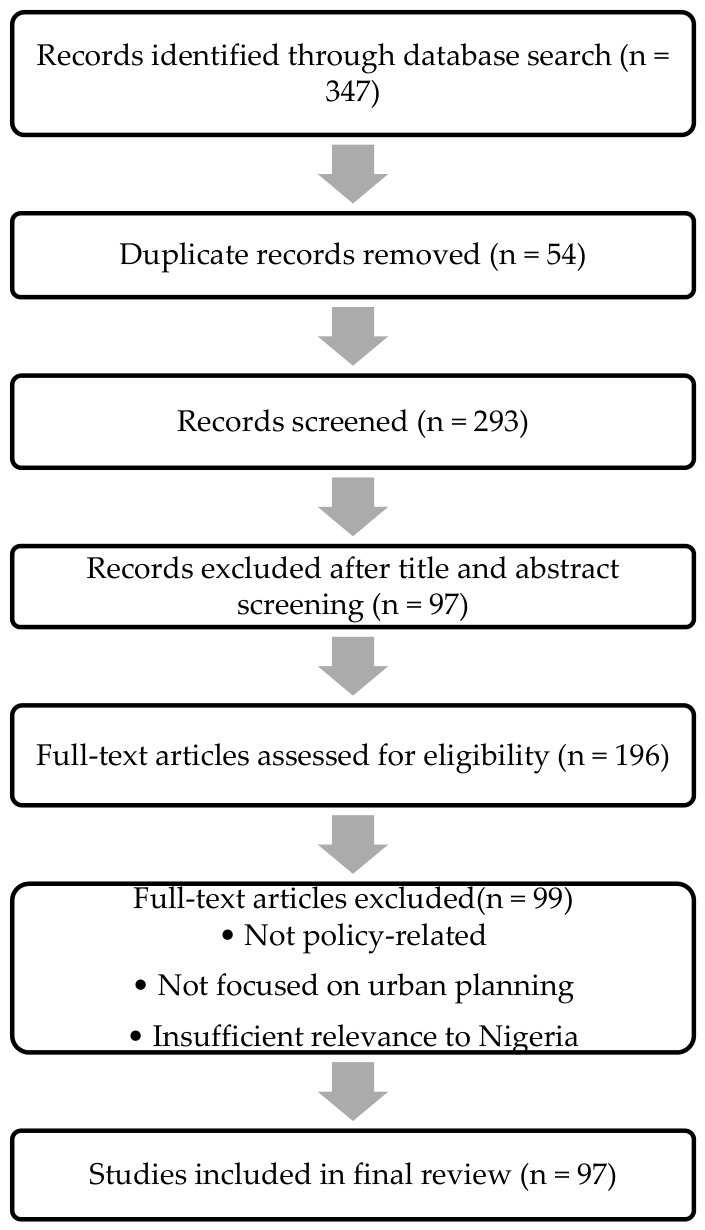
Figure 2.
Climatic zones of Nigeria and their implications for climate-responsive GB design. Source: Adapted from [35,36,37].
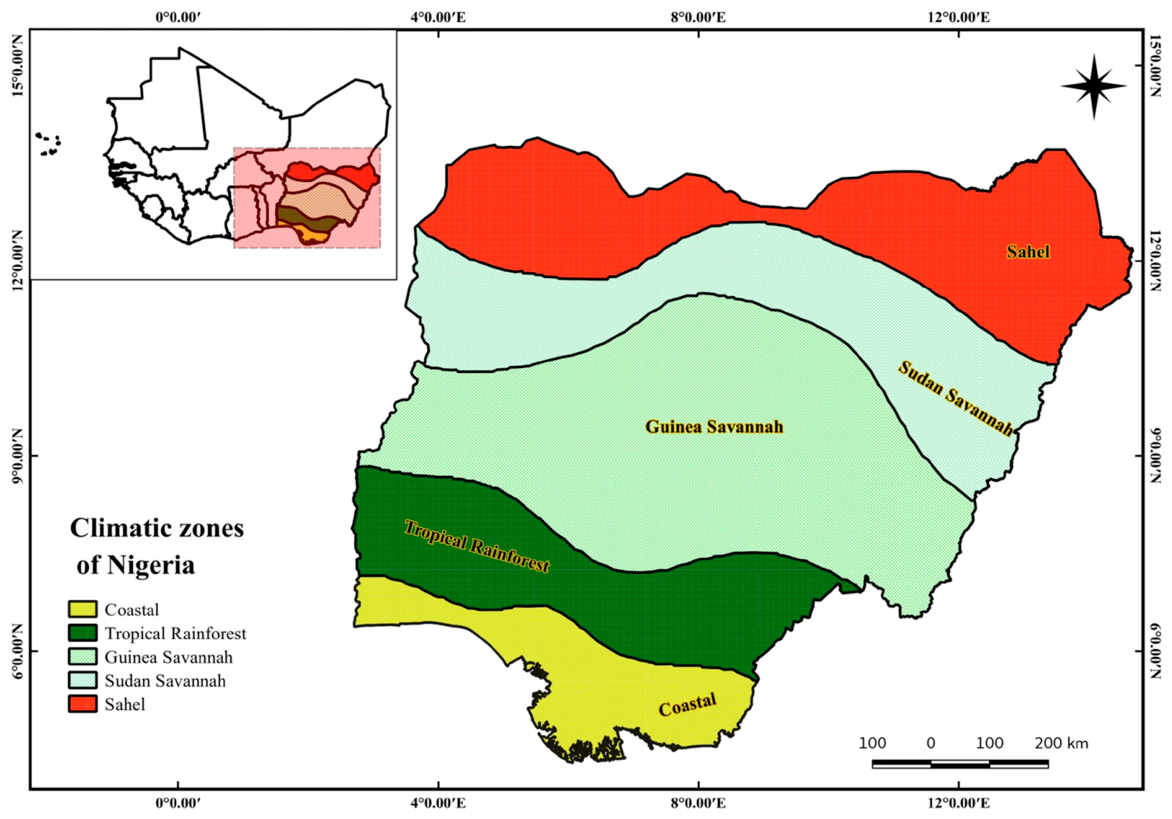
Figure 3.
Conceptual framework showing Nigerian GBPF integrated within sustainable urban planning systems [56,57].
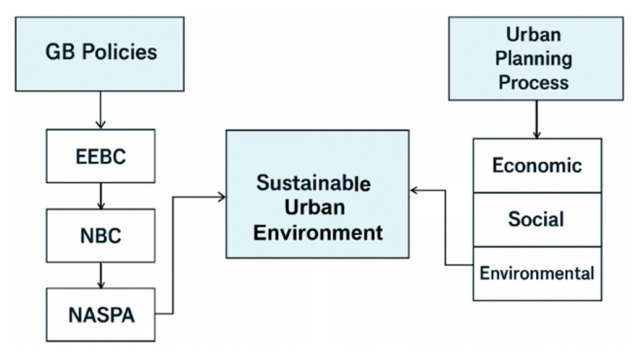

Table 1.
summarizes the study selection process.
| Review Stage | Number of Records |
| Records identified | 347 |
| Duplicates removed | 54 |
| Records screened | 293 |
| Records excluded after title and abstract screening | 97 |
| Full-text articles assessed | 196 |
| Eligibility Assessment | 99 |
| Final studies included | 97 |
Table 2.
Summary of some selected papers used in this research.
| Author(s) | Title | Purpose in Methodology | Method Type | Key Insight/Justification |
| [25] | Towards Sustainable Future: Exploring GB Initiatives… | Justifies narrative review in regional green building | Narrative Review | GB research in developing contexts benefits from flexible review formats that integrate academic + policy perspectives. |
| [26] | Urban Green Spaces and Cancer: A Protocol for a Scoping Review | Informs structured search strategies and criteria | Scoping/Systematic | Demonstrates the importance of using structured databases, inclusion/exclusion criteria, and grey literature in urban health and planning research. |
| [27] | Urban Sustainability and the Governance of Greening | Contextualizes policy integration | Literature Framework | Emphasizes the socio-spatial dynamics of policy mobility in GB transitions. |
| [28] | A systematic literature review and research frontier analysis of health research in urban green space | Supports multi-method integration | Systematic Review | Encourages integrating qualitative and spatial data to evaluate ecosystem services and policy outcomes. |
| [29] | Empirical Planning for Greening Urban Buildings | Validates policy + planning integration framework | Empirical Planning Study | Shows how urban green design frameworks and planning proposals can be quantified, adapted, and scaled based on existing evidence. |
| [29] | Evaluating Stakeholder Roles in GB Implementation | Emphasizes stakeholder integration in policy analysis | Mixed Methods (Lit + Interviews) | Highlights how stakeholder inclusion is critical in policy evaluations and supports broader qualitative analysis frameworks. |
Table 3.
GBRS Scope.
| Rating System | Origin/Developer | Year Established | Key Assessment Categories | Scope | Certification Levels | Notable Features |
| LEED (Leadership in Energy and Environmental Design) | U.S. Green Building Council (USGBC), United States | 1998 | Location and Transportation, Sustainable Sites, Water Efficiency, Energy and Atmosphere, Materials and Resources, Indoor Environmental Quality, Innovation, Regional Priority, Integrative Process | Global (originally North America) | Certified, Silver, Gold, Platinum | Most widely adopted internationally; performance-based metrics; life-cycle assessments; multiple rating systems for different building types |
| BREEAM (Building Research Establishment Environmental Assessment Method) | Building Research Establishment (BRE), United Kingdom | 1990 | Management, Health and Well-being, Energy, Transport, Water, Materials, Waste, Land Use and Ecology, Pollution, Innovation | Global (originally UK/Europe) | Pass, Good, Very Good, Excellent, Outstanding | World’s oldest rating system; emphasis on health and well-being; climate change resilience; comprehensive lifecycle approach |
| EDGE (Excellence in Design for Greater Efficiencies) | International Finance Corporation (IFC), World Bank Group | 2013 | Energy Efficiency, Water Efficiency, Embodied Energy in Materials | Emerging markets globally | EDGE Certified (20% savings), EDGE Advanced (40% savings), Zero Carbon | Simplified and affordable; specifically designed for developing countries; focuses on cost-effective solutions; rapid certification process |
| Green Star | Green Building Council of Australia (GBCA), Australia | 2003 | Management, Indoor Environment Quality, Energy, Transport, Water, Materials, Land Use and Ecology, Emissions, Innovation | Australia and New Zealand (expanding to South Africa) | 4 Star, 5 Star, 6 Star | Tailored to Australian climate and regulations; emphasis on operational performance; strong focus on emissions reduction |
| CASBEE (Comprehensive Assessment System for Built Environment Efficiency) | Japan Sustainable Building Consortium (JSBC), Japan | 2001 | Building Environmental Quality (Q): Indoor Environment, Quality of Service, Outdoor Environment; Building Environmental Load (L): Energy, Resources and Materials, Off-site Environment | Japan and some Asian countries | C (Poor), B- (Fairly Poor), B+ (Good), A (Very Good), S (Excellent) | Unique Building Environmental Efficiency (BEE) ratio; holistic approach to environmental performance; emphasis on harmony with surroundings |
| DGNB (German Sustainable Building Council) | German Sustainable Building Council, Germany | 2009 | Ecological Quality, Economic Quality, Socio-cultural and Functional Quality, Technical Quality, Process Quality, Site Quality | Germany and other European countries | Bronze, Silver, Gold, Platinum | Holistic sustainability assessment; strong emphasis on life-cycle costs; considers entire building lifecycle; performance-based approach |
| Green Building Index (GBI) | Malaysian Institute of Architects and Association of Consulting Engineers Malaysia, Malaysia | 2009 | Energy Efficiency, Indoor Environmental Quality, Sustainable Site Planning and Management, Materials and Resources, Water Efficiency, Innovation | Malaysia | Certified, Silver, Gold, Platinum | Designed for tropical climate; considers local materials and practices; adapted to Malaysian regulations and standards |
| Green Mark | Building and Construction Authority (BCA), Singapore | 2005 | Energy Efficiency, Water Efficiency, Environmental Protection, Indoor Environmental Quality, Other Green Features and Innovation | Singapore (expanding to Southeast Asia) | Certified, Gold, GoldPLUS, Platinum | Mandatory for new buildings in Singapore; strong government support; comprehensive training programs; emphasis on tropical design strategies |
| NABERS (National Australian Built Environment Rating System) | Government of New South Wales, Australia | 1998 | Energy, Water, Waste, Indoor Environment | Australia | 1 Star to 6 Star rating | Performance-based rating using actual operational data; mandatory disclosure for commercial buildings; focuses on operational efficiency rather than design features |
| Living Building Challenge | International Living Future Institute, United States | 2006 | Place, Water, Energy, Health and Happiness, Materials, Equity, Beauty | Global | Petal Certified, Living Certified | Most rigorous sustainability standard; net-positive requirements; emphasis on beauty and inspiration; holistic regenerative approach |
Table 4.
Detailed BREEAM and LEED Comparison Table.
| Aspect | BREEAM | LEED |
| Full Name | Building Research Establishment Environmental Assessment Method | Leadership in Energy and Environmental Design |
| Origin | United Kingdom (British Government) | United States |
| Founding Year | 1990 (BREEAM assessment method) Historical roots: 1921 (Building Research Station established) | Not specified |
| Historical Background | 1921: Building Research Station (BRS) founded to improve housing standards for WWI soldiers- Early focus: reinforced concrete, Britain’s first construction materials standard (bricks)- 1925: Moved to Bucknalls, Hertfordshire (38 acres, Victorian house)- 1927: Forest Products Research Laboratory opened in Buckinghamshire- 1935: Central Fire Testing Station opened in Elstree, Hertfordshire- 1990: BREEAM launched as environmental assessment method | Not provided |
| Global Reach | Most applied environmental assessment standard for buildings, infrastructure, and communities globally | 197,000 LEED-certified projects in 186 countries and territories |
| Current Version | BREEAM 2017 (referenced in text) | LEED v5 (current)LEED v4.1 (previous) |
| Assessment Framework | UK Government’s Standard Assessment Procedure (SAP) for energy efficiency | Framework for healthy, highly efficient spaces with cost savings and ESG benefits |
| Key Indicators | Fabric Energy Efficiency (FEE)- Energy use per unit floor area- SAP energy cost rating- Environmental Impact rating (CO₂ emissions)- Dwelling CO₂ Emission Rate (DER) | LEED v5 Credit Allocation:- 35% Climate change- 20% Human health- 15% Water resources- 10% Biodiversity- 10% Green economy- 5% Community and natural resources |
| Rating Coverage | Energy costs for heating, hot water, ventilation, lighting (minus savings from energy-generating tech) | LEED v4.1 Focus:- Operational carbon- Embodied carbon |
| Rating Scale | 1-100 scale (can exceed 100 with renewables). Higher scores = lower running costs | Points-based system (40-80+ points) |
| Certification Levels | Outstanding: ≥85%; Excellent: ≥70%; Very Good: ≥55%; Good: ≥45%; Pass: ≥30%; Unclassified: <30% | Platinum: ≥80 points; Gold: 60-79.99 points; Silver: 50-59.99 points; Certified: 40-49.99 points |
| Calculation Method | Worksheet format with tables- Aligns with Energy Performance of Buildings Directive (2010/31/EU)- Approved computer programs implement worksheets- Floor-area-adjusted ratings | Quantified criteria including façade thermal transmittance reduction |
| Software Approval | BRE approves SAP software for government-endorsed schemes (Department for Energy and Climate Change, Communities and Local Government, Scottish/Welsh Governments, Northern Ireland Finance) | Not specified |
| Environmental Impact | Environmental Impact rating based on annual CO₂ emissions (heating, hot water, ventilation, lighting) minus emissions saved by energy generation tech | LEED Platinum Breakdown:- 25.1% Embodied Carbon (EC)- 74.9% Operational Carbon (OC)- Combined reduction: up to 61.1% emissions |
| Special Features | Independent of building size (for given form)- Can exceed 100 rating with renewables- Operates timber library at BRE Science Park | - Addresses equity, health, ecosystems, resilience- Moves toward low-carbon future- Strong network driving market transformation |
| Legacy Facilities | BRE Science Park (former Bucknalls estate)- Timber library- Fire testing capabilities | Not specified |
| Regulatory Alignment | Recast Energy Performance of Buildings Directive (2010/31/EU) | Not specified |
Table 5.
Comparative Analysis of Major Nigerian Green Building Policy Frameworks.
| Policy Framework | Legal Status | Enforcement Mechanism | Urban Planning Integration | Climate Change Objectives | Major Weakness |
| National Building Code (NBC, 2018) | National guideline; not fully legally binding across all states | Weak; implementation varies by state | Limited integration with master plans and development control processes | Indirectly addresses sustainability through building standards | Poor enforcement and lack of explicit green building requirements |
| Energy Efficiency Building Code (EEBC) | Sector-specific technical code | Limited implementation and monitoring | Weak connection to urban planning processes | Strong focus on reducing building energy consumption and emissions | Low awareness, voluntary adoption, inadequate technical capacity |
| National Housing Policy (2016) | Federal policy framework | Dependent on state implementation | Moderate integration through housing and urban development strategies | Mentions sustainable housing and resource efficiency | Lacks measurable green building indicators and enforcement mechanisms |
| NASPA-CCN (National Adaptation Strategy and Plan of Action on Climate Change) | National climate adaptation policy | Implemented through sectoral ministries | Indirect integration with urban planning | Strong emphasis on climate adaptation and resilience | Limited translation into building regulations and planning controls |
| Green Building Council of Nigeria (GBCN) | Voluntary professional institution | No regulatory authority | Promotes awareness but not formally embedded in planning approval systems | Promotes sustainable construction and green certification | Limited influence due to absence of legal backing and incentives |
Table 6.
Summary of International and Nigerian GBPF.
| Policy/Framework | Country/Origin | Purpose | Implementation Status | Relevance to Urban Planning | Source |
| LEED (Leadership in Energy and Environmental Design) | USA | Voluntary GB certification focusing on energy, water, materials, and indoor quality | Widely implemented in many countries; globally recognized | Influences city planning codes and sustainability benchmarks | [64] |
| Green Building Index (GBI) | Malaysia | National green rating system offering credits for energy efficiency, water usage, and materials | Actively applied in public and private sectors | Integrated into national urban planning policies | [80] |
| South Korea Climate Agreements Compliance | South Korea | Fulfillment of Kyoto Protocol & Doha Amendments through national greening policies | Strong regulatory compliance and technological integration | Urban greening linked to carbon targets and smart city planning | [81] |
| National Building Code (NBC) | Nigeria | Framework for safe and sustainable construction in Nigeria | Existing but poorly enforced | Has potential to integrate green criteria into development control | [14,69] |
| Energy Efficiency Building Code (EEBC) | Nigeria | Promotes energy conservation in buildings | Developed but lacks widespread adoption | Partially relevant; not yet embedded in most urban plans | [43] |
| GBCN | Nigeria | Advocacy and capacity building for GB practices | Active but lacks regulatory authority | Offers potential as a coordinating body for urban sustainability | [72] |
| Proposed Nigerian National Standard for Green Buildings (NNSGB) | Nigeria | Aimed to unify GB codes and offer clear standards for the built environment | Still at proposal stage | High potential to harmonize GB and planning if adopted | [76] |
| Abuja GB Implementation Framework | Nigeria | Localized roadmap for GB adoption in the capital city | Conceptualized; driven by researchers | Useful pilot model for urban green planning | [82] |
| Green-BIM Framework | Nigeria | Digital model to assess GB sustainability performance | Conceptually tested; limited real-world deployment | Can support urban development approval and sustainability metrics | [83] |
Table 7.
Summary of Nigerian Experience compared with Implications and Global Relevance.
| Topic | Summary of Nigerian Experience | Implications / Global Relevance | Key Sources |
| Capacity and Skills Gaps | Limited integration of GB skills and sustainability principles in technical and professional education constrains effective GB implementation. | Highlights the need for education-driven capacity building common across developing countries. | [91] |
| Policy and Institutional Weaknesses | Fragmented governance and weak state support reduce the effectiveness of GB policies. | International cases show coordinated institutions, incentives, and monitoring frameworks improve adoption. | [79,92] |
| Benefits of GB Adoption | Studies report reduced energy costs, improved health outcomes, and increased asset value from GB adoption. | Aligns with global sustainability goals addressing climate change, resource efficiency, and public health. | [93] |
| Certification and Benchmarks | Adoption of GB certifications (LEED, BREEAM, EDGE) remains low despite proven efficiency gains. | Indicates the need for policy-led incentives to increase certification uptake, as seen in developed countries. | [51] |
| Local Innovation and Global Contribution | Climate-responsive façade designs and localized solutions demonstrate emerging Nigerian innovation in GB practices. | Offers potential for contributing context-specific innovations to global best practices. | [50,94] |
Table 8.
Comparative Analysis of International Best Practices vs. Nigerian Urban Planning Context.
| Dimension | International Best Practice | Current Practice in Nigeria | Identified Gaps |
| Legal & Institutional Framework | Clear, enforceable urban planning laws (e.g., Netherlands, Italy, South Korea) | Urban and Regional Planning Act exists but is poorly implemented in most states | Fragmentation, weak enforcement, limited state adoption [97] |
| Energy-Efficient Infrastructure | Building codes + transport planning integrate energy efficiency (e.g., Singapore, Vienna) | EEBC exists, but limited enforcement; green codes not mandatory | Weak integration of energy policy into planning [109] |
| Urban Density & Design | Compact, mixed-use cities to reduce sprawl and car use (e.g., Burgos, Barcelona) | Urban sprawl prevalent; zoning often ignored in Lagos, Abuja | Poor land use control; sprawl-driven development [88] |
| Public Participation | Participatory planning via community engagement platforms (e.g., South Africa, Brazil) | Top-down planning; community rarely engaged in plan formulation | Low public awareness, weak civic input structures [89] |
| Policy Integration | Transport, energy, housing, and environmental policies interlinked | Siloed ministries; urban plans often disconnected from sustainability or GBCS | Lack of cross-sector planning alignment [84] |
| Monitoring & Evaluation | Use of urban indicators and sustainability audits (e.g., ISO 14001, Green Ratings, Local Agenda 21) | No nationwide performance metrics or monitoring frameworks | Absence of accountability tools or feedback mechanisms [85] |
| Adaptability & Innovation | Localized adaptation of global models (e.g., hybrid eco-cities in China; flexible toolkits in Sweden, Italy) | Attempts to borrow global models without local adaptation (e.g., GBPFs not tailored to local context) | Weak localization of imported frameworks [90] |
| Stakeholder Collaboration | Collaborative platforms between government, academia, private sector (e.g., Netherlands, DIMSUD, MIT/ETH networks) | Weak academia-policy-practice linkage; private sector underleveraged in planning | Poor multi-stakeholder coordination [89] |
Note: DIMSUD → Doctoral Program in Interdisciplinary and International Perspectives on Sustainable Urban Development. MIT → Massachusetts Institute of Technology. ETH → Eidgenössische Technische Hochschule (Swiss Federal Institute of Technology, Zürich).
Disclaimer/Publisher’s Note: The statements, opinions and data contained in all publications are solely those of the individual author(s) and contributor(s) and not of MDPI and/or the editor(s). MDPI and/or the editor(s) disclaim responsibility for any injury to people or property resulting from any ideas, methods, instructions or products referred to in the content. |
© 2026 by the authors. Licensee MDPI, Basel, Switzerland. This article is an open access article distributed under the terms and conditions of the Creative Commons Attribution (CC BY) license (http://creativecommons.org/licenses/by/4.0/).
Copyright: This open access article is published under a Creative Commons CC BY 4.0 license, which permit the free download, distribution, and reuse, provided that the author and preprint are cited in any reuse.


