

Submitted:
07 July 2026
Posted:
08 July 2026
You are already at the latest version
Abstract
We introduce a novel, non-Cantorian framework for transfinite mathematics by embedding the hierarchy of ordinal numbers into a structured class \( \mathcal{D}^+ \) of \emph{definitely nonzero} hyperreal sequences. Within this algebraic setting, the countable ordinals are embedded, but hyperreals possess distinct asymptotic growth rates that algebraic operations can fully capture. This approach provides a unification of the different types of mathematical infinities, from Leibniz's differentials and Euler's infinity, on which he discovered the exponential series, to the asymptotic infinities of Landau notation and Hardy fields, up to Cantor's ordinals and cardinals, and Robinson's hyperreals of non-standard analysis. A theorem about the relationship between differentials and continuum is proved, and the implication of this result for non-Cantorian sets is discussed.
Keywords:
hyperreal numbers
; non-standard analysis
; asymptotic analysis
; ordinal
; cardinal numbers
; continuum hypothesis
1. Introduction
In a previous paper devoted to a constructive foundation of differential calculus [28], we introduced a definition of infinitesimals based on the notion of infinite sequences of real numbers equipped with properties and relations that hold on them definitely. Namely, a standard property P holds definitely on a sequence if there exists a threshold such that is true for all . In particular, a sequence is an infinitesimal if it is either definitively zero or definitively nonzero in absolute value, while being definitively less than any positive real number.
Two sequences satisfy a definitive strict majorization if, after some finite index, the elements of the first sequence remain strictly less than the corresponding elements of the second one. Analogously, we state that two sequences are definitively equal if their elements coincide definitively after some index. Within this framework, an infinitesimal emerges as an equivalence class of nonzero infinitesimal sequences of real numbers under definitive identity. These concepts enable a rigorous foundation of differential calculus based on Landau O-notation and Hardy fields, where calculus reduces to an algebraic framework within a non-Archimedean field of hyperreals , which stands as a constructive version of Robinson’s non-standard analysis. The elements of this field extend the real numbers with infinitesimals and their inverses, infinities. In [28], the logical coherence of Leibnizian notation was completely clarified, and classical intuitions regarding infinite processes in the formalization of physical phenomena were shown to fit naturally within this hyperreal formulation of differentials.
In the present work, we show that inside the constructive world of , diverse mathematical concepts and theories converge seamlessly, uncovering profound connections between real analysis, asymptotic orders, Cantor’s ordinals, and non-standard analysis.
Cantor’s original intuition relied on two foundational pillars: the ordering of the transfinite enumerative process and the equivalence of classes that can be put in a one-to-one correspondence. Building on these ideas, he developed set theory as an architecture of classes of points—distinct elements stripped of specific singular properties. Here, we find that the structure of ordinal enumeration can be reconstructed on a radically different notion of set based on sequences, where standard cardinality is replaced by an intrinsic size measure termed growth or expansion. A Galois connection is rigorously established between these two notions of sets, revealing how the static ordering of inclusion maps onto the dynamic ordering of asymptotic trajectories.
Furthermore, a fundamental relationship between differentials and the continuum is uncovered through the asymptotic formulation of Leibniz’s . Crucially, we demonstrate that such a differential has the same cardinality as the real line. This vision opens entirely new avenues in the analysis of the continuum, relating it to the cardinality of hyperreals, and pointing toward the possibility of considering multiple resolution levels, from which the non-categoricity of mathematical infinities naturally emerges.
In recent years, the recognized inadequacy of the standard Cantorian paradigm in capturing the structural and metric nuances of the transfinite has led to alternative foundational proposals. A notable attempt is found in the numerical methodology of the "Grossone" [33], which revisits classical paradoxes of infinity by introducing an axiomatic, positionally fixed infinite unit to achieve an absolute arithmetic counter.
Our approach via the hyperreal algebra establishes a fundamentally different paradigm. Rather than introducing a rigid arithmetic counter, it unifies the various notions of mathematical infinity within a broader, dynamic framework, enriching their individual perspectives.
2. The Field of Definitely Nonzero Sequences
A sequence of real numbers is said to be definitively nonzero (DNS) if there exists an index such that for all .
Following [28], for any variable x over the real numbers, we define its local differential by the sequence:
where is either definitely zero or a real-valued sequence depending on the macro-coordinate x and the index n, which is a higher-order infinitesimal with respect to the baseline step ; that is, is infinitesimal. We denote by or the infinitesimal interval centered at x with diameter . Following Robinson’s terminology in non-standard analysis, we refer to as the monad of x, a concept rooted directly in Leibniz’s philosophical foundations.
The term must be interpreted as a secondary localization function. Its intrinsic dependence on the macro-coordinate x reflects a topological adaptability. When the scanning point x encounters geometric singularities — such as cusps, angular points, or conical vertices — the localization function dynamically calibrates the sub-microscopic scanning step .
The definition above of was the starting point for answering a question about a crucial notation. Why did Leibniz introduce it? Surely, his intuition of a differential should require an explicit dependence on x, which extends to the whole notation of differential concepts. The analysis developed in [28] shows the exact logic of notations . For example, there is a specific reason in the notation , for the second derivative, for having the exponent 2 referred to d in the numerator, while to in the denominator [28]. Derivatives are ratios of infinitesimals, reducing all the differential calculus to algebraic operations in the algebra of differentials.
Given a differentiable function , the f-dependent differential is defined by:
Both and are infinitesimal sequences, definitely smaller, in absolute value, than any real positive number. We refer to them as d-sequences. The algebraic inverse of a d-sequence is an infinite sequence, which is definitely greater, in absolute value, than any positive real number. Within this framework, the fundamental generating infinitesimal is the sequence , while the fundamental infinite generator is denoted by .
Various equivalence relations can be naturally established over the space of d-sequences. For instance, two sequences and satisfy if the asymptotic ratio is bounded by a positive real number, or if their difference is a infinitesimal with respect to both of them.
The family of definitely nonzero sequences over the field of real numbers extends by pointwise extending standard algebraic operations. The hyperreal algebra of the constructive hyperreals is formally defined as the inductive closure of this extension with respect to the DNS property. Namely, if for all , and the sequence is a DNS, then . The notions of Infinitesimal and infinite sequences extend to : a sequence is infinitesimal if, for any positive real number a, it is definitively smaller than a in absolute value ( for all ). Conversely, is infinite if it corresponds to the algebraic inverse of an infinitesimal element of .
A sequence will be shortly denoted by:
intending that index takes values over the set of natural numbers. If * is an operation in the field () and , then:
If c is a real number, then:
This means that the elements of the real field are treated as constant sequences (with the same value at all positions of the sequence). Let:
Then:
Theorem 1.
For any natural numbers , the infinite hyperreals of is ordered in the following way, according to the definitive order on sequences:
Proof.
Let . To establish the validity of the chain (3) within the algebra, we analyze the relations term-by-term along the baseline as the scansion index n advances:
- 1.
-
The Finite-to-Transfinite Threshold (): Consider the fixed finite integer i. The relation translates to the sequence-level comparison:For any chosen i, the inequality holds for all indices . Since this condition is satisfied definitively on , we obtain the definitive hyperreal inequality .
- 2.
-
The Linear Shift (): Evaluating the algebraic addition of the finite constant m to the foundational seed, we obtain the shifted trajectory:Since holds for every , the sequence is strictly majorized by at every single coordinate. Thus, holds definitely.
- 3.
-
The Scale Multiplication (): We now compare the linearly shifted sequence with the multi-scale magnification . For any chosen , the pointwise inequality holds if , which is satisfied for all indices:Since m and k are fixed finite constants, this condition holds definitively on , guaranteeing that in .
- 4.
-
The Polynomial Leap (): We address the transition from linear multiplication to the polynomial power with . The pointwise inequality is equivalent to , which holds true for all indices satisfying:Consequently, the components of definitely majorize those of , establishing that .
- 5.
-
The Exponential Transcendence (): Finally, we evaluate the step toward the hyper-bound . The pointwise relation is strictly verified at the component level as soon as the dynamic scansion index n outpaces the fixed polynomial degree j:Since j is a fixed finite integer, the condition is satisfied definitively for all terminal indices of the sequence. This ensures the strict dominance within .
□
3. Rigorizing Euler’s Exponential Proof via
To demonstrate the foundational robustness of the theory of constructive hyperreals and its alignment with the intuitive roots of non-standard analysis, we present a formal rigorization of Leonhard Euler’s 1748 derivation of the exponential series. In his seminal work Introductio in analysin infinitorum (1748), Euler introduced an infinitely large integer i to expand via the binomial theorem—an approach historically dismissed as a formal heuristic due to the lack of a sound algebraic framework for transfinite numbers. Within the framework of constructive hyperreals , Euler’s infinitely large integer is rigorously instantiated by the fundamental sequential seed .
3.1. Euler’s Original Argument
Euler began by defining the exponential function as a limit-free power with an infinitely small increment [15]. Let x be a finite real number, and let i be an infinitely large integer. He defined an infinitely small quantity , such that the exponential base a satisfies , where is likewise infinitely small. By setting the natural base such that , the value of is expressed as the transfinite power:
Euler then applied the standard binomial expansion to this infinite exponent i:
By simplifying the algebraic coefficients, he observed that:
Since i is an infinitely large integer, Euler asserted that the fractions vanish identically, causing all product coefficients to collapse strictly to 1. This formal substitution yielded the immortal Taylor series for the exponential function:
This proof was considered unreliable, and proofs were given in classical Cauchy-Weierstrass style, which are longer and less intuitive. However, in the algebra of hyperreals, we can reproduce exactly the passages of Euler by replacing i by . The key point, in the corresponding hyperreal proof, is that the coefficients:
Where is an infinitesimal, therefore the thesis follows from the fact that in the hyperreal calculus, a real number plus an infinitesimal is definitely equal to the number. Namely, this principle, which we call Macroscopic Infinitesimal Anulment (MIA), requires that the sum of a real number R plus any infinitesimal sequence is equal to R:
Which corresponds to Robinson’s operator of non-standard analysis [31], or to the Shadow operator in Nelson’s formulation [28,29].
This transition highlights the immense operational utility of the framework: the transcendental function emerges as the absolute finite core, while the residual quantity is not an abstract limit envelope, but a perfectly quantified scale-invariant infinitesimal. When evaluated in the hyperreal setting, Euler’s identity appears, giving, before the Taylor-Maclaurin theorem, the famous series for .
In [28], it was shown that Leibniz’s differential notation can be completely and rigorously motivated, by concluding that Leibniz was “ab omni naevo vindicatus”. Here we can conclude that the spectacular methods elaborated by Euler in his “Introductio in Analysin in Infinitorum” result in an anticipation of hyperreal algebra. Therefore, we can analogously assert that Euler can also be “ab omni naevo vindicatus”.
4. Ordinal as Hyperreals
The sequence of Cantor’s ordinals can be generated, according to von Neumann’s formulation, by starting from the empty set ∅, which identifies zero, by using the operation , where ∪ is set union and is the singleton set having the element between the braces as its only member:
The ordinal , which corresponds to the set of natural numbers, is generated by all the finite iterations of von Neumann’s :
Then:
And . Therefore, from the following sequence is generated:
The process is endless, continuing by:
Where is the exponential tower with exponents. In this formalization the ordering < coincides with the set inclusion ⊂ and also with the set memebrship ∈
Now, if we use the infinite hyperreals, introduced in the previous section, and iterate the same mechanism for defining , we set:
This ordering gives exactly the ordering of ordinals, where infinite hyperreals play the role of ordinals, with corresponding to , and the definitive order between sequences replacing the inclusion between ordinals.
5. Hyperreals as Growth Orders
In the previous section, the strong relationship between Cantor’s ordinals and hyperreals was evidenced. Here, we show the intrinsic connection that transfinite hyperreals have with the asymptotic growth orders investigated by Paul du Bois-Reymond, along a mathematical line arriving up to computer science [2,5,6,7,17,18,21,22,24,32,35].
5.1. Hardy Fields
A Hardy Field is an algebraic structure that formalizes the asymptotic growth of functions by avoiding the problem of oscillatory functional behaviors, such as , that prevent the possibility of a strict ordering.
Formally, a Hardy field is a subset of the ring of differentiable real functions. It is closed with respect to the usual algebraic operations, every nonzero element has an inverse, and it is closed under derivation.
Every function of is definitely positive or negative, or null, and its derivative keeps this property. Hence, it is definitely monotone. This fact ensures that any function has a limit (finite, infinite, or infinitesimal), and a Hardy field is totally ordered by its definitive ordering.
The class ( of the Logarithmic-Exponential functions was introduced by G. H. Hardy in his famous paper [17] and is obtained starting from real constants and the identity function by applying the algebraic operations (), powers and roots, exponential and logarithmic functions. The central theorem of Hardy’s theory is the following theorem.
Theorem 2
(Hardy’s Total Ordering Theorem). Let f and g be two logarithmico-exponential functions (-functions) that are not identically zero. Then, their asymptotic orders of magnitude as are always totally ordered.
In formal terms, given the germs of , exactly one of the following three asymptotic dominance relations must hold:
- (f is of a lower order than g):
- (f is of a higher order than g):
- (f and g have the same order of magnitude):
This theorem guarantees that the set of orders of infinites (and of infinitesimals) for -functions contains no incomparable elements. If we restrict to the set of natural numbers, the growth order of any function in the LE class provides the hyperreal number :
Therefore, asymptotic ordering in the class of functions LE remains the same among the corresponding hyperreal numbers.
The exact linear hierarchy of asymptotic infinities and their dual symmetric infinitesimals is structured into infinite levels. We summarize the principal scaling results and their linear order below, spanning from the slowest-growing sub-linear infinities to the ultra-fast super-exponential growths:
where .
To each transfinite infinity, the theory maps an exact, dual counterpart within the microscopic infinitesimal framework via the inversion mapping . This dual architecture establishes a perfect, symmetric mirror, where .

Table 1.
Dual linear ordering of infinities and infinitesimals in .
| Infinity Class | Growth Order | Decay Order |
|---|---|---|
| Hyper-Logarithmic | ||
| Logarithmic | ||
| Fractional Polynomial | ||
| Linear Grid Generator | ||
| Higher Polynomial | ||
| Exponential | ||
| Super-Exponential |
The following proposition relates the LE ordering to the ordinal ordering.
Theorem 3(Ordinals map into the LE hyperreal Ordering).
The ordering of ordinals maps coherently with the ordering of LE infinite hyperreals. Moreover, LE ordering is finer because it includes intermediate elements that are absent from the other ordering.
Proof.
Let us consider the ordering given in Formula 3. The corresponding growth functions of the infinities occurring in the formula are (variable in the functions is decorated with ^):
Of course, these functions are in the class LE.
However, according to Cantor’s ordinal algebra , whence does not occur in the ordinal enumeration. To be more precise, , but these infinite ordinals have the same order type (equality means the existence of a 1-to-1 correspondence that preserves the orders, that is, an order isomorphism [19]). Conversely, adherently with usual algebra, in the hyperreal numbers, , because of course:
Therefore, LE ordering is finer. For example:
Due to: . □
While Cantor’s ordinal arithmetic squashes distinct operational behaviors into the same cardinality, the closure of definitely non-zero sequences (DNS) ensures a more articulated space, extending the usual algebraic meaning of the operations. Therefore, the corresponding LE hyperreal ordering of possesses a refined, highly dense resolution capable of hosting the structural skeleton of countable ordinals, translating their purely order types into rigorous, well-behaved asymptotic growth trajectories.
In classical asymptotic analysis, monotone increasing and decreasing functions are compared by using notation and related symbols [2,24]. Donald Knuth addressed its importance in computer science and a constructive notion of calculus [21,22]. The crucial role of notation in the theory of numbers was demonstrated by Helge von Koch [23], who formulated the Riemann Hypothesis in terms of notation.
Definition 1
( Notation). Let and be two functions. We write if there exists a real constant and an index such that for all :
notation can be replaced by hyperreal numbers. For example, is simply means that, for some real number :
The algebraic rules of Landau’s symbols encapsulate a flawless structural duality between infinitesimals and infinities via the inversion mapping . In the infinitesimal realm, higher exponents imply tighter convergence containment, meaning for (in this case is the set of infinitesimals that are an ). Conversely, in the transfinite realm of infinities, higher exponents dictate faster growth divergence, yielding the inverted inclusion .
6. Position Sets
The novelty of this hyperreal interpretation of ordinals is that it introduces a non-Cantorian notion of infinity. Within standard ordinal theory, all the ordinals of any ordinal enumeration collapse to the same countable cardinality , and transfinite cardinal numbers, through discontinuous exponential jumps, develop a parallel constructively inaccessible universe of growing cardinalities. In pure existential terms, Cantor’s Paradise assumes a homogeneity of the two worlds, but an intrinsic dichotomy is apparent: the numerable ordinals of the transfinite enumeration, and the incredibly exploding cardinalities generated by the powerset operator. In the LE constructive hyperreals, we have a highly refined, articulated hierarchy, with an effective ultra-continuum dimension which we will mention in the following section.
This scenario suggests a general reflection on the nature of Cantor sets. The deep conceptual root of Cantor’s intuition was the geometric notion of point set.
To challenge this paradigm, we must revisit the historical, intuitive origin of sets as collections of geometric points—objects that are collectively distinct yet individually indistinguishable. We formulate this core conceptual problem through a precise thought experiment:
Consider two identical 1-Euro coins placed simultaneously on a table. We immediately perceive them as distinct entities. This distinctness does not stem from any intrinsic, chemical, or visual variance, but purely from their relative positions—they occupy separate spatial coordinates on the table. Now, remove both coins from the table. If I show you only one coin in isolation, and then, in a separate moment, I show you another, can you determine whether you have seen the same coin twice or two different coins? Generally, you cannot.
This is the essence of an “ensemble of points”. In standard ZF logic, removing the spatial context (the “table”) flattens the identity of the elements. When a subset is extracted from a benchmark infinite set, standard logic strips the elements of their relational origin, treating them as a new, detached collection of atoms. Consequently, the information regarding where those elements came from is permanently lost, leading to the artificial collapsing of all countable infinities into the static cardinal .
The two-coins example above puts in evidence that point sets consider essentially positions, because the two identical coins distinguish two different positions. This suggests a notion of sets directly based on positions. In this sense, a set is a sequence of increasing positions inside the basic coordination system of natural numbers. Namely, when we abstract from the nature of things we put together in a set, we essentially are considering a set of distinct positions where distinct numbers are located. This intuition corresponds exactly to the notion of a strictly increasing sequence of numbers. An infinite set is a monotone infinite sequence of natural numbers. In this vision, two sets (sequences) are equal if they are definitely equal, and the measure of an infinite set is its growth order expressed by the hyperreal number corresponding to the sequence. The Cartor’s cardinality equivalence, based on a 1-to-1 correspondence between the elements of the two sets, is replaced by asymptotic concepts (constant or unitary ratio between the respective growth functions of the two position sets).
This scenario changes Cantor’s perspective completely, showing the intrinsic relativity of the notion of set and of the of mathematical infinity. However, both perspectives are strongly related, and each of them clarifies the other one. In the positional (asymptotic) vision, it seems that only natural numbers exist, but implicitly the same occurs with ordinals, because all the ordinals reachable in the ordinal enumeration have the same numerable cardinality. The non-numerable ordinals are assumed by a purely existential proof, which corresponds to the Burali-Forti paradox.
The opposite verses of the two visions are easily understandable by considering the two order relations of ordinals and hyperreals. Ordinals are ordered by set inclusion, sequences by definitive order over the LE hyperreal algebra. Surprisingly, a greater sequence can be a subsequence: , but . A positional set is greater than another one when it reaches the greatest number in its positions, but this requires going faster by jumps that avoid the passage by intermediate positions, whence the more the sequence speed, the fewer the positions visited along the path. Of course, numbers placed in the positions of can be seen as positions too.
However, any point set of numbers is a position set. Namely, ordering its elements, we recover immediately the sequence generating it.
Cardinality versus Expansion. This formal equivalence carries radical implications for the ontology of set theory. Under the assumption of the Axiom of Choice (), the apparent distinction between abstract geometric point sets and numerical position sets completely evaporates: via the Well-Ordering Theorem, every set is bijectively equivalent to a transfinite ordinal, which is itself structurally defined as a well-ordered set of numbers.
Consequently, does not postulate a new, alternative universe of sets; the underlying mathematical objects remain strictly identical to those of the Cantorian paradigm. The divergence lies exclusively in the metric lens applied to measure them. While Cantorian cardinality collapses the spatial distribution of an infinite set to extract a static quantitative power, the framework preserves its structural velocity through the concept of Expansion.
In the finite case, a set like possesses a cardinality of 3 but an expansion of 27. In the infinite domain, where a definitive "last element" cannot be caught by real numbers, captures this boundary by mapping the ordering sequence onto its associated hyperreal field. Since transfinite ordinals structurally mirror hyperreals, extending our d-sequences to transfinite ordinal indices achieves a total synthesis. We are left with a dual-gauge description of the transfinite universe: a single set-theoretic reality measured simultaneously by its static capacity (Cardinality) and its asymptotic outreach (Expansion).
This duality corresponds formally to the Galois connection [14] illustrated in the following subsection.
6.1. A Galois Connection between Point and Position Sets
To rigorously formalize how the expansion of the set-theoretic universe—traditionally achieved via forcing—manifests within the sequential architecture of , we establish a foundational structural link. We demonstrate that the static, combinatorial ordering of set inclusion among infinite subsets of stands in a dual, order-preserving relationship with a positional majorization ordering of their corresponding transfinite growth trajectories.
Let denote the poset of all infinite subsets of natural numbers ordered by standard inclusion, . Let denote the poset of all strictly increasing sequences of natural numbers. We equip with a structural relation termed definitive positional domination, denoted by .
Definition 2
(Positional Domination). For any two sequences , we say that definitively positionally dominates , written , if for every index there exists an index such that:
We define the two fundamental mapping operators, (which sequentializes an ensemble) and (which insiemizes a sequence), as follows:
Theorem 4
(The Galois Connection Inclusion-Positional Domination). The pair of operators establishes a Galois connection between the posets and . That is, for any infinite subset and any strictly increasing sequence , the following equivalence holds:
Proof.
We prove the equivalence by demonstrating both implications separately.
Forward Pass (⇒): Assume first that . Let be the n-th element of A generated by the sequentialization operator. Since , every element belonging to A must structurally belong to the image set of s. Consequently, if , then for some m, , but it is possible that some element less than x occurs in s, whence, being both and s strictly increasing sequences of natural numbers, the index m has to be , therefore .
Backward Pass (⟸): Conversely, assume that . By definition of definitive positional domination, for every evaluation index , there exists an associated index such that . To establish the set inclusion , we must show that any arbitrary element belongs to . Let x be an element of A, and let be its exact rank within the monotonic enumeration, such that . Applying the hypothesis, there exists an index satisfying . Therefore, we have , which guarantees that x is an element of the image set . This confirms the exact structural inclusion . □
Remark 1.
This connection proves that the composition acts as a classical closure operator on the poset . Geometrically, it means that injecting new sets into the universe via forcing does not merely increase a static cardinal headcount; via the Galois connection, it injects slower-growing infinite trajectories into , systematically refining the resolution of the hyperreal spectrum in .
If we disregard the explicit indexing positions within a strictly increasing infinite sequence s, extracting its underlying point set , the full structural information of the sequence s remains perfectly recoverable. Indeed, the sequence can be uniquely reconstructed by iteratively stripping the minimal elements via the following inductive relations:
which yields the exact sequence terms through the selection equation:
This reconstructive mapping carries a profound foundational consequence. If we extend the indexing coordinates from the countable domain to the class of ordinals—invoking the Well-Ordering Theorem to guarantee that any set can be well-ordered—the distinction between a purely static point set and a dynamic positioning sequence effectively dissolves. Every point set is uniquely identifiable by its structural position set, and vice versa.
Consequently, the two paradigms of set measurement—Cantorian cardinality (which measures static numerosity) and asymptotic growth (which measures dynamic expansion)—are not mutually exclusive. Through the Galois connection of , they coalesce into a unified transfinite framework. This synthesis bridges ordinal orderings and asymptotic infinitesimals, providing the exact logical basis of their intrinsic homogeneity.
7. Hyperreal Continuum
A profound foundational paradox emerges when we cross-examine the dynamic partition of the unit interval within with classical cardinal arithmetic. Recall that the macroscopic unit interval , which possesses the standard continuum cardinality , can be exactly partitioned by a countable scansion index into a numerable family of infinitesimals.
For , . For , . For , .
Namely, the following identity holds for any natural number n:
Which gives:
Let us consider a partition of into n intervals of centers , where is the maximum of all -infinitesimals, being also infinitesimal with respect to , we have:
The total transfinite summation is the hyperreal . Therefore, according to the principle ofMacroscopic Infinitesimal Anulment(MIA):
The following theorem reveals a surprising aspect of continuum cardinality, giving an impressive meaning to monads, which resembles a crucial aspect of Leibniz’s visions: they are inaccessible microcosmes including the macroscopic world of which they are ultimate components. For easier reading, we use the notation for denoting the hyperreal associated to the sequence of partial sums indexed by n.
Theorem 5(Infinitesimal Abyss Theorem).
For any macroscopic coordinate , the localized infinitesimal monad of diameter within the hyperreal algebra possesses the full cardinality of the continuum:
Furthermore, any higher-order nested monad of diameter remains strictly continuous.
Proof.
Let be the partition established by the partition above. By Cantor’s theorem on the cardinality of numerable unions, if for all n, then the total cardinality of the interval would satisfy:
However, we know that . Therefore, the individual infinitesimal monad cannot be countable. The only possibility for their union to give is that, for every n, . This argument can be iteratively applied for every diameter , for any k power. Therefore, even the monad of center x and diameter has the continuum cardinality. □
Figure 1.
Geometric representation of the Infinitesimal Abyss. The external macroscopic line is scanned via a countable -grid, while the internal cardinal density () remains entirely shielded within the metric horizon of each monad .
Figure 1.
Geometric representation of the Infinitesimal Abyss. The external macroscopic line is scanned via a countable -grid, while the internal cardinal density () remains entirely shielded within the metric horizon of each monad .
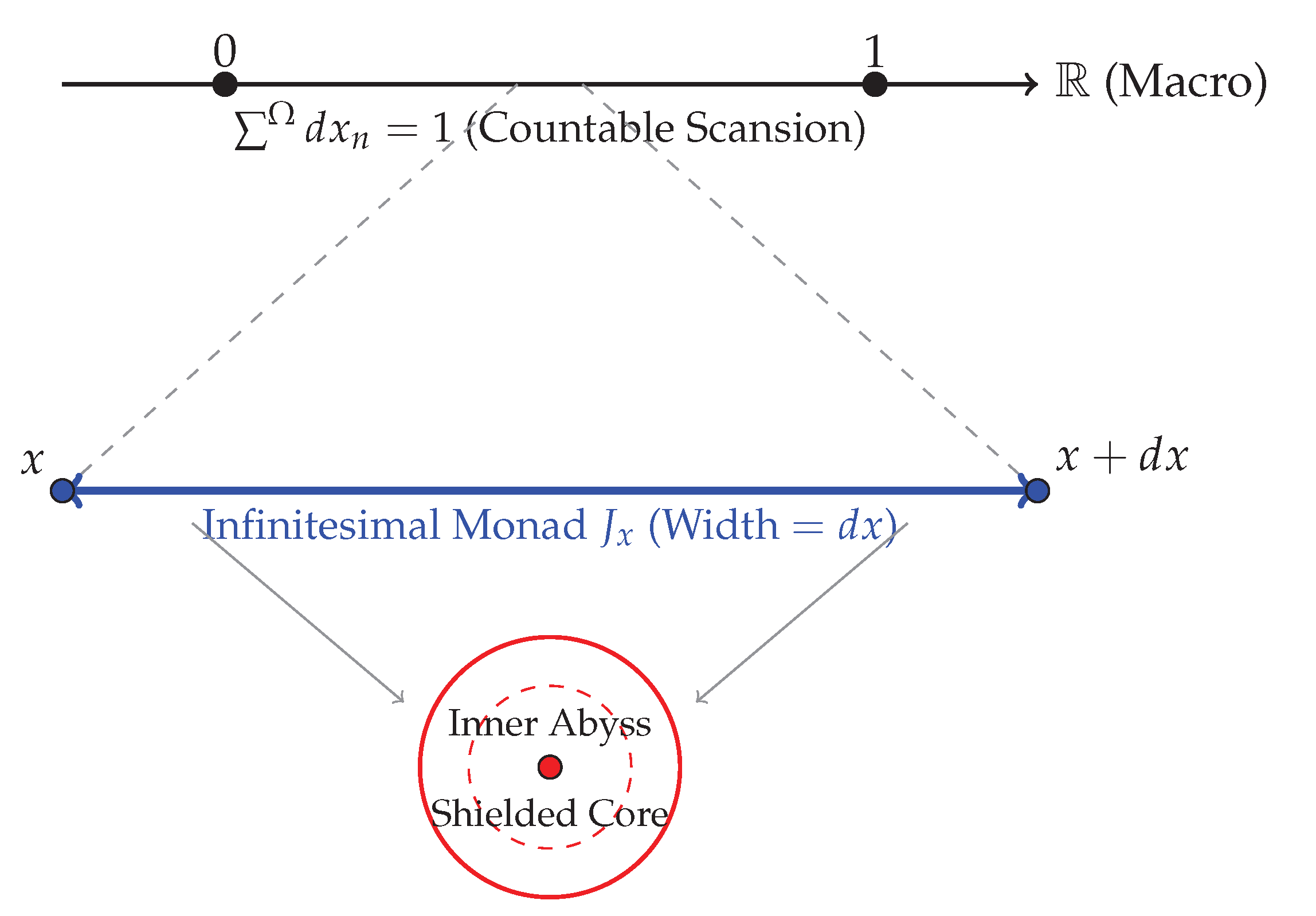
This theorem exposes the exact geometric mechanism underlying Paul Cohen’s Forcing and the independence of the Continuum Hypothesis (CH).
In classical ZFC, the value of the continuum is notoriously volatile—it can be artificially inflated to , or beyond by shifting models. Within the framework of , we see that this volatility is merely an internal artifact of what we define as an Infinitesimal Abyss (Metric Black Hole).
When logicians inject generic sets via forcing to alter , they are not altering the external, deterministic geometry of the macroscopic line, which remains tethered to the invariant scansion relation . Instead, they are stuffing abstract logical information deep inside these inaccessibly dense infinitesimal abysses.
Because the internal cardinal density of a point is entirely shielded by the metric boundary conditions of , what happens inside the abyss has zero retroaction on macroscopic calculus, the value of the continuum is thus revealed to be intrinsically relative to the choice of the internal set-theoretic universe, whereas the dynamic order of the hyperreal trajectories remains stable, invariant, and structurally sovereign.
8. Omega Transfer
The main concept on which the discussion has developed so far is that of a property Pholding definitively on a sequence s of elements. In this way, the property P extends to a property on the sequence, and holds definitively on s when there exists such that holds for any . We denote this definitive validity as (here = is the definitive equality):
This condition is equivalent to extending the definition set of the property according to the following logical equivalences:
We can generalize this situation by considering a relation depending on natural numbers, and assuming a principle, which we call the Ω-Transfer Principle (TP), claiming that when holds definitively on the sequence , or simply holds definitively on the set , then:
In this way, the relation R extends to the elements of the algebra , and it holds on the hyperreal . This principle implicitly underlies many of the arguments we developed in the previous sections. We notice that in the right-hand member of the equivalence above, we do not assert a definitive holding property, but a property holding on the specific element of .
The equivalences (29) can be expressed in terms of the TP, because can be considered equivalent to a property on natural numbers (); therefore:
Analogously, the TP can be generalized to any sequence over , such as the sequence of powers of :
9. Conclusions
In the previous sections, we have shown that the different notions of mathematical infinity are strongly related and belong to a wider mathematical horizon, even developed according to different perspectives. The paper is the ideal continuation of a previous paper on Constructive Differential Calculus, where Leibniz’s d-notation was completely explained and justified in terms of hyperreal numbers, and in turn, these numbers are conceived in a constructive way starting from eight axioms regarding d-notation. Other sources of inspiration are also the history of differential calculus [3,8], especially some of Archimedes’ works [25], and the concepts of reflexivity and duplicability, investigated in set theoretical terms [27]. In the vision emerging in the paper, the infinite of Leibniz’s differential calculus; the infinite of Euler’s transcendental series; the asymptotic analysis developed since the works of Paul du Bois-Reymond [2,5,6,7,17,18,21,22,24,32,35]; the infinite of ordinal and cardinal numbers of set theory [9,10,11,12], up to the results in large cardinals and forcing [13,19]; and finally, Abrham Robinson’s infinite of hyperreal numbers [1,4,20,29,30,31,34] can be seen as different aspects of a common mathematical reality that vivifies the wole mathematics. Infinitesimals and infinities originate in Greek mathematics. Archimedes’ Method on the infinitesimal analysis, and his systematic schema of big numbers generation, by orders and periods, are, in many aspects, the first anticipation of Leibniz’s differentials, and the second a precursor of modern positional number systems, as a finitary version of Cantor’s ordinal enumeration. In this regard, we recall that the structural infinitesimals of Leibniz’s Monadology are conceptually closer to Archimedean mechanical exhaustion rather than Newtonian kinematic fluxions.
The famous Cantor’s proof that real numbers are not a countable set, and that the parts of an infinite set have a cardinality greater than the set, are results that use reflexive schemata, going back to Russell’s paradox and related paradoxes, of Greek origin, investigated by the mathematical logicians at the beginning of the twentieth century.
In the case of ordinals, the existence of non-numerable ordinals is essentially a version of the Burali-Forti paradox, because the set of numerable ordinals cannot include the ordinal of its cardinality. Otherwise, this ordinal should be included in the set that it is counting, against the nature of ordinals, which cannot be elements of themselves.
Analogous arguments in [16] (see later on) show that the log-exp hyperreals have a cardinality greater than the continuum.
The structural scaffolding unveiled by the Abyss Theorem (Theorem 5) forces a profound reconceptualization of the axiomatic nature of geometric space. By demonstrating that a numerable infinitesimal scansion strictly reconstructs the unit measure through the monads , the framework suggests that what we classically define as the macroscopic “continuum” is merely a low-resolution boundary. Beneath this external surface, the microscopic domain is dynamically governed by the growth scales of Hardy’s logarithmic-exponential class , which constitute a non-Archimedean, real-closed Hardy field. Crucially, as established by the foundational isomorphism theorems of Erdős, Gillman, and Henriksen [16], such highly saturated real-closed fields (-sets) natively possess a full transfinite capacity, sustaining an internal algebraic cardinality of exactly , deduced purely through the combinatorial density of their mutually exclusive asymptotic trajectories.
This provides a direct, metric-driven alternative to standard non-Cantorian models. In classical set theory, altering the size of the continuum requires expanding the universe externally via forcing extensions. Conversely, because the continuous asymptotic spectrum of allows the internal space of a single differential to natively harbor a cardinality of , the standard continuum is structurally bypassed from within. The macro-line remains constrained to points only because classical calculus does not see the micro-local degrees of freedom shielded inside .
Consequently, the independence of the Continuum Hypothesis (CH) ceases to be a mere limitation of formal provability within ZFC. It emerges as a necessary geometric consequence of scale projection: CH holds only on the macroscopic surface, while failing within the hyper-continuous underworld of , where the continuum naturally jumps to .
While a formal embedding of these non-Cantorian geometric degrees of freedom within a comprehensive independence proof remains a subject for future work, the hierarchical stability of the Abyss provides the precise infrastructure needed to shelter such transfinite variations without disrupting the foundational rules of classical calculus.
References
- Albeverio, S.; Fenstad, J. E.; Høegh-Krohn, R.; Lindstrøm, T. Nonstandard Methods in Stochastic Analysis and Mathematical Physics; Academic Press, 1986. [Google Scholar]
- Bachmann, P. Analytische Zahlentheorie; Teubner, 1894; Vol. 2. [Google Scholar]
- Baron, M. The Origins of the Infinitesimal Calculus; Dover Publications, 2014. [Google Scholar]
- Bell, J. L. A Primer of Infinitesimal Analysis, 2nd ed.; Cambridge University Press: Cambridge, 2008. [Google Scholar]
- du Bois-Reymond, P. Über Asymptoten und die Unendlichkeit von Functionen. Crelle’s J. 1875. [Google Scholar] [CrossRef]
- du Bois-Reymond, P. Die allgemeine Functionentheorie; Verlag de Laupp: Tübingen, 1882. [Google Scholar]
- Bourbaki, N.; Hermann. Éléments de mathématique. Fonctions d’une variable réelle; Paris, 1961. [Google Scholar]
- Boyer, C. B. The History of the Calculus and Its Conceptual Development; Dover Publications: New York, 1959. [Google Scholar]
- Cantor, G. Über eine Eigenschaft des Inbegriffes aller reellen algebraischen Zahlen. J. Für Die Reine Und Angew. Math. 77, 258–262, 1874.
- Cantor, G. Grundlagen einer allgemeinen Mannigfaltigkeitslehre: ein mathematisch-philosophischer Versuch in der Mengenlehre; B. G. Teubner: Leipzig, 1883. [Google Scholar]
- Cantor, G. Über eine elementare Frage der Mannigfaltigkeitslehre. Jahresber. Der Dtsch. Math.-Ver. 1, 75–78, 1891.
- Cantor, G. Contributions to the Founding of the Theory of Transfinite Numbers; Jourdain, P. E. B., Translator; Dover Publications: New York, 1955. [Google Scholar]
- Cohen, P. Set Theory nd continuum hypothesis; W. A. Benjamin: New York, 1966. [Google Scholar]
- Davey, B. A.; Prestley, H. A. Introduction to Lattices and Order; Cambridge University Press, 2002. [Google Scholar]
- Dunham, W. Euler The Master of Us All; The Mathematica Association of America, 1999. [Google Scholar]
- Erdős, P.; Gillman, L.; Henriksen, M. An isomorphism theorem for real-closed fields. Ann. De l’Institut Fourier 1955, 5, 55–67. [Google Scholar]
- G. H. Hardy, Orders of Infinity: The `Infinitärcalcül’ of Paul du Bois-Reymond; Cambridge University Press, Cambridge, 1910. (The foundational text introducing the logarithmico-exponential scale).
- Hardy, G. H. Properties of logarithmic-exponential functions. Proc. Lond. Math. Soc. vol. 2(no. 1), 54–90, 1912. [CrossRef]
- Jech, T. Set Theory, The Third Millennium Edition (revised and expanded); Springer, 2003. [Google Scholar]
- Keisler, H. J.; Prindle; Weber; Schmidt. Elementary Calculus: An Infinitesimal Approach; Boston, 1976. [Google Scholar]
- D. E. Knuth, Calculus Now. Am. Math. Mon. 1998, 105(2), 119–123.
- Knuth, D. E. Teach Calculus with Big O. Not. Am. Math. Soc., Abridged version; full manuscript circulated as O Calculus; 1998, 45(6), 687. [Google Scholar]
- von Koch, H. Sur la distribution des nombres premiers. Acta Math. 1912, 24(1), 159–182. [Google Scholar]
- Landau, E. Handbuch der Lehre von der Verteilung der Primzahlen; Teubner, 1909. [Google Scholar]
- Manca, V. Lezioni Archimredee; Quaderni della Biblioteca Alagoniana: Siracusa, Italy, 2020. [Google Scholar]
- Manca, V. Python Arithmetic. The Informational Nature of Numbers; Springer, 2024. [Google Scholar]
- Manca, V. Reflexivity and Duplicability in Set Theory. Mathematics (MDPI) 13, 678. [CrossRef]
- Manca, V. Constructive Differential Calculus; To Appear, 2026. [Google Scholar]
- Nelson, E. Internal set theory: A new approach to nonstandard analysis. Bull. Am. Math. Soc. 1977, 83(6), 1165–1198. [Google Scholar] [CrossRef]
- Robert, A. Nonstandard Analysis; John Wiley & Sons: New York, 1988. [Google Scholar]
- Robinson, A. Non-Standard Analysis; North-Holland Publishing Company: Amsterdam, 1966. [Google Scholar]
- Rosenlicht, M. Hardy fields. J. Math. Anal. Appl. 1983, vol. 93(no. 2), 297–311. [Google Scholar] [CrossRef]
- Sergeyev, Ya.D. Some Paradoxes of Infinity Revisited. Mediterr. J. Math. 2022, 19, 143. [Google Scholar] [CrossRef]
- Stroyan, K. D.; Luxemburg, W. A. J. Introduction to the Theory of Infinitesimals; Academic Press: New York, 1976. [Google Scholar]
- van den Dries, L.; Macintyre, A.; Marker, D. Logarithmic-exponential series. Ann. Pure Appl. Log. 2001, vol. 111(no. 1-2), 61–113. [Google Scholar] [CrossRef]
Disclaimer/Publisher’s Note: The statements, opinions and data contained in all publications are solely those of the individual author(s) and contributor(s) and not of MDPI and/or the editor(s). MDPI and/or the editor(s) disclaim responsibility for any injury to people or property resulting from any ideas, methods, instructions or products referred to in the content. |
© 2026 by the authors. Licensee MDPI, Basel, Switzerland. This article is an open access article distributed under the terms and conditions of the Creative Commons Attribution (CC BY) license (http://creativecommons.org/licenses/by/4.0/).
Copyright: This open access article is published under a Creative Commons CC BY 4.0 license, which permit the free download, distribution, and reuse, provided that the author and preprint are cited in any reuse.


