

Submitted:
07 July 2026
Posted:
08 July 2026
You are already at the latest version
Abstract
Background/Objectives: Gastric endoscopic submucosal dissection (ESD) is an established organ-preserving treatment for gastric neoplasia, but the short-term safety of ESD in patients aged 80 years or older remains clinically important. We evaluated the efficacy and short-term safety of gastric ESD in patients aged ≥80 years treated under a uniform peri-procedural surveillance protocol. Methods: This retrospective cohort study included consecutive patients who underwent gastric ESD for gastric adenoma or gastric cancer at a single institution between April 2013 and March 2026. Patients were classified as <80 years or ≥80 years. Under the institutional protocol, standard admission was 3 nights/4 days, with extended monitoring for patients receiving antithrombotic agents. Efficacy and safety outcomes were compared between age groups, and multivariable models adjusted for sex, Charlson Comorbidity Index (CCI), and antithrombotic-agent use. Results: Among 2,021 gastric ESD cases, 285 were performed in patients aged ≥80 years and 1,736 in patients aged <80 years. En bloc resection rates were similarly high in the ≥80-year and <80-year groups (98.6% vs. 99.0%; P=0.524). Post-ESD pneumonia was rare, and no 30-day mortality occurred in either group. Post-ESD bleeding/perforation was not increased in patients aged ≥80 years (2.8% vs. 3.1%; P=0.783), and delirium occurred in only one patient in the ≥80-year group. In multivariable analysis, age ≥80 years was not independently associated with post-ESD bleeding/perforation, whereas Charlson Comorbidity Index and antithrombotic-agent use were significant predictors. Conclusions: Under a uniform peri-procedural surveillance protocol, gastric ESD showed comparable technical success and low short-term complication rates in carefully selected patients aged ≥80 years and younger patients. Chronological age alone should not preclude gastric ESD when standardized monitoring and individualized risk assessment are applied.
Keywords:
gastric neoplasia
; endoscopic submucosal dissection
; aged 80 and over
; safety
; peri-procedural surveillance
; gastric cancer
1. Introduction
Gastric cancer ranks leading causes of cancer related death, thus remains a major global health burden [1,2]. Even worse, as life expectancy rapidly increases, the proportion of elderly patients diagnosed gastric neoplasm are sharply increased [3,4]. Thus gastroenterologists often encounter the situation determining whether resection treating gastric neoplasm be performed safely in patients aged 80 years or older [5]. For elderly population, surgical resection for gastric neoplasm often limited because of 1) physiologic fragility, 2) multiple comorbidities such as cardiopulmonary distress, and 3) thus worries for prolonged recovery after operation [6,7,8,9,10].
Gastric endoscopic submucosal dissection (ESD) is now an established treatment for treating superficial epithelial neoplasia offering possibility of en-bloc resection, and precise histopathologic assessment while preserving the stomach anatomy and physiology [11,12,13,14,15,16,17,18,19]. These advantages are particularly relevant in elderly population, in whom treatment decisions often require balancing treatment benefit against frailty, cardiopulmonary reserve, antithrombotic medication use, and competing risks of non-cancer mortality [20,21,22,23,24,25,26]. Although most prior studies yielded acceptable technical outcomes in elderly patients as compared to younger patients, safety issues remain still a major concern. Along with conventional ESD-related adverse events, such as post-ESD bleeding and perforation, but also alge-related complications including aspiration events, delayed recovery of oral intake and prolonged hospital duration, acute cognitive change such as delirium, unplanned hospital visits, readmission, and short-term mortality should be considered for clinical decision-making [21,27,28,29,30,31,32,33,34].
Even previous studies have investigated the safety outcomes of gastric ESD in elderly patients, the evidences from studies remain heterogeneous according to 1) age cut off, 2) sample size, 3) and operational definition for safety profiles. Early studies in patients aged ≥75 years suggested that gastric ESD is technically feasible, with preserved en bloc and complete resection rates and complication rates broadly comparable to those in younger patients [17]. However, respiratory complications have consistently remained a concern in older populations; Akasaka et al. reported a higher pneumonia rate in elderly patients(≥75 vs <75 years, 3.3 vs 0.5%, p<0.01), and Toyokawa et al. similarly observed numerically higher aspiration pneumonia (≥75 vs <75 years, 0.87 vs. 0.28%, p>0.05 ) and delayed bleeding rates (9.6 vs 5.3%, p=0.04), although advanced age was not an independent predictor of delayed bleeding [27,35]. However, advanced age was not an independent factor for delayed bleeding in multivariable analysis. In studies focusing on more advanced age groups, including patients aged ≥80 or ≥85 years, resection outcomes were generally maintained, but non-bleeding adverse events such as perforation and pneumonia appeared clinically relevant [25,33]. These findings suggest that gastric ESD is feasible in elderly patients, but important uncertainty remains regarding short-term morbidity, delirium, hospitalization duration, and
Most previous studies of gastric ESD in elderly patients have focused on age-group comparisons without fully accounting for differences in peri-procedural care, hospitalization schedules, and antithrombotic management. Because these factors can influence the detection and clinical course of post-ESD adverse events, it remains uncertain whether the outcomes observed in older patients reflect age-related vulnerability itself or variation in clinical management. Evaluating younger and older patients within the same practice environment, under an identical institutional protocol, may therefore provide a more direct assessment of the independent clinical relevance of advanced age. Accordingly, we examined technical and short-term safety outcomes after gastric ESD in patients aged ≥80 years and those aged <80 years who were treated under a uniform peri-procedural surveillance pathway.
We therefore evaluated the efficacy, and short-term safety profiles of gastric ESD in patients aged 80 years or older using real-world institutional data, and especially focused on the situation with uniform standardized common protocol management. Since 2013, in our hospital, uniform common protocol management has been used for treating ESD. The study included 2,021 patients who underwent gastric ESD for gastric adenoma or gastric cancer between April 2013 and March 2026, of whom 285 were aged ≥80 years and 1,736 were aged <80 years with uniform standardized common protocol management comparing efficacy profiles including en bloc resection, and safety profiles including ESD-related complications within 30 days between the two age groups, with particular attention to outcomes observed under a uniform institutional peri-procedural management common protocol.
2. Materials and Methods
2.1. Study Design and Population
This retrospective cohort study included consecutive patients who underwent gastric ESD for gastric adenoma or gastric cancer at our institution between April 2013 and March 2026. Patients were identified from the institutional clinical database. A total of 2,021 patients were included in the final analysis. Eligible patients were classified into two groups according to age at the time of ESD: patients aged ≥80 years and those aged <80 years. Consecutive ESD-treated lesions with available clinical, endoscopic, and pathologic information were reviewed. Gastric epithelial neoplasia was classified into low-grade adenoma, high-grade adenoma, and early gastric cancer according to the final pathologic diagnosis after ESD.
2.2. ESD Procedure and Peri-Procedural Care
All ESD procedures were performed by experienced endoscopists using the standard technique adopted at our institution. The indication for ESD was determined from the pre-procedural biopsy, endoscopic appearance, lesion size and location, and expected depth of invasion. Patients were managed according to a uniform inpatient protocol. In general, patients who were not receiving antithrombotic agents were admitted for 3 nights and 4 days. Patients receiving antiplatelet or anticoagulant therapy were admitted for 5 nights and 6 days to allow closer observation and adjustment of medication if needed. Antithrombotic agents were withheld and restarted according to contemporary guideline-based practice and the patient’s thromboembolic and bleeding risks. After ESD, patients were monitored for abdominal symptoms, fever, bleeding, respiratory symptoms, and changes in mental status. Follow-up endoscopy or radiologic evaluation was performed when clinically indicated.
2.3. Data Collection
Clinical data were obtained from the electronic medical records and institutional endoscopy database. Baseline variables included age, sex, Charlson Comorbidity Index (CCI), use of antithrombotic agents, and length of hospital stay. Endoscopic and pathologic variables included tumor location, tumor size, gross morphology, histologic type, Lauren classification, depth of invasion, resection margin status, lymphovascular invasion, venous invasion, perineural invasion, and whether additional surgery was indicated after ESD. Final pathology was based on the resected ESD specimen. Low-grade adenoma and high-grade adenoma were defined according to the final diagnosis of dysplasia. Early gastric cancer included adenocarcinoma confined to the mucosa or submucosa, irrespective of lymph node status, because lymph node assessment was not available in ESD specimens.
2.4. Outcome Definitions
The primary efficacy outcome was en-bloc resection, defined as removal of the target lesion in a single piece. Other efficacy outcomes were gross complete resection or endoscopic gross margin negativity, histologic negative resection margin, requirement for additional surgery based on non-curative criteria, and actual performance of post-ESD surgery. Gross complete resection was determined from the endoscopic procedure report. Histologic negative margin was defined as the absence of neoplastic involvement at the lateral and vertical margins of the resected specimen.
The safety outcomes, ESD-related complications, included clinically relevant adverse events considered to be associated with the procedure, such as post-ESD bleeding, perforation, aspiration pneumonia or pneumonitis, delirium, need for unplanned intervention, intensive care unit (ICU) transfer, or procedure-related mortality. Delirium was defined as an acute change in mental status documented in the medical record during the post-procedural period, with or without psychiatric consultation, according to routine clinical assessment. Post-ESD bleeding was defined as clinically significant bleeding requiring endoscopic hemostasis, transfusion, or additional intervention. Perforation was defined as endoscopically recognized mural defect or radiologic evidence of free air after ESD.
2.5. Pathology-Stratified Analysis
Because lesion biology and procedural complexity differ between adenoma and early gastric cancer, efficacy and safety outcomes were examined in the overall cohort and then separately within each final pathology category: low-grade adenoma, high-grade adenoma, and early gastric cancer. In each analysis, outcomes were compared between patients aged <80 years and those aged ≥80 years.
2.6. Statistical Analysis
Continuous variables are expressed as mean ± standard deviation or median with interquartile range. Categorical variables are expressed as number and percentage. The <80-year and ≥80-year groups were compared using the Student’s t test or Mann–Whitney U test for continuous variables and the chi-square test or Fisher’s exact test for categorical variables, as appropriate. Multivariable analyses were performed to assess the independent association between age ≥80 years and unfavorable post-ESD outcomes. For efficacy outcomes with a small number of events, Firth penalized logistic regression was used to reduce small-sample bias. These models included non-en bloc resection, gross incomplete resection, failure to achieve a negative histologic resection margin, and requirement for additional surgery based on non-curative criteria. For safety outcomes with sufficient event counts, conventional multivariable logistic regression was used. Outcomes with zero or very sparse events were not modeled. All multivariable models included age group, sex, CCI as a continuous variable, and antithrombotic-agent use. Results are presented as adjusted odds ratios with 95% confidence intervals. A two-sided p value <0.05 was considered statistically significant. Statistical analyses were performed using R software, version 4.6.1 (R Foundation for Statistical Computing, Vienna, Austria). Firth penalized logistic regression was performed using the logistf package, version 1.26.1.
3. Results
3.1. Study Population
The study flow is shown in Figure 1. Between April 2013 and March 2026, a total of 2,021 patients underwent gastric ESD for gastric adenoma or gastric cancer and were included in the analysis. Among them, 285 patients were aged ≥80 years and 1,736 patients were aged <80 years.
3.2. Baseline Characteristics
A total of 2,021 gastric ESD cases were analyzed. Of these, 285 were performed in patients aged ≥80 years and 1,736 in patients aged <80 years. Patients aged ≥80 years had a greater comorbidity burden than younger patients (Table 1). The mean Charlson Comorbidity Index (CCI) was higher in the ≥80-year group (2.2 ± 1.9 vs 1.5 ± 1.7, P<0.001), and the proportion of patients with CCI ≥3 was also higher (37.0% vs 22.7%) (Table 1). Antithrombotic-agent use was more frequent in the ≥80-year group than in the <80-year group (4.2% vs 2.5%, P<0.001) (Table 1). Despite these differences, the duration of hospitalization was similar between the two groups, with a median stay of 4.0 days in both groups (4.0 [IQR, 4.0–5.0] vs 4.0 [IQR, 4.0–4.0] days, P=0.161) (Table 1).
3.3. Lesion and Pathologic Characteristics
In the overall cohort, 923 lesions (45.7%) were classified as low-grade adenoma, 243 (12.0%) as high-grade adenoma, and 855 (42.3%) as early gastric cancer (Table 2). The antrum or lower third was the most common lesion location (66.3%), followed by the body or middle third (21.9%), angle/incisura (8.9%), and fundus/cardia/upper third (3.0%) (Table 2).
The overall en bloc resection rate was 99.0% and did not differ significantly among pathology categories (99.3% for low-grade adenoma, 99.2% for high-grade adenoma, and 98.5% for early gastric cancer; P=0.183) (Table 2). A negative histologic resection margin was achieved in 98.2% of all cases (Table 2). Additional surgery was required according to non-curative criteria in 102 cases (5.0%), nearly all of which were early gastric cancer (101/855, 11.8%; P<0.001) (Table 2).
3.4. Efficacy Outcomes According to Age Group
The en bloc resection rate was high in both groups and did not differ significantly between patients aged ≥80 years and those aged <80 years (98.6% [281/285] vs 99.0% [1,719/1,736], P=0.524) (Table 3). Gross complete resection or endoscopic gross margin-negative resection was also comparable between the two groups (99.3% [283/285] vs 99.4% [1,725/1,736], P=0.704) (Table 3). Similarly, the rate of histologic negative resection margin did not differ significantly by age group (97.9% [279/285] vs 98.2% [1,705/1,736], P=0.637) (Table 3).
Cases meeting non-curative criteria and requiring additional surgery were more frequent in the ≥80-year group in the crude analysis (7.7% [22/285] vs 4.6% [80/1,736], P=0.026) (Table 3). However, the actual rate of post-ESD surgery was identical between the two groups (0.7% [2/285] vs 0.7% [13/1,736], P=1.000) (Table 3).
Pathology-specific analyses showed consistent findings(Tables S1A–C and S2A–C).
3.5. Short-Term Safety Outcomes
Post-ESD adverse events were uncommon in both age groups (Table 4 and Figure 2). Post-ESD pneumonia rarely occurred in 2 of 2,021 cases (0.1%), both in the <80-year group, and was not increased in patients aged ≥80 years (0.0% [0/285] vs 0.1% [2/1,736], P=1.000). Post-ESD bleeding or perforation occurred in 62 cases overall (3.1%) and was comparable between the ≥80-year and <80-year groups (2.8% [8/285] vs 3.1% [54/1,736], P=0.783). Post-ESD delirium was rare. It occurred in one patient in the ≥80-year group and in none of the younger patients (0.4% [1/285] vs 0.0% [0/1,736], P=0.141). ER visits within 7 days were not observed in the ≥80-year group and occurred in 0.5% of younger patients (0.0% [0/285] vs 0.5% [8/1,736], P=0.610). Readmission within 30 days was numerically less frequent in the ≥80-year group, although the difference was not statistically significant (0.7% [2/285] vs 2.1% [36/1,736], P=0.114). Admission or readmission within 30 days also tended to be less frequent in the ≥80-year group (2.5% [7/285] vs 4.7% [81/1,736], P=0.090).
Complication-related endoscopic procedures within 15 days were performed in 2.8% of patients aged ≥80 years and 2.4% of those aged <80 years (P=0.696) (Table 4). Post-ESD surgery was performed in 0.7% of both groups (P=1.000) (Table 4). Complication-related emergency surgery within 15 days was not observed in the ≥80-year group and occurred in 0.2% of younger patients (P=1.000) (Table 4). The composite 30-day safety event rate was numerically lower in the ≥80-year group than in the <80-year group, although the difference was not statistically significant (4.6% [13/285] vs 7.0% [121/1,736], P=0.130). No 30-day mortality occurred in either group (Table 4).
Similar patterns of post-ESD complications were shown stratified by final pathology (Tables S2A–C).
3.6. Multivariable Analyses
In Firth penalized multivariable logistic regression analyses, age ≥80 years was not independently associated with unfavorable efficacy outcomes (Figure 3 and Table 5). The adjusted odds ratios for age ≥80 years were 1.51 for non-en bloc resection (95% CI, 0.54–4.22; P=0.428), 1.31 for gross incomplete resection (95% CI, 0.35–4.89; P=0.685), 1.11 for failure to achieve a negative histologic margin (95% CI, 0.48–2.61; P=0.802), and 1.47 for additional surgery requirement based on non-curative criteria (95% CI, 0.90–2.42; P=0.125).
In contrast, CCI was associated with some unfavorable outcomes. Each 1-point increase in CCI was associated with higher odds of non-en bloc resection (adjusted OR, 1.20; 95% CI, 1.00–1.43; P=0.048) and additional surgery requirement based on non-curative criteria (adjusted OR, 1.29; 95% CI, 1.18–1.41; P<0.001).
In multivariable analyses of safety outcomes, age ≥80 years was not associated with an increased risk of post-ESD bleeding or perforation (adjusted OR, 0.73; 95% CI, 0.34–1.57; P=0.422) (Figure 4 and Table 6). Higher CCI and antithrombotic-agent use were independently associated with post-ESD bleeding or perforation (CCI per 1-point increase: adjusted OR, 1.27; 95% CI, 1.13–1.41; P<0.001; antithrombotic-agent use: adjusted OR, 2.92; 95% CI, 1.11–7.71; P=0.030). Age ≥80 years was associated with lower odds of admission or readmission within 30 days (adjusted OR, 0.42; 95% CI, 0.19–0.94; P=0.035), whereas CCI and antithrombotic-agent use were associated with higher odds of this outcome (CCI per 1-point increase: adjusted OR, 1.23; 95% CI, 1.11–1.36; P<0.001; antithrombotic-agent use: adjusted OR, 3.12; 95% CI, 1.35–7.21; P=0.008). Models for post-ESD pneumonia, post-ESD delirium, ER visits within 7 days, and surgery after ESD were not estimated because of zero or sparse events.
4. Discussion
In this decade-long real-world cohort study of 2,021 patients who underwent gastric ESD for gastric adenoma or gastric cancer under a uniform peri-ESD management protocol, patients aged ≥80 years had en bloc resection rates comparable to those aged <80 years (98.6% vs. 99.0%; P=0.524). More importantly, the incidence of 30-day ESD-related complications was low in both groups and did not differ significantly. Delirium, which is often a major concern after procedures in very elderly patients, was rarely observed. These findings suggest that, under standardized peri-procedural surveillance, gastric ESD can be performed safely in selected patients aged ≥80 years and that chronological age alone should not be regarded as a contraindication to endoscopic treatment.
A major strength and novelty of the present study is that both age groups were treated within the same institution, and under a common peri-procedural protocol regardless of patients’ age. The indications for inpatient surveillance, post-procedural monitoring, and antithrombotic management were applied consistently regardless of age. Patients not receiving antithrombotic agents were generally hospitalized for 3 nights and 4 days, whereas antithrombotic users were observed for 5 nights and 6 days if neededs; interruption and resumption of antithrombotic therapy followed guideline-based practice, with treatment generally resumed within 48 hours after ESD when clinically appropriate. This uniformity reduces the influence of management heterogeneity and allows the observed differences—or lack of differences—between younger and older patients to be interpreted more directly in relation to age. In this controlled real-world setting, patients aged ≥80 years had en bloc resection rates, 30-day ESD-related complication rates, and hospitalization durations comparable to those of younger patients, while delirium remained rare. These findings suggest that, when peri-procedural care is standardized, very elderly age alone may have limited influence on short-term gastric ESD outcomes.
Our findings are broadly consistent with previous studies showing that advanced age does not substantially compromise the technical effectiveness of gastric ESD. Kakushima et al. reported an en bloc R0 resection rate of 96% in patients aged ≥75 years, without a significant increase in procedure-related complications compared with younger patients [17]. Similarly, studies by Son et al. and Otsuka et al. found that resection outcomes were maintained in patients aged ≥80 years, despite some concern regarding perforation or respiratory complications [25,36]. In our cohort of 2,021 patients, including 285 patients aged ≥80 years and 1,736 patients aged <80 years, the en bloc resection rate did not differ significantly between the two age groups. These findings reinforce the view that gastric ESD remains technically feasible in very elderly patients and that chronological age alone does not necessarily predict procedural failure or a prolonged inpatient course.
The safety profile observed in our study, however, differed in several respects from earlier reports. Some previous studies have reported higher rates of post-ESD complications such as aspiration events with pneumonia or delirium, suggesting that post-procedural surveillance and geriatric vulnerability should be considered when interpreting ESD safety. Kakushima et al. investigated 42 patients aged ≥75 years with gastric ESD, and an en bloc R0 resection rate of 96%, without a significant difference in complication rates compared with younger patients [17]. Akasaka et al. conducted multicenter study with 1188 patients, and founded elderly patients (≥75 years, n=459) showed safety profiles including post-procedural perforation, bleeding, and pneumonia rates were 4.4% (vs. <75 years, 4.0%; P=0.77), 2.6% (vs. 3.4%; P=0.50), and 3.3% (vs. 0.5%; P<0.01), respectively [35]. It indicated that respiratory complications such as pneumonia may remain clinically significant complications among elderly population as compared to younger patients. Similarly, Toyokawa et al. reported delayed bleeding in 9.6%, perforation in 1.7%, and pneumonia in 0.87% among elderly patients undergoing gastric ESD [27]. Among patients aged ≥80 years, Son et al. found that en bloc and complete resection outcomes were preserved, although concerns remained regarding perforation and pneumonia [25]. In patients aged ≥85 years, Watanabe et al. reported perforation and pneumonia rates of 8.8% and 6.3%, respectively, suggesting that non-bleeding adverse events may become increasingly important at more advanced ages [33]. Collectively, these studies indicate that gastric ESD is technically feasible in elderly patients, but they also reveal substantial variation in short-term safety outcomes, and provide limited information on delirium, hospitalization duration, and outcomes under a uniform peri-procedural surveillance pathway. A large real-world cohort focusing specifically on patients aged ≥80 years and managed according to a standardized institutional protocol is therefore needed to determine whether very elderly age itself is associated with lower resection success, greater short-term morbidity, or prolonged hospitalization. In this regards, our study has strength and novelty in that large cohort with peri ESD standardized institutional protocol.
A key explanation for the low incidence of delirium and ESD-related complications in our cohort may be the institutional practice of short-term inpatient observation after ESD. Patients were generally monitored during an average hospital stay of approximately 3 nights and 4 days. This period may be particularly important in very elderly patients because it covers the early post-procedural window during which bleeding, perforation-related symptoms, fever, aspiration events, dehydration, poor oral intake, and acute cognitive changes are most likely to become clinically apparent. Rather than reflecting procedure safety alone, the favorable outcomes in the present study likely reflect both appropriate patient selection and structured peri-procedural management.
The management of antithrombotic therapy was another important component of this protocol. ESD is considered a high-bleeding-risk endoscopic procedure, and very elderly patients are more likely to receive antiplatelet or anticoagulant therapy for cardiovascular or cerebrovascular disease. In our institution, antithrombotic agents were withheld according to guideline-based risk assessment when interruption was indicated, and resumption was targeted within 48 hours after ESD once adequate hemostasis was confirmed and no contraindication was present [37]. This standardized approach may have helped reduce both delayed bleeding and thromboembolic risk. The low complication rate observed in our cohort should therefore be viewed as the result of a system of care, rather than the effect of procedural technique alone.
The present findings have practical implications for decision-making in elderly patients with gastric adenoma or cancer. In many clinical settings, advanced age may lead to hesitation in offering ESD, even when the lesion is technically resectable and the patient’s overall condition is acceptable. However, our data suggest that age ≥80 years itself was not associated with lower en bloc resection or higher 30-day ESD-related complication rates. Treatment decisions should therefore be individualized and based on functional status, comorbidity burden, cardiopulmonary reserve, antithrombotic medication use, cognitive status, lesion characteristics, and patient preference rather than chronological age alone.
This study has several limitations. First, it was a retrospective single-center study, and selection bias cannot be excluded. Very elderly patients who underwent ESD were likely selected by experienced gastroenterologists after assessment of procedural feasibility and general condition. Second, frailty, cognitive function, and sedation depth may not have been uniformly captured across the entire study period. Third, because the study period extended from 2013 to 2026, changes in devices, endoscopic technique, sedation practice, and post-ESD care may have influenced outcomes. Finally, although 30-day complications were evaluated, longer-term outcomes, including recurrence, metachronous lesions, non-cancer mortality, and quality of life, require further study.
Despite aforementioned limitations, this study has several strengths. First, it included a large consecutive cohort of patients undergoing gastric ESD over a long period, with a substantial number of patients aged ≥80 years. It also evaluated outcomes that are particularly relevant to very elderly patients, including delirium and short-term ESD-related complications. Second, most importantly, the results were observed within a consistent institutional care pathway, allowing the safety of gastric ESD to be interpreted in the setting of standardized surveillance and guideline-based antithrombotic management.
5. Conclusions
gastric ESD for gastric adenoma or gastric cancer showed comparable en bloc resection rates and similarly low 30-day ESD-related complication rates in patients aged 80 years or older and those younger than 80 years. Delirium and major ESD-related adverse events were rarely observed in the very elderly group with peri ESD uniform protocol management regardless of patients’ age. These findings support gastric ESD as a feasible and safe treatment option for carefully selected very elderly patients, particularly when combined with structured short-term inpatient monitoring over approximately 3 nights and 4 days.
Supplementary Materials
The following supporting information can be downloaded at the website of this paper posted on Preprints.org. The following supporting information is provided as supplementary tables: Tables S1A–S1C and Tables S2A–S2C.
Author Contributions
Conceptualization, Y.I.C.; methodology, Y.I.C.; formal analysis, Y.I.C.; investigation, Y.I.C., S.Y.W., Y.S.C., B.K.P., C.S.P., J.W.C. and C.K.L.; data interpretation, Y.I.C.; writing—original draft preparation, Y.I.C.; writing—review and editing, S.Y.W., Y.S.C., C.S.P., B.K.P., J.W.C. and C.K.L. All authors have read and agreed to the published version of the manuscript.
Funding
This work was supported by the National Health Insurance Service Ilsan Hospital grant (NHIMC-2026-CR-004).
Institutional Review Board Statement
The study was conducted in accordance with the Declaration of Helsinki and approved by the Institutional Review Board of National Health Insurance Service Ilsan Hospital (IRB No. NHIMC 2026-03-010).
Informed Consent Statement
All participants provided written informed consent and were enrolled on a voluntary basis.
Data Availability Statement
The data used to support the findings of this study are available from the corresponding author upon reasonable request, subject to institutional and ethical restrictions.
Acknowledgments
Guarantor of the article: Youn I Choi.
Conflicts of Interest
The authors declare no conflict of interest.
References
- Sung, H.; Ferlay, J.; Siegel, R.L.; Laversanne, M.; Soerjomataram, I.; Jemal, A.; et al. Global Cancer Statistics 2020: GLOBOCAN Estimates of Incidence and Mortality Worldwide for 36 Cancers in 185 Countries. CA Cancer J. Clin. 2021, 71, 209–249. [Google Scholar] [CrossRef] [PubMed]
- Arnold, M.; Abnet, C.C.; Neale, R.E.; Vignat, J.; Giovannucci, E.L.; McGlynn, K.A.; et al. Global Burden of 5 Major Types of Gastrointestinal Cancer. Gastroenterology 2020, 159, 335–349.e15. [Google Scholar] [CrossRef] [PubMed]
- Lee, J.H. Clinical characteristics of elderly patients with gastric cancer. J. Korean Med. Sci. 2005, 20, 901–906. [Google Scholar]
- Saif, M.W.; Makrilia, N.; Zalonis, A.; Merikas, M.; Syrigos, K. Gastric cancer in the elderly: an overview. Eur. J. Surg. Oncol. 2010, 36, 709–717. [Google Scholar] [CrossRef] [PubMed]
- Fried, L.P.; Tangen, C.M.; Walston, J.; Newman, A.B.; Hirsch, C.; Gottdiener, J.; et al. Frailty in older adults: evidence for a phenotype. J. Gerontol. A Biol. Sci. Med. Sci. 2001, 56, M146–56. [Google Scholar] [CrossRef] [PubMed]
- Park, H.A. Impact of age and comorbidity on the short-term surgical outcome after laparoscopy-assisted distal gastrectomy for gastric cancer. Ann. Surg. Treat. Res. 2013, 85, 203–209. [Google Scholar]
- Yamaguchi, H.; Fukuzawa, M.; Kawai, T.; Matsumoto, T.; Suguro, M.; Uchida, K.; et al. Impact of gastric endoscopic submucosal dissection in elderly patients: The latest single center large cohort study with a review of the literature. Medicine 2019, 98, e14842. [Google Scholar] [CrossRef] [PubMed]
- Miyahara, K. Long-term outcomes of endoscopic submucosal dissection versus surgery for elderly patients with early gastric cancer. Gastric Cancer 2022, 25, 558–566. [Google Scholar]
- Nunobe, S. Outcomes of laparoscopic gastrectomy for elderly patients with gastric cancer. J. Gastrointest. Surg. 2011, 15, 1937–1943. [Google Scholar] [CrossRef]
- Kishida, Y.; Takizawa, K.; Kakushima, N.; Kawata, N.; Yoshida, M.; Yabuuchi, Y.; et al. Endoscopic submucosal dissection versus surgery in elderly patients with early gastric cancer of relative indication for endoscopic resection. Dig. Endosc. 2022, 34, 497–507. [Google Scholar] [PubMed]
- Japanese Gastric Cancer Association. Japanese Gastric Cancer Treatment Guidelines 2021 (6th edition). Gastric Cancer 2023, 26, 1–25. [Google Scholar] [CrossRef] [PubMed]
- Kim, T.H.; Kim, I.H.; Kang, S.J.; Choi, M.; Kim, B.H.; Eom, B.W.; et al. Korean Practice Guidelines for Gastric Cancer 2022: An Evidence-based, Multidisciplinary Approach. J. Gastric Cancer 2023, 23, 3–106. [Google Scholar] [CrossRef] [PubMed]
- Kim, S.G.; Park, C.M.; Lee, N.R.; Kim, J.; Lyu, D.H.; Park, S.H.; et al. Long-Term Clinical Outcomes of Endoscopic Submucosal Dissection in Patients with Early Gastric Cancer: A Prospective Multicenter Cohort Study. Gut Liver 2018, 12, 402–410. [Google Scholar] [CrossRef] [PubMed]
- Tanoue, K.; Fukunaga, S.; Nagami, Y.; Sakai, T.; Maruyama, H.; Ominami, M.; et al. Long-term outcome of endoscopic submucosal dissection for early gastric cancer in patients with severe comorbidities: a comparative propensity score analysis. Gastric Cancer 2019, 22, 558–566. [Google Scholar] [PubMed]
- Sumiyoshi, T.; Kondo, H.; Fujii, R.; Minagawa, T.; Fujie, S.; Kimura, T.; et al. Short- and long-term outcomes of endoscopic submucosal dissection for early gastric cancer in elderly patients aged 75 years and older. Gastric Cancer 2017, 20, 489–495. [Google Scholar] [PubMed]
- Ogiyama, H.; Murayama, Y.; Iihara, T.; Okuno, H.; Hanafusa, K.; Nakayama, T.; et al. Short- and Long-Term Outcomes of Endoscopic Submucosal Dissection for Gastric Lesions in Elderly Patients Aged 80 Years or Older: Focus on Non-Procedure-Related Adverse Events. DEN Open 2026, 6, e70334. [Google Scholar] [CrossRef] [PubMed]
- Kakushima, N.; Fujishiro, M.; Kodashima, S.; Muraki, Y.; Tateishi, A.; Yahagi, N.; et al. Technical feasibility of endoscopic submucosal dissection for gastric neoplasms in the elderly Japanese population. J. Gastroenterol. Hepatol. 2007, 22, 311–314. [Google Scholar] [CrossRef] [PubMed]
- Isomoto, H.; Shikuwa, S.; Yamaguchi, N.; Fukuda, E.; Ikeda, K.; Nishiyama, H.; et al. Endoscopic submucosal dissection for early gastric cancer: a large-scale feasibility study. Gut 2009, 58, 331–336. [Google Scholar] [PubMed]
- Pimentel-Nunes, P.; Libanio, D.; Bastiaansen, B.A.J.; Bhandari, P.; Bisschops, R.; Bourke, M.J.; et al. Endoscopic submucosal dissection for superficial gastrointestinal lesions: European Society of Gastrointestinal Endoscopy (ESGE) Guideline - Update 2022. Endoscopy 2022, 54, 591–622. [Google Scholar] [CrossRef] [PubMed]
- Kim, T.J.; Pyo, J.H.; Lee, H.; Choi, S.C.; Min, Y.W.; Min, B.H.; et al. Outcomes of Endoscopic Resection for Early Gastric Cancer in Very Elderly Patients: A Nationwide Population-Based Study. Gut Liver 2023, 17, 529–536. [Google Scholar] [CrossRef] [PubMed]
- Okimoto, K.; Arai, M.; Ishigami, H.; Taida, T.; Saito, K.; Maruoka, D.; et al. Renal Dysfunction is a Risk Factor of Death after Gastric Endoscopic Submucosal Dissection in Elderly Patients Aged ≥80 Years. Can. J. Gastroenterol. Hepatol. 2019, 2019, 7145182. [Google Scholar] [CrossRef] [PubMed]
- Misawa, N.; Higurashi, T.; Tachikawa, J.; Tanabe, H.; Yoshihara, T.; Ashikari, K.; et al. Clinical impact of evaluation of frailty in endoscopic submucosal dissection for early gastric cancer in elderly patients. Geriatr. Gerontol. Int. 2020, 20, 461–466. [Google Scholar] [CrossRef] [PubMed]
- Sekiguchi, M.; Oda, I.; Suzuki, H.; Abe, S.; Nonaka, S.; Yoshinaga, S.; et al. Clinical outcomes and prognostic factors in gastric cancer patients aged ≥85 years undergoing endoscopic submucosal dissection. Gastrointest. Endosc. 2017, 85, 963–972. [Google Scholar] [CrossRef] [PubMed]
- Suzuki, H.; Oda, I.; Abe, S.; Sekiguchi, M.; Nonaka, S.; Yoshinaga, S.; et al. Clinical outcomes of early gastric cancer patients after noncurative endoscopic submucosal dissection in a large consecutive patient series. Gastric Cancer 2017, 20, 679–689. [Google Scholar] [PubMed]
- Son, Y.W.; Kim, A.; Jeon, H.H. Efficacy and safety of endoscopic submucosal dissection for gastric epithelial neoplasia in elderly patients aged 80 years and older. Aging Clin. Exp. Res. 2019, 31, 1833–1838. [Google Scholar] [CrossRef] [PubMed]
- Ahn, J.Y.; Jung, H.Y.; Choi, K.D.; Choi, J.Y.; Kim, M.Y.; Lee, J.H.; et al. Endoscopic and oncologic outcomes after endoscopic resection for early gastric cancer: 1370 cases of absolute and extended indications. Gastrointest. Endosc. 2011, 74, 485–493. [Google Scholar] [CrossRef] [PubMed]
- Toyokawa, T.; Inaba, T.; Omote, S.; Okamoto, A.; Miyasaka, R.; Watanabe, K.; et al. Risk factors for perforation and delayed bleeding associated with endoscopic submucosal dissection for early gastric neoplasms: analysis of 1123 lesions. J. Gastroenterol. Hepatol. 2012, 27, 907–912. [Google Scholar] [CrossRef] [PubMed]
- Yoshikawa, T. The safety and clinical validity of endoscopic submucosal dissection for early gastric cancer in patients aged more than 85 years. Cancers 2022, 14, 3311. [Google Scholar] [CrossRef] [PubMed]
- Kato, M.; Michida, T.; Kusakabe, A.; Sakai, A.; Hibino, C.; Kato, M.; et al. Safety and short-term outcomes of endoscopic submucosal dissection for early gastric cancer in elderly patients. Endosc. Int. Open 2016, 4, E521–6. [Google Scholar] [PubMed]
- Choi, I.J.; Lee, N.R.; Kim, S.G.; Lee, W.S.; Park, S.J.; Kim, J.J.; et al. Short-Term Outcomes of Endoscopic Submucosal Dissection in Patients with Early Gastric Cancer: A Prospective Multicenter Cohort Study. Gut Liver 2016, 10, 739–748. [Google Scholar] [CrossRef] [PubMed]
- Kim, B.J.; Chang, T.H.; Kim, J.J.; Min, B.H.; Lee, J.H.; Son, H.J.; et al. Efficacy and safety of endoscopic submucosal dissection for early gastric cancer in patients with comorbid diseases. Gut Liver 2010, 4, 186–191. [Google Scholar] [CrossRef] [PubMed]
- Yamada, S.; Dohi, O.; Harusato, A.; Iwai, N.; Horie, R.; Yasuda, T.; et al. Endoscopic Submucosal Dissection for Early Gastric Cancer in Patients Aged 85 Years Old or Older Is Associated with a Good Prognosis Compared to Conservative Treatment without Any Invasive Procedure. Digestion 2022, 103, 386–396. [Google Scholar] [CrossRef] [PubMed]
- Watanabe, K.; Hikichi, T.; Nakamura, J.; Takagi, T.; Suzuki, R.; Sugimoto, M.M.; et al. Endoscopic submucosal dissection for early gastric cancer in very elderly patients age 85 or older. Endosc. Int. Open 2017, 5, E17–E24. [Google Scholar] [CrossRef] [PubMed]
- Man-i, M.; Morita, Y.; Fujita, T.; East, J.E.; Tanaka, S.; Wakahara, C.; et al. Endoscopic submucosal dissection for gastric neoplasm in patients with co-morbidities categorized according to the ASA Physical Status Classification. Gastric Cancer 2013, 16, 56–66. [Google Scholar] [PubMed]
- Akasaka, T.; Nishida, T.; Tsutsui, S.; Michida, T.; Yamada, T.; Ogiyama, H.; et al. Short-term outcomes of endoscopic submucosal dissection (ESD) for early gastric neoplasm: multicenter survey by osaka university ESD study group. Dig. Endosc. 2011, 23, 73–77. [Google Scholar] [PubMed]
- Otsuka, Y.; Akahoshi, K.; Yasunaga, K.; Kubokawa, M.; Gibo, J.; Osada, S.; et al. Clinical outcomes of Clutch Cutter endoscopic submucosal dissection for older patients with early gastric cancer. World J. Gastrointest. Oncol. 2017, 9, 416–422. [Google Scholar] [CrossRef] [PubMed]
- Veitch, A.M.; Radaelli, F.; Alikhan, R.; Dumonceau, J.M.; Eaton, D.; Jerrome, J.; et al. Endoscopy in patients on antiplatelet or anticoagulant therapy: British Society of Gastroenterology (BSG) and European Society of Gastrointestinal Endoscopy (ESGE) guideline update. Gut 2021, 70, 1611–1628. [Google Scholar] [CrossRef] [PubMed]
Figure 1.
Study flow of the gastric ESD cohort. Consecutive patients who underwent gastric ESD for gastric adenoma or gastric cancer at NHIS Ilsan Hospital between April 2013 and March 2026 were included. Abbreviations: CDM, common data model; EE, extremely elderly; ESD, endoscopic submucosal dissection; NHIS, National Health Insurance Service.
Figure 1.
Study flow of the gastric ESD cohort. Consecutive patients who underwent gastric ESD for gastric adenoma or gastric cancer at NHIS Ilsan Hospital between April 2013 and March 2026 were included. Abbreviations: CDM, common data model; EE, extremely elderly; ESD, endoscopic submucosal dissection; NHIS, National Health Insurance Service.
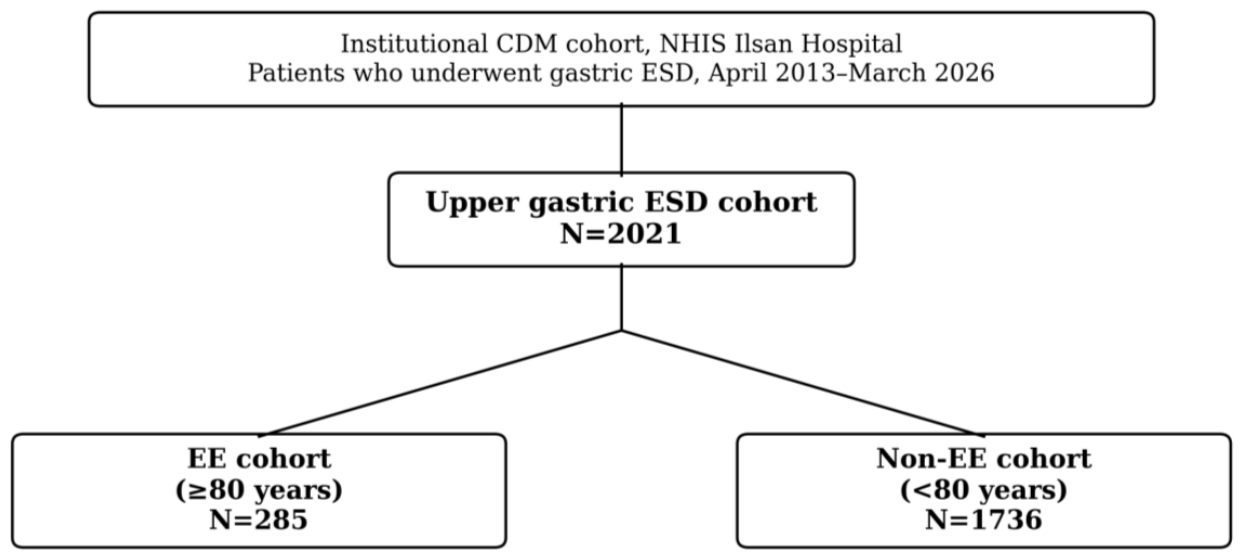
Figure 2.
Incidence of post-ESD safety outcomes according to age group in univariable analysis. Bars represent percentages, with patients aged ≥80 years shown first; 0% values are displayed. P values compare patients aged ≥80 years with those aged <80 years. Abbreviations: ER, emergency room; ESD, endoscopic submucosal dissection.
Figure 2.
Incidence of post-ESD safety outcomes according to age group in univariable analysis. Bars represent percentages, with patients aged ≥80 years shown first; 0% values are displayed. P values compare patients aged ≥80 years with those aged <80 years. Abbreviations: ER, emergency room; ESD, endoscopic submucosal dissection.
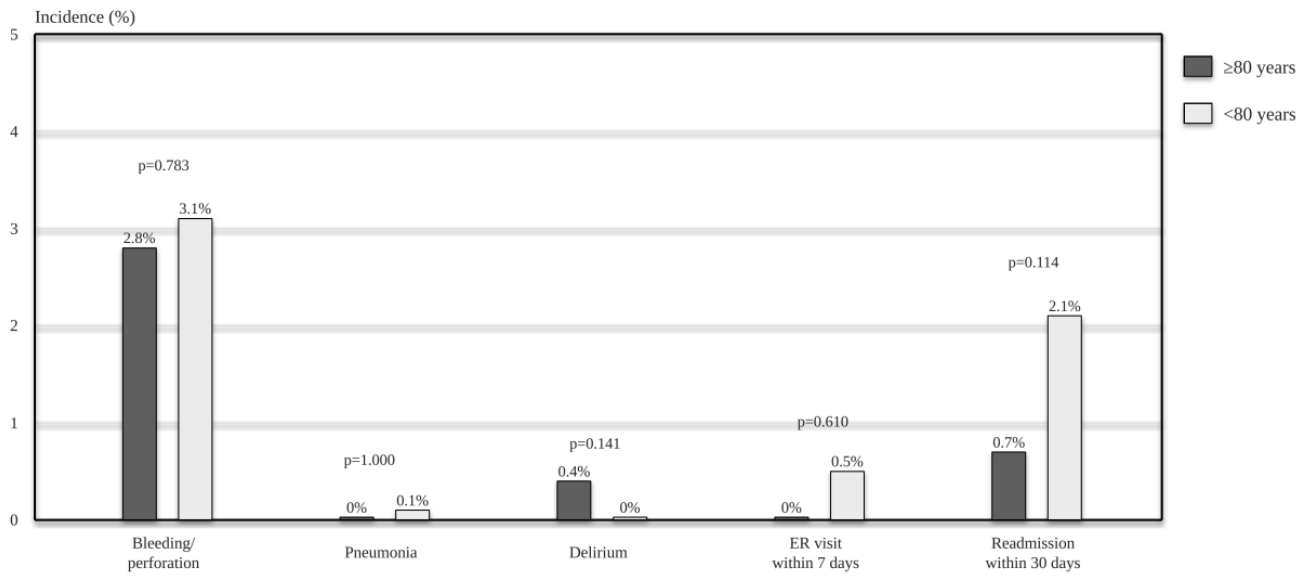
Figure 3.
Forest plot of the age effect on unfavorable efficacy outcomes after gastric ESD in multivariable analysis. Estimates show adjusted odds ratios for patients aged ≥80 years compared with those aged <80 years. Models were adjusted for sex, Charlson Comorbidity Index, and antithrombotic-agent use. Abbreviations: CI, confidence interval; ESD, endoscopic submucosal dissection; OR, odds ratio.
Figure 3.
Forest plot of the age effect on unfavorable efficacy outcomes after gastric ESD in multivariable analysis. Estimates show adjusted odds ratios for patients aged ≥80 years compared with those aged <80 years. Models were adjusted for sex, Charlson Comorbidity Index, and antithrombotic-agent use. Abbreviations: CI, confidence interval; ESD, endoscopic submucosal dissection; OR, odds ratio.
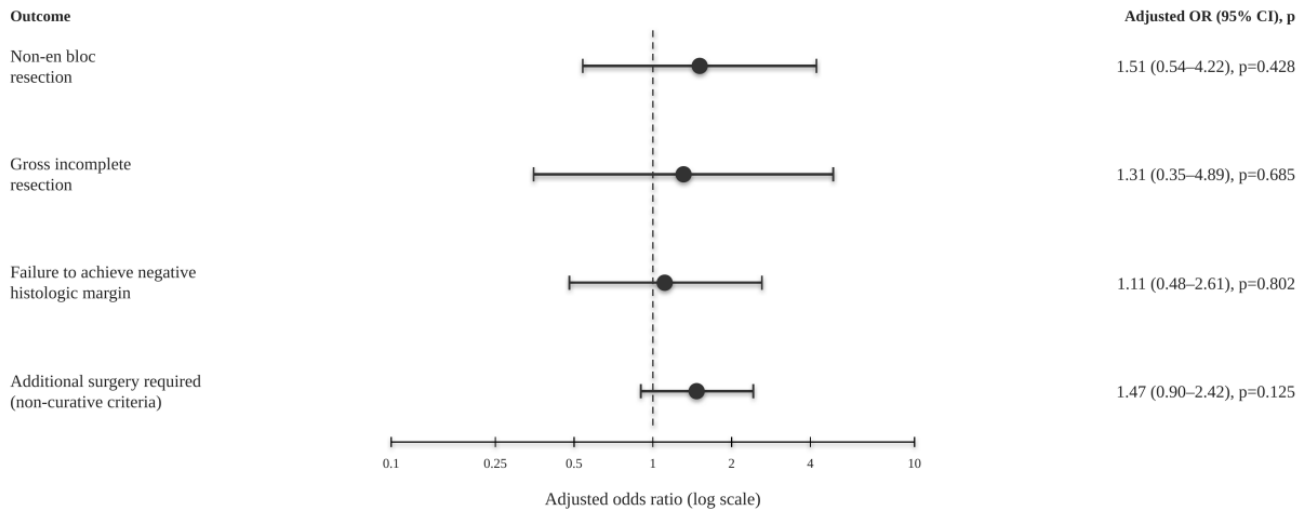
Figure 4.
Forest plot of the age effect on post-ESD safety outcomes in multivariable analysis. Estimates show adjusted odds ratios for patients aged ≥80 years compared with those aged <80 years. Models were adjusted for sex, Charlson Comorbidity Index, and antithrombotic-agent use; other safety outcomes were not modeled because of zero or sparse events. Abbreviations: CI, confidence interval; ESD, endoscopic submucosal dissection; OR, odds ratio.
Figure 4.
Forest plot of the age effect on post-ESD safety outcomes in multivariable analysis. Estimates show adjusted odds ratios for patients aged ≥80 years compared with those aged <80 years. Models were adjusted for sex, Charlson Comorbidity Index, and antithrombotic-agent use; other safety outcomes were not modeled because of zero or sparse events. Abbreviations: CI, confidence interval; ESD, endoscopic submucosal dissection; OR, odds ratio.
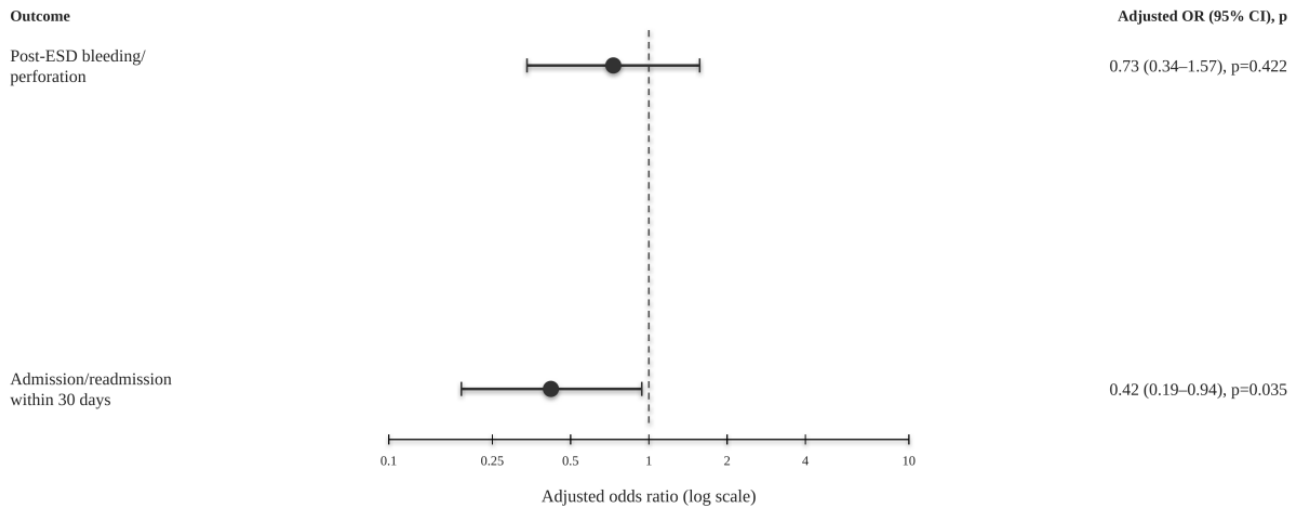

Table 1.
Baseline characteristics according to age group.
| Characteristic | Total (n=2021) | <80 years (n=1736) | ≥80 years (n=285) | P value |
| No. of lesions | 2021 | 1736 | 285 | |
| Age, years, mean ± SD | 68.5 ± 10.1 | 66.1 ± 8.8 | 82.8 ± 2.6 | <0.001 |
| Male sex, n (%) | 1347 (66.7) | 1170 (67.4) | 177 (62.1) | 0.091 |
| CCI, mean ± SD | 1.6 ± 1.7 | 1.5 ± 1.7 | 2.2 ± 1.9 | <0.001 |
| CCI ≥3, n (%) | 383 (24.8) | 299 (22.7) | 84 (37.0) | |
| Antithrombotic agent use, n (%) | 56 (2.8) | 44 (2.5) | 12 (4.2) | <0.001 |
| Hospital stay, days, median (IQR) | 4.0 (4.0–5.0) | 4.0 (4.0–4.0) | 4.0 (4.0–5.0) | 0.161 |
| Final pathology category | ||||
| Low-grade adenoma | 923 (45.7) | 820 (47.2) | 103 (36.1) | <0.001 |
| High-grade adenoma | 243 (12.0) | 209 (12.0) | 34 (11.9) | |
| EGC | 855 (42.3) | 707 (40.7) | 148 (51.9) |
Values are shown as mean ± SD, median (IQR), or n (%). P values compare patients aged <80 years and ≥80 years. CCI, Charlson Comorbidity Index; EGC, early gastric cancer; ESD, endoscopic submucosal dissection; IQR, interquartile range; SD, standard deviation.
Table 2.
ESD lesion and pathologic characteristics according to final pathology category.
| Characteristic | Total (n=2021) | Low-grade adenoma (n=923) | High-grade adenoma (n=243) | EGC (n=855) | P value |
| No. of lesions | 2021 | 923 | 243 | 855 | |
| Location | |||||
| Antrum/lower third | 1340 (66.3) | 585 (63.4) | 160 (65.8) | 595 (69.6) | 0.001 |
| Body/middle third | 442 (21.9) | 232 (25.1) | 52 (21.4) | 158 (18.5) | |
| Fundus/cardia/upper third | 60 (3.0) | 17 (1.8) | 7 (2.9) | 36 (4.2) | |
| Angle/incisura | 179 (8.9) | 89 (9.6) | 24 (9.9) | 66 (7.7) | |
| Tumor size, cm, median (IQR) | 1.2 (0.8–1.8) | 1.0 (0.7–1.5) | 1.1 (0.7–1.5) | 1.3 (0.9–2.0) | <0.001 |
| En bloc resection, n (%) | 2000 (99.0) | 917 (99.3) | 241 (99.2) | 842 (98.5) | 0.183 |
| Gross type | |||||
| Elevated | 127 (6.3) | 107 (11.6) | 19 (7.8) | 1 (0.1) | |
| Flat | 49 (2.4) | 39 (4.2) | 10 (4.1) | 0 (0.0) | |
| Depressed | 38 (1.9) | 25 (2.7) | 12 (4.9) | 1 (0.1) | |
| Elevated/IIa | 1615 (79.9) | 752 (81.5) | 202 (83.1) | 661 (77.3) | |
| Flat/IIb | 46 (2.3) | 0 (0.0) | 0 (0.0) | 46 (5.4) | |
| Depressed/IIc | 146 (7.2) | 0 (0.0) | 0 (0.0) | 146 (17.1) | |
| Histologic type | |||||
| Adenoma/dysplasia, low grade | 923 (45.7) | 923 (100.0) | 0 (0.0) | 0 (0.0) | |
| Adenoma/dysplasia, high grade | 243 (12.0) | 0 (0.0) | 243 (100.0) | 0 (0.0) | |
| Tubular adenocarcinoma, well differentiated | 650 (32.2) | 0 (0.0) | 0 (0.0) | 650 (76.0) | <0.001 |
| Tubular adenocarcinoma, moderately differentiated | 166 (8.2) | 0 (0.0) | 0 (0.0) | 166 (19.4) | |
| Poorly differentiated adenocarcinoma | 19 (0.9) | 0 (0.0) | 0 (0.0) | 19 (2.2) | |
| Signet ring cell carcinoma | 20 (1.0) | 0 (0.0) | 0 (0.0) | 20 (2.3) | |
| Lauren type | |||||
| Intestinal | 2003 (99.1) | 923 (100.0) | 243 (100.0) | 837 (97.9) | <0.001 |
| Diffuse | 12 (0.6) | 0 (0.0) | 0 (0.0) | 12 (1.4) | |
| Mixed | 2 (0.1) | 0 (0.0) | 0 (0.0) | 2 (0.2) | |
| Depth of invasion | |||||
| Intraepithelial/CIS/HGD only | 1191 (58.9) | 923 (100.0) | 243 (100.0) | 25 (2.9) | <0.001 |
| Mucosal invasion (pT1a) | 737 (36.5) | 0 (0.0) | 0 (0.0) | 737 (86.2) | |
| Submucosal invasion <500 um | 44 (2.2) | 0 (0.0) | 0 (0.0) | 44 (5.1) | |
| Submucosal invasion ≥500 um | 49 (2.4) | 0 (0.0) | 0 (0.0) | 49 (5.7) | |
| Resection margin | |||||
| Negative/free margin | 1984 (98.2) | 915 (99.1) | 236 (97.1) | 833 (97.4) | 0.012 |
| Positive/involved or dysplasia at margin | 37 (1.8) | 8 (0.9) | 7 (2.9) | 22 (2.6) | |
| Lymphovascular invasion present, n (%) | 23 (1.1) | 0 (0.0) | 0 (0.0) | 23 (2.7) | |
| Venous invasion present, n (%) | 1 (0.0) | 0 (0.0) | 0 (0.0) | 1 (0.1) | 0.994 |
| Perineural invasion present, n (%) | 0 (0.0) | 0 (0.0) | 0 (0.0) | 0 (0.0) | |
| Additional surgery required (non-curative criteria), n (%) | 102 (5.0) | 1 (0.1) | 0 (0.0) | 101 (11.8) | <0.001 |
EGC, early gastric cancer; ESD, endoscopic submucosal dissection; IQR, interquartile range.
Table 3.
Efficacy profiles for gastric ESD: overall cohort.
| Outcome | All (n=2021) | <80 years (n=1736) | ≥80 years (n=285) | p value |
| En bloc resection | 2000/2021 (99.0) | 1719/1736 (99.0) | 281/285 (98.6) | 0.524 |
| Gross complete resection / endoscopic gross margin negative | 2008/2021 (99.4) | 1725/1736 (99.4) | 283/285 (99.3) | 0.704 |
| Histologic negative resection margin | 1984/2021 (98.2) | 1705/1736 (98.2) | 279/285 (97.9) | 0.637 |
| Additional surgery required (non-curative criteria) | 102/2021 (5.0) | 80/1736 (4.6) | 22/285 (7.7) | 0.026 |
| Post-ESD surgery performed | 15/2021 (0.7) | 13/1736 (0.7) | 2/285 (0.7) | 1.000 |
Values are n/N (%). P values compare patients aged <80 years and ≥80 years. ESD, endoscopic submucosal dissection.
Table 4.
Safety profiles after gastric ESD: overall cohort.
| Outcome | All (n=2021) | <80 years (n=1736) | ≥80 years (n=285) | p value |
| Post-ESD pneumonia | 2/2021 (0.1) | 2/1736 (0.1) | 0/285 (0.0) | 1.000 |
| Post-ESD bleeding/perforation | 62/2021 (3.1) | 54/1736 (3.1) | 8/285 (2.8) | 0.783 |
| Post-ESD delirium | 1/2021 (0.0) | 0/1736 (0.0) | 1/285 (0.4) | 0.141 |
| ER visit within 7 days | 8/2021 (0.4) | 8/1736 (0.5) | 0/285 (0.0) | 0.610 |
| Readmission within 30 days | 38/2021 (1.9) | 36/1736 (2.1) | 2/285 (0.7) | 0.114 |
| Admission/readmission within 30 days | 88/2021 (4.4) | 81/1736 (4.7) | 7/285 (2.5) | 0.090 |
| Complication-related endoscopic procedure within 15 days | 50/2021 (2.5) | 42/1736 (2.4) | 8/285 (2.8) | 0.696 |
| Post-ESD surgery performed | 15/2021 (0.7) | 13/1736 (0.7) | 2/285 (0.7) | 1.000 |
| Complication-related emergency surgery within 15 days | 3/2021 (0.1) | 3/1736 (0.2) | 0/285 (0.0) | 1.000 |
| Composite 30-day safety event | 134/2021 (6.6) | 121/1736 (7.0) | 13/285 (4.6) | 0.130 |
| 30-day mortality | 0/2021 (0.0) | 0/1736 (0.0) | 0/285 (0.0) | |
Values are n/N (%). P values compare patients aged <80 years and ≥80 years. ER, emergency room; ESD, endoscopic submucosal dissection.
Table 5.
Firth penalized multivariable logistic regression analyses of unfavorable efficacy outcomes after gastric ESD.
Table 5.
Firth penalized multivariable logistic regression analyses of unfavorable efficacy outcomes after gastric ESD.
| Covariate | Adjusted OR (95% CI) | P value |
| A. Non-en bloc resection | ||
| Age ≥80 years (reference: <80 years) | 1.51 (0.54–4.22) | 0.428 |
| Female sex (reference: male) | 0.15 (0.03–0.77) | 0.023 |
| CCI, per 1-point increase | 1.20 (1.00–1.43) | 0.048 |
| Antithrombotic-agent use (reference: no use) | 0.60 (0.04–9.70) | 0.720 |
| B. Gross incomplete resection | ||
| Age ≥80 years (reference: <80 years) | 1.31 (0.35–4.89) | 0.685 |
| Female sex (reference: male) | 0.08 (0.01–1.16) | 0.064 |
| CCI, per 1-point increase | 1.17 (0.94–1.47) | 0.166 |
| Antithrombotic-agent use (reference: no use) | 0.99 (0.06–15.43) | 0.993 |
| C. Failure to achieve a negative histologic resection margin | ||
| Age ≥80 years (reference: <80 years) | 1.11 (0.48–2.61) | 0.802 |
| Female sex (reference: male) | 2.23 (1.17–4.22) | 0.014 |
| CCI, per 1-point increase | 1.15 (0.97–1.35) | 0.104 |
| Antithrombotic-agent use (reference: no use) | 0.46 (0.03–7.36) | 0.580 |
| D. Additional surgery required (non-curative criteria) | ||
| Age ≥80 years (reference: <80 years) | 1.47 (0.90–2.42) | 0.125 |
| Female sex (reference: male) | 1.18 (0.77–1.81) | 0.445 |
| CCI, per 1-point increase | 1.29 (1.18–1.41) | <0.001 |
| Antithrombotic-agent use (reference: no use) | 0.70 (0.19–2.60) | 0.596 |
Firth penalized logistic regression was used. Separate models were fitted for non-en bloc resection, gross incomplete resection, failure to achieve a negative histologic resection margin, and additional surgery requirement based on non-curative criteria. Each model included age group, sex, CCI as a continuous variable, and antithrombotic-agent use. Reference categories for binary covariates are shown in parentheses. An OR >1 indicates higher odds of the unfavorable outcome. Post-ESD surgery was not modeled because only 15 events occurred. CCI, Charlson Comorbidity Index; CI, confidence interval; ESD, endoscopic submucosal dissection; OR, odds ratio.
Table 6.
Multivariable logistic regression analyses of post-ESD safety outcomes after gastric ESD.
| Covariate | Adjusted OR (95% CI) | P value |
| A. Post-ESD bleeding/perforation | ||
| Age ≥80 years (reference: <80 years) | 0.73 (0.34–1.57) | 0.422 |
| Female sex (reference: male) | 0.79 (0.44–1.42) | 0.439 |
| CCI, per 1-point increase | 1.27 (1.13–1.41) | <0.001 |
| Antithrombotic-agent use (reference: no use) | 2.92 (1.11–7.71) | 0.030 |
| B. Admission/readmission within 30 days | ||
| Age ≥80 years (reference: <80 years) | 0.42 (0.19–0.94) | 0.035 |
| Female sex (reference: male) | 0.70 (0.42–1.16) | 0.163 |
| CCI, per 1-point increase | 1.23 (1.11–1.36) | <0.001 |
| Antithrombotic-agent use (reference: no use) | 3.12 (1.35–7.21) | 0.008 |
Separate multivariable logistic regression models were fitted for post-ESD bleeding/perforation and admission/readmission within 30 days. Each model included age group, sex, CCI, and antithrombotic-agent use. Reference categories for binary covariates are shown in parentheses. Models for post-ESD pneumonia, post-ESD delirium, ER visits within 7 days, and surgery after ESD were not estimated because of zero or sparse events. CCI, Charlson Comorbidity Index; CI, confidence interval; ER, emergency room; ESD, endoscopic submucosal dissection; OR, odds ratio.
Disclaimer/Publisher’s Note: The statements, opinions and data contained in all publications are solely those of the individual author(s) and contributor(s) and not of MDPI and/or the editor(s). MDPI and/or the editor(s) disclaim responsibility for any injury to people or property resulting from any ideas, methods, instructions or products referred to in the content. |
© 2026 by the authors. Licensee MDPI, Basel, Switzerland. This article is an open access article distributed under the terms and conditions of the Creative Commons Attribution (CC BY) license.
Copyright: This open access article is published under a Creative Commons CC BY 4.0 license, which permit the free download, distribution, and reuse, provided that the author and preprint are cited in any reuse.


