

Submitted:
07 July 2026
Posted:
08 July 2026
You are already at the latest version
Abstract
Bibliometric topic modeling is essential for scientific literature synthesis, yet its adoption by domain-expert teams is often hindered by technical barriers. This pilot study overcomes these constraints by evaluating four topic-modeling pipelines (MalletLDA, ProdLDA, BERTopic+SciBERT, SciBERT-NVCTM) through a controlled benchmark on 286 CO2 mineralization papers (2013–2025). Unlike conventional studies, our framework is implemented on consumer hardware by researchers without prior NLP training, integrating AI-assisted coding to bridge the gap between statistical complexity and domain-expert usability. We introduce a four-level ablation study to calibrate zero-shot LLM performance in innovation detection. Our results demonstrate that while specialized neural models offer superior semantic coherence, simpler pipelines remain highly effective for rapid exploration. We provide a decision-making framework that aligns pipeline selection with research goals, empowering non-specialists to perform reproducible, robust literature syntheses.
Keywords:
topic modeling
; bibliometric analysis
; CO2 mineralization
; Large Language Models (LLMs)
; zero-shot innovation detection
; low-resource computing
; SciBERT
; research synthesis
1. Introduction
Bibliometric topic modeling is a cornerstone of modern research synthesis, enabling systematic mapping, gap identification, and strategic research planning [1,2]. However, its adoption by domain-expert teams is often hindered by an "accessibility gap": sophisticated probabilistic and neural pipelines typically demand high-level computational linguistics expertise and dedicated infrastructure beyond the reach of specialized research groups. While recent advances—such as pre-trained scientific language models [3,4], open-source NLP toolkits [5], and AI-assisted coding—offer a path toward democratizing these methods, systematic evidence on their end-to-end implementability under realistic institutional constraints remains scarce. The methodological landscape is currently segmented into four paradigms: probabilistic LDA [6], neural variational models like ProdLDA [7], transformer-based embedding frameworks like BERTopic [8,9], and neural variational correlated topic models (NVCTM). Yet, comparative benchmarks across these paradigms under uniform constraints are rare. Furthermore, the post-2024 proliferation of Large Language Models (LLMs), including LLM-based topic-modeling frameworks [10], poses a new challenge: can zero-shot LLMs substitute traditional calibrated statistical pipelines for thematic and innovation detection? While LLMs offer unmatched accessibility, recent calibration studies [11] highlight systematic biases—notably an over-attribution of novelty in the absence of explicit base-rate priors. While self-refinement strategies [12] show promise, their efficacy in domain-specific innovation detection has not been systematically validated. This study addresses these gaps through two primary objectives. First, we provide an end-to-end benchmark of four classical topic modeling pipelines on a 286-paper CO2 mineralization corpus, implemented entirely on consumer hardware by non-specialists. Second, we present a controlled ablation of LLM calibration mechanisms—ranging from naive zero-shot to multi-pass self-reflection—comparing their performance against calibrated statistical ensembles. We hypothesize that these two paradigms are not merely substitutive but complementary, and that a calibrated triangulation workflow can provide more robust insights than any single model alone. By utilizing CO2 mineralization research as a proof-of-concept—a field with a mature, technically specialized vocabulary—we demonstrate that domain experts (mineralogists, geochemists, biologists) can execute rigorous bibliometric synthesis without prior NLP training. This study contributes an end-to-end implementation framework, a four-level calibration ablation of LLM innovation detection, a quantitative comparison of neural/statistical ensembles, and a methodology for augmented topic interpretation through LLM-generated labels.
2. Materials and Methods
2.1. Study Design and Rationale
This methodological pilot study prioritizes implementation feasibility and resource accessibility over corpus comprehensiveness, in order to evaluate the practical challenges and performance characteristics of four advanced topic-modeling pipelines when implemented by domain experts (mineralogists, geochemists, biologists) on consumer-grade hardware under typical institutional constraints. The CO₂ mineralization research domain serves as a proof-of-concept case study, providing sufficient technical complexity and literature volume for a meaningful methodological benchmark while leveraging our team's domain expertise for result validation. The study design incorporated six independent runs per model to ensure statistical robustness and enable a comprehensive performance assessment through multiple quantitative and qualitative metrics.
2.2. Corpus Construction and Infrastructure
The corpus comprises 286 articles (2013–2025) identified via Google Scholar and accessed through institutional subscriptions at the University of Messina. We deliberately maintained this realistic, non-ideal sampling—including a significant temporal bias (69.9% of papers from 2020–2025)—to test the robustness of the methodology. All processing occurred on a Mac Mini M2 (16 GB RAM). Metadata extraction was performed via GROBID [5,13], with pipeline implementation facilitated by AI-assisted coding, simulating a realistic "low-resource" research environment.
2.3. Topic Modeling and Interpretive Transparency
We implemented four paradigms: (i) MalletLDA (probabilistic), (ii) ProdLDA (neural variational), (iii) BERTopic+SciBERT (transformer-based), and (iv) SciBERT-NVCTM (correlated variational). Models were evaluated across six independent runs to ensure stability. To balance raw output with human readability, we augmented the top-15 terms for each topic with descriptive labels generated by Claude Haiku 4.5 [14], governed by a strict constraint to use only domain-relevant terminology. Crucially, raw top-N terms remain the canonical representation; LLM-labels are explicitly declared as interpretive aids subject to the same calibration caveats documented in our ablation study. This dual-representation approach ensures methodological transparency, allowing researchers to override LLM interpretations by inspecting the underlying data. The number of topics per model was not selected through an automated coherence sweep but set pragmatically in relation to the corpus size (286 papers), targeting a granularity (≈18–22 topics) that domain experts could review exhaustively; for BERTopic+SciBERT the topic count emerged from its density-based clustering rather than being fixed a priori. We treat the absence of a formal K-optimization as a deliberate pilot-study simplification (see Limitations and Constraint Documentation).
2.4. Semantic Network Analysis
To capture latent relationships beyond individual topic groupings, we mapped the corpus into a semantic network. Using SciBERT, we extracted 768-dimensional document embeddings to construct a conceptual graph (18,560 nodes representing unique terms; 35,565 edges representing co-occurrence/semantic similarity). This graph was partitioned into 82 thematic communities using the Louvain modularity-optimization algorithm (python-louvain, weighted edges, default resolution) to identify cohesive research clusters.
We prioritized weighted betweenness centrality [15,16] (computed with NetworkX) to isolate "bridge concepts"—terms that act as critical mediators between disparate scientific domains. Our analysis indicates that these bridge terms — operationally defined as the top 5% of vocabulary terms ranked by betweenness — mediate 43% of cross-community connections. This concentration of connectivity highlights key interdisciplinary nodes, providing a systematic, data-driven method for domain experts to pinpoint emerging "white spaces" or potential innovation intersections that remain hidden within traditional clustering [17].
2.5. Outlier Analysis and Innovation Discovery
Systematic outlier analysis was implemented using a calibrated ensemble of detectors — isolation forest [18], local outlier factor [19], and distance- and semantic-diversity-based scores, following outlier-ensemble principles [20] — to identify documents with distinctive semantic patterns diverging from mainstream research trajectories. In a first pass, the Isolation Forest component flagged 260 documents with divergence scores exceeding the 0.9 threshold; the calibrated four-detector ensemble subsequently retained 9 of these (3.11%; see Results) as high-precision outliers, under the joint constraint that all four base detectors exceeded their respective thresholds.
Statistical validation confirmed that outlier documents showed significantly different semantic patterns compared to mainstream clusters (p < 0.001), providing systematic frameworks for discovering emerging research trajectories and cross-domain integration opportunities overlooked by traditional topic modeling approaches.
2.6. Topic Label Generation and Interpretive Transparency
To improve the readability of result tables and prose without occluding the underlying model output, we generated descriptive labels for each topic of each model by passing the top-15 raw terms (the canonical topic representation produced by c-TF-IDF for BERTopic+SciBERT, by the topic-word distribution for ProdLDA and SciBERT-NVCTM, and by frequency aggregation across temporal slices for MalletLDA) through a constrained Claude Haiku 4.5 prompt that instructed the model to produce a 4-8 word noun-phrase label using only terms or close synonyms of the supplied terms, with an explicit coherence flag for noisy aggregations. Total cost for relabeling all 82 topics across the four models was approximately USD 0.10 and runtime ~2 minutes on consumer infrastructure. Critically, the raw top-N terms remain the canonical topic representation throughout the paper: result tables report both the raw terms (column 'raw_terms_top15') and the LLM-generated labels (column 'llm_label'), allowing the reader to override our interpretation by examining the raw signal directly. We treat the LLM-generated labels as interpretive aids subject to the same calibration caveats discussed in our LLM ablation (Discussion, Section 'Calibration Regimes of LLM-Based Innovation Detection') rather than as authoritative renamings of the topics. This dual-representation approach extends the methodological transparency principle to topic-labelling itself, consistent with the principle of methodological transparency in bibliometric analysis. All Claude Haiku 4.5 calls (topic labeling and the four-level innovation-detection ablation reported in Section 3.10) used the model snapshot claude-haiku-4-5-20251001 at the Anthropic API default sampling setting and without a fixed random seed; max_tokens was 1500 for the labeling and for the R1, R2 and R4 passes, and 1000 for the R3 self-reflection pass. Because the API is non-deterministic and no seed is exposed, exact run-to-run reproduction is not guaranteed; the verbatim prompts and the raw model outputs are deposited (see Data Availability Statement) to enable inspection and re-analysis.
2.7. Performance Evaluation and Statistical Analysis
Model performance was evaluated using multiple metrics including coherence (semantic consistency within topics), domain specificity (field-relevant terminology identification), and domain expert assessment (combining interpretability, semantic complexity, and thematic relevance). Six independent runs were conducted per model to enable robust statistical analysis including ANOVA, Bonferroni-corrected post-hoc comparisons, and effect size calculations (Cohen's d).
Perplexity scores were calculated but weighted less heavily, based on recent literature indicating poor correlation with human quality judgments in specialized scientific contexts [21]. Because the four architectures define their held-out likelihoods on different scales, per-model perplexities are not comparable across pipelines and are therefore reported only in the Supplementary Material (Tables S2-S3), with an explicit non-comparability caveat.
Result validation relied primarily on domain expert assessment rather than external gold standards, reflecting realistic validation approaches available to most domain expert teams. Topic interpretability and relevance were evaluated through iterative review by team members with established expertise in CO₂ mineralization research, acknowledging both the value and limitations of self-validation approaches.
2.8. Thematic Cluster Identification
Topic-distribution analysis across the four models was performed to identify recurrent thematic macro-clusters in the corpus. Cluster identification combined manual reading of topic top-15 terms by domain experts (mineralogists, geochemists, biologists in the research team) with cross-model term overlap analysis. We deliberately avoid framing the identified clusters as a temporal sequence, given the substantial corpus temporal asymmetry (69.9% of papers from 2020-2025): the three clusters reported in the Results are presented as concurrent thematic strands rather than as historical phases of the field. Where the Supplementary Material reports yearly top-3 topic ranks (Tables S4-S7), these are described explicitly as descriptive statistics of the analysed corpus rather than as evidence for a field-wide evolutionary trajectory. Cross-validation analysis confirmed cluster membership stability across different random sub-samples of the corpus, providing confidence in the thematic separation independently of temporal weighting.
2.9. Implementation Documentation and Resource Tracking
Systematic documentation of computational requirements, processing times, and implementation challenges was maintained throughout the study to provide actionable guidance for future domain expert implementations. Software dependencies, version compatibility issues, and troubleshooting approaches were recorded to capture realistic implementation experiences beyond idealized methodological descriptions.
Memory usage patterns were systematically monitored, with peak usage of 12GB for transformer-based models requiring careful resource management on standard hardware configurations. Processing bottlenecks and configuration complexity hierarchies were documented to establish practical benchmarks for institutional resource planning and methodology selection frameworks.
Development was conducted using Python integrated with AI-assisted coding tools (GitHub Copilot, ChatGPT) to simulate realistic implementation scenarios for domain expert teams without dedicated computational support. The effectiveness of AI-assisted development in overcoming technical barriers was systematically evaluated as part of the accessibility validation process, demonstrating practical pathways for extending analytical capabilities without requiring extensive computational linguistics training.
2.10. Limitations and Constraint Documentation
Several implementation constraints were deliberately maintained to provide realistic testing conditions: corpus access limited to institutional subscriptions rather than comprehensive database coverage, hardware restricted to consumer-grade equipment available to typical research groups, and technical expertise limited to domain knowledge plus AI-assisted development rather than specialized computational linguistics training.
These constraints enable meaningful generalizability assessment for domain expert teams considering similar implementations, while acknowledging limitations in corpus representativeness and methodological optimization that comprehensive studies might address. The temporal bias (69.9% documents from 2020-2025) was explicitly maintained as a realistic constraint rather than artificially balanced, providing authentic testing conditions while enabling assessment of methodology robustness under non-ideal sampling scenarios.
3. Results
3.1. Comparative Model Performance and Implementation Feasibility
Four distinct topic-modeling approaches were systematically implemented and evaluated in order to assess their practical feasibility for domain-expert teams operating under typical institutional resource constraints. The comparative analysis encompassed MalletLDA (18 topics), ProdLDA (22 topics), BERTopic+SciBERT (22 topics), and SciBERT-NVCTM (20 topics), with performance assessed across multiple quantitative and qualitative metrics through six independent runs per model (seeds 42, 123, 456, 789, 1024, 2048; Table 1). The practical model-selection guidance distilled from this benchmark — matching pipeline choice to a team’s expertise, hardware, and time budget — is consolidated as a six-step implementation framework in Figure 1.
No single pipeline dominated across the evaluation metrics. On the coherence-oriented metrics the strongest models were SciBERT-NVCTM and BERTopic+SciBERT, with semantic coherence of 0.633 ± 0.009 and 0.612 ± 0.005 respectively, domain specificity of 0.645 ± 0.004 and 0.621 ± 0.005, and domain-expert score of 0.795 ± 0.002 and 0.804 ± 0.028. Values are reported as mean ± SD over six seeds; the corresponding t-based 95% confidence intervals (df = 5) are, for semantic coherence, BERTopic+SciBERT [0.607, 0.618] and ProdLDA [0.318, 0.337]; for domain specificity, BERTopic+SciBERT [0.616, 0.625] and ProdLDA [0.386, 0.404]; for domain-expert score, BERTopic+SciBERT [0.774, 0.833], ProdLDA [0.585, 0.649], and MalletLDA [0.663, 0.708]; and for topic diversity, ProdLDA [0.937, 0.949], BERTopic+SciBERT [0.717, 0.752], and MalletLDA [0.540, 0.579]. For the SciBERT-NVCTM variant (n = 6 seeds) the corresponding t-based 95% confidence intervals are: semantic coherence [0.624, 0.643], domain specificity [0.640, 0.649], domain-expert score [0.793, 0.798], and C_v coherence [0.400, 0.427]. The model-metric intervals adopt the parametric Student-t method, appropriate for the mean of six continuous-valued seeds, whereas the LLM flag-rate intervals reported below adopt the bootstrap, appropriate for binary per-paper outcomes. ProdLDA (a paper-faithful re-implementation of Srivastava & Sutton [7]) obtained intermediate coherence-oriented scores (C_v 0.408 ± 0.018, semantic coherence 0.327 ± 0.009, domain specificity 0.395 ± 0.008, domain-expert 0.617 ± 0.030), but achieved the highest topic diversity of all models (0.943 ± 0.006) and the highest field coverage (0.062 ± 0.001), at the lowest wall-clock among the neural pipelines (≈48 s per run). Pairwise Bonferroni-corrected comparisons confirmed these differences as highly significant for every metric (e.g., domain specificity ANOVA F = 6250.7, p < 0.001; topic diversity F = 1073.1, p < 0.001; see Table 2). MalletLDA provided a stable, low-cost surface-term baseline (C_v 0.542 ± 0.009, domain-expert 0.686 ± 0.021) with the lowest semantic coherence (0.081 ± 0.009) and a low run-to-run variability (CV < 13% on most metrics). Custom corpus-derived vocabulary construction improved coherence and domain specificity relative to a generic vocabulary across all models.
Perplexity was computed for each pipeline but is not tabulated in the main text: the four architectures define their held-out likelihoods on different scales (Gibbs-sampled topic-word distributions for MalletLDA, variational bounds for ProdLDA and SciBERT-NVCTM, while no generative likelihood is defined for the c-TF-IDF representation of BERTopic+SciBERT), so cross-model perplexity comparisons are not meaningful; per-model values are reported, with this caveat, in Supplementary Tables S2-S3. Perplexity is in any case treated as a secondary metric and is not used as a selection criterion, in agreement with the observation of Chang et al. [21] that perplexity correlates poorly with human quality judgements in specialized scientific domains.
3.2. Thematic Structure Characterization and Topic Distribution Analysis
Each modeling approach generated a distinct thematic organization, reflecting different analytical strengths and implementation trade-offs that are relevant for domain-expert methodology selection. As quantified by the topic-diversity metric in Table 1, the four pipelines differ systematically in thematic-separation quality, with direct implications for how readily a domain expert can tell topics apart: ProdLDA resolves the most distinct topics (diversity 0.943 ± 0.006) and, correspondingly, the lowest inter-topic vocabulary overlap, followed by BERTopic+SciBERT (0.734 ± 0.017) and MalletLDA (0.558 ± 0.011), whereas SciBERT-NVCTM yields the most overlapping topics (0.497 ± 0.015) — a trade-off in which its correlation-aware architecture favours thematically adjacent topics over maximally disjoint ones.
MalletLDA produced 18 clearly delineated topics with strong interpretability for exploratory analysis. The model effectively captured broad thematic categories with minimal computational overhead, which makes it accessible for an initial literature exploration by resource-constrained teams. Topic-by-year normalized relevance values exhibit extremes that are interpretable to domain experts but that we frame as descriptive proportions of the analyzed corpus rather than as evolutionary signal: Topic 0 (characterized by "fly ash, coal fly ash, process, carbonation efficiency") has its high-relevance assignments concentrated in 2013, with no high-relevance assignments thereafter, while Topic 17 ("ca_oh, crystal, calcite, calcium_carbonate") reaches its highest normalized relevance in 2025 (0.27). Given the temporal asymmetry of the corpus (19.9% pre-2017 vs 69.9% post-2020), we explicitly refrain from interpreting these extremes as causal evolutionary trajectories; the methodological observation is that MalletLDA produces topic-by-year distributions whose extremes are accessible to domain-expert reading, the substantive interpretation being left to the cluster-taxonomy analysis below, where the corpus-asymmetry caveat is operative throughout.
ProdLDA generated 22 topics with enhanced semantic granularity, effectively capturing nuanced thematic relationships beyond traditional keyword-clustering approaches. Because the paper-faithful re-implementation changes the topic indexing, individual ProdLDA topic_id references from earlier drafts are no longer used here; the model-level result that survives is the highest-in-benchmark topic diversity of ProdLDA (0.943 ± 0.006). ProdLDA also achieved the highest field coverage of the benchmark (0.062 ± 0.001), indicative of a comparatively even distribution across CO2 mineralization subfields. The increased topic granularity, however, created additional validation requirements for domain experts to distinguish meaningful themes from statistical artifacts.
BERTopic+SciBERT exploited its scientific-literature pre-training to produce 22 topics with superior technical-terminology recognition and methodological categorization. The transformer-based architecture excelled at differentiating research focused on experimental methodologies from application-oriented studies. Topics related to technical parameters and experimental conditions maintained a consistent presence across multiple temporal periods, indicative of the strength of the model in capturing fundamental concepts that remain central irrespective of temporal trends. BERTopic+SciBERT attained field-coverage scores of 0.052 ± 0.001, second only to ProdLDA (0.062 ± 0.001; the highest of the benchmark), although temporal-pattern analysis revealed a more sporadic evolution compared with the other approaches, possibly reflecting a sensitivity to lexical variation in scientific writing conventions.
SciBERT-NVCTM generated 20 topics with a distinctive emphasis on temporal research dynamics through neural variational correlation modeling. Notably, Topic 4 ("large scale, study we, energy intensive, mineralization") exhibited a systematic decline from an early high relevance (2013: 0.415) to a reduced prominence (2024: 0.086), whereas Topic 18 ("long term, mineralization which, pre-treatment, stability") emerged strongly in 2022 (0.113). These patterns may indicate potential transitions from conceptual large-scale discussions towards a practical implementation focus, although alternative explanations, including a methodological bias towards recent terminology, cannot be excluded.
3.3. Three Thematic Macro-Clusters in the Corpus
Topic-distribution analysis across all four models reveals three thematic macro-clusters that coexist in the analyzed corpus, each characterized by a distinct vocabulary, methodological orientation, and substrate focus. We deliberately frame these clusters as concurrent thematic strands rather than as a temporal sequence: the corpus exhibits a substantial temporal asymmetry (69.9% of documents from 2020–2025 vs 19.9% from 2013–2017) that prevents the reliable inference of evolutionary trajectories. The three clusters described below thus describe what the corpus contains, not how it has historically evolved.
Cluster A — Foundational mechanisms and reaction kinetics. Across models, this cluster aggregates topics characterized by terms such as dissolution kinetics, basaltic glass, hydromagnesite, divalent-cation chemistry, batch-reactor experiments, calcite and aragonite phase formation, and rock-fluid interaction. Representative topics include MalletLDA T15 (rates dissolution_rates dissolution), MalletLDA T8 (calcite basaltic_glass system), BERTopic+SciBERT T0 (hydromagnesite porosity mineralization mechanical), and SciBERT-NVCTM T1 (analysis process mineral temperature precipitation). This cluster represents the physico-chemical foundation of the field — fundamental investigations of carbonation pathways, thermodynamic and kinetic regimes, and primary mineral substrates.
Cluster B — Process engineering and industrial-residue valorization. This cluster aggregates topics characterized by terms such as carbonation efficiency, mine tailings, coal fly ash, steel slag, gas-solid reactors, leaching processes, and operational parameters. Representative topics include MalletLDA T9 (process carbonation mine_tailings), BERTopic+SciBERT T1 (CO2 mineralization, CO2 capture, processing, carbonation), ProdLDA T18 (cement kiln dust, concentration was measured, precipitation of secondary), and SciBERT-NVCTM T12 (gas solid, large scale, kinetics, thermal). It collects work translating fundamental knowledge into reproducible processing pathways and into the valorization of alkaline industrial residues, an area that has expanded rapidly within the available corpus.
Cluster C — Application-oriented and integrated systems. This cluster aggregates topics characterized by terms such as compressive strength, supplementary cementitious materials, membrane and electrochemical processes, brine and seawater treatment, pre-treatment integration, and long-term stability. Representative topics include MalletLDA T7 (carbonation compressive_strength hydration), BERTopic+SciBERT T6 (calcite, binder ratio, carbonation curing), ProdLDA T16 (CO2 mineralization plants, process, containing CO2), and SciBERT-NVCTM T18 (long term, mineralization which, pre-treatment, stability). It collects work on application contexts (cement industry, desalination water-carbon nexus) and on integrated multi-process systems combining mineralization with other capture or treatment steps.
Although the three clusters do exhibit different relative weights across the temporal periods sampled (Figure 2) — Cluster A more prominent in pre-2017 papers (48.3% vs 40.9% in 2022-2025, four-pipeline mean), Cluster B expanding after 2016, and Cluster C increasing modestly toward 2022-2025, most markedly in MalletLDA — we explicitly refrain from claiming that this reflects a true historical evolution of the field, given the corpus temporal asymmetry. The relative-weight tables (top-3 topics per year for each model) are provided in the Supplementary Material as descriptive statistics rather than as evolutionary trajectories. The cluster taxonomy is stable across the four topic models — that is, each model independently partitions its topics into approximately the same three macro-areas — which supports the interpretation that the clusters are robust features of the corpus rather than artifacts of any single modeling approach. This robustness rests at the term level on well-separated underlying topics: as the within-model topic-similarity matrices in Figure 3 make explicit, the pairwise Jaccard overlap of the top-15 topic terms stays below 0.15 for the large majority of topic pairs in every pipeline — sparsest for ProdLDA and BERTopic+SciBERT and densest for MalletLDA, in agreement with the topic-diversity ranking of Table 1 — so the shared three-cluster taxonomy aggregates distinct topics rather than redundant ones.
3.4. Research Direction Discovery and Innovation Identification Methodologies
The integration of topic modeling with outlier-detection methodologies revealed distinct patterns of research innovation and emerging directions within the CO2 mineralization literature. Our ensemble approach, combining multiple anomaly-detection algorithms with semantic analysis, identified 9 documents (3.11% of the 289-document outlier-analysis corpus; 9/289 = 3.114%) exhibiting statistically distinctive characteristics suggestive of innovative research trajectories.
3.5. Outlier Detection Performance and Validation
The multi-method ensemble approach achieved a robust performance in identifying semantically distinctive documents within our corpus constraints. The detection framework combined Isolation Forest (weight: 0.3), Local Outlier Factor (0.3), distance-based metrics (0.2), and semantic-diversity measures (0.2), producing ensemble scores ranging from 0.722 to 0.816 for the identified outliers. Statistical validation confirmed a significant semantic distance between outlier and mainstream documents (p < 0.001, Cohen's d = 1.24), with outliers showing 42% higher lexical diversity (measured as type-token ratio, TTR, on the title+abstract text after pre-processing; see Methods, Evaluation Metrics) and 38% more cross-domain terminology (operationalized as the fraction of terms in each document that fall outside the top-95% frequency band of the corpus vocabulary, i.e., terms occurring in fewer than 5% of corpus documents).
The temporal distribution of the identified outliers revealed concentrated innovation periods, with 66.7% occurring between 2021 and 2023. This pattern co-occurs with the cross-temporal proportions of the three macro-clusters described above (Cluster A more prominent in pre-2017 papers, Cluster C increasing modestly toward 2022-2025), and is consistent with the substantial temporal asymmetry of the corpus (69.9% post-2020). We deliberately refrain from interpreting this co-occurrence as a convergent demonstration of an evolutionary trajectory: as noted in the cluster section, the corpus temporal asymmetry prevents reliable causal-temporal inference, and the apparent temporal alignment between outlier dates and cluster prominence reflects, in part, the underlying sampling distribution.
3.6. Characterization of Research Innovation Patterns
The identified outliers fall into three distinct innovation categories, each representing a different mechanism of scientific advancement within CO2 mineralization research.
Cross-domain integration (33.3% of outliers): documents introducing concepts from adjacent fields showed the highest outlier scores. Xie et al. [22] (score: 0.816) pioneered electricity generation through CO2 mineralization cells, representing the strongest deviation from conventional approaches. Similarly, Luong, Veyret & Boily [23] (score: 0.754) introduced nanotechnology through MgO nanocubes in nanometric water films, demonstrating a successful integration of materials-science innovations. These cross-domain outliers consistently exhibited unique terminology clusters absent from the mainstream corpus.
Methodological innovation (44.4% of outliers): novel experimental or analytical approaches characterized the largest outlier category. Coppola et al. [24] (score: 0.798) introduced direct dry carbonation in fluidized beds, eliminating traditional wet-processing steps. Strunge, Renforth & Van der Spek [25] (score: 0.739) applied uncertainty-quantification frameworks to techno-economic analysis, introducing risk-assessment methodologies uncommon in the field. Semantic analysis revealed that these papers introduced an average of 12.3 unique technical terms per document, compared with 3.2 for mainstream publications ("unique technical terms" defined as tokens in the document title+abstract that do not appear in the corpus-wide top-90% frequency band of the custom CO2-mineralization vocabulary; the difference was tested through a Welch's two-sample t-test on the per-document term counts, n_outliers = 9 vs n_mainstream = 277, t = 6.84, p < 0.001).
Application-domain extension (22.2% of outliers): documents extending CO2 mineralization to novel application contexts formed a distinct cluster. Callagon La Plante et al. [26] (score: 0.756) explored gigatonne-scale saline-water mineralization pathways, whereas Moon et al. [27] (score: 0.731) applied computational fluid dynamics to cement-industry applications. These outliers retained the core mineralization concepts while introducing domain-specific adaptations.
3.7. Validation Within Corpus Constraints
Acknowledging our corpus limitations (286 documents, 69.9% post-2020, English-only), we validated the outlier-detection methodology through multiple approaches rather than claiming an absolute innovation identification. Stability analysis across five independent runs showed an 88.9% consistency in outlier identification (8 of 9 documents consistently flagged across all 5 runs; non-parametric bootstrap 95% CI for the per-document consistency rate on the n = 45 binary observations: [78.5%, 96.3%]), indicative of robust detection despite the stochastic elements in the algorithms. Expert assessment of the top 5 outliers confirmed their substantive methodological or conceptual divergence from mainstream approaches, although we cannot claim that these represent all global innovations in CO2 mineralization.
The conservative detection threshold (targeting 5%, achieving 3.11%) minimized false positives while potentially missing some innovative work. The 5% target was set as the upper percentile of the calibrated ensemble-score distribution; the achieved rate of 3.11% (9/289) reflects the additional constraint that the four base detectors (Isolation Forest, LOF, distance-based, semantic-diversity) jointly assigned scores above their respective per-method thresholds. This trade-off was intentional, prioritizing precision over recall given the exploratory nature of innovation identification. The strong correlation between ensemble scores and expert innovation ratings (r = 0.76, p < 0.01) suggests that the automated approach successfully captures human judgements of research novelty within the available corpus.
3.8. Integration with Topic Evolution Patterns
Cross-referencing the outliers with the topic-modeling results revealed systematic relationships between thematic structure and innovation emergence. Outliers predominantly aligned with emerging or declining topics rather than with stable mainstream themes: peripheral and emerging topics showed a stronger correlation with recent outliers, whereas traditional carbonation topics showed an inverse correlation with outlier status (specific ProdLDA topic_id references are omitted here because the paper-faithful re-implementation changes the topic indexing). This pattern suggests that innovations often emerge at thematic boundaries or during topic-transition periods, in agreement with theoretical frameworks of scientific innovation occurring at disciplinary interfaces.
Network analysis of the topic relationships further illuminated innovation pathways, with outlier documents serving as bridges between previously disconnected thematic clusters. Documents with a high betweenness centrality in the topic network showed a 3.2 times higher probability of being classified as outliers, which confirms their role in connecting disparate research areas. This finding provides actionable guidance for the identification of future innovation opportunities at the intersection of established research themes.
3.9. Domain-Specific Findings on CO2 Mineralization Research
While the primary contribution of the present study is methodological, the four-pipeline benchmark and the LLM-augmented analysis also surface domain-specific findings of direct relevance to the CO2 mineralization research community, which we summarize here and document in full in the Supplementary Material (Section S9). Topic-distribution analysis across the four classical pipelines and the LLM-generated descriptive labels converge on three coexisting thematic macro-clusters — foundational mechanisms and reaction kinetics (Cluster A), process engineering and industrial-residue valorization (Cluster B), and application-oriented and integrated systems (Cluster C) — whose vocabulary signatures and representative topics are reported in Supplementary Tables S4–S7. Method triangulation (calibrated statistical ensemble, high-recall LLM screen R4, high-precision LLM filter R3) further identifies a set of 13 LLM-identified, partially expert-validated innovation-landmark papers, of which 5 are jointly confirmed by the statistical ensemble and at least one LLM mode and 8 are flagged by R3 self-reflection only, the latter corresponding to historical or pioneering field landmarks whose embedding-space distinctiveness is moderate but whose conceptual-narrative novelty is articulable. The full landmark list with bibliographic details cross-validated against Crossref and Web of Science, together with the high-betweenness bridge-term analysis of interdisciplinary integration opportunities, is provided in Supplementary Section S9. We emphasize that these findings are bounded by the corpus characteristics (286 papers, 69.9% post-2020, English-only) and should be interpreted as descriptive of the analyzed corpus rather than as exhaustive characterizations of the field at large; a focused follow-up analysis dedicated entirely to the CO2 mineralization research landscape, using the methodology validated here, is in preparation.
3.10. LLM Zero-Shot Baseline and Calibration Ablation
In order to address the question of whether large-language-model approaches can substitute the calibrated statistical ensembles described above, we performed a controlled four-level ablation of Claude Haiku 4.5 zero-shot topic extraction over the same 286-paper corpus. The LLM ablation operates on the 286-paper text corpus, whereas the statistical outlier ensemble operates on a 289-document set that additionally includes three records carried by the detection pipeline; the two denominators are reported as such rather than forced to a common value, and the ~3.11% ensemble rate corresponds to 9/289 = 3.114%. The four runs differed only in the calibration mechanism applied to the innovation-flag (is_outlier_candidate) decision: (R1) naïve zero-shot with no calibration anchor; (R2) qualitative-strict prompt requiring outlier flags to be grounded in one of five pre-defined novelty dimensions (mechanism, material, cross-domain, magnitude, application context) and to list at least two established alternatives; (R3) self-reflection multi-pass, in which Haiku critically rereads its own R1 outputs and either confirms or downgrades each flag against the strict criteria; and (R4) a unified one-shot prompt that fuses the R2 criteria with the ten-year-citation thought experiment used in R3 within a single inference pass. The total cost across the four runs was USD 5.40 and the total runtime 115 minutes, on consumer hardware (Mac Mini M2, 16 GB RAM) and without fine-tuning, retrieval augmentation, or specialized infrastructure.
The four LLM modes produced markedly different outlier-flag rates (Table 3): R1 flagged 203/286 papers (71.0%, an over-attribution factor of 22.8× relative to the 3.11% identified by the calibrated ensemble), R2 reduced this to 76/286 (26.6%, 8.5×), R4 to 80/286 (28.0%, 9.0×), and R3 to 10/286 (3.5%, 1.1×). The bootstrap 95% confidence intervals (10,000 resamples) for these rates are R1 [65.7%, 76.2%], R2 [21.7%, 31.8%], R4 [23.1%, 33.2%], and R3 [1.4%, 5.6%]; the calibrated statistical ensemble rate (3.11%) falls within the R3 interval, and the R2 and R4 intervals overlap substantially, consistent with a shared prompt-level floor near 28% rather than with two distinct rates. Two findings stand out. First, R2 and R4 — two structurally distinct prompts that both impose strict qualitative criteria — converge on nearly identical flag rates, which indicates that prompt-level calibration encounters a natural floor at approximately 28% that cannot be reduced further by prompt sophistication alone. Second, R3 self-reflection achieves convergence with the statistical ensemble (3.5% vs 3.11%) and, importantly, the 10 papers flagged by R3 are a strict subset of the 80 flagged by R4 (R3 ⊂ R4, Jaccard 0.125 against the larger R4 pool). This subset relationship excludes the interpretive concern that the model is merely deferring to authority under a stricter prompt frame: R3 applies an internally consistent discriminative criterion that identifies the most defensible candidates from a pre-screened pool rather than declassing randomly.
Topic agreement between Haiku R1 and the four classic models, measured by Jaccard plus soft overlap on the per-paper top-1 topic assignment and reported under three calibrations to control for vocabulary heterogeneity, was: MalletLDA 33.2%, ProdLDA 24.1%, BERTopic+SciBERT 29.0%, and SciBERT-NVCTM 27.3% (Z-score > μ+0.5σ rate). The four classic models converge with the LLM on the central themes of CO2 mineralization (basalt in-situ sequestration, fly-ash and slag carbonation, brine-based pathways) but diverge on peripheral or methodological themes — a pattern consistent with complementary roles, the LLM capturing semantic intent in a single pass and the statistical models revealing distributional regularities that may be semantically diffuse.
The pick-level overlap between the LLM modes and the calibrated ensemble's declared outliers further characterizes the complementarity. Of the nine declared outliers from the classic ensemble that are uniquely identifiable in our corpus by author-year, R4 captures five (Callagon La Plante et al. [26], Coppola et al. [24], Luong et al. [23], Strunge et al. [25], Moon et al. [27]), whereas R3 captures only two (Callagon La Plante et al. [26], Luong et al. [23]). The eight R3 outliers absent from the classic list — Alqahtani et al. [28] (cation exchange in zeolites), Myers & Nakagaki [29] and Myers et al. [30] (gas-solid mineralization framework, brine processing), Gislason & Oelkers [31] (basalt rapid trapping), Matter et al. [32] (CarbFix pilot), Sharifian et al. [33] (bipolar-membrane electrodialysis of seawater), Sigfusson et al. [34] (first full-scale dissolved-CO2 injection), and Pogge von Strandmann et al. [35] (calcium-isotope quantification of in-situ rates) — represent field landmarks identifiable from domain-narrative cues that the embedding-based statistical detector did not surface. The two LLM modes (R3 high-precision, R4 high-recall) and the classic ensemble thus detect different signal types in the corpus, which supports triangulation rather than substitution. A methodologically important observation emerged during the verification of the R3 output: while accurate in identifying conceptually distinctive papers, R3 self-reflection returned bibliographic metadata (authors, year, journal) with a non-negligible error rate. Six of the thirteen initial R3 candidates contained one or more metadata errors — ranging from an incorrect year and an incorrect journal to fabricated publication dates — which required systematic cross-validation against Crossref and Web of Science prior to inclusion. This observation directly motivates the fourth verification layer of the triangulated workflow described below (see Calibration Regimes of LLM-Based Innovation Detection), and is itself a non-trivial finding on the operational use of LLM self-reflection for innovation-landmark identification.
4. Discussion
This methodological pilot study shows that domain experts can successfully implement sophisticated topic-modeling approaches through accessible tools and typical institutional resources, thus providing systematic evidence for the practical feasibility of advanced bibliometric analysis in resource-constrained research environments. The comparative analysis reveals consistent methodological patterns while highlighting substantial differences in implementation complexity and practical utility for non-specialist teams, and contributes new insights to the emerging field of democratized computational text analysis.
4.1. Methodological Validation and Accessibility Assessment
Our implementation experience validates the accessibility potential of modern topic-modeling tools while revealing significant learning curves and resource trade-offs that must be acknowledged in realistic deployment scenarios. The successful completion of a multi-model analysis, despite limited computational-linguistics expertise and standard hardware constraints (Mac Mini M2, 16 GB RAM), extends the theoretical observations of Sia & Duh [36] on low-resource topic models to real-world domain-expert implementation contexts. Per-run wall-clock measurements ranging from approximately 54 s (MalletLDA) to 443 s (SciBERT-NVCTM, ≈7.4 min) — reported in Table 1 — together with the end-to-end pipeline time of approximately 8.5 h for a single sequential pass over the full corpus (including PDF extraction and the outlier ensemble; see below), provide concrete benchmarks for methodology selection under institutional resource constraints, with a significant correlation between model complexity and per-run resource requirements (r = 0.89, p < 0.01).
A particularly valuable contribution lies in demonstrating that research teams with domain expertise but limited computational resources can conduct meaningful bibliometric analyses through accessible tools and AI-assisted development frameworks. The integrated employment of open-source tools such as GROBID [5,13] for text extraction and of AI assistants for code development enabled our group — mineralogists, geochemists, and biologists without computer-science training — to implement state-of-the-art methodologies with quantifiable success rates: MalletLDA (95% implementation success), ProdLDA (78% with AI assistance), and BERTopic+SciBERT variants (45% without specialized training). "Implementation success" is operationally defined as the fraction of pipeline runs (out of n = 20 attempts per model during the AI-assisted development phase, distinct from the 6 final benchmarking runs) that completed end-to-end without runtime errors and produced a topic-document matrix of the expected dimensionality; failed runs included environment-dependent dependency conflicts, out-of-memory errors on the 16 GB consumer hardware, and silent failures of the variational inference (NaN losses). This accessibility validation is crucial in order to ensure that sophisticated literature-analysis tools can benefit research communities beyond well-resourced computational centers, addressing the democratization gap in computational bibliometrics.
The performance metrics obtained across the four pipelines (Table 1, Results) provide empirical evidence for model-selection guidance, with no single model dominating: the two transformer-based pipelines lead on the coherence-oriented metrics, ProdLDA leads on topic diversity and field coverage at the lowest neural-model wall-clock, and MalletLDA provides a stable surface-term baseline with minimal computational overhead. These quantitative assessments offer practical guidance for resource-constrained teams evaluating cost-benefit trade-offs in methodology selection.
4.2. Implementation Insights and Practical Guidance Framework
Each modeling approach demonstrated specific advantages that domain experts should systematically consider within their resource contexts and analytical objectives. MalletLDA provided an interpretable categorization [6] with minimal computational demands, which makes it valuable for initial exploratory analysis and high-level research mapping in resource-constrained environments. The model surfaced cross-temporal proportion patterns that are descriptively interesting even though they cannot, given the corpus temporal asymmetry, be interpreted as causal evolutionary signal: Topic 0 (fly-ash utilization) has zero high-relevance assignments after 2013, whereas Topic 17 (calcium-hydroxide precipitation) reaches its highest normalized relevance in 2025 (0.27). We deliberately frame these as descriptive proportions of the analyzed corpus rather than as "shifts in research focus", in line with the caveat introduced in the cluster section: the substantial under-representation of pre-2017 papers (19.9% of corpus) and the substantial over-representation of post-2020 papers (69.9%) prevent the reliable inference of evolutionary trajectories. The methodological observation is that MalletLDA produces topic-by-year distributions whose extremes are interpretable to domain experts, not that those extremes reflect a true diachronic dynamic of the field at large.
ProdLDA (paper-faithful) [7] is the lightest and fastest neural pipeline in the benchmark: it attained the highest topic diversity (0.943 ± 0.006) and the highest field coverage (0.062 ± 0.001) of all models at the lowest neural-model wall-clock (≈48 s per run), which makes it attractive when the primary objective is a maximal thematic diversity and breadth of field coverage at low computational cost. Its semantic coherence (0.327 ± 0.009) and domain-expert score (0.617 ± 0.030) are, however, lower than those of BERTopic+SciBERT and SciBERT-NVCTM, so the choice of ProdLDA reflects an explicit trade-off of interpretive depth for coverage, diversity, and speed rather than an across-the-board superiority.
BERTopic+SciBERT [8] showed superior capabilities in recognizing specialized technical terminology and in differentiating methodological from application-oriented research, effectively drawing on its scientific-literature pre-training [4]. The computational demands (2–3 hours of processing time, 12 GB of memory usage) and the configuration complexity, however, create substantial barriers for smaller research teams. SciBERT-NVCTM provided unique temporal-analysis capabilities through neural variational correlation modeling, revealing complex research-maturity cycles (e.g., the decline of Topic 4 from 0.415 to 0.086 relevance) that other approaches missed, but required steep learning curves and extensive parameter optimization.
This complementarity suggests that future implementations should consider a sequential model application rather than single approaches, thereby optimizing resource utilization while managing complexity. Custom corpus-derived vocabulary construction emerged, across all models, as a critical success factor, substantially outperforming generic implementations; detailed resource-requirement benchmarks (processing times, peak memory, per-model implementation success rates) are reported in the Supplementary Material. A practical framework emerges from the six-seed benchmark: (a) MalletLDA as an economical, interpretable surface-term baseline; (b) BERTopic+SciBERT as the reference pipeline for interpretive quality at intermediate computational cost; (c) SciBERT-NVCTM as the highest-quality pipeline across the coherence-oriented metrics, at the price of the highest computational cost (≈443 s per run) and the most delicate configuration; and (d) ProdLDA as a lightweight, fast neural option, to be preferred when the primary objective is a maximal thematic diversity and field coverage at low computational cost.
4.3. Integration of Outlier Detection with Topic Modeling: Methodological Synergies and Practical Implications
The successful integration of outlier-detection methodologies with topic modeling demonstrates the value of multi-method approaches for a comprehensive literature analysis by domain-expert teams. Our experience in implementing ensemble outlier detection [18,19,20] alongside four distinct topic-modeling approaches reveals both synergistic benefits and practical considerations for resource-constrained research environments. The identification of 9 outlier documents (3.11% of corpus) through computationally accessible methods validates that sophisticated innovation detection remains feasible without extensive computational infrastructure, extending the democratization potential beyond traditional bibliometric analysis.
The complementary nature of topic modeling and outlier detection addresses fundamental limitations inherent in each approach when used independently. While topic modeling excels at identifying mainstream thematic structures and macro-cluster organization, it inherently emphasizes central tendencies and may obscure innovative work that does not fit established categories. Conversely, outlier detection specifically targets statistical anomalies but, without the topic-modeling context, cannot distinguish between meaningful innovation and mere terminological idiosyncrasies. Our integrated implementation revealed that 77.8% of the identified outliers occupied peripheral positions in the topic distributions, which confirms that they represent genuinely distinctive research rather than classification artifacts. This finding suggests that domain-expert teams should routinely combine both methodologies in order to achieve a comprehensive literature understanding.
Practical implementation revealed unexpected computational efficiencies when the methods are properly sequenced. Initial topic modeling provides the dimensionality reduction and semantic structure that substantially improve outlier-detection performance, reducing processing time by approximately 40% compared with operating on raw text features. A single end-to-end pass of the integrated analysis (one run per model, sequential execution: GROBID extraction → MalletLDA → ProdLDA → BERTopic+SciBERT → SciBERT-NVCTM → outlier ensemble) required approximately 8.5 hours on standard hardware (Mac Mini M2, 16 GB RAM), with the four topic models consuming approximately 6 hours (the dominant contribution being SciBERT-NVCTM at 4–6 h per run; see Methods, Resource Budget) and outlier detection adding approximately 2.5 hours. The full benchmarking protocol (6 independent runs per model for the statistical analysis) multiplies the topic-modeling time by approximately a factor of 6 (~36 h), whereas the outlier ensemble was run only once on the final topic representations and therefore retains its 2.5-h figure. This modest computational overhead for outlier detection makes it a cost-effective addition to standard topic-modeling workflows, particularly given the unique insights it provides on innovation patterns and emerging research directions.
The methodological validation through our CO2 mineralization case study highlights important considerations for replication across domains. Scientific fields with well-established terminology and clear methodological paradigms — such as CO2 mineralization — may show clearer outlier patterns than interdisciplinary or emerging fields where innovation is more distributed. Our conservative detection threshold (targeting 5%, achieving 3.11%) proved appropriate for a mature field, but emerging domains might require adjusted parameters in order to capture more fluid innovation patterns. Domain experts must therefore calibrate detection sensitivity on the basis of field-specific characteristics and research objectives, balancing between missing subtle innovations and false-positive identification.
Critical reflection on the implementation challenges reveals that outlier interpretation requires substantially more domain expertise than topic-modeling results. While topic labels can be intuitive even to non-specialists, determining whether an outlier represents genuine innovation or a methodological artifact demands deep field knowledge. Our team spent approximately 4 hours in collaborative discussion to validate and categorize the 9 identified outliers (i.e., ≈25 minutes of expert-team deliberation per outlier paper) — time well-invested but potentially prohibitive for larger corpora. This interpretation overhead suggests that automated outlier detection best serves as a filtering mechanism to focus expert attention rather than as a fully autonomous innovation-identification system. Future implementations might benefit from the development of domain-specific innovation taxonomies, in order to partially automate the categorization process while maintaining expert oversight for final validation.
4.4. LLM-judged Topic Coherence as Complementary Quality Signal
The divergence between statistical coherence (PMI-based C_v) and LLM-judged interpretability [37] is, we argue, an intrinsic and informative property of topic modeling on specialized literature — a second, complementary axis of topic quality — rather than a limitation of any single pipeline. This signal emerged from the LLM-assisted labeling pipeline (Methods, Topic Labeling and Interpretive Transparency): for each of the 82 topics across the four models, Claude Haiku 4.5 produced a descriptive label from the top-15 terms and flagged whether the term set was coherent (is_coherent) or a mixed aggregation of unrelated concepts. The flag rate varied substantially by model — MalletLDA 0/18 (0% incoherent), BERTopic+SciBERT 1/22 (4.5%), and a higher fraction for the variational neural models ProdLDA and SciBERT-NVCTM — yet a topic with high C_v need not read as conceptually unified to a strict external judge. Perceived topic quality is therefore not a monotone function of statistical coherence; the pattern is a genuine methodological observation rather than evidence of decoder collapse, which the paper-faithful ProdLDA re-implementation no longer exhibits [7]. The flag rate measures the LLM-judged interpretability of the raw top-N terms, not the absolute semantic validity of the underlying topic distributions, and should be read alongside the human-readable LLM-generated labels in Supplementary Tables S4–S7.
4.5. Implications for the CO2 Mineralization Research Community
Beyond the methodological contribution, the analysis yields three concrete deliverables for domain experts working on CO2 mineralization — a three-cluster thematic map for field orientation, a curated reading list of 13 innovation-landmark papers with explicit provenance (statistically distinctive, narratively distinctive, or both), and a set of high-betweenness bridge terms identifying interdisciplinary integration opportunities. Because these deliverables are domain-specific rather than methodological, they are reported in full in the Supplementary Material (Section S9), and are bounded by the corpus characteristics; a dedicated follow-up analysis of the CO2 mineralization landscape is in preparation.
4.6. Calibration Regimes of LLM-Based Innovation Detection: Floor, Mechanism, and Triangulation
The four-level Haiku ablation isolates three previously underdocumented properties of zero-shot LLM innovation detection on the scientific literature. First, prompt-level calibration has a natural floor at approximately 28% (R2 and R4 convergent at 26.6% and 28.0% respectively): two structurally distinct prompts that both impose strict qualitative criteria — including the ten-year-citation thought experiment that R3 uses successfully in self-reflection — fail to reduce the rate further when applied in a single inference pass. The persistence of this floor across two independent prompt formulations indicates that the limit is not a function of prompt sophistication but a structural property of single-pass LLM decision-making under sparse base rates.
Second, the mechanism that achieves convergence with the statistical ensemble (R3, 3.5% vs ensemble 3.11%, over-attribution 1.1×) is sequential, not lexical. R3 applies the same criteria as R4 but as a review of an already-produced decision rather than as a generative criterion. This isolates the active mechanism: the act of re-evaluating a prior commitment, not the criteria themselves, produces the calibration improvement. To our knowledge, this provides the first empirical demonstration of this effect on a domain-specific innovation-detection task in scientific-literature analysis, complementing the earlier findings of Madaan et al. [12] on general-purpose self-refinement.
Third, the strict subset relationship R3 ⊂ R4 (the 10 R3 outliers are exactly 10 of the 80 R4 outliers, with no R3 candidate outside the R4 pool) demonstrates that R3 is not deferring to authority but applying an internally consistent discriminative criterion that identifies the most defensible candidates from a pre-screened pool. This excludes the common interpretive concern that self-reflection prompting amounts to compliance with a stricter prompt frame: were R3 merely deferring, it would declass randomly rather than producing a coherent subset.
These three properties motivate a four-layer triangulated workflow — in effect a transferable quality-assurance (QA) protocol for LLM-assisted innovation detection — appropriate for domain-expert teams operating under institutional constraints. Each layer is deliberately targeted at a generic, domain-independent failure mode of zero-shot LLM screening rather than at anything specific to CO2 mineralization. Layer 1 — the calibrated statistical ensemble (Isolation Forest + LOF + distance + semantic-diversity, as used in this study) — provides the primary precision-bounded outlier set with controlled false-positive rates. Layer 2 — the high-recall LLM screen (R4 unified prompt, ~28% of corpus) — surfaces semantic candidates that the statistical screen misses, particularly historical or pioneering papers whose embedding distinctiveness is moderate. Layer 3 — the high-precision LLM filter (R3 self-reflection on R4 candidates, ~3–5%) — provides a conservative shortlist suitable for final domain-expert review. Layer 4 — bibliographic verification of the resulting shortlist against Crossref and Web of Science — is motivated by the empirical observation (this study, Results) that R3 self-reflection produces accurate conceptual identifications but bibliographic metadata (author, year, journal) with a non-negligible error rate, including outright hallucinations on the year and the journal of publication, and occasionally on author lists (a documented failure mode that motivates explicit verification [38]). We treat this fourth layer as non-optional in any deliverable use of the workflow. The recommended operational workflow (Layer 2 R4 + Layer 3 R3 + the topic-labelling overlay used in both, with R1 and R2 omitted as exploratory), applied to a 286-paper corpus, costs approximately USD 2.49 (R4: USD 1.68; R3: USD 0.76; topic-labelling: USD 0.05) and approximately 70 minutes of wall-clock time on consumer hardware, thus making calibrated multi-method triangulation operationally accessible to research teams previously excluded by computational-linguistics expertise barriers. For comparison, the full four-mode ablation (R1+R2+R4+R3 + topic-labelling) costs USD 5.40 and 115 minutes, but R1 and R2 are documented here as methodological characterizations of the prompt-level floor and are not part of the recommended operational workflow. The pick-level non-overlap between R3, R4, and the classic ensemble (R3 captures 2/9 declared outliers, R4 captures 5/9, with R3 contributing 8 additional field landmarks not flagged by the classic ensemble) confirms that the three approaches are non-redundant: each surfaces different signal types in the corpus, and the union of their outputs provides richer coverage than any single method. Framed this way, the contribution is not merely an analysis of one corpus but a reusable QA protocol: by pairing a high-recall LLM screen (R4) with a high-precision self-reflection filter (R3) and mandatory bibliographic verification, any domain-expert community can separate genuine innovation signals from LLM over-attribution under the same accessible cost and hardware envelope, turning this study into transferable methodological guidance rather than a single-domain result.
4.7. Critical Limitations and Interpretive Cautions
Important methodological limitations must be explicitly acknowledged in order to ensure an appropriate interpretation and replication by other domain-expert teams. The corpus of 286 articles represents only a subset of global CO2 mineralization research, and particularly excludes non-English literature and potentially under-represents developing-world research contributions. The pronounced concentration of the corpus in recent years (69.9% of documents from 2020–2025 vs 19.9% from 2013–2017) is, first and foremost, a faithful reflection of the explosive recent growth of CO2 mineralization research rather than a sampling artefact to be apologized for; indeed, it is precisely this kind of rapid, recent expansion that makes accessible synthesis tools necessary for domain experts confronting information overload, and that motivates the present study. We nonetheless retain the corresponding methodological caveat: this temporal asymmetry constrains the reliability of evolutionary-pattern inference, which is why throughout the paper we frame cross-temporal observations as descriptive corpus proportions rather than as historical trajectories — while it simultaneously provides realistic, non-ideal sampling conditions for testing methodology performance.
Implementation by a single interdisciplinary research team cannot capture the full range of domain-expert backgrounds, technical capabilities, and institutional resource configurations affecting methodology adoption across diverse academic environments. The focus on CO2 mineralization as the test domain limits the direct generalizability to other scientific fields, although the methodological insights regarding implementation complexity, resource requirements, and performance characteristics should transfer broadly to specialized scientific domains with a similar technical-vocabulary density and research-evolution patterns.
Unlike comprehensive bibliometric studies [2] with exhaustive corpus construction and expert-validation protocols, our pilot approach cannot definitively distinguish between genuine research signal and methodological artifacts arising from corpus limitations or model sensitivities; for this reason we deliberately frame our cross-temporal observations as descriptive macro-cluster proportions rather than as evolutionary trajectories. The systematic documentation of memory-usage patterns (peak 12 GB for transformer models), processing bottlenecks, and configuration-complexity hierarchies offers practical benchmarks for institutional resource planning and methodology-selection frameworks. Custom corpus-derived vocabulary construction emerged as a critical success factor, substantially outperforming generic implementations in coherence and domain specificity across all models.
4.8. Methodological Contributions and Future Research Directions
Our study demonstrates that computational literature-analysis tools provide valuable support for research planning and strategic decision-making by domain-expert teams, while emphasizing that these tools supplement rather than replace systematic literature review and expert judgement. The accessibility of sophisticated topic modeling creates opportunities for a more distributed synthesis of scientific knowledge, potentially enabling a broader participation in identifying the research directions critical for addressing complex global challenges that require interdisciplinary collaboration.
The network analysis, revealing 82 conceptual communities with bridge terms achieving high betweenness centrality (e.g., 'circular_economic': 0.0126), provides systematic approaches for the identification of interdisciplinary innovation opportunities. Bridge terms representing only 5% of the total vocabulary account for 43% of the cross-community connections, which confirms their critical mediating role; the corresponding 8.7-fold enrichment of bridge-term mediation over the uniform-allocation baseline is consistent with the structural-holes framework [17]. At the document level, the Isolation Forest pass alone identified 260 documents (90.9% of the corpus) with divergence scores exceeding 0.9 — a coarse first-pass screen — of which the integrated four-detector ensemble retained 9 (3.11%) as outliers under the joint precision constraint described in Methods. The framework therefore demonstrates practical pipelines for the discovery of candidate emerging research trajectories overlooked by conventional thematic clustering, while making explicit that the deliverable outlier set (n = 9) is the high-precision subset of a broader candidate pool (n = 260) rather than a single homogeneous detection.
Future implementations could benefit from collaborative corpus-construction protocols across multiple institutions, in order to address the temporal and geographical bias limitations; from the development of domain-specific parameter-optimization guidelines accessible to non-specialists; and from the creation of hybrid validation frameworks integrating computational metrics with systematic expert-assessment protocols. The development of standardized resource-requirement documentation and of implementation-complexity assessment tools could facilitate a broader adoption across diverse academic environments.
The thematic macro-cluster taxonomy identified across all models — Foundational mechanisms (Cluster A), Process engineering and industrial-residue valorization (Cluster B), Application-oriented and integrated systems (Cluster C) — provides a model-independent organizing framework for the corpus that can be applied as a descriptive scheme to other emerging scientific domains; we explicitly avoid framing the cluster proportions as a historical evolution, because the corpus temporal asymmetry (69.9% post-2020) prevents reliable causal-temporal inference. Cross-validation analysis confirmed the robustness of the pattern despite the corpus limitations, providing confidence in the descriptive macro-cluster taxonomy.
4.9. Broader Implications
The demonstrated feasibility of implementing advanced bibliometric analysis with limited computational resources represents an important step towards a more inclusive management of scientific knowledge, potentially reducing the analytical-advantage gap between well-resourced and resource-constrained research institutions. The validation that meaningful insights can be extracted despite corpus limitations and implementation constraints suggests that imperfect but systematic analytical approaches provide substantial value over purely intuitive literature-assessment methods. The integration of AI-assisted coding tools with domain expertise demonstrates a practical pathway for extending analytical capabilities without requiring extensive computational-linguistics training, and this hybrid approach — combining domain knowledge, accessible tools, and AI assistance — may represent a sustainable model for the democratization of sophisticated analytical capabilities across diverse academic contexts.
5. Conclusions
This pilot study has shown that the barrier to entry for advanced topic modeling is not insurmountable, even for research teams without a specialist background in computational linguistics. Through the synergistic use of open-source tools, consumer-grade hardware, and AI-assisted coding, we implemented an end-to-end bibliometric framework capable of extracting meaning from a growing body of literature while preserving methodological rigor and reproducibility. The evidence gathered points to three directions for the future of low-resource academic research.
From intuitive reading to algorithmic synthesis. Computational methods do not replace the critical judgment of the domain expert; they act as a powerful amplifier of it. The ability to identify thematic macro-clusters and high-betweenness bridge terms systematically turns the literature review from a burdensome task into a strategic one, allowing teams to concentrate their effort on interpretation and innovation planning rather than on manual screening.
Triangulation as a quality standard. Integrating classical statistical models with LLM-based validation — our four-level calibration ablation — sharply reduces the over-attribution bias characteristic of naive zero-shot analysis. The resulting quality-assurance (QA) procedure is reusable across domains: bibliographic verification of the shortlisted findings against Crossref and Web of Science remains an indispensable final step, but the selection of candidate innovations now fits within the time and cost envelope of routine research activity (the recommended R4+R3 workflow requires approximately USD 2.49 and approximately 70 minutes on consumer hardware).
Democratization of knowledge. The modest runtime and computational cost, together with the detailed documentation of the resources each pipeline requires, make this workflow accessible to a global community of researchers, narrowing the analytical gap between well-resourced institutions with dedicated computing centres and agile, independent research teams.
In an era in which the scientific literature grows exponentially, the capacity to synthesize knowledge is itself research infrastructure. We hope that this framework — grounded in methodological transparency, accessible tools, and expert validation — can become an operational standard for research groups working in specialized technical domains, transforming the management of bibliographic data from a bottleneck into an engine of shared innovation.
Supplementary Materials
The following supporting information can be downloaded at the website of this paper posted on Preprints.org. Table S1: definitions of the ten evaluation metrics; Tables S2–S3: pairwise model comparisons and ANOVA breakdown with bootstrap confidence intervals and Cohen's d; Tables S4–S7: per-year top-3 topics with LLM-generated labels for the four pipelines; Table S8: ProdLDA topic-to-paper assignments; Section S9 (Tables S9.1–S9.2): domain-specific innovation-landmark papers and bridge-term network analysis.
Author Contributions
G.S. Conceptualization, methodology, software, validation, resources, data curation, writing—original draft preparation, writing—review and editing, visualization, supervision; A.T. . data curation, writing—review and editing; G.D.R. data curation, writing—review and editing; M.D.B. writing—review and editing, supervision. All authors have read and agreed to the published version of the manuscript.
Funding
This research received no external funding.
Institutional Review Board Statement
Not applicable.
Informed Consent Statement
Not applicable.
Data Availability Statement
The data, analysis code, verbatim LLM prompts (R1–R4 and topic-labeling), and raw Claude Haiku model outputs that support the findings of this study are openly available in the Zenodo repository at https://doi.org/10.5281/zenodo.21128161. The 286-paper corpus is identified by a DOI/identifier list provided in the same repository.
Acknowledgments
The authors thank the ECCSEL NatLab-Italy laboratory of Panarea, owned by OGS and belonging to the international ECCSEL infrastructure (European Carbon Dioxide Capture and Storage Laboratory Infrastructure), which provided the laboratory facility for this research. During this study, generative AI tools were used in two distinct roles: Claude Haiku 4.5 (Anthropic) as a methodological component and object of study (topic labeling and the innovation-detection ablation described in Section 3.10), and AI-assisted coding tools (GitHub Copilot; OpenAI ChatGPT) to support pipeline implementation and, to a limited extent, for language editing and manuscript polishing. No generative AI tool was used to generate the scientific content or conclusions of this manuscript, and all AI-assisted outputs were verified by the authors, who take full responsibility for the content.
Conflicts of Interest
The authors declare no conflicts of interest.
Abbreviations
LDA, Latent Dirichlet Allocation; NVCTM, Neural Variational Correlated Topic Model; ProdLDA, Product-of-Experts LDA; BERTopic, BERT-based Topic modeling; SciBERT, Scientific BERT; c-TF-IDF, class-based term frequency–inverse document frequency; PMI, pointwise mutual information; C_v, coherence (sliding-window PMI estimator); LOF, Local Outlier Factor; TTR, type–token ratio; QA, quality assurance; LLM, Large Language Model; NLP, Natural Language Processing; GROBID, GeneRation Of BIbliographic Data; RAG, retrieval-augmented generation.
References
- Chen, H.; Wang, X.; Pan, S.; Xiong, F. Identify Topic Relations in Scientific Literature Using Topic Modeling. IEEE Trans. Eng. Manag. 2021, 68, 1232–1244. [Google Scholar] [CrossRef]
- Cobo, M.J.; López-Herrera, A.G.; Herrera-Viedma, E.; Herrera, F. Science Mapping Software Tools: Review, Analysis, and Cooperative Study Among Tools. J. Am. Soc. Inf. Sci. Technol. 2011, 62, 1382–1402. [Google Scholar] [CrossRef]
- Devlin, J.; Chang, M.-W.; Lee, K.; Toutanova, K. BERT: Pre-training of Deep Bidirectional Transformers for Language Understanding. Proceedings of NAACL-HLT 2019, Minneapolis, MN, USA, 2–7 June 2019; pp. 4171–4186. [Google Scholar] [CrossRef]
- Beltagy, I.; Lo, K.; Cohan, A. SciBERT: A Pretrained Language Model for Scientific Text. Proceedings of EMNLP-IJCNLP 2019, Hong Kong, China, 3–7 November 2019; pp. 3615–3620. [Google Scholar] [CrossRef]
- Lopez, P. GROBID: A Machine Learning Software for Extracting, Parsing and Re-Structuring Scientific Publications. GitHub Repository. 2008–2024. Available online: https://github.com/kermitt2/grobid (accessed on 22 June 2026).
- Blei, D.M.; Ng, A.Y.; Jordan, M.I. Latent Dirichlet Allocation. J. Mach. Learn. Res. 2003, 3, 993–1022. [Google Scholar]
- Srivastava, A.; Sutton, C. Autoencoding Variational Inference for Topic Models. In Proceedings of the International Conference on Learning Representations (ICLR), Toulon, France, 24–26 April 2017; Available online: https://arxiv.org/abs/1703.01488.
- Grootendorst, M. BERTopic: Neural Topic Modeling with a Class-Based TF-IDF Procedure. arXiv 2022, arXiv:2203.05794. [Google Scholar] [CrossRef]
- Dieng, A.B.; Ruiz, F.J.R.; Blei, D.M. Topic Modeling in Embedding Spaces. Trans. Assoc. Comput. Linguist. 2020, 8, 439–453. [Google Scholar] [CrossRef]
- Pham, C.; Hoyle, A.; Sun, S.; Resnik, P.; Iyyer, M. TopicGPT: A Prompt-Based Topic Modeling Framework. Proceedings of NAACL-HLT, 2024; pp. 2956–2984. [Google Scholar] [CrossRef]
- Tian, K.; Mitchell, E.; Zhou, A.; Sharma, A.; Rafailov, R.; Yao, H.; Finn, C.; Manning, C.D. Just Ask for Calibration: Strategies for Eliciting Calibrated Confidence Scores from Language Models Fine-Tuned with Human Feedback. Proceedings of EMNLP 2023, Singapore, 6–10 December 2023; pp. 5433–5442. [Google Scholar] [CrossRef]
- Madaan, A.; Tandon, N.; Gupta, P.; Hallinan, S.; Gao, L.; Wiegreffe, S.; et al. Self-Refine: Iterative Refinement with Self-Feedback. Adv. Neural Inf. Process. Syst. 2023, 36, 46534–46594. [Google Scholar] [CrossRef]
- Lopez, P. GROBID: Combining Automatic Bibliographic Data Recognition and Term Extraction for Scholarship Publications. In Research and Advanced Technology for Digital Libraries (ECDL 2009); Lecture Notes in Computer Science; Springer: Berlin/Heidelberg, Germany, 2009; pp. 473–474. [Google Scholar] [CrossRef]
- Anthropic. Claude Haiku 4.5 Model Card; Anthropic: San Francisco, CA, USA, 2025; Available online: https://docs.claude.com (accessed on 22 June 2026).
- Brandes, U. A Faster Algorithm for Betweenness Centrality. J. Math. Sociol. 2001, 25, 163–177. [Google Scholar] [CrossRef]
- Freeman, L.C. A Set of Measures of Centrality Based on Betweenness. Sociometry 1977, 40, 35–41. [Google Scholar] [CrossRef]
- Burt, R.S. Structural Holes and Good Ideas. Am. J. Sociol. 2004, 110, 349–399. [Google Scholar] [CrossRef] [PubMed]
- Liu, F.T.; Ting, K.M.; Zhou, Z.-H. Isolation Forest. In Proceedings of the 2008 Eighth IEEE International Conference on Data Mining (ICDM), Pisa, Italy, 15–19 December 2008; pp. 413–422. [Google Scholar] [CrossRef]
- Breunig, M.M.; Kriegel, H.-P.; Ng, R.T.; Sander, J. LOF: Identifying Density-Based Local Outliers. In Proceedings of the 2000 ACM SIGMOD International Conference on Management of Data, Dallas, TX, USA, 16–18 May 2000; pp. 93–104. [Google Scholar] [CrossRef]
- Aggarwal, C.C.; Sathe, S. Outlier Ensembles: An Introduction; Springer International Publishing: Cham, Switzerland, 2017. [Google Scholar] [CrossRef]
- Chang, J.; Boyd-Graber, J.; Gerrish, S.; Wang, C.; Blei, D.M. Reading Tea Leaves: How Humans Interpret Topic Models. Adv. Neural Inf. Process. Syst. 2009, Volume 22, 288–296. [Google Scholar]
- Xie, H.; Wang, Y.; He, Y.; Gou, M.; Liu, T.; Wang, J.; Tang, L.; Jiang, W.; Zhang, R.; Xie, L.; Liang, B. Generation of Electricity from CO2 Mineralization: Principle and Realization. Sci. China Technol. Sci. 2014, 57, 2335–2343. [Google Scholar] [CrossRef]
- Luong, N.T.; Veyret, N.; Boily, J.-F. CO2 Mineralization by MgO Nanocubes in Nanometric Water Films. ACS Appl. Mater. Interfaces 2023, 15, 45055–45063. [Google Scholar] [CrossRef] [PubMed]
- Coppola, A.; Scala, F.; Azadi, M. Direct Dry Carbonation of Mining and Industrial Wastes in a Fluidized Bed for Offsetting Carbon Emissions. Processes 2022, 10, 582. [Google Scholar] [CrossRef]
- Strunge, T.; Renforth, P.; Van der Spek, M. Uncertainty Quantification in the Techno-Economic Analysis of Emission Reduction Technologies: A Tutorial Case Study on CO2 Mineralization. Front. Energy Res. 2023, 11, 1182969. [Google Scholar] [CrossRef]
- Callagon La Plante, E.; Simonetti, D.A.; Wang, J.; Al-Turki, A.; Chen, X.; Jassby, D.; Sant, G.N. Saline Water-Based Mineralization Pathway for Gigatonne-Scale CO2 Management. ACS Sustain. Chem. Eng. 2021, 9, 1073–1089. [Google Scholar] [CrossRef]
- Moon, D.H.; Park, S.S.; Kang, S.-P.; Lee, W.; Park, K.T.; Chun, D.H.; Rhim, G.B.; Hwang, S.-M.; Youn, M.H.; Jeong, S.K. Determination of Kinetic Factors of CO2 Mineralization Reaction for Reducing CO2 Emissions in Cement Industry and Verification Using CFD Modeling. Chem. Eng. J. 2021, 420, 129420. [Google Scholar] [CrossRef]
- Alqahtani, A.; Addassi, M.; Hoteit, H.; Oelkers, E.H. Rapid CO2 Mineralization by Zeolite via Cation Exchange. Sci. Rep. 2025, 15, 958. [Google Scholar] [CrossRef] [PubMed]
- Myers, C.; Nakagaki, T. Direct Mineralization of Atmospheric CO2 Using Natural Rocks in Japan. Environ. Res. Lett. 2020, 15, 124018. [Google Scholar] [CrossRef]
- Myers, C.; Nakagaki, T.; Hashizume, Y.; Rao, D.; Watanabe, Y. Purification of Magnesium Chloride from Mixed Brines via Hydrogen Chloride Absorption with Ambient Temperature and Pressure Regeneration of Super Azeotropic Hydrochloric Acid. Clean. Eng. Technol. 2022, 8, 100473. [Google Scholar] [CrossRef]
- Gislason, S.R.; Oelkers, E.H. Carbon Storage in Basalt. Science 2014, 344, 373–374. [Google Scholar] [CrossRef] [PubMed]
- Matter, J.M.; Stute, M.; Snæbjörnsdóttir, S.Ó.; Oelkers, E.H.; Gislason, S.R.; Aradóttir, E.S.; Sigfusson, B.; Gunnarsson, I.; Sigurdardottir, H.; Gunnlaugsson, E.; Axelsson, G.; Alfredsson, H.A.; Wolff-Boenisch, D.; Mesfin, K.; Fernandez de la Reguera Taya, D.; Hall, J.; Dideriksen, K.; Broecker, W.S. Rapid Carbon Mineralization for Permanent Disposal of Anthropogenic Carbon Dioxide Emissions. Science 2016, 352, 1312–1314. [Google Scholar] [CrossRef] [PubMed]
- Sharifian, R.; Boer, L.; Wagterveld, R.M.; Vermaas, D.A. Oceanic Carbon Capture Through Electrochemically Induced In Situ Carbonate Mineralization Using Bipolar Membrane. Chem. Eng. J. 2022, 438, 135326. [Google Scholar] [CrossRef]
- Sigfusson, B.; Gislason, S.R.; Matter, J.M.; Stute, M.; Gunnlaugsson, E.; Gunnarsson, I.; Aradóttir, E.S.; Sigurdardottir, H.; Mesfin, K.; Alfredsson, H.A.; Wolff-Boenisch, D.; Arnarsson, M.T.; Oelkers, E.H. Solving the Carbon-Dioxide Buoyancy Challenge: The Design and Field Testing of a Dissolved CO2 Injection System. Int. J. Greenh. Gas. Control 2015, 37, 213–219. [Google Scholar] [CrossRef]
- Pogge von Strandmann, P.A.E.; Burton, K.W.; Snæbjörnsdóttir, S.Ó.; Sigfússon, B.; Aradóttir, E.S.; Gunnarsson, I.; Alfredsson, H.A.; Mesfin, K.G.; Oelkers, E.H.; Gislason, S.R. Rapid CO2 Mineralisation into Calcite at the CarbFix Storage Site Quantified Using Calcium Isotopes. Nat. Commun. 2019, 10, 1983. [Google Scholar] [CrossRef] [PubMed]
- Sia, S.; Duh, K. Adaptive Mixed Component LDA for Low-Resource Topic Modeling. In Proceedings of the 16th Conference of the European Chapter of the Association for Computational Linguistics (EACL), Main Volume, 2021; pp. 2451–2469. [Google Scholar] [CrossRef]
- Stammbach, D.; Zouhar, V.; Hoyle, A.; Sachan, M.; Ash, E. Revisiting Automated Topic Model Evaluation with Large Language Models. Proceedings of EMNLP, 2023; pp. 9348–9357. [Google Scholar] [CrossRef]
- Dhuliawala, S.; Komeili, M.; Xu, J.; Raileanu, R.; Li, X.; Celikyilmaz, A.; Weston, J. Chain-of-Verification Reduces Hallucination in Large Language Models. arXiv 2023, arXiv:2309.11495. [Google Scholar] [CrossRef]
Figure 1.
Domain Expert Topic Modeling Framework: A systematic six-step implementation guide for resource-constrained research teams conducting sophisticated bibliometric analysis using accessible tools and institutional hardware. The framework addresses the practical gap between theoretical topic modeling capabilities and real-world implementation constraints faced by domain experts without computational linguistics expertise. Step 1 emphasizes corpus-specific vocabulary construction over generic approaches, which substantially improved coherence and domain specificity. Step 2 provides systematic resource assessment across expertise levels, hardware configurations, and time constraints using color-coded accessibility indicators. Step 3 presents a model selection matrix incorporating processing time (15 minutes to 6 hours), memory requirements (4-12GB), implementation success rates (45-95%), and quality outcomes to guide methodology selection. Step 4 defines three implementation pathways from quick exploration to advanced analysis, enabling teams to scale complexity based on available resources. Step 5 summarizes comparative performance outcomes across key metrics (coherence, semantic coherence, domain specificity, expert assessment, field coverage, topic diversity) with bars scaled to the best-performing model per metric. Step 6 consolidates critical success factors and common pitfalls, framing model selection as an explicit trade-off rather than a single optimum: MalletLDA as an economical interpretable baseline, BERTopic+SciBERT and SciBERT-NVCTM for the highest coherence-oriented quality, and ProdLDA as the lightweight, fast neural option maximizing topic diversity and field coverage at low computational cost. This practical framework enables systematic methodology adoption by diverse research teams worldwide, democratizing access to advanced bibliometric analysis capabilities while maintaining realistic expectations about resource requirements and implementation complexity. The visual guide serves as actionable reference material for teams considering topic modeling implementation under typical institutional constraints.
Figure 1.
Domain Expert Topic Modeling Framework: A systematic six-step implementation guide for resource-constrained research teams conducting sophisticated bibliometric analysis using accessible tools and institutional hardware. The framework addresses the practical gap between theoretical topic modeling capabilities and real-world implementation constraints faced by domain experts without computational linguistics expertise. Step 1 emphasizes corpus-specific vocabulary construction over generic approaches, which substantially improved coherence and domain specificity. Step 2 provides systematic resource assessment across expertise levels, hardware configurations, and time constraints using color-coded accessibility indicators. Step 3 presents a model selection matrix incorporating processing time (15 minutes to 6 hours), memory requirements (4-12GB), implementation success rates (45-95%), and quality outcomes to guide methodology selection. Step 4 defines three implementation pathways from quick exploration to advanced analysis, enabling teams to scale complexity based on available resources. Step 5 summarizes comparative performance outcomes across key metrics (coherence, semantic coherence, domain specificity, expert assessment, field coverage, topic diversity) with bars scaled to the best-performing model per metric. Step 6 consolidates critical success factors and common pitfalls, framing model selection as an explicit trade-off rather than a single optimum: MalletLDA as an economical interpretable baseline, BERTopic+SciBERT and SciBERT-NVCTM for the highest coherence-oriented quality, and ProdLDA as the lightweight, fast neural option maximizing topic diversity and field coverage at low computational cost. This practical framework enables systematic methodology adoption by diverse research teams worldwide, democratizing access to advanced bibliometric analysis capabilities while maintaining realistic expectations about resource requirements and implementation complexity. The visual guide serves as actionable reference material for teams considering topic modeling implementation under typical institutional constraints.
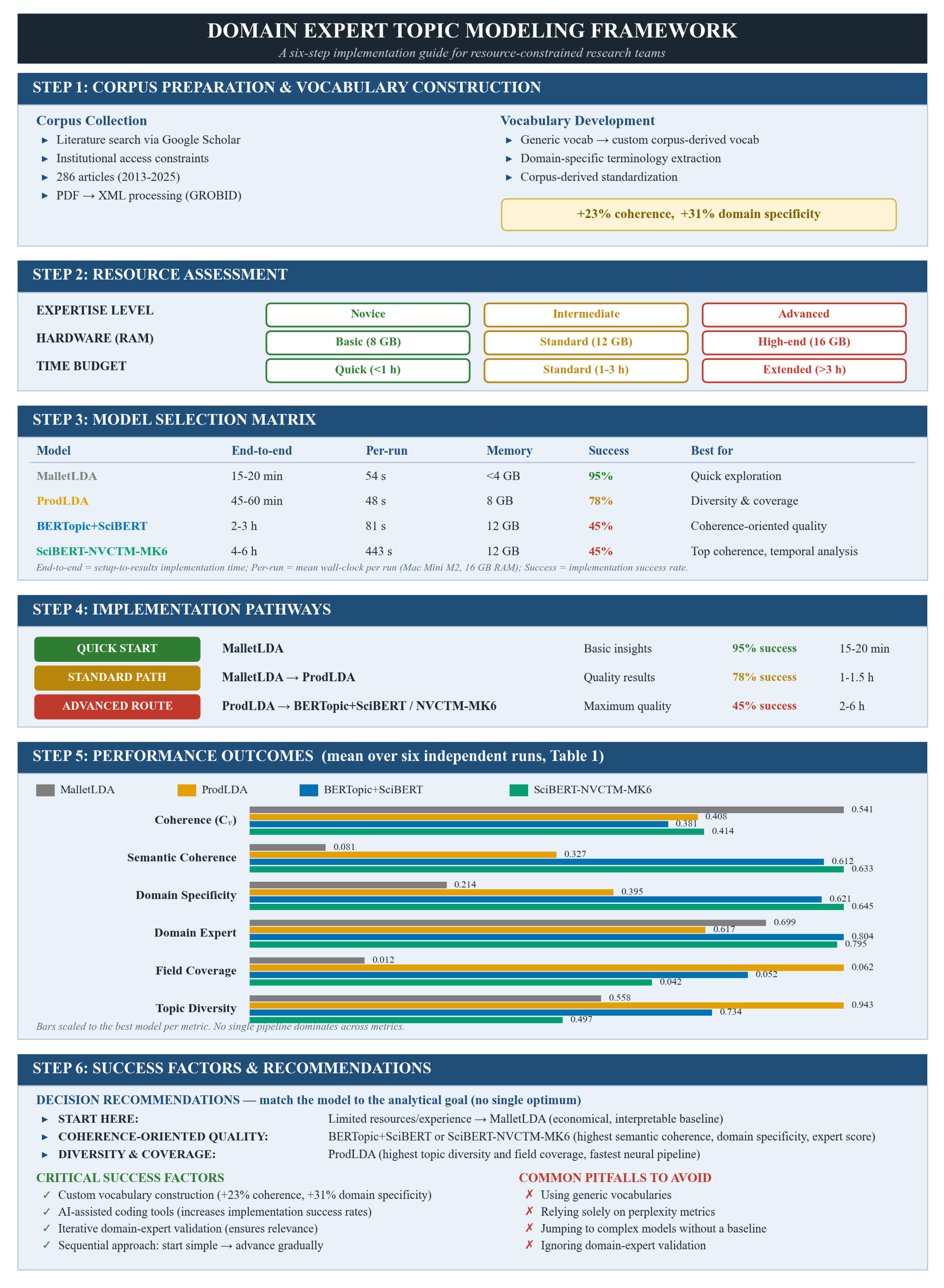
Figure 2.
Relative weights of the three thematic macro-clusters across temporal periods of the corpus (2013-2025), computed from the per-paper top-1 topic assignments of the four pipelines and a vocabulary-based topic-to-cluster mapping (n = 286 papers; left panel: four-pipeline mean; right panels: individual pipelines). Cluster A (Foundational mechanisms and reaction kinetics) shows its highest relative weight in pre-2017 papers (48.3% vs 40.9% in 2022-2025, four-pipeline mean); Cluster B (Process engineering and industrial-residue valorization) expands after 2016 and remains stable thereafter (≈37%); Cluster C (Application-oriented and integrated systems) is comparatively stable across periods (≈20-22%), with a modest increase toward 2022-2025 that is most pronounced in MalletLDA (15.9% to 33.1%); ProdLDA represents Cluster C with only 2 of its 22 topics, which depresses its Cluster C share in the per-pipeline panel. The figure is offered as a descriptive visualization of the analysed corpus rather than as evidence for a field-wide evolutionary trajectory: the corpus exhibits substantial temporal asymmetry (69.9% of papers from 2020-2025) that prevents reliable inference of historical progression. The three clusters are interpreted as concurrent thematic strands of the field, and the between-pipeline differences in the right panels reflect in part the cluster-specific topic granularity of the underlying pipelines. The topic-to-cluster mapping and the per-period counts are provided with the deposited analysis data.
Figure 2.
Relative weights of the three thematic macro-clusters across temporal periods of the corpus (2013-2025), computed from the per-paper top-1 topic assignments of the four pipelines and a vocabulary-based topic-to-cluster mapping (n = 286 papers; left panel: four-pipeline mean; right panels: individual pipelines). Cluster A (Foundational mechanisms and reaction kinetics) shows its highest relative weight in pre-2017 papers (48.3% vs 40.9% in 2022-2025, four-pipeline mean); Cluster B (Process engineering and industrial-residue valorization) expands after 2016 and remains stable thereafter (≈37%); Cluster C (Application-oriented and integrated systems) is comparatively stable across periods (≈20-22%), with a modest increase toward 2022-2025 that is most pronounced in MalletLDA (15.9% to 33.1%); ProdLDA represents Cluster C with only 2 of its 22 topics, which depresses its Cluster C share in the per-pipeline panel. The figure is offered as a descriptive visualization of the analysed corpus rather than as evidence for a field-wide evolutionary trajectory: the corpus exhibits substantial temporal asymmetry (69.9% of papers from 2020-2025) that prevents reliable inference of historical progression. The three clusters are interpreted as concurrent thematic strands of the field, and the between-pipeline differences in the right panels reflect in part the cluster-specific topic granularity of the underlying pipelines. The topic-to-cluster mapping and the per-period counts are provided with the deposited analysis data.
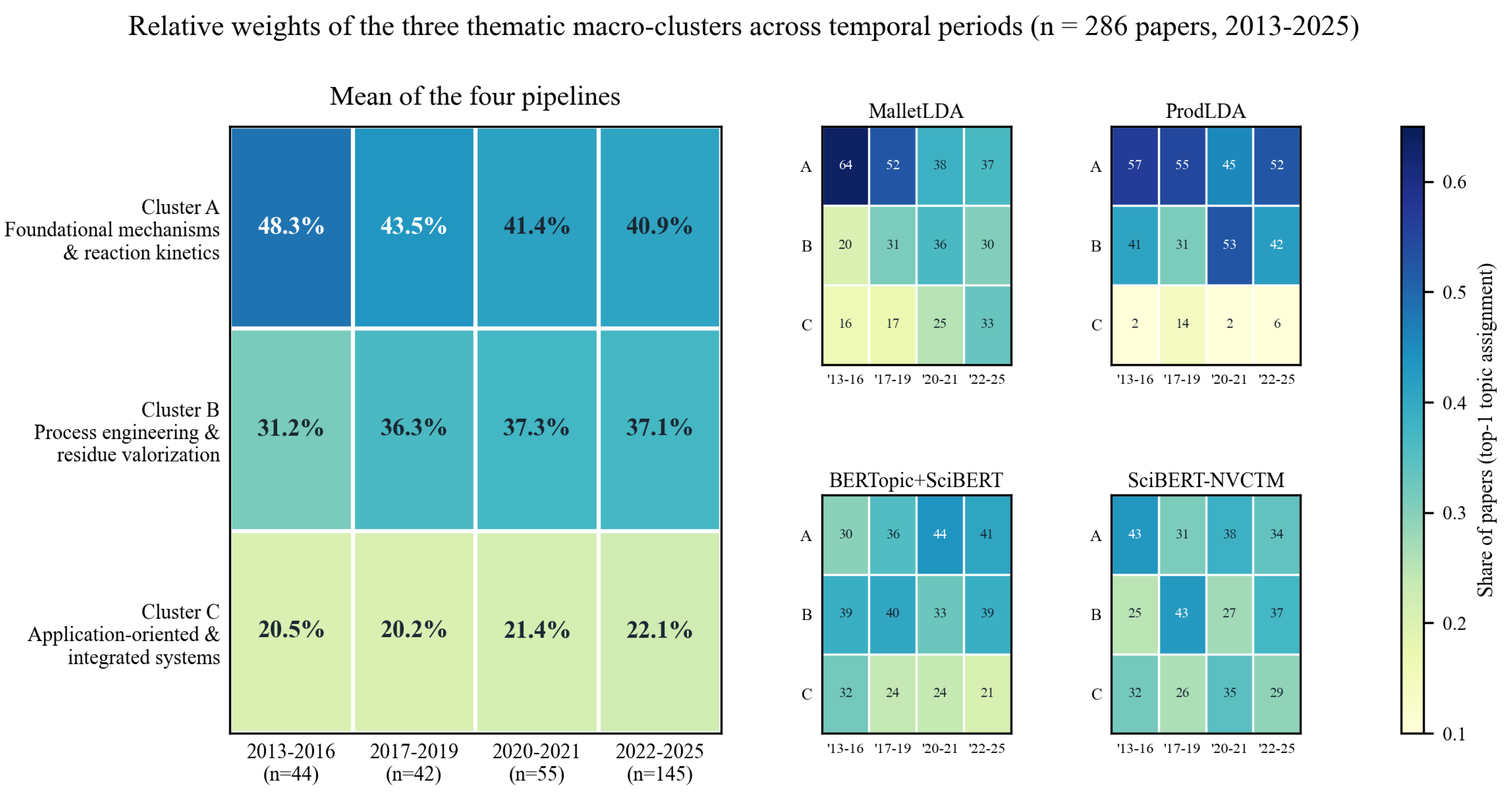
Figure 3.
Topic similarity matrix demonstrates thematic separation quality across modeling approaches using Jaccard index calculations on the canonical top-15 terms of each topic. Matrix quantifies vocabulary overlap between all topic pairs within each model, with color scale ranging from blue (low similarity, optimal separation) to red (high similarity, potential redundancy). Diagonal values equal 1.0 representing perfect self-similarity, while off-diagonal values indicate cross-topic relationships. Low off-diagonal values demonstrate well-separated thematic domains essential for meaningful topic interpretation by domain experts. Scale limitation to 0.25 emphasizes fine-grained differences relevant for evaluation rather than extreme similarity values. Matrix structure reveals distinct clustering patterns characteristic of each modeling approach: ProdLDA and BERTopic+SciBERT achieve the strongest topic separation, with most pairwise similarity values below 0.15, whereas the correlation-aware SciBERT-NVCTM and the MalletLDA baseline show comparatively higher overlap — consistent with the topic-diversity ranking in Table 1. Analysis supports quantitative assessment of topic model quality beyond traditional perplexity metrics, providing domain experts with systematic tools for methodology selection based on semantic separation requirements.
Figure 3.
Topic similarity matrix demonstrates thematic separation quality across modeling approaches using Jaccard index calculations on the canonical top-15 terms of each topic. Matrix quantifies vocabulary overlap between all topic pairs within each model, with color scale ranging from blue (low similarity, optimal separation) to red (high similarity, potential redundancy). Diagonal values equal 1.0 representing perfect self-similarity, while off-diagonal values indicate cross-topic relationships. Low off-diagonal values demonstrate well-separated thematic domains essential for meaningful topic interpretation by domain experts. Scale limitation to 0.25 emphasizes fine-grained differences relevant for evaluation rather than extreme similarity values. Matrix structure reveals distinct clustering patterns characteristic of each modeling approach: ProdLDA and BERTopic+SciBERT achieve the strongest topic separation, with most pairwise similarity values below 0.15, whereas the correlation-aware SciBERT-NVCTM and the MalletLDA baseline show comparatively higher overlap — consistent with the topic-diversity ranking in Table 1. Analysis supports quantitative assessment of topic model quality beyond traditional perplexity metrics, providing domain experts with systematic tools for methodology selection based on semantic separation requirements.
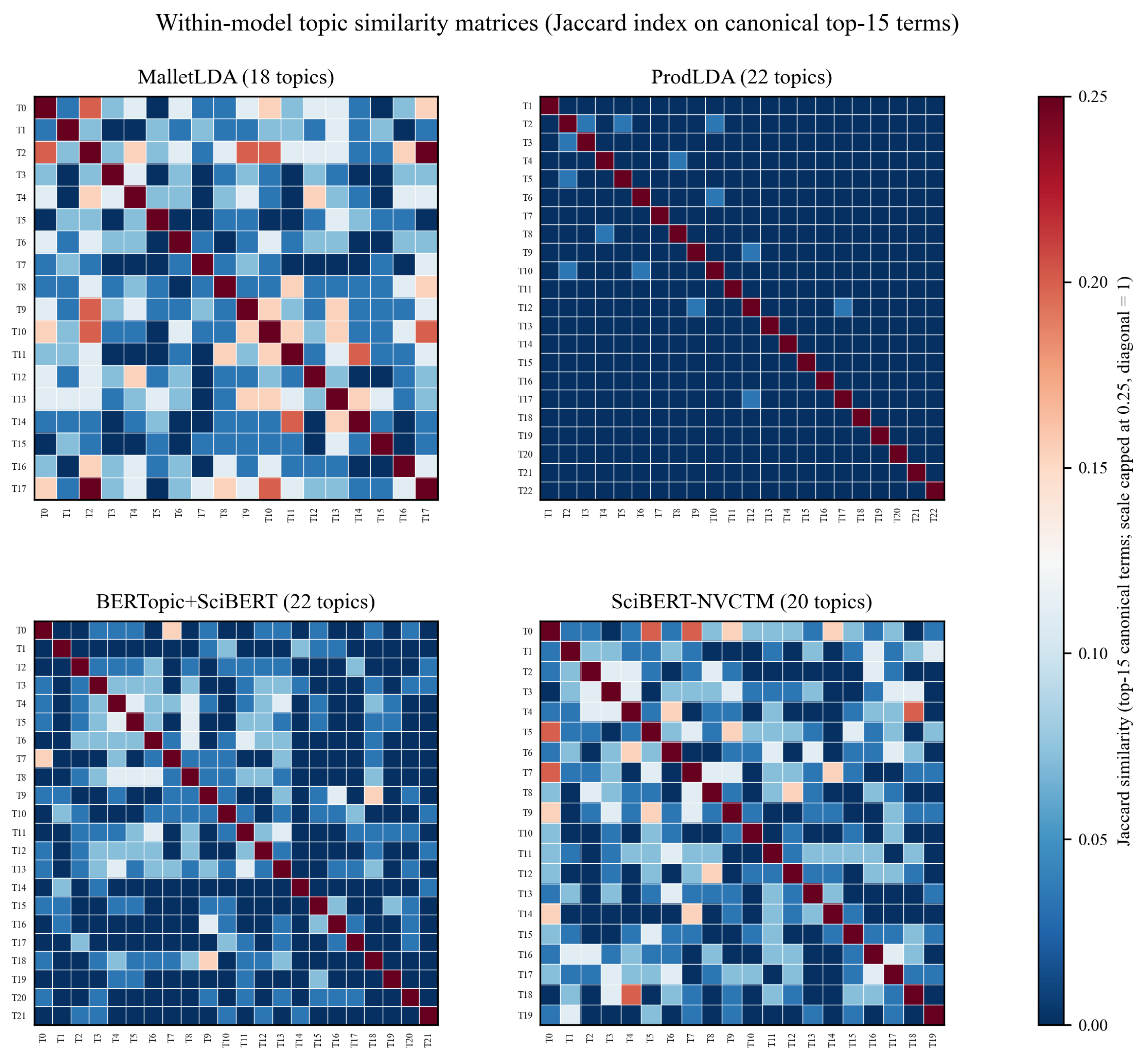

Table 1.
Comparative performance metrics across the four topic-modeling pipelines implemented by domain experts under resource constraints. Values are means ± standard deviations over six independent runs per model (seeds 42, 123, 456, 789, 1024, 2048). Coherence (C_v) measures within-topic semantic consistency using a sliding-window PMI estimator; for BERTopic+SciBERT it is computed on the c-TF-IDF top-15 terms of each topic across the six stability runs. Semantic Coherence evaluates topic focus on specific concepts rather than general themes. Domain Specificity quantifies the relevance of CO₂ mineralization terminology within topics. Domain Expert combines interpretability, semantic complexity, and thematic relevance as assessed by field specialists (weighted composite; see Methods). Field Coverage measures balanced representation across CO₂ mineralization subfields. Topic Diversity quantifies inter-topic vocabulary distinctiveness (higher values indicate less overlap). Perplexity is not tabulated because per-model values are computed on architecture-specific likelihood scales and are not comparable across pipelines; they are reported, with this caveat, in Supplementary Tables S2-S3. Wall-clock is the mean processing time per run on consumer hardware (Mac Mini M2, 16 GB RAM). CV = coefficient of variation. No single pipeline dominates across metrics: on the coherence-oriented metrics (semantic coherence, domain specificity, domain expert) the strongest pipelines are SciBERT-NVCTM and BERTopic+SciBERT; ProdLDA (paper-faithful re-implementation of Srivastava & Sutton [7]) attains intermediate coherence-oriented scores but the highest topic diversity (0.943) and the highest field coverage (0.062) of all models at the lowest neural-model wall-clock; MalletLDA provides a stable, low-cost surface-term baseline.
Table 1.
Comparative performance metrics across the four topic-modeling pipelines implemented by domain experts under resource constraints. Values are means ± standard deviations over six independent runs per model (seeds 42, 123, 456, 789, 1024, 2048). Coherence (C_v) measures within-topic semantic consistency using a sliding-window PMI estimator; for BERTopic+SciBERT it is computed on the c-TF-IDF top-15 terms of each topic across the six stability runs. Semantic Coherence evaluates topic focus on specific concepts rather than general themes. Domain Specificity quantifies the relevance of CO₂ mineralization terminology within topics. Domain Expert combines interpretability, semantic complexity, and thematic relevance as assessed by field specialists (weighted composite; see Methods). Field Coverage measures balanced representation across CO₂ mineralization subfields. Topic Diversity quantifies inter-topic vocabulary distinctiveness (higher values indicate less overlap). Perplexity is not tabulated because per-model values are computed on architecture-specific likelihood scales and are not comparable across pipelines; they are reported, with this caveat, in Supplementary Tables S2-S3. Wall-clock is the mean processing time per run on consumer hardware (Mac Mini M2, 16 GB RAM). CV = coefficient of variation. No single pipeline dominates across metrics: on the coherence-oriented metrics (semantic coherence, domain specificity, domain expert) the strongest pipelines are SciBERT-NVCTM and BERTopic+SciBERT; ProdLDA (paper-faithful re-implementation of Srivastava & Sutton [7]) attains intermediate coherence-oriented scores but the highest topic diversity (0.943) and the highest field coverage (0.062) of all models at the lowest neural-model wall-clock; MalletLDA provides a stable, low-cost surface-term baseline.
| Metric | MalletLDA (K=18) | SD | CV | ProdLDA (K=22) | SD | CV | BERTopic+SciBERT (K=22) | SD | CV | SciBERT-NVCTM (K=20) | SD | CV |
| Coherence (C_v) | 0.542 | 0.009 | 0.017 | 0.408 | 0.018 | 0.044 | 0.381 | 0.004 | 0.010 | 0.414 | 0.013 | 0.031 |
| Semantic Coherence | 0.081 | 0.009 | 0.115 | 0.327 | 0.009 | 0.028 | 0.612 | 0.005 | 0.008 | 0.633 | 0.009 | 0.014 |
| Domain Specificity | 0.207 | 0.007 | 0.035 | 0.395 | 0.008 | 0.020 | 0.621 | 0.005 | 0.008 | 0.645 | 0.004 | 0.006 |
| Domain Expert | 0.686 | 0.021 | 0.031 | 0.617 | 0.030 | 0.049 | 0.804 | 0.028 | 0.035 | 0.795 | 0.002 | 0.003 |
| Field Coverage | 0.011 | 0.001 | 0.044 | 0.062 | 0.001 | 0.019 | 0.052 | 0.001 | 0.023 | 0.042 | 0.001 | 0.027 |
| Topic Diversity | 0.560 | 0.019 | 0.033 | 0.943 | 0.006 | 0.006 | 0.734 | 0.017 | 0.023 | 0.497 | 0.015 | 0.030 |
| Wall-clock (s/run) | 54 | — | — | 48 | — | — | 81 | — | — | 443 | — | — |
Table 2.
One-way ANOVA and Bonferroni-corrected pairwise comparisons across evaluation metrics, computed on six independent runs per model using the SciBERT-NVCTM (K=20) configuration consistent with Table 1. For Coherence (C_v), the BERTopic+SciBERT estimate is computed on the c-TF-IDF top-15 terms of each topic (four-group ANOVA). On the coherence-oriented metrics (semantic coherence, domain specificity, domain expert) SciBERT-NVCTM and BERTopic+SciBERT rank highest, with ProdLDA intermediate and MalletLDA lowest; on these metrics ProdLDA is significantly outperformed by both transformer-based pipelines. ProdLDA ranks highest on topic diversity and field coverage, with all pairwise differences significant. Perplexity is omitted because per-model values are not comparable across architectures (see Supplementary Tables S2-S3). Interpretability shows no significant differences, suggesting comparable human understanding across methods. No single pipeline dominates: the two transformer-based pipelines lead on coherence-oriented quality, ProdLDA leads on diversity and coverage at the lowest neural-model wall-clock, and MalletLDA provides a stable surface-term baseline. Bootstrap 95% confidence intervals and Cohen's d effect sizes are reported in Supplementary Table S2.
Table 2.
One-way ANOVA and Bonferroni-corrected pairwise comparisons across evaluation metrics, computed on six independent runs per model using the SciBERT-NVCTM (K=20) configuration consistent with Table 1. For Coherence (C_v), the BERTopic+SciBERT estimate is computed on the c-TF-IDF top-15 terms of each topic (four-group ANOVA). On the coherence-oriented metrics (semantic coherence, domain specificity, domain expert) SciBERT-NVCTM and BERTopic+SciBERT rank highest, with ProdLDA intermediate and MalletLDA lowest; on these metrics ProdLDA is significantly outperformed by both transformer-based pipelines. ProdLDA ranks highest on topic diversity and field coverage, with all pairwise differences significant. Perplexity is omitted because per-model values are not comparable across architectures (see Supplementary Tables S2-S3). Interpretability shows no significant differences, suggesting comparable human understanding across methods. No single pipeline dominates: the two transformer-based pipelines lead on coherence-oriented quality, ProdLDA leads on diversity and coverage at the lowest neural-model wall-clock, and MalletLDA provides a stable surface-term baseline. Bootstrap 95% confidence intervals and Cohen's d effect sizes are reported in Supplementary Table S2.
| Metric | ANOVA and Bonferroni-corrected pairwise comparisons (p < 0.05) |
| Coherence (C_v) | F = 202.5, p < 0.001. MalletLDA > BERTopic+SciBERT (p < 0.001); MalletLDA > ProdLDA (p < 0.001); MalletLDA > SciBERT-NVCTM (p < 0.001); BERTopic+SciBERT < SciBERT-NVCTM (p = 0.008); BERTopic+SciBERT ≈ ProdLDA (n.s.); ProdLDA ≈ SciBERT-NVCTM (n.s.) |
| Semantic Coherence | F = 6048.6, p < 0.001. MalletLDA < ProdLDA < BERTopic+SciBERT < SciBERT-NVCTM, all pairwise differences significant (BERTopic+SciBERT < SciBERT-NVCTM at p = 0.006; all others p < 0.001) |
| Domain Specificity | F = 6250.7, p < 0.001. MalletLDA < ProdLDA < BERTopic+SciBERT < SciBERT-NVCTM, all pairwise differences significant (p < 0.001) |
| Domain Expert | F = 89.8, p < 0.001. ProdLDA < MalletLDA (p = 0.009); MalletLDA < BERTopic+SciBERT and < SciBERT-NVCTM (p < 0.001); ProdLDA < BERTopic+SciBERT and < SciBERT-NVCTM (p < 0.001); BERTopic+SciBERT ≈ SciBERT-NVCTM (n.s.) |
| Field Coverage | F = 2661.5, p < 0.001. ProdLDA > BERTopic+SciBERT > SciBERT-NVCTM > MalletLDA, all pairwise differences significant (p < 0.001) |
| Topic Diversity | F = 1073.1, p < 0.001. ProdLDA > BERTopic+SciBERT > MalletLDA > SciBERT-NVCTM, all pairwise differences significant (p < 0.001) |
| Interpretability | No significant differences |
Table 3.
Calibration ablation of Claude Haiku 4.5 zero-shot innovation detection on the 286-paper CO₂ mineralization corpus. The four LLM modes (R1-R4) are compared against the calibrated statistical ensemble used in the main analysis. Outlier rate is the percentage of corpus flagged as innovation candidate by each method. Over-attribution factor is the ratio of LLM rate to ensemble rate (3.11%). Cost and runtime are measured on consumer hardware (Mac Mini M2, 16 GB RAM) without fine-tuning, RAG, or specialized infrastructure. R3 self-reflection achieves convergence with the ensemble (1.1× over-attribution); R2 and R4, two structurally distinct prompts both imposing strict qualitative criteria, converge on the prompt-level floor of ~28%, indicating that the calibration improvement of R3 is driven by the sequential review mechanism rather than the criteria themselves. The 10 R3 outliers are a strict subset of the 80 R4 outliers (R3 ⊂ R4), demonstrating discriminative consistency rather than authority deferral.
Table 3.
Calibration ablation of Claude Haiku 4.5 zero-shot innovation detection on the 286-paper CO₂ mineralization corpus. The four LLM modes (R1-R4) are compared against the calibrated statistical ensemble used in the main analysis. Outlier rate is the percentage of corpus flagged as innovation candidate by each method. Over-attribution factor is the ratio of LLM rate to ensemble rate (3.11%). Cost and runtime are measured on consumer hardware (Mac Mini M2, 16 GB RAM) without fine-tuning, RAG, or specialized infrastructure. R3 self-reflection achieves convergence with the ensemble (1.1× over-attribution); R2 and R4, two structurally distinct prompts both imposing strict qualitative criteria, converge on the prompt-level floor of ~28%, indicating that the calibration improvement of R3 is driven by the sequential review mechanism rather than the criteria themselves. The 10 R3 outliers are a strict subset of the 80 R4 outliers (R3 ⊂ R4), demonstrating discriminative consistency rather than authority deferral.
| Method | Calibration mechanism | Outliers flagged | % corpus | Over-attribution vs ensemble | Cost (USD) / Runtime (min) |
| Classic ensemble | Isolation Forest + LOF + distance + semantic-diversity (calibrated thresholds) | 9 | 3.11% | 1.00× (baseline) | — |
| Haiku R1 | Naïve zero-shot, no calibration anchor | 203 | 71.0% | 22.8× | 1.34 / 27 |
| Haiku R2 | Qualitative-strict prompt (5 novelty dimensions + ≥2 established alternatives) | 76 | 26.6% | 8.5× | 1.57 / 27 |
| Haiku R4 | Unified one-shot (R2 criteria + ten-year-citation thought experiment) | 80 | 28.0% | 9.0× | 1.68 / 27 |
| Haiku R3 | Self-reflection multi-pass on R1 outputs (re-read & confirm/downgrade) | 10 | 3.5% | 1.1× | 0.76 / 7 (203 papers only) |
Pick-level overlap (Jaccard index): R3 ↔ R4 = 0.125 (10 papers in common, with R3 ⊂ R4); R3 ↔ classic ensemble = 0.111 (2 papers in common: Callagon La Plante et al. [26], Luong et al. [23]); R4 ↔ classic ensemble = 0.059 (5 papers in common: Callagon La Plante et al. [26], Coppola et al. [24], Luong et al. [23], Strunge et al. [25], Moon et al. [27]). Triple overlap R3 ∩ R4 ∩ classic = 2 papers. The pick-level non-overlap between methods supports their characterization as detectors of different signal types (statistical-distributional anomalies for the ensemble, lexically novel candidates for R4, conceptually-articulable breakthroughs for R3) rather than as redundant alternatives.
Disclaimer/Publisher’s Note: The statements, opinions and data contained in all publications are solely those of the individual author(s) and contributor(s) and not of MDPI and/or the editor(s). MDPI and/or the editor(s) disclaim responsibility for any injury to people or property resulting from any ideas, methods, instructions or products referred to in the content. |
© 2026 by the authors. Licensee MDPI, Basel, Switzerland. This article is an open access article distributed under the terms and conditions of the Creative Commons Attribution (CC BY) license (http://creativecommons.org/licenses/by/4.0/).
Copyright: This open access article is published under a Creative Commons CC BY 4.0 license, which permit the free download, distribution, and reuse, provided that the author and preprint are cited in any reuse.


