

Submitted:
06 July 2026
Posted:
08 July 2026
You are already at the latest version
Abstract
Lightweight vision models are often advanced through architecture-specific innovations or scaling strategies, which can make it difficult to distinguish generalizable design principles from specialized design choices. We hypothesize that lightweight architectures can be more effectively improved by systematically composing complementary components that provide distinct representational capabilities, rather than by optimizing individual building blocks in isolation. Motivated by this perspective, we propose EfficientMixer, a lightweight vision architecture that integrates efficient local feature extraction, spatial mixing, and lightweight global feature modeling within a unified component-level framework inspired by EfficientNet, ConvMixer, and MobileViT. This design enables structured interaction among complementary inductive biases under a fixed budget. Under matched budgets, EfficientMixer consistently outperforms strong lightweight baselines across multiple benchmarks while maintaining similar computational cost and demonstrating improved cross-domain generalization. Furthermore, EfficientMixer achieves larger performance gains under Self-Competitive Distillation, suggesting improved compatibility with advanced training strategies. Extensive ablation studies indicate that these improvements are largely associated with synergistic interactions among complementary architectural components rather than increased model parameters or architectural scaling. Overall, these results highlight component-level architectural composition as an effective and practical design principle for developing efficient and transferable lightweight vision models.
Keywords:
Self-Competitive Distillation
; lightweight vision models
; optimization strategy
; lightweight attention
; effective capacity
; cross-domain generalization
; multi-dataset evaluation
1. Introduction
Lightweight vision networks have become increasingly important for deploying deep learning models on resource-constrained devices [1,2,3,4,5,6,7,8,9,10,11,12,13,14,15,16,17,18,19,20,21,22,23,24,25,26,27,28,29,30,31,32,33,34,35,36,37]. Unlike large-scale models, they operate under strict constraints on parameter count, memory footprint, and computational cost, making naive scaling strategies ineffective [10,12,14,38,39]. A central challenge is therefore to maximize representational capacity under a fixed resource budget.
To address this challenge, a wide range of architectural strategies have been proposed, including depthwise separable convolutions [2], inverted bottlenecks [3], channel shuffling [5,6], cheap feature generation [7], neural architecture search [12,38], and hybrid convolutional–transformer designs [20,21,22,23,40]. Despite their success, these methods are often developed independently and evaluated under differing assumptions, which makes it difficult to isolate the contribution of individual design choices.
Attention mechanisms constitute another key direction for improving feature representation in vision networks [41,42,43,44,45,46,47]. Lightweight variants such as channel attention [41,44], spatial and channel–spatial attention [42,43,48], coordinate attention [45], and global context modules [49,50,51] have been widely explored. In parallel, Transformer-based models have demonstrated strong performance in vision tasks [26,52,53], but their computational cost often limits applicability in mobile settings [33,37]. This raises a practical question: can lightweight attention mechanisms provide similar contextual benefits when integrated into efficient convolutional backbones? In particular, we investigate whether lightweight channel–spatial attention can recover some of the contextual modeling benefits typically associated with Transformer architectures while preserving the computational efficiency of convolutional networks [41,42,44,45,54].
Motivated by these observations, we propose EfficientMixer, a lightweight architecture that integrates three complementary design principles: (i) hierarchical feature scaling inspired by EfficientNet [10], (ii) isotropic spatial–channel mixing from ConvMixer [55], and (iii) lightweight attention refinement motivated by MobileViT [20]. Instead of relying on Transformer blocks, EfficientMixer employs a lightweight nonlinear variant of CBAM [42] that increases feature selectivity while introducing minimal computational overhead.
Beyond its architectural design, EfficientMixer serves as a controlled framework for analyzing how different design principles interact under fixed parameter budgets. Specifically, hierarchical scaling increases semantic abstraction across stages, spatial–channel mixing strengthens local token interaction within stages, and attention selectively enhances informative features. Because these mechanisms operate at different levels of representation learning, they provide complementary inductive biases that can be systematically combined within a unified lightweight architecture.
Experimental evaluation is conducted using a multi-dataset protocol consistent with recent lightweight model evaluation frameworks [56], enabling controlled comparison under matched training settings and similar parameter budgets. Results show that EfficientMixer consistently outperforms EfficientNet, ConvMixer, and MobileViT across multiple datasets. Ablation studies further demonstrate that hierarchical scaling, spatial–channel mixing, and lightweight attention each contribute complementary improvements, highlighting compositional architectural design as an effective strategy for enhancing representation learning under constrained computational budgets.
Our major contributions can be summarized as follows:
- Complementary Architectural Design Principles. We demonstrate that hierarchical feature scaling, isotropic spatial–channel mixing, and lightweight attention provide complementary representational capabilities whose interaction improves lightweight vision models under fixed computational budgets [15,19].
- Comprehensive Multi-Dataset Evaluation. Controlled experiments and ablation studies show that EfficientMixer consistently outperforms strong lightweight baselines under matched parameter budgets, and that these improvements arise from the interaction of complementary architectural components rather than increased model capacity [10,20,57].
The implementation and training code, including data processing, training pipelines, and evaluation scripts, are publicly available in the project repository [58] (commit 58a1eae).
2. Materials and Methods
2.1. Architectural Principles of Lightweight Vision Networks
Modern lightweight vision architectures improve representational efficiency under strict computational constraints through combinations of efficient convolutional processing, scaling strategies, and lightweight attention mechanisms [10,33,35]. Although these architectures differ substantially in implementation, many successful designs share common structural principles. To motivate the design of EfficientMixer, we examine representative principles underlying ConvMixer, EfficientNet, and MobileViT.
2.1.1. ConvMixer Principles
ConvMixer [55] exhibits three main design patterns: (A) Patch-based tokenization, where input images are converted into patch-level representations using strided convolutions, mimicking Transformer-style tokenization while remaining fully convolutional (Eq. (2) [53]; (B) Isotropic processing, where a constant feature dimensionality is maintained across layers and representations are refined through repeated application of identical blocks (Eq. (1)) [59]; and (C) Decoupled spatial–channel mixing, where spatial and channel interactions are separated via depthwise and pointwise convolutions, respectively (Eq. (3)), enabling efficient feature transformation [2,3].
where and denote depthwise and pointwise convolutions, respectively.
where and .
2.1.2. EfficientNet Principles
From EfficientNet [10], we identify three design patterns: (A) stem embedding, where a convolutional stem maps RGB inputs into feature space, as defined in Eq. (6); (B) MBConv-based feature extraction, where inverted bottleneck blocks combine channel expansion, depthwise convolution, and squeeze-and-excitation operations [3,41] (Eq. (7)); and (C) hierarchical scaling, where spatial resolution is progressively reduced while channel capacity increases via compound scaling rules [10] (Eq. (8)).
2.1.3. MobileViT Principles
MobileViT [20] introduces a global aggregation operator that unfolds feature maps into tokens, applies self-attention, and projects them back to spatial form. This enables long-range dependencies through (A) convolution–attention coupling via QKV projections (Eq. (9)) and (B) global contextual modeling via scaled dot-product attention, originally introduced in Vision Transformers [53] (Eq. (10)).
Collectively, these design patterns define the construction space of EfficientMixer. EfficientNet contributes hierarchical feature extraction and compound scaling [10], ConvMixer contributes isotropic patch-level mixing with convolutional tokenization [55], and MobileViT contributes global contextual modeling through lightweight attention mechanisms [20].
2.2. EfficientMixer Architecture
Rather than optimizing a single architectural family or introducing isolated building blocks, EfficientMixer investigates whether complementary design principles extracted from independently developed lightweight architectures can be systematically composed within a unified framework. The key contribution is not a standalone module, but the empirical validation that principled architectural composition yields consistent performance gains under controlled computational budgets.
EfficientMixer integrates complementary architectural principles from EfficientNet [10], ConvMixer [55], and MobileViT [20] within a unified lightweight architecture. It is constructed by selectively composing these patterns into a hierarchical design, enabling controlled analysis of their individual and combined effects on lightweight vision performance. Specifically, it combines hierarchical feature scaling, intra-stage isotropic mixing, and lightweight attention refinement to improve representation learning under fixed computational budgets. The architecture can be interpreted as the composition of four design patterns (Figure 1):
(A) Hierarchical stem embedding. A convolutional stem maps the input RGB image into a feature representation while preserving local spatial structure prior to downsampling, following EfficientNet-style design principles.
(B) Hierarchical spatial–channel scaling. The network adopts EfficientNet’s stage-wise scaling, progressively reducing spatial resolution while increasing channel capacity (e.g., , ), enabling a transition from local spatial detail to high-level semantic features.
(C) Intra-stage isotropic mixing. Following the ConvMixer design, features are refined at a fixed spatial resolution within each stage using repeated depthwise–pointwise convolutional blocks with residual connections. Depthwise convolutions capture local spatial dependencies, pointwise convolutions enable channel mixing, and residual connections improve optimization stability.
(D) Learnable Residual Attention Fusion. Motivated by the stage-level contextual refinement employed in MobileViT [20], we replace Transformer-based refinement with a lightweight trainable Nonlinear Attention Fusion (NAF) module. The proposed module combines CBAM-based channel–spatial attention with nonlinear residual fusion to improve feature selectivity with minimal computational overhead. Given an input feature map , CBAM produces an attention-refined representation:
The original and attention-refined features are then combined through the NAF-attention module:
where ⊙ denotes element-wise multiplication. The fusion coefficients are derived from a learnable parameter vector :
In summary, EfficientMixer composes hierarchical scaling, intra-stage isotropic mixing, and lightweight attention into a unified lightweight architecture. Hierarchical scaling captures increasingly abstract semantic representations across stages, isotropic mixing strengthens local spatial and channel interactions within each stage, and attention selectively emphasizes informative features. Together, these complementary design patterns improve representation learning while maintaining computational efficiency. The resulting architectural patterns are summarized in Table 1.
2.3. Model and Dataset Selection
To evaluate the proposed architecture under realistic mobile constraints, we instantiate a baseline EfficientMixer model containing approximately 2.5 million parameters (Table 2). Matching parameter budgets across models ensures that performance differences primarily reflect architectural design rather than model scale or hyperparameter tuning. This setting reflects practical edge-deployment scenarios, where memory, computation, and latency constraints favor compact models [2,3,37]. Maintaining a fixed parameter budget also enables a fair comparison of architectural efficiency, ensuring that observed performance differences arise from design choices rather than increased model capacity [6,10,33].
We compare EfficientMixer against representative lightweight architectures with similar parameter counts. EfficientNet and ConvMixer are included because EfficientMixer is derived from architectural principles extracted from these models and because they achieved the strongest cross-domain performance among lightweight convolutional architectures in our previous evaluations [56,60]. MobileNet serves as a representative baseline based on depthwise separable convolutions, while MobileViT represents hybrid convolution–attention architectures employing lightweight Transformer blocks. In contrast, EfficientMixer combines hierarchical scaling, isotropic feature mixing, and lightweight CBAM-based attention within a fully convolutional framework. Parameter counts are summarized in Table 3.
We evaluate all models on four image classification benchmarks with complementary characteristics: CIFAR-10 [61], Stanford Dogs [62], HAM10000 [63], and MIT Indoor-67 [64]. These datasets span general object recognition, fine-grained classification, medical imaging, and scene recognition, providing a compact benchmark for assessing cross-domain generalization under resource-constrained settings [2,33,34,35,36,37]. Dataset statistics are summarized in Table 4.
CIFAR-10 [61] consists of low-resolution images from 10 object categories, challenging models to learn discriminative features under limited spatial detail and strong visual overlap between classes. For consistency, we preprocess this dataset to 224 by 224px.
Stanford Dogs [62] is a fine-grained recognition benchmark with 120 visually similar dog breeds, testing a model’s ability to capture subtle inter-class differences from limited training data.
HAM10000 [63] contains dermatoscopic images from seven diagnostic categories and exhibits severe class imbalance, challenging models to represent rare classes without overfitting dominant ones.
MIT Indoor-67 [64] focuses on indoor scene classification, emphasizing global spatial layout and contextual reasoning amid high intra-class variability.
All architectures are trained using identical hyperparameters, including the learning rate schedule, batch size, optimizer, loss function, and data augmentation, to eliminate model-specific tuning effects (Table 5). We report both baseline and Self-Competitive Distillation (SCD) results in terms of average accuracy. Under matched parameter budgets and training conditions, differences in average performance reflect how effectively each architecture converts representational capacity into cross-domain performance, while improvements under SCD indicate more complete utilization of that capacity.
3. Experiments and Results
3.1. Baseline Evaluation of EfficientMixer
We hypothesize that combining these complementary design patterns will provide stronger representations than any individual architectural motif alone, resulting in improved performance across diverse visual domains without increasing model complexity. To evaluate whether complementary architectural design patterns can be effectively combined within a lightweight model, we compare EfficientMixer against EfficientNet, ConvMixer, MobileNet, and MobileViT under matched parameter budgets of approximately 2.5 million parameters.
All models are trained for 100 epochs with and without SCD, using identical hyperparameters and evaluated on four datasets spanning object recognition, fine-grained classification, medical imaging, and scene recognition. This controlled evaluation isolates architectural design from model scale and training effects, allowing us to assess whether integrating EfficientNet-inspired hierarchical scaling, ConvMixer-style spatial–channel mixing, and lightweight attention mechanisms yields improved predictive performance and cross-domain generalization under fixed computational constraints. Table 6 shows the test accuracy of each model at the end of 100 training epochs from scratch, with and without SCD.
As shown in Figure 2, EfficientMixer achieves consistently strong performance compared to other lightweight architectures under both training settings, with and without Self-Competitive Distillation (SCD). Notably, SCD improves all evaluated models, with a larger relative gain observed for EfficientMixer. This indicates that EfficientMixer benefits more effectively from the distillation process, suggesting a stronger underlying representation capacity and better utilization of the additional supervisory signal provided by SCD. Interestingly, ConvMixer also exhibits strong gains under SCD, and given that EfficientMixer inherits ConvMixer-style isotropic intra-stage feature mixing, this observation suggests that such isotropic feature filtering may be a beneficial design choice for enhancing distillation effectiveness in lightweight architectures.
3.2. Ablation Study
To quantify the contribution of individual architectural components, we conduct ablation studies using EfficientMixer variants with approximately matched parameter counts. Specifically, we analyze the effects of the stem design, hierarchical staging, attention, and dropout. By modifying one component at a time while maintaining a comparable computational budget, we isolate the impact of each design choice and evaluate whether performance gains arise from individual components or their interactions. We compare a baseline EfficientMixer model with eight architectural variants, as detailed in Table 7.
All models are trained for 100 epochs under identical settings and evaluated on four datasets: CIFAR-10, HAM10000, Stanford Dogs, and Indoor-67. Each configuration is trained with three random seeds to account for optimization variability.
We report mean test accuracy and standard deviation over three runs per dataset. A single cross-dataset score is obtained by averaging per-dataset means and standard deviations, yielding an overall mean ± standard deviation. This provides a compact summary while preserving per-dataset results. Best-performing values are highlighted in bold in Table 8.
Figure 3 shows the per-component deltas from the ablation study, reported as deviations in mean test accuracy relative to the baseline EfficientMixer configuration (75.78%). This enables a direct comparison of how each architectural modification influences performance. The ablation variants are grouped into four categories—stem design, stage depth, attention mechanisms, and dropout configurations—facilitating a structured analysis of each architectural component.
Among the eight variants, only Stem 2 and No Attention consistently underperform the EfficientNet baseline, indicating that EfficientMixer’s hierarchical staging and isotropic feature mixing form a strong architectural backbone. Overall, performance is most sensitive to changes in the stem and attention modules, highlighting the importance of early feature embedding and global context modeling. In contrast, variations in stage depth and dropout induce more moderate fluctuations around the baseline, suggesting that EfficientMixer is relatively robust to these design and regularization choices. This structured comparison clarifies the relative influence of each component on final model performance.
The convolutional stem was found to be one of the most influential architectural components. The baseline two-layer stem (3–32–64) achieved the highest overall xScore of 75.78, outperforming both the wider single-stage stem (3–64) and the narrower stem (3–32). While the 3–32 variant achieved the highest CIFAR-10 accuracy (95.47%), its performance dropped substantially on Stanford Dogs and MIT Indoor-67, resulting in the lowest overall xScore. These results suggest that progressively increasing channel capacity within the stem improves the quality of low-level feature representations and enhances transferability across diverse visual domains. Overall, the hierarchical stem contributes more to cross-dataset generalization than either a shallow or aggressively widened alternative.
Alternative stage width and depth configurations produce only modest changes in performance. Stage 1 and Stage 2 reduce accuracy by 0.33 and 0.55 points, respectively, relative to the baseline, indicating that EfficientMixer is relatively insensitive to moderate variations in channel allocation and block depth. Although Stage 2 achieved the highest CIFAR-10 accuracy (95.50%), its performance on the other datasets was consistently lower than the baseline. Similarly, Stage 1 yielded a minor improvement on MIT Indoor-67 but did not improve overall accuracy. These results suggest that the effectiveness of EfficientMixer is not primarily driven by specific width or depth scaling choices, but rather by the overall architectural design and feature processing strategy.
The attention module provides a consistent contribution to overall performance. Replacing the baseline NAF attention with a linear attention module reduces xScore from 75.78 to 75.38, while removing attention entirely leads to a larger decline to 74.41. The largest performance degradation is observed on Stanford Dogs, where accuracy decreases from 65.30% to 62.05% when attention is removed. This suggests that attention is particularly beneficial for fine-grained recognition tasks that require enhanced contextual modeling. Furthermore, the baseline NAF attention consistently outperforms linear attention across the benchmark suite, indicating that lightweight contextual refinement remains an important component of EfficientMixer despite its small computational overhead.
The impact of dropout regularization is comparatively small. Introducing dropout rates of 0.25 and 0.30 yields accuracy of 75.48% and 75.66%, respectively, both close to the baseline of 75.78%. Although the 0.30 configuration slightly improves performance on Stanford Dogs, differences across datasets are generally within one standard deviation of the baseline. These findings suggest that EfficientMixer already benefits from strong implicit regularization through its architecture and training strategy, including data augmentation and label smoothing. Consequently, additional dropout provides only marginal gains and does not substantially affect cross-domain robustness.
Overall, the ablation study indicates that the hierarchical convolutional stem and lightweight attention modules are the primary contributors to EfficientMixer’s cross-domain performance, beyond the core convolutional architecture. In contrast, variations in stage width/depth and dropout have only marginal effects, suggesting that model performance is driven more by feature extraction and contextual refinement than by capacity scaling alone.
4. Conclusion
This work investigates a central question in lightweight vision design: which architectural components most effectively improve representation learning under strict parameter constraints. Motivated by the complementary strengths of hierarchical scaling, isotropic spatial–channel mixing, and lightweight attention mechanisms, we proposed EfficientMixer as a unified architecture for studying and combining these design principles.
Extensive experiments across multiple visual domains demonstrate that EfficientMixer consistently outperforms representative lightweight architectures, including EfficientNet, ConvMixer, and MobileViT, under matched computational budgets. In addition, EfficientMixer benefits more effectively from Self-Competitive Distillation (SCD), suggesting that its design facilitates stronger representation learning under enhanced supervision.
Ablation studies provide further insight into the relative importance of architectural components. The hierarchical convolutional stem and lightweight attention modules contribute additional performance gains for cross-domain generalization, while variations in stage configuration and dropout have comparatively limited impact. These results indicate that improved feature extraction and contextual refinement are more critical than capacity scaling alone in determining performance under constrained settings.
Overall, our findings support the hypothesis that complementary architectural motifs can be effectively combined to improve representational capacity without increasing model complexity. This suggests that future lightweight model design should prioritize the principled integration of feature hierarchy, spatial–channel interaction, and efficient attention mechanisms, rather than relying primarily on scaling depth, width, or isolated architectural innovations. More broadly, these results indicate that lightweight architecture design may benefit from systematically composing complementary design principles, rather than relying on increasingly specialized building blocks or large-scale architecture search.
Author Contributions
Conceptualization, W.Z.; methodology, W.Z. and P.D.; software, W.Z.; validation, W.Z., P.D. and H.L.; formal analysis,W.Z. and P.D.; investigation, W.Z.; resources, W.Z.; data curation, W.Z.; writing—original draft preparation, W.Z.; writing—review and editing, W.Z., P.D. and H.L.; supervision, B.L. and H.L.; project administration, H.L.; funding acquisition, H.L. All authors have read and agreed to the published version of the manuscript.
Institutional Review Board Statement
Not applicable.
Informed Consent Statement
Not applicable.
Data Availability Statement
Data is contained within the article, raw data and source code that generates all the tables and graphs in this paper are listed at https://github.com/javawormer/beyond_imagenet.
Conflicts of Interest
The authors declare no conflict of interest.
References
- Iandola, F.N.; Han, S.; Moskewicz, M.W.; Ashraf, K.; Dally, W.J.; Keutzer, K. SqueezeNet: AlexNet-Level Accuracy with 50x Fewer Parameters and. arXiv 2016, arXiv:1602.07360. [Google Scholar]
- Howard, A.G.; Zhu, M.; Chen, B.; Kalenichenko, D.; Wang, W.; Weyand, T.; Andreetto, M.; Adam, H. MobileNets: Efficient Convolutional Neural Networks for Mobile Vision Applications. arXiv 2017, arXiv:1704.04861. [Google Scholar]
- Sandler, M.; Howard, A.; Zhu, M.; Zhmoginov, A.; Chen, L.C. MobileNetV2: Inverted Residuals and Linear Bottlenecks. In Proceedings of the Proceedings of the IEEE Conference on Computer Vision and Pattern Recognition, 2018; pp. 4510–4520. [Google Scholar]
- Howard, A.; Sandler, M.; Chu, G.; Chen, L.C.; Chen, B.; Tan, M.; Wang, W.; Zhu, R. Searching for MobileNetV3. In Proceedings of the Proceedings of the IEEE/CVF International Conference on Computer Vision, 2019; pp. 1314–1324. [Google Scholar]
- Zhang, X.; Zhou, X.; Lin, M.; Sun, J. ShuffleNet: An Extremely Efficient Convolutional Neural Network for Mobile Devices. In Proceedings of the Proceedings of the IEEE Conference on Computer Vision and Pattern Recognition, 2018; pp. 6848–6856. [Google Scholar]
- Ma, N.; Zhang, X.; Zheng, H.T.; Sun, J. ShuffleNet V2: Practical Guidelines for Efficient CNN Architecture Design. In Proceedings of the Proceedings of the European Conference on Computer Vision, 2018; pp. 116–131. [Google Scholar]
- Han, K.; Wang, Y.; Tian, Q.; Guo, J.; Xu, C.; Xu, C. GhostNet: More Features from Cheap Operations. In Proceedings of the Proceedings of the IEEE/CVF Conference on Computer Vision and Pattern Recognition, 2020; pp. 1580–1589. [Google Scholar]
- Tang, Y.; Han, K.; Guo, J.; Xu, C.; Xu, C.; Wang, Y. GhostNetV2: Enhance Cheap Operation with Long-Range Attention. Proc. Adv. Neural Inf. Process. Syst. 2022, Vol. 35, 9969–9982. [Google Scholar] [CrossRef]
- Vasu, P.K.A.; Gabriel, J.; Zhu, J.; Tuzel, O.; Ranjan, A. MobileOne: An Improved One Millisecond Mobile Backbone. In Proceedings of the Proceedings of the IEEE/CVF Conference on Computer Vision and Pattern Recognition, 2023; pp. 7907–7917. [Google Scholar]
- Tan, M.; Le, Q.V. EfficientNet: Rethinking Model Scaling for Convolutional Neural Networks. In Proceedings of the International Conference on Machine Learning. PMLR, 2019; pp. 6105–6114. [Google Scholar]
- Tan, M.; Le, Q.V. EfficientNetV2: Smaller Models and Faster Training. In Proceedings of the Proceedings of the International Conference on Machine Learning. PMLR, 2021; pp. 10096–10106. [Google Scholar]
- Wu, B.; Dai, X.; Zhang, P.; et al. FBNet: Hardware-Aware Efficient ConvNet Design via Differentiable Neural Architecture Search. In Proceedings of the Proceedings of the IEEE/CVF Conference on Computer Vision and Pattern Recognition, 2019; pp. 10734–10742. [Google Scholar]
- Wan, A.; Dai, X.; Zhang, P.; et al. FBNetV2: Differentiable Neural Architecture Search for Spatial and Channel Dimensions. In Proceedings of the Proceedings of the IEEE/CVF Conference on Computer Vision and Pattern Recognition, 2020; pp. 12965–12974. [Google Scholar]
- Cai, H.; Gan, C.; Wang, T.; Zhang, Z.; Han, S. Once-for-All: Train One Network and Specialize it for Efficient Deployment. arXiv 2019, arXiv:1908.09791. [Google Scholar]
- Liu, Z.; Mao, H.; Wu, C.Y.; Feichtenhofer, C.; Darrell, T.; Xie, S. A ConvNet for the 2020s. In Proceedings of the Proceedings of the IEEE/CVF Conference on Computer Vision and Pattern Recognition, 2022; pp. 11976–11986. [Google Scholar]
- Yu, W.; Zhou, P.; Yan, S.; Wang, X. InceptionNeXt: When Inception Meets ConvNeXt. arXiv 2023, arXiv:2303.16900. [Google Scholar]
- Yu, W.; Zhou, P.; Yan, S.; Wang, X. InceptionNeXt: When Inception Meets ConvNeXt. In Proceedings of the Proceedings of the IEEE/CVF Conference on Computer Vision and Pattern Recognition, 2024; pp. 5672–5683. [Google Scholar]
- Zhang, H.; Wu, C.; Zhang, Z.; Zhu, Y.; Lin, H.; Zhang, Z.; Sun, Y.; He, T.; Mueller, J.; Manmatha, R.; et al. ResNeSt: Split-Attention Networks. arXiv 2020, arXiv:2004.08955. [Google Scholar]
- Li, K.; Wang, Y.; Gao, P.; Song, G.; Liu, Y.; Li, H.; Qiao, Y. UniFormer: Unified Transformer for Efficient Spatiotemporal Representation Learning. arXiv 2022, arXiv:2201.04676. [Google Scholar]
- Mehta, S.; Rastegari, M. MobileViT: Light-Weight, General-Purpose, and Mobile-Friendly Vision Transformer. arXiv 2021, arXiv:2110.02178. [Google Scholar]
- Chen, Y.; Dai, X.; Chen, D.; Liu, M.; Dong, X.; Yuan, L.; Liu, Z. Mobile-Former: Bridging MobileNet and Transformer. In Proceedings of the Proceedings of the IEEE/CVF Conference on Computer Vision and Pattern Recognition, 2022; pp. 5270–5279. [Google Scholar]
- Liu, X.; Peng, H.; Zheng, N.; Yang, Y.; Hu, H.; Yuan, Y. EfficientViT: Memory Efficient Vision Transformer with Cascaded Group Attention. arXiv 2023, arXiv:2305.07027. [Google Scholar]
- Shaker, A.; Maaz, M.; Rasheed, H.; Khan, S.; Yang, M.H.; Khan, F.S. SwiftFormer: Efficient Additive Attention for Transformer-based Real-time Mobile Vision Applications. In Proceedings of the Proceedings of the IEEE/CVF International Conference on Computer Vision, 2023; pp. 17379–17390. [Google Scholar] [CrossRef]
- Yu, W.; Luo, M.; Zhou, P.; Si, C.; Zhou, Y.; Wang, X.; Feng, J.; Yan, S. MetaFormer is Actually What You Need for Vision. In Proceedings of the Proceedings of the IEEE/CVF Conference on Computer Vision and Pattern Recognition, 2022; pp. 10819–10829. [Google Scholar]
- Wang, W.; Xie, E.; Li, X.; Fan, D.P.; Song, K.; Liang, D.; Shao, L. Pyramid Vision Transformer: A Versatile Backbone for Dense Prediction Without Convolutions. In Proceedings of the Proceedings of the IEEE/CVF International Conference on Computer Vision, 2021; pp. 568–578. [Google Scholar]
- Liu, Z.; Lin, Y.; Cao, Y.; Hu, H.; Wei, Y.; Zhang, Z.; Lin, S.; Guo, B. Swin Transformer: Hierarchical Vision Transformer Using Shifted Windows. In Proceedings of the Proceedings of the IEEE/CVF International Conference on Computer Vision, 2021; pp. 10012–10022. [Google Scholar]
- Kitaev, N.; Kaiser; Levskaya, A. Reformer: The Efficient Transformer. In Proceedings of the International Conference on Learning Representations, 2020. [Google Scholar]
- Wang, S.; Li, B.; Khabsa, M.; Fang, H.; Ma, H. Linformer: Self-Attention with Linear Complexity. arXiv 2020, arXiv:2006.04768. [Google Scholar]
- Choromanski, K.; Likhosherstov, V.; Dohan, D.; Song, X.; Gane, A.; Sarlos, T.; Hawkins, P.; Davis, J.; Mohiuddin, A.; Kaiser, L.; et al. Rethinking Attention with Performers. arXiv 2022, arXiv:2009.14794. [Google Scholar]
- Shen, Z.; Zhang, M.; Zhao, H.; Yi, S.; Li, H. Efficient Attention: Attention with Linear Complexities. In Proceedings of the Proceedings of the IEEE/CVF Winter Conference on Applications of Computer Vision, 2021; pp. 3531–3539. [Google Scholar]
- Rao, Y.; Zhao, W.; Liu, B.; Lu, J.; Zhou, J.; Hsieh, C.J. DynamicViT: Efficient Vision Transformers with Dynamic Token Sparsification. Proc. Adv. Neural Inf. Process. Syst. 2021, Vol. 34, 13937–13949. [Google Scholar]
- Liang, Y.; Chongjian, G.; Tong, Z.; Song, Y.; Wang, J.; Xie, P. EViT: Expediting Vision Transformers via Token Reorganizations. In Proceedings of the International Conference on Learning Representations (ICLR), 2021. [Google Scholar]
- Menghani, G. Efficient Deep Learning: A Survey on Making Deep Learning Models Smaller, Faster, and Better. ACM Comput. Surv. 2023, 55, 1–37. [Google Scholar] [CrossRef]
- Liu, H.I.; Galindo, M.; Xie, H.; Wong, L.K.; Shuai, H.H.; Li, Y.H.; Cheng, W.H. Lightweight Deep Learning for Resource-Constrained Environments: A Survey. arXiv 2024, arXiv:2404.07236. [Google Scholar]
- Wang, X.; Jia, W. Optimizing Edge AI: A Comprehensive Survey on Data, Model, and System Strategies. arXiv 2025, arXiv:2501.03265. [Google Scholar]
- Wang, X.; Tang, Z.; Guo, J.; Meng, T.; Wang, C.; Wang, T.; Jia, W. Empowering Edge Intelligence: A Comprehensive Survey on On-Device AI Models. ACM Comput. Surv. 2025, 57, 1–39. [Google Scholar] [CrossRef]
- Lin, J.; Zhu, L.; Chen, W.M.; Wang, W.C.; Han, S. Tiny Machine Learning: Progress and Futures. IEEE Circuits Syst. Mag. 2023, 23, 8–34. [Google Scholar] [CrossRef]
- Tan, M.; Chen, B.; Pang, R.; Vasudevan, V.; Sandler, M.; Howard, A.; Le, Q.V. MnasNet: Platform-Aware Neural Architecture Search for Mobile. In Proceedings of the Proceedings of the IEEE/CVF Conference on Computer Vision and Pattern Recognition, 2019; pp. 2820–2828. [Google Scholar]
- Guo, Z.; Zhang, X.; Mu, H.; et al. Single Path One-Shot Neural Architecture Search with Uniform Sampling. Proc. Comput. Vis. – ECCV 2020 2020, Vol. 12361, 544–560. [Google Scholar] [CrossRef]
- Li, Y.; Yuan, G.; Wen, Y.; Hu, J.; Evangelidis, G.; Tulyakov, S.; Ren, J. EfficientFormer: Vision Transformers at MobileNet Speed. Proc. Adv. Neural Inf. Process. Syst. 2022, Vol. 35, 12934–12949. [Google Scholar] [CrossRef]
- Hu, J.; Shen, L.; Sun, G. Squeeze-and-Excitation Networks. In Proceedings of the Proceedings of the IEEE Conference on Computer Vision and Pattern Recognition, 2018. [Google Scholar]
- Woo, S.; Park, J.; Lee, J.Y.; Kweon, I.S. CBAM: Convolutional Block Attention Module. In Proceedings of the Proceedings of the European Conference on Computer Vision, 2018; pp. 3–19. [Google Scholar]
- Park, J.; Woo, S.; Lee, J.Y.; Kweon, I.S. BAM: Bottleneck Attention Module. arXiv 2018, arXiv:1807.06514. [Google Scholar]
- Wang, Q.; Wu, B.; Zhu, P.; Li, P.; Zuo, W.; Hu, Q. ECA-Net: Efficient Channel Attention for Deep Convolutional Neural Networks. In Proceedings of the Proceedings of the IEEE/CVF Conference on Computer Vision and Pattern Recognition, 2020; pp. 11531–11539. [Google Scholar]
- Hou, Q.; Zhou, D.; Feng, J. Coordinate Attention for Efficient Mobile Network Design. In Proceedings of the Proceedings of the IEEE/CVF Conference on Computer Vision and Pattern Recognition, 2021; pp. 13708–13717. [Google Scholar]
- Hassanin, M.; et al. Visual Attention Methods in Deep Learning: An In-Depth Survey. arXiv 2022, arXiv:2204.07756. [Google Scholar]
- Guo, M.H.; et al. Attention Mechanisms in Computer Vision: A Survey. Comput. Vis. Image Underst. 2022, 8, 331–368. [Google Scholar] [CrossRef]
- Misra, D.; Nalamada, T.; Arasanipalai, A.U.; Hou, Q. Rotate to Attend: Convolutional Triplet Attention Module. In Proceedings of the Proceedings of the IEEE Winter Conference on Applications of Computer Vision, 2021; pp. 3138–3147. [Google Scholar]
- Cao, Y.; Xu, J.; Lin, S.; Wei, F.; Hu, H. GCNet: Non-Local Networks Meet Squeeze-Excitation Networks and Beyond. arXiv 2019, arXiv:1904.11492. [Google Scholar]
- Yang, Z.; Zhu, L.; Wu, Y.; Yang, Y. Gated Channel Transformation for Visual Recognition. In Proceedings of the Proceedings of the IEEE/CVF Conference on Computer Vision and Pattern Recognition, 2020; pp. 11791–11800. [Google Scholar]
- Zhang, Q.; Yang, Y. SA-Net: Shuffle Attention for Deep Convolutional Neural Networks. In Proceedings of the IEEE International Conference on Acoustics, Speech and Signal Processing, 2021; pp. 2235–2239. [Google Scholar]
- Vaswani, A.; Shazeer, N.; Parmar, N.; Uszkoreit, J.; Jones, L.; Gomez, A.N.; Kaiser, L.; Polosukhin, I. Attention Is All You Need. In Proceedings of the Advances in Neural Information Processing Systems, 2017. [Google Scholar]
- Dosovitskiy, A.; Beyer, L.; Kolesnikov, A.; Weissenborn, D.; Zhai, X.; Unterthiner, T.; Dehghani, M.; Minderer, M.; Heigold, G.; Gelly, S.; et al. An Image is Worth 16x16 Words: Transformers for Image Recognition at Scale. In Proceedings of the International Conference on Learning Representations, 2021. [Google Scholar]
- Yang, L.; Zhang, R.Y.; Li, L.; Xie, X. SimAM: A Simple, Parameter-Free Attention Module for Convolutional Neural Networks. In Proceedings of the Proceedings of the 38th International Conference on Machine Learning. PMLR, 2021; pp. 11863–11874. [Google Scholar]
- Trockman, A.; Kolter, J.Z. Patches Are All You Need? arXiv 2022, arXiv:2201.09792. [Google Scholar]
- Zhang, W.; Li, B.; Liu, H.; Ding, P.L.K.; Dalyanci, A.A. Accelerating Realization of Effective Capacity in Lightweight Vision Models via Self-Competitive Distillation. Algorithms 2026, 19, 262. [Google Scholar] [CrossRef]
- Ibrahem, H.; Salem, A.; Kang, H.S. Pixel Shuffling Is All You Need: Spatially Aware ConvMixer for Dense Prediction Tasks. Pattern Recognit. 2025, 158, 111068. [Google Scholar] [CrossRef]
- Zhang, W. xScore: Evaluation Framework with Training Wrapper and Dataset Loader. GitHub repository, 2025. Available online: https://github.com/javawormer/beyond_imagenet (accessed on 31 October 2025).
- Tolstikhin, I.O.; Houlsby, N.; Kolesnikov, A.; Beyer, L.; Zhai, X.; Unterthiner, T.; Yung, J.; Steiner, A.; Keysers, D.; Uszkoreit, J.; et al. MLP-Mixer: An All-MLP Architecture for Vision. arXiv 2021, arXiv:2105.01601. [Google Scholar]
- Zhang, W.; Ding, P.L.K.; Li, B.; Liu, H. xScore: A Simple Metric for Cross-Domain Robustness in Lightweight Vision Models. Algorithms 2026, 19, 14. [Google Scholar] [CrossRef]
- Krizhevsky, A. Learning Multiple Layers of Features from Tiny Images. University of Toronto, Technical Report. 2009. [Google Scholar]
- Khosla, A.; Jayadevaprakash, N.; Yao, B.; Fei-Fei, L. Novel Dataset for Fine-Grained Image Categorization: Stanford Dogs. In Proceedings of the CVPR Workshop on Fine-Grained Visual Categorization, 2011. [Google Scholar]
- Tschandl, P.; Rosendahl, C.; Kittler, H. The HAM10000 Dataset: A Large Collection of Multi-Source Dermatoscopic Images of Common Pigmented Skin Lesions. Sci. Data 2018, 5, 180161. [Google Scholar] [CrossRef] [PubMed]
- Quattoni, A.; Torralba, A. Recognizing Indoor Scenes. In Proceedings of the IEEE Conference on Computer Vision and Pattern Recognition, 2009; pp. 413–420. [Google Scholar]
Figure 1.
EfficientMixer architecture overview. EfficientMixer integrates design patterns from EfficientNet, ConvMixer, and MobileViT within a unified hierarchical convolutional framework. The network begins with a convolutional stem that embeds the input image into a feature space, followed by a sequence of hierarchical stages. Each stage performs strided convolutional downsampling to reduce spatial resolution while increasing channel dimensionality. Within each stage, features are refined using repeated depthwise–pointwise convolutional mixing blocks that decouple spatial and channel interactions. CBAM-based attention modules provide lightweight spatial and channel refinement at stage boundaries. The final representation is aggregated via global average pooling for classification.
Figure 1.
EfficientMixer architecture overview. EfficientMixer integrates design patterns from EfficientNet, ConvMixer, and MobileViT within a unified hierarchical convolutional framework. The network begins with a convolutional stem that embeds the input image into a feature space, followed by a sequence of hierarchical stages. Each stage performs strided convolutional downsampling to reduce spatial resolution while increasing channel dimensionality. Within each stage, features are refined using repeated depthwise–pointwise convolutional mixing blocks that decouple spatial and channel interactions. CBAM-based attention modules provide lightweight spatial and channel refinement at stage boundaries. The final representation is aggregated via global average pooling for classification.
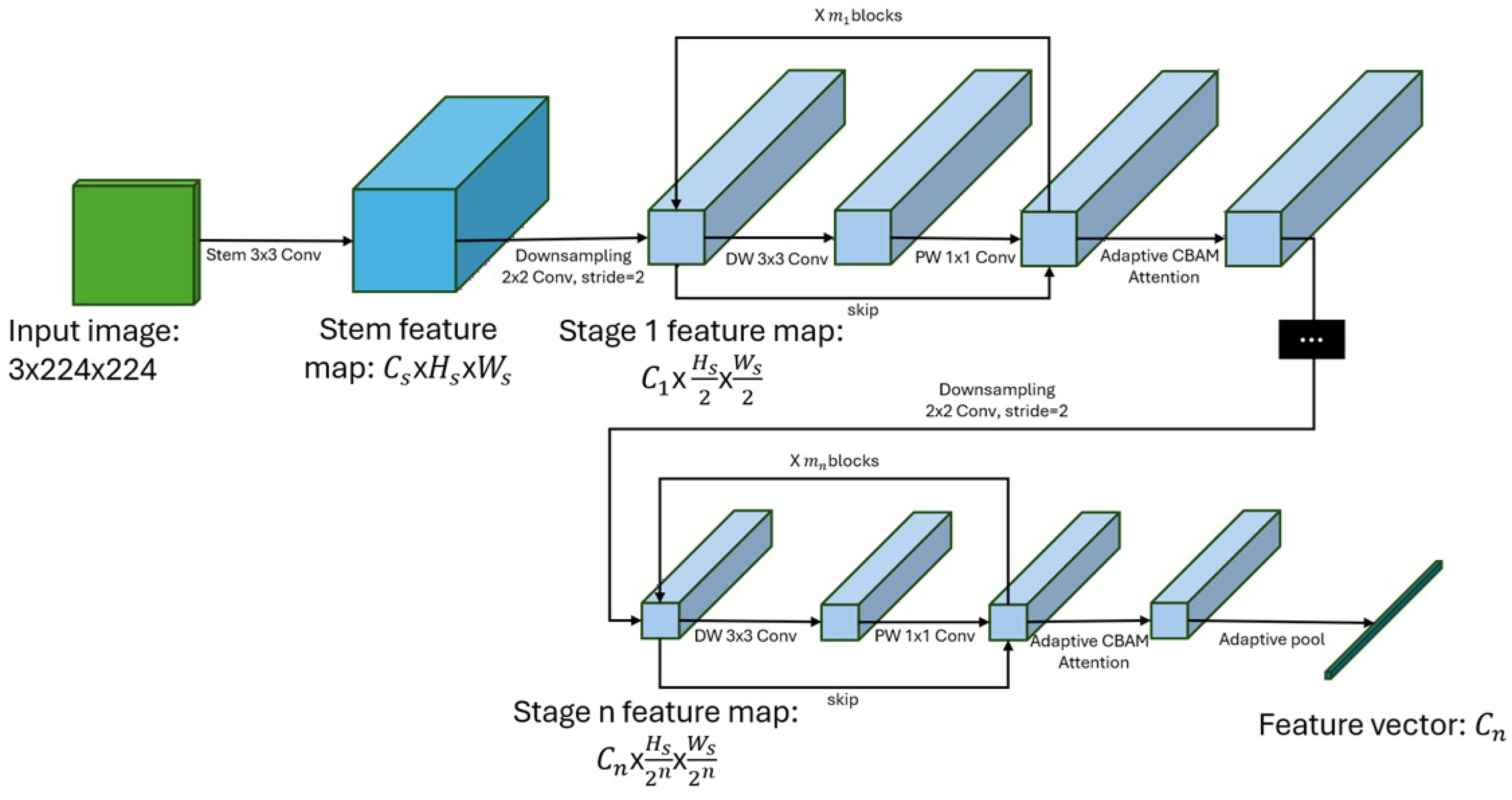
Figure 2.
Performance of EfficientMixer and other lightweight architectures with and without Self-Competitive Distillation (SCD). The plot compares mean test accuracy across CIFAR-10, HAM10000, Stanford Dogs, and MIT Indoor-67 (averaged). Blue and red curves denote models trained without and with SCD, respectively. EfficientMixer consistently benefits from SCD, achieving the highest overall improvement among the evaluated architectures.
Figure 2.
Performance of EfficientMixer and other lightweight architectures with and without Self-Competitive Distillation (SCD). The plot compares mean test accuracy across CIFAR-10, HAM10000, Stanford Dogs, and MIT Indoor-67 (averaged). Blue and red curves denote models trained without and with SCD, respectively. EfficientMixer consistently benefits from SCD, achieving the highest overall improvement among the evaluated architectures.
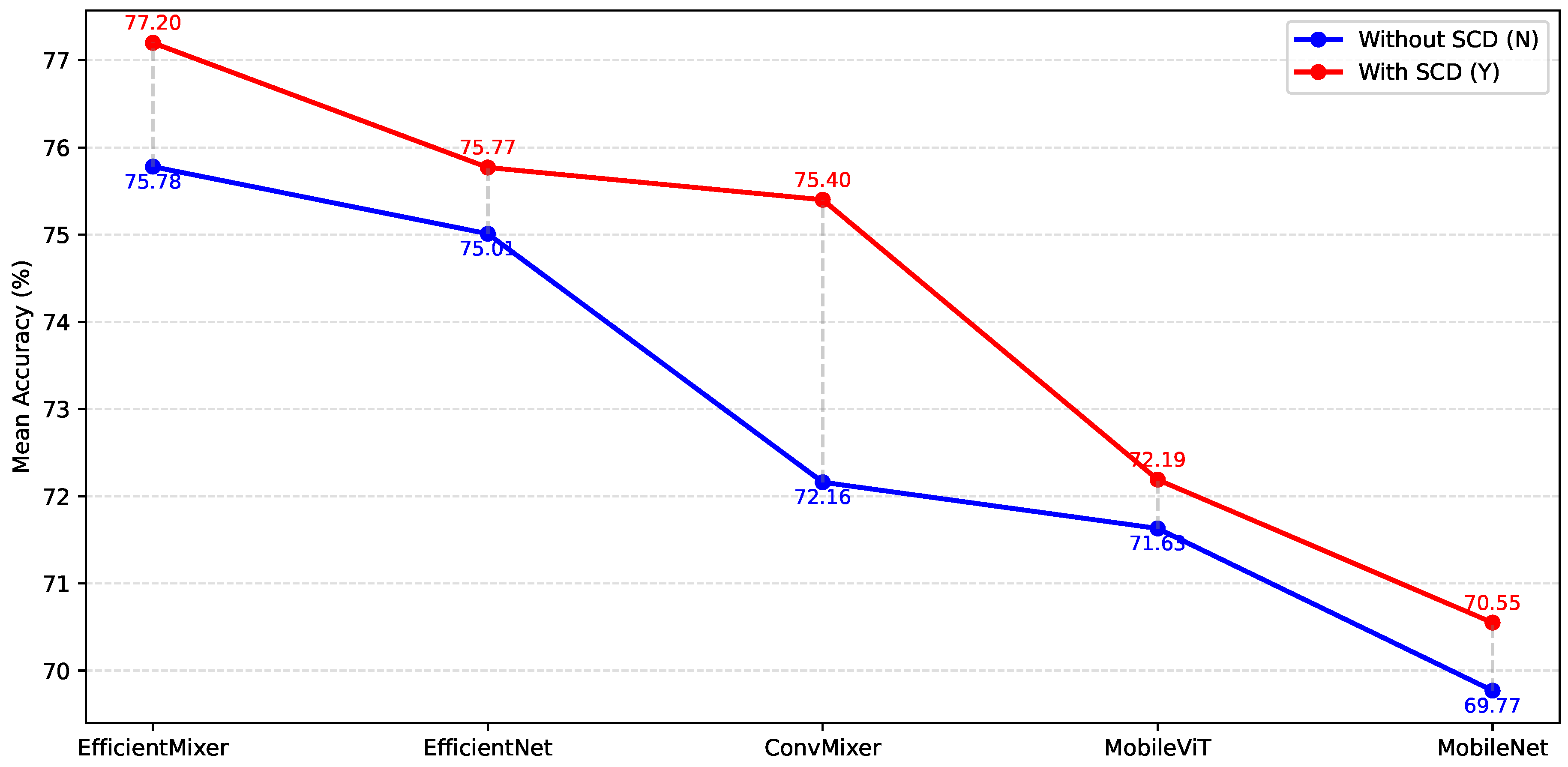
Figure 3.
Ablation analysis of EfficientMixer components. The plot reports the impact of individual architectural modifications on mean test accuracy (%), measured as deviation from the baseline model (75.78%). Variants are grouped into stem changes, stage depth modifications, attention mechanism variations, and dropout settings, highlighting the relative sensitivity of each design component.
Figure 3.
Ablation analysis of EfficientMixer components. The plot reports the impact of individual architectural modifications on mean test accuracy (%), measured as deviation from the baseline model (75.78%). Variants are grouped into stem changes, stage depth modifications, attention mechanism variations, and dropout settings, highlighting the relative sensitivity of each design component.
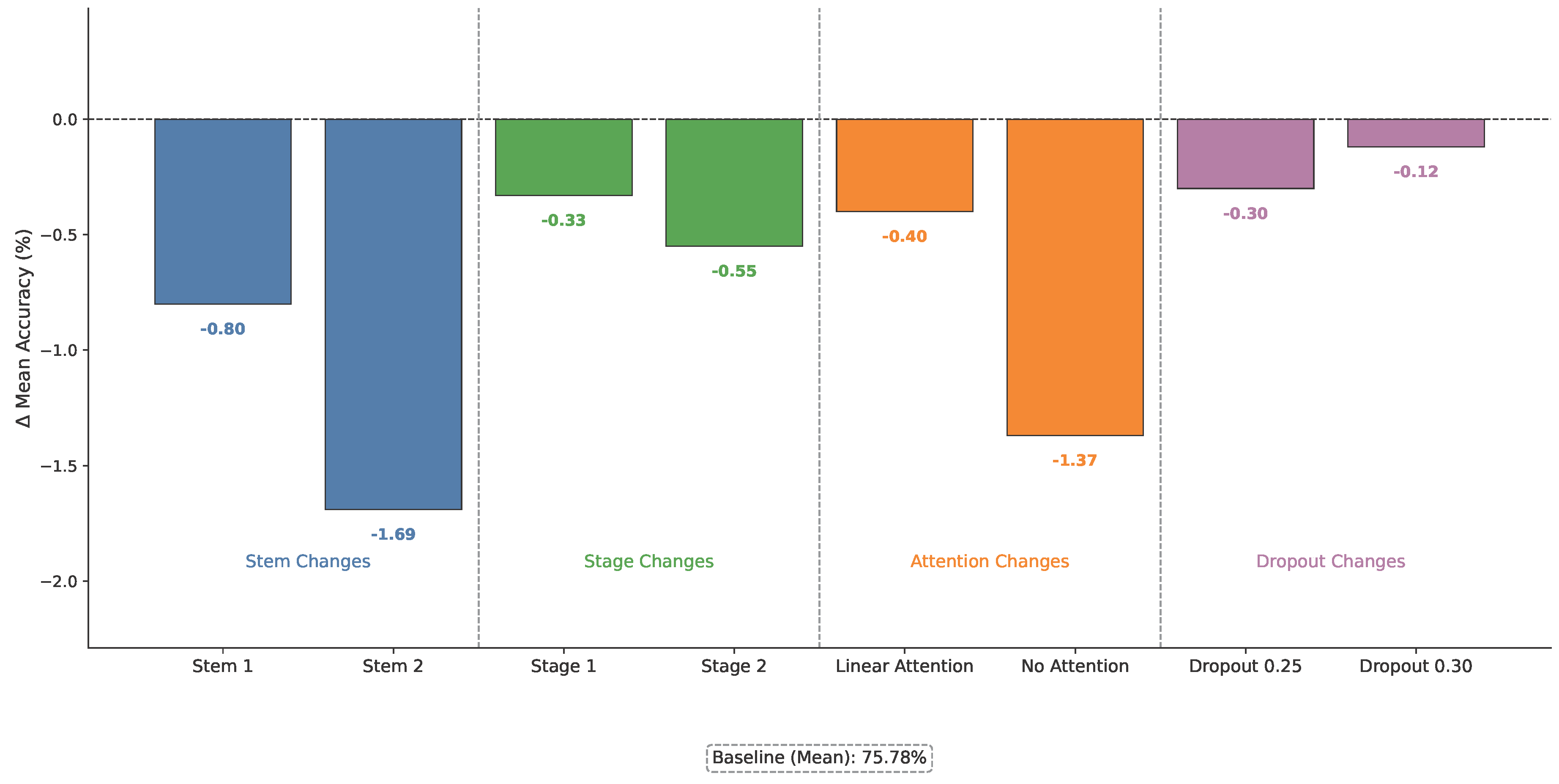

Table 1.
EfficientMixer design pattern mapping. Each component integrates architectural principles from EfficientNet, ConvMixer, and MobileViT into a unified hierarchical convolutional framework.
Table 1.
EfficientMixer design pattern mapping. Each component integrates architectural principles from EfficientNet, ConvMixer, and MobileViT into a unified hierarchical convolutional framework.
| Component | EfficientMixer Design | Source Design Patterns |
|---|---|---|
| Stem | Convolutional stem for initial feature embedding | EfficientNet: stem convolution for low-level feature extraction |
| Hierarchical stages | Progressive spatial downsampling with channel expansion | EfficientNet: stage-wise scaling and hierarchical feature abstraction |
| Intra-stage isotropic blocks | Repeated depthwise–pointwise mixing blocks with residual connections for isotropic feature refinement | ConvMixer: isotropic architecture; decoupled spatial–channel mixing |
| Stage-level refinement | CBAM-based attention with nonlinear feature fusion (NAF) | MobileViT: lightweight attention for global contextual modeling; convolution–attention complementarity |
Table 2.
Baseline EfficientMixer network. Each row describes a stage i with output resolution , output channels , and the number of blocks per stage. Each EfficientMixer stage employs a patch size of and ends with a NAF attention module.
Table 2.
Baseline EfficientMixer network. Each row describes a stage i with output resolution , output channels , and the number of blocks per stage. Each EfficientMixer stage employs a patch size of and ends with a NAF attention module.
| Stage | Operator | Resolution | #Channels | #Layers |
|---|---|---|---|---|
| 1 | Stem Conv | 64 | 2 | |
| 2 | EfficientMixer Stage + NAF | 128 | 3 | |
| 3 | EfficientMixer Stage + NAF | 256 | 3 | |
| 4 | EfficientMixer Stage + NAF | 512 | 3 | |
| 5 | EfficientMixer Stage + NAF | 256 | 3 | |
| 6 | Global Avg Pool + FC | 256 | 1 |
Table 3.
Parameter counts (M) for mobile vision models at 224×224 input.
| Model | Params (M) |
|---|---|
| EfficientMixer | 2.58 |
| EfficientNet | 2.57 |
| ConvMixer | 2.33 |
| MobileNet | 2.38 |
| MobileViT | 2.87 |
Table 4.
Summary of the four datasets used for SCD evaluation.
| Dataset | # Classes | Train Size | Test Size | Train Images per Class |
|---|---|---|---|---|
| CIFAR-10 | 10 | 50,000 | 10,000 | 5000 |
| Stanford Dogs | 120 | 12,000 | 8580 | 100 |
| HAM10000 | 7 | 7000 | 3000 | ∼1000 |
| MIT Indoor-67 | 67 | 5360 | 1340 | ∼80 |
Table 5.
Standardized training hyperparameters used across all models.
| Hyperparameter | Value |
|---|---|
| Data augmentations | CutMix, RandomFlip, ColorJitter |
| Image size | , normalized per dataset |
| Model parameter count | ≈ 2.5 Million |
| Maximum learning rate | |
| Minimum learning rate | |
| Warm-up | 5 epochs, linear schedule |
| Learning rate decay | Cosine annealing |
| Optimizer | Adam |
| Loss function | Cross-entropy with label smoothing |
| Batch size | 32 |
Table 6.
Test accuracy (%) with and without Self-Competitive Distillation (SCD) for 100 epochs. Results represent the mean ± standard deviation over 5 runs. The Mean column reports the raw average across datasets.
Table 6.
Test accuracy (%) with and without Self-Competitive Distillation (SCD) for 100 epochs. Results represent the mean ± standard deviation over 5 runs. The Mean column reports the raw average across datasets.
| Model | SCD | CIFAR-10 | HAM10000 | Dogs | Indoor-67 | Mean ± Std |
|---|---|---|---|---|---|---|
| EfficientMixer | N | 94.98 ± 0.14 | 80.36 ± 0.54 | 65.30 ± 0.55 | 62.48 ± 0.86 | 75.78 ± 0.27 |
| Y | 95.25 ± 0.17 | 81.69 ± 0.24 | 69.30 ± 0.42 | 62.58 ± 0.68 | 77.20 ± 0.38 | |
| EfficientNet | N | 95.35 ± 0.16 | 80.84 ± 0.92 | 64.33 ± 0.64 | 59.51 ± 0.61 | 75.01 ± 0.58 |
| Y | 95.32 ± 0.17 | 82.32 ± 0.34 | 64.82 ± 0.59 | 60.60 ± 0.74 | 75.77 ± 0.46 | |
| ConvMixer | N | 94.48 ± 0.08 | 80.56 ± 0.84 | 55.66 ± 0.71 | 57.93 ± 0.49 | 72.16 ± 0.53 |
| Y | 94.93 ± 0.12 | 82.29 ± 0.57 | 63.23 ± 0.32 | 61.15 ± 0.63 | 75.40 ± 0.41 | |
| MobileNet | N | 94.41 ± 0.17 | 77.81 ± 0.86 | 56.23 ± 1.38 | 50.61 ± 0.68 | 69.77 ± 0.77 |
| Y | 94.52 ± 0.12 | 79.65 ± 0.67 | 56.87 ± 1.23 | 51.15 ± 0.87 | 70.55 ± 0.72 | |
| MobileViT | N | 95.19 ± 0.32 | 77.38 ± 0.41 | 59.18 ± 0.36 | 54.78 ± 0.52 | 71.63 ± 0.39 |
| Y | 94.97 ± 0.28 | 74.32 ± 0.60 | 63.78 ± 0.59 | 55.67 ± 0.91 | 72.19 ± 0.59 |
Table 7.
EfficientMixer architectural variants evaluated in the ablation study. All stages use patch size unless otherwise noted. Stage notation denotes output channels C and number of ConvMixer-style blocks L within each stage.
Table 7.
EfficientMixer architectural variants evaluated in the ablation study. All stages use patch size unless otherwise noted. Stage notation denotes output channels C and number of ConvMixer-style blocks L within each stage.
| Variant | Stem | Stages | Attention | Dropout |
|---|---|---|---|---|
| Baseline | 3–32–64 | 128[3]-256[3]-512[3]-256[3] | NAF-attention | 0.20 |
| Stem 1 | 3–64 | 128[3]-256[3]-512[3]-256[3] | NAF-attention | 0.20 |
| Stem 2 | 3–32 | 64[8]-128[8]-256[7]-512[4] | NAF-attention | 0.20 |
| Stage 1 | 3–32–64 | 128[4]-256[3]-512[3]-256[2] | NAF-attention | 0.20 |
| Stage 2 | 3–32–64 | 128[4]-192[4]-256[4]-512[4] | NAF-attention | 0.20 |
| Linear Attention | 3–32–64 | 128[3]-256[3]-512[3]-256[3] | CBAM | 0.20 |
| No Attention | 3–32–64 | 128[3]-256[3]-512[3]-256[3] | None | 0.20 |
| Dropout 0.25 | 3–32–64 | 128[3]-256[3]-512[3]-256[3] | NAF-attention | 0.25 |
| Dropout 0.30 | 3–32–64 | 128[3]-256[3]-512[3]-256[3] | NAF-attention | 0.30 |
Table 8.
Ablation study of EfficientMixer. Results are reported as mean test accuracy (%) ± standard deviation over three training runs with different random seeds. The baseline uses a 3–32–64 convolutional stem, stage widths of 64–128–256–512–256, NAF-CBAM attention, and dropout . Stem 1 replaces the stem with 3–64, while Stem 2 uses 3–32. Stage 1 and Stage 2 modify the baseline stage configuration as described in Table 7. Linear Attention replaces NAF-CBAM with a linear attention mechanism, while No Attention removes the attention module entirely. Dropout 0.25 and Dropout 0.30 increase the dropout rate to and , respectively. Best-performing results for each dataset and the overall average are shown in bold.
Table 8.
Ablation study of EfficientMixer. Results are reported as mean test accuracy (%) ± standard deviation over three training runs with different random seeds. The baseline uses a 3–32–64 convolutional stem, stage widths of 64–128–256–512–256, NAF-CBAM attention, and dropout . Stem 1 replaces the stem with 3–64, while Stem 2 uses 3–32. Stage 1 and Stage 2 modify the baseline stage configuration as described in Table 7. Linear Attention replaces NAF-CBAM with a linear attention mechanism, while No Attention removes the attention module entirely. Dropout 0.25 and Dropout 0.30 increase the dropout rate to and , respectively. Best-performing results for each dataset and the overall average are shown in bold.
| Variant | CIFAR-10 | HAM10000 | Stanford Dogs | Indoor-67 | Mean ± Std |
|---|---|---|---|---|---|
| Baseline | 94.98 ± 0.14 | 80.36 ± 0.54 | 65.30 ± 0.55 | 62.48 ± 0.86 | 75.78 ± 0.27 |
| Stem 1 | 94.93 ± 0.07 | 79.48 ± 0.53 | 65.12 ± 0.41 | 60.38 ± 0.88 | 74.98 ± 0.28 |
| Stem 2 | 95.47 ± 0.13 | 78.38 ± 0.87 | 62.14 ± 0.51 | 60.35 ± 0.76 | 74.09 ± 0.32 |
| Stage 1 | 94.91 ± 0.07 | 79.95 ± 0.08 | 64.41 ± 0.49 | 62.54 ± 1.32 | 75.45 ± 0.35 |
| Stage 2 | 95.50 ± 0.11 | 80.01 ± 0.44 | 63.77 ± 0.11 | 61.63 ± 1.29 | 75.23 ± 0.34 |
| Linear Attention | 95.04 ± 0.11 | 79.22 ± 0.32 | 64.52 ± 0.32 | 62.73 ± 0.34 | 75.38 ± 0.14 |
| No Attention | 94.66 ± 0.19 | 78.01 ± 0.73 | 62.05 ± 0.54 | 62.93 ± 0.83 | 74.41 ± 0.31 |
| Dropout 0.25 | 94.85 ± 0.07 | 79.82 ± 0.57 | 64.40 ± 0.81 | 62.84 ± 0.74 | 75.48 ± 0.28 |
| Dropout 0.30 | 94.96 ± 0.07 | 80.13 ± 0.49 | 64.74 ± 0.36 | 62.79 ± 0.43 | 75.66 ± 0.17 |
Disclaimer/Publisher’s Note: The statements, opinions and data contained in all publications are solely those of the individual author(s) and contributor(s) and not of MDPI and/or the editor(s). MDPI and/or the editor(s) disclaim responsibility for any injury to people or property resulting from any ideas, methods, instructions or products referred to in the content. |
© 2026 by the authors. Licensee MDPI, Basel, Switzerland. This article is an open access article distributed under the terms and conditions of the Creative Commons Attribution (CC BY) license (http://creativecommons.org/licenses/by/4.0/).
Copyright: This open access article is published under a Creative Commons CC BY 4.0 license, which permit the free download, distribution, and reuse, provided that the author and preprint are cited in any reuse.


