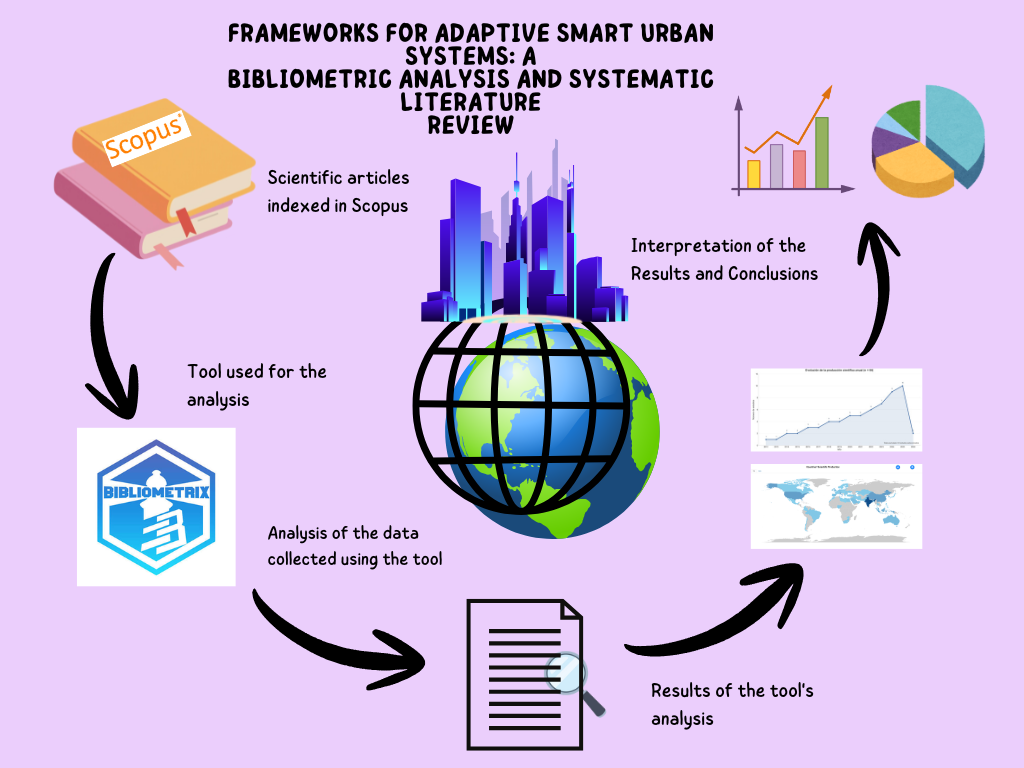
4.1. Results of the Selection Process
The systematic review process identified a total of 2,528 initial records, obtained using the search strategy defined in the Scopus database. Subsequently, through an initial screening process based on a review of titles, abstracts, and keywords, duplicates and studies unrelated to the urban context or not involving the application of artificial intelligence were eliminated, reducing the sample to 105 potentially relevant articles.
In a second phase, corresponding to the eligibility analysis, the selected documents were read in full, and their thematic relevance, methodological rigor, and scientific contribution were evaluated. As a result, studies that did not meet the established criteria were excluded, ultimately yielding a sample of 64 scientific articles that form the basis of the analysis.
This process is summarized in
Table 2, which provides a structured overview of the progressive reduction of studies through the phases of the PRISMA model.
4.2. Bibliometric Analysis of the Dataset
4.2.1. General Description
The analyzed dataset consists of the 64 selected articles, which represent a significant sample of the current state of research on adaptive smart urban systems. These studies cover the period from 2012 to 2026, demonstrating a progressive evolution of the field.
Overall, there is a high number of authors per paper, reflecting a strong collaborative component in the research. Furthermore, the presence of international co-authorship indicates that the development of solutions for smart cities is an area of global interest.
4.2.2. Annual Scientific Output
An analysis of scientific output reveals an upward trend in the number of publications, particularly in recent years. This growth is directly related to advances in technologies such as artificial intelligence, the Internet of Things (IoT), and urban data analytics.
A notable increase is observed starting in 2023, reaching its peak in 2025, which suggests that this area is becoming established as a priority line of research.
Figure 1.
Trend in Annual Scientific Output from 2012 to 2026
Figure 1.
Trend in Annual Scientific Output from 2012 to 2026
4.2.3. Analysis of Sources and Authors
An analysis of the sources reveals that most of the studies come from high-impact indexed journals and international conferences, which guarantees the scientific quality of the selected works.
As for the authors, a diverse distribution is observed, with no dominant concentration, indicating that the field is expanding and has multiple active contributors. This diversity fosters the development of multidisciplinary approaches to creating smart urban solutions.
4.2.4. Keyword Frequency
The keyword analysis identified the most representative terms in the literature. Among the most frequent are:
Smart city
Artificial intelligence
Internet of things
Machine learning
Sustainability
These terms clearly reflect the technological and data-driven approach that characterizes modern smart urban systems.
4.2.5. Keyword Co-occurrence Network
The co-occurrence network shows the relationships between the main concepts used in the literature. It reveals that the term “smart city” acts as a central node, establishing strong connections with artificial intelligence, IoT, and sustainability.
This demonstrates that current research is based on the integration of multiple technologies to solve complex urban problems.
Figure 2.
Keyword Co-occurrence Network
Figure 2.
Keyword Co-occurrence Network
4.2.6. Thematic Grouping
Cluster analysis made it possible to identify different lines of research within the domain studied. Among the main thematic groups are:
These clusters reflect the multidimensional nature of smart urban systems, where technological, social, and environmental aspects converge.
Figure 3.
Thematic Grouping
Figure 3.
Thematic Grouping
4.2.7. Emerging Trends
Trend analysis reveals a growing interest in advanced technologies such as:
In addition, new concerns related to privacy, cybersecurity, and interoperability have been identified, indicating a shift toward more comprehensive and responsible approaches to smart city design [
5,
45,
47,
48].
Figure 4.
Emerging Trends
Figure 4.
Emerging Trends
4.2.8. Geographic Distribution of Research
An analysis of the selected studies shows that scientific output is concentrated primarily in regions such as Europe, Asia, and North America.
This suggests that countries with greater technological development are leading the way in smart city research, while other regions have a lower level of participation, which opens up opportunities for future research in local contexts.
Figure 5.
Geographic Distribution of Research
Figure 5.
Geographic Distribution of Research
Overall, the results of the bibliometric analysis show that research on adaptive smart urban systems is in a phase of growth and consolidation. The combination of artificial intelligence, the Internet of Things (IoT), and distributed architectures has enabled the development of increasingly sophisticated solutions for urban management.
Persistent challenges related to technological integration, interoperability between systems, and the need for sustainable and scalable approaches have also been identified, which is consistent with the findings of recent studies [
3,
8,
41].
These findings form the basis for the comparative analysis of the frameworks, which is presented in the following sections.
4.3. Classification of Frameworks for Smart Urban Systems
Based on a detailed analysis of the 64 selected articles, different approaches to the design and implementation of frameworks for smart urban systems were identified. These approaches were grouped according to their technological orientation, architecture, and functional purpose, allowing for the establishment of a structured classification that facilitates an understanding of the current state of the field.
The proposed classification is organized into four main categories:
Internet of Things (IoT)-based architectures
Artificial intelligence-driven frameworks
Distributed architectures (edge/fog computing)
Approaches focused on sustainability and governance
4.3.1. Relevant Research on Internet of Things (IoT)-Based Architectures
IoT-based frameworks form the technological foundation of most smart urban systems. These approaches are characterized by the integration of sensor devices, communication networks, and data collection platforms that enable real-time monitoring of various variables in the urban environment. The reviewed studies show an evolution from traditional IoT architectures—focused on data capture and transmission—toward hybrid approaches that incorporate artificial intelligence, digital twins, Zero Trust security, and intelligent cyber-physical systems.
In these models, the architecture is typically structured in multiple layers, including perception (sensors), communication (networks), processing (cloud or edge platforms), and application (urban services). This organization facilitates the continuous acquisition of data and its subsequent analysis for decision-making.
Table 3 summarizes the main frameworks identified within this category, listing their name, authors, year, country or context of presentation, and main contribution.
An analysis of these frameworks shows that the role of the IoT is no longer limited to urban sensor deployment. In the most recent proposals, the data captured by sensors becomes input for predictive models, smart maintenance systems, adaptive mobility platforms, and security mechanisms for model training. In this regard, the hybrid AI-IoT framework with digital twin integration represents a clear transition toward AIoT architectures, where urban infrastructure can be simulated and evaluated before actual failures occur [
7]. Complementarily, IoT applied to traffic gains value when combined with algorithms capable of processing data in real time and generating optimization actions [
4].
TwinSnake broadens the discussion to the security of AIoT ecosystems, emphasizing that urban adaptability requires protecting the data used to train intelligent models [
37]. Intelligent cyber-physical systems underscore the importance of connecting physical objects, sensors, and computational processing to achieve continuous interaction between the city and its digital platforms [
31]. Finally, the AI-IoT convergence can be interpreted as a structural trend toward a new generation of urban systems that are more autonomous and context-aware [
32]. Taken together, these frameworks show that the main strength of IoT architectures is their ability to generate real-time urban data; however, their limitations continue to relate to interoperability, security, data quality, and dependence on robust connectivity infrastructures.
4.3.2. Relevant Research on Artificial Intelligence
A second category consists of frameworks focused on using artificial intelligence as the core of the system. These approaches incorporate machine learning algorithms, deep learning, explainable artificial intelligence, and multi-agent systems to analyze urban data and generate adaptive responses. Unlike traditional models, these systems not only collect information but are also capable of predicting urban events, optimizing resources, automating decisions, and dynamically adapting to changes in the environment.
Applications within this category include public services, smart transportation, urban infrastructure, land-use planning, and algorithmic transparency.
Table 4 presents the main AI-driven frameworks identified in the review, listing their name, authors, year, country or context, and main contribution.
An analysis of these frameworks shows that artificial intelligence is used as a layer of reasoning capable of transforming large volumes of urban data into actionable knowledge. SmartCityPredict and SmartCityNext reflect this approach by employing machine learning and real-time analytics to improve the efficiency and responsiveness of urban services [
16,
21]. In the field of mobility, AI-based smart transportation architecture demonstrates a more concrete application, tied to a specific geographic context, where algorithms support traffic management and real-time decision-making [
20].
AI-driven decision-making architectures extend the scope of these systems to urban infrastructures prepared for future scenarios, in which automation enables a response to complex operational conditions [
8]. However, the growing autonomy of these models requires mechanisms for transparency and trust; therefore, explainable artificial intelligence becomes a key component for understanding the reasoning behind the decisions generated by algorithms [
45]. Finally, multi-agent approaches provide a distributed perspective for urban planning by allowing multiple intelligent agents to interact, evaluate scenarios, and support more flexible decision-making processes [
38].Taken together, these results show that AI has evolved from applications focused solely on prediction to more complex architectures geared toward decision-making, algorithmic transparency, and the automation of urban processes.
4.3.3. Relevant Work on Distributed Architectures: Edge and Fog Computing
The growth of real-time applications has driven the development of distributed architectures, particularly those based on edge computing, fog computing, Edge AI, federated learning, and 5G networks. These frameworks aim to reduce latency and improve processing efficiency by executing analytical tasks close to the data source.
Unlike centralized cloud models, these architectures enable local data processing, real-time response, reduced network traffic, and greater system resilience.
Table 5 summarizes the main distributed frameworks identified in the review.
An analysis of these frameworks reveals a growing trend toward decentralized architectures that seek to minimize latency, improve citizens’ privacy, and increase the resilience of smart urban systems. In this regard, proposals based on edge computing and edge intelligence reduce dependence on central servers by processing information on devices close to the source of data generation [
35,
36]. Federated learning, in turn, extends this logic by enabling the collaborative training of models without moving the original data, which promotes scalability and cooperation among multiple urban stakeholders [
33].
The incorporation of 5G and multi-agent reinforcement learning accelerates the response to dynamic events, especially in urban infrastructures that require low latency and continuous adaptation [
29]. The integration of blockchain adds an additional layer of traceability and trust, which is particularly relevant when distributed urban systems use sensitive data or AI models shared among different entities [
49]. This approach is especially useful in critical applications such as traffic control, security monitoring, and emergency management; however, it introduces new challenges related to distributed management, data synchronization, and the maintenance of multiple nodes.
4.3.4. Relevant Works on Sustainability- and Governance-Oriented Approaches
A set of frameworks was identified that integrate technological aspects with social, environmental, and governance dimensions. These approaches seek not only to optimize the city’s operations but also to ensure its long-term sustainability. This category includes models that incorporate energy efficiency, emissions reduction, citizen participation, transparency in decision-making, ethical data management, climate resilience, and public dissemination of urban information.
Table 6 presents the main sustainability- and governance-oriented frameworks identified in the review.
An analysis of these frameworks reveals a gradual transition from approaches focused exclusively on technology toward comprehensive models that integrate sustainability, data governance, and urban resilience. Frameworks based on digital twins enable the dynamic representation of urban infrastructure and support both operational management and the public communication of information [
1]. In the case of transportation, the combination of digital twins and real-time optimization helps reduce environmental impacts and improve the efficiency of mobility networks [
39].
Data governance emerges as a cross-cutting theme, as it defines the conditions under which urban data can be collected, shared, audited, and used ethically. In this regard, the governance models evaluated for European smart cities provide relevant regulatory and operational criteria [
5], while SORA-ATMAS extends this discussion to adaptive trust management and the alignment of systems based on multiple LLMs [
50]. Furthermore, approaches focused on climate change and sustainability show that the convergence of AIoT and AI can strengthen urban resilience, optimize resources, and promote more sustainable urban lifestyles [
9,
43,
44].These frameworks reflect an evolution of the smart city concept toward a more comprehensive approach, in which technology serves as a means to improve quality of life, environmental sustainability, and institutional trust.
4.3.5. Summary of the Classification
In summary, the proposed classification shows that smart city frameworks have evolved from isolated technological structures toward complex, adaptive, and multidimensional ecosystems.
The results obtained lead to the conclusion that the current trend is toward the integration of multiple technologies, automation based on artificial intelligence, distributed processing, and the incorporation of sustainability criteria.
This classification provides a solid conceptual foundation for the development of new models of adaptive smart urban systems, as well as for identifying opportunities for future research.
4.4. Identified and Implemented Frameworks
4.4.1. Artificial Intelligence-Driven Frameworks
Within this category, one framework was identified that has an application associated with a specific geographic context. These types of architectures are characterized by their use of artificial intelligence algorithms as a central element for analyzing urban information, optimizing processes, and generating adaptive responses to changes in the environment.
Project: An AI-Driven Intelligent Transportation System: Functional Architecture and Implementation
Framework implemented: CityAI.
Implementation: Applied in an urban context in Hungary, Europe, as a smart architecture geared toward the management and optimization of Intelligent Transportation Systems (ITS).
The CityAI framework, developed by Huszak, Simon, Bokor, Tizedes, and Pekar in 2024, integrates technologies such as artificial intelligence, machine learning, functional architectures for urban transportation management, and data processing mechanisms geared toward decision-making.
The proposed architecture enables the collection, processing, and interpretation of information related to urban mobility, using computational models capable of analyzing the behavior of the transportation system and generating useful insights to improve its operation. Through the application of intelligent techniques, the framework seeks to adapt to changes in the urban environment and provide data-driven solutions to optimize traffic-related processes.
One of the most significant aspects of this framework is its implementation in a specific geographic setting, which demonstrates the applicability of artificial intelligence within real-world mobility systems. Unlike purely conceptual proposals, CityAI presents a functional architecture in which intelligent models are integrated with transportation management to transform urban data into useful information for vehicle planning and operations.
This framework represents a significant contribution to the development of solutions focused on analyzing mobility patterns, optimizing traffic, and enabling smart urban transportation planning. Its implementation highlights the importance of combining artificial intelligence, data processing, and digital infrastructure to address the current challenges facing smart cities.
4.4.2. Approaches Focused on Sustainability and Governance
Within this category, a framework focused on smart urban information management was identified, in which digital technologies are used as tools to strengthen sustainability, governance, and decision-making within urban environments. These approaches are characterized by the integration of different data sources, digital platforms, and information management mechanisms with the aim of improving the operational efficiency and transparency of public services.
Unlike frameworks focused exclusively on data processing or the optimization of specific processes, these models incorporate a comprehensive perspective in which technology serves as a support for urban planning, efficient resource management, and the generation of data-driven knowledge.
Project: Smart City Digital Twin Framework for Real-Time Multi-Data Integration and Wide Public Distribution
Framework implemented: Snap4City.
Implementation: Applied in Italy as a smart city-oriented architecture for the integration, management, and distribution of urban information using digital technologies.
The Snap4City framework, developed by Adreani, Bellini, Fanfani, Nesi, and Pantaleo in 2024, is an open-source, integrated IoT platform architecture designed to manage the entire urban data lifecycle. The framework enables the collection, indexing, processing, and distribution of information from multiple sources, facilitating the creation of dynamic digital representations of the urban environment.
The architecture integrates technologies such as digital twins (Digital Twin), the Internet of Things (IoT), smart urban data management, and digital platforms for the public distribution of information. Through this integration, the framework enables the centralization of heterogeneous data generated by different urban systems, providing tools for the visualization, analysis, and monitoring of variables relevant to city management.
A key feature of Snap4City is its ability to combine information from various systems within a single platform, thereby improving interoperability among urban services and facilitating data-driven decision-making processes. Its implementation in Italy demonstrates the practical application of digital architectures geared toward the development of smart cities and the efficient management of urban resources.
This framework represents a significant contribution to sustainability and governance approaches because its purpose is not limited to the technological processing of information; rather, it seeks to strengthen urban administration through mechanisms of integration, transparency, and access to data. Although it is not directly focused on identifying traffic congestion using artificial intelligence, it provides a relevant technological infrastructure for future smart mobility systems that require the integration of data from sensors, connected devices, and urban platforms.
Project: Green Transportation Planning for Smart Cities: Digital Twins and Real-Time Traffic Optimization in Urban Mobility Networks
Implemented framework: Digital twins (DT) with real-time traffic optimization systems.
Implementation: Applied in Poland within the context of sustainable urban transportation planning and mobility network optimization.
The framework developed by Lis and Madziel in 2026 proposes an architecture based on the integration of digital twins, microsimulation, and real-time information processing to improve urban transportation management. The proposal combines digital models capable of representing the actual conditions of the mobility system with analytical mechanisms designed to evaluate scenarios and optimize the operation of road networks.
The architecture uses a dynamic Adaptive Flow Measurement (AIM) logic, which interacts with data from IoT sensors to enable real-time Software-in-the-Loop (SiL) simulation processes. This integration makes it possible to analyze traffic behavior, identify potential congestion scenarios, and evaluate optimization strategies before implementing them in the physical environment.
The framework integrates technologies such as digital twins (Digital Twin), Intelligent Transportation Systems (ITS), real-time traffic optimization, digital urban modeling, and sustainable mobility systems. Through this combination of technologies, the model generates a dynamic representation of the transportation system, facilitating data-driven decision-making and improving the ability to respond to changes in traffic conditions.
A key feature of this framework is its preventive approach to traffic congestion, as it uses simulations and digital models to anticipate system behavior before implementing changes to infrastructure or mobility strategies. This makes it possible to evaluate alternatives aimed at increasing operational efficiency, reducing environmental impacts, and improving the sustainability of urban transportation.
This framework represents a significant contribution to approaches focused on sustainability and governance, as it combines advanced digital technologies with objectives related to energy efficiency, resource optimization, and smart mobility planning.Although it does not focus directly on GPS trajectory clustering algorithms, its architecture is relevant to intelligent transportation systems that require the integration of urban data, computational models, and real-time analysis for traffic congestion management.
4.4.3. Comparison of the Identified Frameworks
A comparison of the identified frameworks shows that intelligent systems applied to urban environments do not rely on a single technology, but rather are evolving toward integrated architectures capable of combining different approaches to address the complexity of modern cities. Each framework analyzed has specific characteristics depending on its primary objective, the technologies used, and its level of integration with urban transportation management.
Table 7.
Comparison of the Identified and Implemented Frameworks
Table 7.
Comparison of the Identified and Implemented Frameworks
| Framework |
Approach |
Main Technologies |
Contribution to Smart Transportation |
| CityAI |
Artificial Intelligence applied to Intelligent Transportation Systems (ITS) |
Artificial Intelligence, Machine Learning, data processing, and functional architectures for urban transportation |
Enables the analysis of mobility information, the generation of insights from urban data, and the improvement of operational transportation management through intelligent models. |
| Snap4City |
Intelligent urban data management and governance |
Digital Twin, Internet of Things (IoT), integration of multiple data sources, and digital urban information platforms |
Facilitates the integration, processing, and distribution of urban data, providing a technological infrastructure for the efficient administration of smart cities. |
| Digital Twin (DT)-Based Framework for Real-Time Traffic Optimization |
Traffic Optimization and Sustainable Mobility |
Digital Twins, IoT, Microsimulation, Adaptive Flow Measurement (AIM), and Software-in-the-Loop (SiL) |
Enables dynamic representation of the transportation system, evaluation of mobility scenarios, and optimization of traffic conditions through real-time simulation. |
Frameworks based on the Internet of Things (IoT) represent the initial layer within smart ecosystems, as they enable the continuous acquisition of information through sensors, connected devices, and monitoring systems. In the context of urban transportation, these technologies facilitate the collection of variables related to traffic flow, infrastructure conditions, vehicle location, and travel patterns. However, the massive generation of data requires additional mechanisms capable of processing and transforming this information into useful knowledge for decision-making.
Artificial intelligence-oriented frameworks, such as the CityAI model, represent an evolution toward systems capable of interpreting large volumes of information and generating adaptive responses to changes in the urban environment. These models incorporate machine learning and computational analysis techniques to identify patterns, optimize processes, and improve the management of Intelligent Transportation Systems. Their main strength lies in their ability to transform historical data and real-time data into useful information for transportation planning and operations.
Distributed architectures based on edge computing, fog computing, and federated models complement these approaches by enabling information processing to take place closer to the data source. This is essential in smart mobility applications, where rapid response times and reduced latency are critical factors for analyzing dynamic traffic conditions. Additionally, these models help improve aspects related to security, privacy, and computational efficiency.
Studies related to digital twins (Digital Twin) show a trend toward the creation of dynamic virtual representations of urban systems. Frameworks such as Snap4City and digital twin-based models using microsimulation demonstrate that these technologies enable the integration of heterogeneous information, the representation of real-world environmental conditions, and the evaluation of scenarios before implementing changes to physical systems. In the field of transportation, these capabilities make it possible to analyze optimization strategies, simulate vehicle behavior, and improve sustainable mobility planning.
The comparison conducted reveals that technological evolution within smart cities does not occur through the replacement of one approach with another, but rather through the progressive integration of different paradigms. Each framework contributes a specific capability within the urban ecosystem: IoT enables the capture of information; artificial intelligence enables the analysis of patterns and the generation of predictions; distributed architectures provide efficient processing; while digital twins and governance models enable the strategic representation, management, and use of information.
This integration is particularly relevant for systems designed to identify areas of traffic congestion, as these systems require combining different sources of information, such as GPS trajectories, urban sensors, historical records, and real-time data. The combined application of artificial intelligence techniques, spatiotemporal analysis, and digital architectures enables the development of models capable of identifying mobility patterns, detecting recurring behaviors, and supporting traffic management decisions.
Future intelligent transportation systems are moving toward hybrid architectures where different technologies work in a complementary manner. The combination of data capture via the IoT, processing using artificial intelligence, trajectory analysis, and appropriate information management mechanisms represents a highly promising approach for improving our understanding of urban mobility and developing more efficient, sustainable, and adaptive solutions to today’s transportation challenges.