
Submitted:
07 July 2026
Posted:
08 July 2026
You are already at the latest version
Abstract
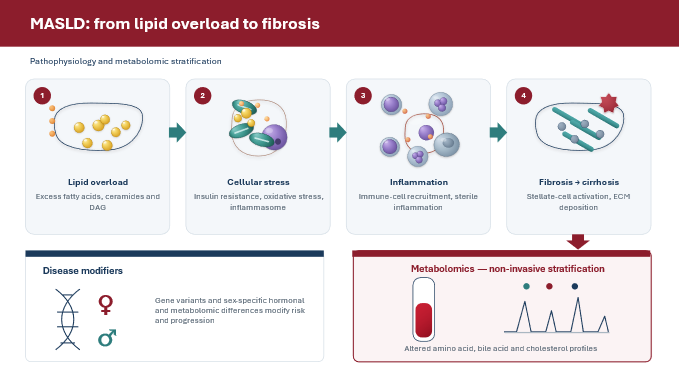
Background/Objectives: Metabolic dysfunction-associated steatotic liver disease (MASLD), a leading cause of chronic liver disease, encompasses a continuum from steatosis to metabolic dysfunction-associated steatohepatitis (MASH), fibrosis, cirrhosis, and hepatocellular carcinoma. This review aimed to synthesize current evidence on how metabolomic, lipidomic, and spatial multi-omic approaches illuminate MASLD pathogenesis and support precision hepatology. Methods: A structured narrative review was conducted through searches of PubMed, Scopus, and Web of Science, complemented by manual screening of key references. Studies were prioritized when they addressed MASLD biology, metabolic rewiring, lipid remodeling, mitochondrial dysfunction, inflammatory and fibrogenic pathways, gut–liver–adipose crosstalk, biomarker development, or therapeutic monitoring. Results: The reviewed evidence identifies MASLD as a systemic metabolic disorder shaped by excess lipid flux, enhanced de novo lipogenesis, impaired mitochondrial adaptation, oxidative and endoplasmic reticulum stress, sterile inflammation, and hepatic stellate-cell activation. Recurrent metabolomic signatures include altered amino acid, fatty acids, bile acid, and microbial co-metabolite pathways. Lipidomic studies consistently implicate depletion of protective polyunsaturated fatty acids, lysophosphatidylcholines, and phosphatidylcholines, in association with accumulation of diacylglycerols and ceramides, in the transition from steatosis to MASH and fibrosis. Emerging spatial and multi-omic analyses further resolve cell-specific metabolic niches involving hepatocytes, macrophages, endothelial cells, and stellate cells. Conclusions: Metabolomics provides a mechanistic and translational bridge between molecular injury, histological progression, and non-invasive risk stratification in MASLD. Future progress requires standardized analytical workflows, longitudinal validation, causal pathway interrogation, and integration with imaging, genetics, microbiome profiling, and treatment-response phenotyping.
Keywords:
bile acids
; biomarkers
; cholesterol
; gut-liver axis
; lipidomics
; MASH
; mitochondria
; phospholipids
; saturated fatty acids
; sex differences
Copyright: This open access article is published under a Creative Commons CC BY 4.0 license, which permit the free download, distribution, and reuse, provided that the author and preprint are cited in any reuse.


