
Submitted:
06 July 2026
Posted:
07 July 2026
You are already at the latest version
Abstract
Background/Objectives: Healthcare-associated infections (HAIs) remain a pressing patient-safety challenge, disproportionately burdening low- and middle-income countries. Uzbekistan's national sanitary regulations govern HAI prevention, but their alignment with World Health Organization (WHO) standards has not been systematically assessed. The primary aim of this study was to evaluate the alignment of Uzbekistan's national regulatory framework with the WHO Core Components (CC1–CC8) of infection prevention and control (IPC), using a decade of national HAI surveillance data (2015–2024) as descriptive context. Methods: We performed a retrospective analysis of officially registered HAI cases (2015–2024) using national surveillance and population data. We compared national regulations (SanPiN No. 0342-17 and No. 0317-15) against the eight WHO Core Components using a qualitative method, with two authors independently classifying alignment as full, partial, or weak. Results: National HAI incidence declined from 3.95 to 2.16 per 100,000 population (45.3% reduction; Mann–Kendall p = 0.007; average annual percentage change [AAPC] −6.36%/year, 2020 excluded). Tashkent city accounted for the largest 2024 share (31.7%); surgical site infections predominated (44.1%). Full WHO alignment was found for guidelines (CC2), training (CC3), and environment/equipment (CC8); partial or weak alignment for staffing (CC1, CC7), surveillance (CC4), and audit (CC6). Conclusions: HAI incidence has declined over the past decade, though this should be interpreted cautiously given likely 2020 reporting artefacts. The framework is strong in waste-management provisions but would benefit from mandatory epidemiologist staffing, electronic real-time surveillance, and more frequent audits. This is, to our knowledge, the first such regulatory-to-WHO benchmarking reported from Central Asia, offering a transferable template for similar evaluations in other low- and middle-income countries.
Keywords:
healthcare-associated infections
; infection control
; Uzbekistan
; sanitary regulations
; surveillance
; antimicrobial resistance
1. Introduction
Healthcare-associated infections (HAIs) are infections acquired during healthcare that were not present or incubating at admission [1]. They remain one of the most pervasive patient-safety problems in modern healthcare. The World Health Organization (WHO) estimates that approximately 7% of patients in high-income countries and up to 10% in developing countries acquire at least one HAI during hospitalisation, with the burden in low- and middle-income countries (LMICs) several times higher and surgical site infections (SSIs) typically the most prevalent type [2,3,4]. HAIs prolong hospital stay by 7–15 days, increase treatment costs two- to three-fold, and raise mortality – exceeding 50% in intensive care and 24% in healthcare-associated sepsis [2,3]. Gram-negative organisms (Klebsiella spp., Pseudomonas aeruginosa, Acinetobacter spp.) account for an estimated 32% of HAI aetiology worldwide, Staphylococcus aureus (including MRSA) for 15–25%, with ESBL-producing and carbapenem-resistant Enterobacterales (CRE) of particular concern given limited treatment options [5,6].
HAIs and antimicrobial resistance (AMR) are mechanistically interlinked: the WHO’s 2024 Global Report on Infection Prevention and Control attributes an estimated 75% of the global AMR burden to HAIs, and projects that improving infection prevention and control (IPC) in LMIC settings could avert at least 337,000 AMR-associated deaths annually [7,8]. Strengthening national HAI surveillance is therefore a foundational AMR-containment strategy rather than merely an adjunct to it, a framing revisited in the Discussion.
In Uzbekistan, HAI prevention is governed by Sanitary Rules and Norms (SanPiN) No. 0342-17, setting out sanitary-hygienic, preventive, and anti-epidemic requirements for healthcare facilities [9]; a complementary regulation, SanPiN No. 0317-15, governs medical waste handling [10].
Empirical HAI data from the wider Central Asian region remain sparse. An earlier Kazakhstani intensive care unit (ICU) study (Astana, 2014–2015) found gram-negative pathogens predominant in surgical site, ventilator-associated, and bloodstream infections, and noted the absence of functioning regional surveillance systems at that time [11]. A 2022 pilot point-prevalence survey across four tertiary-care hospitals using European Centre for Disease Prevention and Control (ECDC) methodology found 3.8% of surveyed patients had an active HAI [12]; a subsequent 2023 nationwide survey of 26 hospitals and 8,076 patients found a lower prevalence of 2.4%, attributed to the broader mix of hospital levels included [13]. In our literature search, we did not identify a comparable point-prevalence or regulatory-comparison study for Uzbekistan.
The extent to which Uzbekistan’s national framework corresponds to the WHO “Guidelines on Core Components of Infection Prevention and Control Programmes” (2016) [14] has not previously been systematically examined; a literature search (PubMed, Google Scholar) did not identify a prior comparison of this kind.
This points to several unresolved gaps. No nationwide, electronic, real-time HAI surveillance system has been described for Uzbekistan, and no standardised surveillance using harmonised case definitions (US Centers for Disease Control and Prevention/National Healthcare Safety Network [CDC/NHSN] or ECDC) has been implemented. Furthermore, no prior study has benchmarked the national IPC framework against WHO Core Components or an internationally codified surveillance algorithm such as that recommended by the JSI Research & Training Institute (JSI), based on CDC/NHSN and ECDC case definitions, including whether the national digital health platform (DMED, “Electronic Hospital”) has been extended to HAI-specific detection.
The primary aim of this study was therefore to evaluate the degree of alignment between Uzbekistan’s national IPC regulatory framework and the WHO Core Components of infection prevention and control. As a necessary first step and descriptive context for this evaluation, we also characterised the epidemiological dynamics of HAIs in Uzbekistan between 2015 and 2024 using official national surveillance data.
2. Materials and Methods
2.1. Study Design and Data Sources
We conducted a retrospective epidemiological analysis combined with a qualitative comparative-regulatory review, drawing on three data sources: officially registered HAI case counts for Uzbekistan, 2015–2024, with 2024 regional/nosological distribution, from the State Sanitary-Epidemiological Surveillance Centres [15]; official annual population estimates from the National Statistics Committee [16], which we used as the denominator for incidence rate calculation; and the national regulatory texts SanPiN No. 0342-17 (HAI prevention) [9] and SanPiN No. 0317-15 (medical waste management) [10], together with Ministry of Health Order No. 92 (2 April 2019) on the Infection Control Committee and associated staff training [17]. For each year, we divided the absolute case count by the corresponding population estimate to obtain the incidence rate per 100,000 population.
2.2. Comparative Framework
We mapped national regulatory provisions against the eight WHO Core Components (CC1–CC8) of infection prevention and control (IPC) programmes [14]: (CC1) IPC programmes, (CC2) IPC guidelines, (CC3) education and training, (CC4) HAI surveillance, (CC5) multimodal strategies, (CC6) monitoring/audit and feedback, (CC7) workload, staffing and bed occupancy, and (CC8) built environment, materials, and equipment. Two authors (N.T.K., B.B.R.) independently identified corresponding provisions and classified them relative to WHO guidance using the following criteria: “Full” required a mandatory, specifically worded provision matching the corresponding WHO Core Component in both content and frequency (e.g., a stipulated minimum meeting frequency or training duration); “Partial” indicated a relevant provision was present but lacked specificity, a mandatory frequency, or full facility-level coverage (e.g., applying only above a bed-count threshold); and “Weak” indicated either no corresponding provision or one that was discretionary, vaguely worded, or substantially narrower in scope than WHO guidance. We provide the full decision algorithm applied for this classification in Supplementary Table S3. We resolved disagreements through joint re-examination of the relevant regulatory text against the decision algorithm and discussion between the two raters until we reached agreement. We did not use a third, independent adjudicator: the small number of components (n=8) and the structured, criterion-based decision algorithm made consensus discussion between the two raters a practical and transparent approach, and no component required escalation beyond this process. We did not calculate a formal agreement statistic (e.g., Cohen’s kappa), as this classification was not based on a standardised, externally validated instrument such as IPCAF (see Limitations). For Figure 4 only, we mapped categories onto an ordinal scale (weak = 1, partial = 2, full = 3) to position components on the radar plot; this is not a quantitative score.
2.3. Statistical Analysis
We calculated incidence rates by dividing the annual case count by the official population estimate, per 100,000 population. We used a population-based denominator because HAI cases are notified at the population level; no admissions/patient-day denominator currently exists (see Limitations). We expressed regional and nosological distributions for 2024 as counts and proportions of the national total.
We evaluated the ten-year time series (Table 1) for monotonic trend using the non-parametric Mann–Kendall test. We estimated the average annual percentage change (AAPC) by fitting a log-linear regression of the annual rate on calendar year, deriving AAPC from the regression slope (β) as (eᵗ − 1) × 100, and its 95% confidence interval (CI) from the standard error of the slope. As we judged 2020 a priori to reflect pandemic-related disruption, we estimated AAPC both with and without this year, for transparency. We did not perform segmented (Joinpoint) or Poisson regression, given the small number of annual points (n=10; see Limitations). We performed analyses in R (version 4.3.3; R Foundation for Statistical Computing, Vienna, Austria), with cross-validation against an independent Python/SciPy implementation. We considered a two-sided p < 0.05 statistically significant.
We used ChatGPT (OpenAI, GPT-5.5) during manuscript preparation to critically review author-generated statistical outputs and figures for internal consistency and to assist with language editing; all statistical analyses were performed independently by the authors, and the authors reviewed and take full responsibility for all reported results and interpretations (see Acknowledgments).
3. Results
3.1. National Trends, 2015–2024
We found that between 2015 and 2024, the national HAI incidence rate declined from 3.95 to 2.16 per 100,000 population, a 45.3% reduction (Table 1) [15].
A pronounced decline was observed in 2020 (1.00 per 100,000), most plausibly reflecting pandemic-related reductions in elective admissions and surveillance capacity rather than a genuine epidemiological improvement. Between 2021 and 2024, the rate partially stabilised, fluctuating between 2.1 and 2.5 per 100,000.
The Mann–Kendall test confirmed a statistically significant decreasing monotonic trend across the full 2015–2024 series (S = −31, Z = −2.68, p = 0.007) and, with greater consistency, excluding 2020 (S = −30, Z = −3.02, p = 0.002). The log-linear AAPC for the full series was −6.94%/year (95% CI −14.88 to 1.75; R2 = 0.30, p = 0.10) – a wide, non-significant interval reflecting the disproportionate influence of the 2020 outlier. Excluding 2020, the AAPC was −6.36%/year (95% CI −8.34 to −4.33; R2 = 0.88, p < 0.001), a substantially narrower, significant interval supporting a steady underlying decline of approximately 6–7% per year, on which 2020 was superimposed as a transient disruption (Figure 1).
3.2. Regional Distribution, 2024
The regional distribution of HAIs in 2024 showed marked heterogeneity (Table 2): Tashkent city accounted for the largest share (259 cases; 31.7% of the national total), followed by Samarkand (9.1%) and Andijan (8.0%) regions, with the lowest proportions in Bukhara and Namangan regions.
This likely reflects both genuine variation – concentration of tertiary-care facilities in the capital – and differences in diagnostic capacity (Figure 2). Region-specific incidence rates (cases per 100,000 regional population) would in principle be more informative than national-total shares, as Tashkent city’s large population could itself inflate its proportional share independent of true regional risk; however, we did not calculate this because year-disaggregated, region-level population denominators consistent with the national surveillance dataset were not available to us for the full study period. We therefore present case shares instead, and flag region-specific incidence as a priority for future regional analyses.
3.3. Nosological Structure
In 2024, surgical site infections accounted for the largest proportion of HAIs (44.1%; Table 3), followed by puerperal (16.5%) and neonatal (15.5%) purulent-septic conditions, underscoring the importance of surgical and obstetric/neonatal infection control.
Over the 2015–2024 period, marked positive dynamics were observed for specific nosological forms: the rate of acute upper respiratory tract infections fell 6.8-fold, and that of healthcare-associated hepatitis B fell 5.7-fold [15], plausibly reflecting expanded vaccination coverage and more effective isolation practices. By contrast, the relatively stable, persistently high share of surgical site infections suggests that perioperative infection control warrants review (Figure 3).
3.4. Comparative Analysis Against WHO Core Components
We systematically compared the provisions of SanPiN No. 0342-17 and related orders against the eight WHO Core Components of infection prevention and control programmes (Table 4).
Full alignment was found for IPC guidelines (CC2), education and training (CC3), and built environment/equipment (CC8); partial or weak alignment was found for staffing (CC1, CC7) and surveillance/audit (CC4, CC6) (Figure 4).
4. Discussion
Our findings indicate an overall downward HAI trend over 2015–2024, though the sharp 2020 decline (from 3.09 to 1.00 per 100,000) most plausibly reflects pandemic-related disruption rather than genuine improvement. We situate our findings against two comparators: Kazakhstan, the most directly comparable Central Asian setting with recent ECDC-methodology survey data, and Romania, whose 20-year legislative analysis offers a longer-horizon parallel for interpreting the gap between regulatory design and implementation.
A first point requires clarification. The reported incidence – 3.95 to 2.16 per 100,000 – is substantially lower than HAI prevalence figures typically cited internationally (commonly 7–10% of hospitalised patients, or higher in LMIC settings). This gap is expected, not anomalous: the Uzbek figures are a population-based incidence rate from passive, notification-based surveillance, capturing only actively reported cases, whereas internationally cited percentages are typically point-prevalence or admission-based estimates from active, criteria-based case-finding. The low absolute incidence should therefore not be read as evidence of a low true HAI burden; rather, it most plausibly reflects the sensitivity of the surveillance architecture itself, with these figures describing reporting performance at least as much as disease occurrence – a distinction revisited in the Limitations.
The predominance of surgical site infections (44.1%) is consistent with international LMIC experience [3,4]. This relates to multimodal strategies (CC5, partial alignment): WHO guidance treats hand hygiene, disinfection, sterilisation, and isolation as one coordinated strategy [14,18], whereas Uzbek regulations address these separately – fragmentation that may explain the persistent SSI share. An international multicentre cohort across 66 countries reported an overall 30-day SSI incidence of 12.3%, rising to 23.2% in low-human-development-index settings [19,20], and a multimodal intervention bundling these same prevention measures across five African hospitals reduced SSI incidence from 8.0% to 3.8%, supporting bundling as a low-cost, high-yield intervention [21]. Given that SSIs account for 44.1% of registered HAIs in Uzbekistan, a comparable national bundle (Table 5, Priority 6) is plausibly the single intervention with the largest near-term effect on the overall HAI rate. Kazakhstani surveys found comparable patterns, with SSIs accounting for 42.9% of ward HAIs and cephalosporin resistance the most frequent pattern [12,13], suggesting broadly consistent regional clinical patterns despite differing methodology. By contrast, a Romanian point-prevalence study found gastrointestinal and respiratory infections predominant, with SSIs under-represented relative to typical European distributions – a divergence the original authors attributed partly to under-ascertainment within passive, document-based surveillance, illustrating how surveillance design itself shapes the apparent nosological structure of reported HAIs [22]. For Uzbekistan, this means the high registered SSI share should be read as a genuine clinical priority rather than purely a surveillance artefact, since it converges with regional Kazakhstani data using a different methodology, whereas the low representation of other infection types may, as in Romania, partly reflect detection limits of the current passive system.
Full alignment was identified for education and training (CC3): Order No. 92 specifies a 36-hour, 12-topic curriculum for physicians and mid-level staff [17]. The principal remaining gap is evaluation, not content: how training effectiveness is assessed and fed back into subsequent cycles is not specified, pointing to a broader concern across several Core Components – provisions formally present may still be insufficiently specific to reliably translate into frontline behaviour. A behaviour-specification analysis of Australian IPC documents similarly found hand hygiene and PPE recommendations poorly specified at national and facility level – frequently omitting who should act, in what context, or when – concluding that specificity and actionability, once basic alignment is achieved, is a distinct and necessary next step [23]. A qualitative analysis of IPC implementation across low-resource settings likewise identified operational detail, rather than formal existence, as the recurring determinant of whether policy translates into practice. For Order No. 92’s curriculum, this suggests the next refinement for Uzbekistan is not additional content but a specified post-training competency check and feedback loop, linking completion to demonstrated practice change rather than attendance alone [24].
Three further gap areas relative to WHO guidance were identified. The first is staffing (CC1, CC7): a dedicated epidemiologist is mandatory only above 200 beds, a threshold that may leave nursing and surveillance staffing levels unaddressed. A national IPCAF-based survey of Turkish hospitals similarly identified workload and staffing (CC7) as the lowest-scoring component, with low nurse-to-patient ratios independently associated with higher HAI and carbapenem-resistance rates [25], underscoring staffing as a determinant of IPC outcomes rather than an administrative formality. A global needs-assessment survey of IPC professionals across LMICs similarly reported widespread workload pressure and limited dedicated staffing time, suggesting this is a structural rather than country-specific constraint [26]. For Uzbekistan, this suggests the 200-bed threshold should be reassessed primarily as a determinant of patient outcomes, with regional shared-epidemiologist coverage for smaller facilities (Table 5, Priority 4) as a pragmatic near-term step.
The second and third gap areas concern surveillance and audit. Surveillance (CC4): case ascertainment relies on paper-based notification (Form F.085/U) and ICD-10 logbooks, without a real-time electronic module. Monitoring/audit (CC6): committees meet only quarterly [17], without mandated continuous monitoring. These echo a Kazakhstani ICU study identifying similarly weak regional surveillance and recommending active surveillance and regular audits [11] – the same priorities identified independently here, indicating these are a regional, not merely national, priority.
A document-analysis study of Romanian HAI legislation over 20 years similarly found that, despite legislation now formally aligned with EU standards, workforce capacity deficits and a regulatory culture in which increased reporting can trigger sanctions remained persistent barriers to accurate surveillance, lending weight to a regional framing in which adequate regulation alone does not guarantee implementation [22]. For Uzbekistan, this parallel cautions against treating regulatory alignment as an endpoint: closing the CC1/CC4/CC6 gaps will only translate into practice if implementation, not text revision alone, is resourced and monitored.
These gaps are also AMR-relevant: since an estimated three-quarters of the global AMR burden is attributable to HAIs [7], a passive surveillance system is limited in detecting both HAI cases and resistant-organism clusters promptly. A recent multi-country survey of general practitioners in Kazakhstan, Kyrgyzstan, Uzbekistan, and Tajikistan found delayed-prescribing strategies unfamiliar to over a quarter of respondents, with patient-driven pressure a frequent reason for unnecessary antibiotic use, underscoring that prescribing-side stewardship and surveillance gaps likely compound one another regionally [27]. For Uzbekistan, this means the surveillance modernisation priorities identified here (Table 5, Priorities 1–3) should not be pursued in isolation from antimicrobial stewardship, since a system that cannot reliably detect HAIs is equally limited in detecting the resistant organisms driving them.
The CC4/CC6 gaps can be specified at the workflow level by benchmarking the Uzbek pathway against the nine-step JSI surveillance algorithm (CDC/NHSN/ECDC-based: risk stratification, monitoring, laboratory review, case confirmation, electronic registry, epidemiologist review, investigation, and reporting). Although Order No. 270 (2025) has digitised numerous facility-level records into the DMED system, no dedicated module exists for HAI-specific case-finding or CDC/ECDC-based confirmation; the pathway therefore operates as post-discharge detection followed by retrospective investigation rather than in-admission detection. Developing a CDC/ECDC-compliant electronic HAI module, built on the JSI algorithm and integrated into DMED, is a pressing, actionable priority [28]. This challenge is not unique to Uzbekistan: as of 2010, only 16% of LMICs had HAI surveillance at the national or sub-national level, and a multicentre Indian surveillance initiative similarly modified NHSN and ECDC case definitions to fit locally available resources, demonstrating the feasibility of such an approach for other LMICs [29]. For Uzbekistan, this suggests a DMED-integrated HAI module need not await a bespoke national standard, but could adapt existing CDC/NHSN or ECDC definitions to locally available laboratory and prescribing data. A subsequent global situational analysis found surveillance-related core components remained among the weakest nationally, particularly in lower-income countries, indicating this gap has persisted well beyond 2010[30]. Where a full electronic module is not yet feasible, lower-cost interim approaches such as syndromic, symptom-based case-finding have been proposed as a bridge toward fuller electronic surveillance [31]; for Uzbekistan, this could be piloted within existing DMED infrastructure as an interim step rather than treating electronic surveillance as an all-or-nothing investment.
Because CC4 (Partial) and CC6 (Weak) represented the surveillance- and audit-related gaps with the least favourable WHO alignment, Uzbekistan’s passive model was further situated against international surveillance approaches and recent Kazakhstani national HAI data, by domain (Supplementary Tables S1–S2). The most consistent shared regional gap is the transition toward continuous electronic surveillance; a phased approach – layering active case-finding onto existing notification, extending DMED to flag probable cases electronically, and adopting ECDC point-prevalence methodology – would also enable direct comparison with the Kazakhstani survey [13]. By contrast, a notable strength lies in SanPiN No. 0317-15’s detailed five-class, colour-coded medical waste system (CC8), a level of specificity rarely matched internationally. For Uzbekistan, this asymmetry between an advanced waste-management framework (CC8) and an underdeveloped surveillance/audit framework (CC4, CC6) suggests regulatory drafting capacity itself is not the constraint; rather, the gap is concentrated where investment in electronic infrastructure and dedicated personnel is required.
Several limitations should be acknowledged. Our analysis relies on officially registered cases, and given well-documented under-ascertainment internationally [3,32,33], we consider the true burden likely higher. International experience also suggests that a regulatory culture in which increased reporting can trigger administrative scrutiny may discourage complete case ascertainment by clinical staff; we could not determine whether this dynamic contributes to the observed decline in registered incidence from document-based, aggregate data alone, and recommend dedicated, confidential qualitative investigation in future work [22].
The population-based denominator we used differs from hospital-level denominators used internationally (e.g., per 1,000 patient-days, or per 100 procedures for SSIs), precluding direct comparison with facility-level literature. A hospital-level denominator was not available because no nationally aggregated, year-disaggregated registry of hospital admissions or patient-days currently exists in Uzbekistan in a form linkable to our surveillance data. This is a structural data-availability constraint rather than a methodological preference; we report it explicitly so that readers are not misled into treating these incidence rates as numerically equivalent to hospital-level prevalence figures elsewhere. Relatedly, variation in laboratory diagnostic capacity across facilities may itself contribute to under-ascertainment, independent of the reporting-culture effects discussed above.
For the regulatory comparison, we used a study-specific classification rather than a standardised instrument such as the WHO Infection Prevention and Control Assessment Framework (IPCAF) [34]; future assessments should apply IPCAF directly for a benchmarked score. A narrative review of IPCAF applications across 13 countries found median scores ranging from 117.5 (Pakistan, inadequate level) to 690/800 (Germany, advanced level), with a consistent pattern of lower scores in lower-income settings [35]; applying IPCAF to Uzbek facilities would allow our analysis to move from qualitative classification to a quantitative, internationally benchmarked score. A recent IPCAF-based survey in an under-resourced region of China similarly found lower scores at secondary- versus tertiary-level hospitals, illustrating that such within-country, facility-tier disparities – plausible in Uzbekistan too – can only be captured once a standardised instrument is applied [36].
We used document review rather than on-site assessment; regional/nosological data are available only for 2024; and the available data were aggregated at national and regional level, without facility-level information on patient risk factors, invasive device use, or procedure-specific denominators that would allow risk-adjusted comparison between hospitals. We did not use Joinpoint regression, which can detect multiple distinct trend segments, for two reasons: it typically requires more annual data points than we had available (n=10) to reliably fit more than a single segment, and we identified the 2020 disruption a priori as a discrete, explainable event rather than an unknown breakpoint to be empirically detected. For the same reasons, we judged Mann–Kendall and log-linear AAPC, applied with and without 2020, the more transparent and appropriate approach for this short series. We likewise did not use Poisson regression, as it requires case-level or stratified count data rather than the ten annual aggregate rates available for this study.
5. Conclusions
In this study, we provide, to our knowledge, the first systematic comparison of Uzbekistan’s national IPC regulatory framework against the WHO Core Components, situated within the first decade-long national description of HAI epidemiology in the country. We regard this regulatory–WHO benchmarking, rather than the epidemiological description alone, as the principal contribution of this work. We interpret the observed decline in registered incidence over 2015–2024 cautiously, both because of the 2020 pandemic-related disruption and because passive, document-based surveillance cannot distinguish a genuine reduction in HAI occurrence from a reduction in case ascertainment.
The national regulatory framework demonstrates full alignment with WHO Core Components for IPC guidelines and for environmental/equipment/waste management provisions, but shows partial or weak alignment for staffing, real-time surveillance, and audit frequency. Based on these findings, we recommend the following measures, with current status, responsible bodies, and indicative timelines detailed in Table 5:
- Priority 1 – Surveillance denominators and reporting infrastructure: standardise facility-level HAI denominators, since population-based incidence alone cannot adequately reflect the true burden of HAIs;
- Priority 2 – Sentinel active surveillance: pilot CDC/NHSN- or ECDC-aligned active surveillance for key device- and procedure-associated infections in tertiary hospitals, before national scale-up;
- Priority 3 – Electronic HAI module within DMED: build a dedicated, JSI/CDC-NHSN/ECDC-aligned case-detection module into the national DMED platform;
- Priority 4 – Epidemiologist staffing: extend mandatory IPC epidemiologist staffing beyond the 200-bed threshold, using regional shared-epidemiologist teams for smaller facilities;
- Priority 5 – Audit and feedback: move infection-control committees from quarterly meetings to monthly, indicator-based audit-and-feedback cycles;
- Priority 6 – SSI-focused prevention bundle: given that SSIs represented 44.1% of registered HAIs, prioritise a national, multimodal SSI prevention bundle;
- Priority 7 – IPCAF-based facility assessment: apply IPCAF nationally to move from document-based alignment to a measurable, internationally benchmarked implementation score.
Taken together, Priorities 1–7 above follow a logical implementation sequence, from establishing surveillance infrastructure and denominators through to staffing, audit, and a standardised SSI bundle, culminating in an IPCAF-based benchmarking assessment. This phased sequence, and the underlying regulatory-to-WHO comparison methodology, offers a template that other Central Asian and middle-income countries could adapt to identify and act on their own priority gaps.
Supplementary Materials
The following supporting information can be downloaded at the website of this paper posted on Preprints.org: Table S1: Surveillance approaches for healthcare-associated infections: international definitions and current status in Uzbekistan; Table S2: Comparison of national HAI surveillance and IPC structures: Uzbekistan, Kazakhstan, and WHO recommendations; Table S3: Decision algorithm used to classify WHO Core Component alignment as Full, Partial, or Weak.
Author Contributions
Conceptualization, N.T.K.; Methodology, N.T.K. and B.B.R.; Software, N.T.K.; Validation, N.T.K., B.B.R. and I.Kh.M.; Formal Analysis, N.T.K.; Investigation, N.T.K. and M.O.K.; Resources, B.B.R. and F.O.A.; Data Curation, M.O.K.; Writing – Original Draft Preparation, N.T.K.; Writing – Review and Editing, B.B.R., I.Kh.M., F.O.A., M.F.A. and M.O.K.; Visualization, N.T.K.; Supervision, I.Kh.M.; Project Administration, N.T.K. All authors have read and agreed to the published version of the manuscript.
Funding
This research received no external funding.
Institutional Review Board Statement
This study was based exclusively on aggregated, de-identified national surveillance statistics and publicly available regulatory documents (SanPiN No. 0342-17 and SanPiN No. 0317-15); the analysis did not involve individual patient data, identifiable personal information, or any primary human-subject research procedures. Notwithstanding the foregoing, the study was conducted in accordance with the Declaration of Helsinki, and approved by the Institutional Review Board (Ethics Committee) of Tashkent State Medical University (Decision No. 29, dated 12 June 2026).
Informed Consent Statement
Not applicable, as the manuscript does not contain any individual person’s data in any form.
Data Availability Statement
The raw aggregated national HAI surveillance data analysed in this study are available from the corresponding author on request due to restrictions on redistribution by the State Sanitary-Epidemiological Surveillance Centres of the Republic of Uzbekistan. The regulatory texts analysed (SanPiN No. 0342-17, https://nrm.uz/contentf?doc=509278_&products=1_vse_zakonodatelstvo_uzbekistana; SanPiN No. 0317-15, https://ssv.uz/ru/documentation/canpin-0317-15-sanitarnye-normy-i-pravila-sbora-hranenija-i-utilizatsii-othodov-v-lpu) are publicly available through the official channels of the Ministry of Health of the Republic of Uzbekistan.
Conflicts of Interest
The authors declare no conflicts of interest.
Acknowledgments
The authors thank the State Sanitary-Epidemiological Surveillance Centres of the Republic of Uzbekistan for the provision of national surveillance data used in this study. During the preparation of this manuscript, the author(s) used ChatGPT (OpenAI, GPT-5.5) for the purposes of critically reviewing author-generated statistical outputs and figures for internal consistency, and assisting with language editing. Statistical analyses were performed independently by the authors in R and cross-validated against an independent Python/SciPy implementation. The authors have reviewed and edited the output and take full responsibility for the content of this publication.
Abbreviations
HAI, healthcare-associated infection; WHO, World Health Organization; IPC, infection prevention and control; CC, Core Component; SanPiN, Sanitary Rules and Norms; ESBL, extended-spectrum beta-lactamase; CRE, carbapenem-resistant Enterobacterales; MRSA, methicillin-resistant Staphylococcus aureus; ICD-10, International Classification of Diseases, 10th revision; CDC, Centers for Disease Control and Prevention (United States); NHSN, National Healthcare Safety Network; ECDC, European Centre for Disease Prevention and Control; JSI, JSI Research & Training Institute, Inc.; DMED, the national digital health information system (“Electronic Hospital”) of the Republic of Uzbekistan; SSI, surgical site infection; CLABSI, central-line-associated bloodstream infection; VAP, ventilator-associated pneumonia; CAUTI, catheter-associated urinary tract infection.
References
- World Health Organization. Health Care-Associated Infections Fact Sheet; WHO: Geneva, Switzerland, 2024. [Google Scholar]
- World Health Organization. Report on the Burden of Endemic Health Care-Associated Infection Worldwide; WHO: Geneva, Switzerland, 2020. [Google Scholar]
- Allegranzi, B.; Bagheri Nejad, S.; Combescure, C.; et al. Burden of endemic health-care-associated infection in developing countries: systematic review and meta-analysis. Lancet 2011, 377, 228–241. [Google Scholar] [CrossRef] [PubMed]
- Odoom, A.; Tetteh-Quarcoo, P.B.; Donkor, E.S. Prevalence of hospital-acquired infections in low- and middle-income countries: systematic review and meta-analysis. Asia Pac. J. Public Health 2025, 37, 448–466. [Google Scholar] [CrossRef] [PubMed]
- Klevens, R.M.; Edwards, J.R.; Richards, C.L., Jr.; et al. Estimating health care-associated infections and deaths in U.S. hospitals, 2002. Public Health Rep. 2007, 122, 160–166. [Google Scholar] [CrossRef] [PubMed]
- Murray, C.J.L.; Ikuta, K.S.; Sharara, F.; et al. Global burden of bacterial antimicrobial resistance in 2019: a systematic analysis. Lancet 2022, 399, 629–655. [Google Scholar] [CrossRef]
- World Health Organization. Global Report on Infection Prevention and Control 2024; WHO: Geneva, Switzerland, 2024. [Google Scholar]
- GBD 2021 Antimicrobial Resistance Collaborators. Global burden of bacterial antimicrobial resistance 1990–2021: a systematic analysis with forecasts to 2050. Lancet 2024, 404, 1199–1226. [Google Scholar] [CrossRef] [PubMed]
- Ministry of Health of the Republic of Uzbekistan. Sanitary Rules and Norms No. 0342-17: Prevention of Healthcare-Associated Infections; Ministry of Health. Tashkent, Uzbekistan, 2017.
- Ministry of Health of the Republic of Uzbekistan. Sanitary Rules and Norms No. 0317-15: Collection, Storage and Disposal of Waste from Healthcare Facilities; Ministry of Health: Tashkent, Uzbekistan, 2015. [Google Scholar]
- Viderman, D.; Khamzina, Y.; Kaligozhin, Z.; et al. An observational case study of hospital associated infections in a critical care unit in Astana, Kazakhstan. Antimicrob. Resist. Infect. Control 2018, 7, 57. [Google Scholar] [CrossRef] [PubMed]
- Semenova, Y.; Yessmagambetova, A.; Akhmetova, Z.; et al. Point-prevalence survey of antimicrobial use and healthcare-associated infections in four acute care hospitals in Kazakhstan. Antibiotics 2024, 13, 981. [Google Scholar] [CrossRef] [PubMed]
- Smagul, M.; Yessmagambetova, A.; Semenova, Y.; et al. Prevalence of healthcare-associated infections and antimicrobial use in Kazakhstan: results of the first nationwide survey in 2023. Antimicrob. Resist. Infect. Control 2025, 14, 150. [Google Scholar] [CrossRef] [PubMed]
- World Health Organization. Guidelines on Core Components of Infection Prevention and Control Programmes at the National and Acute Health Care Facility Level; WHO: Geneva, Switzerland, 2016. [Google Scholar]
- State Sanitary-Epidemiological Surveillance Centres of the Republic of Uzbekistan. National Surveillance Reports on Healthcare-Associated Infections; State Sanitary-Epidemiological Surveillance Centres: Tashkent, Uzbekistan, 2015–2024. [Google Scholar]
- National Statistics Committee of the Republic of Uzbekistan. Permanent Population of the Republic of Uzbekistan, by Year (Official Annual Estimates); National Statistics Committee: Tashkent, Uzbekistan, 2026; Available online: https://stat.uz (accessed on 1 January 2026).
- Ministry of Health of the Republic of Uzbekistan. Order No. 92, 2 April 2019: On Approval of the Regulation on the Infection Control Committee in Treatment-and-Prophylactic Institutions and on Improving the Activity of the Committee (with Annexes 1–3); Ministry of Health: Tashkent, Uzbekistan, 2019. [Google Scholar]
- Saito, H.; Allegranzi, B.; Pittet, D. 2018 WHO hand hygiene campaign: preventing sepsis in health care and the path to universal health coverage. Lancet Infect. Dis. 2018, 18, 490–491. [Google Scholar] [CrossRef] [PubMed]
- Jacobson, J. Surgical site infection—the next frontier in global surgery. Lancet Infect. Dis. 2018, 18, 477–478. [Google Scholar] [CrossRef]
- Mengistu, D.A.; Alemu, A.; Abdukadir, A.A.; Husen, A.M.; Ahmed, F.; Mohammed, B.; Musa, I. Global Incidence of Surgical Site Infection Among Patients: Systematic Review and Meta-Analysis. SAGE Open Med. 2023, 11. [Google Scholar] [CrossRef]
- Allegranzi, B.; Aiken, A.M.; Kubilay, N.Z.; Nthumba, P.; Barasa, J.; Okumu, G.; Mugarura, R.; Elobu, A.; Jombwe, J.; Maimbo, M.; et al. A multimodal infection control and patient safety intervention to reduce surgical site infections in Africa: a multicentre, before–after, cohort study. Lancet Infect. Dis. 2018, 18, 507–515. [Google Scholar] [CrossRef] [PubMed]
- Coman, A.; Pop, D.; Muresan, F.; Oprescu, F.; Fjaagesund, S. Surveillance and reporting of hospital-associated infections—a document analysis of Romanian healthcare legislation evolution over 20 years. Healthcare 2025, 13, 229. [Google Scholar] [CrossRef] [PubMed]
- Peters, S.; Lim, L.-L.; Francis, J.J.; Bennett, N.; Fetherstonhaugh, D.; Buising, K.; McCahon, J.; Marshall, C.; Presseau, J.; Lim, W.K.; et al. Analysis of infection prevention and control documentation in residential aged care based on a behaviour specification framework. Infect. Dis. Health 2025, 30, 217–224. [Google Scholar] [CrossRef] [PubMed]
- Tomczyk, S.; Storr, J.; Kilpatrick, C.; Allegranzi, B. Infection prevention and control (IPC) implementation in low-resource settings: a qualitative analysis. Antimicrob. Resist. Infect. Control 2021, 10, 113. [Google Scholar] [CrossRef] [PubMed]
- Azak, E.; Sertcelik, A.; Ersoz, G.; Celebi, G.; Eser, F.; Batirel, A.; Cag, Y.; Ture, Z.; Ozturk Engin, D.; Yetkin, M.A.; et al. Evaluation of the implementation of WHO infection prevention and control core components in Turkish health care facilities: results from a WHO infection prevention and control assessment framework (IPCAF)-based survey. Antimicrob. Resist. Infect. Control 2023, 12, 11. [Google Scholar] [CrossRef] [PubMed]
- Sreeramoju, P.; Song, X.; Bardossy, A.C.; Cadena, J.; Forde, C.A.; Patel, P.; Salinas, J.; Tolliver, C.; Zayed, B.; Krein, S.L. Infection prevention and healthcare epidemiology professionals in low- and middle-income countries: a needs assessment survey and call for action. BMJ Glob. Health 2025, 10, e018265. [Google Scholar] [CrossRef] [PubMed]
- Semenova, Y.; Akhmetova, K.; Rakhmatullaeva, S.; Muminova, M.; Fakhriddinova, D.; Dzhusupov, K.; Kanymetova, A.; Ashyralieva, D.; Saidova, M.; Yakubova, S.; et al. Antibiotic Resistance Awareness and Prescribing Behavior Among General Practitioners in Kazakhstan, Kyrgyzstan, Uzbekistan, and Tajikistan. Antibiotics 2026, 15, 309. [Google Scholar] [CrossRef] [PubMed]
- Ministry of Health of the Republic of Uzbekistan. Order No. 270, 29 August 2025: On the Phased Introduction of the DMED (“Electronic Hospital”) Information System and Electronic Medical Record Forms in Treatment-and-Prophylactic Institutions; Ministry of Health: Tashkent, Uzbekistan, 2025.
- Murhekar, M.V.; Kumar, C.P.G. Health-care-associated infection surveillance in India. Lancet Glob. Health 2022, 10, e1222–e1223. [Google Scholar] [CrossRef] [PubMed]
- Tartari, E.; Tomczyk, S.; Pires, D.; Zayed, B.; Coutinho Rehse, A.P.; Kariyo, P.; Stempliuk, V.; Zingg, W.; Pittet, D.; Allegranzi, B. Implementation of the infection prevention and control core components at the national level: a global situational analysis. J. Hosp. Infect. 2021, 108, 94–103. [Google Scholar] [CrossRef] [PubMed]
- Mwanja, H.; Waswa, J.P.; Kiggundu, R.; Mackline, H.; Bulwadda, D.; Byonanebye, D.M.; Kambugu, A.; Kakooza, F. Utility of syndromic surveillance for the surveillance of healthcare-associated infections in resource-limited settings: a narrative review. Front. Microbiol. 2024, 15, 1493511. [Google Scholar] [CrossRef] [PubMed]
- Zingg, W.; Holmes, A.; Dettenkofer, M.; et al. Hospital organisation, management, and structure for prevention of health-care-associated infection: a systematic review and expert consensus. Lancet Infect. Dis. 2015, 15, 212–224. [Google Scholar] [CrossRef] [PubMed]
- Bunduki, G.K.; Masoamphambe, E.; Fox, T.; Musaya, J.; Musicha, P.; Feasey, N. Prevalence, risk factors, and antimicrobial resistance of endemic healthcare-associated infections in Africa: a systematic review and meta-analysis. BMC Infect. Dis. 2024, 24, 158. [Google Scholar] [CrossRef] [PubMed]
- World Health Organization. Infection Prevention and Control Assessment Framework (IPCAF) at the Facility Level; WHO: Geneva, Switzerland, 2018. [Google Scholar]
- Asgedom, A.A. Status of infection prevention and control (IPC) as per the WHO standardised Infection Prevention and Control Assessment Framework (IPCAF) tool: existing evidence and its implication. Infect. Prev. Pract. 2024, 6, 100351. [Google Scholar] [CrossRef] [PubMed]
- Li, L.; Leng, K.; Du, X.; Wang, G.; Liu, M.; Meng, Q. Evaluating infection prevention and control implementation in Shospitals of underdeveloped region of China using the standardized WHO-IPCAF tool. Front. Public Health 2026, 13, 1749241. [Google Scholar] [CrossRef] [PubMed]
Figure 1.
National HAI incidence rate, Uzbekistan, 2015–2024 (per 100,000 population). The red marker (2020) was excluded from the trend fit owing to pandemic-related disruption. The dashed line shows the log-linear trend excluding 2020 (AAPC = −6.36%/year; 95% CI −8.34 to −4.33; R2 = 0.88; p < 0.001); shaded band shows the 95% confidence band.
Figure 1.
National HAI incidence rate, Uzbekistan, 2015–2024 (per 100,000 population). The red marker (2020) was excluded from the trend fit owing to pandemic-related disruption. The dashed line shows the log-linear trend excluding 2020 (AAPC = −6.36%/year; 95% CI −8.34 to −4.33; R2 = 0.88; p < 0.001); shaded band shows the 95% confidence band.
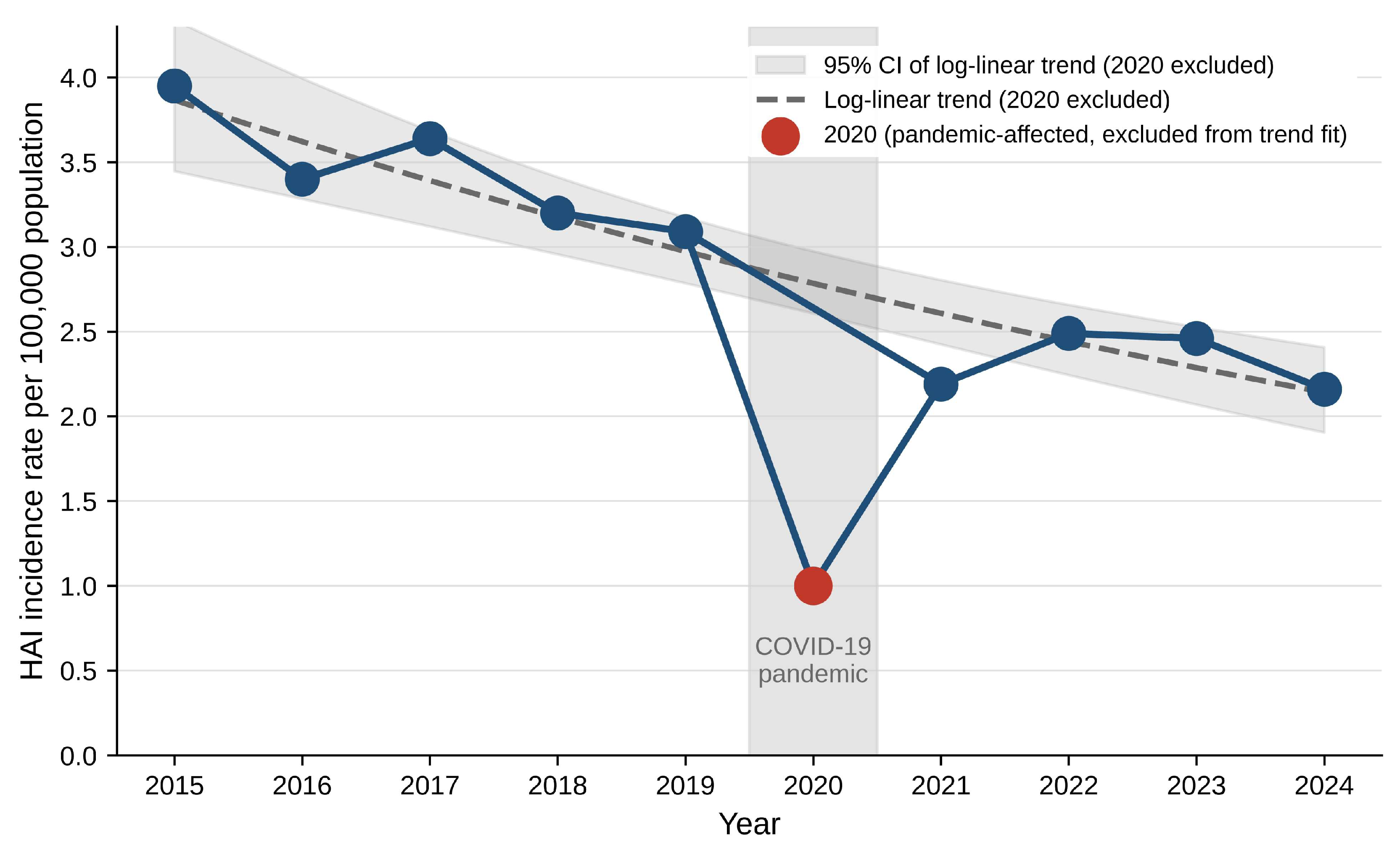
Figure 2.
Regional distribution of HAI cases, Uzbekistan, 2024. Bars show each region’s share of the national total (%) with case counts (n) labelled. Tashkent city (highlighted in red) is the highest-ranked region; the colour carries no statistical meaning.
Figure 2.
Regional distribution of HAI cases, Uzbekistan, 2024. Bars show each region’s share of the national total (%) with case counts (n) labelled. Tashkent city (highlighted in red) is the highest-ranked region; the colour carries no statistical meaning.
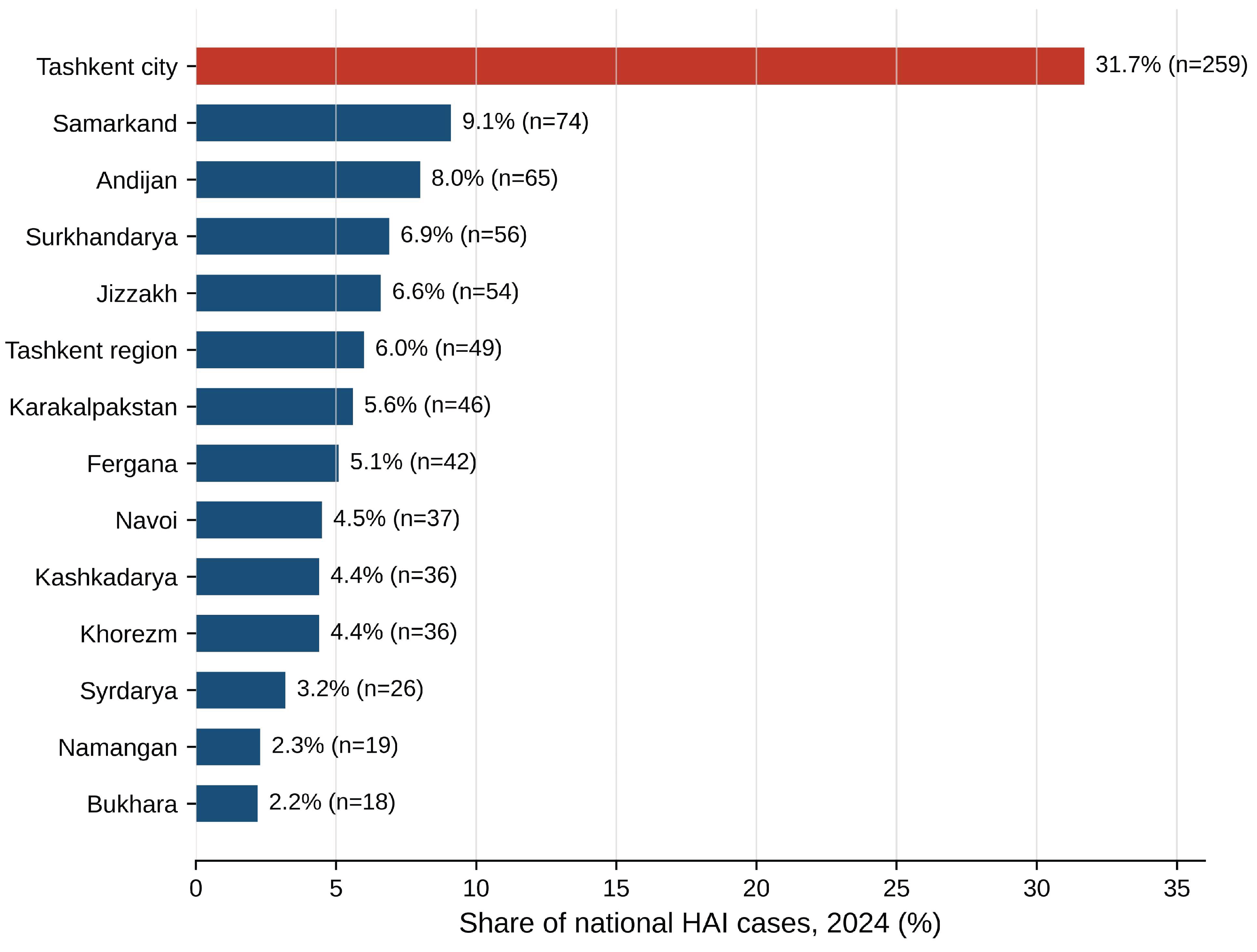
Figure 3.
Nosological structure of HAI cases, Uzbekistan, 2024 (% of national total). “Other nosological forms” (20.3%) is an aggregate category of remaining, individually less frequent HAI types not separately itemised in the source data.
Figure 3.
Nosological structure of HAI cases, Uzbekistan, 2024 (% of national total). “Other nosological forms” (20.3%) is an aggregate category of remaining, individually less frequent HAI types not separately itemised in the source data.
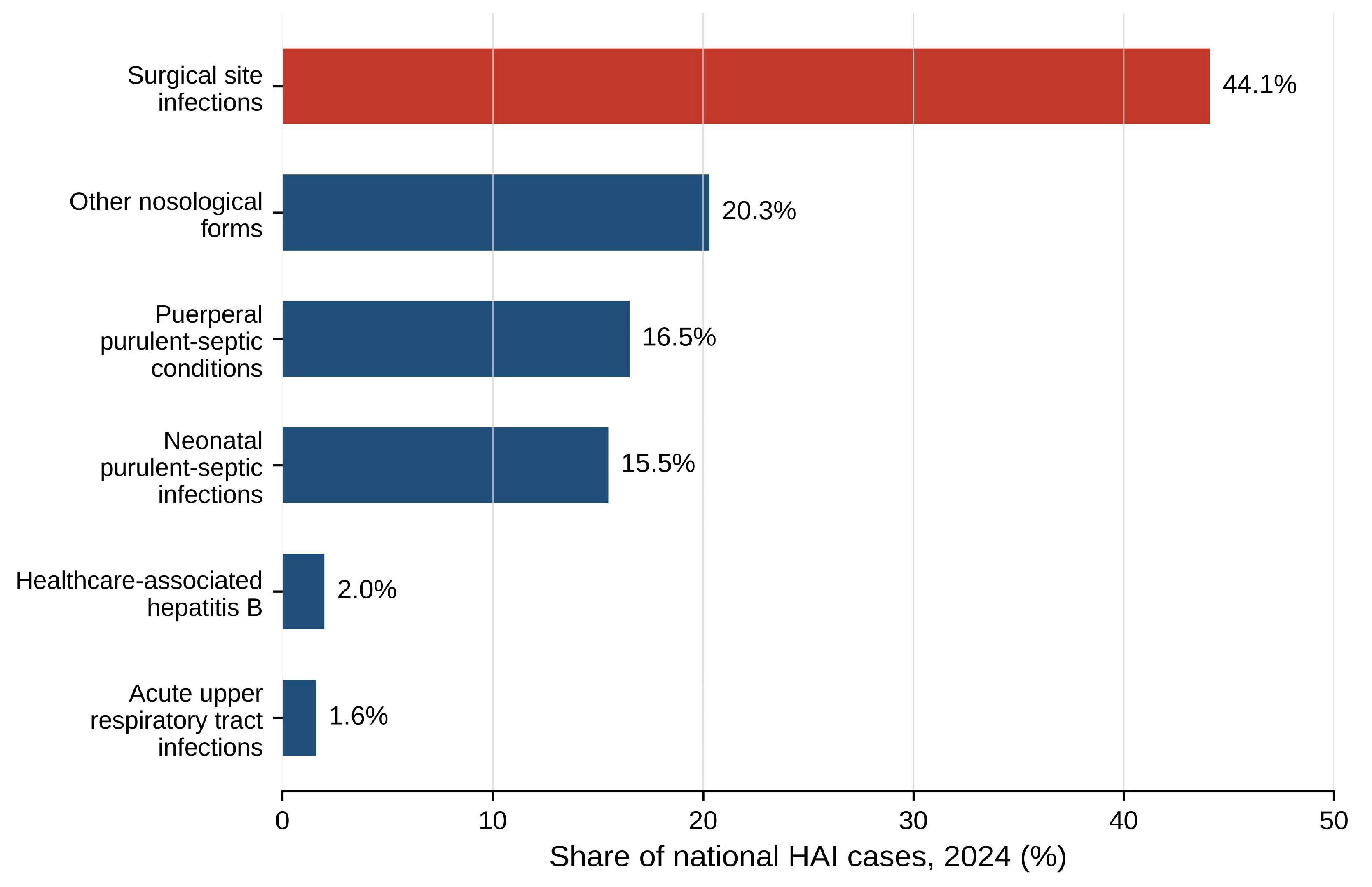
Figure 4.
Radar plot of alignment between the Uzbek regulatory framework and the eight WHO Core Components (CC1–CC8; Table 4), classified using the decision algorithm in Supplementary Table S3. The three ordinal categories (weak, partial, full) are mapped onto axis positions 1, 2, and 3 purely to enable visual plotting; the resulting shape is a qualitative summary, not a quantitative composite score, and distances between categories on each axis are not numerically equivalent across Core Components.
Figure 4.
Radar plot of alignment between the Uzbek regulatory framework and the eight WHO Core Components (CC1–CC8; Table 4), classified using the decision algorithm in Supplementary Table S3. The three ordinal categories (weak, partial, full) are mapped onto axis positions 1, 2, and 3 purely to enable visual plotting; the resulting shape is a qualitative summary, not a quantitative composite score, and distances between categories on each axis are not numerically equivalent across Core Components.
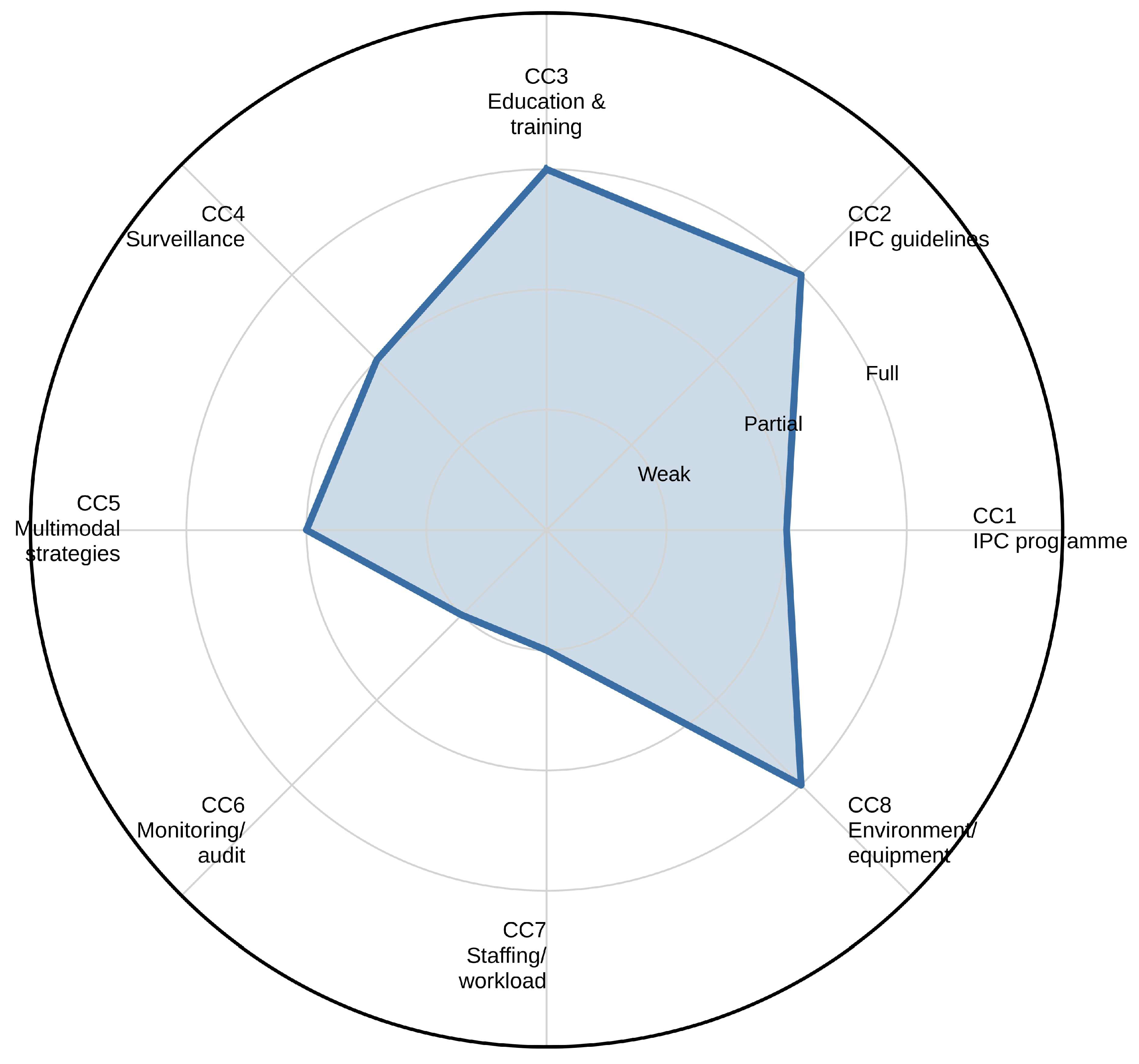

Table 1.
National healthcare-associated infection (HAI) incidence rate in Uzbekistan, 2015–2024 (per 100,000 population) [15].
Table 1.
National healthcare-associated infection (HAI) incidence rate in Uzbekistan, 2015–2024 (per 100,000 population) [15].
| Indicator | 2015 | 2016 | 2017 | 2018 | 2019 | 2020 | 2021 | 2022 | 2023 | 2024 |
| HAI rate per 100,000 | 3.95 | 3.40 | 3.64 | 3.20 | 3.09 | 1.00 | 2.19 | 2.49 | 2.46 | 2.16 |
Table 2.
Regional distribution of HAI cases, 2024.
| Region | Cases, n | Share, % |
| Tashkent city | 259 | 31.7 |
| Samarkand region | 74 | 9.1 |
| Andijan region | 65 | 8.0 |
| Surkhandarya region | 56 | 6.9 |
| Jizzakh region | 54 | 6.6 |
| Tashkent region | 49 | 6.0 |
| Republic of Karakalpakstan | 46 | 5.6 |
| Fergana region | 42 | 5.1 |
| Navoi region | 37 | 4.5 |
| Khorezm region | 36 | 4.4 |
| Kashkadarya region | 36 | 4.4 |
| Syrdarya region | 26 | 3.2 |
| Namangan region | 19 | 2.3 |
| Bukhara region | 18 | 2.2 |
| Total | 817 | 100.0 |
Table 3.
Nosological structure of HAIs, 2024.
| Nosological form | n | % |
| Surgical site infections | 360 | 44.1 |
| Puerperal purulent-septic conditions | 135 | 16.5 |
| Neonatal purulent-septic infections | 127 | 15.5 |
| Healthcare-associated hepatitis B | 16 | 2.0 |
| Acute upper respiratory tract infections | 13 | 1.6 |
| Other nosological forms | 166 | 20.3 |
| Total | 817 | 100.0 |
Table 4.
Comparative analysis of the Uzbek regulatory framework against WHO IPC Core Components.
| Component | WHO Core Component | Corresponding provision in the Uzbek regulatory framework | Alignment |
| CC1 | National and facility-level IPC programme | Mandatory hospital epidemiologist staffing only in facilities with >200 beds (programme-level provision; staffing is one of several CC1 elements, hence Partial rather than Weak) | Partial |
| CC2 | IPC guidelines | SanPiN No. 0342-17 | Full |
| CC3 | IPC education and training | Mandatory induction and periodic staff training with competency testing; Order No. 92 specifies a defined 12-topic, 36-hour curriculum (3 hours per topic) for physicians and mid-level medical staff, covering HAI epidemiology, infection control committee functioning, bloodborne/HIV-related infections, surgical and obstetric services, paediatric and intensive care units, hand hygiene, and disinfection/sterilisation [17]. | Full |
| CC4 | HAI surveillance | Paper-based emergency notification form (F.085/U); ICD-10 coding | Partial |
| CC5 | Multimodal strategies | Disinfection, sterilisation, hand hygiene, and isolation addressed in separate chapters | Partial |
| CC6 | Monitoring/audit and feedback | Infection-control committee meets at least quarterly; Order No. 92 additionally permits extraordinary (out-of-schedule) meetings depending on the epidemiological situation in the facility [17]. | Weak |
| CC7 | Workload, staffing, bed occupancy | Epidemiologist mandatory only in facilities with >200 beds; no facility-wide nurse staffing or bed-occupancy standard (the same threshold provision is here the entire CC7 response, hence Weak rather than Partial) | Weak |
| CC8 | Built environment, materials, equipment | Detailed disinfection/sterilisation protocols; SanPiN No. 0317-15 classifies medical waste into 5 hazard classes (A–D) with colour-coding, packaging, and decontamination procedures | Full |
Table 5.
Summary of identified WHO Core Component gaps and corresponding prioritised recommendations.
Table 5.
Summary of identified WHO Core Component gaps and corresponding prioritised recommendations.
| WHO Core Component gap | Current status in Uzbekistan | Recommendation (priority) |
| CC4 – Surveillance (three-phase priority) | 1a. National incidence denominator only; no facility-level admissions, patient-days, device-days, or procedure denominators 1b. No active, criteria-based case-finding; passive notification (Form F.085/U) only, no sentinel-site model 1c. Paper-based notification; ICD-10 logbooks; no real-time electronic module in DMED |
Priority 1: standardise facility-level denominators (admissions, patient-days, surgical procedures, device-days, deliveries/neonatal admissions) Priority 2: pilot sentinel active surveillance in tertiary hospitals for SSI, CAUTI, CLABSI, VAP, and neonatal sepsis using CDC/NHSN- or ECDC-aligned definitions, before national scale-up Priority 3: dedicated HAI module within DMED flagging probable cases from microbiology results, antibiotic prescriptions, fever records, re-operation, prolonged stay, and readmission |
| CC1/CC7 – Staffing | Epidemiologist mandatory only above 200 beds; no facility-wide nurse staffing standard | Priority 4: extend mandatory IPC epidemiologist staffing beyond 200-bed threshold, with regional shared-epidemiologist teams for smaller facilities |
| CC6 – Monitoring/audit | Infection-control committees meet only quarterly; no mandated continuous, indicator-based monitoring | Priority 5: shift to monthly indicator-based audit-and-feedback cycles (hand hygiene compliance, SSI rate, sterilisation quality, antibiotic prophylaxis timing, device-associated infections) |
| CC5 – Multimodal strategies (SSI bundle) | Hand hygiene, disinfection, sterilisation, and isolation addressed in separate regulatory chapters; SSIs account for 44.1% of registered HAIs | Priority 6: national SSI prevention bundle (preoperative bathing, hair removal, skin antisepsis, surgical hand preparation, antibiotic prophylaxis timing, sterilisation assurance, operating-room discipline) |
| Surveillance methodology – IPCAF | No standardised facility-level IPC implementation assessment to date; alignment classification is document-based only | Priority 7: national IPCAF-based facility assessment to move from document-based alignment to measurable, internationally benchmarked implementation scoring |
Disclaimer/Publisher’s Note: The statements, opinions and data contained in all publications are solely those of the individual author(s) and contributor(s) and not of MDPI and/or the editor(s). MDPI and/or the editor(s) disclaim responsibility for any injury to people or property resulting from any ideas, methods, instructions or products referred to in the content. |
© 2026 by the authors. Licensee MDPI, Basel, Switzerland. This article is an open access article distributed under the terms and conditions of the Creative Commons Attribution (CC BY) license (http://creativecommons.org/licenses/by/4.0/).
Copyright: This open access article is published under a Creative Commons CC BY 4.0 license, which permit the free download, distribution, and reuse, provided that the author and preprint are cited in any reuse.


