

Submitted:
06 July 2026
Posted:
07 July 2026
You are already at the latest version
Abstract
A recurrent challenge in scaling ultra-wideband (UWB) motion-capture systems is interference management whenmanyranging transactions coexist in time and space. To address this, we study a two-layer localization architecture that separates field-level player localization from local on-body pose tracking, allowing the two tasks to operate with different communication regimes and spatial-reuse policies. A stochastic-geometry framework is used to map sport-dependent parameters, including player density, field size, tag count, anchor count, update rates, and ranging airtime, to reliability and update-rate tradeoffs. The analytical model is parametrized based on controlled experiments that characterize ranging success under temporal overlap, player distance, and variable-delay scheduling, which we use to design a proximity-aware local coordination strategy. We apply our proposed approach to soccer, volleyball, and ice hockey as representative use cases. Our results show that proximity-aware coordination can provide a scalable and lightweight interference management mechanism. Coordination is activated only where local player clustering creates strong interference, while spatially separated players continue to share resources without coordination. For the highest density scenario tested, this increases the local-layer ranging success from below 50% without coordination to over 80% in fourand eight-player congestion clusters, while avoiding network-wide coordination overhead.
Keywords:
ultra-wideband (UWB)
; wearable localization
; scalability
; stochastic geometry
; spatial reuse
; proximity-aware coordination
1. Introduction
Wearable localization is increasingly used in human motion analysis, with sport-performance optimization emerging a challenging application. Ultra-wideband (UWB) is particularly suitable for these applications because it enables accurate ranging in indoor and body-centric environments [1,2,3,4,5,6,7]. However, as deployments become denser, scalability becomes increasingly constrained by the complexity of managing the interference among many double-sided two-way ranging (DS-TWR) transactions coexisting in time and space.
As the number of nodes increases, repeated ranging exchanges and contention reduce the update rates that can be attained, when a target reliability must be ensured. Existing approaches address this issue through scheduling, protocol design, or platform-level optimizations [8,9,10,11,12]. These solutions are typically studied in single-layer localization networks, where all ranging interactions are treated as part of the same access problem. This view is limiting for wearable motion-capture systems, where different localization tasks operate at different spatial scales.
A key observation is that sport-oriented wearable localization naturally separates into two layers. Field-level player localization requires infrastructure coverage and moderate refresh rates, typically with only one globally visible tag per player. In contrast, on-body pose estimation requires several body-worn tags and higher-rate ranging over much shorter distances, as the relevant links are confined to the body of the same player. This creates two different interference problems. At the global layer, all player tags may contribute to the field-wide interference environment. At the local layer, interference is mainly relevant between players that are physically close, because spatially separated players can reuse the same radio resources with limited mutual impact.
Figure 1 illustrates the local-layer interference scenario. Each player wears several tags used for on-body ranging. Players that are sufficiently separated can operate their local (i.e., on-body) ranging networks independently, while nearby players create overlapping local interference regions and may require temporary coordination. Treating both layers as one flat ranging network would ignore this spatial structure, leading either to excessive interference under uncoordinated access or to overly conservative network-wide scheduling and higher management overhead. A two-layer architecture instead can enable spatial reuse in the local layer while reserving coordination for the cases where player proximity makes it necessary.
This paper studies such a two-layer UWB localization architecture that separates global player localization from local on-body pose tracking. We use stochastic geometry to map sport-specific and system-level parameters, including player density, field size, tag count, anchor count, update rates, and ranging airtime, to an interference scenario from which insights into reliability and its tradeoff with update rate can be extracted. The resulting analytical framework is applied to the analysis of soccer, volleyball, and ice hockey as representative use cases. Controlled experiments are used to characterize the coexistence mechanisms that underlie the model, in particular temporal-overlap sensitivity, distance-dependent interference, and uncoordinated-delayed transmissions. These experiments bridge the gap between approximations in our model and real implementations.
Our main contributions can be summarized as:
- A two-layer UWB localization architecture that separates global player localization from local on-body pose tracking, enabling lightweight interference management and better scalability.
- A stochastic-geometry framework that maps sport and system parameters to system design tradeoffs and assesses the associated operation regimes.
- A proximity-aware coordination strategy for local congestion regions that adapts spatial reuse to sport-specific clustering, simplifying network-wide coordination.
- Experimental validation of the proposed architecture, identifying vulnerable overlap regions and providing practical reuse evaluation.
The remainder of the paper is organized as follows. Section 2 introduces the two-layer architecture and sport scenarios considered throughout the paper. Section 3 describes the experimental platform used to parameterize the analytical model. Section 4 and Section 5 develop the stochastic-geometry network model and analyze scalability tradeoffs. Section 6 introduces the proposed proximity-aware coordination and validates it experimentally. Section 7 discusses the overall design implications, Section 8 positions the work with respect to prior research, and Section 9 concludes the paper.
2. System Architecture and Problem Statement
We consider a wearable localization system where multiple players, each wearing several UWB sensors, are simultaneously tracked within a shared field. Localization is separated into two communication layers, as illustrated in Figure 2, reflecting the different spatial scales and update-rate requirements of player tracking and pose estimation. The global layer provides field-level player localization: one globally visible tag per player ranges to infrastructure anchors in order to estimate the player position, requiring coverage over the full field. In contrast, the local layer supports player pose tracking through short-distance ranging among the tags worn by the same player. Although this requires several tags per player and higher local ranging activity, the relevant links are mostly confined to the body. Hence, the local layer can operate with lower transmit power and a smaller interference footprint than the global layer.
The smaller interference footprint of the local layer can be harnessed to improve the system scalability. The global layer scales primarily with the number of players and anchors, whereas the local layer scales with the number of body-worn tags per player but remains spatially confined. This creates the spatial-reuse opportunity that is the focus of this paper: radio resources can be reused independently across sufficiently separated players, while additional coordination is only required for nearby players.
To make the discussion concrete, we consider three representative sport scenarios: soccer, volleyball, and ice hockey, whose deployment characteristics are summarized in Table 1, following FIFA, FIVB, and IIHF regulations, respectively. They differ substantially in field size and number of players (i.e., player density), and expected motion dynamics. Soccer represents a large-area, low-density deployment, where accurate player location tracking with full field coverage is the dominant challenge. Clustering of players requiring local coordination is limited. Volleyball represents a smaller-area, high-density deployment, where short inter-player distances and fast pose changes make local-layer coordination critical. Finally, ice hockey represents a moderate-density deployment, where rapid skating motion and the associated pose-update rate is the main challenge.
These example sports illustrate how the relevant design parameters cannot be chosen independently or freely. The number of players and the deployment area are imposed by the sport, while the required global and local update rates depend on the motion dynamics to be captured. The number of body-worn sensors depends on the desired pose resolution. The following sections formalize these constraints and analyze how the two-layer architecture scales as these parameters vary.
For easy reference, Table 2 summarizes the main system-level parameters used throughout the paper. These parameters connect the architecture in Figure 2 and the sport scenarios in Table 1 to the stochastic-geometry model introduced in Section 4. The number of players , the field area , and the sport-dependent update-rate requirements define the deployment load. The number of anchors and body-worn tags define the global and local ranging demand, respectively, while the airtimes and transmit powers capture the main implementation and physical-dependent design choices.
3. Experimental Setup and Scenario Characterization
The stochastic-geometry model in the following sections requires hardware-dependent parameter values that cannot be set arbitrarily, as results are sensitive to them. In particular the DS-TWR transaction airtime and the transmit-power settings that describe how the local and global layers operate. This section therefore describes the experimental platform, provides specific values for , , , and , and explains how these are used in the analytical framework.
All experiments were conducted using DWM3001CDK development boards based on the Qorvo DW3110 UWB transceiver [13]. The UWB PHY was configured for IEEE 802.15.4z [14] HRP-UWB on channel 5, with center frequency 6489.6 MHz, 499.2 MHz bandwidth, 64 MHz BPRF, and a 6.8 Mbit/s data rate. The varied parameters are the preamble length and the DW3110 transmit-power configuration. Each node runs custom firmware implementing DS-TWR ranging with configurable timeouts and a suitable local and global update schedule.
3.1. Measurement Setup and Data Collection
The calibration setup is shown in Figure 3. It consists of a LEADER node and two ranging nodes mounted on opposing rails held by cobots. The left node acts as DS-TWR initiator and the one on the right acts as responder. Both operate on the same personal area network (PAN). The LEADER periodically triggers the ranging transaction, collects condensed ranging reports and timing diagnostics, and forwards the data to a host PC for post-processing in Python. The separation d between initiator and responder is varied using the available cobots for better reproducibility.
This setup provides a controlled way to measure the DS-TWR airtime associated with different preamble length configurations. It also characterizes the ranging success probability as a function of distance, preamble length, and transmit power, needed to determine which PHY settings are used for the local and global layers.
3.2. Ranging Airtime and Operating-Point Selection
A DS-TWR transaction consists of three frames: POLL, RESP, and FINAL. The total ranging airtime is therefore the time required to exchange the three frames and depends strongly on preamble length. Direct timing measurements on the platform give the following ranging airtimes for preamble lengths 32 and 1024 symbols:
Thus, moving from a 32-symbol to a 1024-symbol preamble increases the DS-TWR airtime by a factor of approximately . For the local layer, where many pairwise ranges must be updated at high rate, short preambles are preferable provided that the required link distance can be reliably reached, understanding by reliablility, the meeting of a given ranging success probability target.
Table 3 reports the measured DS-TWR success probability for short-range links. Each operating point aggregates 5000 ranging exchanges. At the baseline local-power setting ( dB relative to maximum output), the 32-symbol configuration is reliable up to about 60 cm but degrades sharply at 70 cm. Increasing the preamble length to 1024 symbols improves the link margin, but at the cost of the 3.5 times longer airtime. Alternatively, raising the transmit power to ( dB) preserves the short airtime and gives 97% success at 70 cm and 90% at 80 cm.
For the local layer, the selected operating point is therefore the 32-symbol preamble with the elevated local-power configuration . This preserves the short ranging airtime
while supporting the intended body-scale ranging distances. In the analytical model, this operating point defines the local-layer airtime and transmit power. For notational simplicity, the selected local-layer power is denoted by in the following sections.
The global layer has a different requirement: player tags must range to infrastructure anchors over substantially larger distances, and the number of global tags is only one per player. Longer airtime is therefore acceptable if it provides the required link margin. To characterize this regime, Table 4 reports measurements at an elevated transmit-power configuration over distances from one to 20 m. The measurements are averaged over 5000 DS-TWR exchanges.
The long-range measurements show that transmit-power increase alone is insufficient to support the global-layer distance scale with a short preamble. Both preamble lengths are reliable up to 5 m, but at 10–15 m the 32-symbol configuration collapses to 0–6%, while the 1024-symbol configuration remains at 97–99%. The global layer is therefore represented in the model by the long-preamble operating point
together with the elevated transmit-power setting denoted by (maximum output power).
The calibrated operating points used in the analytical model are thus: a short-airtime local layer with s and selected local transmit power , and a longer-range global layer with s and transmit power . These values are used in the activity probabilities and interference terms of the stochastic-geometry model in Section 4.
4. Stochastic-Geometry Network Model
Using the characterization from Section 3, we now turn to the stochastic-geometry model used to analyze the scalability of the two-layer architecture. We first define the spatial distribution of players and body-worn tags, then translate update rates and ranging airtimes into global and local activity probabilities, and finally decompose the resulting interference in order to derive ranging success probabilities and expressions for the main physical interference mechanisms.
Spatial model: Player locations are modeled as a homogeneous Poisson point process (PPP) with density , representing the spatial density of players. Although the actual sport field is finite and contains a deterministic number of players, the PPP model provides an analytically tractable approximation for spatial snapshots of player configurations. For a field of area containing players, the corresponding player density is
which allows to relate to finite player numbers.
Each player forms a wearable sensor cluster. The cluster center is given by the player location , and each cluster contains body-worn tags in total. In our notation, includes the globally tracked tag; hence the number of purely local tags is . The relative displacement of tag i with respect to the player x center is denoted by , with density . Unless otherwise stated, the displacements are assumed independent and identically distributed for all players, with , resulting in a Thomas-type cluster process [15,16]. The number of tags per cluster is deterministic and equal to , reflecting the actual system design.
The set of body-worn tags associated with player x is therefore
Traffic model: The global and local layers operate in the same radio channel. Global-layer ranging uses transmit power , while local-layer ranging uses a lower transmit power .
A global position update requires the globally tracked tag to range with anchors at update rate . If each global ranging occupies an airtime , the global-layer activity probability of a player is approximated as
For the local layer, pose estimation requires all pairwise distances between the body-worn tags to be updated. The number of required local ranging transactions per pose update is
For a local update rate and local ranging airtime , the local-layer activity load per cluster is
The condition
is therefore a basic airtime feasibility constraint for completing one local pose update within the available update period. For example, increasing from 4 to 8 increases from 6 to 28, i.e., by a factor of , showing how quickly local airtime demand grows with pose granularity.
Channel model: Channel fading is assumed Rayleigh with independent unit-mean exponential gains . Signal attenuation at distance r follows the power-law model , with path-loss exponent . Thermal noise can be included, but the dense co-channel operation considered here is interference-limited; hence, the main analysis is expressed in terms of SIR.
Interference model: The total interference experienced by a receiver is decomposed into three components:
where denotes interference from active global-layer transmissions, denotes local-layer interference generated by other tags within the same player cluster, and denotes local-layer interference generated by tags belonging to other player clusters.
The global interference is
where indicates whether the global tag of player x is active, and denotes the displacement of the globally tracked tag relative to the player center.
For a typical local receiver in the cluster centered at the origin, the intra-cluster local interference is
where and denote the desired local transmitter and receiver, respectively, and indicates whether another local tag in the same cluster is simultaneously active. If local ranging within a player is deterministically scheduled, then for all , and .
Finally, the inter-cluster local interference is
where denotes the activity of local tag u in cluster x.
This decomposition separates the main physical interference mechanisms of the two-layer architecture: high-power global ranging, local interference within the same player, and local interference from nearby players.
4.1. Ranging Success Probability
We evaluate performance from the perspective of a typical receiver under the Palm distribution of the corresponding point process [15]. A ranging transaction is considered successful if the received SIR exceeds a threshold . For a desired transmitter located at distance r from the receiver, the instantaneous SIR is
where depending on whether the considered link belongs to the global or local layer.
Under Rayleigh fading, the ranging success probability is
where is the Laplace transform of the aggregate interference.
In this work, a ranging operation is modeled as a single airtime-consuming transaction of duration or . Therefore, unlike a packet-level model of double-sided two-way ranging that explicitly evaluates the success of each individual message, the success probability in (15) directly represents the success probability of a ranging transaction. The duration of the transaction enters the model through the activity probabilities and in (6) and (8).
For local ranging, the shorter airtime is achieved by using a shorter preamble configuration. This reduces channel occupancy but may also reduce the baseline ranging reliability, as packet synchronization becomes harder. We account for this effect through an empirical reliability factor , obtained from Table 3, such that
For the reference, longest-preamble configuration , we set .
Similarly, for global ranging,
where local-layer transmissions from all wearable clusters contribute to . Intra-cluster interference is not defined for the global receiver when the receiver is an anchor.
4.2. Laplace Transforms of the Interference Components
The global tags form an independently thinned version of the parent process, with activity probability . Approximating the displacement of the global tag from the player center as negligible compared with global anchor distances, the global interference field is a PPP with density . Its Laplace transform is the standard PPP expression [15]
For inter-cluster local interference, each player cluster contributes a finite number of possible local interferers. Assuming independent local activity with probability per tag, the Laplace transform is
where
Here v denotes the distance from the interfering player center to the typical receiver. The exponent appears because each cluster contains a deterministic number of tags. The per-tag local activity probability can be related to the cluster-level local load by
since each local ranging transaction activates one transmitter and one receiver pair, and each tag participates in approximately pairwise distances per pose update. If only transmitting tags are counted as interferers, a conservative alternative is to use .
For the intra-cluster interference term in the uncoordinated local case, conditioned on the relative positions of the tags in the typical cluster, the Laplace transform is
For scheduled local ranging within the player, intra-cluster interference is eliminated and
5. Interference Analysis and Scaling Limits
Scalability is evaluated in terms of the ranging success probability obtained from the model parameters , , , , , , , , , which combine sport-dependent deployment choices with the hardware operating points characterized in Section 3.
The maximum supported player density for a target ranging reliability is defined as
The corresponding maximum number of players in a finite field is then
Similarly, for a fixed player density, the maximum local update rate is obtained from
subject to the airtime feasibility constraint in (9).
5.1. Local Layer Analysis
For local-layer performance, we consider a typical player cluster and condition on one desired transmitter–receiver pair within that cluster. The desired local ranging distance is denoted by . The local success probability is given by (16).
Two local access modes are considered. In the uncoordinated mode, multiple body-worn tags within the same player may initiate ranging transactions independently, giving rise to intra-cluster interference according to (22). In the scheduled mode, local ranging transactions inside the same player are deterministically coordinated, so that only one local transaction is active within the cluster at a time. In this case, intra-cluster interference is removed and the local success probability becomes
Table 5 is computed from (16) using (18), (19), and either (22) (ALOHA) or (23) (coordinated). Four cases are compared at Hz and anchors: coordinated versus ALOHA intra-cluster access, each evaluated with and without global interference . Columns report soccer, ice hockey, and volleyball using the densities in Table 1. The results show a pronounced gap between coordinated and ALOHA operation: intra-cluster coordination delivers a gain in in all three sport regimes. This coordination-to-ALOHA ratio is essentially sport-independent because it is set by the cluster geometry through , not by inter-player density. The with/without- gap remains smaller than the coordination gain in all three scenarios, confirming intra-cluster coordination as the dominant scalability lever at this operating point. Volleyball remains the most challenging due to high player and anchor density.
Figure 4 evaluates (16) over for two representative sports from Table 1: soccer ( on a m2 field) and ice hockey ( on a m2 rink), with coordinated intra-cluster access. The red frontier marks , separating airtime-feasible designs from infeasible ones. Within the feasible region, varies only marginally (soccer: ; ice hockey: –). This flatness arises because global interference does not depend on at fixed and , while inter-cluster local interference scales with and is therefore capped by the player density inside the feasible set. The dominant trade-off exposed by the figure is therefore whether a full local pose update can be completed within one period, rather than large reliability gradients across feasible configurations. We do not include a volleyball panel in this figure because the much higher player density shifts most of the sweep into low-reliability regimes; volleyball is analyzed explicitly in Section 6 with focus on proximity-aware coordination.
5.2. Global Layer Analysis
For global-layer performance, we consider a typical global ranging link between a player tag and an infrastructure anchor at distance . The desired transmitter uses power , while interference is generated by active global tags and by local-layer transmissions occurring simultaneously in the wearable network. The global success probability is
Increasing or increases the global-layer activity probability in (6), and therefore increases the global interference term. Increasing or increases the local-layer activity load in (8), and therefore increases the local interference seen by both global and local ranging links. Figure 5 evaluates (16) over for soccer and ice hockey, with coordinated intra-cluster access, fixed , and Hz. The red frontier marks , separating feasible global designs from infeasible ones. Within the feasible region, decreases as either or increases (soccer: –; ice hockey: –), reflecting the stronger global interference load at higher anchor counts and refresh rates. The dominant trade-off is therefore twofold: first, whether a full global position update can be completed within one period; second, how much global-layer activity the chosen parameters inject into the shared channel.
6. Scaling via Proximity-Aware Local Coordination
The previous section quantified scalability limits under increasing player density, update rates, and body-worn sensor counts. Architectural separation between global and local ranging already reduces interference, but dense sport scenarios still require additional coexistence mechanisms.
One standard option is to exploit PHY diversity, for example by distributing local ranging transactions across quasi-orthogonal preamble codes. If preamble codes are available and transactions are uniformly assigned to them, the effective density of simultaneous local interferers is approximately thinned as . This approach can reduce aggregate interference and can be combined with the method proposed here. However, because PHY diversity is a standard interference-thinning mechanism and is constrained in practice by code availability, synchronization robustness, and receiver complexity, it is not analyzed further.
Our approach is to use the approximate player positions already provided by the global localization layer to drive local medium-access coordination. The key idea is to introduce temporal separation only where it is physically needed: between players that are close enough for their local ranging transactions to create strong mutual interference. The inter-player distances
between players i and j are therefore available without adding a separate sensing or discovery mechanism.
Instead of enforcing complete network-wide TDMA scheduling, local coordination is activated only when players become closer than a predefined proximity threshold . Players satisfying
are temporarily assigned to different local coordination slots, so that the strongest local interferers are separated in time. Players outside such congestion regions remain uncoordinated and continue to reuse the same local ranging resources. This avoids the main drawback of network-wide TDMA: fixed temporal separation among all players, including pairs that are already sufficiently separated in space and therefore do not need coordination.
If coordination slots are used within a local congestion region, the effective local refresh rate for the coordinated players becomes
Thus, increasing reduces the probability of harmful temporal overlap within a congestion region and improves ranging reliability, but it also lowers the effective pose refresh rate of the players participating in that local coordination group. The scalability advantage comes from applying this rate penalty only locally, instead of imposing it on the complete deployment.
To quantify this tradeoff, we use a bounded-cluster coordination model built on the same Laplace-form success expression used in the previous section:
with under coordinated intra-player operation. The global term is kept as in the earlier analysis. The inter-player local intensity is then reduced only inside the coordinated congestion region, which we model through the slot-dependent effective intensity
where K is the local congestion cluster size. The resulting proximity-aware coordination procedure is summarized in Algorithm 1.
| Algorithm 1 Proximity-aware local coordination. The global layer provides approximate player positions, which are used to identify nearby players requiring temporal separation. |
|
Figure 6 evaluates the reliability–rate tradeoff of proximity-aware coordination for volleyball, the highest density scenario considered in this work. We consider local congestion clusters of size and two anchor deployments, . The left panel shows how the local-layer success probability changes with the number of coordination slots , while the right panel expresses the same operating points in terms of the effective local update rate .
Without inter-player coordination (), the local-layer success probability is only about –, depending on K and . For a four-player congestion cluster, using slots raises to approximately for and for , corresponding to an absolute gain of about 34–39 percentage points, or a relative improvement of roughly – times. This is obtained while retaining an effective local update rate of Hz for the coordinated players.
Larger congestion clusters require more slots to reach the same reliability. For , restores the same high-reliability regime, with –, but the effective local update rate decreases to Hz, below the specification in Table 1. For , the evaluated range up to still improves reliability to approximately –, but does not fully reach the four- and eight-player plateau. Thus, proximity-aware coordination provides a scalable compromise: it applies TDMA-like temporal separation only inside local congestion regions, where the reliability gain is largest, while spatially separated players continue to reuse the same local ranging resources without paying the penalty of a network-wide TDMA.
6.1. Experimental Validation of Proximity-Aware Coordination
The purpose of the following experiments is to test if the main insights of our analytical framework also appear in a small, finite-node implementation with real DS-TWR timing, receiver behavior, and protocol abort conditions. In particular, we evaluate whether a lightweight coordination action is enough to restore reliable ranging for two nearby players, each equipped with an initiator and a responder node.
The global layer is represented by a LEADER node that periodically broadcasts the start of the pose update routine to both players via a TRIGGER message. The two players have already been identified as belonging to the coordinated cluster. The experiment does not implement the full proximity-graph construction of Algorithm 1; instead, it validates the corresponding coordination action. Extension to larger components and mixed coordinated/uncoordinated populations is left to future work.
The two-network setup shown in Figure 7 isolates the distance-dependent coexistence problem that motivates proximity-aware coordination. The LEADER at the center of the setup broadcasts TRIGGER messages consumed by both PANs A and B. PAN A occupies the right rail: its initiator is placed at the outer edge of the rail and its responder at the rail midpoint. PAN B occupies the left rail in a mirror-flipped arrangement, with its initiator at the rail midpoint and its responder at the outer edge. The inter-network distance is defined as the gap between the two innermost cross-PAN nodes, namely the responder of PAN A and the initiator of PAN B. This distance is swept by translating both rails via the cobots. When is small, the players are in the congestion region and temporal separation should be coordinated. When is sufficiently large, the two networks can operate independently. Results are averaged over 5000 DS-TWR rounds per operating point.
We compare a baseline when players operate independently regardless of the distance between them, and a coordinated regime where the proximity-aware coordination is implemented as a temporal delay between the start of the pose update routine of the second player (PAN B) at each round, with the first player (PAN A) starting its round immediately after the TRIGGER. The delay for PAN B is drawn independently in each round from a clipped Gaussian distribution, emulating lightweight pairwise coordination with timing uncertainty rather than perfectly synchronized network-wide TDMA. Two settings are tested: a tight-guard configuration with delays clipped to ms and mean ms, and a wider-guard configuration with delays clipped to ms and mean ms. Both use ms and fit within the 45 ms round period.
The delay windows are chosen relative to the measured duration of a 32-symbol preamble DS-TWR round. Thus, the tight-guard setting (, ) leaves only a narrow margin above the round duration, whereas the wider-guard setting (, ) provides additional tolerance for implementation-level timing uncertainty. In the uncoordinated regime, is swept from 40 cm to 140 cm to identify the distance beyond which explicit coordination is not necessary.
Table 6 reports the resulting success rates. For each round, the firmware classifies the DS-TWR outcome on each PAN as ok, intf, or to. An ok outcome means that the full DS-TWR exchange was completed. An intf outcome means that a frame with a mismatched PAN identifier was decoded inside an expected receive window. A to outcome means that no decodable frame was received. The throughput reported in Table 6 is the fraction of ok outcomes among all attempts.
Table 6 provides a key validation of the coordination principle. If reliability is defined as a DS-TWR success probability above 90%, the uncoordinated networks are not jointly reliable until cm. At 40 cm, the two networks almost completely collapse, with success of only 2% and 8%. At 80 cm, PAN A reaches 89%, but PAN B remains at only 21%, so ranging remains unreliable. Even at 120 cm, PAN B reaches only 72%. In contrast, with the more relaxed coordinated delay, both players reach 99% throughput already at cm. Thus, the experiment shows that temporal separation is essential in close proximity, and that a lightweight pairwise delay is sufficient to restore near-isolated ranging performance.
The coordinated rows demonstrate the practical effect of the proposed mechanism. The tight coordination already improves the 40 cm case from 2%/8% to 97%/84%, confirming that separating the two local rounds in time removes most cross-PAN interference. The coordination with larger guard interval (last row), reaches 99% for both. This confirms that the local delay must include sufficient guard time for implementation-level timing uncertainty. This requirement is compatible with the analytical coordination model: the model captures the benefit of separating nearby local transmissions, while the experiment identifies the timing margin needed to realize this separation on the hardware platform.
Remark on interference range and ranging range: The single-network measurements of Table 3 showed that DS-TWR ranging at with a 32-symbol preamble is reliable only up to approximately 60 cm and already degrades strongly between 60 and 80 cm. However, Table 6 shows that another local network can still disturb ranging at larger separations as shown in Table 7. The asymmetric degradation remains visible up to 120 cm. This is consistent with the fact that a successful DS-TWR exchange requires three consecutive frames to be received correctly and within their timing windows, whereas interference involves the reception or partial reception of a single frame.
Remark on asymmetry between players: The strong asymmetry between PAN A and PAN B in the uncoordinated regime is not related to our analytical model, but to the concrete ranging updates implementation used in the experiment. To maintain high update rates, the firmware uses tight receive windows and aborts ranging attempt when the expected POLL is not received, or when a frame from the wrong PAN is received. Since PAN A starts slightly earlier in the tests, when PAN B receives PAN A’s POLL, it aborts its ranging. PAN A can complete the ranging more often, while PAN B accumulates more intf and to outcomes. This asymmetry explains the intermediate-distance behavior of the table without changing the main conclusion: uncoordinated operation is not reliable when the local networks are within mutual interference range.
Overall, our hardware validation confirms that the stochastic-geometry insights remain valid in a finite-node implementation.
6.2. Proof-of-Concept Test with Two 5-Sensor Players
This final experiment populates each player network with five body-worn sensors, so that every ranging round contains a sequence of intra-PAN DS-TWR exchanges. Each player is equipped with five sensors as shown in Figure 8, so that links span the actual body-scale distances. The two players are again placed at cm, the worst-case proximity condition, and the coordination setup is otherwise unchanged.
The nominal duration of a five-sensor local round is approximately ms, but the effective duration on the tested platform is close to 15 ms once inter-frame gaps and firmware-level bookkeeping between successive exchanges are taken into account. The clipped-Gaussian inter-PAN delay of PAN B is widened accordingly to ms, clamped to ms. This window is chosen such that PAN B starts its own four-exchange sequence only after PAN A’s round is expected to have terminated, while the total delay still fits within the 45 ms round period.
Table 8 presents the experiment outcome breakdown. PAN A and B reach a success rate of 99.8%, and 98.4%, respectively. Interference-labeled outcomes (intf) remain in the low tens on both PANs, showing that the coordinated inter-PAN delay effectively suppresses cross-PAN frame decoding inside expected receive windows even when four intra-PAN exchanges are chained per round. The proof-of-concept confirms that the lightweight coordination proposed scales to a realistic five-sensor-per-player configuration. Aggregated over all four sequential intra-PAN exchanges, both networks retain near-isolated ranging performance at the worst-case proximity distance of 40 cm, without any explicit intra-PAN scheduling beyond the fixed INITIATOR-driven order.
7. Discussion of Results
The results of this paper support a common design message: dense wearable UWB motion capture should not be treated as a single flat ranging network. Field-level player localization and on-body pose tracking operate at different spatial scales, require different update rates, and create different interference footprints. Separating them into global and local layers therefore changes the medium-access problem. The global layer is responsible for field-level observability, while the local layer carries the high-rate body-scale ranging load. This architectural separation makes spatial reuse meaningful: local ranging resources can be reused by players that are sufficiently separated, while only nearby players require additional coordination.
A second consequence is that the main scalability bottleneck is not the number of players alone, but the airtime load created by the desired pose resolution. At the local layer, the number of pairwise ranging transactions grows quadratically with the number of body-worn tags. The model therefore exposes a direct tradeoff between tag count, local update rate, and ranging airtime. This explains why sparse and moderate-density sports leave a larger design margin, whereas dense or fast-motion scenarios move the system closer to its reliability boundary. In this sense, the stochastic-geometry model is not only a predictor of success probability, but also a design tool for selecting feasible combinations of pose granularity and refresh rate.
The results also suggest a hierarchical coordination strategy. Coordination inside each player cluster is a platform-level requirement: the body-worn tags of one player should not contend independently if high local update rates are desired. This part of the design is largely independent of the sport scenario and can be implemented as a fixed local schedule. Coordination between players is different. It should depend on the current spatial configuration of the game, because only nearby players create strong local-layer interference. The proximity-aware strategy therefore avoids the main limitation of network-wide TDMA by applying a rate penalty only to players inside local congestion regions.
This point also clarifies the relation between the analytical and experimental parts of the paper. The stochastic-geometry framework describes average scaling behavior across sport-dependent densities and system parameters. The experiments validate the physical mechanisms on which the model relies: the existence of distance-dependent spatial reuse, the collapse of simultaneous local ranging in close proximity, and the recovery obtained by temporal separation. The experiments further show that the practical coordination threshold should be tied to the interference/reuse distance of the implemented DS-TWR system, not only to the nominal ranging distance of an isolated link.
Compared with conventional UWB scalability approaches based on flat scheduling, distributed TDMA, or PHY-level interference thinning, the proposed architecture exploits information that is already available in the localization system. The global layer supplies approximate player positions, and these positions are reused to decide where local-layer coordination is necessary. This provides a spatial decision layer above existing MAC or PHY mechanisms. Preamble-code diversity, channelization, or backbone-assisted scheduling can still be used as complementary tools, but the central result here is that coordination need not be applied uniformly across the full deployment.
The present treatment remains limited in several ways. The model uses average success probability and representative channel and cluster parameters; it does not yet describe the distribution of per-link reliability or the resulting localization accuracy. The experiments are static, line-of-sight measurements without body attenuation, player motion, or dynamic cluster formation. In addition, the proximity-aware coordination is experimentally validated only for the smallest congestion component, namely two nearby local networks. Larger coordinated components, mixed coordinated and uncoordinated populations, and full in-game validation remain future work.
8. Related Work
Prior work relevant to this manuscript can be grouped into three threads: (i) UWB tracking in sports and human motion analysis, (ii) UWB scalability and MAC/scheduling design, and (iii) stochastic-geometry modeling of dense interference-limited networks.
8.1. UWB Localization in Sports and Human Motion Analysis
[1,2,3] validate UWB tracking in sports and body-centric settings. [4] demonstrate field-level player tracking in ice hockey using a commercial local positioning system. [5] demonstrates IMU-based activity recognition combined with UWB positioning for ice-hockey analytics, while [6] presents a self-calibrating UWB localization workflow for sport applications. [7] combine sparse inertial sensors with UWB inter-sensor ranging for scalable full-body motion capture, directly motivating the on-body pose layer studied here.
More recent work has extended these results. [17] characterize the ranging performance and multi-user interference robustness of the updated IEEE 802.15.4z standard, providing an important link between protocol specification and measured behavior in realistic environments. The forthcoming IEEE 802.15.4ab amendment [14] further targets enhanced device density and ranging integrity through additional PHY and MAC enhancements, explicitly positioning UWB for the dense-deployment regime considered here. The survey by [18] reviews wearable sensor-based motion-capture technologies including UWB for sport science and identifies dense, dynamic deployments as an open challenge. [19] study end-to-end UWB TDOA deployment for mobile agents and show how sensor placement and system-level design interact.
These works establish feasibility and accuracy, but typically do not provide sport-aware scalability rules under dense coexistence.
8.2. UWB Scalability, MAC, Scheduling, and Multi-User Ranging
[8,9,10] show that MAC and scheduling dominate large-scale performance. Their results motivate explicit coexistence design, but mostly treat single-layer localization networks. [11,12] demonstrate hardware platforms with sub-GHz backbone links that partially offload MAC overhead from the UWB channel, a concept that is orthogonal but complementary to the two-layer separation proposed here.
Addressing the multi-user ranging problem more directly, [20] propose a UWB swarm ranging protocol for dynamic and dense networks that achieves simultaneous ranging and communication at high node densities. [9] develop a fully distributed TDMA algorithm for mobile UWB networks. Compared with that work, the proximity-aware strategy studied here avoids network-wide TDMA by activating slot coordination only among nearby players, reducing overhead in sparse to moderate regimes. [8] provides theoretical scalability models for UWB localization across MAC and PHY configurations that inform the update-rate bounds used in our model.
For the specific problem of anchor-dense deployments, [21] addresses large-scale multi-zone TDOA localization by combining cascaded wireless multi-hop clock synchronization with dynamic localization-zone selection, demonstrating continuous cross-room coverage in a multi-room testbed. [22] propose an adaptive channel-aware DL-TDOA scheme that adjusts ranging frequency dynamically based on non-Line-of-Sight conditions, reducing power consumption while maintaining accuracy.
These works largely treat homogeneous single-layer networks. The gap addressed by the present paper is the lack of a unified treatment that separates two qualitatively different ranging tasks and derives access rules from their different spatial and temporal scales.
8.3. Stochastic Geometry for Interference and Reliability
Foundational stochastic geometry tools and methodology are given by [15] and the tutorial of [23], while [16] analyzes interference and outage in clustered ad hoc networks using the Thomas cluster process, providing the Laplace-transform machinery that directly underlies our inter-cluster interference decomposition in Section 5. [24] extend this approach to heterogeneous networks in which users and small-cell base stations are co-clustered around shared hotspot centers via a Poisson cluster process, showing that within-cluster resource reuse improves throughput at the cost of coverage—a trade-off analogous to the densely co-located wearable tags considered here.
For body-centric settings, [25,26,27] apply related ideas to WBAN interference analysis, and the recent survey by [28] reviews interference-mitigation strategies in WBANs spanning classical signal-processing, cooperative, game-theoretic, and learning-based approaches. The inter-WBAN model of [25] in particular uses an extended Matérn point process to capture MAC-induced spatial correlations, a modeling choice we revisit and adapt with the Thomas cluster process for wearable tags.
The SIR meta distribution, introduced by [29] and extended by [30] to per-link reliability and rate control, and by [31] to Poisson cluster process based heterogeneous network models, provides a finer-grained performance view than the mean success probability used here. While the present paper focuses on the mean success probability as a tractable design metric, the meta-distribution framework would be a natural extension for characterizing the tail of link reliability.
Relative to these strands, the gap addressed in this paper is the lack of a unified, sport-aware framework that links: (a) a two-layer localization architecture, (b) Stochastic geometry-based design interpretation across sport regimes, and (c) controlled coexistence experiments validating temporal-overlap and distance-dependent reuse mechanisms.
9. Conclusions and Future Work
This paper studied the scalability of dense wearable UWB motion capture using a two-layer architecture that separates field-level player localization from local on-body pose ranging. The main result is that this separation turns the medium-access problem into a spatial-reuse problem. A stochastic-geometry model was used to connect sport-dependent parameters, body-worn tag count, update rates, ranging airtime, and transmit power to reliability tradeoffs. Controlled DS-TWR experiments then validated the key coexistence mechanisms behind the model: local ranging can be spatially reused when players are sufficiently separated, while nearby local networks require temporal coordination. Together, the analytical and experimental results show that proximity-aware coordination is a lightweight alternative to full network-wide synchronization, because it applies coordination only where player clustering makes it necessary.
Future work should extend the hardware validation from two nearby local networks to larger and dynamic components, including mixed coordinated and uncoordinated players. Further work is also needed to include body attenuation, player motion, non-line-of-sight effects, and localization accuracy in the performance framework. Finally, the empirical reliability factor used for different PHY and preamble configurations should be refined into a measured function of distance, body placement, and channel conditions, enabling the model to support deployment-level design choices more directly.
Abbreviations
The following abbreviations are used in this manuscript:
| UWB | Ultra-Wideband |
| DS-TWR | Double-Sided Two-Way Ranging |
| PPP | Poisson Point Process |
| PHY | Physical Layer |
| MAC | Medium Access Control |
| TDMA | Time-Division Multiple Access |
| SIR | Signal-to-Interference Ratio |
| PAN | Personal Area Network |
References
- Fleureau, A.; Lacome, M.; Buchheit, M.; Couturier, A.; Rabita, G. Validity of an ultra-wideband local positioning system to assess specific movements in handball. Biol. Sport 2020, 37, 351–357. [Google Scholar] [CrossRef] [PubMed]
- Blauberger, P.; Marzilger, R.; Lames, M. Validation of Player and Ball Tracking with a Local Positioning System. Sensors 2021, 21, 1465. [Google Scholar] [CrossRef] [PubMed]
- Ridolfi, M.; Vandermeeren, S.; Defraye, J.; Steendam, H.; Gerlo, J.; De Clercq, D.; Hoebeke, J.; De Poorter, E. Experimental Evaluation of UWB Indoor Positioning for Sport Postures. Sensors 2018, 18, 168. [Google Scholar] [CrossRef] [PubMed]
- Douglas, A.S.; Kennedy, C.R. Tracking In-Match Movement Demands Using Local Positioning System in World-Class Men’s Ice Hockey. J. Strength Cond. Res. 2020, 34, 639–646. [Google Scholar] [CrossRef] [PubMed]
- Vleugels, R.; Van Herbruggen, B.; Fontaine, J.; De Poorter, E. Ultra-Wideband Indoor Positioning and IMU-Based Activity Recognition for Ice Hockey Analytics. Sensors 2021, 21, 4650. [Google Scholar] [CrossRef] [PubMed]
- Piavanini, M.; Barbieri, L.; Brambilla, M.; Cerutti, M.; Ercoli, S.; Agili, A.; Nicoli, M. A Self-Calibrating Localization Solution for Sport Applications with UWB Technology. Sensors 2022, 22, 9363. [Google Scholar] [CrossRef] [PubMed]
- Armani, R.; Qian, C.; Jiang, J.; Holz, C. Ultra Inertial Poser: Scalable Motion Capture and Tracking from Sparse Inertial Sensors and Ultra-Wideband Ranging. In Proceedings of the Special Interest Group on Computer Graphics and Interactive Techniques Conference Conference Papers 24, Denver CO USA, 2024; pp. 1–11. [Google Scholar] [CrossRef]
- Ridolfi, M.; Van De Velde, S.; Steendam, H.; De Poorter, E. Analysis of the Scalability of UWB Indoor Localization Solutions for High User Densities. Sensors 2018, 18, 1875. [Google Scholar] [CrossRef] [PubMed]
- Cao, Y.; Chen, C.; St-Onge, D.; Beltrame, G. Distributed TDMA for Mobile UWB Network Localization. IEEE Internet Things J. 2021, 8, 13449–13464. [Google Scholar] [CrossRef]
- Charlier, M.; Koutsiamanis, R.A.; Quoitin, B. Scheduling UWB Ranging and Backbone Communications in a Pure Wireless Indoor Positioning System. IoT 2022, 3, 219–258. [Google Scholar] [CrossRef]
- Van Herbruggen, B.; Jooris, B.; Rossey, J.; Ridolfi, M.; Macoir, N.; Van Den Brande, Q.; Lemey, S.; De Poorter, E. Wi-PoS: A Low-Cost, Open Source Ultra-Wideband (UWB) Hardware Platform with Long Range Sub-GHz Backbone. Sensors 2019, 19, 1548. [Google Scholar] [CrossRef] [PubMed]
- Macoir, N.; Bauwens, J.; Jooris, B.; Van Herbruggen, B.; Rossey, J.; Hoebeke, J.; De Poorter, E. UWB Localization with Battery-Powered Wireless Backbone for Drone-Based Inventory Management. Sensors 2019, 19, 467. [Google Scholar] [CrossRef] [PubMed]
- Qorvo, Inc. DW3110 IEEE 802.15.4z Compliant UWB Transceiver IC – Datasheet. 2023, Rev. 1.1. [Google Scholar]
- IEEE 802.15 Working Group. IEEE Std 802.15.4z-2020; IEEE Standard for Low-Rate Wireless Networks–Amendment 1: Enhanced Ultra Wideband (UWB) Physical Layers (PHYs) and Associated Ranging Techniques, 2020. [CrossRef]
- Haenggi, M. Stochastic Geometry for Wireless Networks, 1 ed.; Cambridge University Press, 2012. [Google Scholar] [CrossRef]
- Ganti, R.K.; Haenggi, M. Interference and Outage in Clustered Wireless Ad Hoc Networks. IEEE Trans. Inf. Theory 2009, 55, 4067–4086. [Google Scholar] [CrossRef]
- Tiemann, J.; Friedrich, J.; Wietfeld, C. Experimental Evaluation of IEEE 802.15.4z UWB Ranging Performance under Interference. Sensors 2022, 22, 1643. [Google Scholar] [CrossRef] [PubMed]
- Suo, X.; Tang, W.; Li, Z. Motion Capture Technology in Sports Scenarios: A Survey. Sensors 2024, 24, 2947. [Google Scholar] [CrossRef] [PubMed]
- Zhao, W.; Goudar, A.; Tang, M.; Schoellig, A.P. Ultra-wideband Time Difference of Arrival Indoor Localization: From Sensor Placement to System Evaluation, 2024. 2. [CrossRef]
- Shan, F.; Huo, H.; Zeng, J.; Li, Z.; Wu, W.; Luo, J. Ultra-Wideband Swarm Ranging Protocol for Dynamic and Dense Networks. IEEE/ACM Trans. Netw. 2022, 30, 2834–2848. [Google Scholar] [CrossRef]
- Friedrich, J.; Tiemann, J.; Wietfeld, C. Accurate Multi-Zone UWB TDOA Localization utilizing Cascaded Wireless Clock Synchronization. In Proceedings of the 2021 International Conference on Indoor Positioning and Indoor Navigation (IPIN), Lloret de Mar, Spain, 2021; pp. 1–8. [Google Scholar] [CrossRef]
- Bhattacharya, S.; Choi, J.; Lee, J. Power-Efficient Indoor Localization Using Adaptive Channel-Aware Ultra-Wideband DL-TDOA. In Proceedings of the GLOBECOM 2023 - 2023 IEEE Global Communications Conference, Kuala Lumpur, Malaysia, 2023; pp. 7465–7470. [Google Scholar] [CrossRef]
- Haenggi, M.; Andrews, J.G.; Baccelli, F.; Dousse, O.; Franceschetti, M. Stochastic Geometry and Random Graphs for the Analysis and Design of Wireless Networks. IEEE J. Sel. Areas Commun. 2009, 27, 1029–1046. [Google Scholar] [CrossRef]
- Afshang, M.; Dhillon, H.S. Poisson Cluster Process Based Analysis of HetNets with Correlated User and Base Station Locations, 2017. arXiv [cs.IT. arXiv:1612.07285. [CrossRef]
- Sun, W.; Ge, Y.; Zhang, Z.; Wong, W.C. An Analysis Framework for Interuser Interference in IEEE 802.15.6 Body Sensor Networks: A Stochastic Geometry Approach. IEEE Trans. Veh. Technol. 2016, 65, 8567–8577. [Google Scholar] [CrossRef]
- Liu, R.; Wang, Y.; Shu, M.; Wu, S. Throughput assurance of wireless body area networks coexistence based on stochastic geometry. PLoS ONE 2017, 12, e0171123. [Google Scholar] [CrossRef] [PubMed]
- Balevi, E.; Gitlin, R.D. Stochastic geometry analysis of IEEE 802.15.6 UWB WBAN performance with game theoretical power management. In Proceedings of the 2018 IEEE 19th Wireless and Microwave Technology Conference (WAMICON), Sand Key, FL, 2018; pp. 1–5. [Google Scholar] [CrossRef]
- Abass, A.A.A.; Anwar, H.; Alshaheen, H.S. A Survey on Interference Mitigation for Wireless Body Area Networks. Univ. Thi-Qar J. Eng. Sci. 2024, 14. [Google Scholar] [CrossRef]
- Haenggi, M. The Meta Distribution of the SIR in Poisson Bipolar and Cellular Networks. IEEE Trans. Wirel. Commun. 2016, 15, 2577–2589. [Google Scholar] [CrossRef]
- Kalamkar, S.S.; Haenggi, M. Per-Link Reliability and Rate Control: Two Facets of the SIR Meta Distribution. IEEE Wirel. Commun. Lett. 2019, 8, 1244–1247. [Google Scholar] [CrossRef]
- Saha, C.; Afshang, M.; Dhillon, H.S. Meta Distribution of Downlink SIR in a Poisson Cluster Process-based HetNet Model. IEEE Wirel. Commun. Lett. 2020, 9, 2144–2148. [Google Scholar] [CrossRef]
Figure 1.
Local-layer interference scenario. Body-worn tags (yellow dots) perform on-body ranging for each player. Spatially separated players (orange circles) can reuse resources without coordination, while nearby players (red circles) would require coordination for successful pose tracking. Global-layer interference is not shown to avoid clutter.
Figure 1.
Local-layer interference scenario. Body-worn tags (yellow dots) perform on-body ranging for each player. Spatially separated players (orange circles) can reuse resources without coordination, while nearby players (red circles) would require coordination for successful pose tracking. Global-layer interference is not shown to avoid clutter.
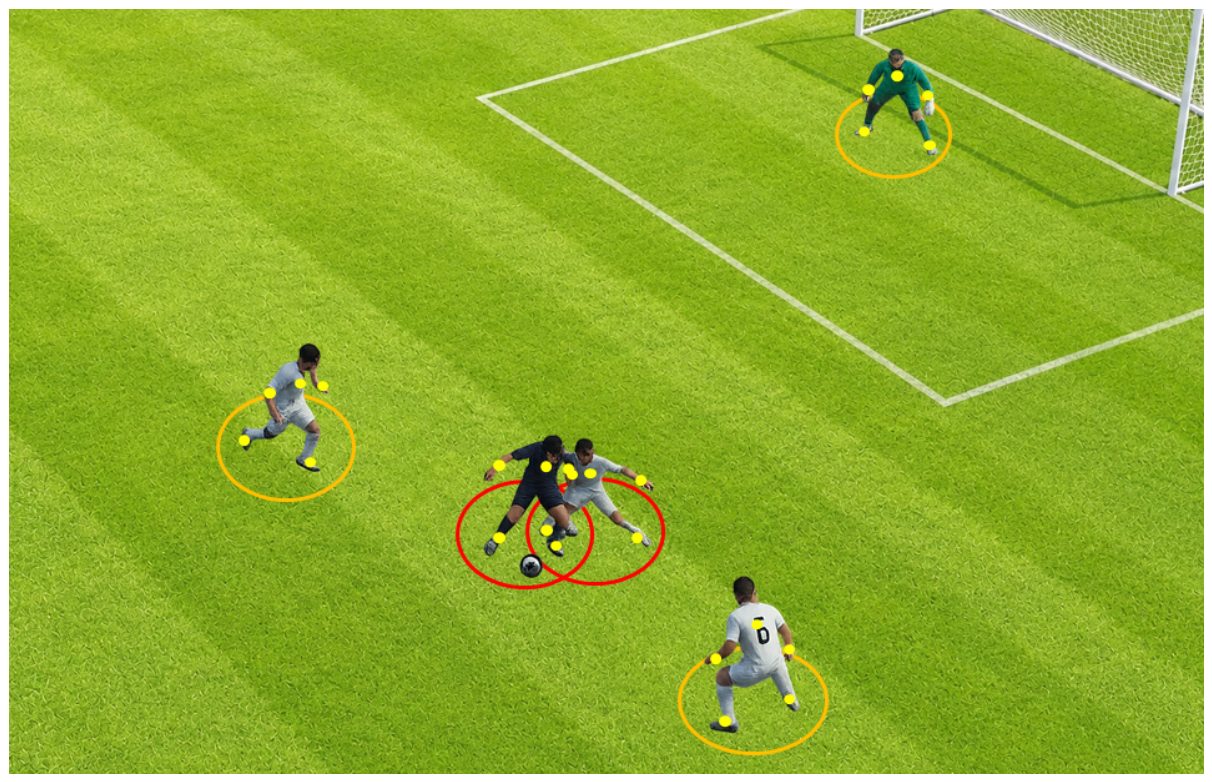
Figure 2.
Two-layer UWB localization architecture and corresponding abstraction for the analytical model. This separation maps naturally to the model parameters: player density, anchor count, body-worn tag count, global and local update rates, and global and local ranging airtimes.
Figure 2.
Two-layer UWB localization architecture and corresponding abstraction for the analytical model. This separation maps naturally to the model parameters: player density, anchor count, body-worn tag count, global and local update rates, and global and local ranging airtimes.
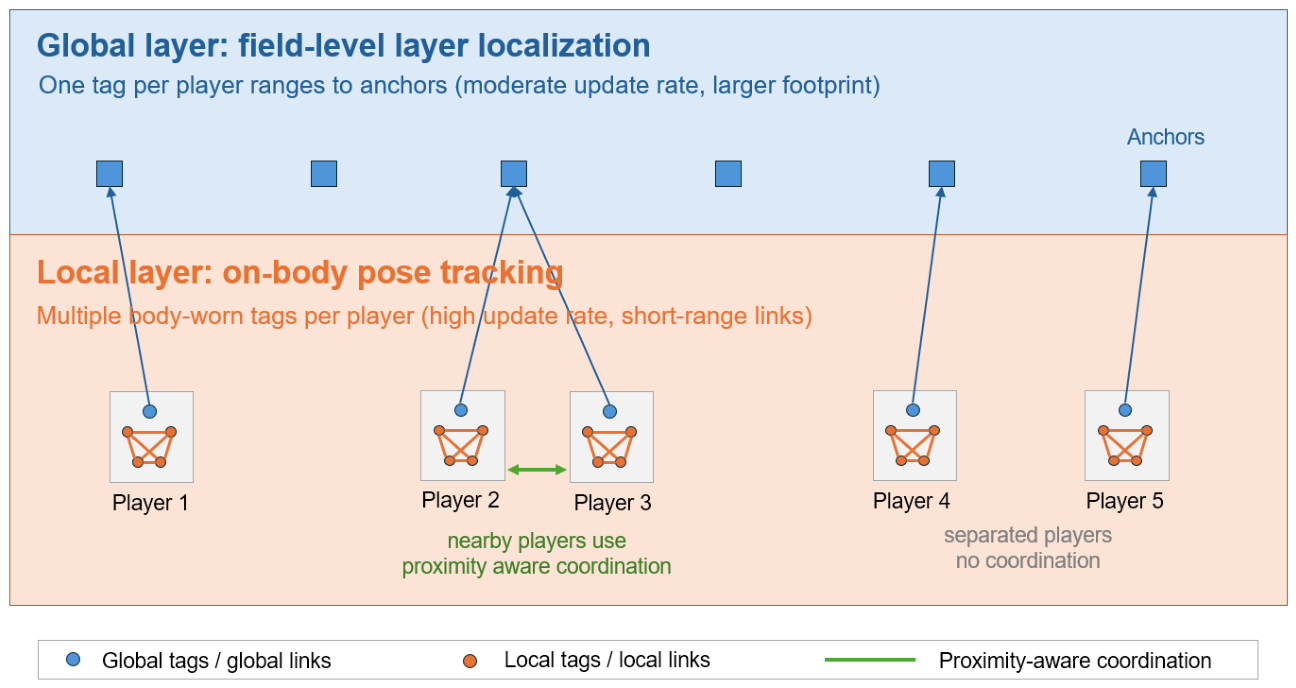
Figure 3.
Single-network calibration setup (a) and laboratory deployment (b). The two ranging nodes are mounted on opposing cobot rails, and their separation d is swept to measure distance-dependent ranging success under different preamble and transmit-power settings.
Figure 3.
Single-network calibration setup (a) and laboratory deployment (b). The two ranging nodes are mounted on opposing cobot rails, and their separation d is swept to measure distance-dependent ranging success under different preamble and transmit-power settings.
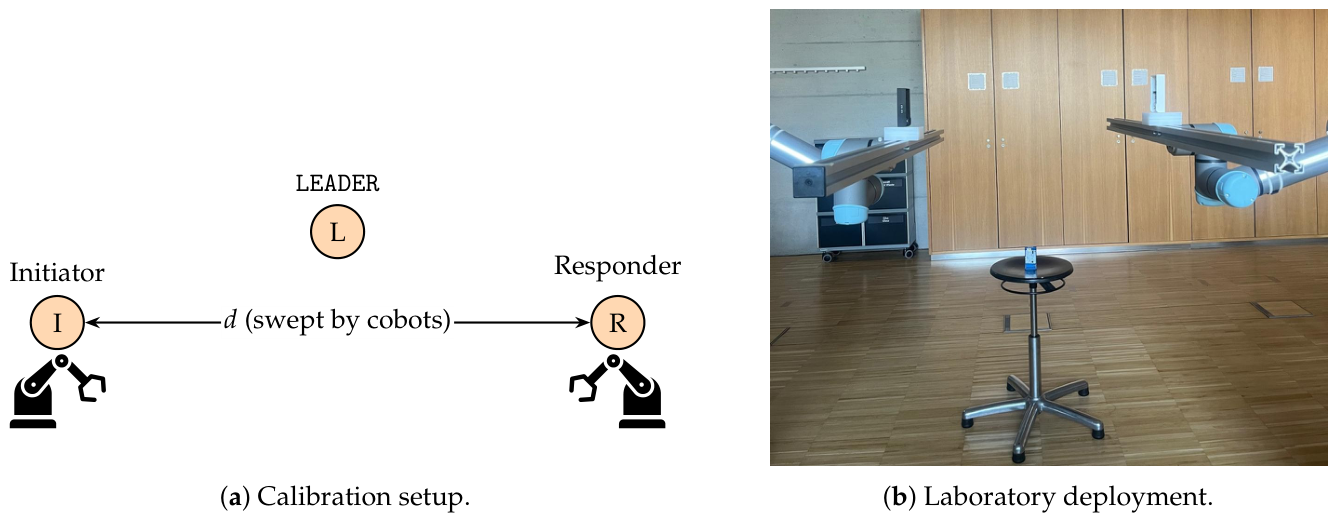
Figure 4.
Local-layer success probability over local update rate and tags per player , with coordinated intra-cluster access. Left: soccer (, m2). Right: ice hockey (, m2). The red curve is the airtime feasibility frontier from (9); gray shading marks infeasible configurations. Stars mark nominal design points. Because is constant in and inter-cluster load is bounded by , reliability varies only marginally within the feasible region.
Figure 4.
Local-layer success probability over local update rate and tags per player , with coordinated intra-cluster access. Left: soccer (, m2). Right: ice hockey (, m2). The red curve is the airtime feasibility frontier from (9); gray shading marks infeasible configurations. Stars mark nominal design points. Because is constant in and inter-cluster load is bounded by , reliability varies only marginally within the feasible region.
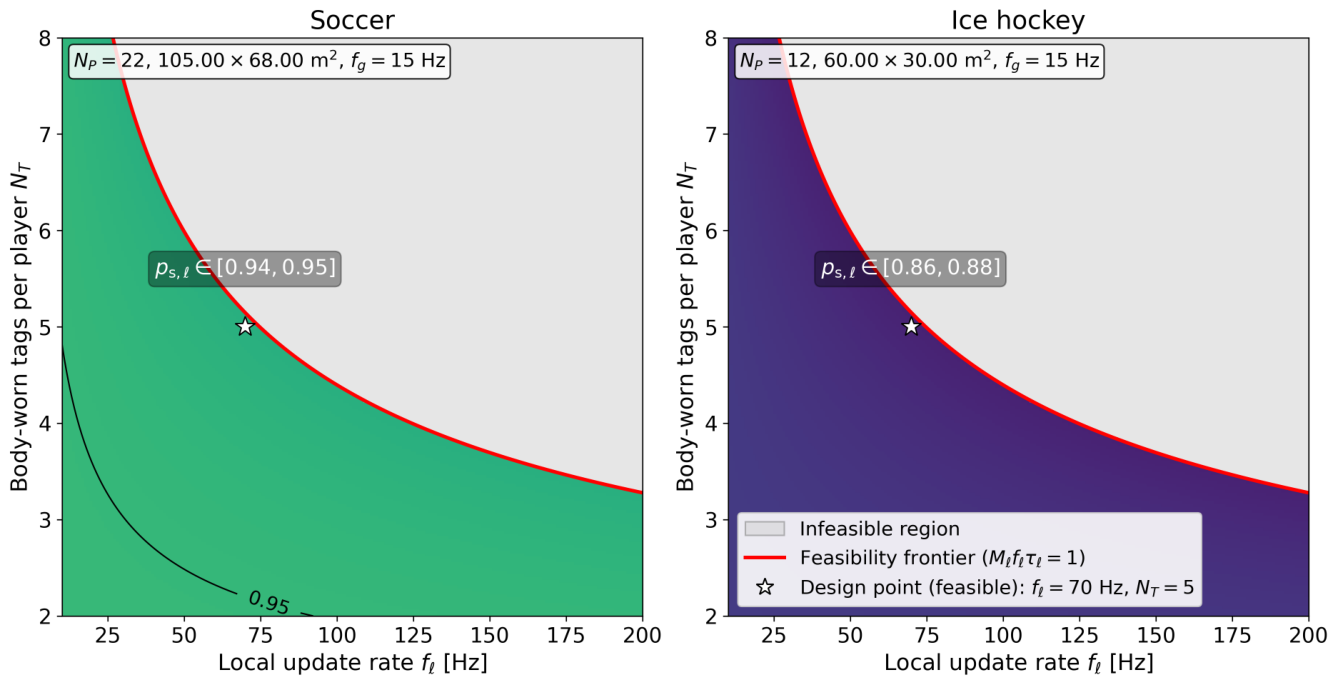
Figure 5.
Local-layer success probability versus anchors and global refresh rate , with coordinated intra-cluster access and fixed , Hz. Left: soccer (). Right: ice hockey (). The red curve is the airtime feasibility frontier from (6); gray shading marks infeasible configurations. Annotated ranges report over the feasible region.
Figure 5.
Local-layer success probability versus anchors and global refresh rate , with coordinated intra-cluster access and fixed , Hz. Left: soccer (). Right: ice hockey (). The red curve is the airtime feasibility frontier from (6); gray shading marks infeasible configurations. Annotated ranges report over the feasible region.
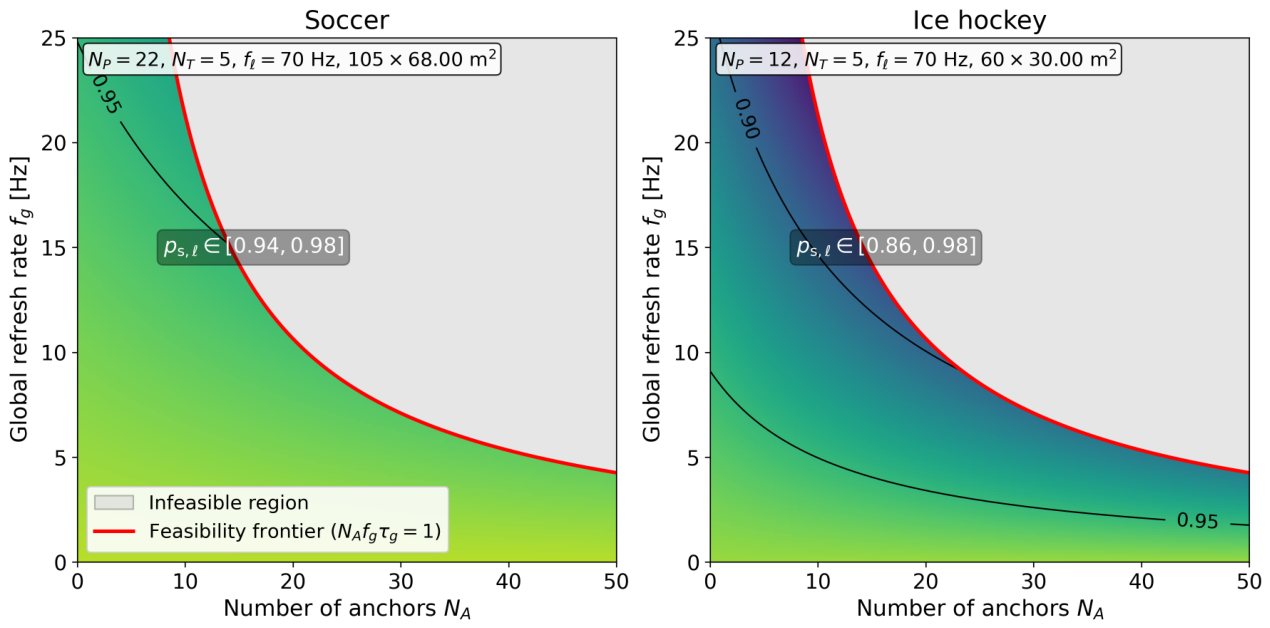
Figure 6.
Proximity-aware coordination tradeoff for volleyball. Left: local-layer success probability versus coordination slots . Right: local-layer success probability versus effective local update rate . Colors denote ; line styles denote (solid/dashed/dotted). Slotting improves reliability but reduces effective temporal resolution.
Figure 6.
Proximity-aware coordination tradeoff for volleyball. Left: local-layer success probability versus coordination slots . Right: local-layer success probability versus effective local update rate . Colors denote ; line styles denote (solid/dashed/dotted). Slotting improves reliability but reduces effective temporal resolution.
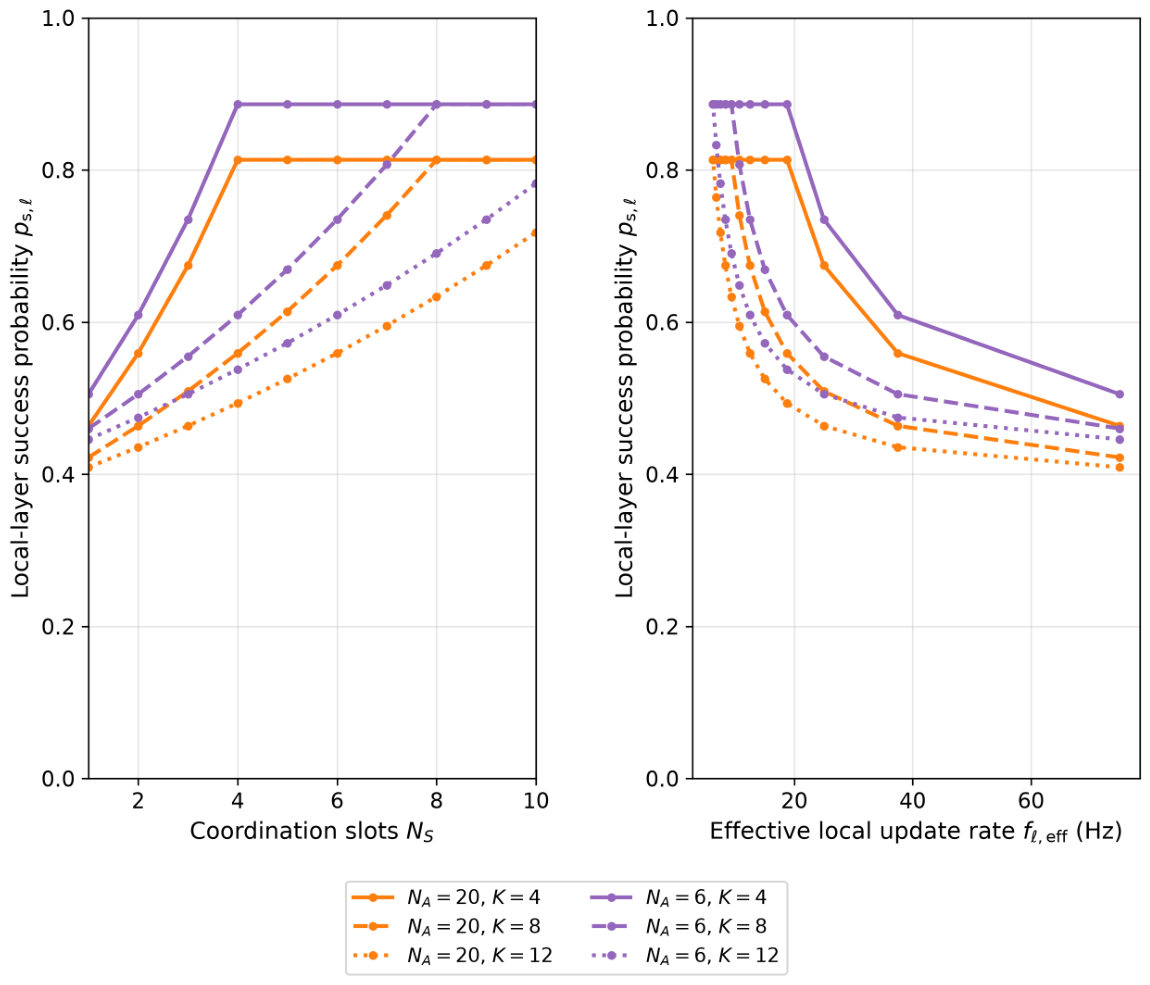
Figure 7.
Two-network coexistence. The LEADER broadcasts the TRIGGER consumed by PAN A and B. The inter-network distance (i.e., the gap between the two innermost cross-PAN nodes) is varied via the available cobots.
Figure 7.
Two-network coexistence. The LEADER broadcasts the TRIGGER consumed by PAN A and B. The inter-network distance (i.e., the gap between the two innermost cross-PAN nodes) is varied via the available cobots.
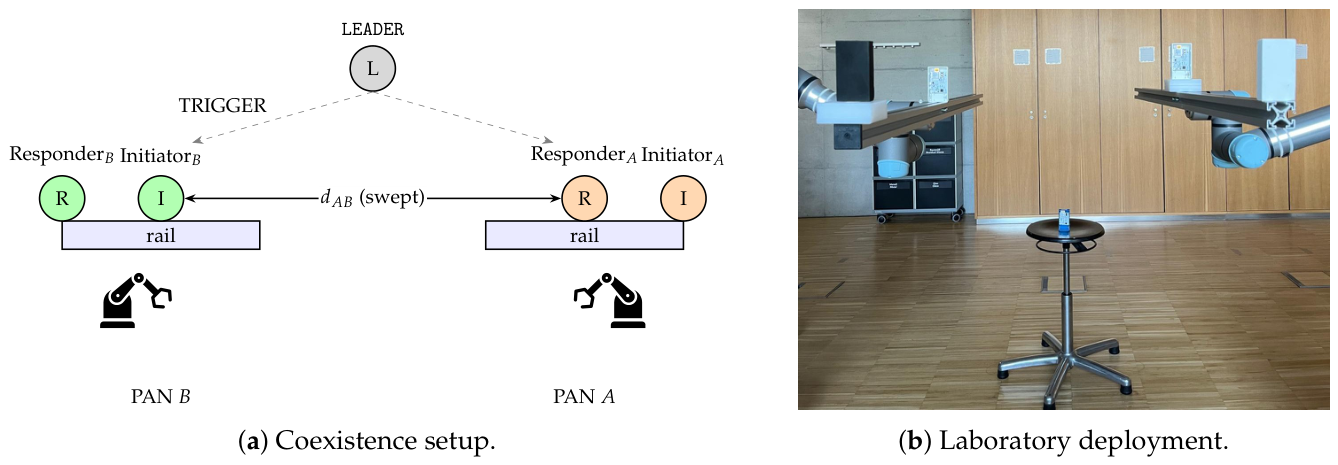
Figure 8.
Proof-of-concept setup with five sensors per player and two players. Each player carries one INITIATOR (torso) and four RESPONDERs (wrists and ankles), highlighted by the orange circles. The two silhouettes are separated by cm.
Figure 8.
Proof-of-concept setup with five sensors per player and two players. Each player carries one INITIATOR (torso) and four RESPONDERs (wrists and ankles), highlighted by the orange circles. The two silhouettes are separated by cm.
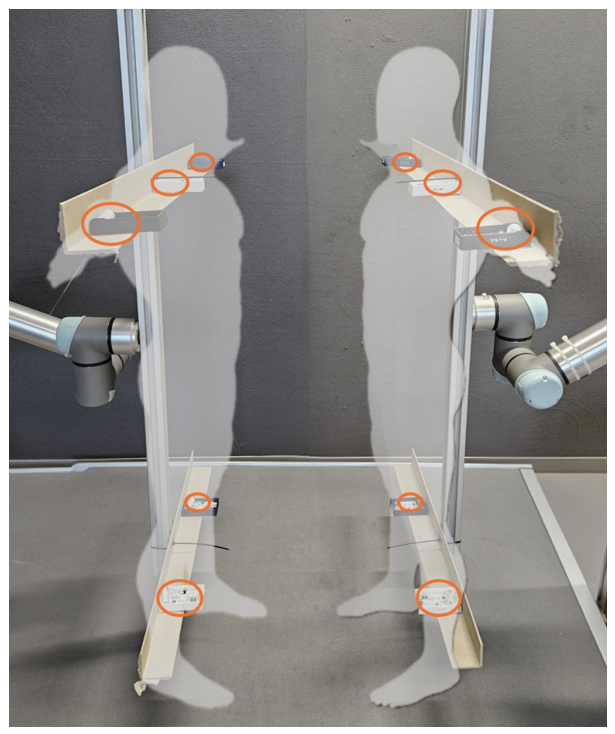

Table 1.
Deployment characteristics for soccer, volleyball, and ice hockey. The number of body-worn sensors and local update rates are aligned with sparse-inertial motion-capture [7]. Global update rates are consistent with commercial UWB deployments [2,5].
| Parameter | Soccer | Volleyball | Ice hockey |
|---|---|---|---|
| Playing area | m2 | m2 | m2 |
| Number of players | 22 | 12 | 12 |
| Player density | Low | High | Moderate |
| Global tags per player | 1 | 1 | 1 |
| Body-worn sensors per player | 4–8 | 4–8 | 4–8 |
| Global update rate | 10–20 Hz | 20–25 Hz* | 20–25 Hz |
| Local update rate | 50–100 Hz | 50–100 Hz | 50–100 Hz |
| Main scalability bottleneck | Field-wide coverage | Dense spatial reuse | Fast skating dynamics |
* Player-tracking ceiling for volleyball; the upper bound is included as an aspirational design target matched to commercial ball-tracking refresh rates (e.g., Kinexon ball rate of 50 Hz [2]).
Table 2.
Core system parameters used throughout the two-layer architecture and analytical model.
| Symbol | Meaning |
|---|---|
| Number of players in the field | |
| Total number of body-worn tags per player, including one global tag | |
| Number of infrastructure anchors | |
| Global and local update rates | |
| Airtime per global/local ranging transaction | |
| Global/local transmit powers | |
| Player density, | |
| Number of local pairwise ranges per pose update | |
| Global/local activity probabilities | |
| Global, intra-cluster, and inter-cluster interference |
Table 3.
Short-range DS-TWR success probability as a function of preamble length, transmit-power setting, and ranging distance. Each entry is averaged over 5000 DS-TWR exchanges.
Table 3.
Short-range DS-TWR success probability as a function of preamble length, transmit-power setting, and ranging distance. Each entry is averaged over 5000 DS-TWR exchanges.
| Preamble | TX power | 50 cm | 60 cm | 70 cm | 80 cm | 90 cm | 100 cm |
|---|---|---|---|---|---|---|---|
| 32 sym | 98% | 82% | 33% | 2% | 0% | 0% | |
| 1024 sym | 99% | 99% | 99% | 97% | 26% | 1% | |
| 32 sym | 99% | 99% | 97% | 90% | 83% | 68% |
Table 4.
Long-range DS-TWR success probability at elevated transmit power as a function of preamble length and inter-node distance. Each cell aggregates 5000 ranging exchanges.
Table 4.
Long-range DS-TWR success probability at elevated transmit power as a function of preamble length and inter-node distance. Each cell aggregates 5000 ranging exchanges.
| Preamble | TX power | 1 m | 5 m | 10 m | 15 m | 20 m |
|---|---|---|---|---|---|---|
| 32 sym | 99% | 99% | 6% | 0% | 0% | |
| 1024 sym | 99% | 99% | 99% | 97% | 3% |
Table 5.
Local-layer ranging success probability per sport. Deployment parameters: , Hz, Hz, . Channel path-loss , reliability factor , intra-player design distance m with m, local airtime s, global airtime s. Intra-cluster coordination yields the dominant gain.
Table 5.
Local-layer ranging success probability per sport. Deployment parameters: , Hz, Hz, . Channel path-loss , reliability factor , intra-player design distance m with m, local airtime s, global airtime s. Intra-cluster coordination yields the dominant gain.
| Case | Soccer | Volleyball | Ice hockey |
|---|---|---|---|
| Player density [m−2] | 0.003 | 0.074 | 0.007 |
| Coordinated, with | 0.954 | 0.387 | 0.910 |
| Coordinated, without | 0.960 | 0.471 | 0.926 |
| ALOHA, with | 0.329 | 0.133 | 0.313 |
| ALOHA, without | 0.331 | 0.162 | 0.319 |
Table 6.
DS-TWR outcome breakdown for two nearby players. Uncoordinated baseline at from 40 cm to 140 cm; and proximity-aware coordination at 40 cm. Each operating point aggregates 5000 rounds per PAN. ok: full DS-TWR exchange completed; intf: a frame with mismatched PAN; to: no decodable frame received. Success rate succ = ok / (ok + intf + to).
Table 6.
DS-TWR outcome breakdown for two nearby players. Uncoordinated baseline at from 40 cm to 140 cm; and proximity-aware coordination at 40 cm. Each operating point aggregates 5000 rounds per PAN. ok: full DS-TWR exchange completed; intf: a frame with mismatched PAN; to: no decodable frame received. Success rate succ = ok / (ok + intf + to).
| Interference management | Distance | PAN A | PAN B | ||||||
|---|---|---|---|---|---|---|---|---|---|
| ok | intf | to | succ | ok | intf | to | succ | ||
| Uncoordinated | 40 cm | 132 | 14 | 4854 | 2% | 408 | 98 | 4494 | 8% |
| Uncoordinated | 60 cm | 2327 | 659 | 2014 | 46% | 773 | 2178 | 2049 | 15% |
| Uncoordinated | 80 cm | 4490 | 358 | 152 | 89% | 1054 | 2514 | 1432 | 21% |
| Uncoordinated | 120 cm | 4918 | 47 | 35 | 98% | 3609 | 614 | 777 | 72% |
| Uncoordinated | 140 cm | 4984 | 11 | 5 | 99% | 4848 | 46 | 106 | 96% |
| Coord. (, ) | 40 cm | 4866 | 12 | 122 | 97% | 4245 | 5 | 750 | 84% |
| Coord. (, ) | 40 cm | 4976 | 12 | 12 | 99% | 4955 | 5 | 40 | 99% |
Table 7.
Single-frame success rate versus distance (operating point and 32-symbol preamble).
| Distance | 40 cm | 60 cm | 80 cm | 100 cm | 120 cm | 140 cm | 160 cm |
|---|---|---|---|---|---|---|---|
| Success rate | 100% | 100% | 98% | 77% | 14% | 13% | 0% |
Table 8.
Proof-of-concept outcome breakdown. Inter-PAN delay ( ms, clamped to ms), at cm. Each round comprises four sequential DS-TWR exchanges. to aggregates POLL/RESP/FINAL timeouts and CRC errors.
Table 8.
Proof-of-concept outcome breakdown. Inter-PAN delay ( ms, clamped to ms), at cm. Each round comprises four sequential DS-TWR exchanges. to aggregates POLL/RESP/FINAL timeouts and CRC errors.
| PAN | Rounds | DS-TWR exch. | ok | intf | to | S |
|---|---|---|---|---|---|---|
| PAN A | 5000 | 20 000 | 19 966 | 16 | 18 | 99.8% |
| PAN B | 5000 | 20 000 | 19 681 | 8 | 311 | 98.4% |
Disclaimer/Publisher’s Note: The statements, opinions and data contained in all publications are solely those of the individual author(s) and contributor(s) and not of MDPI and/or the editor(s). MDPI and/or the editor(s) disclaim responsibility for any injury to people or property resulting from any ideas, methods, instructions or products referred to in the content. |
© 2026 by the authors. Licensee MDPI, Basel, Switzerland. This article is an open access article distributed under the terms and conditions of the Creative Commons Attribution (CC BY) license (http://creativecommons.org/licenses/by/4.0/).
Copyright: This open access article is published under a Creative Commons CC BY 4.0 license, which permit the free download, distribution, and reuse, provided that the author and preprint are cited in any reuse.