
Submitted:
06 July 2026
Posted:
07 July 2026
You are already at the latest version
Abstract
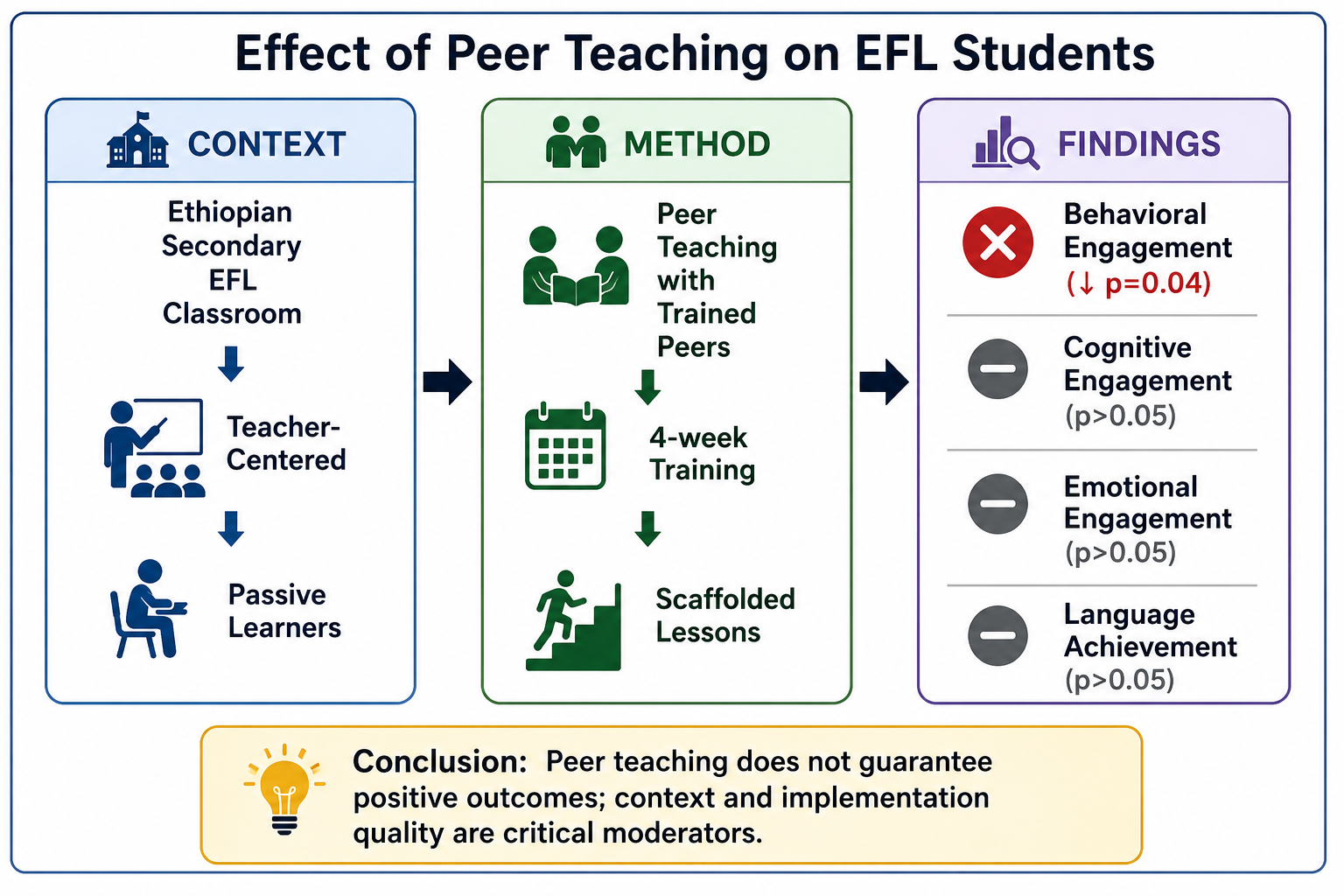
Peer teaching has been proposed as a pedagogical mechanism to foster independent learning, willingness, and confidence in students' learning processes (Doyle, 2008). However, the empirical evidence supporting these claims in English as a Foreign Language (EFL) contexts remains limited, with few studies examining the applicability and effectiveness of peer teaching approaches in African educational settings. This quasi-experimental study examines the effect of peer teaching on students' classroom engagement—comprising behavioral, cognitive, and emotional dimensions—and English language achievement in Ethiopian secondary EFL classrooms. The study involved 91 Grade 11 students from two randomly selected sections at Dangila Higher Education Preparatory School. Six students from the experimental group (n=45) were selected and trained to peer-teach grammar lessons over a four-week period, while the control group (n=42) continued with conventional teacher led instruction. Data were collected using a classroom engagement questionnaire (Cronbach's α = 0.82) and grammar tests administered both before and after the intervention, with independent samples t-tests employed for statistical analysis. The findings revealed no statistically significant effect of peer teaching on either students' engagement or language achievement. Unexpectedly, the experimental group showed a slight decline in behavioral engagement compared to the control group, while no significant differences were observed for cognitive or emotional engagement, nor for language achievement between the two groups. These findings challenge assumptions about the universal effectiveness of peer teaching in EFL contexts, suggesting that contextual factors—including learner readiness, implementation quality, and cultural considerations—may significantly moderate its pedagogical impact. The study underscores the critical need for careful consideration of implementation conditions and learner characteristics when adopting peer teaching approaches in similar educational settings, and highlights the importance of contextual adaptation rather than uncritical adoption of pedagogical innovations.
Keywords:
peer teaching
; classroom engagement
; EFL learning
; student-centered instruction
; Ethiopian secondary education
Copyright: This open access article is published under a Creative Commons CC BY 4.0 license, which permit the free download, distribution, and reuse, provided that the author and preprint are cited in any reuse.


