

Submitted:
06 July 2026
Posted:
07 July 2026
You are already at the latest version
Abstract
Sleep architecture alterations are consistently reported across major psychiatric disorders, but the contribution of demographic factors to between-study heterogeneity remains insufficiently characterized. Age and sex have not been systematically examined as study-level moderators across harmonized case-control polysomnographic evidence spanning psychotic and mood disorders. A transdiagnostic systematic review and meta-regression of case-control polysomnographic studies compared schizophrenia, bipolar disorder and unipolar depression with healthy controls. Eligible studies reported diagnostic criteria, treatment status, age and sex. Standardized mean differences were synthesized using random-effects models with REML estimation. Univariable mixed-effects meta-regressions assessed age and sex as moderators within each diagnostic group. Age and sex moderated delta sleep-related effect sizes in schizophrenia and unipolar depression. Age also moderated sleep continuity and sleep duration effect sizes in unipolar depression and REM sleep-related effect sizes across all disorders. Sex moderated delta sleep duration and REM density in bipolar mania. No significant effects were observed in bipolar depression. These effects were heterogeneous and not consistently observed across disorders or sleep parameters. Overall, demographic composition explains only a modest proportion of heterogeneity. Interpretation is limited by the ecological nature of study-level meta-regression and residual between-study heterogeneity.
Keywords:
sleep
; polysomnography
; schizophrenia
; bipolar disorder
; major depressive disorder
; meta-regression
Introduction
Sleep architecture undergoes several changes across the lifespan, as demonstrated by polysomnographic (PSG) studies. Aging is associated with reductions in total sleep time (TST), sleep efficiency (SE), delta sleep percentage (%DELTA), REM sleep time (REMT), REM sleep percentage (%REM) and REM latency (REML), whereas sleep onset latency (SOL), wake after sleep onset (WASO) and the percentage of stage 1 (%ST1) and stage 2 (%ST2) sleep generally increase with age [1,2]. These findings are broadly supported by an earlier meta-analysis including both PSG and actigraphic measures [3], although age-related changes in %ST2, %DELTA and %REM remain debated [4].
Sex-related differences in sleep architecture have also been consistently reported. Compared with age-matched males, females generally exhibit deeper and more consolidated sleep, characterized by higher %DELTA and lower %ST1, %ST2 and wakefulness after sleep onset [1]. Male sex has additionally been associated with shorter REML [4]. Similarly, a meta-analysis including both PSG and actigraphic data reported longer TST, albeit with slightly prolonged SOL, in females compared with age-matched men [3].
Large-scale normative data for REM density (REMD) remain scarce and scoring methodologies have varied considerably across studies. Although some investigations reported an age-related reduction in REMD [5,6], others failed to replicate this finding [7,8]. Likewise, evidence regarding sex differences in REMD is limited, with one study reporting no significant differences between males and females [8]. More generally, healthy adults exhibit substantial intra- and inter-individual variability across polysomnographic sleep measures [1].
Meta-analyses have consistently identified abnormalities in sleep architecture across several major psychiatric disorders, including schizophrenia (SCZ) [9,10], schizoaffective disorder (SZA) [11], major depressive disorder (MDD) [12,13,14,15] and bipolar disorder (BD) [16,17]. However, the extent to which demographic characteristics contribute to between-study variability in these abnormalities has received comparatively little attention. A comprehensive systematic review qualitatively assessed demographic subgroup differences, reporting altered REM sleep measures in studies comparing men with MDD and healthy controls (HC), whereas studies of women with MDD more frequently reported impaired sleep continuity and prolonged stage 1 sleep. Among men with SCZ, prolonged REMT but normal REML were described. The same review found only limited evidence supporting age-related differences in sleep architecture among patients with MDD [18].
The present study aimed to investigate age and sex as study-level moderators of case-control differences in polysomnographic sleep architecture across schizophrenia, bipolar disorder and unipolar depression using harmonized mixed-effects meta-regression analyses.
Methods
Studies included in the present analysis were derived from previously published systematic reviews and meta-analyses conducted by the authors, investigating sleep architecture in schizophrenia (SCZ) and bipolar disorder (BD) [10,17]. These datasets were re-assembled and harmonized according to updated inclusion criteria. All eligible studies were re-screened to ensure consistency with current requirements for reporting of age, sex and treatment status. Studies not meeting these criteria were excluded prior to analysis.
Previous meta-analyses on major depressive disorder (MDD) have applied heterogeneous inclusion criteria, including restriction to early-onset samples, focus on selected sleep parameters (e.g., REM sleep), or incomplete reporting of polysomnographic outcomes [12,13,14,15]. In addition, several syntheses have combined heterogeneous depressive phenotypes, including seasonal affective disorder and broadly defined or non-operationalized MDD, resulting in substantial diagnostic variability across included samples.
To address these limitations, a harmonized dataset of recurrent, non-psychotic, drug-free unipolar depression (UD) case-control studies was additionally assembled, with the aim of improving diagnostic specificity and methodological consistency. This dataset provided a unified basis for subsequent meta-regression analyses examining age and sex as study-level moderators of sleep architecture. Inclusion criteria for UD were aligned with those applied in SCZ and BD datasets to ensure comparability across diagnostic groups.
Detailed characteristics of individual studies are provided in the Supplementary Material (Supplementary File S1).
Database Search (UD vs HC)
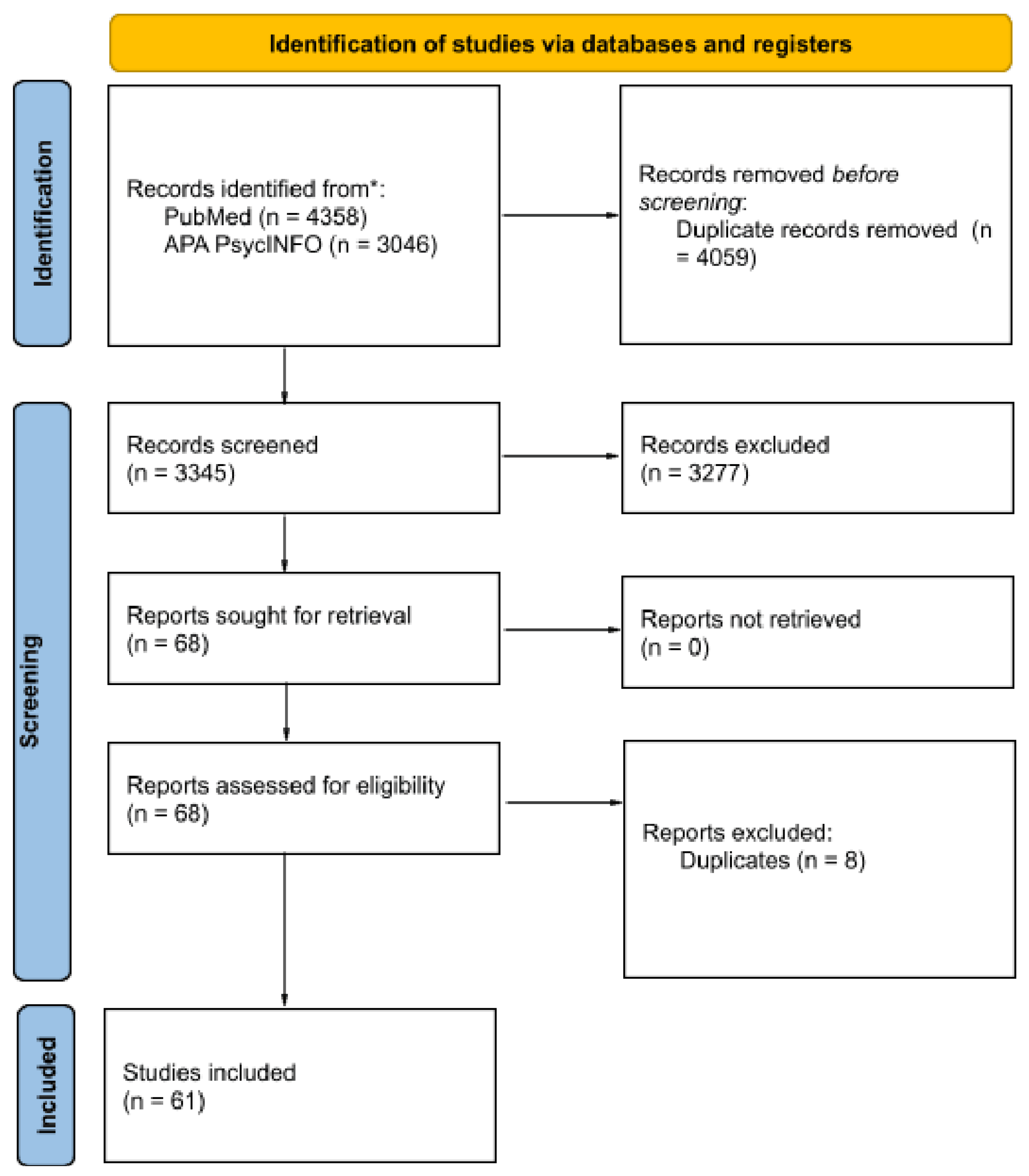
A systematic literature search was conducted in PubMed and PsycINFO from inception to 2026. The search strategy combined the terms “(sleep OR sleep*) AND (polysomnogra* OR EEG) AND depress*”. The search yielded 4358 records from PubMed and 3046 from PsycINFO. After removal of duplicates (4059), 3345 records remained for screening. Full-text assessment identified 68 eligible studies. Of these, 3277 were excluded due to absence of polysomnographic sleep data. Seven studies were excluded due to overlapping patient samples with previously published datasets. Ultimately, 61 studies were included in the UD vs HC meta-analysis. Study eligibility was assessed independently by both authors (DM and GB). The PRISMA flow diagram is presented in Figure 1 and the PRISMA checklist is provided in Supplementary File S2.
Eligibility Criteria
Studies were included in the meta-regression only if they met all of the following criteria:
1) Case-control studies including at least one patient sample composed exclusively of individuals with SCZ, SZA, UD or BD.
2) Case-control studies including at least one healthy control (HC) sample.
3) Studies clearly reporting the diagnosis, age, sex and treatment status of the patient sample.
4) Studies in which the patient sample was entirely drug-naive or drug-free.
5) Studies using polysomnography (PSG) for sleep staging.
6) Studies in which patients were diagnosed according to DSM or iCD criteria or according to Research Diagnostic Criteria (RDC).
All included studies scored at least 6 points on the Newcastle–Ottawa Scale.
Studies were excluded from the meta-analysis if they met at least one of the following criteria:
1) Absence of a healthy control (HC) sample.
2) Patient samples not composed exclusively of individuals with SCZ, SZA, UD or BD.
3) Failure to clearly report the diagnosis, age, sex, or treatment status of the patient sample.
4) Patient samples including treated participants or participants who were not entirely drug-naive or drug-free.
5) Studies including patients with other psychiatric, neurological, sleep-related or substance use comorbidities (e.g., ADHD, obstructive sleep apnea, substance abuse, etc.).
6) Studies not using polysomnography (PSG) for sleep staging (e.g., actigraphy, sleep diaries)
Data Extraction
Sample size, age, sex (as male proportion), diagnosis and medication status were extracted from the studies assessed as eligible, together with mean and standard deviation (SD) of the following sleep parameters: TST, SE, SOL, WASO, ST1, %ST1, ST2, %ST2, DELTA, %DELTA, REMT, %REM, REML, REMD.
Statistical Analysis
Statistical analyses were performed using Jamovi 2.6.26 (Windows x64). Effect sizes were expressed as standardized mean differences (SMD) as reported in the original studies. Random-effects models were fitted using restricted maximum-likelihood estimation. Univariable mixed-effects meta-regression models were conducted to examine the association between study-level mean age and proportion of male participants and effect sizes within each sleep parameter and psychiatric diagnostic group. Moderators were entered separately as continuous predictors based on sample-size weighted study-level aggregates. Results are reported as regression coefficients with corresponding p-values. No multivariable models or interaction terms were tested.
The analytical strategy was based on harmonized datasets derived from previously published meta-analyses of sleep in SCZ and BD, with standardized inclusion criteria across diagnostic groups and restriction to drug-naive or drug-free samples. The primary objective was estimation of age and sex as study-level moderators of sleep architecture differences.
Between-study heterogeneity, publication bias and influence diagnostics were not uniformly re-estimated in the transdiagnostic SCZ and BD analyses, in order to maintain consistency with the analytical structure of the original datasets. An exception was made for the UD subgroup, for which a fully harmonized meta-analysis was additionally conducted. In this subgroup, the primary outcome was a standard mean difference (SMD) and data were fitted with a random-effects model. Heterogeneity assessment, influence diagnostics and publication bias analyses were performed, including funnel plot inspection, Begg and Mazumdar rank correlation test and Egger-type regression of effect sizes on their standard errors.
Results
A total of 132 studies were included after application of the updated inclusion criteria and were stratified according to diagnostic group [19,20,21,22,23,24,25,26,27,28,29,30,31,32,33,34,35,36,37,38,39,40,41,42,43,44,45,46,47,48,49,50,51,52,53,54,55,56,57,58,59,60,61,62,63,64,65,66,67,68,69,70,71,72,73,74,75,76,77,78,79,80,81,82,83,84,85,86,87,88,89,90,91,92,93,94,95,96,97,98,99,100,101,102,103,104,105,106,107,108,109,110,111,112,113,114,115,116,117,118,119,120,121,122,123,124,125,126], with some studies providing separate datasets for different diagnoses and therefore contributing to multiple meta-analyses. Study-level characteristics, including sample sizes for patients and healthy controls, mean age and proportion of male participants, are summarized in Table 1. Results of univariable meta-regression analyses examining age and sex as moderators of each sleep parameter are reported in Table 2 and Table 3, respectively.
Of these 132 studies, 61 investigated sleep in UD versus that of HC. The corresponding harmonized meta-analysis results are presented in Table 4, while assessments of between-study heterogeneity, identification of potential outliers and influential studies and evaluation of publication bias using funnel plot inspection, Begg and Mazumdar rank correlation test and Egger-type regression of effect sizes on their standard errors are reported in Table 5.
Age and Sex as Moderators
Both age (p=0.043) and sex (p=0.026) were significantly associated with %DELTA in drug-naive patients with SCZ, whereas no significant associations were observed for other sleep parameters in drug-free SCZ. In BD, no significant associations between age or sex and sleep parameters were observed during the depressive phase. During the manic phase in BD, age was significantly associated with REMT (p=0.043), while sex was significantly associated with DELTA (p=0.002) and REMD (p=0.008). In drug-free UD, age was significantly associated with TST (p=0.001), SE (p=0.002), WASO (p < 0.001), ST2 (p=0.004), DELTA (p<0.001), %DELTA (p=0.021) and REMT (p=0.026). Sex was significantly associated with DELTA (p=0.034) and %DELTA (p=0.049) in UD.
Drug-Free UD vs HC Meta-Analysis
The meta-analysis of sleep parameters in drug-free UD versus HC revealed significant sleep continuity alterations with decreased TST (p<0.001) and SE (p<0.001) and prolonged SOL (p<0.001) and WASO (p<0.001). Patients with UD showed reduced ST2 (p<0.001), %ST2 (p=0.045) and DELTA (p=0.02), as well as increased %REM (p<0.001) and REMD (p<0.001) and shortened REML (p<0.001) compared to HC.
Age and Sex Imbalance Assessment
Across the included literature, demographic composition shows substantial and diagnosis-dependent heterogeneity. In SCZ, mean study-level age is similar between drug-naive (29.7 ± 10.5 years, range 22.2-70.9) and drug-free samples (29.6 ± 4.9 years, range 16.2-44.6), although dispersion is markedly reduced in drug-free studies, indicating tighter age selection at the expense of representativeness. Sex distribution is consistently male-biased but more extreme in drug-free SCZ (81.7 ± 22.1% male, median 100%) compared to drug-naive samples (72.8 ± 14.2% male). BD samples show higher mean age in depressive (39.4 ± 7.7 years) than manic episodes (36.2 ± 8.4 years), with moderate-to-high variability in sex composition in both groups (71.8 ± 24.6% and 74.8 ± 26.7% male, respectively). UD exhibits the greatest demographic heterogeneity, with a broad lifespan age distribution (29.5 ± 11.5 years, range 9.4-69.5) and the widest variability in sex composition (57.1 ± 28.8% male, range 0-100%), indicating fundamentally heterogeneous recruitment across pediatric, adult and late-life populations.

Table 1.
Included studies with numerosity of samples, age and sex composition.
| N. datasets | N. Patients/HC | Average Age (Patients/HC) | Average %Males (Patients/HC) |
|
|---|---|---|---|---|
| SCZ (drug-naive) | 14 | 263/232 | 29.74 | 72.80 |
| SCZ (drug-free) | 40 | 726/633 | 29.57 | 81.70 |
| BD (drug-free, manic) | 5 | 62/67 | 36.16 | 71.80 |
| BD (drug-free, depressed) | 12 | 138/178 | 39.41 | 74.80 |
| MDD (drug-free) | 61 | 1823/1343 | 29.53 | 57.10 |
Table 2.
Results of age as sleep parameters moderator.
| Age as moderator | ||||||||||
|---|---|---|---|---|---|---|---|---|---|---|
| SCZ (drug-naive) | SCZ (drug-free) | BD (depressed, drug-free) | BD (manic, drug-free) | MDD (drug-free) | ||||||
| Estimate | p-value | Estimate | p-value | Estimate | p-value | Estimate | p-value | Estimate | p-value | |
| TST | 0.008 (-0.038 to 0.054) | 0.721 | 0.058 (-0.072 to 0.187) | 0.385 | -0.04 (-0.132 to 0.052) | 0.344 | 0.025 (-0.060 to 0.110) | 0.337 | -0.020 (-0.033 to -0.008) | 0.001 |
| SOL | 0.019 (-0.013 to 0.052) | 0.240 | -0.039 (-0.099 to 0.020) | 0.192 | 0.075 (-0.053 to 0.202) | 0.203 | 0.034 (-0.317 to 0.385) | 0.780 | 0.005 (-0.006 to 0.016) | 0.353 |
| SE | -0.080 (-0.271 to 0.107) | 0.394 | 0.015 (-0.060 to 0.090) | 0.702 | 0.045 (-0.407 to 0.497) | 0.810 | -0.022 (-0.348 to 0.305) | 0.848 | -0.020 (-0.033 to -0.007) | 0.002 |
| WASO | -0.013 (-0.041 to 0.015) | 0.358 | 0.049 (-0.018 to 0.115) | 0.154 | -0.002 (-0.085 to 0.082) | 0.965 | -0.035 (-0.133 to 0.063) | 0.265 | 0.024 (0.015 to 0.032) | <0.001 |
| ST1 | -0.024 (-0.076 to 0.029) | 0.380 | 0.026 (-0.058 to 0.111) | 0.541 | -0.022 (-0.124 to 0.079) | 0.535 | -0.058 (-0.181 to 0.065) | 0.181 | -0.003 (-0.016 to 0.009) | 0.605 |
| %ST1 | -0.014 (-0.033 to 0.005) | 0.160 | 0.011 (-0.056 to 0.077) | 0.758 | -0.032 (-0.166 to 0.102) | 0.505 | -0.033 (-0.222 to 0.156) | 0.618 | 0.007 (-0.004 to 0.017) | 0.202 |
| ST2 | 0.007 (-0.044 to 0.057) | 0.793 | -0.011 (-0.078 to 0.056) | 0.743 | -0.031 (-0.180 to 0.118) | 0.552 | 0.014 (-0.071 to 0.098) | 0.557 | -0.015 (-0.025 to -0.005) | 0.004 |
| %ST2 | 0.000 (-0.048 to 0.048) | 0.989 | -0.014 (-0.065 to 0.037) | 0.597 | -0.025 (-0.136 to 0.087) | 0.530 | 0.050 (-0.203 to 0.304) | 0.572 | 0.000 (-0.015 to 0.014) | 0.928 |
| DELTA | 0.012 (-0.109 to 0.134) | 0.841 | 0.002 (-0.065 to 0.068) | 0.964 | -0.004 (-0.043 to 0.035) | 0.814 | -0.032 (-0.131 to 0.068) | 0.304 | -0.014 (-0.021 to -0.006) | <0.001 |
| %DELTA | 0.113 (0.003 to 0.222) | 0.043 | 0.000 (-0.012 to 0.010) | 0.862 | -0.006 (-0.047 to 0.034) | 0.727 | -0.041 (-0.129 to 0.047) | 0.237 | -0.013 (-0.023 to -0.002) | 0.021 |
| REMT | 0.008 (-0.041 to 0.056) | 0.753 | 0.068 (0.005 to 0.131) | 0.036 | -0.011 (-0.073 to 0.051) | 0.737 | -0.024 (-0.046 to -0.002) | 0.043 | -0.012 (-0.022 to -0.001) | 0.026 |
| %REM | 0.002 (-0.070 to 0.073) | 0.964 | 0.049 (-0.011 to 0.110) | 0.108 | 0.010 (-0.035 to 0.055) | 0.657 | -0.035 (-0.105 to 0.035) | 0.208 | 0.001 (-0.014 to 0.016) | 0.884 |
| REML | -0.019 (-0.081 to 0.043) | 0.547 | 0.034 (-0.019 to 0.087) | 0.205 | -0.046 (-0.177 to 0.085) | 0.489 | 0.059 (-0.089 to 0.207) | 0.294 | -0.008 (-0.020 to 0.004) | 0.187 |
| REMD | -0.034 (-0.110 to 0.043) | 0.385 | -0.004 (-0.048 to 0.040) | 0.869 | 0.042 (-0.035 to 0.119) | 0.282 | -0.070 (-0.195 to 0.055) | 0.137 | 0.014 (-0.010 to 0.037) | 0.255 |
Table 3.
Results of sex as sleep parameters moderator.
| Sex as moderator | ||||||||||
|---|---|---|---|---|---|---|---|---|---|---|
| SCZ (drug-naive) | SCZ (drug-free) | BD (depressed, drug-free) | BD (manic, drug-free) | MDD (drug-free) | ||||||
| Estimate | p-value | Estimate | p-value | Estimate | p-value | Estimate | p-value | Estimate | p-value | |
| TST | 0.031 (-0.003 to 0.065) | 0.074 | 0.005 (-0.010 to 0.019) | 0.522 | 0.121 (-0.383 to 0.626) | 0.594 | -0.225 (1.004 to 0.555) | 0.341 | 0.002 (-0.004 to 0.008) | 0.450 |
| SOL | -0.010 (-0.036 to 0.016) | 0.448 | -0.010 (-0.022 to 0.002) | 0.102 | -0.090 (-0.898 to 0.719) | 0.796 | -0.148 (2.436 to 2.140) | 0.850 | -0.000 (-0.005 to 0.005) | 0.765 |
| SE | 0.037 (-0.020 to 0.095) | 0.206 | 0.005 (-0.010 to 0.019) | 0.522 | 0.222 (-1.235 to 1.678) | 0.712 | 0.067 (-2.053 to 2.189) | 0.925 | 0.003 (-0.003 to 0.009) | 0.334 |
| WASO | -0.005 (-0.033 to 0.024) | 0.732 | 0.000 (-0.011 to 0.010) | 0.931 | -0.233 (-0.709 to 0.242) | 0.275 | 0.372 (-0.352 to 1.095) | 0.158 | 0.003 (-0.003 to 0.008) | 0.305 |
| ST1 | 0.010 (-0.036 to 0.055) | 0.679 | -0.007 (-0.021 to 0.007) | 0.332 | 0.010 (-0.025 to 0.044) | 0.446 | 0.187 (-1.811 to 2.185) | 0.726 | 0.000 (-0.006 to 0.005) | 0.922 |
| %ST1 | 0.000 (-0.015 to 0.013) | 0.890 | 0.000 (-0.014 to 0.014) | 0.991 | -0.436 (-1.424 to 0.552) | 0.255 | 0.032 (-1.224 to 1.289) | 0.940 | 0.001 (-0.003 to 0.006) | 0.579 |
| ST2 | 0.014 (-0.028 to 0.055) | 0.525 | -0.001 (-0.013 to 0.010) | 0.800 | 0.602 (-0.122 to 1.326) | 0.077 | -0.233 (-0.740 to 0.274) | 0.187 | 0.000 (-0.004 to 0.006) | 0.763 |
| %ST2 | -0.014 (-0.053 to 0.026) | 0.500 | -0.002 (-0.012 to 0.008) | 0.687 | 0.424 (-0.100 to 0.949) | 0.082 | -0.402 (-1.975 to 1.172) | 0.476 | 0.000 (-0.006 to 0.006) | 0.927 |
| DELTA | 0.081 (-0.009 to 0.172) | 0.079 | -0.019 (-0.229 to 0.192) | 0.863 | 0.068 (-0.144 to 0.281) | 0.463 | 0.421 (0.343 to 0.499) | 0.002 | -0.004 (-0.008 to -0.000) | 0.034 |
| %DELTA | 0.096 (0.011 to 0.181) | 0.026 | -0.017 (-0.058 to 0.024) | 0.424 | 0.023 (-0.210 to 0.255) | 0.820 | 0.317 (-0.123 to 0.757) | 0.106 | -0.005 (-0.010 to -0.000) | 0.049 |
| REMT | 0.028 (-0.010 to 0.065) | 0.150 | 0.006 (-0.007 to 0.020) | 0.363 | -0.100 (-0.500 to 0.299) | 0.623 | 0.119 (-0.465 to 0.704) | 0.472 | 0.000 (-0.005 to 0.006) | 0.843 |
| %REM | 0.034 (-0.002 to 0.090) | 0.238 | 0.011 (-0.002 to 0.025) | 0.106 | -0.078 (-0.356 to 0.200) | 0.584 | 0.217 (-0.211 to 0.645) | 0.205 | 0.000 (-0.005 to 0.007) | 0.822 |
| REML | 0.028 (-0.021 to 0.077) | 0.268 | 0.008 (-0.004 to 0.021) | 0.188 | 0.229 (-0.471 to 0.928) | 0.521 | -0.336 (-1.294 to 0.623) | 0.346 | -0.003 (-0.008 to 0.002) | 0.283 |
| REMD | 0.004 (-0.021 to 0.029) | 0.760 | 0.009 (-0.005 to 0.022) | 0.216 | 0.144 (-0.288 to 0.575) | 0.513 | 0.578 (0.356 to 0.799) | 0.008 | -0.004 (-0.016 to 0.008) | 0.516 |
Table 4.
Sleep parameters in UD versus HC meta-analysis results.
| Meta-analysis | |||||
|---|---|---|---|---|---|
| N. of studies | N. of subjects | Mean ± SD | RE Model | p-value | |
| TST | 55 | 1614 VS 1185 | 410.08 ± 53.91 VS 433.23 ± 37.13 | -0.372 (-0.555 to -0.188) | <0.001 |
| SOL | 59 | 1734 VS 1282 | 26.64 ± 21.96 VS 16.91 ± 12.45 | 0.547 (0.407 to 0.687) | <0.001 |
| SE | 49 | 1468 VS 1028 | 86.27 ± 8.75 VS 91.39 ± 5.54 | -0.633 (-0.828 to -0.438) | <0.001 |
| WASO | 48 | 1488 VS 1011 | 34.98 ± 47.34 VS 24.29 ± 20.96 | 0.375 (0.221 to 0.529) | <0.001 |
| ST1 | 48 | 1525 VS 1052 | 29.73 ± 17.66 VS 31.78 ± 15.02 | 0.067 (-0.103 to 0.236) | 0.441 |
| %ST1 | 51 | 1592 VS 1141 | 7.41 ± 4.45 VS 7.36 ± 4.36 | 0.138 (-0.005 to 0.280) | 0.059 |
| ST2 | 49 | 1535 VS 1062 | 220.33 ± 44.26 VS 236.53 ± 41.45 | -0.454 (-0.606 to -0.302) | <0.001 |
| %ST2 | 52 | 1602 VS 1151 | 54.01 ± 8.73 VS 54.89 ± 7.18 | -0.195 (-0.385 to -0.004) | 0.045 |
| DELTA | 31 | 972 VS 789 | 66.34 ± 31.55 VS 72.85 ± 32.50 | -0.144 (-0.266 to -0.022) | 0.020 |
| %DELTA | 52 | 1588 VS 1102 | 13.51 ± 7.47 VS 14.51 ± 6.95 | -0.138 (-0.287 to 0.010) | 0.068 |
| REMT | 32 | 1167 VS 776 | 93.83 ± 26.15 VS 92.03 ± 20.91 | 0.135 (-0.022 to 0.2919 | 0.092 |
| %REM | 44 | 1233 VS 799 | 23.01 ± 5.88 VS 20.66 ± 4.30 | 0.369 (0.196 to 0.543) | <0.001 |
| REML | 58 | 1776 VS 1312 | 75.20 ± 34.42 VS 88.85 ± 34.69 | -0.441 (-0.601 to -0.280) | <0.001 |
| REMD | 43 | 1459 VS 962 | 5.15 ± 1.41 VS 4.56 ± 1.37 | 0.610 (0.288 to 0.931) | <0.001 |
Table 5.
Heterogeneity, publications bias, outlier and overly influential studies and funnel plot asymmetry analyses (UD vs HC).
Table 5.
Heterogeneity, publications bias, outlier and overly influential studies and funnel plot asymmetry analyses (UD vs HC).
| Heterogeneity | Publication Bias | Funnel plot asymmetry | |||||||
|---|---|---|---|---|---|---|---|---|---|
| Q | i² | p-value | Fail-Safe N | p-value | Outlier | Overly influential | Rank correlation (p-value) | Regression test (p-value) | |
| TST | 204.42 | 78.92% | <0.001 | 1453 | <0.001 | Arana-Lechuga et al., 2008 | Arana-Lechuga et al., 2008 | 0.718 | 0.010* |
| SOL | 153.42 | 65.29% | <0.001 | 3555 | <0.001 | Arana-Lechuga et al., 2008 Asaad et al., 2016 |
Arana-Lechuga et al., 2008 Asaad et al., 2016 |
0.567 | 0.043* |
| SE | 178.15 | 78.32% | <0.001 | 3215 | <0.001 | Asaad et al., 2016 | Asaad et al., 2016 | 0.455 | 0.071 |
| WASO | 141.65 | 65.56% | <0.001 | 1035 | <0.001 | - | - | 0.565 | 0.448 |
| ST1 | 159.29 | 73.24% | <0.001 | 0 | 0.071 | Arana-Lechuga et al., 2008 | Hoffman et al., 2000 Arana-Lechuga et al., 2008 |
0.577 | 0.021* |
| %ST1 | 143.49 | 64.50% | <0.001 | 144 | <0.001 | Hubain et al., 2006 Asaad et al., 2016 |
Hubain et al., 2006 Asaad et al., 2016 |
0.224 | 0.444 |
| ST2 | 156.72 | 68.01% | <0.001 | 1896 | <0.001 | - | Reynolds et al., 1985 Lauer et al., 1991 |
0.051 | 0.060 |
| %ST2 | 190.89 | 80.38% | <0.001 | 328 | <0.001 | McCracken et al., 1997 Asaad et al., 2016 |
McCracken et al., 1997 Landolt & Gillin, 2005 Asaad et al., 2016 |
0.117 | 0.682 |
| DELTA | 42.89 | 31.74% | 0.06 | 68 | 0.020 | - | - | 0.145 | 0.507 |
| %DELTA | 133.52 | 66.21% | <0.001 | 116 | 0.002 | Asaad et al., 2016 | Asaad et al., 2016 | 0.969 | 0.840 |
| REMT | 91.80 | 56.36% | <0.001 | 59 | 0.003 | Arana-Lechuga et al., 2008 | Emslie et al., 1990 Arana-Lechuga et al., 2008 |
0.530 | 0.003* |
| %REM | 112.12 | 66.18% | <0.001 | 817 | <0.001 | Landolt & Gillin, 2005 | Landolt & Gillin, 2005 | 0.193 | 0.056 |
| REML | 200.94 | 74.80% | <0.001 | 2314 | <0.001 | Landolt & Gillin, 2005 Arana-Lechuga et al., 2008 |
Landolt & Gillin, 2005 Arana-Lechuga et al., 2008 |
0.521 | 0.133 |
| REMD | 304.06 | 91.78% | <0.001 | 1976 | <0.001 | Armitage et al., 2000.3 Asaad et al., 2016 |
Emslie et al., 1987 McCracken et al., 1997 Armitage et al., 2000.3 Asaad et al., 2016 |
0.260 | 0.957 |
| * Asymmetry found | |||||||||
Discussion
To date, this is the first study to systematically examine age and sex as study-level moderators of polysomnographic case-control differences across schizophrenia, bipolar disorder and unipolar depression.
The present study found an effect of sex on both DELTA and %DELTA in UD versus HC compatible with previous reports of sex differences in SWS in MDD [122,127,128], found also in early-onset samples [129], as depressed women have been reported to live on a higher homeostatic sleep pressure level [130]. Age significantly moderated differences in DELTA, %DELTA, REMT and measures of sleep continuity and duration between UD and HC. These findings are in line with the literature reporting an age-related decline in TST, including SWS and REMT and a disruption of sleep continuity. No significant age-related moderation was observed for SOL in UD, compatible with evidence suggesting only modest age-related changes in this parameter. Along these results, the moderator effect of age on ST2 differences may reflect greater time spent in lighter NREM stages as SWS declines with aging [131]. Our results did not identify a moderating effect of age on REMD in UD, in line with evidence suggesting that REMD may be less sensitive to age-related variation than REML [99]. Early studies suggested a steeper age-related shortening of REML in MDD compared to HC, interpreted as evidence of “premature aging” effects [99,132,133], while more recent evidence challenged this idea by not identifying clear differences in REML patterns across age strata between MDD and HC [123]. Consistently, the present meta-regression did not identify age as a significant moderator of REML differences between drug-free UD and HC, suggesting a lack of robust evidence for age-related modulation of UD-HC differences in REML.
Cross-sectional reports observing age and sex differences in SCZ and BD are scarce, whereas such differences were disproportionately investigated in MDD. Contrary to what found in this study regarding sleep in UD, no effect of age and sex on any sleep parameter in the depressive phase of BD was found. On the opposite, a significant effect of age on REMT was found in the manic phase of BD. Higher REM pressure has recently been proposed as a characteristic feature of manic episodes [17], which may partly explain why demographic moderation was observed for this REM-related measure. No other effect of age on any sleep parameter in mania was found consistently with an early study on the matter [71]. The effect of sex on sleep parameters in mania was tested with no results in one small-sized sample study [72], whereas our study found sex to significantly moderate DELTA also in BD mania. An effect of sex on REMD in mania was further found in the present study. Sex-related differences in the clinical expression, course and neurobiology of bipolar disorder have been reported [134,135] and may contribute to the observed study-level moderation of REMD. REMD has been proposed as a marker associated with antidepressant treatment response in MDD [136]. Whether REMD may similarly reflect treatment response in bipolar mania remains unknown. Given that lithium has been reported to delay REM sleep [137] and reduce REMD [138], future longitudinal studies could examine whether REMD changes during lithium treatment are associated with clinical response.
Regarding SCZ, age and sex significantly moderated %DELTA differences in drug-naive samples, whereas no such effects were observed in drug-free samples. This discrepancy may reflect differences in illness stage and treatment history between the two populations. Drug-naive samples are more likely to represent earlier phases of the disorder, whereas drug-free samples may include individuals with longer illness duration and prior pharmacological exposure or discontinuation effects, all of which may contribute to increased between-study heterogeneity in sleep architecture measures [9]. Such heterogeneity may attenuate detectable demographic moderation in chronic or clinically heterogeneous samples, raising the possibility that demographic influences may be more detectable in early-stage schizophrenia, although differences in study heterogeneity and statistical power may also contribute. Age significantly moderated REMT differences in drug-free SCZ, potentially reflecting greater variability in illness duration and treatment history in these samples.
As reported, high-quality PSG studies in specific populations, particularly drug-naive SCZ and BD, remain limited in the literature. Several analyses may therefore have limited statistical power and negative findings may reflect type II error. Moreover, age and sex are not homogeneously represented across studies within and between diagnostic groups, with a general predominance of male participants and limited variability in demographic distributions. This demographic imbalance limits the ability to robustly assess differential effects of age and sex on PSG parameters. Furthermore, because our meta-regression relies on study-level moderators, such as mean age or the percentage of maleparticipants, our findings are susceptible to the ecological fallacy. Consequently, associations observed at the aggregate study level may not perfectly reflect relationships at the individual patient level. Finally, differences in observed moderation effects across disorders may partly reflect differences in between-study variance of demographic composition rather than disorder-specific mechanisms. In SCZ and BD, restricted variability in sex ratios across studies likely reduced statistical power to detect sex-related moderation effects, potentially attenuating regression estimates.
The meta-analysis of sleep parameters of drug-free UD versus HC confirmed marked abnormalities in sleep continuity and duration, increased REM pressure and reduced SWS [14,18]. Although heterogeneity was moderate to high (>60%) for the majority of analyzed parameters, lowest heterogeneity (31.7%) was observed in the meta-analysis of DELTA in UD patients, supporting SWS reduction in depressed patients regardless of previous exposure to treatment. A meta-regression could not be performed for SZA due to insufficient number of available sleep studies and limited variability in study-level covariates, including age and sex distribution [11], highlighting a gap in literature that currently limits characterization of sleep architecture in this diagnostic group.
Future research should prioritize longitudinal designs and individual participant data meta-analyses to better disentangle biological aging from illness chronicity and pharmacological exposure while reducing ecological bias. A shift toward sleep microstructural characterization is warranted, as sleep microstructure may be more sensitive than macrostructure to age-related differences [139,140,141]. In particular, parameters such as REMD may benefit from this approach, given the heterogeneity in scoring methodologies. Methods aggregating healthy populations to model demographic effects on sleep spindles [142,143] may be extended to psychiatric cohorts to improve characterization of age and sex effects in pathological sleep. Such work should be coupled with improved sampling of underrepresented clinical strata, including drug-naive and drug-free populations with broader and more balanced demographic distributions, alongside stricter stratification of medication history. Finally, integrating circadian timing metrics with sleep microstructural features may improve characterization of dynamic vulnerability across mood and psychotic phases [144], while dimensional approaches across diagnostic boundaries may further enhance explanatory resolution beyond categorical classifications.
Supplementary Materials
The following supporting information can be downloaded at the website of this paper posted on Preprints.org. Supplementary File S1, Supplementary File S2 (PRISMA checklist).
Funding
No funding received.
Data Availability Statement
No new data were created.
Conflicts of Interest
The authors declare that there are no conflicts of interest.
Conflicts of Interest
No financial conflicts of interest.
Abbreviations
| Abbreviation | In full |
| BD | Bipolar disorder |
| DELTA | Delta sleep time |
| %DELTA | Delta sleep percentage |
| HC | Healthy control |
| MDD | Major depressive disorder |
| NREM | Non-rapid-eye-movement |
| PRISMA | Preferred reporting items for systematic reviews and meta-analyses |
| PSG | Polysomnography |
| REM | Rapid-eye-movement |
| REMD | Rapid-eye-movement density |
| REML | Rapid-eye-movement latency |
| REMT | Rapid-eye-movement time |
| %REM | Rapid-eye-movement percentage |
| SCZ | Schizophrenia |
| SD | Standard deviation |
| SE | Sleep efficiency |
| SOL | Sleep onset latency |
| ST1 | Stage 1 sleep time |
| ST2 | Stage 2 sleep time |
| %ST1 | Stage 1 sleep percentage |
| %ST2 | Stage 2 sleep percentage |
| SWS | Slow-wave sleep |
| SZA | Schizoaffective disorder |
| TST | Total sleep time |
| UD | Unipolar depression |
| WASO | Wake after sleep onset |
References
- Hertenstein, E., Gabryelska, A., Spiegelhalder, K., Nissen, C., Johann, A. F., Umarova, R., Riemann, D., Baglioni, C., & Feige, B. (2018). Reference Data for Polysomnography-Measured and Subjective Sleep in Healthy Adults. Journal of clinical sleep medicine : JCSM : official publication of the American Academy of Sleep Medicine, 14(4), 523–532. [CrossRef]
- Van Eyck, A., de Caen, G., Bokhaut, J., Blinder, H., Bouziotis, J., Katz, S. L., Kaditis, A., Verhulst, S., & Ersu, R. (2026). Normal polysomnography parameters in healthy children: a systematic review and meta-analysis. European respiratory review : an official journal of the European Respiratory Society, 35(180), 250224. [CrossRef]
- Ohayon, M. M., Carskadon, M. A., Guilleminault, C., & Vitiello, M. V. (2004). Meta-analysis of quantitative sleep parameters from childhood to old age in healthy individuals: developing normative sleep values across the human lifespan. Sleep, 27(7), 1255–1273. [CrossRef]
- Boulos, M. I., Jairam, T., Kendzerska, T., Im, J., Mekhael, A., & Murray, B. J. (2019). Normal polysomnography parameters in healthy adults: a systematic review and meta-analysis. The Lancet. Respiratory medicine, 7(6), 533–543. [CrossRef]
- Darchia, N., Campbell, I. G., & Feinberg, I. (2003). Rapid eye movement density is reduced in the normal elderly. Sleep, 26(8), 973–977. [CrossRef]
- Barbato G. (2023). Is REM Density a Measure of Arousal during Sleep?. Brain sciences, 13(3), 378. [CrossRef]
- Peters, K. R., Ray, L. B., Fogel, S., Smith, V., & Smith, C. T. (2014). Age differences in the variability and distribution of sleep spindle and rapid eye movement densities. PloS one, 9(3), e91047. [CrossRef]
- Danker-Hopfe, H., Gruber, G., Olbert, E., Dorffner, G., & Anderer, P. (2015). Variations in microstructures of REM sleep: Gender-specific differences and age-related variation. Somnologie-Schlafforschung und Schlafmedizin, 19(1), 12-21.
- Chan, M. S., Chung, K. F., Yung, K. P., & Yeung, W. F. (2017). Sleep in schizophrenia: A systematic review and meta-analysis of polysomnographic findings in case-control studies. Sleep medicine reviews, 32, 69–84. [CrossRef]
- Morra, D., & Barbato, G. (2025). REM sleep in schizophrenia: a systematic review and meta-analysis. Sleep medicine reviews, 83, 102134. [CrossRef]
- Morra, D., Ficca, G., Barbato, G. (2026). Polysomnographic parameters in schizoaffective disorder: a systematic review and meta-analysis. Alpha Psychiatry, 27(4), in press. Preprint on: openRxiv. [CrossRef]
- Arfken, C. L., Joseph, A., Sandhu, G. R., Roehrs, T., Douglass, A. B., & Boutros, N. N. (2014). The status of sleep abnormalities as a diagnostic test for major depressive disorder. Journal of affective disorders, 156, 36–45. [CrossRef]
- Augustinavicius, J. L., Zanjani, A., Zakzanis, K. K., & Shapiro, C. M. (2014). Polysomnographic features of early-onset depression: a meta-analysis. Journal of affective disorders, 158, 11–18. [CrossRef]
- Arikan, M. K., Uysal, Ö., Gica, Ş., Orhan, Ö., ilhan, R., Esmeray, M. T., Bakay, H., Metin, B., Pogarell, O., & Turan, Ş. (2024). REM parameters in drug-free major depressive disorder: A systematic review and meta-analysis. Sleep medicine reviews, 73, 101876. [CrossRef]
- Leitner, C., Dalle Piagge, F., Tomic, T., Nozza, F., Fasiello, E., Castronovo, V., De Gennaro, L., Baglioni, C., Ferini-Strambi, L., & Galbiati, A. (2025). Sleep alterations in major depressive disorder and insomnia disorder: A network meta-analysis of polysomnographic studies. Sleep medicine reviews, 80, 102048. [CrossRef]
- Marchetti, M., Mayeli, A., Sanguineti, C., Donati, F. L., Chaichian, O., Kim, A., Piskun, K., D’Agostino, A., Meyer, N., Wilson, J. D., Fusar-Poli, P., Phillips, M. L., & Ferrarelli, F. (2025). Sleep abnormalities in bipolar disorders across mood phases: A systematic review and meta-analysis. Sleep medicine reviews, 83, 102137. [CrossRef]
- Barbato, G., Tondi, B., & Morra, D. (2026). Sleep in Bipolar Disorder: A Systematic Review and Meta-Analysis of Case Control Drug Free Patients. Preprints. [CrossRef]
- Baglioni, C., Nanovska, S., Regen, W., Spiegelhalder, K., Feige, B., Nissen, C., Reynolds, C. F., & Riemann, D. (2016). Sleep and mental disorders: A meta-analysis of polysomnographic research. Psychological bulletin, 142(9), 969–990. [CrossRef]
- Vincent, J. D., Favarrel-Garrigues, B., Bourgeois, M., & Dufy, B. (1968, July). The night sleep of schizophrenics in the early stage of development. Polygraphic study by telemetry. In Annales medico-psychologiques (Vol. 2, No. 2, pp. 227-236).
- Jus, K. (1968). A polygraphic study of night sleep in schizophrenia before and during treatment with phenothiazine derivatives. In Annales Médico-Psychologiques. Elsevier Science.
- Jus, K., Bouchard, M., Jus, A. K., Villeneuve, A., & Lachance, R. (1973). Sleep EEG studies in untreated, long-term schizophrenic patients. Archives of general psychiatry, 29(3), 386–390. [CrossRef]
- Ganguli, R., Reynolds, C. F., 3rd, & Kupfer, D. J. (1987). Electroencephalographic sleep in young, never-medicated schizophrenics. A comparison with delusional and nondelusional depressives and with healthy controls. Archives of general psychiatry, 44(1), 36–44. [CrossRef]
- Tandon, R., Shipley, J. E., Taylor, S., Greden, J. F., Eiser, A., DeQuardo, J., & Goodson, J. (1992). Electroencephalographic sleep abnormalities in schizophrenia. Relationship to positive/negative symptoms and prior neuroleptic treatment. Archives of general psychiatry, 49(3), 185–194. [CrossRef]
- Lauer, C. J., Schreiber, W., Pollmächer, T., Holsboer, F., & Krieg, J. C. (1997). Sleep in schizophrenia: a polysomnographic study on drug-naive patients. Neuropsychopharmacology : official publication of the American College of Neuropsychopharmacology, 16(1), 51–60. [CrossRef]
- Lauer, C. J., & Krieg, J. C. (1998). Slow-wave sleep and ventricular size: a comparative study in schizophrenia and major depression. Biological psychiatry, 44(2), 121–128. [CrossRef]
- Poulin, J., Daoust, A. M., Forest, G., Stip, E., & Godbout, R. (2001). Sleep architecture, phasic activities and their clinical correlates in drug-naive patients with schizophrenia. Mémoire présenté à la Faculté des études supérieures en vue de l’obtention du grade de Maître es sciences (M.Sc.) en sciences biomédicales.
- Poulin, J., Daoust, A. M., Forest, G., Stip, E., & Godbout, R. (2003). Sleep architecture and its clinical correlates in first episode and neuroleptic-naive patients with schizophrenia. Schizophrenia research, 62(1-2), 147–153. [CrossRef]
- Forest, G., Poulin, J., Daoust, A. M., Lussier, I., Stip, E., & Godbout, R. (2007). Attention and non-REM sleep in neuroleptic-naive persons with schizophrenia and control participants. Psychiatry research, 149(1-3), 33–40. [CrossRef]
- Yetkin, S., Aydın, H., Özgen, F., Sütcigil, L., & Bozkurt, A. (2011). Şizofreni Hastalarında Uyku Yapısı [Sleep architecture in schizophrenia patients]. Turk psikiyatri dergisi = Turkish journal of psychiatry, 22(1), 1–9.
- Manoach, D. S., Demanuele, C., Wamsley, E. J., Vangel, M., Montrose, D. M., Miewald, J., Kupfer, D., Buysse, D., Stickgold, R., & Keshavan, M. S. (2014). Sleep spindle deficits in antipsychotic-naïve early course schizophrenia and in non-psychotic first-degree relatives. Frontiers in human neuroscience, 8, 762. [CrossRef]
- Sasidharan, A., Kumar, S., Nair, A. K., Lukose, A., Marigowda, V., John, J. P., & Kutty, B. M. (2017). Further evidences for sleep instability and impaired spindle-delta dynamics in schizophrenia: a whole-night polysomnography study with neuroloop-gain and sleep-cycle analysis. Sleep medicine, 38, 1–13. [CrossRef]
- RAY, S., KUNDU, P. S., BHATTACHARYA, A. K., & PAL, A. K. (2023). Variations in Sleep Architecture among Different Subtypes of Schizophrenia: A Cross-sectional Study. Journal of Clinical & Diagnostic Research, 17(12). [CrossRef]
- FEINBERG, I., KORESKO, R. L., GOTTLIEB, F., & WENDER, P. H. (1964). SLEEP ELECTROENCEPHALOGRAPHIC AND EYE-MOVEMENT PATTERNS IN SCHIZOPHRENIC PATIENTS. Comprehensive psychiatry, 5, 44–53. [CrossRef]
- Azumi, K., Takahashi, S., Takahashi, K., Maruyama, N., & Kikuchi, S. (1967). The effects of dream deprivation on chronic schizophrenics and normal adults: a comparative study. Folia psychiatrica et neurologica japonica, 21(3), 205–225. [CrossRef]
- Gulevich, G. D., Dement, W. C., & Zarcone, V. P. (1967). All-night sleep recordings of chronic schizophrenics in remission. Comprehensive psychiatry, 8(3), 141–149. [CrossRef]
- Caldwell, D. F., & Domino, E. F. (1967). Electroencephalographic and eye movement patterns during sleep in chronic schizophrenic patients. Electroencephalography and clinical neurophysiology, 22(5), 414–420. [CrossRef]
- Stern, M., Fram, D. H., Wyatt, R., Grinsponn, L., & Tursky, B. (1969). All-night sleep studies of acute schizophrenics. Archives of general psychiatry, 20(4), 470–477. [CrossRef]
- Gaillard, J. M., Iorio, G., Campajola, P., & Kemali, D. (1984). Temporal organization of sleep in schizophrenics and patients with obsessive-compulsive disorder. Advances in biological psychiatry.
- Benson, K. L., & Zarcone, V. P., Jr (1985). Testing the REM sleep phasic event intrusion hypothesis of schizophrenia. Psychiatry research, 15(3), 163–173. [CrossRef]
- Hiatt, J. F., Floyd, T. C., Katz, P. H., & Feinberg, I. (1985). Further evidence of abnormal non-rapid-eye-movement sleep in schizophrenia. Archives of general psychiatry, 42(8), 797–802. [CrossRef]
- Zarcone, V. P., Jr, Benson, K. L., & Berger, P. A. (1987). Abnormal rapid eye movement latencies in schizophrenia. Archives of general psychiatry, 44(1), 45–48. [CrossRef]
- Kempenaers, C., Kerkhofs, M., Linkowski, P., & Mendlewicz, J. (1988). Sleep EEG variables in young schizophrenic and depressive patients. Biological psychiatry, 24(7), 833–838. [CrossRef]
- Riemann, D., Gann, H., Fleckenstein, P., Hohagen, F., Olbrich, R., & Berger, M. (1991). Effect of RS 86 on REM latency in schizophrenia. Psychiatry research, 38(1), 89–92. [CrossRef]
- Van Cauter, E., Linkowski, P., Kerkhofs, M., Hubain, P., L’Hermite-Balériaux, M., Leclercq, R., Brasseur, M., Copinschi, G., & Mendlewicz, J. (1991). Circadian and sleep-related endocrine rhythms in schizophrenia. Archives of general psychiatry, 48(4), 348–356. [CrossRef]
- Benson, K. L., Faull, K. F., & Zarcone, V. P., Jr (1991). Evidence for the role of serotonin in the regulation of slow wave sleep in schizophrenia. Sleep, 14(2), 133–139. [CrossRef]
- Tandon, R., Shipley, J. E., Taylor, S., Greden, J. F., Eiser, A., DeQuardo, J., & Goodson, J. (1992). Electroencephalographic sleep abnormalities in schizophrenia. Relationship to positive/negative symptoms and prior neuroleptic treatment. Archives of general psychiatry, 49(3), 185–194. [CrossRef]
- Röschke, J., & Aldenhoff, J. B. (1993). Estimation of the dimensionality of sleep-EEG data in schizophrenics. European archives of psychiatry and clinical neuroscience, 242(4), 191–196. [CrossRef]
- Benson, K. L., & Zarcone, V. P., Jr (1993). Rapid eye movement sleep eye movements in schizophrenia and depression. Archives of general psychiatry, 50(6), 474–482. [CrossRef]
- Riemann, D., Hohagen, F., Krieger, S., Gann, H., Müller, W. E., Olbrich, R., Wark, H. J., Bohus, M., Löw, H., & Berger, M. (1994). Cholinergic REM induction test: muscarinic supersensitivity underlies polysomnographic findings in both depression and schizophrenia. Journal of psychiatric research, 28(3), 195–210. [CrossRef]
- Riemann, D., Kammerer, J., Löw, H., & Schmidt, M. H. (1995). Sleep in adolescents with primary major depression and schizophrenia: a pilot study. Journal of child psychology and psychiatry, and allied disciplines, 36(2), 313–326. [CrossRef]
- Röschke, J., Fell, J., & Beckmann, P. (1995). Nonlinear analysis of sleep EEG data in schizophrenia: calculation of the principal Lyapunov exponent. Psychiatry research, 56(3), 257–269. [CrossRef]
- Zarcone, V. P., Jr, & Benson, K. L. (1995). Middle ear muscle activity (MEMA) in schizophrenia using a noninvasive technique. Sleep, 18(4), 266–271. [CrossRef]
- Benson, K. L., Sullivan, E. V., Lim, K. O., Lauriello, J., Zarcone, V. P., Jr, & Pfefferbaum, A. (1996). Slow wave sleep and computed tomographic measures of brain morphology in schizophrenia. Psychiatry research, 60(2-3), 125–134. [CrossRef]
- Frieboes, R. M., Murck, H., Wiedemann, K., Holsboer, F., & Steiger, A. (1997). Open clinical trial on the sigma ligand panamesine in patients with schizophrenia. Psychopharmacology, 132(1), 82–88. [CrossRef]
- Frieboes, R. M., Murck, H., Antonijevic, I., Kraus, T., Hinze-Selch, D., Pollmächer, T., & Steiger, A. (1999). Characterization of the sigma ligand panamesine, a potential antipsychotic, by immune response in patients with schizophrenia and by sleep-EEG changes in normal controls. Psychopharmacology, 141(1), 107–110. [CrossRef]
- Nishino, S., Mignot, E., Benson, K. L., & Zarcone, V. P., Jr (1998). Cerebrospinal fluid prostaglandins and corticotropin releasing factor in schizophrenics and controls: relationship to sleep architecture. Psychiatry research, 78(3), 141–150. [CrossRef]
- Keshavan, M. S., Reynolds, C. F., 3rd, Miewald, M. J., Montrose, D. M., Sweeney, J. A., Vasko, R. C., Jr, & Kupfer, D. J. (1998). Delta sleep deficits in schizophrenia: evidence from automated analyses of sleep data. Archives of general psychiatry, 55(5), 443–448. [CrossRef]
- Tandon, R., Taylor, S. F., DeQuardo, J. R., Eiser, A., Jibson, M. D., & Goldman, M. (1999). The Cholinergic System in Schizophrenia Reconsidered:: Anticholinergic Modulation of Sleep and Symptom Profiles. Neuropsychopharmacology, 21(6), S189-S202. [CrossRef]
- Rotenberg P Indurski R Kimhi J Hadjez Y Gutman E Shamir Y Barak A Elizur V. (2000). The relationship between objective sleep variables and subjective sleep estimation in schizophrenia. International journal of psychiatry in clinical practice, 4(1), 63–67. [CrossRef]
- Hoffmann, R., Hendrickse, W., Rush, A. J., & Armitage, R. (2000). Slow-wave activity during non-REM sleep in men with schizophrenia and major depressive disorders. Psychiatry research, 95(3), 215–225. [CrossRef]
- Lee, J. H., Woo, J. I., & Meltzer, H. Y. (2001). Effects of clozapine on sleep measures and sleep-associated changes in growth hormone and cortisol in patients with schizophrenia. Psychiatry research, 103(2-3), 157–166. [CrossRef]
- Salín-Pascual, R. J., Herrera-Estrella, M., Galicia-Polo, L., Rosas, M., & Brunner, E. (2004). Low delta sleep predicted a good clinical response to olanzapine administration in schizophrenic patients. Revista de investigacion clinica; organo del Hospital de Enfermedades de la Nutricion, 56(3), 345–350.
- Tekell, J. L., Hoffmann, R., Hendrickse, W., Greene, R. W., Rush, A. J., & Armitage, R. (2005). High frequency EEG activity during sleep: characteristics in schizophrenia and depression. Clinical EEG and neuroscience, 36(1), 25–35. [CrossRef]
- Das, M., Das, R., Khastgir, U., & Goswami, U. (2005). REM sleep latency and neurocognitive dysfunction in schizophrenia. Indian journal of psychiatry, 47(3), 133–138. [CrossRef]
- Chen, X. S., Zhang, M. D., Lou, F. Y., Wang, H. X., Wang, J. J., Liang, J. H., ... & Liu, X. W. (2006). Effects of risperidone on polysomnography in patients with first-episode schizophrenia. Zhonghua yi xue za zhi, 86(35), 2467-2470.
- Yang, C., & Winkelman, J. W. (2006). Clinical significance of sleep EEG abnormalities in chronic schizophrenia. Schizophrenia research, 82(2-3), 251–260. [CrossRef]
- Sarkar, S., Katshu, M. Z., Nizamie, S. H., & Praharaj, S. K. (2010). Slow wave sleep deficits as a trait marker in patients with schizophrenia. Schizophrenia research, 124(1-3), 127–133. [CrossRef]
- Künzel, H., Held, K., Schmidt, D., Ziegenbein, M., Murck, H., & Steiger, A. (2018). Sleep-endocrine effects of growth hormone-releasing hormone (GHRH) in patients with schizophrenia. Journal of psychiatric research, 101, 1–4. [CrossRef]
- Sun, J. B., Deng, H., Wang, S. Y., Cui, Y. P., Yang, X. J., Wang, C. Y., Chen, Y. H., Yang, Q., Wang, H. N., & Qin, W. (2023). The Feature of Sleep Spindle Deficits in Patients With Schizophrenia With and Without Auditory Verbal Hallucinations. Biological psychiatry. Cognitive neuroscience and neuroimaging, 8(3), 331–342. [CrossRef]
- Linkowski, P., Kerkhofs, M., Rielaert, C., & Mendlewicz, J. (1986). Sleep during mania in manic-depressive males. European archives of psychiatry and neurological sciences, 235(6), 339–341. [CrossRef]
- Hudson, J. I., Lipinski, J. F., Frankenburg, F. R., Grochocinski, V. J., & Kupfer, D. J. (1988). Electroencephalographic sleep in mania. Archives of general psychiatry, 45(3), 267–273. [CrossRef]
- Hudson, J. I., Lipinski, J. F., Keck, P. E., Jr, Aizley, H. G., Lukas, S. E., Rothschild, A. J., Waternaux, C. M., & Kupfer, D. J. (1992). Polysomnographic characteristics of young manic patients. Comparison with unipolar depressed patients and normal control subjects. Archives of general psychiatry, 49(5), 378–383. [CrossRef]
- Linkowski, P., Kerkhofs, M., Van Onderbergen, A., Hubain, P., Copinschi, G., L’Hermite-Balériaux, M., Leclercq, R., Brasseur, M., Mendlewicz, J., & Van Cauter, E. (1994). The 24-hour profiles of cortisol, prolactin, and growth hormone secretion in mania. Archives of general psychiatry, 51(8), 616–624. [CrossRef]
- Asaad, T., Sabry, W., Rabie, M., & El-Rassas, H. (2016). Polysomnographic characteristics of bipolar hypomanic patients: Comparison with unipolar depressed patients. Journal of affective disorders, 191, 274–279. [CrossRef]
- Duncan, W. C., Jr, Pettigrew, K. D., & Gillin, J. C. (1979). REM architecture changes in bipolar and unipolar depression. The American journal of psychiatry, 136(11), 1424–1427. [CrossRef]
- Feinberg, M., Gillin, J. C., Carroll, B. J., Greden, J. F., & Zis, A. P. (1982). EEG studies of sleep in the diagnosis of depression. Biological psychiatry, 17(3), 305–316.
- Linkowski, P., Mendlewicz, J., Leclercq, R., Brasseur, M., Hubain, P., Golstein, J., Copinschi, G., & Van Cauter, E. (1985). The 24-hour profile of adrenocorticotropin and cortisol in major depressive illness. The Journal of clinical endocrinology and metabolism, 61(3), 429–438. [CrossRef]
- Mendlewicz, J., Linkowski, P., Kerkhofs, M., Desmedt, D., Golstein, J., Copinschi, G., & Van Cauter, E. (1985). Diurnal hypersecretion of growth hormone in depression. The Journal of clinical endocrinology and metabolism, 60(3), 505–512. [CrossRef]
- Jernajczyk W. (1986). Latency of eye movement and other REM sleep parameters in bipolar depression. Biological psychiatry, 21(5-6), 465–472. [CrossRef]
- de Maertelaer, V., Hoffman, G., Lemaire, M., & Mendlewicz, J. (1987). Sleep spindle activity changes in patients with affective disorders. Sleep, 10(5), 443–451. [CrossRef]
- Linkowski, P., Mendlewicz, J., Kerkhofs, M., Leclercq, R., Golstein, J., Brasseur, M., Copinschi, G., & Van Cauter, E. (1987). 24-hour profiles of adrenocorticotropin, cortisol, and growth hormone in major depressive illness: effect of antidepressant treatment. The Journal of clinical endocrinology and metabolism, 65(1), 141–152. [CrossRef]
- Thase, M. E., Himmelhoch, J. M., Mallinger, A. G., Jarrett, D. B., & Kupfer, D. J. (1989). Sleep EEG and DST findings in anergic bipolar depression. The American journal of psychiatry, 146(3), 329–333. [CrossRef]
- Lauer, C. J., Wiegand, M., & Krieg, J. C. (1992). All-night electroencephalographic sleep and cranial computed tomography in depression. A study of unipolar and bipolar patients. European archives of psychiatry and clinical neuroscience, 242(2-3), 59–68. [CrossRef]
- Hudson, J. I., Lipinski, J. F., Keck, P. E., Jr, Aizley, H. G., Vuckovic, A., Zierk, K. C., & Pope, H. G., Jr (1993). Polysomnographic characteristics of schizophrenia in comparison with mania and depression. Biological psychiatry, 34(3), 191–193. [CrossRef]
- Rao, U., Dahl, R. E., Ryan, N. D., Birmaher, B., Williamson, D. E., Rao, R., & Kaufman, J. (2002). Heterogeneity in EEG sleep findings in adolescent depression: unipolar versus bipolar clinical course. Journal of affective disorders, 70(3), 273–280. [CrossRef]
- Gillin, J. C., Duncan, W., Pettigrew, K. D., Frankel, B. L., & Snyder, F. (1979). Successful separation of depressed, normal, and insomniac subjects by EEG sleep data. Archives of general psychiatry, 36(1), 85–90. [CrossRef]
- Puig-Antich, J., Goetz, R., Hanlon, C., Davies, M., Thompson, J., Chambers, W. J., Tabrizi, M. A., & Weitzman, E. D. (1982). Sleep architecture and REM sleep measures in prepubertal children with major depression: a controlled study. Archives of general psychiatry, 39(8), 932–939. [CrossRef]
- Borbély, A. A., Tobler, I., Loepfe, M., Kupfer, D. J., Ulrich, R. F., Grochocinski, V., Doman, J., & Matthews, G. (1984). All-night spectral analysis of the sleep EEG in untreated depressives and normal controls. Psychiatry research, 12(1), 27–33. [CrossRef]
- Quitkin, F. M., Rabkin, J. G., Stewart, J. W., McGrath, P. J., Harrison, W., Davies, M., Goetz, R., & Puig-Antich, J. (1985). Sleep of atypical depressives. Journal of affective disorders, 8(1), 61–67. [CrossRef]
- Reynolds, C. F., 3rd, Kupfer, D. J., Taska, L. S., Hoch, C. C., Spiker, D. G., Sewitch, D. E., Zimmer, B., Marin, R. S., Nelson, J. P., & Martin, D. (1985). EEG sleep in elderly depressed, demented, and healthy subjects. Biological psychiatry, 20(4), 431–442. [CrossRef]
- Emslie, G. J., Roffwarg, H. P., Rush, A. J., Weinberg, W. A., & Parkin-Feigenbaum, L. (1987). Sleep EEG findings in depressed children and adolescents. The American journal of psychiatry, 144(5), 668–670. [CrossRef]
- Goetz, R. R., Puig-Antich, J., Ryan, N., Rabinovich, H., Ambrosini, P. J., Nelson, B., & Krawiec, V. (1987). Electroencephalographic sleep of adolescents with major depression and normal controls. Archives of general psychiatry, 44(1), 61–68. [CrossRef]
- Kupfer, D. J., Frank, E., & Ehlers, C. L. (1989). EEG sleep in young depressives: first and second night effects. Biological psychiatry, 25(1), 87–97. [CrossRef]
- Waller, D. A., Hardy, B. W., Pole, R., Giles, D., Gullion, C. M., Rush, A. J., & Roffwarg, H. P. (1989). Sleep EEG in bulimic, depressed, and normal subjects. Biological psychiatry, 25(5), 661–664. [CrossRef]
- Emslie, G. J., Rush, A. J., Weinberg, W. A., Rintelmann, J. W., & Roffwarg, H. P. (1990). Children with major depression show reduced rapid eye movement latencies. Archives of general psychiatry, 47(2), 119–124. [CrossRef]
- Buysse, D. J., Jarrett, D. B., Miewald, J. M., Kupfer, D. J., & Greenhouse, J. B. (1990). Minute-by-minute analysis of REM sleep timing in major depression. Biological psychiatry, 28(10), 911–925. [CrossRef]
- Dahl, R. E., Puig-Antich, J., Ryan, N. D., Nelson, B., Dachille, S., Cunningham, S. L., Trubnick, L., & Klepper, T. P. (1990). EEG sleep in adolescents with major depression: the role of suicidality and inpatient status. Journal of affective disorders, 19(1), 63–75. [CrossRef]
- Dahl, R. E., Ryan, N. D., Birmaher, B., al-Shabbout, M., Williamson, D. E., Neidig, M., Nelson, B., & Puig-Antich, J. (1991). Electroencephalographic sleep measures in prepubertal depression. Psychiatry research, 38(2), 201–214. [CrossRef]
- Lauer, C. J., Riemann, D., Wiegand, M., & Berger, M. (1991). From early to late adulthood. Changes in EEG sleep of depressed patients and healthy volunteers. Biological psychiatry, 29(10), 979–993. [CrossRef]
- Mendlewicz, J., & Kerkhofs, M. (1991). Sleep electroencephalography in depressive illness. A collaborative study by the World Health Organization. The British journal of psychiatry : the journal of mental science, 159, 505–509. [CrossRef]
- Goetz, R. R., Puig-Antich, J., Dahl, R. E., Ryan, N. D., Asnis, G. M., Rabinovich, H., & Nelson, B. (1991). EEG sleep of young adults with major depression: a controlled study. Journal of affective disorders, 22(1-2), 91–100. [CrossRef]
- Delvenne, V., Kerkhofs, M., Appelboom-Fondu, J., Lucas, F., & Mendlewicz, J. (1992). Sleep polygraphic variables in anorexia nervosa and depression: a comparative study in adolescents. Journal of affective disorders, 25(3), 167–172. [CrossRef]
- Moeller, F. G., Gillin, J. C., Irwin, M., Golshan, S., Kripke, D. F., & Schuckit, M. (1993). A comparison of sleep EEGs in patients with primary major depression and major depression secondary to alcoholism. Journal of affective disorders, 27(1), 39–42. [CrossRef]
- Lauer, C. J., Schreiber, W., Holsboer, F., & Krieg, J. C. (1995). In quest of identifying vulnerability markers for psychiatric disorders by all-night polysomnography. Archives of general psychiatry, 52(2), 145–153. [CrossRef]
- Hubain, P. P., Souery, D., Jönck, L., Staner, L., Van Veeren, C., Kerkhofs, M., Mendlewicz, J., & Linkowski, P. (1995). Relationship between the Newcastle scale and sleep polysomnographic variables in major depression: a controlled study. European neuropsychopharmacology : the journal of the European College of Neuropsychopharmacology, 5(2), 129–134. [CrossRef]
- Thase, M. E., Simons, A. D., & Reynolds, C. F., 3rd (1996). Abnormal electroencephalographic sleep profiles in major depression: association with response to cognitive behavior therapy. Archives of general psychiatry, 53(2), 99–108. [CrossRef]
- Thase, M. E., Kupfer, D. J., Fasiczka, A. J., Buysse, D. J., Simons, A. D., & Frank, E. (1997). Identifying an abnormal electroencephalographic sleep profile to characterize major depressive disorder. Biological psychiatry, 41(9), 964–973. [CrossRef]
- McCracken, J. T., Poland, R. E., Lutchmansingh, P., & Edwards, C. (1997). Sleep electroencephalographic abnormalities in adolescent depressives: effects of scopolamine. Biological psychiatry, 42(7), 577–584. [CrossRef]
- Armitage, R., Emslie, G. J., Hoffmann, R. F., Weinberg, W. A., Kowatch, R. A., Rintelmann, J., & Rush, A. J. (2000). Ultradian rhythms and temporal coherence in sleep EEG in depressed children and adolescents. Biological psychiatry, 47(4), 338–350. [CrossRef]
- Liscombe, M. P., Hoffmann, R. F., Trivedi, M. H., Parker, M. K., Rush, A. J., & Armitage, R. (2002). Quantitative EEG amplitude across REM sleep periods in depression: preliminary report. Journal of psychiatry & neuroscience : JPN, 27(1), 40–46.
- Peteranderl, C., Antonijevic, I. A., Steiger, A., Murck, H., Held, K., Frieboes, R. M., Uhr, M., & Schaaf, L. (2002). Nocturnal secretion of TSH and ACTH in male patients with depression and healthy controls. Journal of psychiatric research, 36(3), 189–196. [CrossRef]
- Staner, L., Cornette, F., Maurice, D., Viardot, G., Le Bon, O., Haba, J., Staner, C., Luthringer, R., Muzet, A., & Macher, J. P. (2003). Sleep microstructure around sleep onset differentiates major depressive insomnia from primary insomnia. Journal of sleep research, 12(4), 319–330. [CrossRef]
- Motivala, S. J., Sarfatti, A., Olmos, L., & Irwin, M. R. (2005). Inflammatory markers and sleep disturbance in major depression. Psychosomatic medicine, 67(2), 187–194. [CrossRef]
- Landolt, H. P., & Gillin, J. C. (2005). Similar sleep EEG topography in middle-aged depressed patients and healthy controls. Sleep, 28(2), 239–247. [CrossRef]
- Held, K., Antonijevic, I., Murck, H., Kuenzel, H., & Steiger, A. (2006). Neuropeptide Y (NPY) shortens sleep latency but does not suppress ACTH and cortisol in depressed patients and normal controls. Psychoneuroendocrinology, 31(1), 100–107. [CrossRef]
- Hubain, P., Le Bon, O., Vandenhende, F., Van Wijnendaele, R., & Linkowski, P. (2006). Major depression in males: effects of age, severity and adaptation on sleep variables. Psychiatry research, 145(2-3), 169–177. [CrossRef]
- Rao, U., & Poland, R. E. (2008). Electroencephalographic sleep and hypothalamic-pituitary-adrenal changes from episode to recovery in depressed adolescents. Journal of child and adolescent psychopharmacology, 18(6), 607–613. [CrossRef]
- Arana-Lechuga, Y., Nuñez-Ortiz, R., Terán-Pérez, G., Castillo-Montoya, C., Jiménez-Anguiano, A., Gonzalez-Robles, R. O., Castro-Roman, R., & Velázquez-Moctezuma, J. (2008). Sleep-EEG patterns of school children suffering from symptoms of depression compared to healthy controls. The world journal of biological psychiatry : the official journal of the World Federation of Societies of Biological Psychiatry, 9(2), 115–120. [CrossRef]
- Forbes, E. E., Bertocci, M. A., Gregory, A. M., Ryan, N. D., Axelson, D. A., Birmaher, B., & Dahl, R. E. (2008). Objective sleep in pediatric anxiety disorders and major depressive disorder. Journal of the American Academy of Child and Adolescent Psychiatry, 47(2), 148–155. [CrossRef]
- Lopez, J., Hoffmann, R., & Armitage, R. (2010). Reduced sleep spindle activity in early-onset and elevated risk for depression. Journal of the American Academy of Child and Adolescent Psychiatry, 49(9), 934–943. [CrossRef]
- Brower, K. J., Hoffmann, R., Conroy, D. A., Arnedt, J. T., & Armitage, R. (2011). Sleep homeostasis in alcohol-dependent, depressed and healthy control men. European archives of psychiatry and clinical neuroscience, 261(8), 559–566. [CrossRef]
- Plante, D. T., Landsness, E. C., Peterson, M. J., Goldstein, M. R., Riedner, B. A., Wanger, T., Guokas, J. J., Tononi, G., & Benca, R. M. (2012). Sex-related differences in sleep slow wave activity in major depressive disorder: a high-density EEG investigation. BMC psychiatry, 12, 146. [CrossRef]
- Frey, S., Birchler-Pedross, A., Hofstetter, M., Brunner, P., Götz, T., Münch, M., Blatter, K., Knoblauch, V., Wirz-Justice, A., & Cajochen, C. (2012). Challenging the sleep homeostat: sleep in depression is not premature aging. Sleep medicine, 13(7), 933–945. [CrossRef]
- Goldschmied, J. R., Cheng, P., Hoffmann, R., Boland, E. M., Deldin, P. J., & Armitage, R. (2019). Effects of slow-wave activity on mood disturbance in major depressive disorder. Psychological medicine, 49(4), 639–645. [CrossRef]
- Kwon, H. B., Yoon, H., Choi, S. H., Choi, J. W., Lee, Y. J., & Park, K. S. (2019). Heart rate variability changes in major depressive disorder during sleep: Fractal index correlates with BDI score during REM sleep. Psychiatry research, 271, 291–298. [CrossRef]
- Baena, D., Toor, B., Ray, L. B., Smith, D., Kong, P., Lopez, J., Hoffmann, R., Bertram, H., Robillard, R., Armitage, R., & Fogel, S. M. (2024). Sleep spindles in adolescents with major depressive disorder. Journal of affective disorders, 344, 535–545. [CrossRef]
- Riemann, D., Hohagen, F., Bahro, M., & Berger, M. (1994). Sleep in depression: the influence of age, gender and diagnostic subtype on baseline sleep and the cholinergic REM induction test with RS 86. European archives of psychiatry and clinical neuroscience, 243(5), 279–290. [CrossRef]
- Armitage, R., Hoffmann, R., Fitch, T., Trivedi, M., & Rush, A. J. (2000). Temporal characteristics of delta activity during NREM sleep in depressed outpatients and healthy adults: group and sex effects. Sleep, 23(5), 607–617.
- Robert, J. J., Hoffmann, R. F., Emslie, G. J., Hughes, C., Rintelmann, J., Moore, J., & Armitage, R. (2006). Sex and age differences in sleep macroarchitecture in childhood and adolescent depression. Sleep, 29(3), 351–358. [CrossRef]
- Birchler-Pedross, A., Frey, S., Chellappa, S. L., Götz, T., Brunner, P., Knoblauch, V., Wirz-Justice, A., & Cajochen, C. (2011). Higher frontal EEG synchronization in young women with major depression: a marker for increased homeostatic sleep pressure?. Sleep, 34(12), 1699–1706. [CrossRef]
- Li, J., Vitiello, M. V., & Gooneratne, N. S. (2018). Sleep in Normal Aging. Sleep medicine clinics, 13(1), 1–11. [CrossRef]
- Ulrich, R. F., Shaw, D. H., & Kupfer, D. J. (1980). Effects of aging on EEG sleep in depression. Sleep, 3(1), 31–40.
- Gillin, J. C., Duncan, W. C., Murphy, D. L., Post, R. M., Wehr, T. A., Goodwin, F. K., Wyatt, R. J., & Bunney, W. E., Jr (1981). Age-related changes in sleep in depressed and normal subjects. Psychiatry research, 4(1), 73–78. [CrossRef]
- Kubacki A. (1986). Male and female mania. Canadian journal of psychiatry. Revue canadienne de psychiatrie, 31(1), 70–72. [CrossRef]
- Miquel, L., Usall, J., Reed, C., Bertsch, J., Vieta, E., González-Pinto, A., Angst, J., Nolen, W., van Rossum, I., & Haro, J. M. (2011). Gender differences in outcomes of acute mania: a 12-month follow-up study. Archives of women’s mental health, 14(2), 107–113. [CrossRef]
- Steiger, A., & Kimura, M. (2010). Wake and sleep EEG provide biomarkers in depression. Journal of psychiatric research, 44(4), 242–252. [CrossRef]
- Campbell, S. S., Gillin, J. C., Kripke, D. F., Janowsky, D. S., & Risch, S. C. (1989). Lithium delays circadian phase of temperature and REM sleep in a bipolar depressive: a case report. Psychiatry research, 27(1), 23–29. [CrossRef]
- Kupfer, D. J., Reynolds, C. F., 3rd, Weiss, B. L., & Foster, F. G. (1974). Lithium carbonate and sleep in affective disorders. Further considerations. Archives of general psychiatry, 30(1), 79–84. [CrossRef]
- Carrier, J., Land, S., Buysse, D. J., Kupfer, D. J., Monk, T. H., & New Collective Author (2001). The effects of age and gender on sleep EEG power spectral density in the middle years of life (ages 20-60 years old). Psychophysiology, 38(2), 232–242.
- Schwarz, J. F. A., Åkerstedt, T., Lindberg, E., Gruber, G., Fischer, H., & Theorell-Haglöw, J. (2017). Age affects sleep microstructure more than sleep macrostructure. Journal of sleep research, 26(3), 277–287. [CrossRef]
- Mander, B. A., Winer, J. R., & Walker, M. P. (2017). Sleep and Human Aging. Neuron, 94(1), 19–36. [CrossRef]
- Zhang, Z. Y., Campbell, I. G., Dhayagude, P., Espino, H. C., & Feinberg, I. (2021). Longitudinal Analysis of Sleep Spindle Maturation from Childhood through Late Adolescence. The Journal of neuroscience : the official journal of the Society for Neuroscience, 41(19), 4253–4261. [CrossRef]
- Campos-Beltrán, D., Zhang, S., & Marshall, L. (2026). Differences in sleep spindles and polysomnography in humans: a meta-analysis on the influence of age, sex, and cognitive ability. Frontiers in sleep, 5, 1802882. [CrossRef]
- Taillard, J., Sagaspe, P., Philip, P., & Bioulac, S. (2021). Sleep timing, chronotype and social jetlag: Impact on cognitive abilities and psychiatric disorders. Biochemical pharmacology, 191, 114438. [CrossRef]
Figure 1.
PRISMA diagram for the UD vs HC case-control studies search.
Disclaimer/Publisher’s Note: The statements, opinions and data contained in all publications are solely those of the individual author(s) and contributor(s) and not of MDPI and/or the editor(s). MDPI and/or the editor(s) disclaim responsibility for any injury to people or property resulting from any ideas, methods, instructions or products referred to in the content. |
© 2026 by the authors. Licensee MDPI, Basel, Switzerland. This article is an open access article distributed under the terms and conditions of the Creative Commons Attribution (CC BY) license (http://creativecommons.org/licenses/by/4.0/).
Copyright: This open access article is published under a Creative Commons CC BY 4.0 license, which permit the free download, distribution, and reuse, provided that the author and preprint are cited in any reuse.


