

Submitted:
06 July 2026
Posted:
07 July 2026
You are already at the latest version
Abstract
Cridanimod (acridoneacetic acid), the active ingredient of the immunomodulatory drug Cycloferon®, has a well-characterized antiviral profile, but an unexplored analgesic potential. Bornane monoterpenes, notably (+)-camphor and (−)-fenchone, are established scaffolds for analgesic drug design. We therefore synthesized thirteen cridanimod–monoterpene conjugates — seven amides, three acylhydrazones, and three esters — by EDC/DMAP-mediated coupling or CDI/DBU-promoted esterification, and evaluated them in mice at an oral dose of 10.0 mg/kg in the acetic acid writhing and hot plate tests, with diclofenac sodium (10.0 mg/kg) as the reference. Acridoneacetic acid and Cycloferon® were themselves inactive in both assays. By contrast, six of the thirteen conjugates were significantly active (p < 0.05) in at least one test, with distinct leads in each: amide 19 matched diclofenac in the writhing test (−63.7% vs −64.4%), whereas acylhydrazone 23 exceeded diclofenac in the hot plate test (+43.9% vs +25.7%). The divergent profiles suggest that different structural subclasses engage peripheral and central antinociceptive mechanisms. Conjugation thus converts an analgesically inactive immunomodulator into a substance yielding analgesics that match or exceed a standard NSAID at the same oral dose, providing a promising starting point for the development of new pain-relieving agents.
Keywords:
cridanimod
; acridoneacetic acid
; Cycloferon®
; monoterpenes
; camphor
; fenchone
; analgesic activity
; writhing test
; hot plate test
; structure–activity relationship
1. Introduction
Pain remains one of the most prevalent and debilitating medical conditions worldwide, affecting hundreds of millions of people and imposing enormous social and economic burdens on healthcare systems [1]. Despite the availability of numerous analgesic agents, ranging from non-steroidal anti-inflammatory drugs (NSAIDs) to opioids, the management of chronic and acute pain continues to pose significant clinical challenges due to issues of insufficient efficacy, gastrointestinal toxicity [2], dependence, and other adverse effects [3]. The need for novel analgesic products with improved safety profiles and distinct mechanisms of action therefore remains a priority in medicinal chemistry.
Cridanimod (acridoneacetic acid, 9-oxo-10(9H)-acridineacetic acid) is a low-molecular-weight synthetic compound that has attracted considerable attention as a multifunctional pharmacological agent [4,5]. As an immunomodulatory drug, cridanimod triggers the production of interferons, which play a central role in the immune response against viral infections, and is therefore primarily used in the treatment and prevention of various viral infections, including influenza, acute respiratory viral infections, HIV, and herpes [4,6]. Its meglumine salt, marketed as Cycloferon®, is a clinically approved interferon inducer that has been widely used in Russia and other countries [6,7]. Mechanistically, in murine systems, acridoneacetic acid activates the innate immune STING–TBK1–IRF3 signaling pathway [8], while recent studies have also revealed direct antiviral activity against SARS-CoV-2 that appears to be independent of interferon induction [5,9]. Beyond these antiviral and immunomodulatory effects, the broad biological profile of acridoneacetic acid encompasses antitumor and, importantly for the present study, anti-inflammatory activity [4] — a property that suggests a possible link to pain modulation, since inflammation is a major contributor to nociception in both acute and chronic pain states. To our knowledge, however, the analgesic potential of acridoneacetic acid itself has not been systematically explored, and chemical modification of its framework therefore represents a rational and largely untapped strategy for the discovery of new bioactive compounds with potentially expanded therapeutic applications.
Terpenoids constitute the largest and most structurally diverse class of natural products, with tens of thousands of known structures, and represent a rich source of biologically active scaffolds for drug discovery [10]. Within this family, monoterpenoids built on the bornane skeleton — most notably camphor, fenchone, and their derivatives — have been extensively studied by our group and others as pharmacophoric building blocks for antiviral, analgesic, and other biologically active compounds [10,11]. The rigid, enantiopure bicyclic framework of bornane confers favorable steric properties and contributes to high target-binding affinity and selectivity. Importantly, multiple bornane-type compounds and their amine, alcohol, and hydrazone derivatives have independently demonstrated analgesic activity in standard in vivo nociception models [12,13], making them attractive starting fragments for the design of new analgesics.
Molecular hybridization, in which two pharmacophoric fragments are combined within a single molecular framework, has emerged as a powerful strategy in medicinal chemistry [14]. Such conjugates allow simultaneous modulation of pharmacokinetic properties, target affinity, and biological activity, and have been successfully applied in the development of antiviral, anticancer, and anti-inflammatory agents, particularly when natural-product fragments are merged with bioactive heterocyclic scaffolds [15]. In this context, conjugating the acridoneacetic acid core with monoterpenoid fragments offers a rational approach toward the discovery of novel bioactive molecules with potential analgesic activity, drawing simultaneously on the anti-inflammatory profile of the heterocyclic core and on the established antinociceptive activity of the bornane fragments.
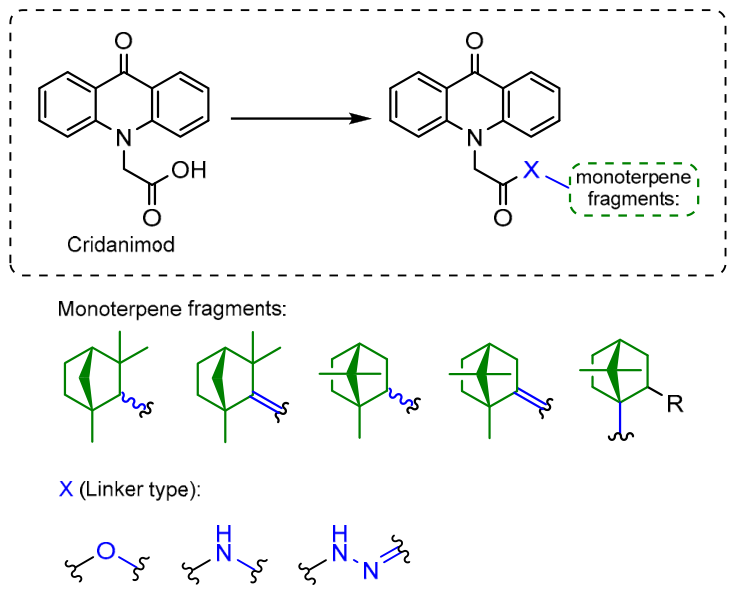
We hypothesized that linking the acridoneacetic acid core to bornane-type monoterpenoid fragments would yield new bioactive entities with measurable antinociceptive activity, despite the parent acridoneacetic acid not being known for such effects. To test this hypothesis, we designed and synthesized a focused library of thirteen cridanimod–monoterpene conjugates featuring three different linker types — amide, ester, and acylhydrazone (Scheme 1). The starting amines, alcohols, and hydrazones were drawn from four sources: (+)-camphor and (−)-fenchone, used as precursors to the corresponding primary amines (bornylamine and fenchylamine) and ketone-derived hydrazones; commercially available (−)-borneol and (+)-fenchol as the alcohol building blocks; ketopinic acid, providing access to amines bearing additional functional groups on the bornane skeleton; and non-terpenoid cyclohexanone-derived counterparts (cyclohexylamine, cyclohexanol, and cyclohexanone hydrazone), included in each series as controls to gauge the specific contribution of the bicyclic bornane framework. The analgesic activity of all synthesized compounds was then evaluated in vivo in mice using the acetic acid writhing test and the hot plate test, with diclofenac sodium as the reference drug.
2. Materials and Methods
2.1. Chemistry
2.1.1. General Procedure
1H and 13C NMR spectra were recorded on Bruker spectrometers (Bruker BioSpin GmbH, Ettlingen, Germany), including an AV-300 instrument at 300.13 MHz (1H) and 75.47 MHz (13C), an AV-400 instrument at 400.13 MHz (1H) and 100.61 MHz (13C), and a DRX-500 instrument at 500.13 MHz (1H) and 125.76 MHz (13C) in CDCl3; chemical shifts δ were reported in ppm relative to residual CHCl3 [d(CHCl3) 7.26, d(CDCl3) 77.16 ppm], J in Hz. The atom numbering in the compounds is given for the assignment of the NMR spectra signals and does not match with the atom numbering in the nomenclature name. High-resolution mass spectra were recorded on DFS ThermoScientific and Agilent 7200 Accurate Mass Q-TOF spectrometers (Agilent Tech., Santa Clara, CA, USA) in full scan mode in the range m/z 0-500, electron impact ionization 70 eV at direct sample input.
Separation and isolation of the reaction products was carried out using silica gel column chromatography (60-200 μm, Macherey-Nagel). Thin layer chromatography was performed on Merck silica gel (60 F254) TLC plates and visualised under 254 nm UV lamp. All reagents and other chemicals were purchased from Across, Merck, ABCR and TCI and used without further purification.
2.1.2. Synthesis of Cridanimod Amides (Compound 14-20)
To a stirred solution of the corresponding amine 1–4 (0.395 mmol) and DMAP (0.02 mmol) in anhydrous dichloromethane (20 mL per 1 mmol of acid) at room temperature was added acridoneacetic acid (0.395 mmol) in one portion. EDCI (0.513 mmol) was then added in one portion, and the resulting reaction mixture was stirred at room temperature for 12–18 h (reaction progress monitored by TLC).
After completion, the reaction mixture was successively washed with 10% aqueous citric acid, water, saturated aqueous Na2CO3, and brine. The organic layer was dried over anhydrous Na2SO4, filtered, and concentrated under reduced pressure. The crude product was purified by column chromatography on silica gel (CHCl3) to afford the corresponding acridoneacetic acid amides 14-20 as individual compounds.
2-(9-oxoacridin-10(9H)-yl)-N-((1R,2R,4S)-1,3,3-trimethylbicyclo[2.2.1]heptan-2-yl)acetamide (14). The compound was a light green powder, in a 62% yield, m.p.: 235.7–239.1 °C. 1H NMR (500 MHz, CDCl3) δ 8.58–8.51 (m, 2H, H-18, H-25), 7.73 (ddd, J = 8.8, 7.0, 1.6 Hz, 2H, H-20, H-23), 7.41–7.31 (m, 4H, H-19, H-21, H-22, H-24), 5.81 (d, J = 9.6 Hz, 1H, NH), 5.05–4.93 (m, 2H, 2-12), 3.62 (dd, J = 9.7, 1.9 Hz, 1H, H-6), 1.32–1.15 (m, 4H, H-2′, H-3″, H-4, H-7′), 1.08 (dd, J = 10.3, 1.6 Hz, 1H, H-7″), 1.04 (s, 3H, H-10), 0.84 (s, 3H, H-8), 0.81–0.69 (m, 1H, H-3′), 0.37 (s, 3H, H-9). 13C NMR (126 MHz, CDCl3) δ 178.04 (C-17), 167.24 (C-11), 141.91 (C-13, C-14), 134.58 (C-20, C-23), 128.26 (C-18, C-25), 122.70 (C-15, C-16), 122.61 (C-19, C-24), 114.52 (C-21, C-22), 63.21 (C-6), 51.31 (C-12), 48.45 (C-1), 47.84 (C-4), 42.36 (C-7), 39.17 (C-5), 30.83 (C-10), 26.74 (C-2), 25.61 (C-3), 21.14 (C-9), 19.44 (C-8). HRMS (EI) m/z calculated for C25H28O2N2 [M]+• 388.2145, found 388.2140.
2-(9-oxoacridin-10(9H)-yl)-N-((1R,2R,4R)-1,7,7-trimethylbicyclo[2.2.1]heptan-2-yl)acetamide (15). The compound was a light green powder, in a 75% yield, m.p.: 253.8–257.6 °C. 1H NMR (400 MHz, CDCl3) δ 8.58 (dd, 2H, H-18, H-25), 7.76 (ddd, J = 1.7, 7.0, 8.7 Hz, 2H, H-20, H-23), 7.42–7.33 (m, 4H, H-19, H-21, H-22, H-24), 5.72 (d, J = 9.2 Hz, 1H, NH), 4.96 (s, 2H, H-12), 3.87 (td, J = 4.6, 9.1 Hz, 1H, H-6), 1.75 (dd, J = 9.0, 13.5 Hz, 1H, H-5″), 1.65–1.47 (m, 2H, H-2″, H-4), 1.52–1.40 (m, 1H, H-3″), 1.28–1.15 (m, 3H, H-2′, H-5′), 1.11–0.99 (m, 1H, H-3′), 0.58 (s, 3H, H-9), 0.50 (s, 3H, H-8), 0.05 (s, 3H, H-10). 13C NMR (126 MHz, CDCl3) δ 178.28 (C-17), 167.81 (C-11), 141.59 (C-13, C-14), 133.76 (C-20, C-23), 128.38 (C-18, C-25), 122.65 (C-19, C-24), 122.01 (C-15, C-16), 114.47 (C-21, C-22), 64.45 (C-6), 48.77 (C-1), 47.16 (C-4), 41.22 (C-7), 39.56 (C-5), 29.99 (C-10), 26.55 (C-2), 25.61 (C-3), 21.41 (C-9), 19.47 (C-8). HRMS (EI) m/z calculated for C25H28O2N2 [M]+• 388.2149, found 388.2140.
2-(9-oxoacridin-10(9H)-yl)-N-((1R,2S,4R)-1,7,7-trimethylbicyclo[2.2.1]heptan-2-yl)acetamide (16). The compound was a light green powder, in a 84% yield, m.p.: 264.9–266.2 °C. 1H NMR (500 MHz, CDCl3) δ 8.47–8.43 (m, 2H, H-18, H-25), 7.77–7.72 (m, 2H, H-20, H-23), 7.39–7.35 (m, 2H, H-21, H-22), 7.34–7.29 (m, 2H, H-19, H-14), 5.07 (d, J = 9.1 Hz, 1H, NH), 5.02–4.92 (m, 2H, H-12), 4.35–4.28 (m, 1H, H-6), 2.30–2.22 (m, 1H, H-5″), 1.54–1.45 (m, 2H, H-4, H-3″), 1.12–1.02 (m, 1H, H-2″), 0.90 (s, 3H, H-2′, H-3′), 0.76 (s, 3H, H-9), 0.75–0.70 (m, 2H, H-8), 0.73 (s, 3H, H-10), 0.61–0.55 (m, 1H, H-5′). 13C NMR (126 MHz, CDCl3) δ 178.04 (C-17), 167.01 (C-11), 142.17 (C-13, C-14), 134.59 (C-20, C-23), 128.16 (C-18, C-25), 122.75 (C-19, C-24), 122.56 (C-15, C-16), 114.51 (C-21, C-22), 54.02 (C-6), 51.65 (C-12), 49.73 (C-1), 48.22 (C-7), 44.72 (C-4), 37.15 (C-5), 28.01 (C-3), 27.65 (C-2), 19.76 (C-8), 18.68 (C-9), 13.88 (C-10). HRMS (EI) m/z calculated for C25H28O2N2 [M]+• 388.2145, found 388.2138.
N-((1S,4R)-7,7-dimethyl-2-oxobicyclo[2.2.1]heptan-1-yl)-2-(9-oxoacridin-10(9H)-yl)acetamide (17). The compound was a light yellow powder, in a 42% yield, m.p.: 253.1–259.6 °C. 1H NMR (500 MHz, CDCl3) δ 8.58–8.53 (m, 2H, H-17, H-24), 7.76–7.70 (m, 2H, H-19, H-22), 7.40–7.31 (m, 4H, H-18, H-20, H-21, H-23), 6.27 (s, 1H, NH), 5.03–4.92 (m, 2H, H-11), 3.15–3.05 (m, 1H, H-6″), 2.35–2.27 (m, 1H, H-3″), 2.19–2.10 (m, 1H, H-5″), 2.02 (t, J = 4.5 Hz, 1H, H-4), 1.94 (d, J = 18.7 Hz, 1H, H-3′), 1.48–1.39 (m, 2H, H-5′, H-6′), 1.18 (s, 3H, H-9), 0.65 (s, 3H, H-8). 13C NMR (126 MHz, CDCl3) δ 212.65 (C-2), 178.21 (C-16), 167.57 (C-10), 142.27 (C-12, C-13), 134.47 (C-19, C-22), 128.23 (C-17, C-24), 122.86 (C-14, C-15), 122.39 (C-18, C-23), 114.42 (C-20, C-21), 73.02 (C-1), 51.76 (C-11), 48.56 (C-7), 41.25 (C-3), 40.51 (C-4), 26.71 (C-5), 22.55 (C-6), 21.39 (C-9), 19.28 (C-8). HRMS (EI) m/z calculated for C24H24O3N2 [M]+• 388.1781, found 388.1780.
N-((1S,2R,4R)-2-hydroxy-7,7-dimethylbicyclo[2.2.1]heptan-1-yl)-2-(9-oxoacridin-10(9H)-yl)acetamide (18). The compound was a white powder, in a 84% yield, m.p.: 262.5–262.9 °C. 1H NMR (500 MHz, CDCl3) δ 8.59–8.55 (m, 2H, H-17, H-24), 7.79–7.74 (m, 2H, H-19, H-22), 7.45–7.34 (m, 4H, H-18, H-20, H-21, H-23), 5.85 (s, 1H, NH), 5.03–4.93 (m, 2H, H-11), 4.34–4.29 (m, 1H, H-2), 2.82 (m, 1H, OH), 1.85–1.76 (m, 2H, H-3″, H-6″), 1.73–1.58 (m, 4H, H-3′, H-4, H-5″, H-6′), 1.16–1.10 (m, 1H, H-5′), 0.69 (s, 3H, H-9), 0.48 (s, 3H, H-8). 13C NMR (126 MHz, CDCl3) δ 178.09 (C-16), 167.97 (C-10), 141.96 (C-12, C-13), 134.74 (C-19, C-22), 128.34 (C-17, C-24), 122.78 (C-14, C-15), 122.68 (C-18, C-23), 114.41 (C-20, C-21), 75.01 (C-2), 67.18 (C-1), 51.66 (C-11), 47.10 (C-7), 41.79 (C-4), 39.38 (C-3), 30.35 (C-6), 27.03 (C-5), 20.07 (C-8), 19.23 (C-9). HRMS (EI) m/z calculated for C24H26O3N2 [M]+• 390.1938, found 390.1936.
N-((1r,4r)-7,7-dimethylbicyclo[2.2.1]heptan-1-yl)-2-(9-oxoacridin-10(9H)-yl)acetamide (19). The compound was a light green powder, in a 77% yield, m.p.: 246.3–249.2 °C. 1H NMR (300 MHz, CDCl3) δ 8.63–8.53 (m, 2H, H-17, H-24), 7.81–7.71 (m, 2H, H-19, H-22), 7.44–7.32 (m, 4H, H-18, H-20, H-21, H-23), 5.61 (s, 1H, NH), 4.91 (s, 2H, H-11), 2.19–2.06 (m, 2H, H-2″, H-6″), 1.81–1.56 (m, 4H, H-2′, H-3″, H-5″, H-6′), 1.56–1.49 (m, 1H, H-4), 1.34–1.20 (m, 2H, H-3′, H-5′), 0.47 (m, 6H, H-8, H-9). 13C NMR (75 MHz, CDCl3) δ 178.06 (C-16), 167.28 (C-10), 141.96 (C-12, C-13), 134.65 (C-19, C-22), 128.30 (C-17, C-24), 122.77 (C-14, C-15), 122.58 (C-18, C-23), 114.45 (C-20, C-21), 64.03 (C-1), 51.66 (C-11), 47.51 (C-7), 42.54 (C-4), 32.89 (C-2, C-6), 28.05 (C-3, C-5), 18.61 (C-8, C-9). HRMS (EI) m/z calculated for C24H26O2N2 [M]+• 374.1989, found 374.1986.
N-cyclohexyl-2-(9-oxoacridin-10(9H)-yl)acetamide (20). The compound was a light yellow powder, in a 79% yield, m.p.: 268.0–269.9 °C. 1H NMR (500 MHz, MeOD, CDCl3) δ 8.53–8.41 (dd, J = 8.0, 1.7 Hz, 2H, H-14, H-21), 7.81–7.74 (ddd, J = 8.7, 7.0, 1.8 Hz, 2H, H-15, H-20), 7.51–7.41 (d, J = 8.7 Hz, 2H, H-17, H-18), 7.40–7.29 (t, J = 7.5 Hz, 2H, H-16, H-19), 5.08–5.02 (s, 2H, H-8), 3.83–3.73 (m, 1H, H-6), 1.97–1.84 (m, 2H, H-1″, H-5″), 1.79–1.69 (m, 2H, H-2′, H-4′), 1.68–1.55 (m, 1H), 1.44–1.05 (m, 6H, H-1′, H-2″, H-3, H-4″, H-5′). 13C NMR (126 MHz, MeOD+CDCl3) δ 179.59 (C-13), 167.42 (C-7), 143.31 (C-9, C-10), 135.04 (C-16, C-19), 127.78 (C-14, C-21), 122.65 (C-11, C-12), 122.52 (C-15, C-20), 115.47 (C-17, C-18), 50.39 (C-8), 49.42 (C-6), 33.06 (C-1, C-5), 30.10, 25.79 (C-3), 25.39 (C-2, C-4). HRMS (EI) m/z calculated for C21H22O2N2 [M]+• 334.1676, found 334.1670.
2.1.3. Synthesis of Cridanimod Acylhydrazones (Compound 21-23)
To a stirred solution of the corresponding hydrazone 1–4 (0.395 mmol) and DMAP (0.05 mmol) in anhydrous dichloromethane (20 mL per 1 mmol of acid) at room temperature was added acridoneacetic acid (0.395 mmol) in one portion. EDCI (0.513 mmol) was then added in one portion, and the resulting reaction mixture was stirred at room temperature for 12–18 h (reaction progress monitored by TLC).
After completion, the reaction mixture was successively washed with 10% aqueous citric acid, water, saturated aqueous Na2CO3, and brine. The organic layer was dried over anhydrous Na2SO4, filtered, and concentrated under reduced pressure. The crude product was purified by column chromatography on silica gel (CHCl3) to afford the corresponding acridoneacetic aciylhydrazones 21-23 as individual compounds. When required, the reactions were carried out under an inert atmosphere using dry solvents.
2-(9-oxoacridin-10(9H)-yl)-N′-((1R,4S,Z)-1,3,3-trimethylbicyclo[2.2.1]heptan-2-ylidene)acetohydrazide (21). The compound was a white powder, in a 82% yield, m.p.: 259.2–264.7 °C. 1H NMR (400 MHz, CDCl3) δ 8.97–8.93 (s, 1H, NH), 8.60–8.50 (td, J = 7.7, 1.7 Hz, 2H, H-18, H-25), 7.78–7.62 (ddd, J = 8.7, 6.9, 1.7 Hz, 2H, H-20, H-23), 7.48–7.26 (m, 4H, H-19, H-21, H-22, H-24), 5.51–5.37, 5.13–5.03 (s, 2H, H-12), 1.91–1.86 (m, 1H, H-4), 1.84–1.53 (m, 4H, H-2′, H-3′, H-3″), 1.52–1.37 (m, 3H, H-2″, H-7), 1.31–1.20 (m, 6H, H-8, H-10), 1.18–1.11 (s, 3H, H-9). 13C NMR (101 MHz, CDCl3) δ 178.44, 177.75 (C-17), 170.81 (C-11), 168.61 (C-6), 142.83, 141.59 (C-13, C-14), 134.94, 133.93 (C-20, C-23), 128.38, 127.85 (C-18, C-25), 122.73 (C-15, C-16), 121.57 (C-19, C-24), 114.87, 114.47 (C-21, C-22), 51.76 (C-1), 50.31 (C-5), 49.86 (C-4), 47.90, 47.66 (C-12), 42.97, 42.68 (C-7), 34.35 (C-2), 25.08, 24.79 (C-3), 23.13 (C-9), 22.78 (C-8), 17.27 (C-10). HRMS (EI) m/z calculated for C25H27O2N3 [M]+• 401.2098, found 401.2093.
2-(9-oxoacridin-10(9H)-yl)-N′-((1R,4R,E)-1,7,7-trimethylbicyclo[2.2.1]heptan-2-ylidene)acetohydrazide (22). The compound was a white powder, in a 86% yield, m.p.: 219.6–222.2 °C. 1H NMR (500 MHz, CDCl3) δ 9.61 (s, 1H, NH), 8.57 (dd, J = 8.0, 1.7 Hz, 2H, H-18, H-25), 7.68 (ddd, J = 8.7, 6.9, 1.7 Hz, 2H, H-20, H-23), 7.36 (d, J = 8.7 Hz, 2H, H-21, H-22), 7.30 (t, J = 7.5 Hz, 1H, H-19, H-24), 5.47 (d, J = 5.0 Hz, 2H, H-12), 2.11–2.02 (m, 1H, H-5″), 1.85–1.67 (m, 3H, H-2, H-3″), 1.58 (d, J = 17.4 Hz, 1H, H-5′), 1.36 (ddd, J = 13.0, 9.3, 3.6 Hz, 1H, H-4), 1.31–1.20 (m, 0H, H-3′), 1.00 (s, 3H, H-8), 0.91 (s, 3H, H-10), 0.70 (s, 3H, H-9). 13C NMR (126 MHz, DMSO) δ 178.47 (C-17), 169.18 (C-11), 169.06 (C-6), 142.80 (C-13, C-14), 133.94 (C-20, C-23), 127.91 (C-18, C-25), 122.67 (C-15, C-16), 121.62 (C-19, C-24), 114.84 (C-21, C-22), 53.03 (C-1), 48.10 (C-12), 47.69 (C-7), 43.86 (C-4), 33.88 (C-5), 32.63 (C-2), 27.15 (C-3), 19.64 (C-9), 18.69 (C-8), 11.24 (C-10). HRMS (EI) m/z calculated for C25H27O2N3 [M]+• 401.2098, found 401.2103.
N’-cyclohexylidene-2-(9-oxoacridin-10(9H)-yl)acetohydrazide (23). The compound was a light yellow powder, in a 85% yield, m.p.: 262.3 – 262.7 °C. 1H NMR (500 MHz, DMSO-d6) δ 10.96 (s, 0.6H, NH), 10.84 (s, 0.4H, NH), 8.35 (d, J = 7.6 Hz, 2H, H-14, H-21), 7.84 – 7.76 (m, 2H, H-16, H-19), 7.65 (d, J = 8.9 Hz, 1H, H-17, H-18), 7.56 (d, J = 8.8 Hz, 1H), 7.38 – 7.31 (m, 2H, H-15, H-20), 5.58 (s, 1H), 5.32 (s, 1H, H-8), 2.50 – 2.45 (m, 2H, H-1, H-5), 2.30 (dt, J = 35.1, 6.2 Hz, 2H), 1.76 – 1.52 (m, 6H, H-2, H-3, H-4). 13C NMR (126 MHz, DMSO-d6) δ 176.84 (C-13), 168.66 (C-7), 163.77, 161.81 (C-6), 157.63, 142.56 (C-9, C-10), 134.25 (C-16, C-19), 126.62 (C-14, C-21), 121.60 (C-11, C-12), 121.49 (C-15, C-20), 116.01 (C-17, C-18), 47.50 (C-8), 35.31, 35.04 (C-1, C-5), 26.99 (C-2, C-4), 25.80, 25.20 (C-3). HRMS (EI) m/z calculated for C21H21O2N3 [M]+• 347.1628, found 347.1626.
2.1.4. Synthesis of Cridanimod Esters (Compound 24-26).
N,N′-Carbonyldiimidazole (1.97 mmol) was added portionwise to a solution of cridanimod (1.97 mmol) in anhydrous DMF (15–20 mL per 1 mmol) under an argon atmosphere. The reaction mixture was stirred at 40 °C for 1 h to allow complete formation of the corresponding acyl imidazolide.
DBU (1.97 mmol) was then added to the activated solution. Upon addition of DBU, the reaction mixture immediately turned dark orange. The corresponding alcohol (3.95 mmol) was subsequently added, and the mixture was stirred at 40 °C for 24 h under argon. After addition of the alcohol, the initially dark orange solution gradually faded over several hours, becoming pale yellow. The progressive discoloration of the reaction mixture served as a convenient visual indicator of reaction progress (TLC control was additionally performed).
After completion, the reaction mixture was cooled to room temperature and diluted with diethyl ether. The organic phase was washed successively with 10% aqueous HCl, water, and 10% aqueous K2CO3. The organic layer was dried over anhydrous Na2SO4, filtered, and concentrated under reduced pressure. The crude product was purified by column chromatography on silica gel using chloroform as eluent to afford the corresponding cridanimod esters 24-26 as individual compounds.
(1R,2R,4S)-1,3,3-trimethylbicyclo[2.2.1]heptan-2-yl 2-(9-oxoacridin-10(9H)-yl)acetate (24). The compound was a white powder, in a 79% yield, m.p.: 150.8–151.9 °C. ¹H NMR (500 MHz, CDCl₃) δ 8.57 (dd, J = 8.0, 1.7 Hz, 2H, H-18, H-25), 7.75–7.68 (m, 2H, H-20, H-23), 7.40–7.29 (m, 4H, H-19, H-21, H-22, H-24), 5.18–5.06 (m, 2H, H-12, H-12″), 4.43 (d, J = 2.0 Hz, 1H, H-6), 1.64 (d, J = 3.9 Hz, 1H, H-3′), 1.54–1.47 (m, 1H, H-4), 1.44–1.35 (m, 1H, H-2″), 1.34–1.23 (m, 1H, H-3″), 1.13–1.07 (m, 2H, H-2′, H-7′), 1.05 (s, 3H, H-10), 0.86 (s, 3H, H-8), 0.81 (tt, J = 12.5, 2.7 Hz, 1H, H-7″), 0.59 (s, 3H, H-9). 13C NMR (126 MHz, CDCl3) δ 178.29 (C-17), 168.82 (C-11), 142.27 (C-13, C-14), 134.17 (C-20, C-23), 128.16 (C-18, C-25), 122.64 (C-19, C-24), 122.02 (C-15, C-16), 114.37 (C-21, C-22), 88.47 (C-6), 48.37 (C-1), 48.16 (C-4), 41.22 (C-7), 39.59 (C-5), 29.67 (C-10), 26.25 (C-2), 25.62 (C-3), 20.41 (C-9), 19.27 (C-8). HRMS (EI) m/z calculated for C25H27O3N [M]+• 389.1986, found 389.1988.
(1R,2S,4R)-1,7,7-trimethylbicyclo[2.2.1]heptan-2-yl 2-(9-oxoacridin-10(9H)-yl)acetate (25). The compound was a white powder, in a 86% yield, m.p.: 129.6–131.1 °C. ¹H NMR (500 MHz, CDCl₃) δ 8.56 (dd, J = 8.0, 1.7 Hz, 2H, H-18, H-25), 7.71 (ddd, J = 8.7, 6.9, 1.7 Hz, 2H, H-20, H-23), 7.36–7.28 (m, 4H, H-19, H-21, H-22, H-24), 5.08 (d, J = 1.3 Hz, 2H, H-12), 5.01–4.94 (m, 1H, H-6), 2.34 (ddt, J = 13.8, 9.9, 4.0 Hz, 1H, H-5″), 1.73–1.68 (m, 1H, H-4), 1.63–1.52 (m, 2H, H-2″, H-3′), 1.29 (ddd, J = 13.3, 9.4, 4.2 Hz, 1H, H-3″), 1.07–0.97 (m, 1H, H-5′), 0.89–0.83 (m, 1H, H-2′), 0.84 (s, 3H, H-10), 0.77 (s, 3H, H-9), 0.64 (s, 3H, H-8). 13C NMR (126 MHz, CDCl3) δ 178.30 (C-17), 168.69 (C-11), 142.32 (C-13, C-14), 134.17 (C-20, C-23), 128.11 (C-18, C-25), 122.65 (C-19, C-24), 121.98 (C-15, C-16), 114.26 (C-21, C-22), 82.13 (C-6), 48.90 (C-1), 48.61 (C-12), 47.93 (C-7), 44.77 (C-4), 36.81 (C-5), 27.85 (C-2), 26.82 (C-3), 18.87 (C-10), 13.43 (C-9). HRMS (EI) m/z calculated for C25H27O3N [M]+• 389.1986, found 389.1983.
Cyclohexyl 2-(9-oxoacridin-10(9H)-yl)acetate (26). The compound was a light green powder, in a 82% yield, m.p.: 179.2–179.3 °C. 1H NMR (400 MHz, Chloroform-d) δ 8.60–8.53 (dd, J = 8.1, 1.7 Hz, 2H, H-14, H-21), 7.74–7.67 (ddd, J = 8.7, 7.0, 1.7 Hz, 2H, H-16, H-19), 7.35–7.28 (m, 4H, H-15, H-17, H-18, H-20), 5.07–5.02 (s, 2H, H-8), 4.98–4.89 (m, 1H, H-6), 1.88–1.78 (m, 2H, H-1″, H-5″), 1.64–1.54 (m, 2H, H-2′, H-4′), 1.53–1.15 (m, 6H, H-2″, H-3, H-4″). 13C NMR (101 MHz, CDCl3) δ 178.32 (C-13), 167.85 (C-7), 142.45 (C-9, C-10), 134.15 (C-16, C-19), 128.08 (C-14, C-21), 122.76 (C-11, C-12), 121.94 (C-15, C-20), 114.36 (C-17, C-18), 74.88 (C-6), 48.84 (C-8), 31.49 (C-1, C-5), 25.23 (C-3), 23.48 (C-2, C-4). HRMS (EI) m/z calculated for C21H21O3N [M]+• 335.1516, found 335.1517.
2.2. Biological Studies
2.2.1. Animals
All studies were carried out on non-breeding CD-1 albino mice (male) weighing 20-25 g, 8 animals in each group (SPF-vivarium of the Institute of Cytology and Genetics of the Siberian Branch of the Russian Academy of Sciences). Mice were maintained at 22-25oC on a 12 h light-dark cycle with food and water available ad libitum.
The study protocol was approved by the Bioethics Commission of the Laboratory of Pharmacological Research, N.N. Vorozhtsov Novosibirsk Institute of Organic Chemistry, SB RAS (Protocol No. R-14-2026-04-01 dated April 1, 2026). All animal experiments were carried out in accordance with the guidelines laid down in the legislation of the Russian Federation and European Union Directive of 22 September 2010 (2010/63/EU).
2.2.2. Analgesic Tests
Agents were dissolved in saline containing 0.5% Tween 80 just before use and were administered per os, 1 hour before testing. Control group: saline was administered per os in blank mice (0.2 ml per 10 g of animal weight), 1 hour before testing. Analgesic activity of test agents was assessed using acetic acid-induced writhing test and hot plate test.
In the hot plate test, animals were placed individually on a metallic plate (VWR Hotplate/Stirrer 725-HPS, U.S.A.) warmed to 54±0.5oC until either licking of the hind paw or jumping [16]. This time of pain response was recorded by a stopwatch and the animal was immediately taken away from the plate and put back into the cage. A 60 second cut-off time is assigned in this protocol. The percentage of protection (P) was calculated according to the following equation: Protection P (%) = 100%•(Kexp – Kcontrol)/Kcontrol, where Kcontrol is the mean time on the hot plate in the control group, and Kexp is the mean time on the hot plate in the test group.
In the acetic acid-induced writhing test, the pain reaction was determined by the number of abdominal convulsions, recorded from the 5th to the 8th min following the acetic acid injection (0.75%, 0.1 mL/10 g body weight) [17,18]. The percentage of inhibition of pain response (IPR) was calculated according to the following equation: Inhibition of pain response (IPR) = 100%•(Kcontrol – Kexp)/Kcontrol, where Kcontrol is the mean number of writhes in the control group, and Kexp is the mean number of writhes in the test group.
Statistical analysis was conducted in Statistica 10.0 program using the Mann-Whitney U Test to assess the significance (p<0.05) of differences. The data are presented in the format: mean ± standard error of the mean (SE).
3. Results and Discussion
3.1. Chemistry
To evaluate how the linker nature and the monoterpene substitution affect analgesic activity, we designed a library of 13 cridanimod–monoterpene conjugates covering three connection types: amides (14–20), acylhydrazones (21–23), and esters (24–26) (Scheme 1). The starting amines, alcohols, and hydrazones were drawn from four distinct sources. First, (+)-camphor and (−)-fenchone served as precursors to bornylamine and fenchylamine (for amide formation) and to the corresponding hydrazones (for acylhydrazone formation). Second, commercially available (−)-borneol and (+)-fenchol were used directly as the alcohol building blocks for ester formation. Third, ketopinic acid provided access to amines 7–9 bearing additional functional groups at the bornane skeleton. Finally, non-terpenoid cyclohexanone-derived counterparts (cyclohexylamine, cyclohexanol, and cyclohexanone hydrazone) were included in each series as controls to gauge the specific contribution of the bicyclic bornane framework. Within the amide series, structural variation at the carbon bearing the nitrogen was explored: primary bornyl- and fenchyl-amines, amines carrying an additional carbonyl or hydroxy group (derived from ketopinic acid), and the 7,7-dimethylnorbornyl-amine. A cyclohexyl counterpart was included in each series as a non-terpenoid control to gauge the specific contribution of the bicyclic bornane framework.
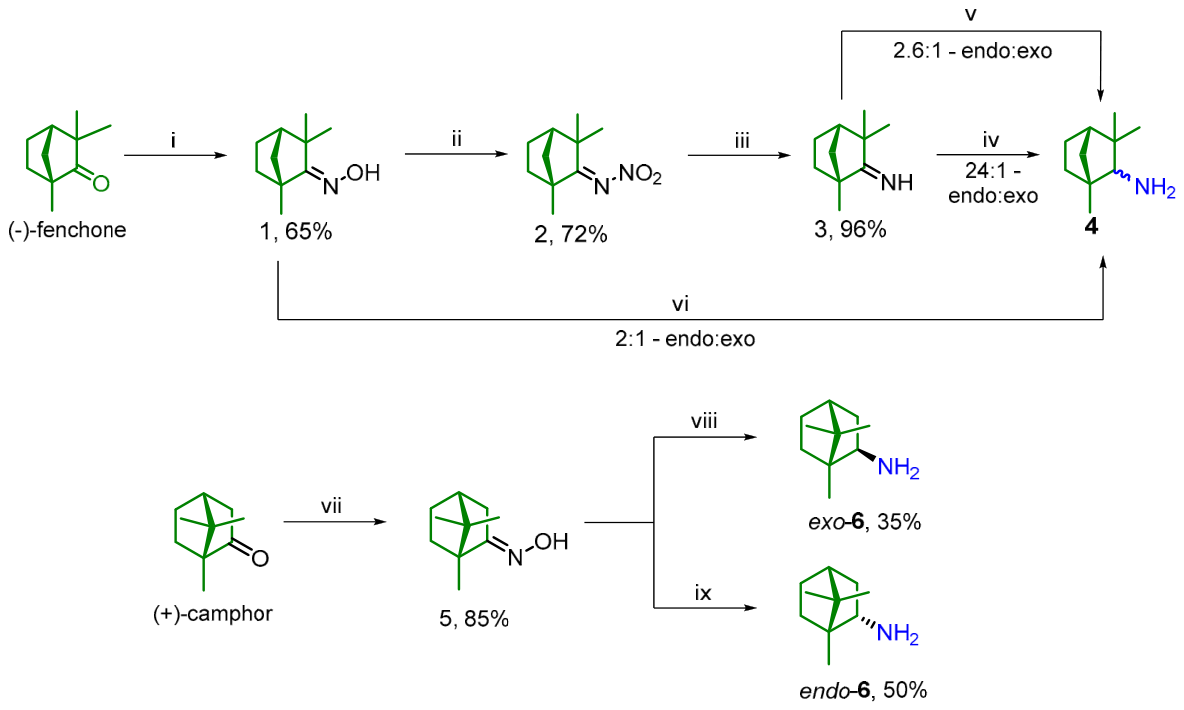
Synthesis of starting amines and hydrazones. Fenchylamine 4, bornylamine 6, amines 7–9, and cyclohexylamine were selected as starting materials for the preparation of cridanimod amides. Commercially available fenchone was sequentially converted to oxime 1 and then to nitroimine 2 following reported procedures; treatment of the latter with gaseous ammonia in dry THF afforded imine 3, which was subsequently reduced with sodium borohydride in methanol to give fenchylamine 4 with a predominance of the endo-isomer (endo:exo = 24:1). The second method involved reduction of oxime 1 with a nickel–aluminum alloy under alkaline conditions, affording a mixture of endo- and exo-isomers 4 in a 2:1 ratio. In the third approach, imine 3 was reduced with sodium cyanoborohydride in acidic medium (H₂SO₄), providing an isomer ratio of 2.6:1. In all cases, the reaction mixtures were analyzed by derivatization of the monoterpene amines with Boc₂O, followed by determination of the ratio of the obtained derivatives by GC/MS. The results of the reaction mixture analysis are presented in Scheme 2. Both the exo- and endo-isomers of bornylamine 6 were synthesized from (+)-camphor following reported procedures. [19].
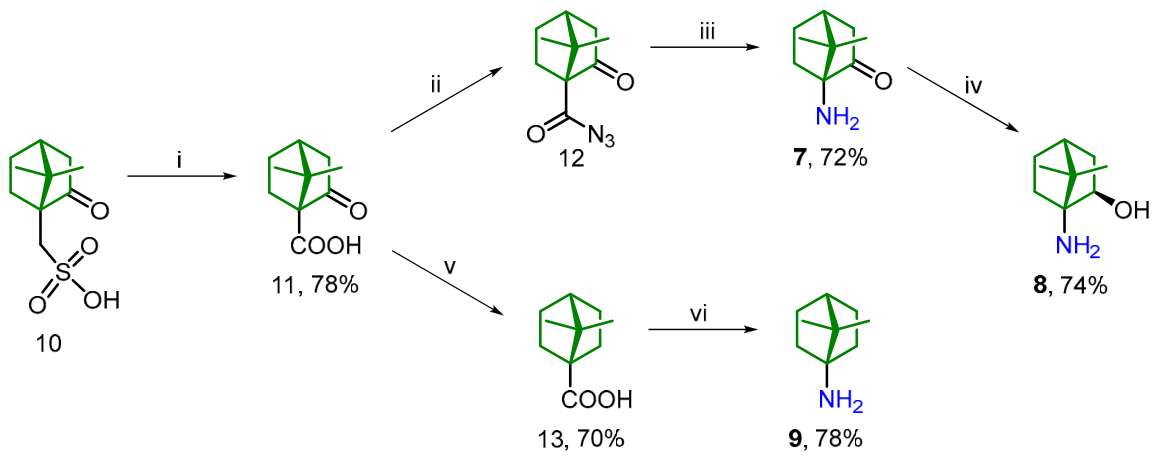
Amines 7–9 were prepared from a common starting material, following our previously established procedures [20] (Scheme 3). The synthesis starts with the two-step conversion of camphor-10-sulfonic acid 10 into ketopinic acid 11. To obtain amine 7, ketopinic acid 11 was first converted to the corresponding acid chloride and then to the acyl azide 12, which was then subjected to Curtius rearrangement in refluxing toluene, followed by hydrolysis of the resulting isocyanate. Amine 8 was synthesized via the reduction of amine 7 using NaBH4 in MeOH with CeCl3·7H2O. Amine 9 was synthesized from ketopinic acid 11 via Wolff–Kishner reduction to acid 13, followed by a Schmidt reaction.
Commercially available cyclohexylamine and cyclohexanol were used without further purification. Camphor and fenchone hydrazones were obtained by reaction of the corresponding ketones with hydrazine hydrate in ethanol. The structures of the obtained amines and hydrazones were confirmed by NMR spectroscopy and high-resolution mass spectrometry.
Screening of activation methods for acridoneacetic acid. Due to steric hindrance of the monoterpene substrates, activation of the carboxylic group of acridoneacetic acid proved non-trivial. Seven strategies were systematically examined using monoterpene amines, hydrazones, and alcohols prior to the preparation of the target conjugates (Table 1).
Four of the strategies proved unsuitable. Acyl chloride activation with SOCl₂ (entry 1) produced the target compounds but was consistently accompanied by significant amounts of inseparable byproducts, which precluded isolation of analytically pure material. Mixed-anhydride activation with ethyl chloroformate (entry 2) cleanly afforded the mixed-anhydride intermediate (confirmed by NMR monitoring), but no coupling to amines, hydrazones, or alcohols was observed under any of the conditions tested. HBTU in the presence of DIPEA (entry 3) did not activate acridoneacetic acid, with full recovery of the starting material. DCC/DMAP (entry 4) afforded the target amides, but the stoichiometric N,N′-dicyclohexylurea byproduct co-eluted with the products on silica gel and could not be removed by chromatography.
Two protocols ultimately proved satisfactory. For amides and acylhydrazones, the water-soluble carbodiimide EDCl together with DMAP in anhydrous dichloromethane (entry 5) gave clean couplings; the EDC-derived urea is water-soluble and is readily removed during aqueous workup. The same protocol, however, failed to promote esterification of the bornane-type alcohols, consistent with the low nucleophilicity of sterically hindered secondary alcohols toward carbodiimide-activated intermediates. For ester formation (entry 6), CDI activation in anhydrous DMF at 40 °C cleanly generated the acyl imidazolide intermediate; subsequent addition of the alcohol furnished the ester only in the presence of DBU (1.0 equiv), whereas Et₃N and DIPEA were ineffective under otherwise identical conditions. A distinctive fading of the deep orange color of the reaction mixture upon DBU addition served as a convenient visual indicator of reaction progress, complementing TLC monitoring.
Synthesis of the target cridanimod–monoterpene conjugates. With reliable activation protocols identified, the 13 target conjugates were assembled under the optimized conditions (Scheme 4). EDC/DMAP-mediated coupling of acridoneacetic acid with amines 4, 6, 7–9, and cyclohexylamine furnished the seven amides 14–20 in 42–84% isolated yield. Under the same conditions, condensation with the (+)-camphor, (−)-fenchone, and cyclohexanone-derived hydrazones delivered the three acylhydrazones 21–23 in 82–86% yield. Esters 24–26 were obtained from (-)-borneol, (+)-fenchol, and cyclohexanol, respectively, by CDI/DBU activation in DMF, in 79–86% yield. All target compounds were purified by silica gel column chromatography and characterized spectroscopically (see Materials and Methods).
3.2. Biology
The analgesic activity of acridoneacetic acid, Cycloferon®, and the obtained cridanimod–monoterpene conjugates 14-26 in a dose of 10.0 mg/kg (oral administration) was studied in the standard experimental pain models, namely the acetic acid-induced writhing (0.75% acetic acid, 0.1 mL for one animal, intraperitoneally) and hot plate (thermal stimulation, 54 ± 0.5 °C) tests. Sodium diclofenac in the same dose was used as a reference drug (Table 2). The acetic acid-induced writhing test is designed to evaluate acute visceral and deep somatic pain. Acetic acid induces chemical irritation and an inflammatory response in the abdominal cavity, with subsequent activation of nociceptors. The animals react with typical animal movements involving abdominal muscle contractions alternating with relaxation, extension of the hind limbs and arching of the back which is called writhing [21]. The hot plate test is employed to quantify the analgesic effect of test substances following thermal stimulation. In this test, the effect is assessed by the duration of presence of animals placed individually on a metallic plate warmed to 54.0 ± 0. 5 °C until either licking of the hind paw or jumping which was recorded by a stopwatch [21].
Neither acridoneacetic acid nor Cycloferon® exhibited activity in either test, indicating a lack of analgesic effect. However, some cridanimod–monoterpene conjugates exhibited analgesic activity in at least one assay. Among the agents containing an amide substituent, compounds 17 and 19 significantly decreased the number of acetic acid-induced writhings (-38.9% and -63.7%, respectively), whereas compound 14 demonstrated analgesic activity on the hot plate (+62.1%). In addition, compound 20 tended to lower the number of acetic acid-induced writhing (p = 0.09). Among the agents containing an acylhydrazone fragment, compound 21 exhibited significant analgesic activity in acetic acid-induced writhing test (-57.6%), and compound 23 showed a trend toward a lower number of writhings (p = 0.09). Moreover, compound 23 significantly increased the latency period on the hot plate (+43.9%). Among the esters, only compound 26 demonstrated a significant analgesic activity in the hot plate test (+41.8%). The data are shown graphically in Figure 1.
Based on the obtained data, the following lead compounds can be identified: amide 19, which was comparable to the reference drug diclofenac in the writhing test (−63.7% vs −64.4%), and acylhydrazone 23, which outperformed diclofenac in the hot plate test (+43.9% vs +25.7%). Taken together, these findings indicate that derivatization of acridoneacetic acid may represent a viable approach to the development of new analgesic agents.
4. Conclusions
In this study, we explored the previously untapped analgesic potential of cridanimod (acridoneacetic acid) through molecular hybridization with bornane-type monoterpenoid fragments. A focused library of thirteen conjugates — seven amides, three acylhydrazones, and three esters — was assembled using two complementary protocols identified by systematic screening of seven activation strategies: EDC/DMAP-mediated coupling for the amides and acylhydrazones, and CDI/DBU-promoted esterification for the sterically hindered bornane alcohols. In vivo evaluation in the acetic acid writhing and hot plate tests revealed a clear contrast: whereas the parent acridoneacetic acid and its meglumine salt Cycloferon® were devoid of analgesic activity, six of the thirteen conjugates were significantly active (p < 0.05) in at least one model, with two distinct leads emerging — the amide 19, which matched the reference NSAID diclofenac in the writhing test (−63.7% vs −64.4%), and the acylhydrazone 23, which surpassed diclofenac in the hot plate test (+43.9% vs +25.7%).
These findings demonstrate that conjugation transforms an analgesically inactive immunomodulator into derivatives that match or exceed a standard NSAID at the same oral dose, while the divergent activity profiles across the structural subclasses suggest that the linker type and monoterpene fragment together modulate the balance between peripheral and central antinociceptive mechanisms. Acridoneacetic acid thus represents a viable and largely unexplored scaffold for analgesic drug design, and further studies directed at elucidating the underlying mechanisms of action, refining the structure–activity relationships, and assessing the safety and pharmacokinetic profiles of the lead compounds are currently underway.
Supplementary Materials
The following supporting information can be downloaded at the website of this paper posted on Preprints.org.
Author Contributions
Conceptualization, D.D.A., O.I.Y., K.S.K; methodology, D.D.A., A.Y.F., A.V.P.; O.I.Y., K.S.K, M.V.K. T.G.T.; investigation, D.D.A., S.A.T., A.A.S; resources, A.V.P., M.V.K., T.G.T.; data curation, D.D.A., A.Y.F., S.A.T.; formal analysis, D.D.A., A.Y.F., S.A.T., A.A.S, A.Y.V; writing—original draft, D.D.A., A.Y.F., O.I.Y., A.V.P.; writing—review and editing, K.S.K., O.I.Y., A.Y.V.; validation, O.I.Y.; supervision, A.V.P., K.S.K., M.V.K., T.G.T., N.F.S.; project administration, K.S.K; funding acquisition, O.I.Y., N.F.S.;, All authors have read and agreed to the published version of the manuscript.
Funding
This work was financially supported by the Russian Science Foundation and the Government of the Novosibirsk region (Project № 26-23-20046.
Institutional Review Board Statement
Not applicable.
Informed Consent Statement
Not applicable.
Data Availability Statement
Not applicable.
Acknowledgments
The authors would like to acknowledge the Multi-Access Chemical Service Centre SB RAS for spectral and analytical measurements. The authors also gratefully acknowledge Polysan for providing acridoneacetic acid.
Conflicts of Interest
The authors declare no conflict of interest.
References
- Cohen, S.P.; Vase, L.; Hooten, W.M. Chronic Pain: An Update on Burden, Best Practices, and New Advances. The Lancet 2021, 397, 2082–2097. [Google Scholar] [CrossRef] [PubMed]
- Domper Arnal, M.-J.; Hijos-Mallada, G.; Lanas, A. Gastrointestinal and Cardiovascular Adverse Events Associated with NSAIDs. Expert Opin. Drug Saf. 2022, 21, 373–384. [Google Scholar] [CrossRef] [PubMed]
- Vascular and Upper Gastrointestinal Effects of Non-Steroidal Anti-Inflammatory Drugs: Meta-Analyses of Individual Participant Data from Randomised Trials. The Lancet 2013, 382, 769–779. [CrossRef] [PubMed]
- Kovalenko, A.L.; Romantsev, M.G.; Ershov, F.I. Acridonacetic acid: pharmacological properties and clinical use. Zh. Mikrobiol. Epidemiol. Immunobiol. 2000, 103–108. [Google Scholar] [CrossRef] [PubMed]
- Keyer, V.; Syzdykova, L.; Zauatbayeva, G.; Zhulikeyeva, A.; Ramanculov, Y.; Shustov, A.V.; Shulgau, Z. Tilorone and Cridanimod Protect Mice and Show Antiviral Activity in Rats despite Absence of the Interferon-Inducing Effect in Rats. Pharmaceuticals 2022, 15, 617. [Google Scholar] [CrossRef] [PubMed]
- Mazina, N.K.; Sheshunov, I.V.; Mazin, P.V.; Mazin, V.P.; Kovalenko, A.L.; Zaplutanov, V.A. Clinical Efficacy of the Immunomodulatory Agent Cycloferon (Tablets) in Viral Respiratory Infections: Results of a Systematic Review and Meta-Analysis. Ter. Arkh. 2017, 89, 84–92. [Google Scholar] [CrossRef] [PubMed]
- Plotnikova, M.A.; Klotchenko, S.A.; Kiselev, A.A.; Gorshkov, A.N.; Shurygina, A.-P.S.; Vasilyev, K.A.; Uciechowska-Kaczmarzyk, U.; Samsonov, S.A.; Kovalenko, A.L.; Vasin, A.V. Meglumine Acridone Acetate, the Ionic Salt of CMA and N-Methylglucamine, Induces Apoptosis in Human PBMCs via the Mitochondrial Pathway. Sci. Rep. 2019, 9, 18240. [Google Scholar] [CrossRef] [PubMed]
- Cavlar, T.; Deimling, T.; Ablasser, A.; Hopfner, K.; Hornung, V. Species-specific Detection of the Antiviral Small-molecule Compound CMA by STING. EMBO J. 2013, 32, 1440–1450. [Google Scholar] [CrossRef] [PubMed]
- Zhurinov, M.Zh.; Miftakhova, A.F.; Keyer, V.; Shulgau, Z.T.; Solodova, E.V.; Kalykberdiyev, M.K.; Abilmagzhanov, A.Z.; Talgatov, E.T.; Ait, S.; Shustov, A.V. Glycyrrhiza Glabra L. Extracts and Other Therapeutics against SARS-CoV-2 in Central Eurasia: Available but Overlooked. Molecules 2023, 28, 6142. [Google Scholar] [CrossRef] [PubMed]
- Salakhutdinov, N.F.; Volcho, K.P.; Yarovaya, O.I. Monoterpenes as a Renewable Source of Biologically Active Compounds. Pure Appl. Chem. 2017, 89, 1105–1117. [Google Scholar] [CrossRef]
- Zielińska-Błajet, M.; Feder-Kubis, J. Monoterpenes and Their Derivatives—Recent Development in Biological and Medical Applications. Int. J. Mol. Sci. 2020, 21, 7078. [Google Scholar] [CrossRef] [PubMed]
- Sokolova, A.S.; Kovaleva, K.S.; Kuranov, S.O.; Bormotov, N.I.; Borisevich, S.S.; Zhukovets, A.A.; Yarovaya, O.I.; Serova, O.A.; Nawrozkij, M.B.; Vernigora, A.A.; et al. Design, Synthesis, and Biological Evaluation of (+)-Camphor- and (−)-Fenchone-Based Derivatives as Potent Orthopoxvirus Inhibitors. ChemMedChem 2022, 17, e202100771. [Google Scholar] [CrossRef] [PubMed]
- Almeida, J.R.G.D.S.; Souza, G.R.; Silva, J.C.; Saraiva, S.R.G.D.L.; Júnior, R.G.D.O.; Quintans, J.D.S.S.; Barreto, R.D.S.S.; Bonjardim, L.R.; Cavalcanti, S.C.D.H.; Junior, L.J.Q. Borneol, a Bicyclic Monoterpene Alcohol, Reduces Nociceptive Behavior and Inflammatory Response in Mice. Sci. World J. 2013, 2013, 808460. [Google Scholar] [CrossRef] [PubMed]
- Wang, X.; Guo, C.; Shao, J.; Zou, X.; Xing, S.; Xu, C.L.; Zhao, Q.; Wu, Y.; Sun, C.; Chen, Y.; et al. Small Molecule-Drug Conjugates: An Emerging Drug Design Strategy for Targeted Therapeutics. J. Med. Chem. 2025, 68, 24759–24784. [Google Scholar] [CrossRef] [PubMed]
- De Sena Murteira Pinheiro, P.; Franco, L.S.; Montagnoli, T.L.; Fraga, C.A.M. Molecular Hybridization: A Powerful Tool for Multitarget Drug Discovery. Expert Opin. Drug Discov. 2024, 19, 451–470. [Google Scholar] [CrossRef] [PubMed]
- Eddy, N.B.; Leimbach, D. Synthetic Analgesics. II. Dithienylbutenyl- and Dithienylbutylamines. J. Pharmacol. Exp. Ther. 1953, 107, 385–393. [Google Scholar] [CrossRef] [PubMed]
- Morozova, E.A.; Tolstikova, T.G.; Bolkunov, A.V.; Dolgikh, M.P.; Shul’ts, E.E. Analgesic Properties of New Pyrrolidinomorphinane Derivatives: Revealing Potential Pathways. Nat. Prod. Commun. 2008, 3, 1934578X0800301008. [Google Scholar] [CrossRef]
- Koster, R.; Anderson, M.; de Beer, E.J. Acetic Acid for Analgesic Screening. Fed. Proc. 1959, 18, 412–414. [Google Scholar]
- Tishchenko, S.A.; Sokolova, A.S.; Yarovaya, O.I.; Krasnov, V.I.; Shtro, A.A.; Galochkina, A.V.; Klabukov, A.M.; Razgulyaeva, D.N.; Salakhutdinov, N.F. Synthesis of Secondary Amines of Bornylamine and Isobornylamine Containing a Saturated N-Heterocycle and Study of Their Antiviral Activity against Respiratory Syncytial Virus. Russ. J. Gen. Chem. 2025, 95, 79–87. [Google Scholar] [CrossRef]
- Tishchenko, S.А.; Sokolova, A.S.; Arbuzova, M.A.; Selyutina, O.Yu.; Tsypyshev, D.O.; Yarovaya, O.I.; Arkhipov, S.G.; Salakhutdinov, N.F. Synthesis and a Kinetic Study of the Reactivity of 1-Amino-7,7-dimethylbicyclo[2.2.1]Heptan-2-one in Alkylation Reactions with Structurally Similar Amines. ChemistrySelect 2025, 10, e05689. [Google Scholar] [CrossRef]
- Kokova, Vesela; Apostolova, Elisaveta. Experimental Models and Tests for Nociceptive and Neuropathic Pain Evaluation. Knowl.-Int. J. 2022, 51, 609–614. [Google Scholar]
Scheme 1.
General scheme of acridoneacetic acid modification.
Scheme 2.
Synthesis of fenchylamine and bornylamine. Reagents and conditions: (i): NH2OH⋅HCl, Et3N, EtOH, reflux; (ii): NaNO2, H2SO4, Et2O/H2O; (iii): NH3 (gas), THF, 0 °C; (iv): NaBH4, MeOH; (v): NaBH3CN, AcOH, MeOH; (vi): Ni-Al, KOH, THF; (vii): NH2OH⋅HCl, Et3N, EtOH, reflux; (viii): NaBH4, NiCl2⋅6H2O, MeOH, -40 °C; (ix): Ni/Al, NaOH, r.t.
Scheme 2.
Synthesis of fenchylamine and bornylamine. Reagents and conditions: (i): NH2OH⋅HCl, Et3N, EtOH, reflux; (ii): NaNO2, H2SO4, Et2O/H2O; (iii): NH3 (gas), THF, 0 °C; (iv): NaBH4, MeOH; (v): NaBH3CN, AcOH, MeOH; (vi): Ni-Al, KOH, THF; (vii): NH2OH⋅HCl, Et3N, EtOH, reflux; (viii): NaBH4, NiCl2⋅6H2O, MeOH, -40 °C; (ix): Ni/Al, NaOH, r.t.
Scheme 3.
– Synthesis of amines 7–9. Reagents and conditions: (i) 1) SOCl2, reflux, 3 h, 2) KMnO4, Na2CO3, 80 °C; (ii) 1) SOCl2, reflux, 3 h, 2) NaN3, acetone/H2O; (iii) 1) toluene, reflux, 2) H+, reflux, 8 h; (iv) NaBH4, CeCl3·7H2O, MeOH, −30 °C, 4 h; (v) N2H4·H2O, KOH, reflux, 8 h; (vi) H2SO4, NaN3, 50 °C, 1 h.
Scheme 3.
– Synthesis of amines 7–9. Reagents and conditions: (i) 1) SOCl2, reflux, 3 h, 2) KMnO4, Na2CO3, 80 °C; (ii) 1) SOCl2, reflux, 3 h, 2) NaN3, acetone/H2O; (iii) 1) toluene, reflux, 2) H+, reflux, 8 h; (iv) NaBH4, CeCl3·7H2O, MeOH, −30 °C, 4 h; (v) N2H4·H2O, KOH, reflux, 8 h; (vi) H2SO4, NaN3, 50 °C, 1 h.
Scheme 4.
– General scheme of synthesis and structures of the obtained acridoneacetic acid derivatives.
Scheme 4.
– General scheme of synthesis and structures of the obtained acridoneacetic acid derivatives.
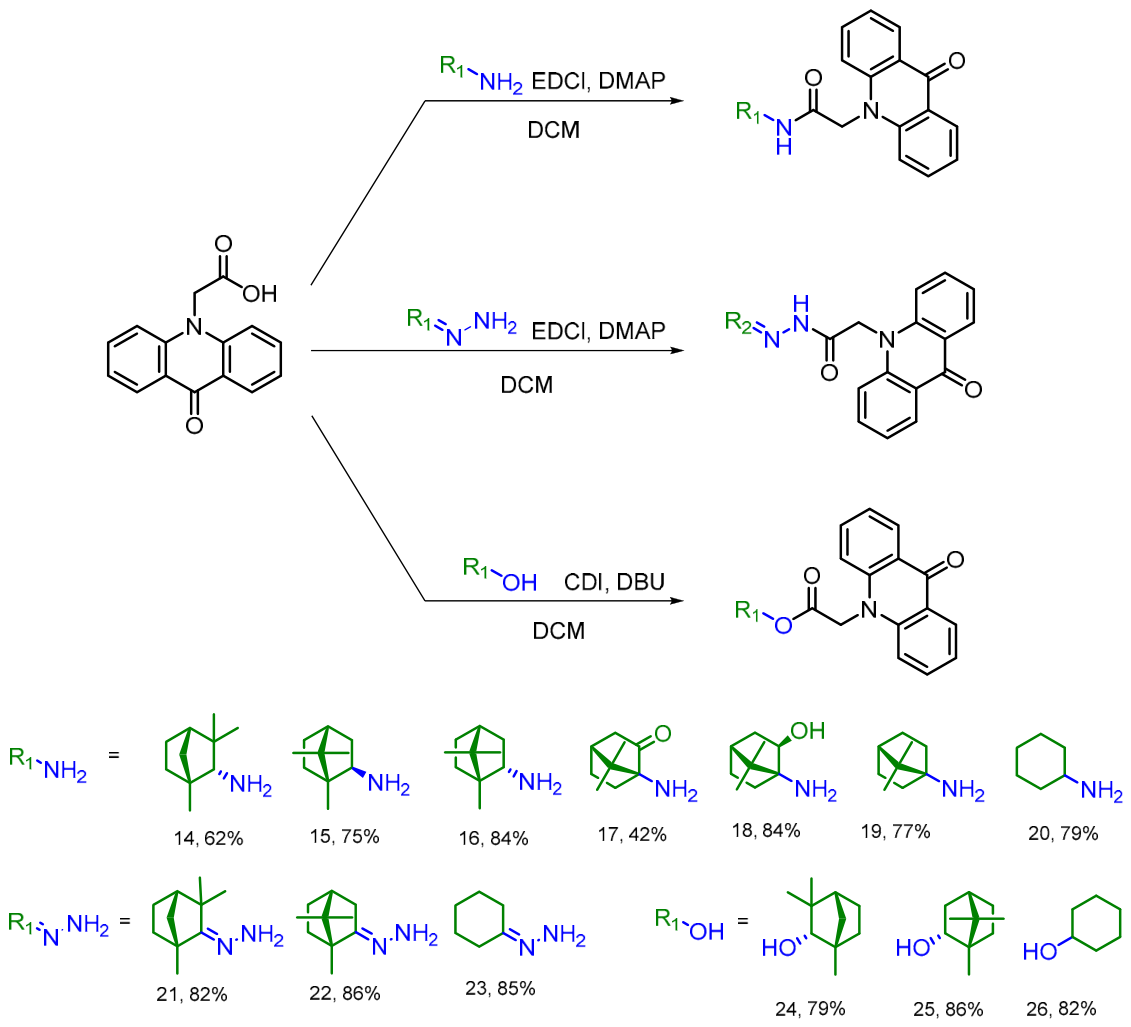
Figure 1.
(a) Inhibition of pain response (IPR) in the acetic acid-induced writhing; (b) Protection (P) in the hot plate test. p is the criterion for the presence of statistically significant differences in data compared to the control group: * p < 0.05. Data are presented as percentage of control, which was set to 100%.
Figure 1.
(a) Inhibition of pain response (IPR) in the acetic acid-induced writhing; (b) Protection (P) in the hot plate test. p is the criterion for the presence of statistically significant differences in data compared to the control group: * p < 0.05. Data are presented as percentage of control, which was set to 100%.
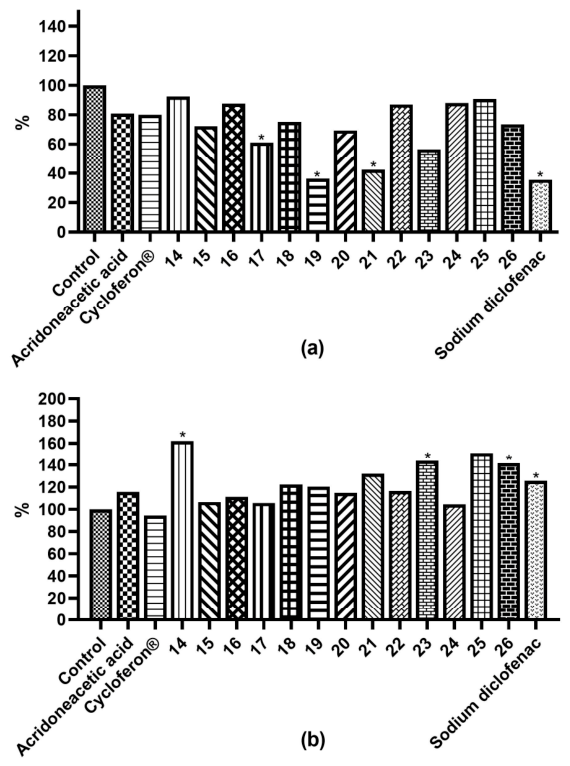

Table 1.
Screening of activation methods for the reaction of acridoneacetic acid with monoterpene amines, hydrazones, and alcohols.
Table 1.
Screening of activation methods for the reaction of acridoneacetic acid with monoterpene amines, hydrazones, and alcohols.
| Entry | Activation method | Reagents | Product class | Outcome |
|---|---|---|---|---|
| 1 | Acyl chloride | SOCl2 | amides, acylhydrazones |
Target products formed, accompanied by inseparable byproducts |
| 2 | Mixed anhydride | ClCO₂Et, Et₃N | amides, acylhydrazones |
Mixed anhydride formed, but no conversion to target products |
| 3 | Uronium salt | HBTU, DIPEA | amides | No conversion of starting acid |
| 4 | Carbodiimide | DCC, DMAP | amides, acylhydrazones | Target amides were formed, but proved difficult to separate from N,N′-dicyclohexylurea. |
| 5 | Carbodiimide | EDCl, DMAP | amides, acylhydrazones | Clean couplings; esters not formed |
| 6 | Acyl imidazolide | CDI; CDI, Et₃N; CDI, DIPEA |
esters | CDI reacted with the acid, but no substitution by the alcohol occurred |
| 7 | Acyl imidazolide | CDI, DBU | esters | Successful esterification |
Table 2.
Analgesic activity of acridoneacetic acid, Cycloferon®, compounds 14-26, and sodium diclofenac (10.0 mg/kg dose).
Table 2.
Analgesic activity of acridoneacetic acid, Cycloferon®, compounds 14-26, and sodium diclofenac (10.0 mg/kg dose).
| Compound | Acetic acid-induced writhing, N | Hot plate, τ/s | ||
|---|---|---|---|---|
| Control | Agent (IPR (%))a | Control | Agent (P (%))b | |
| Acridoneacetic acid | 11.0 ± 2.2 | 8.9 ± 1.6 | 8.9 ± 1.2 | 10.3 ± 1.7 |
| Cycloferon® | 11.0 ± 2.2 | 8.8 ± 1.6 | 8.9 ± 1.2 | 8.4 ± 1.3 |
| 14 | 9.2 ± 1.0 | 8.5 ± 1.4 | 8.7 ± 1.0 | 14.1 ± 1.6* (+62.1%) |
| 15 | 10.8 ± 0.7 | 7.8 ± 1.9 | 12.1 ± 1.9 | 12.9 ± 1.8 |
| 16 | 11.3 ± 2.4 | 9.9 ± 2.0 | 9.8 ± 1.1 | 10.9 ± 1.1 |
| 17 | 10.8 ± 0.7 | 6.6 ± 1.4* (-38.9%) | 12.1 ± 1.9 | 12.8 ± 0.9 |
| 18 | 11.3 ± 2.4 | 8.5 ± 2.1 | 9.8 ± 1.1 | 12.0 ± 1.3 |
| 19 | 11.3 ± 2.4 | 4.1 ± 1.2* (-63.7%) | 9.8 ± 1.1 | 11.8 ± 0.8 |
| 20 | 10.8 ± 0.7 | 7.5 ± 1.3 | 12.1 ± 1.9 | 13.9 ± 1.8 |
| 21 | 9.2 ± 1.0 | 3.9 ± 1.9* (-57.6%) | 8.7 ± 1.0 | 11.5 ± 1.3 |
| 22 | 10.8 ± 0.7 | 9.4 ± 2.1 | 12.1 ± 1.9 | 14.1 ± 1.1 |
| 23 | 11.3 ± 2.4 | 6.4 ± 1.5 | 9.8 ± 1.1 | 14.1 ± 1.0* (+43.9%) |
| 24 | 9.2 ± 1.0 | 8.1 ± 1.8 | 8.7 ± 1.0 | 9.1 ± 0.6 |
| 25 | 10.8 ± 0.7 | 9.8 ± 1.2 | 12.1 ± 1.9 | 18.3 ± 3.9 |
| 26 | 11.3 ± 2.4 | 8.3 ± 1.8 | 9.8 ± 1.1 | 13.9 ± 0.8* (+41.8%) |
| Sodium diclofenac | 11.8 ± 0.5 | 4.2 ± 0.8* (-64.4%) | 10.5 ± 1.4 | 13.2 ± 1.4* (+25.7%) |
Notes: N is the number of writhings, τ represents the latent period between the animal’s placement on the hot plate and the first observed nociceptive response (either paw licking or jumping). a Inhibition of pain response (IPR) = 100%•(Kcontrol – Kexp)/Kcontrol. b Protection P (%) = 100%•(Kexp – Kcontrol)/Kcontrol. p is the criterion for the presence of statistically significant differences in data compared to the control group: * p < 0.05, ** p < 0.01, *** p < 0.001. The compounds 20 and 23 showed a nonsignificant trend for lower number of acetic acid-induced writhing (p = 0.09 for both compounds).
Disclaimer/Publisher’s Note: The statements, opinions and data contained in all publications are solely those of the individual author(s) and contributor(s) and not of MDPI and/or the editor(s). MDPI and/or the editor(s) disclaim responsibility for any injury to people or property resulting from any ideas, methods, instructions or products referred to in the content. |
© 2026 by the authors. Licensee MDPI, Basel, Switzerland. This article is an open access article distributed under the terms and conditions of the Creative Commons Attribution (CC BY) license (http://creativecommons.org/licenses/by/4.0/).
Copyright: This open access article is published under a Creative Commons CC BY 4.0 license, which permit the free download, distribution, and reuse, provided that the author and preprint are cited in any reuse.


