
Submitted:
07 July 2026
Posted:
07 July 2026
You are already at the latest version
Abstract
Impulsivity is a common trait of various mental disorders having a high worldwide prevalence in childhood and adolescence, such as ADHD and conduct disorders. We propose the ImpulsivityBank protocol, a standardized discourse protocol and a battery of linguistic assessments. Our research aims to provide standardized procedures for retrieving speech samples that enable the determination of the speech features related to impulsivity trait in children and adolescents. We also report on the Impulsivity corpus, a new corpus that consists of speech samples collected using our protocol. Our protocol and corpus are resources that facilitate the investigation of speech in relation to impulsivity trait in children and adolescents. Our protocol is different from current studies because we use different elicitation methods (recall task, storyboard, and picture description) in the same participants to recollect diverse speech samples. Thus, we incorporated traditional elicitation methods that are present in similar studies and existing clinical language banks, in order to promote comparisons between our findings and other research.
Keywords:
impulsivity
; discourse protocol
; narrative discourse
1. Introduction
Impulsivity is a multidimensional personality/behavioral construct that describes the predisposition to rapid, unplanned, unduly risky, and inappropriate reactions to internal or external stimuli regardless possible undesirable outcomes for oneself or others [1,2,3]. Impulsivity can be understood as a common symptom of various disorders, such as Attention-Deficit/Hyperactivity Disorder (ADHD) but not only. The combination of impulsivity trait and environmental predisposing factors usually promotes risk conduct and, eventually, the consolidation of cognitive, affective or behavioral problematic conditions [4]. In this order of ideas, identifying transdiagnostic biomarkers of impulsivity trait is important to recognize a common factor to support diagnosing and treating heterogeneous disorders of clinical impulsivity populations [5].
Nonetheless, impulsivity diagnosis is demanding due to the shortcomings in assessing biomarkers [6,7]. Behavioral observations by experienced psychiatrists are time-consuming, labor-intensive, and prone to interpretation biases due to manual analysis [8]. Standardized questionnaires or scales require a self-report that may be unreliable [9]. On the one hand, questionnaires demand the memory and situational awareness of the participant about his or her behavior patterns [10]. On the other hand, the honesty and will of the individual are necessary to disclose information that others may perceive negatively [11,12]. Computerized behavioral laboratory responses measure reaction time, performance accuracy, and the electrical brain activity through electroencephalography while participants execute experimental tasks [13]. Nevertheless, behavioral laboratory responses may not translate into behavior in real-world situations [14]; thus, conclusions drawn from laboratory experiments fail to accurately predict executive function capacity in real-world scenarios [6,15]. Furthermore, some behavioral tasks tend to measure only a specific dimension of behavior, limiting conclusions about the multidimensional construct of impulsivity [16].
Linguistic biomarkers in speech have recently been investigated for the diagnosis of various disorders and clinical traits [7,17], as speech is the everyday and natural form of communication between individuals [18,19]. Linguistic biomarkers are attractive since the input data is the individual’s speech production; thus, data extraction is non-invasive, non-intrusive, and inexpensive [20,21] compared to other strategies, such as neurocognitive paradigms during fMRI or EEG recordings. Linguistic biomarkers also offer greater objectivity than standardized questionnaires, as speech extraction occurs through oral interviews [22] in which the individual is unaware of the symptoms assessed.
There is minimal research analyzing speech distortions to diagnose impulsivity by assessing whether emotion-triggered impulsivity is related to speech disfluency in adults aged 18 to 55. Emotion-triggered impulsivity is a specific form of impulsivity that occurs in response to highly emotional states [23]. Thus, [24] created a situation with high emotional arousal in which participants must produce a speech on a socially controversial topic. The conclusions indicate significant interactions between the number of disfluencies and emotional impulsivity scores when arousal was relatively high. [24]’s research is the first effort to link speech disfluencies and impulsivity. Unfortunately their study does not explore more fundamental physiological and cognitive mechanisms underlying impulsive behavior.
Beyond [24]’s research, studies on the relationship between impulsivity trait and speech distorsions are virtually nonexistent. Nevertheless, clinicians generally agree that behavioral disorders characterized by marked impulsivity, such as ADHD, are associated with speech impairments. The evidence suggests that ADHD subjects have scarce narrative language abilities [9,25,26]. The most widely accepted hypothesis is that errors in narrative language are related to deficits in executive functions [26,27]. Deficits in executive functions occur in working memory, inhibition, emotional regulation, and the ability to select, encode, interpret, and retrieve information relevant to initiating and organizing activities in an appropriate structure [28,29,30,31]. Therefore, ADHD children generate less cohesive narratives with inappropriate references to characters, as they may have trouble keeping track of multiple referents due to their low working memory and impulsive responses [32]. Furthermore, [9] report a positive correlation between working memory with verbal production (, ), syntactic complexity (, ), and cohesion (, ). Thus, ADHD children with lower working memory tend to produce shorter, effortless sentences and less cohesive speech. [29] find a positive correlation (, ) between working memory and the percentage of statements correctly recalled about the structure and theme of a story that the participants had just heard. Therefore, [29] indicate that ADHD children recall significantly less units from the story due to their working memory deficiencies. Recently, [33] report that ADHD children have a negative correlation (, ) between the frequency of disfluencies and working memory, and there is a positive correlation (, ) between disfluencies and response inhibition. Therefore, [33] suggest that ADHD children produce more disfluencies in their narrative productions because they do not detect and correct speech errors due to their working memory and inhibition deficits.
Our hypothesis is that impulsivity trait affects the narrative discourse of children and adolescents. We examine recent studies on speech analysis in children and adolescents with ADHD to evaluate methodological characteristics for extracting and analyzing speech data (see Section 4). Thereby, we recognize five methodological shortcomings in current studies.
We have recognized five methodological shortcomings in current studies. First, most studies have limited samples (see Table 4), which means that the experimental groups may be nonrepresentative. Second, some studies do not assess general language abilities (e.g., structural linguistic ability, lexical ability, verbal ability) through test batteries (see Table 4). Consequently, they overlook the effects of general language abilities on narrative discourse [25,26], which limits their conclusions, as it is not possible to establish whether language abilities influence narrative skills or mediate the relationship between behavioral traits and narrative performance. Although there is research evaluating general language abilities, their role in narrative discourse remains unclear in the context of behavioral disorders with a marked trait of impulsivity as ADHD. While certain authors [29,30,34] argue that language abilities do not affect narrative performance, others [35] report that they mediate the link between behavioral traits and narrative discourse. Third, few studies have examined how discourse varies across elicitation methods (see Table 4), despite existing evidence that speech features are task-specific rather than universal, as each method entails distinct linguistic and cognitive demands [28,31,35,36]. Only one study [37] compared elicitation methods within the same population; nonetheless, it focused solely on disfluency excluding other dimensions of narrative production. Moreover, [37]’s findings are difficult to compare with previous studies because it did not employ storyboard that is the elicitation method most commonly used in the field. Fourth, manual speech transcription is common (see Table 4), which requires substantial time and effort. Besides, research rarely adheres to a standardized transcription format. Consequently, the existence of multiple conventions for coding discourse events poses challenges for automatic computational analysis and complicates the comparison of studies and results [38,39].
We propose the ImpulsivityBank protocol, a standardized discourse protocol and a battery of linguistic assessments. Our research aims to provide standardized procedures for retrieving speech samples that enable the determination of the speech features related to impulsivity trait in children and adolescents. We also report on the Impulsivity corpus, a new corpus that consists of speech samples collected using our protocol. Therefore, our protocol and corpus are resources that facilitate the investigation of questions such as: Are there speech features associated with impulsivity trait? How does impulsivity modify the narrative discourse of children and adolescents?
Furthermore, our protocol diverges from current studies in two aspects. First, we assess general language abilities (e.g., naming, concept formation, reading comprehension, and verbal fluency) to establish a framework for investigating both the potential effects of language abilities on narrative discourse and the mediating role of language abilities in the association between impulsivity trait and the speech features of narrative samples. Second, we use different elicitation methods (see Section 2.1.1) in the same participants to recollect diverse speech samples, as we are aware that each task entails different linguistic demands and executive function requirements [31,38,40]. Therefore, we aim to obtain a more comprehensive discourse profile that meets various linguistic and cognitive needs.
ImpulsivityBank protocol presents three elicitation methods (storyboard, recall task, picture description) based on several considerations. We seek comparisons between our protocol and similar studies (see Table 4). Given the evidence of narrative skill shortcomings in children and adolescents with ADHD [25,26]; thus, we include tasks involving the production of narrative discourse. Furthermore, we comprise the story “Frog goes to dinner” [41] in our storyboard to enable comparisons between our discourse samples and the Frog Story Corpora1, which comprise narrative productions from hundreds of children and adolescents elicited using Mercer Mayer’s wordless “frog story” picture book. The Frog Story Corpora contain samples in multiple languages, including from children diagnosed with Specific Language Impairment (SLI).
One of the main strengths of our protocol is that we incorporate elicitation methods that are present in existing clinical language banks, which are databases designed to investigate discourse across a range of clinical conditions. Hence, we facilitate the comparison across studies, support the identification of potential common discourse markers, and contribute to a better understanding of language in diverse clinical conditions. For example, our protocol involves the storyboard and picture description similar to tasks in clinical language banks such as DementiaBank [38], TBIBank [42], RHDBank [40], AphasiaBank [43], and PsychosisBank [44]. Likewise, we use the recall task from the Neuropsychological Assessment of Children - II (in Spanish Evaluación Neuropsicológica Infantil - II, ENI-II) [45], which is a neuropsychological battery widely used in Spanish-speaking children and adolescents to assess diverse areas, including language.
We aimed for Impulsivity corpus to address the shortcomings of current studies, thus we took various factors under consideration during the data collection and processing. First, we explore a wider age range to capture speech in children and adolescents (see Table 4), whereas most studies focuses on a single age spectrum. Second, we collect speech samples controlling age and gender of participants during the matching process to minimize bias and improve fairness. Third, we report the largest sample size for this type of study to date (see Table 4), providing representative evidence of variations in speech. Our corpus data offers multiple elicitation methods to obtain speech samples that facilitate robust speech analysis, considering both linguistic demands and executive function requirements. We produce transcription using a pipeline for semi-automatic speech recognition. The automatic speech recognition (ASR) system provides an initial transcript with some errors (e.g., substitutions, deletions, or insertions). Afterwards, we employ trained humans to refine the initial transcript, removing errors and adding labels using the CHAT format [46] to encode the information.
We expect the Impulsivity corpus will provide an environment that aids the development, understanding, and consistency of narrative discourse measures. Hence, we support [38]’s idea regarding the encouragement of collaborations among researchers, the replication of experiments, advancements in computational analyses, the conduct of new research, and the generation of new assumptions. Mainly, our corpus data is a source of information for studying the hypothesis of differences in narrative discourse across multiple conditions in which impulsivity occurs. Thus, our corpus data will help address questions about the severity levels of language deficits in relation to impulsivity, individual differences in populations that share a behavioral trait such as impulsivity and study the relations between categories of narrative discourse.
Notably, our proposal seeks to address the shortcomings of [24], who do not evaluate participants’ general language abilities. Conversely, we measure general language abilities to recognize their role in participants’ discourse. While [24] conducted the analysis manually using a self-coding system without benchmarking against other disfluency measures, our proposal introduces a standardized discourse protocol and an associated corpus that enable researchers to test multiple coding schemes and explore narrative discourse measures. Thus, our proposal directly addresses the limitations of ad hoc manual analyses by promoting methodological consistency, comparability, and collaborative validation. Similarly, our protocol differs from [24]’s work in that we do not use a speech on a socially controversial topic to provoke emotional arousal. We select elicitation methods based on the hypothesis that impulsivity trait affects the narrative discourse of children and adolescents. Thus, we depart from [24]’s approach, which focused on the higher-level behavioral expression of impulsivity framed within emotional arousal. Instead, we examine impulsivity as a trait from more fundamental processes, closer to the physiological level of brain functioning rather than its emotional manifestations. Likewise, we did not adopt the [24] elicitation method, as it is not appropriate for our sample of children and adolescents, who have not yet fully developed their language abilities.
We hope that ImpulsivityBank protocol and the corresponding corpus data will provide essential information for developing a deeper understanding of language differences that occur along with the impulsivity trait. For instance, detailing the profile of discursive difficulties can guide therapeutic approaches. Highlighting the existence and nature of language impairments will increase access to speech and language services and facilitate the development of interventions that focus on addressing the language abilities required in educational, work, and personal contexts [26].
We seek in this article (a) to describe the ImpulsivityBank protocol; and (b) present the Impulsivity corpus data. The rest of the document is organized as follows. Section 2 describes our proposal for the ImpulsivityBank protocol. Section 3 states the Impulsivity corpus data. Section 4 discusses our protocol regarding similar investigations. Finally, Section 5 indicates the conclusions, limitations and future work.
2. Materials and Methods
Our goal was to develop a standardized discourse protocol for collecting data from children and adolescents to help determine speech features during the identification of impulsivity trait. A multidisciplinary group of health professionals (psychiatrists and psychologists) and engineers (specialized in automatic speech analysis) proposed the protocol. We took inspiration from [38,40,47] to build our protocol. Therefore, we reviewed similar research on connected speech, language batteries, open-access data, and protocols from other clinical language banks. Further, we discussed and validated our proposal with human experts before conducting pilot tests. We pursued the following six steps.
First, we reviewed research on connected speech in ADHD (see Table 4), acknowledging that impulsivity is a trait of the disorder and that no prior research has directly addressed speech dysfunction related to impulsivity in children and adolescents. We thereby recognized the characteristics of data collection, such as test batteries to complement speech analysis, elicitation methods, and transcription strategies.
Second, we explored language evaluation, taking into account that the children we had access to for applying the protocol were of school age, Colombian, and native Spanish speakers. The ENI-II neuropsychological battery includes tasks developed and standardized for Latin American children aged 5 to 16 and was initially validated in a Colombian sample [45]. Therefore, we assessed general language abilities using ENI-II tasks. Moreover, we used the recall task from this battery.
Third, we analyzed open-access data (e.g., Frog Story Corpora and [31] dataset) on the narrative discourse of children and adolescents to identify suitable elicitation methods for the age range in our sample. Furthermore, we aimed to design our storyboard to closely resemble those used in existing datasets and studies [31,35,36], ensuring comparable scenarios and facilitating data comparison.
Fourth, we examined the protocols from other clinical language banks (particularly, DementiaBank [38], TBIBank [42], RHDBank [40], PsychosisBank [44]) to characterize existing elicitation methods. We recognized that the picture description task, which typically uses a version of the “Cookie Theft” image, is a common task in the protocols, allowing for comparison between studies and across populations. Picture description provides explicit instructions and standardized materials, ensuring that the resulting verbal output is a descriptive discourse focused on a single topic, with minimal variation in content compared to elicitation methods such as the recall task [20]. Furthermore, the working memory load is lower compared to that required in a storyboard, as the visual stimulus is a single image that does not require connections to previous or subsequent events [48].
Fifth, we held meetings and discussions with three experts in the diagnosis, treatment, and research of behavioral disorders with impulsivity as a trait. The experts agreed on the clarity of the protocol and the relevance of its structure for achieving the objective of recognizing speech features associated with the impulsivity trait. The experts proposed prompts (e.g., you can tell it as a fairy tale, beginning for example with Once upon a time) for storyboard to obtain narratives rather than descriptive discourses. Similarly, the experts suggested including questions in the storyboard and picture description about the characters’ emotions or cognitive states. We acknowledge the importance of retrieving information about internal states, bearing in mind that some literature [9,25] indicates that children with ADHD make fewer references to the characters’ perceptions, thoughts, beliefs, and feelings than their peers without ADHD.
Finally, we conducted pilot tests before beginning large-scale data collection. We applied the protocol to some subjects with diagnoses involving high impulsivity, as well as to typically developing children and adolescents. Essentially, we wanted to ensure that the protocol included a set of elicitation methods that were manageable for participants in terms of time and effort.
The following subsections present the structure of the ImpulsityBank protocol.
2.1. ImpulsivityBank Protocol
The discourse protocol involves three elicitation methods: recall task, storyboard, and picture description. Likewise, we include a linguistic battery to assess general language abilities and a measure of the impulsivity trait. We developed a script to maintain consistency in protocol administration across interviewers. Besides, we produced the transcriptions with a pipeline for semi-automatic speech recognition and manually added labels using the CHAT format to encode the information.
2.1.1. Discourse Protocol
We selected specific elicitation methods based on several considerations. First, these methods have been previously employed in studies examining the discourse of children and adolescents with ADHD, a disorder characterized by marked impulsivity (see Table 4). Furthermore, evidence indicates that these tasks involves both linguistic and executive functions, which may lead children and adolescents with high impulsivity to perform differently from their less impulsivity peers. Moreover, we aimed to ensure that elicitation methods were consistent with methods from other clinical language banks and discourse research in children and adolescents, to enable comparisons across studies and populations.
Likewise, we selected elicitation methods that mirror communicative situations relevant to personal, social, and academic contexts, aiming to examine how speech features associated with impulsivity influence children’s and adolescents’ performance in everyday activities. We also considered the time use management to avoid designing a protocol that was excessively long or fatiguing for participants. Finally, we selected elicitation methods based on the native language and age of the participants to ensure their suitability for the target population.
The ImpulsivityBank protocol includes the following elicitation methods:
-
Recall task: We used a recall task without picture support from the ENI-II [45]. The interviewer read a story aloud and instructed the participant to listen carefully, as the participant must retell it immediately afterward. We utilized the story Piel de Azabache, which has 1469 characters. The story narrates the tale of a colt living on Don Juan’s farm who is stolen by a circus owner and later rescued when the farm animals alert Don Juan.If the participant says “I don’t know” or reduces the narration to a few sentences without information, the interviewer should say “What happened?”, “How did the story begin/end?”, “Remember the order of the story”. The interviewer should try to make the participant feel comfortable and not get stuck. If the participant does not tell the story after three attempts, the interviewer should move on to the next task.
-
Storyboard: We used the wordless picture book “Frog goes to dinner” [41], which consists of 16 black-and-white illustrations without written narration. The story depicts a boy who accidentally takes his pet frog to a restaurant, where the frog escapes from his pocket and causes several incidents before being found again. Thus, the story provides a context for describing the emotional and cognitive states of the main characters, as it includes instances of deception and trickery. The “Frog goes to dinner” book was previously used by [36] to study the speech of Spanish children with ADHD, ASD, and typically developing peers.The interviewer introduces the activity with the following prompt: “Here is an illustrated story about a boy and his pets—a frog, a turtle, and a dog. Please look carefully at each page. Afterwards, you will tell me the story in your own words. There is no need to memorize it; you will have the book with you all the time”. The interviewer shows the participant all the images in the story, displaying each page sequentially for approximately three seconds so that the participant can become familiar with the book. Finally, the interviewer gives the following instruction: “Now, tell me or make up a story based on the book. You can tell it as a fairy tale, beginning for example with Once upon a time. Pretend I haven’t seen it before”. The interviewer then hands the book to the participant, who can turn the pages while narrating the story.If the participant narrates the story fluently, the interviewer does not interrupt the narration. If the participant does not provide a verbal response, the interviewer uses prompts to encourage verbalization. Once the narration ends, the interviewer asks the following four questions:
- 1.
- What did you think of the story?
- 2.
- How would you feel if you were the boy in the story?
- 3.
- What would you have done instead of the boy when they tried to take the frog out of the restaurant?
- 4.
- What would you have done instead of the boy when his family was very upset with him because of what happened?
-
Picture description: We used the last version of the “Cookie Theft” picture [49] with the prompt “Describe the image in as much detail as possible. Tell me what is happening and what you see.”. Once the description ends, the interviewer asks the following two questions:
- 1.
- What else would you like to know about what is happening in the picture?
- 2.
- What do you think the man in the picture is thinking?
2.1.2. Linguistic Battery
We used the ENI-II to assess general language abilities through tasks involving naming, concept formation, reading comprehension, and verbal fluency. The ENI-II is a widely used neuropsychological battery for evaluating language, reading, conceptual, and executive functions in Spanish-speaking children and adolescents [45]. Importantly, the ENI-II was validated in the Colombian population. Likewise, we selected these tasks because they are time-efficient and provide direct measures of linguistic performance, in contrast to other instruments (e.g., Children’s Communication Checklist-II, CCC-II) which rely on parent or teacher reports.
The naming task engages attentional processes directed toward the target object, visual processes for pattern identification and discrimination, and the integration of visual and conceptual information to access phonological representations [50]. We included the naming task to assess participants’ ability to plan, control, and monitor visual processing, as well as to inhibit distractors to efficiently retrieve successive representations and execute sequential processing [51]. We used a concept formation task to assess categorization, which is the ability to identify and extract the higher category or features that overlap between more than one entity; thus, we assess the ability to develop and organize semantic knowledge into taxonomic categories [52]. We measure reading comprehension skills because they include decoding information and understanding language. Therefore, we sought to quantify the ability to decode unfamiliar information, retrieve relevant content, and engage in language comprehension through identifying main ideas, generating inferences, sequencing information, and forming connections [53,54]. Finally, we contemplated verbal fluency to measure the efficiency of retrieving information from long-term memory to quickly produce spontaneous verbal responses that conform to imposed semantic or phonetic rules [55].
A child psychologist and a psychology intern manually rated each task using the rubric designed and validated by the ENI-II. We converted the score for each task into standardized t-scores using age-specific normative data provided by the ENI-II manual. T-scores are scaled to a common metric (mean = 50, SD = 10), allowing for age-independent interpretation of linguistic performance. Below, we detail each of the tasks involved in assessing general language abilities.
-
Naming task: We used an object naming task in which the participant had to name 15 black-and-white drawings as quickly as possible. We awarded one point when the participant correctly named the image and zero points otherwise. The total score is the sum of the individual scores.Some studies [50,51] report that ADHD children and adolescents exhibit poorer performance on naming tasks relative to their typically developing peers, consistent with attentional resource deficits linked to ADHD. Therefore, we expect high impulsivity participants to score worse than individuals with low impulsivity.
-
Concept formation task: We used a concept formation task composed of eight questions in which participants had to categorize two concrete or abstract items (e.g., “In what way are an apple and an orange alike?”, “In what way are freedom and justice alike?”) and give their taxonomic category (e.g., “fruits”, “social ideas”). The ENI-II proposes a scoring system to evaluate the participant’s response, considering three sets of answers for each question. The first set consists of the desired responses, which are worth two points. The second set comprises specific responses, which are worth one point. Finally, incorrect responses are worth zero points. The total score is the sum of the scores for each question.Evidence suggests that ADHD children and adolescents have difficulties with categorization due to their deficits in executive functions such as working memory and selective attention, which limit their ability to contextualize similar items [56]. Hence, we expect participants with high impulsivity to score lower than their counterparts.
-
Reading comprehension task: We used a passage comprehension task to assess reading comprehension ability. Thus, the participant read aloud a passage presented in printed format; subsequently, the interviewer asked four open-ended questions that the participant answered aloud. The task included both literal and inferential questions to evaluate the participant’s ability to recall explicitly stated information and comprehend information implied within the passage. We employed the Tontolobo y la cabra story, which has 1456 characters. The scoring involved evaluating each response for accuracy and confidence. The total score corresponded to the sum of the four individual scores.Most of the evidence suggests that children and adolescents with ADHD have difficulty answering inferential questions during a passage task [57], possibly due to deficiencies in working memory, which hinder the formation of implicit connections between events or conclusions [58]. Nonetheless, [53] conduct a scoping review on reading comprehension skills in ADHD and conclude that modifications to the task, such as presenting a printed text or reading aloud, alter the cognitive load of the task, improving performance in the ADHD group in some cases and hindering it in others. Therefore, we did not formulate a specific hypothesis about the performance of children and adolescents with high impulsivity during the passage comprehension task, considering that our task involved presenting the passage in print and reading it aloud.
-
Verbal fluency tasks: We administered three verbal fluency tasks. Two semantic (i.e., fruits and animals) and one phonemic (i.e., words beginning with the sound /m/). In each task, participants were asked to produce as many unique terms as possible within one minute. The interviewer clarified which responses were considered errors and conducted a brief trial run for the phonemic task to ensure comprehension of the instructions. Scores for each task corresponded to the number of unique correct terms, and the total verbal fluency score was the sum of the performance on each task.Studies [55,59,60] indicate that children and adolescents with ADHD produce a comparable number of unique correct responses to their peers in verbal fluency tasks. Therefore, we hypothesize that there will be no differences in performance between low- and high-impulsivity participants in verbal fluency tasks.
2.1.3. Impulsivity Measure
We assed impulsivity through the Barratt Impulsiveness Scale (BIS-11c), adapted for Spanish-speaking children and adolescents [61,62,63]. BIS-11c consists of 26 items that seek to describe three factors of impulsivity: motor impulsivity, cognitive impulsivity, and non-planning impulsivity. These factors are consistent with the three-factor model originally proposed by [64]. BIS-11c quantifies motor impulsivity with 13 items referring to the tendency to act without thinking (e.g., “I act without thinking”), while cognitive impulsivity has 5 items associated with thinking and making decisions quickly (e.g., “I think quickly”). Finally, non-planning impulsivity corresponds to 8 items related to lack of planning (e.g., “I organize my activities”). The questions have four response options (0 = Never/Almost never, 1 = Sometimes, 2 = Frequently, 3 = Always/Almost always). Each factor score was calculated as the sum of its associated item responses. The total impulsivity score is the sum of all 26 items, yielding a possible range from 0 to 78, with elevated scores indicating higher impulsivity.
2.1.4. Procedure
We obtained informed consent from the participants’ parents or legal mentors. First, we recollected demographic characteristics from the participants and entered into a master spreadsheet using a de-identified participant ID. The demographic characteristics covered age, sex, educational level, and school year. Participants then completed the BIS-11c.
Subsequently, participants completed the ImpulsivityBank discourse protocol and the linguistic battery. A standardized script and the necessary supporting materials (e.g., the wordless picture book “Frog goes to dinner”) were provided to all interviewers to guarantee consistency in protocol administration. The script included second-level prompts (e.g., “Can you tell me anything else?”, “Please, go on.”) that could be used if a participant did not respond to the initial prompt. Interviewers were encouraged to use nonverbal encouragers (e.g., eye contact, facial expressions, head nods) while minimizing verbal prompts and avoiding speaking simultaneously with the participant.
Clinicians, psychologists, psychiatry residents, and medical and psychology interns administered the protocol after receiving training in its structure and the management of children and adolescents. They also observed the administration of the protocol by a child psychologist and then participated in practice sessions where interviewers rehearsed the administration of the protocol with one another.
The protocol was administered in a single face-to-face session lasting approximately 20–25 minutes and was audio-recorded following specific guidelines to ensure high recording quality. If the participant refused to read aloud the story from the reading comprehension task (which was the fourth activity), the interviewer read the story aloud, asked the corresponding questions, and concluded the protocol. Otherwise, the interviewer administered the entire discourse protocol and linguistic battery to finally conclude the session.
2.1.5. Transcription and Coding
For transcription, we used a semi-automatic speech recognition pipeline. Specifically, we employed the ASR system from the AWS Transcribe service to convert raw audio files to text. We used the Spanish configuration with automatic speaker diarization and included a custom vocabulary containing proper names relevant to the recall task and the storyboard. The ASR system provided initial transcripts with some errors, such as substitutions, deletions, or insertions of information, and without the correct utterance segmentation.
Therefore, human-assisted transcription correction was necessary to fix errors, complete words partially produced by the participants, and revise utterance segmentation. Furthermore, trained human annotators labeled time stamps to capture the duration of each elicitation method and each task in the linguistic battery. They also annotated prosody and behavioral features, including: disfluency features (i.e., errors that reduce narrative fluency, such as pauses, sound prolongations, or false starts), speech fragments (i.e., segments in which the participant speaks to the interviewer or engages in self-directed speech), and simple events (i.e., audible behaviors or sounds produced by the participant such as physical movements). We followed the CHAT structure to correct and label the transcriptions.
A manual annotation strategy with adjudication facilitated the correction and labeling of the transcriptions. Initially, two trained humans individually annotated 20% of the transcriptions. A third trained human compared the work of the first two to identify discrepancies and reach consensus when necessary. The third human also provided feedback on the quality of the corrections and labels. The remaining 80% of the transcriptions were divided equally between the first two trained humans. Finally, the third human randomly reviewed some of the corrected and annotated transcriptions from the 80% set for quality control.
3. Results
In this section, we present the Impulsivity corpus. We have recollected speech samples from two public schools in the urban area of Pereira (a central city in Colombia’s coffee region). We obtained permission from each educational institution to collect data during school hours. The inclusion criteria were: native Spanish speakers, had adequate hearing and vision, aged between 8 and 17, and enrolled in an academic course between elementary and high school. All participant had their involvement authorized by their parents and/or legal mentors upon signing the informed consent form. We classified participants as either low impulsivity (Low Imp) or high impulsivity (High Imp) based on the score that each participant obtained on the BIS-11c. We calculated the mean impulsivity score across all participants and rounded it down to the nearest integer, referred to as the cutoff value. Participants with a total impulsivity score below the cutoff value belonged to the low impulsivity class; otherwise, they were classified as high impulsivity.
We present the classification of low- and high-impulsivity to show Impulsivity corpus and subsequent analyses. We are also aware of the infinite possibilities that exist for organizing speech data in relation to impulsivity trait within the methodological framework of our protocol. Therefore, we provide the corpus together with comprehensive demographic, linguistic, and impulsivity information, enabling researchers to organize the data according to their specific needs.
3.1. Demographic, Linguistic and Impulsivity Information
Although data collection is still ongoing, Table 1 summarizes the current demographic, linguistic, and impulsivity information about the participants, considering whether they belong to the low or high impulsivity group. One hundred eighty-one Colombian participants (52.49% are women), comprising 86 individuals with low impulsivity and 95 individuals with high impulsivity. We found no statistically significant differences in age, gender distribution, educational level, and school year among participants according to their impulsivity classification.
Remarkably, there is no significant differences between the scores of low- and high-impulsivity participants in terms of the general language abilities. We found no significant differences in naming task performance between low- and high-impulsivity participants. Interestingly, our findings do not point to differences in this item solely based on impulsivity scores, in absence of a formal psychopathology diagnose, in contrast with previous studies [50,51] reporting poorer naming performance in children and adolescents with ADHD. Nonetheless, descriptive data indicated that the 25th and 50th percentiles were higher in the low-impulsivity group, while the modal value and 75th percentile were comparable across groups, suggesting a modest trend toward better naming performance among low impulsivity participants.
We identified that low- and high-impulsivity participants perform very similarly on the concept formation task. Therefore, there is no statistically significant difference between the classes. Descriptively, there is a majority of participants with low impulsivity who have higher values than their counterparts. Our results differ from evidence [56] suggesting that ADHD children and adolescents perform poorly on the concept formation task. We suggest a deeper analysis of categorization difficulties within the concept formation task to determine if failures arise from over-specificity (i.e., response more specific than expected) or element differentiation (i.e., response indicates a differentiation between the items rather than their similarity) [52]. Understanding these errors is crucial for identifying the nature of impulse control deficit and its underlying cognitive mechanisms [52,56].
Participants achieved high reading comprehension scores independent of their impulsivity classification. Our results stand in contrast to the majority of previous evidence [57,58] showing lower performance among children with ADHD compared to their typically developing peers. Nevertheless, we cautiously analyze the results, considering the evidence [53] on changes in the performance of ADHD children given the task conditions (e.g., the passage in print and the reading aloud).
Table 1 shows a poor performance on verbal fluency tasks, regardless of impulsivity classification. Therefore, we confirm our hypothesis that low- and high-impulsivity participants perform similarly on verbal fluency tasks. Possibly, high impulsivity children and adolescents may perform comparably to their ADHD peers during verbal fluency tasks. Still, we recognize the need for further analysis; for instance, quantify the number of errors and repetitions in verbal fluency tasks [55], and identify semantic or phonological clusters within the list of terms produced by the participant to characterize the associative structure of responses and the tendency to switch between clusters [59,60].
All impulsivity scores are statistically significant () between classes (see Table 1). We present Table 2 with the Spearman correlations between impulsivity scores and demographic information to further the analysis. There is no statistically significant relationship between impulsivity scores and demographic information, reaffirming the evidence of statistical tests of differences between groups (see Table 1). Nevertheless, the total score (TOTAL) has strong correlations with motor impulsivity (MOT) () and non-planning impulsivity (NPLAN) () in the entire sample; conversely, its association with cognitive impulsivity (COG) is moderate (). Therefore, the classification of impulsivity (low imp vs. high imp) primarily reflects differences in motor and non-planning factors.
In the low impulsivity class, TOTAL is moderate associated with motor impulsivity () and non-planning impulsivity (). In contrast, the high impulsivity class has a total score where the variability is largely driven by motor impulsivity (); meanwhile, cognitive and non-planning dimensions show weaker associations, indicating a limited contribution to the overall score. These correlation patterns help explain why the high impulsivity group exhibits greater variability in BIS-11c scores (see ranges in Table 1).
Notably, correlations between TOTAL and COG scores are weak across both impulsivity classifications (see Table 2), suggesting that COG contributes inconsistently to the overall BIS-11c score. The inconsistency may reflect that items assessing cognitive impulsivity capture aspects less aligned with the broader construct of impulsivity. Previous studies [61,63] reach similar conclusions, noting that cognitive impulsivity is difficult to identify reliably, as its expression changes with age and becomes more distinguishable as children grow older.
Table 3 presents Spearman’s correlations between the total impulsivity score and scores on general language skills. We only identified a statistically significant weak association () between the impulsivity score and performance on the naming task in the high impulsivity class. In contrast, there is no statistically significant monotonic association between most variables in the comparison scenarios.
3.2. Discourse Protocol: Word Count
Figure 1 shows the histograms of word count that low- and high-impulsivity participants verbalized for each of the elicitation methods of the discourse protocol (Figure 1-A depicts the word count for the recall task, Figure 1-B illustrates the storyboard data, Figure 1-C shows the distribution for the picture description). There are no statistically significant differences in the number of words when considering impulsivity classes. Therefore, the number of words in the speech appears to be independent of impulsivity classification. Our finding is congruent with previous research. [36] indicate no significant differences in the number of words in the speech between ADHD children and typically developing peers during storyboard. Similarly, [28] report no significant differences in the number of words between the ADHD group and the typically developing group during recall task.
4. Discussion
Table 4 presents various attributes of current studies on speech analysis in children and adolescents with ADHD, as well as our own research. We aim to compare participant characteristics, such as analyzed language, age and disorders or behavioral traits of interest. Data collection characteristics include discourse modality, sample size, test batteries, elicitation methods, and strategies for transcribing information. Section 4 provides a detailed overview of the related work along with our proposal.
4.1. Participant Characteristics
Most studies explore the Dutch languages. The average range of participants is between 8 and 12 years old (see Table 4). Two studies [66,67] analyze written speech in the same sample of adolescents with ADHD. On the contrary, spoken speech is the most common modality, due to its similarity to everyday social communication activities. Spoken speech provides spontaneous samples of “real-world” language [18] that demonstrate discourse skills in an ecologically valid manner [68], without requiring participants to have writing expertise.
Four studies [9,31,32,36] compare the narrative productions of populations with different disorders. The most common comparison is between ADHD and Autism Spectrum Disorder (ASD). These disorders share a deficiency in narrative ability [9,36]. We found only one longitudinal study [30] analyzing the coherence of narrative speech among children with ADHD and a typically developing group.
Current studies rely on restricted sample sizes, ranging from 26 to 155 individuals (see Table 4) having less than 60 participants in groups that do not have typical development. The sample size may limit the statistical difference for characterizing speech or identifying dissimilarities between groups when the sample is nonrepresentative. [26] claim that small and unrepresentative sample sizes are the most common limitations after a systematic review of language impairments in children with ADHD.
ImpulsivityBank protocol and the corresponding corpus data are different from current research. We examine speech in children and adolescents when most studies focus on a single age group. We analyze spontaneous speech to assess discourse skills in a natural setting. Morevoer, we report the largest sample size for this type of study to date.
4.2. Data Collection Characteristics
Researchers commonly apply test batteries to obtain contextual and complementary information to the metrics of narrative discourse categories. For example, neuropsychological assessments through behavioral laboratory measures. Likewise, standardized questionnaires (e.g., CCC-II) and standardized test manuals (e.g., Clinical Evaluation of Language Fundamentals Fourth Edition, CELF-4) facilitate the evaluation of general language abilities.
As in previous research [25,26], our examination of the literature reveals that some studies overlook the effects of general language abilities. Some investigations [66,67] do not quantify or examine language abilities, while others [28,32] report differences in verbal skills but do not consider them during analysis. For instance, [28] claim that their findings of language processing deficits in the ADHD group may be due to the fact that ADHD participants performed significantly worse in syntactic processing and grammatical comprehension compared to the typically developing group. On the other hand, studies that statistically controls for the effects of language proficiency recognize the limitations of such techniques and state that conclusions may vary if language abilities are similar [36]. Therefore, not measuring or using unmatched samples based on language proficiencies jeopardizes the research findings, as it is not possible to determine whether it is the child’s general language abilities rather than their behavioral traits, that define their narrative abilities [25,31].
Furthermore, studies analyzing general language abilities reach divergent conclusions about their role in narrative discourse. For example, [29] indicate that narrative discourse is directly related to executive function scores rather than language abilities; whereas, [35] report the opposite. The discrepancies may stem from methodological differences, such as reliance on manual coding and the lack of standardized comparison frameworks. Hence, there is a clear need to establish a shared framework for testing working hypotheses that will allow for a more in-depth examination of the contribution of general language abilities to narrative discourse.
Hence, we propose ImpulsivityBank protocol regarding the general language abilities to establish a framework for assessing both their contribution to narrative discourse and their mediating role in the association between impulsivity and the speech features of narrative productions. Indeed, we seek to control for the effects of language abilities, age, and gender on the speech samples of Impulsivity corpus.
All studies use elicitation methods that involve the production of connected speech such as narrative discourse (e.g., personal narrative, storyboard, recall task) and descriptive discourse (e.g., picture description) (see Table 4). Connected speech is a form of spoken or written speech in which terms appear in a continuous sequence, as each one is lexically “connected” to the next [20]. Moreover, connected speech production involves the use and coordination of linguistic domains (e.g., conceptual and semantic preparation, lexical access, syntactic and phonological encoding) along with executive functions such as working memory, inhibition, emotional regulation, etc [69,70]. Therefore, connected speech enables multidimensional analysis of communication processes and executive functions in real-life situations [38,69].
[66,67] use personal narratives in which participants must generate first-person memories using real events from their own lives. Personal narratives collect speech about self-concept through a story with an expected coherence and common thread. Alternatively, the storyboard consists of creating a narrative of fictional events using a wordless picture book. The storyboard is the most common elicitation method because personal narratives rely more on recounting autobiographical content rather than the ability of using language to construct a story [25].
Storyboards typically have a linear, goal-oriented narrative structure, with a time frame that integrates events as well as the emotional and cognitive states of the main characters [21,25]. A variation of the storyboard is the reference production task, which presents a narrative structure that involves the use of expressions to introduce or maintain references to story characters; thus, the reference production task facilitates ambiguous references examination [32]. Storyboards eliminate the need to organize ideas before expressing them, as the story’s organization occurs visually in the sequence of images [33]. Nevertheless, the task is challenging from a visuospatial perspective, as repetitive characters change similar contexts while performing various behaviors, and there is a requirement for working memory to connect each image to the previous and next ones [48].
Recall task is another elicitation method that involves narrating as many details as possible about a fictional story that the participant has just heard or seen. A recall task requires the integration of language abilities and executive function such as working memory, attention, and planification to retain and encode information, establish the order of events, and generate a narrative that allows for understanding of the story [48]. Typically, a participant does not have picture support during a recall task. Consequently, the task has fewer linguistic and structural constraints, as there is no visual information to influence vocabulary choice or the order in which events are narrated [20]. [28] compare narrative productions between the use and non-use of picture support during a recall task. The authors report that ADHD children have significantly fewer words and a higher proportion of grammatical errors compared to the typically developing group in the recall task without picture support.
We found that only one study [37] uses picture description, which involves describing an image. In this elicitation method, the topic of the image restricts the descriptive speech and limits the significant influence from working memory [48], since the participant does not have to remember information as in a recall task or relate different events as in a storyboard. Picture description advantageously elicits hierarchical language, as participants may produce simple descriptions of the objects appearing in the image or focus on how the objects relate to each other [20].
As far as we know, [37] are the only ones who analyze speech disfluencies in samples from various elicitation methods, including recall task, picture description, and reading task (see Table 4). Reading task consisted of the participant reading a text aloud without answering comprehension questions; therefore, the goal was to capture guided speech about reading a text. Consequently, [37] report that ADHD children produce significantly more interjections, revision, and phrase repetitions during recall task than in the other two elicitation methods. The difference is likely due to the higher cognitive load generated by story recall, which requires attending to events while planning and organizing speech; therefore, the increased cognitive load may divert attentional resources away from speech and language processes, resulting in more disfluencies. [37] present preliminary findings on differences in discourse profiles across elicitation methods. Nonetheless, the study is limited because it focuses exclusively on speech disfluencies and does not include storyboard discourse, which is the most common elicitation method in previous studies (see Table 4). Hence, the conclusions apply only to one category of narrative production and are difficult to compare with other studies due to the lack of a shared methodological framework.
We agree with previous studies [25,36] highlighting the limited investigation of discourse variation across elicitation methods in children with ADHD, who tend to exhibit marked impulsivity. Studies on discourse in populations with Mild Cognitive Impairment (MCI) [20,21,69], dementia [48], psychosis [71], and aphasia [70] suggest that speech features are task-specific rather than universal, reflecting the intrinsic characteristics and distinct linguistic and cognitive demands of each elicitation method. Findings in ADHD children appear to follow this pattern. For instance, some studies [31,36] report no significant group differences in grammatical errors during storyboard, whereas others [28] show that ADHD children produce significantly more errors than typically developing peers in recall task. Nevertheless, these differences cannot be attributed solely to the type of elicitation method, as studies have employed varying methodologies and participant characteristics. Consequently, including diverse elicitation methods could enable a comprehensive analysis of how speech features vary across different methods in regard to specific disorder or behavioral trait [20,21,38,40,48,69]. We propose the ImpulsivityBank protocol, in which we collect speech samples using different elicitation methods to establish a discourse profile, considering various linguistic and cognitive demands.
Speech transcription is usually done manually by trained researchers or research assistants (see Table 4). Some studies [28,36,66,67] do manual orthographic transcription, ignoring morphosyntactic and grammatical errors, as well as mistakes in oral narratives that make a story less fluid. We consider that manual orthographic transcription means that investigations lose information about fluency and syntactic complexity, both categories of narrative discourse that differentiate ADHD children [9,25]. Alternatively, other studies [9,28,31] employ manual transcription using formats as Codes for the Human Analysis of Transcripts (CHAT) and Systematic Analysis of Language Transcripts (SALT). Manual transcription using a format provides common conventions for encoding discourse events, thereby enabling the automatic computational analysis of data from various research communities, disciplinary perspectives, and languages [39].
Nonetheless, manual transcription is labor-intensive and time-consuming. An ASR pipeline ideally should process raw audio files into a transcription format [38,39]. To the best of our knowledge, no research has succeeded in implementing a fully automated system due to the challenge of adding disfluency labels (e.g., pauses, sound prolongations, false starts, extralinguistic elements, segmented terms, incomplete words, sound accentuations). We support the idea that a semiautomatic approach is an appropriate route to reduce human labor. An ASR system facilitated an initial transcript that may contain some errors as substitutions, deletions, and insertions; subsequently, trained humans removed errors and added labels using a transcription format.
We propose ImpulsivityBank protocol, which includes elicitation methods that would facilitate comparing our data with similar research, existing clinical language banks, and databases of children’s narrative productions using storyboards. Therefore, the Impulsivity corpus, our dataset with the largest sample to date for studying language deficits in disorders with impulsivity, will aid the replication of experiments, support automatic discourse analysis, and contribute to the generation of new hypotheses.
5. Conclusions and Future Work
Impulsivity is a multidimensional personality/behavioral construct that is inherent to human beings and can be understood as a symptom of various disorders such as ADHD. There is significant interest in identifying impulsivity biomarkers; nonetheless, impulsivity diagnosis is challenging because i) manual analysis is time-consuming, labor-intensive, and prone to interpretation biases, ii) self-reports are subjective, and iii) there is a persistent gap between laboratory performance and real-world executive functioning.
We support the hypothesis that the impulsivity trait affects the narrative discourse of children and adolescents. This aligns with the consensus on deviant speech in behavioral disorders with a marked trait of impulsivity as ADHD. Specifically, it is widely recognized that deficits in executive functions are related to errors in narrative language. Consequently, individuals with impulsivity and those with ADHD may have similar narrative productions, since impulsivity and ADHD children have in common the characteristics of some executive functions.
There are virtually no studies on the relationship between impulsivity and speech distortions. Furthermore, recent studies on speech analysis in children and adolescents with ADHD have the following methodological shortcomings. There are limited size samples. Some studies overlook the effects of general language abilities on narrative discourse. Few studies have examined how discourse varies across elicitation methods (see Table 4), despite evidence that speech features are task-specific rather than universal. Manual speech transcription is common strategy (Table 4); thus, it is resource-intensive and lacks standardized formats of coding conventions that hinder automatic computational analysis and comparisons between studies.
We propose the ImpulsivityBank protocol, a standardized discourse protocol and a battery of linguistic assessments. We also report on the Impulsivity corpus, a new corpus that consists of speech samples collected using our protocol. Our protocol and corpus are resources that facilitate the investigation of speech in relation to impulsivity trait in children and adolescents.
Our protocol is different from current studies because we assess general language abilities (e.g., naming, concept formation, reading comprehension, and verbal fluency. See Section 2.1.2) and use different elicitation methods (recall task, storyboard, and picture description in Section 2.1.1) in the same participants to recollect diverse speech samples. One of the main strengths of ImpulsivityBank protocol is that we incorporate elicitation methods that are present in similar studies and existing clinical language banks, in order to promote comparisons between our findings and other research.
To date, we have collected and processed 181 speech samples that make up the Impulsivity corpus (see Table 1). Particularly, our corpus overcomes current shortcomings through its unprecedented sample size and wider age range (see Table 4). Methodological rigor is ensured via controlled matching for age and gender (see Table 1), while transcription occurs through a semi-automatic speech recognition pipeline regarding the CHAT format (see Section 2.1.5).
One advantage of our protocol is the recollection of information on general language abilities. We analyzed the correlation between impulsivity scores (TOTAL) and general language abilities scores. Besides, we designed classification systems that used general language abilities scores to predict impulsivity class (low and high impulsivity). Our results indicate that general language abilities are not monotonically associated with impulsivity scores (TOTAL) (see Table 3).
We acknowledge that we have not addressed the role of general language abilities in narrative discourse; therefore, future work may investigate whether language abilities influence narrative skills or mediate the relationship between behavioral traits and narrative performance.
Our protocol proposal arose, in part, from the assumption that impulsivity participants exhibit narrative language deficits comparable to those observed in children with ADHD. Thus, we argue that executive function deficits contribute to the narrative language production of impulsivity and ADHD children. Nonetheless, there are findings to refute that executive function is the main contributor to the narrative language production of ADHD children [26]. [35] report no significant effect of working memory and response inhibition on the association between ADHD and narrative language production. Some studies [9,31] indicate that inhibition does not have a significant relation with narrative skills in ADHD children.
Most studies only evaluate motor response inhibition, when cognitive inhibition may be relevant for narrative ability [35]. The production of a sentence involves syntactic and lexical decisions, such as inhibiting competing words and syntactic structures. This inhibition may be more similar to performance on an interference control task than on a motor response inhibition task [9]. Therefore, there is a lack of experimental evidence to analyze the role of executive functions in the narrative language ability of ADHD children. A limitation of our protocol and its respective corpus data is the absence of information on participants’ executive functions. We continue to capture data and anticipate strengthening the linguistic registers.
Narrative skills comprise pragmatic language that is highly susceptible to cultural and linguistic variation [36]. For instance, there are divergences in self-concept during psychological processes [72]. Western cultures regard the self as an entity with meaningful dispositional attributes and detached from its context, leading to the self being viewed as a target; conversely, Japanese and Latin American cultures understand the self in its context as “self-in-relation-to-others”. Thus, collectivistic cultures tend to speak without pronouns (e.g., I, mine) that emphasize individuality [73]. Our corpus data lacks interactions from different languages and cultures. Hence, there is a limitation when analyzing the impact of cultural and linguistic context on discursive narratives regarding the impulsivity trait. We plan to collect discursive narratives from children and adolescents from indigenous communities inside Colombian regions, whose native language is not Spanish and whose culture is different from urban Latin America populations.
Another limitation of our protocol and corpus data is the absence of speech samples from participants with different characteristics. In future work, we consider including the following groups. First, participants with a behavioral disorder that presents a marked trait of impulsivity (such as ADHD), thus establishing variations between the narrative discourse of impulsivity participants and those who also possess other behavioral marks. Second, it is necessary to compare with other psychiatric and neurodevelopmental disorders (such as Bipolar disorder, Opositional Defiant Disorder, ASD) that present deficits in narrative discourse, raising questions about the association between executive functions and speech features [9,32,36]. Third, SLI participants would be a benchmark, facilitating the assessment of the severity of deficits in narrative skills [28,31]. Evidently, we will obtain a greater number of samples with subgroups that will enrich the information in the discourse profile. Fourth, children and adolescents from private schools. Currently, our speech samples come exclusively from public schools. We hope to analyze the speech of children and adolescents with different educational backgrounds to answer questions about whether the reported differences persist in participants who we presume would generally have higher scores in language abilities.
Author Contributions
Conceptualization, M.G.S.; methodology, M.G.S., J.E.C. and P.H.G.; software, M.G.S.; validation, M.G.S., J.E.C. and P.H.G.; formal analysis, M.G.S.; investigation, M.G.S.; resources, J.E.C. and P.H.G.; data curation, M.G.S.; writing—original draft preparation, M.G.S.; writing—review and editing, J.E.C. and P.H.G.; visualization, M.G.S. and J.E.C.; supervision, J.E.C. and P.H.G.; project administration, J.E.C. and P.H.G.; funding acquisition, J.E.C. and P.H.G. All authors have read and agreed to the published version of the manuscript.
Funding
Our research is part of project “Community-focused scientific alliance to mitigate gaps in care and management of mental disorders related to impulsivity in Colombia” (Project number 91908), funded by the Ministerio de Ciencia, Tecnología e Innovación of Colombia.
Institutional Review Board Statement
The study was conducted in accordance with the Declaration of Helsinki, and approved by the Institutional Review Board (or Ethics Committee) of Universidad Tecnológica de Pereira (endorsement 28-100522 dated May 10, 2022).
Informed Consent Statement
Informed consent was obtained from all subjects involved in the study. Moreover, written informed consent has been obtained from all subjects to publish this paper.
Data Availability Statement
The data supporting the findings of this study are available on request. The data are not publicly available due to confidentiality agreements.
Acknowledgments
We appreciate the role and participation of Jorge Avila-Ocampo in his help in the selection of the tasks for the linguistic battery, as well as the application of the protocol. M. Gómez-Suta also acknowledges the support from the Training and Employment Program for high-level Human Capital in Clinical Research - Universidad Tecnológica de Pereira and the Doctoral Program in Engineering at the Universidad Tecnológica de Pereira, Colombia. During the preparation of this work the authors used the free versions of Gemini 3 Flash and Microsoft Copilot in order to assist the writing process in tasks such as translation, spell checking, style editing, stylistic refinement, synthesis and paraphrasing. After using this tool/service, the authors reviewed and edited the content as needed and take full responsibility for the content of the publication.
Conflicts of Interest
The authors declare no conflicts of interest. The funders had no role in the design of the study; in the collection, analyses, or interpretation of data; in the writing of the manuscript; or in the decision to publish the results.
References
- Moeller, F.; Barratt, E.; Dougherty, D.; Schmitz, J.; Swann, A. Psychiatric aspects of impulsivity. Am. J. Psychiatry 2001, 158, 1783–1793. [Google Scholar] [CrossRef] [PubMed]
- Daruna, J.H.; Barnes, P.A. A neurodevelopmental view of impulsivity; American Psychological Association, 1993. [Google Scholar] [CrossRef]
- Stanford, M.S.; Mathias, C.W.; Dougherty, D.M.; Lake, S.L.; Anderson, N.E.; Patton, J.H. Fifty years of the Barratt Impulsiveness Scale: An update and review. Personal. Individ. Differ. 2009, 47, 385–395. [Google Scholar] [CrossRef]
- Fornaro, S.; Menardi, A.; Vallesi, A. Topological features of functional brain networks and subclinical impulsivity: an investigation in younger and older adults. Brain Struct. Funct. 2024, 229, 865–877. [Google Scholar] [CrossRef] [PubMed]
- Walsh, K.H.; McDougle, C.J. Impulsivity in Childhood; Oxford University Press, 2012. [Google Scholar] [CrossRef]
- Zare, F.; Sedighi, P.; Delrobaei, M. Evaluating Attentional Impulsivity: A Biomechatronic Approach. IEEE Trans. Instrum. Meas. 2023, 72. [Google Scholar] [CrossRef]
- Harvey, D.; Lobban, F.; Rayson, P.; Warner, A.; Jones, S. Natural Language Processing Methods and Bipolar Disorder: Scoping Review. JMIR Ment. Health 2022, 9. [Google Scholar] [CrossRef] [PubMed]
- Moreira-De-oliveira, M.; Ribeiro, A.; Chacur, C.; Fontenelle, L. Compulsivity, Impulsivity, and Obsessiveness as Transdiagnostic Factors in Childhood Psychopathology; Taylor and Francis, 2025; pp. 11–32. [Google Scholar] [CrossRef]
- Kuijper, S.J.M.; Hartman, C.A.; Bogaerds-Hazenberg, S.T.M.; Hendriks, P. Narrative production in children with autism spectrum disorder (ASD) and children with attention-deficit/hyperactivity disorder (ADHD): Similarities and differences. J. Abnorm. Psychol. 2017, 126, 63–75. [Google Scholar] [CrossRef] [PubMed]
- Kerz, E.; Zanwar, S.; Qiao, Y.; Wiechmann, D. Toward explainable AI (XAI) for mental health detection based on language behavior. Front. Psychiatry 2023, 14. [Google Scholar] [CrossRef] [PubMed]
- Vassiliu, C.; Mouzaki, A.; Antoniou, F.; Ralli, A.M.; Diamanti, V.; Papaioannou, S.; Katsos, N. Development of Structural and Pragmatic Language Skills in Children With Attention-Deficit/Hyperactivity Disorder. Commun. Disord. Q. 2023, 44, 207–218. [Google Scholar] [CrossRef]
- Wang, X.Q.; Albitos, P.J.; Hao, Y.F.; Zhang, H.; Yuan, L.X.; Zang, Y.F. A review of objective assessments for hyperactivity in attention deficit hyperactivity disorder. J. Neurosci. Methods 2022, 370. [Google Scholar] [CrossRef] [PubMed]
- Reynolds, E.K.; Mayes, L.C. Impulsivity in Adolescents; Oxford University Press, 2012. [Google Scholar] [CrossRef]
- Coelho, R.M.; Drummond, C.; Mota, N.B.; Erthal, P.; Bernardes, G.; Lima, G.; Molina, R.; Sudo, F.K.; Tannock, R.; Mattos, P. Network analysis of narrative discourse and attention-deficit hyperactivity symptoms in adults. PLoS ONE 2021, 16. [Google Scholar] [CrossRef] [PubMed]
- Tivadar, R.I.; Murray, M.M. A Primer on Electroencephalography and Event-Related Potentials for Organizational Neuroscience. Organ. Res. Methods 2019, 22, 69–94. [Google Scholar] [CrossRef]
- Fonseca, I.; Hart, C. A comprehensive assessment of impulsivity requires more than a single questionnaire. Trends Psychiatry Psychother. 2024, 46. [Google Scholar] [CrossRef] [PubMed]
- Mota, N.B.; Weissheimer, J.; Finger, I.; Ribeiro, M.; Malcorra, B.; Hübner, L. Speech as a Graph: Developmental Perspectives on the Organization of Spoken Language. Biol. Psychiatry Cogn. Neurosci. Neuroimaging 2023, 8, 985–993. [Google Scholar] [CrossRef] [PubMed]
- Valeriano, M.G.; Alegria, R.; Forlenza, O.V.; Radanovic, M. Discourse abilities in euthymic elderly patients with bipolar disorder: a preliminary study. Dement. E Neuropsychol. 2023, 17. [Google Scholar] [CrossRef] [PubMed]
- Hinzen, W.; Palaniyappan, L. The ‘L-factor’: Language as a transdiagnostic dimension in psychopathology. Prog. Neuro-Psychopharmacol. Biol. Psychiatry 2024, 131. [Google Scholar] [CrossRef] [PubMed]
- Kleiman, M.J.; Galvin, J.E. High frequency post-pause word choices and task-dependent speech behavior characterize connected speech in individuals with mild cognitive impairment. J. Alzheimer’s Dis. 2024, 102, 815–829. [Google Scholar] [CrossRef] [PubMed]
- Clarke, N.; Barrick, T.R.; Garrard, P. A Comparison of Connected Speech Tasks for Detecting Early Alzheimer’s Disease and Mild Cognitive Impairment Using Natural Language Processing and Machine Learning. Front. Comput. Sci. 2021, 3. [Google Scholar] [CrossRef]
- Foltz, P.W.; Chandler, C.; Diaz-Asper, C.; Cohen, A.S.; Rodriguez, Z.; Holmlund, T.B.; Elvevåg, B. Reflections on the nature of measurement in language-based automated assessments of patients’ mental state and cognitive function. Schizophr. Res. 2023, 259, 127–139. [Google Scholar] [CrossRef] [PubMed]
- Javelle, F.; Wiegand, M.; Joormann, J.; Timpano, K.R.; Zimmer, P.; Johnson, S.L. The German Three Factor Impulsivity Index: Confirmatory factor analysis and ties to demographic and health-related variables. Personal. Individ. Differ. 2021, 171. [Google Scholar] [CrossRef] [PubMed]
- Johnson, S.L.; Levitan, J.M.; Marks, L.C.; Swerdlow, B.A.; Kaur, B.; Timpano, K.R. Emotion-Triggered impulsivity relates to speech dysfluency during high arousal states. J. Res. Personal. 2023, 105. [Google Scholar] [CrossRef]
- Jepsen, I.B.; Hougaard, E.; Matthiesen, S.T.; Lambek, R. A Systematic Review and Meta-analysis of Narrative Language Abilities in Children with Attention-Deficit/Hyperactivity Disorder. Res. Child Adolesc. Psychopathol. 2022, 50, 737–751. [Google Scholar] [CrossRef] [PubMed]
- Carruthers, S.; Taylor, L.; Sadiq, H.; Tripp, G. The profile of pragmatic language impairments in children with ADHD: A systematic review. Dev. Psychopathol. 2022, 34, 1938–1960. [Google Scholar] [CrossRef] [PubMed]
- Westby, C.; Watson, S.M.R. ADHD and Communication Disorders; Wiley, 2021; pp. 531–570. [Google Scholar] [CrossRef]
- Bergman, A.; Hallin, A.E. The effect of picture support on narrative retells in Swedish adolescents with ADHD. Clin. Linguist. Phon. 2021, 35, 690–705. [Google Scholar] [CrossRef] [PubMed]
- Papaeliou, C.F.; Maniadaki, K.; Kakouros, E. Association Between Story Recall and Other Language Abilities in Schoolchildren With ADHD. J. Atten. Disord. 2015, 19, 53–62. [Google Scholar] [CrossRef] [PubMed]
- Lorch, E.P.; Milich, R.; Flake, R.A.; Ohlendorf, J.; Little, S. A Developmental Examination of Story Recall and Coherence Among Children with ADHD. J. Abnorm. Child Psychol. 2010, 38, 291–301. [Google Scholar] [CrossRef] [PubMed]
- Parigge, E. Language and executive functioning in children with ADHD. Phd thesis, Universiteit van Amsterdam, 2012. [Google Scholar]
- Kuijper, S.J.M.; Hartman, C.A.; Hendriks, P. Who Is He? Children with ASD and ADHD Take the Listener into Account in Their Production of Ambiguous Pronouns. PLoS ONE 2015, 10, 1–18. [Google Scholar] [CrossRef] [PubMed]
- Bijnens, A.; Pistono, A. Disfluency production in children with attention-deficit/hyperactivity disorder during a narrative task. Speech Commun. 2025, 171. [Google Scholar] [CrossRef]
- Ygual-Fernández, A.; Roselló-Miranda, B.; Miranda-Casas, A. Funciones ejecutivas, comprensión de historias y coherencia narrativa en niños con trastorno por déficit de atención con hiperactividad. Rev. De Logop. Foniatría Y Audiol. 2010, 30, 151–161. [Google Scholar] [CrossRef]
- Jepsen, I.B.; Brynskov, C.; Thomsen, P.H.; Rask, C.U.; Lambek, R. The association between attention-deficit/hyperactivity disorder and narrative language: What is the role of executive function? JCPP Adv. 2025, 1–12. [Google Scholar] [CrossRef] [PubMed]
- Baixauli Fortea, I.; Berenguer Forner, C.; Colomer, C.; Casas, A.M.; Miranda, B.R. “Communicative skills in Spanish children with Autism Spectrum Disorder and children with Attention Deficit Hyperactivity Disorder. Analysis through parents’ perceptions and narrative production”. Res. Autism Spectr. Disord. 2018, 50, 22–31. [Google Scholar] [CrossRef]
- Lee, H.; Sim, H.; Lee, E.; Choi, D. Disfluency characteristics of children with attention-deficit/hyperactivity disorder symptoms. J. Commun. Disord. 2017, 65, 54–64. [Google Scholar] [CrossRef] [PubMed]
- Lanzi, A.M.; Saylor, A.K.; Fromm, D.; Liu, H.; Macwhinney, B.; Cohen, M.L. DementiaBank: Theoretical Rationale, Protocol, and Illustrative Analyses. Am. J. Speech-Lang. Pathol. 2023, 32, 426–438. [Google Scholar] [CrossRef] [PubMed]
- Ratner, N.B.; MacWhinney, B. Fluency Bank: A new resource for fluency research and practice. J. Fluen. Disord. 2018, 56, 69–80. [Google Scholar] [CrossRef] [PubMed]
- Minga, J.; Johnson, M.; Blake, M.L.; Fromm, D.; MacWhinney, B. Making Sense of Right Hemisphere Discourse Using RHDBank. Top. Lang. Disord. 2021, 41, 99–122. [Google Scholar] [CrossRef] [PubMed]
- Mayer, M. Frog Goes to Dinner Wordless picture book.; Dial Press: New York, 1974; p. 32. [Google Scholar]
- Elbourn, E.; MacWhinney, B.; Fromm, D.; Power, E.; Steel, J.; Togher, L. TBIBank: An International Shared Database to Enhance Research, Teaching and Automated Language Analysis for Traumatic Brain Injury Populations. Arch. Phys. Med. Rehabil. 2023, 104, 824–829. [Google Scholar] [CrossRef]
- Forbes, M.M.; Fromm, D.S.; MacWhinney, B. AphasiaBank: A resource for clinicians. Semin. Speech Lang. 2012, 33, 217–222. [Google Scholar] [CrossRef] [PubMed]
- Tan, E.J.; Sommer, I.E.; Palaniyappan, L. Language and Psychosis: Tightening the Association. Schizophr. Bull. 2023, 49, S83–S85. [Google Scholar] [CrossRef] [PubMed]
- Matute, E.; Rosselli, M.; Ardila, A.; Ostrosky, F. Evaluación Neuropsicológica Infantil (ENI-2). In Editorial manual moderno; 2013. [Google Scholar]
- Macwhinney, B. The Childes Project: Tools for Analyzing Talk, Volume I: Transcription format and Programs; Taylor and Francis, 2014; pp. 1–159. [Google Scholar] [CrossRef]
- Mao, K.; Wang, D.B.; Zheng, T.; Jiao, R.; Zhu, Y.; Wu, B.; Qian, L.; Lyu, W.; Chen, J.; Ye, M. Analysis of Automated Clinical Depression Diagnosis in a Chinese Corpus. IEEE Trans. Biomed. Circuits Syst. 2023, 17, 1135–1152. [Google Scholar] [CrossRef] [PubMed]
- Yih, T.; Yang, H.; Huang, L.; Yao, Q. Identifying syntactic biomarkers of cognitive impairment in Mandarin-speaking older adults by applying machine learning approaches across multiple speech tasks. Aphasiology 2025. [Google Scholar] [CrossRef]
- Berube, S.; Nonnemacher, J.; Demsky, C.; Glenn, S.; Saxena, S.; Wright, A.; Tippett, D.C.; Hillis, A.E. Stealing cookies in the twenty-first century: Measures of spoken narrative in healthy versus speakers with aphasia. Am. J. Speech-Lang. Pathol. 2019, 28, 321–329. [Google Scholar] [CrossRef] [PubMed]
- Polito, C.; Conca, F.; Santi, G.C.; Esposito, V.; Caminiti, S.P.; Boccalini, C.; Berti, V.; Morinelli, C.; Mazzeo, S.; Marcone, A.; et al. Comparing two picture naming tasks in primary progressive aphasia: Insights from behavioural and neural results. Cortex 2023, 166, 1–18. [Google Scholar] [CrossRef] [PubMed]
- Koltermann, G.; Becker, N.; Wauke, A.P.T.; de Oliveira, C.P.; Gomides, M.R.D.A.; Paiva, G.M.; Haase, V.G.; Salles, J.F. Intragroup differences and similarities in performance on rapid automatized naming tasks in children with ADHD symptoms, children with reading disabilities, and controls. Trends Psychiatry Psychother. 2020, 42, 190–194. [Google Scholar] [CrossRef] [PubMed]
- Garcin, B.; Volle, E.; Funkiewiez, A.; Miller, B.L.; Dubois, B.; Levy, R. A mosquito bites and a butterfly flies: A specific response type of frontal patients in a similarity task. Neuropsychologia 2018, 117, 371–378. [Google Scholar] [CrossRef]
- Parks, K.M.; Moreau, C.N.; Hannah, K.E.; Brainin, L.; Joanisse, M.F. The Task Matters: A Scoping Review on Reading Comprehension Abilities in ADHD. J. Atten. Disord. 2022, 26, 1304–1324. [Google Scholar] [CrossRef] [PubMed]
- Vieiro-Iglesias, P.; González-Fernández, M.D. Reading and listening comprehension in the narrative of students with ADHD comorbid with dyslexia; Comprensión lectora y auditiva en la narrativa de estudiantes con TDAH comórbidos con dislexia. OCNOS 2025, 24. [Google Scholar] [CrossRef]
- Xing, J.; Wei, R.; Wang, H.; Hua, Z.; Tang, X.; Yi, L.; Li, X.; Liu, J. Symptoms of ADHD and Autism Spectrum Disorder Interactively Predict Children’s Verbal Fluency. J. Atten. Disord. 2024, 28, 1092–1104. [Google Scholar] [CrossRef] [PubMed]
- Roark, C.L.; Ben-Anat, Y.; Gabay, Y. Category learning difficulties in ADHD across modalities and multiple learning systems. Psychon. Bull. Rev. 2025, 32, 3300–3311. [Google Scholar] [CrossRef] [PubMed]
- Yeari, M.; Lavie, A. The Role of Surface Text Processing in Centrality Deficit and Poor Text Comprehension of Adolescents with Attention Deficit Hyperactivity Disorder: A Think-Aloud Study. Learn. Disabil. Res. Pract. 2021, 36, 40–55. [Google Scholar] [CrossRef]
- Friedman, L.M.; Rapport, M.D.; Raiker, J.S.; Orban, S.A.; Eckrich, S.J. Reading Comprehension in Boys with ADHD: The Mediating Roles of Working Memory and Orthographic Conversion. J. Abnorm. Child Psychol. 2017, 45, 273–287. [Google Scholar] [CrossRef] [PubMed]
- Bertschy, G.; Martz, E.; Weibel, S.; Weiner, L. Psychopathological Dissection of Bipolar Disorder and ADHD: Focussing on Racing Thoughts and Verbal Fluency. Neuropsychiatr. Dis. Treat. 2023, 19, 1153–1168. [Google Scholar] [CrossRef] [PubMed]
- Martz, E.; Weibel, S.; Weiner, L. An overactive mind: Investigating racing thoughts in ADHD, hypomania and comorbid ADHD and bipolar disorder via verbal fluency tasks. J. Affect. Disord. 2022, 300, 226–234. [Google Scholar] [CrossRef] [PubMed]
- Chahín Pinzón, N. BARRATT CHILDREN IMPULSIVITY SCALE (BIS-11c): COLOMBIAN CONSIDERATIONS AND REFLECTIONS. Psicogente 2015, 18, 389–398. [Google Scholar] [CrossRef]
- Chahín Pinzón, N.; Cosi, S.; Lorenzo-Seva, U.; Vigil-Colet, A. Stability of the factor structure of barrat’s impulsivity scales for children across cultures: A comparison of Spain and Colombia. Psicothema 2010, 22, 983–989. [Google Scholar]
- Chahín Pinzón, N.; Moncada Duarte, C.E.; Acosta Salazar, H.U. Study of the psychometric properties of the Barratt Impulsiveness Scale (BIS-11) in children and adolescents. Ter. Psicológica 2019, 37, 129–140. [Google Scholar] [CrossRef]
- Barratt, E.S. Impulsiveness subtraits: Arousal and information processing; Elsevier: Amsterdam, 1985; pp. 137–146. [Google Scholar]
- Zenaro, M.P.; Rossi, N.F.; de Souza, A.L.D.M.; Giacheti, C.M. Oral narrative structure and coherence of children with attention deficit hyperactivity disorder. CODAS 2019, 31. [Google Scholar] [CrossRef] [PubMed]
- Barrios, J.; Gabay, S.; Cafiero, F.; Debbané, M. Detecting Psychological Disorders with Stylometry: the Case of ADHD in Adolescent Autobiographical Narratives. In Proceedings of the Workshop on Computational Humanities Research, 2023. [Google Scholar]
- Barrios, J.; Poznyak, E.; Lee Samson, J.; Rafi, H.; Gabay, S.; Cafiero, F.; Debbané, M. Detecting ADHD through natural language processing and stylometric analysis of adolescent narratives. Front. Child Adolesc. Psychiatry 2025, 4. [Google Scholar] [CrossRef] [PubMed]
- Fromm, D.; Forbes, M.; Holland, A.; MacWhinney, B. Using AphasiaBank for Discourse Assessment. Semin. Speech Lang. 2020, 41, 10–19. [Google Scholar] [CrossRef] [PubMed]
- Chen, Y.; Hartsuiker, R.J.; Pistono, A. A comparison of different connected-speech tasks for detecting mild cognitive impairment using multivariate pattern analysis. Aphasiology 2025, 39, 476–499. [Google Scholar] [CrossRef]
- Alyahya, R.S.; Halai, A.D.; Conroy, P.; Lambon, M.A. A unified model of post-stroke language deficits including discourse production and their neural correlates. Brain 2020, 143, 1541–1554. [Google Scholar] [CrossRef] [PubMed]
- Mota, N.B.; Furtado, R.; Maia, P.P.; Copelli, M.; Ribeiro, S. Graph analysis of dream reports is especially informative about psychosis. Sci. Rep. 2014, 4. [Google Scholar] [CrossRef] [PubMed]
- Altarriba, J.; Basnight-Brown, D. The Psychology of Communication: The Interplay Between Language and Culture Through Time. J. Cross-Cult. Psychol. 2022, 53, 860–874. [Google Scholar] [CrossRef]
- Norbury, C.F.; Sparks, A. Difference or disorder? Cultural issues in understanding neurodevelopmental disorders. Dev. Psychol. 2013, 49, 45–58. [Google Scholar] [CrossRef] [PubMed]
| 1 | Frog Story corpora: https://talkbank.org/childes/access/Frogs/
|
Figure 1.
Distribution of word count by impulsivity class for each elicitation method. Low impulsivity (Low Imp). High impulsivity (High Imp). The groups were compared using the Wilcoxon Ranksum test. P-values are shown for each comparison. A, B, and C represent the distributions of word count for the recall task, storyboard, and picture description, respectively.
Figure 1.
Distribution of word count by impulsivity class for each elicitation method. Low impulsivity (Low Imp). High impulsivity (High Imp). The groups were compared using the Wilcoxon Ranksum test. P-values are shown for each comparison. A, B, and C represent the distributions of word count for the recall task, storyboard, and picture description, respectively.
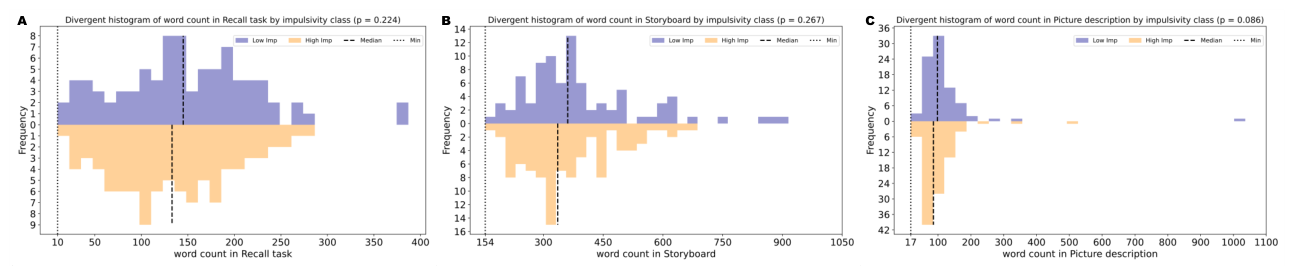

Table 1.
Participants demographic, linguistic and impulsivity information.
| Classification | ||||
|---|---|---|---|---|
| Low Imp (n=86) | High Imp (n=95) | p-value | ||
| Demographics | ||||
| Mean (SD, range) age at testing (years) | 12.88 (2.84, 8-17) | 12.55 (2.51, 8-17) | 0.395 | |
| Sex (n) | 0.167 | |||
| Male | 46 | 40 | ||
| Female | 40 | 55 | ||
| Educational level (n) | 0.830 | |||
| Elementary school (2nd to 5th grade) | 31 | 43 | ||
| Middle school (6th to 8th grade) | 29 | 34 | ||
| High school (9th to 11th grade) | 26 | 18 | ||
| Mean (SD, range) school year at testing | 7.45 (2.52, 2-11) | 7.05 (2.12, 3-11) | 0.244 | |
| Linguistic characteristics | ||||
| Naming task | 57 (47, 53, 57) | 57 (40, 50, 57) | 0.131 | |
| Concept formation task | 60 (43, 53, 60) | 53 (43, 53, 60) | 0.567 | |
| Reading comprehension task | 53 (50, 55, 63) | 57 (50, 57, 63) | 0.842 | |
| Verbal fluency tasks | 40 (34, 40, 50) | 40 (31.5, 40, 50) | 0.311 | |
| Impulsivity trait | ||||
| BIS-11c | ||||
| TOTAL | 23.29 (5.37, 13-34) | 44.62 (6.19, 35-62) | ||
| MOT | 8.74 (4.01, 1-20) | 21.22 (5.34, 11-32) | ||
| COG | 7.16 (1.89, 2-11) | 9.17 (2.13, 4-15) | ||
| NPLAN | 7.38 (3.45, 1-15) | 14.23 (3.72, 3-24) | ||
1 Low impulsivity (Low Imp). High impulsivity (High Imp). Barratt Impulsiveness Scale (BIS-11c). Total impulsivity score (TOTAL). Motor impulsivity (MOT). Cognitive impulsivity (COG). Non-planning impulsivity (NPLAN). We show the number of participants (n) regarding sex and educational level. The scores for linguistic characteristics arose from the procedure described in Section 2.1.2. The modal value (P25, P50, P75) of each of the linguistic characteristics is indicated and the mean (SD, range) value for each impulsivity score. The groups were compared using the chi-square test for sex, the linear-by-linear association test for educational level, the Wilcoxon Ranksum test for age, school year, and all the linguistic characteristics, and the Student’s t-test for BIS-11c scores. P-values are shown for each comparison.
Table 2.
Spearman correlations between impulsivity scores and demographic information.
| MOT | COG | NPLAN | Age | School year | ||
|---|---|---|---|---|---|---|
| TOTAL | Entire sample | 0.905 ()** | 0.535 ()** | 0.782 ()** | -0.004 (0.949) | -0.029 (0.689) |
| Low Imp | 0.627 ()** | 0.269 (0.012)* | 0.642 ()** | 0.100 (0.361) | 0.107 (0.325) | |
| High Imp | 0.737 ()** | 0.355 ()** | 0.390 ()** | 0.131 (0.206) | 0.103 (0.322) | |
Table 3.
Spearman correlations between total impulsivity score and general language abilities.
| Naming task | Concept formation task | Reading comprehension task | Verbal fluency tasks | ||
|---|---|---|---|---|---|
| TOTAL | Entire sample | -0.020 (0.791) | -0.073 (0.327) | -0.023 (0.757) | -0.081 (0.277) |
| Low Imp | 0.078 (0.475) | 0.011 (0.923) | -0.050 (0.650) | 0.046 (0.674) | |
| High Imp | 0.218 (0.033)* | -0.148 (0.154) | -0.088 (0.398) | -0.084 (0.422) | |
1 Low impulsivity (Low Imp). High impulsivity (High Imp). General language abilitiesis are measured with maning task, conceptualization task, reading comprehension task, and verbal fluency tasks. Each cell contains the ρ coefficient (p-value). We present correlations in the entire sample and for each impulsivity class. *Significant correlation with α = 0.05.
Table 4.
Current research on speech analysis in children and adolescents with ADHD and impulsivity.
| Research | Participant characteristics | Data collection characteristics | ||||||
|---|---|---|---|---|---|---|---|---|
|
Analyzed language |
Age (years) Mean ± SD |
Modality | Sample size (n) | Test batteries | Elicitation method | Transcription | ||
| [30] | English | 8.1 ± 1.7 | Spoken speech |
Total (155) | ADHD (57) TD (98) |
Language evaluation | Recall task | Manual transcription |
| [34] | Spanish | 8.5 ± 0.7 | Spoken speech |
Total (26) | ADHD (26) | Language evaluation | Recall task | Manual transcription |
| [31] | Dutch | 8.2 ± 0.5 | Spoken speech |
Total (67) | ADHD (22) SLI (19) TD (26) |
Reading problem tasks Neuropsychological assessment Language evaluation |
Storyboard | Manual transcription with CHAT format |
| [32] | Dutch | 9.1 ± 1.9 | Spoken speech |
Total (121) | ADHD (37) ASD (46) TD (38) |
Neuropsychological assessment | Storyboard (reference production task) |
Manual transcription |
| [33] | Total (75) | ADHD (37) TD (38) |
||||||
| [29] | Greek | 8.8 ± 1.4 | Spoken speech |
Total (50) | ADHD (25) TD (25) |
Neuropsychological assessment Language evaluation |
Recall task | Manual transcription |
| [9] | Dutch | 9.1 ± 1.8 | Spoken speech |
Total (106) | ADHD (34) ASD (36) TD (36) |
Neuropsychological assessment Language evaluation |
Storyboard | Manual transcription with CHAT format |
| [37] | Korean | 8 ± 0.9 | Spoken speech |
Total (30) | ADHD (15) TD (15) |
Language evaluation | Recall task Picture description Reading task |
Manual transcription |
| [36] | Spanish | 8.8 ± 1.4 | Spoken speech |
Total (124) | ADHD (35) ASD (52) TD (37) |
Language evaluation | Storyboard | Manual orthographic transcription |
| [65] | Portuguese | 7.5 ± 2.5 | Spoken speech |
Total (40) | ADHD (20) TD (20) |
Storyboard | Manual transcription |
|
| [28] | Swedish | 13.7 ± 1.3 | Spoken speech |
Total (46) | ADHD (15) TD (31) |
Language evaluation | Recall task (with and without picture support) |
Manual orthographic transcription with SALT format |
| [66,67] | French | 15.2 ± 1.6 | Written speech |
Total (48) | ADHD (24) TD (24) |
Personal narrative | Manual orthographic transcription |
|
| [35] | Dutch | 9.5 ± 1.3 | Spoken speech |
Total (86) | ADHD (46) TD (40) |
Neuropsychological assessment Language evaluation |
Storyboard | Manual transcription |
| Our research | Spanish | 12.7 ± 2.6 | Spoken speech |
Total (181) | High Imp (95) Low Imp (86) |
Language evaluation | Storyboard Recall task Picture description |
Semiautomatic transcription with CHAT format |
1 Typically Developing (TD) children. Autism Spectrum Disorder (ASD). Specific Language Impairment (SLI). Attention-Deficit/Hyperactivity Disorder (ADHD). High impulsivity (High Imp). Low impulsivity (Low Imp).
Disclaimer/Publisher’s Note: The statements, opinions and data contained in all publications are solely those of the individual author(s) and contributor(s) and not of MDPI and/or the editor(s). MDPI and/or the editor(s) disclaim responsibility for any injury to people or property resulting from any ideas, methods, instructions or products referred to in the content. |
© 2026 by the authors. Licensee MDPI, Basel, Switzerland. This article is an open access article distributed under the terms and conditions of the Creative Commons Attribution (CC BY) license.
Copyright: This open access article is published under a Creative Commons CC BY 4.0 license, which permit the free download, distribution, and reuse, provided that the author and preprint are cited in any reuse.


