
Submitted:
06 July 2026
Posted:
07 July 2026
You are already at the latest version
Abstract
Background: Early parenting support has been shown to improve child development outcomes and parental well being. The Strengthening Families Program (SFP) is an evidence based, multicomponent intervention targeting parents, children, and family interactions. While the French adaptation for families with children aged 6–11 years has demonstrated effectiveness, evidence remains limited for younger age groups. This study aimed to assess the feasibility and effectiveness of the French adaptation of SFP for families with children aged 3–6 years (FPSP 3–6). Methods: A pre–post quasi experimental study was conducted in five municipalities in southern France. Families with children aged 3–6 years were enrolled in a 10 to 12 session group based intervention combining parallel parent and child sessions and joint family sessions. Outcomes were assessed before (T0) and immediately after the intervention (T1). Parental quality of life was measured using the General Health Questionnaire (GHQ 12). Child behavior was assessed using the Strengths and Difficulties Questionnaire (SDQ), and child health related quality of life using the KINDL R. Screen time was parent reported. Paired Wilcoxon signed rank tests were used for pre–post comparisons. Results: A total of 45 families participated, with high program adherence (90% attended ≥70% of sessions). Significant improvements were observed in parental quality of life (median GHQ 12 score reduced from 5 to 1, p < 0.001). Children showed significant reductions in emotional symptoms, behavioral difficulties, hyperactivity, and peer problems, as well as a significant increase in prosocial behaviors (SDQ total score: median reduced from 13 to 8, p < 0.001). A modest but significant reduction in daily television viewing time was also observed (p = 0.028). Parental satisfaction and acceptability of the intervention were high. Conclusions: The French FPSP 3–6 appears feasible, highly acceptable, and associated with meaningful short term improvements in parental well being, child behavior, and screen exposure. These findings support the relevance of early, family based psychosocial interventions in public health, although confirmation in larger controlled studies with longer follow up is warranted.
Keywords:
parenting support
; early childhood
; psychosocial skills
; family intervention
; public health prevention
1. Background
Parenting plays a central role in shaping children’s emotional regulation, social competencies, and long-term health trajectories. Contemporary families face increasing expectations regarding educational practices, emotional availability, and behavioral management, often in contexts characterized by social and digital complexity [1]. In response, early and structured parenting support interventions have emerged as promising public health strategies to promote child well-being and reduce psychosocial vulnerabilities.
Authoritative parenting—characterized by warmth, consistent rule-setting, positive reinforcement, and non-violent discipline—has repeatedly been associated with favorable developmental outcomes [2]. Parenting support programs that strengthen parental skills, enhance self-efficacy, and foster positive family interactions contribute to child resilience and improved mental health outcomes.
The Strengthening Families Program (SFP) is an evidence-based, multi-level intervention recognized internationally for its effectiveness in improving parenting practices, child psychosocial skills, and family functioning, and in preventing later substance use. Its distinguishing feature lies in its tripartite design, simultaneously targeting parents, children, and family interactions. The French adaptation of SFP for families with children aged 6–11 years has previously demonstrated significant benefits [3,4].
Given growing evidence highlighting the importance of early childhood as a critical period for psychosocial development, the adaptation of SFP for families with children aged 3–6 years was undertaken. The present study evaluates the feasibility and effectiveness of this French FPSP 3–6 adaptation in real-world community settings.
2. Methods
2.1. Study Design
A pre–post intervention study was conducted, with each family acting as its own control. Assessments were carried out immediately before the intervention (T0) and at program completion (T1).
2.2. Setting and Participants
The program was implemented in five municipal sites in the Provence–Alpes–Côte d’Azur region, France. Families were eligible if they had at least one child aged 3–6 years and at least one adult responsible for the child’s daily upbringing. Exclusion criteria included known psychiatric disorders, concurrent participation in another parenting program, or refusal by one legal guardian.
2.3. Intervention
FPSP 3–6 consisted of weekly group sessions (10 sessions initially, extended to 12 following pilot evaluation), each lasting 1 hour and 45 minutes. Sessions followed a standardized structure:
- Welcome and introduction
- Separate parent and child sessions
- Joint family session focusing on skills practice
Parent sessions addressed stress management, communication, rule-setting, and conflict resolution. Child sessions focused on communication skills, emotional recognition, problem-solving, and cooperation. Family sessions reinforced skill transfer to everyday contexts.
Facilitators received standardized training and used structured manuals to ensure intervention fidelity.
2.4. Outcome Measures
- Parental quality of life: GHQ-12
- Parenting practices and attitudes: ECEP scale (Larose)
- Child behavior: Strengths and Difficulties Questionnaire (SDQ)
- Child quality of life: KINDL-R
- Screen use: parent-reported frequency and duration
Process indicators included attendance, intervention fidelity, and satisfaction.
2.5. Statistical Analysis
Non-parametric paired Wilcoxon signed-rank tests were used to compare pre- and post-intervention scores. Statistical significance was set at p < 0.05. Analyses were performed using R software.
3. Results
3.1. Participant Characteristics
Forty-five families participated; 91% of respondents were mothers. Most families were two-parent households (82%). Children were predominantly aged 3–5 years, with a balanced sex distribution.
3.2. Impact Outcomes
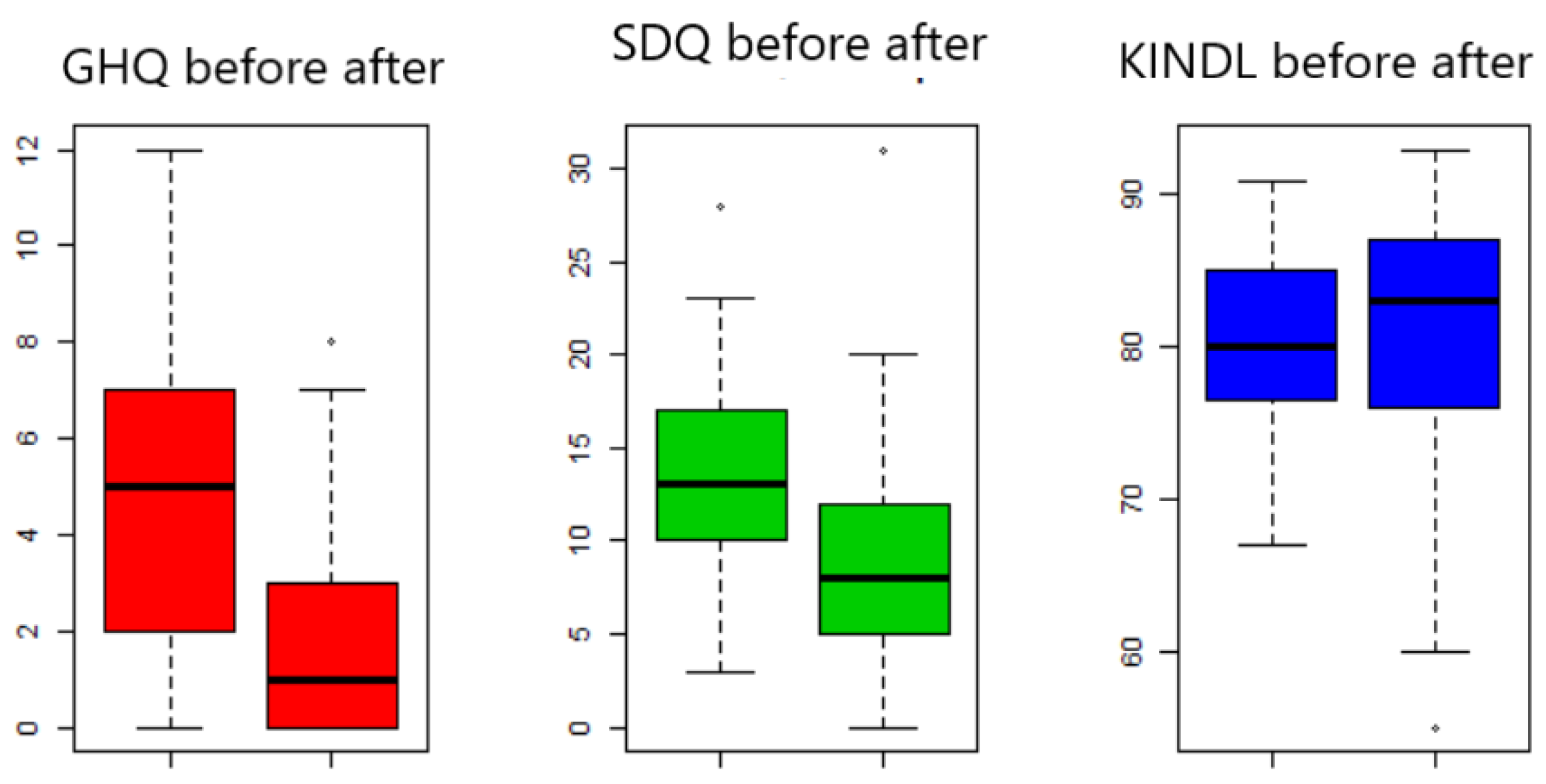
Significant improvements were observed in parental quality of life (median GHQ-12 score reduced from 5 to 1, p < 0.001). Children showed significant reductions in emotional symptoms, behavioral difficulties, hyperactivity, and peer problems, as well as a significant increase in prosocial behaviors (SDQ total score: median reduced from 13 to 8, p < 0.001). A modest but significant reduction in daily television viewing time was also observed (p = 0.028). Parental satisfaction and acceptability of the intervention were high.
Figure 1.
.
3.3. Process Indicators
Attendance was high, with 90% of families attending at least 70% of sessions. Overall satisfaction was very high, with most parents reporting that the program substantially benefited their family. Facilitator engagement and perceived intervention relevance were rated positively.
4. Discussion
This study provides evidence that the French adaptation of the Strengthening Families Program for families with children aged 3–6 years is feasible, well accepted, and associated with meaningful short-term improvements in both parental and child outcomes. Specifically, participation in FPSP 3–6 was associated with a significant reduction in parental psychological distress, improvements in multiple dimensions of child behavior, increased prosocial skills, and a modest but significant reduction in children’s screen exposure.
The observed improvement in parental quality of life, as measured by the GHQ-12, suggests that early parenting support may play a protective role against parental stress and anxiety during a developmentally demanding period. This finding is consistent with evidence indicating that parents of young children experience heightened psychosocial strain, which in turn may negatively affect parenting practices and child outcomes. By strengthening parents’ skills in stress management, communication, and rule-setting, FPSP 3–6 may interrupt this negative cycle and promote more supportive family environments.
Improvements in child behavior, reflected by reductions in emotional symptoms, conduct problems, hyperactivity, and peer difficulties, align with the core objectives of the program. The significant increase in prosocial behaviors is particularly noteworthy, as these skills are strongly associated with social integration, school readiness, and long-term educational and mental health outcomes. These findings reinforce the relevance of targeting psychosocial competencies during early childhood, a period characterized by rapid emotional and social development.
The reduction in daily television viewing time represents an additional and public-health-relevant outcome. Excessive screen exposure in early childhood has been associated with impaired language development, attention difficulties, and increased sedentary behavior. The explicit integration of screen-related parenting practices in the French adaptation—absent from the original U.S. version of SFP—may therefore constitute an important contextual innovation responding to contemporary environmental risks for children.
While most evaluations of the Strengthening Families Program have focused on older children and adolescents, this study adds to a limited body of evidence regarding early childhood applications. The results are consistent with findings from the French FPSP 6–11 and international studies demonstrating the effectiveness of multi-component, family-based interventions in improving parenting practices and child psychosocial functioning.
Importantly, this study contributes real-world evidence from community implementation settings, rather than controlled experimental environments. Such data are particularly valuable for public health decision-makers, as they reflect feasibility and effectiveness under routine conditions, including variable recruitment pathways and diverse municipal contexts.
Several strengths should be highlighted. First, the program achieved high adherence and satisfaction levels, indicating strong acceptability among families. Second, the intervention’s structured yet flexible design allowed for consistent implementation across multiple municipalities. Third, standardized and validated outcome measures were used, facilitating comparison with national and international studies.
However, important limitations must be acknowledged. The absence of a control group precludes causal inference and raises the possibility that part of the observed improvements may be attributable to natural developmental changes or regression to the mean. The relatively small sample size limits statistical power and prevents subgroup analyses, particularly by child age, sex, or family socioeconomic characteristics. Moreover, outcomes relied exclusively on parent-reported measures, which may be subject to reporting bias or social desirability effects.
Fathers were underrepresented among participants, a limitation frequently observed in parenting interventions. Given the established role of paternal involvement in children’s emotional regulation and social development, this imbalance may limit the generalizability of findings and highlights the need for more targeted engagement strategies.
Finally, outcomes were assessed only at program completion. The durability of observed effects over time remains unknown and warrants longitudinal follow-up.
Despite these limitations, the findings support the relevance of FPSP 3–6 as an early prevention strategy in public health. By simultaneously addressing parental well-being, parenting practices, child psychosocial skills, and environmental factors such as screen exposure, the program addresses multiple determinants of child mental health within a single intervention framework.
Future research should aim to confirm these findings using controlled or randomized study designs, include longer follow-up periods to assess sustainability of effects, and explore mechanisms of change. Particular attention should be paid to strategies designed to increase father participation and to the potential role of booster sessions or digital support tools in maintaining gains over time.
From a policy perspective, the strong involvement of municipalities in program implementation underscores the importance of local governance structures in parenting support initiatives. Scaling up FPSP 3–6 may therefore contribute to reducing early psychosocial inequalities and strengthening population-level mental health promotion.
5. Conclusions
This study suggests that the French adaptation of the Strengthening Families Program for families with children aged 3–6 years is feasible, highly acceptable, and associated with beneficial short-term outcomes for both parents and children when implemented in community settings. Participation in FPSP 3–6 was linked to improved parental psychological well-being, reductions in multiple domains of child behavioral difficulties, increased prosocial behaviors, and decreased screen exposure, all of which are relevant determinants of early mental health and development.
By targeting parents, children, and family interactions simultaneously, the program addresses several modifiable risk and protective factors during a critical developmental period. These findings support the relevance of early, family-based psychosocial interventions as a public health strategy for promoting child well-being and reducing early psychosocial vulnerabilities.
However, given the quasi-experimental design, small sample size, and short follow-up period, results should be interpreted with caution. Further research using controlled designs, larger and more diverse populations, and longitudinal follow-up is needed to confirm effectiveness, assess sustainability of effects, and identify mechanisms of change. Particular attention should be paid to strategies aimed at increasing father participation and at reinforcing long-term benefits through booster sessions or complementary digital tools.
From a public health perspective, the strong engagement of municipal stakeholders highlights the potential of local governance structures to support parenting interventions at scale. If confirmed by future studies, FPSP 3–6 could contribute to integrated early prevention policies aimed at strengthening family environments, promoting psychosocial development, and reducing inequalities in child mental health outcomes.
Author Contributions
Conceptualization, Corinne Roehrig; Methodology, Noemie Ferre, Christian Pradier and Corinne Roehrig; Validation, Corinne Roehrig; Formal analysis, Roxane Fabre; Data curation, Roxane Fabre; Writing – original draft, Noemie Ferre; Writing – review & editing, Christian Pradier and Corinne Roehrig; Supervision, Christian Pradier. All authors have read and agreed to the published version of the manuscript.
Funding
This research received no external funding.
Institutional Review Board Statement
The study was conducted in accordance with the Declaration of Helsinki, and approved by the Institutional Review Board (or Ethics Committee) of NAME OF INSTITUTE (protocol code XXX and date of approval).
Informed Consent Statement
Informed consent was obtained from all subjects involved in the study.
Data Availability Statement
The raw data supporting the conclusions of this article will be made available by the authors on request.
Conflicts of Interest
The authors declare no conflicts of interest.
References
- Lasbeur, L.; Pelat, C. Évaluation de l’efficacité du Programme de soutien aux familles et à la parentalité 6-11 ans, en comparaison avec une intervention minimale de la parentalité; Santé publique France: Saint-Maurice, 2023; Available online: https://www.santepubliquefrance.fr/les-actualites/2023/programme-de-soutien-aux-familles-et-a-la-parentalite-6-11-ans-des-effets-positifs-sur-le-bien-etre-de-l-enfant.
- Roehrig, C.; Pradier, C. Clés de l’adaptation française d’un programme américain de soutien à la parentalité. Sante Publique (Bucur) 2017, Vol. 29(5), 643–53. [Google Scholar]
- Why parenting matters for children in the 21st century: an evidence-based framework for understanding parenting and its impact on child development. OECD Education working papers; No.222.
- Baumrind, D. Modèles actuels d'autorité parentale. Dev. Psychol. Monogr. 1971, 4, 1–103. [Google Scholar] [CrossRef]
- Leroy-Rivierre, O.; El Ouazzani, H.; Raynaud, A. Évaluation du programme d’accompagnement de la parentalité « Ateliers Parents: la sécurité affective dans la relation Parent-Enfant. Devenir 2021, 33(1), 69–88. [Google Scholar]
- Roehrig, C. Programme de Soutien aux Familles et à la Parentalité « SFP 6–11 ans »: description et facteurs d’influence potentiels de son implantation en France. Glob. Health Promot 2013, 20((2_) suppl, 8–12. [Google Scholar] [CrossRef] [PubMed]
- United Nations Office on Drugs and Crime. World drug report; UN: New York, 2009. [Google Scholar]
- Coombes, L.; Allen, D.; Foxcroft, D. An exploratory pilot study of the Strengthening Families Programme 10–14 (UK). Drugs Educ. Prev. Policy 2012, 19. [Google Scholar] [CrossRef]
- Gates, S.; McCambridge, J.; Smith, L.A.; Foxcroft, D. Interventions for prevention of drug use by young people delivered in non-school settings. In Cochrane Database Syst Rev [Internet]; 2006. [Google Scholar]
- Foxcroft. Primary prevention for alcohol misuse in young people - Foxcroft, D - 2002 | Cochrane Library [Internet]. 2002. [Google Scholar] [PubMed]
- Bandura, A. L’auto-efficacité. Le sentiment d’efficacité personnelle; De Boeck: Paris, 2003. [Google Scholar]
- Profil des animateurs PSFP 6-11. Santé publique France. Available online: https://www.santepubliquefrance.fr/les-actualites/2023/programme-de-soutien-aux-familles-et-a-la-parentalite-6-11-ans-des-effets-positifs-sur-le-bien-etre-de-l-enfant.
- Larose, F.; Terrisse, B.; Grenon, V. L’évaluation des facteurs de risque et de protection chez les enfants de maternelle et de premier cycle de l’enseignement primaire: l’échelle des compétences éducatives parentales (ECEP). Rev. Int. Léducation Fam. Rech. Interv. 2000, 4(2), 103–127. [Google Scholar]
- Lesage, F.-X.; Martens-Resende, S.; Deschamps, F.; Berjot, S. Validation of the General Health Questionnaire (GHQ-12) adapted to a work-related context. Open J. Prev. Med. 2011, 1(02), 44. [Google Scholar]
- Ravens-Sieberer, U.; Bullinger, M. KINDLR-Questionnaire for measuring health-related quality of life in children and adolescents. In KINDL-R Retrieved Httpwww Kindl Org; 2000. [Google Scholar]
- ENABEE: étude nationale sur le bien-être des enfants. In Enabee.fr.
- Commission Nationale « Enfants et écrans: à la recherche du temps perdu ». Avril 2024.
- Junior Connect’ 2018 - Jeunes et medias: une consommation toujours dynamique et diversifiée ! [Internet]. Ipsos, 2020. Available online: https://www.ipsos.com/fr-fr/junior-connect-2018-jeunes-et-medias-une-consommation-toujours-dynamique-et-diversifiee.
- Développement des compétences psychosociales des enfants et des jeunes: un référentiel pour favoriser un déploiement national. 2021. Available online: https://www.santepubliquefrance.fr/docs/le-programme-de-soutien-aux-familles-et-a-la-parentalite-psfp.
Disclaimer/Publisher’s Note: The statements, opinions and data contained in all publications are solely those of the individual author(s) and contributor(s) and not of MDPI and/or the editor(s). MDPI and/or the editor(s) disclaim responsibility for any injury to people or property resulting from any ideas, methods, instructions or products referred to in the content. |
© 2026 by the authors. Licensee MDPI, Basel, Switzerland. This article is an open access article distributed under the terms and conditions of the Creative Commons Attribution (CC BY) license.
Copyright: This open access article is published under a Creative Commons CC BY 4.0 license, which permit the free download, distribution, and reuse, provided that the author and preprint are cited in any reuse.


