

Submitted:
03 July 2026
Posted:
07 July 2026
You are already at the latest version
Abstract
The release of ChatGPT on 30 November 2022 renewed expectations that generative artificial intelligence might democratize international academic publishing by lowering linguistic and textual barriers. This article develops a narrower account: conversion without redistribution. Generative AI may reduce the cost of converting existing research capacity into internationally legible manuscripts, but it does not directly redistribute data, funding, networks, journal access, or cumulative reputation. Using OpenAlex metadata, the study combines a 51,840-work authorship sample for 2019–2024 with a balanced panel of 13,860 country-subfield-year cells for 2017–2025. Pooled work-level difference-in-differences estimates are positive across participation, leadership, and recognition outcomes. Annual diagnostics, however, show a more selective pattern: the disadvantaged-country first-author share increased by 3.67 percentage points in 2023 and 2.85 points in 2024 relative to the 2022 high-versus-low-exposure difference, whereas most participation, corresponding-author, fractional-author, and high-citation intervals include zero in at least one post year. After restoring 5,385 zero-output panel cells, aggregate triple-difference estimates remain small and window-sensitive. An apparent post-ChatGPT advantage for higher-capacity disadvantaged countries disappears after accounting for a differential trend already visible before 2022. The evidence therefore does not identify a causal democratization effect. Its most defensible implication is narrower: early post-ChatGPT change is visible in one dimension of authorship leadership, but not as broad redistribution of global scientific output or recognition.
Keywords:
generative AI
; ChatGPT
; academic inequality
; international publishing
; global science
; authorship
; OpenAlex
; conversion capacity
; difference-in-differences
Introduction
The release of ChatGPT on 30 November 2022 rapidly changed the practical conditions of academic writing. Generative AI tools are now used for language editing, abstract drafting, literature organization, cover letters, reviewer responses, and manuscript restructuring. For non-native English scholars and researchers working in resource-constrained settings, these tools appear to offer a low-cost substitute for professional language editing and informal writing support.
This technological shift has produced a powerful claim: generative AI may democratize international academic publishing. If English fluency, rhetorical polish, and familiarity with journal conventions previously acted as barriers to publication, then large language models could lower these barriers and give scholars from disadvantaged countries a fairer chance to publish internationally.
That claim is plausible but incomplete. International publishing inequality is not simply writing inequality. It also involves data resources, research infrastructure, collaboration networks, institutional reputation, editorial trust, journal hierarchies, citation accumulation, and the ability to define what counts as an important research question. A tool that improves language and presentation may make manuscripts more publishable, but it cannot by itself redistribute the resources and recognition systems that define global academic authority.
The central claim of this article is conversion without redistribution. Generative AI may democratize the conversion of research into publishable form, but it does not democratize the resources, networks, and recognition systems that define global academic authority. The sharper question is therefore not whether generative AI makes academic prose more fluent. It is whether the post-ChatGPT period is associated with changes in the ability of disadvantaged scholars to convert existing research capacity into visible academic authority:
After ChatGPT, did disadvantaged-country scholars improve their relative position in high-AI-exposure fields only as aggregate participants, or also as first authors, corresponding authors, and authors of highly cited papers?
The concept of conversion capacity captures this mechanism: the ability to transform research resources, evidence, and disciplinary judgment into manuscripts that are legible, credible, and visible in international publishing. Generative AI is not an automatic equalizer, because it does not remove structural differences in research capacity and academic recognition. It may change the route through which existing research capacity becomes internationally visible output. Whether scholars with stronger prior capacity gain disproportionately is an empirical question rather than an assumption of the theory.
The point is not to choose between optimism and pessimism. Universal access to AI writing tools is unlikely to democratize global science by itself; at the same time, incumbent advantage is not the only plausible outcome. The empirical issue is where post-ChatGPT changes appear: only in aggregate publication counts, or also in authorship leadership and recognition.
Using OpenAlex data, this article combines two empirical layers. The first is a work-level authorship sample that measures participation, first authorship, corresponding authorship, fractional authorship, and positions in high-citation papers. The second is a zero-complete country-subfield-year panel that tests whether any work-level pattern survives as aggregate redistribution across ten subfields. Pooled pre/post estimates initially suggest broad authorship gains, but annual diagnostics narrow the durable result to first authorship. The aggregate panel shows no stable redistribution, and a capacity-gradient test reveals that apparent gains among better-established disadvantaged countries were already developing before ChatGPT.
The contribution is therefore deliberately bounded. Individual ChatGPT use cannot be isolated in bibliometric data, and publication-year designs cannot cleanly separate AI from concurrent changes. The paper instead identifies where the post-2022 pattern is strongest, where it fails to persist, and which apparently supportive mechanism does not survive a trend correction. This asymmetry is substantively useful: a technology may alter one positional margin of academic authority without democratizing the system that produces and recognizes knowledge.
Literature and Theoretical Background
Publishing inequality is not only a language problem
Research on academic publishing has long shown that peripheral scholars face barriers that go beyond English grammar or style. Canagarajah (1996) argues that scholars at the periphery face “nondiscursive” requirements, including material resources, institutional conditions, editorial expectations, and the politics of knowledge production. Lillis and Curry (2010) show that English-dominant academic publishing is not merely a communication system but also an institutional gatekeeping system.
Later studies provide more direct evidence of the costs borne by non-native English scholars. Flowerdew (2007); Flowerdew (2008); Flowerdew (2019) discuss the linguistic disadvantage and identity pressures faced by scholars writing in English as an additional language. Amano et al. (2023) survey 908 environmental science researchers and show that non-native English speakers spend more effort on reading, writing, publishing, and conference participation in English.
Generative AI changes part of this situation by lowering the cost of language editing and textual organization. Lingard et al. (2023) explicitly examine whether ChatGPT’s free language editing service can level the playing field in science communication. Their conclusion is cautious: AI can assist writing, but claims of full equalization lack systematic support. This distinction is central to the present article. Linguistic accessibility is not the same as epistemic authority.
Global science is structured by center-periphery relations
The global academic publishing system is stratified by geography, institutional prestige, language, and recognition. Paasi (2005) analyzes the uneven geography of international journal publishing spaces and shows how the meaning of “international” is often shaped by Anglo-American academic norms. Collyer (2018) documents global North-South patterns in the publication of academic knowledge. Demeter (2020) further links global knowledge production to under-representation of the Global South.
At the same time, the center-periphery model should not be treated as a static binary. Marginson and Xu (2023) emphasize hegemony and inequality in global science while warning against deterministic interpretations that underestimate agency outside traditional centers. That caution is useful here. If global science is hierarchical but not frozen, then a major reduction in writing and coordination costs could partially loosen academic authority without eliminating deeper inequality.
The sociology of scientific recognition also matters. Merton (1968) describes the Matthew effect in science: recognition tends to accumulate among already recognized scholars. DiPrete and Eirich (2006) generalize cumulative advantage as a mechanism of inequality, and Fortunato et al. (2018) show how large-scale data can be used to study the structure and dynamics of scientific production. These literatures imply that AI cannot be evaluated solely by whether it improves writing. The deeper question is whether it changes who leads and who is recognized.
Generative AI is changing academic writing and peer review
The diffusion of generative AI in scholarly communication is no longer speculative. van Dis et al. (2023) identify ChatGPT as a major development for scientific research and writing. Gao et al. (2023) show that ChatGPT-generated scientific abstracts can be difficult for humans and detectors to distinguish from real abstracts. Liang et al. (2025) quantify large language model use in scientific papers, showing a steady increase in AI-modified scholarly text. Liu et al. (2025) find that AI-assisted writing is growing fastest among non-English-speaking and less-established scientists, suggesting that AI adoption itself may be shaped by existing linguistic and professional inequalities.
AI is also entering peer review. Liang et al. (2024) estimate AI-modified content in conference peer reviews, while Yu et al. (2024) highlight the difficulty of detecting AI-generated peer-review text reliably. These developments matter because academic authority is produced not only at the writing stage but also through evaluation, revision, and review.
AI governance may reproduce new forms of unfairness
AI can also create new risks for disadvantaged scholars. Liang et al. (2023) show that GPT detectors are biased against non-native English writers, often misclassifying their writing as AI-generated. Lepp and Smith (2025) analyze almost 80,000 peer reviews from computer science and find that language discrimination persisted after ChatGPT, with reviewers potentially associating “GPT style” and non-linguistic cues with author background and scientific quality. Hu et al. (2025) show that non-native English researchers using ChatGPT experience tensions around identity, legitimacy, and scholarly voice. He and Bu (2026) further show that journal AI policies have not necessarily curbed AI-assisted writing or solved transparency problems.
These findings imply that AI’s effect on inequality is institutionally mediated. The same tools that reduce linguistic costs may also trigger suspicion, disclosure burdens, detector errors, and new evaluation biases.
Theory: Conversion Capacity and Academic Authority
International publishing can be treated as a conversion process. Research resources, data, methods, and scholarly judgment must be converted into manuscripts that journals and readers recognize as internationally legible contributions. Academic inequality can therefore arise at two different points: unequal access to research resources and unequal capacity to convert existing research into visible academic authority.
The first layer is participation: whether disadvantaged-country scholars appear in international journal articles at all. AI is most likely to affect this level first because language editing, cover-letter preparation, and manuscript restructuring are direct writing tasks.
The second layer is leadership: whether disadvantaged-country scholars occupy first-author, corresponding-author, or high fractional-authorship positions. Leadership is more demanding than participation because it reflects who defines the research problem, conducts the analysis, coordinates the manuscript, and manages submission.
The third layer is recognition: whether disadvantaged-country scholars appear in highly cited papers and other visible positions in global knowledge circulation. Recognition is the deepest level of inequality because it shapes what knowledge is seen, cited, and treated as important.
This framework generates three competing propositions.
P1: Conversion easing. If generative AI lowers the cost of turning research into internationally legible manuscripts, disadvantaged-country scholars should show relative improvement in authorship positions after ChatGPT, especially in high-AI-exposure fields.
P2: Redistribution absence. If academic inequality is primarily driven by data resources, research infrastructure, collaboration networks, journal hierarchies, and cumulative reputation, aggregate country-level output should not show stable redistribution merely because writing tools become more available.
P3: Conversion without redistribution. If AI changes conversion costs more than resource distribution, the evidence should be layered: work-level authorship positions may improve for some disadvantaged scholars, while aggregate country-subfield-year output does not show stable equalization. This pattern would indicate a conditional loosening of academic authority rather than broad redistribution of global science.
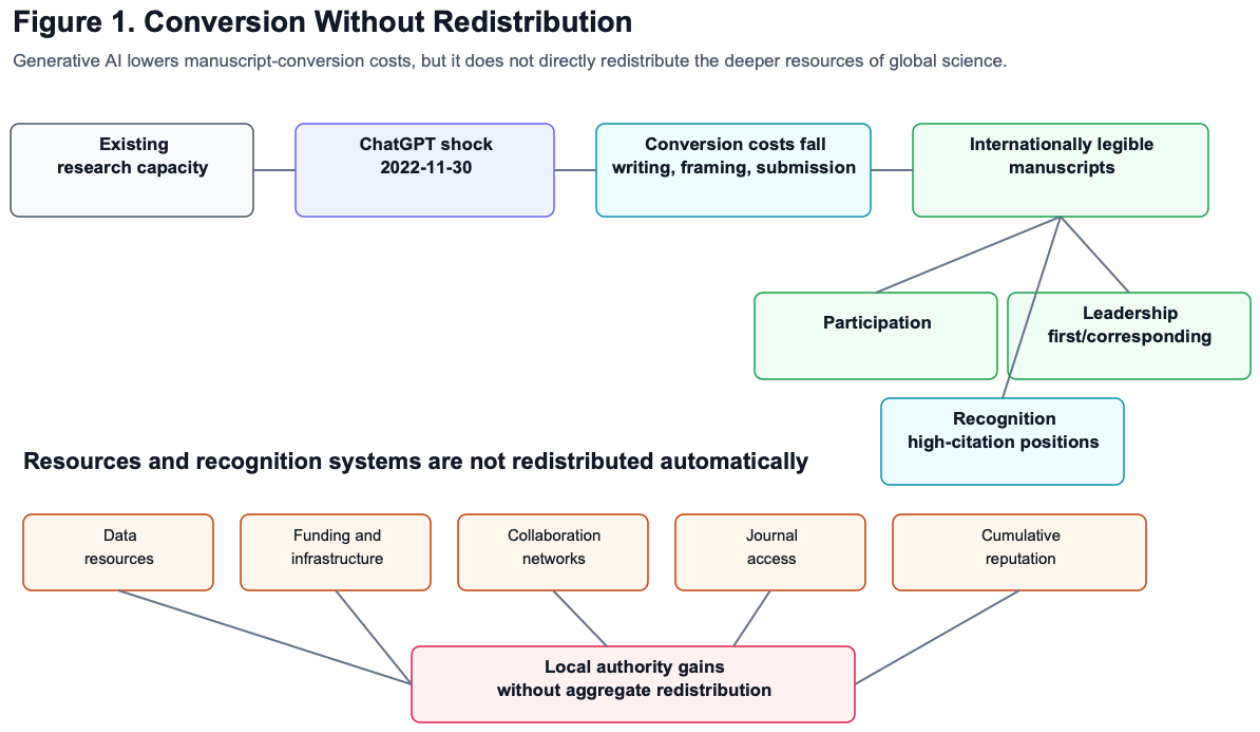
Figure 1 summarizes the mechanism.
Materials and Methods
Data Sources
The analysis uses work-level metadata from OpenAlex, a fully open scholarly knowledge graph covering works, authors, venues, institutions, and concepts (Priem et al., 2022). OpenAlex provides publication year, language, source information, subject classification, authorship position, author countries, corresponding-author markers, and citation percentile indicators. Country income groups are obtained from the World Bank country classification system (World Bank, 2026).
The empirical design is layered and descriptive. The work-level sample tests whether authorship positions changed after ChatGPT in fields where writing and manuscript packaging are expected to be more exposed to generative AI. The country-subfield-year panel then tests whether the same shock is associated with aggregate redistribution across a broader set of subfields. The design is not presented as a definitive causal estimate of individual AI use.
Sample Construction
The sample covers English-language journal articles published from 2019 to 2024 in OpenAlex core sources. The post-ChatGPT period is defined as 2023-2024. The pre-period is 2019-2022. The analysis uses primary subfield assignment to avoid assigning the same work to multiple subfields.
High-AI-exposure subfields are Communication and Marketing. Low-AI-exposure subfields are Geometry and Topology and Condensed Matter Physics. The high-exposure fields were selected because their publication process is relatively more dependent on academic English, framing, literature positioning, and textual organization. The low-exposure fields were selected because they are relatively more dependent on mathematical formalism, experimental infrastructure, or material research conditions.
For each of 24 subfield-year cells, five fixed random seeds were used to sample 500 works. This produced 60,000 sampled work selections. After deduplication by OpenAlex work ID, the union sample contains 51,840 unique works. Each cell contains between 2,052 and 2,248 unique works in the union sample.

Table 1.
Research design and sample structure.
| Dimension | Design choice |
|---|---|
| Data sources | OpenAlex Works API; World Bank Country API |
| Years | 2019-2024 |
| Shock date | ChatGPT public release on 30 November 2022; 2023-2024 coded as post |
| Publication type | English-language journal articles in OpenAlex core sources |
| Field assignment | Primary subfield |
| High-AI-exposure subfields | Communication; Marketing |
| Low-AI-exposure subfields | Geometry and Topology; Condensed Matter Physics |
| Sampling | Five fixed random seeds; 500 works per subfield-year-seed cell |
| Sample size | 60,000 sampled selections; 51,840 deduplicated unique works |
| Panel extension | 13,860 balanced country-subfield-year cells across five high-exposure and five low-exposure subfields, 2017-2025 |
| Disadvantaged countries | World Bank low-income and lower-middle-income economies |
| Comparison countries | World Bank high-income economies |
Outcomes
The main outcomes measure disadvantaged-country authorship positions:
- Participation: whether a paper includes at least one author from a low-income or lower-middle-income country.
- First authorship: the disadvantaged-country share of first-author country weights.
- Corresponding authorship: the disadvantaged-country share of corresponding-author country weights.
- Fractional authorship: the disadvantaged-country share of all author-country weights.
- High-citation outcomes: the same indicators restricted to OpenAlex top 10% citation-percentile papers.
Empirical Approach
The analysis reports descriptive difference-in-differences estimates comparing changes in high-AI-exposure subfields with changes in low-AI-exposure subfields:
Delta-hat^DID = ( mean(Y)_High,Post − mean(Y)_High,Pre ) − ( mean(Y)_Low,Post − mean(Y)_Low,Pre ).
Uncertainty is assessed using 2,000 stratified bootstrap replications within field-by-year cells. To address sampling sensitivity, the analysis also reports the distribution of point estimates across five fixed OpenAlex random seeds. Because a pooled pre/post contrast can conceal timing, the same bootstrap design is used to estimate annual high-minus-low-exposure contrasts relative to 2022.
This design is related to the difference-in-differences literature (Angrist and Pischke, 2009; Callaway and Sant’Anna, 2021; Goodman-Bacon, 2021; Roth et al., 2023; Sun and Abraham, 2021). However, the current estimates remain descriptive. ChatGPT is a global shock, field-level exposure is only a proxy for actual AI use, and parallel trends cannot yet be fully established. The preferred interpretation is therefore structural: the analysis asks whether post-ChatGPT patterns are consistent with conversion without redistribution.
Country-Subfield-Year Panel Extension
The work-level sample is designed to measure authorship position, but it covers four subfields. To assess whether the pattern generalizes to a broader aggregate setting, the article constructs a second OpenAlex panel at the country-subfield-year level. This panel covers five high-AI-exposure subfields-Education, Communication, Strategy and Management, Marketing, and Developmental and Educational Psychology-and five low-AI-exposure subfields-Organic Chemistry, Electronic, Optical and Magnetic Materials, Nuclear and High Energy Physics, Condensed Matter Physics, and Geometry and Topology. The OpenAlex query audit contains 270 aggregate queries and shows no group-by truncation.
OpenAlex country group-by responses report only cells with at least one article. Treating those responses as a panel would condition the analysis on positive publication and omit the extensive margin of international participation. The analysis therefore forms the Cartesian product of 154 comparison countries, 10 subfields, and 9 years, then restores zero counts where no country group was returned. This produces 13,860 cells, including 5,385 restored zero-output cells. The main estimation window ends in 2024 because 2025 is incomplete.
The panel estimates the following triple-difference model:
Y_cft = beta ( Disadvantaged_c x HighAI_f x Post_t ) + alpha_cf + gamma_ct + delta_ft + arepsilon_cft.
The dependent variables are log total articles, log top-10% cited articles, and log international-collaboration articles. The model absorbs country-by-subfield, country-by-year, and subfield-by-year fixed effects. Standard errors are clustered by country.
The panel also tests a sharper implication of the conversion-capacity argument. For each disadvantaged country, pre-shock capacity is the log of its total participating-country article count across the ten selected subfields during 2017-2022, standardized within the disadvantaged-country group. The heterogeneity model interacts this measure with high AI exposure and the post period. An unadjusted estimate is compared with a specification that includes a capacity-by-high-exposure linear time trend. This comparison asks whether a post-2022 capacity gradient is new or merely continues differential convergence already present before ChatGPT.
Results
Work-Level Authorship Evidence: Multiple Random Seeds
The original pilot sample used only one fixed sample of 12,000 works. A single OpenAlex random seed could generate a misleading narrative if the resulting works are not representative. The analysis therefore adds four additional seeds and evaluates whether the direction of the result is stable.
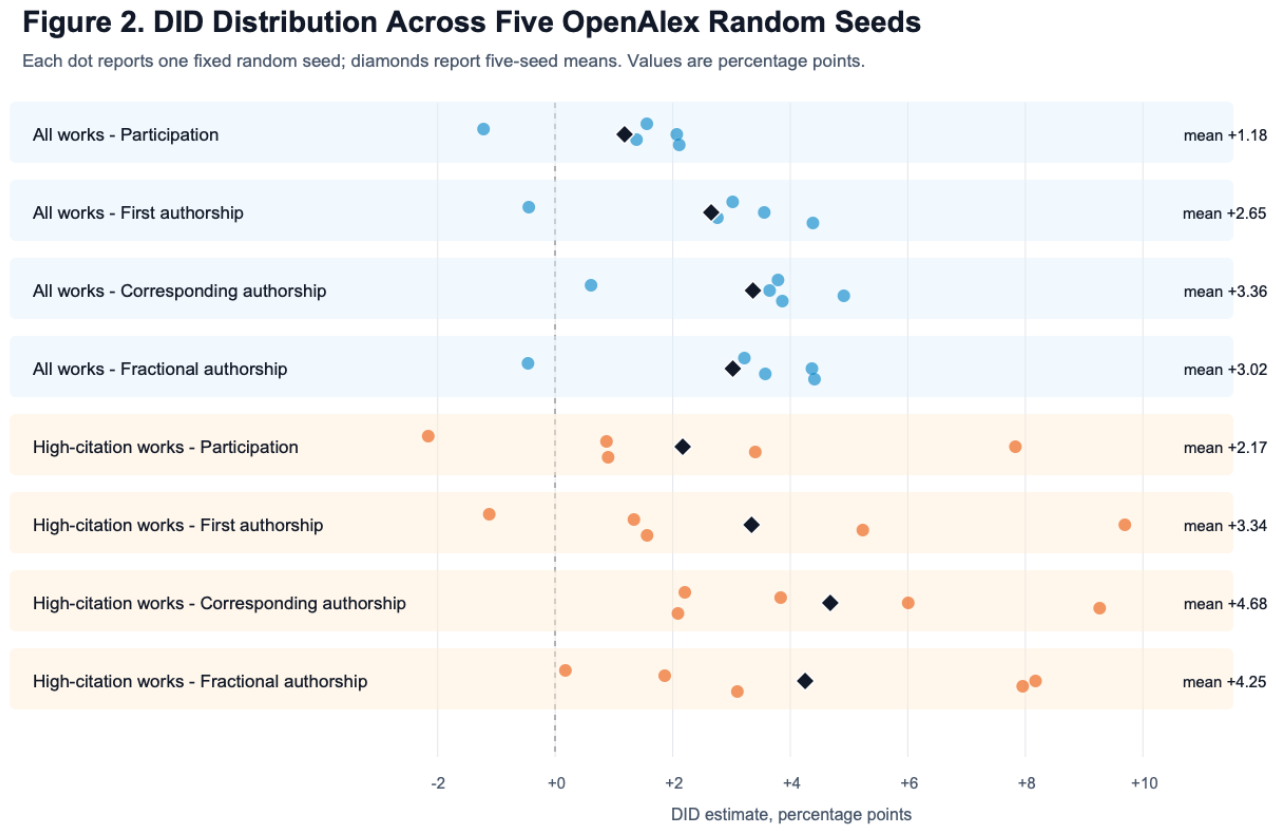
Across all works, the mean DID estimates across five seeds are positive for participation, first authorship, corresponding authorship, and fractional authorship. The corresponding average estimates are +1.18, +2.65, +3.36, and +3.02 percentage points. Four of five seeds are positive for participation, first authorship, and fractional authorship. All five seeds are positive for corresponding authorship.
The same pattern appears in high-citation papers. The mean seed-level DID estimates are +2.17 percentage points for participation, +3.34 for first authorship, +4.68 for corresponding authorship, and +4.25 for fractional authorship. Four or five seeds are positive for every high-citation outcome.
Figure 2.
DID estimates across five OpenAlex random seeds. Each point reports the estimate from one fixed random seed; diamonds report seed means. The figure shows that positive estimates are not driven by a single OpenAlex sample draw.
Figure 2.
DID estimates across five OpenAlex random seeds. Each point reports the estimate from one fixed random seed; diamonds report seed means. The figure shows that positive estimates are not driven by a single OpenAlex sample draw.
Work-Level Authorship Evidence: Union Sample
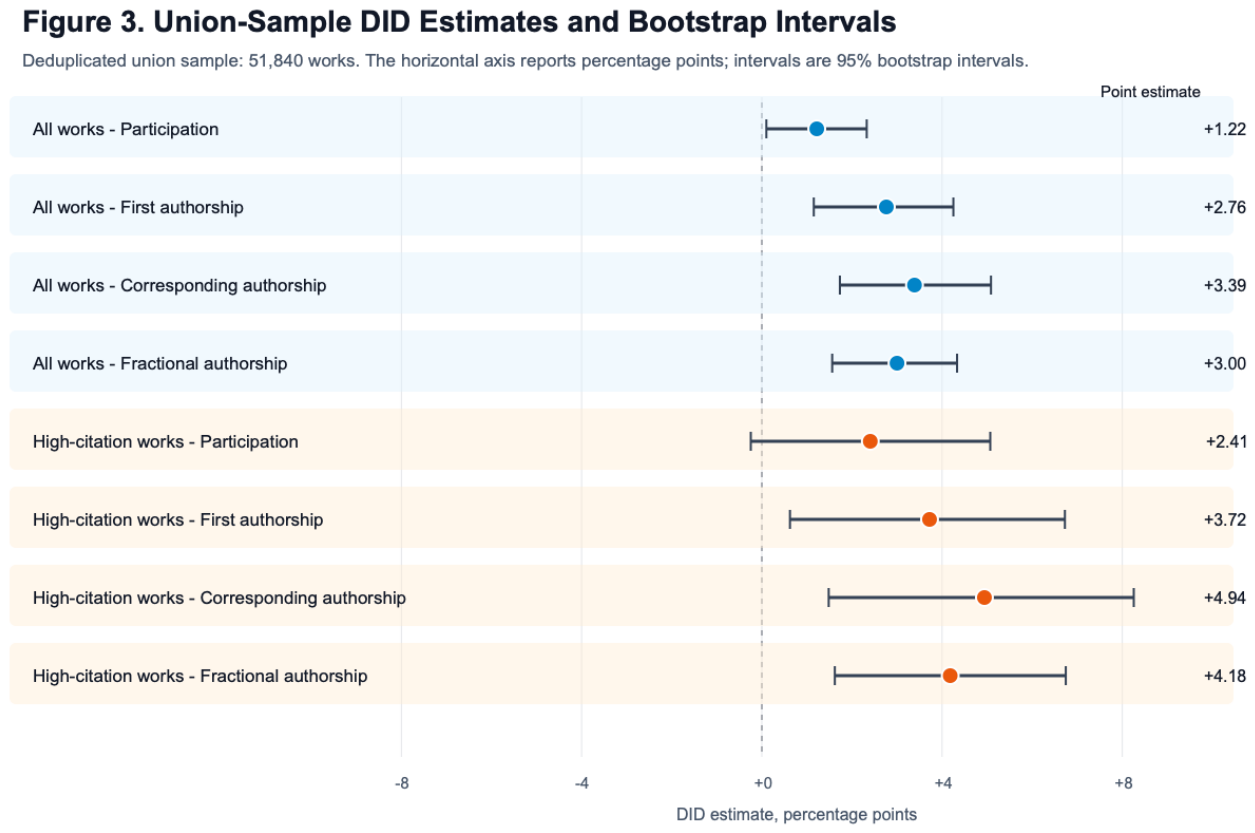
In the deduplicated union sample, disadvantaged-country participation in high-AI-exposure fields increased from 9.11% before ChatGPT to 10.62% after ChatGPT, a change of +1.51 percentage points. In low-AI-exposure fields, participation increased from 11.33% to 11.62%, a change of +0.29 percentage points. The resulting DID is +1.22 percentage points, with a 95% bootstrap interval of [+0.10, +2.33].
The leadership outcomes show larger changes. The DID estimates for first authorship, corresponding authorship, and fractional authorship are +2.76, +3.39, and +3.00 percentage points, respectively. All three bootstrap intervals are above zero.
Table 2.
Main DID estimates in all works.
| Outcome | High change | Low change | DID | 95% bootstrap interval |
|---|---|---|---|---|
| Disadvantaged-country participation | +1.51 pp | +0.29 pp | +1.22 pp | [+0.10, +2.33] |
| First-author share | +2.72 pp | -0.04 pp | +2.76 pp | [+1.15, +4.25] |
| Corresponding-author share | +2.59 pp | -0.80 pp | +3.39 pp | [+1.73, +5.09] |
| Fractional-author share | +2.41 pp | -0.59 pp | +3.00 pp | [+1.56, +4.33] |
Figure 3.
Pooled union-sample DID estimates with stratified bootstrap intervals. These estimates summarize average pre/post differences; Figure 4 provides the stricter annual timing diagnostic.
Figure 3.
Pooled union-sample DID estimates with stratified bootstrap intervals. These estimates summarize average pre/post differences; Figure 4 provides the stricter annual timing diagnostic.
Annual Work-Level Dynamics: A Narrower Leadership Result
The pooled estimates combine four pre years and two post years. Annual contrasts relative to 2022 reveal a narrower pattern. For first authorship, the disadvantaged-country high-minus-low-exposure difference rises by 3.67 percentage points in 2023, with a 95% bootstrap interval of [1.36, 5.99], and by 2.85 points in 2024, with an interval of [0.17, 5.46]. The three pre-2022 first-author contrasts are statistically compatible with zero. First authorship is therefore the only outcome with positive intervals in both post years and no comparable pre-period departure.
The other outcomes are less stable. Participation rises by 1.79 points in 2023 but its interval narrowly includes zero, and the 2024 estimate falls to 0.53 points. Fractional authorship is positive in 2023 but its 2024 interval includes zero. Corresponding authorship is positive in both post years, but both intervals include zero and the 2021 contrast is already negative. These dynamics do not invalidate the pooled estimates; they show that averaging years makes the evidence appear broader than its timing supports.
Work-Level Recognition Evidence: High-Citation Papers
To approximate scholarly recognition, the analysis restricts the sample to papers marked by OpenAlex as top 10% citation-percentile works within their field-year context. The high-citation results remain positive. The DID estimates are +2.41 percentage points for participation, +3.72 for first authorship, +4.94 for corresponding authorship, and +4.18 for fractional authorship.
The pooled bootstrap interval for high-citation participation crosses zero. The pooled authorship-position intervals are positive, but annual post-2022 intervals for all four high-citation outcomes include zero. The high-citation results should therefore be treated as suggestive pooled associations rather than a stable annual change in recognition.
Figure 4.
Annual work-level authorship dynamics. Each estimate is the high-minus-low AI-exposure contrast relative to the same contrast in 2022. Lines report 95% stratified bootstrap intervals. First authorship is the only outcome with positive intervals in both 2023 and 2024.
Figure 4.
Annual work-level authorship dynamics. Each estimate is the high-minus-low AI-exposure contrast relative to the same contrast in 2022. Lines report 95% stratified bootstrap intervals. First authorship is the only outcome with positive intervals in both 2023 and 2024.
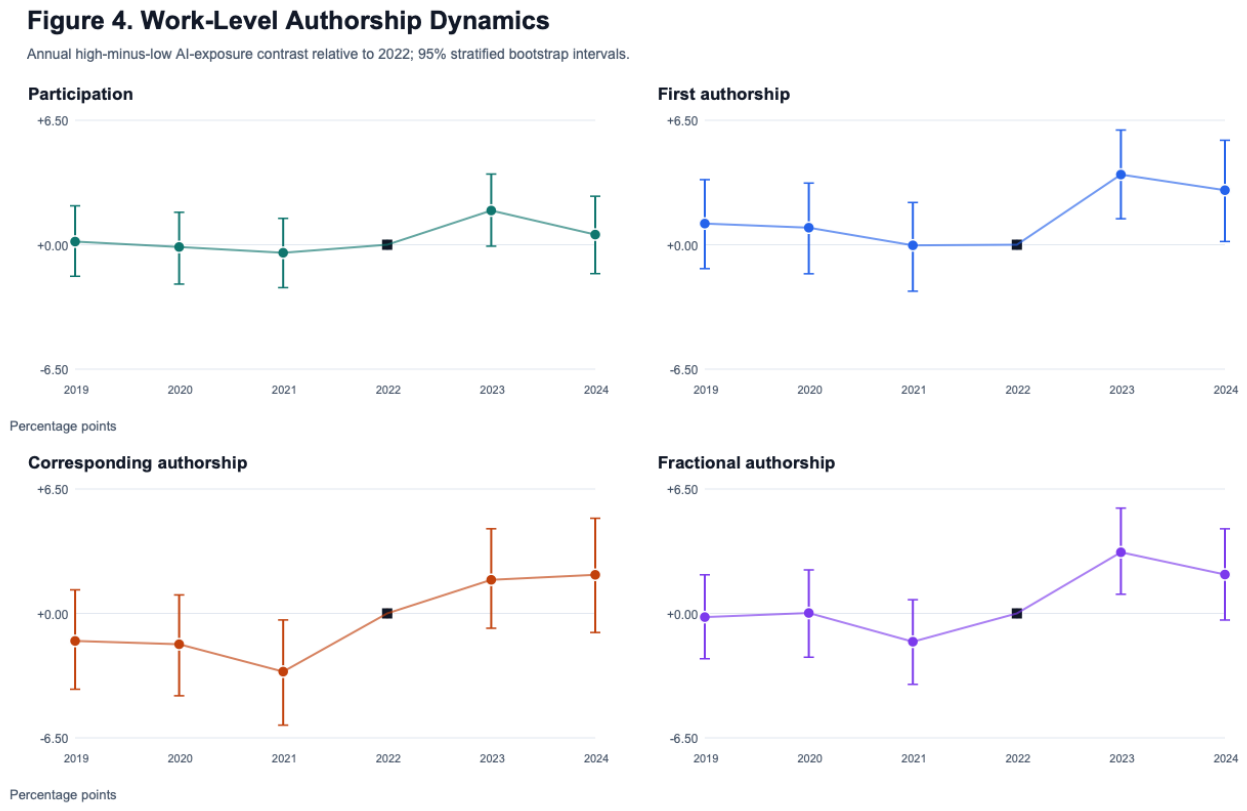
Table 3.
DID estimates in high-citation papers.
| Outcome | High change | Low change | DID | 95% bootstrap interval |
|---|---|---|---|---|
| Disadvantaged-country participation | +3.20 pp | +0.79 pp | +2.41 pp | [-0.24, +5.07] |
| First-author share | +4.36 pp | +0.64 pp | +3.72 pp | [+0.62, +6.73] |
| Corresponding-author share | +4.21 pp | -0.73 pp | +4.94 pp | [+1.48, +8.26] |
| Fractional-author share | +3.97 pp | -0.21 pp | +4.18 pp | [+1.62, +6.75] |
Source-Quality Sensitivity
OpenAlex journal sources include a small number of sources whose names contain conference-like terms such as “conference”, “proceedings”, or “workshop”. These records account for 3.11% of the union sample and 3.09% of weighted observations. Excluding them does not change the direction of the results.
After excluding conference-like source names, the all-work DID estimates remain positive: +1.11 percentage points for participation, +2.51 for first authorship, +3.00 for corresponding authorship, and +2.74 for fractional authorship. The high-citation estimates also remain positive: +2.42, +3.71, +5.10, and +4.22 percentage points.
Figure 5.
Source-quality sensitivity. Excluding conference-like source names does not reverse the sign of any of the eight main estimates. This is a source-name sensitivity check rather than a formal journal-quality ranking.
Figure 5.
Source-quality sensitivity. Excluding conference-like source names does not reverse the sign of any of the eight main estimates. This is a source-name sensitivity check rather than a formal journal-quality ranking.
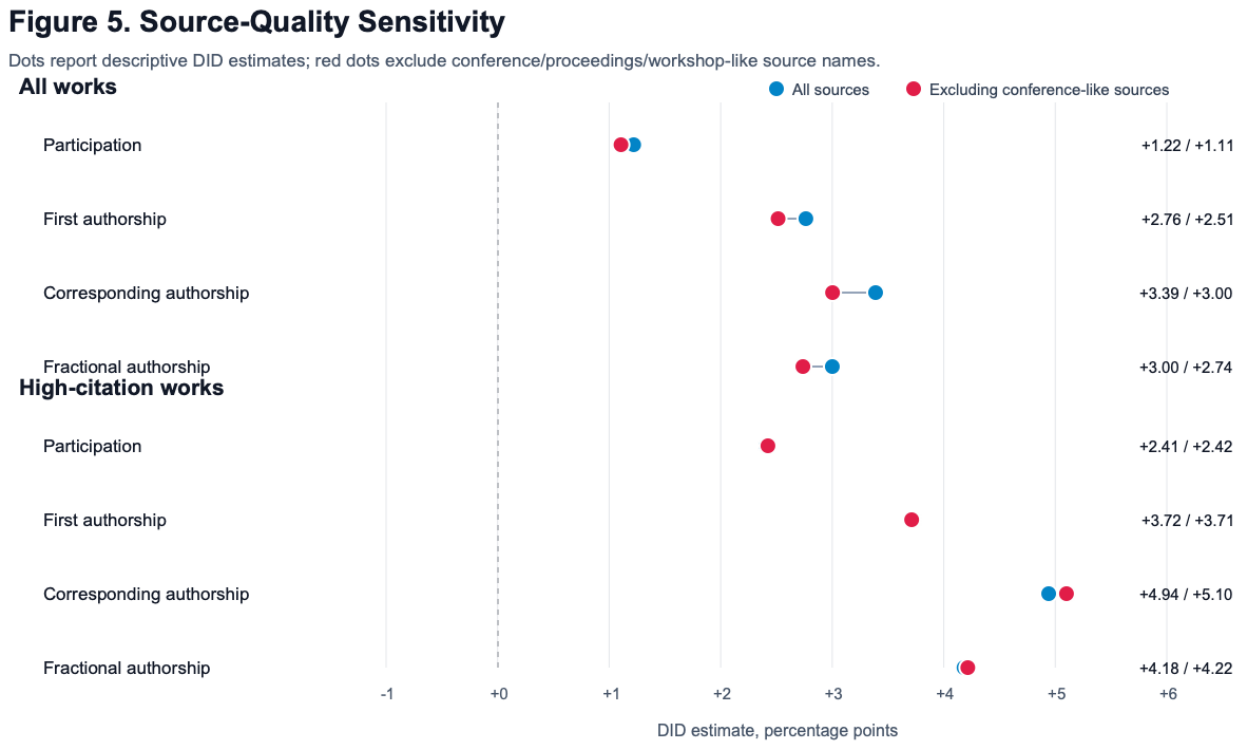
Table 4.
Source-quality robustness.
| Subsample | Outcome | All sources | Excluding conference-like sources | Direction |
|---|---|---|---|---|
| All works | Participation | +1.22 pp | +1.11 pp | unchanged |
| All works | First authorship | +2.76 pp | +2.51 pp | unchanged |
| All works | Corresponding authorship | +3.39 pp | +3.00 pp | unchanged |
| All works | Fractional authorship | +3.00 pp | +2.74 pp | unchanged |
| High citation | Participation | +2.41 pp | +2.42 pp | unchanged |
| High citation | First authorship | +3.72 pp | +3.71 pp | unchanged |
| High citation | Corresponding authorship | +4.94 pp | +5.10 pp | unchanged |
| High citation | Fractional authorship | +4.18 pp | +4.22 pp | unchanged |
Aggregate Panel Evidence: No Stable Redistribution
The zero-complete country-subfield-year panel provides a more conservative aggregate check. In the baseline 2017-2024 sample, the triple-difference coefficients are -0.021 for log total articles, -0.015 for log top-10% cited articles, and -0.057 for log international-collaboration articles. None reaches conventional statistical significance with country-clustered standard errors.
The time-window checks remain informative. Restricting the sample to 2019-2024 produces coefficients of +0.004, +0.021, and -0.024. Treating 2023 as a transition year and comparing 2024 with 2017-2022 produces -0.074, -0.025, and -0.106; only the international-collaboration estimate is statistically distinguishable from zero. The aggregate evidence therefore does not support broad equalization, but neither does it establish a general post-ChatGPT deterioration across outcomes.
Figure 6.
Triple-difference estimates in the balanced country-subfield-year panel. Zero-output cells are retained. Points report the coefficient on disadvantaged country x high-AI-exposure subfield x post-ChatGPT; lines report 95% country-clustered intervals.
Figure 6.
Triple-difference estimates in the balanced country-subfield-year panel. Zero-output cells are retained. Points report the coefficient on disadvantaged country x high-AI-exposure subfield x post-ChatGPT; lines report 95% country-clustered intervals.
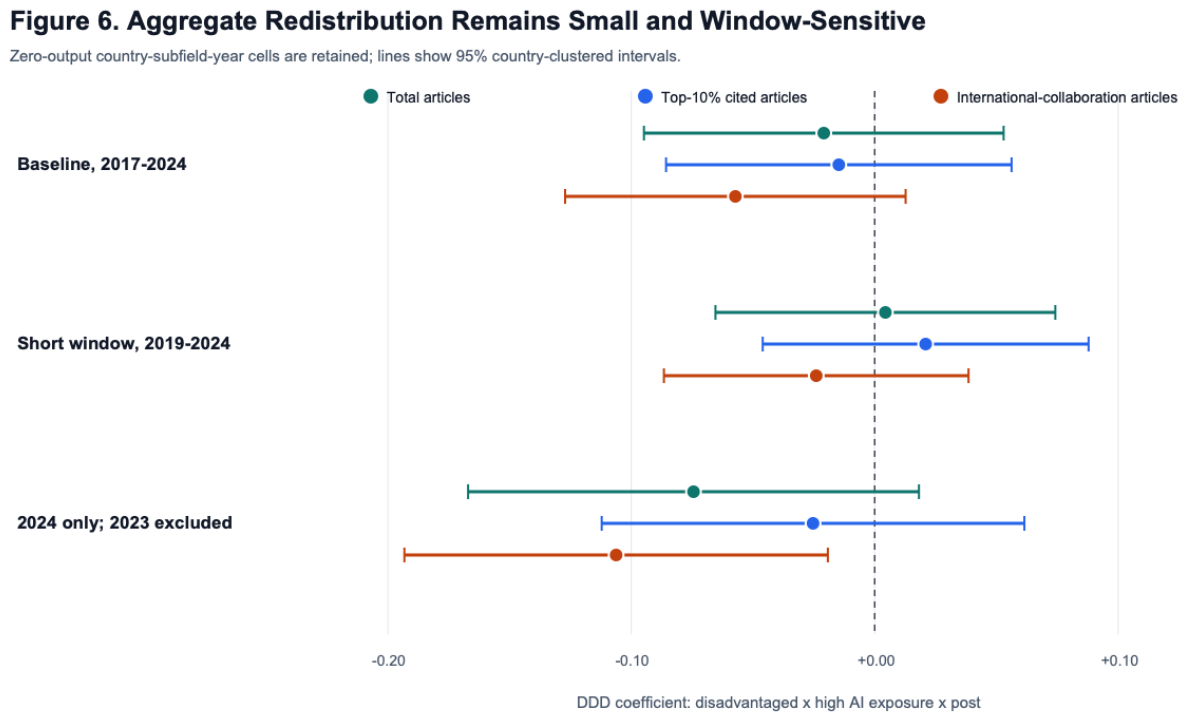
Table 5.
Subfield-level DDD estimates in the country-subfield-year panel.
| Outcome | DDD coefficient | Cluster SE | t value | N |
|---|---|---|---|---|
| Total articles | -0.021 | 0.038 | -0.55 | 12,320 |
| Top-10% cited articles | -0.015 | 0.036 | -0.41 | 12,320 |
| International-collaboration articles | -0.057 | 0.036 | -1.60 | 12,320 |
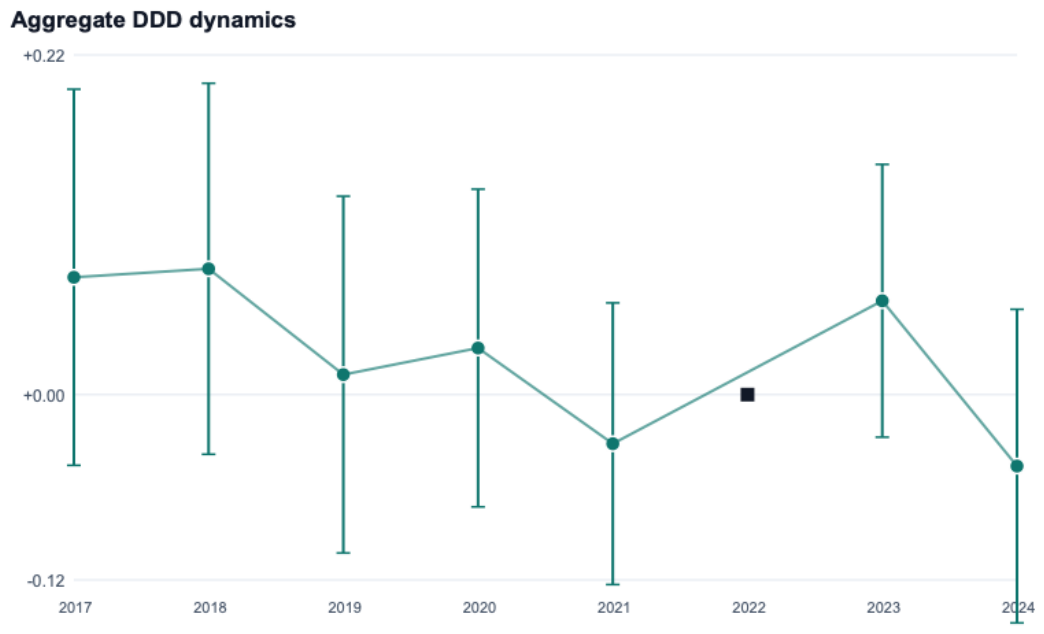
The balanced-panel event study further limits causal claims. Relative to 2022, the log-total-article coefficient is +0.061 in 2023 and -0.046 in 2024; both intervals include zero. Earlier coefficients fluctuate around zero, although 2017 and 2018 remain positive. The annual pattern contains neither a stable post-shock break nor evidence strong enough to validate strict causal interpretation.
Figure 7.
Balanced-panel event-study check. The outcome is log total articles and 2022 is the reference year. The post-ChatGPT coefficients change sign between 2023 and 2024 and are statistically imprecise.
Figure 7.
Balanced-panel event-study check. The outcome is log total articles and 2022 is the reference year. The post-ChatGPT coefficients change sign between 2023 and 2024 and are statistically imprecise.
Capacity Heterogeneity: An Apparent Mechanism That Predates ChatGPT
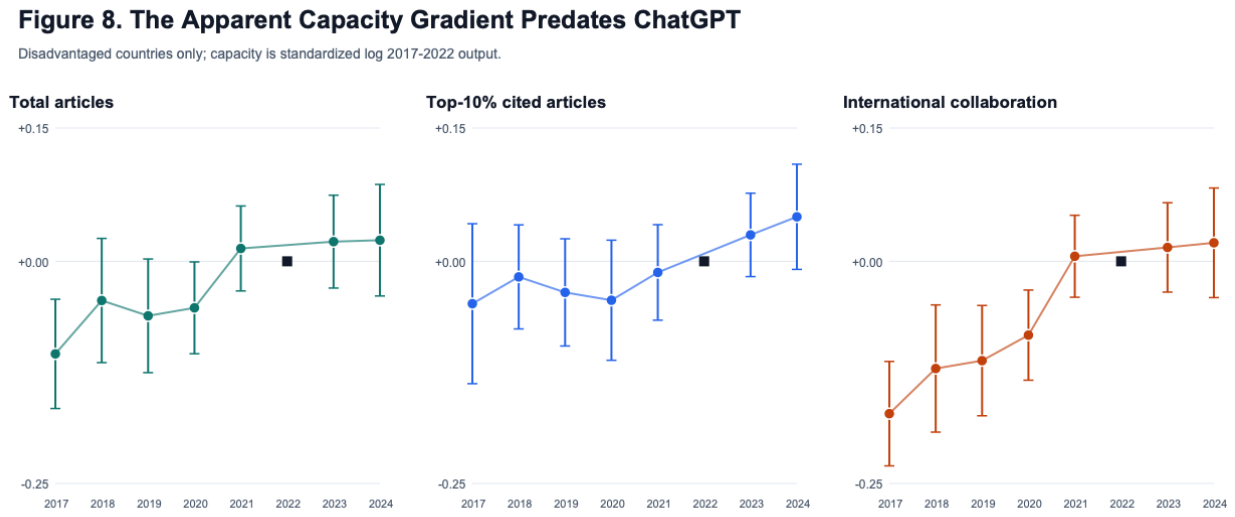
Within the 71 disadvantaged countries, the unadjusted interaction between pre-2022 research capacity, high AI exposure, and the post period is positive: +0.064 for total articles, +0.066 for top-10% cited articles, and +0.098 for international collaboration. The pattern survives excluding India and the three largest disadvantaged-country producers. Considered alone, these estimates might be interpreted as evidence that AI disproportionately helps countries already capable of producing internationally visible research.
The timing evidence rejects that interpretation. Higher-capacity disadvantaged countries were already converging more rapidly in high-exposure subfields before 2022, especially for international collaboration. Once a capacity-by-high-exposure linear trend is included, the post coefficients become -0.014 for total articles, +0.037 for top-10% cited articles, and -0.043 for international collaboration; none is statistically distinguishable from zero. The capacity gradient is real as a descriptive cross-temporal pattern, but this design cannot attribute it to ChatGPT.
Table 6.
Pre-shock capacity heterogeneity among disadvantaged countries.
| Outcome | Unadjusted | SE | Trend-adjusted | SE |
|---|---|---|---|---|
| Total articles | +0.064 | 0.027 | -0.014 | 0.030 |
| Top-10% cited articles | +0.066 | 0.024 | +0.037 | 0.035 |
| International-collaboration articles | +0.098 | 0.021 | -0.043 | 0.030 |
Figure 8.
Annual capacity-gradient estimates among disadvantaged countries. Capacity is standardized log publication output during 2017-2022. The pre-2022 movement shows that the positive pooled interaction cannot be interpreted as a new ChatGPT effect.
Figure 8.
Annual capacity-gradient estimates among disadvantaged countries. Capacity is standardized log publication output during 2017-2022. The pre-2022 movement shows that the positive pooled interaction cannot be interpreted as a new ChatGPT effect.
Discussion
The results rule out both a simple democratization story and a simple inequality-amplification story. There is no broad aggregate redistribution after ChatGPT, and the apparent advantage of higher-capacity disadvantaged countries is largely a continuation of earlier convergence. At the same time, first-author leadership shows a positive and sustained post-2022 work-level pattern. Conversion without redistribution is therefore best understood as a bounded interpretation of this asymmetry, not as a demonstrated causal mechanism.
The distinction between pooled and annual results matters. Pooled DID estimates are positive across all authorship measures, but only first authorship has positive bootstrap intervals in both 2023 and 2024. Participation weakens in 2024, corresponding-authorship intervals include zero, and high-citation estimates are not stable year by year. The evidence therefore concerns one positional dimension of leadership rather than generalized improvement in participation, leadership, and recognition.
The country-subfield-year panel narrows the claim further. Restoring zero-output cells changes the empirical population from countries that already published to all country-subfield-year opportunities in the comparison sample. On this more defensible denominator, aggregate coefficients remain small and sensitive to the window. The first-author pattern should therefore not be read as evidence that AI redistributed global research resources or recognition.
The failed capacity test is also informative. A positive pooled interaction initially appears to support the claim that AI releases existing research capacity. Event-study estimates show that the same gradient was developing before ChatGPT, and explicit trend adjustment removes the post association. Reporting this failed mechanism test prevents the theoretical language from outrunning the evidence.
The remaining interpretation is institutional and positional. When journal-legible text becomes cheaper to produce, authors may renegotiate who drafts, leads, and receives first-author credit before country-level output or citation hierarchies move. This is consistent with a conversion margin, but bibliometric timing alone cannot show that AI caused the change or identify the underlying authorship negotiations.
This also clarifies the role of scholarly judgment. In an AI-rich environment, polished writing may become less scarce, while question selection, credible evidence, data access, methods, networks, and editorial trust remain scarce. The present study does not establish that better judgment causes the observed first-author change. It shows why lower writing costs alone are insufficient grounds for claiming that academic inequality has been solved.
Limitations and Future Research
This study has several limitations.
First, the work-level authorship sample covers four subfields, while the broader country-subfield-year panel covers ten subfields but measures aggregate country participation rather than authorship leadership. Future work should combine both strengths by constructing a larger work-level authorship sample across a preregistered set of high- and low-AI-exposure subfields.
Second, field-level AI exposure is a proxy rather than a direct measure of AI use. The analysis does not observe whether authors used ChatGPT or other AI tools. More credible treatment intensity measures could include LLM-modified text estimates, journal AI policy timing, country-level access restrictions, or institutional subscriptions.
Third, annual diagnostics do not establish a clean common-trends design. The aggregate post coefficients are unstable, and the capacity gradient clearly predates ChatGPT. The work-level first-author result has cleaner timing, but it still compares four purposively classified subfields after a global shock. The study must therefore remain descriptive rather than causal.
Fourth, the income-group classification uses current World Bank categories. Historical income-group classifications should be used in future robustness checks. Corresponding-author markers are also incomplete in OpenAlex, with coverage around 69-71% in the present data. Publication year is an imperfect treatment clock because articles published in 2023 may have been designed, written, or accepted before ChatGPT became available.
Fifth, OpenAlex cannot observe submissions, desk rejections, reviewer reports, editorial decisions, or AI-detection risk. The study therefore measures published outcomes rather than the full publication pipeline.
Conclusions
Generative AI has changed the conditions of academic writing, but its effect on academic inequality cannot be inferred from writing assistance alone. The relevant question is whether AI changes the conversion of research capacity into academic authority: who participates, who leads, and whose work is recognized.
Using OpenAlex evidence from 2019 to 2024, the article finds a sustained relative improvement in disadvantaged-country first authorship in the selected high-AI-exposure subfields. Broader pooled authorship estimates are positive, but most annual participation, corresponding-author, fractional-author, and high-citation estimates are not stable across both post years.
These findings are not proof that ChatGPT caused equalization. The balanced country-subfield-year panel does not show broad aggregate redistribution, and the apparent advantage of higher-capacity disadvantaged countries disappears after differential trends are modeled. The strongest conclusion is therefore asymmetric: early post-ChatGPT change is visible in first-author leadership, while output, collaboration, and recognition hierarchies remain largely intact.
Conversion without redistribution names this limited pattern. It does not claim that AI democratized global science. It identifies a plausible margin at which academic authority can move before the resources and recognition structures of global science are redistributed.
Author Contributions
Conceptualization, L.L.; methodology, L.L. and M.E.T.P.; software, L.L.; validation, L.L. and M.E.T.P.; formal analysis, L.L.; investigation, L.L.; data curation, L.L.; writing-original draft preparation, L.L.; writing-review and editing, L.L. and M.E.T.P.; visualization, L.L.; supervision, M.E.T.P. All authors have read and agreed to the published version of the manuscript.
Funding
This research received no external funding.
Institutional Review Board Statement
Not applicable. This study uses publicly available bibliographic metadata and does not involve humans or animals.
Informed Consent Statement
Not applicable.
Data Availability Statement
The study uses publicly accessible metadata from OpenAlex and World Bank country classifications. Processed tables, query audit files, and figure outputs are available from the corresponding author upon reasonable request and will be deposited in a public replication repository before publication.
Acknowledgments
The authors thank colleagues and reviewers who provided comments on the research design. During the preparation of this manuscript, the authors used OpenAI ChatGPT to assist with language polishing and the organization of ideas. The authors reviewed and revised all outputs and take full responsibility for the content of this publication.
Conflicts of Interest
The authors declare no conflicts of interest.
Abbreviations
| Abbreviation | Meaning |
| AI | Artificial intelligence |
| DDD | Difference-in-differences-in-differences |
| DID | Difference-in-differences |
| GenAI | Generative artificial intelligence |
| LLM | Large language model |
References
- Canagarajah, A.S. “Nondiscursive” requirements in academic publishing, material resources of periphery scholars, and the politics of knowledge production. Writ. Commun. 1996, 13, 435–472. [Google Scholar] [CrossRef]
- Lillis, T.; Curry, M.J. Academic Writing in a Global Context: The Politics and Practices of Publishing in English; Routledge: London, 2010. [Google Scholar]
- Flowerdew, J. The non-Anglophone scholar on the periphery of scholarly publication. AILA Rev. 2007, 20, 14–27. [Google Scholar] [CrossRef]
- Flowerdew, J. Scholarly writers who use English as an additional language: What can Goffman’s stigma tell us? J. Engl. Acad. Purp. 2008, 7, 77–86. [Google Scholar] [CrossRef]
- Flowerdew, J. The linguistic disadvantage of scholars who write in English as an additional language: Myth or reality. Lang. Teach. 2019, 52, 249–260. [Google Scholar] [CrossRef]
- Amano, T.; Ramírez-Castañeda, V.; Berdejo-Espinola, V.; Borokini, I.; Chowdhury, S.; Golivets, M.; González-Trujillo, J.D.; Montaño-Centellas, F.; Paudel, K.; White, R.L.; et al. The manifold costs of being a non-native English speaker in science. PLoS Biol. 2023, 21, e3002184. [Google Scholar] [CrossRef] [PubMed]
- Lingard, L.; Chandritilake, M.; de Heer, M.; Klasen, J.; Maulina, F.; Olmos-Vega, F.; St-Onge, C. Will ChatGPT’s free language editing service level the playing field in science communication? Insights from a collaborative project with non-native English scholars. Perspect. Med. Educ. 2023, 12, 565–574. [Google Scholar] [CrossRef] [PubMed]
- Paasi, A. Globalisation, academic capitalism, and the uneven geographies of international journal publishing spaces. Environ. Plan. A 2005, 37, 769–789. [Google Scholar] [CrossRef]
- Collyer, F.M. Global patterns in the publishing of academic knowledge: Global North, global South. Curr. Sociol. 2018, 66, 56–73. [Google Scholar] [CrossRef]
- Demeter, M. Academic Knowledge Production and the Global South: Questioning Inequality and Under-representation; Palgrave Macmillan: Cham, 2020. [Google Scholar] [CrossRef]
- Marginson, S.; Xu, X. Hegemony and inequality in global science: Problems of the center-periphery model. Comp. Educ. Rev. 2023, 67, 31–52. [Google Scholar] [CrossRef]
- Merton, R.K. The Matthew effect in science. Science 1968, 159, 56–63. [Google Scholar] [CrossRef]
- DiPrete, T.A.; Eirich, G.M. Cumulative advantage as a mechanism for inequality: A review of theoretical and empirical developments. Annu. Rev. Sociol. 2006, 32, 271–297. [Google Scholar] [CrossRef]
- Fortunato, S.; Bergstrom, C.T.; Börner, K.; Evans, J.A.; Helbing, D.; Milojević, S.; Petersen, A.M.; Radicchi, F.; Sinatra, R.; Uzzi, B.; et al. Science of science. Science 2018, 359, eaao0185. [Google Scholar] [CrossRef] [PubMed]
- van Dis, E.A.M.; Bollen, J.; Zuidema, W.; van Rooij, R.; Bockting, C.L. ChatGPT: five priorities for research. Nature 2023, 614, 224–226. [Google Scholar] [CrossRef] [PubMed]
- Gao, C.A.; Howard, F.M.; Markov, N.S.; Dyer, E.C.; Ramesh, S.; Luo, Y.; Pearson, A.T. Comparing scientific abstracts generated by ChatGPT to real abstracts with detectors and blinded human reviewers. npj Digit. Med. 2023, 6, 75. [Google Scholar] [CrossRef] [PubMed]
- Liang, W.; Zhang, Y.; Wu, Z.; Lepp, H.; Ji, W.; Zhao, X.; Cao, H.; Liu, S.; He, S.; Huang, Z.; et al. Quantifying large language model usage in scientific papers. Nat. Hum. Behav. 2025, 9, 2599–2609. [Google Scholar] [CrossRef] [PubMed]
- Liu, J.; He, Y.; Zheng, Z.; Bu, Y.; Ni, C. AI-assisted writing is growing fastest among non-English-speaking and less established scientists. 2025. [Google Scholar] [CrossRef]
- Liang, W.; Izzo, Z.; Zhang, Y.; Lepp, H.; Cao, H.; Zhao, X.; Chen, L.; Ye, H.; Liu, S.; Huang, Z.; et al. Monitoring AI-modified content at scale: A case study on the impact of ChatGPT on AI conference peer reviews. In Proceedings of the Proceedings of the 41st International Conference on Machine Learning, 2024. [Google Scholar]
- Yu, S.; Luo, M.; Madasu, A.; Lal, V.; Howard, P. Is your paper being reviewed by an LLM? Investigating AI text detectability in peer review. 2024. Available online: http://arxiv.org/abs/2410.03019.
- Liang, W.; Yuksekgonul, M.; Mao, Y.; Wu, E.; Zou, J. GPT detectors are biased against non-native English writers. Patterns 2023, 4, 100779. [Google Scholar] [CrossRef] [PubMed]
- Lepp, H.; Smith, D.S. “You cannot sound like GPT”: Signs of language discrimination and resistance in computer science publishing. In Proceedings of the Proceedings of the 2025 ACM Conference on Fairness, Accountability, and Transparency, 2025; pp. 3162–3181. [Google Scholar] [CrossRef]
- Hu, H.; Zhou, Q.; Hashim, H. Negotiating identity in the age of ChatGPT: Non-native English researchers’ experiences with AI-assisted academic writing. Humanit. Soc. Sci. Commun. 2025, 12, 965. [Google Scholar] [CrossRef]
- He, Y.; Bu, Y. Academic journals’ AI policies fail to curb the surge in AI-assisted academic writing. Proc. Natl. Acad. Sci. 2026, 123, e2526734123. [Google Scholar] [CrossRef] [PubMed]
- Priem, J.; Piwowar, H.; Orr, R. OpenAlex: A fully-open index of scholarly works, authors, venues, institutions, and concepts. 2022. Available online: http://arxiv.org/abs/2205.01833. [CrossRef]
- World Bank. World Bank country and lending groups. 2026. [Google Scholar] [PubMed]
- Angrist, J.D.; Pischke, J.S. Mostly Harmless Econometrics: An Empiricist’s Companion; Princeton University Press: Princeton, 2009. [Google Scholar]
- Callaway, B.; Sant’Anna, P.H.C. Difference-in-differences with multiple time periods. J. Econom. 2021, 225, 200–230. [Google Scholar] [CrossRef]
- Goodman-Bacon, A. Difference-in-differences with variation in treatment timing. J. Econom. 2021, 225, 254–277. [Google Scholar] [CrossRef]
- Roth, J.; Sant’Anna, P.H.C.; Bilinski, A.; Poe, J. What’s trending in difference-in-differences? A synthesis of the recent econometrics literature. J. Econom. 2023, 235, 2218–2244. [Google Scholar] [CrossRef]
- Sun, L.; Abraham, S. Estimating dynamic treatment effects in event studies with heterogeneous treatment effects. J. Econom. 2021, 225, 175–199. [Google Scholar] [CrossRef]
Figure 1.
Conversion without redistribution. Generative AI lowers the cost of producing internationally legible academic text. This may improve authorship leadership and recognition for scholars with credible research capacity, but it does not directly redistribute data resources, collaboration networks, journal access, cumulative reputation, or scholarly judgment.
Figure 1.
Conversion without redistribution. Generative AI lowers the cost of producing internationally legible academic text. This may improve authorship leadership and recognition for scholars with credible research capacity, but it does not directly redistribute data resources, collaboration networks, journal access, cumulative reputation, or scholarly judgment.
Disclaimer/Publisher’s Note: The statements, opinions and data contained in all publications are solely those of the individual author(s) and contributor(s) and not of MDPI and/or the editor(s). MDPI and/or the editor(s) disclaim responsibility for any injury to people or property resulting from any ideas, methods, instructions or products referred to in the content. |
© 2026 by the authors. Licensee MDPI, Basel, Switzerland. This article is an open access article distributed under the terms and conditions of the Creative Commons Attribution (CC BY) license (http://creativecommons.org/licenses/by/4.0/).
Copyright: This open access article is published under a Creative Commons CC BY 4.0 license, which permit the free download, distribution, and reuse, provided that the author and preprint are cited in any reuse.


