

Submitted:
05 July 2026
Posted:
06 July 2026
You are already at the latest version
Abstract
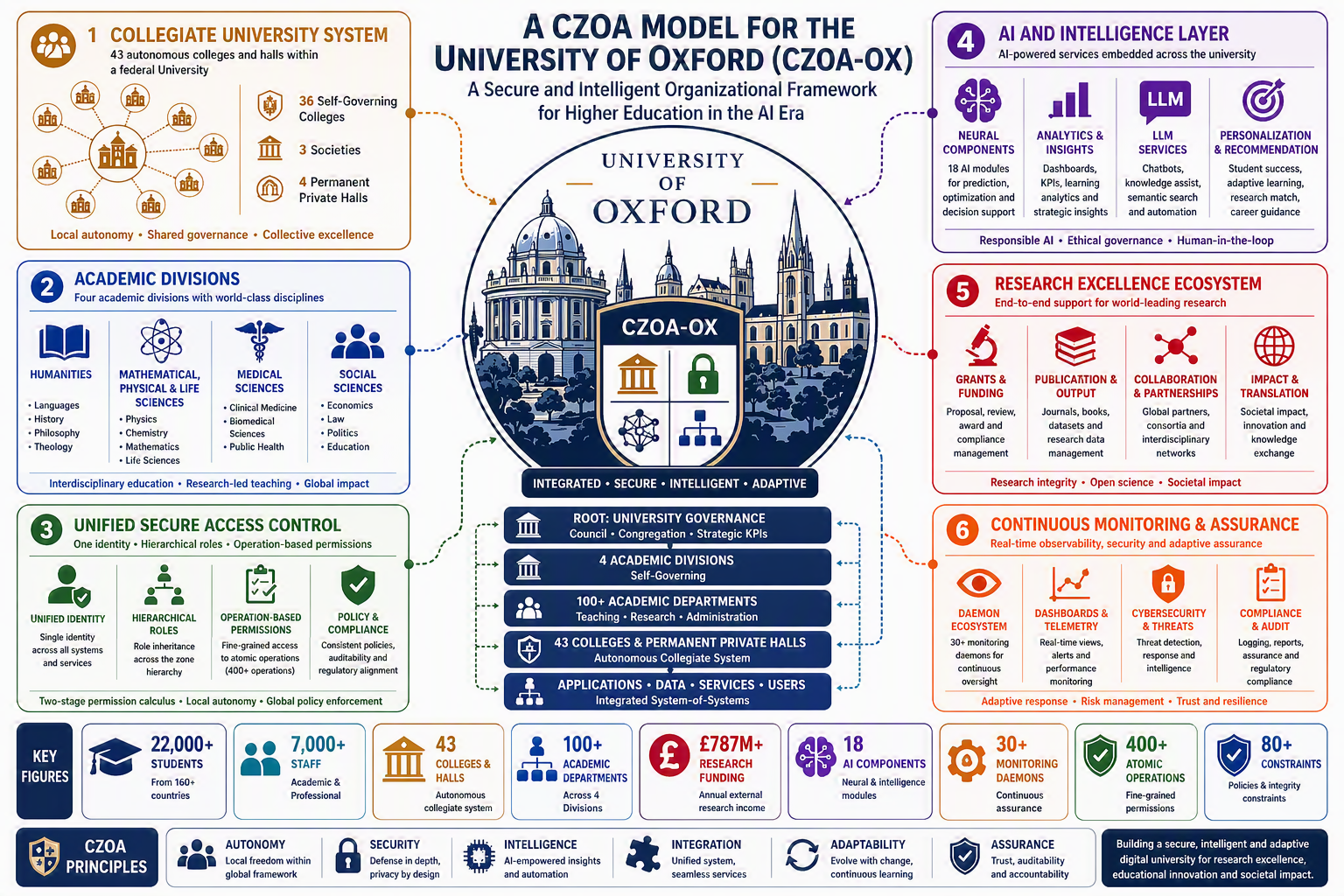
The University of Oxford is the oldest university in the English-speaking world, with teaching existing since 1096 and formal incorporation in 1571. As the world's top-ranked university in the Times Higher Education World University Rankings since 2017, Oxford serves approximately 22,000 students, employs over 7,000 staff, and secures £787 million in annual external research funding—more than any other UK university. Its distinctive collegiate structure comprises 43 colleges and halls—including 36 self-governing colleges, three societies, and four permanent private halls—integrated within a federal system alongside four academic divisions, over 100 academic departments, and central University Administration and Services (UAS). As Oxford embarks on an ambitious digital transformation programme spanning research, education, administration, technology, and engagement, with a dedicated focus on AI competency and responsible AI deployment, a new architectural paradigm is required. This paper applies the Constrained Zoned-Object Architecture (CZOA) to design a comprehensive, integrated, secure, and intelligent organizational system for the University of Oxford. We present a recursive CZOA model comprising a three-level zone tree with over 70 zones, 80+ roles, 35 applications, 400+ atomic operations, 18 neural components, hierarchical embeddings, 80+ constraints, and 30+ continuous monitoring daemons. The model preserves the unique autonomy of Oxford's 43 colleges while enabling cohesive central governance through Council and Congregation. We describe the implementation approach and discuss how CZOA aligns with Oxford's strategic priorities of research excellence, educational innovation, and digital transformation.
Keywords:
constrained zoned-object architecture
; intelligent academic systems
; access control
; collegiate university
; adaptive systems
; University of Oxford
; system-ofsystems
; digital transformation
1. Introduction
1.1. The Challenge of Organizational System Integration
Modern large-scale organizations face profound challenges in integrating diverse, historically evolved information systems while maintaining security, operational efficiency, and adaptability. These challenges are particularly acute in complex multi-stakeholder environments where autonomous units must collaborate within a federated governance framework.
System Integration Challenges: Organizations typically accumulate systems over decades, resulting in heterogeneous technology stacks, inconsistent data models, and incompatible interfaces. Legacy systems—often mission-critical—resist replacement, creating integration debt that impedes digital transformation. Integration requires not merely technical interoperability but semantic alignment: ensuring that identical concepts (e.g., "student," "course," "research project") carry consistent meaning across systems. Without careful architectural design, integration efforts produce brittle point-to-point connections that are costly to maintain and fragile when any component changes.
Authentication and Access Control Challenges: As organizations grow, identity management becomes exponentially more complex. Users require access to multiple systems, each with its own authentication mechanisms and permission models. This creates several interrelated problems:
- Identity Fragmentation: Users maintain separate credentials across systems, creating security vulnerabilities (password reuse, credential proliferation) and user frustration.
- Inconsistent Authorization: The same user may have different access rights in different systems based on inconsistent role definitions or outdated synchronization mechanisms.
- Role Explosion: Defining roles separately for each system leads to hundreds or thousands of roles that are difficult to audit, manage, and secure.
- Inadequate Cross-System Workflows: Business processes that span multiple systems—such as student admissions, research grant management, or employee onboarding—require coordinated access decisions that individual systems cannot support.
- Audit and Compliance Gaps: When access is managed in silos, organizations cannot produce comprehensive audit trails or enforce consistent security policies, exposing them to regulatory risk (e.g., GDPR, UK Data Protection Act, research governance frameworks).
Division and Department Fragmentation: Large organizations with multiple divisions and departments face additional challenges. Each unit develops its own systems, processes, and access policies, leading to:
- Siloed Operations: Inability to share data and functionality across organizational boundaries, impeding collaboration and creating duplicate effort.
- Inconsistent Security Posture: Some departments may implement robust access controls while others remain vulnerable, creating organization-wide security weaknesses.
- Delayed Digital Transformation: Enterprise-wide initiatives stall because they require buy-in and integration across multiple autonomous units.
- Inefficient Resource Utilization: Redundant systems and infrastructure consume budget that could support innovation.
AI Adoption and Intelligent Systems Challenges: The current wave of AI adoption introduces new architectural demands:
- Data Access for AI: AI systems require comprehensive, high-quality data from multiple source systems, but data silos and inconsistent access policies impede data collection and model training.
- Responsible AI Governance: Organizations must ensure AI systems operate within ethical and regulatory boundaries, requiring continuous monitoring, audit trails, and policy enforcement—capabilities that traditional systems lack.
- Personalization Requirements: AI-driven personalization (e.g., student success prediction, personalized learning recommendations) requires fine-grained user understanding and contextual access decisions.
- Continuous Learning: AI systems must be retrained on new data, requiring ongoing access to operational data while maintaining security and privacy.
- Operational Integration: AI insights must be delivered through existing applications and workflows, requiring tight integration with operational systems.
1.2. CZOA: A Unified Architectural Solution
The Constrained Zoned-Object Architecture (CZOA) addresses these challenges through a unified architectural framework built on several key principles:
Integrated System Architecture: CZOA represents the entire organization as a single, recursively composable system. All applications, data, users, and operations are defined within a unified model, eliminating artificial boundaries between systems. The recursive zone structure allows each organizational unit (division, department, college) to operate as an autonomous subsystem while participating in the whole.
Unified Identity and Access Management: CZOA provides:
- Centralized Identity: Each user has a single identity across the entire system, with attributes managed consistently.
- Hierarchical Role Model: Roles are defined once and inherited across the zone tree, eliminating role explosion and ensuring consistent access semantics.
- Operation-Based Permissions: Permissions attach to atomic operations rather than applications, enabling fine-grained, cross-system access control. Users are granted rights to perform specific actions (e.g., submit_grant, grade_assignment), not to entire applications.
- Parent Override: The two-stage permission calculus enables local autonomy while maintaining global policy enforcement through parent zone override.
Cross-Division Integration: CZOA naturally supports integration across divisions and departments:
- Zones map directly to organizational structure, providing a clear architecture for division and department autonomy.
- Parent-child relationships enable both local control and enterprise-wide coordination.
- Operation definitions are global, ensuring semantic consistency across all zones.
- Cross-zone workflows are supported through the recursive permission calculus and hierarchical daemon communication.
Security and Compliance: CZOA provides comprehensive security capabilities:
- Granular, operation-level permissions ensure the principle of least privilege.
- Separation of duty constraints prevent conflicts of interest (e.g., teaching vs. grading).
- Hierarchical constraints ensure child policies inherit and extend parent policies.
- Continuous daemon monitoring detects violations and triggers remediation.
- Comprehensive audit trails support regulatory compliance.
AI Integration: CZOA natively supports intelligent systems:
- Neural components integrate with the permission calculus to enable context-aware, adaptive decisions.
- Embeddings provide semantic understanding across zones, supporting personalization and recommendation.
- Continuous learning is enabled through daemons that trigger model retraining.
- Responsible AI governance is enforced through constraints and monitoring daemons.
1.3. The University of Oxford: Context and Challenges
The University of Oxford exemplifies the organizational challenges described above. With a history stretching back to 1096, Oxford has accumulated centuries of tradition, decentralized autonomy, and heterogeneous systems—all while maintaining its position as the world's top-ranked university.
Governance Structure: Oxford's governance stems from its long history. The two main bodies are:
- Council: The University's principal executive and policy-making body, responsible for advancing the University's objectives, administration, and managing finances and property. The Chair of Council is the Vice-Chancellor.
- Congregation: The sovereign body of the University, acting as its 'parliament' with over 5,000 members including academic staff, college heads, and senior administrative staff. All resolutions passed by Congregation are binding on Council.
- Convocation: Elects the Chancellor and the Professor of Poetry.
- Conference of Colleges: Where colleges come together to deal with matters of shared interest.
Executive Leadership:
- Chancellor: Elected by Convocation.
- Vice-Chancellor: The senior officer of the University, holding office for up to seven years.
- Pro-Vice-Chancellors: Currently four, with portfolios in Education, Research, Strategic Initiatives, and External Engagement, plus a Pro-Vice-Chancellor (Digital) leading the digital transformation.
- Registrar: Heads University Administration and Services (UAS).
Academic Structure: Oxford's academic departments, faculties, and research centres are grouped into four academic divisions:
| Division | Description |
| Humanities | Classics, English, History, Linguistics, Modern Languages, Music, Oriental Studies, Philosophy, Theology, Ruskin School of Art |
| Mathematical, Physical and Life Sciences (MPLS) | Physics, Chemistry, Earth Sciences, Materials, Plant Sciences, Computer Science, Engineering Science, Mathematics, Statistics |
| Medical Sciences | Biochemistry, Experimental Psychology, Clinical Medicine, Oncology, Pathology, Population Health, Surgical Sciences |
| Social Sciences | Anthropology, Economics, Archaeology, Education, Law, Geography, International Development, Sociology, Said Business School |
The Collegiate System: Oxford's 43 colleges and halls (including 36 self-governing colleges, three societies, and four permanent private halls) are independent, self-governing institutions related to the central University in a federal system. Each college has its own statutes, endowment, and governing body. Colleges provide tutorials and small-group teaching, while the central University organises lectures and seminars, sets syllabuses, examines students, and awards degrees.
Key Facts:
| Metric | Value |
| Total Students | ~22,000 |
| International Students | ~42-43% |
| Staff (excluding academics) | ~7,866 |
| Faculty/Academic Staff | ~2,000+ |
| Colleges and Halls | 43 (36 colleges, 4 PPHs, 3 societies) |
| Academic Divisions | 4 |
| Academic Departments | 100+ |
| Annual Research Funding | £787 million (2022/23) |
| Spinout Companies Created | 300+ |
| Times Higher Education Ranking | #1 (2017-present) |
1.4. Business Operations
Oxford's core business operations span:
- Teaching and Learning: ~22,000 students across hundreds of undergraduate and graduate programmes, delivered through a unique tutorial system combining college-based and central University teaching.
- Research: £787M annual research income, leading the UK in research funding and spinout creation.
- Collegiate Administration: 43 autonomous colleges managing their own admissions, endowments, and governance.
- Digital Services: A comprehensive digital transformation programme spanning research, education, administration, technology, and engagement.
- Libraries and Museums: The Bodleian Libraries, four University museums, and the Botanic Garden.
- Continuing Education: Lifelong learning, professional development, and online learning.
1.5. Challenges in the AI Era
Oxford's challenges reflect the broader organizational integration and AI adoption challenges described above:
System Integration and Access Control: Oxford operates dozens of core systems—including the Student Information System (SIS), Oxford Research Management System (ORMS), Teaching Management System (TMS), MyOxford student portal, Finance System, HR System, and Learning Management System (Canvas)—each with its own authentication, authorization, and data models. These systems must interoperate across four academic divisions, 100+ departments, and 43 autonomous colleges, creating complex integration requirements that legacy architectures struggle to support. Consistent authentication and fine-grained access control across this heterogeneous landscape remains a significant challenge.
Digital Transformation: Oxford's long-term investment in digital services spans research, education, administration, technology, and engagement, requiring integrated, intelligent systems that can operate across organizational boundaries.
AI Integration: Training nearly 3,000 colleagues in AI tools, supporting pilots with over 700 staff, and establishing an AI Competency Centre. These initiatives require architectures that support responsible AI deployment, data access for model training, and integration of AI capabilities into operational workflows.
Collegiate Autonomy: 43 independent colleges require local autonomy while ensuring enterprise-wide cohesion—a fundamental tension that CZOA's recursive zone structure is designed to resolve.
Research Excellence: £787M research enterprise requires secure, intelligent systems for grant management, ethics compliance, and research data that operate across departmental and collegiate boundaries.
Cybersecurity: Growing threats require enhanced data governance and security, including consistent identity management, granular access control, and continuous monitoring across all systems.
Scale and Complexity: 100+ departments, 43 colleges, and 22,000 students across a federal system demand a system-of-systems architecture that can handle this complexity while maintaining security and operational efficiency.
1.6. How CZOA Addresses Oxford's Challenges
This paper presents a comprehensive CZOA model specifically designed for the University of Oxford. Our model:
- Provides a unified architecture that integrates Oxford's diverse systems—including ORMS, MyOxford, TMS, SIS, Finance, HR, and library systems—within a single recursive framework.
- Implements consistent authentication and authorization through a hierarchical role model, operation-based permissions, and the two-stage permission calculus, eliminating the identity fragmentation and inconsistent access control that plague current systems.
- Preserves collegiate autonomy by representing each of Oxford's 43 colleges as an autonomous CZOA zone, while enabling central governance through parent-child relationships and hierarchical constraints.
- Supports cross-division workflows through the recursive zone structure, enabling seamless collaboration across academic divisions, departments, and colleges.
- Integrates AI capabilities through 18 neural components that enable student success prediction, grant forecasting, research collaboration discovery, and responsible AI governance.
- Enforces continuous security and compliance through 30+ hierarchical monitoring daemons and 80+ constraints.
The remainder of this paper is organized as follows: Section 2 provides an overview of CZOA; Section 3 details the full CZOA model for the University of Oxford, including zones, roles, users, applications, operations, neural components, embeddings, constraints, permission calculus, and daemons; Section 4 presents the implementation approach; Section 5 discusses benefits; and Section 6 concludes.
2. CZOA Overview
CZOA defines a system as a 10-tuple:
- Z (Zones): Recursive subsystems forming a rooted tree; every zone is a CZOA system.
- R (Roles): Job functions with base permissions (sets of operations).
- U (Users): Authenticated identities with attributes and active roles.
- A (Applications): Structural modules grouping operations; permissions are not granted on applications.
- (Operations): Atomic executable actions; sole targets of permission assignments.
- N (Neural Components): Trainable functions for learning and adaptation.
- E (Embeddings): Semantic mappings with local and global alignment.
- Γ (Constraints): Hierarchical Identity, Trigger, Goal, and Access constraints.
- Φ (Permission Calculus): Two-stage recursive decision: local check with parent override.
- Δ (Daemons): Continuous monitoring processes, recursively organized.
3. CZOA Model for the University of Oxford
This section details .
3.1. Zones () — Three-Level Zone Tree
The zone tree has a root node (University of Oxford), with first-level division and functional zones, second-level department and administrative zones, and third-level college zones reflecting Oxford's unique collegiate structure.
Level 1: Root Zone
Oxford (Root)
Level 2: Division and Functional Zones
| Zone ID | Zone Name | Description |
| OX_HUM | Humanities Division | Classics, English, History, Languages, Music, Philosophy, Theology, Art |
| OX_MPLS | Mathematical, Physical & Life Sciences Division | Physics, Chemistry, Computer Science, Engineering, Mathematics, Statistics, Earth Sciences, Materials, Plant Sciences, Zoology |
| OX_MED | Medical Sciences Division | Biochemistry, Clinical Medicine, Oncology, Pathology, Population Health, Surgical Sciences |
| OX_SOC | Social Sciences Division | Anthropology, Economics, Archaeology, Education, Law, Geography, International Development, Sociology, Said Business School |
| OX_CONT | Department for Continuing Education | Lifelong learning, professional development, online learning |
| OX_GLAM | Gardens, Libraries and Museums | Bodleian Libraries, 4 museums, Botanic Garden |
| OX_UAS | University Administration and Services | Central administrative departments |
| OX_GOV | Governance | Council, Congregation, Convocation |
| OX_EXEC | Executive | Chancellor, Vice-Chancellor, Pro-Vice-Chancellors |
| OX_RES | Research and Innovation | Research Services, Oxford Research Management System (ORMS) |
| OX_FIN | Finance | Financial operations, research funding management |
| OX_HR | Human Resources | Personnel, People Committee |
| OX_IT | Information Technology | IT Services, Digital Governance Unit (DGU) |
| OX_DIGITAL | Digital Transformation | Digital portfolio, AI Competency Centre, UX Centre of Excellence |
| OX_EXT | External Affairs | Communications, engagement, Oxford Science Enterprises |
| OX_EST | Estates | Buildings, infrastructure |
Level 3: Department and Administrative Zones
Under Humanities Division (OX_HUM) :
| Zone ID | Zone Name | Description |
| CLASSICS | Faculty of Classics | Classics |
| ENGLISH | Faculty of English Language and Literature | English |
| HISTORY | Faculty of History | History |
| LINGUISTICS | Faculty of Linguistics, Philology & Phonetics | Linguistics |
| MODLANG | Faculty of Medieval and Modern Languages | Modern Languages |
| MUSIC | Faculty of Music | Music |
| ORIENTAL | Faculty of Oriental Studies | Oriental Studies |
| PHILOSOPHY | Faculty of Philosophy | Philosophy |
| THEOLOGY | Faculty of Theology and Religion | Theology |
| RUSKIN | Ruskin School of Art | Art |
| TORCH | TORCH Research Centre | Humanities research |
Under MPLS Division (OX_MPLS) :
| Zone ID | Zone Name | Description |
| PHYSICS | Department of Physics | Physics |
| CHEMISTRY | Department of Chemistry | Chemistry |
| COMPSCI | Department of Computer Science | Computer Science |
| ENGSCI | Department of Engineering Science | Engineering |
| MATH | Mathematical Institute | Mathematics |
| STATS | Department of Statistics | Statistics |
| EARTH | Department of Earth Sciences | Earth Sciences |
| MATERIALS | Department of Materials | Materials |
| PLANT | Department of Plant Sciences | Plant Sciences |
| ZOOLOGY | Department of Zoology | Zoology |
| BEGBROKE | Begbroke Science Park | Science park |
| ERESEARCH | Oxford e-Research Centre | e-Research |
Under Medical Sciences Division (OX_MED) :
| Zone ID | Zone Name | Description |
| BIOCHEM | Department of Biochemistry | Biochemistry |
| EXPSYCH | Department of Experimental Psychology | Psychology |
| ORTHO | Nuffield Department of Orthopaedics | Orthopaedics |
| PHARM | Department of Pharmacology | Pharmacology |
| PRIMARY | Nuffield Department of Primary Care | Primary Care |
| WOMENS | Nuffield Department of Women's & Reproductive Health | Women's Health |
| CLINMED | Nuffield Department of Clinical Medicine | Clinical Medicine |
| RADCLIFFE | Radcliffe Department of Medicine | Medicine |
| PAEDS | Department of Paediatrics | Paediatrics |
| PHYSIOL | Department of Physiology, Anatomy & Genetics | Physiology |
| PSYCHIAT | Department of Psychiatry | Psychiatry |
| NEURO | Nuffield Department of Clinical Neurosciences | Neurosciences |
| ONCOLOGY | Department of Oncology | Oncology |
| PATH | Sir William Dunn School of Pathology | Pathology |
| POPHEALTH | Nuffield Department of Population Health | Population Health |
| SURG | Nuffield Department of Surgical Sciences | Surgical Sciences |
Under Social Sciences Division (OX_SOC) :
| Zone ID | Zone Name | Description |
| ANTHRO | School of Anthropology and Museum Ethnography | Anthropology |
| ECON | Department of Economics | Economics |
| GLOBAL | Oxford School of Global and Area Studies | Global Studies |
| OII | Oxford Internet Institute | Internet |
| POLITICS | Department of Politics and International Relations | Politics |
| ARCHAE | School of Archaeology | Archaeology |
| EDUC | Department of Education | Education |
| BLAVATNIK | Blavatnik School of Government | Government |
| LAW | Faculty of Law | Law |
| SOCPOL | Department of Social Policy and Intervention | Social Policy |
| SAID | Saïd Business School | Business |
| GEOG | School of Geography and the Environment | Geography |
| INTDEV | Department of International Development | International Development |
| MARTIN | Oxford Martin School | Research |
| SOCIOL | Department of Sociology | Sociology |
Under University Administration and Services (OX_UAS) :
| Zone ID | Zone Name | Description |
| ACAD_ADMIN | Academic Administration | Academic services |
| RES_SERV | Research Services | Research support |
| FIN_SERV | Finance Services | Financial operations |
| HR_SERV | Personnel/Human Resources | HR services |
| ESTATES | Estates Services | Buildings, infrastructure |
| IT_SERV | IT Services | Central IT |
| DGU | Digital Governance Unit | Digital governance |
| EXT_AFF | External Affairs | Communications, engagement |
| GOV_SERV | Governance Services | Council, Congregation support |
Under GLAM (OX_GLAM) :
| Zone ID | Zone Name | Description |
| BODLEIAN | Bodleian Libraries | Central library |
| ASHMOLEAN | Ashmolean Museum | Art/archaeology |
| HISTSCI | History of Science Museum | Science history |
| NATURAL | Museum of Natural History | Natural history |
| PITTRIVERS | Pitt Rivers Museum | Anthropology |
| BOTANIC | Botanic Garden | Botanic |
Level 4: College Zones
Oxford's 43 colleges and halls are represented as recursive zones under the relevant campus/division structure, each as a complete CZOA system.
Constituent Colleges (36 self-governing) :
| Zone ID | Zone Name | Zone ID | Zone Name |
| ALLSOULS | All Souls College | MAGDALEN | Magdalen College |
| BALLIOL | Balliol College | MANSFIELD | Mansfield College |
| BRASENOSE | Brasenose College | MERTON | Merton College |
| CHRISTCHURCH | Christ Church | NEW | New College |
| CORPUS | Corpus Christi College | NUFFIELD | Nuffield College |
| EXETER | Exeter College | ORIEL | Oriel College |
| GREENTEMP | Green Templeton College | PEMBROKE | Pembroke College |
| HARRIS | Harris Manchester College | QUEENS | The Queen's College |
| HERTFORD | Hertford College | REUBEN | Reuben College |
| JESUS | Jesus College | STANNES | St Anne's College |
| KEBLE | Keble College | STANTONY | St Antony's College |
| KELLOGG | Kellogg College | STCATS | St Catherine's College |
| LADYMARG | Lady Margaret Hall | STCROSS | St Cross College |
| LINACRE | Linacre College | STEDMUND | St Edmund Hall |
| LINCOLN | Lincoln College | STHILDAS | St Hilda's College |
| STHUGHS | St Hugh's College | STJOHNS | St John's College |
| STPETERS | St Peter's College | SOMERVILLE | Somerville College |
| TRINITY | Trinity College | UNIV | University College |
| WADHAM | Wadham College | WOLFSON | Wolfson College |
| WORCESTER | Worcester College |
Permanent Private Halls (4) :
| Zone ID | Zone Name | Zone ID | Zone Name |
| BLACKFRIARS | Blackfriars | CAMPION | Campion Hall |
| REGENTS | Regent's Park College | WYCLIFFE | Wycliffe Hall |
Societies (3) : Kellogg, Linacre, St Cross (graduate-only colleges that are departments of the university without their own royal charter)
3.2. Roles ()
Roles are defined per zone with inheritance across the zone tree.
Governance and Executive Roles
| Role | Zone | Base Permission Examples |
| Chancellor | OX_GOV | preside_ceremonies, ex_officio_govern, advise_university |
| Vice-Chancellor | OX_EXEC | lead_university, strategic_direction, chair_Council |
| Pro-Vice-Chancellor | OX_EXEC | oversee_portfolio, policy_development |
| Registrar | OX_UAS | lead_administration, manage_UAS |
| Council Member | OX_GOV | govern_university, approve_strategy, manage_finances |
| Congregation Member | OX_GOV | approve_statutes, elect_officers, consider_policy |
| Head of House | College | manage_college, oversee_fellows |
| College Fellow | College | teach_tutorials, conduct_research, govern_college |
| Dean | Division/Department | manage_faculty/division, approve_programs |
Academic Roles
| Role | Zone | Base Permission Examples |
| Professor | Department | teach_course, conduct_research, supervise_student |
| Associate Professor | Department | teach_course, conduct_research |
| Lecturer | Department | teach_course, grade_assignment |
| Tutor | College | conduct_tutorials, teach_small_groups |
| Teaching Assistant | Department | assist_teaching, grade_assignment |
| Research Assistant | Department | conduct_research, access_lab, analyze_data |
| Postdoctoral Fellow | Department | conduct_research, publish_findings |
| Graduate Student | Department/College | enroll_courses, conduct_research, submit_thesis |
| Undergraduate Student | Department/College | enroll_courses, access_materials, submit_assignments, attend_tutorials |
Administrative Roles
| Role | Zone | Base Permission Examples |
| Registrar | ACAD_ADMIN | manage_registration, issue_transcripts |
| College Administrator | College | manage_college_administration, coordinate_tutorials |
| Research Administrator | RES_SERV | manage_grants, oversee_compliance |
| Ethics Officer | RES_SERV | review_protocols, ensure_compliance |
| Financial Analyst | FIN_SERV | manage_budget, process_payments |
| HR Manager | HR_SERV | manage_personnel, oversee_recruitment |
| Facilities Manager | ESTATES | manage_buildings, coordinate_maintenance |
| Librarian | BODLEIAN | curate_collections, provide_research_support |
| Museum Curator | GLAM | curate_exhibitions, manage_collections |
IT and Digital Roles
| Role | Zone | Base Permission Examples |
| CDIO | OX_IT | set_strategy, manage_infrastructure |
| Systems Administrator | IT_SERV | maintain_servers, manage_cloud |
| Database Administrator | IT_SERV | manage_databases, ensure_integrity |
| Security Officer | IT_SERV | enforce_security, conduct_audits |
| Digital Transformation Lead | OX_DIGITAL | lead_digital_initiatives |
| AI Competency Centre Lead | OX_DIGITAL | enable_AI_tools, provide_training |
| UX Designer | OX_DIGITAL | design_user_experience |
| LMS Administrator | IT_SERV | manage_learning_systems |
3.3. Users ()
User categories with approximate counts:
| Category | Count | Zone Affiliation |
| Undergraduate Students | ~12,000 | Department/College zones |
| Graduate Students | ~10,000 | Department/College zones |
| Total Students | ~22,000 | All zones |
| International Students | ~42-43% | All zones |
| Academic Staff (Faculty) | ~2,000+ | Department zones |
| Administrative Staff | ~5,000+ | UAS, College zones |
| College Fellows | ~4,000 | College zones |
| Total Staff | ~7,866 | All zones |
| Congregation Members | 5,000+ | Governance zones |
| Alumni (limited access) | Extensive | Root |
3.4. Applications ()
Applications are structural modules grouping operations; they are not permission targets.
| Application | Zone | Description |
| MyOxford | OX_DIGITAL | Student app, 12,000+ registered users |
| Teaching Management System (TMS) | OX_DIGITAL | Course management, teaching administration |
| Oxford Research Management System (ORMS) | OX_RES | Integrated research management |
| Worktribe Ethics | OX_RES | Online ethics applications, 1,600+ applications |
| Research File Service (RFS) | OX_RES | Secure research data storage, 200+ projects, 283TB data |
| Online Course Hub | OX_CONT | Online course production, 470 courses in pipeline |
| Student Information System (SIS) | ACAD_ADMIN | Student records, registration |
| Finance System | FIN_SERV | Financial management, research costing |
| HR System | HR_SERV | Personnel management |
| Bodleian Libraries Catalogue | BODLEIAN | Library search, access |
| Museum Collection Management | GLAM | Collections management |
| Estates Management | ESTATES | Facilities, space management |
| ServiceNow | IT_SERV | IT service management |
| SharePoint | OX_UAS | Intranet, collaboration |
| Microsoft 365 | OX_IT | Email, collaboration |
| Canvas | OX_DIGITAL | Learning Management System |
3.5. Operations ()
Operations are atomic actions; permissions are granted only on operations.
Academic Operations
| Category | Example Operations |
| Course Management | course.create, course.develop, course.review, course.approve, course.revise |
| Tutorial Management | tutorial.schedule, tutorial.conduct, tutorial.evaluate |
| Enrollment | enroll.student, drop.course, withdraw.program, transfer.credit |
| Teaching | teach.course, grade.assignment, provide.feedback |
| Learning | access.materials, submit.assignment, participate.forum, view.grades |
| Research | propose.project, apply.ethics, submit.grant, conduct.experiment, publish.findings |
| Thesis | propose.thesis, submit.thesis, defend.thesis, approve.graduation |
Research Management Operations (ORMS)
| Category | Example Operations |
| Grants | submit.grant, cost.grant, manage.award, report.progress, close.project |
| Ethics | submit.protocol, review.protocol, approve.protocol |
| Data | store.data, share.data, archive.data, access.data |
| Contracts | manage.contract, review.contract |
| Due Diligence | conduct.due_diligence, review.compliance |
Digital Services Operations
| Category | Example Operations |
| Student Portal | access.myoxford, view.app, update.profile |
| Online Courses | create.course_online, publish.course_online, manage.enrollment_online |
| Digital Governance | manage.portfolio, oversee.digital_initiative |
Administrative Operations
| Category | Example Operations |
| Registration | register.course, issue.transcript, certify.graduation |
| Finance | process.payment, manage.budget, generate.report, cost.grant |
| HR | hire.staff, manage.benefits, process.payroll |
| Facilities | manage.building, schedule.maintenance, allocate.space |
| Library | search.catalogue, request.item, access.database |
IT Operations
| Category | Example Operations |
| Infrastructure | manage.servers, manage.network, ensure.uptime |
| Security | enforce.policy, conduct.audit, respond.incident |
| Digital Services | manage.digital_services, support.digital_transformation |
| Support | provide.helpdesk, resolve.ticket |
3.6. Neural Components ()
| Component | Zone | Type | Purpose |
| Student Success Predictor | OX_DIGITAL | Gradient Boosting | Predict at-risk students, retention optimization |
| Enrollment Forecaster | ACAD_ADMIN | Time-series Transformer | Predict enrollment patterns |
| Course Recommendation | OX_DIGITAL | Collaborative Filtering | Personalized course suggestions |
| Research Grant Predictor | RES_SERV | LSTM | Predict grant success likelihood |
| Anomaly Detector | IT_SERV | Autoencoder | Detect security threats, unusual access |
| Financial Fraud Detector | FIN_SERV | Autoencoder | Detect irregular transactions |
| Research Impact Predictor | OX_RES | Graph Neural Network | Predict citation impact, REF2029 readiness |
| Ethics Compliance Monitor | RES_SERV | NLP | Review protocol compliance |
| Learning Analytics | OX_DIGITAL | Transformer | Analyze student engagement |
| AI Assistant | OX_DIGITAL | LLM | Responsible AI leverage, training |
| Space Utilization | ESTATES | CNN | Optimize space allocation across colleges |
| Maintenance Predictor | ESTATES | LSTM | Predict facility maintenance needs |
| Library Recommendation | BODLEIAN | Collaborative Filtering | Recommend research resources |
| Career Path Advisor | OX_DIGITAL | LLM | Career guidance for students |
| Research Collaboration Finder | OX_RES | Graph Neural Network | Identify potential collaborators |
| Spinout Opportunity Detector | OX_EXT | NLP | Identify commercialisation opportunities |
| Online Course Demand | OX_CONT | Time-series | Predict online course demand |
| Tutorial Quality Analyzer | OX_DIGITAL | NLP | Analyze tutorial effectiveness |
3.7. Embeddings ()
Local Embeddings ()
Each zone maintains local embeddings in Hilbert space :
| Entity Type | Embedding Purpose |
| Students | Academic history, college affiliation, tutorial performance |
| Courses | Subject matter, difficulty, prerequisites, tutorial requirements |
| Faculty | Expertise, teaching style, research areas, college fellowship |
| Colleges | Character, history, tutorial strengths, student demographics |
| Research Projects | Topics, methods, collaborations, funding |
| Publications | Topics, citations, journals, authors |
Application-Aware Embedding:
- Application-level embedding for each application
- Operation-level residual:
- Contrastive loss encourages same-application operation similarity
Global Alignment Functor ()
Enables:
- Cross-college similarity: Compare entities across 43 colleges
- Role matching: Find equivalent roles across departments and colleges
- Anomaly detection: Detect unusual patterns across the collegiate University
- Research collaboration: Identify cross-division and cross-college research opportunities
3.8. Constraints ()
Identity Constraints (I)
I₁: ∀z_child ∈ Z_z, U_{z_child} ⊆ U_z # Zone containment
I₂: ∀r ∈ R, P_base(r) ⊆ O # Permissions only on operations
I₃: ∀u ∈ U, ∃ at least one active role # Every user has a role
I₄: Γ_{z_child} ⊆ Γ_z* # Child constraints superset of parent
I₅: ∀student, college_affiliation ⇒ program_eligibility[reference:211]
I₆: ∀faculty, appointment ⇒ college_fellowship_or_departmental_affiliation[reference:212]
I₇: ∀research, ethics_certification ⇒ approved_protocol[reference:213]
Trigger Constraints (T)
| Trigger | Condition | Action |
| ON student_grade_below(C, threshold) | IF attempts ≥ 2 | trigger_tutor_intervention |
| ON tutorial_enrollment_imbalance | IF tutor_capacity_available | reallocate_tutorials |
| ON research_grant_deadline(30 days) | IF researcher_eligible | send_reminder |
| ON security_anomaly(score > 0.85) | IF security_team_available | initiate_incident_response |
| ON budget_variance(>10%) | IF finance_team_available | trigger_review |
| ON IT_system_outage | IF recovery_plan_available | initiate_disaster_recovery |
| ON research_data_volume_exceeded | IF storage_available | alert_researcher |
| ON ethics_application_submitted | IF reviewer_available | assign_reviewer |
Goal Constraints (G)
| Zone | Goal | Metric | Target |
| Root | Research excellence | Research income | £787M+ |
| Root | Student success | Completion rate | >95% |
| OX_DIGITAL | Digital adoption | MyOxford users | 15,000+ |
| OX_DIGITAL | AI training | Staff trained | 3,000+ |
| OX_DIGITAL | Online courses | Courses in pipeline | 500+ |
| RES_SERV | Grant management | Compliance rate | 100% |
| IT_SERV | System reliability | Uptime | >99.9% |
| IT_SERV | Cybersecurity | Incident response | <1 hour |
| FIN_SERV | Fiscal responsibility | Budget variance | <5% |
| BODLEIAN | Resource utilization | Database usage | >80% |
| OX_EXT | Spinout creation | Companies created | 300+ |
Access Constraints (C)
C₁ (SoD): ∀u, NOT (teach_course(u) AND grade_course(u)) # Teaching vs. grading
C₂ (SoD): ∀u, NOT (approve_grant(u) AND manage_grant(u))
C₃ (SoD): ∀u, NOT (issue_transcript(u) AND approve_graduation(u))
C₄ (SoD): ∀u, NOT (submit_ethics(u) AND approve_ethics(u))[reference:229]
C₅ (Temporal): grade_access ONLY DURING term_active
C₆ (Temporal): registration ONLY DURING registration_period
C₇ (Temporal): research_data_access ONLY DURING project_active[reference:230]
C₈ (Attribute): IF student_status = 'probation' THEN tutorial_load ≤ 2
C₉ (Attribute): IF faculty_rank = 'junior' THEN grant_limit ≤ £100,000
C₁₀ (Attribute): IF user_role = 'undergraduate' THEN no_access_to_grade_administration
C₁₁ (Context): IF location = 'outside_UK' THEN MFA_required
C₁₂ (Context): IF device = 'untrusted' THEN read-only_access
C₁₃ (Context): IF research_data = 'sensitive' THEN require_ethics_approval[reference:231]
3.9. Permission Calculus ()
Two-stage recursive decision:
- Local check: Evaluate using local roles, constraints, neural outputs
- Parent override: Cross-zone resources or inconclusive local decision
Effective Permissions:
Example: A History student at Balliol College requesting to access a cross-listed course in Classics:
- Local check (College zone): Student role permits access.materials
- If course is cross-listed, parent (Humanities Division) consulted
- If access involves Bodleian special collections, GLAM zone may be consulted
- College affiliation may affect tutorial scheduling and student support
3.10. Daemons ()
Root Daemons
| Daemon | Function | Frequency |
| Global Compliance | Monitor policy violations | Continuous |
| System Health | Monitor IT systems uptime | Every 5 min |
| Strategic KPI | Track university-wide KPIs | Daily |
| Security Operations | Monitor cross-zone security | Continuous |
| Research Impact | Monitor research metrics | Monthly |
| Digital Transformation Monitor | Track digital progress | Daily |
Divisional Daemons
| Daemon | Function | Frequency |
| Humanities Operations | Monitor Humanities Division | Continuous |
| MPLS Operations | Monitor MPLS Division | Continuous |
| Medical Sciences Operations | Monitor Medical Sciences Division | Continuous |
| Social Sciences Operations | Monitor Social Sciences Division | Continuous |
Department/Faculty Daemons
| Daemon | Function | Frequency |
| Program Review | Monitor program review cycles | Annual |
| Faculty Performance | Track teaching/research metrics | Monthly |
| Curriculum Currency | Ensure courses current | Quarterly |
| Student Progress | Track student progress, flag at-risk | Daily |
| Tutorial Quality | Monitor tutorial effectiveness | Termly |
College Daemons
| Daemon | Function | Frequency |
| College Operations | Monitor college activities | Daily |
| Tutorial Allocation | Monitor tutorial assignments | Weekly |
| Student Welfare | Monitor student wellbeing | Daily |
Administrative Daemons
| Daemon | Function | Frequency |
| Enrollment Monitor | Track registration patterns | Daily |
| Grant Compliance | Monitor grant reporting | Monthly |
| Ethics Monitoring | Monitor ethics approvals | Continuous |
| Financial Integrity | Monitor transactions | Continuous |
| Research Data Monitor | Monitor research data storage | Daily |
| Online Course Monitor | Monitor online course production | Weekly |
IT Daemons
| Daemon | Function | Frequency |
| Security Monitoring | Detect intrusions, violations | Continuous |
| Infrastructure Health | Monitor servers, cloud | Every minute |
| Digital Services Performance | Monitor MyOxford, TMS, ORMS | Every 5 min |
| Backup Verification | Verify backups | Daily |
| Access Anomaly | Detect unusual access patterns | Continuous |
| AI Governance | Monitor responsible AI use | Daily |
Hierarchical Communication
Figure 1.
Hierarchical Communication of IT Daemons.
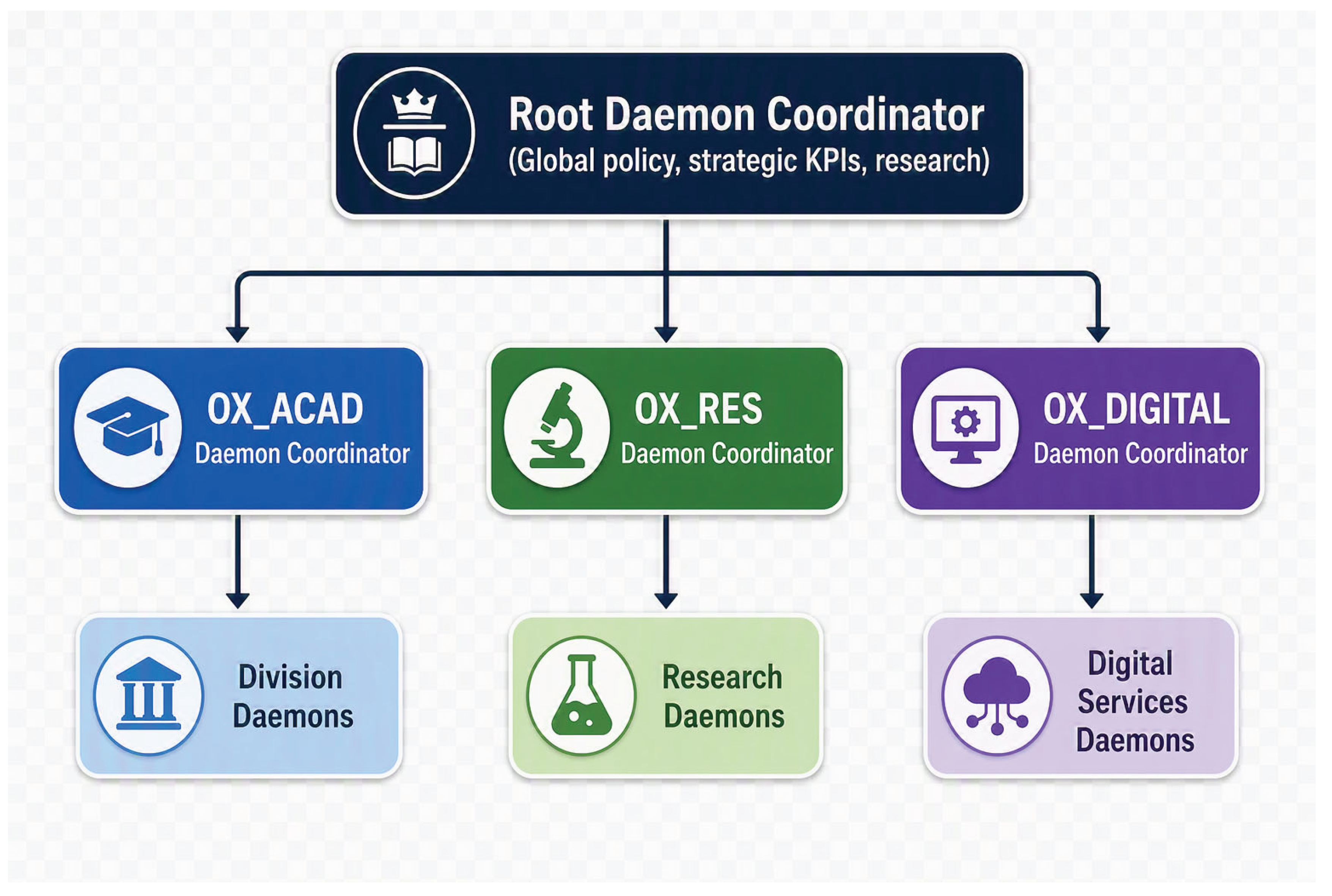
Signal Propagation Example:
- Child: Department daemon detects 30% student failure rate in a course
- Signal: STATE_CRITICAL → Division daemon
- Division: Triggers course quality review, allocates additional tutors
- Signal: STATE_WARNING → OX_ACAD daemon
- OX_ACAD: Updates student experience dashboard, triggers tutor intervention
- Signal: STATE_INFO → Root daemon
- Root: Updates strategic KPI dashboard, potentially triggers policy review
4. Implementation Approach
4.1. Core System Definition (Python)
# python
from czoi import System, Zone, Role, Application, Operation
# Root System
Oxford = System(name="UniversityOfOxford")
# Division Zones (Level 2)
ox_hum = Zone(name="HumanitiesDivision", parent=Oxford)
ox_mpls = Zone(name="MPLSDivision", parent=Oxford)
ox_med = Zone(name="MedicalSciencesDivision", parent=Oxford)
ox_soc = Zone(name="SocialSciencesDivision", parent=Oxford)
# Functional Zones (Level 2)
ox_digital = Zone(name="DigitalTransformation", parent=Oxford)
ox_res = Zone(name="ResearchAndInnovation", parent=Oxford)
ox_uas = Zone(name="UniversityAdministrationAndServices", parent=Oxford)
# Department Zones (Level 3 - under Humanities)
classics = Zone(name="FacultyOfClassics", parent=ox_hum)
english = Zone(name="FacultyOfEnglish", parent=ox_hum)
history = Zone(name="FacultyOfHistory", parent=ox_hum)
# Department Zones (Level 3 - under MPLS)
physics = Zone(name="DepartmentOfPhysics", parent=ox_mpls)
compsci = Zone(name="DepartmentOfComputerScience", parent=ox_mpls)
engsci = Zone(name="DepartmentOfEngineeringScience", parent=ox_mpls)
# College Zones (Level 4 - under appropriate structure)
balliol = Zone(name="BalliolCollege", parent=Oxford)
christchurch = Zone(name="ChristChurch", parent=Oxford)
magdalen = Zone(name="MagdalenCollege", parent=Oxford)
# Applications
myoxford = Application("MyOxford", zone=ox_digital)
orms = Application("OxfordResearchManagementSystem", zone=ox_res)
tms = Application("TeachingManagementSystem", zone=ox_digital)
# Operations
op_access = Operation("access_materials", application=tms)
op_submit = Operation("submit_grant", application=orms)
op_cost = Operation("cost_grant", application=orms)
op_view_myoxford = Operation("view.myoxford", application=myoxford)
# Roles
student = Role("Student", zone=balliol, base_perms=[op_access, op_view_myoxford])
tutor = Role("Tutor", zone=balliol, base_perms=[op_access, op_tutorial])
researcher = Role("Researcher", zone=ox_res, base_perms=[op_submit, op_cost])
4.2. Neural Component Integration
# python
from czoi.neural import (
StudentSuccessPredictor, ResearchGrantPredictor,
AnomalyDetector, LearningAnalytics
)
# Student success prediction
success_predictor = StudentSuccessPredictor(
model_type="gradient_boosting",
features=["tutorial_performance", "engagement", "course_load", "demographics"]
)
ox_digital.add_neural(success_predictor)
# Grant prediction - ORMS integration[reference:251]
grant_predictor = ResearchGrantPredictor(
model_type="lstm",
features=["proposal_quality", "PI_record", "funding_history"]
)
ox_res.add_neural(grant_predictor)
# Anomaly detection
anomaly_detector = AnomalyDetector(
model_type="autoencoder",
threshold=0.95
)
ox_uas.add_neural(anomaly_detector)
# Learning analytics
learning_analytics = LearningAnalytics(
model_type="transformer",
features=["tutorial_attendance", "assignment_scores", "engagement"]
)
ox_digital.add_neural(learning_analytics)
4.3. Constraint Definition (UniLang)
% unilang
% Identity: Zone containment
G (forall u, z (in_zone(u, z) -> in_zone(u, parent(z))))
% Identity: Every student has a college and departmental affiliation
G (forall s:Student (exists c:College (affiliated(s, c)) and
exists d:Department (affiliated(s, d))))
% Identity: Every fellow has a college affiliation
G (forall f:Fellow (exists c:College (affiliated(f, c))))
% Trigger: At-risk student intervention
G (at_risk(s) -> F_[0,7] tutor_intervention(s))
% Trigger: Grant deadline reminder - ORMS
G (grant_deadline(g, 30) -> F_[0,7] send_reminder(PI(g), g))
% Trigger: Ethics application assignment
G (ethics_submitted(e) -> F_[0,0.5] assign_reviewer(e))
% Access: Separation of duty - teaching vs. grading
forall u, c . not (teaches(u, c) and grades(u, c))
% Access: Tutorials require college affiliation
forall u, s . (conduct_tutorial(u, s) -> college_fellow(u))
% Access: Research data requires ethics approval
forall u, d . (access_research_data(u, d) -> ethics_approved(d))
% Access: MFA required for external access
forall u, o . (access_external(u, o) -> mfa_completed(u))
4.4. Daemon Configuration
# python
from czoi.daemons import (
ComplianceDaemon, SecurityDaemon, PerformanceDaemon,
StudentProgressDaemon, ResearchComplianceDaemon,
DigitalTransformationDaemon
)
# Root daemons
Oxford.add_daemon(ComplianceDaemon(
name="GlobalCompliance",
policies=["UK_Data_Protection", "FOI", "Research_Governance"]
))
Oxford.add_daemon(SecurityDaemon(
name="SecurityOperations",
threat_threshold=0.85
))
# Digital Transformation daemon[reference:252]
ox_digital.add_daemon(DigitalTransformationDaemon(
name="DigitalTransformationMonitor",
metrics=["myoxford_users", "online_courses", "AI_training_completed"],
check_interval="daily"
))
# Divisional daemons
ox_hum.add_daemon(PerformanceDaemon(
name="HumanitiesPerformance",
check_interval="daily",
metrics=["student_satisfaction", "research_output", "tutorial_quality"]
))
# College daemons
balliol.add_daemon(StudentProgressDaemon(
name="StudentProgress",
at_risk_threshold=0.6,
check_interval="daily"
))
# Research daemons - ORMS integration[reference:253]
ox_res.add_daemon(ResearchComplianceDaemon(
name="GrantCompliance",
check_interval="monthly"
))
5. Benefits for the University of Oxford
5.1. Alignment with Oxford's Strategic Priorities
| Strategic Priority | CZOA Enablement |
| Research Excellence | ORMS integration, grant prediction, research impact monitoring, spinout detection |
| Digital Transformation | MyOxford, TMS, ORMS, Online Education Hub |
| AI Integration | AI Competency Centre, AI training (3,000+ staff), responsible AI governance |
| Collegiate Autonomy | 43 colleges as autonomous CZOA zones |
| Student Experience | Personalized learning, tutorial quality monitoring, at-risk prediction |
| Cybersecurity | Enhanced security, threat detection, data governance |
5.2. Security Benefits
| Benefit | Mechanism | CZOA Component |
| Granular access control | Permissions on operations only | O + Φ |
| Hierarchical enforcement | Parent constraints override child | Γ (Identity) |
| Continuous monitoring | Daemons detect violations | Δ |
| Anomaly detection | Neural components identify threats | N + E |
| Separation of duty | Constraints prevent conflicts | Γ (Access) |
| Research data protection | Ethics constraints, access controls | Γ + Φ |
| Cybersecurity alignment | IT governance and standards | Γ + Δ |
5.3. Intelligence Benefits
| Benefit | Mechanism | CZOA Component |
| Student success prediction | ML models identify at-risk students | N |
| Grant success prediction | LSTM predicts funding likelihood | N |
| Research collaboration | GNN identifies potential partners | N + E |
| Learning analytics | Transformer analyzes tutorial engagement | N |
| AI-powered services | Responsible AI leverage | N + E |
| Spinout detection | NLP identifies commercialisation opportunities | N |
| Online course demand | Time-series predicts demand | N |
5.4. Operational Benefits
| Benefit | Mechanism | CZOA Component |
| Collegiate autonomy | Each college is a CZOA system | Z (Recursive) |
| Federal system support | Native composition of central + collegiate | Z |
| Parent override | Cross-zone decisions escalate | Φ |
| System-of-systems | Native composition | Z |
| Policy compliance | Constraints enforce regulations | Γ |
| Continuous improvement | Daemons monitor and trigger | Δ |
| Research management | ORMS integration | A + O |
| Digital services | MyOxford, TMS, Online Hub | A + O + N |
5.5. Unique Oxford-Specific Benefits
| Oxford Feature | CZOA Enablement |
| 43 Colleges | Each college as autonomous recursive zone with own statutes, endowment, and governing body |
| Tutorial System | Dedicated operations, roles (Tutor), and daemons for tutorial quality |
| Federal Structure | Parent-child hierarchy: colleges → divisions → root |
| Congregation | 5,000+ members as governance zone users |
| Bodleian Libraries | GLAM zone with library-specific operations and embeddings |
| Spinout Leadership | 300+ companies created, dedicated innovation zone |
6. Conclusions
The CZOA model for the University of Oxford provides a comprehensive, integrated framework for building a secure and intelligent collegiate system at the world's oldest and highest-ranked university. Key features include:
- Three-level recursive zone structure: Root → 4 divisions + 14 functional zones → 100+ departments + 43 colleges
- Collegiate integration: 43 autonomous colleges as independent CZOA zones within a federal system
- Granular security: Permissions granted only on atomic operations, not applications
- Intelligent adaptation: 18 neural components for prediction, recommendation, and anomaly detection
- Continuous enforcement: 30+ hierarchical daemons monitoring all operations
- Semantic understanding: Embeddings enable cross-college and cross-division similarity reasoning
- Policy compliance: 80+ constraints ensuring regulatory and strategic alignment
- Research enablement: ORMS integration for grants, ethics, contracts, and due diligence
- Digital transformation: MyOxford (12,000+ users), TMS, Online Education Hub (470 courses)
- AI readiness: AI Competency Centre, 3,000+ staff trained
This model transforms the University of Oxford from a traditional collegiate institution into an intelligent, adaptive, and secure system-of-systems capable of responding dynamically to the needs of over 22,000 students, 7,000+ staff, and 43 autonomous colleges while maintaining rigorous security, privacy, and research integrity standards in the AI era.
References
- University of Oxford. Organisational structure; 2026. [Google Scholar]
- University of Oxford. Governance; 2026. [Google Scholar]
- University of Oxford. Colleges of the University of Oxford - Wikipedia. 2026. [Google Scholar] [CrossRef] [PubMed]
- University of Oxford. Divisions & departments. 2026. [Google Scholar] [CrossRef] [PubMed]
- University of Oxford. Digital services. 2026. [Google Scholar] [CrossRef] [PubMed]
- Trefethen, A. Digital transformation – now and in the future; 2026. [Google Scholar]
- University of Oxford. Research funding statistics; 2025. [Google Scholar]
- University of Oxford. Digital transformation priorities; 2025. [Google Scholar]
- University of Oxford. University finances. 2026. [Google Scholar] [CrossRef] [PubMed]
- University of Oxford. Oxford Science Enterprises; 2026. [Google Scholar]
- Wang, H. Constrained Zoned-Object Architecture (CZOA): A Unified Framework for Building Secure and Intelligent Integrated Organizational Systems. Preprints 2026, 2026031846. [Google Scholar] [CrossRef]
Disclaimer/Publisher’s Note: The statements, opinions and data contained in all publications are solely those of the individual author(s) and contributor(s) and not of MDPI and/or the editor(s). MDPI and/or the editor(s) disclaim responsibility for any injury to people or property resulting from any ideas, methods, instructions or products referred to in the content. |
© 2026 by the authors. Licensee MDPI, Basel, Switzerland. This article is an open access article distributed under the terms and conditions of the Creative Commons Attribution (CC BY) license (http://creativecommons.org/licenses/by/4.0/).
Copyright: This open access article is published under a Creative Commons CC BY 4.0 license, which permit the free download, distribution, and reuse, provided that the author and preprint are cited in any reuse.


