Preprint
Article

This version is not peer-reviewed.

Premedication of Pediatric Cardiac Population with Midazolam: Comparison of Oral Versus Sublingual Route of Administration in Terms of Effectiveness and Possible Side Effects. Evaluation of Pharmacokinetic, Haemodynamic and Behavioral Outcomes

Submitted:

05 July 2026

Posted:

06 July 2026

You are already at the latest version

Abstract

Background: Midazolam is widely used as pediatric premedication, but evidence directly comparing oral and sublingual administration in children with congenital heart disease remains limited, particularly when pharmacokinetic and physiologic data are analyzed together. Methods: We conducted a single-center prospective randomized study comparing oral midazolam 0.5 mg/kg with sublingual midazolam 0.3 mg/kg in children undergoing cardiac surgery or catheterization procedures under general anesthesia. Plasma midazolam and 1-hydroxymidazolam concentrations were measured approximately 30 minutes after administration. Log-transformed concentrations were compared using regression/ANCOVA models adjusted for dose and age. Changes in mean arterial pressure (MAP), heart rate (HR), and oxygen saturation (SpO2) were analyzed from baseline to 15 and 30 minutes. Behavioral outcomes included sedation score, separation from parents, and mask acceptance. Results: Sixty-eight children were randomized; 65 had evaluable pharmacokinetic samples and formed the complete-case pharmacokinetic cohort. Adjusted plasma midazolam concentrations did not differ significantly between groups, with an adjusted geometric mean ratio for sublingual versus oral administration of 0.98 (95% CI 0.53-1.79; p=0.940). The corresponding ratio for 1-hydroxymidazolam was 1.37 (95% CI 0.55-3.41; p=0.494). HR and SpO2 changes were similar between groups. At 30 minutes, sublingual administration was associated with a lower adjusted change in MAP compared with oral administration (adjusted difference -12.08 mmHg, 95% CI -19.74 to -4.42; p=0.002). Behavioral outcomes were comparable between groups. Conclusions: In this prospective randomized pediatric cardiac cohort, oral midazolam 0.5 mg/kg and sublingual midazolam 0.3 mg/kg produced comparable plasma concentrations and similar behavioral outcomes. Sublingual administration was not associated with worse HR or SpO2 responses, although an isolated lower MAP change at 30 minutes warrants confirmation in larger studies. Sublingual midazolam may represent a feasible lower-dose alternative for premedication in this population.

Keywords: 
;  ;  ;  ;  ;  ;  ;  ;  

1. Introduction

Hospitalization and surgery can be a source of stress and anxiety for pediatric patients [1]. Induction of anesthesia is often highly distressing and studies have shown that an anxious child during anaesthetic induction has more possibilities to develop adverse clinical outcomes, such as emergence delirium and negative behavioral changes, namely separation anxiety and aggression [2,3,4].
Children with cardiac disease may experience elevated preoperative anxiety because of previous hospitalizations, operations, or catheterization laboratory interventions. Parental stress related to the severity of the child’s condition and the planned intervention may further amplify the child’s anxiety [5,6].
Non-pharmacological strategies for reducing preoperative anxiety and improving anaesthesia compliance in children have evolved [7]. Virtual reality acts through cognitive distraction and immersion and has shown promising results in terms of better preoperative anxiety scores and improved cooperation during anaesthesia induction, as children get more familiarized with the whole process. However, these approaches can be costly, may be less suitable for children younger than 5 years, and appear more likely to reduce than fully replace sedative requirements [8,9].
Among pharmacological options for reducing anxiety prior to surgery in pediatric population, midazolam remains one of the most widely used premedication agents because of its anxiolytic, sedative, and amnestic properties [10]. Its cardiovascular stability makes it attractive for the pediatric cardiac population, that is more vulnerable to changes in myocardial contractility, vascular tone, heart rate and oxygenation particularly when intracardiac or extracardiac shunts are present [11].
The oral route is well established and widely utilized in clinical practice, but sublingual administration may offer practical advantages, including faster mucosal absorption and partial avoidance of first-pass metabolism [12]. Prior pediatric studies have suggested that sublingual midazolam is at least comparable to oral midazolam, and in some reports may produce earlier or deeper sedation. Kattoh et al. reported similar efficacy of sublingual and oral midazolam in pediatric anesthesia, whereas Gupta et al. found higher sedation scores with the sublingual route [13,14]. In parallel, earlier cardiac-surgery literature supports oral midazolam as a safe premedication option in children with congenital heart disease.
Despite these data, literature directly combining route comparison with measured plasma concentrations, metabolite analysis, and serial physiologic observations in a pediatric cardiac cohort is sparse. The present study was designed to compare oral midazolam 0.5 mg/kg with sublingual midazolam 0.3 mg/kg across three complementary domains: pharmacokinetics, hemodynamic and oxygenation stability, and peri-induction behavioral performance.

2. Methods

2.1. Study Design and Approval

This was a single-center prospective randomized study. The study protocol was approved by the Ethics Committee and the Scientific Board of the Onassis Hospital (B.03. Π.Ε.Ε 709 (ΙΩ Γ 010) / 25.02.2021) and written informed consent was obtained from the parents or legal guardians of all participants. The trial was registered to the International Standard Randomised Controlled Trial Number (ISRCTN) registry (ISRCTN33764131 -https://doi.org/10.1186/ISRCTN33764131) and was conducted between July 2021 and October 2022 .

2.2. Patient Recruitment

Children scheduled for cardiac surgery or catheterization laboratory interventions under general anesthesia were screened after standard preoperative anesthetic evaluation. Parents or legal guardians were informed about the purpose and procedures of the study.
  • Inclusion criteria:
  • age 6 months to 8 years
  • diagnosed heart disease
  • Undergoing general anesthesia for pediatric cardiac surgery
  • Undergoing general anesthesia for interventions in the catheterization
laboratory
Exclusion criteria:
Children with body weight less than 5 Kg
History of adverse or allergic reaction to midazolam
Conditions in which sedative premedication may be contraindicated
(anticipated difficult airway, increased risk of aspiration, acute systemic illness, upper respiratory tract infection)

2.3. Randomization and Blinding

Patients were randomized to the oral or sublingual midazolam group using a computer-generated allocation sequence. The anesthesiologist who performed perioperative evaluations and managed the intraoperative anesthetic was blinded to the dose and route of premedication. Parents were also blinded to the intervention. Only the anesthesiologist or nurse who administered the premedication was aware of the assigned route.

2.4. Anesthetic Management

Preoperative fasting was applied as per local protocol.
Thirty minutes before arrival in the operating theater, children received premedication according to randomization: midazolam 0.5 mg/kg orally or midazolam 0.3 mg/kg sublingually. Because an injectable midazolam formulation was used and has a bitter taste, an equal volume of flavored paracetamol syrup was added for oral administration and an equal volume of 10% dextrose water was added for sublingual administration.
Children were monitored all the period after premedication administration. Blood pressure, heart rate, and oxygen saturation (SpO₂) recorded at baseline and at 15 and 30 minutes after drug administration. Blood pressure values were recorded either as systolic(SAP)/diastolic(DAP)/mean(MAP) arterial pressures or as systolic/diastolic only. When mean arterial pressure was not explicitly recorded, MAP was calculated as DAP + (SAP−DAP)/3.
Sedation was assessed at 15 and 30 minutes after drug administration using a five-category sedation score: A = anxious, Β = restless, C = calm and awake, D = sedated but easily woken, and Ε = deeply sedated. Positive sedation outcomes were predefined as C or D at each time point.
Separation from parents was assessed at approximately 30 minutes after drug administration using a three-category score: A = easy, B = mild resistance, and C = strong resistance. A positive separation outcome was predefined as A.
Mask acceptance was assessed at approximately 30 minutes after drug administration using the same three-category score: A = easy, B = mild resistance, and C = strong resistance. A positive mask-acceptance outcome was predefined as A.
On arrival in the operating theater, standard monitoring was established, including electrocardiography, pulse oximetry, and noninvasive blood pressure monitoring until placement of an arterial catheter when applicable. Venous access was secured, and blood samples for pharmacokinetic assessment of plasma midazolam and 1-hydroxymidazolam concentrations were collected approximately 30 minutes after drug administration.
The attending anesthesiologist who performed and recorded all measured clinical parameters was blinded to the route of midazolam administration. The 15-minute evaluation was performed in the patient room. The child was then transferred under monitoring to the operating theater. On arrival in the pre-anesthesia area, the child was separated from the parents and transferred to the operating room. Once monitoring was connected, hemodynamic and oxygenation parameters were recorded, a mask was applied, and anesthesia induction was initiated. Blood sampling was performed after the child had been put to sleep using inhalational anesthesia. The aforementioned sequence of events coincided with our 30-minute measurement timeframe.

2.5. Pharmacokinetic Assessment

Midazolam is a controlled substance classified at Table D of the Individual Listing for Greece according to the Code of Laws for Narcotic Drugs (Law 3459/2006). Due to these regulatory restrictions, Dormixal Injectable solution 15mg/3mL was used for midazolam LC-MS/MS method development in study. 1-Hydroxy Midazolam 5mg was purchased from Cayman Chemicals (MI, USA). The LC-MS grade solvents ammonium acetate, formic acid (FA) and water (H20) were procured from Fisher Scientific (Loughborough, UK). Acetonitrile (ACN; LC-MS grade) was bought from Carlo Erba (Milan, Italy).
For the preparation of midazolam stock and standard solutions, Dormixal 15mg/3mL was diluted into acetonitrile:water (ACN:H2O) for the preparation 1 mg/mL stock solution. Following, dilutions in ACN:H2O midozalam standards were prepared in the concentration ranges of 1 ng/mL to 200 ng/mL. 1-Hydroxymidazolam (item 10385.5mg) was dissolved in 1 mL of solvent and metabolite standard solutions were prepared. All stock and working solutions were stored at 4 °C until the day of sample preparation in human plasma.
Detection and quantification of midazolam and 1-hydroxymidazolam via LC-MS/MS
Midazolam and its metabolite 1-hydroxymidazolam levels in standard and unknown samples were detected and quantified via LC-MS/MS. A Triple Quad 5500+ LC-MS/MS System—QTRAP (AB SCIEX LLC, CA, USA) was used for method development. A dC18 column (Waters, Atlantis, 2.1 × 50 mm, 3 μΜ) was used for chromatographic separation of midazolam and its metabolite at a flow rate of 0.3 mL/min. Mobile phase consisted of solutions A (90% H2O, 10% ACN, 0.1% formic acid [FA]), 2mM ammonium acetate), Β (10% H2O, 90% ACN, 0.1% formic acid [FA]), 2mM ammonium acetate), needle wash (ACN: H2O 1:1), and injection volume for each sample was 10 μL. Analytes of interest (midazolam and 1-hydroxymidazolam) were eluted separately by implementation of a 8.5 min-gradient system described accordingly: 80% A and 20% Β (0.0—0.5 min), 20% A and -70% Β (2.5—5.00 min), 80% A and 20% Β (6.0—8.5 min). Transitions 326.1/209.1 for midazolam, 342.0/324.0 for the primary metabolite 1-OH midazolam and warfarin (IS) 309.0/163.0 were monitored via multiple reaction monitoring at times 2.3 min, 2.2 min and 3.5 min respectively. The mass spectrometry (MS) system was operated using positive electrospray ionization mode (ESI). LC-MS/MS methodology and linearity were set up using human plasma with concentrations between 1 ng/mL—200 ng/mL for both analytes.
For standard curve sample preparation, 50 μL of human plasma were spiked with 50 μL of midazolam and 50 μL of 1-hydroxymidazolam standard solution. 50 μL of Warfarin were added for a final concentration of 10 ng/mL in human plasma. Accordingly, 50 μL of unknown samples (pediatric plasma) were prepared with 10 ng/mL IS concentration. Double blank (human plasma in ACN:H2O) and Blank IS (10 ng/mL) samples were included to determine noise levels of the assay. Samples were centrifuged at 13.000 rpm for 15 min following protein precipitation with cold ACN (400μL). Supernatant was transferred into glass tubes and samples were evaporated to dry at 50oC for approximately 1h. Samples were reconstituted in 150 μL of solution 80% A—20% B, vortexed and added to 96-well plates for LC-MS/MS analysis.

2.6. Statistics and Sample Size

Continuous variables are presented as mean +/- SD and median with interquartile range (IQR). Because midazolam and 1-hydroxymidazolam concentrations were right-skewed, pharmacokinetic comparisons were performed using linear regression/ANCOVA on natural log-transformed concentrations, adjusting for administered dose in mg/kg and age. Results are reported as adjusted geometric mean ratios with 95% confidence intervals (CIs).
Hemodynamic and oxygenation outcomes were analyzed as changes from baseline at 15 and 30 minutes using linear regression adjusted for age and body weight. Behavioral outcomes were compared using Fisher’s exact test. No adjustment for multiple testing was performed because of the exploratory nature of the study.
The planned sample size was 60 children, with 30 per group, providing approximately 80% power to detect a standardized between-group difference of about 0.7. The final pharmacokinetic complete-case cohort included 65 children, preserving similar power for moderate-to-large continuous effects. Binary behavioral outcomes should therefore be interpreted as exploratory.

3. Results

3.1. Baseline Characteristics

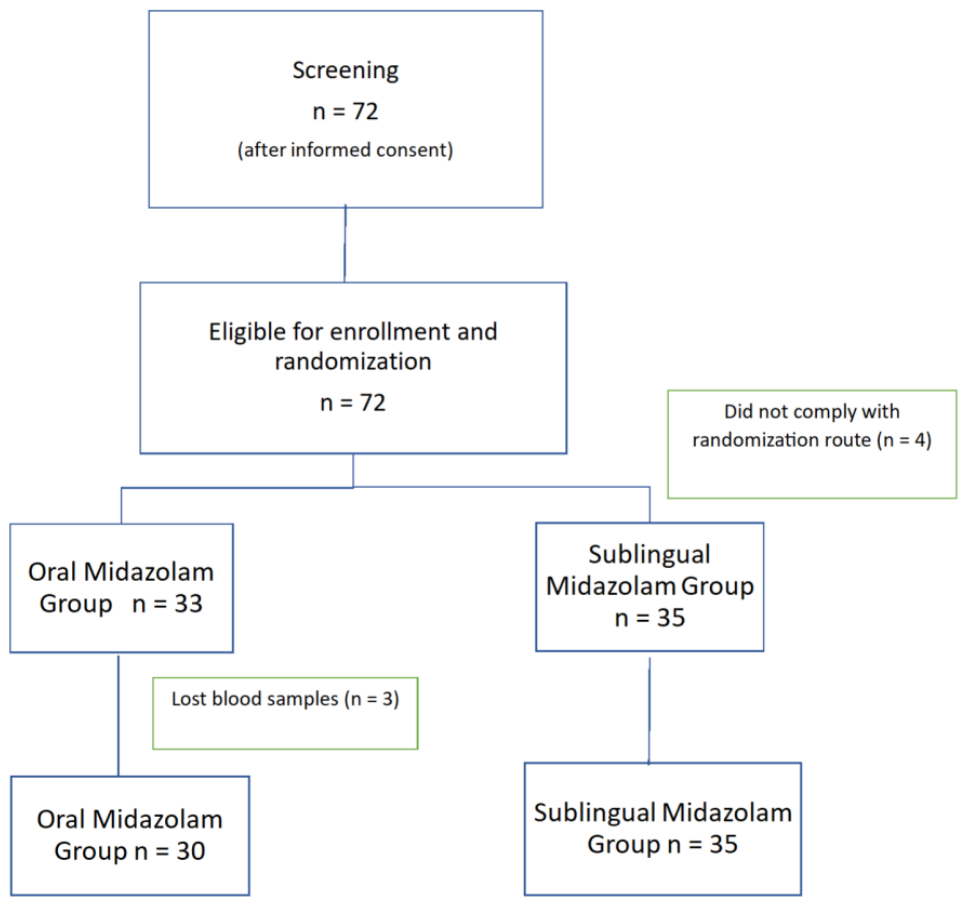
Sixty-eight children were randomized: 33 to oral midazolam and 35 to sublingual midazolam. Three blood samples from oral midazolam group were inappropriate for analysis, leaving 65 observations for the complete-case pharmacokinetic analysis. Baseline demographic characteristics and procedure type performed are summarized in the two tables below.
Table 1. Baseline characteristics of the complete-case cohort.
Characteristic Oral (O), n=30 Sublingual (S), n=35 p-value
Age, years (mean ± SD) 3.13 ± 2.62 2.65 ± 2.24 0.532
Age, years [median (IQR)] 2.60 (0.85-4.69) 2.01 (0.69–4.80)
Weight, kg (mean ± SD) 14.66 ± 6.38 15.51 ± 8.64 0.854
Weight, kg [median (IQR)] 12.00 (9.40-18.75) 13.90 (9.00–20.50)
Operation setting
Cardiac surgery 26 (86.7%) 32 (91.4%
Cathetirization lab 4 (13.3%) 3 (8.6%)
Table 2. Procedure categories in the complete-case cohort.
Procedure Type Oral, n (%) Sublingual, n (%)
ASD 7 (23.3%) 8 (22.9%)
ASD device closure 1 (3.3%) 0 (0.0%)
AV canal 2 (6.7%) 2 (5.7%)
Aortic arch / vascular ring 2 (6.7%) 3 (8.6%)
Complex cyanotic / staged repair 3 (10.0%) 2 (5.7%)
Electrophysiology / pacemaker 2 (6.7%) 4 (11.4%)
Other cardiac 4 (13.3%) 6 (17.1%)
PDA 1 (3.3%) 1 (2.9%)
VSD / conotruncal-VSD 8 (26.7%) 9 (25.7%)

3.2. Pharmacokinetic Outcomes

Table 3. Pharmacokinetic outcomes.
Substance Oral mean ± SD Sublingual mean ± SD Oral median (IQR) Sublingual median (IQR) Adjusted ratio S/O (95% CI) p
Midazolam
(ng/mL)
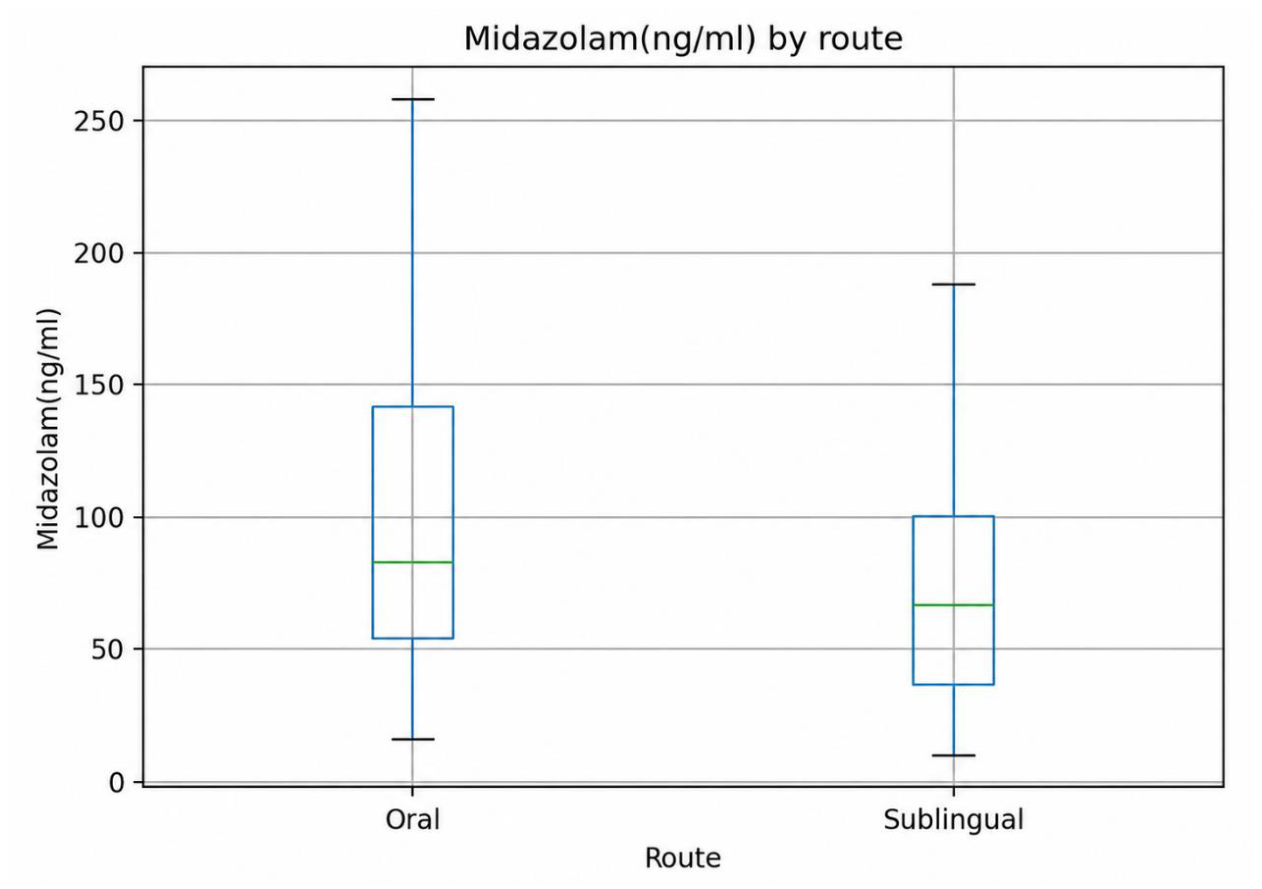
102.52 ± 61.98 75.04 ± 46.48 83.00 (54.15–141.50) 66.50 (36.95–100.60) 0.98 (0.53–1.79) 0.940
1-OH Midazolam
(ng/mL)
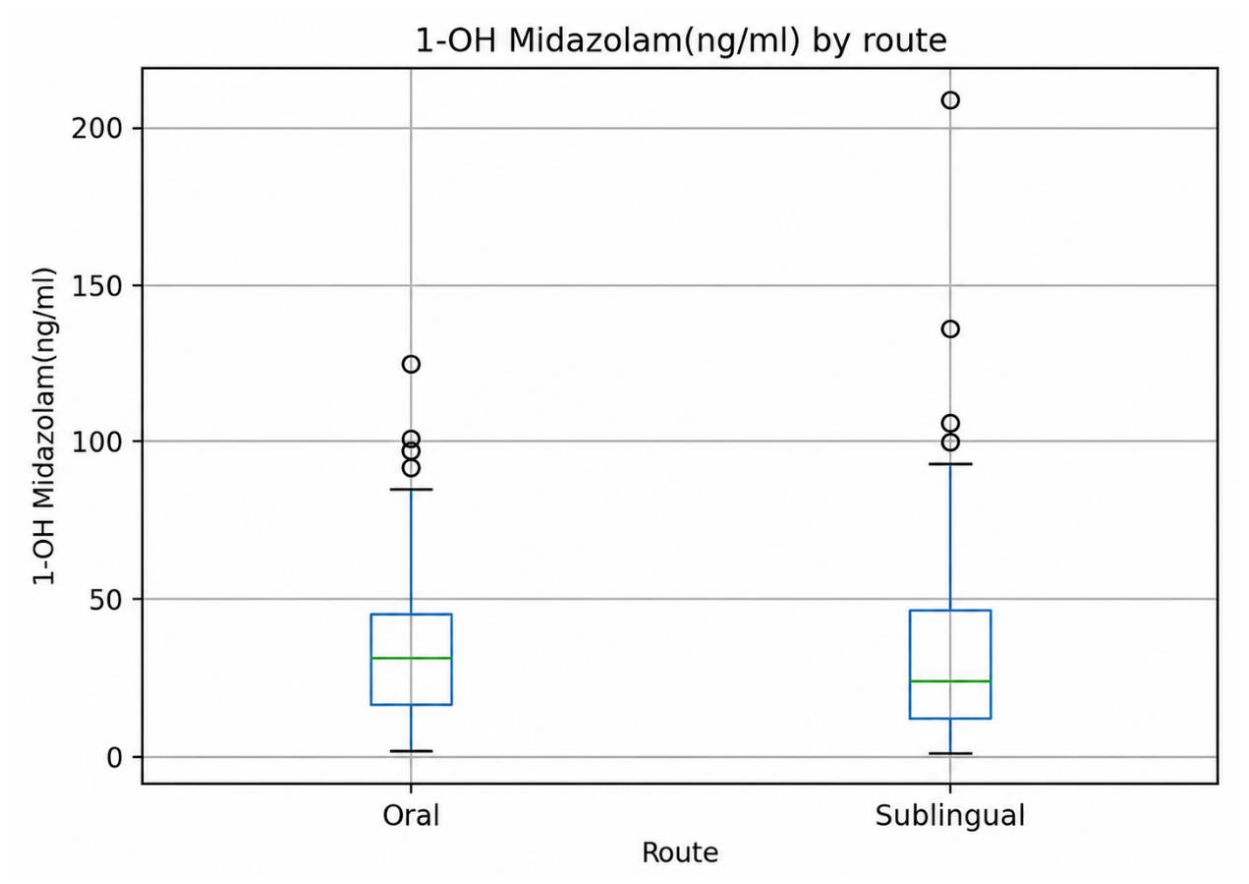
40.04 ± 32.30 40.00 ± 43.89 31.55 (16.52–45.25) 24.10 (12.25–46.60) 1.37 (0.55–3.41) 0.494
After adjustment for dose and age, there was no evidence of a route effect for midazolam concentration (adjusted geometric mean ratio S/O 0.98, 95% CI 0.53–1.79; p=0.940) or for 1-hydroxymidazolam concentration (ratio 1.37, 95% CI 0.55–3.41; p=0.494).

3.3. Hemodynamic and Oxygenation Outcomes

Route-dose comparisons for physiologic outcomes were based on change from baseline (Δ at 15 and 30 minutes).
Table 4. Hemodynamic and oxygenation changes from baseline.
Outcome Oral mean ± SD Sublingual mean ± SD Adjusted diff S−O (95% CI) p-value
ΔMAP at 15 min, (mmHg) 1.27 ± 13.65 -3.80 ± 14.80 -6.08 (-13.57 to 1.40) 0.109
ΔMAP at 30 min, (mmHg) 5.34 ± 15.62 -5.42 ± 13.93 -12.08 (-19.74 to -4.42) 0.002
ΔHR at 15 min, (bpm) -3.10 ± 17.70 -3.40 ± 10.95 -0.37 (-7.99 to 7.25) 0.923
ΔHR at 30 min, (bpm) -2.77 ± 15.36 0.74 ± 13.27 3.34 (-4.09 to 10.76) 0.372
ΔSpO₂ at 15 min, (%) -0.77 ± 2.06 -0.63 ± 3.80 0.10 (-1.55 to 1.74) 0.907
ΔSpO₂ at 30 min, (%) -0.20 ± 6.07 0.88 ± 2.77 0.73 (-1.69 to 3.15) 0.549
No regimen-associated difference was observed for ΔHR or ΔSpO₂ at either time point. For MAP, the 15-minute adjusted difference did not reach significance (S−O -6.08 mmHg, 95% CI -13.57 to 1.40; p=0.109). At 30 minutes, however, the sublingual group showed a lower adjusted ΔMAP than the oral group (S−O -12.08 95% CI -19.74 to -4.42; p=0.002).

3.4. Behavioral Outcomes

Behavioral outcomes are summarized in Table 5. At 15 minutes, a positive behavioral score (calm/awake or easily rousable) was observed in 80.0% of children receiving oral midazolam and 85.7% receiving sublingual midazolam (p=0.742). Positive sedation ratings were similarly frequent in the two groups (86.7% vs 88.6%, p=1.000). Easy separation from parents occurred in 83.3% of oral cases and 85.7% of sublingual cases (p=1.000). Easy mask acceptance was observed in 43.3% and 54.3% of children, respectively (p=0.459) showing a non- significant tendency in favor of the sublingual group. Overall, no significant differences in behavioral outcomes were detected between administration routes, although the available sample size was underpowered to exclude small-to-moderate differences in binary behavioral outcomes.
Table 5. Behavioral outcomes.
Outcome Oral positive n/N (%) Sublingual positive n/N (%) Odds ratio S vs O p (Fisher)
Positive 15-minute score 24/30 (80.0%) 30/35 (85.7%) 0.67 0.742
Positive sedation rating 26/30 (86.7%) 31/35 (88.6%) 0.84 1.000
Easy separation from parents 25/30 (83.3%) 30/35 (85.7%) 0.83 1.000
Easy mask acceptance 13/30 (43.3%) 19/35 (54.3%) 0.64 0.459

4. Discussion

This prospective randomized analysis integrates pharmacokinetic, physiologic, and behavioral data to compare oral midazolam 0.5 mg/kg with sublingual midazolam 0.3 mg/kg in children undergoing cardiac surgery or catheterization laboratory procedures. The principal findings are: first, plasma midazolam and 1-hydroxymidazolam concentrations did not differ significantly between routes after adjusting for dose and age; second, HR and SpO₂ changes were similar between groups; third, behavioral outcomes were also similar; and fourth, an isolated signal of lower adjusted ΔMAP at 30 minutes was observed in the sublingual group.
The pharmacokinetic findings suggest that, within the regimens used in this cohort, sublingual administration did not produce clearly higher or lower systemic exposure than oral administration once dose differences were taken into account. This is clinically relevant because the oral group generally received higher mg/kg doses than the sublingual group, yet the adjusted models still showed overlapping exposure estimates.
The behavioral results align more closely with the study by Kattoh et al.[13], which found comparable efficacy of oral and sublingual midazolam, than with the study by Gupta et al.[14], which reported better sedation with the sublingual route. The present dataset did not demonstrate a statistically significant advantage of either administration regimen for calmness at 15 minutes, overall sedation rating, separation from parents, or mask acceptance.
Achieving comparable behavioral and sedation scores with a lower dose of midazolam administered via the sublingual route may confer additional clinical benefits. Paradoxical agitation with midazolam, including disinhibition, restlessness, hallucinations and disorientation, is uncommon but distressing. The reported incidence of this reaction is referred to be 1-10% and is usually observed in younger children and elderly patients. Paradoxical agitation is an idiopathic reaction and various studies support it’s reversal with flumazenil. Additional doses of midazolam may further enhance this phenomenon and should be avoided [15]. Eventhough we have come across such reactions over our clinical practice, none of our studied pediatric patients exhibited such a reaction. Nevertheless, the lower doses used in the sublingual route might be favourable in that context, as both young age and higher dose are recognized as risk factors [16].
We did not assess delayed recovery or postoperative delirium, and a considerable proportion of children in this pediatric cardiac cohort remained intubated and required further sedation in the pediatric intensive care unit. Therefore, no conclusion can be drawn regarding whether the lower sublingual dose influenced recovery or delirium. Garcia et al. reported no dose-response relationship between oral midazolam dose and emergence or discharge times in a retrospective pediatric tonsillectomy and adenoidectomy cohort [17]. Earlier prospective day-case studies using oral midazolam 0.5 mg/kg demonstrated delayed early recovery without prolonging discharge time [18,19].
From a safety perspective, the absence of a route-associated HR or SpO₂ signal is reassuring in this pediatric cardiac cohort. This is consistent with earlier literature supporting the safety of oral midazolam in children with congenital heart disease and cardiovascular surgery [11]. The significant 30-minute MAP difference should be interpreted cautiously. It may represent a true regimen-related hemodynamic effect, but it may also reflect residual confounding, heterogeneity in underlying cardiac diagnoses, baseline physiologic differences, measurement variability, or multiple testing across several physiologic endpoints. Larger studies with absolute MAP values and adjustment for cardiac diagnosis severity are needed to clarify this signal.
Previous studies have also reported blood pressure reductions after midazolam premedication. Masue et al. tested oral high dose of midazolam (1,5mg/kg) in infants and children presenting for cardiac surgery and found it to be a safe option without significant cardiovascular deterioration although systolic arterial pressure reduction was among the more prominent hemodynamic findings [20]. Vasakova et al.[21] reported a similar reduction in systolic blood pressure 30 minutes after oral administration of midazolam for conscious sedation during dental procedures in children aged 1–12 years.
Overall, adverse effects of midazolam on oxygenation and hemodynamic stability appear more pronounced after intravenous administration for sedation than after non-intravenous routes such as oral, intranasal, rectal, or sublingual administration [22,23].
This study has several strengths. It used a prospective randomized design in a clinically vulnerable pediatric cardiac population, accounted for administered dose in pharmacokinetic comparisons, and combined objective plasma concentrations with bedside behavioral and physiologic outcomes. The main limitations are the single-center design, modest sample size, incomplete pharmacokinetic data in three oral cases, heterogeneity in underlying cardiac diagnoses, limited ability to adjust for disease severity or concomitant medications, and the exploratory nature of multiple physiologic and behavioral comparisons. The study was also not powered to detect rare adverse effects or small-to-moderate differences in binary behavioral outcomes.
Determining the optimal preanesthetic medication for pediatric patients remains an important yet unresolved challenge in perioperative care. Appropriate premedication can reduce anxiety, ease separation from parents, and enhance cooperation during anesthetic induction, thereby promoting a safer and more compassionate perioperative experience. In addition to pharmacologic effectiveness, the acceptability of the premedication is also an important consideration [24]. An ideal agent should not only be pharmacologically effective but also be administered by a route readily accepted by children. Spitting, refusal, or incomplete intake of oral premedication is not uncommon in children. In an effort to predict uncooperative behavior in children, Lena et al. identified factors projecting anxiety and distress in the child at induction of anaesthesia. Factors such as age between 1 and 3 years, parental anxiety, previous hospitalization, and previous operating theater experience may increase the likelihood of resistant behavior, characteristics frequently encountered in pediatric cardiac patients [25].The sublingual route may be a useful alternative and could support future child-friendly formulations. Kumar et al. evaluated sublingual midazolam delivered with an atomizer spray in children, while Hirokawa et al. reported successful sublingual midazolam premedication using a suction toothbrush in an adult with intellectual disabilities [26,27]. Compared with intranasal and rectal administration, sublingual administration may be preferable in some contexts because intranasal administration can cause nasal irritation and rectal administration may be uncomfortable or unacceptable [23].
Overall, our findings support both oral and sublingual administration as clinically workable premedication strategies in this setting. In addition to comparing effectiveness, this study provides preliminary support for further development of alternative sublingual formulations, including individualized 3D-printed medicinal films for pediatric use, with the goal of reducing procedural stress and improving patient acceptance [28].
3D printing is proven to be a feasible manufacturing prospect for drug-loaded films with promising control-over-dose, geometry and physicochemical property precision that may lead to potent patient-tailored formulations. Beyond applications related to pediatric populations, several studies provide evidence, even for challenging compounds such as cisplatin, for 3D-printed incorporation of drug in oral films with optimistic release characteristics. Further studies show an increasing interest in the development of individualized medication for children, placing emphasis on age- and weight-related dosing requirements that will also ensure easy administration and patient acceptance. Such advances indicate that personalized medicine and 3D-printed sublingual films could form a promising approach for future premedication in pediatric populations while exploring aspects of their clinical performance, acceptability, and implementation in routine practice is still essential [29,30,31].

5. Conclusion

In this single-center prospective randomized study of children with congenital heart disease, oral midazolam 0.5 mg/kg and sublingual midazolam 0.3 mg/kg produced comparable adjusted plasma midazolam and 1-hydroxymidazolam concentrations and similar behavioral outcomes. HR and SpO2 remained comparable between groups. Sublingual administration was associated with a greater reduction in MAP at 30 minutes, a finding that should be interpreted cautiously and confirmed in larger studies. These results support the clinical feasibility of sublingual midazolam as a lower-dose premedication strategy and provide a rationale for further development of child-friendly sublingual formulations.
Figure 1. CONSORT Flowchart.
Preprints 221761 g001
Figure 2. Plasma midazolam concentration by administration route.
Preprints 221761 g002
Figure 3. Plasma 1-hydroxymidazolam concentration by administration route.
Preprints 221761 g003

Author Contributions

Conceptualization: T.K., T.A., I.Z., C.T. Methodology: T.K., T.A, A.K., V.K., A.S., C.T. Software: T.K., V.K., G.G. Validation:T.K., A.K,, I.S., M.K. Formal analysis: T.K., V.K., G.G., A.S., C.T. Investigation: T.K., A.K., I.S., A.S. Data Curation: T.K., V.K. Writing—Original draft preparation: T.K.,V.K., G.G. Writing—Review & Editing: T.K., T.A., A.K., V.K., G.G, M.K., I.S., A.S., I.Z., C.T, Visualization: T.A., C.T. Supervision: T.K., T.A. Funding Acquisition: T.K., T.A.

Funding

The research was funded by the Onassis Foundation through the framework of the Joint Medical Research Protocols –OCSC & BRFAA—Protocol ID: OF 010/C’ CYCLE”. statsi@onassis.org,kmagkel@onassis.org.

Conflicts of Interest

The authors declare no conflicts of interest.

References

  1. Otto CO, Tawuye HY, Aytolign HA, Ferede YA, Tegegne BA, Admassie BM. Preoperative anxiety in children: Prevention and management. A comprehensive review and analysis. International Journal of Surgery Open 2025;63:127–35. [CrossRef]
  2. Chorney JML, Kain ZN. Behavioral analysis of children’s response to induction of anesthesia. Anesth Analg 2009;109:1434–40. [CrossRef]
  3. Dave NM. Premedication and Induction of Anaesthesia in paediatric patients. Indian J Anaesth 2019;63:713–20. [CrossRef]
  4. Davidson A, McKenzie I. Distress at induction: prevention and consequences. Curr Opin Anaesthesiol 2011;24:301–6. [CrossRef]
  5. Ma X, Zhang Z, Bao Y, Zhao H. Impact of pediatric surgery on anxiety in children and their families and coping strategies: a narrative review. Transl Pediatr 2025;14:718–27. [CrossRef]
  6. Bögels SM, Brechman-Toussaint ML. Family issues in child anxiety: Attachment, family functioning, parental rearing and beliefs. Clin Psychol Rev 2006;26:834–56. [CrossRef]
  7. López-Rodrigo N, Moll-Bertó A, Montoro-Pérez N, Montejano-Lozoya R, Mármol-López MI, Alós-Maldonado R. Nonpharmacological Interventions to Reduce Anxiety in Paediatric Preoperative Settings: An Updated Umbrella Review and Meta-Analysis. J Spec Pediatr Nurs 2025;30. [CrossRef]
  8. Gerards M, Miller J, Hoyer A, Gerards A, Bierhoff V, Eichler KA, et al. Virtual reality in surgical preparation for children and adolescent: a randomized clinical trial. Journal of Pediatric Surgery Open 2025;12:100229. [CrossRef]
  9. Chamberland C, Bransi M, Boivin A, Jacques S, Gagnon J, Tremblay S. The effect of augmented reality on preoperative anxiety in children and adolescents: A randomized controlled trial. Paediatr Anaesth 2024;34:153–9. [CrossRef]
  10. Lethin M, Paluska MR, Petersen TR, Falcon R, Soneru C. Midazolam for Anesthetic Premedication in Children: Considerations and Alternatives. Cureus 2023;15. [CrossRef]
  11. Levine ME, Hartley EJ, Macpherson BA, Burrows FA, Lerman J. Oral midazolam premedication for children with congenital cyanotic heart disease undergoing cardiac surgery: a comparative study. Can J Anaesth 1993;40:934–8. [CrossRef]
  12. Kraan H, Vrieling H, Czerkinsky C, Jiskoot W, Kersten G, Amorij JP. Buccal and sublingual vaccine delivery. Journal of Controlled Release 2014;190:580–92. [CrossRef]
  13. Kattoh T, Katome K, Marino S, Wakamatsu N, Shimazu A, Toriumi S. [Comparative study of sublingual midazolam with oral midazolam for premedication in pediatric anesthesia]. Masui 2008;57:1227–32.
  14. Gupta S, Gadani H, Kedia S. Is premedication with midazolam more effective by the sublingual than the oral route? Anesth Essays Res 2011;5:43. [CrossRef]
  15. Jackson BF, Beck LA, Losek JD. Successful flumazenil reversal of paradoxical reaction to midazolam in a child. Journal of Emergency Medicine 2015;48:e67–72. [CrossRef]
  16. Shin YH, Kim MH, Lee JJ, Choi SJ, Gwak MS, Lee AR, et al. The effect of midazolam dose and age on the paradoxical midazolam reaction in Korean pediatric patients. Korean J Anesthesiol 2013;65:9–13. [CrossRef]
  17. Garcia A, Clark EA, Rana S, Preciado D, Jeha GM, Viswanath O, et al. Effects of Premedication With Midazolam on Recovery and Discharge Times After Tonsillectomy and Adenoidectomy. Cureus 2021;13. [CrossRef]
  18. Viitanen H, Annila P, Viitanen M, Tarkkila P. Premedication with midazolam delays recovery after ambulatory sevoflurane anesthesia in children. Anesth Analg 1999;89:75–9. [CrossRef]
  19. Bevan JC, Veall GRO, Macnab AJ, Ries CR, Marsland C. Midazolam premedication delays recovery after propofol without modifying involuntary movements. Anesth Analg 1997;85:50–4. [CrossRef]
  20. Masue T, Shimonaka H, Fukao I, Kasuya S, Kasuya Y, Dohi S. Oral high-dose midazolam premedication for infants and children undergoing cardiovascular surgery. Paediatr Anaesth 2003;13:662–7. [CrossRef]
  21. VASAKOVA J, DUSKOVA J, LUNACKOVA J, DRAPALOVA K, ZUZANKOVA L, STARKA L, et al. Midazolam and its effect on vital signs and behavior in children under conscious sedation in dentistry. Physiol Res 2020;69:S305–14. [CrossRef]
  22. Lamireau T, Dubreuil M, Daconceicao M. Oxygen saturation during esophagogastroduodenoscopy in children: general anesthesia versus intravenous sedation. J Pediatr Gastroenterol Nutr 1998;27:172–5. [CrossRef]
  23. Kogan A, Katz J, Efrat R, Eidelman LA. Premedication with midazolam in young children: a comparison of four routes of administration. Paediatr Anaesth 2002;12:685–9. [CrossRef]
  24. Wegner GRM, Wegner BFM, González GL, Quineper JN, Ferreira CHO, de Brito HM, et al. Comparative acceptability and immediate behavioral response to different pediatric premedications: A systematic review and network meta-analysis. J Clin Anesth 2026;108. [CrossRef]
  25. Tan L, Meakin GH. Anaesthesia for the uncooperative child. Continuing Education in Anaesthesia, Critical Care & Pain 2010;10 Number 2. [CrossRef]
  26. Kumar N, Sharma R, Sharma M, Verma I, Sharma M. Midazolam Pre-medication in Paediatrics: Comparison of the Intranasal and Sublingual Routes by Using an Atomizer Spray. Journal of Clinical and Diagnostic Research 2012;Vol-6(1): 65-68.
  27. Hirokawa J, Kimata N. Successful Premedication With Sublingual Midazolam Using a Suction Toothbrush. Anesth Prog 2023;70:80–4. [CrossRef]
  28. Bernatoniene J, Stabrauskiene J, Kazlauskaite JA, Bernatonyte U, Kopustinskiene DM. The Future of Medicine: How 3D Printing Is Transforming Pharmaceuticals. Pharmaceutics 2025;17. [CrossRef]
  29. Racaniello GF, Mathiron D, Rigaud S, Denora N, Leonetti F, Lopalco A, et al. Development of midazolam/γ-cyclodextrin orodispersible films using direct powder extrusion 3D printing: A novel approach to inclusion complex and drug delivery systems formulation. Carbohydr Polym 2025;368. [CrossRef]
  30. Kanaki Z, Smina A, Chandrinou C, Koukouzeli FE, Ntounias Y, Paschalidis N, et al. Printed cisplatin on microneedle arrays for transdermal delivery enhances olaparib-induced synthetic lethality in a mouse model of homologous recombination deficiency. Int J Bioprint 2023;9:26–39. [CrossRef]
  31. Breithaupt MH, Krohmer E, Taylor L, Koerner E, Hoppe-Tichy T, Burhenne J, et al. Oral bioavailability of microdoses and therapeutic doses of midazolam as a 2-dimensionally printed orodispersible film in healthy volunteers. Eur J Clin Pharmacol 2022;78:1965–72. [CrossRef]
Disclaimer/Publisher’s Note: The statements, opinions and data contained in all publications are solely those of the individual author(s) and contributor(s) and not of MDPI and/or the editor(s). MDPI and/or the editor(s) disclaim responsibility for any injury to people or property resulting from any ideas, methods, instructions or products referred to in the content.
Copyright: This open access article is published under a Creative Commons CC BY 4.0 license, which permit the free download, distribution, and reuse, provided that the author and preprint are cited in any reuse.
Prerpints.org logo

Preprints.org is a free preprint server supported by MDPI in Basel, Switzerland.

Subscribe

© 2026 MDPI (Basel, Switzerland) unless otherwise stated

Accessibility

Disclaimer

Terms of Use

Privacy Policy

Privacy Settings