

Submitted:
03 July 2026
Posted:
06 July 2026
You are already at the latest version
Abstract
Autism intervention responsiveness is highly heterogeneous, and current clinical approaches often remain insufficiently sensitive to dynamic fluctuations in biological, physiological, environmental, and behavioral readiness for therapeutic engagement and learning. This manuscript introduces NAI-Digital, a hypothesis-generating, human-supervised multimodal convergence architecture for investigating dynamic neuroplastic accessibility in autism. Neuroplastic accessibility is defined here not as neuroplasticity itself, but as the degree to which current conditions may support access to adaptive learning, engagement, consolidation, and therapeutic responsiveness at a given moment. NAI-Digital organizes candidate determinants of accessibility into four functional domains: Fuel, representing biochemical and systemic substrate; Support, representing physiological regulation, recovery, sleep, autonomic balance, and body-state stability; Trigger, representing environmental sensory load, predictability, transitions, contextual stress, and task demand; and Engine, representing behavioral priming, movement, preparatory routines, and activity-dependent readiness. The architecture proposes a dual-output logic combining a global accessibility state with domain-specific profiles, allowing constrained accessibility to be interpreted not as child failure or absence of intervention potential, but as a state requiring modulation, pacing, regulation, or restoration. The framework further introduces accessibility-oriented adaptation and neuroplastic readiness as translational targets for future feasibility research. NAI-Digital is not presented as a validated diagnostic tool, medical device, treatment-selection algorithm, or autonomous decision-support system. Rather, it is a conceptual and translational architecture intended to support future construct validation, measurement feasibility testing, stakeholder interpretation, longitudinal monitoring, and ethically governed pilot studies. The manuscript outlines testable hypotheses, falsifiability conditions, safety-aware safeguards, and a staged validation pathway for investigating whether multimodal convergence patterns can meaningfully inform timing-sensitive, individualized, and equity-aware autism intervention research.
Keywords:
autism
; neuroplastic accessibility
; neuroplastic readiness
; NAI-Digital
; precision intervention
; therapeutic responsiveness
; digital health
; translational psychiatry
; multimodal convergence
; safety-aware AI
; human-supervised decision support
; intervention timing
; neurodevelopment
; accessibility-oriented adaptation
; autism heterogeneity
1. Introduction
1.1. Autism Intervention Responsiveness and the Accessibility Timing Problem
Autism spectrum disorder is characterized by substantial heterogeneity in developmental trajectories, communication profiles, sensory regulation, adaptive functioning, learning patterns, therapeutic participation, and response to intervention. Although intervention type, intensity, fidelity, clinician expertise, developmental profile, family context, and service accessibility are important determinants of outcome, they do not fully explain why the same autistic child may respond differently to similar therapeutic or educational demands across successive days or sessions. [1,2,3,4,5,6,7,8,9]
This intra-individual variability remains one of the central challenges in autism intervention science. A child may demonstrate strong engagement, cognitive availability, and learning consolidation during one session, yet show reduced responsiveness, emotional dysregulation, avoidance, shutdown, sensory overload, or limited retention during another session that appears superficially similar. In clinical practice, this variability is often described as “good day / bad day” fluctuation. From a translational neuroscience perspective, however, such variability may reflect dynamic changes in the biological, physiological, environmental, and behavioral conditions that make learning accessible. [4,6,7,8,9]
Current therapeutic and educational interventions are frequently delivered according to calendar-based schedules. Sessions occur because they were scheduled, not necessarily because the child’s current state is optimally aligned for adaptive learning. This creates a translational gap: intervention planning often focuses on what intervention should be delivered, while having limited structured information about when the child may be most accessible to benefit and which objective may be most appropriate for the current state. [5,6,7,8,37,38,39]
The central problem addressed by NAI-Digital is therefore not only intervention selection. It is the timing, orientation, modulation, and future-state impact of intervention according to dynamic accessibility conditions.
1.2. From Neuroplasticity to Neuroplastic Accessibility
Neuroplasticity refers to the nervous system’s capacity to reorganize structurally and functionally in response to experience, learning, environmental input, and developmental context. However, this capacity is not expressed uniformly across time. It may be shaped by fluctuating conditions, including sleep architecture, autonomic regulation, inflammatory burden, neurotrophic signaling, metabolic state, stress physiology, sensory load, environmental predictability, and activity-dependent priming. [10,11,12,13]
The concept of neuroplastic accessibility emerges from this timing problem. Neuroplastic accessibility does not refer to neuroplasticity itself. It refers to the hypothesized degree to which the conditions surrounding an individual at a given moment may support access to adaptive learning, engagement, consolidation, and therapeutic responsiveness.
This distinction is essential. NAI-Digital does not claim to measure neuroplasticity directly. Rather, it proposes that biological, physiological, environmental, and behavioral determinants may converge or diverge in ways that make plasticity-related learning opportunities more or less accessible at a specific time.
The conceptual distinction between neuroplasticity and neuroplastic accessibility is summarized in Figure 1.
Under this framework, reduced response during a session should not automatically be interpreted as lack of motivation, resistance, non-compliance, poor prognosis, or reduced capacity. It may reflect a temporary constraint in neuroplastic accessibility caused by misalignment among internal state, regulatory reserve, environmental load, and behavioral readiness.
1.3. Fragmented Evidence and the Need for Computational Convergence
Multiple research traditions have generated evidence relevant to intervention responsiveness and learning accessibility. Sleep research has examined sleep architecture and recovery in memory consolidation and regulation. Autonomic research has examined heart rate variability, arousal regulation, vagal tone, and physiological flexibility. Molecular and systems neuroscience have investigated neurotrophic signaling, inflammation, oxidative stress, neurotransmission, metabolic burden, and excitatory–inhibitory balance. Sensory and environmental research has examined overload, predictability, transitions, task complexity, contextual stress, and environmental adaptation. Exercise and rehabilitation research has examined the influence of physical activity, movement, behavioral activation, and priming on cognition, regulation, and engagement. [14,15,16,17,18,19,20,21,22,23,24,25,26,27,28,29,41,42]
These research traditions have produced valuable insights, but they remain largely fragmented. One tradition measures sleep. Another measures physiological regulation. Another examines inflammatory or biochemical burden. Another studies sensory overload or environmental structure. Another examines movement, exercise, or behavioral priming.
The problem is therefore not the absence of relevant evidence. The problem is the lack of a structured, human-supervised, computational convergence architecture capable of integrating these determinants into interpretable accessibility states.
NAI-Digital is proposed to address this translational fragmentation.
1.4. Core Conceptual Innovation of NAI-Digital
NAI-Digital does not claim that sleep, autonomic regulation, inflammation, sensory load, environmental context, or behavioral activation are novel determinants. Its innovation lies in organizing these fragmented determinants into a multimodal convergence architecture for investigating dynamic neuroplastic accessibility.
The framework organizes relevant determinants into four functional domains:
Fuel, corresponding to biochemical and systemic substrate;
Support, corresponding to physiological regulation, recovery, sleep, autonomic balance, and body-state stability;
Trigger, corresponding to environmental sensory load, predictability, transitions, contextual stress, and task demand;
Engine, corresponding to behavioral priming, activation, movement, preparatory routines, and activity-dependent readiness.
NAI-Digital proposes that neuroplastic accessibility emerges from the dynamic alignment, partial divergence, or misalignment of these functional domains. When domains converge toward regulation, recovery, low contextual burden, and appropriate activation, accessibility may be more favorable. When domains partially diverge, accessibility may be intermediate, unstable, or context-dependent. When domains substantially misalign, accessibility may be constrained or safety-aware.
Thus, NAI-Digital does not merely add variables to autism intervention research. It proposes a functional architecture for studying how variables interact over time to shape access to therapeutic learning.
The four-domain architecture of Fuel, Support, Trigger, and Engine is illustrated in Figure 2.
1.5. Dual Output, Longitudinal Monitoring, and Next-State Preparation
A key innovation of NAI-Digital is its proposed dual-output architecture. The framework is not limited to a single global accessibility state. Instead, it distinguishes between a global output and domain-specific outputs.
The global output represents the integrated accessibility state generated by convergence, partial divergence, or misalignment among Fuel, Support, Trigger, and Engine. This output may be represented conceptually through Green, Yellow, Orange, and Red states. Domain-specific outputs represent the functional status of each domain and may help identify whether biochemical burden, physiological dysregulation, environmental overload, or behavioral priming mismatch is contributing to the global accessibility profile.
This distinction is important because a constrained global state does not explain itself. A global Orange or Red profile may be driven primarily by Support constraints, Trigger overload, Engine mismatch, Fuel burden, or multidomain misalignment. The dual-output architecture therefore allows future research to examine not only whether accessibility is favorable or constrained, but also which domains may be driving the state and which domains may require modulation.
NAI-Digital also introduces a prospective logic. It does not ask only what therapeutic objective is compatible with the current state. It asks which objective today may help preserve, restore, or improve accessibility for the next session or the following day. In this logic, intervention success is not limited to immediate skill acquisition. It may also include preserving engagement, reducing overload, supporting recovery, stabilizing regulation, and preparing a more favorable future accessibility state.
Across this framework, constrained accessibility does not mean absence of intervention. It means that the objective of intervention may need to change.
1.6. Nearable-Compatible Measurement and Purpose of the Manuscript
NAI-Digital further differs from many digital phenotyping and physiological monitoring approaches by prioritizing low-burden, nearable, and context-sensitive data collection strategies rather than wearable-dependent monitoring. Many current digital health approaches rely heavily on wristbands, watches, chest straps, adhesive sensors, or body-mounted devices. Although such technologies may generate useful physiological data, they may be difficult to tolerate for some autistic children and may themselves increase sensory burden, stress, or dysregulation. [30,31,35,36,40]
NAI-Digital is therefore designed around the principle that measurement must not become an additional source of inaccessibility. Nearable approaches refer to systems that capture relevant information from the child’s environment, routine, or context without requiring continuous body-worn devices. The goal is not maximal data extraction, but accessibility-compatible measurement: data collection that is sufficient for research interpretation while remaining tolerable, low-burden, ethically acceptable, and aligned with the child’s sensory and regulatory needs.
The purpose of this manuscript is to introduce NAI-Digital as a hypothesis-generating translational architecture for investigating dynamic neuroplastic accessibility in autism. The manuscript defines the conceptual rationale, functional domains, dual-output structure, longitudinal monitoring logic, domain-targeted modulation pathway, safety-aware orientation, falsifiable hypotheses, and future feasibility-testing agenda.
The manuscript does not report human-subject data, validate a clinical tool, test therapeutic efficacy, establish predictive accuracy, or propose autonomous decision support. Its purpose is to specify a research architecture that can generate empirical predictions for future feasibility testing and pilot validation.
2. Scientific and Clinical Caution Statement
NAI-Digital is proposed as a hypothesis-generating translational research architecture. It is not a validated clinical instrument, diagnostic system, biomarker panel, treatment-selection tool, medical device, or autonomous decision-making technology. [33,34,35,36]
The framework does not claim to measure neuroplasticity directly. Neuroplasticity is a complex, multidimensional, context-sensitive biological process that cannot be reduced to a single score, marker, sensor output, color state, or behavioral observation. Instead, NAI-Digital proposes a structured approach for investigating whether multimodal convergence among independently studied biological, physiological, environmental, and behavioral determinants may help characterize dynamic states of neuroplastic accessibility.
All accessibility states, computational representations, domain-specific profiles, safety-aware flags, longitudinal indicators, and future dashboard outputs described in this manuscript are conceptual and require feasibility testing, ethics review, pilot validation, and appropriate governance before any clinical implementation can be considered.
The Green, Yellow, Orange, and Red states should not be interpreted as validated clinical categories, medical alerts, treatment commands, or deterministic indicators of readiness. They are proposed as conceptual accessibility orientations for future research on therapeutic objective matching, longitudinal monitoring, domain-targeted modulation, and next-state preparation.
Similarly, the dual-output architecture should not be interpreted as producing validated scores or causal explanations. Global accessibility states and domain-specific profiles are proposed as candidate interpretive signals that may help generate modulation hypotheses for future empirical testing.
NAI-Digital does not classify days as “intervention days” or “non-intervention days.” A constrained or safety-aware state does not mean absence of intervention or withdrawal of care. Rather, it suggests that the therapeutic objective may need to shift away from acquisition-oriented demand and toward pacing, consolidation, regulation, environmental adaptation, sensory protection, physiological comfort, stabilization, recovery, or preparation of future accessibility.
The safety-aware function should not be interpreted as a claim of medical neuroprotection. NAI-Digital does not diagnose, measure, treat, or prevent excitotoxicity as a cellular medical condition. It does not directly measure glutamatergic activity, calcium-mediated cellular stress, neuronal injury, or excitotoxic mechanisms. Rather, its safety-aware logic may support functional protection against excessive excitatory, sensory, cognitive, or regulatory burden by helping future users recognize when therapeutic demand may need to be reduced, paced, or redirected during vulnerable low-accessibility states. [22,23,24,25,35]
NAI-Digital also does not imply that wearable monitoring is inappropriate in all contexts. Wearables may be useful when tolerated, ethically justified, and scientifically appropriate. However, NAI-Digital prioritizes nearable, low-burden, and accessibility-compatible measurement strategies whenever possible because wearable-dependent monitoring may be poorly tolerated by some autistic children and may itself increase sensory burden or dysregulation.
The present manuscript does not report human-subject data, test clinical efficacy, modify intervention delivery, or provide therapeutic recommendations. Until feasibility testing and pilot validation are completed, NAI-Digital should be interpreted as a conceptual scientific framework for investigation rather than as an implementation-ready clinical technology.
3. Positioning NAI-Digital Relative to Existing Frameworks
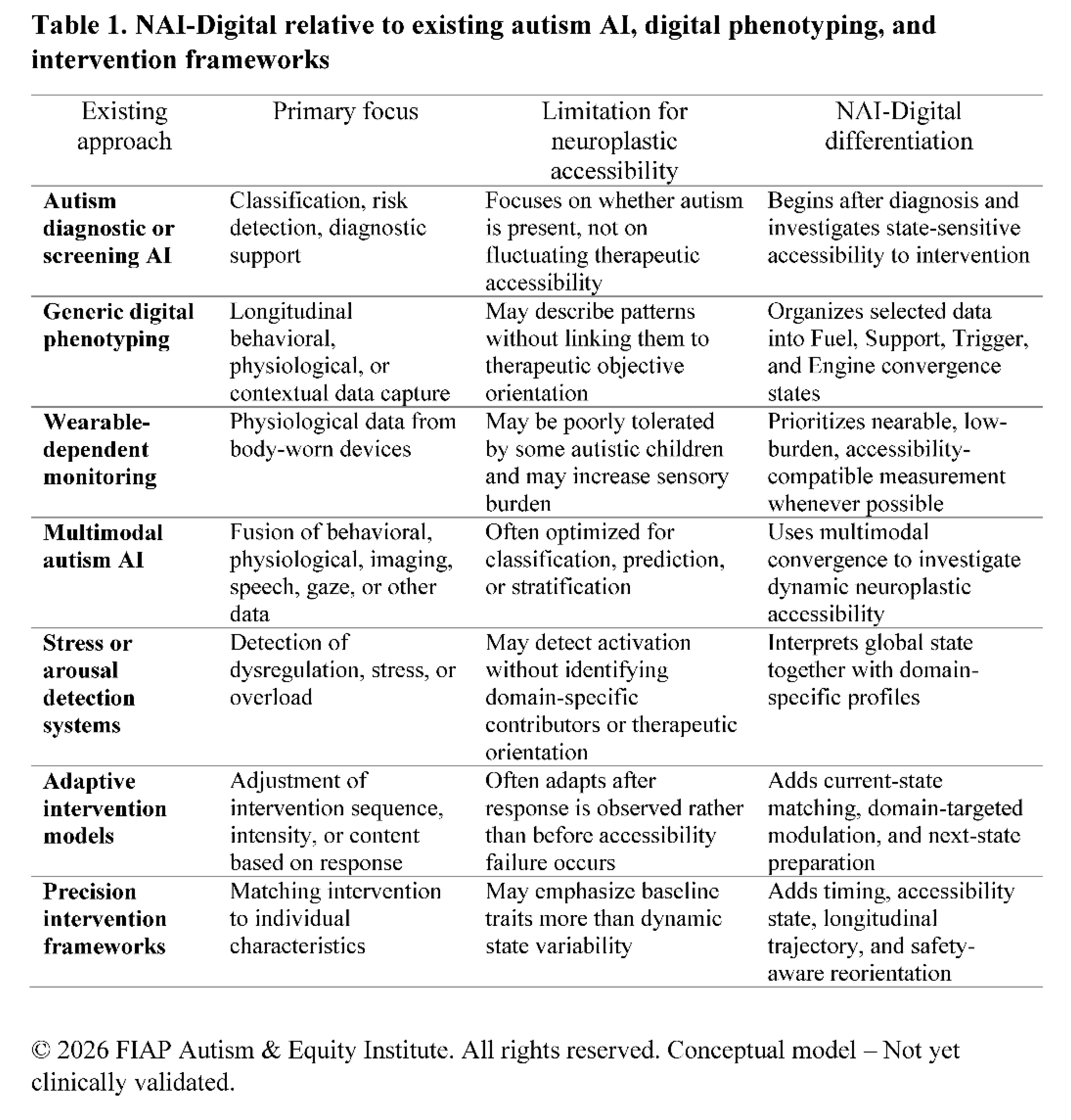
NAI-Digital is positioned within a rapidly expanding landscape of autism-related artificial intelligence, digital phenotyping, physiological monitoring, multimodal sensing, adaptive intervention, and precision health frameworks. These approaches have contributed valuable tools for screening, classification, behavioral characterization, physiological tracking, and data-driven understanding of autism heterogeneity. However, NAI-Digital is not proposed as an autism diagnostic classifier, generic digital phenotyping platform, wearable stress monitor, behavioral prediction system, or autonomous treatment-selection algorithm. [30,31,32,33,34,35,36]
Its scientific purpose is different. NAI-Digital is designed as a human-supervised, multimodal convergence architecture for investigating dynamic neuroplastic accessibility, therapeutic objective orientation, domain-targeted modulation, and next-state preparation. The target phenomenon is not diagnostic status, autism severity, service use, or general behavioral monitoring. The target phenomenon is the fluctuating accessibility of therapeutic and educational input within a specific biological, physiological, environmental, and behavioral state.
This distinction is essential. Many existing digital frameworks focus on classification, detection, monitoring, or prediction. NAI-Digital focuses on a translational question: how do multiple conditions align or misalign over time in ways that may make adaptive learning more or less accessible, and how might this information support future research on accessibility-informed therapeutic planning after appropriate validation?
NAI-Digital differs from autism diagnostic and screening AI because it does not attempt to determine whether a child is autistic, estimate diagnostic probability, classify severity, or identify diagnostic subtypes. It begins after the diagnostic question. Its purpose is to study how accessibility to intervention may fluctuate within an autistic child over time. [32]
NAI-Digital differs from generic digital phenotyping because it is not designed merely to collect or describe longitudinal digital data. Digital phenotyping may characterize behavior, physiology, activity, or context over time, but it does not necessarily organize these data into a therapeutic accessibility model. NAI-Digital uses selected multimodal information within a functional architecture structured around Fuel, Support, Trigger, and Engine; global and domain-specific outputs; longitudinal trajectories; domain-targeted modulation; safety-aware reorientation; and next-state preparation. [30,31]
NAI-Digital also differs from wearable-dependent physiological monitoring. Many monitoring systems depend on wristbands, watches, chest straps, adhesive sensors, patches, or body-mounted devices. These technologies may generate valuable physiological data, but they may be difficult to tolerate for some autistic children, particularly those with tactile hypersensitivity, sensory defensiveness, anxiety related to body-worn objects, repetitive removal of sensors, or limited tolerance for continuous monitoring. In such cases, the monitoring device itself may increase sensory burden, stress, dysregulation, or behavioral disruption. [40]
NAI-Digital therefore prioritizes low-burden, nearable, and context-sensitive measurement strategies whenever possible. Nearable approaches refer to systems that capture relevant information from the child’s environment, routine, or interactional context without requiring continuous body-worn devices. Examples may include non-intrusive sleep monitoring, environmental sensory load documentation, structured caregiver or therapist observations, brief contextual reports, and other minimally disruptive approaches. This principle does not reject wearables categorically. Wearables may be useful when tolerated, ethically justified, and scientifically appropriate. However, NAI-Digital does not depend on wearable monitoring as its default measurement assumption.
NAI-Digital also differs from multimodal autism AI systems that fuse data to improve classification, prediction, stratification, or characterization. Its multimodality is organized around a distinct translational goal: investigating dynamic neuroplastic accessibility and therapeutic objective orientation. The innovation lies not only in multimodal data fusion, but in the functional interpretation of multimodal convergence. NAI-Digital asks whether domain alignment or misalignment can help characterize when acquisition, consolidation, pacing, regulation, or safety-aware reorientation may be the more appropriate therapeutic objective to investigate.
Finally, NAI-Digital is complementary to adaptive intervention models but adds a more upstream, state-sensitive layer. Adaptive intervention models often adjust treatment sequence or intensity based on observed response over time. NAI-Digital asks whether the child’s current biological, physiological, environmental, and behavioral accessibility conditions can inform therapeutic objective orientation before overload, failed engagement, or reduced accessibility occurs. The differentiating features of NAI-Digital are summarized in Table 1. [37,38,39]
4. Core NAI-Digital Architecture: Fuel, Support, Trigger, and Engine
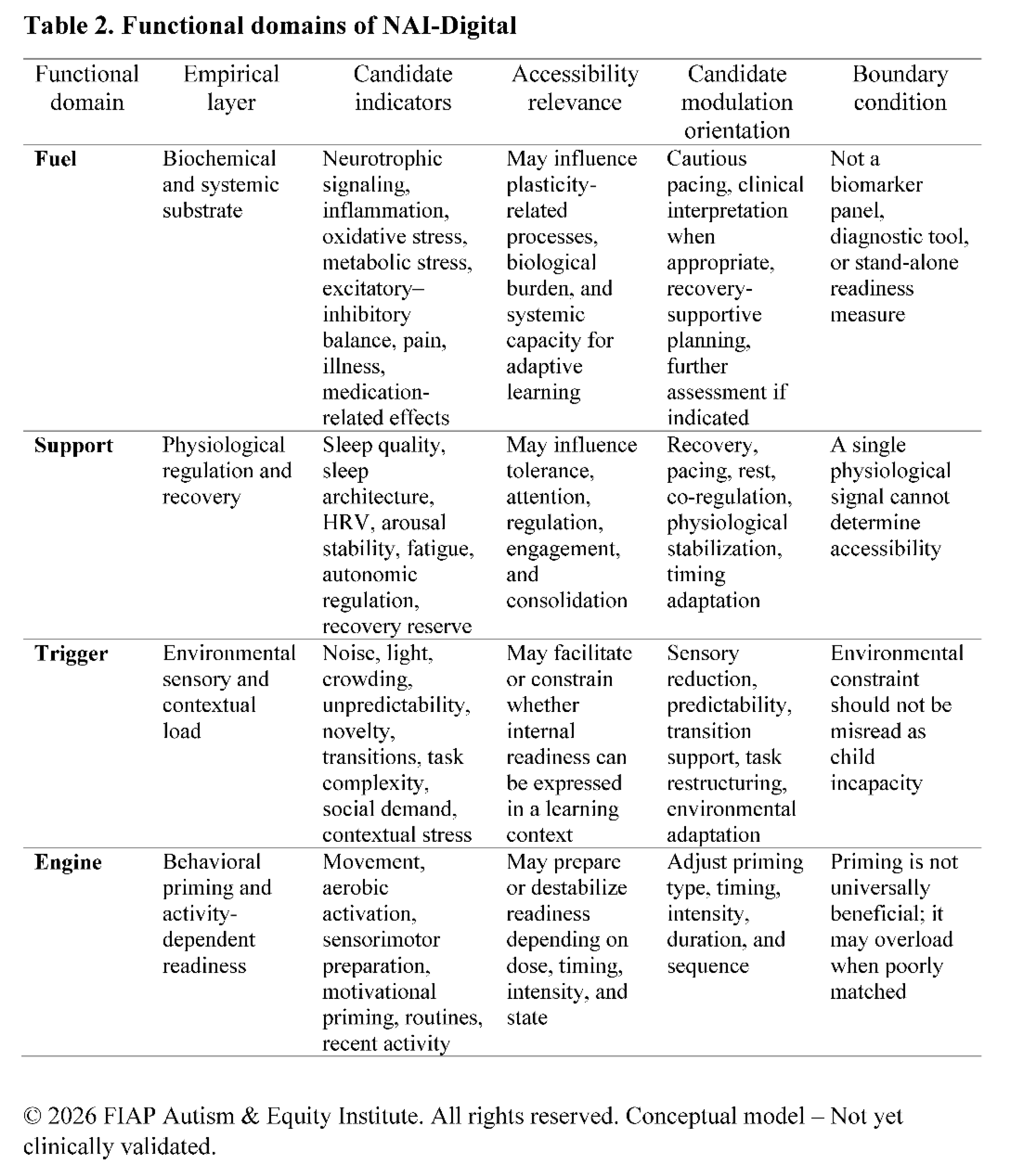
NAI-Digital is organized around four empirically supported translational domains: biochemical profile, physiological regulation, environmental sensory load, and behavioral priming. These domains are not presented as exhaustive determinants of neuroplasticity. Rather, they provide a pragmatic architecture for integrating major classes of variables that may influence dynamic neuroplastic accessibility in autism. [10,11,12,13,14,15,16,17,18,19,20,21,22,23,24,25,26,27,28,29,41,42]
The four-domain structure reflects the hypothesis that accessibility to adaptive learning is shaped by the interaction between internal biological state, physiological regulation, environmental context, and activity-dependent readiness. Each domain captures a distinct functional layer. The biochemical domain concerns molecular and systemic conditions that may support or constrain plasticity-related processes. The physiological domain concerns regulation, recovery, sleep, autonomic balance, arousal stability, fatigue, and body-state readiness. The environmental domain concerns sensory load, predictability, transitions, task complexity, contextual stress, and environmental fit. The behavioral priming domain concerns movement, activation, preparatory routines, motivational engagement, and activity-dependent readiness before therapeutic or educational input.
NAI-Digital does not claim that any single domain determines readiness, responsiveness, or learning outcome. A favorable sleep pattern may be insufficient if environmental sensory load is excessive. A favorable physiological signal may be insufficient if biological burden is high. A low sensory burden may be insufficient if recovery is poor. Behavioral priming may support accessibility in one context but increase overload in another if the child is fatigued or dysregulated. The scientific value of NAI-Digital lies in examining how these domains align, partially diverge, or misalign over time.
To clarify the functional role of each domain, NAI-Digital uses four conceptual terms: Fuel, Support, Trigger, and Engine.
Fuel refers to the biochemical and systemic substrate that may support or constrain plasticity-related processes. Candidate factors may include neurotrophic signaling, inflammatory burden, oxidative stress, metabolic stress, neurotransmitter-related processes, excitatory–inhibitory balance, pain, illness, medication-related effects, and other biological or systemic variables relevant to adaptive learning. Fuel is not a diagnostic biomarker panel and is not a stand-alone measure of readiness. It is one functional layer within a multimodal accessibility architecture. [22,23,24,25,26,27,28,29]
Support refers to physiological regulation and recovery. Candidate indicators may include sleep duration and quality, sleep architecture, heart rate variability, arousal stability, respiratory regulation, fatigue, autonomic balance, and body-state readiness. Support represents the regulatory reserve that may allow the child to access, tolerate, sustain, and recover from therapeutic or educational input. A constrained Support profile may indicate that pacing, recovery, co-regulation, or physiological stabilization should be considered in future research. [14,15,16,17,18,19]
Trigger refers to environmental sensory load and contextual conditions. Candidate factors may include noise, light, crowding, unpredictability, novelty, transitions, social demand, relational context, task complexity, environmental mismatch, and caregiver- or therapist-reported overload. Trigger is especially important because environmental conditions are often modifiable. Reducing sensory load, increasing predictability, simplifying transitions, modifying task complexity, or redesigning the context may alter accessibility without implying that the child’s intrinsic capacity has changed. [20,21,41,42]
Engine refers to behavioral priming and activity-dependent readiness. Candidate variables may include physical activity, aerobic activation, movement-based preparation, sensorimotor regulation, motivational priming, structured pre-session routines, and recent activity patterns. Engine is bidirectional. Appropriately dosed priming may support accessibility, but excessive, poorly timed, or mismatched activation may increase fatigue, arousal instability, or overload. [26,27,28,29]
The central premise of the architecture is that neuroplastic accessibility emerges from dynamic alignment, partial divergence, or misalignment among these four domains. When Fuel, Support, Trigger, and Engine converge toward biological support, physiological regulation, contextual safety, low sensory burden, and appropriate activation, accessibility may be more favorable. When domains partially align, accessibility may be intermediate, fragile, or context-dependent. When domains substantially diverge or misalign, accessibility may be constrained or safety-aware.
This alignment–divergence logic helps explain the lability of neuroplastic accessibility. The same child may move across accessibility states over hours, days, sessions, or contexts because the functional domains supporting learning may temporarily converge, partially diverge, or become constrained. NAI-Digital is designed to investigate this dynamic movement rather than classify the child as globally ready, unready, capable, or incapable. The four-domain architecture is summarized in Table 2.
5. Computational Convergence, Dual Output, and Accessibility States
The NAI-Digital architecture is designed to translate fragmented empirical information into a human-supervised, interpretable representation of dynamic neuroplastic accessibility. Its purpose is not to automate clinical decision-making, diagnose autism, prescribe treatment, or measure neuroplasticity directly. Rather, it provides a conceptual computational architecture for investigating whether multimodal convergence across Fuel, Support, Trigger, and Engine can generate meaningful accessibility profiles over time. [30,31,35,36]
The rationale for a computational convergence architecture is that isolated signals are insufficient. A favorable sleep indicator may be insufficient if sensory load is excessive. A favorable physiological signal may be insufficient if biochemical or systemic burden is high. A low sensory load may be insufficient if recovery is poor. Behavioral priming may support accessibility in one state but increase overload in another. NAI-Digital therefore does not interpret each domain as an isolated predictor. It examines how the four functional domains align, partially diverge, or misalign in relation to a specific therapeutic or educational context.
The proposed architecture can be summarized as a staged data-flow process. First, candidate indicators are collected or documented across biochemical, physiological, environmental, and behavioral domains. Second, these indicators are interpreted within their functional roles: Fuel, Support, Trigger, and Engine. Third, the architecture evaluates patterns of alignment, partial divergence, or misalignment among these roles. Fourth, these patterns are translated into candidate accessibility states. Fifth, the outputs are represented at two levels: a global accessibility state and domain-specific profiles. Sixth, repeated outputs may support longitudinal monitoring, domain-targeted modulation hypotheses, safety-aware interpretation, and next-state preparation.
A central innovation of NAI-Digital is this dual-output architecture. The global output represents the integrated accessibility state generated by multimodal convergence. It provides a summary-level interpretation of whether current conditions appear more compatible with acquisition-oriented learning, consolidation, pacing, regulation, or safety-aware therapeutic orientation. The domain-specific outputs represent the functional status of Fuel, Support, Trigger, and Engine. These outputs may help identify whether biochemical burden, physiological dysregulation, environmental overload, or behavioral priming mismatch is contributing to the global accessibility profile.
This distinction is essential because a constrained global state does not explain itself. A global Orange state may be driven primarily by Support constraint, such as poor recovery or autonomic dysregulation; by Trigger constraint, such as sensory overload or environmental mismatch; by Engine mismatch, such as poorly timed or excessive activation; by Fuel burden, such as biological or systemic load; or by multidomain misalignment. Without domain-specific profiles, the global output risks becoming descriptive but not interpretable.
NAI-Digital therefore proposes that accessibility should be interpreted at two levels. The global state answers: What is the overall accessibility orientation? The domain-specific profiles answer: Which functional domains may be supporting or constraining this orientation?
The dual-output architecture is represented in Figure 3.
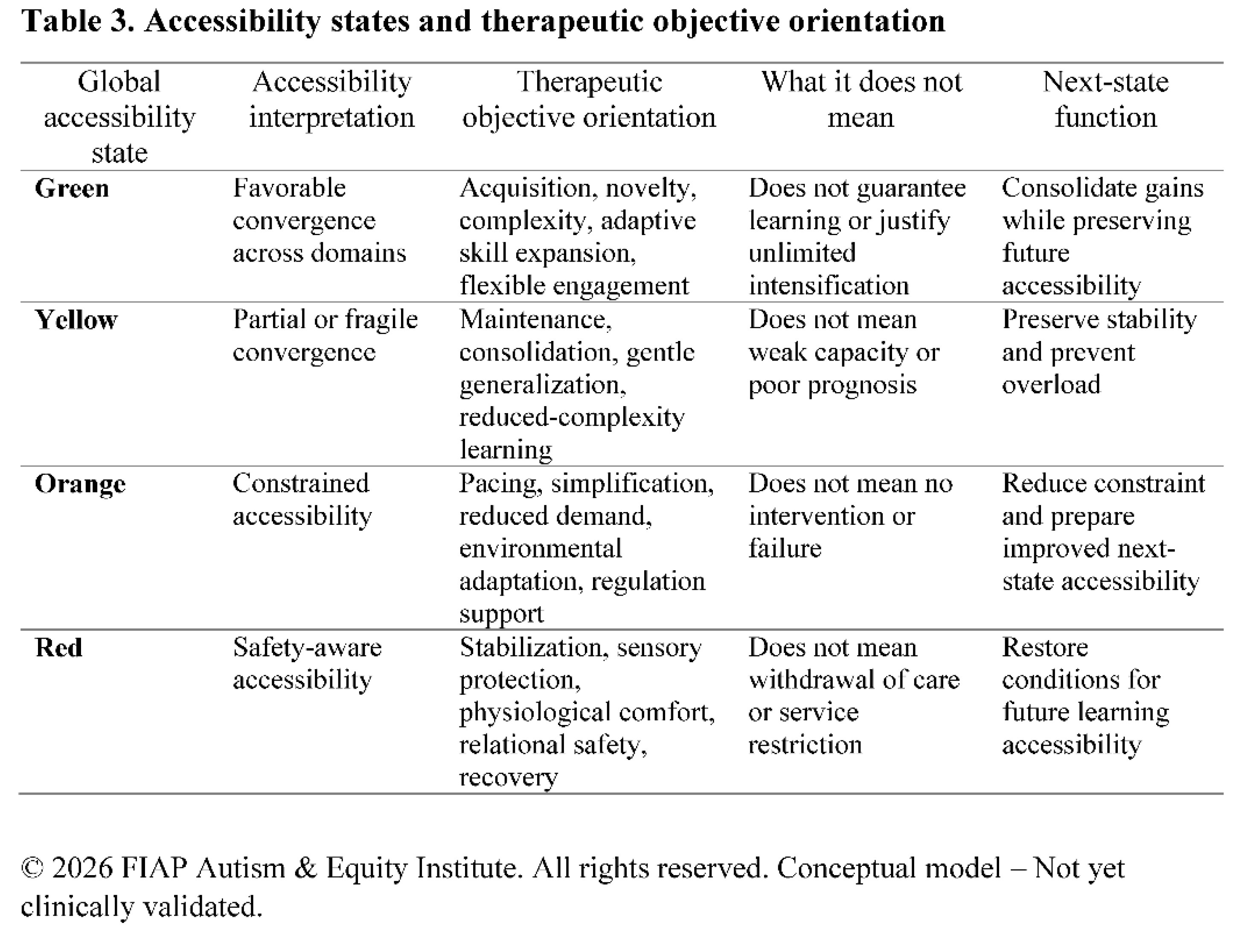
The global output may be represented conceptually through four accessibility states: Green, Yellow, Orange, and Red. These states are not validated clinical categories, treatment commands, medical alerts, or deterministic indicators of readiness. They are proposed as candidate interpretive constructs for future feasibility testing and pilot validation.
A Green state represents a hypothesized favorable accessibility condition. It may occur when multiple domains converge toward biological support, physiological regulation, low sensory burden, contextual predictability, and appropriate behavioral activation. Green may be compatible with acquisition-oriented learning, novelty, adaptive skill expansion, and increased complexity, while still requiring human judgment, pacing, and attention to wellbeing.
A Yellow state represents a hypothesized intermediate or partially accessible condition. It may occur when some domains are favorable while others are neutral, uncertain, mildly constraining, or unstable. Yellow may be compatible with consolidation, maintenance, gentle generalization, lower-complexity learning, and stabilization. It should not be interpreted as weak capacity; rather, it may indicate that accessibility is present but requires protection.
An Orange state represents a hypothesized constrained accessibility condition. It may occur when several domains suggest fatigue, sensory load, physiological dysregulation, insufficient recovery, stress activation, or reduced tolerance for high-demand learning. Orange does not mean absence of intervention. It suggests that the therapeutic objective may need to be reconfigured toward pacing, simplification, reduced demand, environmental adaptation, regulation support, or preservation of engagement.
A Red state represents a hypothesized safety-aware accessibility condition. It may occur when indicators suggest severe dysregulation, overload, exhaustion, low tolerance for demand, physiological stress, reduced regulatory reserve, or major multidomain misalignment. Red does not mean withdrawal of care. It means protective reorientation of care toward stabilization, sensory protection, relational safety, physiological comfort, environmental simplification, recovery, and preparation of future accessibility.
Across all states, care remains active. What changes is not whether intervention occurs, but the objective, intensity, timing, and orientation of intervention. This is a central boundary condition of NAI-Digital. The framework does not classify days as intervention days or non-intervention days. It proposes that therapeutic objectives may need to shift according to accessibility conditions. The proposed relationship between global states, therapeutic orientation, and next-state function is summarized in Table 3.
Human supervision is fundamental to the interpretation of these outputs. A computational representation may summarize the current alignment of domains, but clinical meaning requires human interpretation. A constrained state should not be interpreted as non-compliance, low motivation, poor prognosis, or absence of therapeutic opportunity. It may instead indicate that the conditions surrounding the child are temporarily less favorable for high-demand acquisition-oriented learning. [33,34,35,36]
Similarly, a favorable state should not be interpreted as a command to intensify intervention. It may indicate an opportunity, but professional judgment, caregiver knowledge, child communication, assent, relational safety, and contextual sensitivity remain essential. NAI-Digital therefore proposes a cautious interpretive model: computational outputs may support hypotheses about therapeutic orientation, but they do not replace observation, relationship, clinical reasoning, or professional responsibility.
At the present stage, specific computational weights, thresholds, normalization rules, safety-flag triggers, dashboard logic, scoring procedures, and proprietary feature-interaction rules are not disclosed. The purpose of this manuscript is to establish conceptual priority and translational structure, not to release an implementation-ready operational system. Future technical specifications should be developed only under appropriate ethics review, governance, feasibility testing, pilot validation, and intellectual-property protection.
6. Longitudinal Monitoring, Domain-Targeted Modulation, and Next-State Preparation
NAI-Digital is designed not only to represent neuroplastic accessibility at a single time point, but also to investigate how accessibility changes over time. This longitudinal dimension is central because neuroplastic accessibility is conceptualized as labile, dynamic, and context-sensitive rather than fixed. [37,38,39]
A point-in-time output may indicate whether current accessibility is favorable, intermediate, constrained, or safety-aware. However, it does not explain whether this state is unusual, recurrent, improving, deteriorating, or part of a stable pattern. A Yellow state may indicate recovery after several Red states, but it may indicate deterioration after several Green states. An Orange state may be transient, recurrent, cumulative, domain-specific, or context-dependent. A Red state may represent an acute safety-aware condition or the endpoint of progressive misalignment across domains.
NAI-Digital therefore proposes repeated monitoring of both global accessibility states and domain-specific profiles. The global trajectory may reveal whether overall accessibility is stable, fluctuating, improving, deteriorating, or responsive to therapeutic adaptation. The domain-specific trajectories may reveal whether constraints are primarily Fuel-related, Support-related, Trigger-related, Engine-related, or multidomain.
This dual longitudinal structure is important because similar global states may arise from different domain patterns. Repeated Support constraint may suggest variable recovery, sleep disruption, fatigue, autonomic dysregulation, or arousal instability. Repeated Trigger constraint may suggest environmental sensory overload, excessive novelty, unpredictable transitions, contextual stress, or task-context mismatch. Repeated Engine constraint may suggest insufficient, excessive, poorly timed, or poorly matched behavioral priming. Repeated Fuel constraint may suggest biological burden, systemic stress, pain, illness, medication-related effects, or other factors requiring cautious clinical interpretation.
Longitudinal monitoring may also reveal patterns of alignment and divergence. A stable convergence profile may occur when domains repeatedly align toward favorable or intermediate accessibility. A recurrent divergence profile may occur when one domain repeatedly disrupts an otherwise favorable pattern. A cumulative constraint profile may occur when multiple domains progressively shift toward burden, dysregulation, overload, or insufficient recovery. A recovery profile may occur when domain-targeted modulation is followed by gradual improvement in subsequent global or domain-specific states.
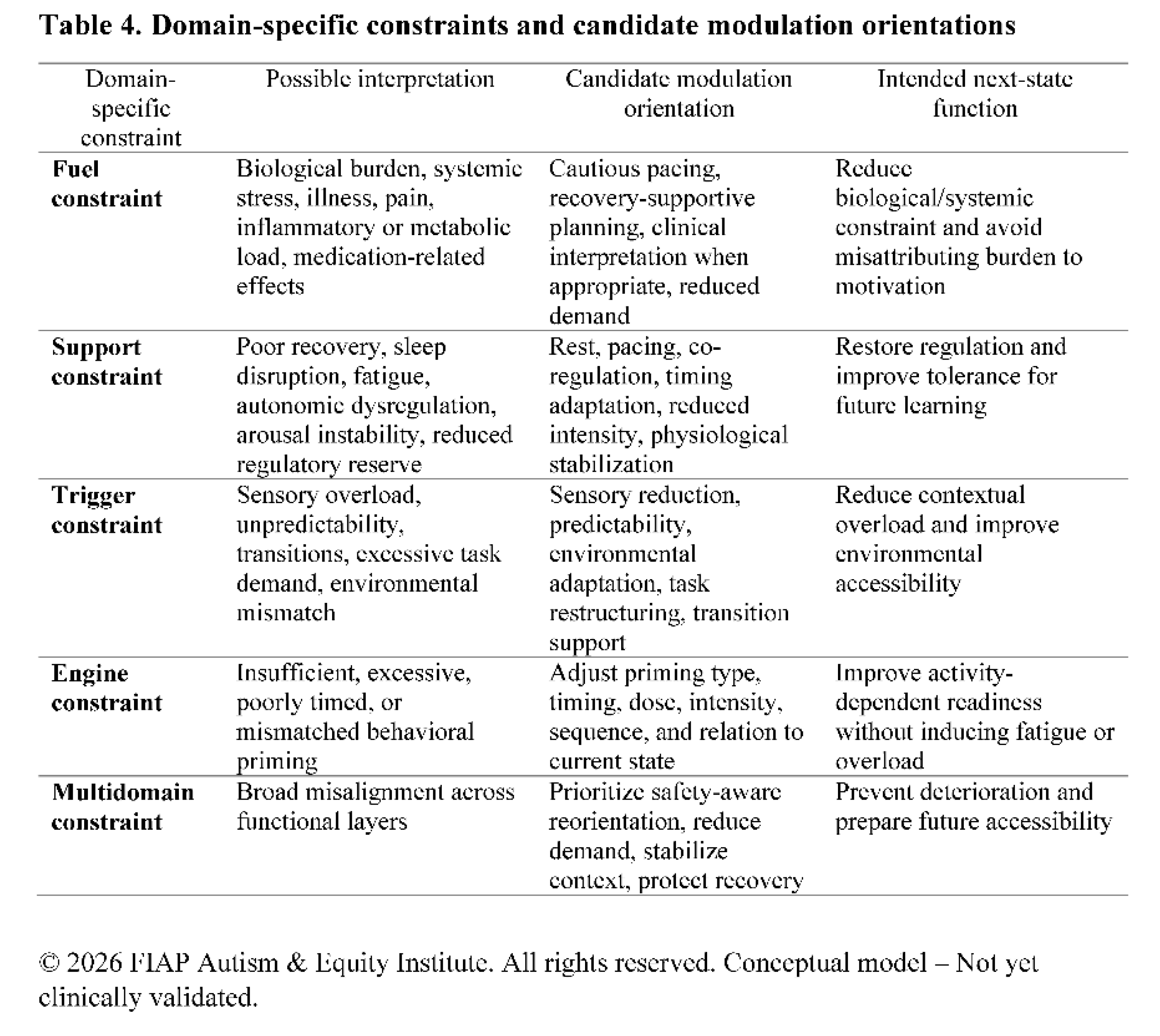
The purpose of longitudinal monitoring is not only descriptive. It is also modulatory. By identifying which domains repeatedly contribute to constrained states, NAI-Digital may support future research on domain-targeted modulation. Domain-targeted modulation refers to the process of identifying which functional layer may be contributing to reduced accessibility and selecting therapeutic, environmental, regulatory, or preparatory objectives that may support that layer.
For example, a constrained Fuel profile may suggest that biological burden, systemic stress, illness, pain, inflammatory load, metabolic stress, or medication-related factors may require cautious interpretation, pacing, recovery-supportive planning, or further clinical evaluation when appropriate. NAI-Digital does not prescribe biological treatment; it identifies Fuel as a possible contributor to accessibility constraint.
A constrained Support profile may suggest that recovery, sleep, fatigue, autonomic regulation, arousal stability, or physiological reserve require attention. Modulation may involve pacing, rest periods, co-regulation, reduced intensity, timing adaptation, or physiological stabilization. Support is especially important because poor recovery may reduce tolerance for sensory input, lower behavioral readiness, and increase vulnerability to overload.
A constrained Trigger profile may suggest that the environment is contributing to reduced accessibility. Modulation may involve reducing noise or lighting, increasing predictability, preparing transitions, simplifying tasks, modifying social demand, restructuring the space, or increasing relational safety. Trigger is highly relevant because environmental constraints are often modifiable and should not be misread as child incapacity.
A constrained Engine profile may suggest that behavioral priming is insufficient, excessive, poorly timed, or mismatched to the child’s current state. Modulation may involve adjusting the type, intensity, duration, timing, or sequence of movement, activation, sensorimotor preparation, motivational engagement, or pre-session routine. Engine is bidirectional: priming may support accessibility when well matched, but may increase fatigue or overload when poorly matched.
This modulation logic is systems-oriented. The four domains do not operate independently. Modulating one domain may influence the others. Environmental sensory reduction may improve physiological regulation. Improved sleep and recovery may increase tolerance for behavioral priming. Biological burden may reduce the effectiveness of environmental or behavioral modulation. Excessive priming may worsen fatigue or dysregulation. The key question is therefore not only which domain is constrained, but which domain or combination of domains should be prioritized today to improve the global accessibility trajectory. [10,11,12,13,37,38,39]
NAI-Digital also introduces a prospective dimension: next-state preparation. The framework does not ask only what objective is appropriate for the current state. It asks which objective today may help preserve, restore, or improve accessibility tomorrow or in the next session.
This is especially important because intervention success is often evaluated through immediate performance or skill acquisition. NAI-Digital expands this definition. A session may be valuable if it prevents overload, preserves engagement, supports recovery, stabilizes regulation, protects relational safety, or prepares a more favorable future learning state. In this logic, an Orange-state session focused on pacing and regulation may be successful if it prevents progression toward Red. A Red-state session focused on stabilization and sensory protection may be successful if it supports recovery toward Yellow or Green. A Yellow-state session focused on consolidation may be successful if it preserves stability. A Green-state session focused on acquisition may be successful if it supports learning without destabilizing subsequent accessibility.
This prospective logic transforms intervention from a one-session performance event into a trajectory-shaping process. Today’s intervention is not only an attempt to produce immediate learning; it may also prepare the child’s future neuroplastic accessibility window.
The longitudinal trajectory and next-state preparation model is illustrated in Figure 4.
The relationship between domain-specific constraints, modulation orientation, and next-state preparation is summarized in Table 4.
Ethical interpretation is central to longitudinal and domain-specific monitoring. Repeated constrained states should not be used to label a child as low-potential, resistant, fragile, difficult, or unsuitable for intervention. They should prompt investigation of modifiable conditions, environmental mismatch, physiological burden, recovery deficits, or unmet support needs. Similarly, repeated favorable states should not be used to increase pressure without attention to fatigue, assent, relationship, preference, and wellbeing.
In this framework, NAI-Digital reframes variable responsiveness. Instead of asking only, “Why is the child not responding?”, it asks, “Which accessibility conditions are limiting response today, and how can they be adjusted to support tomorrow?” This shift is central to the translational and ethical value of the architecture.
7. Safety-Aware Logic and Ethical Protection
NAI-Digital is proposed as a safety-aware translational architecture. Its purpose is not to maximize intervention intensity under all conditions, but to support future research on how therapeutic objectives may be matched to dynamic accessibility states while protecting wellbeing, regulation, recovery, and future learning capacity. [35,36,43]
This distinction is essential. A model focused only on identifying favorable learning windows could unintentionally encourage performance optimization, excessive acquisition-oriented demand, or inappropriate intensification of intervention. Such an approach would contradict the ethical purpose of NAI-Digital. Neuroplastic accessibility is not a performance opportunity to be exploited. It is a dynamic state that must be interpreted, protected, and supported.
The safety-aware logic of NAI-Digital begins from the premise that constrained accessibility should not be treated as failure. A child who withdraws, avoids a task, becomes dysregulated, resists transition, stops engaging, or fails to consolidate learning may be interpreted as non-compliant, unmotivated, or behaviorally resistant. NAI-Digital proposes an alternative interpretation: the child may be experiencing reduced accessibility because the biological, physiological, environmental, or behavioral conditions supporting learning are misaligned.
A safety-aware state should therefore not be interpreted as “no intervention.” The model does not divide children into those who should receive intervention and those who should not. Nor does it divide days into intervention days and non-intervention days. Instead, a safety-aware state indicates that high-demand acquisition-oriented learning may not be the appropriate therapeutic objective at that moment. The objective may need to shift toward stabilization, sensory protection, physiological comfort, relational safety, recovery, environmental simplification, or reduced demand.
In this framework, Red does not mean withdrawal of care. Red means protective reorientation of care.
Safety-aware interpretation may occur at both the global and domain-specific levels. A global Red state may indicate broad multidomain constraint. Domain-specific profiles may clarify whether the safety-aware condition is primarily related to Fuel, Support, Trigger, Engine, or multidomain misalignment. A Fuel-related safety concern may suggest biological or systemic burden. A Support-related safety concern may suggest poor recovery, fatigue, autonomic dysregulation, or reduced regulatory reserve. A Trigger-related safety concern may suggest excessive sensory load, unpredictability, transitions, task complexity, or contextual stress. An Engine-related safety concern may suggest behavioral priming that is insufficient, excessive, poorly timed, or mismatched to the child’s current state.
This domain-specific safety interpretation matters because protective response should not be generic. If the safety constraint is primarily environmental, the priority may be environmental adaptation. If it is physiological, recovery and regulation may require priority. If it is behavioral, priming may need adjustment. If it is biological or systemic, further clinical interpretation or cautious pacing may be required. The safety-aware function therefore supports targeted protection rather than global restriction.
A further value of the safety-aware architecture is its potential role in protecting the autistic child from excessive excitatory, sensory, cognitive, and regulatory burden during states of reduced accessibility. In autism and other neurodevelopmental conditions, physiological stress, sleep disruption, sensory overload, autonomic dysregulation, fatigue, and altered excitatory–inhibitory balance may contribute to states in which high-demand stimulation is less tolerable. [22,23,24,25]
This point requires careful scientific framing. NAI-Digital does not claim to diagnose excitotoxicity, measure excitotoxic processes, treat excitotoxic injury, or directly prevent cellular excitotoxic damage. Excitotoxicity refers to a pathological neurobiological process in which excessive excitatory signaling, classically involving glutamatergic mechanisms and calcium-mediated cellular stress, may contribute to neuronal injury. The present framework does not measure these mechanisms directly and should not be interpreted as a neuroprotective medical intervention. [22,23,24,25]
Rather, the safety-aware function of NAI-Digital is designed to support a protective therapeutic orientation when the accessibility profile suggests heightened vulnerability to overload. Its value is to reduce the likelihood that high-demand therapeutic, sensory, cognitive, or behavioral input is added on top of an already constrained state characterized by dysregulation, fatigue, stress activation, sensory burden, or reduced regulatory reserve.
In this sense, NAI-Digital may contribute to functional protection against excitatory and regulatory overload, without claiming to prevent excitotoxicity as a cellular medical condition. The distinction is essential: the framework does not treat excitotoxicity; it helps conceptualize when therapeutic demand may need to be reduced, paced, or redirected in order to avoid adding excessive stimulation during vulnerable states.
Safety-aware logic is also linked to next-state preparation. When the child is in a constrained or safety-aware state, the value of intervention may appear not as immediate skill acquisition, but as restoration of future accessibility. A Red-state session focused on stabilization, sensory protection, co-regulation, and physiological comfort may be successful if it helps restore Yellow or Green accessibility later. An Orange-state session focused on pacing and environmental adaptation may be successful if it prevents progression toward Red.
The ethical boundaries of safety-aware outputs must be explicit. They should not be used to deny services, reduce therapeutic access, exclude children from programs, lower expectations permanently, or justify withdrawal of care. They should not label a child as fragile, incapable, difficult, resistant, or unsuitable for learning. They should not function as autonomous commands. Safety-aware outputs must remain human-supervised, contextual, and interpreted with caregiver input, professional judgment, and attention to the child’s communication, preferences, distress signals, and wellbeing. [35,36,43]
The appropriate use of safety-aware interpretation is protective and adaptive. Its purpose is to identify when intervention objectives, intensity, timing, environment, or priming may need to change in order to preserve accessibility and reduce harm. It is an ethical safeguard against interpreting low-accessibility states as failure of the child.
NAI-Digital is therefore grounded in an equity-oriented interpretation of neuroplastic accessibility. Variable responsiveness should not automatically be attributed to motivation, compliance, or intrinsic capacity. It may reflect unequal access to the biological, physiological, environmental, and behavioral conditions required for learning. Safety-aware logic asks whether the intervention context is accessible to the child today and whether the therapeutic objective should be adapted to protect future access.
In this sense, safety-aware NAI-Digital is not only a technical feature. It is an ethical commitment: to interpret variability through accessibility, not blame.
The safety-aware reorientation and governance safeguard logic is summarized in Figure 5.
8. Testable Hypotheses, Empirical Predictions, and Falsifiability
NAI-Digital is proposed as a hypothesis-generating translational architecture. Its scientific value depends not only on conceptual coherence, but also on its capacity to generate empirical predictions that can be tested, refined, weakened, or falsified. [33,34,35,36,37,38,39]
This requirement is essential for a conceptual framework. A model of neuroplastic accessibility should not be presented as a closed explanatory system. It should specify what observations would support the model, what observations would challenge it, and which components would require revision if future data do not support the proposed architecture.
NAI-Digital is therefore explicitly falsifiable. Its core claims generate testable hypotheses regarding multimodal convergence, dual-output interpretation, longitudinal trajectories, domain-targeted modulation, next-state preparation, safety-aware reorientation, nearable feasibility, and stakeholder interpretability.
The first hypothesis is the multimodal convergence hypothesis. NAI-Digital predicts that greater alignment among Fuel, Support, Trigger, and Engine will be associated with more favorable indicators of therapeutic accessibility, such as engagement, regulation, participation, tolerance of demand, learning readiness, or consolidation-related outcomes. This hypothesis would be weakened if repeated observations show no meaningful association between multimodal convergence and accessibility-related outcomes.
The second hypothesis is the dual-output hypothesis. NAI-Digital predicts that domain-specific profiles will add interpretive value beyond a global accessibility state alone. Knowing whether a global Orange or Red state is driven primarily by Fuel, Support, Trigger, Engine, or multidomain misalignment should improve interpretation of the global state and generate more precise modulation hypotheses. This hypothesis would be weakened if domain-specific profiles do not improve interpretability, do not help explain global states, or do not show meaningful longitudinal patterns.
The third hypothesis is the longitudinal trajectory hypothesis. NAI-Digital predicts that repeated monitoring of global and domain-specific accessibility states will reveal meaningful intra-individual patterns over time, including stable convergence profiles, recurrent domain-specific constraints, cumulative constraint patterns, rapid-shift profiles, and recovery trajectories following modulation. This hypothesis would be weakened if repeated outputs do not show interpretable temporal patterns or if longitudinal monitoring adds no value beyond isolated point-in-time observations.
The fourth hypothesis is the domain-targeted modulation hypothesis. NAI-Digital predicts that interventions, adaptations, or therapeutic objective changes targeting a constrained domain may be associated with improvement in that domain-specific profile and, potentially, in the subsequent global accessibility state. For example, Trigger-focused environmental adaptation may be followed by reduced Trigger constraint and improved global accessibility. Support-focused pacing or recovery may be followed by improved physiological readiness. This hypothesis would be weakened if domain-targeted modulation is not associated with changes in domain-specific or global accessibility patterns.
The fifth hypothesis is the next-state preparation hypothesis. NAI-Digital predicts that the therapeutic objective selected today may influence tomorrow’s or the next session’s accessibility state. Under this hypothesis, pacing during Orange states may reduce the likelihood of Red states, consolidation during Yellow states may support later Green states, and regulation-oriented intervention during Red states may support recovery toward Yellow or Green. This hypothesis would be weakened if therapeutic objective orientation has no observable relationship with subsequent accessibility states.
The sixth hypothesis is the safety-aware hypothesis. NAI-Digital predicts that safety-aware reorientation during Red or strongly constrained states may reduce excessive therapeutic, sensory, cognitive, behavioral, excitatory, or regulatory burden and may support improved subsequent accessibility. This hypothesis does not claim that NAI-Digital diagnoses or prevents excitotoxicity as a cellular medical condition. Rather, it predicts that reducing high-demand input during vulnerable low-accessibility states may be associated with lower observable overload, improved regulation, reduced distress, better recovery, or more favorable next-state accessibility. This hypothesis would be weakened if safety-aware reorientation does not reduce overload indicators, does not improve subsequent accessibility, or is interpreted by users as restrictive rather than protective.
The seventh hypothesis is the nearable feasibility hypothesis. NAI-Digital predicts that low-burden, nearable, and context-sensitive data collection strategies may be more acceptable and less disruptive than wearable-dependent monitoring for autistic children who present tactile sensitivity, sensory defensiveness, anxiety related to body-worn devices, or intolerance to continuous monitoring. This hypothesis would be weakened if nearable approaches prove less feasible, less interpretable, less reliable, more burdensome, or less acceptable than wearable alternatives in pilot testing. [30,31,40]
The eighth hypothesis is the interpretability hypothesis. NAI-Digital predicts that clinicians, therapists, educators, caregivers, and researchers will be able to understand the distinction between global accessibility states, domain-specific profiles, therapeutic objective orientation, and safety-aware reorientation when appropriate training and safeguards are provided. This hypothesis would be weakened if stakeholders consistently misinterpret outputs as deterministic commands, diagnostic scores, treatment prescriptions, or service-restriction signals. These hypotheses are summarized in Table 5. They demonstrate that NAI-Digital is not a closed theoretical claim but a research architecture open to empirical correction. [35,36,43]
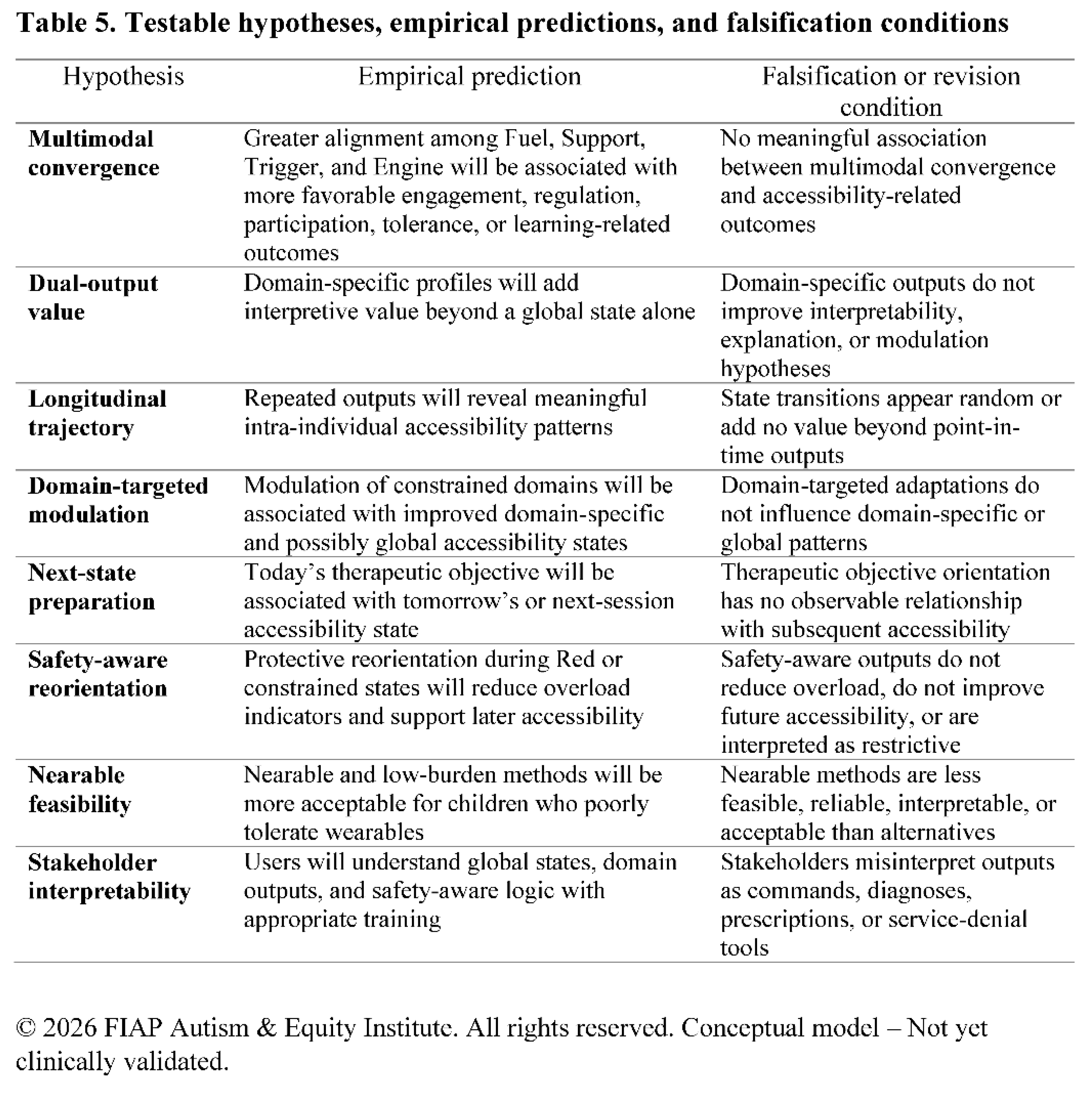
These falsification conditions are not weaknesses of the framework. They are necessary scientific safeguards. They define what would need to change if future data do not support the proposed model. The convergence claim would require revision if multimodal alignment does not relate to accessibility. The dual-output claim would require revision if domain-specific profiles do not add value. The longitudinal claim would require revision if repeated outputs do not reveal meaningful trajectories. The modulation and next-state claims would require revision if therapeutic objective orientation does not influence future accessibility. The nearable claim would require revision if low-burden measurement is not feasible or interpretable.
NAI-Digital should therefore be understood as a falsifiable scientific architecture. Future data may support, refine, weaken, or refute specific components of the model. This openness to empirical correction is central to its scientific credibility and to its responsible translational development.
9. Future Feasibility Testing and Pilot Validation Pathway
NAI-Digital requires a staged empirical development pathway before any clinical, educational, digital, or implementation use can be considered. At the present stage, the framework is conceptual. It proposes hypotheses, domains, outputs, and translational logic, but it does not provide validation evidence, predictive accuracy, treatment guidance, clinical utility, or implementation readiness. [33,34,35,36,37,38,39]
The purpose of future feasibility testing is therefore not to prove that NAI-Digital is a clinical tool. The purpose is to determine whether its core components can be operationalized, collected, interpreted, and evaluated safely in real-world autism intervention contexts. This includes feasibility of low-burden data collection, acceptability of nearable measurement, interpretability of global and domain-specific outputs, usability of color-state representations, safety of output communication, and preliminary relationships between accessibility states and subsequent engagement, regulation, participation, or learning-related outcomes.
A staged pathway is necessary because premature implementation would create risks of false precision, overinterpretation, service restriction, inappropriate therapeutic adaptation, or excessive monitoring. NAI-Digital should therefore progress from conceptual specification to feasibility testing, pilot validation, technical refinement, and implementation research only if each stage demonstrates acceptable scientific, ethical, and operational readiness.
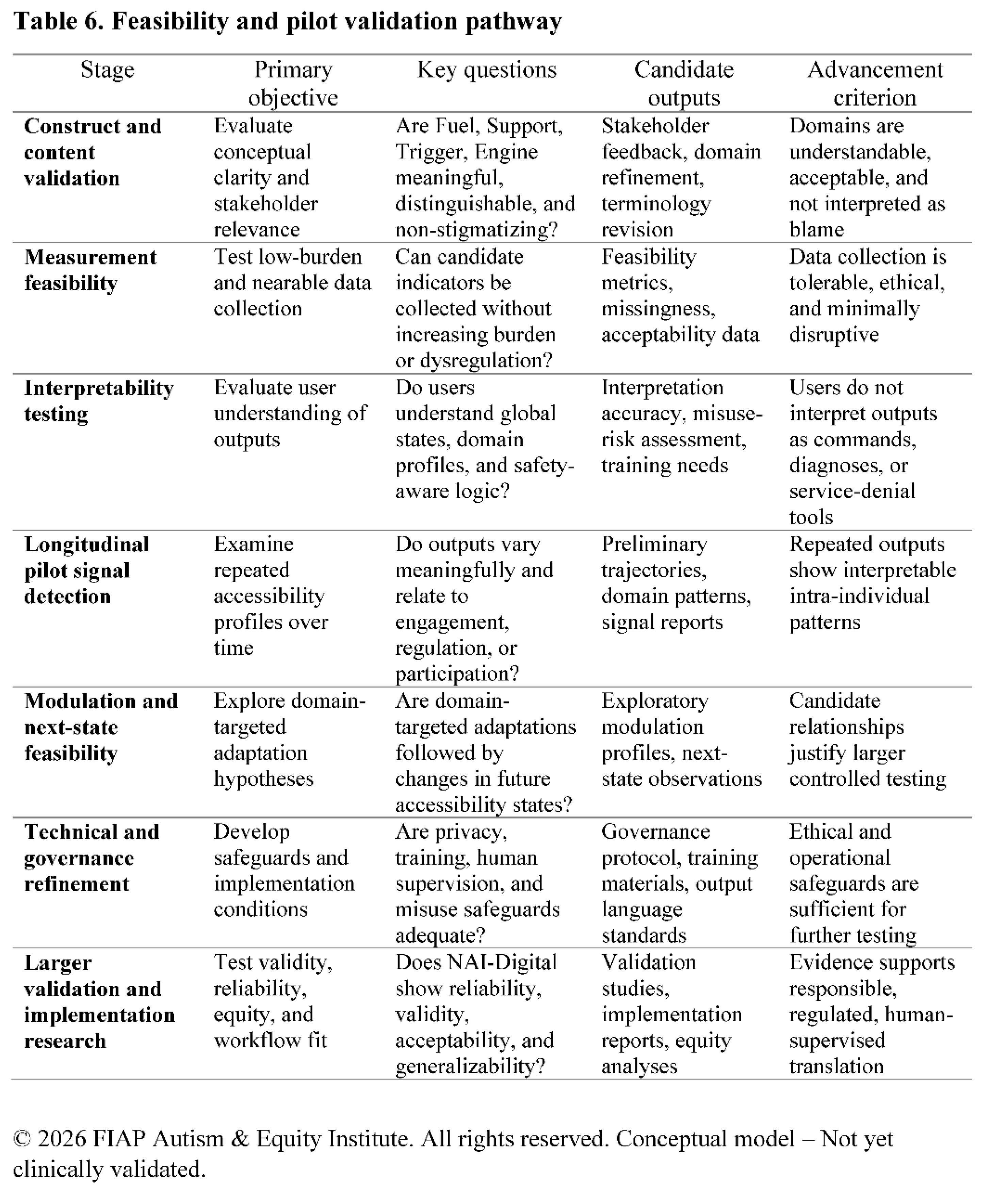
The first stage is construct and content validation. Autistic stakeholders, caregivers, clinicians, therapists, educators, researchers, and ethics experts should examine whether the proposed domains are meaningful, distinguishable, non-stigmatizing, observable, and relevant to intervention accessibility. This stage should evaluate whether Fuel, Support, Trigger, and Engine are understandable as functional domains and whether global and domain-specific outputs are interpreted as accessibility hypotheses rather than clinical commands. [35,43]
The second stage is measurement feasibility. Candidate indicators should be tested for acceptability, burden, missingness, reliability, ecological fit, and compatibility with autistic sensory profiles. This stage should evaluate whether nearable and low-burden strategies can provide sufficient information without increasing stress, dysregulation, or surveillance burden. Wearable methods may be compared when tolerated, but they should not be imposed as the default measurement requirement.
The third stage is interpretability and workflow testing. Future users should be asked to interpret sample profiles, global states, domain-specific outputs, and safety-aware flags. The goal is to determine whether users understand that Green, Yellow, Orange, and Red are conceptual accessibility orientations, not treatment commands. Testing should examine whether users can distinguish Orange as a modulation state and Red as safety-aware reorientation rather than withdrawal of care.
The fourth stage is pilot signal detection. A small, ethically approved, longitudinal pilot may examine whether repeated global and domain-specific outputs vary meaningfully over time and whether these variations relate to engagement, regulation, participation, tolerance, recovery, or learning-related outcomes. Such a pilot should not test clinical efficacy. It should test whether the architecture produces interpretable, low-burden, longitudinal signals that justify larger validation work.
The fifth stage is modulation and next-state feasibility testing. Once observational feasibility is established, future studies may examine whether domain-targeted adaptations are associated with subsequent changes in accessibility profiles. For example, Trigger-focused environmental adaptation may be examined in relation to subsequent sensory tolerance or engagement; Support-focused pacing may be examined in relation to recovery and next-session accessibility; Engine-focused priming adjustments may be examined in relation to regulation and readiness. These studies should remain exploratory until validated methods exist.
The sixth stage is technical refinement and governance development. This stage should refine output visualization, user training, uncertainty communication, privacy safeguards, data governance, stakeholder review procedures, algorithmic transparency, intellectual-property boundaries, and misuse-prevention policies. No digital implementation should proceed without clear human supervision, documented limitations, and explicit safeguards against service restriction.
The seventh stage is larger validation and implementation research, if earlier stages support feasibility. This may include reliability testing, construct validity, convergent validity, longitudinal sensitivity, acceptability, equity analysis, stakeholder interpretability, workflow integration, calibration, and external validation across sites. Only after such evidence should future work consider whether NAI-Digital could support clinical or educational decision-making as a validated, regulated, human-supervised technology. The feasibility and validation pathway is summarized in Table 6.
Future pilot work should prioritize within-person longitudinal designs because NAI-Digital concerns fluctuating accessibility states rather than fixed traits. Intensive repeated measures may be especially useful for examining whether global and domain-specific profiles change across days, contexts, sessions, and therapeutic objectives. Between-person comparisons may be useful later, but the initial scientific target should be intra-individual variability.
Candidate feasibility outcomes may include data completeness, participant burden, caregiver and clinician acceptability, child tolerance, interpretability of outputs, missingness patterns, nearable feasibility, stakeholder understanding, and preliminary associations with engagement, regulation, participation, or recovery. Candidate safety outcomes should include distress, measurement intolerance, misinterpretation, increased performance pressure, and risk of service restriction.
Ethics review is essential before any data collection involving children, caregivers, clinicians, educational records, health-related information, or intervention contexts. Data minimization, privacy protection, consent, assent where appropriate, secure storage, governance agreements, and clear role definitions should be required. Outputs should be framed as research constructs and interpretive hypotheses, not as clinical conclusions. [35,36]
The future development of NAI-Digital should therefore follow a conservative translational sequence: conceptual architecture, stakeholder review, feasibility testing, pilot signal detection, modulation exploration, validation, governance, and only then implementation research. This staged pathway protects scientific credibility while reducing the risk of premature digital deployment.
10. Discussion
This manuscript introduces NAI-Digital as a hypothesis-generating, human-supervised, multimodal convergence architecture for investigating dynamic neuroplastic accessibility in autism. The framework addresses a central translational problem in autism intervention science: therapeutic and educational interventions are often delivered according to scheduled availability and predefined targets, while the child’s dynamic accessibility to adaptive learning may fluctuate across biological, physiological, environmental, and behavioral states. [1,2,3,4,5,6,7,8,9,30,31,32,33,34,35,36,37,38,39]
The scientific contribution of NAI-Digital is not the isolated identification of sleep, autonomic regulation, sensory load, inflammation, stress physiology, environmental predictability, or behavioral activation as relevant to learning. These determinants have been studied across multiple research traditions. The contribution lies in organizing them into a functional convergence architecture centered on Fuel, Support, Trigger, and Engine. This architecture allows future research to investigate whether alignment, partial divergence, or misalignment among these domains may help characterize when therapeutic or educational input is more accessible, less accessible, or requires protective adaptation. [14,15,16,17,18,19,20,21,22,23,24,25,26,27,28,29,41,42]
A second contribution is the distinction between neuroplasticity and neuroplastic accessibility. NAI-Digital does not claim to measure neuroplasticity directly. Instead, it proposes that the conditions supporting access to adaptive learning may vary over time. This distinction is important because reduced responsiveness should not automatically be interpreted as lack of motivation, resistance, poor prognosis, or reduced intrinsic capacity. It may reflect a temporary state in which the conditions necessary for learning are not sufficiently aligned.
A third contribution is the dual-output architecture. A global accessibility state may indicate whether current conditions appear favorable, intermediate, constrained, or safety-aware. However, a global state alone does not explain itself. Domain-specific outputs are therefore needed to identify whether Fuel, Support, Trigger, Engine, or multidomain misalignment may be contributing to the global profile. This structure may support more precise hypotheses about modulation and may reduce the risk of treating constrained accessibility as a child-level failure.
A fourth contribution is the longitudinal logic. NAI-Digital is not designed to classify a child once. It is designed to study trajectories. Repeated global and domain-specific outputs may help future research distinguish transient states, recurrent domain-specific constraints, cumulative overload, recovery trajectories, and possible effects of therapeutic objective orientation on subsequent accessibility. This time-sensitive perspective is essential because accessibility may change across hours, days, sessions, environments, and intervention demands.
A fifth contribution is next-state preparation. Traditional intervention evaluation often emphasizes immediate performance, skill acquisition, or session-level response. NAI-Digital proposes that intervention may also be evaluated by its effect on future accessibility. A session may be valuable if it prevents overload, preserves engagement, supports recovery, stabilizes regulation, protects relational safety, or prepares a more favorable future learning state. This does not replace outcome measurement, but it expands the conceptual meaning of therapeutic success.
A Sixth, NAI-Digital introduces accessibility-oriented adaptation and neuroplastic readiness as explicit translational targets, shifting the focus from intervention intensity alone toward state-sensitive adjustment of therapeutic objectives according to current accessibility conditions and future learning capacity.
The safety-aware dimension is a further ethical contribution. NAI-Digital explicitly rejects the idea that the goal of accessibility detection is to maximize intervention intensity. Instead, the framework proposes that constrained or safety-aware states should trigger reconsideration of objective, intensity, context, timing, and demand. Orange is not a stop state; it is a modulation state. Red is not withdrawal of care; it is protective reorientation of care. This distinction is central to preventing misuse.
The nearable-compatible measurement philosophy also has translational importance. Many digital health approaches rely heavily on body-worn devices. Such devices may be useful in some contexts, but they may be poorly tolerated by autistic children with tactile sensitivity, sensory defensiveness, anxiety related to devices, or intolerance to continuous monitoring. NAI-Digital therefore prioritizes low-burden, nearable, and context-sensitive methods whenever possible. The guiding principle is that measurement must not become an additional source of inaccessibility. [30,31,40]
NAI-Digital may also contribute to equity-oriented autism intervention research. If variable responsiveness is interpreted as non-compliance, low motivation, or family-level failure, children may be misunderstood or underserved. By reframing variability as a question of accessibility conditions, the framework shifts attention toward modifiable supports, environmental fit, recovery, regulation, and timing. This may be particularly important for children with high support needs, sensory intolerance, limited expressive communication, co-occurring medical complexity, or unstable access to services. [4,35,43]
At the same time, the framework requires caution. NAI-Digital is not validated. It does not provide predictive accuracy, clinical thresholds, treatment recommendations, diagnostic interpretation, or autonomous decision support. Its color states are conceptual. Its domain profiles are not validated scores. Its safety-aware logic is not a medical neuroprotection system. Its nearable preference requires empirical testing. Its feasibility and interpretability remain unknown.
The central question for future research is therefore not whether NAI-Digital should be implemented clinically now. It should not. The central question is whether this architecture can generate interpretable, low-burden, ethically acceptable, longitudinal signals that justify further validation. If future studies show that multimodal convergence, dual outputs, domain-specific profiles, and next-state preparation add value beyond existing models, NAI-Digital may become a useful translational framework for accessibility-informed autism intervention research.
In its current form, NAI-Digital should be understood as a structured scientific proposal: a way to organize fragmented evidence, generate falsifiable hypotheses, protect against child-blaming interpretations of variable responsiveness, and guide future feasibility testing. Its value will depend on whether empirical work supports its assumptions, whether stakeholders find it interpretable and respectful, and whether governance safeguards prevent premature or restrictive use.
11. Limitations, Boundary Conditions, and Governance Safeguards
NAI-Digital is subject to several important limitations and boundary conditions. These limitations are not secondary considerations; they define the conditions under which the framework can be interpreted responsibly.
First, NAI-Digital is currently a conceptual and translational research architecture. It has not been validated as a clinical instrument, digital health tool, biomarker panel, intervention-timing system, or decision-support technology. The framework proposes domains, outputs, hypotheses, and a staged validation pathway, but it does not yet provide empirical evidence of reliability, validity, predictive accuracy, clinical utility, or implementation readiness.
Second, NAI-Digital does not measure neuroplasticity directly. Neuroplasticity is a complex biological process involving cellular, synaptic, network-level, developmental, behavioral, and environmental mechanisms. No global accessibility state, domain-specific profile, color output, physiological signal, or behavioral indicator should be interpreted as a direct measure of neuroplasticity. The framework instead concerns neuroplastic accessibility: the hypothesized degree to which biological, physiological, environmental, and behavioral conditions may support access to adaptive learning at a given moment.
Third, the four-domain model is pragmatic rather than exhaustive. Fuel, Support, Trigger, and Engine organize major classes of variables relevant to accessibility, but they do not capture every determinant of intervention responsiveness. Communication profile, intellectual disability, language development, family context, intervention fidelity, therapist skill, cultural factors, socioeconomic constraints, educational resources, trauma history, medication context, co-occurring conditions, and service access may also influence responsiveness. Future work must clarify which factors belong inside the NAI-Digital architecture, which should be treated as moderators, and which should be modeled as contextual covariates.
Fourth, the color-state system is conceptual. Green, Yellow, Orange, and Red should not be interpreted as validated clinical categories, treatment commands, risk scores, diagnostic indicators, or eligibility criteria. Their function is to support research on accessibility-oriented interpretation, therapeutic objective orientation, and longitudinal state change. Misuse of color states could create false precision or inappropriate simplification if users interpret them as deterministic.
Fifth, the dual-output system requires empirical validation. The distinction between global accessibility and domain-specific profiles is conceptually important, but future data must determine whether domain-specific outputs add interpretive value beyond a global state alone. If domain profiles do not improve interpretation, modulation hypotheses, longitudinal analysis, or stakeholder understanding, the dual-output model will require revision.
Sixth, NAI-Digital risks overmedicalization if biological, physiological, or computational language is used without sufficient caution. The framework should not transform ordinary variability, fatigue, distress, refusal, sensory overwhelm, or contextual mismatch into pathological states. Its purpose is to improve understanding of accessibility conditions, not to medicalize every fluctuation in behavior or learning.
Seventh, NAI-Digital risks performance-optimization misuse. A framework that identifies favorable accessibility states could be misused to intensify intervention, increase demand, or pressure the child to perform whenever Green-like conditions are detected. This would contradict the safety-aware purpose of the model. A favorable state should be interpreted as a possible opportunity, not as permission for unlimited demand.
Eighth, constrained or safety-aware states could be misused to restrict services. Orange or Red outputs should never be used to deny intervention, reduce therapeutic access, exclude a child from a program, lower expectations permanently, or justify administrative withdrawal of support. A constrained state means that objectives, intensity, timing, environment, or support may require adaptation. It does not mean that the child needs less care.
Ninth, NAI-Digital does not provide medical neuroprotection. Its safety-aware logic may support functional protection against excessive sensory, cognitive, excitatory, or regulatory burden, but it does not diagnose, measure, treat, or prevent excitotoxicity as a cellular medical condition. It does not directly measure glutamatergic activity, calcium-mediated cellular stress, neuronal injury, or excitotoxic mechanisms. This boundary must remain explicit.
Tenth, the nearable-compatible measurement model remains untested. Nearable methods may reduce burden for children who poorly tolerate wearable devices, but they also raise issues of validity, privacy, environmental surveillance, technical reliability, missingness, and interpretability. Nearable methods are not automatically ethical simply because they are non-worn. Future research must evaluate their acceptability, accuracy, and privacy implications.
Eleventh, algorithmic and digital health risks must be anticipated before any implementation. These include false precision, automation bias, overreliance on dashboard outputs, inequitable calibration, misinterpretation by non-specialists, privacy breaches, caregiver burden, data incompleteness, and use of outputs outside the context for which they were designed. Human supervision, uncertainty communication, training, and governance are therefore non-negotiable. [33,34,35,36]
Twelfth, generalizability cannot be assumed. NAI-Digital may not apply equally across age groups, communication profiles, intellectual or developmental disability levels, cultural contexts, socioeconomic conditions, intervention models, school environments, or clinical settings. Feasibility and validation work must examine whether the framework remains meaningful for children with high support needs, limited expressive communication, medical complexity, sensory intolerance, multilingual families, and under-resourced service contexts. [1,2,3,4,5,6,7,8,35,43]
These limitations require explicit governance safeguards. Future NAI-Digital development should include stakeholder review, autistic and caregiver input, ethics oversight, data minimization, privacy protection, human-supervised interpretation, clear output language, training requirements, misuse-prevention policies, and safeguards against service restriction. Intellectual-property protection should also be balanced with sufficient methodological transparency for scientific evaluation. The key risks and safeguards are summarized in Table 7.
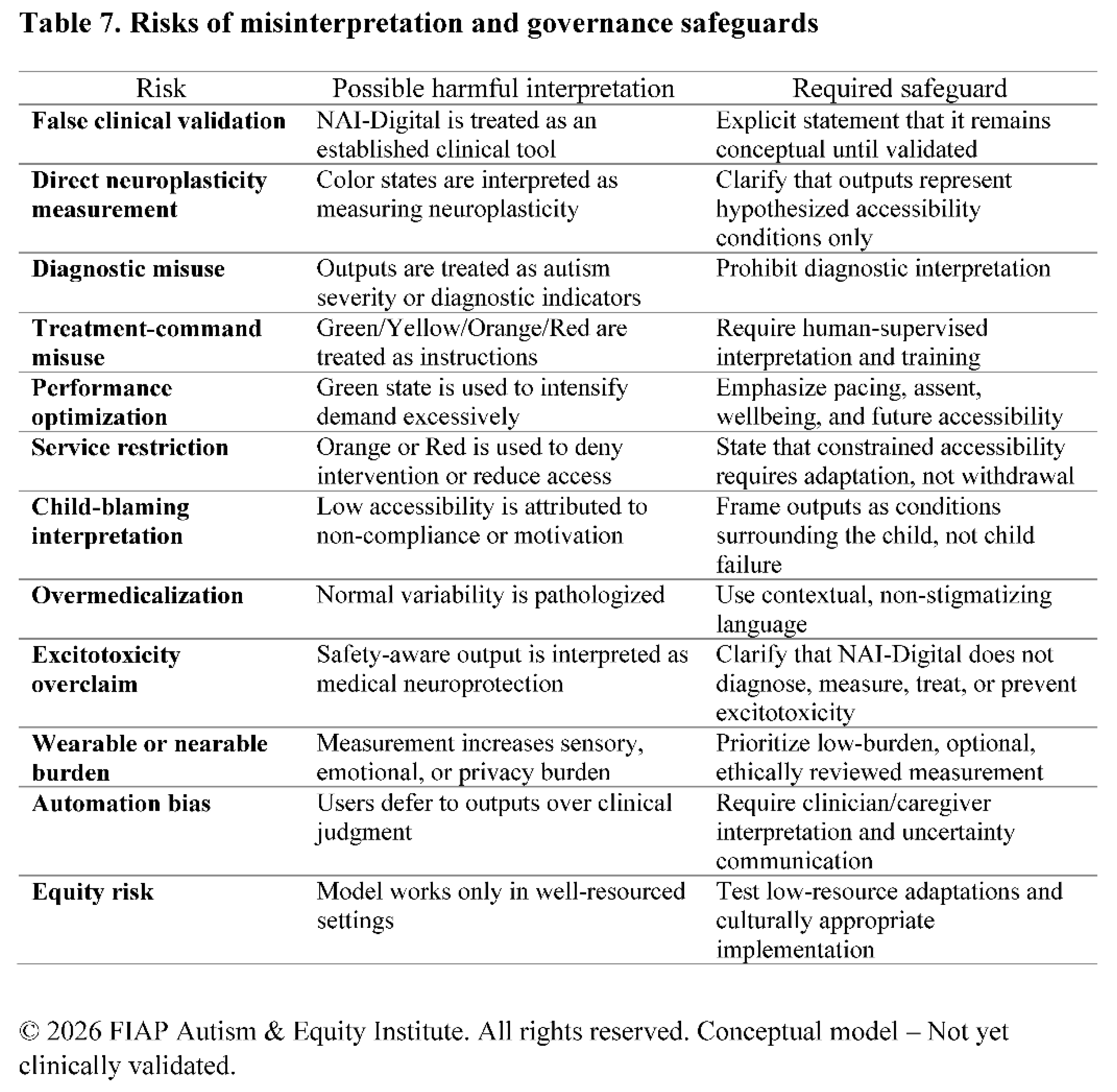
The responsible interpretation of NAI-Digital depends on maintaining these boundaries. The framework should be evaluated as a research architecture, not as a ready clinical technology. Its future value will depend not only on empirical validity, but also on whether it can be implemented without increasing surveillance, burden, stigma, inequity, or inappropriate restriction of care.
12. Conclusion
NAI-Digital is proposed as a hypothesis-generating, human-supervised, multimodal convergence architecture for investigating dynamic neuroplastic accessibility in autism. The framework addresses a persistent gap in autism intervention science: therapeutic and educational supports are often delivered according to schedule, service availability, and predefined goals, while less structured attention is given to whether the child’s current biological, physiological, environmental, and behavioral conditions make adaptive learning accessible at that moment.
The central contribution of NAI-Digital is the organization of fragmented evidence into a functional architecture. Sleep, autonomic regulation, inflammatory burden, sensory load, environmental predictability, stress physiology, and behavioral activation have each been studied in separate research traditions. NAI-Digital does not claim novelty for these determinants individually. Its novelty lies in integrating them into four functional domains — Fuel, Support, Trigger, and Engine — and proposing that neuroplastic accessibility may emerge from their dynamic alignment, partial divergence, or misalignment over time. [10,11,12,13,14,15,16,17,18,19,20,21,22,23,24,25,26,27,28,29,41,42]
The framework distinguishes neuroplasticity from neuroplastic accessibility. It does not claim to measure neuroplasticity directly. Rather, it proposes that accessibility to therapeutic or educational input may fluctuate according to changing conditions surrounding the child. This distinction helps reframe variable responsiveness away from explanations based on motivation, compliance, or fixed capacity, and toward investigation of modifiable accessibility conditions.
A key innovation is the dual-output architecture. The global output represents the integrated accessibility state, while domain-specific outputs identify which functional layers may be supporting or constraining that state. This structure allows future research to examine not only whether accessibility appears favorable or constrained, but also why a given state may be emerging and which domain may require modulation.
NAI-Digital also introduces longitudinal monitoring and next-state preparation. Intervention success is not limited to immediate performance or skill acquisition. It may also include preserving engagement, preventing overload, supporting recovery, stabilizing regulation, protecting relational safety, and preparing future accessibility. In this framework, Orange does not mean failure or cancellation. Red does not mean withdrawal of care. Across all states, care remains active; what changes is the therapeutic objective.
The safety-aware logic of NAI-Digital is central. The framework is not designed to maximize intensity, optimize performance at any cost, or classify children as ready or unready. It is designed to investigate how therapeutic objectives may be aligned with accessibility while protecting wellbeing, regulation, and future learning capacity. It does not diagnose, measure, treat, or prevent excitotoxicity as a cellular medical condition, but it may support future research on functional protection against excessive sensory, cognitive, excitatory, or regulatory burden.
The framework also prioritizes nearable, low-burden, and context-sensitive measurement because measurement should not become another source of inaccessibility. Wearables may be useful when tolerated and ethically justified, but NAI-Digital does not depend on body-worn monitoring as its default assumption.
At this stage, NAI-Digital remains conceptual. It is not a validated clinical instrument, diagnostic system, medical device, treatment-selection algorithm, biomarker panel, or autonomous decision-support technology. Its scientific value lies in its falsifiability. The proposed hypotheses regarding multimodal convergence, dual-output interpretation, longitudinal trajectories, domain-targeted modulation, next-state preparation, safety-aware reorientation, nearable feasibility, and stakeholder interpretability must be tested empirically.
Future work should proceed through staged feasibility testing, stakeholder review, pilot validation, governance development, and larger implementation research only if early evidence supports acceptability, interpretability, low-burden measurement, safety, equity, and scientific validity. Until then, NAI-Digital should be understood as a structured research architecture for investigating when and how adaptive learning may become more accessible in autism.
Its long-term vision is not to replace clinical judgment, caregiver knowledge, autistic communication, therapeutic relationship, or individualized care. Its purpose is to support a more precise, ethical, state-sensitive, and accessibility-informed understanding of intervention responsiveness: the right therapeutic objective, under the right conditions, at the right time, while protecting future accessibility.
Ethics Statement
This manuscript does not report human-subject data, animal data, clinical intervention, identifiable health information, or retrospective record review. It presents a conceptual and translational research architecture. Therefore, research ethics board approval was not required for the present manuscript. Future feasibility studies, pilot validation, data collection, or implementation research involving autistic children, caregivers, clinicians, educational contexts, health-related information, or service records will require appropriate ethics review, consent procedures, privacy safeguards, and governance approval before initiation.
Data Availability Statement
No datasets were generated or analyzed for the present manuscript. NAI-Digital is presented as a conceptual and hypothesis-generating architecture. Future empirical studies will require predefined data governance procedures, privacy protections, data minimization, and ethics-approved data-sharing arrangements where applicable.
Author Contributions
YF conceived the NAI-Digital framework, developed the conceptual architecture, defined the Fuel, Support, Trigger, and Engine domains, formulated the dual-output and safety-aware logic, and wrote the manuscript.
Conflicts of Interest Statement
The author is the founder of FIAP Autism & Equity Institute and the originator of the NAI-Digital conceptual architecture. NAI-Digital, FIAP-related constructs, figures, terminology, translational models, and future digital implementation concepts may constitute intellectual assets under development. The present manuscript is conceptual and does not present a validated clinical product, commercial device, medical intervention, diagnostic tool, or autonomous decision-support system.
Funding Statement
No specific external funding was received for the preparation of this manuscript.
Clinical and Translational Caution
NAI-Digital is not a validated clinical instrument, diagnostic system, biomarker panel, medical device, treatment-selection algorithm, or autonomous decision-making technology. It should not be used to make clinical decisions, determine service eligibility, restrict care, diagnose autism or any other condition, or modify intervention delivery outside an approved research protocol.
Intellectual Property Notice
© 2026 FIAP Autism & Equity Institute / Yves Fuamba. All rights reserved. The conceptual architecture, terminology, figures, tables, and translational model described in this manuscript are presented for scientific communication and hypothesis generation. No license is granted for unauthorized clinical, commercial, digital, algorithmic, educational, or derivative use without prior written authorization.
Acknowledgments
Generative artificial intelligence tools were used for language refinement and figure-development support. All AI-assisted outputs were critically reviewed, revised, verified, and approved by the author, who takes full responsibility for the accuracy, originality, integrity, and scientific content of the manuscript. The tools used included ChatGPT (OpenAI) for language refinement and figure development support.
References
- American Psychiatric Association. Diagnostic and Statistical Manual of Mental Disorders, 5th ed, text rev; American Psychiatric Association Publishing: Washington, DC, 2022. [Google Scholar]
- Lord, C.; Brugha, T.S.; Charman, T.; Cusack, J.; Dumas, G.; Frazier, T.; et al. Autism spectrum disorder. Nat. Rev. Dis. Prim. 2020, 6, 5. [Google Scholar] [CrossRef]
- Lai, M.C.; Lombardo, M.V.; Baron-Cohen, S. Autism. Lancet 2014, 383, 896–910. [Google Scholar] [CrossRef] [PubMed]
- Lord, C.; Charman, T.; Havdahl, A.; Carbone, P.; Anagnostou, E.; Boyd, B.; et al. The Lancet Commission on the future of care and clinical research in autism. Lancet 2022, 399, 271–334. [Google Scholar] [CrossRef] [PubMed]
- Smith, T.; Iadarola, S. Evidence base update for autism spectrum disorder. J. Clin. Child Adolesc. Psychol. 2015, 44, 897–922. [Google Scholar] [CrossRef] [PubMed]
- Sandbank, M.; Bottema-Beutel, K.; Crowley, S.; Cassidy, M.; Dunham, K.; Feldman, J.I.; et al. Project AIM: autism intervention meta-analysis for studies of young children. Psychol. Bull. 2020, 146, 1–29. [Google Scholar] [CrossRef] [PubMed]
- Dawson, G.; Rogers, S.; Munson, J.; Smith, M.; Winter, J.; Greenson, J.; et al. Randomized, controlled trial of an intervention for toddlers with autism: the Early Start Denver Model. Pediatrics 2010, 125, e17–e23. [Google Scholar] [CrossRef] [PubMed]
- Schreibman, L.; Dawson, G.; Stahmer, A.C.; Landa, R.; Rogers, S.J.; McGee, G.G.; et al. Naturalistic developmental behavioral interventions: empirically validated treatments for autism spectrum disorder. J. Autism Dev. Disord. 2015, 45, 2411–2428. [Google Scholar] [CrossRef] [PubMed]
- Fuamba, Y. The therapeutic engagement index in autism: a hypothesis-generating framework for stratifying intervention responsiveness and adaptive therapeutic availability. Front Child Adolesc. Psychiatry 2026, 5, 1872562. [Google Scholar] [CrossRef] [PubMed]
- Kolb, B.; Gibb, R. Brain plasticity and behaviour in the developing brain. J. Can. Acad. Child Adolesc. Psychiatry 2011, 20, 265–276. [Google Scholar] [PubMed]
- Hensch, T.K. Critical period plasticity in local cortical circuits. Nat. Rev. Neurosci. 2005, 6, 877–888. [Google Scholar] [CrossRef] [PubMed]
- Knudsen, E.I. Sensitive periods in the development of the brain and behavior. J. Cogn. Neurosci. 2004, 16, 1412–1425. [Google Scholar] [CrossRef] [PubMed]
- Takesian, A.E.; Hensch, T.K. Balancing plasticity/stability across brain development. Prog. Brain Res. 2013, 207, 3–34. [Google Scholar] [CrossRef] [PubMed]
- Diekelmann, S.; Born, J. The memory function of sleep. Nat. Rev. Neurosci. 2010, 11, 114–126. [Google Scholar] [CrossRef] [PubMed]
- Rasch, B.; Born, J. About sleep’s role in memory. Physiol. Rev. 2013, 93, 681–766. [Google Scholar] [CrossRef] [PubMed]
- Richdale, A.L.; Schreck, K.A. Sleep problems in autism spectrum disorders: prevalence, nature, and possible biopsychosocial aetiologies. Sleep Med. Rev. 2009, 13, 403–411. [Google Scholar] [CrossRef] [PubMed]
- Elrod, M.G.; Hood, B.S. Sleep differences among children with autism spectrum disorders and typically developing peers: a meta-analysis. J. Dev. Behav. Pediatr. 2015, 36, 166–177. [Google Scholar] [CrossRef] [PubMed]
- Porges, S.W. The polyvagal theory: new insights into adaptive reactions of the autonomic nervous system. Cleve Clin. J. Med. 2009, 76 Suppl 2, S86–S90. [Google Scholar] [CrossRef] [PubMed]
- Thayer, J.F.; Ahs, F.; Fredrikson, M.; Sollers, J.J., 3rd; Wager, T.D. A meta-analysis of heart rate variability and neuroimaging studies: implications for heart rate variability as a marker of stress and health. Neurosci. Biobehav Rev. 2012, 36, 747–756. [Google Scholar] [CrossRef] [PubMed]
- Robertson, C.E.; Baron-Cohen, S. Sensory perception in autism. Nat. Rev. Neurosci. 2017, 18, 671–684. [Google Scholar] [CrossRef] [PubMed]
- Ben-Sasson, A.; Hen, L.; Fluss, R.; Cermak, S.A.; Engel-Yeger, B.; Gal, E. A meta-analysis of sensory modulation symptoms in individuals with autism spectrum disorders. J. Autism Dev. Disord. 2009, 39, 1–11. [Google Scholar] [CrossRef] [PubMed]
- Rubenstein, J.L.R.; Merzenich, M.M. Model of autism: increased ratio of excitation/inhibition in key neural systems. Genes Brain Behav. 2003, 2, 255–267. [Google Scholar] [CrossRef] [PubMed]
- Nelson, S.B.; Valakh, V. Excitatory/inhibitory balance and circuit homeostasis in autism spectrum disorders. Neuron 2015, 87, 684–698. [Google Scholar] [CrossRef] [PubMed]
- Estes, M.L.; McAllister, A.K. Immune mediators in the brain and peripheral tissues in autism spectrum disorder. Nat. Rev. Neurosci. 2015, 16, 469–486. [Google Scholar] [CrossRef] [PubMed]
- Onore, C.; Careaga, M.; Ashwood, P. The role of immune dysfunction in the pathophysiology of autism. Brain Behav. Immun. 2012, 26, 383–392. [Google Scholar] [CrossRef] [PubMed]
- Cotman, C.W.; Berchtold, N.C. Exercise: a behavioral intervention to enhance brain health and plasticity. Trends Neurosci. 2002, 25, 295–301. [Google Scholar] [CrossRef] [PubMed]
- Voss, M.W.; Nagamatsu, L.S.; Liu-Ambrose, T.; Kramer, A.F. Exercise, brain, and cognition across the life span. J. Appl. Physiol. 2011, 111, 1505–1513. [Google Scholar] [CrossRef] [PubMed]
- Sowa, M.; Meulenbroek, R. Effects of physical exercise on autism spectrum disorders: a meta-analysis. Res. Autism Spectr. Disord. 2012, 6, 46–57. [Google Scholar] [CrossRef]
- Srinivasan, S.M.; Pescatello, L.S.; Bhat, A.N. Current perspectives on physical activity and exercise recommendations for children and adolescents with autism spectrum disorders. Phys. Ther. 2014, 94, 875–889. [Google Scholar] [CrossRef] [PubMed]
- Onnela, J.P.; Rauch, S.L. Harnessing smartphone-based digital phenotyping to enhance behavioral and mental health. Neuropsychopharmacology 2016, 41, 1691–1696. [Google Scholar] [CrossRef] [PubMed]
- Torous, J.; Kiang, M.V.; Lorme, J.; Onnela, J.P. New tools for new research in psychiatry: a scalable and customizable platform to empower data driven smartphone research. JMIR Ment. Health 2016, 3, e16. [Google Scholar] [CrossRef] [PubMed]
- Wall, D.P.; Dally, R.; Luyster, R.; Jung, J.Y.; DeLuca, T.F. Use of artificial intelligence to shorten the behavioral diagnosis of autism. PLoS ONE 2012, 7, e43855. [Google Scholar] [CrossRef] [PubMed]
- Liu, X.; Rivera, S.C.; Moher, D.; Calvert, M.J.; Denniston, A.K. SPIRIT-AI and CONSORT-AI Working Group. Reporting guidelines for clinical trial reports for interventions involving artificial intelligence: the CONSORT-AI extension. Nat. Med. 2020, 26, 1364–1374. [Google Scholar] [CrossRef] [PubMed]
- Rivera, S.C.; Liu, X.; Chan, A.W.; Denniston, A.K.; Calvert, M.J. SPIRIT-AI and CONSORT-AI Working Group. Guidelines for clinical trial protocols for interventions involving artificial intelligence: the SPIRIT-AI extension. Nat. Med. 2020, 26, 1351–1363. [Google Scholar] [CrossRef] [PubMed]
- World Health Organization. Ethics and governance of artificial intelligence for health: WHO guidance; World Health Organization: Geneva, 2021. [Google Scholar]
- International Medical Device Regulators Forum. Software as a Medical Device (SaMD): Clinical Evaluation; IMDRF/SaMD WG/N41FINAL, 2017. [Google Scholar]
- Collins, L.M.; Murphy, S.A.; Bierman, K.L. A conceptual framework for adaptive preventive interventions. Prev. Sci. 2004, 5, 185–196. [Google Scholar] [CrossRef] [PubMed]
- Murphy, S.A. An experimental design for the development of adaptive treatment strategies. Stat. Med. 2005, 24, 1455–1481. [Google Scholar] [CrossRef] [PubMed]
- Nahum-Shani, I.; Smith, S.N.; Spring, B.J.; Collins, L.M.; Witkiewitz, K.; Tewari, A.; et al. Just-in-time adaptive interventions: an organizing framework for ongoing health behavior support. Ann. Behav. Med. 2018, 52, 446–462. [Google Scholar] [CrossRef] [PubMed]
- Bent, B.; Goldstein, B.A.; Kibbe, W.A.; Dunn, J.P. Investigating sources of inaccuracy in wearable optical heart rate sensors. npj Digit Med. 2020, 3, 18. [Google Scholar] [CrossRef] [PubMed]
- Pellicano, E.; Burr, D. When the world becomes ‘too real’: a Bayesian explanation of autistic perception. Trends Cogn. Sci. 2012, 16, 504–510. [Google Scholar] [CrossRef] [PubMed]
- Sinha, P.; Kjelgaard, M.M.; Gandhi, T.K.; Tsourides, K.; Cardinaux, A.L.; Pantazis, D.; et al. Autism as a disorder of prediction. Proc. Natl. Acad. Sci. U S A 2014, 111, 15220–15225. [Google Scholar] [CrossRef] [PubMed]
- Bottema-Beutel, K.; Kapp, S.K.; Lester, J.N.; Sasson, N.J.; Hand, B.N. Avoiding ableist language: suggestions for autism researchers. Autism Adulthood 2021, 3, 18–29. [Google Scholar] [CrossRef] [PubMed]
Figure 1.
Conceptual distinction between neuroplasticity and neuroplastic accessibility. Legend. This figure illustrates the conceptual distinction between neuroplasticity and neuroplastic accessibility. Neuroplasticity refers to the intrinsic capacity of the nervous system to reorganize structurally and functionally in response to experience, learning, and developmental context. Neuroplastic accessibility refers to the dynamic degree to which current biological, physiological, environmental, and behavioral conditions may support access to adaptive learning, engagement, consolidation, and therapeutic responsiveness at a specific moment. NAI-Digital does not claim to measure neuroplasticity directly. Instead, it investigates whether multimodal conditions may converge or diverge in ways that make plasticity-related learning opportunities more or less accessible over time.
Figure 1.
Conceptual distinction between neuroplasticity and neuroplastic accessibility. Legend. This figure illustrates the conceptual distinction between neuroplasticity and neuroplastic accessibility. Neuroplasticity refers to the intrinsic capacity of the nervous system to reorganize structurally and functionally in response to experience, learning, and developmental context. Neuroplastic accessibility refers to the dynamic degree to which current biological, physiological, environmental, and behavioral conditions may support access to adaptive learning, engagement, consolidation, and therapeutic responsiveness at a specific moment. NAI-Digital does not claim to measure neuroplasticity directly. Instead, it investigates whether multimodal conditions may converge or diverge in ways that make plasticity-related learning opportunities more or less accessible over time.
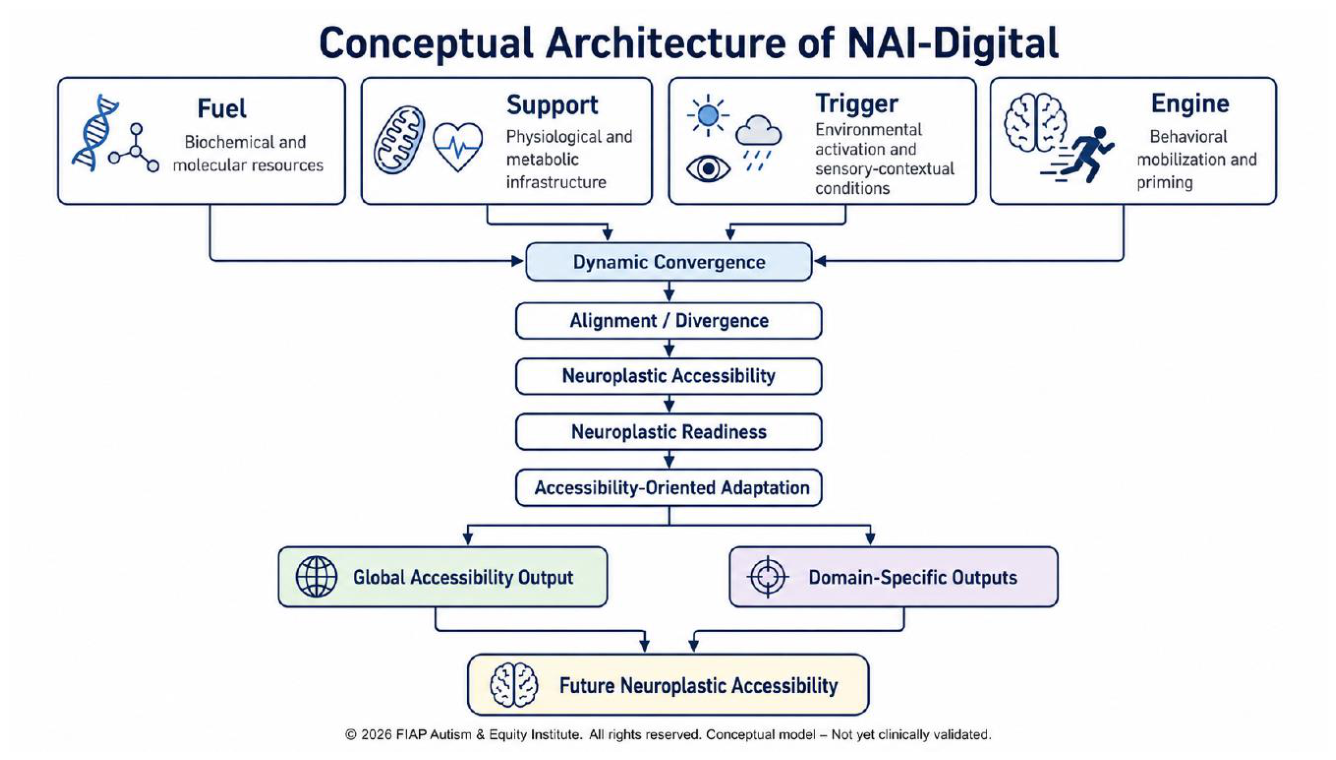
Figure 2.
NAI-Digital four-domain architecture: Fuel, Support, Trigger, and Engine. Legend. This figure presents the core four-domain architecture of NAI-Digital. The framework organizes candidate determinants of dynamic neuroplastic accessibility into four functional domains: Fuel, representing biochemical and systemic substrate; Support, representing physiological regulation, recovery, sleep, autonomic balance, and body-state stability; Trigger, representing environmental sensory load, predictability, transitions, contextual stress, and task demand; and Engine, representing behavioral priming, activity-dependent readiness, movement, preparatory routines, and activation. No single domain is sufficient to define accessibility. Neuroplastic accessibility is hypothesized to emerge from the alignment, partial divergence, or misalignment of these domains over time.
Figure 2.
NAI-Digital four-domain architecture: Fuel, Support, Trigger, and Engine. Legend. This figure presents the core four-domain architecture of NAI-Digital. The framework organizes candidate determinants of dynamic neuroplastic accessibility into four functional domains: Fuel, representing biochemical and systemic substrate; Support, representing physiological regulation, recovery, sleep, autonomic balance, and body-state stability; Trigger, representing environmental sensory load, predictability, transitions, contextual stress, and task demand; and Engine, representing behavioral priming, activity-dependent readiness, movement, preparatory routines, and activation. No single domain is sufficient to define accessibility. Neuroplastic accessibility is hypothesized to emerge from the alignment, partial divergence, or misalignment of these domains over time.
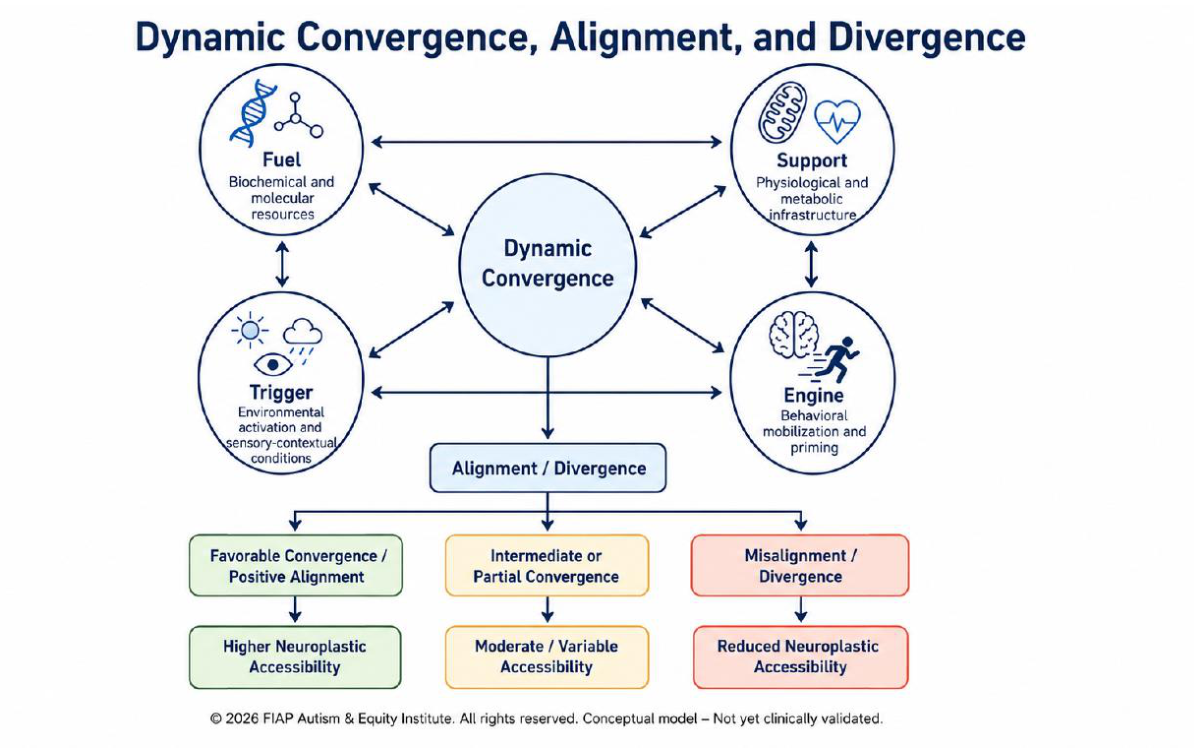
Figure 3.
Dual-output architecture: global accessibility state and domain-specific profiles. Legend. This figure represents the dual-output architecture of NAI-Digital. The first output is a global accessibility state, conceptually represented as Green, Yellow, Orange, or Red. This global output summarizes the integrated accessibility orientation generated by multimodal convergence across Fuel, Support, Trigger, and Engine. The second output consists of domain-specific profiles indicating which functional domains may be supporting or constraining the global state. This distinction is central because a constrained global state does not explain itself. A global Orange or Red state may arise from Fuel burden, Support dysregulation, Trigger overload, Engine mismatch, or multidomain misalignment. The dual-output structure is intended to support interpretability, domain-targeted modulation hypotheses, longitudinal monitoring, and future empirical validation.
Figure 3.
Dual-output architecture: global accessibility state and domain-specific profiles. Legend. This figure represents the dual-output architecture of NAI-Digital. The first output is a global accessibility state, conceptually represented as Green, Yellow, Orange, or Red. This global output summarizes the integrated accessibility orientation generated by multimodal convergence across Fuel, Support, Trigger, and Engine. The second output consists of domain-specific profiles indicating which functional domains may be supporting or constraining the global state. This distinction is central because a constrained global state does not explain itself. A global Orange or Red state may arise from Fuel burden, Support dysregulation, Trigger overload, Engine mismatch, or multidomain misalignment. The dual-output structure is intended to support interpretability, domain-targeted modulation hypotheses, longitudinal monitoring, and future empirical validation.
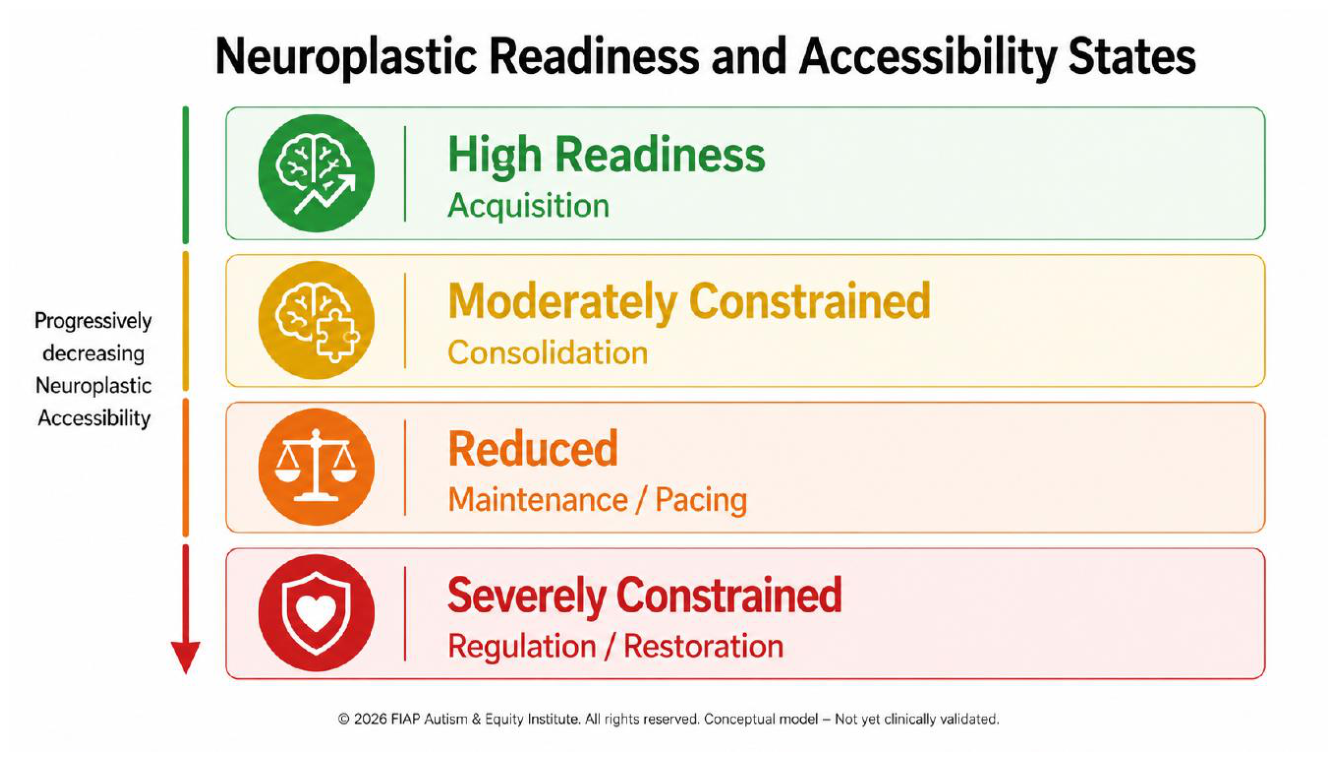
Figure 4.
Longitudinal trajectory and next-state preparation model. Legend. This figure illustrates the longitudinal logic of NAI-Digital. Neuroplastic accessibility is conceptualized as labile and time-sensitive rather than fixed. Repeated global and domain-specific outputs may reveal stable convergence profiles, recurrent domain-specific constraints, cumulative constraint patterns, rapid shifts, or recovery trajectories. The figure also illustrates next-state preparation: today’s therapeutic objective may influence tomorrow’s or the next session’s accessibility state. A Green-state session may support acquisition while preserving future accessibility; a Yellow-state session may consolidate and stabilize; an Orange-state session may prevent progression toward Red; and a Red-state session may support recovery toward Yellow or Green. This model reframes intervention success as both immediate learning and preservation or restoration of future accessibility.
Figure 4.
Longitudinal trajectory and next-state preparation model. Legend. This figure illustrates the longitudinal logic of NAI-Digital. Neuroplastic accessibility is conceptualized as labile and time-sensitive rather than fixed. Repeated global and domain-specific outputs may reveal stable convergence profiles, recurrent domain-specific constraints, cumulative constraint patterns, rapid shifts, or recovery trajectories. The figure also illustrates next-state preparation: today’s therapeutic objective may influence tomorrow’s or the next session’s accessibility state. A Green-state session may support acquisition while preserving future accessibility; a Yellow-state session may consolidate and stabilize; an Orange-state session may prevent progression toward Red; and a Red-state session may support recovery toward Yellow or Green. This model reframes intervention success as both immediate learning and preservation or restoration of future accessibility.
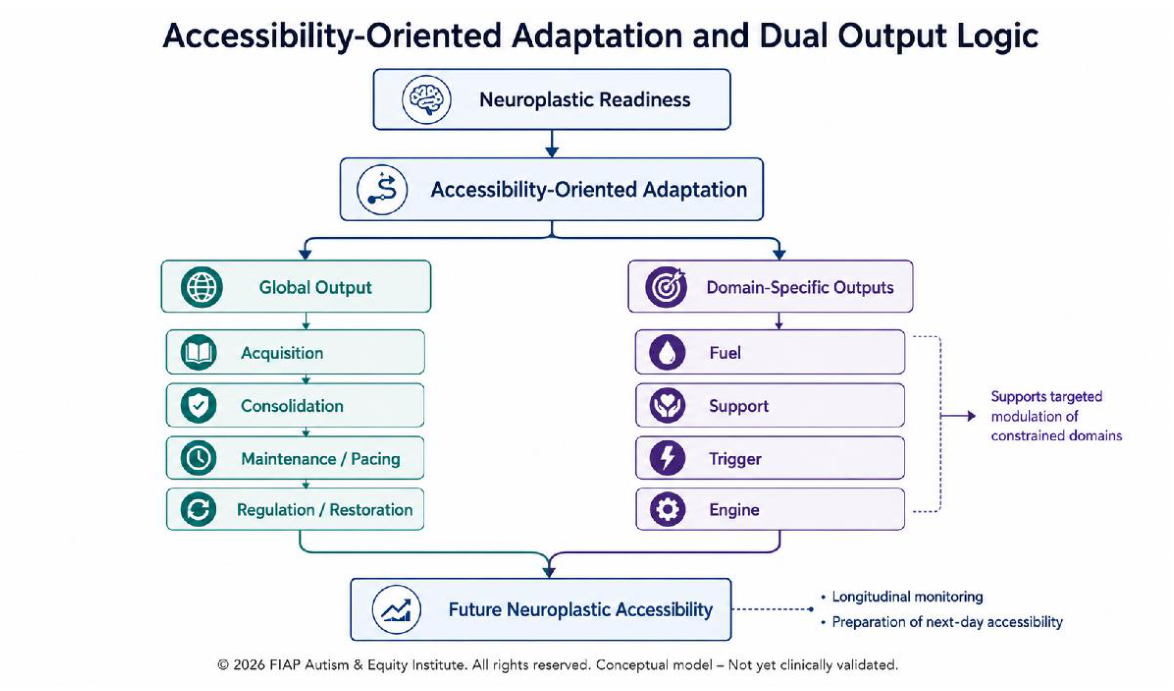
Figure 5.
Safety-aware reorientation and governance safeguards in NAI-Digital. Legend. This figure summarizes the safety-aware logic and governance safeguards of NAI-Digital. The framework is designed not to maximize intervention intensity, but to support research on therapeutic objective orientation while protecting wellbeing, regulation, recovery, relational safety, and future learning capacity. Safety-aware outputs should not be interpreted as service restriction, withdrawal of care, child failure, low motivation, or poor prognosis. Instead, they indicate that therapeutic demand, environmental load, behavioral priming, or intervention timing may need to be reduced, paced, or redirected. The figure also highlights required safeguards: human supervision, caregiver and autistic stakeholder input, privacy protection, data minimization, uncertainty communication, training, avoidance of deterministic output language, and explicit safeguards against clinical overinterpretation or service denial.
Figure 5.
Safety-aware reorientation and governance safeguards in NAI-Digital. Legend. This figure summarizes the safety-aware logic and governance safeguards of NAI-Digital. The framework is designed not to maximize intervention intensity, but to support research on therapeutic objective orientation while protecting wellbeing, regulation, recovery, relational safety, and future learning capacity. Safety-aware outputs should not be interpreted as service restriction, withdrawal of care, child failure, low motivation, or poor prognosis. Instead, they indicate that therapeutic demand, environmental load, behavioral priming, or intervention timing may need to be reduced, paced, or redirected. The figure also highlights required safeguards: human supervision, caregiver and autistic stakeholder input, privacy protection, data minimization, uncertainty communication, training, avoidance of deterministic output language, and explicit safeguards against clinical overinterpretation or service denial.
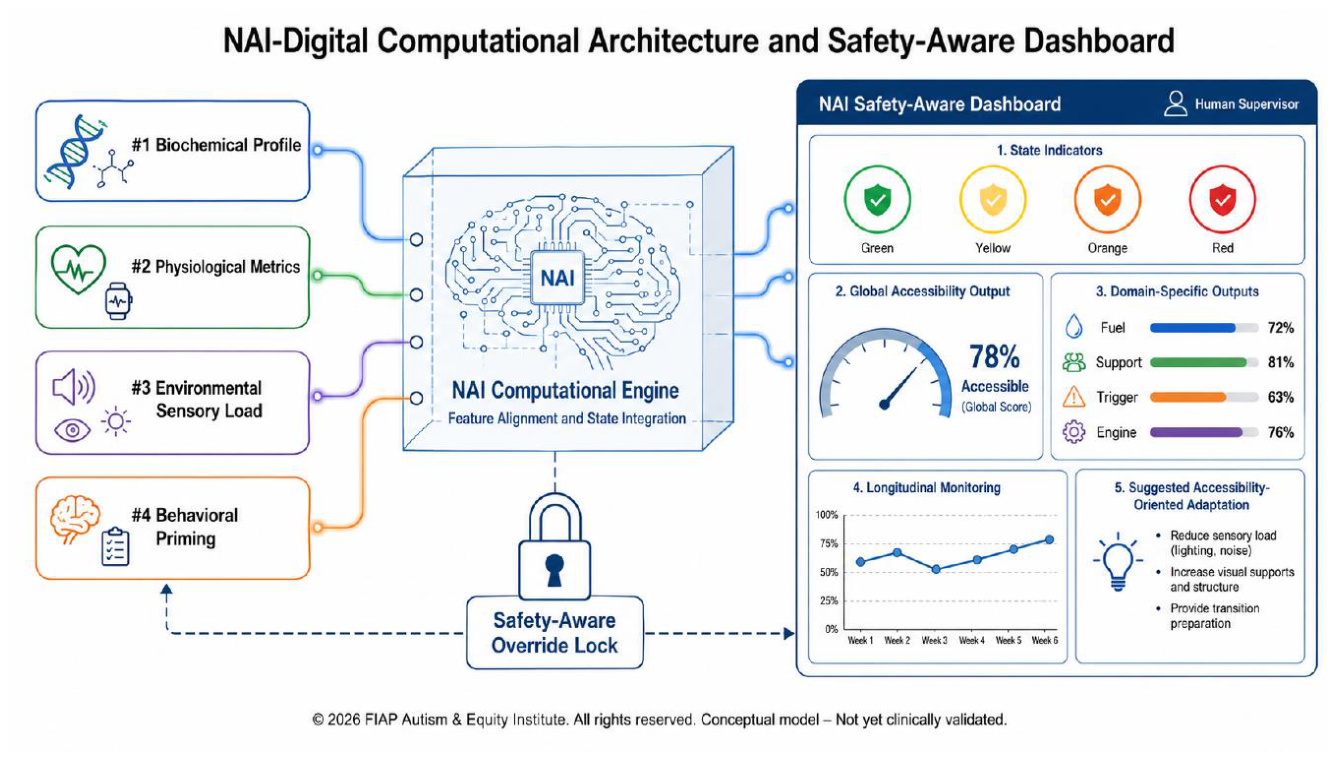
Disclaimer/Publisher’s Note: The statements, opinions and data contained in all publications are solely those of the individual author(s) and contributor(s) and not of MDPI and/or the editor(s). MDPI and/or the editor(s) disclaim responsibility for any injury to people or property resulting from any ideas, methods, instructions or products referred to in the content. |
© 2026 by the authors. Licensee MDPI, Basel, Switzerland. This article is an open access article distributed under the terms and conditions of the Creative Commons Attribution (CC BY) license (http://creativecommons.org/licenses/by/4.0/).
Copyright: This open access article is published under a Creative Commons CC BY 4.0 license, which permit the free download, distribution, and reuse, provided that the author and preprint are cited in any reuse.


