

Submitted:
05 July 2026
Posted:
06 July 2026
You are already at the latest version
Abstract
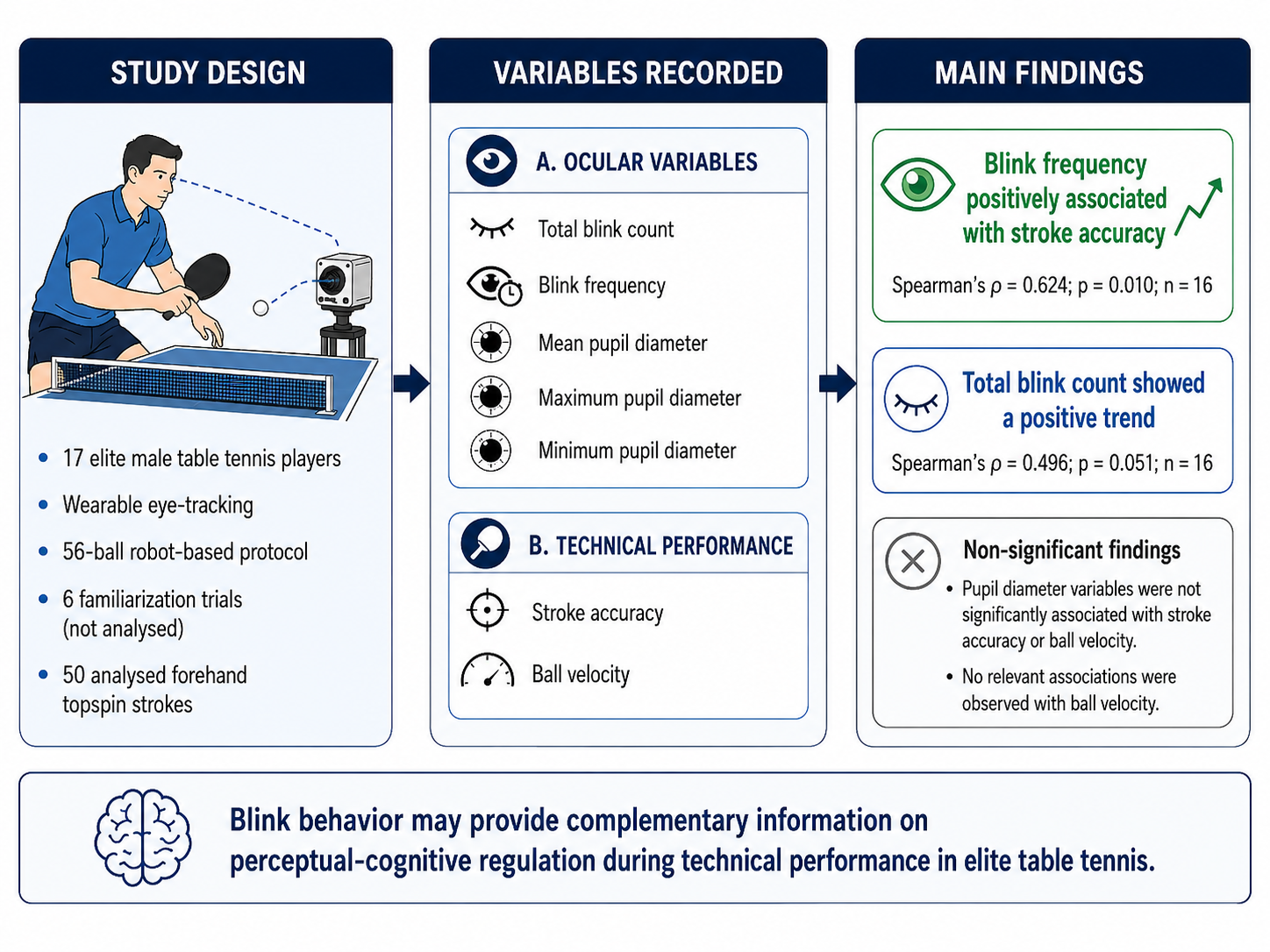
Background: Table tennis is a fast interceptive sport that requires continuous visual information processing and precise visuomotor control. Wearable eye tracking may provide objective information about ocular behaviour during sport-specific performance, although evidence on blink behaviour and pupil diameter in elite players re-mains limited. Methods: This observational cross-sectional study analysed blink-related and pupil-related variables during a standardized table tennis stroke-performance test in 17 elite male players. Participants completed a 56-ball ro-bot-based protocol, consisting of six familiarization trials followed by 50 analysed forehand topspin strokes. Ocular variables included total blink count, blink frequency, mean pupil diameter, maximum pupil diameter, and minimum pupil diameter. Technical performance outcomes were stroke accuracy and ball velocity. Results: Blink frequency was positively associated with stroke accuracy score (Spearman’s ρ = 0.624, p = 0.010), while total blink count showed a similar but weaker tendency (ρ = 0.496, p = 0.051). No significant associations were observed between blink-related variables and ball velocity. Pupil diameter variables were not significantly associated with either stroke accuracy or ball velocity. Conclusions: Blink behaviour, particularly blink frequency, may provide complementary information about perceptual-cognitive regulation during technical performance in elite table tennis. Further studies are needed to confirm these exploratory findings and analyse blink timing during the stroke sequence.
Keywords:
table tennis
; wearable eye tracking
; blink frequency
; pupil diameter
; visuomotor performance
; stroke accuracy
; perceptual-cognitive regulation
1. Introduction
Table tennis is a fast interceptive sport in which successful performance depends on the continuous integration of perceptual, cognitive, and motor processes. Players must extract relevant visual information from the opponent, the racket–ball contact, and the early ball trajectory, and transform this information into accurate motor responses within very short time windows. Therefore, technical performance in table tennis cannot be explained only by physical or biomechanical factors, but also by the efficiency with which players perceive, select, and use visual information during sport-specific actions [1,2,3].
The perceptual demands of table tennis have increased in parallel with the evolution of the modern game, which is characterised by faster rallies, higher stroke velocities, and greater tactical complexity [4]. In this context, expert players are required to anticipate future events before all relevant information is fully available. Previous research in racket and striking sports has shown that skilled athletes are generally better than less experienced players at using early visual cues, anticipating ball direction, and adapting their motor response to time-constrained situations [1,2,3]. In table tennis specifically, visual strategies involving gaze, eye, and head movements appear to be highly task-dependent and may contribute to effective ball tracking during rallies [5]. Recent evidence also suggests that table tennis players may show enhanced saccadic performance when tracking moving targets, probably as a result of extensive visuomotor experience in the sport [6].
Eye-tracking technology has become an increasingly useful tool for studying perceptual-cognitive expertise in sport. Early research mainly focused on visual search behaviour, fixation patterns, gaze location, and anticipatory cues. More recently, wearable and applied eye-tracking systems have allowed researchers to examine visual behaviour and visuocognitive performance in more representative and applied sport settings. Previous work in rhythmic gymnastics has shown that eye-tracking-derived visual variables can contribute to the assessment and modelling of sport-specific visual performance, supporting the relevance of objective oculomotor metrics in athlete evaluation [7,8]. This is especially relevant in table tennis, where laboratory-based tasks may not fully reproduce the temporal constraints and dynamic visual demands of realistic sport-specific situations. Recent studies using wearable eye tracking have begun to describe visuomotor strategies in table tennis players under naturalistic conditions, suggesting that portable systems can provide valuable information about gaze behaviour and visual processing during sport-specific actions [9].
Although most eye-tracking studies in sport have focused on gaze direction, fixations, or quiet eye duration, other ocular variables may also provide relevant information about the cognitive and attentional state of the athlete. Spontaneous blinking, for example, is not only a physiological mechanism related to ocular surface protection, but has also been associated with attention, fatigue, information processing, and task demands [10,11]. Blink behaviour may vary depending on the need to maintain visual input, the temporal structure of the task, and the cognitive resources allocated to performance. In dynamic sports such as table tennis, where relevant visual information is available only for very brief periods, blink behaviour could be particularly informative.
Pupil diameter is another ocular variable that has been widely used as a physiological marker of cognitive load, mental effort, and attentional engagement [12,13]. Increases in task difficulty or processing demands are frequently accompanied by changes in pupil size, although pupillary responses are also sensitive to illumination, emotional arousal, fatigue, and other contextual factors. For this reason, pupillometry in sport-specific settings requires careful methodological control, especially when wearable eye-tracking systems are used outside strictly controlled laboratory conditions. Nevertheless, pupil-based metrics may provide complementary information about how athletes manage perceptual and cognitive demands during technical performance tasks.
Despite growing interest in eye tracking in sport, evidence on blink behaviour and pupil diameter in elite table tennis players remains limited. Most previous research has focused on visual search strategies, gaze behaviour, anticipation, or differences between expertise levels, whereas fewer studies have examined whether ocular variables related to attention or cognitive load are associated with objective indicators of technical performance. This gap is relevant because variables such as ball velocity and stroke accuracy are commonly used to assess sport-specific performance in table tennis and may be affected by perceptual-cognitive demands, fatigue, or attentional regulation [14,15].
From a methodological perspective, studying elite athletes in sport-specific settings is particularly relevant, although it often involves limited sample sizes due to the restricted accessibility of this population. In this context, ecologically valid protocols may provide complementary information to laboratory-based assessments by capturing ocular responses during tasks that preserve the temporal and technical constraints of the sport. This balance between ecological validity and experimental control has been identified as a central challenge in sport-related eye-tracking research [16]. However, the use of pupil- and blink-related metrics in dynamic settings also requires cautious interpretation, because these variables can be influenced by task structure, lighting conditions, fatigue, signal quality, and individual variability [17]. Therefore, examining these measures during a standardized table tennis test may help to clarify their potential usefulness as complementary indicators of perceptual-cognitive demands and technical performance in elite players.
Therefore, the aim of the present study was to analyse blink behaviour and pupil diameter recorded with wearable eye-tracking technology during a sport-specific table tennis test in elite players, and to explore their association with objective indicators of technical performance, namely stroke accuracy and ball velocity. Based on previous evidence linking ocular metrics with attention, cognitive load, and visuomotor performance, we explored whether blink-related and pupil-related variables were associated with sport-specific performance outcomes during the task.
2. Materials and Methods
2.1. Study Design
This observational cross-sectional study was designed to examine the association between ocular variables recorded with wearable eye-tracking technology and sport-specific technical performance in elite table tennis players. Each participant completed a single experimental session in which ocular behaviour and technical performance were recorded simultaneously during a standardized table tennis stroke-performance test.
The ocular variables analysed were total blink count, blink frequency, mean pupil diameter, maximum pupil diameter, and minimum pupil diameter. Technical performance outcomes included stroke accuracy and ball velocity. All assessments were conducted in the table tennis hall of the High Performance Centre (Centro de Alto Rendimiento, CAR) in Madrid, Spain, under indoor conditions without exposure to natural light. To reduce the influence of external factors on ocular recordings, all participants were evaluated under similar environmental conditions and within the same time period.
2.2. Participants
Seventeen male elite table tennis players voluntarily participated in the study. All participants had international competitive experience representing their national teams and regularly competed in the highest national categories, including the Spanish Superdivision and Honor Division, as well as in international competitions. The sample included 14 senior international players, one U19 international player, and two U17 international players.
Demographic, anthropometric, and sport-related characteristics were recorded for all participants, including age, height, body mass, sport experience, and weekly training volume.
The inclusion criteria were as follows: (1) international competitive experience representing a national team; (2) regular participation in high-level national or international table tennis competitions; (3) systematic participation in table tennis training programmes; and (4) absence of injury or medical condition that could affect performance during the assessment. Players were excluded if they reported any acute musculoskeletal injury, neurological disorder, uncorrected visual condition, or other health-related limitation that could interfere with the execution of the test or with the quality of the eye-tracking recording.
All participants were free from injury at the time of testing and provided written informed consent before participation. The study was conducted in accordance with the Declaration of Helsinki and was approved by the Research Ethics Committee for Medicinal Products of Hospital Clínico San Carlos, Madrid, Spain (approval code: C.I. 23/415-E; date of approval: 28 June 2023).
2.3. Experimental Procedure
All assessments were performed individually in the table tennis hall of the CAR Madrid. Participants were evaluated in a single session and under homogeneous indoor conditions. Before testing, participants completed a standardized 10-min warm-up consisting of joint mobility exercises, low-intensity displacements, muscular activation, high-intensity displacements, and plyometric exercises. This was followed by 2 min of table-specific practice, reproducing their usual pre-competition warm-up routine.
After the warm-up, the wearable eye-tracking system was fitted to each participant and adjusted individually to ensure a stable position during the task. Before starting the experimental test, the eye-camera view was checked to confirm adequate visualization of both eyes, and the interpupillary distance was adjusted when required. According to the manufacturer, the Pupil Labs Neon system does not require a conventional calibration procedure before or during recording. Participants then completed the sport-specific table tennis performance test described below.
Each participant performed a single experimental series. The protocol consisted of 56 balls delivered by a table tennis robot. The first six balls were used as familiarization trials and were not included in the main analysis. These familiarization trials were identified in the eye-tracking recordings as the initial practice phase. The remaining 50 forehand topspin strokes constituted the analysed test phase and were used for the extraction of ocular and technical performance variables.
To reduce the influence of potential modulators of ocular activity, participants were instructed to avoid caffeine intake for at least 2 h before testing. All recordings were obtained in an indoor facility without natural light exposure, and testing was performed within the same time period to minimise the possible effects of circadian variation and lighting conditions on pupil-related measures.
Figure 1 illustrates the experimental set-up used during the table tennis-specific performance test, including the player’s position, the wearable eye-tracking system, and the robot-based ball delivery configuration.
To facilitate interpretation of the experimental workflow, Figure 2 provides an overview of the complete procedure, from participant eligibility screening and standardized warm-up to simultaneous ocular and technical performance recording, data processing, and statistical analysis.
2.4. Eye-Tracking Assessment
Ocular variables were recorded using a wearable eye-tracking system (Pupil Labs Neon, Pupil Labs GmbH, Berlin, Germany). According to the manufacturer’s technical specifications, the system supports binocular and monocular eye tracking and provides 2D gaze data at 200 Hz, infrared eye video at 200 Hz, RGB scene video at 30 Hz, pupillometry data and eye state at 200 Hz, as well as eye position, eye orientation, pupil diameter, fixation data, and blink data. The device is designed as a calibration-free system and therefore does not require a conventional calibration procedure before or during recording.
In addition, the device includes inertial sensors, such as gyroscopes and accelerometers, which allow head-motion data to be recorded. Inertial sensor data were not included in the main analysis of the present study.
The eye tracker was fitted before the experimental test and adjusted individually for each participant. Before each recording, the eye-camera view was checked to confirm adequate visualization of both eyes and stable positioning of the device. Recordings were managed in real time using the Neon Companion app and processed post hoc using Pupil Cloud, according to the manufacturer’s software environment. During data extraction, the exported recordings were reviewed to ensure that the variables required for the analysis were available for the 50 analysed forehand topspin strokes. The ocular variables extracted for the present analysis were total blink count, blink frequency, mean pupil diameter, maximum pupil diameter, and minimum pupil diameter. Blink frequency was expressed as blinks·min−1. Pupil diameter metrics were extracted from the binocular eye-tracking recordings for statistical analysis.
2.5. Sport-Specific Technical Performance Test
Technical performance was assessed using a modified version of the table tennis stroke-performance test described by Le Mansec et al. [15]. The test was performed on a Butterfly Octet 25+ table (Butterfly, Tokyo, Japan) using a NARAQ RoboPing Halo Pro table tennis robot (Future Mind, China). The robot delivered 56 backspin balls at a velocity of 35 km·h−1 and a frequency of one ball every 3 s. The first six balls were used as familiarization trials and were excluded from the analysis. Therefore, a total of 50 valid forehand topspin strokes were analysed for each participant.
The spatial arrangement of the players, the target zones, and the general configuration of the test followed the protocol described by Le Mansec et al. [15], with the adaptations required for the present experimental setting. Participants were instructed to perform forehand topspin strokes and to direct the ball towards the established target area.
Ball velocity was recorded using a Stalker Pro IIs radar gun (Applied Concepts Inc., USA), configured with a sampling frequency of 50 Hz and an accuracy of ±0.041 m·s−1. The radar was positioned 1 m behind the table, aligned with the longitudinal axis of the robot, and at a height of 113 cm. Mean ball velocity was calculated from the 50 analysed strokes.
Stroke accuracy was assessed using the scoring system proposed by Le Mansec et al. [15]. Each stroke received two points when the ball landed within the target area, one point when the ball landed on the table outside the target area, and zero points when the ball did not land on the playing surface. The total accuracy score was calculated as the sum of the 50 analysed strokes, with higher scores indicating better stroke accuracy.
2.6. Statistical Analysis
Statistical analyses were performed using Python 3.13. Descriptive statistics were calculated using the pandas library, correlation analyses were conducted using the SciPy library, and figures were generated using Matplotlib. Continuous variables are presented as mean ± standard deviation when normally distributed, and as median and interquartile range when normality assumptions were not met. The normality of the data distribution was assessed using the Shapiro–Wilk test and visual inspection of histograms and Q–Q plots.
Analyses were conducted using the maximum number of valid observations available for each variable. Missing eye-tracking values were not imputed because of the exploratory nature of the study and the small sample size.
Given the exploratory nature of the study and the limited sample size, associations between ocular variables and technical performance outcomes were examined using correlation analyses. Pearson’s correlation coefficient was used for normally distributed variables, whereas Spearman’s rank correlation coefficient was used when normality assumptions were not met or when variables showed evident non-linear or ordinal characteristics. Correlation coefficients were interpreted according to their magnitude and direction.
The main associations of interest were those between blink-related variables and performance outcomes, and between pupil-related variables and performance outcomes. Technical performance outcomes were stroke accuracy and mean ball velocity. Statistical significance was set at p < 0.05. Due to the exploratory nature of the study and the small sample size, emphasis was placed on the magnitude and direction of the associations rather than solely on p-values. The potential risk of type I error due to multiple correlations was considered when interpreting the results.
No formal adjustment for multiple comparisons was applied because of the exploratory nature of the study; therefore, p-values should be interpreted as descriptive indicators rather than confirmatory evidence.
3. Results
The descriptive characteristics of the participants are presented in Table 1. Technical performance data were available for all 17 participants included in the study. In the analysed post-familiarization test phase, valid blink-related eye-tracking data were available for 16 participants, whereas pupil diameter data were available for 15 participants. Therefore, descriptive and correlational analyses were performed using the maximum number of valid observations available for each variable.
3.1. Participant Characteristics
The participants had a mean age of 20.34 ± 3.86 years, height of 177.91 ± 3.79 cm, body mass of 69.97 ± 8.12 kg, sport experience of 11.36 ± 4.37 years, and weekly training volume of 21.91 ± 3.83 h·week−1.
3.2. Descriptive Analysis of Ocular and Technical Performance Variables
During the analysed test phase, participants achieved a mean stroke accuracy score of 80.47 ± 3.04 points, with scores ranging from 75 to 86 points. Mean ball velocity was 48.83 ± 3.79 km·h−1, ranging from 42.59 to 55.33 km·h−1.
Regarding blink-related variables, the mean total blink count was 50.56 ± 36.53 blinks during the analysed test phase, whereas mean blink frequency was 16.79 ± 11.57 blinks·min−1. Mean pupil diameter was 4.71 ± 0.45 mm. The mean maximum pupil diameter was 5.77 ± 0.57 mm, and the mean minimum pupil diameter was 1.60 ± 0.14 mm. A complete summary of ocular and technical performance variables is provided in Table 2.
3.3. Associations Between Ocular Variables and Technical Performance
Correlation analyses between ocular variables and technical performance outcomes are presented in Table 3. Blink frequency showed a positive association with stroke accuracy score (ρ = 0.624, p = 0.010). Total blink count also showed a positive association with stroke accuracy, although this association was at the threshold of statistical significance (ρ = 0.496, p = 0.051). No significant associations were observed between blink-related variables and ball velocity.
Pupil-related variables were not significantly associated with either stroke accuracy or ball velocity. Mean pupil diameter showed no relevant association with stroke accuracy (r = −0.130, p = 0.645) or ball velocity (r = 0.060, p = 0.832). Similarly, maximum and minimum pupil diameter were not significantly related to either of the technical performance outcomes.
The relationship between blink-related variables and stroke accuracy score is shown in Figure 3. Both total blink count and blink frequency showed positive associations with stroke accuracy, although the association was statistically significant only for blink frequency. This pattern suggests that players with a higher blink rate during the analysed test phase tended to achieve higher accuracy scores.
The relationship between mean pupil diameter and stroke accuracy score is shown in Figure 4. In contrast to blink frequency, mean pupil diameter was not significantly associated with stroke accuracy (Pearson’s r = −0.130, p = 0.645; n = 15). The scatterplot did not show a clear linear trend, supporting the absence of a relevant relationship between pupil diameter and accuracy performance during the analysed test phase.
Supplementary Figure S1 shows scatterplots of mean, maximum, and minimum pupil diameter in relation to stroke accuracy and ball velocity, supporting the absence of clear visual trends.
Overall, the results indicate that blink-related variables, particularly blink frequency, were positively associated with stroke accuracy during the sport-specific table tennis task. In contrast, pupil diameter variables did not show significant associations with either stroke accuracy or ball velocity. No relevant associations were observed between ocular variables and ball velocity.
4. Discussion
The present study analysed blink behaviour and pupil diameter recorded with wearable eye-tracking technology during a sport-specific table tennis test in elite players. The main finding was that blink frequency was positively associated with stroke accuracy, whereas total blink count showed a similar positive tendency that was close to statistical significance. In contrast, pupil diameter variables were not significantly associated with either stroke accuracy or ball velocity. Overall, the results point to blink frequency as the ocular variable most closely related to accuracy in this specific task. By contrast, the global pupil diameter measures used here did not seem to capture meaningful differences in technical performance.
The positive association between blink frequency and stroke accuracy is noteworthy because table tennis requires continuous processing of rapidly changing visual information and precise visuomotor coordination. Although blinks are traditionally considered from a physiological perspective, mainly in relation to ocular surface protection, increasing evidence suggests that spontaneous blinking is also modulated by attention, cognitive state, and task demands [10,11,18,21,22,23]. In visually demanding tasks, blinks do not occur randomly; rather, they tend to be temporally organized around moments of lower information demand or brief attentional transitions [21,22,23]. From this perspective, the higher blink frequency observed in more accurate players may not necessarily reflect distraction or reduced attention. Instead, it could indicate a more efficient temporal regulation of blinking, allowing players to preserve visual input during the most relevant phases of the stroke while blinking during less critical moments of the task.
This interpretation is consistent with previous evidence showing that blinking behaviour can adapt rapidly to environmental and task demands [23]. In fast interceptive sports such as table tennis, the timing of visual information is crucial. Players must extract information from the ball trajectory, adjust body position, and execute the stroke within a very short temporal window. Therefore, a higher blink rate during the overall analysed phase could reflect a more flexible visual sampling strategy rather than a lower level of engagement. However, the present study did not analyse blink timing in relation to specific ball-flight or stroke phases. For this reason, this explanation should be considered exploratory. Future studies should examine whether more accurate players suppress blinks during ball approach and racket–ball contact, while allowing blinks during inter-stroke intervals or less visually demanding moments.
This approach would be consistent with previous experimental evidence showing that blinks are reduced when new information is expected and during active cognitive processing, and tend to occur after response execution [22].
The finding that total blink count was also positively associated with stroke accuracy, although only at the threshold of statistical significance, supports the same general pattern. Nevertheless, blink frequency may be a more appropriate variable than total blink count because it accounts for differences in the duration of valid recordings. In the present sample, the association between blink frequency and accuracy was moderate to strong and statistically significant, suggesting that blink rate may capture task-related ocular behaviour more consistently than the absolute number of blinks. This is clinically and methodologically relevant because blink frequency can be extracted from wearable eye-tracking recordings without adding extra burden to the athlete or modifying the technical test.
In contrast, blink-related variables were not associated with ball velocity. This suggests that the ocular variables analysed in the present study were more closely related to accuracy than to the speed component of performance. Stroke accuracy and ball velocity may depend on partially different determinants. Accuracy is likely to require fine visuomotor control, spatial precision, and appropriate use of visual information, whereas ball velocity may be more strongly influenced by biomechanical, coordinative, and neuromuscular factors. Previous work using table tennis-specific performance tests has shown that accuracy and speed can be affected differently by fatigue and task demands [14,15]. Therefore, the absence of an association between blink behaviour and ball velocity is not unexpected and may indicate that blink-related metrics are more informative for perceptual accuracy than for power-related technical output.
Pupil diameter variables did not show significant associations with either stroke accuracy or ball velocity. This result should be interpreted cautiously. Pupil diameter has been widely used as an indirect marker of cognitive load, mental effort, and arousal [12,13,17,19,20]. However, pupillary responses are also sensitive to multiple non-cognitive factors, including illumination, fatigue, emotional arousal, accommodation, individual variability, and signal quality [17,19,20]. Although the present study was conducted under indoor conditions without natural light exposure and within the same time period, the dynamic nature of the table tennis task may have limited the sensitivity of mean, maximum, and minimum pupil diameter as performance-related indicators.
Another possible explanation is that average pupil diameter across the whole analysed test phase may be too global to detect subtle task-related changes. In sport-specific contexts, cognitive and attentional demands fluctuate rapidly across time. Therefore, mean pupil diameter may mask short phasic changes associated with ball delivery, anticipation, stroke preparation, or recovery between strokes. More refined analyses, such as event-related pupil responses or time-locked pupillometry around the stroke sequence, may be required to determine whether pupil dynamics are informative in table tennis. The absence of significant associations in the present study should therefore not be interpreted as evidence that pupillometry is irrelevant in sport, but rather that the global pupil metrics used here were not associated with the selected performance outcomes.
The present findings also contribute to the growing interest in wearable eye tracking for the assessment of visuomotor behaviour in sport. Previous studies in table tennis have highlighted the relevance of gaze behaviour, eye movements, and visuomotor strategies in naturalistic or sport-specific conditions [5,6,9]. The current study extends this line of research by focusing on blink behaviour and pupil diameter, two ocular variables that have received less attention in table tennis than gaze location, fixation behaviour, or saccadic performance. The use of a wearable eye-tracking system allowed ocular data to be collected during a standardized stroke-performance test, preserving relevant temporal and technical features of the sport. This approach may help bridge the gap between laboratory-based visual assessments and applied sport performance evaluation.
Recent reviews have emphasized the need to move sport eye-tracking research towards more representative tasks, improved data-processing approaches, and field-based designs that preserve the constraints of real performance environments [24,25].
From an applied perspective, blink frequency may be useful as an additional variable when evaluating visual behaviour during table tennis-specific tasks. However, the findings should not be interpreted as suggesting that a higher blink frequency is universally beneficial. The functional meaning of blinking depends on task structure, timing, and context. In table tennis, the critical issue may not be the absolute number of blinks, but whether blinks occur at appropriate moments within the action sequence. Therefore, blink frequency should be interpreted alongside task timing, accuracy outcomes, and potentially other eye-tracking metrics. Coaches and sport scientists should avoid using blink rate in isolation until further evidence is available.
Several limitations should be acknowledged. The sample size was small, although this is partly explained by the difficulty of recruiting elite table tennis players with international competitive experience. In addition, the high competitive level of the sample may have produced a restricted range of technical performance scores, particularly for stroke accuracy, which could influence the magnitude and stability of the observed correlations. The inclusion of only male players also limits the generalizability of the findings to female athletes. Moreover, the cross-sectional design prevents any causal interpretation of the associations observed. Some eye-tracking data were unavailable, resulting in different sample sizes across blink-related and pupil-related analyses.
Finally, multiple correlations were performed in an exploratory framework, increasing the risk of type I error, and the study analysed global blink and pupil metrics across the test phase without examining the temporal coupling between ocular behaviour and specific phases of ball flight or stroke execution.
This cautious interpretation is especially important in sport and exercise science, where small samples and selective reporting can contribute to unstable effect-size estimates and replication concerns [26].
Future research should replicate these findings in larger samples and include female players and different competitive levels. Longitudinal or intervention studies could help determine whether blink-related variables change with training, fatigue, or perceptual-cognitive interventions. In addition, future studies should analyse blink timing and event-related pupil responses in relation to specific moments of the stroke sequence, such as ball release, ball approach, racket–ball contact, and recovery between strokes. Combining wearable eye tracking with biomechanical, physiological, and performance data may provide a more comprehensive understanding of how elite table tennis players regulate visual information during technical execution.
Methodological approaches based on dynamic areas of interest and time-resolved analysis of head-mounted eye-tracking data may be particularly useful for studying visual behaviour in complex, fast-changing sport scenes [27].
In summary, the present study shows that blink frequency, but not pupil diameter, was associated with stroke accuracy during a sport-specific table tennis task in elite players. These findings suggest that blink behaviour may provide useful complementary information about perceptual-cognitive regulation during technical performance. However, given the exploratory nature of the study and the small sample size, the results should be interpreted cautiously and confirmed in future research using larger samples and time-resolved analyses of ocular behaviour.
5. Conclusions
In elite male table tennis players, blink behaviour recorded with wearable eye-tracking technology was associated with stroke accuracy during a standardized sport-specific performance test. In particular, higher blink frequency was positively related to better accuracy scores, whereas total blink count showed a similar but weaker tendency. In contrast, pupil diameter variables were not significantly associated with stroke accuracy or ball velocity.
These findings indicate that blink-related measures, particularly blink frequency, may add useful information when analysing perceptual-cognitive aspects of technical performance in table tennis. However, the results should be interpreted cautiously due to the exploratory design, small sample size, and correlational nature of the study. Future research should examine the temporal distribution of blinks in relation to key phases of the stroke sequence and determine whether blink behaviour can be used as a reliable marker of visuomotor performance in larger and more diverse samples.
Supplementary Materials
The following supporting information can be downloaded: Figure S1. Associations between pupil diameter variables and technical performance outcomes.
Author Contributions
Conceptualization, A.C., R.B.-V. and F.J.P.-M.; methodology, A.C., R.B.-V. and F.J.P.-M.; software, A.C. and R.B.-V.; validation, A.C., R.B.-V. and F.J.P.-M.; formal analysis, A.C. and R.B.-V.; investigation, A.C., R.G.-J. and R.B.-V.; resources, R.B.-V. and F.J.P.-M.; data curation, A.C., R.G.-J. and R.B.-V.; writing—original draft preparation, A.C.; writing—review and editing, A.C., R.G.-J., R.B.-V., J.E.C.-S., M.H. and F.J.P.-M.; visualization, A.C. and F.J.P.-M.; supervision, R.B.-V. and F.J.P.-M.; project administration, R.B.-V. and F.J.P.-M. All authors have read and agreed to the published version of the manuscript.
Funding
This research received no external funding.
Institutional Review Board Statement
The study was conducted in accordance with the Declaration of Helsinki and approved by the Research Ethics Committee for Medicinal Products of Hospital Clínico San Carlos, Madrid, Spain (approval code: C.I. 23/415-E; date of approval: 28 June 2023).
Informed Consent Statement
Written informed consent was obtained from all participants involved in the study.
Data Availability Statement
The data supporting the findings of this study are available from the corresponding author upon reasonable request. The data are not publicly available due to privacy and ethical restrictions related to participant-level information.
Acknowledgments
The authors would like to thank the players who participated in the study and the staff of the High Performance Centre (CAR) in Madrid for their support during data collection.
Conflicts of Interest
The authors declare no conflicts of interest.
Abbreviations
The following abbreviations are used in this manuscript:
| CAR | High Performance Centre |
| CEIm | Research Ethics Committee for Medicinal Products |
| C.I. | Internal code |
| IQR | Interquartile range |
| RGB | Red, green, and blue |
| SD | Standard deviation |
References
- Abernethy, B. Expertise, visual search, and information pick-up in squash. Perception 1990, 19, 63–77. [Google Scholar] [CrossRef] [PubMed]
- Mann, D.T.; Williams, A.M.; Ward, P.; Janelle, C.M. Perceptual-cognitive expertise in sport: a meta-analysis. J. Sport Exerc Psychol. 2007, 29, 457–478. [Google Scholar] [CrossRef] [PubMed]
- Müller, S.; Abernethy, B. Expert anticipatory skill in striking sports: a review and a model. Res. Q. Exerc Sport. 2012, 83, 175–187. [Google Scholar] [CrossRef] [PubMed]
- Leite, J.V.; Barbieri, F.A.; Miyagi, W.; Malta, E.S.; Zagatto, A.M. Influence of Game Evolution and the Phase of Competition on Temporal Game Structure in High-Level Table Tennis Tournaments. J. Hum. Kinet. 2017, 55, 55–63. [Google Scholar] [CrossRef] [PubMed]
- Shinkai, R.; Ando, S.; Nonaka, Y.; Kizuka, T.; Ono, S. Visual Strategies for Eye and Head Movements During Table Tennis Rallies. Front Sports Act. Living 2022, 4, 897373. [Google Scholar] [CrossRef] [PubMed]
- Nakazato, R.; Aoyama, C.; Komiyama, T.; Himo, R.; Shimegi, S. Table tennis players use superior saccadic eye movements to track moving visual targets. Front Sports Act. Living 2024, 6, 1289800. [Google Scholar] [CrossRef] [PubMed]
- Bernardez-Vilaboa, R.; Povedano-Montero, F.; Trillo, J.; Ruiz-Pomeda, A.; Martínez-Florentín, G.; Cedrún-Sánchez, J. AI-Based Prediction of Visual Performance in Rhythmic Gymnasts Using Eye-Tracking Data and Decision Tree Models. Photonics 2025, 12(7), 711. [Google Scholar] [CrossRef]
- Povedano-Montero, F.J.; Bernardez-Vilaboa, R.; Trillo, J.R.; et al. Integrating Eye-Tracking and Artificial Intelligence for Quantitative Assessment of Visuocognitive Performance in Sports and Education. Photonics 2025, 12(12), 1167. [Google Scholar] [CrossRef]
- Guiseris-Santaflorentina, A.; Sanchez-Cano, A.; Orduna-Hospital, E. Wearable eye-tracking of visuomotor strategies in table tennis players of diverse expertise and cognitive function in a naturalistic environment. Hum. Mov. Sci. 2026, 103448. [Google Scholar] [CrossRef] [PubMed]
- Stern, J.A.; Boyer, D.; Schroeder, D. Blink rate: a possible measure of fatigue. Hum. Factors 1994, 36, 285–297. [Google Scholar] [CrossRef] [PubMed]
- Stern, J.A.; Walrath, L.C.; Goldstein, R. The endogenous eyeblink. Psychophysiology 1984, 21, 22–33. [Google Scholar] [CrossRef] [PubMed]
- Van Orden, K.F.; Jung, T.P.; Makeig, S. Combined eye activity measures accurately estimate changes in sustained visual task performance. Biol. Psychol. 2000, 52, 221–240. [Google Scholar] [CrossRef] [PubMed]
- Gorin, H.; Patel, J.; Qiu, Q.; Merians, A.; Adamovich, S.; Fluet, G. A Review of the Use of Gaze and Pupil Metrics to Assess Mental Workload in Gamified and Simulated Sensorimotor Tasks. Sensors 2024, 24(6), 1759. [Google Scholar] [CrossRef] [PubMed]
- Le Mansec, Y.; Pageaux, B.; Nordez, A.; Dorel, S.; Jubeau, M. Mental fatigue alters the speed and the accuracy of the ball in table tennis. J. Sports Sci. 2018, 36, 2751–2759. [Google Scholar] [CrossRef] [PubMed]
- Le Mansec, Y.; Dorel, S.; Nordez, A.; Jubeau, M. Sensitivity and Reliability of a Specific Test of Stroke Performance in Table Tennis. Int. J. Sports Physiol. Perform. 2016, 11, 678–684. [Google Scholar] [CrossRef] [PubMed]
- Kredel, R.; Vater, C.; Klostermann, A.; Hossner, E.J. Eye-Tracking Technology and the Dynamics of Natural Gaze Behavior in Sports: A Systematic Review of 40 Years of Research. Front Psychol. 2017, 8, 1845. [Google Scholar] [CrossRef] [PubMed]
- Mathôt, S.; Vilotijević, A. Methods in cognitive pupillometry: Design, preprocessing, and statistical analysis. Behav. Res. Methods 2023, 55, 3055–3077. [Google Scholar] [CrossRef] [PubMed]
- Magliacano, A.; Fiorenza, S.; Estraneo, A.; Trojano, L. Eye blink rate increases as a function of cognitive load during an auditory oddball paradigm. Neurosci. Lett. 2020, 736, 135293. [Google Scholar] [CrossRef] [PubMed]
- van der Wel, P.; van Steenbergen, H. Pupil dilation as an index of effort in cognitive control tasks: A review. Psychon. Bull. Rev. 2018, 25, 2005–2015. [Google Scholar] [CrossRef] [PubMed]
- Mathôt, S. Pupillometry: Psychology, Physiology, and Function. J. Cogn. 2018, 1, 16. [Google Scholar] [CrossRef] [PubMed]
- Nakano, T.; Kato, M.; Morito, Y.; Itoi, S.; Kitazawa, S. Blink-related momentary activation of the default mode network while viewing videos. Proc. Natl. Acad. Sci. U S A 2013, 110, 702–706. [Google Scholar] [CrossRef] [PubMed]
- Wascher, E.; Heppner, H.; Möckel, T.; Kobald, S.O.; Getzmann, S. Eye-blinks in choice response tasks uncover hidden aspects of information processing. EXCLI j. 2015, 14, 1207–1218. [Google Scholar] [CrossRef] [PubMed]
- Hoppe, D.; Helfmann, S.; Rothkopf, C.A. Humans quickly learn to blink strategically in response to environmental task demands. Proc. Natl. Acad. Sci. U S A 2018, 115, 2246–2251. [Google Scholar] [CrossRef] [PubMed]
- Kredel, R.; Hernandez, J.; Hossner, E.J.; Zahno, S. Eye-tracking technology and the dynamics of natural gaze behavior in sports: an update 2016-2022. Front Psychol. 2023, 14, 1130051. [Google Scholar] [CrossRef] [PubMed]
- Stellingwerff, T.; Burke, L.M.; Caldwell, H.G.; et al. Integrative Field-Based Health and Performance Research: A Narrative Review on Experimental Methods and Logistics to Conduct Competition and Training Camp Studies in Athletes. Sports Med. 2025, 1377–1403. [Google Scholar] [CrossRef] [PubMed]
- Mesquida, C.; Murphy, J.; Lakens, D.; Warne, J. Replication concerns in sports and exercise science: a narrative review of selected methodological issues in the field. R Soc. Open Sci. 2022, 9, 220946. [Google Scholar] [CrossRef] [PubMed]
- Tzamaras, H.M.; Wu, H.L.; Moore, J.Z.; Miller, S.R. Shifting Perspectives: A proposed framework for analyzing head-mounted eye-tracking data with dynamic areas of interest and dynamic scenes. Proc. Hum. Factors Ergon. Soc. Annu Meet. 2023, 67, 953–958. [Google Scholar] [CrossRef] [PubMed]
Figure 1.
Experimental set-up of the table tennis-specific performance test.
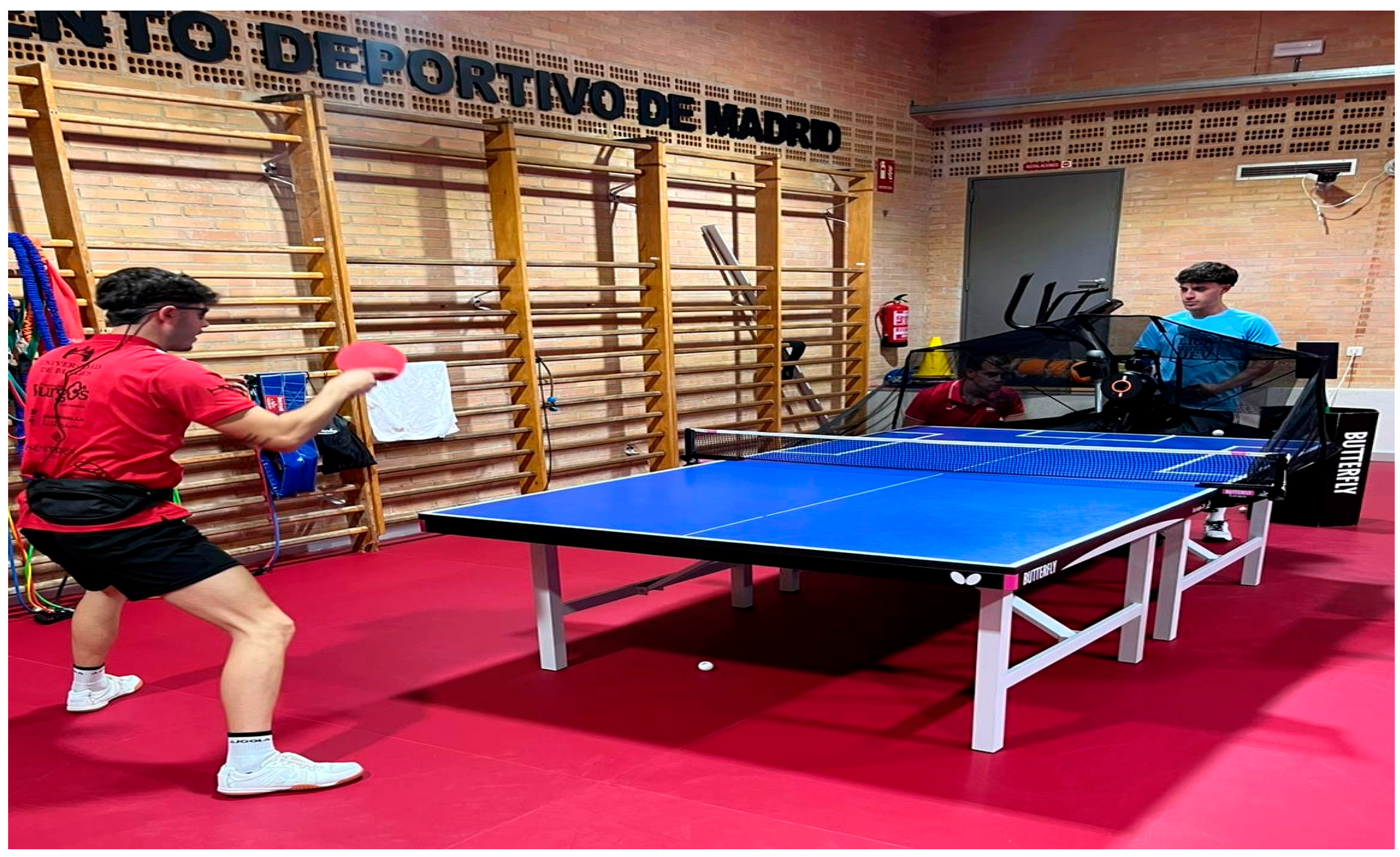
Figure 2.
Schematic overview of the experimental procedure.
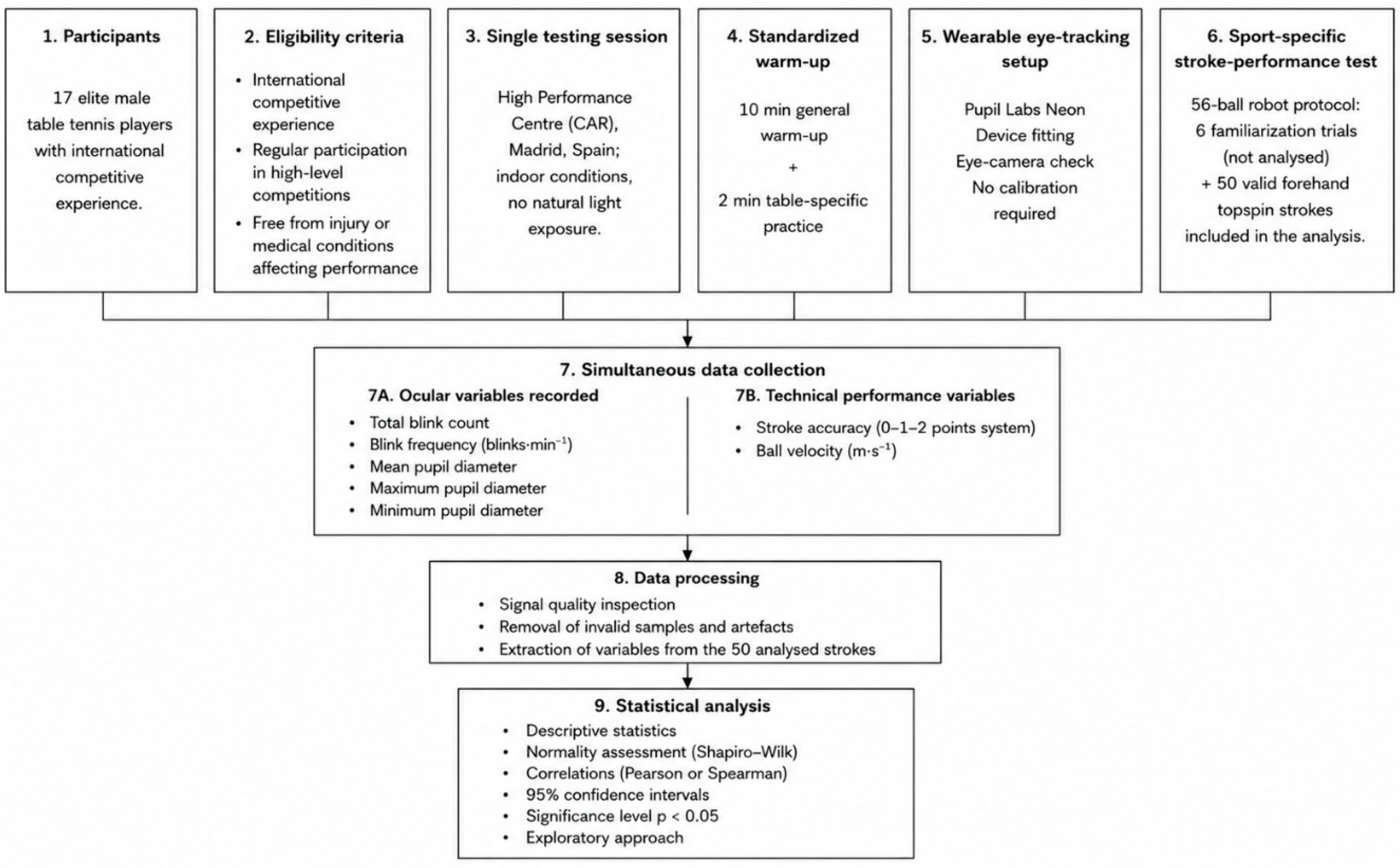
Figure 3.
Associations between blink-related variables and stroke accuracy score during the analysed test phase. (A) Total blink count. (B) Blink frequency.
Figure 3.
Associations between blink-related variables and stroke accuracy score during the analysed test phase. (A) Total blink count. (B) Blink frequency.
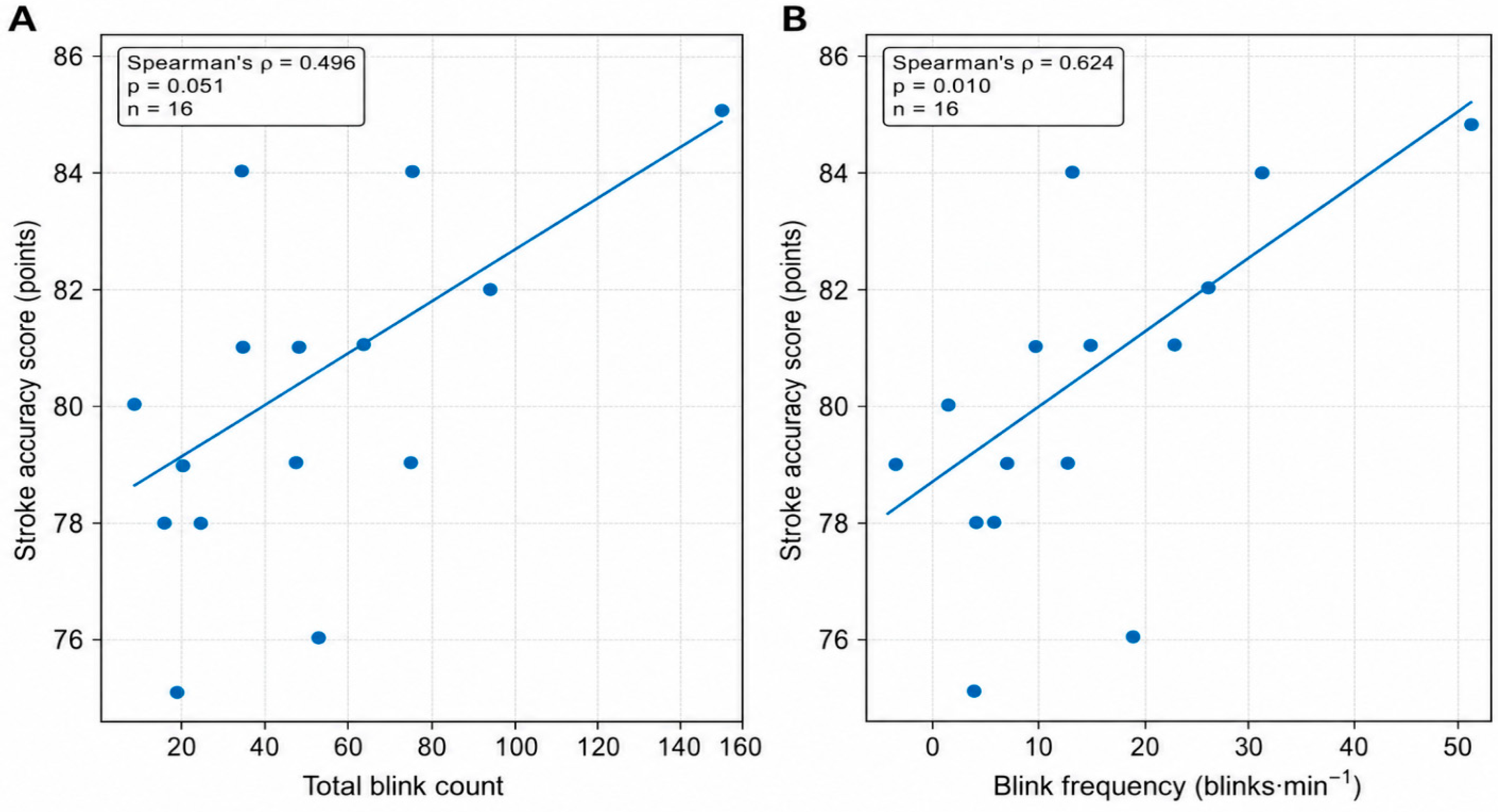
Figure 4.
Relationship between mean pupil diameter and stroke accuracy score during the analysed test phase.
Figure 4.
Relationship between mean pupil diameter and stroke accuracy score during the analysed test phase.
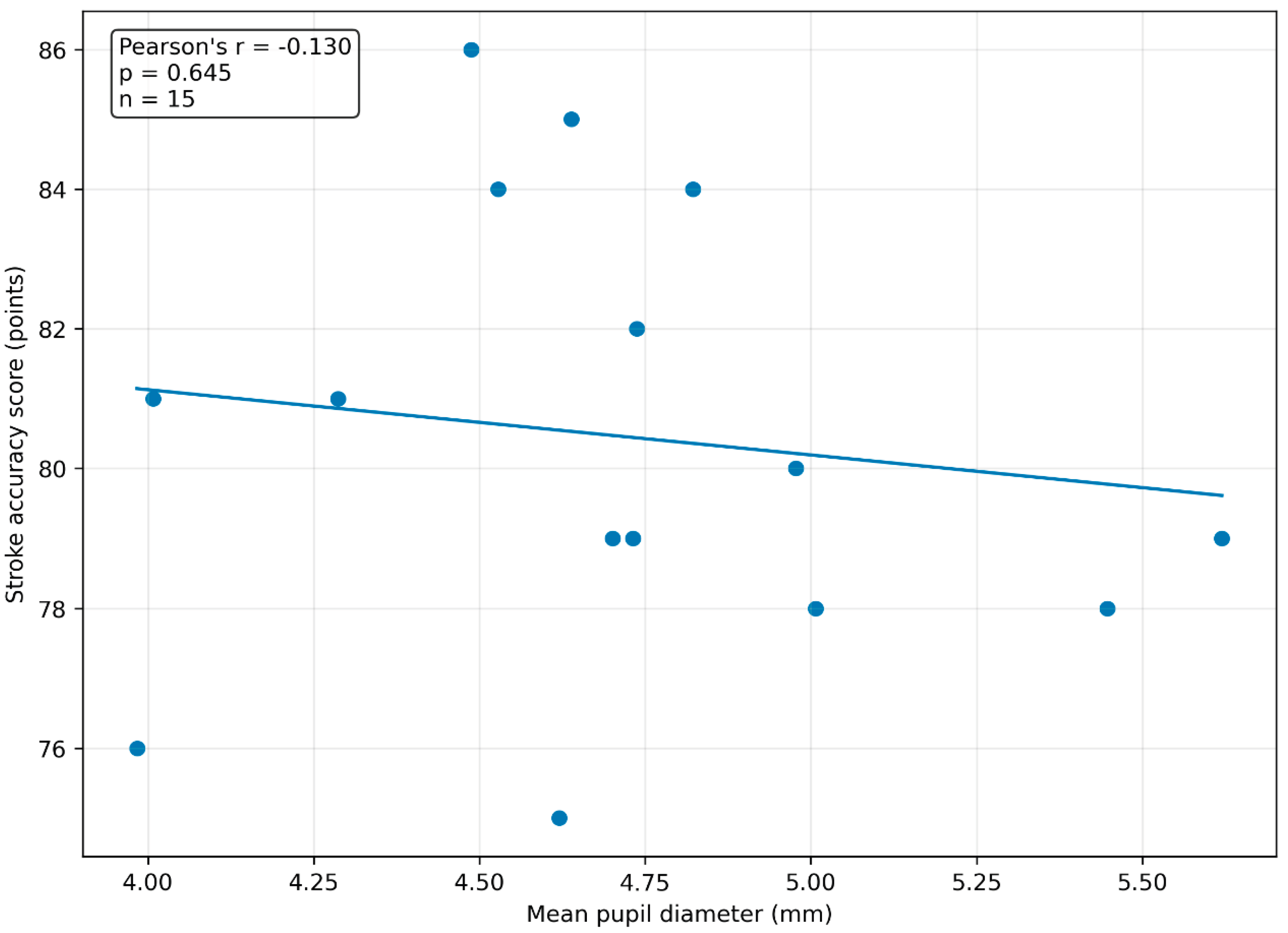

Table 1.
Descriptive characteristics of the sample.
| Variable | n | Mean ± . |
| Age, years | 17 | 20.34 ± 3.86 |
| Height, cm | 17 | 177.91 ± 3.79 |
| Body mass, kg | 17 | 69.97 ± 8.12 |
| Sport experience, years | 17 | 11.36 ± 4.37 |
| Weekly training volume, h·week−1 | 17 | 21.91 ± 3.83 |
Table 2.
Descriptive statistics of ocular and technical performance variables during the analysed test phase.
Table 2.
Descriptive statistics of ocular and technical performance variables during the analysed test phase.
| Variable | n | Mean ± SD | Median | IQR | Minimum | Maximum |
| Total blink count | 16 | 50.56 ± 36.53 | 45.00 | 43.00 | 9.00 | 154.00 |
| Blink frequency, blinks·min−1 | 16 | 16.79 ± 11.57 | 15.07 | 12.82 | 3.67 | 49.27 |
| Mean pupil diameter, mm | 15 | 4.71 ± 0.45 | 4.70 | 0.39 | 3.98 | 5.62 |
| Maximum pupil diameter, mm | 15 | 5.77 ± 0.57 | 5.57 | 0.30 | 5.24 | 7.41 |
| Minimum pupil diameter, mm | 15 | 1.60 ± 0.14 | 1.63 | 0.23 | 1.36 | 1.80 |
| Stroke accuracy score, points | 17 | 80.47 ± 3.04 | 80.00 | 3.00 | 75.00 | 86.00 |
| Ball velocity, km·h−1 | 17 | 48.83 ± 3.79 | 48.35 | 4.57 | 42.59 | 55.33 |
Table 3.
Correlations between ocular variables and technical performance outcomes.
| Ocular variable | Performance outcome | n | Test | Correlation coefficient | p-value |
| Total blink count | Stroke accuracy score | 16 | Spearman | ρ = 0.496 | 0.051 |
| Total blink count | Ball velocity | 16 | Spearman | ρ = −0.130 | 0.633 |
| Blink frequency | Stroke accuracy score | 16 | Spearman | ρ = 0.624 | 0.010 |
| Blink frequency | Ball velocity | 16 | Spearman | ρ = −0.129 | 0.633 |
| Mean pupil diameter | Stroke accuracy score | 15 | Pearson | r = −0.130 | 0.645 |
| Mean pupil diameter | Ball velocity | 15 | Pearson | r = 0.060 | 0.832 |
| Maximum pupil diameter | Stroke accuracy score | 15 | Spearman | ρ = −0.253 | 0.362 |
| Maximum pupil diameter | Ball velocity | 15 | Spearman | ρ = −0.046 | 0.869 |
| Minimum pupil diameter | Stroke accuracy score | 15 | Pearson | r = −0.138 | 0.623 |
| Minimum pupil diameter | Ball velocity | 15 | Pearson | r = 0.327 | 0.234 |
Disclaimer/Publisher’s Note: The statements, opinions and data contained in all publications are solely those of the individual author(s) and contributor(s) and not of MDPI and/or the editor(s). MDPI and/or the editor(s) disclaim responsibility for any injury to people or property resulting from any ideas, methods, instructions or products referred to in the content. |
© 2026 by the authors. Licensee MDPI, Basel, Switzerland. This article is an open access article distributed under the terms and conditions of the Creative Commons Attribution (CC BY) license (http://creativecommons.org/licenses/by/4.0/).
Copyright: This open access article is published under a Creative Commons CC BY 4.0 license, which permit the free download, distribution, and reuse, provided that the author and preprint are cited in any reuse.