

Submitted:
04 July 2026
Posted:
06 July 2026
You are already at the latest version
Abstract
Outcome-based Arabic teacher education requires graduate outcome monitoring, yet program-specific online tracing in Indonesian Islamic universities remains under-documented. This documentary case study analyzes post-enrollment digital student support and alumni engagement—not online instruction—in an Arabic Teacher Education Study Program. The 2025 Self-Evaluation Report (LED; Laporan Evaluasi Diri) was cross-validated against Independent Accreditation Institute for Education (LAMDIK) field assessment minutes and coded for tracer workflow, outcome indicators, and quality-assurance follow-up. Online graduate tracing operates through the Talian platform (talian.uir.ac.id), SMS reminders, alumni networks, and a real-time dashboard (app.uir.ac.id), linked to upstream WhatsApp-based retention monitoring. Across study-year cohorts TS-4 to TS-2 (Tahun Studi), 39 of 42 graduates (92.86%) were traced; 97.5% were employed, self-employed, or studying further; average waiting time to first employment was 4.8 months. Employer surveys flagged relative weaknesses in foreign-language and information-technology domains (58.24% and 69.23% “very good,” respectively). The LED does not report employer sample size, and domain percentages are not independently verified competence measures. Documented institutional responses, planned SMART targets (2026–2027), and unevaluated follow-up are classified separately (Table 11). The study offers a descriptive workflow model for technology-enhanced post-program monitoring in face-to-face teacher education.
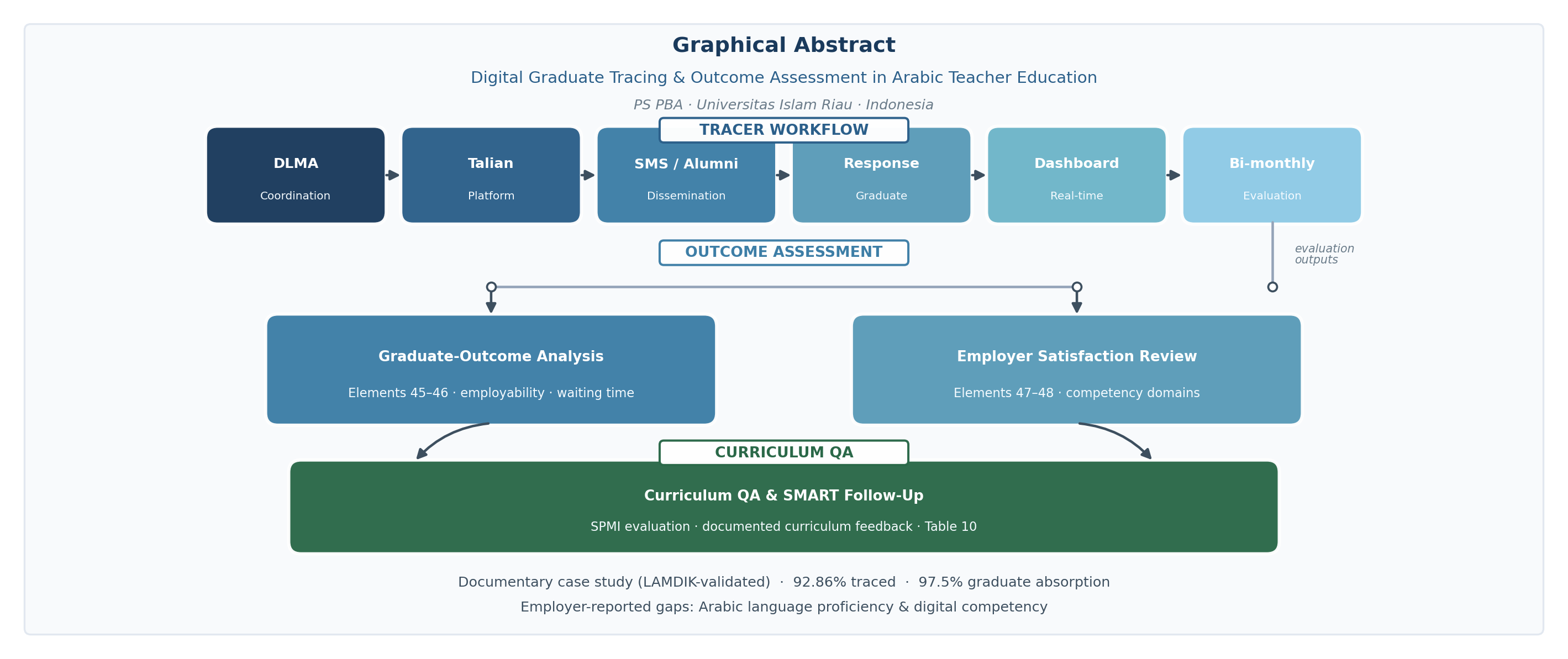
Keywords:
online graduate tracing
; graduate outcome monitoring
; graduate employability
; teacher quality
; higher education quality
; Arabic teacher education
; teaching effectiveness
; employability skills
; Indonesia
1. Introduction
Arabic teacher education in Indonesia operates at the intersection of Islamic educational traditions, national outcome-based policy, and contemporary demands for graduate employability, bilingual proficiency, and digital competence (Kamal, 2025; Muhammad & Ariani, 2020; Ritonga et al., 2021; Yuliana et al., 2026). Programs must prepare graduates as Arabic educators, entrepreneurial practitioners, and novice researchers while aligning curricula with labor-market needs in Islamic day schools (madrasah), Islamic boarding schools (pesantren), secular schools, and related service sectors (Mohamed, 2023; Vanpee & Soneson, 2019; Raswan et al., 2025). Under Indonesia’s Indonesian National Qualifications Framework (KKNI; Kerangka Kualifikasi Nasional Indonesia)-aligned accreditation regime, study programs are expected to demonstrate not only curriculum design but also verifiable graduate outcomes, stakeholder satisfaction, and documented follow-up actions that renew curriculum relevance over time (Sridharan et al., 2015; Erihadiana & Syaripudin, 2026; Putra et al., 2026).
Graduate tracer studies have become a central instrument for this accountability cycle. In Indonesia, the Ministry of Education requires universities to report graduate-tracer data annually, positioning tracer evidence as a policy input for curriculum evaluation (Abdulloh et al., 2022). Tracer studies track employment, further study, waiting time to first job, and alignment between training and workplace roles, thereby supplying curriculum feedback rather than terminal reporting alone (Harvey, 2012; Dzomeku et al., 2024). Recent scholarship on Islamic higher education emphasizes that digital quality-assurance (QA) mechanisms—dashboards, learning management systems (LMS), online surveys, and integrated academic records—can strengthen transparency, participatory improvement, and continuous monitoring of graduate performance (Yuliana et al., 2026; Lee & Mak, 2019). As institutions digitize administrative and academic services, tracer administration has shifted from paper-based alumni surveys toward online platforms integrated with institutional dashboards, SMS dissemination, and real-time reporting (Alghamdi et al., 2021; Gaebel et al., 2020). In teacher education, tracer data indicate whether graduates enter classrooms aligned with declared graduate profiles, whether waiting times to employment remain acceptable, and whether employers report competency gaps that require curricular response (Bremner et al., 2023; Kamal, 2025).
Despite this policy momentum, syntheses of recent research identify persistent gaps. Tracer studies are increasingly mandated and technically feasible, yet systematic, program-specific, and longitudinal application in Arabic teacher education—particularly within Indonesian Islamic universities—remains limited (Abdulloh et al., 2022; Kamal, 2025; Ulum et al., 2023). Graduate tracking systems are often generic university platforms rather than workflows customized to Arabic teacher education outcomes, employer validation, and curriculum renewal (Azis et al., 2018; Lee & Mak, 2019; Abdulloh et al., 2022). Kamal (2025) further notes that Arabic language curricula can lag behind contemporary labor-market and digital competence demands, underscoring the need for tracer-based feedback that connects post-graduation evidence to course revision, digitalization workshops, and SMART improvement targets. Digital QA tools show promise, but their educational value depends on institutional infrastructure, governance, regional digital readiness, and the extent to which online monitoring is linked to curriculum decision-making rather than accreditation compliance alone (Doneva et al., 2018; Jaya et al., 2024; Malik, 2015; Supardi et al., 2024).
Educational technology and institutional quality-assurance scholarship increasingly treat online alumni tracking, graduate-outcome dashboards, and SMS-mediated survey dissemination as post-enrollment student support and lifecycle monitoring services in teacher education and higher education evaluation (Azis et al., 2018; Doneva et al., 2018; Gaebel et al., 2020; Olson & Krysiak, 2021; Pannen, 2021). In technology-enhanced teacher preparation, these web-based services extend learner support beyond the campus, enabling alumni engagement, employer feedback, and curriculum renewal through platforms integrated with institutional academic records (Lee & Mak, 2019; Supardi et al., 2024). Program-level Arabic language education research has begun linking holistic assessment design to graduate-outcome indicators through goal-free evaluation (Samin et al., 2026), yet fewer studies document how post-graduation tracer workflows independently feed curriculum feedback beyond in-course assessment systems. The present study analyzes this extended support layer in a face-to-face Arabic teacher education program: online graduate tracing supplies post-program curriculum feedback through Talian, dashboard monitoring, and bi-monthly quality review—not online course effectiveness.
The Arabic Teacher Education Study Program (PS PBA; Program Studi Pendidikan Bahasa Arab), Faculty of Islamic Studies, Universitas Islam Riau (UIR; Islamic University of Riau), offers a pertinent documentary case. Established in 2017 and accredited at Good level under Indonesia’s LAMDIK (Independent Accreditation Institute for Education) framework, PS PBA maintains an outcome-based education (OBE) curriculum with 33 graduate learning outcomes across 67 courses (144 credits). Its 2025 Self-Evaluation Report (LED; Laporan Evaluasi Diri) documents a university-coordinated online tracer system, real-time graduate-outcome dashboards, employer satisfaction surveys, and institutional follow-up actions (Universitas Islam Riau, 2025). Students attend face-to-face classes supported by hybrid facilities, learning management system (LMS) tools, and integrated information systems; the analytical focus is digital alumni/outcome monitoring and internal quality assurance (SPMI; Sistem Penjaminan Mutu Internal, internal quality assurance system) follow-up—not classroom teaching methods or rubric enactment.
This study addresses four research questions:
RQ1. How is the online graduate-tracing system documented in design, governance, and operational workflow?
RQ2. What tracer coverage and graduate-outcome indicators are reported for recent cohorts (TS-4 to TS-2)?
RQ3. How are tracer and employer-survey results linked to documented quality-assurance and curriculum-improvement actions—and what remains planned rather than verified?
RQ4. What weaknesses and SMART follow-up plans does the LED identify for tracer coverage and graduate digital competency?
Empirically, the study responds to the under-documented need for program-specific graduate tracking in Arabic teacher education by analyzing tracer-based curriculum feedback linking graduate outcomes to OBE improvement cycles. Theoretically, it connects alumni-tracking and digital QA literature with curriculum evaluation and internal quality assurance (SPMI) in Islamic higher education contexts (Nasrallah, 2014; Yuliana et al., 2026). Practically, it offers a replicable technology-mediated model for programs seeking to use online tracer data for curriculum decisions without claiming causal effects of SMS reminders, dashboard visibility, or tracer participation on employment outcomes.
The paper proceeds as follows: Section 2 synthesizes prior scholarship on tracer studies, digital quality assurance, and Arabic teacher education; Section 3 describes the documentary design and analysis; Section 4 presents findings on tracer workflow, graduate outcomes, and linked digital student support services; Section 5 interprets implications for graduate-outcome monitoring, curriculum renewal, and institutional quality assurance in teacher education; and Section 6 offers recommendations and states limitations.
2. Literature Review
2.1. Graduate Tracer Studies, Online Alumni Tracking, and Post-Enrollment Support
Tracer studies track graduates’ employment status, further study, waiting time to first job, and alignment between training and workplace roles (Harvey, 2012). In outcome-based systems, tracer evidence feeds curriculum evaluation and accreditation review (Alghamdi et al., 2021; Sridharan et al., 2015). Digital tracer administration reduces cost, accelerates aggregation, and enables real-time monitoring through dedicated survey platforms, automated reminders, alumni social networks, and dashboards (Gaebel et al., 2020; Alghamdi et al., 2021). Lee and Mak (2019) and Azis et al. (2018) illustrate how web-based academic records and mobile-accessible alumni systems support institutional outreach even when programs remain face-to-face—a function increasingly relevant as Indonesian universities digitize graduate tracking under KKNI-aligned accreditation (Abdulloh et al., 2022). Research emphasizes governance—who coordinates dissemination, who acts as surveyor, and how frequently results are reviewed—as a determinant of response rates (Gaebel et al., 2020).
In teacher education, tracer outputs indicate whether graduates enter classrooms aligned with declared profiles and whether employers report competency gaps requiring curricular response (Bremner et al., 2023; Kamal, 2025; Maujud & Syaharuddin, 2025). Despite policy mandates, tracer implementation in Arabic teacher education remains uneven (Abdulloh et al., 2022; Ulum et al., 2023). The present gap is program-specific online graduate tracing linked to documented QA follow-up in Indonesian Islamic Arabic teacher education (Sapawi & Yusoff, 2025; Yuliana et al., 2026).
2.2. Digital Infrastructure and Information Technology in Quality Assurance
The educational impact of online tracer and dashboard systems is mediated by national digital readiness. Jaya et al. (2024) and Supardi et al. (2024) show uneven digital infrastructure across Indonesian regions, suggesting that technology-mediated QA may produce uneven post-program monitoring capacity unless institutions invest in bandwidth, single sign-on (SSO) databases, and staff digital literacy. Pannen (2021) documents how Indonesia’s Cyber Education Institute scaled online QA for distance learning, demonstrating that national digital governance frameworks can complement program-level tracer systems even when the program under study remains face-to-face.
Information technologies in higher education QA extend beyond LMS instruction to evaluation portals, employer satisfaction systems, and performance dashboards (Doneva et al., 2018; Olson & Krysiak, 2021; Toprak & Sakar, 2020). Yuliana et al. (2026) report that digital mechanisms support participatory improvement in Islamic higher education, although evaluations of their educational impact remain limited. For teacher education, when employer surveys identify competency gaps—particularly in information technology and foreign languages—institutions may schedule digitalization workshops or revise supporting courses (Kamal, 2025; Universitas Islam Riau, 2025). Documentary case studies can describe these linkages without inferring that digital tools alone produce competency gains (Malik, 2015; Pannen, 2021).
2.3. Arabic Teacher Education and Graduate Profiles
Arabic teacher education programs articulate graduate profiles spanning pedagogical Arabic competence, Islamic ethical formation, entrepreneurial skills, and research readiness (Mohamed, 2023; Kamal, 2025). Employer-rated competency domains—ethics, disciplinary expertise, Arabic proficiency, information technology, communication, teamwork, self-development, critical thinking, and creativity—provide external validation of graduate performance (Vanpee & Soneson, 2019; Maujud & Syaharuddin, 2025). Relative weakness in technology and foreign-language ratings may signal misalignment between hybrid learning opportunities during study and workplace expectations (Sauri & Sanusi, 2024; Saad et al., 2025). The present case study addresses the documented gap through analysis of PS PBA’s LED and field-assessment evidence on online tracer workflow and QA follow-up.
2.4. Conceptual Framework
Figure 1 summarizes the documentary framework applied in this study. Digital IT infrastructure (Element 28) enables online tracer administration (Element 41) and dashboard monitoring. Tracer outputs feed graduate-outcome analysis (Elements 45–46) and employer satisfaction review (Elements 47–48). Results enter SPMI curriculum evaluation and SMART improvement planning (Table 10). The framework treats online tracing as a post-enrollment digital support service within a predominantly face-to-face program; arrows represent documented QA pathways, not verified causal effects on curriculum change.
3. Materials and Methods
3.1. Research Design
This study employed a documentary embedded case study design (Yin, 2018). The case unit was PS PBA at UIR, a private Islamic university program in Arabic teacher education. The study did not collect primary data through interviews, classroom observation, or experimental intervention. Instead, it analyzed secondary institutional documents and aggregated outcome statistics produced for LAMDIK accreditation.
The analytic stance is descriptive and documentary: the study reports how online graduate tracing is specified, operationalized, and linked to QA follow-up in LED evidence—not whether the tracer system causally improved employment or digital competency. This distinction is essential because the program under study delivers face-to-face instruction; online technologies function here as monitoring and dissemination tools rather than as primary instructional delivery modes (Malik, 2015; Toprak & Sakar, 2020).
3.2. Data Sources
Data were drawn from the 2025 Self-Evaluation Report (LED), independent LAMDIK Field Assessment Minutes (Berita Acara Asesmen Lapangan, field assessment minutes; panel code 101006-882040-DD-AL, 19 December 2025), and referenced supporting evidence (Table 1). Element-specific sections on information technology (Element 28), tracer study (Element 41), employability (Element 45), waiting time (Element 46), job-field alignment and employer satisfaction (Elements 47–48), and education evaluation follow-up (Table 23) constituted the primary corpus. Where the LED cited dashboard records (app.uir.ac.id), tracer platform URLs (talian.uir.ac.id), and monitoring systems (siquis.uir.ac.id), these were treated as documented components of the digital QA ecosystem.

Table 1.
Documentary Data Sources.
| Source | LED Element(s) | Data Type | Analytical Function |
| Self-Evaluation Report (Universitas Islam Riau, 2025) | 28, 41, 45–48 | Institutional self-evaluation | Core documentary source |
| Field Assessment Minutes (LAMDIK, 2025) | 28, 41, 45–48, 65 | External assessor validation | Cross-validation of LED tracer and outcome claims |
| Tracer study reports (cited in LED) | 41, 45–46 | Aggregated graduate outcomes | Coverage, employability, waiting time |
| Employer/user satisfaction surveys | 47–48 | Stakeholder ratings | External competency validation |
| IT infrastructure documentation | 28 | Infrastructure narrative | Enabling conditions for online tracing |
| Education evaluation follow-up table | Table 23 | SMART improvement plan | Documented weaknesses and targets |
| app.uir.ac.id dashboard records (cited) | 43–44 | Academic progress aggregates | Triangulation with tracer cohorts |
Note. LED = Laporan Evaluasi Diri (Self-Evaluation Report). LAMDIK = Independent Accreditation Institute for Education. PS PBA = Program Studi Pendidikan Bahasa Arab (Arabic Teacher Education Study Program). SPMI = Sistem Penjaminan Mutu Internal (internal quality assurance system). KKNI = Kerangka Kualifikasi Nasional Indonesia (Indonesian National Qualifications Framework). All sources are secondary institutional documents prepared for or verified during LAMDIK accreditation review.
Table 2.
LAMDIK Field Assessment Cross-Validation of Tracer and Outcome Claims.
| Element | Domain | LED Claim (summary) | Field Assessment Verification |
| 28 | IT infrastructure | 78 integrated systems; SSO; 2 Gbps; Talian and dashboard URLs documented | IT infrastructure supporting academic and alumni services confirmed |
| 41 | Tracer study | Online Talian platform; Directorate of Student and Alumni Services (DLMA) coordination; SMS dissemination; bi-monthly review; LED instrument description limited | Tracer implementation very good; instruments confirmed aligned with national core tracer questions (field assessment) |
| 45–46 | Graduate outcomes | 92.86% coverage; 97.5% post-graduation activity; 4.8-month average waiting time | Graduate outcome indicators valid and authentic |
| 47–48 | Employer satisfaction | Nine-domain partner-institution surveys; foreign language and IT lowest | Employer satisfaction data valid and authentic; monitoring structure needs strengthening |
| 65 | QA follow-up | Periodic monitoring and SMART planning reported | Evaluation and follow-up documented; effectiveness not yet evaluated |
Note. Synthesized from Universitas Islam Riau (2025) cross-validated against LAMDIK Field Assessment Minutes (LAMDIK, 2025). DLMA = Directorate of Student and Alumni Services. SIMFOKOM = Bureau of Information and Computing Systems. PPEPP = quality-assurance cycle (Perencanaan, Pelaksanaan, Evaluasi, Pengendalian, Peninjauan).
Table 3.
Documented Tracer Study and Employer Survey Methodology.
| Component | Specification |
| Reference period | Academic years TS-4 through TS-2 (2022/2023–2024/2025 reporting cycle) |
| Tracer instrument | Online questionnaire via UIR Talian system; national core questions (Element 41) |
| Tracer dissemination | SMS reminders (three waves, including two monthly reminders) and study-program alumni group networks |
| Tracer coverage | 39 traced of 42 eligible graduates (92.86%) |
| Employer respondents | Partner institutions (Islamic day schools [madrasah], Islamic boarding schools [pesantren], and related employers); institution count not reported in LED |
| Employer instrument | Nine competency dimensions rated on institutional satisfaction scales (Elements 47–48) |
| Employer reporting | Percentage rated “very good” and “good” by domain |
| Documented limitation | Employer institution denominator unavailable; percentages read as stakeholder perceptions, not independent competence measures |
Note. Synthesized from Universitas Islam Riau (2025), Elements 41 and 47–48. TS = Tahun Studi (study year). PPG = Program Pendidikan Profesi Guru (professional teacher certification program). CPL = Capaian Pembelajaran Lulusan (graduate learning outcomes).
3.3. Analysis Procedure
Analysis proceeded in six steps. First, document extraction: LED sections were coded for tracer workflow components (platform, dissemination, monitoring, reporting, follow-up). Second, LAMDIK cross-validation: LED claims for Elements 28, 41, 45–48, and 65 were compared with independent field assessor judgments (Table 2). Third, descriptive quantification: reported percentages for tracer coverage, post-graduation activities, waiting time, and employer satisfaction were tabulated without re-analysis of raw microdata unavailable in the manuscript corpus. Fourth, process mapping: the Talian-to-dashboard workflow was reconstructed as a sequential model (Figure 2). Fifth, follow-up classification: institutional responses were categorized as documented actions, planned SMART targets, or unevaluated processes (Table 11). Sixth, triangulation: tracer statistics were compared with adjacent LED indicators (on-time graduation, study success) drawn from the same dashboard ecosystem to assess internal consistency of the documented digital QA environment.
LED narrative sections, tracer workflow descriptions, employer-survey summaries, SMART follow-up tables, and cited dashboard records were coded using predefined categories and decision rules (Table S1, Supplementary Materials). Illustrative coded excerpts appear in Table S2 (Supplementary Materials). The primary coder applied the protocol to all Element 28, 41, and 45–48 sections plus education evaluation Table 22 and Table 23. A second coder independently verified a 20% random sample of coded excerpts; discrepancies were resolved through discussion and referral to LAMDIK field assessment minutes. No inter-rater statistics were computed because the study prioritizes transparent documentary interpretation over psychometric coding reliability. Full coding tables are provided in the Supplementary Materials.
3.4. Validity, Positionality, and Research Ethics
Interpretive confidence rests on the LED’s accreditation function, cited supporting documents, and LAMDIK field assessor corroboration of tracer and outcome authenticity (Table 2). The LED itself acknowledges imperfections—tracer coverage below 100%, unstructured employer monitoring, lowest satisfaction in foreign-language and IT domains, and unevaluated follow-up effectiveness—supporting academic objectivity rather than solely promotional reporting. Limitations are detailed in the Limitations section.
Because the study uses aggregated institutional documents rather than primary interaction with individual alumni or employers, no personal identifiers were collected or reported. Documentary analysis of accreditation materials is consistent with ethical research using secondary administrative data when findings are reported at aggregate level. The author is affiliated with the institution studied; confirmability was addressed through LAMDIK cross-validation, coding verification, and reflexive acknowledgment of potential institutional advocacy in self-evaluation reporting.
3.5. Use of Generative AI
During manuscript preparation, the author used generative AI tools within Cursor (an AI-assisted integrated development environment) for the following purposes: drafting and revising English-language prose; organizing and synthesizing literature for the Introduction and Discussion; proposing structural edits to align Results and Discussion with RQ1–RQ4; assisting Python-based layout of Figure 1 and Figure 2 and the graphical abstract; and formatting the manuscript for journal submission. Documentary coding of LAMDIK-verified accreditation materials, categorization of follow-up actions (Table 11), tabulation of reported statistics, and all substantive interpretive decisions were performed by the author. Each institutional statistic, workflow claim, and citation was verified by the author against the Self-Evaluation Report (Universitas Islam Riau, 2025) and LAMDIK Field Assessment Minutes (2025). No generative AI tool was used to generate, simulate, or alter institutional data, employer-survey results, or accreditation findings reported in this study.
4. Results
4.1. Digital IT Infrastructure Supporting Tracer Administration (RQ1)
Element 28 identifies tracer-relevant faculty IT infrastructure under UIR’s information-system blueprint (2021–2026): centralized academic and alumni records, SSO-enabled platform integration, and 24/7 online access for alumni survey completion (Universitas Islam Riau, 2025).
Table 6 summarizes IT components directly supporting online graduate tracing; broader faculty IT inventory in Element 28 (78 integrated systems, network capacity, monitoring and evaluation [MONEV] portal, parent portal) is omitted here because it does not directly define tracer workflow.
The LED’s SWOT analysis notes incomplete integration of performance-monitoring applications—contextualizing tracer administration as one developing function within faculty digital QA rather than a standalone system (Universitas Islam Riau, 2025, Table 15).
4.2. Online Tracer System Design and Workflow (RQ1)
Element 41 documents tracer study implementation coordinated at university level by the Directorate of Student and Alumni Services (DLMA), with regular coordination to PS PBA. The study program serves dual roles: initial alumni data source and active surveyor mobilizing graduates to complete questionnaires.
Tracer administration is online through Talian (http://talian.uir.ac.id), developed by the Bureau of Information and Computing Systems (SIMFOKOM). Dissemination combines SMS (three messages, including two reminders sent at the beginning of each month, counted one month after link distribution) with distribution through study-program alumni groups. Results are visible in real time to program chairs, faculty leadership, and university administration via app.uir.ac.id. Every two months, tracer results are evaluated and follow-up efforts implemented to increase respondent numbers. At period end, reports are presented to study programs, faculty leaders, and university leadership to inform policy decisions (Universitas Islam Riau, 2025).
Supporting mechanisms documented beyond Element 41 include the Ikatan Keluarga Alumni (IKA; Alumni Family Association) of PS PBA for career development, Forum Alumni & Mitra Visi (twice yearly), and study-program mobilization of graduates for further study and professional teacher certification program (PPG; Program Pendidikan Profesi Guru) pathways (Universitas Islam Riau, 2025, Elements 45 and 329).
4.3. Upstream Digital Student Support and Retention Monitoring (RQ1; Elements 43–44)
Within the same digital QA ecosystem examined under RQ1, upstream retention monitoring provides contextual background for interpreting graduate-outcome indicators reported in RQ2. Beyond post-graduation tracing, Elements 43–44 document during-enrollment digital student support within the same app.uir.ac.id ecosystem. PS PBA implements a monitoring and evaluation diagnostic system (MONEV Diagnostik; Monitoring dan Evaluasi): program staff review integrated student databases, contact at-risk students by telephone and WhatsApp, and maintain dedicated student–faculty WhatsApp groups for academic calendars, advising information, and retention outreach (Universitas Islam Riau, 2025). On-time graduation rose from 39.13% (TS-2) to 52% (most recent TS), and study-success rates for entry cohorts 2019–2021 ranged from 52.27% to 78.26%—indicators LAMDIK field assessors judged valid and authentic (Table 2, Elements 43–44).
Table S2 (Supplementary Materials) illustrates how upstream retention passages were coded alongside tracer workflow excerpts. From a student support perspective, this upstream layer constitutes technology-mediated learner support—continuous, mobile-accessible contact that complements face-to-face instruction rather than replacing it (Malik, 2015; Gaebel et al., 2020). Graduate tracing (Elements 41, 45–46) and retention monitoring therefore function as linked digital support services within one SSO-integrated platform: upstream outreach aims to reduce at-risk non-completion during study; downstream tracer supplies employer-validated post-program feedback for curriculum review.
4.4. Tracer Coverage and Graduate Outcomes (RQ2)
Tracer coverage spans graduating cohorts from TS-4 through TS-2. The LED reports that tracer reach during TS-2 and TS-3 reached 93%, indicating strong but incomplete coverage. Across the three most recent years, 39 of 42 graduates were traced (92.86%), meeting the LED’s stated minimum respondent threshold (Universitas Islam Riau, 2025).
Table 7.
Post-Graduation Activities of Traced Graduates (TS-4 to TS-2).
| Post-Graduation Activity | n | % | Alignment with Graduate Profile |
| Employment in formal/nonformal education institutions | 30 | 76.9 | Arabic educator |
| Entrepreneurship based on Arabic expertise | 4 | 10.3 | Skill-based practitioner |
| Continuing master’s study | 4 | 10.3 | Novice researcher/academic |
| Professional teacher certification program (PPG; Program Pendidikan Profesi Guru) | 0 | 0.0 | Professional educator pathway |
| Total (categories a–d) | — | 97.5 | Combined profile attainment |
| One traced respondent seeking employment | 1 | — | Transitional status |
Note. Source: Universitas Islam Riau (2025), Element 45, Table 21. Percentages calculated from traced graduates (n = 39).
Majority employment in educational institutions (76.9%) supports the primary graduate profile as Arabic educators in madrasah (Islamic day schools), secular schools, and pesantren (Islamic boarding schools). Entrepreneurship (10.3%) and further study (10.3%) align with secondary profiles as practitioners and novice researchers. Zero PPG (Program Pendidikan Profesi Guru, professional teacher certification program) participation among traced graduates (0/39) is explicitly flagged as a strategic gap requiring motivation efforts (Universitas Islam Riau, 2025). In Indonesia, PPG remains a salient pathway to certified appointment in formal madrasah and school sectors; its complete absence in tracer records may reflect delayed certification uptake, entry into nonformal teaching without certification requirements, or incomplete tracer item design—not necessarily absence of professional intent. Tracer instruments should therefore include PPG application status, certification barriers, and timeline from graduation to certification.
Waiting-time data (Element 46) indicate that among 39 traced graduates, 27 (69.2%) obtained first employment within six months of graduation, 12 (30.76%) within six to twelve months, and average waiting time was 4.8 months based on self-reported graduation and employment start dates in the most recent tracer survey. One traced respondent remained job-seeking. The LED interprets 4.8 months as relatively short, while noting labor-market fluctuations and competitive public-sector selection may extend waiting periods for some graduates (Universitas Islam Riau, 2025).
Table 8.
Waiting Time to First Employment (Traced Graduates).
| Waiting-Time Category | n | % |
| Less than 6 months | 27 | 69.2 |
| 6–12 months | 12 | 30.76 |
| Average waiting time | 4.8 months | — |
Note. Source: Universitas Islam Riau (2025), Element 46. LAMDIK field assessment validated graduate outcome indicators for Elements 45–46 as authentic (Table 2); the LED reports 4.8 months average waiting time, whereas field assessment records 4.7 months; because neither source documents the exact cohort reference or calculation method, this one-month difference should be read as documentary uncertainty rather than reconciled to a single point estimate.
4.5. Employer Satisfaction and Digital Competency Gaps (RQ2–RQ3)
Table 3 specifies tracer and employer survey methodology; the LED does not report the number of employer institutions surveyed. Elements 47–48 therefore supply domain-level percentage distributions without a documented institutional denominator. Employer satisfaction surveys were completed by partner institutions—madrasah (Islamic day schools), pesantren (Islamic boarding schools), and related organizations—for graduates from TS-4 through TS-2, using nine competency domains (ethics, disciplinary expertise, Arabic language ability, information technology use, communication, teamwork, self-development, critical thinking, and creativity).
Table 9.
Employer Satisfaction Ratings (% Very Good).
| Competency Domain | Very Good (%) | Good (%) |
| Ethics | 69.04 | 30.97 |
| Core disciplinary competence | 79.83 | 20.17 |
| Foreign-language ability | 58.24 | 41.76 |
| Information technology use | 69.23 | 30.77 |
| Communication | 63.07 | 36.93 |
| Teamwork | 89.21 | 10.80 |
| Self-development | 78.41 | 18.47 |
| Critical thinking | 65.91 | 34.09 |
| Creativity | 65.91 | 34.09 |
Note. Source: Universitas Islam Riau (2025), Elements 47–48.
Teamwork (89.21% very good) and core disciplinary competence (79.83%) received the strongest ratings. Foreign-language ability (58.24%) and information technology use (69.23% very good) represent relative weaknesses in domain-specific employer ratings (Elements 47–48). These figures should be distinguished from the education evaluation SWOT summary (Table 22), which lists foreign language (58.24%) and information technology (60.23%) as the lowest domains in composite program evaluation—not a contradictory statistic but a separate evaluative frame aggregating employer satisfaction among multiple education aspects (Universitas Islam Riau, 2025). LAMDIK field assessors confirmed employer satisfaction data as valid and authentic while noting that monitoring structure requires strengthening (Table 2).
Documented follow-up actions include: (1) curriculum revision strengthening supporting courses for graduate profiles; (2) training and workshops on learning digitalization; (3) project-based assignments to strengthen critical and creative thinking; and (4) collaborative competitions and international conference participation (Universitas Islam Riau, 2025, Elements 47–48). Tracer-derived employability analysis similarly recommends outcome-based curriculum adjustment using tracer data, strengthened partnerships with madrasah (Islamic day schools) and pesantren (Islamic boarding schools), and optimized career-development activities including PPG and further-study motivation (Element 46).
4.6. Integration with Quality-Assurance Follow-Up (RQ3–RQ4)
Education evaluation within the LED identifies explicit weaknesses and SMART targets (Table 10). Table 11 distinguishes documented institutional responses from planned targets and unevaluated processes, addressing RQ3 at the level of evidence available in accreditation documents rather than verified curriculum change.
Table 10.
Documented Weaknesses and SMART Follow-Up for Tracer and Employer Satisfaction.
| Evaluation Aspect | Documented Weakness | SMART Follow-Up | Target Period |
| Graduate learning outcomes (CPL; Capaian Pembelajaran Lulusan) | Tracer not 100% traced (92.86%) | Tracer coverage ≥ 95% | 2026–2027 |
| Employer satisfaction | Foreign language (58.24%) and IT lowest | Foreign language and IT ≥ 75% very good; routine surveys with documented follow-up | 2026 |
| Employer monitoring | Satisfaction monitoring not fully structured | Routine survey cycle with documented follow-up | 2026 |
| Digital QA (executive summary) | Digital monitoring optimization needed | Strengthen digital infrastructure and monitoring (roadmap 2025–2026) | 2025–2026 |
Note. Source: Universitas Islam Riau (2025), evaluation Table 22 and Table 23 and executive summary. SMART = Specific, Measurable, Achievable, Relevant, Time-bound.
Table 11.
Classification of Curriculum Feedback Evidence (RQ3).
| Feedback type | Documented content | Evidence status |
| Institutional actions named in LED | Curriculum revision strengthening supporting courses; digitalization workshops; project-based assignments; student competitions and conference participation | Documented as institutional responses in Elements 47–48; classroom impact not independently audited |
| SPMI reporting cycle | Employer survey results reported in annual curriculum evaluation meetings | Process documented; follow-up effectiveness not evaluated (Table 22 SWOT) |
| SMART improvement targets | Tracer coverage ≥95% (2026–2027); foreign language and IT ≥75% very good (2026); routine employer survey cycle | Planned targets in Table 23; not yet outcome-verified at time of LED reporting |
| LAMDIK external validation | Tracer workflow, graduate outcomes, and employer data judged authentic | External corroboration of record authenticity, not of curriculum change effectiveness |
Note. Source: Universitas Islam Riau (2025), Elements 47–48, Table 22 SWOT, Table 23, cross-validated in Table 2.
These plans indicate that online tracing is not treated as a terminal reporting exercise. Bi-monthly tracer evaluation, dashboard visibility, employer surveys, and SMART targets form a documented improvement cycle consistent with PPEPP-based SPMI (Penjaminan Mutu cycle: Perencanaan, Pelaksanaan, Evaluasi, Pengendalian, Peninjauan [planning, implementation, evaluation, control, improvement]) described elsewhere in the LED (Universitas Islam Riau, 2025). However, the LED explicitly states that follow-up effectiveness has not yet been evaluated—a boundary that prevents treating the workflow as a verified curriculum feedback loop.
5. Discussion
The following sections address the four research questions in turn: RQ1 (documented tracer workflow and digital infrastructure), RQ2 (graduate coverage and outcomes), RQ3 (linkages between tracer or employer evidence and curriculum-quality-assurance action), and RQ4 (documented weaknesses and SMART follow-up), interpreting findings within the limits of documentary accreditation evidence.
Online Tracer as Post-Enrollment Digital Support Infrastructure
The documented Talian–dashboard workflow illustrates how face-to-face teacher education programs can embed online graduate tracing as a post-enrollment student support and alumni engagement service within institutional IT ecosystems (Malik, 2015; Gaebel et al., 2020). Talian provides the survey interface; SMS and alumni groups address response-rate challenges common in graduate surveys; app.uir.ac.id supplies real-time visibility for decision-makers. This architecture extends hybrid teacher preparation beyond the campus through web-based lifecycle monitoring (Pannen, 2021; Toprak & Sakar, 2020).
Linked Upstream and Downstream Digital Student Support
The LED documents a two-tier digital support architecture within the same UIR platform ecosystem (Element 28). During enrollment, diagnostic dashboard monitoring, telephone and WhatsApp outreach, and faculty–student WhatsApp groups provide retention-oriented learner support (Elements 43–44). After graduation, Talian, SMS reminders, alumni networks, and employer surveys supply post-program outcome monitoring and curriculum feedback (Elements 41, 47–48). Both tiers rely on app.uir.ac.id and related integrated systems rather than on separate ad hoc tools.
For scholarship on student support services in technology-enhanced and hybrid teacher education, this linked architecture matters because it shows how institutions can extend learner contact beyond the physical campus through web and mobile channels—without converting the program into a distance degree (Malik, 2015; Gaebel et al., 2020). Tracer coverage and retention monitoring should therefore be interpreted as complementary digital support functions, not isolated accreditation metrics.
Importantly, the study documents infrastructure and process—not causal effectiveness. Higher tracer coverage (92.86%) correlates with active study-program surveyor roles and multi-channel reminders, but the documentary design cannot isolate SMS effects from alumni network effects or faculty relationships. This caution aligns with Abdulloh et al. (2022), who emphasize that tracer datasets require structured governance and analytical use before they reliably inform curriculum policy.
Graduate Outcomes and Profile Alignment
Employability statistics (97.5% in work, entrepreneurship, or further study; 4.8-month average waiting time) suggest labor-market relevance consistent with the program’s educator-centered graduate profile. Strong employment in educational institutions (76.9%) aligns with PS PBA’s primary mission. However, zero PPG (professional teacher certification) participation among traced graduates signals incomplete transition into certified teaching pathways—a finding with policy relevance in Indonesia’s madrasah and school sectors, where certification requirements remain salient for formal appointment and career progression (Bremner et al., 2023). Because PPG pathways are documented as an explicit graduate profile in the LED yet absent in tracer outcomes, future tracer instruments should track certification intent, application status, and barriers; bi-monthly alumni outreach via WhatsApp groups (Elements 43–44, 41) could be repurposed to motivate PPG enrollment without inferring causal effects from this documentary study.
Employer satisfaction confirms strengths in teamwork and disciplinary competence while exposing gaps in foreign-language and IT ratings. For Arabic teacher education, IT weakness is particularly significant because the LED simultaneously documents hybrid facilities, LMS use in semester plans, and research on AI-supported Arabic learning at the institution (Universitas Islam Riau, 2025). This pattern parallels Sauri and Sanusi’s (2024) finding that Indonesian prospective Arabic teachers can use digital media yet still require stronger active Arabic performance, and Saad et al.’s (2025) observation that digital tools improve speaking skills only when infrastructure and instructional design align. The gap therefore likely reflects employer expectations or graduate transfer of digital skills rather than complete absence of digital exposure during study—a distinction future tracer instruments could probe with finer-grained items (Sapawi & Yusoff, 2025).
5.1. Linking Tracer Data to Curriculum and Digitalization Plans
The LED’s documented response—digitalization workshops, curriculum revision, project-based learning—shows intended closure of the OBE loop from graduate evidence to design adjustment (Sridharan et al., 2015; Muhammad & Ariani, 2020). Table 11 clarifies, however, that these entries represent institutional claims and planned SMART targets rather than independently verified curriculum changes. The same document admits employer monitoring is not fully structured and follow-up effectiveness is not yet evaluated (Universitas Islam Riau, 2025, Table 22). Online tracing thus functions as a necessary but insufficient QA tool; bi-monthly review may accelerate administrative attention without guaranteeing that meetings produce enacted curriculum revision beyond documented plans.
5.2. Implications for Arabic Teacher Education, Evaluation, and Institutional Quality Assurance
For Arabic teacher education programs internationally, the case offers a modular post-program monitoring workflow: centralized platform, study-program surveyor role, SMS/alumni dissemination, dashboard monitoring, bi-monthly review, and employer triangulation (Kamal, 2025; Mohamed, 2023).
The study further documents how linked upstream (retention) and downstream (tracer) digital support services operate within one institutional platform—a descriptive contribution for teacher education programs extending graduate-outcome monitoring and curriculum feedback through web and mobile channels when instruction remains face-to-face (Doneva et al., 2018; Jaya et al., 2024).
For Arabic language education scholarship, online graduate tracing should be interpreted as program-level stakeholder feedback on graduate performance—not merely accreditation or alumni administration (Olson & Krysiak, 2021; Nasrallah, 2014). In-course assessment is analyzed elsewhere for the same program (Samin et al., 2026); this study addresses the complementary tracer workflow layer only. Tracer and employer data can flag post-program performance gaps that classroom grades alone cannot detect (Muhammad & Ariani, 2020; Ritonga et al., 2021), including relative weakness in foreign-language and IT domains (Raswan et al., 2025; Saad et al., 2025). Documented institutional responses to those signals remain planned or logged follow-up—not verified curriculum enactment (Table 11).
Alternative Explanations
Strong employability indicators may partly reflect regional demand for Arabic educators rather than tracer-system quality alone. Riau and broader Sumatra contexts include sustained need for Arabic instructors in madrasah (Islamic day schools), pesantren (Islamic boarding schools), and private language centers; tracer statistics therefore cannot be disentangled from labor-market demand independent of digital infrastructure (Harvey, 2012). Short waiting times may correlate with graduates entering nonformal sectors or entrepreneurship with lower entry barriers—categories explicitly reported at 10.3%—rather than formal public-school appointments subject to longer selection cycles (Universitas Islam Riau, 2025).
Employer satisfaction samples drawn from existing partner institutions may overrepresent cooperative relationships built through teaching internships and community partnerships. Tracer self-reports may overestimate employment stability because alumni may report first-job entry dates without subsequent turnover. SMS reminders may increase response quantity without improving response quality if graduates complete surveys hastily. Dashboard visibility may accelerate administrative review without guaranteeing that bi-monthly meetings produce curriculum changes beyond documented plans. These rival explanations caution against inferring program excellence solely from online tracing metrics and support the LED’s own admission that follow-up effectiveness remains unevaluated (Universitas Islam Riau, 2025, Table 22).
5.3. Transferability to Other Contexts
Transferability depends on institutional prerequisites: a centralized alumni directorate, developer capacity for survey platforms, SMS dissemination infrastructure, and dashboard integration with academic records. Programs lacking SSO-linked databases may still adopt the surveyor-role model at study-program level while using commercial survey tools (Azis et al., 2018). Islamic Arabic teacher education programs sharing similar graduate profiles—educator, practitioner, researcher—may adapt employer survey domains directly, whereas general language programs may weight communicative competence differently (Mohamed, 2023; Maujud & Syaharuddin, 2025; Vanpee & Soneson, 2019). Institutions in regions with lower digital readiness should anticipate slower tracer uptake unless infrastructure investment precedes dashboard deployment (Jaya et al., 2024; Supardi et al., 2024). The case is less transferable to fully online teacher licensure programs where tracer outcomes intertwine with instructional delivery metrics; such programs require additional indicators on clinical practice and digital pedagogy competence (Pannen, 2021).
6. Conclusions
This documentary case study analyzed how PS PBA at Universitas Islam Riau documents online graduate tracing and linked digital student support services within a technology-enhanced, face-to-face Arabic teacher education program.
Tracer workflow findings. Online graduate tracing operates through Talian, disseminated via SMS and alumni networks, monitored in real time on app.uir.ac.id, and reviewed bi-monthly with institutional reporting. Across TS-4 to TS-2, 92.86% of graduates were traced; 97.5% were employed, self-employed, or studying further; average waiting time to first employment was 4.8 months (LED; LAMDIK-validated). Employer surveys rated teamwork and disciplinary competence highest while flagging foreign-language and information-technology domains as relative weaknesses. The LED does not report employer survey sample size, and domain-level percentages should not be read as independently verified competence measures.
Curriculum feedback evidence must be read in three distinct tiers (Table 11). First, documented institutional responses named in the LED—including curriculum revision, digitalization workshops, and project-based assignments—are institutional claims recorded in Elements 47–48, not independently verified classroom enactment. Second, SMART targets for 2026–2027 (tracer coverage ≥95%; foreign language and IT ≥75% “very good”) remain planned at the time of LED reporting. Third, whether bi-monthly tracer review, employer surveys, or annual curriculum meetings produce enacted curriculum change remains unevaluated in LED and LAMDIK evidence—a boundary that precludes treating the workflow as a verified feedback loop.
Recommendations for practice include: (1) publishing Talian workflow standards as a replicable guide for other Arabic teacher education programs; (2) integrating tracer items on digital competency transfer and professional teacher certification program (PPG) pathway tracking; (3) structuring employer survey cycles with explicit follow-up effectiveness review; and (4) linking tracer under-coverage cases to the Alumni Family Association (IKA), Forum Alumni, and WhatsApp retention outreach records.
Recommendations for research include comparative documentary studies of online tracer systems across Islamic teacher education programs, mixed-methods evaluation of SMS versus social-network dissemination effects on response rates, longitudinal tracking of whether 2026 digitalization workshops improve employer IT ratings, and primary verification of whether SMART targets translate into enacted curriculum change (Ulum et al., 2023).
Viewed from the standpoint of Arabic teacher education, the principal contribution of this study is to show how post-program tracer evidence can supply documented graduate-outcome indicators for meso-level QA planning without claiming verified classroom transformation (Table 11). Programs that treat tracer and employer data as stakeholder feedback—not terminal alumni reports—may better connect external accountability (LAMDIK, SPMI) with documented or planned curriculum review, complementing in-course assessment research at the same institution (Samin et al., 2026). Future research should pair documentary workflow analysis with primary verification of whether SMART targets and logged institutional responses translate into enacted curriculum change.
The study offers a descriptive, LAMDIK-cross-validated workflow model for online graduate tracing and linked digital student support in technology-enhanced Arabic teacher education—reporting graduate outcomes, employer perceptions, and QA planning without claiming verified curriculum transformation or online instructional effectiveness.
Statement on Related Manuscripts
The author has published related program-level work at the same institution. Measuring What Matters: Goal-Free Evaluation of Holistic Assessment in Arabic Language Education (Samin et al., 2026, Ijaz Arabi: Journal of Arabic Learning) evaluates in-course holistic assessment (40–30–30 cognitive–affective–psychomotor design) and its association with academic attainment and graduate employability using goal-free evaluation. The present manuscript does not re-analyze that assessment architecture; it documents online graduate-tracing workflow, digital QA infrastructure, and post-program curriculum feedback (RQ1–RQ4 here). Shared aggregate statistics (e.g., 97.5% graduate absorption, 4.8-month waiting time, tracer coverage, employer domain percentages) appear in both publications because they derive from the same LED Elements 41, 45–48; analytical focus, methods, tables, figures, and contributions are distinct. A separate manuscript titled Documenting Constructive Alignment in Arabic Teacher Education: Curriculum Design, Student-Centered Pedagogy, and Rubric-Based Assessment at an Indonesian Islamic University is submitted at the International Journal for Learning in Higher Education (CGRN); it addresses curriculum–method–assessment alignment documentation and does not re-analyze tracer workflow. The present Education Sciences manuscript is the sole submission addressing tracer workflow and digital QA infrastructure. None of these manuscripts is submitted concurrently to another journal for the same analytical focus. Cross-citations are maintained across all related publications.
Limitations
Seven limitations bound interpretation. First, the study relies on a self-evaluation report prepared for accreditation; despite acknowledged weaknesses and LAMDIK corroboration of record authenticity, institutional self-reporting may still frame outcomes favorably. Second, raw tracer microdata, Talian instrument items, and employer institution counts were not independently audited. Third, the program is face-to-face; findings do not generalize to fully online Arabic teacher education. Fourth, employer satisfaction percentages lack a reported institutional denominator, limiting statistical generalization. Fifth, the design cannot establish causal effects of SMS reminders, dashboard access, or online administration on response rates or employment. Sixth, documented curriculum responses (Table 11) cannot be treated as verified enactment; follow-up effectiveness remains unevaluated in LED evidence. Seventh, aggregate graduate-outcome statistics overlap with a published goal-free evaluation of holistic assessment at the same study program (Samin et al., 2026); the present manuscript does not re-evaluate rubric architecture or claim causal effects of in-course assessment on employment independent of post-program tracer workflow.
Supplementary Materials
The following supporting information can be downloaded at the website of this paper posted on Preprints.org.
Author Contributions
Conceptualization, S.M.S.; methodology, S.M.S.; formal analysis, S.M.S.; investigation, S.M.S.; resources, S.M.S.; data curation, S.M.S.; writing—original draft preparation, S.M.S.; writing—review and editing, S.M.S.; visualization, S.M.S. The author has read and agreed to the published version of the manuscript.
Funding
This research received no external funding. Universitas Islam Riau provided institutional access to verified Self-Evaluation Report and Field Assessment documents.
Institutional Review Board Statement
Ethical review and approval were waived for this study because the research involved aggregated institutional documentary materials from accreditation evaluation, did not collect personal identifiers from alumni or employers, and posed minimal risk beyond standard secondary-data analysis.
Informed Consent Statement
Not applicable. The study analyzed LAMDIK-verified accreditation documents at aggregate level without direct interaction with individual alumni, employers, or other human participants.
Data Availability Statement
Data supporting this study are available from the LAMDIK-verified Self-Evaluation Report (Universitas Islam Riau, 2025) and Field Assessment Minutes (LAMDIK, 2025) of PS PBA, Faculty of Islamic Studies, Universitas Islam Riau, upon reasonable request with institutional authorization, in line with accreditation-body policies. The documentary coding protocol (Tables S1–S2) is provided in the Supplementary Materials submitted concurrently with this manuscript via the MDPI submission system.
Acknowledgments
The author thanks colleagues at the Faculty of Islamic Studies, Universitas Islam Riau, for facilitating access to LAMDIK-verified accreditation documents used in this documentary analysis. During the preparation of this manuscript, the author used Cursor (AI-assisted integrated development environment) for drafting support, English-language revision, literature organization, manuscript restructuring, and figure layout assistance. The author reviewed and edited all AI-assisted output and takes full responsibility for the content of this publication.
Conflicts of Interest
The author declares no financial or other substantive conflicts of interest that could influence the results or interpretation of this manuscript. The author is affiliated with the institution under study; confirmability was addressed through LAMDIK cross-validation (Table 2), documentary coding verification (Table S1, Supplementary Materials), and researcher reflexivity.
References
- Abdulloh, F. F.; Rahardi, M.; Aminuddin, A.; Anggita, S. D.; Nugraha, A. Y. A. Observation of imbalance tracer study data for graduates employability prediction in Indonesia. Int. J. Adv. Comput. Sci. Appl. 2022, 13(8), 169–174. [Google Scholar] [CrossRef]
- Alghamdi, A. K. H.; McGregor, S. L. T.; El-Hassan, W. S.; AlMubarak, S. H. Case study supporting the development of a university-wide program-level learning outcomes assessment plan for Saudi Arabian universities. Int. J. Assess. Eval. 2021, 28(2), 65–80. [Google Scholar] [CrossRef]
- Azis, A.; Sugiarti, Y.; Kumaladewi, N.; Huda, M. Q. Designing and building an information system of career development and alumni based on Android (Case study: Information Systems Department, Syarif Hidayatullah State Islamic University Jakarta). In 2018 6th International Conference on Cyber and IT Service Management (CITSM); IEEE, 2018; pp. 1–5. [Google Scholar] [CrossRef]
- Bremner, N.; Sakata, N.; Cameron, L. Teacher education as an enabler or constraint of learner-centred pedagogy implementation in low- to middle-income countries. Teach. Teach. Educ. 2023, 125, 104033. [Google Scholar] [CrossRef]
- Doneva, R.; Gaftandzhieva, S.; Totkov, G. Automated quality assurance of educational testing. Turk. Online J. Distance Educ. 2018, 19(3), 71–92. [Google Scholar] [CrossRef]
- Dzomeku, V. M.; Kusi Amponsah, A.; Boateng, E. A.; Antwi, J.; Amooba, P. A.; Deo Gracious, P.; Armah, J.; Bam, V. Tracer study to assess the employability of graduates and quality of a nursing program: A descriptive cross-sectional survey. Int. J. Afr. Nurs. Sci. 2024, 20, 100673. [Google Scholar] [CrossRef]
- Erihadiana, M.; Syaripudin, U. Advancing faith-based higher education: Strategic analysis of outcome-based education implementation in Indonesian Islamic postgraduate programs. Asian J. Hum. Serv. 2026. [Google Scholar] [CrossRef]
- Gaebel, M.; Zhang, G.; Bunescu, T.; Grünwald, H. Tracking graduates’ transitions into the labour market—. In European University Association; EU-level report, 2020; Volume 2, Available online: https://eua.eu/resources/publications/915:tracking-graduates-transitions-into-the-labour-market.html.
- Harvey, L. Graduate employability in Asia: A personal critique of systems, practices, and beliefs. In Employability, enterprise and higher education; Tomlinson, M., Holmes, J., Eds.; Routledge, 2012; pp. 58–76. [Google Scholar]
- Jaya, I. G. N. M.; Pahlevi, S. M.; Susenna, A.; Agustina, L.; Kusumasari, D.; Sukma, Y. A. A.; Hernikawati, D.; Rahmi, A. A.; Pravitas, A. A. Framework for monitoring the spatiotemporal distribution and clustering of the Digital Society Index of Indonesia. Sustainability 2024, 16(24), Article 11258. [Google Scholar] [CrossRef]
- Kamal, H. Teaching Arabic today: Challenges, strategies, and opportunities in Islamic higher education. Int. J. Learn. Teach. Educ. Res. 2025, 24(10), 644–659. [Google Scholar] [CrossRef]
- LAMDIK. Berita acara asesmen lapangan: Program studi pendidikan bahasa Arab, Fakultas Studi Islam, Universitas Islam Riau [Field assessment minutes, panel code 101006-882040-DD-AL; Independent Accreditation Institute for Education, 2025. [Google Scholar]
- Lee, B. L. P.; Mak, S. A web-based academic records tracking system for outcome-based education. In Proceedings of the 26th International Workshop on Intelligent Computing in Engineering (EG-ICE). CEUR Workshop Proceedings., 2019. [Google Scholar]
- Malik, S. K. Strategies for maintaining quality in distance higher education. Turk. Online J. Distance Educ. 2015, 16(1), 238–248. [Google Scholar] [CrossRef]
- Maujud, F.; Syaharuddin, S. A quality assurance framework for strengthening post-certification Arabic language teacher performance in madrasah. J. Pendidik. Islam 2025, 11(2), 343–360. [Google Scholar] [CrossRef]
- Mohamed, S. The development of an Arabic curriculum framework based on a compilation of salient features from CEFR level descriptors. Lang. Learn. J. 2023, 51(1), 33–47. [Google Scholar] [CrossRef]
- Muhammad, I.; Ariani, S. The development of KKNI-based curriculum at the Arabic language education programs in Indonesian higher education. J. Ilm. Peuradeun 2020, 8(3), 451–474. [Google Scholar] [CrossRef]
- Nasrallah, R. Learning outcomes’ role in higher education teaching. Educ. Bus. Soc. Contemp. Middle East. Issues 2014, 7(4), 257–276. [Google Scholar] [CrossRef]
- Olson, J. M.; Krysiak, R. Rubrics as tools for effective assessment of student learning and program quality. In Curriculum development and online instruction for the 21st century; IGI Global, 2021; pp. 173–200. [Google Scholar] [CrossRef]
- Pannen, P. Quality assurance in online learning at scale at the Indonesia Cyber Education Institute. In Powering a learning society during an age of disruption; Ra, S., Jagannathan, S., Maclean, R., Eds.; Springer, 2021; pp. 121–134. [Google Scholar] [CrossRef]
- Putra, F. M.; Purwana, D.; Madhakomala, R.; Firmansyah, F. Bridging equity and excellence: A mixed-methods quality assurance evaluation of Indonesia’s pre-service professional teacher program. Int. J. Learn. Teach. Educ. Res. 2026, 25(4), 36–56. [Google Scholar] [CrossRef]
- Raswan, R.; Husni, A.; Mudhofir, I.; Qodri, M.; Husein, S. Y.; Muradi, A.; Ashfia, A. Developing a competency-based Arabic curriculum to foster Merdeka Belajar in Indonesian madrasahs. J. Ilm. Peuradeun 2025, 13(3), 1881–1908. [Google Scholar] [CrossRef]
- Ritonga, M.; Widodo, H.; Lahmi, A.; Budiarti, M.; Annova, F.; Zubaidah. Arabic learning orientation in ma’had and Islamic boarding schools, and its relevance to the need for human resources with language skills in the globalization era. Int. J. Early Child. Spec. Educ. 2021, 13(2), 375–384. [Google Scholar] [CrossRef]
- Saad, R.; Baharudin, H.; Yusoff, N. M. R. N. The use of digital teaching tools to support Arabic speaking skills in secondary school: A systematic literature review. Educ. Process Int. J. 2025, 17, e2025404. [Google Scholar] [CrossRef]
- Sapawi, S. M. M.; Yusoff, N. M. R. N. Integrating technology into the Arabic language curriculum: A systematic review of trends, strategies and cultural dimensions. Soc. Sci. Humanit. Open 2025, 12, 101974. [Google Scholar] [CrossRef]
- Samin, S. M.; Jaafar, A.; Supriady, H.; Pebrian, R.; Zulkifli, A.; Yunita, Y. Measuring what matters: Goal-free evaluation of holistic assessment in Arabic language education. Ijaz Arab. J. Arab. Learn. 2026, 9(1), 278–290. [Google Scholar] [CrossRef]
- Sauri, S.; Sanusi, A. Assessing of pedagogical competency of prospective teachers in teaching Arabic in schools: Suitable or not suitable? J. Ecohumanism 2024, 3(7), 2509–2518. [Google Scholar] [CrossRef]
- Sridharan, B.; Leitch, S.; Watty, K. Evidencing learning outcomes: A multi-level, multi-dimensional course alignment model. Qual. High. Educ. 2015, 21(2), 171–188. [Google Scholar] [CrossRef]
- Supardi, S.; Agustina, T.; Muslimin, A. I. Exploring the role of digital infrastructure in school accreditation across types and geographies. Edelweiss Appl. Sci. Technol. 2024, 8(6), 8793–8804. [Google Scholar] [CrossRef]
- Toprak, E.; Sakar, A. N. Need for accreditation agencies as stakeholders in open and distance learning: Case of “AUDAK” in Turkish higher education system. Turk. Online J. Distance Educ. 2020, 21(Special Issue-IODL), 29–48. [Google Scholar] [CrossRef]
- Ulum, M. S.; Rohmana, W. I. M.; Elvira, M. Dynamics of content knowledge: Learned from Indonesian Arabic teachers. Educ. Res. Int. 2023, 2023, 8883362. [Google Scholar] [CrossRef]
- Universitas Islam Riau; Faculty of Islamic Studies. Laporan evaluasi diri (Self-Evaluation Report): Program studi pendidikan bahasa Arab [Self-evaluation report]; Universitas Islam Riau, 2025. [Google Scholar]
- Vanpee, K.; Soneson, D. Arabic proficiency improvement through a culture of assessment. In Educational linguistics; Springer, 2019; pp. 197–216. [Google Scholar] [CrossRef] [PubMed]
- Yin, R. K. Case study research and applications: Design and methods, 6th ed.; SAGE Publications, 2018. [Google Scholar]
- Yuliana, L.; Hamdi, S.; Perdana, R. Quality assurance in Islamic higher education: Global trends, challenges, and future directions. Munaddhomah J. Manaj. Pendidik. Islam 2026, 7(1), 202–215. [Google Scholar] [CrossRef]
Figure 1.
Digital quality-assurance ecosystem for online graduate tracing in Arabic teacher education. Note. IT infrastructure supports the Talian online platform and real-time dashboard; tracer outcomes and employer feedback inform SPMI follow-up. Synthesized from Universitas Islam Riau (2025), Elements 28, 41, and 45–48.
Figure 1.
Digital quality-assurance ecosystem for online graduate tracing in Arabic teacher education. Note. IT infrastructure supports the Talian online platform and real-time dashboard; tracer outcomes and employer feedback inform SPMI follow-up. Synthesized from Universitas Islam Riau (2025), Elements 28, 41, and 45–48.
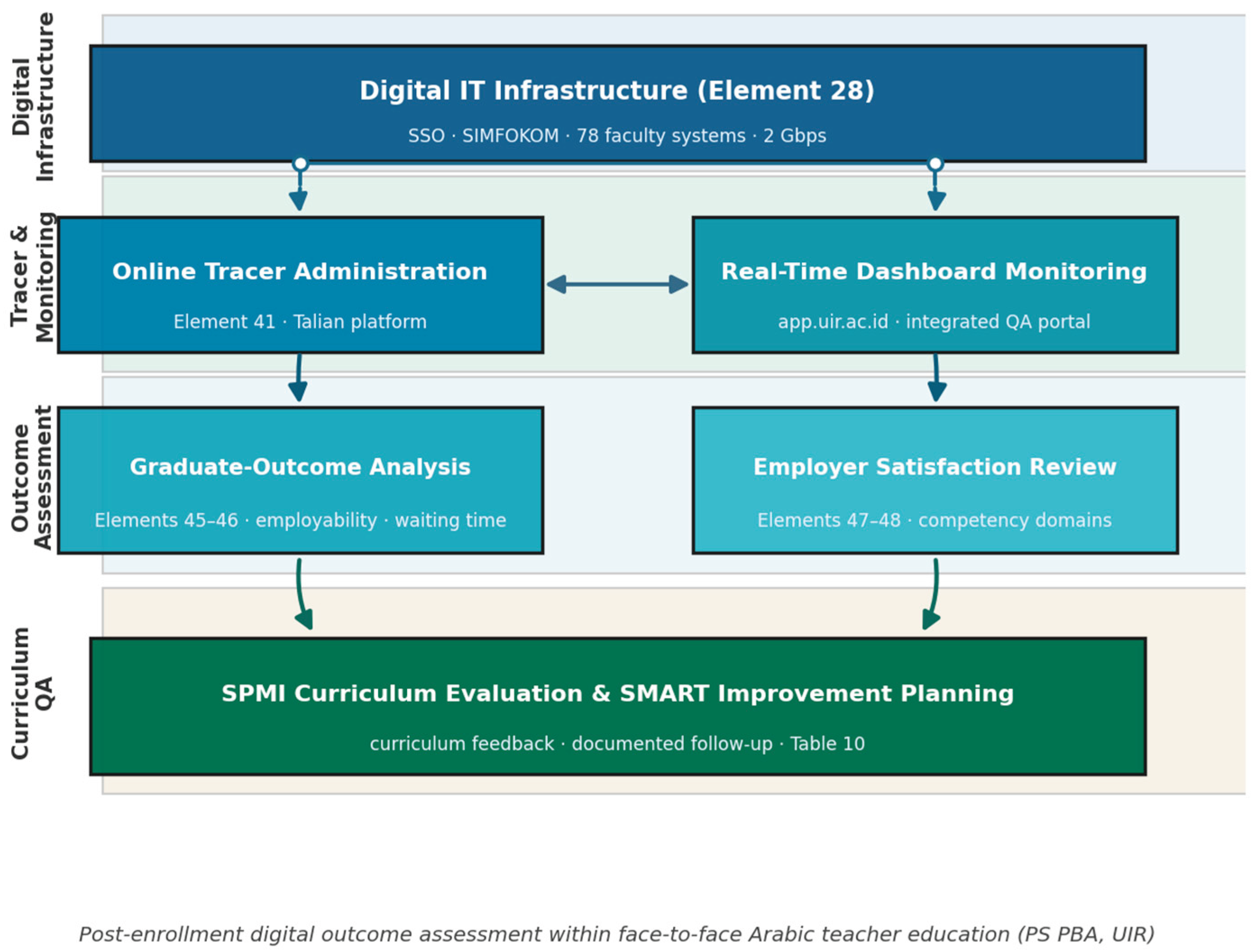
Figure 2.
Documented governance, platform, dissemination, and monitoring operations for online graduate tracing at PS PBA (Element 41). Note. DLMA = Directorate of Student and Alumni Services; SIMFOKOM = Bureau of Information and Computing Systems. Swimlanes show university–program governance (top), Talian/SMS/alumni dissemination (middle), and dashboard-led bi-monthly QA reporting (bottom). Dashed arrow = documented follow-up mobilization to increase tracer response. Source: Universitas Islam Riau (2025), Element 41.
Figure 2.
Documented governance, platform, dissemination, and monitoring operations for online graduate tracing at PS PBA (Element 41). Note. DLMA = Directorate of Student and Alumni Services; SIMFOKOM = Bureau of Information and Computing Systems. Swimlanes show university–program governance (top), Talian/SMS/alumni dissemination (middle), and dashboard-led bi-monthly QA reporting (bottom). Dashed arrow = documented follow-up mobilization to increase tracer response. Source: Universitas Islam Riau (2025), Element 41.
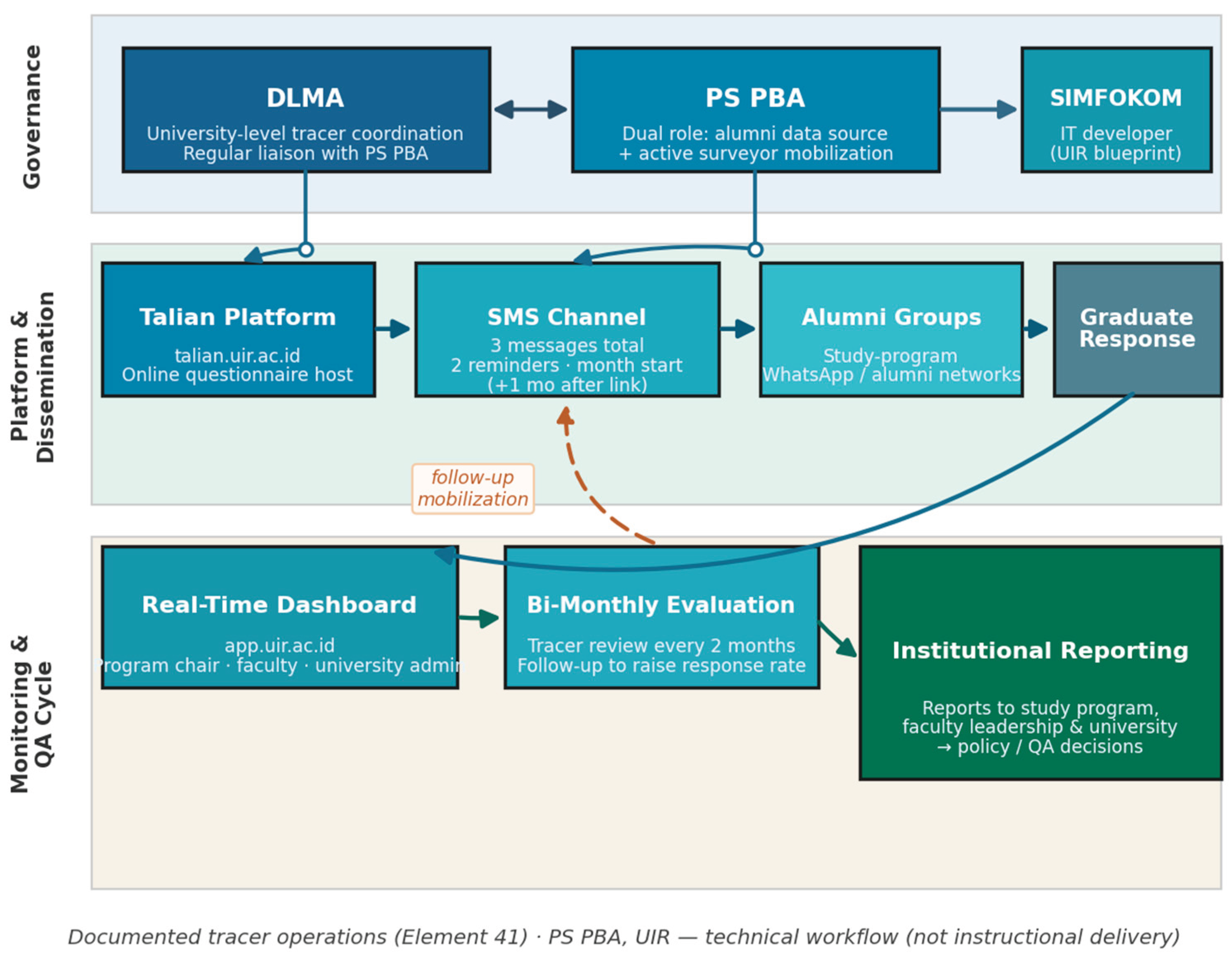
Table 6.
Documented IT Infrastructure Supporting Graduate Monitoring and QA.
| Component | Documented Feature | Relevance to Online Tracing |
| Alumni/academic records | Centralized academic and alumni records (SSO-integrated platform ecosystem) | Graduate cohort linkage for tracer targeting |
| Integration | SSO; centralized database | Consistent records across Talian and dashboard |
| Tracer platform | http://talian.uir.ac.id (SIMFOKOM) | Primary online tracer instrument |
| Dashboard | https://app.uir.ac.id | Real-time tracer and academic indicators |
Note. Source: Universitas Islam Riau (2025), Element 28. SIMFOKOM = Bureau of Information and Computing Systems.
Disclaimer/Publisher’s Note: The statements, opinions and data contained in all publications are solely those of the individual author(s) and contributor(s) and not of MDPI and/or the editor(s). MDPI and/or the editor(s) disclaim responsibility for any injury to people or property resulting from any ideas, methods, instructions or products referred to in the content. |
© 2026 by the author. Licensee MDPI, Basel, Switzerland. This article is an open access article distributed under the terms and conditions of the Creative Commons Attribution (CC BY) license.
Copyright: This open access article is published under a Creative Commons CC BY 4.0 license, which permit the free download, distribution, and reuse, provided that the author and preprint are cited in any reuse.