

Submitted:
03 July 2026
Posted:
06 July 2026
You are already at the latest version
Abstract
Overseas land investment has emerged as one of the most complex human–environment system challenges of the twenty-first century, yet its evolving role under global carbon neutrality targets remains theoretically under-specified. This study conducts a systematic literature review and bibliometric analysis of 145 English and 38 Chinese publications (2008–2026) to map the intellectual landscape, identify divergent research priorities, and examine the implications of carbon-credit-based land investment. Our analysis reveals three distinct evolutionary phases—from conceptual emergence and mechanism analysis to interdisciplinary expansion—and identifies three parallel divergences between Chinese and international scholarship: contrasting research stances, thematic priorities, and governance imaginaries, all rooted in China's transitional position within a Western-dominated discourse system. We conclude that China must transition from rule-adaptation to active governance participation, and identify priority pathways including property-rights protection, carbon-standard alignment, and polycentric governance frameworks that balance food security, host-country development rights, and global ecological justice. These findings provide both theoretical synthesis and actionable directions for governing land-based carbon markets in an era of geopolitical fragmentation.
Keywords:
overseas land investment
; carbon neutrality
; land system science
; carbon-credit land investment
; bibliometric analysis
1. Introduction
Since the turn of the twenty-first century, overseas land investments have emerged as one of the most striking phenomena in global land system change. Driven by multiple intersecting crises—food shortages and price volatility, energy insecurity fuelling competition for land for biofuel production, and climate-induced pressures on agricultural productivity—food security has escalated from a purely agricultural concern to a strategic issue at the heart of national economic stability and political security. Compounding these pressures, the global distribution of arable land remains highly uneven, land-use intensity continues to rise, and the urgency of meeting carbon peaking and neutrality targets has intensified. In this context, both the modalities and research priorities of overseas land investment are undergoing profound transformation. As of the end of 2024, Chinese enterprises had undertaken 530 overseas land investment projects across 61 countries, covering a cumulative area of 19.77 million hectares, positioning China as one of the largest overseas land investors globally [1].
Overseas land investment—often referred to in the literature as "large-scale land acquisitions" or "land grabbing"—is broadly defined as the acquisition of extensive land-use rights or ownership by a range of actors (sovereign governments, multinational corporations, investment funds, private individuals, etc.) in other sovereign states, particularly in the Global South. Such acquisitions are typically executed through purchase, leasehold arrangements, joint ventures, or project-based development, and are used for agricultural cultivation, livestock farming, agro-processing, and resource extraction. While these investments bring capital, technology, and enhanced productive capacity to host countries, they have simultaneously sparked intense controversy over the loss of food sovereignty, environmental degradation, and the marginalisation of smallholder farmers. As such, they are widely regarded as one of the most complex human–environment system challenges of the contemporary era. Beyond reshaping local land-use patterns, ecological processes and community livelihoods, these investments also embed local land tenure transformations within global networks of food, finance and geopolitics through intricate telecoupling linkages [2].
Against the backdrop of a global transition from carbon-peaking and carbon-neutrality pledges to concrete implementation, the drivers of overseas land investment are undergoing a fundamental shift. Traditional motivations—securing agricultural production space, safeguarding food and energy supplies, and diversifying resource reserves—are now being extended to include emerging ecological values such as carbon-sink resource acquisition, ecosystem service compensation, and biodiversity conservation. With an increasing number of technology and energy firms committing to net-zero targets, the expansion of Voluntary Carbon Markets (VCM), and the introduction of the EU Carbon Border Adjustment Mechanism (CBAM), global demand for forest carbon credits has surged, drawing overseas land investments into international carbon-trading and green agricultural cooperation [3]. China's pledge to peak carbon emissions before 2030 and achieve carbon neutrality by 2060 constitutes not only a major policy decision grounded in its own sustainable development imperatives but also a critical contribution to global climate governance. However, a notable gap persists between current research and real-world governance needs: the precise roles and functions that overseas land investment should play in meeting carbon-peaking and neutrality objectives remain theoretically under-specified. Moreover, China's positioning as one of the world's largest carbon-credit suppliers calls for further empirical validation of its strategic pathways in global land-based carbon governance.
Methodologically and conceptually, overseas land investment cuts across multiple disciplines—land resources, agricultural economics, geopolitics, environmental science, and public administration—making it an inherently interdisciplinary subject. To date, most studies have approached the issue from relatively narrow perspectives, such as food security, geopolitics, international law, or regional/country-specific case studies. A comprehensive, globally oriented synthesis that bridges theory and practice remains conspicuously absent. To address this gap, the present study adopts land system science as its overarching analytical framework. This interdisciplinary paradigm, centred on human–environment coupled systems, emphasises cross-scale land-use interactions, telecoupling mechanisms, and complex feedback loops, and conceptualises land as a complex social–ecological system embedded with power relations, political dynamics, and equity concerns [4,5,6]. Within this framework, overseas land investment is understood as a telecoupled, human-induced cross-border land development activity that entails the transgression of territorial boundaries and the reconfiguration of human–nature relationships. Drawing on land-use transition and telecoupling theory, land-use change is no longer seen as driven solely by local factors, but increasingly by trade and investment flows that catalyse land transfers across regions [7]. In this sense, overseas land investment can be interpreted as an extraterritorial manifestation of domestic land-use transitions, materialising through a remote interactive system comprising investor countries, host countries, local communities, and supply chains.
The tensions generated by overseas land investments across multiple dimensions—and the cascading effects they produce—constitute the central research agenda in this field. As the literature demonstrates, these investments alter not only land-resource subsystems (e.g., cropland, forests) but also trigger ripple effects across socio-economic subsystems (property rights, land values, community livelihoods, and entitlements) and ecological subsystems (biodiversity, carbon cycling) [8,9]. These multi-subsystem feedbacks can, in turn, affect the investor countries themselves—by destabilising overseas resource supplies or generating international controversies that ultimately feed back into domestic land-use strategies. Land system science, with its normative commitment to human wellbeing, sustainability, and distributive justice, offers a framework that explicitly balances productive functions, social welfare, and ecosystem services, thereby avoiding the pitfalls of single-objective approaches that lead to ecological degradation and social inequity. It thus provides a robust integrative lens for analysing the drivers, spatial dynamics, and multi-scale outcomes of overseas land investments, and for elucidating how such investments couple distant social–ecological systems via trade, capital, and information flows—ultimately reshaping the geography and trajectory of global land change.
In this study, we employ bibliometric methods to conduct a comprehensive literature search and screening, yielding a core sample of 145 English-language and 38 Chinese-language publications for systematic analysis. The paper proceeds as follows: we first trace the evolution of major research themes in overseas land investment studies from 2008 to 2026; second, we compare and contrast the divergent research priorities between English and Chinese literatures; and finally, we outline the challenges, mechanisms, and pathways for overseas land investment in the context of China's carbon-peaking and carbon-neutrality goals. Through this systematic review, we aim to provide a theoretically grounded and practically relevant reference for future research, as well as for policy-making on global land governance and the strategic deployment of cross-border land resources.
2. Materials and Methods
We conducted a systematic literature review and bibliometric analysis to comprehensively examine the research landscape of overseas land investment. The methodological framework followed the PRISMA (Preferred Reporting Items for Systematic Reviews and Meta-Analyses) guidelines and was implemented through three sequential stages: literature retrieval and screening, content analysis, and thematic classification. All procedures were designed to ensure reproducibility, transparency, and methodological rigour.
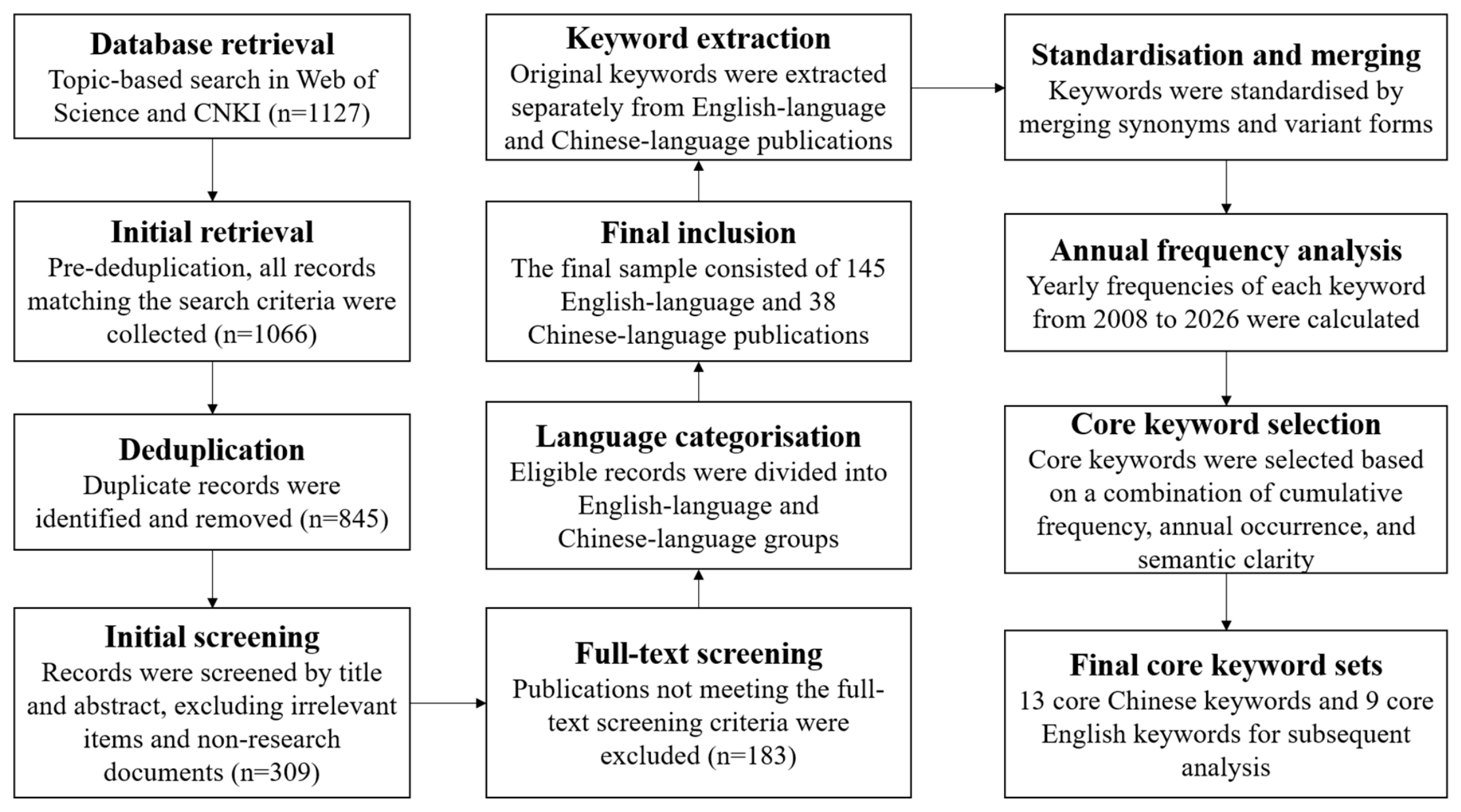
Literature retrieval and screening. We searched two major academic databases: Web of Science for English-language publications and China National Knowledge Infrastructure (CNKI) for Chinese-language publications. The search covered the period from 2008 to 2026, as the global financial crisis of 2007–2008 triggered a marked surge in overseas land acquisitions and subsequent scholarly attention. Although large-scale land acquisitions existed before 2008, we chose this starting point to capture the post-crisis wave of investment and the associated research boom. We included peer-reviewed journal articles, books, and book chapters that substantively addressed overseas land investment, while excluding news reports, conference abstracts, editorials, and other non-systematic materials. Duplicates were removed, and two rounds of screening—first by titles and abstracts, then by full-text reading—were performed independently by two reviewers, with disagreements resolved through discussion. The screening process is illustrated in a PRISMA flow diagram (see Figure 2). This procedure yielded a final sample of 145 English-language and 38 Chinese-language publications.
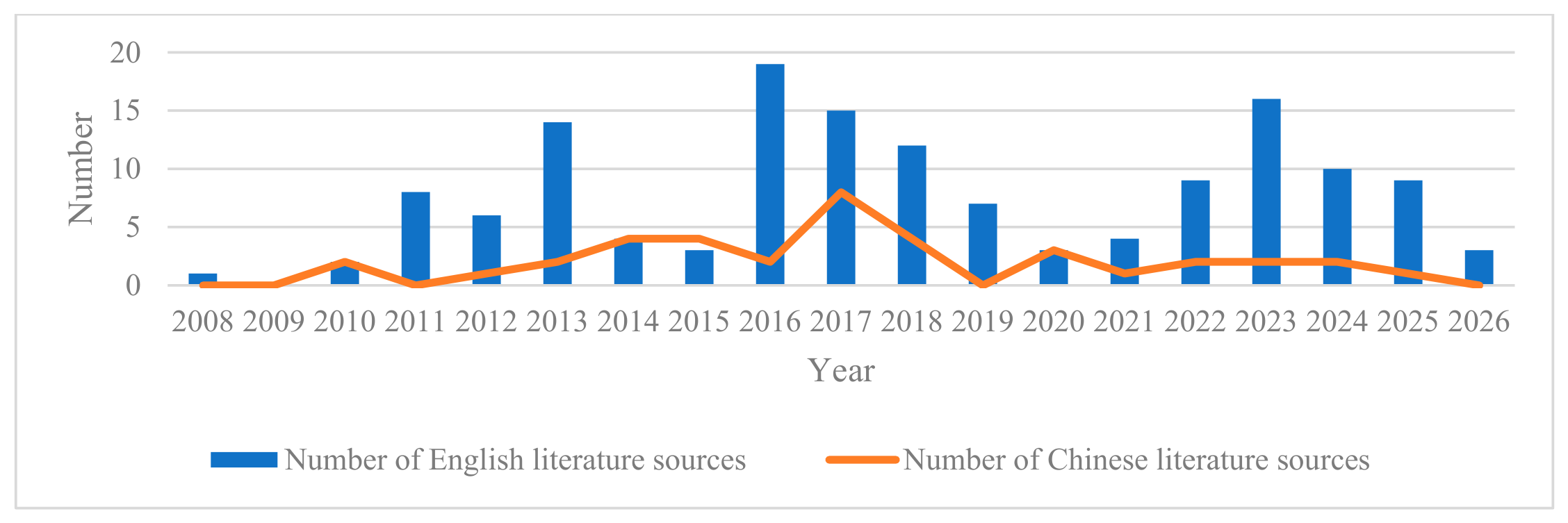
The publications were predominantly found in journals such as Land Use Policy, The Journal of Peasant Studies, World Development, China Land Science, Resources Science, and China Population, Resources and Environment. Temporal patterns (see Figure 1) revealed a steady growth in scholarly output, with Chinese publications peaking in 2017 and English publications reaching a first peak in 2016 and a second surge in 2023—the latter coinciding with renewed global food crises and climate negotiations. The overlapping peak in 2016–2017 coincided with the deepening of China’s Belt and Road Initiative and the initial shaping of global land governance frameworks.
Figure 1.
Number of core publications on overseas land investment, 2008–2026.
Keyword standardisation. To enhance the accuracy of bibliometric analyses, we standardised all keywords in the sample. We merged variant spellings, capitalisation, and plural/singular forms of key terms: all variants of “large-scale land acquisition” (e.g., “Large-scale Land Acquisitions”, “large-scale land acquisitions”) were consolidated to “large-scale land acquisition”; similarly, all forms of “land grabbing” (e.g., “Land Grab”, “land grab”) were unified as “land grabbing”. This harmonisation eliminated statistical biases arising from terminological inconsistencies.
Core keyword selection. Based on the standardised keyword set, we calculated annual and cumulative frequencies for each keyword across the 2008–2026 period. After evaluating semantic clarity, annual occurrence, and cumulative relevance, we retained 13 core Chinese keywords and 9 core English keywords as the basis for subsequent content analysis.
Figure 2.
Conceptual diagram illustrating the approach used for the systematic selection of articles to review.
Figure 2.
Conceptual diagram illustrating the approach used for the systematic selection of articles to review.
Content analysis. We performed a detailed content analysis on the 183 selected publications. Using the annual frequency data of the core keywords, we traced the evolution of research hotspots and overall trends in the field over the 17-year period. We also compared the thematic emphases between English- and Chinese-language literatures to identify divergent perspectives and focal points across research communities.
Thematic classification. We conducted a full-text coding analysis using NoteExpress bibliographic management software. Following a three-level coding procedure—open coding, axial coding, and selective coding—we integrated the findings from full-text reading, standardised keyword clustering, and identification of core research topics. This multi-step process avoided the limitations of single-keyword clustering and enabled a systematic synthesis of scattered research outputs (see Table 1).
Ultimately, we constructed a four-theme framework that encompasses: (1) foundational theories of overseas land investment; (2) full-chain research on conventional overseas land investment; (3) emerging cross-cutting research on carbon-sink land investment in the context of dual-carbon goals; and (4) comparative studies of Chinese and international research paradigms, themes, and value orientations. To ensure robust classification, we also considered temporal phases (e.g., 2008–2015, 2016–2020, 2021–2026), geographical foci (e.g., Africa, Southeast Asia, South American rainforests), and methodological approaches (e.g., spatial econometrics, multi-case comparisons, remote-sensing carbon estimation, evolutionary game models), although detailed findings on these dimensions are presented in the Results section. This comprehensive and transparent methodological design allows for full replication and further extension by other researchers.
3. Research Trajectory and Key Divergences
3.1. Evolution of Overseas Land Investment Research
Examination of the frequency dynamics of core keywords in both Chinese and international literature from 2008 to 2026 reveals a continuous deepening and broadening of research agendas. Chinese-language publications centre on “overseas farmland investment” and “food security”, with a predominant emphasis on influencing factors and mechanism analysis, whereas English-language counterparts prioritise “large-scale land acquisitions” and “land grabbing”, with a stronger focus on governance dimensions (Figure 3 and Figure 4). The intellectual evolution of the field can be periodised into three distinct phases: an initial stage (2008–2015), a developmental stage (2016–2020), and an expansion stage (2021–present).
Phase I: Emergence and Conceptualisation (2008–2015). This phase was predominantly descriptive, concentrating on identifying the global distribution of land acquisitions, proposing definitions and typologies, and preliminarily exploring investment drivers, with particular attention to foreign agricultural development in Africa and Latin America. Core debates revolved around the impacts of foreign capital on local agricultural structures. Divergences between domestic and international scholarship were already evident. International research, grounded in a critical “land-grabbing” narrative, examined global capital expansion, community livelihoods, land tenure conflicts, and the incipient role of transnational agribusiness, with Africa and Latin America as primary study regions [10,11,12]. Chinese scholarship, while engaging with contentious terms such as “land grabbing” and “new enclosure movement”, adopted a distinctly problem-oriented approach, focusing on overseas farmland investment and food security, and constructively debating the necessity and feasibility of such investments [13,14]. This reflected a strategic concern with opportunities and risks in overseas land resource utilisation. Methodologically, this period relied heavily on qualitative descriptive approaches and institutional analyses, with in-depth case studies but limited empirical work. Theoretical lenses included political economy critique, neoliberal critique, foreign investment theory, and food security frameworks.
Phase II: Mechanism Analysis and Regional Focus (2016–2020). During this period, research shifted toward social conflicts, food sovereignty, and human rights implications arising from land investments, with growing attention to locational determinants, socioeconomic impacts on host countries, and comparative efficiency and risk profiles of different investor types and business models. While cross-country differences persisted, both Chinese and international scholars increasingly identified China as a key actor in overseas land investment, and adopted more constructive perspectives on investment modalities. International research expanded to encompass global land governance mechanisms, institutional arrangements, risk management, transnational investment networks, and international rules, accompanied by a notable increase in country-specific studies—particularly on China, Africa, and Southeast Asia—addressing food security, investment efficiency, sustainability, spatial distribution, and outcome evaluation. The role and specific models of Chinese overseas investment became a prominent theme [15,16,17]. Chinese scholarship grew rapidly in volume, deepening the core concerns of overseas farmland investment and food security, with more refined spatial and factor analyses, and a progressive geographic concentration on Africa. Research perspectives moved from macro-level factors to micro-level mechanisms, examining concrete investment modes, spatial choices, and international rules [18,19,20], thereby offering more actionable guidance for Chinese enterprises’ “going global” strategies and strengthening policy orientation. Methodologically, this phase witnessed a marked increase in empirical studies, facilitated by the use of multi-source databases such as Land Matrix and GRAIN. Quantitative analyses, spatial econometrics, institutional analyses, and multi-case comparative designs proliferated. Theoretical underpinnings drew from investment decision theory, spatial economics, and geopolitical economy.
Phase III: Interdisciplinary Expansion and Emerging Agendas (2021–present). The most recent phase is characterised by thematic diversification and pronounced interdisciplinary convergence, as research perspectives gradually shift from critical appraisal towards balanced rational assessment and governance optimisation. Current scholarship addresses stakeholder compensation mechanisms in land transactions, pathways to inclusive growth that reconcile economic and environmental objectives, and standards and policies for responsible overseas land investment. Distinctive research priorities remain: international studies emphasise global macro-drivers, social justice, and governance structures, with core interests in social impacts, distributive justice, compensation mechanisms, and sustainable development models [21,22,23]. Chinese researchers have introduced novel theoretical and methodological approaches to investigate the implications of the COVID-19 pandemic for food supply security, environmental impact assessments of overseas farmland investment, and investment developments under the Belt and Road Initiative, with strong emphases on geostrategy and network analysis [9,24,25]. At the same time, multidisciplinary perspectives—integrating management, economics, environmental science, and international relations—have been applied to examine participant evolutionary game dynamics, geo-economics, host-country environmental quality, and international rule systems. Methodological repertoires have further expanded to include remote-sensing analysis, evolutionary game models, network analysis, and coupled coordination analysis, alongside established quantitative, institutional, and comparative case methods. Theoretical innovations incorporate institutional complexity, telecoupling, and supply-chain security frameworks.
In summary, the chronological progression of research themes—from initial identification and conceptual framing, through mechanism-focused regional analysis, to contemporary interdisciplinary and policy-oriented inquiry—demonstrates a clear intellectual maturation of the field. This evolution reflects both the shifting geopolitical and environmental contexts of overseas land investment and the growing sophistication of analytical approaches employed across different scholarly communities.
3.2. Core Research Progress and Contentious Debates
Systematic synthesis of the literature reveals that research on overseas land investment has coalesced around three thematic clusters: driving mechanisms, multi-dimensional effects, and governance and risk management. Within each cluster, however, significant theoretical and empirical disagreements persist, reflecting divergent disciplinary perspectives, normative commitments, and methodological choices.
Driving mechanisms. There is broad consensus that overseas land investment results from the interplay of demand-side pressures, supply-side conditions, global factor mobility, and location-specific attributes. On the demand side, investor countries face domestic land scarcity, low food self-sufficiency, and high import dependence; at the firm level, the pursuit of low-cost land expansion and market opportunities prevails, while at the state level, strategic considerations of resource and food security guide investment promotion [26]. On the supply side, host countries offer abundant land, low labour costs, and often preferential land policies to attract foreign capital; in many cases, weak tenure security and regulatory gaps further facilitate large-scale transactions [27]. Global factor mobility—including trade liberalisation, international capital flows, technology transfer, and modern logistics networks—has substantially reduced transaction costs and enabled the formation of global production networks and value chains [10]. Finally, locational factors—geopolitical relations, bilateral trade agreements, climatic and soil endowments, and socio-cultural conditions—critically shape where investments materialise, with major investor origins concentrated in East Asia (China, Japan, South Korea), the Gulf states, and Western Europe, and host regions clustered in Africa (East, Southern, West), Southeast Asia, and Eastern Europe [28].
However, sharp disagreements underlie this apparently coherent framework. A first debate concerns the relative primacy of demand- versus supply-side forces. Some scholars argue that demand-side pressures—particularly food-importing countries' strategic anxieties—are the primary engine, framing overseas land investment as a necessary response to global resource competition [26]. Others contend that supply-side institutional weaknesses in host countries, especially opaque land administration and corrupt governance, are equally or more decisive, and that demand-side narratives often obscure the agency of domestic elites who facilitate land transfers for personal gain [27]. A second controversy revolves around the interpretation of locational choices: while mainstream economic analyses emphasise cost-minimisation and comparative advantage, critical political economy approaches highlight geopolitical manoeuvring and neocolonial power asymmetries, pointing to the concentration of investments in countries with weak land rights as evidence of structural inequality rather than pure market logic [28]. These competing explanations have not been reconciled, and the relative weight of each factor remains an open empirical question.
Multi-dimensional effects. The impacts of overseas land investment are widely recognised as economically, socially, and ecologically multi-faceted, exhibiting significant ambivalence, complexity, and scale dependence. Economically, investments can bring foreign exchange, technology, employment, infrastructure, and export revenues to host countries, while improving land productivity and modernising agriculture; for investor countries, they secure supply chains and reduce domestic land pressure [29]. Yet they also risk causing profit repatriation, crowding out local capital, eroding food pricing power, and fostering economic monocultures that undermine host-country autonomy. Socially, investments often upgrade local infrastructure and public services and generate technology spillovers; however, large-scale land acquisitions have been linked to landlessness, smallholder marginalisation, community conflicts, widening inequality, and the erosion of food sovereignty, with some cases denounced as “neocolonial” practices [30]. Ecologically, intensive production may increase yields per hectare, potentially sparing natural habitats from conversion, yet it frequently entails substantial environmental costs—forest and wetland loss, biodiversity decline, soil erosion, non-point pollution from agrochemicals, and excessive water consumption—thereby shifting ecological risks across borders [31].
Within this domain, three major controversies stand out. First, the net effect of overseas land investment is hotly contested: while some quantitative studies report positive aggregate gains in host-country GDP and employment, qualitative and case-based research often highlights distributive losses and livelihood disruptions, raising the question of whether conventional cost-benefit analysis adequately captures social and ecological externalities [29,30]. Second, the causal attribution of effects remains methodologically fraught, as investments are rarely exogenous and host-country conditions vary widely; disentangling investment impacts from concurrent economic and policy changes poses a persistent identification challenge. Third, and perhaps most fundamentally, normative positions diverge sharply: scholars aligned with global justice and postcolonial frameworks interpret negative social and ecological outcomes as evidence of systemic exploitation, whereas more pragmatic voices view these effects as manageable trade-offs that can be mitigated through improved practices and regulation [31]. This normative divide colours not only the interpretation of evidence but also the policy recommendations that follow.
Governance and risk management. Research in this area centres on three sub-themes: governance architectures, risk identification, and mitigation strategies. Governance frameworks have proliferated, including voluntary guidelines (e.g., the UN’s Principles for Responsible Agricultural Investment – RAI), World Bank land governance frameworks, and the African Union’s Land Policy Framework, alongside key instruments such as transparency requirements, community participation, environmental impact assessments, benefit-sharing mechanisms, and full-cycle contract monitoring [32,33]. Risk typologies commonly distinguish political risks (regime change, policy reversals, expropriation), legal risks (tenure ambiguity, contractual disputes, tightening environmental regulations), social risks (local protests, labour conflicts, international reputational damage), ecological risks (extreme weather, land degradation, water constraints), and market risks (price volatility, trade barriers, supply-chain disruptions) [34,35]. Corresponding mitigation measures include due diligence, risk assessment tools, insurance products, localised operations, multi-stakeholder benefit-sharing, and corporate social responsibility mechanisms [36,37].
Nevertheless, the governance literature is characterised by deep and unresolved disagreements. A central debate concerns the effectiveness and legitimacy of voluntary versus mandatory approaches: proponents of voluntary guidelines argue that flexibility and soft law encourage broader participation and adaptation, while critics contend that these instruments lack enforcement power and have failed to prevent abuses, calling for binding international treaties with strong compliance mechanisms [32]. A second controversy revolves around the fragmentation of governance architectures: multiple overlapping initiatives—from the UN, World Bank, FAO, AU, and regional bodies—create coordination gaps and forum-shopping opportunities for investors, yet some scholars view this pluralism as a source of normative innovation rather than dysfunction [33]. Third, there is significant North–South divergence: host countries, particularly in Africa and Southeast Asia, often perceive global governance frameworks as externally imposed and insufficiently attentive to their development priorities, whereas investor countries tend to emphasise investment protection and regulatory predictability [34]. This geopolitical dimension complicates any unified governance agenda and suggests that contextual, nationally-owned approaches may be more viable than one-size-fits-all solutions. Finally, risk management research itself is divided between technocratic approaches—which treat risks as objectively identifiable and insurable—and critical perspectives that highlight the political construction of risk, where definitions and allocations of risk often favour powerful actors over vulnerable communities [36,37].
In sum, while the three thematic clusters provide a useful organising framework, the literature is marked by persistent theoretical pluralism, methodological contestation, and normative polarisation. These disagreements are not merely academic; they have direct implications for how policymakers, investors, and civil society understand and respond to the challenges of overseas land investment. Recognising these fissures is essential for advancing both scholarly inquiry and evidence-based governance.
3.3. Key Divergences between Chinese and International Research
The existing literature collectively illustrates the intellectual life cycle of overseas land investment research—from conceptual germination and exploratory analysis to deepening thematic inquiry and, more recently, diversified expansion. Research dimensions have broadened from a narrow focus on food security to encompass economic, spatial, environmental, political, and institutional perspectives; methodological approaches have evolved from qualitative description and case-study narratives to interdisciplinary, model-based analyses integrating econometrics, spatial statistics, and simulation techniques. This evolution not only reflects the progressive intellectual maturation of the field but also mirrors the growing complexity and contested nature of overseas land investment as a global practice embedded in dynamic geopolitical, economic, and ecological contexts. A systematic comparison of Chinese- and English-language literatures reveals three salient dimensions of divergence that warrant particular attention. The three divergences are parallel, manifesting across three distinct analytical dimensions—research stance, thematic focus, and ultimate governance imaginary—all stemming from a single underlying structural condition: China's transitional position in the global knowledge and rule-making system for land governance, moving from a rule-taker toward a co-shaping actor while operating within a discourse historically dominated by Western frameworks. These dimensions are mutually reinforcing but logically independent, jointly constituting a systematic epistemic gap between Chinese and international scholarship. Recognising this coherence moves beyond mere listing of differences toward a structural understanding of how geopolitical and intellectual power shape research production in this field.
The first divergence concerns research stance and value orientation. International scholarship, particularly from Western academic institutions and transnational civil society networks, tends to position itself in the role of either rule-maker or rule-critic within global governance architectures. A substantial body of this literature begins from a critical interrogation of "land grabbing" as a manifestation of neoliberal globalisation and proceeds to advocate for institutional reforms, normative refinements, or regulatory innovations aimed at repairing perceived deficiencies in the existing order. This stance is epitomised by foundational critical works such as Borras and Franco's political economy analyses, which framed land grabbing as a symptom of deeper crises in global capitalism and called for structural transformation rather than incremental adjustment [10,12]. Similarly, Edelman's contributions have consistently foregrounded human rights violations and social justice deficits, positioning scholarly critique as a counterweight to corporate-friendly policy discourses [30]. The "global land rush" literature, as synthesised by Cotula and colleagues, has been particularly influential in shaping international policy agendas, offering evidence-based critiques of weak governance and proposing concrete governance tools such as transparency standards and community consent protocols [27,32]. At the normative frontier, scholars such as De Schutter have articulated rights-based frameworks that directly challenge state-centric investment treaties, arguing for the primacy of food sovereignty over investor protections [33]. These works collectively illustrate how international research actively constructs the normative vocabulary and institutional blueprints through which global land governance is debated, performing a constitutive rather than merely descriptive function.
In sharp contrast, Chinese scholarship occupies a markedly different position within this global knowledge landscape. As China has emerged as a major overseas investor, its research community confronts a global land governance discourse largely framed by Western normative priorities and institutional templates. Consequently, domestic studies have tended to focus on strategic adaptation: identifying risks, seizing opportunities, and navigating the constraints of a pre-existing rule system while gradually exploring how to participate in shaping more inclusive investment norms. Rather than adopting the "land grabbing" frame with its critical baggage, Chinese researchers have developed an alternative vocabulary centred on "overseas farmland investment" and "food security cooperation," which emphasises mutual benefit and developmental pragmatism. This framing not only reflects China's position as a rule-taker transitioning toward co-shaping the rules but also represents a substantive challenge to the West's definitional authority—contesting the very language through which overseas land investment is understood and evaluated. This linguistic and conceptual divergence is not merely academic; it constitutes a form of discursive politics, revealing the "centre–periphery" structure of knowledge production in global land governance and the inherent tensions that arise as emerging powers seek to reshape a governance order historically dominated by Western actors.
The second divergence concerns research focus and core conceptual priorities. International scholarship places primary emphasis on land rights, social justice, fair compensation, and the livelihood impacts on local communities, with a strong protective orientation toward vulnerable groups and their entitlements. This line of inquiry has been advanced by scholars such as Borras and Franco, who examine the distributive consequences of land acquisitions, and by Edelman, who documents the erosion of smallholder rights and calls for remedial justice [10,30]. Cotula and colleagues have systematically analysed tenure conflicts and community displacement, using empirical evidence from sub-Saharan Africa to highlight the procedural deficits in consultation and consent mechanisms [27,32]. De Schutter, from a human-rights perspective, argues that the right to food must take precedence over investment protection, and that any governance framework should embed social safeguards as non-negotiable prerequisites [33]. In contrast, Chinese research is predominantly concerned with resource allocation efficiency, focusing on the determinants and drivers of land investment, spatial optimisation of investment locations, and the evolution of investment networks. Studies by Chinese scholars have employed spatial econometrics and network analysis to identify key nodes and corridors in China’s overseas land investment, often with an explicit aim to inform national geopolitical strategies and enhance the effectiveness of outward capital deployment [9,18,20]. This divergence reflects how scholarly communities, operating under different developmental stages, institutional environments, and historical roles, differently problematise the same global issue. On the one hand, an efficiency discourse that brackets out social embeddedness tends to produce fragile and low-resilience outcomes; on the other hand, a rights-based discourse that overlooks developmental needs and national strategies may inadvertently foreclose opportunities for local employment, infrastructure upgrading, and technological diffusion—opportunities that host communities might otherwise gain from foreign investment.
The third divergence lies in ultimate concerns and strategic orientations. International research is predominantly oriented toward global governance, tending to detach land issues from specific geopolitical contexts and assuming that global land governance problems can be resolved through the establishment of universally applicable, transnational legal and ethical norms. This perspective seeks to replace power politics with rules, reflecting a distinctly technocratic inclination—one that privileges expert-driven, standardised solutions over politically negotiated, context-sensitive arrangements. Scholars working within this tradition have proposed model codes of conduct, standardised impact assessment protocols, and harmonised dispute resolution mechanisms, often with the implicit belief that procedural rationalisation can transcend the messy realities of sovereign interests and power asymmetries [32,35].
In contrast, Chinese scholarship does not take abstract, universal norms as its primary concern. Instead, it proceeds from a pragmatic recognition of sovereign equality and divergent national interests, focusing on how concrete projects, bilateral agreements, and regional cooperation initiatives can tangibly enhance agricultural productive capacity in host countries, safeguard China’s food supply chains, and promote shared development along the Belt and Road. This orientation has effectively given rise to a governance discourse centred on the right to development—distinct from the human rights-centred discourse that predominates in Western international scholarship. The ultimate aspiration of Chinese research is to construct a cooperative network grounded in benefit-sharing and risk-sharing, with development priority and outcome-orientation as its core values, approximating what might be termed realist institutionalism—an approach that acknowledges power realities while seeking institutional arrangements that align diverse interests through practical cooperation rather than normative imposition.
At its deepest level, this divergence reflects fundamentally different imaginaries of global governance held by Chinese and international scholarly communities, and their differing answers to the foundational question: what constitutes good global governance? For the international mainstream, good governance is defined by procedural fairness, normative coherence, and the subordination of power to universal rules; for Chinese scholarship, it is defined by tangible developmental outcomes, mutual benefit, and respect for state sovereignty as the irreducible foundation of international order. This is not merely a difference of emphasis but a constitutive contrast in how the very purpose and architecture of global governance are conceived.
4. Overseas Land Investment under the Dual-Carbon Goals: Challenges, Mechanisms, and Pathways
Authors should discuss the results and how they can be interpreted from the perspective of previous studies and of the working hypotheses. The findings and their implications should be discussed in the broadest context possible. Future research directions may also be highlighted.
4.1. Challenges: New Constraints Imposed by the Dual-Carbon Goals on Overseas Land Investment
In recent years, against the backdrop of China's carbon-peaking and carbon-neutrality commitments and the deepening of global climate governance, the asset attributes and functional connotations of land resources are undergoing a profound reconstitution. The low-carbon transformation of global value chains has generated large-scale demand for land-based ecological products, including carbon-sink assets and ecosystem services [38], thereby fundamentally reshaping the behavioural logic of overseas land investment. Traditional investment models oriented toward food security and resource supply are progressively being supplemented—and in some cases superseded—by a carbon-credit-based land transaction paradigm centred on carbon-sink asset development and the valorisation of ecosystem services. This transition signifies that the object of overseas land investment is expanding from conventional agricultural production spaces toward ecological service territories that perform climate-regulating functions.
Whereas conventional overseas land investment targeted land's tangible, material outputs—crops, biofuels, minerals, and other physical commodities—the emerging carbon-credit-oriented model treats land as a natural carbon-sequestration infrastructure, deriving value from its ecological function rather than its material production. In this model, investors acquire land-use or development rights not to extract physical products but to generate carbon credits from the land's carbon storage and sequestration capacity, transforming an ecosystem service into a tradable financial asset. The core transaction object is thus no longer agricultural or resource commodities, but future carbon credits—verified emission reductions recognised by governmental or independent certification bodies, which serve as transferable financial instruments in global carbon markets. In practice, carbon funds, energy majors (e.g., Shell, BP), technology corporations, and transnational asset managers—all seeking to meet their net-zero commitments—invest in land-based carbon projects to generate credits for offsetting their own emissions. The most prominent model is investment in REDD+ (Reducing Emissions from Deforestation and Forest Degradation) projects, whereby firms finance the conservation of tropical rainforests or the restoration of forest lands in exchange for verified, tradable carbon offset credits generated by the project over its lifetime. These credits can be used for the investor's own carbon-neutrality targets or sold on secondary markets to other buyers seeking to improve their net emission records.
Between 2020 and 2025, forestry and land-use projects accounted for nearly 40% of all credits issued in the global voluntary carbon market, the majority of which were REDD+ projects, and a substantial proportion involved cross-border land investments [39]. Carbon-credit projects initiated between 2016 and 2024 have covered more than 9 million hectares across 52 countries in the Global South, making this one of the fastest-growing categories of overseas land investment and warranting close scholarly attention. Over half of these projects are concentrated in Africa, covering more than 5.2 million hectares, with the remainder distributed across China, India, Brazil, and Colombia [40].
Unlike farmland conversion or mining operations, carbon-credit projects do not significantly alter surface landscapes. They typically acquire land-development rights through long-term leases or carbon-rights sharing agreements, and are often conducted under the banner of "ecological conservation." Due to their unobtrusive nature, such projects rarely provoke immediate land conflicts. However, the substantive constraints they impose are considerable: investment cycles in carbon-credit projects typically span 30 to 50 years, placing long-term restrictions on traditional livelihood activities of local indigenous communities—including agriculture, logging, and mining—thereby triggering ethical controversies over "carbon colonialism," wherein the Global North, through its capital and technological advantages, shifts emission-reduction responsibilities and ecological conservation costs to the Global South while dominating the distribution of carbon-credit revenues. Simultaneously, the international institutional environment has generated a new framework of constraints: the refinement of Article 6 rules under the Paris Agreement, along with international climate conferences such as COP30 (2025), have further underscored the importance of forest protection and just transition, providing political momentum for such investments. Meanwhile, the anticipated maturation of global carbon markets and projected rises in carbon prices may drive explosive growth in this category of investment in the near future [41].
4.2. Mechanisms: Carbon Effect Analysis from the Perspective of Land System Science
Land system science (LSS) focuses on the drivers and feedback mechanisms that shape human land-use activities in interaction with natural ecosystems and socio-economic systems, emphasising cross-temporal and cross-spatial spillover effects [42]. LSS thus provides a foundational theoretical framework for understanding the complexity and dynamics of overseas land investment. Research on traditional overseas agricultural land investment has largely proceeded from the theoretical perspective of land-use displacement effects—namely, that investor countries transfer domestic pressures of land scarcity, environmental regulations, and ecological constraints to host countries through overseas land investment, resulting in irreversible conversion of ecological land to other use types and substantial associated carbon emissions [43]. From an LSS perspective, this constitutes a typical telecoupling and feedback process within social-ecological systems. Studies indicate that potential carbon emissions from large-scale land transactions amount to up to 2.26 GtC, with 97% of biomass-related emissions concentrated in tropical regions [44].
For the emerging category of carbon-credit-based land investment, the mechanisms are considerably more complex. Such investments tightly couple global carbon market signals, investor countries' carbon-neutrality demands, and host countries' forest endowments, land tenure institutions, and community livelihoods. Drawing on the theoretical foundations of land system science, and building upon the five core thematic clusters identified in our systematic review—driving mechanisms, spatial patterns, multi-dimensional effects, governance models, and risk resilience—this study constructs an analytical framework that integrates the driver–transmission–impact triad to capture the complete transmission chain of global carbon-credit-based land transactions from global drivers to local impacts.
The driver–transmission–impact structure is not derived from a single a priori theory but is synthesised inductively from the reviewed literature, while being theoretically grounded in land system science and telecoupling theory. Specifically, the framework emerges from a systematic synthesis of the five thematic clusters identified in our literature review: the "driver" segment synthesises findings on driving mechanisms; the "transmission" segment integrates insights from spatial patterns and governance models; and the "impact" segment distils evidence from multi-dimensional effects and risk resilience studies. The underlying logic—that external pressures propagate through mediating institutions and mechanisms to produce distal outcomes—draws analytically on telecoupling theory [7], which emphasises how flows of capital, information, and materials couple distant social-ecological systems across space. Thus, the framework is best understood as an inductively derived analytical heuristic, theoretically anchored in LSS and telecoupling, yet empirically populated and validated through the thematic synthesis of extant scholarship.
At the driver end, three mutually reinforcing forces converge. First, global carbon-pricing mechanisms endow land-based carbon sinks with tradable economic value. Second, corporate ESG (Environmental, Social, and Governance) constraints generate sustained demand from transnational capital for verifiable carbon offsets. Third, international climate finance—exemplified by the Green Climate Fund—provides initial capital and institutional legitimacy for project implementation. These three dynamics, operating through global–local telecoupling processes, collectively constitute the core driving mechanism underpinning the expansion of overseas land carbon-sink assets [45].
At the transmission end, the capital and policy pressures generated at the driver end are spatially diffused and value-transformed through market-based mechanisms. REDD+ and analogous frameworks convert forest carbon sinks from local ecological services into globally tradable carbon-credit commodities, effectively financialising natural capital. This financialisation process lowers transaction costs for cross-regional ecological asset transfers, thereby facilitating large-scale investment by carbon funds, energy majors, asset managers, and other transnational actors in host countries' carbon-sink land assets. This creates a spatial transmission chain linking capital, ecological resources, and institutional arrangements.
At the impact end, the combined capital–policy forces, mediated through the transmission mechanisms, generate a dynamic nexus centred on land–carbon–capital. Unlike the "hard development" model of conventional overseas land investment—characterised by direct resource extraction through mining, cultivation, or physical transformation—carbon-credit investments acquire a form of "soft control" over ecological land, with carbon rights as the core asset. Investors achieve indirect, exclusive access to land through the market-based appropriation of its carbon-sequestration function, without necessarily altering its physical morphology or formal ownership. This shift triggers a dual structural reconfiguration of land systems [46]. First, in the land function domain, the primary role of land shifts from satisfying local communities' productive and livelihood needs to providing ecosystem carbon-sequestration services for the global carbon market. Second, in the land tenure domain, substantive control over land shifts from territorially embedded institutional arrangements—grounded in community customary rights or local legal systems—to transboundary contractual arrangements centred on long-term carbon-credit agreements. This transformation essentially embodies a telecoupling process between the global carbon governance regime and local land institutions, which, while reshaping land-use patterns, may simultaneously generate new institutional frictions, rights conflicts, and distributive inequities—issues that are increasingly central to critical scholarship on this topic.
This analytical framework suggests that carbon-credit-based overseas land investment transcends the conventional explanatory paradigm of "ecological pressure displacement" that dominated earlier research. Instead, it reveals a dynamic, global-scale "carbon-sink supply chain" in which land, as the critical material carrier of carbon-sink assets, undergoes cross-regional re-pricing and reallocation through capital–policy telecoupling mechanisms. This process illuminates how core elements of land systems—spatial location, resource endowments, property-rights structures, and functional attributes—are systematically reorganised across scales through capital flows and institutional arrangements under globalisation. This perspective offers a theoretically integrative analytical lens for understanding how the dual-carbon goals are reshaping global land-use patterns and their underlying governance logics.
4.3. Pathways: Global Governance and the Repositioning of China's Strategic Role
The current landscape of global climate governance is characterised by a relatively pluralistic configuration. On the one hand, despite policy uncertainties in the United States, international multilateral processes—exemplified by COP30—continue to advance steadily, with a focus on doubling climate adaptation finance, institutional recognition of climate governance contributions from the Global South, and capacity-building for climate resilience. On the other hand, Northern countries, leveraging policy instruments such as ESG standards and the Carbon Border Adjustment Mechanism (CBAM), continue to dominate agenda-setting, rule-making, and resource allocation. While their discursive practices foreground their own climate action achievements, they simultaneously exhibit a tendency to unilaterally shift and externalise emission-reduction responsibilities onto developing countries. Within this configuration, balancing North–South cooperation with South–South cooperation, and faithfully implementing the principle of "common but differentiated responsibilities and respective capabilities," has become a critical pathway for advancing a just global transition. This context also provides an important framework for reorienting China's role in global climate governance and overseas land investment governance.
As a key actor in global climate governance and a major participant in South–South cooperation, China's role in overseas land investment urgently needs to transition from passive rule-adaptation to active governance participation. The vision of a community with a shared future for mankind and the Global Development Initiative provide essential intellectual resources and an operational framework for this transition. These initiatives uphold the core principles of development-first, people-centred approaches, and inclusive, universally beneficial cooperation, advocating for the resolution of global challenges through mutually beneficial collaboration. Guided by its dual-carbon goals, China's engagement in global climate governance and overseas land investment constitutes both a significant strategic opportunity to fulfil its international responsibilities and advance global ecological governance, and a core arena for demonstrating its leadership in promoting a just and green transition and implementing the Global Development Initiative. This process enables China to achieve a role transition—from a passive participant to an active shaper—within the global governance system for carbon-credit-based land transactions.
As one of the world's largest suppliers of carbon credits, China's action pathways in global carbon-credit land investment governance can be oriented along the following three dimensions. First, strengthening the protection of carbon-sink resource property rights: clarifying the attribution and distribution rules of land carbon-sink rights among the state, collectives, farming households, and foreign investors; preventing rights deprivation and risk transfer during the financialisation of carbon credits; and safeguarding resource sovereignty and community interests. Second, promoting mutual recognition of carbon-credit standards and participation in rule-making: aligning domestic carbon-credit standards with international markets; actively engaging in the revision of global carbon-credit methodologies and certification rules; and, through South–South cooperation, assisting other developing countries in enhancing their capacities for forest monitoring, carbon accounting, and verification, thereby strengthening their bargaining power and leadership in global carbon markets. Third, building a just carbon-governance system: embedding community participation, benefit-sharing, and ecological compensation into carbon-sink project management, and fostering a new order of global ecological governance that balances efficiency and equity [47].
5. Conclusions
This study has systematically traced the intellectual trajectory of overseas land investment research, from its conceptual inception to its current phase of diversified expansion. Over the past decade and a half, the field has witnessed a continuous broadening of research dimensions and a progressive sophistication of methodological approaches. This evolution not only reflects the natural maturation of a scholarly domain but also mirrors the growing complexity, diversity, and practical challenges that China—as a major outward investor—has encountered in its overseas land investment practices amid deepening globalisation.
Driven by the dual-carbon goals, overseas land investment research is undergoing a profound paradigm shift, with increasing emphasis on the ecological functions, comprehensive values, co-benefits, and equity implications of land use. The emerging category of carbon-credit-based land investment, while constituting an essential instrument for global climate mitigation, simultaneously harbours the potential to exacerbate global inequalities, generate governance risks, and distort distributive justice. Understanding this new phenomenon requires moving beyond traditional analytical frameworks and situating it within the theoretical lenses of land system science and the governance vision of a community with a shared future for mankind. For China, this transition represents not only a strategic opportunity to participate in global ecological governance and fulfil its dual-carbon commitments, but also a critical arena in which to demonstrate its leadership in advancing a just green transition and operationalising the Global Development Initiative.
As global climate governance deepens, and as intensifying geopolitical conflicts profoundly disrupt global resource flow patterns, global land governance is entering a new phase of heightened uncertainty. In this turbulent geopolitical environment, overseas land investment practices must place greater emphasis on sustainability and equity to effectively address the systemic pressures arising from the interwoven challenges of climate change, developmental imbalances, and geopolitical rivalries. China should prudently identify new opportunities and emerging challenges in overseas land investment amid these geopolitical shifts, adhere to the principle of mutual benefit and win-win cooperation in international engagement, and actively advance the construction of a community with a shared future for mankind to achieve common development.
Based on a systematic comparison of Chinese and international literatures, this study distils three key implications for future scholarship. First, the necessity of theoretical dialogue. A persistent divergence exists between Chinese and international scholarship in core concepts, research perspectives, thematic priorities, and value orientations. Strengthening cross-cultural academic exchange and theoretical cross-fertilisation is urgently needed to build a more inclusive consensus foundation for global land investment research. Second, the possibility of methodological integration. The well-established mixed-methods approaches prevalent in English-language scholarship and the spatial econometric and complex network analyses commonly employed in Chinese research can be mutually complementary. Their integration would yield more explanatory and synthesised analytical frameworks. Third, the importance of data sharing. Current research relies heavily on disparate data sources; promoting cross-platform data sharing and the standardisation of indicator systems would significantly enhance the cross-study comparability and replicability of research findings.
As China's engagement in global governance continues to deepen, domestic scholarship has begun to incorporate frontier issues such as sustainability assessment, community impact, and transparency mechanisms. Concurrently, international research has renewed its attention to the role of the "developmental state" in land governance, offering more nuanced conceptual tools for understanding China's practices. Looking ahead at the global scale, priority research directions include: the synergistic pathways between overseas land investment and global carbon-reduction targets; the long-term effects of carbon-credit investment on land-system functional transformation and global carbon-cycle feedbacks; and the application of big data and artificial intelligence in land investment decision-making and risk early warning. Pursuing these avenues could contribute to constructing a polycentric governance framework that accommodates national food security, host-country developmental rights, and global ecological justice. Ultimately, through strengthened regulation, innovative business models, technological empowerment, and deepened research, overseas land investment can be steered away from the traditional logic of resource extraction or pressure displacement toward a new paradigm that promotes optimal global land-resource allocation and synergistic sustainable development—thereby offering both scholarly insights and practical contributions to the building of a community of life for humanity and nature.
Author Contributions
Conceptualization, Y.Y.; methodology, Y.Y.; software, Y.Y.; validation, Y.S. and X.Y.; formal analysis, Y.Y. and Q.F.; resources, X.Y.; data curation, Y.Y.; writing—original draft preparation, Y.Y.; writing—review and editing, Y.S. and X.Y.; visualization, Y.Y.; supervision, Q.F.; project administration, Y.Y.; funding acquisition, Y.Y. and Q.F. All authors have read and agreed to the published version of the manuscript.
Funding
This research was funded by the General Research Projects of Philosophy and Social Sciences in Jiangsu Universities (grant number 2024SJYB1012), the National Natural Science Foundation of China (grant number 42101253), and the Jiangsu Province Social Sciences Application Research Boutique Project (grant number 25SYA-014).
Data Availability Statement
Dataset available on request from the authors.
Conflicts of Interest
The authors declare no conflicts of interest.
References
- Long, W.; Keske, C.; Guo, F. Enhancing food security and trade resilience in sustainable agricultural systems; Frontiers Media SA: Lausanne, 2025. [Google Scholar]
- Lambin, E.F.; Meyfroidt, P. Global land use change, economic globalization, and the looming land scarcity. Proc. Natl. Acad. Sci. 2011, 108, 3465–3472. [Google Scholar] [CrossRef] [PubMed]
- Zhao, H.; Lin, B. Integrating voluntary carbon offsets into the carbon border adjustment mechanism through multi-objective optimization of REDD+ funds. J. Env. Manag. 2025, 388, 126019. [Google Scholar] [CrossRef] [PubMed]
- Long, H.; Chen, K.; Zheng, Y.; Zhang, Y. The theoretical cognition and research paradigm of land system science. Resour. Sci. 2025, 47, 3–13. [Google Scholar] [CrossRef]
- Ramankutty, N.; Garrett, R.; Munroe, D.; Nielsen, J.; Meyfroidt, P. Global Land Programme Science Plan and Implementation Strategy 2024-2028 (Draft December 2023); Global Land Programme Scientific Committee: College Park, Maryland, 2024; p. 10, 14. [Google Scholar]
- Garrett, R.; Meyfroidt, P.; de Bremond, A.; Wartenberg, A.; Barbieri, L.; Fernández-Llamazares, Á.; Acheampong, E.; Addoah, T.; Adeleye, M.; Alexander, P.; Brandão, J.; Coomes, D.A.; Ellis, E.C.; Fajardo, J.; Jacobi, J.; Leach, M.; Lele, S.; Zonta, A.L.; Lyons-White, J.; Martin, A.; Messerli, P.; Milner-Gulland, E.J.; Müller, D.; Mills, M.; Kalunda, P.N.; Pascual, U.; Rueda, X.; Ryan, C.; Setty, S.; Pham, T.T.; Zagaria, C. Policy principles for sustainable and just land systems. Roy. Soc. Open Sci. 2025, 250810. [Google Scholar] [CrossRef] [PubMed]
- Song, Y.; Huang, X.; Li, Q.; Qi, X.; Sun, R.; Wang, M. Unpacking China's land use and trade-driven land transfers through telecoupling. Land Use Policy 2025, 158, 107709. [Google Scholar] [CrossRef]
- Munroe, D.K.; Batistella, M.; Friis, C.; Gasparri, N.I.; Lambin, E.F.; Liu, J.; Meyfroidt, P.; Moran, E.; Nielsen, J.Ø. Governing flows in telecoupled land systems. Curr. Opin. Env. Sust. 2019, 38, 53–59. [Google Scholar] [CrossRef]
- Ru, Y.; Duan, J.; Zhou, K.; Jiang, H. The evolution and influencing factors of global overseas farmland investment network. Geogr. Res.-Aust. 2025, 44, 223–246. [Google Scholar]
- Zoomers, A. Globalisation and the foreignisation of space: seven processes driving the current global land grab. J. Peasant Stud. 2010, 37, 429–447. [Google Scholar] [CrossRef]
- Cotula, L.; Vermeulen, S.; Mathieu, P.; Toulmin, C. Agricultural investment and international land deals: evidence from a multi-country study in Africa. Food Secur 2011, 3, 99–113. [Google Scholar] [CrossRef]
- Oliveira, G. Land regularization in Brazil and the global land grab. Dev. Change 2013, 44, 261–283. [Google Scholar] [CrossRef]
- Lu, X.; Li, S. Probe on overseas farmland investment patterns. J. Northwest a&F Univ. (Social Science Edition) 2012, 12, 81–85. [Google Scholar] [CrossRef]
- Li, R.; Lu, X. Opportunities and risks of China's overseas cultivated land investment. J. Huazhong Univ. Sci. Technol. (Social Science Edition) 2010, 24, 74–78. [Google Scholar] [CrossRef]
- Bottazzi, P.; Goguen, A.; Rist, S. Conflicts of customary land tenure in rural Africa: is large-scale land acquisition a driver of 'institutional innovation'? J. Peasant Stud. 2016, 43, 971–988. [Google Scholar] [CrossRef]
- Herrmann, R.T. Large-scale agricultural investments and smallholder welfare: a comparison of wage labor and outgrower channels in Tanzania. World Dev. 2017, 90, 294–310. [Google Scholar] [CrossRef]
- Dwyer, M.; Vongvisouk, T. The long land grab: market-assisted enclosure on the China-Lao rubber frontier. Territ. Politics Gov. 2019, 7, 96–114. [Google Scholar] [CrossRef]
- Xu, X. Transnational agricultural land tenure transactions and the making of international rules. World Agric. 2016, 73–77. [Google Scholar] [CrossRef]
- Wan, K.; Lu, X. Research on the impact factors on selecting host countries of China's overseas farmland investment: an empirical study based on gravity model and random utility model. China Land Sci. 2018, 32, 75–81. [Google Scholar]
- Han, J.; Lu, X.; Kuang, B. Analysis of the spatial distribution and geo-relationship factors influencing paths of host countries for China's overseas farmland investment. China Land Sci. 2020, 34, 79–88. [Google Scholar]
- Wegenast, T.; Richetta, C.; Krauser, M.; Leibik, A. Grabbed trust? The impact of large-scale land acquisitions on social trust in Africa. World Dev. 2022, 159. [Google Scholar] [CrossRef]
- Sullivan, J.A.; Samii, C.; Brown, D.G.; Moyo, F.; Agrawal, A. Large-scale land acquisitions exacerbate local farmland inequalities in Tanzania. P Natl. Acad. Sci. Usa 2023, 120, 1–9. [Google Scholar] [CrossRef] [PubMed]
- Article-Number = {e2207398120.
- Castet, A. The impact of large-scale land acquisitions on child food insecurity in Africa. World Dev. 2024, 179, 106597. [Google Scholar] [CrossRef]
- Han, J.; Pan, Z.; Lu, X. Impacts of the COVID-19 pandemic on China's external food supply security and policy responses. Agric. Econ. 2022, 120–122. [Google Scholar]
- Sun, Z.; Yu, L. The influencing factors and development trends of overseas arableland investment in China. Food Sci. Technol. Econ. 2024, 49, 1–7. [Google Scholar] [CrossRef]
- Rulli, M.C.; Saviori, A.; D Odorico, P. Global land and water grabbing. Proc. Natl. Acad. Sci. 2013, 110, 892–897. [Google Scholar] [CrossRef] [PubMed]
- Hall, R.; Edelman, M.; Borras, S.M.; Scoones, I.; White, B.; Wolford, W. Resistance, acquiescence or incorporation? An introduction to land grabbing and political reactions ‘from below’. J. Peasant Stud. 2015, 42, 467–488. [Google Scholar] [CrossRef]
- Cotula, L. The international political economy of the global land rush: A critical appraisal of trends, scale, geography and drivers. J. Peasant Stud. 2012, 39, 649–680. [Google Scholar] [CrossRef]
- De Schutter, O. How not to think of land-grabbing: three critiques of large-scale investments in farmland. J. Peasant Stud. 2011, 38, 249–279. [Google Scholar] [CrossRef]
- de L. T. Oliveira, G. Chinese land grabs in Brazil? Sinophobia and foreign investments in Brazilian soybean agribusiness. In BRICS and MICs: Implications for Global Agrarian Transformation, 1st Edition ed.; Routledge, 2019. [Google Scholar]
- Vandergeten, E.; Azadi, H.; Teklemariam, D.; Nyssen, J.; Witlox, F.; Vanhaute, E. Agricultural outsourcing or land grabbing: a meta-analysis. Landsc. Ecol. 2016, 31, 1395–1417. [Google Scholar] [CrossRef]
- Lu, X.; Daouran, S.; Han, J. Legal regulation of overseas farmland investment and its implications for China. World Agric. 2016, 23–28. [Google Scholar] [CrossRef]
- Long, X.; Hong, J. South Korea's overseas agricultural investment: Motive, policy and implication. J. Int. Trade 2013, 78–86. [Google Scholar] [CrossRef]
- Yu, L. Overseas farmland investments: China's dilemma and outlet —— with the perspective of non-traditional securit. Master's dissertation Type, Zhejiang University, 2013. [Google Scholar]
- Yu, Y. Study on the strategic risks of overseas cultivated land investment of China's enterprises. PhD thesis Type, Huazhong University of Science & Technology, 2011. [Google Scholar]
- Han, J. China's overseas farmland investment: Choices of regions and modes. PhD thesis Type, Huazhong University of Science & Technology, 2014. [Google Scholar]
- Han, J.; Li, Y.; Lu, X. Analysis on the sector collaboration type of overseas farmland investment. Res. Agric. Mod. 2017, 38, 241–249. [Google Scholar] [CrossRef]
- Zheng, H.; He, B.; Zhang, W.; Guo, L.; Huang, D.; Zheng, L.; Li, T.; Chu, Y. Carbon emission reduction and carbon sink enhancement pathway for national spatial planning under the "dual carbon" goals. Acta Geogr. Sin. 2025, 80, 1183–1211. [Google Scholar]
- Statista. Voluntary carbon markets worldwide - Statistics & Facts. Available online: https://www.statista.com/topics/12517/voluntary-carbon-markets-worldwide/.
- DSI. Bringing Transparency to Carbon Credit Projects. Available online: https://datascience.uchicago.edu/news/bringing-transparency-to-carbon-credit-projects/.
- XinhuaFinance. Nobel laureate Carlos Nobre: Physical climate risks are accelerating their materialization, and the financial system needs to reshape natural capital pricing. Available online: https://www.cnfin.com/hg-lb/detail/20250923/4308290_1.html.
- Verburg, P.H. The representation of human-environment interactions in land change research and modelling. In Understanding Society and Natural Resources; Manfredo, M.J., Ed.; Springer, 2014; pp. 161–177. [Google Scholar]
- Liu, Z.; Fang, C.; Guan, L.; Liu, M. Cascading coupling between urban-rural settlements and the ecological environment. Sci. China Earth Sci. 2026, 69, 1697–1712. [Google Scholar] [CrossRef]
- Liao, C.; Nolte, K.; Sullivan, J.A.; Brown, D.G.; Lay, J.; Althoff, C.; Agrawal, A. Carbon emissions from the global land rush and potential mitigation. Nat. Food 2021, 2, 15–18. [Google Scholar] [CrossRef] [PubMed]
- Zhao, Y. Institutional deficiencies in ESG information disclosure of Chinese listed companies and pathways to improvement. Soc. Sci. 2023, 77–83. [Google Scholar]
- Ji, Z.; Xu, Y.; Sun, D.; Lun, F.; Sun, Q.; Qiao, X.; Chen, L. The identification and management of production-living-ecological space from theperspective of land system science: Connection logic and realization path. Resour. Sci. 2025, 47, 14–25. [Google Scholar]
- Liao, L. The Global Development Initiative and the building of a community with a shared future for mankind. J. World Peoples Stud. 2023, 1–10. [Google Scholar]
Figure 3.
Temporal heatmap of Chinese core keyword frequencies.
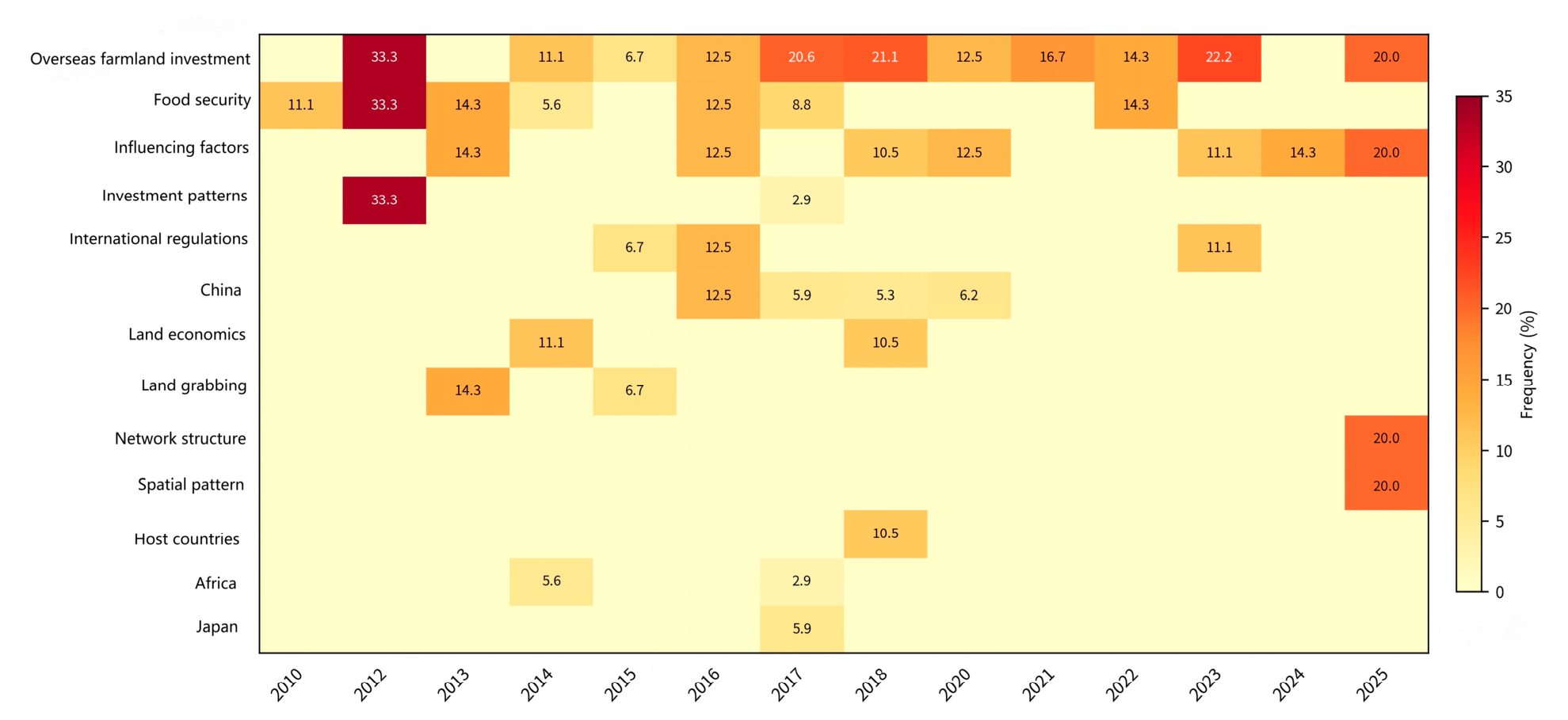
Figure 4.
Temporal heatmap of English core keyword frequencies.
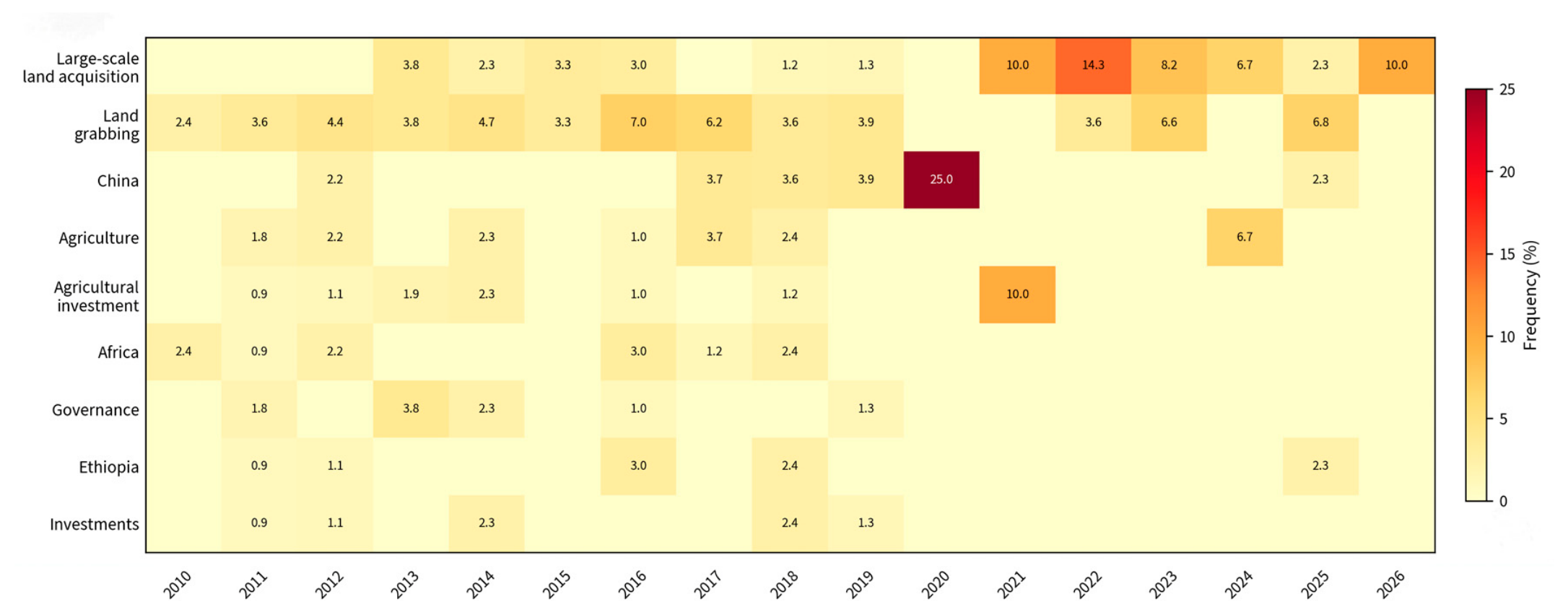

Table 1.
Systematic coding on the literature of overseas land investment.
| Selective Coding | Axial Coding | Open Coding |
| 1. Foundational theoretical system of overseas land investment (n=19) | Land system science and telecoupling theory (n=19) | Human–environment coupling, telecoupling, land-use transition, political economy of transnational investment, conceptual critique and Sino–Western comparison |
| 2. Full-chain research on conventional overseas land investment (n=166) | Driving mechanisms of overseas land investment (n=47) | Food security, resource reserves, host-country land policies, capital flows, geo-location, biofuel demand |
| Spatial–temporal patterns and actor networks of overseas land investment (n=26) | Global spatial distribution, investment networks, case studies in Africa/Southeast Asia/Latin America, Chinese overseas investment actors | |
| Socio-economic multi-dimensional effects of overseas land investment (n=34) | Foreign investment returns, landless smallholders, food sovereignty, community conflicts, socio-spatial polarisation, labour rights | |
| Ecological and carbon effects of overseas land investment (n=21) | Forest degradation, soil erosion, biodiversity loss, land-use displacement carbon emissions | |
| Global land governance frameworks and instruments (n=23) | RAI guidelines, World Bank land framework, bilateral investment treaties, community participation, ecological compensation mechanisms | |
| Conventional investment models and policy optimisation (n=15) | Land leasing, agricultural cooperation, industrial-chain investment, national foreign agricultural support policies | |
| 3. Emerging cross-cutting research on carbon-sink land investment under dual-carbon goals (n=27) | Driving logic of carbon-credit-based land investment (n=11) | Voluntary carbon markets, ESG, REDD+, Carbon Border Adjustment Mechanism (CBAM), financialisation of carbon-sink assets |
| New socio-ecological contradictions in carbon-sink land investment (n=9) | Carbon colonialism, constraints on indigenous production, monopolisation of carbon rights, inequitable benefit distribution, long-term land contract restrictions | |
| Global land governance transformation in the dual-carbon context (n=7) | North–South climate responsibilities and rights, mutual recognition of carbon standards, South–South ecological cooperation, just green transition | |
| 4. Comparison of Chinese and international research paradigms, themes, and value orientations (n=15) | Divergence in discourse and value orientations between Chinese and international research (n=15) | Western land-grabbing critique, China's food security strategy, global governance discourse differences, methodological divergences |
Disclaimer/Publisher’s Note: The statements, opinions and data contained in all publications are solely those of the individual author(s) and contributor(s) and not of MDPI and/or the editor(s). MDPI and/or the editor(s) disclaim responsibility for any injury to people or property resulting from any ideas, methods, instructions or products referred to in the content. |
© 2026 by the authors. Licensee MDPI, Basel, Switzerland. This article is an open access article distributed under the terms and conditions of the Creative Commons Attribution (CC BY) license (http://creativecommons.org/licenses/by/4.0/).
Copyright: This open access article is published under a Creative Commons CC BY 4.0 license, which permit the free download, distribution, and reuse, provided that the author and preprint are cited in any reuse.