

Submitted:
02 July 2026
Posted:
03 July 2026
You are already at the latest version
Abstract
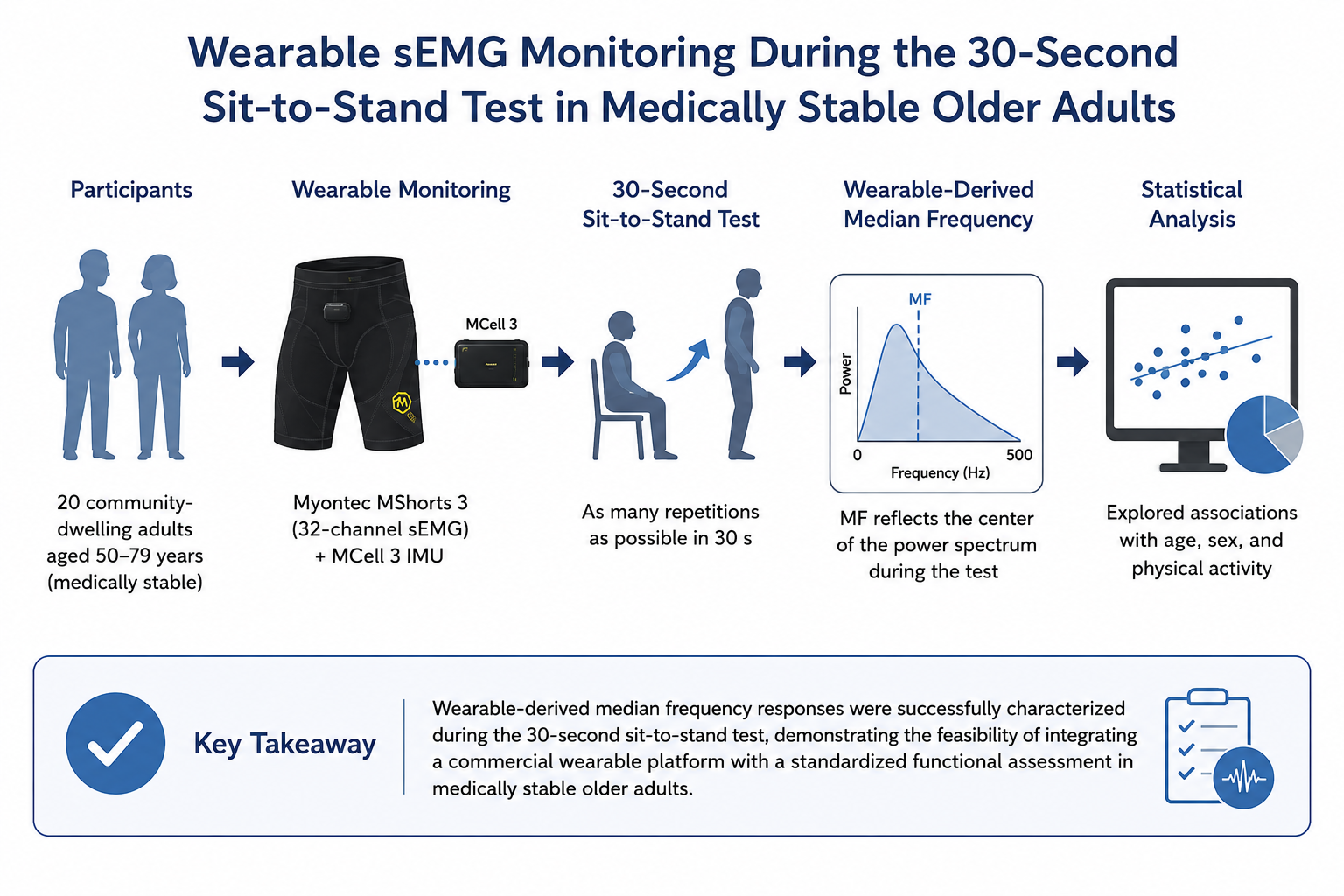
Background: The primary purpose of this feasibility-oriented investigation was to characterize wearable-derived median frequency (MF) responses during the standardized 30-second sit-to-stand (30-STS) assessment in medically stable adults aged 50–79 years using the Myontec MShorts 3 (Myontec Ltd., Kuopio, Finland) wearable monitoring platform and MBody Live application (Myontec Ltd., Kuopio, Finland). A secondary purpose was to examine associations among wearable-derived MF, age, biological sex, and self-reported physical activity. Methods: Twenty community-dwelling adults completed a standardized 30-STS assessment while wearable-derived physiological outputs were acquired using the Myontec MShorts 3 wearable monitoring platform. Participants were stratified into three age groups (50–59, 60–69, and 70–79 years), and habitual physical activity was assessed using the Rapid Assessment of Physical Activity (RAPA). Statistical outliers were identified using predefined standardized z-score criteria, resulting in a final analytical sample of sixteen participants. One-way analysis of variance examined age-group differences in wearable-derived MF, and multiple linear regression evaluated associations among wearable-derived MF, age, biological sex, and RAPA measures. Results: No statistically significant age-group differences in wearable-derived MF were observed (F(2,13) = 2.641, p = 0.109), although a moderate effect size was identified (η² = 0.289). Multiple linear regression did not identify significant associations among wearable-derived MF, age, biological sex, aerobic physical activity, or strength and flexibility activities (R² = 0.094, adjusted R² = -0.235). Wearable-derived physiological responses were successfully characterized during the standardized functional assessment, and substantial interindividual variability was observed across participants. Conclusions: Although statistically significant age-group differences and predictor relationships were not identified, the present investigation demonstrated the feasibility of integrating a commercially available wearable monitoring platform with a standardized functional assessment and a practical frequency-domain interpretive framework. The findings support continued investigation of wearable-derived physiological monitoring as a complementary approach for evaluating lower-extremity functional responses in exercise science, rehabilitation, and healthy aging.
Keywords:
wearable technology
; surface electromyography
; functional assessment
; healthy aging
; rehabilitation
; physiological monitoring
Copyright: This open access article is published under a Creative Commons CC BY 4.0 license, which permit the free download, distribution, and reuse, provided that the author and preprint are cited in any reuse.


