
Submitted:
02 July 2026
Posted:
03 July 2026
You are already at the latest version
Abstract
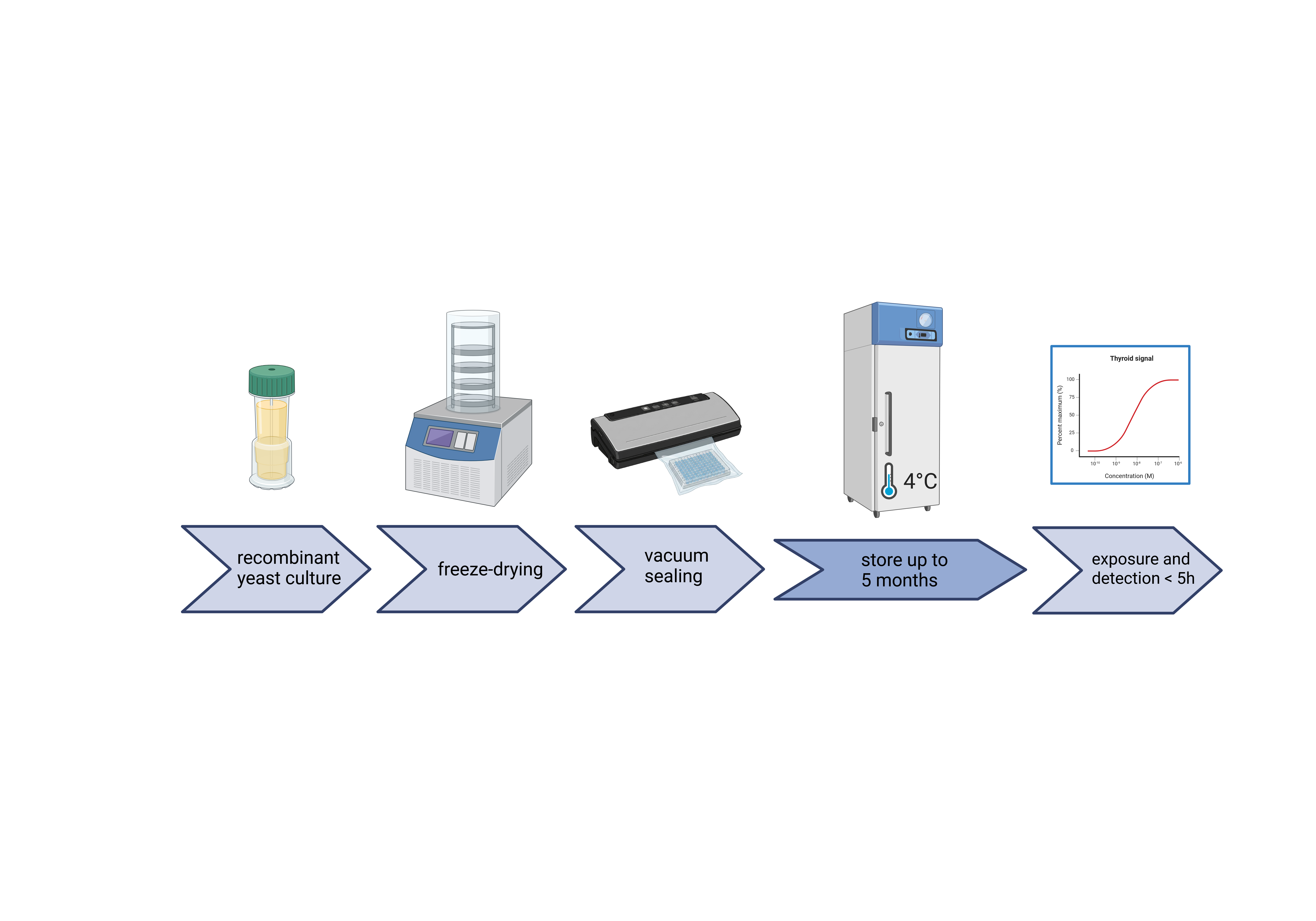
We report a freeze-dried ready-to-use yeast thyroid screen (YTS), displaying detection sensitivity and performance comparable to that of the freshly prepared counterpart. This field-deployable method reduces the duration of the worktime from several days to 5 hours with no requirement for sterile conditions, fulfilling key requirements for implementation in a biosensor array with on-site application. The effects of cell density and concentration of the cryoprotectant trehalose on median effective concentrations (EC50), limit of detection (LOD) and biosensor induction (IF) were determined and monitored over a storage period of 5 months. In addition, the impact of these parameters was monitored on the biosensor survival rate during freeze-drying and the subsequent storage process. Throughout the 5-month study, the freeze-dried recombinant yeast-assay retained comparable dose-response characteristics to those of the freshly prepared counterpart, displaying median values of EC50 in the range of 350 nM to 550 nM and LODs in the range of 20 nM to 45 nM of the reference compound thyroxine (T4). A proof of principle of the long-term stabilization is demonstrated using spiked (T4, 2 µM) river water and extracted wastewater effluent. After 5 months of storage, the T4 recoveries were 96 ± 38% and 112 ± 15% for river water and wastewater, respectively.
Keywords:
recombinant yeast assay
; thyroid
; ready-to-use
; freeze-drying
; cryopreservation
; long-term
; field-deployable
; survival-rate
Copyright: This open access article is published under a Creative Commons CC BY 4.0 license, which permit the free download, distribution, and reuse, provided that the author and preprint are cited in any reuse.


