

Submitted:
03 July 2026
Posted:
10 July 2026
You are already at the latest version
Abstract
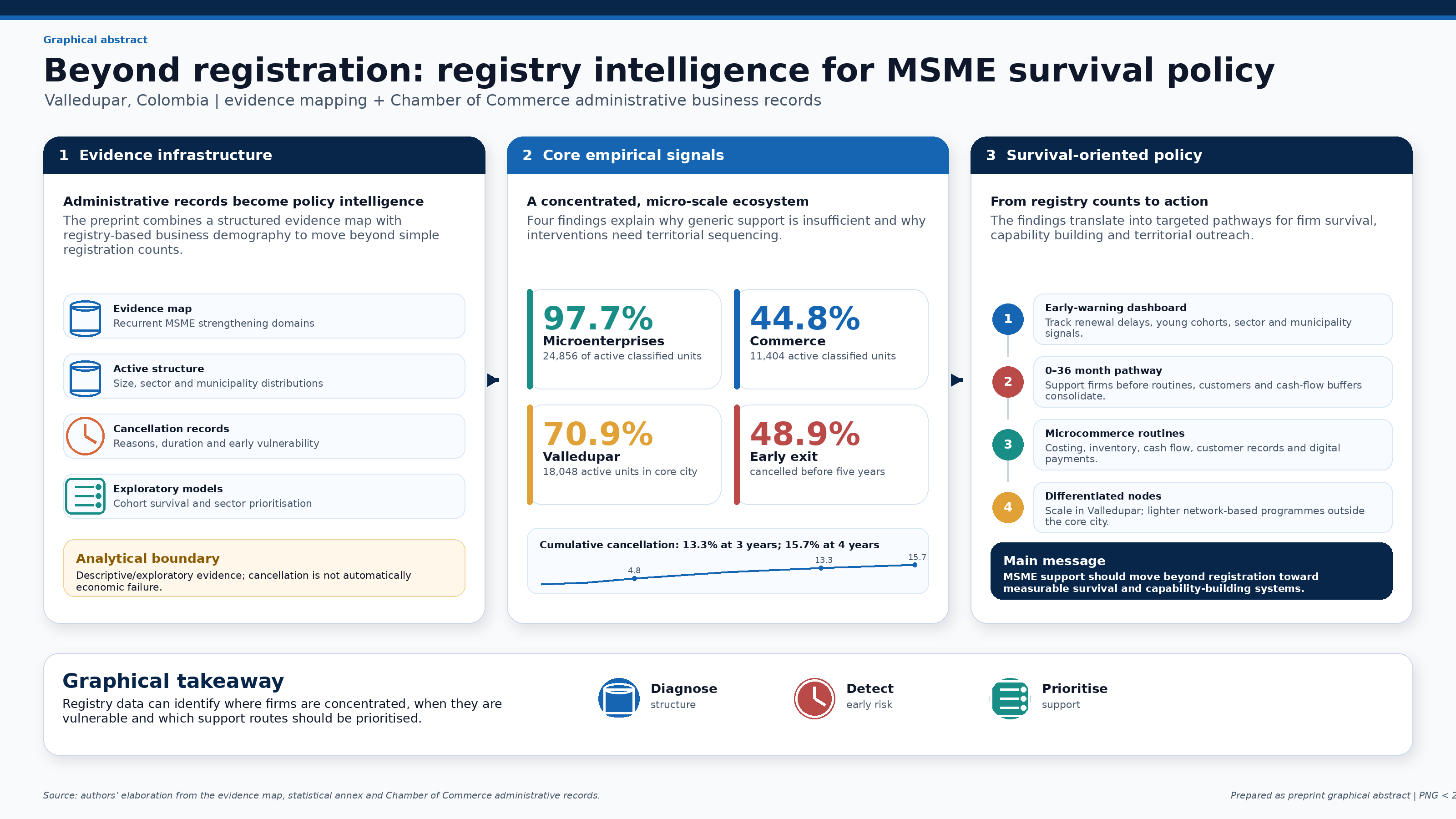
This article examines how administrative business records can strengthen place-based support for micro, small and medium-sized enterprises (MSMEs) in peripheral entrepreneurial ecosystems. It develops a structured evidence map and an exploratory business-demography analysis of Chamber of Commerce records from Valledupar, Colombia. The evidence map organises MSME constraints into formalisation, finance, digitalisation, managerial capabilities, innovation and markets, sustainability and governance. The registry analysis describes active business structure, sectoral and territorial concentration, cancellations, early survival and exploratory cancellation hazards. The active classified base contained 25,444 units; 97.7% were microenterprises. Commerce and repair accounted for 44.8%, and the core municipality of Valledupar concentrated 70.9%. Cancellation records were dominated by administrative clean-up (67.1%), requiring careful separation of registry updating from economic closure. Nevertheless, cancelled firms showed early vulnerability: the median duration was 5.03 years and 48.9% cancelled before five years. The article contributes to small business research by linking evidence mapping, business demography and territorial policy sequencing. It argues that MSME support should move beyond registration counts towards early-warning systems, capability-building routes and differentiated sectoral interventions.
Keywords:
MSMEs
; small business
; business demography
; firm survival
; administrative records
; entrepreneurial ecosystems
; territorial policy
; Colombia
1. Introduction
Micro, small and medium-sized enterprises (MSMEs) are a central component of employment, income generation and regional development. In emerging and middle-income economies, however, high MSME density does not automatically translate into productivity, innovation or survival. Persistent gaps in finance, formalisation, managerial capabilities and market access continue to limit the contribution of small firms to inclusive development (OECD/CAF/SELA, 2024).
Small business research has long shown that firm outcomes depend on resources, institutions, learning processes and local context. Resource-based and dynamic-capabilities perspectives emphasise internal routines and adaptability; institutional theory highlights rules, incentives and legitimacy; and entrepreneurial ecosystem research stresses the relational conditions that shape firm creation and survival (Porter, 1985; Barney, 1991; North, 1990; DiMaggio and Powell, 1983; Teece, 2007; Sirmon et al., 2011; Welter, 2011).
Valledupar, a medium-sized Colombian city and the core municipality of the Chamber of Commerce of Valledupar for the Cesar River Valley, provides a relevant empirical setting. It is not a global entrepreneurial hub, but precisely this makes it analytically valuable. Peripheral entrepreneurial ecosystems face a practical policy challenge: how to prioritise scarce support resources when the business base is dominated by microenterprises, commerce and low-scale services. This setting helps illuminate a wider question relevant to small business policy: how can administrative records be used to design more targeted and measurable MSME strengthening strategies? (Audretsch and Keilbach, 2004; Isenberg, 2010; Spigel, 2017; Cámara de Comercio de Valledupar para el Valle del Río Cesar, 2023, 2025).
The study addresses a gap between documentary evidence and territorial business policy. Evidence on formalisation, financing, digitalisation, managerial capabilities, innovation and sustainability is abundant, but often fragmented across disciplines and data sources. At the same time, business registries provide detailed administrative traces that are underused for policy learning. This paper brings these two streams together by combining structured evidence mapping with business-demography analysis based on administrative records (Franco-Ángel and Urbano, 2019; Vera-Colina et al., 2014; Jones et al., 2016; Sánchez-Torres et al., 2021; Bikefe et al., 2020; Cardoza et al., 2016).
The research objective is to identify, organise and translate MSME weaknesses, challenges and strengthening strategies into a measurable territorial agenda for Valledupar, Colombia, and to contrast that agenda with administrative evidence on business structure, sectoral concentration, cancellation records and early-stage survival. Three research questions guide the analysis: (1) What capability domains emerge from the evidence on MSME strengthening? (2) How is the active business structure distributed by size, sector and municipality? (3) What do cancellation and survival patterns reveal for prioritising territorial entrepreneurship support?
The contribution is threefold. First, the article links evidence-mapping logic with business-demography analysis based on administrative records. Second, it shows how registry data can be translated into actionable territorial priorities for MSME support. Third, it offers an analytically cautious approach that distinguishes descriptive and exploratory evidence from causal claims. Table 1 summarises how the article is positioned within small business and entrepreneurship research, particularly in relation to entrepreneurial ecosystems, territorial context and registry-based policy intelligence (Audretsch and Keilbach, 2004; Isenberg, 2010; Welter, 2011; Spigel, 2017).
2. Literature Background and Analytical Framework
2.1. MSMEs, Context and Entrepreneurial Ecosystems
MSME performance is inseparable from context. A firm’s ability to survive and grow depends not only on internal resources but also on the quality of institutions, markets, finance, infrastructure and support organisations. The entrepreneurial ecosystem literature emphasises the relational and contextual conditions that shape entrepreneurship, including networks, finance, culture, policy and support systems. For peripheral territories, ecosystem logic is especially important because resource scarcity and market thinness can magnify firm-level weaknesses (Isenberg, 2010; Welter, 2011; Spigel, 2017).
The notion of context is also central to interpreting formalisation. Formal registration may reduce information asymmetries and open access to support programmes, but it may not generate competitiveness if it is disconnected from managerial routines, bankability, market access and learning. In this sense, registration is a necessary institutional gateway, not a sufficient development outcome (North, 1990; DiMaggio and Powell, 1983; Ministerio de Comercio, Industria y Turismo de Colombia, 2019).
2.2. Resources, Capabilities and Small Business Strengthening
Resource-based theory argues that firms gain advantage from valuable, rare, inimitable and organised resources. In MSMEs, however, the most critical resources are often basic: reliable records, cost information, cash-flow routines, customer management and the ability to adjust products or channels. Dynamic capabilities theory complements this view by focusing on sensing, seizing and reconfiguring opportunities under uncertainty. For microenterprises, dynamic capability building often begins with simple routines: measuring sales, tracking inventory, evaluating margins and learning from customer feedback (Barney, 1991; Teece, 2007; Sirmon et al., 2011).
Resource orchestration is therefore a more appropriate policy objective than generic support delivery. A training session, a loan or a digital tool only becomes valuable when it is integrated into the firm’s routines. This is particularly relevant in territories where most firms are very small and owner-managed, because resource value depends on mobilisation, coordination and use across the firm life cycle (Barney, 1991; Teece, 2007; Sirmon et al., 2011).
2.3. Business Demography, Firm Age and Early Vulnerability
Business demography provides a complementary lens for small business research. The liability of newness suggests that young organisations face higher failure risk because they lack stable routines, legitimacy, relationships and resource buffers. Organisational ecology studies have shown that age and size are related to mortality, while small business research links early survival to experience, market position, finance and managerial capabilities (Stinchcombe, 1965; Freeman et al., 1983; Hannan and Freeman, 1984; Aldrich and Auster, 1986).
For policy, the implication is clear: new and young firms require more than registration. They need early-stage monitoring, renewal support, financial literacy, market access and practical management routines. Administrative records can help identify cohorts, sectors and municipalities where early vulnerability is more pronounced, consistent with business-demography and organisational-ecology perspectives on firm age, legitimacy and survival (Stinchcombe, 1965; Freeman et al., 1983; Hannan and Freeman, 1984; Aldrich and Auster, 1986).
2.4. Analytical Framework
The article integrates four lenses. The resource-based view explains why firm capabilities matter; institutional theory explains why formalisation and registry quality shape incentives; dynamic capabilities explain adaptation and learning; and business demography explains survival patterns. These lenses are connected through a place-based policy question: how can a territory convert registration data and fragmented evidence into a sequenced support agenda? (North, 1990; Barney, 1991; Teece, 2007; Welter, 2011).
The framework assumes that MSME strengthening should progress through four layers: (1) institutional entry and data quality, including registration and renewal; (2) basic managerial routines, including accounting, cost control and cash flow; (3) market and digital capabilities, including customer acquisition and payment channels; and (4) sector-specific upgrading, including differentiation, innovation, sustainability and wider market access. This staged logic is consistent with evidence on formalisation, finance, digitalisation, managerial capability and market access in small firms (Vera-Colina et al., 2014; Jones et al., 2016; Sánchez-Torres et al., 2021; OECD/CAF/SELA, 2024).
3. Data and Methods
3.1. Research Design
The study uses a mixed documentary and empirical design. A structured narrative evidence map was combined with exploratory empirical analysis of administrative business records from the Chamber of Commerce of Valledupar for the Cesar River Valley. Table 2 summarises the data sources, their analytical role and the methodological controls applied in the study. The evidence-mapping component was guided by transparency principles from PRISMA 2020, PRISMA-ScR and evidence-synthesis guidance (Page et al., 2021; Tricco et al., 2018; Munn et al., 2018; Higgins et al., 2024).
The design is intentionally cautious. The article does not claim causal impact or meta-analytic comparability. Instead, the documentary component identifies policy-relevant domains and the empirical component provides a territorial contrast that helps to prioritise interventions, following transparency principles for evidence mapping and narrative synthesis when heterogeneous sources cannot be pooled statistically (Page et al., 2021; Tricco et al., 2018; Munn et al., 2018; Higgins et al., 2024).
3.2. Administrative Data Cleaning and Variables
The administrative records were reviewed to identify duplicate or equivalent files, select a canonical version for each dataset and harmonise the interpretation of business registry fields. The active-structure tables contained both CIIU section-level rows and more detailed activity rows. To avoid double counting, the analysis of sectoral structure used section-level rows and classified totals from the administrative records (Cámara de Comercio de Valledupar para el Valle del Río Cesar, 2025).
The main variables were firm status, municipality, legal organisation, CIIU section, size class, registration date, renewal date, cancellation date and cancellation reason. Firm duration was calculated as the elapsed time between registration and cancellation for cancelled firms. For exploratory survival analysis, active registrations were treated as censored observations at the end of the observation window, using the cleaned Chamber of Commerce administrative records as the empirical base (Cámara de Comercio de Valledupar para el Valle del Río Cesar, 2025).
3.3. Statistical Strategy
The analysis first reports descriptive statistics for active business structure by size, sector and municipality. Sectoral and territorial concentration are described using participation shares and a Herfindahl-Hirschman Index for municipalities. Cancellation records are analysed by reason and duration, and all descriptive outputs are interpreted as registry-based indicators rather than direct measures of economic failure (Cámara de Comercio de Valledupar para el Valle del Río Cesar, 2025).
An exploratory Kaplan-Meier estimator was used to describe cumulative cancellation for the 2016–2019 cohort, and a Cox proportional hazards model was estimated to explore associations between sector, municipality, legal organisation and cancellation hazard (Kaplan and Meier, 1958; Cox, 1972). The model used commerce, Valledupar and natural person as reference categories. Results are interpreted as relative associations in administrative records, not as causal effects. Finally, a sectoral prioritisation index was constructed to translate empirical patterns into policy ordering. The index combined active magnitude, cancellation burden, three-year cumulative cancellation, early exit before five years and microenterprise weight. The index is not a causal score; it is a transparent policy heuristic for sequencing support (Cámara de Comercio de Valledupar para el Valle del Río Cesar, 2025).
4. Results
4.1. Evidence Map: Domains for MSME Strengthening
The evidence map grouped MSME constraints into seven domains: formalisation, finance, digitalisation, managerial capabilities, innovation and markets, sustainability and internationalisation, and territorial governance. Table 3 synthesises the core weakness, the capability to build and a suggested indicator for each domain, drawing on the evidence map and the literature on SME finance, digitalisation, capabilities, sustainability and internationalisation (Vera-Colina et al., 2014; Cardoza et al., 2016; Jones et al., 2016; Bikefe et al., 2020; Sánchez-Torres et al., 2021; OECD/CAF/SELA, 2024).
For Valledupar, the evidence map suggests that policy should be sequenced rather than fragmented. As shown in Table 3, formalisation, managerial routines and commercially oriented digitalisation should come first, while more advanced sector-specific upgrading should follow once basic routines exist (Barney, 1991; Teece, 2007; Sirmon et al., 2011; OECD/CAF/SELA, 2024).
4.2. Active Business Structure: Micro-Scale and Sectoral Concentration
Figure 1 integrates the central indicators of the active business structure with the sectoral profile. The active classified business structure contained 25,444 units, of which 24,856 were microenterprises (97.7%), confirming that the local business base is overwhelmingly micro-scale, with limited internal administrative and financial capacity (Cámara de Comercio de Valledupar para el Valle del Río Cesar, 2025).
As also shown in Figure 1, the sectoral distribution is concentrated. Commerce and repair accounted for 11,404 active classified units (44.8%), followed by accommodation and food services (3,220; 12.7%) and manufacturing (2,047; 8.0%). This profile supports the prioritisation of microcommerce, face-to-face services and early business routines, consistent with the need to connect formalisation, finance, digitalisation and managerial capability in MSME support (Vera-Colina et al., 2014; Sánchez-Torres et al., 2021; OECD/CAF/SELA, 2024).
4.3. Territorial Concentration
Figure 2 shows a strong territorial concentration of active units. Valledupar concentrated 70.9% of active classified business units (18,048), far above the following municipalities, including La Jagua de Ibirico, Agustín Codazzi, Bosconia and El Paso (Cámara de Comercio de Valledupar para el Valle del Río Cesar, 2025).
Territorial concentration matters because the same programme architecture cannot be applied uniformly. As indicated by Figure 2, the core city can support larger-scale interventions, while smaller municipalities may require lighter-touch, network-based programmes and staged digitalisation pathways, consistent with place-based and ecosystem approaches to entrepreneurship support (Isenberg, 2010; Welter, 2011; Spigel, 2017).
4.4. Cancellation Records and Early Survival
Table 4 and Figure 3 summarise the cancellation profile. The cancellation database contained 23,624 records. The dominant reason was administrative clean-up (15,861; 67.1%), which should not be interpreted automatically as economic closure because many registry cancellations reflect administrative updating, clean-up or registry regularisation (Cámara de Comercio de Valledupar para el Valle del Río Cesar, 2025).
At the same time, Table 4 and Figure 4 reveal early vulnerability in business duration. The median duration of cancelled firms was 5.03 years; 48.9% of cancellations occurred before five years and 86.0% before ten years. The cumulative cancellation estimate reached 13.3% at three years when active firms were treated as censored observations, reinforcing the need to interpret survival estimates as exploratory registry indicators (Kaplan and Meier, 1958; Cámara de Comercio de Valledupar para el Valle del Río Cesar, 2025).
These findings align with the liability-of-newness perspective and with wider Colombian concern about early firm survival, because many firms disappear before they consolidate routines, customer relationships and managerial capabilities (Confecámaras, 2023). Figure 3 and Figure 4 therefore suggest that early support should focus on the first years of operation rather than only on mature firms.
4.5. Exploratory Cox Model and Sectoral Prioritisation
The exploratory Cox model was estimated using the 2016–2019 cohort and selected categories with sufficient observations. Table 5 reports the main results, and Figure 5 summarises the exploratory sectoral prioritisation derived from the wider evidence base. The reference categories were commerce, Valledupar and natural person; therefore, the estimates should be read as relative associations within the registry data, not as causal effects (Cox, 1972; Cámara de Comercio de Valledupar para el Valle del Río Cesar, 2025).
As shown in Table 5, higher relative hazards were observed in financial and insurance activities, human health and social assistance, arts, entertainment and recreation, and accommodation and food services. Figure 5 complements this pattern by showing that intervention priority depends not only on hazard, but also on business volume, cancellation load, early exit and microenterprise weight. Table 6 translates these registry patterns into territorial policy decisions that can inform prioritisation and monitoring (Cámara de Comercio de Valledupar para el Valle del Río Cesar, 2025).
5. Discussion
5.1. Contribution to Small Business Theory
The findings contribute to small business research by showing that registry-based business demography can enrich territorial MSME policy. The article does not treat registration as the endpoint of formalisation. Instead, it shows that the registry is a potential learning infrastructure: it can reveal concentration, age profiles, cancellation reasons and early-risk cohorts. This supports a shift from counting firms to understanding firm trajectories, connecting administrative evidence with entrepreneurial ecosystem and business-demography perspectives (Aldrich and Auster, 1986; Isenberg, 2010; Welter, 2011; Spigel, 2017).
The study also extends the liability-of-newness argument to a peripheral Latin American entrepreneurial ecosystem. Early vulnerability is not only a firm-level problem; it is shaped by the local ecosystem’s ability to provide timely capabilities. Where firms are predominantly micro-scale and concentrated in commerce, the first policy layer should be basic managerial and market routines, not sophisticated innovation instruments (Stinchcombe, 1965; Freeman et al., 1983).
Finally, the article connects resource-based and institutional perspectives. Formalisation creates an institutional entry point, but resources and capabilities determine whether firms convert that entry into survival and upgrading. This integration is particularly relevant for MSME contexts where low-scale firms face both institutional and organisational constraints (North, 1990; Barney, 1991; Teece, 2007).
5.2. Policy and Managerial Implications
For chambers of commerce and local governments, the central implication is to convert registry data into an early-warning and prioritisation system. Renewal delays, young firm cohorts, sectoral concentration and cancellation histories can be monitored to trigger targeted support before firms exit the registry. This approach is more actionable than generic entrepreneurship events or broad training campaigns and is consistent with place-based ecosystem policy and administrative-record learning (Isenberg, 2010; Spigel, 2017; Cámara de Comercio de Valledupar para el Valle del Río Cesar, 2025).
For financial institutions, the findings point to the need for credit with capability-building. A microenterprise without cash-flow records or cost information may receive credit but still remain fragile. Financial products should therefore be linked to simple accounting, inventory and sales routines, because access to finance in MSMEs is closely related to information quality, creditworthiness and internal financial management (Vera-Colina et al., 2014; OECD/CAF/SELA, 2024).
For universities, the results support consultorio empresarial models and cohort-based accompaniment. Students and faculty can help microenterprises adopt dashboards, digital sales tools, product differentiation and basic financial planning. For business owners, the managerial message is practical: survival is associated with routines, not only with motivation or formal registration (Barney, 1991; Teece, 2007; Sirmon et al., 2011).
5.3. Why This Matters Beyond Valledupar
Although the empirical setting is local, the problem is not. Many peripheral entrepreneurial ecosystems have dense microenterprise bases, high dependence on commerce and limited capacity to measure support outcomes. The methodological logic of this paper—evidence mapping plus administrative business demography—can be replicated in other chambers of commerce, municipalities and regions (Audretsch and Keilbach, 2004; Isenberg, 2010; Welter, 2011; OECD/CAF/SELA, 2024).
The article therefore offers transferable lessons rather than universal causal estimates. It shows how a territory can use imperfect but available data to identify priorities, design pathways and distinguish administrative clean-up from economic exit. This is valuable for policymakers and researchers working in settings where experimental data or complete survey microdata are not available, provided that descriptive, exploratory and causal claims remain clearly separated (Page et al., 2021; Tricco et al., 2018; Higgins et al., 2024).
5.4. Limitations and Future Research
The study has limitations. First, the documentary component is a structured evidence map rather than a formal systematic review with independent double screening and risk-of-bias assessment. Second, the administrative analysis is exploratory and does not identify causal effects. Third, registry cancellation is a mixed administrative event and should not be interpreted as firm death without qualification. Fourth, the EMICRON file available for this stage contained no useful observations, limiting firm-level analysis of finance, digitalisation, innovation and managerial capabilities (Page et al., 2021; Tricco et al., 2018; Munn et al., 2018; Higgins et al., 2024).
Future research should build a firm-level panel that links registry data with survey data on finance, management routines, digital adoption, sales and employment. A local baseline and repeated measurements would allow stronger tests of survival, growth and intervention effects. Future work should also compare Valledupar with other intermediate cities to examine whether microenterprise dominance and early vulnerability follow similar patterns across peripheral entrepreneurial ecosystems (Audretsch and Keilbach, 2004; Isenberg, 2010; Spigel, 2017).
6. Conclusions
This paper examined MSME strengthening in Valledupar, Colombia, by combining structured evidence mapping with administrative business-demography analysis. As shown in Figure 1, the results indicate a business structure dominated by microenterprises, commerce and the core municipality of Valledupar. As shown in Table 4 and Figure 3 and Figure 4, cancellation records must be interpreted carefully because administrative clean-up explains most registry cancellations, while duration patterns still point to early-stage vulnerability (Confecámaras, 2023; Cámara de Comercio de Valledupar para el Valle del Río Cesar, 2025).
The main conclusion is that place-based MSME support should move beyond registration and isolated training. A stronger strategy should use registry data to identify cohorts, sectors and territories; provide early-stage accompaniment during the first years; build practical routines in accounting, cash flow, inventory and customer management; and differentiate support for microcommerce, face-to-face services and municipalities outside the core city. Table 6 summarises this policy translation and links it to observable operational recommendations (North, 1990; Barney, 1991; Teece, 2007; OECD/CAF/SELA, 2024).
The article contributes to the International Journal of Entrepreneurship and Small Business readership by linking small business theory, administrative records and practical policy design in a peripheral entrepreneurial ecosystem. It offers a replicable approach for territories seeking to transform business registries into systems for learning, prioritisation and survival-oriented entrepreneurship support (Welter, 2011; Spigel, 2017; Cámara de Comercio de Valledupar para el Valle del Río Cesar, 2025).
Funding
The authors declare that this manuscript received no specific external funding, unless updated by the author team before submission.
Conflicts of Interest
The authors declare no conflict of interest related to the content of this manuscript. Institutional affiliations are disclosed in the author information.
Ethical considerations
The study used documentary sources and secondary administrative records. The reported analyses are aggregated by sector, municipality, size, legal form and year; no names, tax identifiers or individual firm-level information are disclosed.
Data availability
Aggregated tables, the statistical annex and figures may be shared as supplementary material after metadata review, licence verification and removal of any confidential or identifying information by the authors.
Use of artificial intelligence
AI assistance was used for editorial support, structure, language refinement and consistency checking. The authors remain responsible for source verification, data interpretation, analysis, integrity and final scientific decisions.
References
- Aldrich, H. and Auster, E.R. (1986) ‘Even dwarfs started small: liabilities of age and size and their strategic implications’, Research in Organizational Behavior, Vol. 8, pp.165-198.
- Audretsch, D.B. and Keilbach, M. (2004) ‘Entrepreneurship capital and economic performance’, Regional Studies, Vol. 38 No. 8, pp.949-959.
- Barney, J. (1991) ‘Firm resources and sustained competitive advantage’, Journal of Management, Vol. 17 No. 1, pp.99-120. [CrossRef]
- Bikefe, G., Zubairu, U., Araga, S., Maitala, F., Ediuku, E. and Anyebe, D. (2020) ‘Corporate social responsibility by small and medium enterprises: a systematic review’, Small Business International Review, Vol. 4 No. 1, pp.16-33. [CrossRef]
- Cámara de Comercio de Valledupar para el Valle del Río Cesar (2023) Estimación del potencial de comerciantes 2023, Observatorio Socioeconómico, Valledupar.
- Cámara de Comercio de Valledupar para el Valle del Río Cesar (2025) Administrative records on active registrations, cancelled registrations and business structure by CIIU, size and municipality, Valledupar.
- Cardoza, G., Fornes, G., Farber, V., Gonzalez Duarte, R. and Ruiz Gutierrez, J. (2016) ‘Barriers and public policies affecting the international expansion of Latin American SMEs: evidence from Brazil, Colombia, and Peru’, Journal of Business Research, Vol. 69 No. 6, pp.2030-2039. [CrossRef]
- Confecámaras (2023) Según estudio de Confecámaras el 33,5% de las empresas del país sobreviven al término de 5 años, Confecámaras, Bogotá.
- Cox, D.R. (1972) ‘Regression models and life-tables’, Journal of the Royal Statistical Society: Series B, Vol. 34 No. 2, pp.187-220.
- DiMaggio, P.J. and Powell, W.W. (1983) ‘The iron cage revisited: institutional isomorphism and collective rationality in organizational fields’, American Sociological Review, Vol. 48 No. 2, pp.147-160.
- Franco-Ángel, M. and Urbano, D. (2019) ‘Caracterización de las pymes colombianas y de sus fundadores: un análisis desde dos regiones del país’, Estudios Gerenciales, Vol. 35 No. 150, pp.81-91. [CrossRef]
- Freeman, J., Carroll, G.R. and Hannan, M.T. (1983) ‘The liability of newness: age dependence in organizational death rates’, American Sociological Review, Vol. 48 No. 5, pp.692-710.
- Hannan, M.T. and Freeman, J. (1984) ‘Structural inertia and organizational change’, American Sociological Review, Vol. 49 No. 2, pp.149-164.
- Higgins, J.P.T., Thomas, J., Chandler, J., Cumpston, M., Li, T., Page, M.J. and Welch, V.A. (eds.) (2024) Cochrane Handbook for Systematic Reviews of Interventions, Version 6.5, Cochrane.
- Isenberg, D.J. (2010) ‘How to start an entrepreneurial revolution’, Harvard Business Review, Vol. 88 No. 6, pp.40-50.
- Jones, C., Motta, J. and Alderete, M.V. (2016) ‘Gestión estratégica de tecnologías de información y comunicación y adopción del comercio electrónico en MiPymes de Córdoba, Argentina’, Estudios Gerenciales, Vol. 32 No. 138, pp.4-13. [CrossRef]
- Kaplan, E.L. and Meier, P. (1958) ‘Nonparametric estimation from incomplete observations’, Journal of the American Statistical Association, Vol. 53 No. 282, pp.457-481. [CrossRef]
- Ministerio de Comercio, Industria y Turismo de Colombia (2019) Decreto 957 de 2019: clasificación de empresas por tamaño según ingresos por actividades ordinarias anuales, Bogotá.
- Munn, Z., Peters, M.D.J., Stern, C., Tufanaru, C., McArthur, A. and Aromataris, E. (2018) ‘Systematic review or scoping review? Guidance for authors when choosing between a systematic or scoping review approach’, BMC Medical Research Methodology, Vol. 18, Article 143. [CrossRef]
- North, D.C. (1990) Institutions, Institutional Change and Economic Performance, Cambridge University Press, Cambridge.
- OECD/CAF/SELA (2024) SME Policy Index: Latin America and the Caribbean 2024: Towards an Inclusive, Resilient, and Sustainable Recovery, OECD Publishing, Paris. [CrossRef]
- Page, M.J., McKenzie, J.E., Bossuyt, P.M., Boutron, I., Hoffmann, T.C., Mulrow, C.D. et al. (2021) ‘The PRISMA 2020 statement: an updated guideline for reporting systematic reviews’, BMJ, Vol. 372, n71. [CrossRef]
- Porter, M.E. (1985) Competitive Advantage: Creating and Sustaining Superior Performance, Free Press, New York.
- Sánchez-Torres, J.A., Rojas Berrío, S.P. and Ortiz Rendón, P.A. (2021) ‘The adoption of e-commerce in SMEs: the Colombian case’, Journal of Telecommunications and the Digital Economy, Vol. 9 No. 3, pp.110-135. [CrossRef]
- Sirmon, D.G., Hitt, M.A., Ireland, R.D. and Gilbert, B.A. (2011) ‘Resource orchestration to create competitive advantage: breadth, depth, and life cycle effects’, Journal of Management, Vol. 37 No. 5, pp.1390-1412.
- Spigel, B. (2017) ‘The relational organization of entrepreneurial ecosystems’, Entrepreneurship Theory and Practice, Vol. 41 No. 1, pp.49-72.
- Stinchcombe, A.L. (1965) ‘Social structure and organizations’, in March, J.G. (Ed.), Handbook of Organizations, Rand McNally, Chicago, pp.142-193.
- Teece, D.J. (2007) ‘Explicating dynamic capabilities: the nature and microfoundations of sustainable enterprise performance’, Strategic Management Journal, Vol. 28 No. 13, pp.1319-1350. [CrossRef]
- Tricco, A.C., Lillie, E., Zarin W., O’Brien K.K., Colquhoun H., Levac D. et al. (2018) ‘PRISMA extension for scoping reviews (PRISMA-ScR): checklist and explanation’, Annals of Internal Medicine, Vol. 169 No. 7, pp.467-473. [CrossRef]
- Vera-Colina, M.A., Melgarejo-Molina, Z.A. and Mora-Riapira, E.H. (2014) ‘Acceso a la financiación en Pymes colombianas: una mirada desde sus indicadores financieros’, Innovar, Vol. 24 No. 53, pp.149-160. [CrossRef]
- Welter, F. (2011) ‘Contextualizing entrepreneurship: conceptual challenges and ways forward’, Entrepreneurship Theory and Practice, Vol. 35 No. 1, pp.165-184.
Figure 1.
Active business structure: integrated sector and structural profile. Source: Authors’ elaboration from Chamber of Commerce administrative records.
Figure 1.
Active business structure: integrated sector and structural profile. Source: Authors’ elaboration from Chamber of Commerce administrative records.
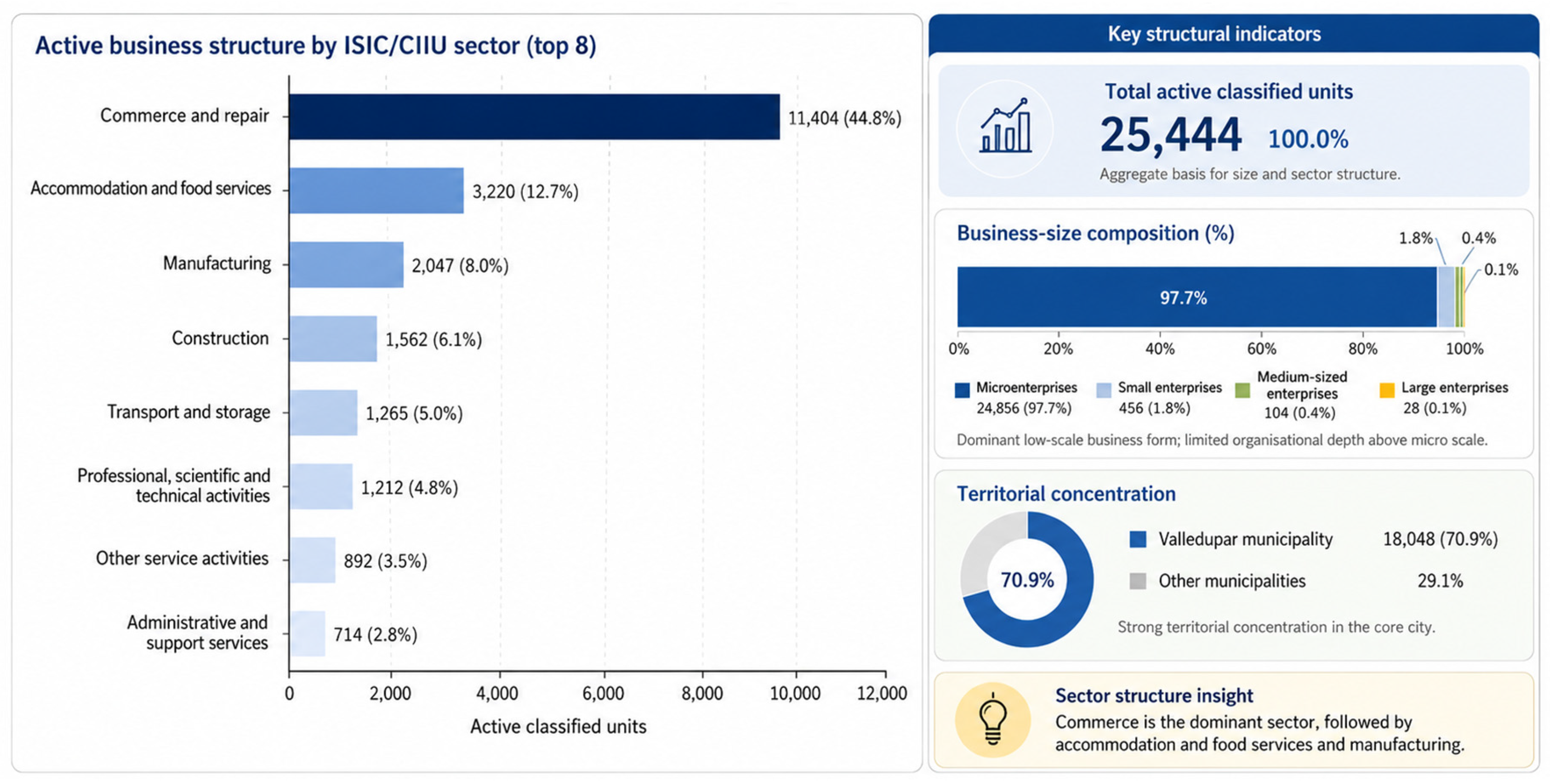
Figure 2.
Territorial concentration of active units (top 10 municipalities). Source: Authors’ elaboration from Chamber of Commerce administrative records.
Figure 2.
Territorial concentration of active units (top 10 municipalities). Source: Authors’ elaboration from Chamber of Commerce administrative records.
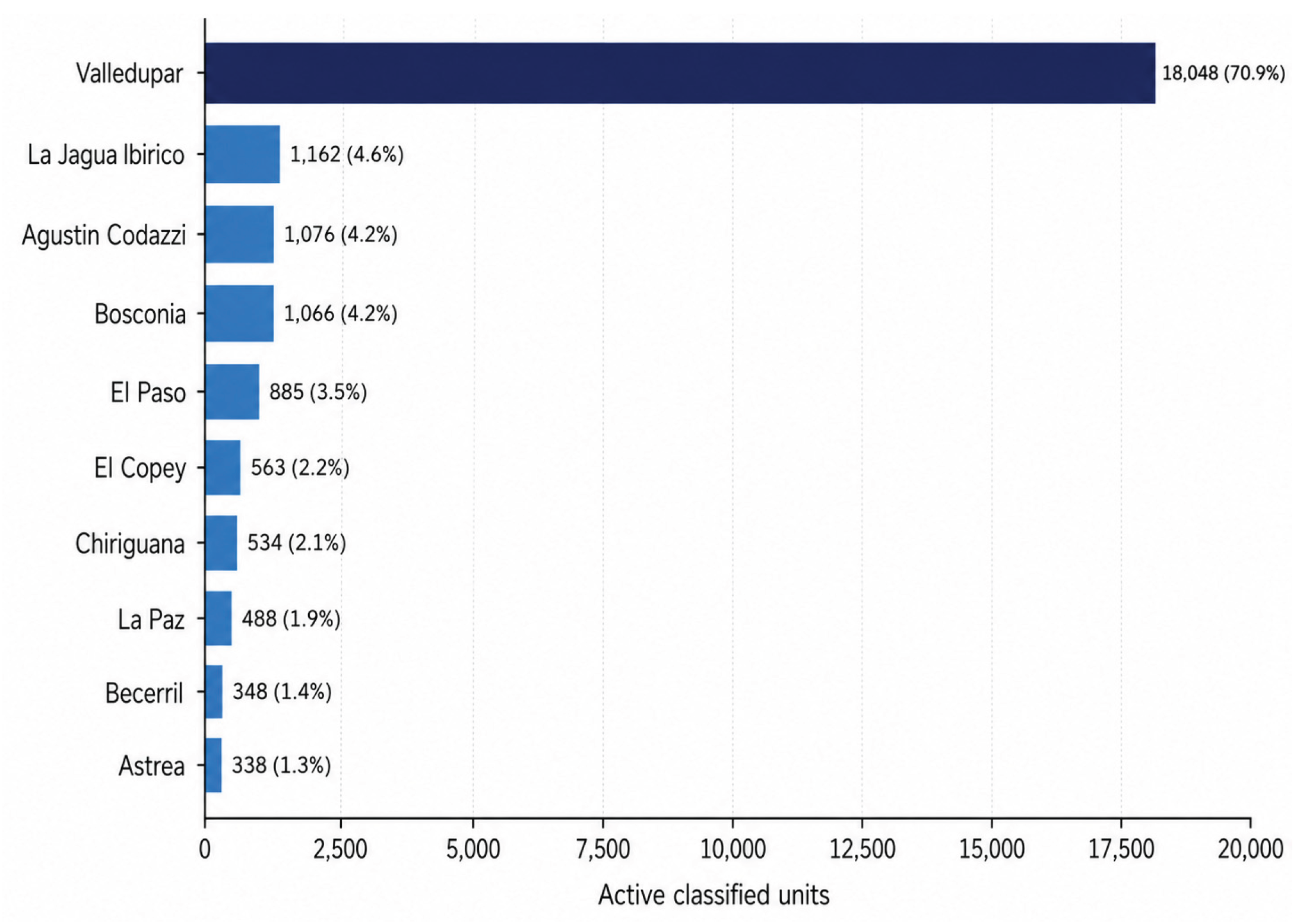
Figure 3.
Registry cancellation profile and exploratory survival indicators. Source: Authors’ elaboration from the evidence map, statistical annex and Chamber of Commerce administrative records, unless otherwise stated.
Figure 3.
Registry cancellation profile and exploratory survival indicators. Source: Authors’ elaboration from the evidence map, statistical annex and Chamber of Commerce administrative records, unless otherwise stated.
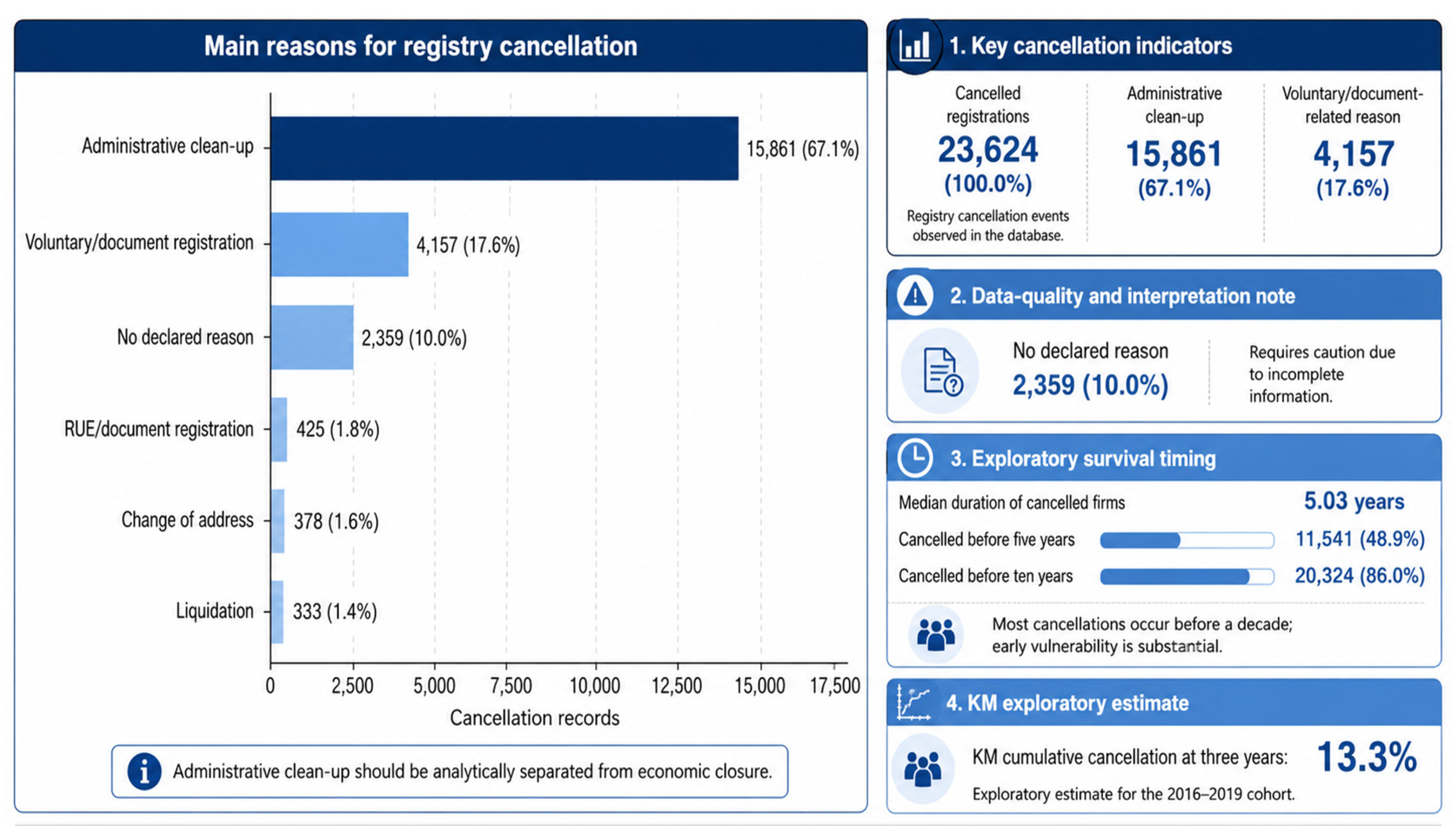
Figure 4.
Cumulative cancellation estimate, 2016–2019 cohort. Source: Authors’ elaboration from Chamber of Commerce administrative records.
Figure 4.
Cumulative cancellation estimate, 2016–2019 cohort. Source: Authors’ elaboration from Chamber of Commerce administrative records.
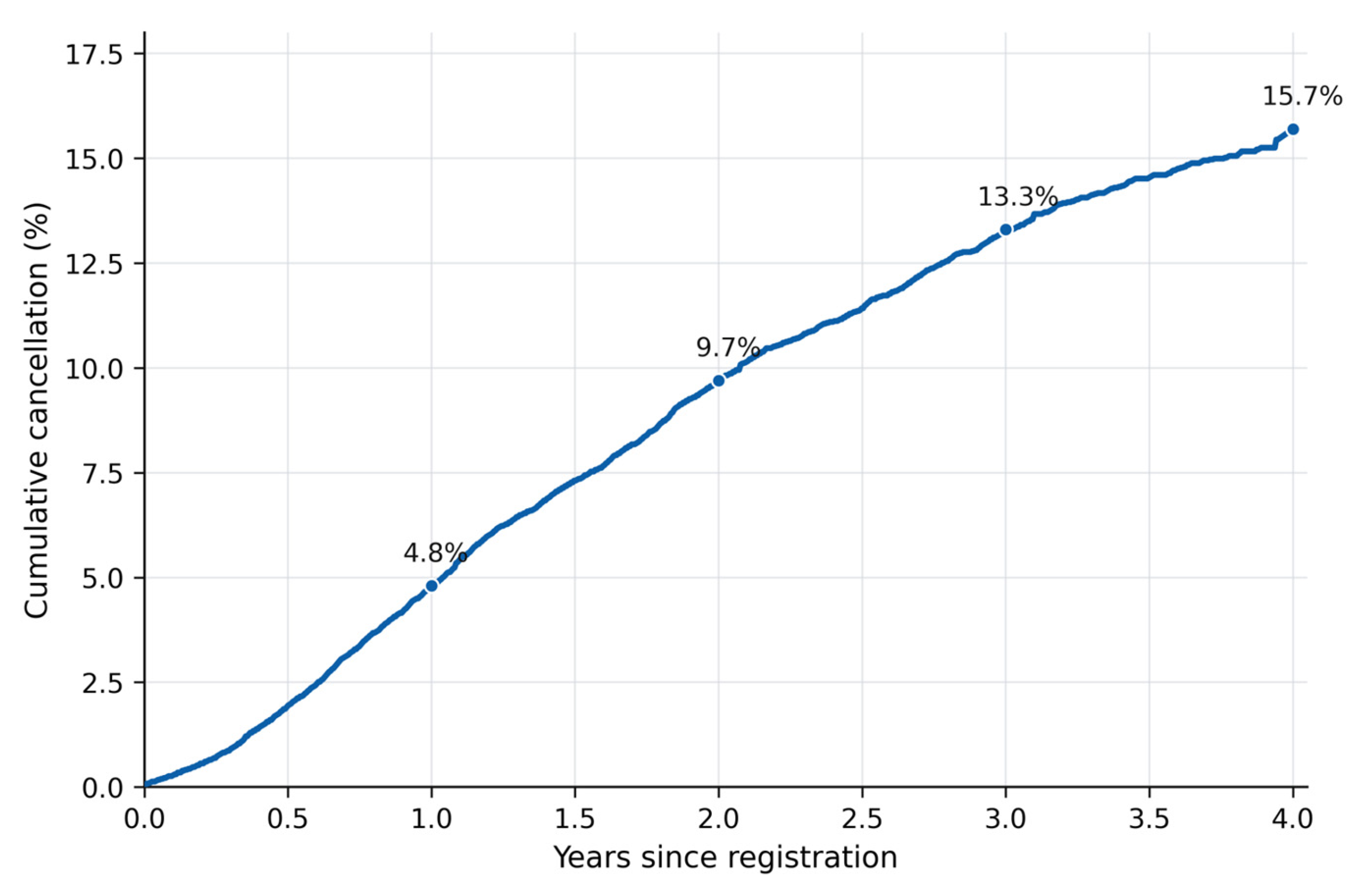
Figure 5.
Exploratory sectoral prioritisation for territorial intervention. Source: Authors’ elaboration from Chamber of Commerce administrative records.
Figure 5.
Exploratory sectoral prioritisation for territorial intervention. Source: Authors’ elaboration from Chamber of Commerce administrative records.
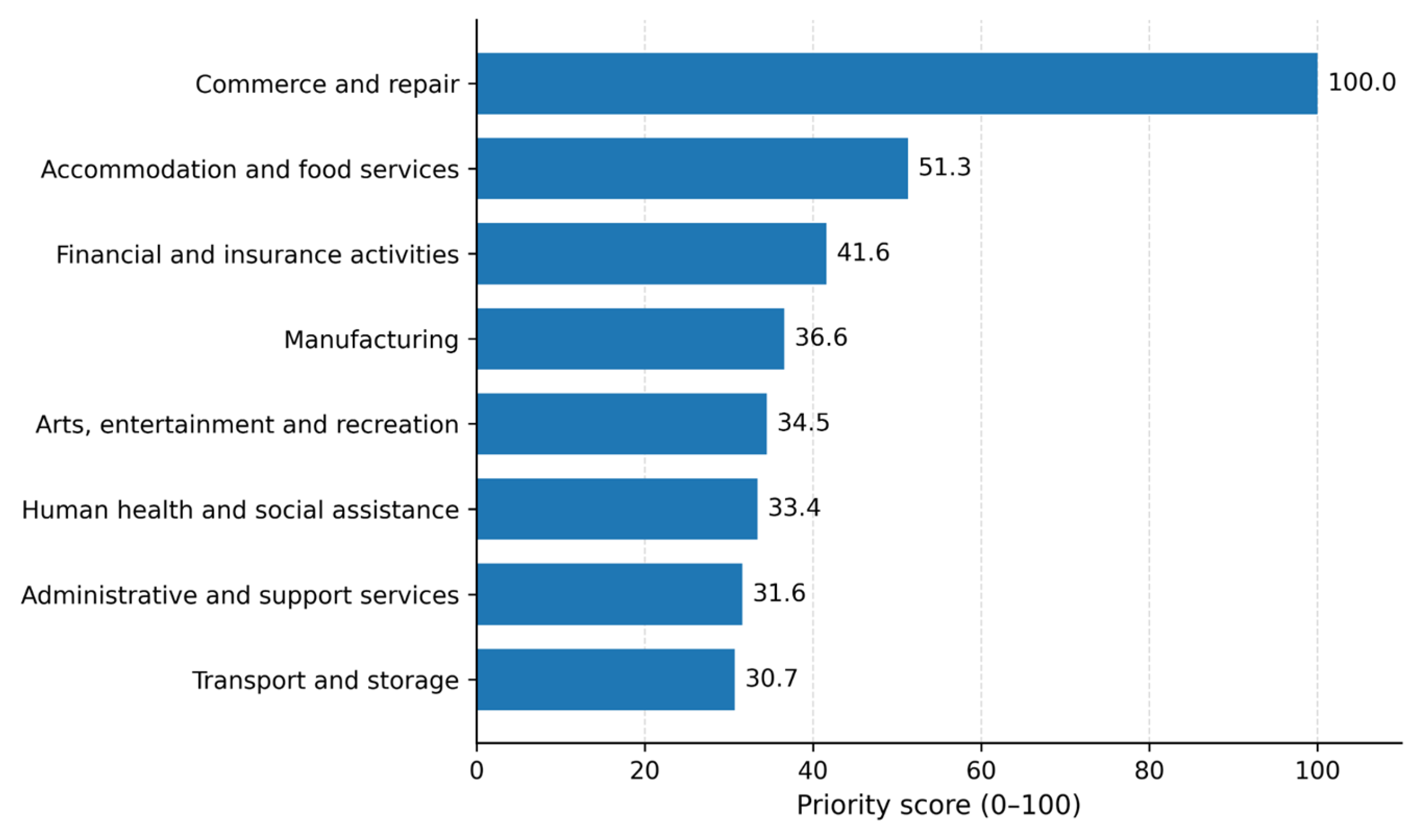

Table 1.
Positioning of the article for small business and entrepreneurship research.
| Dimension | Problem in prior work | Response in this article | Contribution |
| Empirical setting | Peripheral and intermediate cities are less represented than metropolitan entrepreneurial ecosystems. | Uses Valledupar and the Chamber of Commerce jurisdiction as a territorial case. | Adds evidence from a Latin American peripheral ecosystem. |
| Data use | Business registries are often treated as administrative counts rather than policy intelligence. | Analyses active structure, cancellations, duration and exploratory hazards. | Shows how registries can support early-warning and prioritisation. |
| Policy design | MSME support often appears as fragmented services: registration, credit, training or digitalisation. | Organises evidence into sequential capability domains and links them to registry patterns. | Proposes a place-based capability-building agenda. |
| Methodological stance | Evidence is heterogeneous and often unsuitable for meta-analysis. | Uses structured evidence mapping and avoids unsupported causal claims. | Balances transparency, empirical contrast and policy usefulness. |
Source: Authors’ elaboration from the evidence map, statistical annex and Chamber of Commerce administrative records, unless otherwise stated.
Table 2.
Data sources and analytical use.
| Source | Volume used | Analytical role | Methodological control |
| Evidence audit | 6,234 raw API records; 300 prioritised records; 45 open-access PDFs; 10 Elicit reviews; 960 Web of Science records. | Identification of recurrent MSME strengthening domains. | Counts are reported as audit traces, not as final included studies for meta-analysis. |
| Active registrations | 30,964 individual registry records. | Used for cohort construction and censored observations in survival analysis. | Not added to aggregate structure tables without reconciliation. |
| Cancelled registrations | 23,624 records with valid cancellation information. | Used for duration, cancellation reasons and cancellation events. | Registry cancellation is not automatically interpreted as economic failure. |
| Active structure by CIIU/size | 403 rows; 25,444 active classified units. | Used for size and sector structure. | Section-level CIIU rows were used to avoid double counting. |
| Active structure by CIIU/municipality | 405 rows; 25,445 active classified units. | Used for territorial concentration. | Minor total difference is reported as an administrative aggregation issue. |
| EMICRON file | No useful observations in the file available for this stage. | Not used for firm-level finance, digitalisation or innovation indicators. | A complementary survey or valid microdata are recommended. |
Source: Authors’ elaboration from the evidence map, statistical annex and Chamber of Commerce administrative records, unless otherwise stated.
Table 3.
Evidence domains and territorial capability translation.
| Domain | Core weakness | Capability to build | Suggested indicator |
| Formalisation and institutions | Formal status may remain a procedural requirement. | Registration, renewal, tax and accounting routines connected to benefits. | Renewal continuity; tax and accounting compliance; programme access. |
| Finance and working capital | Limited creditworthiness and weak cash-flow information. | Costing, cash-flow planning, inventory and receivables management. | Monthly cash-flow use; margin tracking; approved credit without early arrears. |
| Digital transformation | Digital tools are adopted without commercial integration. | Catalogues, digital payments, customer records and basic analytics. | Digital sales share; conversion; payment adoption; customer retention. |
| Managerial capabilities | Owner-managed firms lack formal routines. | Simple dashboards, sales targets and decision routines. | Use of monthly indicators; inventory control; sales planning. |
| Innovation and markets | Low differentiation and dependence on local demand. | Incremental product, service, packaging and channel innovation. | New products; new customers; repeat sales; new channels. |
| Sustainability and internationalisation | Higher-level agendas are difficult without basic capabilities. | Efficiency, compliance and gradual market expansion. | Resource efficiency; certifications; sales outside the municipality. |
| Territorial governance | Support programmes are dispersed and weakly measured. | A shared MSME dashboard and coordinated support pathway. | Coverage, completion, adoption and survival indicators. |
Source: Authors’ elaboration from the evidence map, statistical annex and Chamber of Commerce administrative records, unless otherwise stated.
Table 4.
Cancellation records and exploratory survival indicators.
| Indicator | Value | Share | Interpretation |
| Cancelled registrations | 23,624 | 100.0% | Registry cancellation events observed in the database. |
| Administrative clean-up | 15,861 | 67.1% | Must be separated from economic closure. |
| Voluntary/document-related reason | 4,157 | 17.6% | Declared exit or procedure-linked cancellation. |
| No declared reason | 2,359 | 10.0% | Requires caution due to incomplete information. |
| Median duration of cancelled firms | 5.03 years | — | Half of cancelled firms lasted up to this threshold. |
| Cancelled before five years | 11,541 | 48.9% | Evidence of early vulnerability. |
| Cancelled before ten years | 20,324 | 86.0% | Most cancellations occur before a decade. |
| KM cumulative cancellation at three years | — | 13.3% | Exploratory estimate for the 2016-2019 cohort. |
Source: Authors’ elaboration from the evidence map, statistical annex and Chamber of Commerce administrative records, unless otherwise stated.
Table 5.
Selected results from the exploratory Cox model.
| Variable | HR | 95% CI | p-value | Reading |
| Financial and insurance activities | 1.96 | 1.48-2.60 | <0.001 | Higher relative hazard |
| Human health and social assistance | 1.49 | 1.18-1.89 | <0.001 | Higher relative hazard |
| Arts, entertainment and recreation | 1.31 | 1.08-1.59 | 0.006 | Higher relative hazard |
| Accommodation and food services | 1.20 | 1.09-1.31 | <0.001 | Higher relative hazard |
| Legal form: commercial establishment | 1.10 | 1.02-1.18 | 0.012 | Higher relative hazard |
| Manufacturing | 0.69 | 0.59-0.80 | <0.001 | Lower relative hazard |
| Legal form: legal person | 0.52 | 0.44-0.62 | <0.001 | Lower relative hazard |
| Construction | 0.48 | 0.38-0.62 | <0.001 | Lower relative hazard |
| Legal form: non-profit entity | 0.15 | 0.09-0.26 | <0.001 | Lower relative hazard |
Source: Authors’ elaboration from the evidence map, statistical annex and Chamber of Commerce administrative records, unless otherwise stated.
Table 6.
Translating empirical findings into territorial policy decisions.
| Empirical finding | Policy implication | Operational recommendation |
| 97.7% of classified active units are microenterprises. | The dominant firms have limited administrative and financial capacity. | Offer simple routines for cost control, cash flow, inventory, renewal and basic accounting. |
| Commerce concentrates 44.8% of active classified units. | The business base depends heavily on a highly competitive sector. | Prioritise microcommerce with digital catalogues, payments, inventory control, customer records and differentiation. |
| Valledupar concentrates 70.9% of active classified units. | The intervention requires a core-city strategy and peripheral outreach. | Create a large-scale Valledupar pathway and smaller territorial nodes in secondary municipalities. |
| 48.9% of cancelled firms cancelled before five years. | Vulnerability is concentrated in the early stage. | Implement a 0-36 month survival pathway and non-renewal alerts. |
| 67.1% of cancellations correspond to administrative clean-up. | Cancellation records mix economic exit and registry updating. | Separate administrative clean-up from true business closure in dashboards and policy diagnostics. |
| Accommodation/food and recreation show signals of fragility. | Face-to-face services may require preventive support. | Support cost management, customer experience, digital promotion, hygiene standards and local demand strategies. |
Source: Authors’ elaboration from the evidence map, statistical annex and Chamber of Commerce administrative records, unless otherwise stated.
Disclaimer/Publisher’s Note: The statements, opinions and data contained in all publications are solely those of the individual author(s) and contributor(s) and not of MDPI and/or the editor(s). MDPI and/or the editor(s) disclaim responsibility for any injury to people or property resulting from any ideas, methods, instructions or products referred to in the content. |
© 2026 by the authors. Licensee MDPI, Basel, Switzerland. This article is an open access article distributed under the terms and conditions of the Creative Commons Attribution (CC BY) license (http://creativecommons.org/licenses/by/4.0/).
Copyright: This open access article is published under a Creative Commons CC BY 4.0 license, which permit the free download, distribution, and reuse, provided that the author and preprint are cited in any reuse.


