

Submitted:
03 July 2026
Posted:
06 July 2026
You are already at the latest version
Abstract
Digital humanities has become increasingly capable of scaling textual analysis, yet the interpretive labour that sustains its claims often remains obscured behind visualisations, classifiers, and annotation layers. This study responds to that methodological tension by introducing a Stylistic Diagnostic Protocol for Ḥadīth that treats stylistic judgment as an explicit object of method rather than an implicit background intuition. Using Prophetic Ḥadīth as a working corpus, it examines how evaluative interpretation can be rendered reproducible without eroding analytical depth. The protocol operationalises a set of markers including lexical restraint, semantic proportionality, rhetorical coherence, pragmatic alignment, and variant stability, tracing their patterned behaviour across defined units of analysis and structured annotation schemas as points of interface between inherited scholarly practice and formalised digital procedures. It unfolds through a stepwise workflow of text delimitation, segmentation, genre profiling, marker extraction, cross-variant testing, and structured reporting, with each stage designed to preserve a transparent audit trail of analytical decisions and interpretive constraints. Rather than supplanting transmission-based scholarship or issuing definitive judgments of authenticity, the framework generates bounded stylistic integrity profiles that function as diagnostic signals of relative stability, tension, or anomaly within a critically mediated digital research environment. Whether such formalisation fosters convergence or clarifies the contours of principled disagreement remains an open and generative question for digitally supported humanities inquiry.
Keywords:
digital humanities
; interpretability
; annotation protocols
; reproducible workflows
; scholarly judgment modelling
; textual variants
1. Introduction
Digital humanities can now scale textual analysis with unprecedented ease. Yet the interpretive labour that authorises its conclusions is often least visible at the moment it matters most, such as when a model flags a passage as anomalous, when an annotation scheme designates a feature as salient, or when a workflow converts a scholarly judgment into a stable label. In these moments, the output appears reproducible, but the reasoning that produced it frequently is not. The paradox is not technical but epistemic. Methods designed to increase transparency in textual research can obscure the very interpretive acts on which their authority depends.
In authenticity-sensitive corpora such as Prophetic Ḥadīth, this opacity carries particular methodological weight. Computational approaches increasingly absorb stylistic and rhetorical cues into latent feature spaces, embeddings, or classifier parameters. This enables large-scale detection while limiting direct inspection of the grounds on which distinctions are made. A report may be flagged as stylistically irregular, yet whether that signal derives from disproportionate reward framing, register drift, or instability across transmission variants often remains analytically inaccessible. This asymmetry between scalable detection and reproducible judgment has been noted in both matn-based classification studies and hybrid sanad–matn modelling, where performance gains are reported without a commensurate increase in interpretive transparency (Hassaine et al., 2016; Gaanoun & Alsuhaibani, 2022).
Drawing on design-oriented approaches in Digital Humanities that treat analytical frameworks as scholarly models rather than neutral instruments (Drucker, 2011; Burdick et al., 2016), and on recent calls to frame interpretability as a methodological rather than purely technical problem in computational text analysis (e.g., Kassimi et al., 2025), this paper introduces a Stylistic Diagnostic Protocol for Ḥadīth (SDP–Ḥadīth).
Rather than issuing authenticity verdicts or displacing transmission-based evaluation, the protocol generates bounded stylistic integrity profiles that function as diagnostic signals of relative stability, tension, or anomaly under explicit interpretive constraints. In doing so, it translates historically cultivated scholarly sensibility, often described as malakah, into a documented analytical layer that can be inspected, compared, and re-applied by other researchers. The contribution is therefore not a new classifier or scoring system, but a reusable representational architecture that renders expert judgment a visible and accountable object of method. By situating stylistic analysis within this formally articulated diagnostic logic, the study positions Ḥadīth research within a broader Digital Humanities concern for interpretability, modelling, and the responsible mediation of scholarly authority in digitally scaled research environments.
2. Conceptual Foundations: Style, Authenticity, and Diagnostic Reasoning
This section establishes the conceptual grounding for the diagnostic framework developed in the study. It begins by situating stylistic judgment within classical Ḥadīth criticism as a cultivated scholarly disposition rather than a formalised method. It then traces how these inherited sensitivities can be reframed within contemporary debates on modelling, interpretability, and diagnostic reasoning in Digital Humanities. The aim is not to recover a historical procedure, but to clarify the epistemic conditions under which stylistic evaluation can be rendered explicit without losing its tradition-bound character.
2.1. Stylistic Awareness in Classical Ḥadīth Criticism
Classical Ḥadīth criticism did not treat stylistic analysis as an autonomous evaluative discipline, nor did it articulate explicit stylistic rules comparable to those found in modern analytical frameworks. Even so, sustained attention to the linguistic and rhetorical plausibility of Prophetic discourse formed an integral, though rarely formalised, dimension of sanad–matn assessment. This attention operated alongside the evaluation of transmission reliability, doctrinal coherence, and contextual plausibility, contributing to scholarly judgment without displacing the established hierarchy of evidentiary reasoning (Ibn al-Ṣalāḥ, n.d./2002; al-Khaṭīb al-Baghdādī, 1989).
Within this tradition, a set of recurrent sensitivities can be identified that correspond to what are here conceptualised as stylistic indicators, even though they were not articulated as discrete criteria. These sensitivities emerge less from prescriptive theory than from descriptive engagement with authenticated material. They are best understood as elements of a cultivated critical disposition formed through long-term comparative exposure.
One such sensitivity appears in the classical characterisation of Prophetic speech as jawāmiʿ al-kalim. The term points to a tendency toward lexical restraint, in which dense ethical or legal meaning is conveyed without unnecessary elaboration or rhetorical padding. Classical authors present this feature as an observed trait of Prophetic discourse rather than as a normative rule for authentication (al-Suyūṭī, 2003; Ibn Ḥajar al-ʿAsqalānī, 2001). Reports that appear excessively verbose or rhetorically inflated therefore invite caution, particularly when corroborating transmission evidence is limited. This observation underlies the diagnostic attention to concision formalised later in this study, without implying that brevity alone constitutes a sufficient condition for authenticity.
A closely related concern emerges in discussions of exaggerated reward, disproportionate threat, and inflated moralisation. Although proportionality was neither quantified nor systematised, critics frequently remarked on instances where rhetorical force seemed misaligned with the stated action or claim. In his treatment of fabricated reports, Ibn al-Jawzī highlights semantic inflation and overstatement as warning signs that merit suspicion, especially when combined with weak transmission (Ibn al-Jawzī, 1997). These remarks reflect an evaluative concern with rhetorical balance rather than aesthetic preference, and they inform the diagnostic category of semantic proportionality developed in Section 4.
Judgments involving nakārah and shudhūdh likewise presuppose sensitivity to internal coherence and comparative consistency. Although these terms are technical within transmission criticism, their application often involved attention to wording that appeared conceptually alien, internally disjointed, or incongruent with more stable attestations. Such judgments were comparative rather than absolute, emerging through familiarity with multiple variants and with an internalised corpus of authenticated reports (Ibn Ḥajar al-ʿAsqalānī, 2001; al-Dhahabī, 1995). This comparative logic corresponds to the attention given in this study to rhetorical coherence and variant stability, which seeks to render such assessments more explicit while remaining anchored in their classical epistemic context.
Classical scholars also demonstrated sensitivity to pragmatic alignment and genre expectation. Reports whose tone resembled later homiletic, juridical, or polemical registers were sometimes approached with reservation, particularly when their communicative framing appeared incongruent with known Prophetic contexts. While these concerns were not formalised as genre analysis, they reflect attention to speech-act plausibility and audience orientation. Any contemporary articulation of this sensitivity must therefore proceed cautiously, recognising both its diagnostic value and its inferential limits.
The cumulative character of these sensitivities is often captured by the concept of malakah, understood as an acquired critical disposition developed through prolonged engagement with canonical texts. Classical authors describe malakah not as subjective intuition, but as a disciplined form of comparative judgment grounded in repeated exposure to authenticated material (al-Shāṭibī, 2004). This disposition enabled scholars to detect stylistic disturbance in cases where transmission evidence alone was inconclusive, while remaining subordinate to sanad evaluation when transmission evidence was strong.
Recent work in Critical Ḥadīth Studies has reaffirmed the relevance of these embedded sensitivities, particularly in contexts of rapid digital circulation where unauthenticated reports are frequently reproduced without scrutiny (Rozikin, 2025). At the same time, this literature acknowledges that classical scholarship did not supply an explicit procedural framework for stylistic evaluation. The present study therefore does not claim to recover a lost method. Instead, it offers a contemporary articulation of historically operative sensibilities, translating them into defined markers and comparative practices while maintaining epistemic restraint and methodological transparency.
2.2. Style as an Epistemic Indicator
In approaching stylistic features for diagnostic purposes, a clear distinction must be maintained between linguistic form and theological or legal content. Stylistic analysis does not assess doctrinal truth, nor does it determine legal validity. It attends instead to how meaning is articulated, with attention to rhetorical balance, semantic compression, register consistency, and narrative proportionality. A proposition may be theologically sound yet stylistically unsettled, just as a stylistically plausible utterance may carry a ruling that is legally weak or contextually constrained. This separation of expression from normative authority underlies both classical matn criticism and contemporary analytical approaches that treat form and validity as related but non-identical dimensions of evaluation (Hassaine et al., 2016; Kassimi et al., 2025).
Stylistic deviation functions as an epistemic signal because fabrication and retrospective attribution often leave traces at the level of expression. Reports composed outside the Prophetic communicative environment may display tendencies toward over-explanation, exaggerated moralisation, didactic redundancy, or anachronistic framing. Computational studies that rely on matn-based classification frequently draw on such irregularities, even when they are not explicitly theorised as stylistic phenomena (Hassaine et al., 2016; Gaanoun & Alsuhaibani, 2022). These features do not constitute proof of fabrication. They instead raise the level of analytical caution by marking divergence from stylistic patterns that recur across authenticated material.
At the same time, the limits of stylistic inference require explicit recognition. Stylistic analysis cannot independently establish authenticity, nor can it displace strong transmission evidence. Legitimate variation in audience, situational context, and communicative function permits a controlled range of stylistic diversity within authentic reports. Findings from hybrid sanad–matn studies further suggest that stylistic signals acquire interpretive weight primarily through relational comparison across variants and transmission clusters, rather than through isolated application (Tarmom et al., 2022; Alghamdi et al., 2025).
By treating style as an epistemic indicator rather than as an autonomous criterion, this study locates stylistic analysis within a diagnostic logic that is explicit in procedure yet restrained in inference. This conceptual positioning prepares the way for the subsequent articulation of stylistic markers and comparative practices that complement classical sanad–matn criticism while remaining compatible with contemporary digital research environments and prevailing standards of interpretability (Kassimi et al., 2025; Rozikin, 2025).
3. Related Work: Computational and Critical Approaches to Ḥadīth Authentication
This section reviews two strands of related work that have developed largely in parallel. The first examines computational approaches that model authenticity through matn-based features, hybrid sanad–matn representations, and deep learning architectures. The second considers critical scholarship that reflects on the epistemic and normative dimensions of authentication within classical and contemporary contexts. Read together, these strands reveal a shared concern with diagnostic reasoning, while also exposing a gap between large-scale predictive modelling and the interpretive transparency required for scholarly validation.
3.1. Matn-Based and Hybrid Computational Models
Over the past decade, a growing body of research has explored computational techniques for questions of textual authentication, most often framing the task in terms of classification and pattern recognition. Early studies concentrated on matn-based features, employing keyword extraction, n-gram distributions, and conventional machine learning classifiers to distinguish between accepted and rejected reports. These investigations showed that certain lexical and distributional regularities could partially differentiate categories of authenticity, suggesting that aspects of textual form carry diagnostic potential that can be rendered computationally tractable (Hassaine et al., 2016).
Subsequent work extended this approach by incorporating structured representations of transmission data alongside textual features. By modelling narrator chains and transmission networks in parallel with linguistic signals, these studies reported improvements in predictive performance, indicating that hybrid representations can approximate some dimensions of classical evaluative practice when applied at scale (Haque et al., 2020).
More recent research has turned to deep learning architectures, particularly transformer-based models fine-tuned on large Arabic and multilingual corpora. These systems have reported further gains in binary and multi-class classification tasks, including the identification of fabricated material and the joint representation of matn and sanad features within unified embedding spaces (Gaanoun & Alsuhaibani, 2022; Mulyana & Lhaksmana, 2024; Alghamdi et al., 2025). In parallel, the emergence of large, structured datasets has facilitated scalability, benchmarking, and cross-study comparison. Resources such as Sanadset 650K, MAHADDAT, and ABCD have become reference points for training, evaluation, and replication within this literature (Mghari et al., 2022; Gaanoun & Alsuhaibani, 2022; Ramzy et al., 2023).
Taken together, these studies demonstrate that computational frameworks can approximate certain dimensions of classical authenticity assessment across extensive corpora. Their primary emphasis, however, remains on predictive performance. Stylistic and rhetorical features tend to be absorbed into high-dimensional representations rather than articulated as explicit, theoretically grounded objects of analysis.
3.2. Limitations of Implicit Stylistic Modelling
Despite reported gains in classification accuracy, computational approaches raise persistent methodological concerns related to interpretability and scholarly validation. In most implementations, stylistic regularities are treated as latent signals encoded within embeddings, attention mechanisms, or classifier parameters. This makes them difficult to inspect or evaluate directly, particularly in transformer-based systems characterised by complex and opaque learning dynamics (Hassaine et al., 2016; Kassimi et al., 2025).
This opacity complicates replication and comparative assessment. While datasets and code may be shared, the interpretive logic that connects textual features to authenticity judgments is rarely formalised in a way that can be transferred across corpora, genres, or research settings. Two studies may report similar performance metrics while relying on different, undocumented stylistic cues shaped by their respective training data. Such variability limits the ability of scholars to relate computational outputs to established modes of reasoning within classical critical traditions or to engage contested cases where transmission evidence is ambiguous.
More broadly, this literature reflects a tension between predictive success and interpretive intelligibility that is widely recognised within Digital Humanities and computational text analysis, particularly in debates on model transparency and scholarly accountability in explainable and responsible AI (Burrell, 2016; Tarmom et al., 2022; Alghamdi et al., 2025). Recent contributions therefore call for analytical frameworks that give equal weight to interpretability, explicit criteria, and procedural documentation alongside quantitative performance indicators.
3.3. Insights from Critical Ḥadīth Studies
Alongside computational research, qualitative scholarship within Critical Ḥadīth Studies has reaffirmed the importance of integrating transmission and textual criticism, while drawing attention to the normative implications of unauthenticated citation in legal, educational, and public discourse. This work emphasises that reliance on weak or fabricated material can distort legal reasoning, introduce methodological bias, and weaken epistemic accountability, particularly under conditions of rapid digital circulation (Rozikin, 2025).
A recurring theme in this literature is the call for greater procedural clarity in authenticity assessment. Rather than treating scholarly judgment as an inarticulable product of expertise, critical scholars increasingly argue for the documentation of evaluative steps, comparative reasoning, and evidentiary thresholds. While these discussions rarely formalise stylistic analysis into transferable analytical protocols, they provide a strong epistemic rationale for doing so, especially as a means of preserving accountability and methodological coherence in digitally mediated research environments.
An example of this integrative impulse is the proposal to treat internal rhetorical and stylistic cues as epistemic indicators that complement transmission-based evaluation, while stopping short of a fully specified, replicable diagnostic workflow (Author, 2025).
Viewed together, computational and critical approaches reveal complementary strengths and limitations. Computational models offer sensitivity to large-scale regularities and the capacity to process extensive corpora, but they often lack interpretive transparency. Critical scholarship offers epistemic rigor and normative awareness, but it remains difficult to operationalise at scale. The absence of a formal, replicable framework for stylistic diagnostics therefore constitutes a significant gap in the current literature. Addressing this gap requires an approach that renders stylistic judgment explicit, inspectable, and conceptually grounded, thereby enabling sustained dialogue between classical critical traditions and contemporary Digital Humanities methodologies.
4. Methodological Framework: From Stylistic Intuition to Protocol
This study adopts a methodological framework that seeks to translate historically embedded stylistic intuition into a structured and replicable diagnostic architecture for digital text analysis. Rather than displacing established sanad and matn criticism, the framework formalises a limited subset of scholarly judgments that have traditionally operated through expert malakah, rendering them explicit and testable within both qualitative inquiry and computational implementation. The protocol is organised around three interlocking elements: the definition of stylistic markers, the specification of hierarchical units of analysis, and the articulation of validation constraints that discipline inference and guard against methodological overreach.
By positioning the protocol as an architectural layer rather than as a classificatory system, the framework foregrounds procedural transparency and alignment with prevailing standards of replicability in Digital Humanities research. The emphasis is less on producing outcomes than on making the conditions of analysis visible and open to re-examination.
4.1. Defining Stylistic Markers
Stylistic markers are defined as recurrent linguistic and rhetorical properties that characterise authenticated discourse and that tend to display patterned disturbance in weak or fabricated material. Markers are operationalised as observable features that can be coded, compared across variants, and documented within structured annotation schemes. Five categories are specified.
Lexical restraint refers to the density of propositional meaning relative to lexical length. Authenticated reports often convey ethical or legal content without sustained redundancy; a tendency associated with the classical description of jawāmiʿ al-kalim. Reports that exhibit prolonged elaboration, repetitive moral exhortation, or inflated descriptive detail are treated as diagnostically elevated rather than as determinative evidence of fabrication (Rozikin, 2025).
Semantic proportionality concerns the alignment between rhetorical force and propositional content. In Prophetic discourse, legal and ethical claims are typically expressed with calibrated emphasis rather than hyperbolic escalation. Disproportionate reward, threat, or absolutist framing in relation to the stated action is treated as a stylistic anomaly that invites comparative scrutiny, in line with classical observations associated with judgments of nakārah in matn criticism (Rozikin, 2025).
Rhetorical coherence captures internal consistency in reference tracking, discourse progression, and pragmatic sequencing. Authenticated reports tend to maintain stable addressees and a coherent argumentative trajectory. Fabricated material more often displays tonal shifts, loosely connected exhortative segments, or discontinuities in narrative focus. This category corresponds to findings in computational studies that identify coherence-related signals as contributors to classification performance, even when such signals remain embedded within model representations (Hassaine et al., 2016; Kassimi et al., 2025).
Variant stability assesses the persistence of stylistic form across independently transmitted witnesses. Reports whose variants preserve comparable stylistic profiles are treated as diagnostically stable. Reports that show stylistic divergence, semantic inflation, or rhetorical drift across variants are flagged for elevated epistemic risk. This category formalises classical comparative practice within a cross-variant testing framework compatible with digital corpus analysis (Tarmom et al., 2022).
Pragmatic alignment evaluates the plausibility of the speech act in relation to communicative context, audience orientation, and register expectation. Reports that resemble later homiletic, juridical, or polemical genres are treated as pragmatically misaligned, even when their propositional content appears orthodox. This marker reflects both classical sensitivity to genre and contemporary concerns regarding anachronistic attribution (Rozikin, 2025).
Collectively, these markers function as diagnostic indicators rather than as sufficient conditions for authenticity or fabrication. Each contributes to a bounded interpretive profile that must be read in relation to transmission evidence and comparative context.
4.2. Units of Analysis
To ensure analytical precision and replicability across both manual and computational environments, stylistic markers are applied across three hierarchical units of analysis.
The clause-level unit supports the detection of micro-features such as lexical redundancy, disproportionate intensifiers, and anomalous collocations. This level enables fine-grained annotation aligned with token-based or span-based representations in digital analysis systems.
The sentence-level unit captures discourse coherence, syntactic balance, and pragmatic sequencing. Analysis at this level facilitates the assessment of referential stability and the identification of tonal or functional shifts that may remain obscured at the clause level.
The report-level unit evaluates cumulative stylistic behaviour across the full text of a report and across its transmitted variants. This level situates stylistic judgment within the broader transmission ecology of the text and supports cross-variant comparison, aggregation, and profiling.
Applying markers across these units reduces reliance on isolated features and aligns with established practices in qualitative textual analysis and computational segmentation, including multi-scale annotation and hierarchical modelling (Hassaine et al., 2016; Tarmom et al., 2022).
4.3. Protocol Outputs as Digital Humanities Artefacts
In Digital Humanities terms, the protocol produces a set of reusable scholarly artefacts rather than a single analytical outcome. These artefacts function as structured components of a broader research infrastructure. They include: (i) a formal marker schema specifying stylistic features and their operational definitions; (ii) layered annotation structures applied at clause-, sentence-, and report-level units; (iii) cross-variant validation records documenting stability, deviation, and drift across independently transmitted witnesses; and (iv) a minimum reporting package comprising normalisation logs, marker matrices, stability summaries, and interpretive memos.
Taken together, these components constitute a versioned analytical system that supports replication, comparative evaluation, and methodological extension across corpora and research contexts. By framing outputs as artefacts rather than as isolated results, the protocol aligns with design-oriented approaches in Digital Humanities that treat interpretation as a form of scholarly modelling rather than as data extraction. This orientation positions knowledge production as the construction of reusable systems of inquiry rather than the delivery of singular interpretive claims (Burdick et al., 2016). It also facilitates interoperability with annotation platforms, repository-based dissemination, and cumulative refinement through community reuse and critique.
5. The Replicable Diagnostic Protocol (SDP–Ḥadīth)
This section presents the core methodological contribution of the study, namely the Stylistic Diagnostic Protocol for Ḥadīth (SDP–Ḥadīth) as a formal and replicable annotation architecture for modelling scholarly stylistic judgment in digitally mediated research environments. The protocol translates historically embedded interpretive practices into a documented workflow that can be implemented and re-executed across settings, including manual expert analysis, semi-automated annotation platforms, and computational pipelines.
SDP–Ḥadīth is positioned as a diagnostic and modelling layer rather than as a dispositive system for authenticity adjudication. It does not replace classical sanad and matn criticism, nor does it function as a predictive classifier. Instead, it provides an intermediary representational structure that organises stylistic reasoning into a sequence of controlled analytical operations that can be stored, visualised, and compared within digital research infrastructures.
Figure 1 presents the eight-stage workflow of the Stylistic Diagnostic Protocol for Ḥadīth (SDP–Ḥadīth), showing how stylistic judgment is translated into a documented and replicable analytical process. The sequence proceeds from (1) text object definition and variant delimitation, through (2) segmentation and structural normalisation, (3) genre and speech-act profiling, (4) explicit stylistic marker extraction, and (5) variant stability and deviation testing, to (6) stylistic integrity profiling, (7) classical corroboration, and (8) reporting and replication standards. The diagram emphasises the separation between diagnostic signal generation and normative judgment, positioning stylistic analysis as an interpretable intermediary layer that interfaces with, but does not replace, transmission-based evaluation. Arrows indicate the primary analytic flow, while feedback links highlight points where interpretive review and classical corroboration can prompt re-examination of earlier stages.
Step 1: Text Object Definition and Variant Delimitation
The diagnostic process begins with the formal definition of the text object under analysis. Each case specifies whether the object is a single report or a cluster of transmission variants (riwāyāt) associated with a shared narrative core.
Source metadata are recorded through a structured schema that includes compilation, book, chapter, numbering system, edition, and variant identifiers. This metadata layer functions as a stable reference frame that supports traceability, dataset versioning, and cross-study comparison.
Variants are treated as analytically independent witnesses rather than as interchangeable duplicates. This preserves the evidentiary value of divergence and enables alignment at the variant level with corpus management systems and relational databases. The output of this step is a machine-readable text object record that links each variant to its source metadata and internal identifiers.
Step 2: Segmentation and Structural Normalisation
Each variant undergoes controlled segmentation into sanad and matn components. Segmentation is implemented through explicit markup that identifies narrator boundaries, transition points, and connective structures. Only the matn layer proceeds to stylistic diagnosis, while the sanad layer remains indexed for contextual reference and cross-linking.
Structural normalisation is applied conservatively and recorded in a preprocessing log. Orthographic harmonisation addresses inconsistent spelling and non-semantic diacritic variation while preserving rhetorical markers, syntactic parallelism, and stylistically meaningful punctuation.
Transformations commonly used in large-scale computational preprocessing, such as stemming, lemmatisation, or stop-word removal, are deliberately excluded. These operations may erase diagnostically relevant stylistic cues. The output is a segmented and normalised matn corpus encoded in a stable format suitable for annotation platforms and corpus analysis environments.
Step 3: Genre and Speech-Act Profiling
Before marker extraction, each report is profiled according to its dominant genre and speech act, such as aphoristic maxim, narrative account, legal directive, exhortative counsel, dialogic exchange, or mixed form.
This profile is encoded as a categorical attribute within the annotation schema and functions as an interpretive constraint that conditions subsequent stylistic evaluation. Narrative elaboration, for example, is assessed differently from aphoristic concision.
By formalising genre and speech-act expectations as structured metadata, the protocol supports filtering, stratified comparison, and genre-sensitive aggregation across corpora.
Step 4: Explicit Stylistic Marker Extraction
Stylistic markers defined in Section 4 are extracted using a fixed coding template that supports both manual and semi-automated annotation. Extraction may be implemented in spreadsheet-based systems, XML or JSON annotation layers, or Digital Humanities platforms such as CATMA, INCEpTION, or comparable text-annotation environments.
Markers are encoded using binary or categorical values at the appropriate unit of analysis, whether clause-level, sentence-level, or report-level. Each coding decision is accompanied by an evidence field that records a minimal textual span and a justification field that documents the interpretive reasoning behind the assignment.
This representation converts stylistic judgment into a structured data layer that can be queried, visualised, and exported for comparative analysis or cross-annotation review.
Step 5: Variant Stability and Deviation Testing
Diagnostic evaluation proceeds through comparative alignment across variants. Intra-variant analysis identifies internal disturbances such as register shifts, semantic inflation, or breakdowns in rhetorical coherence. These observations are recorded as local anomaly flags rather than as conclusive determinations.
Inter-variant analysis compares marker distributions across independently transmitted witnesses. Reports whose variants preserve comparable stylistic profiles are treated as diagnostically stable. Reports that display additive expansion, substitutive reformulation, or rhetorical drift across variants are flagged for elevated epistemic risk.
Where reference corpora are available, reports may be contrasted with baseline sets of widely accepted material and curated fabricated datasets. This situates observed deviations within a broader stylistic distribution rather than treating them as isolated anomalies.
Step 6: Stylistic Integrity Profiling and Interpretation
Stylistic interpretation proceeds through structured aggregation rather than automated verdict generation. Two aggregation modes are supported.
In the non-weighted mode, all markers contribute equally to the stylistic integrity profile. This mode prioritises transparency and facilitates cross-study replication.
In the weighted mode, markers may be assigned differential significance based on classical corroboration, empirical validation, or inter-annotator agreement. Any weighting scheme must be explicitly documented within the reporting schema and justified in relation to its epistemic rationale.
Outputs are expressed as bounded integrity profiles, such as high, moderate, or low stylistic stability, rather than as categorical authenticity judgments. All profiles require documented human-in-the-loop review, including notes on alternative interpretations, genre effects, and contextual constraints.
Step 7: Classical Corroboration Interface
Stylistic findings are mapped onto established diagnostic categories within classical Ḥadīth criticism, including indicators associated with shudhūdh, ʿillah, and nakārah.
This interface is implemented as a linked interpretive layer that records points of convergence, divergence, or indeterminacy between stylistic diagnostics and transmission-based evaluation. The aim is not to subordinate one mode of reasoning to the other, but to document their interaction within a unified analytical record.
This design supports comparative epistemic analysis and scholarly audit of how digital stylistic modelling aligns with inherited critical taxonomies.
Step 8: Reporting and Replication Standards
The final step establishes minimum reporting and data-release requirements. Each application of SDP–Ḥadīth must include:
- A variant inventory table with persistent identifiers and source metadata
- A stylistic marker matrix encoded in a reusable tabular or structured format
- A stability and deviation summary across variants
- A documented integrity profile accompanied by interpretive notes
A transparency checklist records preprocessing actions, annotation tools, aggregation mode, analyst involvement, and dataset versions. Any protocol deviation or marker redefinition must be explicitly justified.
These standards support independent re-execution, enable cross-project comparison, and facilitate cumulative methodological refinement within Digital Humanities research infrastructures.
Table 1 operationalises stylistic judgment as a structured annotation schema in which each marker is evaluated at a defined analytical unit, grounded in minimal textual evidence, and accompanied by an explicit interpretive justification to support replication and scholarly audit.
While Table 1 defines the formal annotation schema, Table 2 provides an illustrative application of the protocol to a bounded set of transmission variants. The example demonstrates how stylistic judgments are recorded, justified, and compared in practice. The case applies the diagnostic workflow to a compressed ethical aphorism drawn from a canonical Ṣaḥīḥ variant cluster, selected for its high stylistic economy and multi-witness transmission. It is used here solely to demonstrate the operational logic of marker-based annotation under controlled, double-blind conditions.
In a comparative application, two independently transmitted witnesses of this ethical aphorism were aligned at the clause level and evaluated using the marker of semantic proportionality. While both preserved the same normative injunction, one exhibited a marginal expansion in its reward framing that introduced a subtle shift in rhetorical emphasis. This divergence did not alter categorical classification. It reweighted the stylistic integrity profile from stable to moderate and prompted prioritisation for closer transmission-based scrutiny.
6. Demonstrative Application
This section presents the protocol as a portable diagnostic package rather than as an empirical validation study. Its aim is to demonstrate how scholarly stylistic judgment can be encoded, stored, and re-executed across platforms by making visible the full chain of data objects, annotation layers, diagnostic signals, and aggregation logic. The emphasis remains on auditability, schema stability, and procedural reproducibility rather than on statistical generalisation or predictive performance.
6.1. Case Selection and Dataset Construction
Illustrative cases are selected to maximise diagnostic contrast while preserving traceability and replicability. The dataset includes:
- 1. A widely transmitted report with broad scholarly acceptance, used as a stylistic baseline.
- 2. A report marked by contestation, weak grading, or attributional instability, used as a negative control.
- 3. An optional report that circulates widely in contemporary digital environments, used to model exposure pressure and platform-driven amplification.
Selection prioritises reports with multiple transmission variants to enable variant stability testing (Step 5). Genre diversity is maintained by sampling across aphoristic, legal-instructional, and narrative forms so that stylistic judgment can be examined under differing genre and speech-act constraints (Step 3).
All sources are catalogued through a structured metadata record that includes compilation, edition, location identifiers, variant IDs, and dataset provenance. Where available, structured narrator-chain resources and curated corpora of weak or fabricated material are referenced to ensure that the negative control set remains reproducible across studies.
The output of this stage is a case dataset bundle consisting of a variant inventory file, a source metadata table, and a segmented matn corpus encoded in a reusable tabular or structured format, corresponding to the text object record defined in Step 1.
6.2. Annotation Workflow and Data Representation
The protocol is implemented as a layered annotation workflow that produces both human-readable and machine-actionable artefacts.
Step 2: Normalisation and segmentation.
Variants are segmented into sanad and matn components using explicit markup. Normalisation rules are recorded in a preprocessing log that documents orthographic harmonisation, the exclusion of aggressive transformations, and any variant-specific handling. Only the normalised matn layer proceeds to stylistic diagnosis.
Step 4: Stylistic marker extraction.
Stylistic markers are encoded using the fixed schema defined in Section 4 and documented in a tabular or structured data format such as CSV, JSON, or XML. Each record links a diagnostic signal to a variant ID, a unit of analysis, and an evidence span, accompanied by a justification field that records the interpretive reasoning behind the coding decision.
Step 5: Alignment and comparison.
Marker matrices are aligned across variants using shared identifiers. This alignment supports both manual inspection and semi-automated comparison of marker distributions within and across reports.
The output is an annotation package composed of a marker matrix, a preprocessing log, and a genre profile file. Together, these artefacts form a minimal, portable dataset that can be redistributed and re-analysed by independent researchers.
6.3. Stability Analysis and Diagnostic Profiling
Diagnostic evaluation proceeds through structured comparison rather than automated classification, maintaining the separation between diagnostic signal generation and normative judgment established in Section 5.
Intra-variant analysis identifies local diagnostic signals such as disruptions in rhetorical coherence, disproportionate emphasis, or pragmatic misalignment. These observations are recorded as anomaly flags attached to specific marker records.
Inter-variant analysis compares variant stability across independently transmitted witnesses. Reports that preserve comparable marker profiles are treated as diagnostically stable. Reports that display additive expansion, substitutive reformulation, or register drift across variants are flagged for elevated epistemic risk.
Where reference datasets are available, marker distributions are contextualised against baseline sets of widely accepted reports and curated fabricated material. This comparison supports interpretive contrast without introducing population-level performance claims.
The output of this stage is a stylistic integrity profile expressed as a structured summary table and a visualisable distribution of marker stability across variants, corresponding to the integrity profiling stage (Step 6).
In a demonstrative case, two independently transmitted variants of a widely cited exhortative report were aligned at the sentence level and evaluated using the marker of semantic proportionality. While both conveyed the same normative injunction, one preserved calibrated emphasis, whereas the other introduced an expanded promise of disproportionate reward not attested in parallel witnesses. This divergence did not generate a categorical judgment. It shifted the stylistic integrity profile from stable to moderate and prompted prioritisation for closer transmission-based scrutiny.
6.4. Re-Execution and Replication Pathway
To support methodological portability, the protocol defines a minimal re-execution pathway that enables independent researchers to reproduce the analysis using the released data package.
A replication package includes:
- Variant inventory and source metadata table (Step 1)
- Segmented and normalised matn corpus (Step 2)
- Stylistic marker matrix with evidence and justification fields (Step 4)
- Stability and deviation summary file (Step 5)
- Aggregation and interpretation notes documenting integrity profiling and weighting choices (Step 6)
Researchers may re-run the protocol by importing the marker matrix into an annotation or analysis environment, applying the documented aggregation logic, and comparing the resulting integrity profiles with the original outputs. Any divergence can be traced to specific marker records, normalisation decisions, or weighting schemes, preserving human-in-the-loop accountability.
This design positions SDP–Ḥadīth as a methodological artefact that can be inspected, adapted, and extended within broader Digital Humanities workflows.
6.5. Permitted Inferences and Interpretive Boundaries
Because the demonstrative cases are methodological in scope, permitted conclusions are explicitly constrained by the validation logic articulated in Section 5.
The protocol supports claims about:
- Procedural feasibility and workflow interoperability
- Stability or divergence of specific stylistic markers across documented variants
- Consistency of integrity profiles under stated aggregation and weighting rules
It does not support claims about population-level authenticity detection performance, nor does it authorise categorical judgments of authenticity or fabrication. Diagnostic outputs function as bounded stylistic signals that may guide further classical corroboration (Step 7) or computational investigation. They do not displace transmission-based evaluation.
These boundaries preserve epistemic alignment with established Ḥadīth criticism while ensuring that digital annotation and modelling practices remain transparent, inspectable, and methodologically accountable.
7. Discussion
This section situates the Stylistic Diagnostic Protocol for Ḥadīth (SDP–Ḥadīth) within ongoing debates in Digital Humanities, computational text analysis, and the ethics of scholarly interpretation. Rather than advancing new empirical claims, the discussion clarifies the protocol’s methodological contribution, its relationship to inherited critical traditions, and the governance requirements that arise when stylistic diagnostics operate within digitally mediated research environments.
7.1. Methodological Contribution to Ḥadīth Studies
The principal methodological contribution of SDP–Ḥadīth lies in the formalisation of stylistic judgment as a documented and replicable diagnostic process. Classical Ḥadīth criticism has long acknowledged the role of a cultivated scholarly disposition, often described as malakah, in identifying textual disturbance. This includes phenomena associated with nakārah, shudhūdh, and forms of semantic inflation. Historically, however, this sensitivity has been transmitted primarily through apprenticeship, commentary, and comparative reading rather than through explicit procedural articulation.
By specifying marker definitions, hierarchical units of analysis, comparative rules, and reporting standards, the protocol translates inherited critical sensibilities into a structured diagnostic layer. This transformation supports auditability, pedagogical transmission, and inter-scholarly comparability, while preserving contextual interpretation through mandatory evidence fields and human-in-the-loop review. The result is a method that renders stylistic reasoning inspectable without converting it into a system of mechanical scoring. This articulation resonates with Polanyi’s account of tacit knowledge, in which expert judgment is grounded in skills and recognitions that exceed formal rule systems, yet remain open to partial externalisation through disciplined methodological design (Polanyi, 1966).
7.2. Complementarity with Transmission-Based Evaluation
A central implication of this framework is its positioning as complementary rather than substitutive in relation to transmission-based evaluation. SDP–Ḥadīth does not establish a parallel authority structure alongside sanad criticism. Instead, it provides a matn-focused diagnostic interface that can contextualise transmission findings and assist in prioritisation where evidence is weak, contested, or internally inconsistent.
Where strong transmission evidence coincides with stylistic stability, the two lines of reasoning converge to reinforce epistemic confidence. Where transmission evidence is limited or disputed, stylistic diagnostics function as bounded signals of epistemic risk that prompt further scrutiny rather than as grounds for categorical exclusion. In this respect, the framework preserves the hierarchical balance characteristic of classical practice, in which stylistic sensitivity informs but does not override transmitter-based judgment.
A brief illustration clarifies this interaction. In one demonstrative case, a widely cited report with weak but non-fabricated transmission exhibits strong lexical restraint and stable rhetorical structure across its primary variants. This produces a moderate stylistic integrity profile despite a contested isnād. Rather than elevating the report’s epistemic status, this diagnostic signal serves to prioritise it for further classical scrutiny, particularly in relation to potential hidden defects (ʿilal) rather than outright fabrication. Stylistic stability does not resolve the authenticity question, but it reorients the critical task from exclusion to focused transmission analysis.
7.3. Implications for Digital Humanities and AI-Assisted Analysis
From a Digital Humanities perspective, the framework addresses a persistent limitation in computational text analysis, namely the gap between predictive success and interpretive intelligibility. High-performing machine learning systems often encode stylistic cues as latent features within complex model representations. This makes it difficult to relate classification outcomes to established scholarly categories or to examine contested cases in conceptually meaningful terms.
SDP–Ḥadīth introduces an interpretable intermediary layer that can function as a feature framework, validation scaffold, or post hoc audit mechanism within AI-assisted workflows. By externalising stylistic criteria into explicit, annotated data objects and schemas, the protocol aligns computational outputs with human-readable scholarly reasoning. This alignment reflects wider concerns about the governance of algorithmic knowledge production and the ethical mediation of scholarly authority in digital systems (Floridi et al., 2018; Burdick et al., 2016). It also supports methodological transparency and facilitates comparison across corpora, genres, and tradition-specific research settings.
At the same time, the framework draws a clear distinction between procedural replicability and computational scalability. Replication refers to the ability of independent analysts to apply the same diagnostic steps and arrive at comparable integrity profiles, not to the automated classification of large corpora. Human oversight therefore remains a methodological.
7.4. Ethical Governance and Epistemic Safeguards
The formalisation of stylistic diagnostics introduces ethical and epistemic risks that require explicit governance. One such risk is the reification of stylistic norms into prescriptive templates of Prophetic discourse, which could marginalise legitimate variation across genre, audience, and situational context. The framework addresses this concern through genre profiling, cross-variant testing, and classical corroboration, which constrain stylistic interpretation within historically grounded and comparatively validated parameters.
A second risk concerns methodological overextension; whereby diagnostic outputs are treated as categorical authenticity judgments. To mitigate this, the framework restricts outcomes to bounded integrity profiles and requires documented interpretive justification at each stage of aggregation. This design choice preserves epistemic humility and prevents stylistic analysis from functioning as an autonomous adjudicator.
Finally, the framework recognises the amplification effects of digital dissemination. Automated and semi-automated tools can propagate both well-founded and erroneous judgments at scale. For this reason, SDP–Ḥadīth embeds transparency and disclosure requirements within its reporting standards, including explicit statements of analytic limits, data provenance, and interpretive uncertainty. These measures align methodological innovation with ethical responsibility in the public circulation of religious texts.
8. Limitations and Future Directions
This section delineates the methodological boundaries of the Stylistic Diagnostic Protocol for Ḥadīth (SDP–Ḥadīth) and outlines pathways for extension within Digital Humanities and computational text analysis. Making these limits explicit is not a concession but a design choice. It positions the protocol as a foundational diagnostic architecture rather than as an exhaustive account of scholarly judgment in digitally mediated research environments.
8.1. Dependence on Expert Calibration and Interpretive Communities
A central limitation of the framework lies in its reliance on expert calibration. Although stylistic markers are formally specified and procedurally extracted, their interpretive weight remains contingent on trained scholarly judgment. Calibration is required to distinguish diagnostically meaningful disturbance from legitimate variation attributable to genre, audience, or situational context. Differences in scholarly formation, linguistic competence, and exposure to canonical corpora may therefore yield variation in integrity profiles across research groups and institutional settings.
This dependence constrains full automation, but it reflects a deliberate epistemic commitment. The framework privileges interpretive accountability over algorithmic closure and resists the appearance of objectivity that can arise from mechanically applied thresholds. Future work may address this limitation through the development of shared calibration corpora, inter-annotator agreement studies, and community-defined training benchmarks. If deployed at scale, agreement on marker coding can be evaluated using established reliability measures such as Cohen’s κ for two annotators or Krippendorff’s α for multi-annotator designs. These measures should ideally be reported per marker and per unit of analysis. Such initiatives would support cross-institutional comparability while preserving the interpretive depth that characterises tradition-based scholarship.
8.2. Register, Genre, and Language Transferability
The framework is sensitive to register and genre differentiation within Prophetic discourse, which encompasses legal directives, ethical exhortation, narrative reporting, and situational dialogue. Stylistic markers such as lexical restraint, rhetorical coherence, and pragmatic alignment may therefore manifest differently across communicative functions. This limits the portability of diagnostic thresholds between genres.
In addition, the current design is grounded in classical Arabic textual analysis and presupposes familiarity with Arabic rhetorical and semantic conventions. Direct application to translated or paraphrased corpora introduces further layers of mediation, including translator intervention and target-language stylistic norms. Future research may explore the development of genre-specific marker profiles and controlled adaptations for multilingual or translated datasets. Such work should be accompanied by explicit documentation of epistemic trade-offs and potential sources of distortion.
8.3. Interoperability with Explainable and Responsible AI Frameworks
While SDP–Ḥadīth is designed to be compatible with computational workflows, it does not itself constitute an explainable artificial intelligence system. Its primary contribution lies in procedural transparency and interpretive intelligibility rather than in predictive optimisation. This positioning, however, makes the framework a suitable candidate for integration with emerging explainable and responsible AI approaches in Digital Humanities.
Future work may investigate how formalised stylistic markers can function as interpretable feature sets within machine learning pipelines, supporting model validation, bias detection, and post hoc explanation. Such integration would allow algorithmic outputs to be related back to explicit scholarly categories, strengthening methodological accountability without reducing stylistic judgment to opaque statistical proxies.
8.4. Extension to Comparative and Cross-Traditional Corpora
The present study is confined to Islamic Ḥadīth literature, a focus that is methodologically necessary given the tradition-specific nature of authenticity criteria and rhetorical norms. This constraint, however, limits the comparative reach of the framework within the broader landscape of Digital Humanities.
Future research may explore the development of analogous diagnostic architectures for other authoritative or prophetic discourse traditions, such as early Christian, rabbinic, or Buddhist canonical texts, with appropriate contextual recalibration. Such work would not presuppose stylistic equivalence across traditions. Rather, it would enable systematic examination of how authenticity cues and diagnostic signals are operationalised within distinct epistemic cultures and rhetorical systems, contributing to cross-traditional dialogue in textual criticism, religious studies, and Digital Humanities methodology.
9. Conclusions
This study has introduced a structured and replicable diagnostic protocol for formalising stylistic judgment in textual analysis, using Ḥadīth literature as a demonstrative domain. By operationalising markers such as lexical restraint, semantic proportionality, rhetorical coherence, pragmatic alignment, and variant stability, the protocol translates long-standing scholarly sensitivities into an explicit and inspectable workflow. In doing so, it offers a methodological layer that is auditable and adaptable across both qualitative scholarship and digitally mediated research environments.
The principal contribution lies in clarifying the epistemic role of style within analytic reasoning. Rather than treating stylistic features as latent signals embedded in opaque computational models or as inarticulable judgments accessible only to specialists, the framework makes visible how stylistic assessment is conducted, compared across textual variants, and reported under shared criteria. This formalisation supports independent verification, pedagogical transmission, and cumulative methodological refinement. It responds directly to persistent concerns about interpretability and accountability in both humanistic and computational approaches to text analysis.
Equally central is the framework’s commitment to methodological restraint. Stylistic diagnostics are positioned as bounded signals of epistemic stability or anomaly, not as autonomous arbiters of authenticity or correctness. Diagnostic outcomes are intended to inform further inquiry, guide prioritisation, and contextualise transmission-based evaluation rather than to override established evidentiary hierarchies. In this respect, the design preserves a balance between analytic innovation and tradition-specific standards of judgment.
Beyond its immediate domain, the protocol offers a general methodological model for Digital Humanities research. It demonstrates how expert interpretive practices can be translated into documented and replicable procedures that interface with computational tools while remaining intelligible to scholarly communities. In contexts of large-scale digital circulation and increasing reliance on automated systems, such approaches become especially important, ensuring that efficiency and scalability do not displace transparency, interpretability, and ethical responsibility.
What began as an effort to formalise stylistic judgment thus resolves into a broader claim about scholarly accountability. Even when rendered through contemporary analytical infrastructures, judgment remains tradition-bound, situated, and contestable. It invites continued calibration rather than closure. By making its conditions of operation explicit, SDP–Ḥadīth provides a way to trace convergence and disagreement alike, positioning stylistic analysis not as a final arbiter of authenticity, but as a legible and revisitable layer within a wider ecology of critical reasoning. With appropriate recalibration, the same design logic can be extended to other canon-based traditions, including rabbinic literature, patristic theological corpora, and Buddhist scriptural collections, where questions of authority and normativity are increasingly negotiated under conditions of digital mediation.
Appendix A. Data and Materials Availability
To support reproducibility, provenance, and scholarly reuse, the full protocol package is designed for deposit in a versioned, citable research repository such as Zenodo, the Open Science Framework (OSF), or an institutional digital archive. Each release is assigned a persistent identifier (DOI) and includes the marker schema, annotation templates, validation scripts, and exemplar datasets. Citation practice follows a versioned release model, enabling subsequent studies to reference specific protocol iterations and to track methodological evolution over time. This approach positions the protocol as a living Digital Humanities resource rather than as a static methodological appendix, enabling cumulative refinement, forked reuse, and comparative benchmarking across corpora.
A.1 Availability Statement
All materials supporting the demonstrative application of the Stylistic Diagnostic Protocol for Ḥadīth (SDP–Ḥadīth) are provided as structured, platform-independent data objects. The replication package is designed to enable independent inspection, re-annotation, and extension of the protocol in Digital Humanities and computational text analysis environments.
Repository metadata follow established Digital Humanities and open-science conventions, including Dublin Core and DataCite schemas, to support discovery, citation, interoperability, and long-term preservation. Where applicable, materials are released under an open licence that permits reuse with attribution, subject to institutional and ethical constraints governing the circulation of religious texts and derivative annotations.
A.2 Repository Structure
The reference implementation follows a modular directory layout that separates source data, annotation layers, and derived outputs:
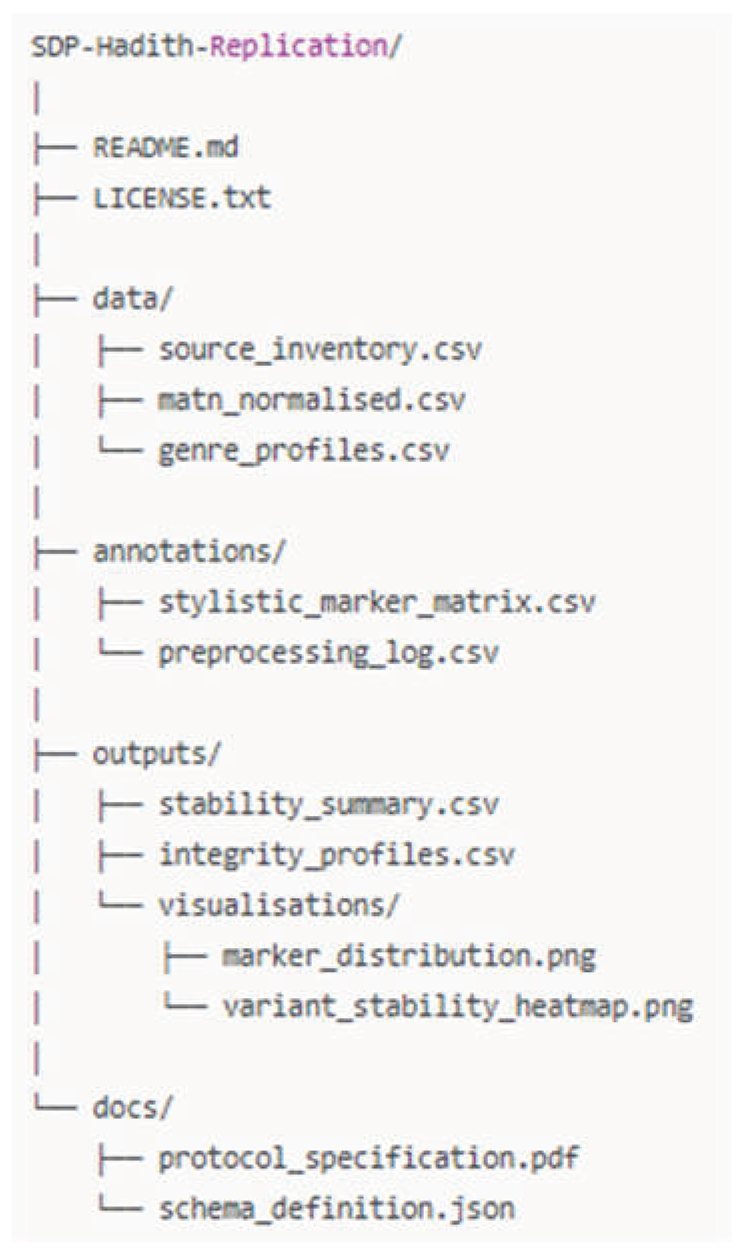
A.3 File FormatsA.4 Core Data Files and Schemas
| Format | Purpose | Compatibility |
| CSV | Tabular data files and annotations | Spreadsheet software, R, Python, DH annotation tools |
| JSON | Schema definitions and metadata | Validation tools, web-based pipelines |
| PNG | Visual outputs | Document preparation systems, repositories |
A.4.1 Variant Inventory
File: variants_inventory.csv
| Column | Description |
| report_id | Persistent identifier for narrative core |
| variant_id | Unique identifier for each transmission variant |
| source_compilation | Classical source or collection |
| book | Book or section |
| chapter | Chapter or thematic unit |
| location_ref | Source numbering or locator |
| edition | Edition or digital source |
| dataset_provenance | Corpus or repository reference |
A.4.2 Normalised Matn Corpus
File: matn_normalised.csv
| Column | Description |
| variant_id | Link to variant inventory |
| segment_id | Clause or sentence identifier |
| text_ar | Normalised Arabic text segment |
| segment_type | Clause, sentence, or report |
| normalisation_notes | Orthographic or formatting notes |
A.4.3 Genre and Speech-Act Profiles
File: genre_profiles.csv
| Column | Description |
| report_id | Narrative core identifier |
| dominant_genre | Aphoristic, narrative, legal, exhortative, dialogic, mixed |
| speech_act | Directive, descriptive, advisory, evaluative |
| justification | Scholarly rationale |
A.4.4 Stylistic Marker Matrix
File: stylistic_marker_matrix.csv
| Column | Description |
| variant_id | Link to variant inventory |
| segment_id | Unit identifier |
| marker_code | LE, SP, RC, PA, VMS, NC, EE |
| unit_of_analysis | Clause, sentence, report, variant cluster |
| value | Binary or categorical |
| evidence_span | Triggering Arabic text |
| justification | Scholarly reasoning |
| annotator_id | Analyst identifier |
| timestamp | Annotation date |
| Note: LE (Lexical Economy), SP (Semantic Proportionality), RC (Rhetorical Coherence), PA (Pragmatic Alignment), and VMS (Variant Stability) constitute the baseline marker set required for protocol replication. NC (Narrative Coherence) and EE (Ethical Emphasis) are optional extension markers provided for domain-specific or pedagogical annotation. | |
A.4.5 Preprocessing Log
File: preprocessing_log.csv
| Column | Description |
| variant_id | Link to variant inventory |
| operation | Normalisation or segmentation step |
| description | Description of action |
| rationale | Methodological justification |
| operator | Analyst or tool |
| date | Execution date |
A.5 Derived Outputs
A.5.1 Stability Summary
File: stability_summary.csv
| Column | Description |
| report_id | Narrative core |
| marker_code | Stylistic marker |
| stable | Yes/No |
| divergence_type | Additive, substitutive, register shift |
| notes | Interpretation |
A.5.2 Integrity Profiles
File: integrity_profiles.csv
| Column | Description |
| report_id | Narrative core |
| aggregation_mode | Weighted or non-weighted |
| integrity_level | High, moderate, low |
| summary_rationale | Interpretive summary |
A.6 Schema Definition and Validation
A formal schema is provided in schema_definition.json. The schema specifies:
- Permitted values for marker codes and genre categories
- Required and optional fields
- Data types and referential integrity constraints
This file enables automated validation of annotation packages prior to analysis, reuse, or redistribution. The schema is designed to support continuous integration (CI) and batch-based verification pipelines, ensuring structural consistency, referential integrity, and version compliance before release or downstream analysis.
A.7 Licensing
All files are released under a Creative Commons Attribution–NonCommercial 4.0 International (CC BY-NC 4.0) licence. This choice reflects the ethical and normative sensitivities associated with religious textual traditions while preserving full rights for scholarly reuse, pedagogical deployment, and non-commercial Digital Humanities infrastructure development. Commercial reuse and derivative redistribution require explicit permission.
A.8 Replication Procedure
- 1. Load variants_inventory.csv and matn_normalised.csv into an annotation or corpus analysis environment.
- 2. Apply validation rules defined in schema_definition.json.
- 3. Populate or review stylistic_marker_matrix.csv.
- 4. Generate cross-variant comparisons using marker_code and variant_id as keys.
- 5. Record aggregated outcomes in integrity_profiles.csv.
All deviations from the original protocol should be documented as versioned releases of the replication package.
A.9 Methodological Note
The release of stylistic diagnostics as structured data, formal schemas, and versioned artefacts positions methodological infrastructure as a first-class scholarly output. This approach supports transparency, interpretability, and cumulative methodological development in Digital Humanities research by enabling independent verification, comparative reuse, and community-driven refinement.
The schema and marker system are designed for extension beyond ḥadīth studies, supporting comparative application to other prophetic, legal, and authoritative discourse corpora in which interpretive judgment must be formalised, documented, and evaluated across variant textual traditions.
References
- Al-Dhahabī, Shams al-Dīn; Abū ʿAbd Allāh Muḥammad ibn Aḥmad ibn ʿUthmān ibn Qāymāz. Mīzān al-iʿtidāl fī naqd al-rijāl; Beirut, Lebanon; Dār al-Maʿrifah, 1995. [Google Scholar]
- Alghamdi, J.; Albukhari, A.; Al-Dala’in, T. Pretrained models against traditional machine learning for detecting fake Hadith. Electronics 2025, 14(17), 3484. [Google Scholar] [CrossRef]
- Al-Khaṭīb al-Baghdādī; Aḥmad ibn ʿAlī ibn Thābit ibn Aḥmad ibn Mahdī, Abū Bakr. Al-kifāyah fī ʿilm al-riwāyah; Hyderabad, Deccan; Jamʿiyyat Dāʾirat al-Maʿārif al-ʿUthmāniyyah, 1989. [Google Scholar]
- Al-Shāṭibī, Abū Isḥāq; Ibrāhīm ibn Mūsā ibn Muḥammad al-Lakhmī. Al-muwāfaqāt; Zayd, Bakr ibn ʿAbd Allāh Abū, Ed.; Riyadh, Saudi Arabia; Dār Ibn ʿAffān, 2004. [Google Scholar]
- Al-Suyūṭī; ʿAbd al-Raḥmān ibn Abī Bakr; al-Dīn, Jalāl. Al-itqān fī ʿulūm al-Qurʾān; Cairo, Egypt; Al-Hayʾah al-Miṣriyyah al-ʿĀmmah lil-Kitāb, 2003. [Google Scholar]
- Author. (2025). [Title removed for review]. [Journal removed for review].
- Burdick, A.; Drucker, J.; Lunenfeld, P.; Presner, T.; Schnapp, J. Digital_Humanities; MIT Press, 2016. [Google Scholar]
- Burrell, J. How the machine “thinks”: Understanding opacity in machine learning algorithms. Big Data & Society 2016, 3(1), 1–12. [Google Scholar] [CrossRef]
- Drucker, J. Humanities approaches to graphical display. Digital Humanities Quarterly 2011, 5(1). Available online: https://www.digitalhumanities.org/dhq/vol/5/1/000091/000091.html. [CrossRef]
- Floridi, L.; Cowls, J.; Beltrametti, M.; Chatila, R.; Chazerand, P.; Dignum, V.; Luetge, C.; Madelin, R.; Pagallo, U.; Rossi, F.; Schafer, B.; Valcke, P.; Vayena, E. AI4People—An Ethical Framework for a Good AI Society. Minds and Machines 2018, 28(4), 689–707. [Google Scholar] [CrossRef]
- Gaanoun, K.; Alsuhaibani, M. Fabricated Hadith detection: A novel matn-based approach with transformer language models. IEEE Access 2022, 10, 113330–113342. [Google Scholar] [CrossRef]
- Haque, F.; Orthy, A. H.; Siddique, S. Hadith authenticity prediction using sentiment analysis and machine learning. In Proceedings of the 14th IEEE International Conference on Application of Information and Communication Technologies (AICT 2020); IEEE, 2020; Volume Art. No. 9368569. [Google Scholar] [CrossRef]
- Hassaine, A.; Safi, Z.; Jaoua, A. Authenticity detection as a binary text categorization problem: Application to Hadith authentication. In Proceedings of the IEEE/ACS International Conference on Computer Systems and Applications (AICCSA); IEEE, 2016; Volume Art. No. 7945764. [Google Scholar] [CrossRef]
- Ibn al-Jawzī; al-Dīn ʿAbd al-Raḥmān ibn ʿAlī ibn Muḥammad, Jamāl. Al-mawḍūʿāt; Medina, Saudi Arabia; Al-Maktabah al-Salafiyyah, 1997. [Google Scholar]
- Ibn al-Ṣalāḥ; ʿUthmān ibn ʿAbd al-Raḥmān; ʿAmr, Abū; al-Dīn, Taqī. Maʿrifat anwāʿ ʿulūm al-ḥadīth; Damascus, Syria; Dār al-Fikr, 2002. [Google Scholar]
- al-ʿAsqalānī, Ibn Ḥajar; Muḥammad, Aḥmad ibn ʿAlī ibn. Nuzhat al-naẓar fī tawḍīḥ Nukhbat al-fikr fī muṣṭalaḥ ahl al-athar, 3rd ed.; Damascus, Syria; Maṭbaʿat al-Ṣabāḥ, 2001. [Google Scholar]
- Kassimi, M. A.; Essayad, A.; Tatane, K. Classifying authenticity of Prophet’s statements using artificial intelligence techniques. Communications in Computer and Information Science 2025, 2255, 128–136. [Google Scholar] [CrossRef]
- Mghari, M.; Bouras, O.; El Hibaoui, A. Sanadset 650K: Data on Hadith narrators. Data in Brief 2022, 44, 108540. [Google Scholar] [CrossRef] [PubMed]
- Mulyana, M. H.; Lhaksmana, K. M. Classification of Hadith using BERT-BiLSTM and BERT-BiGRU. In Proceedings of the IEEE COMNETSAT Conference; IEEE, 2024; pp. 252–257. [Google Scholar] [CrossRef]
- Polanyi, M. The tacit dimension; University of Chicago Press, 1966. [Google Scholar]
- Ramzy, A.; Torki, M.; Abdeen, M.; Saif, O.; ElNainay, M.; Alshanqiti, A.; Nabil, E. Hadiths classification using a novel author-based Hadith classification dataset (ABCD). Big Data and Cognitive Computing 2023, 7(3), 141. [Google Scholar] [CrossRef]
- Rozikin, M. R. Al-Farāʾiḍ is half of knowledge: A critical Hadith analysis and its juridical implications in Islamic inheritance discourse. Cogent Arts and Humanities 2025, 13(1), 2598289. [Google Scholar] [CrossRef]
- Tarmom, T.; Atwell, E.; Alsalka, M. Deep learning vs compression-based vs traditional machine learning classifiers to detect Hadith authenticity. Communications in Computer and Information Science 2022, 1577, 206–222. [Google Scholar] [CrossRef]
Figure 1.
The SDP–Ḥadīth diagnostic workflow.
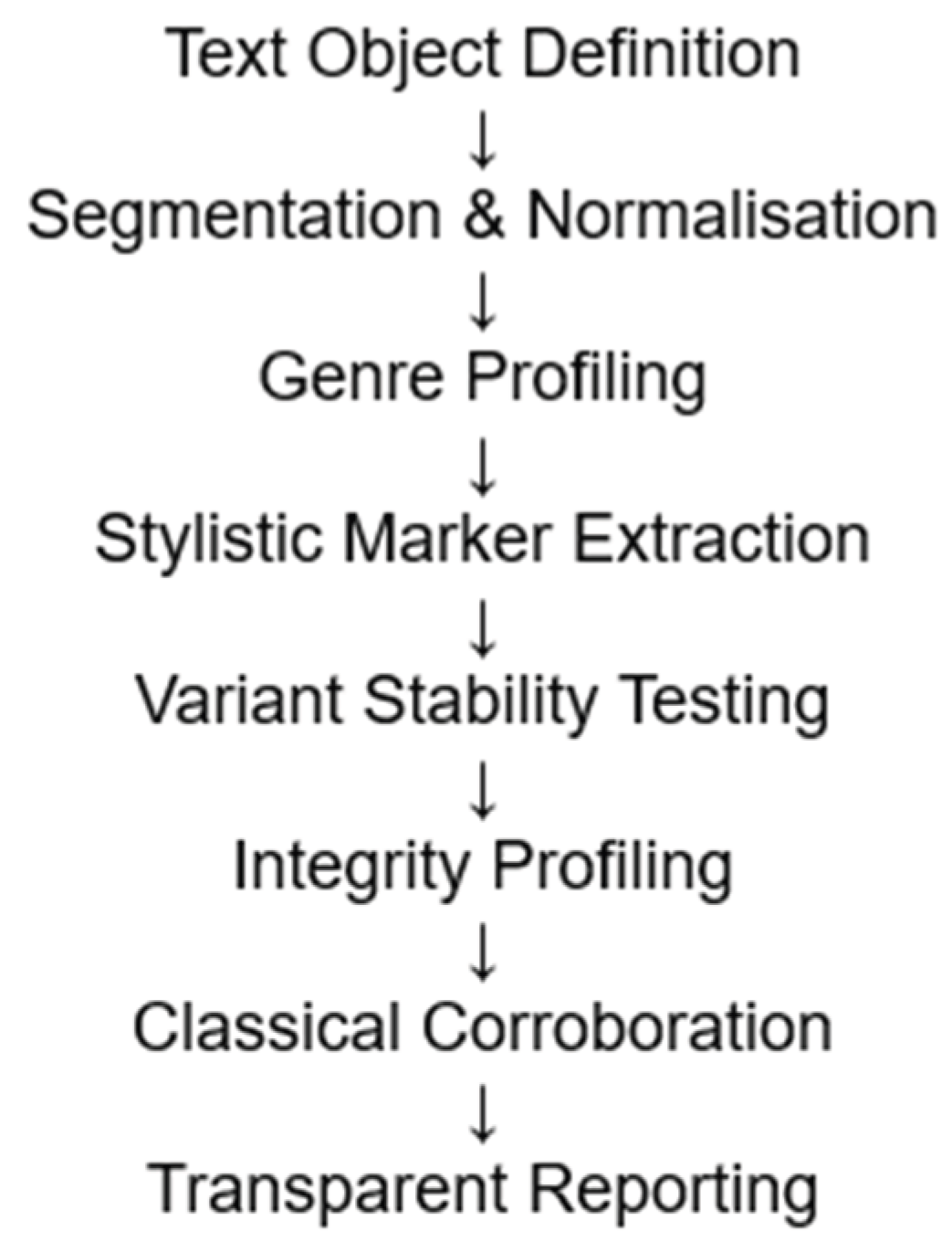

Table 1.
SDP–Ḥadīth Coding Sheet.
| Marker (code) | Operational definition | Decision rule | Unit of analysis | Evidence field | Notes field |
| Lexical restraint (LR) | Density of propositional meaning relative to lexical length, excluding genre-driven rhetorical repetition | 1 if compact expression without avoidable paraphrase; 0 if redundancy or circular elaboration is present | Clause, sentence, report | Minimal triggering span with variant ID and location | Distinguish redundancy from rhetorical emphasis |
| Semantic proportionality (SP) | Alignment between rhetorical force and stated act or claim | 1 if calibrated emphasis; 0 if inflated reward, threat, or absolutist framing | Sentence, report | Span linking act and rhetorical force | Note possible genre effects |
| Rhetorical coherence (RC) | Stability of reference, discourse flow, and logical progression | 1 if referents and progression are consistent; 0 if discontinuities or non-sequitur transitions occur | Sentence, report | Disruption points with preceding anchor | Specify coherence type |
| Register stability (RS) | Consistency of rhetorical register within the report | 1 if stable register; 0 if shift into later homiletic, juridical, or polemical tone | Sentence, report | Register-shift span and anchor span | Note dialogue or quotation effects |
| Pragmatic alignment (PA) | Plausibility of speech act in communicative context | 1 if situationally plausible; 0 if anachronistic or abstractly didactic | Report | Pragmatic cue and missing context | Justify low-context genres |
| Narrative coherence (NC) | Temporal, causal, and actor continuity in narrative reports | 1 if continuous; 0 if discontinuous | Report | Narrative break span | Mark N/A if non-narrative |
| Elliptical economy (EE) | Functional ellipsis that preserves intelligibility | 1 if recoverable; 0 if ambiguous or incoherent | Clause, sentence | Ellipted span and reconstruction note | Record alternative reconstructions |
| Variant marker stability (VMS) | Consistency of marker coding across variants | 1 if stable across two or more variants; 0 if divergent | Variant cluster | Mini-matrix excerpt | Identify additive or substitutive drift |
Table 2.
Example of a Filled Marker Table (Masked Demonstration Case).
| Marker (code) | Evidence spans (masked) | Decision | Interpretive note |
| Lexical restraint (LR) | Clause A: opening ethical maxim | 1 | High propositional density with no avoidable paraphrase; semantic content is compressed into a minimal lexical frame. |
| Semantic proportionality (SP) | Clause A → Clause B | 1 | Rhetorical force is calibrated to the normative claim without inflated promise or threat across aligned witnesses. |
| Rhetorical coherence (RC) | Clause A–B sequence | 1 | Stable referents and linear progression preserved across variants with no discourse break. |
| Register stability (RS) | Full report | 1 | Consistent ethical–didactic register maintained; no juridical or polemical shift observed. |
| Pragmatic alignment (PA) | Speech-act frame | 1 | Utterance plausibly situated within an instructional setting and aligned with audience-directed moral guidance. |
| Variant marker stability (VMS) | Two independent witnesses | 1 | Marker profile remains stable across aligned variants with no additive expansion or substitutive reformulation. |
Note: LE (Lexical Economy), SP (Semantic Proportionality), RC (Rhetorical Coherence), PA (Pragmatic Alignment), and VMS (Variant Stability) constitute the baseline marker set required for protocol replication. NC (Narrative Coherence) and EE (Ethical Emphasis) are optional extension markers provided for domain-specific or pedagogical annotation.
Disclaimer/Publisher’s Note: The statements, opinions and data contained in all publications are solely those of the individual author(s) and contributor(s) and not of MDPI and/or the editor(s). MDPI and/or the editor(s) disclaim responsibility for any injury to people or property resulting from any ideas, methods, instructions or products referred to in the content. |
© 2026 by the authors. Licensee MDPI, Basel, Switzerland. This article is an open access article distributed under the terms and conditions of the Creative Commons Attribution (CC BY) license (http://creativecommons.org/licenses/by/4.0/).
Copyright: This open access article is published under a Creative Commons CC BY 4.0 license, which permit the free download, distribution, and reuse, provided that the author and preprint are cited in any reuse.


