

Submitted:
02 July 2026
Posted:
03 July 2026
You are already at the latest version
Abstract
Background and Objectives: High-risk pregnancy is associated with increased vulnerability to psychological distress, yet the protective mechanisms that may buffer this vulnerability remain insufficiently understood. This study examined differences in emotional distress and coping strategies between women with high-risk and low-risk pregnancies and investigated whether active coping and marital satisfaction attenuate associations between negative pregnancy experiences, prenatal depression and perceived stress. Materials and Methods: A cross-sectional study was conducted among 195 pregnant women aged 18–51 years (M = 31.76, SD = 5.32), including 102 women with high-risk pregnancies and 93 women with low-risk pregnancies. Participants completed measures of prenatal depression (EPDS), state anxiety (STAI), perceived stress (PSS-10), pregnancy-related anxiety (PRAS), pregnancy experiences (PES), coping strategies (COPE), and marital satisfaction (CSI). Independent-samples t tests, correlation analyses, partial correlations and moderation analyses were conducted. Results: Women with high-risk pregnancies reported significantly higher levels of prenatal depression (p = 0.032) and pregnancy-related anxiety (p < 0.001) than women with low-risk pregnancies. They also reported lower use of socio-emotional support (p = 0.036) and mental disengagement coping strategies (p = 0.022). Negative pregnancy experiences were positively associated with state anxiety, pregnancy-related anxiety, prenatal depression, and perceived stress after controlling for pregnancy risk status (all p < 0.001). Maladaptive coping strategies were generally associated with higher emotional distress, whereas adaptive coping strategies, particularly positive reinterpretation and planning, were associated with lower levels of prenatal depression and anxiety. Active coping moderated the association between negative pregnancy experiences and perceived stress (β = −0.16, p = 0.016). Marital satisfaction moderated the association between prenatal depression and perceived stress among women with high-risk pregnancies (β = −0.21, p = 0.016). Conclusions: Active coping and marital satisfaction emerged as modifiable protective factors that may attenuate psychological distress during pregnancy. These findings support the integration of psychological screening, coping-focused interventions, and partner involvement into prenatal care, particularly for women experiencing high-risk pregnancies.
Keywords:
high risk pregnancy
; prenatal negative experiences
; coping strategies
; marital satisfaction
1. Introduction
Pregnancy represents a period of substantial psychological reorganization, characterized by increased vulnerability to stress, anxiety and depressive symptoms, even under physiological conditions [1,2]. Contemporary biopsychosocial models conceptualize the prenatal period as a dynamic process of emotional and cognitive adaptation, in which the individual’s appraisal of events and the availability of internal and external resources play a central role in shaping psychological outcomes. Within this framework, the transactional theory of stress and coping offers a relevant explanatory perspective, suggesting that the psychological impact of pregnancy is mediated by subjective appraisal processes and the coping strategies mobilized in response to perceived demands [3].
High-risk pregnancy constitutes a particularly salient stressor, significantly amplifying psychological vulnerability. Empirical evidence consistently indicates higher levels of anxiety, depression, perceived stress and overall psychological distress among women with high-risk pregnancies compared to those with uncomplicated pregnancies [4,5,6,7,8]. Furthermore, psychological distress during pregnancy has been associated with poorer health-related quality of life and reduced maternal well-being, highlighting the importance of routine psychological assessment during prenatal care [9].
Systematic reviews further confirm that the majority of studies report decreased well-being and increased psychological symptomatology in high-risk contexts [10]. From a phenomenological perspective, women often describe persistent fears related to pregnancy outcomes, a heightened sense of uncertainty and loss of control, as well as feelings of guilt and social isolation [11]. Moreover, medicalization processes such as hospitalization or the assignment of a “high-risk” label may be experienced as psychologically traumatic, further intensifying emotional distress. Recent findings from the COVID-19 pandemic context have further underscored the fragility of this population, documenting elevated levels of anxiety, depression and stress [12,13].
Despite this heightened vulnerability, high-risk pregnancy also mobilizes a wide range of coping strategies, which may function adaptively or maladaptively. Adaptive coping strategies-such as problem-focused coping, positive reappraisal and positive spiritual coping- have been consistently associated with lower levels of distress and better psychological adjustment [14,15]. In contrast, avoidant or passive coping strategies are linked to higher levels of anxiety and depression [16] while negative forms of spiritual coping may exacerbate depressive symptomatology, particularly in high-risk contexts [17]. Comparative findings further suggest that women with high-risk pregnancies tend to rely less on problem-focused strategies and more on avoidance or rigid emotional control than women with low-risk pregnancies [6,14].
Although the literature consistently documents elevated distress levels in high-risk pregnancies and highlights the general role of coping processes, several important limitations remain. First, many studies rely primarily on global indicators of anxiety and depression, without incorporating pregnancy-specific dimensions such as pregnancy-related anxiety or subjective prenatal experiences. Second, the relationship between negative pregnancy experiences and multiple indicators of emotional distress has been insufficiently examined within integrated models, particularly in samples of women with high-risk pregnancies. Third, although coping has been widely investigated, there is a need to clarify the differentiated roles of adaptive and maladaptive strategies in relation to prenatal anxiety and depression, beyond descriptive or unidimensional approaches. In addition, direct comparative studies between high-risk and low-risk pregnancies using integrative explanatory frameworks remain relatively limited.
Against this background, the present study aims to contribute to the existing literature by adopting an integrative approach to the relationship between emotional vulnerability and coping strategies during pregnancy.
Specifically, the objectives of the study are:
- To compare prenatal depression, pregnancy-related anxiety, and coping strategies between women with high-risk and low-risk pregnancies.
- To examine whether negative pregnancy experiences are associated with emotional distress independently of pregnancy risk status.
- To investigate the associations between adaptive and maladaptive coping strategies and prenatal emotional distress.
- To examine whether active coping moderates the association between negative pregnancy experiences and perceived stress.
- To examine whether marital satisfaction moderates the association between prenatal depression and perceived stress among women with high-risk pregnancies.
In line with these objectives, the following hypotheses were formulated:
H1a. Women with high-risk pregnancies will report higher levels of prenatal depression and pregnancy-related anxiety than women with low-risk pregnancies.
H1b. Women with high-risk pregnancies will report lower use of socio-emotional support and mental disengagement coping strategies than women with low-risk pregnancies.
H2. Negative pregnancy experiences will be positively associated with perceived stress, state anxiety, pregnancy-related anxiety and prenatal depression.
H3. Maladaptive coping strategies will be positively associated with prenatal anxiety and depression, whereas adaptive coping strategies will be negatively associated with these indicators of emotional distress.
H4. Active coping will moderate the positive association between negative pregnancy experiences and perceived stress.
H5. Marital satisfaction will moderate the positive association between prenatal depression and perceived stress among women with high-risk pregnancies.
Overall, the present study advances the literature by integrating pregnancy-specific emotional processes, subjective experiences and coping mechanisms within a unified explanatory framework of prenatal adjustment. This approach provides a more nuanced understanding of emotional vulnerability in high-risk pregnancies and has direct implications for the development of targeted psychological interventions aimed at supporting maternal mental health.
2. Materials and Methods
2.1. Population
The study population consisted of 195 participants. Their age ranged from 18 to 51 years (M = 31.76; SD = 5.32). Most participants were married (87.2%, n = 170), and 10.8% (n = 21) reported living with a partner. The other categories (divorced, widowed, separated or other situations) were poorly represented in the study sample. Regarding the environment of origin, 74.4% of the participants (n = 145) came from urban areas, and 25.6% (n = 50) from rural areas.
The level of education of the participants indicates a predominance of higher education, the majority of them having a bachelor’s degree (40%) or postgraduate studies (39%). The other educational levels (high school and sub-university or incomplete university education) were represented in a significantly lower proportion.
Regarding professional status, the majority of participants were employed (85.6%, n = 167), while lower percentages were recorded for the housewife (7.7%, n = 15) and self-employed (6.7%, n = 13) categories as shown in Table 1a.
In terms of economic status, most participants fell into the middle income category (79.5%, n = 155), followed by those with high income (12.8%, n = 25) and low income (5.1%, n = 10), with a small percentage preferring not to respond (2.6%, n = 5).
Regarding maternity experience, 62.1% of participants (n = 121) were in their first pregnancy, and 37.9% (n = 74) had at least one previous pregnancy. In terms of pregnancy trimester, 47.7% of participants (n = 93) were in the third trimester, 36.9% (n = 72) in the second trimester, and 15.4% (n = 30) in the first trimester.
Concerning the risk status of the current pregnancy, 47.7% of participants (n = 93) were classified without medically risk pregnancies, while 52.3% (n = 102) had pregnancies with medical risk. Within the high-risk pregnancy group, the most prevalent medical conditions were Rh incompatibility (17.6%) and conception through assisted reproductive technologies (15.6%). Additional risk factors included preeclampsia and uterine pathology (11.7% each), gestational diabetes (9.9%), infectious diseases (7.9%), chronic maternal conditions and overweight status (6.9% each), and anemia (4.9%). Genetic abnormalities (4.0%), placenta previa (2.0%), and intrahepatic cholestasis of pregnancy (0.9%) were less commonly reported. (Table 1a and Table 1b)
The clinical criterion for operationalizing the concept of high-risk pregnancy was developed by the co-authors of this study, as is evident from previously published studies [18,19,20].
An a priori power analysis using G*Power Program indicate that a minimum sample of 176 participants (88 per group) was required to detect a medium effect size with 90% power at α = .05. The final sample of 195 participants exceeded this requirement.
2.2. Measures
Participants completed a battery of seven self-report questionnaires administered either in person at the Filantropia Clinical Hospital of Obstetrics and Gynecology or online via Google Forms. The hospital is affiliated with “Carol Davila” University of Medicine and Pharmacy of Bucharest and is a tertiary care center serving both urban and rural populations in Romania, thus providing access to a diverse patient pool. Inclusion criteria were being pregnant, aged 18 years or older and able to read and understand Romanian.
2.2.1. Edinburgh Postnatal Depression Scale (EPDS)
Prenatal depressive symptoms were assessed using the Edinburgh Postnatal Depression Scale (EPDS) [21]. The EPDS is a 10-item self-report questionnaire designed to assess depressive symptomatology during the perinatal period. Items are rated on a 4-point Likert scale, and total scores range from 0 to 30, with higher scores indicating greater depressive symptomatology. A cut-off score of 13 or higher was used to identify women at increased risk for clinically significant depression. In the present study, internal consistency was good (α = .87).
2.2.2. State–Trait Anxiety Inventory (STAI)
State anxiety was assessed using the State–Trait Anxiety Inventory (STAI) [22]. The STAI is a widely used measure of anxiety consisting of separate state and trait anxiety scales. The present study employed the 20-item State Anxiety subscale, which assesses current anxiety symptoms. Items are rated on a 4-point Likert scale, and total scores range from 20 to 80, with higher scores indicating greater anxiety. Scores of 40 or above are generally considered indicative of clinically relevant anxiety symptoms. Internal consistency in the present sample was excellent (α = .95).
2.2.3. Pregnancy Experiences Scale (PES)
Pregnancy-related experiences were assessed using the Pregnancy Experiences Scale (PES) [23]. The PES evaluates both positive pregnancy experiences (uplifts) and negative pregnancy experiences (hassles), providing an assessment of women’s subjective appraisal of pregnancy. Internal consistency was good for the positive experiences subscale (α = .79), very good for the negative experiences subscale (α = .85) and acceptable for the total score (α = .77).
2.2.4. Perceived Stress Scale (PSS-10)
Perceived stress was measured using the 10-item Perceived Stress Scale (PSS-10) [24]. Participants rate the frequency of stress-related experiences during the previous month on a 5-point Likert scale ranging from 0 (“never”) to 4 (“very often”). Total scores range from 0 to 40, with higher scores indicating greater perceived stress. The scale includes two dimensions: perceived helplessness and perceived self-efficacy. Internal consistency in the present study was acceptable (α = .71).
2.2.5. Pregnancy-Related Anxiety Scale (PRAS)
Pregnancy-specific anxiety was assessed using the Pregnancy-Related Anxiety Scale (PRAS) [25]. The PRAS measures concerns related to childbirth, fetal health and obstetric complications. Items are rated on a 4-point Likert scale ranging from 1 (“not at all”) to 4 (“very much”), with higher scores indicating greater pregnancy-related anxiety. Internal consistency was good (α = .83).
2.2.6. Coping Orientation to Problems Experienced (COPE)
Coping strategies were assessed using the Coping Orientation to Problems Experienced Inventory (COPE) [26]. The COPE is a multidimensional measure that evaluates adaptive and maladaptive coping strategies, including active coping, planning, seeking instrumental social support, seeking emotional social support, suppression of competing activities, religion, positive reinterpretation, restraint coping, acceptance, focus on and venting of emotions, denial, mental disengagement, behavioral disengagement strategies. For this study, 13 subscales of 4 items each were used, resulting in a total of 52 items. Responses are rated on a 4-point Likert scale, with higher scores indicating greater use of a given coping strategy. Internal consistency for the overall scale was good (α = .73).
2.2.7. Couples Satisfaction Index (CSI)
Relationship satisfaction was assessed using the 32-item Couples Satisfaction Index (CSI) [27]. The CSI is a widely used measure of couple relationship quality with excellent psychometric properties. Items are rated using Likert-type response formats, and higher scores indicate greater relationship satisfaction. Internal consistency in the present sample was excellent (α = .95).
Overall, Cronbach’s alpha coefficients ranged from .71 to .95, indicating acceptable to excellent internal consistency across all study measures.
2.3. Procedure and Ethical Considerations
The study received ethical approval from the Ethics Committee of Filantropia Clinical Hospital, Bucharest, Romania (Approval No. 4902, 30 May 2025). Participants were recruited between March and December 2025 either in person at the Filantropia Clinical Hospital of Obstetrics and Gynecology or online via Google Forms.
All participants received information regarding the study objectives, procedures, confidentiality of data, voluntary participation, and their right to withdraw at any time. Written informed consent was obtained prior to participation. Participants were also provided with the contact details of the principal investigator and could request a summary of the study findings upon completion of the research. Women interested in receiving psychological support were informed about the availability of support groups.
2.4. Data Analysis
Descriptive statistics were computed for all study variables and are presented as means and standard deviations (SD). The normality of continuous variables was assessed using the Shapiro–Wilk test.
Independent-samples t tests were conducted to examine differences between women with high-risk and low-risk pregnancies. Pearson and partial correlation analyses were used to examine associations between negative pregnancy experiences, coping strategies, and indicators of emotional distress. To control for multiple comparisons, the Holm correction was applied with an alpha level of .05.
Moderation analyses were conducted using regression-based approaches that included interaction terms between predictors. Assumptions of normality, homoscedasticity, multicollinearity, and the absence of influential outliers were examined and met for all models.
Statistical analyses were performed using IBM SPSS Statistics and Intellectus Statistics.
3. Results
H1a.
Women with high-risk pregnancies will report higher levels of prenatal depression and pregnancy-related anxiety than women with low-risk pregnancies.
H1b.
Women with high-risk pregnancies will report lower use of socio-emotional support and mental disengagement coping strategies than women with low-risk pregnancies.
The first hypothesis proposed that women with high-risk pregnancies would report significantly higher levels of pregnancy-related anxiety and prenatal depression compared to women with low-risk pregnancies. In addition, it was hypothesized that women with high-risk pregnancies would report lower use of socio-emotional support and mental disengagement coping strategies.
Before conducting the independent-samples t tests, Levene’s tests for equality of variances were examined. Results indicated that the assumption of homogeneity of variances was met for all variables analyzed.
Regarding prenatal depression, Levene’s test was non-significant, F (1, 193) = 0.22, p = .640, indicating equality of variances between groups. The independent-samples t test revealed a statistically significant difference between women with high-risk pregnancies and those with low-risk pregnancies, t (193) = -2.16, p = .032, mean difference = -1.64, 95% CI [-3.14, -0.14]. Women with high-risk pregnancies reported significantly higher levels of depressive symptoms as shown in Table 2b.
For pregnancy-related anxiety, Levene’s test was also non-significant, F (1, 193) = 0.33, p = .566. Results indicated a significant group difference, t (193) = -3.57, p < .001, mean difference = -3.02, 95% CI [-4.68, -1.35], showing that women with high-risk pregnancies experienced significantly higher levels of pregnancy-related anxiety compared to women with low-risk pregnancies.
Similarly, for socio-emotional support coping strategies, Levene’s test indicated equality of variances, F (1, 193) = 3.10, p = .080. The independent-samples t test showed a statistically significant difference between groups, t (193) = 2.11, p = .036, mean difference = 0.90, 95% CI [0.06, 1.74], indicating that women with high-risk pregnancies reported lower use of socio-emotional support strategies.
For mental disengagement coping strategies, Levene’s test was non-significant, F (1, 193) = 0.24, p = .628. The independent-samples t test revealed a statistically significant difference between women with high-risk and low-risk pregnancies, t (193) = 2.31, p = .022, mean difference = 0.82, 95% CI [0.12, 1.53]. Women with high-risk pregnancies reported significantly lower levels of mental disengagement coping.
Regarding Cohen’s d values and effect-size r, for Prenatal Depression the values are d= -.31, r= -.15, for Pregnancy-related Anxiety d= -.51, r= -.24, for Socio emotional support d= .30, r= .14, for Mental disengagement d= .33, r= .16.
Overall, these findings support Hypothesis 1, indicating that women with high-risk pregnancies experience higher emotional distress, reflected by elevated prenatal depression and pregnancy-related anxiety, and uses less socio-emotional support and mental disengagement coping strategies.
H2.
Negative pregnancy experiences will be positively associated with perceived stress, state anxiety, pregnancy-related anxiety and prenatal depression.
The second hypothesis proposed that negative pregnancy experiences would be positively associated with perceived stress, state anxiety (STAI), pregnancy-related anxiety (PRAS), and prenatal depression, even after controlling for pregnancy risk status.
Partial correlation analyses controlling for pregnancy risk status were conducted to examine the associations between negative pregnancy experiences and indicators of emotional distress. The Holm correction was applied to control for multiple comparisons using an alpha level of .05.
Results indicated that negative pregnancy experiences were significantly and positively associated with state anxiety (STAI), r = .33, p < .001, pregnancy-related anxiety (PRAS), r = .42, p < .001, prenatal depression, r = .36, p < .001, and perceived stress, r = .39, p < .001, after controlling for pregnancy risk status.
Additionally, negative pregnancy experiences were positively associated with perceived helplessness, r = .38, p < .001 as shown in Table 3.
Overall, these findings support Hypothesis 2, indicating that negative pregnancy experiences are associated with higher levels of emotional distress independently of pregnancy risk status.
H3.
Maladaptive coping strategies will be positively associated with prenatal anxiety and depression, whereas adaptive coping strategies will be negatively associated with these indicators of emotional distress.
The third hypothesis proposed that maladaptive coping strategies would be positively associated with prenatal anxiety and prenatal depression, whereas adaptive coping strategies would demonstrate differentiated associations, reflecting their role in emotional regulation.
Pearson correlation analyses were conducted to examine the associations between coping strategies and emotional distress variables. The Holm correction was applied to control for multiple comparisons using an alpha level of .05. Only associations that remained significant after Holm correction are reported.
Results indicated that maladaptive coping strategies were generally positively associated with emotional distress indicators. Prenatal depression was significantly and positively associated with denial, r = .39, p < .001, emotional discharge, r = .24, p = .011, mental disengagement, r = .24, p = .012, and behavioral disengagement, r = .36, p < .001. In addition, pregnancy-related anxiety was positively associated with emotional discharge, r = .24, p = .013 as shown in Table 4.
Regarding adaptive coping strategies, prenatal depression was significantly and negatively associated with planning, r = −.37, p < .001, instrumental social support, r = −.23, p = .012, socio-emotional support, r = −.26, p = .002, positive reinterpretation, r = −.52, p < .001, and acceptance, r = −.30, p < .001. Furthermore, pregnancy-related anxiety was negatively associated with positive reinterpretation, r = −.28, p < .001 as shown in Table 5.
Overall, these findings partially support Hypothesis 3, indicating that maladaptive coping strategies are associated with higher levels of emotional distress, whereas adaptive coping strategies, particularly positive reinterpretation and planning, are associated with lower levels of prenatal anxiety and depressive symptoms.
H4.
Active coping will moderate the positive association between negative pregnancy experiences and perceived stress.
The fourth hypothesis proposed that active coping would moderate the relationship between negative pregnancy experiences and perceived stress in the overall sample.
Figure 1.
Moderating role of active coping.
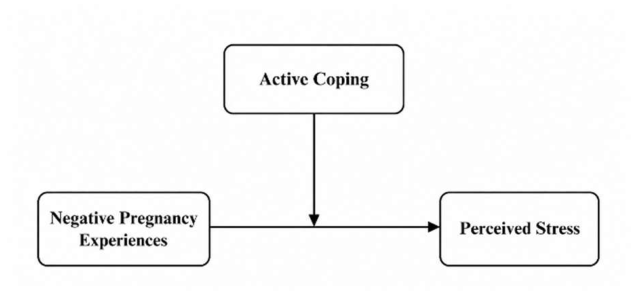
A moderation analysis was conducted to examine whether active coping moderated the association between negative pregnancy experiences and perceived stress. The overall regression model was statistically significant, R2 = .18, F(3, 191) = 14.06, p < .001, indicating that the predictors accounted for 18.09% of the variance in perceived stress.
The interaction between negative pregnancy experiences and active coping was statistically significant, B = -0.06, SE = 0.03, β = -0.16, t(191) = -2.44, p = .016, indicating a significant moderating effect. Specifically, higher levels of active coping weakened the positive association between negative pregnancy experiences and perceived stress.
The main effect of negative pregnancy experiences was significant, B = 0.31, SE = 0.05, β = 0.38, t(191) = 5.74, p < .001, suggesting that higher levels of negative pregnancy experiences were associated with increased perceived stress. In contrast, the main effect of active coping was not statistically significant, B = -0.03, SE = 0.17, β = -0.01, t(191) = -0.19, p = .846 as shown in Table 6.
Overall, these findings support Hypothesis 4, indicating that active coping functions as a protective factor that buffers the relationship between negative pregnancy experiences and perceived stress.
Simple slopes analysis was conducted to further explore the effect of active coping on the relationship between negative pregnancy experiences and perceived stress. The regression coefficient for negative pregnancy experiences was calculated while holding active coping constant at its mean value, one standard deviation above the mean, and one standard deviation below the mean. The coefficient for negative pregnancy experiences with active coping fixed to a value of 10.68 was significant, B = 0.44, p < .001. The coefficient for negative pregnancy experiences with active coping fixed to a value of 12.67 was significant, B = 0.31, p < .001. The coefficient for negative pregnancy experiences with active coping fixed to a value of 14.66 was significant, B = 0.19, p = .015. This suggests that as active coping increases, the relationship between negative pregnancy experiences and perceived stress weakens. The results of the simple slopes analysis are presented in Table 7.
H5. Marital satisfaction will moderate the positive association between prenatal depression and perceived stress among women with high-risk pregnancies.
The fifth hypothesis proposed that marital satisfaction would moderate the relationship between prenatal depression and perceived stress among women with high-risk pregnancies.
Figure 2.
Moderating role of marital satisfaction.
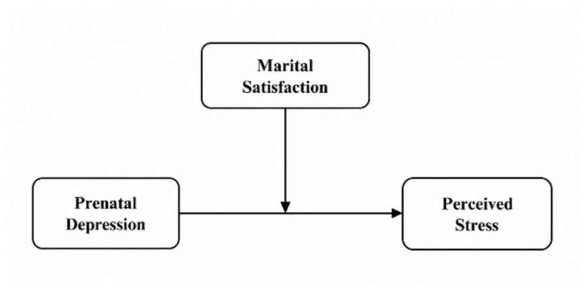
A moderation analysis was conducted to examine whether marital satisfaction moderated the association between prenatal depression and perceived stress in women with high-risk pregnancies. The overall regression model was statistically significant, R2 = .46, F (3, 98) = 27.56, p < .001, indicating that the predictors accounted for 45.76% of the variance in perceived stress.
The interaction between prenatal depression and marital satisfaction was statistically significant, B = -0.006, SE = 0.002, β = -0.21, t (98) = -2.45, p = .016, indicating a significant moderating effect. Specifically, higher levels of marital satisfaction weakened the positive association between prenatal depression and perceived stress.
The main effect of prenatal depression was significant, B = 0.51, SE = 0.08, β = 0.52, t (98) = 6.19, p < .001, suggesting that higher levels of prenatal depression were associated with increased perceived stress. In contrast, the main effect of marital satisfaction was not statistically significant, B = -0.02, SE = 0.02, β = -0.11, t (98) = -1.24, p = .219 as shown in Table 8.
Simple slopes analysis was conducted to further explore the effect of marital satisfaction on the relationship between prenatal depression and perceived stress. The regression coefficient for prenatal depression was calculated while holding marital satisfaction constant at its mean value, one standard deviation above the mean, and one standard deviation below the mean. The coefficient for prenatal depression with marital satisfaction fixed to a value of 101.17 was significant, B = 0.67, p < .001. The coefficient for prenatal depression with marital satisfaction fixed to a value of 129.45 was significant, B = 0.51, p < .001. The coefficient for prenatal depression with marital satisfaction fixed to a value of 157.73 was significant, B = 0.35, p = .002. This suggests that as marital satisfaction increases, the relationship between prenatal depression and perceived stress weakens. The results of the simple slopes analysis are presented in Table 9.
Overall, these findings support Hypothesis 5, indicating that marital satisfaction functions as a protective factor that buffers the relationship between prenatal depression and perceived stress among women with high-risk pregnancies.
5. Discussion
The prenatal period represents a critical window of psychological vulnerability during which pregnant women go through risks of depression, anxiety and stress, with prevalence estimates for postnatal depression ranging from 10% to 20% globally [28,29]. These mental health difficulties frequently co-occur and are compounded by the demands of adjusting to the parental role, a transition that can deplete cognitive and emotional resources [30]. While a growing body of research has identified coping strategies, social support and marital satisfaction as factors that may mitigate perinatal distress, the specific mechanisms through which these protective resources operate, particularly their moderating functions, remain insufficiently understood [31].
The present study investigated the interrelationships among prenatal depressive symptomatology, anxiety, perceived stress and a comprehensive set of coping and emotion regulation strategies in a sample of perinatal women. Additionally, the study examined whether active coping and marital satisfaction functioned as moderators of the relationship between negative affect and perceived stress.
The findings revealed several noteworthy patterns. Women with high-risk pregnancies reported significantly higher levels of prenatal depression and pregnancy-related anxiety compared to women with low-risk pregnancies. This finding is consistent with previous literature suggesting that high-risk pregnancy constitutes a context of increased psychological vulnerability and emotional distress. The strong association between anxiety and depressive symptoms supports transdiagnostic models of perinatal mental health, which conceptualize anxiety and depression as overlapping manifestations of broader emotional distress rather than isolated conditions [32,33]. The fact that women with high-risk pregnancies use less socio-emotional support and mental passivity shows the need for further investigation of these data and the determination of causal relationships, which may include prolonged hospitalization in women with high-risk pregnancies, avoidance of negative comments, anxiety related to uncertainty. This fact also draws attention to the need for specialized psychological assistance programs and support groups for high-risk pregnancies.
The significant associations between negative pregnancy experiences and perceived stress, anxiety and prenatal depression suggest that the subjective appraisal of pregnancy-related difficulties plays a central role in emotional adjustment during pregnancy. These findings are consistent with cognitive models of stress and emotional vulnerability, which emphasize the importance of perceived uncontrollability and negative appraisal processes in the development of psychological distress [34,35].
Maladaptive coping strategies, particularly denial, behavioral disengagement, and mental disengagement, were positively associated with prenatal depression and anxiety. This pattern aligns with previous research showing that avoidant and disengagement coping strategies are linked with poorer psychological adjustment in perinatal populations. Moreover, the clustering of denial, mental passivity, and behavioral passivity supports theoretical frameworks describing disengagement coping as a coherent maladaptive coping dimension [36].
In contrast, adaptive coping strategies such as planning, acceptance, and especially positive reinterpretation were negatively associated with depressive and anxiety symptoms. Positive reinterpretation demonstrated the strongest inverse association with prenatal depression, supporting cognitive appraisal theories which propose that the ability to reframe adverse experiences in more adaptive ways buffers against emotional distress [37,38]. These findings suggest that cognitive flexibility and meaning-making may represent important psychological resources during pregnancy.
An important finding of the present study was the moderating role of active coping. Higher levels of active coping weakened the association between negative pregnancy experiences and perceived stress, indicating that active coping may function as a protective factor in the context of prenatal stress. This buffering effect is consistent with the transactional model of stress and coping [35] according to which active engagement with stressors reduces perceived threat and enhances feelings of control.
Finally, marital satisfaction buffered the relationship between prenatal depression and perceived stress among women with high-risk pregnancies. This result highlights the importance of relational resources and partner support in emotional adjustment during pregnancy and is consistent with previous findings emphasizing the protective role of supportive couple relationships in perinatal mental health [39,40].
Previous studies conducted in Romania have highlighted the importance of antenatal mental health screening and the identification of psychosocial risk factors associated with prenatal depression and anxiety [41].
The present findings contribute to the understanding of psychological adaptation during pregnancy by highlighting the interplay between emotional distress, coping strategies and relational resources. Beyond confirming the heightened vulnerability associated with high-risk pregnancy, the results suggest that subjective pregnancy experiences, active coping and marital satisfaction play important roles in shaping emotional adjustment. These findings support biopsychosocial models of perinatal mental health and emphasize the importance of considering both individual and interpersonal resources when examining psychological well-being during pregnancy.
Clinical Implications
The present findings have direct implications for prenatal care. First, women reporting frequent negative pregnancy experiences may benefit from early psychological screening and monitoring, as these experiences were consistently associated with higher levels of stress, anxiety and depressive symptoms. Second, the protective role of active coping suggests that prenatal interventions should focus on strengthening adaptive coping skills, including problem-solving, cognitive reappraisal and active engagement with pregnancy-related challenges.
Third, the buffering effect of marital satisfaction highlights the importance of partner involvement in perinatal care. Couple-focused interventions designed to enhance communication, emotional support, and relationship satisfaction may reduce psychological vulnerability, particularly among women facing high-risk pregnancies. Together, these findings support a biopsychosocial approach to prenatal care that addresses both medical and psychosocial determinants of maternal well-being. This recommendation is consistent with recent evidence emphasizing the value of integrating mental health assessment into routine prenatal care in order to identify women at increased psychological risk and improve maternal well-being [15].
Also, the present findings support previous recommendations advocating the integration of mental health screening into routine prenatal care in Romania, where systematic antenatal psychological assessment remains limited [41].
Limitations and Future Directions
Several limitations should be acknowledged. First, the cross-sectional design of this study inherently precludes any definitive causal inference. Second, our exclusive reliance on self-report measures introduces potential internal validity risks. This approach raises critical concerns regarding common method variance or common method bias [42]. Gathering data for both predictors and outcomes from the same respondents via the same questionnaire instrument can artificially inflate or deflate the observed statistical correlations.
Third, the demographic composition of our sample limits the external validity and generalizability of the findings. The participants were predominantly urban and highly educated, a specific sub-population that may not accurately represent the broader, more diverse national or global population. Future research must utilize more inclusive sampling strategies that deliberately capture rural populations, varied socioeconomic backgrounds and diverse educational level.
Finally, the inherent heterogeneity within the designated high-risk group presents a confounding variable. While participants were classified under a single high-risk umbrella, this cohort actually comprises individuals facing different types, intensities and combinations of risk factors. Future studies should employ advanced subgroup analyses, such as cluster analysis, to disentangle this heterogeneity and provide tailored insights for specific high-risk profiles. Potential confounding variables such as parity and gestational trimester were not included as covariates.
5. Conclusion
This study highlights that emotional vulnerability during high-risk pregnancy is shaped not only by the severity of the underlying medical condition but also by the dynamic interplay between subjective pregnancy experiences, coping strategies, and relational resources. While high-risk pregnancies were associated with higher levels of prenatal depression and pregnancy-related anxiety, negative pregnancy experiences were linked to greater emotional distress regardless of risk status.
A key contribution of the study is the identification of two modifiable protective factors. Active coping attenuated the association between negative pregnancy experiences and perceived stress, whereas marital satisfaction buffered the relationship between prenatal depression and perceived stress among women with high-risk pregnancies. These findings underscore the importance of adaptive coping and relationship quality in emotional adjustment during pregnancy.
From a clinical perspective, the results support the integration of psychological screening, coping assessment, and partner involvement into routine prenatal care, particularly for women experiencing medical complications. Future longitudinal studies are needed to clarify causal pathways and evaluate interventions aimed at strengthening coping resources and relationship support during the perinatal period.
Author Contributions
Conceptualization, E.O.V.; methodology, E.O.V., C.I.P.-S., A.M.P. and N.G.; formal analysis, E.O.V., C.I.P.-S. and D.A.I.; investigation, E.O.V., C.I.P.-S. and D.A.I.; data curation, D.A.I.; validation, A.M.P., N.G. and C.M.; supervision, E.O.V., A.M.P. and N.G.; visualization, E.O.V., C.I.P.-S. and D.A.I.; writing-original draft preparation, E.O.V., C.I.P.-S. and D.A.I.; writing-review and editing, E.O.V., C.I.P.-S., D.A.I., A.M.P., N.G. and C.M. All authors have read and agreed to the published version of the manuscript.
Funding
This research received no external funding.
Institutional Review Board Statement
The Scientific Research Ethics Commission of Filantropia Clinical Hospital, Bucharest approved the study (Approval No. 4902, 30 May 2025).
Informed Consent Statement
The researchers obtained written consent after informing participants about the purpose of the study and before they filled out the questionnaires.
Data Availability Statement
The original contributions presented in this study are included in the article. Further inquiries can be directed to the corresponding author.
Conflicts of Interest
The authors declare no conflicts of interest.
References
- Dunkel Schetter, C. Psychological science on pregnancy: Stress processes, biopsychosocial models, and emerging research issues. Annu. Rev. Psychol. 2011, 62, 531–558. [Google Scholar] [CrossRef] [PubMed]
- Guardino, C.M.; Dunkel Schetter, C. Coping during pregnancy: A systematic review and recommendations. Health Psychol. Rev. 2014, 8(1), 70–94. [Google Scholar] [CrossRef] [PubMed]
- Gourounti, K.; Anagnostopoulos, F.; Lykeridou, K. Coping strategies as psychological risk factor for antenatal anxiety, worries, and depression among Greek women. Arch. Women’s Ment. Health 2013, 16, 353–361. [Google Scholar] [CrossRef] [PubMed]
- Kiyak, S. The relationship of depression, anxiety, and stress with pregnancy symptoms and coping styles in pregnant women: A multi-group structural equation modeling analysis. Midwifery 2024, 136, 104103. [Google Scholar] [CrossRef] [PubMed]
- Williamson, S.P.; Moffitt, R.L.; Broadbent, J.; Neumann, D.L.; Hamblin, P.S. Coping, wellbeing, and psychopathology during high-risk pregnancy: A systematic review. Midwifery 2022. [Google Scholar] [CrossRef] [PubMed]
- Isaacs, N.Z.; Andipatin, M.G. A systematic review regarding women’s emotional and psychological experiences of high-risk pregnancies. BMC Psychol. 2020, 8(45). [Google Scholar] [CrossRef] [PubMed]
- Öcalan, D.; Ceylantekin, Y.; Karslı, T.A.; Dursun-Karslı, P. Psychosocial adaptation, marital satisfaction and meaning in life between women with high and low-risk pregnancies. Curr. Psychol. 2024, 43, 15–27. [Google Scholar] [CrossRef]
- Smorti, M.; Ginobbi, F.; Simoncini, T.; Pancetti, F.; Carducci, A.; Mauri, G.; Gemignani, A. Anxiety and depression in women hospitalized due to high-risk pregnancy: An integrative quantitative and qualitative study. Curr. Psychol. 2023, 42, 5570–5579. [Google Scholar] [CrossRef]
- Bernad, B.-C.; Tomescu, M.-C.; Velimirovici, D.E.; Andor, M.; Lungeanu, D.; Enătescu, V.; Rata, A.L.; Arnăutu, S.-F.; Bernad, E.S.; Neda-Stepan, O.; et al. Health-Related Quality of Life in Pregnancy Associated with Psychological Distress. Medicina 2026, 62, 445. [Google Scholar] [CrossRef] [PubMed]
- Mirzakhani, K.; Ebadi, A.; Faridhosseini, F.; Khadivzadeh, T. Well-being in high-risk pregnancy: An integrative review. BMC Pregnancy Childbirth 2020, 20(526). [Google Scholar] [CrossRef] [PubMed]
- McCoyd, J.L.M.; Curran, L.; Munch, S. They say “If you don’t relaxyou’re going to make something bad happen”: Women’s emotion management during medically high-risk pregnancy. Psychol. Women Q. 2019, 44(1). [Google Scholar] [CrossRef]
- Khoury, J.E.; Atkinson, L.; Bennett, T.; Jack, S.; Gonzalez, A. Coping strategies mediate the associations between COVID-19 experiences and mental health outcomes in pregnancy. Arch. Women’s Ment. Health 2021, 24, 1007–1017. [Google Scholar] [CrossRef] [PubMed]
- Levinson, A.; Lobel, M.; Preis, H.; Mahaffey, B. Coping with subjective and objective stress during a pandemic pregnancy: Implications for maternal mental health. Arch. Women’s Ment. Health 2023, 26(6), 819–829. [Google Scholar] [CrossRef] [PubMed]
- Zhang, T.; Chen, W.-T.; He, Q.; Li, Y.; Peng, H.; Xie, J. Coping strategies following the diagnosis of a fetal anomaly: A scoping review. Front. Public Health 2023, 11, 1055562. [Google Scholar] [CrossRef] [PubMed]
- Ibrahim, S.M.; Nicoloro-SantaBarbara, J.; Auerbach, M.V.; Rosenthal, L.; Kocis, C.; Busso, C.E.; Lobel, M. Pregnancy-specific coping and changes in emotional distress from mid- to late pregnancy. J. Reprod. Infant Psychol. 2019, 37(4), 397–412. [Google Scholar] [CrossRef] [PubMed]
- Chapuis-de-Andrade, S.; Moret-Tatay, C.; Amado de Paula, T.; Irigaray, T.Q.; Antonello, I.C.F.; da Costa, B.E.P. Psychological factors and coping strategies in pregnancies complicated by hypertension: A cluster-analytic approach. J. Affect. Disord. 2022, 296, 89–94. [Google Scholar] [CrossRef] [PubMed]
- Bjelica, A.; Cetkovic, N.; Trninic-Pjevic, A.; Mladenovic-Segedi, L. The phenomenon of pregnancy—A psychological view. Ginekol. Pol. 2018, 89(2), 102–106. [Google Scholar] [CrossRef] [PubMed]
- Panaitescu, A.M.; Syngelaki, A.; Prodan, N.; Akolekar, R.; Nicolaides, K.H. Chronic hypertension and adverse pregnancy outcome: A cohort study. Ultrasound Obstet. Gynecol. 2017, 50(2), 228–235. [Google Scholar] [CrossRef] [PubMed]
- Panaitescu, A.; Ciobanu, A.; Syngelaki, A.; Wright, A.; Wright, D.; Nicolaides, K.H. Screening for pre-eclampsia at 35–37 weeks’ gestation. Ultrasound Obstet. Gynecol. 2018, 52(4), 501–506. [Google Scholar] [CrossRef] [PubMed]
- Gică, N.; Panaitescu, A.M.; Iancu, G.; Botezatu, R.; Peltecu, G.; Gică, C. The role of biological markers in predicting infertility associated with non-obstructive endometriosis. Ginekol. Pol. 2020, 91(4), 189–192. [Google Scholar] [CrossRef] [PubMed]
- Cox, J.L.; Holden, J.M.; Sagovsky, R. Detection of Postnatal Depression: Development of the 10-item Edinburgh Postnatal Depression Scale. Br. J. Psychiatry 1987, 150(6), 782–786. [Google Scholar] [CrossRef]
- Spielberger, C.D. State-Trait Anxiety Inventory: Bibliography, 2nd ed.; Consulting Psychologists Press: Palo Alto, CA, 1989; pp. 48–104. [Google Scholar]
- Dipietro, J.A.; Christensen, A.L.; Costigan, K.A. The pregnancy experience scale–brief version. J. Psychosom. Obstet. Gynecol. 2008, 29(4), 262–267. [Google Scholar] [CrossRef] [PubMed]
- Cohen, S.; Kamarck, T.; Mermelstein, R. Perceived stress scale [Database record]. 1983. [Google Scholar]
- Rini, C.K.; Dunkel-Schetter, C.; Wadhwa, P.D.; Sandman, C.A. Pregnancy-Related Anxiety Scale [Database record]. APA PsycTests, 1999. [Google Scholar]
- Carver, C.S.; Scheier, M.F.; Weintraub, J.K. Assessing coping strategies: A theoretically based approach. J. Personal. Soc. Psychol. 1989, 56(2), 267–283. [Google Scholar] [CrossRef] [PubMed]
- Funk, J.L.; Rogge, R.D. Testing the ruler with item response theory: Increasing precision of measurement for relationship satisfaction with the Couples Satisfaction Index. J. Fam. Psychol. 2007, 21, 572–583. [Google Scholar] [CrossRef] [PubMed]
- Woody, C.A.; Ferrari, A.J.; Siskind, D.J.; Whiteford, H.A.; Harris, M.G. A systematic review and meta-regression of the prevalence and incidence of perinatal depression. J. Affect. Disord. 2017, 219, 86–92. [Google Scholar] [CrossRef] [PubMed]
- Wang, Z.; Liu, J.; Shuai, H.; Cai, Z.; Fu, X.; Liu, Y.; Xiong, X.; Zhang, W.; Krabbendam, E.; Liu, S.; et al. Mapping global prevalence of depression among postpartum women. Transl. Psychiatry 2021, 11(1), 1–13. [Google Scholar] [CrossRef] [PubMed]
- Ngai, F.W.; Ngu, S.F. Predictors of maternal and paternal depressive symptoms at postpartum. J. Psychosom. Res. 2015, 78(2), 156–161. [Google Scholar] [CrossRef] [PubMed]
- Lever Taylor, B.; Cavanagh, K.; Strauss, C. The effectiveness of mindfulness-based interventions in the perinatal period: A systematic review and meta-analysis. PLoS ONE 2017, 12(5). [Google Scholar] [CrossRef] [PubMed]
- Falah-Hassani, K.; Shiri, R.; Dennis, C.L. Prevalence and risk factors for comorbid postpartum depressive symptomatology and anxiety. J. Affect. Disord. 2016, 198, 142–147. [Google Scholar] [CrossRef] [PubMed]
- Dalgleish, T.; Black, M.; Johnston, D.; Bevan, A. Transdiagnostic approaches to mental health problems: Current status and future directions. J. Consult. Clin. Psychol. 2020, 88(3), 179–195. [Google Scholar] [CrossRef] [PubMed]
- Abramson, L.Y.; Metalsky, G.I.; Alloy, L.B. Hopelessness depression: A theory-based subtype of depression. Psychol. Rev. 1989, 96(2), 358–372. [Google Scholar] [CrossRef]
- Lazarus, R.S.; Folkman, S. Stress, appraisal, and coping; Springer Publishing Company: New Jersey, 1984; pp. 30–100. [Google Scholar]
- Compas, B.E.; Jaser, S.S.; Bettis, A.H.; Watson, K.H.; Gruhn, M.A.; Dunbar, J.P.; Williams, E.; Thigpen, J.C. Coping, emotion regulation, and psychopathology in childhood and adolescence: A meta-analytic review. Psychol. Bull. 2017, 143(9), 939–991. [Google Scholar] [CrossRef] [PubMed]
- Garnefski, N.; Kraaij, V. Cognitive Emotion Regulation Questionnaire: Development of a short 18-item version (CERQ-short). Personal. Individ. Differ. 2006, 41(6), 1045–1053. [Google Scholar] [CrossRef]
- Gross, J.J. (Ed.) Handbook of emotion regulation, 2nd ed.; The Guilford Press: New York, 2015; pp. 80–120. [Google Scholar]
- Leahy-Warren, P.; McCarthy, G.; Corcoran, P. First-time mothers: Social support, maternal parental self-efficacy and postnatal depression. J. Clin. Nurs. 2012, 21(3-4), 388–397. [Google Scholar] [CrossRef] [PubMed]
- Bedaso, A.; Adams, J.; Peng, W.; Sibbritt, D. The relationship between social support and postpartum depression: A systematic review and meta-analysis. J. Affect. Disord. 2021, 285, 98–110. [Google Scholar] [CrossRef] [PubMed]
- Răchită, A.I.C.; Strete, G.E.; Sălcudean, A.; Ghiga, D.V.; Rădulescu, F.; Călinescu, M.; Nan, A.G.; Sasu, A.B.; Suciu, L.M.; Mărginean, C. Prevalence and Risk Factors of Depression and Anxiety among Women in the Last Trimester of Pregnancy: A Cross-Sectional Study. Medicina 2023, 59, 1009. [Google Scholar] [CrossRef] [PubMed]
- Podsakoff, P.M.; MacKenzie, S.B.; Lee, J.Y.; Podsakoff, N.P. Common method biases in behavioral research: A critical review of the literature and recommended remedies. J. Appl. Psychol. 2003, 88(5), 879–903. [Google Scholar] [CrossRef] [PubMed]

Table 1.
a. Socio-demographic and obstetric characteristics of participants (N = 195). b. High-risk pregnancy (N=102).
Table 1.
a. Socio-demographic and obstetric characteristics of participants (N = 195). b. High-risk pregnancy (N=102).
| (a) | |||
| Variable | Category | N | % |
| Marital status | Married | 170 | 87.2 |
| Lives with partner | 21 | 10.8 | |
| Other situations | 4 | 2 | |
| Hometown | Urban | 145 | 74.4 |
| Rural | 50 | 25.6 | |
| Educational level | University studies | 78 | 40 |
| Postgraduate studies | 76 | 39 | |
| Other forms | 41 | 21 | |
| Professional status | Employed | 167 | 85.6 |
| Housewife | 15 | 7.7 | |
| Self-employed | 13 | 6.7 | |
| Economic status | Low income | 10 | 5.1 |
| Average income | 155 | 79.5 | |
| High income | 25 | 12.8 | |
| No answer | 5 | 2.6 | |
| Primiparity | Yes | 121 | 62.1 |
| No | 74 | 37.9 | |
| Pregnancy trimester | First trimester | 30 | 15.4 |
| Second trimester | 72 | 36.9 | |
| 3rd trimester | 93 | 47.7 | |
| Pregnancy risk | Low risk | 93 | 47.7 |
| High risk | 102 | 52.3 | |
| (b) | |||
| High-risk pregnancy | N | % | |
| Rh incompatibility | 18 | 17.6 | |
| Assisted human reproduction techniques | 16 | 15.6 | |
| Preeclampsia | 12 | 11.7 | |
| Uterine pathology | 12 | 11.7 | |
| Gestational diabetes | 10 | 9.9 | |
| Infectious diseases | 8 | 7.9 | |
| Chronic diseases | 7 | 6.9 | |
| Overweight | 7 | 6.9 | |
| Anemia | 5 | 4.9 | |
| Genetic abnormalities | 4 | 4 | |
| Placenta previa | 2 | 2 | |
| Cholestasis of pregnancy | 1 | .9 | |
Table 2.
a.Group Statistics. b. Differences between women with high-risk and low-risk pregnancies on emotional distress and coping variables.
Table 2.
a.Group Statistics. b. Differences between women with high-risk and low-risk pregnancies on emotional distress and coping variables.
| (a) | ||||||||||||||
| N | Mean | Std. Deviation | ||||||||||||
| Prenatal depression | Low-risk | 93 | 7.02 | 5.483 | ||||||||||
| High-risk | 102 | 8.67 | 5.123 | |||||||||||
| Pregnancy-related anxiety | Low-risk | 93 | 20.28 | 6.212 | ||||||||||
| High-risk | 102 | 23.29 | 5.564 | |||||||||||
| Socio-emotional support | Low-risk | 93 | 12.88 | 2.801 | ||||||||||
| High-risk | 102 | 11.98 | 3.131 | |||||||||||
| Mental disengagement | Low-risk | 93 | 10.01 | 2.577 | ||||||||||
| High-risk | 102 | 9.19 | 2.399 | |||||||||||
| (b) | ||||||||||||||
| Levene’s Test for Equality of Variances | t-test for Equality of Means | |||||||||||||
| F | Sig. | t | df | Sig. (2-tailed) | Mean Difference | Std. Error Difference | 95% Confidence Interval of the Difference | |||||||
| Lower | Upper | |||||||||||||
| Prenatal depression | Equal variances assumed | .220 | .640 | -2.166 | 193 | .032 | -1.645 | .760 | -3.143 | -.147 | ||||
| Equal variances not assumed | -2.159 | 188.156 | .032 | -1.645 | .762 | -3.148 | -.142 | |||||||
| Pregnancy-related anxiety | Equal variances assumed | .330 | .566 | -3.574 | 193 | .000 | -3.015 | .843 | -4.678 | -1.351 | ||||
| Equal variances not assumed | -3.556 | 185.437 | .000 | -3.015 | .848 | -4.687 | -1.342 | |||||||
| Socio-emotional support | Equal variances assumed | 3.101 | .080 | 2.111 | 193 | .036 | .901 | .427 | .059 | 1.743 | ||||
| Equal variances not assumed | 2.122 | 192.934 | .035 | .901 | .425 | .064 | 1.739 | |||||||
| Mental disengagement | Equal variances assumed | .236 | .628 | 2.313 | 193 | .022 | .824 | .356 | .122 | 1.527 | ||||
| Equal variances not assumed | 2.306 | 187.952 | .022 | .824 | .358 | .119 | 1.530 | |||||||
Table 3.
Partial correlations between negative pregnancy experiences and emotional distress variables controlling for pregnancy risk status.
Table 3.
Partial correlations between negative pregnancy experiences and emotional distress variables controlling for pregnancy risk status.
| Variable | 1 | 2 | 3 | 4 | 5 | 6 |
| 1. Negative pregnancy experiences | - | |||||
| 2. Anxiety (STAI) | .33* | - | ||||
| 3. Pregnancy-related anxiety (PRAS) | .42* | .52* | - | |||
| 4. Prenatal depression (EPDS) | .36* | .78* | .52* | - | ||
| 5. Perceived Stress (PSS) | .39* | .60* | .38* | .56* | - | |
| 6. Perceived helplessness (PSS) | .38* | .71* | .41* | .67* | .95* | - |
| Note. ‘*’ indicates p < .05. | ||||||
Table 4.
Pearson correlation between maladaptive coping strategies and emotional distress variables.
Table 4.
Pearson correlation between maladaptive coping strategies and emotional distress variables.
| Variable | 1 | 2 | 3 | 4 | 5 | 6 | 7 | 8 |
| 1. Prenatal depression | - | |||||||
| 2. Pregnancy-related anxiety | .54* | - | ||||||
| 3. Suppression of competing activities | -.12 | -.02 | - | |||||
| 4. Denial | .39* | .17 | -.01 | - | ||||
| 5. Emotional discharge | .24* | .24* | .28* | .20 | - | |||
| 6. Mental disengagement | .24* | .13 | .11 | .47* | .33* | - | ||
| 7. Behavioral disengagement | .36* | .20 | .09 | .49* | .18 | .40* | - | |
| 8. Restraint coping | -.15 | -.13 | .50* | .21* | .09 | .14 | .29* | - |
| Note. ‘*’ indicates p < .05. | ||||||||
Table 5.
Pearson correlation between adaptive coping strategies and emotional distress variables.
| Variable | 1 | 2 | 3 | 4 | 5 | 6 | 7 | 8 |
| 1. Prenatal depression | - | |||||||
| 2. Pregnancy-related anxiety | .54* | - | ||||||
| 3. Planning | -.37* | -.17 | - | |||||
| 4. Instrumental social support | -.23* | .00 | .52* | - | ||||
| 5. Socio-emotional support | -.26* | -.05 | .37* | .76* | - | |||
| 6. Positive reinterpretation | -.52* | -.28* | .53* | .45* | .50* | - | ||
| 7. Acceptance | -.30* | -.02 | .41* | .34* | .36* | .64* | - | |
| 8. Religious coping | -.01 | -.15 | .04 | .11 | .21* | .21* | .16 | - |
| Note. ‘*’ indicates p < .05. | ||||||||
Table 6.
Moderation analysis predicting perceived stress from negative pregnancy experiences and active coping.
Table 6.
Moderation analysis predicting perceived stress from negative pregnancy experiences and active coping.
| Predictor | B | SE | β | t | p |
| (Intercept) | 19.85 | 0.34 | 0.00 | 58.11 | < .001 |
| Negative pregnancy experiences | 0.31 | 0.05 | 0.38 | 5.74 | < .001 |
| Active coping | -0.03 | 0.17 | -0.01 | -0.19 | .846 |
| Negative pregnancy experiences × Active coping |
-0.06 | 0.03 | -0.16 | -2.44 | .016 |
Note. Dependent variable: perceived stress (PSS). R2 = .18, F(3, 191) = 14.06, p < .001.
Table 7.
Simple slopes analysis for active coping moderating the relationship between negative pregnancy experiences and perceived stress.
Table 7.
Simple slopes analysis for active coping moderating the relationship between negative pregnancy experiences and perceived stress.
| Values of active coping | B | SE | % CI | t | p |
| 10.68 | 0.44 | 0.07 | [0.30, 0.58] | 6.13 | < .001 |
| 12.67 | 0.31 | 0.05 | [0.21, 0.42] | 5.74 | < .001 |
| 14.66 | 0.19 | 0.08 | [0.04, 0.34] | 2.44 | .015 |
Table 8.
Moderation analysis predicting perceived stress from prenatal depression and marital satisfaction in high-risk pregnancies.
Table 8.
Moderation analysis predicting perceived stress from prenatal depression and marital satisfaction in high-risk pregnancies.
| Predictor | B | SE | β | t | p |
| (Intercept) | 19.92 | 0.40 | 0.00 | 49.68 | < .001 |
| Prenatal depression | 0.51 | 0.08 | 0.52 | 6.19 | < .001 |
| Marital satisfaction | -0.02 | 0.02 | -0.11 | -1.24 | .219 |
| Prenatal depression × Marital satisfaction | -0.006 | 0.002 | -0.21 | -2.45 | .016 |
Note. Dependent variable: perceived stress (PSS). R2 = .46, F(3, 98) = 27.56, p < .001.
Table 9.
Simple slopes analysis for marital satisfaction moderating the relationship between prenatal depression and perceived stress.
Table 9.
Simple slopes analysis for marital satisfaction moderating the relationship between prenatal depression and perceived stress.
| Values of Marital satisfaction | B | SE | % CI | T | p |
| 101.17 | 0.67 | 0.10 | [0.47, 0.87] | 6.62 | < .001 |
| 129.45 | 0.51 | 0.08 | [0.34, 0.67] | 6.19 | < .001 |
| 157.73 | 0.35 | 0.11 | [0.13, 0.56] | 3.18 | .002 |
Disclaimer/Publisher’s Note: The statements, opinions and data contained in all publications are solely those of the individual author(s) and contributor(s) and not of MDPI and/or the editor(s). MDPI and/or the editor(s) disclaim responsibility for any injury to people or property resulting from any ideas, methods, instructions or products referred to in the content. |
© 2026 by the authors. Licensee MDPI, Basel, Switzerland. This article is an open access article distributed under the terms and conditions of the Creative Commons Attribution (CC BY) license.
Copyright: This open access article is published under a Creative Commons CC BY 4.0 license, which permit the free download, distribution, and reuse, provided that the author and preprint are cited in any reuse.