

Submitted:
01 July 2026
Posted:
03 July 2026
You are already at the latest version
Abstract
Schrödinger (What Is Life?, 1944) and Anderson (More Is Different, 1972) argued thathigher levels of organization obey novel laws not straightforwardly derivable from microscopicones. We make this precise in Kolmogorov Theory (KT), where agents model the world bycompressing coarse-grained data. Emergence here is agent-relative: algorithmic emergenceoccurs when an agent empirically finds a concise, predictive macro-model that it could not havealgorithmically derived from the micro-rules alone. The emergent entity is that macro-model.Beyond a trivial resource barrier (o)—simulation is possible but infeasible—three barriersseparate micro-knowledge from macro-models. (i) A weak barrier: for bounded finite-statesystems an agent can simulate step by step but cannot in general shortcut the simulation.(ii) A strong barrier: with unbounded size, coarse-grained questions encode the haltingproblem and become undecidable. (iii) Our main result, the algorithmic barrier, in twoparts: for generic data no concise macro-model exists (most trajectories are Kolmogorov-random), and even when one exists no algorithm can find it (the structure function isuncomputable). Concise macro-laws are guaranteed neither to exist nor, where they exist, tobe derivable—even for bounded systems. Anderson’s “reduction ̸= construction” is thus acorollary of uncomputability: knowing the micro-laws rarely yields the compressed macro-laws.Effectivemacro-modelingstaysempirical. Favorablesymmetries—renormalization-groupflows,hydrodynamics, some elementary cellular automata—sometimes permit concise descriptions,but as exceptions, not algorithmic guarantees.
Keywords:
algorithmic information theory
; emergence
; Kolmogorov complexity
; AI
; Kolmogorov theory
1. Introduction
Emergence is the appearance of qualitatively novel macroscopic behavior not obvious from the microscopic description: simple micro-rules give rise to intricate macro-behavior [1,2,3]. A system with many microscopic degrees of freedom can nonetheless have simple emergent regularities, captured by a coarse-grained model that vastly compresses the underlying data—much as temperature or magnetization summarize countless micro-degrees of freedom yet obey compact, structured laws.
In More Is Different, Anderson argued that large assemblies of particles can display original and surprising behaviors that cannot be understood as a simple extrapolation of the behavior of isolated parts. In other words, new effective laws and concepts are needed at higher levels of complexity, and the whole is different from the sum of its parts. He writes:
“The ability to reduce everything to simple fundamental laws does not imply the ability to reconstruct the universe from those laws.” [1]
In relation to this, two forms of emergent phenomena have been proposed. Weakly emergent phenomena are those that, while perhaps unpredictable except by simulation, do not transcend computability [4]. Computability (simulation) is always an option for bounded (finite) systems. On the other hand, Strongly emergent phenomena are those that cannot be predicted or deduced, even with unlimited computational resources [5].
Our proposal is that algorithmic information theory (AIT), and its central definition of compression via algorithmic complexity, provide a solid framework to study these questions. We recall that the algorithmic or Kolmogorov complexity or K of the dataset is the length of the shortest program capable of generating the data [6,7].
The algorithmic perspective is already present in What Is Life?, where Schrödinger argued that living cells achieve “order from order’’ by storing a low-entropy aperiodic crystal (the genome) and importing negentropy from the environment [8]. Recast in AIT terms, (i) the genome is a short program of Kolmogorov length , and (ii) metabolism maintains low internal complexity by exporting entropy. Thus Schrödinger already sketched the compression principle that underpins both Anderson’s “construction problem’’ and the uncomputability barrier: keeping a concise description of macro-order is the resource constraint for living and computational agents.
The computational perspective has since been echoed by others. For instance, Gell-Mann and Lloyd introduced an information-theoretic view of emergence: they defined the effective complexity of an entity as “the length of a highly compressed description of its regularities”, separating meaningful structural patterns from random noise [2].
Cellular automata (CA) [3] serve as compelling examples of how simple underlying rules can produce patterns with high apparent Kolmogorov complexity at the microscopic level. Patterns can often appear chaotic or random, but are, in fact, governed by intrinsically simple rules. A classic example is the elementary cellular automata (ECA) Rule 110, which is capable of generating highly complex outputs and is Turing complete [9]. Another example is Conway’s Game of Life [10].
Wolfram’s Principle of Computational Irreducibility is closely related to the notion of emergent phenomena. It states that, for many deterministic systems, the only way to know their state after t steps is to perform those t steps of computation [3]. Our notion of algorithmic emergence makes this intuition precise: the uncomputability of K implies that no uniform algorithm can, in general, shortcut the simulation by producing a shorter macro-level program within a fixed additive constant. Wolfram’s further Principle of Computational Equivalence—that almost all non-trivial rules exhibit the same maximal computational sophistication—explains why this barrier is so pervasive: for a vast class of micro-rules, most interesting coarse-grainings inevitably inherit the full power of universal computation.
Yet coarse-graining can sometimes succeed, and observers do find macroscopic patterns. For example, Israeli & Goldenfeld [11] demonstrated that coarse-graining can, in many cases, transform elementary cellular automata rules into new effective rules that describe the system’s behavior at a larger scale, revealing emergent phenomena that were not obvious at the microscopic level. Their key insight is that useful coarse-grainings succeed because macro rules inherit strong structural constraints (symmetries, conservation patterns) already present in the microscale rule table. We return to these exceptions in Section 5.
The Algorithmic Agent Perspective
Here, we reframe Anderson’s statements in terms of modeling a system (the agent) that seeks succinct descriptions of world data, connecting directly with the notion of Kolmogorov Complexity and compression. Our goal is to formalize the notion of emergence and the conditions under which emergent behavior can be recognized and understood. The conceptual gap we aim to clarify is the difference between (i) knowing a microscopic update rule (micro-model) and initial state, and (ii) deriving a compact, explanatory macro-model.
We adopt a weak (algorithmic) pancomputationalism: whatever the underlying substrate—classical, quantum, or other—natural phenomena can be fruitfully analyzed in algorithmic terms [12,13,14]. This is weaker than the digital-physics hypothesis that every finite region evolves by a computable local rule within the Church–Turing class [3,15,16,17], and it sidesteps the debate over the fundamental substrate—quantum [18,19,20], information-theoretic [21], or beyond computation altogether [22,23]. Even if the universe is not literally a computer, scientific explanation proceeds by seeking short, computable descriptions of observed data.
Figure 1.
The interaction of an agent with the environment can be described by the symmetric coupling of two three-tape Turing machines (the internal tape of each machine is not shown for simplicity). Both the agent and the world read and write to the tapes using sensors (s) and effectors (e), respectively. The shown tapes move only in one direction.
Figure 1.
The interaction of an agent with the environment can be described by the symmetric coupling of two three-tape Turing machines (the internal tape of each machine is not shown for simplicity). Both the agent and the world read and write to the tapes using sensors (s) and effectors (e), respectively. The shown tapes move only in one direction.
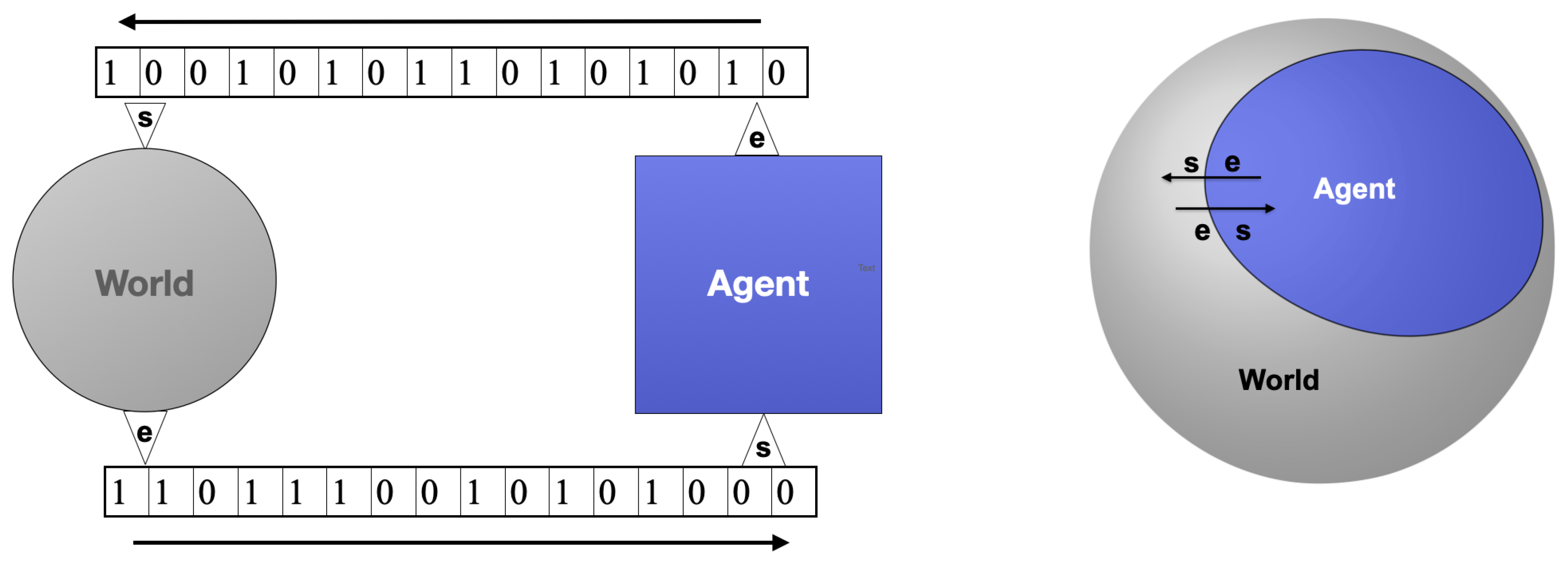
In the Kolmogorov Theory (KT) framework [24,25], the central figure is the algorithmic agent, an information-processing system with bounded computational resources and limited access to data. To persist, the agent must compress raw sensory inputs into simple representations (models) that capture useful structure. Compression here entails a form of coarse-graining: the agent discards or averages over microscopic details and exploits patterns to obtain a more tractable macro-level description of the world. The Kolmogorov complexity of the dynamics of a system reflects two parts: the specification of dynamical laws, and the initial conditions of the system at some time . In general, agents may have access to the microdynamical laws but not the microscopic initial conditions.
In the next sections, we develop the idea that the act of coarse-graining inevitably gives rise to emergent phenomena that are incompressible by the agent, in bounded and unbounded systems. We first review some known facts about emergent phenomena: (i) Finite-size digital physics guarantees weak emergence; (ii) Unbounded systems can produce strong emergence. Then, we recast this in algorithmic terms: (iii) algorithmic emergence is blocked on two counts—a concise model may not exist, and where it does, the uncomputability of K prevents finding it—for both bounded and unbounded systems, even given the microlaws.
It will be useful to keep in mind that what we describe is the interaction between two Turing machines: the world and the agent. As such, both may be affected by the Halting problem or Kolmogorov undecidability (they are equivalent), which takes place in unbounded or infinite systems. To manage this, we consider the cases of a bounded or unbounded world, but we grant our agent unlimited computational powers (an infinite tape in the Turing machine framework).
2. Weak Emergence
In what follows, fix a universal prefix-free Turing machine U. Let be a finite dynamical system of size N with local, computable update rule and initial state . A coarse-graining is a map ; its output trajectory is .
Weak emergence occurs when higher-level patterns are fully fixed by lower-level rules and, given unlimited time and computing power, could in principle be derived from them. Bedau [4] defines weak emergence as a macro-property S of system that “can be derived from the micro-facts of only by simulation” — that is, there is no shortcut analytic proof. Chalmers adds that such properties are “unexpected” yet “logically necessitated” by the base facts once they are run forward [5]. More formally, a macro-predicate (e.g., “ ever reaches region R’’) is weakly emergent if, for every fixed N, there exists some algorithm that decides given . Brute-force simulation suffices, possibly at prohibitive cost.
The Game of Life, for instance, produces intricate patterns (gliders, oscillators) with no closed-form predictor. On a bounded grid any specific outcome still follows from simulating long enough, since a finite state space must eventually repeat; on its standard unbounded grid the Game of Life is Turing-complete, and the same questions can become undecidable—an instance of strong emergence (next section).
Bounded systems are periodic. For example, for a single fixed cellular automaton of width W, the phase space has states, so any property of its orbit is decidable in principle by exhaustive enumeration. Once the system revisits one of the available states, dynamics will repeat. Thus, if the number of available states N is finite, all decision problems are decidable. The undecidability we call strong emergence requires the limit , exactly as Kolmogorov complexity is uncomputable only when program lengths are unbounded.
Wolfram [3] refers to this lack of shortcut to raw computation as computational irreducibility: the minimal way to know the system’s fate (e.g., “will this bit flip?") is to simulate the system itself.
Such behavior is emergent in the sense that high-level structures (e.g., a glider gun shooting out gliders) are not apparent from the microscopic rules, but it is weakly emergent because it remains within the realm of computable processes. The agent can eventually answer any well-posed question about the macro-state by sufficient computation (or observation), though it may be infeasible to do so analytically in closed form.
3. Strong Emergence
Coarse-graining, by design, discards micro-level information. By doing this, it may be possible to find a simplified description at the macro level. However, this also implies that it is not directly possible to use the microlaws for deduction, as they require micro-level information. In some cases, the coarse-graining can induce questions that are provably unanswerable in finite time even with complete knowledge of the microdynamics. This requires the system to be infinite or unbounded, much as a universal Turing machine, which requires an infinite tape.
Strong emergence carries a philosophical and a computational reading, and we keep them apart. In the philosophical tradition a high-level fact is strongly emergent if it is not deducible even in principle from the lower-level facts—Chalmers’ criterion [5]—in contrast to Bedau’s weak emergence, which is derivable but “only by simulation” [4]. We use instead the computational notion now standard in the physics-of-undecidability literature [26,27,28,29]: for an unbounded family of systems, a question about their long-term dynamics is undecidable from the micro-rules—no single algorithm settles it for all members. The two readings do not coincide. An undecidable fact is still logically fixed by the micro-rules—a Laplacean reasoner “in principle” knows it; only no algorithm extracts it uniformly—so in Chalmers’ and Bedau’s terms it remains weak. Our computational strong emergence is therefore weaker than metaphysical strong emergence, and distinct from the algorithmic barrier of the next section, which concerns the uncomputability of optimal compression and already bites for a single bounded system. We say is strongly emergent if the uniform decision problem is undecidable—typically by Turing-reducing the Halting problem. This requires an unbounded size parameter N. The Rule 110 cylinder, Moore’s 3-body Hamiltonian, and the infinite Ising lattice supply concrete examples [9,28,29] we discuss further below.
Strong emergence is a direct consequence of the Church–Turing barrier: if the micro-dynamics are rich enough to perform universal computation, then certain questions about the system’s long-term behavior encode the Halting Problem. We sketch here some examples of how locally computable systems, when viewed at an appropriate coarse-grained level, can manifest undecidable behavior.
Consider a simple deterministic cellular automaton (CA) as the micro-level system. CAs are discrete models with local update rules, often cited in discussions of emergence due to their ability to generate complex patterns from simple rules. Wolfram conjectured that some elementary CAs might be capable of universal computation (Class IV behavior) and therefore exhibit computational irreducibility – meaning no shortcut exists to determine their evolution except to simulate them step by step. This conjecture was dramatically confirmed by Cook (2004) [9], who proved that the 1-dimensional CA known as Rule 110 is Turing-complete. As a result, “many questions concerning its behavior, such as whether a particular sequence of bits will occur or whether the behavior will become periodic, are formally undecidable”. In other words, given an initial configuration of this CA, there is no general algorithm to predict certain macro-level outcomes (like the eventual appearance of a certain pattern) without effectively running the automaton itself. The micro-level evolution rule of Rule 110 is trivially simple and local, yet at the coarse-grained level of large-scale patterns, the system’s behavior can encode arbitrary computations and thus the Halting Problem. This exemplifies strong emergence: the system’s long-term behavior (e.g. the eventual appearance of particular structures) is not just unexpected but in fact undecidable from the micro-dynamics.
The same phenomenon appears in other substrates [26]. Moore (1990) [28] showed that even a low-dimensional continuous dynamical system (a particle moving in a carefully designed 3D potential) can simulate a universal Turing machine, so that “virtually any question about [the particle’s] long-term dynamics is undecidable.” In condensed-matter physics, recent work by Cubitt, Bausch, and others has constructed translationally invariant quantum spin systems whose phase properties hinge on the solution to a halting problem [27]. Specifically, deciding whether an infinite quantum spin chain has a spectral energy gap was proven to be at least as hard as the Halting Problem. This result, initially shown for two-dimensional lattices, was extended to one-dimensional chains by Bausch et al. (2020) [30]. They built a family of 1D Hamiltonians such that the presence or absence of a gap in the many-body energy spectrum depends on the outcome of a certain Turing machine computation; thus no algorithm can determine the gap for all cases. Put succinctly, they encoded Chaitin’s halting constant (an uncomputable number) into a material’s phase diagram, so that an observable phase transition occurs at a parameter value equal to . This means that even with exact microscopic equations (the Hamiltonian), the emergent phase behavior cannot be derived by any finite computation.
Gu et al. [29,31] provide a further illustrative example in a classical setting: they proved that many macroscopic observables of an infinite Ising spin lattice “cannot in general be derived from a microscopic description”, reinforcing that a complete “theory of everything” at the micro-level may still be insufficient to answer certain questions about macroscopic order. All these results point to the same conclusion: when a system’s micro-dynamics are capable of rich computation, a coarse-grained macro description will inherit that computational richness, yielding emergent properties that range from unpredictable to provably undecidable.
4. Algorithmic Emergence
We now formalize weak emergence for agents building compressive models after coarse-graining. The result is a barrier: whether the observed system is bounded or unbounded, an agent cannot in general find optimal macro-models even when handed the microlaws—it must discover macro-scale regularities empirically, from scratch. There may be some exceptions to this general rule, as we discuss further below in Section 5.
First, we define emergence as an event:
Definition 1
(Emergence as empirical discovery of compressive models). Algorithmic emergence occurs when an agent empirically discovers a concise, predictive macro-level model from coarse-grained data, despite lacking the ability to algorithmically derive or predict this simplified description from complete knowledge of the microscopic laws alone.
In other words, the emergent object is precisely the discovered macro-level pattern or simplified model. Such a discovery is not guaranteed: a concise model need not exist (Theorem 1), and where it does it need not be computable to find (Theorem 2); algorithmic emergence is the favorable exception.
For example, a tornado can be described as a “self-organizing entity caught up in a global pattern of behavior" [4]. In Kolmogorov Theory (KT) terms, a tornado is precisely a model that agents construct or empirically discover from coarse-grained observations of atmospheric dynamics. Agents use this model—this simplified macro-level pattern—because it provides substantial compression of otherwise overwhelmingly complex microscopic data, enabling prediction, understanding, and action. The tornado model succinctly summarizes and predicts properties such as its trajectory, intensity, longevity, and characteristic structure, all without directly simulating every underlying microscopic interaction.
The fundamental question is whether such macrolaws or models/patterns can be derived from microlaws.
Defining Emergence Through Kolmogorov’s Structure Function
Suppose we may spend at most a bits to describe a dataset, capturing as much of its structure as that budget allows. With few bits we capture only the coarsest patterns; as a grows the description sharpens and the residual randomness it leaves shrinks.
This intuition underlies the definition of Kolmogorov’s structure function, which can be expressed as [6]
where x is a binary string of length n, S is a contemplated model (a set of n-length strings) containing x, and is the Kolmogorov complexity of S. The value a is a nonnegative integer that bounds the complexity of the contemplated sets S.
In this formulation, the structure function measures the minimal log-size of a set S that contains x and has a complexity less than or equal to a. The function is non-increasing and reaches when , where is the Kolmogorov complexity of x and c represents the additional bits needed to transform x into the set . This function provides insight into how the complexity of a set S changes as we vary the allowable complexity a. As we increase a, allowing for more complex descriptions, we can describe x using smaller sets, effectively compressing the data further by including more of its regularities.
The Kolmogorov structure function definition illustrates the trade-off between the complexity of the model and the compressed representation of the data. The function shows how, as we allocate more bits to describe a dataset, we can capture more of its structure, achieving a more compact representation. The function may display abrupt jumps. This motivates an alternative algorithmic definition of emergence. Bédard & Bergeron (2022) [32] propose a definition of algorithmic emergence as the phenomenon characterized by observation data that display several minimal partial models, that is, that can be non-trivially compressed in jumps as longer programs are allowed for compression.
The above definitions are also related to the concept of Effective Complexity [2]. Briefly, one can conceptually split the Kolmogorov optimal program describing a data string into two parts: a set of bits describing its regularities and another that captures the rest (the part with no structure). The first term is effective complexity, which is the minimal description of the regularities of the data. This concept brings to light the power of the notion of Kolmogorov complexity, as it provides, single-handedly, the means to account for and separate regularities in data from noise [24].
These definitions are related but not equivalent; we adopt the one suited to the algorithmic agent.
The Algorithmic Barrier
What is, and is not, the obstruction. For fixed the coarse-grained trajectory is a finite string, and brute-force simulation prints it; that step is trivial and is not where the difficulty lies. The barrier appears after the data exist: finding a shortest macro-program p with —that is, computing —requires searching candidate programs, and that search meets the halting problem (a shorter p may print x, may halt with something else, or may never halt). Hence no procedure can certify that a given compressor is optimal, or that no shorter macro-law exists:
Simulation yields the finite string; it does not yield the shortest explanation of the string.
This is the Anderson–Kolmogorov point precisely: reduction delivers the data, but construction of the compressed macro-law is blocked by the uncomputability of K. Note the contrast with strong emergence: unbounded systems are needed for halting-style dynamical undecidability, but not for this barrier, which already bites for finite strings produced by bounded systems over bounded time.
A critical insight from algorithmic information theory is that K is uncomputable in general: no algorithm can be reliably used by agents to compute the shortest description (most compressed model) of an arbitrary data set, nor decide certain global properties of a system’s behavior. Specifically, a foundational result in AIT — independently derived by Ray Solomonoff, Andrey Kolmogorov, and Gregory Chaitin — states that there is no general algorithm that, given a string x, can compute its exact Kolmogorov complexity . In other words, there is no computable function that can take x as input and output [7]. Thus, the shortest program or minimal model that generates the string x cannot be found.
Moreover, uncomputability is already a finite-size phenomenon. The counting proof in [7, §2.2] shows that for every bit-length n at least one of the strings satisfies ; the Berry/diagonal theorem [7, Thm. 2.1.1] and Chaitin’s halting-reduction argument [33,34] demonstrate that no single algorithm can map every finite string to its exact complexity. The same point is reinforced in modern treatments of algorithmic randomness [35, Ch. 1]. Thus the compression bottleneck bites long before we worry about infinite trajectories: even a 16-bit sensor snapshot can encode a question our best compressor cannot certify as minimal. Optimal coarse-grain laws are uncomputable in every finite digital world—not only in the thermodynamic limit.
This shows that even though an agent’s coarse-grained world is simpler than the micro-state description, reasoning about the model’s behavior may be computationally intractable or even formally undecidable. This is true for both bounded and unbounded systems.
We summarize this as follows:
Algorithmic emergence barrier. Two obstructions compound. (i) Existence (Theorem 1): for generic data no concise model exists—most strings are Kolmogorov-random (), so the structure function never descends below the sufficiency line and the only sufficient statistic is the data itself. (ii) Computability (Theorem 2): even when a concise model exists, K and the structure function are uncomputable, so no algorithm reliably finds it. A concise, predictive macro-model is therefore guaranteed neither to exist nor, where it exists, to be found—even given the microlaws and a coarse-graining, and even for bounded systems. Meaningful compression, let alone optimal compression, is the exception.
Formalization
Assume we are given
- a short description of the microscopic update rule ();
- a short coarse-graining ();
- the observable macro-trajectory generated from some but unknown micro-initial state .
- Case 1: is known. A short simulator program of length prints x by brute-force simulation. Yet this program is not guaranteed to be optimal: x might itself be far simpler (e.g. if C collapses all states to a constant symbol). Determining whether a strictly shorter program exists is equivalent to computing , which is uncomputable.
- Case 2: is not known (typical experimental situation). Here even the brute-force simulator must somehow encode enough information about to generate the exact x; in the worst case (the trajectory is algorithmically random relative to ). Can we always leverage to find a short description of x? The following theorem says no.
Theorem 1
(Micro-law knowledge does not guarantee compression). There exist a fixed update rule , a fixed coarse-graining C (both with ), and for each n a micro-initial state and time horizon such that the macro-trajectory
satisfies
In other words, conditioned oncompleteknowledge of the microscopic laws, remainsmaximally incompressible. No algorithm can find a substantially shorter program for the macro history.
Proof
Fix once and for all an -bit cellular-automaton rule that implements a universal Turing machine, and an -bit projection that outputs the symbol currently under the TM’s head. For each binary string y of length n choose an initial microstate whose embedded tape is y. Then for the macro-trajectory is exactly . Because y can be any string, pick one with (possible by the classic counting argument). Conditioned on , the complexity of x is still , proving maximal incompressibility. □
Interpretation.
The microscopic rule and the coarse-graining are compressive information only insofar as they constrain the family of possible trajectories. When the coarse-graining is sufficiently lossy, different micro-initial states project to macro-trajectories that are algorithmically unrelated; in the extreme construction above, every binary string can appear as a legal macro-history. In such cases the shortest description of x is x itself, up to an additive constant.
When Do Micro-Laws Help?
They help precisely when the image of C under has low algorithmic entropy. That is the case for equilibrium Ising magnetisation, for hydrodynamic fields obeying closed PDEs, or for block-spins flowing to an RG fixed point. Outside such special structures—e.g. in rule-30 randomness or in cryptographic cellular automata—the micro-laws contribute almost no compressive advantage.
Knowing the microscopic equations of motion is valuable but not sufficient: unless the coarse-graining aligns with particular symmetries or attractors of the dynamics, the resulting macro-history can remain algorithmically incompressible.
The informal “no shortcuts” of weak emergence now has a precise meaning: no algorithm can, in general, produce a macro-model whose length is within an additive constant of the Kolmogorov-optimal one. Successful macro theories—hydrodynamics, the renormalization-group flow of the Ising model—are exceptions owed to special symmetries and fixed-point structure, not to any universal derivation procedure.
Kolmogorov’s Structure Function and Coarse-Graining
Theorem 1 says that, in general, the pair does not supply a low-complexity model whose data–fit term (the log-size of the model class containing x) beats the trivial upper bound . Hence even perfect knowledge of the micro-laws cannot, in a uniform way, circumvent the Vereshchagin–Vitányi incomputability of the structure function , which we now describe.
In algorithmic statistics a “model’’ for a binary string is simply a finite set S with . The model’s description length is bits; the residual randomness once S is known is bits (the index of x inside S).
For a complexity budget the structure function introduced by Kolmogorov is
The curve shows the best trade-off between model complexity and remaining randomness. The point where first holds is the algorithmic minimal sufficient statistic for x.
Given a deterministic micro-dynamics D and a coarse-graining , fix a horizon T and define
Then and
because D is a fixed constant-size program. Thus every computable coarse-graining corresponds to a single candidate point on the structure-function plot of the macro data.
For every fixed the mapping is not computable; equivalently the set of optimal models
is undecidable (Vereshchagin–Vitányi [36]). If such an oracle existed it would compute and hence solve the Halting problem. Because each computable coarse-graining yields one set , the Vereshchagin–Vitányi result implies:
Theorem 2
(No algorithm finds the optimal coarse-graining). There is no algorithm that, given and a complexity bound on C, outputs a coarse-graining C minimizing —nor even one guaranteeing an additive-constant approximation.
Proof.
Take the universal CA rule (constant description) and the projection that outputs the symbol under the TM head each step (). For any n-bit string y embed y in the initial tape so that the macro-trajectory equals y. Then ; if y is chosen algorithmically random () the point lies near — the worst possible compression. No algorithm can look at and guarantee to find a different coarse-graining C that achieves a substantially smaller ; doing so for every y would violate Eq. (1)’s incomputability. □
Knowing the exact microscopic equations constrains which macro trajectories are possible, but selecting a coarse-graining that yields a maximally concise macro model is itself an uncomputable search problem. Hence “discovering the laws at the next scale’’ cannot be guaranteed by any general algorithm—successful cases (e.g. RG flows, hydrodynamics) owe their existence to special symmetries, not to a universal derivation procedure.
Table 1 summarizes the three senses of emergence and the role of bounded versus unbounded systems.
5. Discussion
Microscopic dynamics D may be completely known, yet we rarely know the exact micro–initial state . Naively this makes unique macro–prediction hopeless, but it isn’t always. For example, in cellular automata models, Israeli–Goldenfeld determined simpler cellular-automaton rules that reproduce large-scale patterns of class-IV CAs [11].
In a gas, unknown velocities can in principle yield wildly different futures. Nevertheless physics abounds with concise macro laws—thermodynamics, hydrodynamics, critical exponents—that compress enormous micro complexity into a few parameters. Two generic compression engines explain these successes.
The first is central-limit compression. Averages over weakly-correlated variables converge to a Gaussian ; higher cumulants vanish as . In Kolmogorov terms, irregular bits collapse to bits. Examples include
- Brownian motion: molecular kicks per second average to one parameter, the diffusion constant D [39].
The second is renormalization-group universality. Successive coarse-graining drives most couplings to zero; only a small set of relevant parameters survives, yielding short, scale-independent macro theories. As an example, near the Ising microstates reduce to a single order parameter governed by a Landau–Ginzburg functional with couplings [43,44].
Symmetry and associated conservation laws amplify both mechanisms: if the micro rules are translation-, rotation-, or gauge-invariant, the effective macro equations must respect the same invariances, drastically reducing their allowable form. Ensemble theory then promotes “overwhelmingly likely’’ behavior to a practical law: “black swan" microstates exist but occupy a negligible fraction of phase space.
Scale separation, self-averaging, symmetry, RG irrelevance, and ensemble equivalence shrink the accessible macro configuration space. The choice of proper coarse-graining is key. A coarse-graining aligned with these statistical regularities facilitates the discovery of macro descriptions which are short, predictive, and experimentally testable.
Limits and Consequences for Agents
Our impossibility theorems remain intact: there is no uniform procedure that, for every locally interacting system, guarantees both compression and decidability. In favorable systems (Ising, hydrodynamics) good variables exist; when coarse-graining encodes universal computation, compression is provably out of reach. Hence a KT agent must maintain a portfolio of models—some elegant, others heuristic or brute-force. For natural agents, the selection of appropriate coarse-grainings is part of their successful evolutionary trajectory. In summary,
- Simulation suffices in principle for any finite system, but may exceed available time or energy.
- Compression is uncomputable in general; agents cannot derive optimal macro laws from first principles alone. The choice of proper coarse-grainings is paramount.
- Empirical macro experiments are mandatory: thermodynamics, hydrodynamics, genetics, etc. are discovered by observation, then justified statistically.
This provides an algorithmic context for Anderson’s dictum “reduction ≠ construction”: knowing the micro rules does not guarantee a concise macro law, because constructing such a law in full generality would compute and contradict its uncomputability.
6. Conclusion
Digital physics tells us that microscopic dynamics are, in principle, computable. Algorithmic information theory, however, shows that no uniform procedure can extract optimally compressed macro-laws from those dynamics, not even in finite systems. Agents are thus doubly limited: simulation is possible but often infeasible; analytic compression is uncomputable in general. Predictive science survives by exploiting special structure—symmetry, scale separation, self-averaging, RG universality—and by testing coarse-grainings empirically. Where such structure exists, short and powerful macro models emerge; where it does not, brute-force simulation or heuristics remain the only tools. In this precise algorithmic sense, “more is different’’: higher-level regularities cannot be mechanically derived from lower-level rules, but must be discovered through informed coarse-graining and experiment.
Machine-checked formalization.
The central uncomputability result of this paper—a correct general coarse-graining solver, specialized to , would compute the Kolmogorov structure function, contradicting Vereshchagin–Vitányi—is formalized in Lean 4 + Mathlib in the KTAIT development (CoarseGraining.algorithmic_emergence, with the targeted and regulatory forms theoremB / corollaryB; the proofs are axiom-free reductions). See BCOM WP0195 and https://github.com/giulioruffini/KTAIT (doi: 10.5281/zenodo.20969562). The probability/precision companion—how resource-limited agents derive probability, Bayesian inference, and emergent structure—is the paper [45] (WP0017).
Appendix A Uncomputability Theorem
Fix a universal prefix-free Turing machine U [7]. For , the Kolmogorov complexity w.r.t. U is
The prefix-free condition lets us treat program lengths as code-word lengths and apply Kraft’s inequality [35, §1.3].
Theorem A3.
There is no total computable function that, on every input string x, outputs .
Proof 1: Diagonal/Berry Argument [34]
Sketch.
Assume a total computable function . Define the following program (Algorithm A1) that, on input , searches for the lexicographically first string whose complexity exceeds k. Its description length is bits, a constant c plus the binary length of k. For sufficiently large k this length is , contradicting the test used in line 2. Hence f cannot exist. □
| Algorithm A1 Find high-complexity string (Berry diagonalisation) |
|
Proof 2: Reduction from the Halting Problem [46,47]
Sketch.
Given machine M and input w, build a self-delimiting program that runs and, if M halts, prints the fixed string . If were computable we could distinguish the halting case (short ) from the non-halting case (longer minimal program), thereby deciding the halting problem— impossible by Turing’s 1936 result [48]. □
In more detail: Given a program p, build a wrapper
- If p halts, outputs with a description of length .
- If p never halts, the shortest way to output is to quote it verbatim, needing bits with .
Thus an oracle that returns the exact value of tells us whether p halts—solving the Halting problem. Since the Halting problem is undecidable, such an oracle (and hence an algorithm for K) cannot exist [34,35].
Corollary.
The decision problem “Is ?’’ is Turing-equivalent to the Halting problem.
Proof 3: Counting / Incompressible Strings [49,50]
Sketch.
Among the strings of length n there are only programs shorter than n bits, so at least one string has . If were computable we could enumerate such , giving each an explicit description of length (“enumeration + index’’), contradicting for large n. □
In more detail: fix a length n.
- There are exactly binary strings of length n.
- The number of candidate descriptions (binary programs) strictly shorter than n bits isbecause at length k there are distinct bit-strings.
Since , at least one n-bit string has no description shorter than n bits, i.e. . Such strings are called incompressible [47]. If we had an algorithm that always returned , we could produce the lexicographically first incompressible string of each length, thereby giving it a very short description (“the first incompressible string of length n”) and contradicting its incompressibility. Hence K cannot be computable [7, §2.2].
Prefix-free caveat. In a self-delimiting (prefix-free) code the number of programs of length is , so the counting gap is even larger; the conclusion is unchanged.
Consequences
The decision problem “is ?” is Turing-equivalent to the halting problem, and the real number formed by the halting probabilities of U—Chaitin’s —is algorithmically random [7, Ch. 3].
Appendix B The Limits of Coarse Graining from Microlaws
This appendix expands Theorem 1 in the language of algorithmic statistics. Fix a finite-state system with known micro-rule D and coarse-graining C (both of low complexity), an unknown initial microstate , and the macro-trajectory .
The cost of not knowing σ0.
Given , the string x has a short description of length . Without it, any program for x must encode enough of to reproduce the outputs, so
If is algorithmically random, x inherits its complexity and . Determinism buys decidability, not compressibility: like a pseudo-random generator, a simple rule seeded with a complex input yields incompressible output. Indeed any string y occurs as the macro-trajectory of a fixed universal D—embed y in , as in the proof of Theorem 1—so the family of macro-histories is as rich as the set of all strings.
Structure-function view.
Write the structure function [36]. Two models bracket the curve. “ alone” has complexity yet leaves , so sits near for small ; “” has and drives the residual to . For an algorithmically random x there is no model in between: stays flat near until reaches . The laws are not a sufficient statistic for x; only (or x itself) is.
Consequence.
A general “macro-law extractor” mapping to a substantially compressed model would compute a point of , hence —which is uncomputable. Absent , the only universally valid description of x is “simulate D from the that produces x,” a restatement of the micro story. This is Wolfram’s computational irreducibility sharpened to informational irreducibility: x carries bits present only in the initial condition.
Appendix C Kolmogorov Structure Function Definitions
Kolmogorov’s structure function was introduced to quantify how well a finite model of bounded complexity can describe a given data string. Several equivalent—yet differently convenient—definitions are used in the literature. We collect the three most common versions and state their mutual relationships.
Kolmogorov’s original hx(α) (finite sets)
Fix a universal prefix–free Turing machine U. For a binary string x of length n and a complexity bound Kolmogorov defined
where the minimum ranges over finite sets . Here is the prefix complexity of any standard description of S. The pair thus trades model length () against residual randomness ().
fx(α) (conditional complexity form)
Vereshchagin and Vitányi [36] rewrote the same trade–off as
where M now ranges over arbitrary computable descriptions (programs, probability distributions, grammars …) whose self-delimiting length is . Formally,
because a shortest conditional program for x given M can be encoded as an index of x inside an appropriately enumerated finite set and vice versa. Thus (A2) and (A3) are equivalent up to an additive term.
gx(α) (MDL / stochastic complexity form)
In Minimum Description Length (MDL) theory one often writes the structure function as the two–part code length
where is the log-likelihood code length if M is a stochastic model, or any other admissible data code (e.g. two-stage Shannon–Fano) if M is deterministic [51]. Under standard coding schemes , so
The three curves therefore contain the same information, merely plotted in different coordinate systems.
Figure A2.
Illustrative structure function showing a ‘crack point’ where a modest increase in model length produces a large drop in residual randomness.
Figure A2.
Illustrative structure function showing a ‘crack point’ where a modest increase in model length produces a large drop in residual randomness.
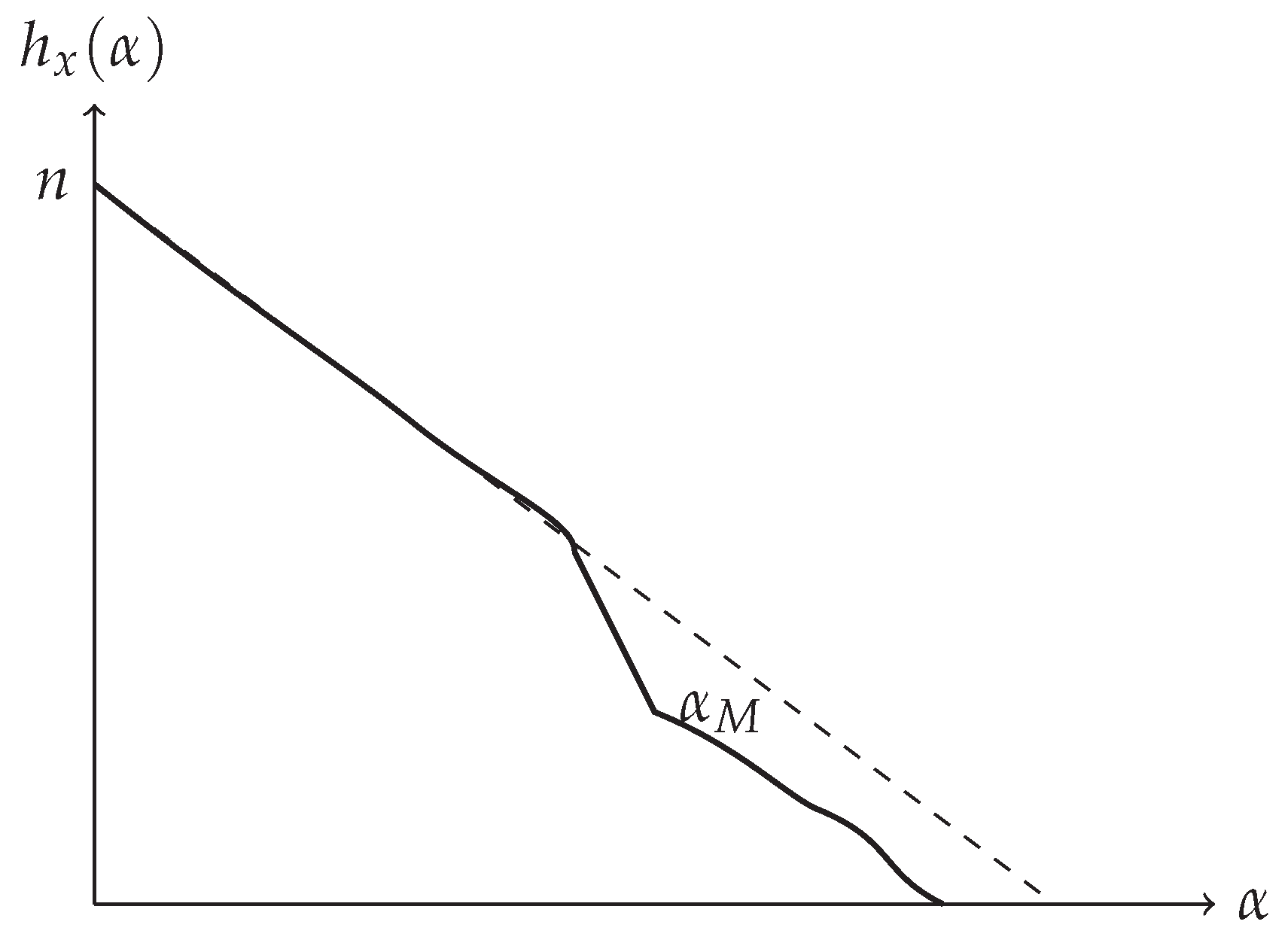
For each in Figure A2 one reads the best achievable model length / noise length trade–off. The point where (or equivalently ) is Kolmogorov’s minimal sufficient statistic; models to the left underfit ( too small), those to the right overfit ( needlessly large).
Finally, Vereshchagin–Vitányi proved that for any fixed the functions are not computable from alone—computing them would decide the Halting problem. This underlies our claim in the main text that no uniform procedure can guarantee finding the maximally compressive coarse-graining.
References
- Anderson, P.W. More is different. In Science (New York, N.Y.); American Association for the Advancement of Science (AAAS): Publisher, 1972; Volume 177, pp. 393–396. [Google Scholar]
- Gell-mann, M.; Lloyd, S. Effective complexity Issue: 2003-12-068 tex.date-added: 2016-10-16 14:02:46 +0000. SFI Work. Pap. St. Fe Inst. tex.date-modified: 2016-10-16 14:04:20 +0000. 2003. [Google Scholar]
- Wolfram, S. A new kind of science tex.date-added: 2016-05-06 23:17:17 +0000; tex.date-modified: 2016-05-06 23:21:31 +0000; Wolfram Media, 2002. [Google Scholar]
- Bedau, M.A. Weak Emergence. In Philosophical Perspectives; Ridgeview Publishing Company, Wiley, 1997; Volume 11, pp. 375–399. [Google Scholar]
- Chalmers, D.J. Strong and weak emergence. In The re-emergence of emergence: the emergentist hypothesis from science to religion; Clayton, P., Davies, P., Eds.; Oxford University Press, 2006. [Google Scholar]
- Cover, T.M.; Thomas, J.A. Elements of information theory tex.date-added: 2016-10-20 21:00:29 +0000, tex.date-modified: 2016-10-20 21:00:58 +0000, 2 ed.; John Wiley & sons, 2006. [Google Scholar]
- Li, M.; Vitanyi, P. An introduction to Kolmogorov Complexity and its applications tex.date-added: 2009-03-01 22:14:38 +0100; tex.date-modified: 2009-05-24 11:58:30 +0200; Spriger Verlag, 2008. [Google Scholar]
- Schrödinger, E. What is life?: The physical aspect of the living cell; Cambridge University Press, 1944. [Google Scholar]
- Cook, M. Universality in elementary cellular automata. Complex Syst. tex.date-added: 2016-05-24 15:46:35 +0000 tex.date-modified: 2016-09-17 21:49:32 +0000. 2004, 15 2004(15), 1–40. [Google Scholar] [CrossRef]
- Gardner, M. Mathematical Games – The fantastic combinations of John Conway’s new solitaire game “life” tex.date-added: 2016-10-15 11:24:34 +0000. Sci. Am. tex.date-modified: 2016-10-15 11:29:25 +0000. 1970, 223, 120–123. [Google Scholar]
- Israeli, N.; Goldenfeld, N. Coarse-graining of cellular automata, emergence, and the predictability of complex systems E. tex.date-added: 2016-05-27 02:05:15 +0000 tex.date-modified: 2016-05-27 02:06:21 +0000. Phys. Rev. 2006. [Google Scholar] [CrossRef]
- Chaitin, G.J. Proving Darwin: making biology mathematical; Pantheon Books: New York, 2012. [Google Scholar]
- Zenil, H. A Computable Universe: Understanding and Exploring Nature as Computation; World Scientific Publishing Co., Inc.: USA, 2012. [Google Scholar]
- PhilPapers. Pancomputationalism; 2025. [Google Scholar]
- Zuse, K. Rechnender raum. Elektron. Datenverarb. tex.date-added: 2016-12-05 21:59:52 +0000 tex.date-modified: 2016-12-05 22:00:40 +0000. 1967, 8, 336–344. [Google Scholar]
- Fredkin, E. Digital mechanics - an informational process based on reversible universal cellular automata. Phys. D. Nonlinear Phenom. 1990, 45, 254–70. [Google Scholar]
- Fredkin, E. An introduction to digital philosophy tex.date-added: 2016-12-05 22:09:16 +0000. Int. J. Theor. Phys. tex.date-modified: 2016-12-05 22:10:00 +0000. 2003, 42. [Google Scholar]
- Feynman, R.P. Simulating physics with computers. Int. J. Theor. Phys. 1982, 21, 467–488. [Google Scholar] [CrossRef]
- Deutsch, D. The fabric of reality; Penguin, 1997. [Google Scholar]
- Lloyd, S. Programming the universe: a quantum computer scientist takes on the cosmos; Vintage, 2010. [Google Scholar]
- Wheeler, J.A. Information, physics, quantum: The search for links. In Proceedings III international symposium on foundations of quantum mechanics; Archibald, W.J., Ed.; Physical Society of Japan, 1989; pp. 354–358. [Google Scholar]
- Penrose, R. The emperor’s new mind: Concerning computers, minds, and the laws of physics, 1 ed.; Oxford University Press: New York, 1989. [Google Scholar]
- Scheidl, T.; Ursin, R.; Kofler, J.; Ramelow, S.; Ma, X.S.; Herbst, T.; Ratschbacher, L.; Fedrizzi, A.; Langford, N.K.; Jennewein, T.; et al. Violation of local realism with freedom of choice. In Proceedings of the National Academy of Sciences; Proceedings of the National Academy of Sciences, 2010; Volume 107, pp. 19708–19713. [Google Scholar] [CrossRef] [PubMed]
- Ruffini, G. An algorithmic information theory of consciousness. Neurosci. Conscious. 2017, nix019. [Google Scholar] [CrossRef] [PubMed]
- Ruffini, G.; Lopez-Sola, E. AIT foundations of structured experience. In Journal of Artificial Intelligence and Consciousness; World Scientific Pub Co Pte Ltd: Publisher, 2022; Volume 9, pp. 153–191. [Google Scholar]
- Perales-Eceiza; Cubitt, T.; Gu, M.; Pérez-García, D.; Wolf, M.M. Undecidability in Physics: a Review, 2024. arXiv, [math-ph] version: 1; arXiv:2410.16532. [CrossRef]
- Cubitt, T.; Perez-Garcia, D.; Wolf, M.M. Undecidability of the Spectral Gap (short version). Nature [quant-ph. 2015, arXiv:1502.04135528, 207–211. [Google Scholar] [CrossRef] [PubMed]
- Moore, C. Generalized shifts: unpredictability and undecidability in dynamical systems. In Nonlinearity; IOP Publishing: Publisher, 1991; Volume 4, pp. 199–230. [Google Scholar]
- Gu, M.; Weedbrook, C.; Perales, A.; Nielsen, M.A. More Really is Different. Phys. D. Nonlinear Phenom. [cond-mat]. 2009, arXiv:0809.0151238, 835–839. [Google Scholar] [CrossRef]
- Bausch, J.; Cubitt, T.S.; Watson, J.D. Uncomputability of Phase Diagrams. Nat. Commun. [quant-ph]. 2021, arXiv:1910.0163112, 452. [Google Scholar] [CrossRef] [PubMed]
- Gu, M.; Perales. Encoding universal computation in the ground states of ising lattices. Phys. Rev. E 2012, 86, 011116. [Google Scholar] [CrossRef] [PubMed]
- Bédard, C.A.; Bergeron, G. An Algorithmic Approach to Emergence. Entropy 2022, 24, 985. [Google Scholar] [CrossRef] [PubMed]
- Chaitin, G.J. On the Length of Programs for Computing Finite Binary Sequences. J. ACM 1966, 13, 547–569. [Google Scholar] [CrossRef]
- Chaitin, G.J. A Theory of Program Size Formally Identical to Information Theory. J. ACM 1975, 22, 329–340. [Google Scholar] [CrossRef]
- Downey, R.; Hirschfeldt, D. Algorithmic randomness and complexity; Springer, 2010. [Google Scholar]
- Vereshchagin, N.K.; Vitanyi, P.M. Kolmogorov’s structure functions and model selection. IEEE Trans. Inf. Theor. 2004, 50, 3265–3290. [Google Scholar] [CrossRef]
- Boltzmann, L. Lectures on gas theory; J. A. Barth: Leipzig, 1896. [Google Scholar]
- Huang, K. Statistical mechanics; Wiley, 1987. [Google Scholar]
- Einstein, A. Über die von der molekularkinetischen Theorie der Wärme geforderte Bewegung von in ruhenden Flüssigkeiten suspendierten Teilchen. Ann. De Phys. 1905, 322, 549–560. [Google Scholar] [CrossRef]
- Alder, B.; Wainwright, T. Molecular dynamics by computer. Sci. Am. 1967, 217, 94–106. [Google Scholar]
- Evans, D.J.; Morris, G. Statistical mechanics of nonequilibrium liquids; Cambridge University Press, 2008. [Google Scholar]
- Landau, L.D.; Lifshitz, E.M. Fluid mechanics; Pergamon Press, 1987. [Google Scholar]
- Kadanoff, L.P. Scaling laws for ising models near ${T}_{c}$. In Physics Physique Fizika; American Physical Society, 1966; Volume 2, pp. 263–272. [Google Scholar] [CrossRef]
- Wilson, K.G. Renormalization Group and Critical Phenomena. I. Renormalization Group and the Kadanoff Scaling Picture. In Physical Review B; American Physical Society: Publisher, 1971; Volume 4, pp. 3174–3183. [Google Scholar] [CrossRef]
- Ruffini, G. Navigating Complexity: How Resource-Limited Agents Derive Probability and Generate Emergence. Zenodo 2024. [Google Scholar] [CrossRef]
- Levin, L.A. Laws of information conservation (non-growth) and aspects of the foundation of probability theory. Probl. Inf. Transm. 1974, 10, 206–210. [Google Scholar]
- Nies, A. Computability and randomness; Oxford University Press, 2009. [Google Scholar]
- Sipser, M. Introduction to the theory of computation, third edition, international edition ed.; Cengage Learning: Australia Brazil Japan Korea Mexiko Singapore Spain United Kingdom United States, 2013. [Google Scholar]
- Calude, C.S. Information and randomness: An algorithmic perspective, 2 ed.; Springer, 2002. [Google Scholar]
- Schnorr, C.P. A unified approach to the definition of random sequences. Math. Syst. Theory 1971, 5, 246–258. [Google Scholar] [CrossRef]
- Rissanen, J.; Grünwald, P. Stochastic Complexity in Statistical Inquiry; The Minimum Description Length Principle, 2007; World Scientific; MIT Press, 1989. [Google Scholar]

Table 1.
Three distinct senses of emergence in an algorithmic-information framework. Here D, C and stand for the microdynamics rule, coarse-graining operator, and microstate initial condition, respectively.
Table 1.
Three distinct senses of emergence in an algorithmic-information framework. Here D, C and stand for the microdynamics rule, coarse-graining operator, and microstate initial condition, respectively.
| Emergence | Informal idea | Formal core | Role of bounded / unbounded systems |
|---|---|---|---|
| Weak | A question about the dynamics is not analytically predictable but becomes explicit by simulating the micro-dynamics step by step. | For every instance the decision problem is decidable; no algorithm solves it asymptotically faster than full micro-simulation (computational irreducibility). | Occurs in both single finite systems and unbounded families. Boundedness removes undecidability but not the need for brute-force simulation. |
| Strong | A question about the system’s long-term dynamics has no algorithmic answer, even with complete micro-knowledge. | For an unbounded family, the dynamical decision problem is Turing-equivalent to the halting problem (undecidable). | Requires an unbounded size parameter (e.g. lattice width ). Every fixed finite instance is still decidable by exhaustive enumeration. |
| Algorithmic (this work) | Knowing D, C (and optionally ) does not let an agent find an optimally compressed macro-model. | No Turing machine, for all , outputs a program of length ; this follows from the uncomputability of optimal compression (K). | Holds even for a single bounded system. Unboundedness is unnecessary; the barrier is the uncomputability of compression, not dynamical undecidability. |
Disclaimer/Publisher’s Note: The statements, opinions and data contained in all publications are solely those of the individual author(s) and contributor(s) and not of MDPI and/or the editor(s). MDPI and/or the editor(s) disclaim responsibility for any injury to people or property resulting from any ideas, methods, instructions or products referred to in the content. |
© 2026 by the authors. Licensee MDPI, Basel, Switzerland. This article is an open access article distributed under the terms and conditions of the Creative Commons Attribution (CC BY) license (http://creativecommons.org/licenses/by/4.0/).
Copyright: This open access article is published under a Creative Commons CC BY 4.0 license, which permit the free download, distribution, and reuse, provided that the author and preprint are cited in any reuse.