

Submitted:
02 July 2026
Posted:
03 July 2026
You are already at the latest version
Abstract
Climate change, altered ecosystems and expanding development in fire-prone landscapes are increasing fire risk in the wildland–urban interface (WUI). This study uses Noosa, southeast Queensland, Australia, as a proof-of-concept case study to test irrigated Green Firebreaks (iGFBs). Using the AMICUS Vesta Mk2 fire-behaviour model, fire spread and fireline intensity were compared across dry eucalypt control scenarios, non-irrigated green firebreak scenarios, and irrigated green firebreak scenarios, receiving 1 and 2 mm m⁻2 day-1 of water. In line with future climate predictions, these scenarios were all compared under progressively worsening fire-weather conditions. The drought-affected dry eucalypt control produced the highest predicted fire spread and fireline intensity, while non-irrigated green firebreak scenarios reduced fire behaviour, but they may still exceed typical suppression thresholds under catastrophic conditions. In contrast, iGFB scenarios consistently reduced both fire spread and fireline intensity across all fire-weather classes. Sensitivity analysis indicated that the model outputs were most responsive to drought- and moisture-related assumptions, supporting the importance of fuel moisture in the performance of the iGFB concept. Although iGFBs are not a stand-alone solution suitable for all settings, the findings provide a region-specific proof of concept for iGFBs and support the need for further applied research.
Keywords:
irrigated green fire-break
; wildland urban interface
; green firebreak (GFB)
; fire behaviour modelling
; AMICUS
; Vesta Mk2
1. Introduction
Wildfire extent and intensity are predicted to increase under future climate scenarios, placing growing pressure on existing fire management approaches [1]. These challenges are compounded in wildland urban interface (WUI) environments, where expanding human development intersects with fire-prone vegetation [2]. Decades of reports, inquiries, and research into Australian fire disasters, including the post-Black Summer, 2020 NSW Bushfire Inquiry, have identified the need for enhanced preparedness and mitigation to strengthen disaster risk reduction [3,4,5]. The Australian Productivity Commission notes the considerable cost-benefit of proactive investments, but ongoing reactive emphasis [6]. As the potential for fire disasters in the WUI increases, complementary options to proactively mitigate fire are needed to enhance preparedness.
Green firebreaks (GFBs) are a proactive option that uses strategically placed low-flammability vegetation to reduce fire spread and fireline intensity; however, under extreme heat and drought conditions, effectiveness may be compromised [7]. Under climatic heating and drying trends, any vegetation near homes is becoming more flammable. A review of GFBs identified irrigation as a means of strengthening and maintaining fuel moisture and enhancing fire resistance [8]. Research on GFBs and proactive water management, such as irrigation for wildfire mitigation, is limited in fire management literature.
Fire behaviour modelling is widely used to support fire management by informing risk assessment, suppression planning, zoning, firebreak placement and prescribed burning [9]. Methods for predicting fire behaviour have been evolving, with increasingly detailed software programs [8], and more vegetation options have supported the predictive accuracy [10]. Contemporary models estimate fire behaviour metrics such as rate of spread and fireline intensity from environmental and fuel inputs, including vegetation and weather [11]. Field-based testing of landscape-scale mitigation strategies is often costly, risky, or impractical, and modelling provides a way to assess how changes in vegetation structure and moisture influence fire behaviour under defined conditions.
Fire behaviour models are designed to support fire management decision-making, and as they allow key design variables to be manipulated, they can be used to test new approaches. Scenario-based modelling can compare alternative vegetation and moisture configurations under increasingly severe fire-weather conditions, and has been used to explore GFB as a fire management strategy[12,13]. CSIRO AMICUS software is suited to this type of analysis because it allows vegetation and moisture inputs to be varied while generating outputs for fire spread and fireline intensity [14,15]. This makes it a useful platform for testing proof-of-concept fire mitigation scenarios in WUI landscapes.
The application of modelling to test nature-based fire mitigation interventions such as GFBs and irrigated vegetation systems remains limited. To address this gap, a conceptual iGFB design was developed for Noosa, Queensland, Australia (Smith et al., 2026, in press). The present study builds on this framework by evaluating whether irrigation can influence fire behaviour under increasingly severe fire weather conditions. Specifically, it tests the hypothesis that iGFBs reduce fire spread and fireline intensity relative to non-irrigated vegetation systems.
The CSIRO AMICUS Vesta Mk2 modelling platform was used to compare fire behaviour across contrasting dry and wet eucalypt vegetation and moisture scenarios under defined fire-weather conditions. The models were based on more extreme fire weather and drought conditions as worst-case scenarios, which are becoming more likely with climate change. Simulation scenarios were developed to compare (i) dry eucalypt vegetation under severe drought conditions as the control, (ii) non-irrigated green firebreaks, under drought conditions, and (iii) irrigated green firebreaks receiving 1- and 2-mm m⁻² day⁻¹ of water. These scenarios were evaluated across a gradient of fire weather conditions to assess differences in fire spread and fireline intensity. The study provides region-specific proof of concept for iGFB and assesses whether further applied research is warranted.
2. Methodology
2.1. Modelling Approach
2.1.1. Study Area
The study area is located in Southeast Queensland, a region projected to experience rising temperatures, drying trends, and more extreme fire-weather days [16]. The analysis focuses on the Noosa Local Government Area (26.30S, 152.90E), which covers 872 km2. Noosa is characterised by a mix of coastal and hinterland landscapes, a sub-tropical climate, and approximately 1500 mm of mean annual rainfall falling over 107 days [17].
With a population of 59,274, the population density is 68 persons km-2 [18]. Around 40% of the land area comprises protected areas, interspersed with urban and peri-urban development [19]. This landscape configuration creates extensive WUI zones in which residential areas are closely integrated with fire-prone vegetation (Smith et al 2026 in Press).
Noosa was selected as the case study because it is experiencing increasing fire risk and vulnerability, and its WUI has been identified as particularly complex to manage [19]. In addition, local policy settings and planning frameworks that emphasise environmental protection and climate response provide a relevant context for exploring proactive, vegetation-based mitigation approaches such as irrigated green firebreaks [12,20].
2.1.2. Scenario Design
This study is built on the GFB concept, which proposes that strategically placed vegetation and ecosystems can reduce fire spread and fireline intensity [8]. Landscape fuel moisture characteristics influence fire behaviour and risk [21]. The effectiveness of GFBs may decline under extreme drought and severe fire-weather conditions, when vegetation moisture decreases, and flammability increases [7,22]. This limitation provided the rationale for testing whether irrigation could strengthen vegetation-based fire mitigation by maintaining fuel moisture.
The design focused on manipulating vegetation type and fuel moisture as key variables influencing fire behaviour. Three landscape configurations were defined: (i) a control scenario representing dry eucalypt vegetation under drought conditions, (ii) a non-irrigated GFB scenario, and (iii) irrigated GFB (iGFB) design scenarios. To evaluate this iGFB concept, a simplified design was implemented within the fire behaviour modelling framework (Table 1).
The iGFB design was represented using a wet eucalypt forest as a proxy for a higher-moisture vegetation system, combined with irrigation inputs based on a Design Irrigation Rate for native vegetation in Queensland of 10 mm m⁻2 week⁻¹ [26]. Irrigation scenarios were varied to simulate different levels of moisture availability, allowing comparison of fire behaviour under progressively wetter conditions. By systematically varying vegetation and moisture inputs, the modelling framework enables assessment of how iGFB configurations influence fire spread and fireline intensity under increasingly extreme fire weather conditions.
2.2. Scenario Design
Fire behaviour simulations were conducted using the CSIRO AMICUS 0.7.1 beta platform with Vesta Mk2 vegetation models (AMICUS). AMICUS is based on the Australian National Fire Behaviour Database and is used for bushfire prediction, prescribed burn planning, and assessment of fire behaviour under varying environmental conditions [14,15,23,24]. The model allows manipulation of key inputs, including vegetation type, fuel moisture, and fire weather, enabling comparison of alternative landscape configurations. The Vesta Mk2 module incorporates fire behaviour models for Australian vegetation types, including dry and wet eucalypt forests, and has been refined to improve prediction accuracy relative to earlier versions [15,25,26]. Model outputs included rate of fire spread (m h⁻¹) and fireline intensity (kW m⁻¹), which are used as primary indicators of fire behaviour. Fire behaviour was interpreted using three general propagation phases defined within the Vesta Mk2 framework:
- Phase 1: reduced fire spread (<120 m h⁻¹) and fireline intensity (10-300 kW m⁻¹);
- Phase 2: moderate fire spread (120-150 m h⁻¹), and fireline intensity (300 - 7500 kW m⁻¹); and
- Phase 3: increased fire spread (>150 m h⁻¹) influenced by spotting, and higher fireline intensity (>7500 kW m⁻¹) [24].
In addition, a fireline intensity threshold of approximately 4,000 kW m⁻¹ was used as an indicative limit for effective suppression under Queensland conditions [27,28]. These thresholds provide a basis for comparing the relative performance of control, GFB, and iGFB scenarios under different fire weather conditions.
2.2.1. Scenario Parameterisation
Fire behaviour simulations were parameterised to represent conditions beyond those typical of the Noosa region, and in line with climate drought and fire weather predictions, while allowing controlled comparison between vegetation and irrigation scenarios. To reduce variability unrelated to the study objectives, several environmental inputs were standardised across all simulations. These include aspect (0°), slope (6°), elevation (69 m), and cloud cover (10%). These fixed input parameters simplify consideration of simulation outputs, and the inputs for fuel, weather and moisture are expanded to capture the design.
2.2.2. Fuel Inputs
Using the wildfire option in AMICUS, the specified fuel parameters were fuel type, fuel load, elevated fuel hazard, elevated fuel height, bark hazard, and a wind adjustment factor. Fuel parameters were linked to vegetation type, with Vesta Mk2 dry eucalypt used as a control vegetation type at 30 t ha⁻¹, and wet eucalypt used as a proxy for GFB and iGFB vegetation at 15 t ha⁻¹, as a surrogate for a lower-flammability, higher-moisture vegetation system [24].
Control areas were assigned a fuel hazard score of 3.5 on a four-point scale, whereas hazard scores for treated areas were set at 2.0. Fuel heights were assumed to be the same in control and treated areas. Bark hazard scores of 3.5 and 2.0 are assigned to the dry and wet eucalypt forests, respectively. Wind Adjustment Factors were set at 6 for the control scenario and 9 for the wet eucalypt design scenarios.
2.2.3. Weather Inputs
Cloud cover and wind direction were held constant across all scenarios. In contrast, air temperature, relative humidity, and wind speed were manipulated to simulate escalating fire-weather conditions for the control and design scenarios. The AMICUS fire weather parameters used to test the iGFB scenarios (Table 2) were selected to align with Australian Fire Danger Rating System (AFDRS) classes.
2.2.4. Moisture Inputs
In the control and non-irrigated GFB scenarios, drought conditions were set to severe, with rainfall held constant, but fuel moisture-related inputs varied from 7-14 % to capture changing moisture across scenarios (Table 3). AMICUS relies on a predictor model for fuel moisture in native wet eucalypt forest [29,30]. Accordingly, fuel moisture and soil dryness were adjusted, and irrigation rates were represented by modifying the inputs for Last Rainfall (mm) and Time Since Last Rain (days).
In Queensland, the design irrigation rate for native vegetation is approximately 10 mm week⁻¹ [31]. On this basis, the irrigation treatments were set at 1 and 2 mm m⁻2 day⁻¹, equivalent to 7 and 14 mm m-2 week⁻¹. The purpose of the iGFB design was to maintain more consistent moisture availability, reduce drought effects, and shorten the period during which fuels remain highly combustible [32].
AMICUS calculates a drought factor ranging from 1 to 10, with 10 representing extreme drought. This parameter was adjusted so that the control and non-irrigated GFB sites represented more drought-stressed conditions. The design scenarios were scaled from severe drought (0 mm m⁻2 day⁻¹), to drought (1 mm m⁻2 day⁻¹), to moderate drought (2 mm m⁻2 day⁻¹), with the latter exceeding the prescribed regional design irrigation rate for native vegetation [31].
2.2.5. Sensitivity Analysis
Small changes in fire model parameters can influence outputs in non-linear ways [33]. To assess the robustness of the modelled treatment differences, a one-at-a-time sensitivity analysis was conducted on key input parameters expected to influence fire spread and fireline intensity (Table 4).
Parameters tested included vegetation, fuel moisture content, wind and drought factor. Each parameter was varied across a plausible low, baseline, and high setting while all other inputs were held constant. Sensitivity was assessed by comparing the resulting changes in predicted rate of fire spread and fireline intensity for the control, GFB, and iGFB scenarios.
The purpose of this analysis was not to generate new treatment scenarios, but to determine which assumptions most influenced the outputs and whether the relative advantage of the iGFB scenarios remained consistent under plausible variation in model inputs.
3. Results
AMICUS predicted rates of fire spread and fireline intensity results for the control, GFB and two iGFB treatments across five fire-weather scenarios, yielding 20 scenario combinations for comparison. These outputs were used to compare transitions in the fire behaviour phase and the relevance of the indicative suppression threshold of 4,000 kW m⁻¹.
3.1. Modelled Rate of Fire Spread
Under moderate fire weather, fires are predicted to spread nearly four times faster in the dry eucalypt control than in the wet eucalypt GFB without irrigation, and over 80 times faster than in the iGFB receiving 2 mm day⁻¹ of irrigation (Table 5, Figure 1). The dry eucalypt control entered Phase 2 at lower fire-weather levels and transitioned to Phase 3 under high and more severe fire-weather conditions. Under catastrophic conditions, the predicted spread rate exceeded 4 km h⁻¹, indicating a very rapid-moving forest fire.
By contrast, all iGFB scenarios remained within the Phase 1 rate-of-spread range across all fire weather scenarios. Under catastrophic weather conditions, irrigation was associated with substantially lower predicted rates of spread than both the dry eucalypt control and the non-irrigated GFB. Even at only 1 mm m⁻2 day⁻¹, irrigation was predicted to reduce fire spread substantially.
3.2. Modelled Fireline Intensity
Modelled fireline intensity was highly sensitive to drought (Figure 2). Under catastrophic droughts and fire-weather conditions, peak fireline intensities in dry eucalypt control exceed 65,000 kW m⁻¹. The strongest contrast was observed between the dry eucalypt control and the non-irrigated GFB scenario.
Most non-irrigated GFB scenarios and all iGFB scenarios stayed under the 4,000 kW m⁻¹ suppression threshold. However, under catastrophic conditions, the non-irrigated GFB scenario exceeds this threshold. In contrast, the irrigated scenarios remained below the threshold across the tested fire-weather range.

Table 6.
Fireline intensity predicted using AMICUS 0.7.1 beta with Vesta Mk2 vegetation.
| Modelled fireline intensity (kW m⁻¹) across fire weather | No Rating | Moderate | High | Extreme | Catastrophic |
| Control (Dry) 0 mm m-2 day -1 | 6253 | 13633 | 24776 | 54553 | 65684 |
| GFB (Wet) 0 mm m-2 day -1 | 253 | 1739 | 2709 | 3487 | 4048 |
| iGFB (Wet) 1 mm m-2 day -1 | 88 | 653 | 1459 | 2155 | 2409 |
| iGFB (Wet) 2 mm m-2 day -1 | 2 | 83 | 84 | 83 | 72 |
3.3. Sensitivity of Model Outputs to Key Input Assumptions
Sensitivity analysis was used to assess how variation in selected input parameters influenced predicted fire spread and fireline intensity in the control and design scenarios. Alterations to the control scenario typically reduced fire spread and fireline intensity, whereas alterations to the iGFB design scenario typically increased both outputs. Despite some variation in magnitude, these changes did not reverse the overall treatment pattern.
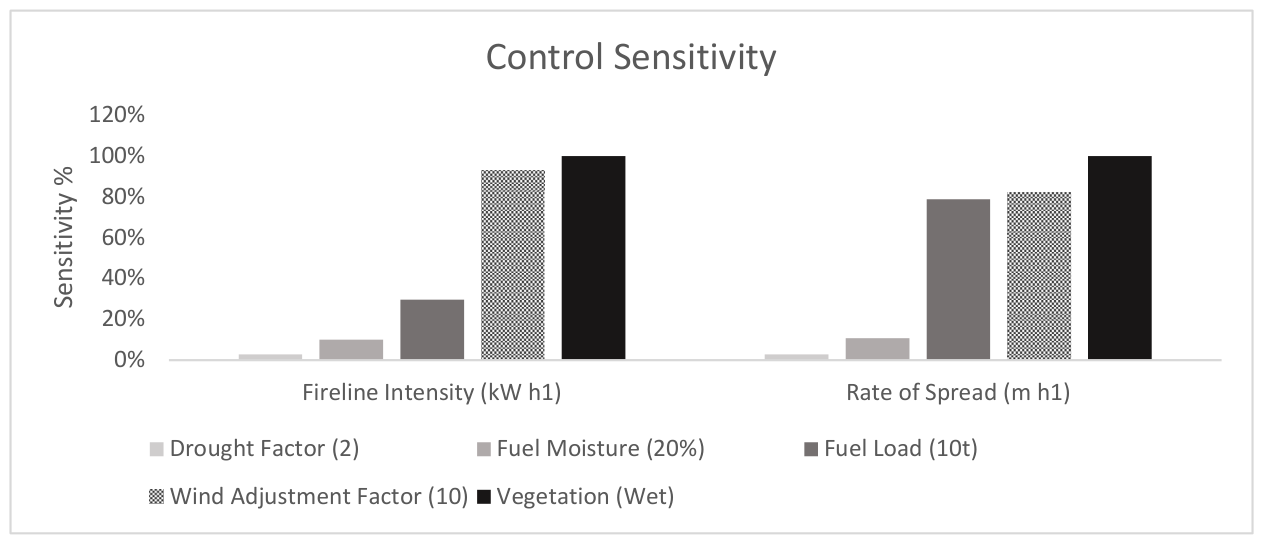
For the control scenario, model outputs were most sensitive to drought-related inputs, particularly the shift from extreme to no drought. Fuel moisture and fuel load showed moderate sensitivity. The wind adjustment factor was less sensitive; however, the model already included moderate wind. The vegetation change to wet eucalypt was not sensitive and was flagged in the software as lacking input boundaries.
Table 7.
Control Sensitivity Results – Rate of Spread.
| Control - Rate of Spread (m h-1) across fire weather scenarios | No Rating | Moderate | High | Extreme | Catastrophic |
| Control (Dry) 0 mm m1 day1 | 403 | 880 | 1598 | 3520 | 4238 |
| Drought Factor (2) | 24 | 50 | 66 | 74 | 89 |
| Fuel Moisture (20%) | 89 | 190 | 251 | 280 | 337 |
| Fuel Load (10t) | 47 | 501 | 1265 | 2350 | 4219 |
| Wind Adjustment Factor (10) | 265 | 589 | 1315 | 2377 | 4222 |
| Vegetation (Wet not Dry) | 403 | 880 | 1598 | 3520 | 4238 |
Table 8.
Control Sensitivity Results – Fireline Intensity.
| Control - Fireline Intensity (kW h-1) across fire weather scenarios | No Rating | Moderate | High | Extreme | Catastrophic |
| Control (Dry) 0 mm m1 day1 | 6253 | 13633 | 24776 | 54553 | 65684 |
| Drought Factor (2) | 364 | 777 | 1026 | 1145 | 1377 |
| Fuel Moisture (20%) | 1280 | 2728 | 3602 | 4022 | 4836 |
| Fuel Load (10t) | 241 | 2586 | 6537 | 17832 | 21798 |
| Wind Adjustment Factor (10) | 4102 | 9137 | 20381 | 53646 | 65435 |
| Vegetation (Wet) | 6253 | 13633 | 24766 | 54553 | 65684 |
Figure 3.
Control Sensitivity Chart highlighting sensitivity to change, especially wind and vegetation.
Figure 3.
Control Sensitivity Chart highlighting sensitivity to change, especially wind and vegetation.
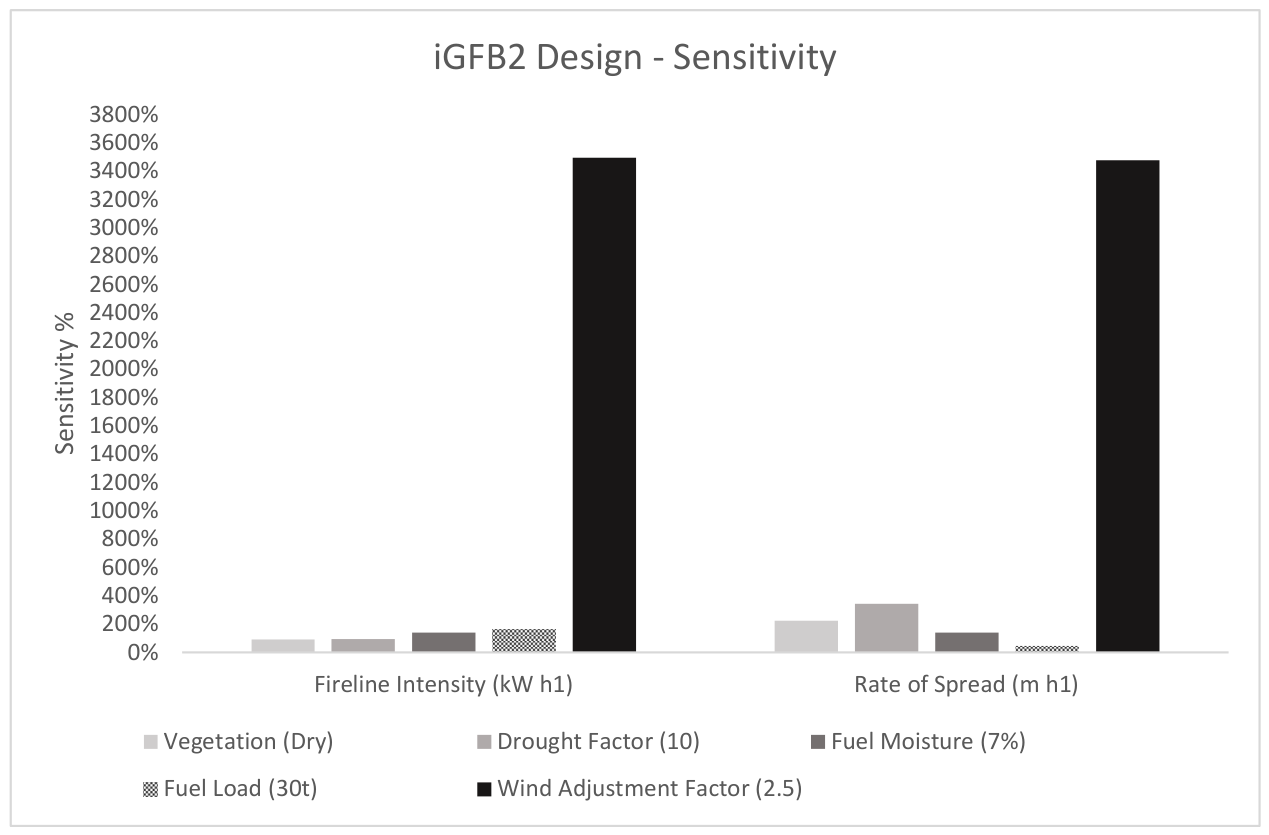
For the iGFB 2mm design scenario, model outputs were more variable than in the control. The rate of spread was more sensitive to drought and vegetation assumptions, whereas fireline intensity was more sensitive to fuel load and fuel moisture. Wind adjustment factor also had a strong influence on the design scenario outputs; however, the change was significant, from the very high to the lowest rate. Overall, the sensitivity analysis indicated that absolute model outputs varied with key assumptions, but the relative advantage of the iGFB scenario was generally maintained across the tested parameter range.
Table 9.
iGFB2 Design Sensitivity Results – Rate of Spread.
| iGFB2 - Rate of Spread (m h-1) across fire weather scenarios | No Rating | Moderate | High | Extreme | Catastrophic |
| iGFB 2 mm m-2 day-1 | 0 | 11 | 11 | 10 | 9 |
| Fuel Load (30t) | 2 | 3 | 4 | 5 | 6 |
| Fuel Moisture (7%) | 1 | 12 | 14 | 15 | 17 |
| Vegetation (Dry) | 1 | 16 | 20 | 23 | 35 |
| Drought Factor (10) | 1 | 13 | 15 | 19 | 97 |
| Wind Adjustment (2.5) | 63 | 251 | 332 | 370 | 445 |
Table 10.
iGFB2 Design Sensitivity Results – Fireline Intensity.
| iGFB2 - Fireline Intensity (kW h-1) across fire weather scenarios | No Rating | Moderate | High | Extreme | Catastrophic | |
| iGFB mm m⁻2 day⁻1 | 2 | 83 | 84 | 83 | 72 | |
| Vegetation (Dry) | 24 | 50 | 66 | 74 | 89 | |
| Drought Factor (10) | 24 | 51 | 67 | 75 | 90 | |
| Fuel Moisture (7%) | 5 | 95 | 106 | 112 | 135 | |
| Fuel Load (30t) | 6 | 102 | 118 | 129 | 170 | |
| Wind Adjustment (2.5) | 489 | 1948 | 2571 | 2871 | 3452 | |
Figure 4.
Design Sensitivity Chart highlighting sensitivity to change, especially the response to wind adjustment changes.
Figure 4.
Design Sensitivity Chart highlighting sensitivity to change, especially the response to wind adjustment changes.
4. Discussion
This study used control, GFB, and iGFB scenarios to test whether irrigation could reduce modelled fire spread and fireline intensity under increasingly severe fire-weather conditions. Across the tested scenarios, the dry eucalypt control consistently produced the highest predicted rate of spread and fireline intensity, while the irrigated scenarios produced the lowest values. These results support the hypothesis that irrigation may strengthen green firebreak performance by maintaining lower fire behaviour relative to non-irrigated vegetation systems.
The control scenarios were intentionally configured to represent severe drought conditions and therefore indicate the types of behaviour that may occur where low fuel moisture combines with worsening fire weather. Notably, even in the absence of elevated fire-weather conditions, the control scenarios produced fireline intensities above the indicative suppression threshold of 4,000 kW m⁻¹. This result reinforces concern about the influence of drought on fire behaviour, even before additional fire-weather escalation is considered. In this respect, the results are consistent with research from the Black Summer fires, which identified drought and fire weather as stronger drivers of large fires than fuel alone [34].
The non-irrigated GFB scenario performed better than the dry eucalypt control across the tested fire-weather classes, indicating that vegetation change alone may reduce predicted fire behaviour relative to drought-affected dry eucalypt conditions. However, the non-irrigated GFB scenario still exceeded the suppression threshold under catastrophic conditions. These findings suggest that the advantages of GFBs without irrigation are most evident under mild-to-moderate fire-weather conditions and far superior to the dry eucalypt control, while also reinforcing concerns that such systems may lose effectiveness as vegetation dries under increasingly extreme conditions [7,8], especially when winds are not buffered.
By contrast, irrigated scenarios have fire spread and fireline-intensity benefits across all fire-weather scenarios, with greater benefits under more irrigation. Irrigating at 1 mm m⁻2 day⁻¹ provides the greatest benefits when fire weather is absent; however, all these scenarios remained below Phase 3, and within suppression thresholds, reaching a maximum of 2409 kW m⁻¹ as fire weather became catastrophic. The 2 mm m⁻2 day⁻¹ scenarios transitioned to Phase 2 only under Extreme and Catastrophic fire weather, but the peak fireline intensity of 561 kW m⁻¹ remains well within the suppression threshold. These findings suggest that irrigation may strengthen green firebreak function by maintaining lower fire behaviour under severe drought and fire-weather conditions. In practical terms, lower spread rates and lower fireline intensities may increase the time available for warning, preparation, evacuation, or suppression.
Several caveats are important. This was a simplified, model-based analysis of the effects of vegetation and irrigation on fire behaviour in a single case-study WUI landscape in south-east Queensland. The results should therefore be interpreted as conceptual rather than prescriptive. The AMICUS Vesta Mk2 fire spread model performs better than earlier models [23], but has a noted mean absolute error that may overpredict spread rates [10]. While conservative prediction is generally preferable to underestimation in fire management contexts, this uncertainty still affects the interpretation of the absolute values generated by the model.
While the dry eucalypt control scenarios were classified by AMICUS as having “good” model quality, the wet eucalypt design scenarios were classified only as “fair”. This does not invalidate the comparison, but it does indicate lower confidence in the underlying validation of the design-side simulations. An anomaly in the rate of spread results was noted; at 2 mm m⁻2 day⁻¹ irrigation, it stabilized at moderate and higher fire weather (11 m h⁻¹ ), and then declined as the fire weather became extreme (10 m h⁻¹ ) and catastrophic (9 m h⁻¹ ). Given the small magnitude of this change, it did not alter the overall treatment pattern, but it may reflect reduced model performance at low spread rates or behaviour near the limits of the model’s valid operating range [14,26].
The sensitivity analysis reinforced consideration of drought and fire weather as the AMICUS model is driven more by environmental factors such as moisture, wind, and vegetation than by fuel load. Although vegetation is a less dynamic variable, the model shows that changes in moisture and wind can dramatically alter fire behaviour. At the same time, the sensitivity analysis suggested that although absolute values varied with parameter changes, the overall advantage of the iGFB scenarios was generally maintained across the tested range. This strengthens the interpretation that the effect of irrigation in the model was not solely an artefact of a single parameter setting.
More broadly, the present findings highlight both the usefulness and the limits of existing fire behaviour models when applied to novel, water-based mitigation concepts. The iGFB design intentionally manipulates vegetation and moisture, but these variables are not parameterised for this purpose within AMICUS, and the design scenarios rely on less-validated wet eucalypt proxy inputs. Further work is therefore needed to test whether the same patterns emerge under alternative modelling frameworks, broader parameter sets, and, ultimately, field-based investigation.
AMICUS provides a snapshot of the initial fire behaviour rather than the full temporal complexity of a long-duration wildfire. The persistence and cascading nature of major wildfire events mean that the longer-term performance of irrigated green firebreaks cannot be inferred from the present modelling exercise alone [35] [36]. Further research is therefore warranted on the feasibility, implementation, and trade-offs of irrigated green firebreaks, including issues such as vegetation selection, irrigation design, water sourcing, and longer-term system performance under real-world WUI conditions.
5. Conclusions
This study used a simplified modelling framework to examine how vegetation type and irrigation influenced predicted fire spread and fireline intensity in a wildland-urban interface (WUI) case study in Noosa, south-east Queensland, Australia. Across the tested fire-weather scenarios, the dry eucalypt control consistently produced the highest predicted rates of fire spread and fireline intensity, while the non-irrigated green firebreak (GFB) scenarios generally reduced fire behaviour but showed reduced effectiveness under the most severe fire-weather conditions. In contrast, the irrigated green firebreak (iGFB) scenarios produced the lowest predicted rates of spread and fireline intensity across the tested fire-weather range, with the strongest reductions observed under the higher irrigation treatment.
These findings provide an initial proof of concept that irrigation may strengthen green firebreak function by helping maintain lower fire behaviour under increasingly severe fire-weather conditions. The sensitivity analysis further indicated that the treatment effect was most responsive to drought-, moisture-, and wind-related assumptions, but that the relative advantage of the iGFB scenarios was generally maintained across the tested range. In this way, iGFBs may have potential to complement fire management in the WUI by slowing fire spread and reducing fireline intensity relative to non-irrigated vegetation systems. However, these findings are based on a simplified modelling framework and should be interpreted cautiously. iGFBs should not be considered a stand-alone solution, suitable for all settings, or capable of stopping all fires. Rather, they are more appropriately viewed as a site-specific component of a broader integrated fire management strategy.
The principal contribution of this paper is the testing of irrigated green firebreaks as a proactive fire-mitigation concept within a region-specific modelling framework. On that basis, this study supports the case for further applied research to assess the feasibility, performance, and limitations of iGFBs under real-world conditions.
Author Contributions
Conceptualisation, methodology, validation, investigation, resources, data curation, and original draft preparation, JDS.; writing—review and editing, visualisation, supervision, and project administration, J.D.S., A.P., F.E.P., and S.V.H. All authors have read and agreed to the published version of the manuscript.
Funding
This research received no external funding. The lead author’s PhD studies were supported by scholarships from the University of the Sunshine Coast and Natural Hazards Research Australia.
Acknowledgments
We acknowledge the past, present, and emerging traditional owners’ management of Country, as well as the important traditional approaches and scientific research that we seek to build upon. We also extend our gratitude to our research colleagues and peers for their ongoing support.
Conflicts of Interest
The authors declare that they have no conflicts of interest.
References
- Nolan, R.H.; Bowman, D.M.J.S.; Clarke, H.; Haynes, K.; Ooi, M.K.J.; Price, O.F.; Williamson, G.J.; Whittaker, J.; Bedward, M.; Boer, M.M.; et al. What Do the Australian Black Summer Fires Signify for the Global Fire Crisis? Fire 2021, 4. [Google Scholar] [CrossRef]
- Teymoor Seydi, S.; Abatzoglou, J.T.; Jones, M.W.; Kolden, C.A.; Filippelli, G.; Hurteau, M.D.; AghaKouchak, A.; Luce, C.H.; Miao, C.; Sadegh, M. Increasing global human exposure to wildland fires despite declining burned area. Science 2025, 389, 826–829. [Google Scholar] [CrossRef] [PubMed]
- Ellis, T.M.; Bowman, D.M.J.S.; Jain, P.; Flannigan, M.D.; Williamson, G.J. Global increase in wildfire risk due to climate-driven declines in fuel moisture. Glob. Change Biol. 2022, 28, 1544–1559. [Google Scholar] [CrossRef] [PubMed]
- Tolhurst, K. Submission to the Inquiry into the Impact of Public Land Management Practices on Bushfires in Victoria; 2007. [Google Scholar]
- Final Report of the NSW Bushfire Inquiry. 2020; p. 436.
- Natural disaster funding arrangements: Productivity Commission inquiry report; 9781740375252; Australian Productivity Commission: Canberra, Australia, 1 May 2015.
- Cui, X.; Alam, M.A.; Perry, G.L.; Paterson, A.M.; Wyse, S.V.; Curran, T.J. Green firebreaks as a management tool for wildfires: Lessons from China. J. Environ. Manag. 2019, 233, 329–336. [Google Scholar] [CrossRef] [PubMed]
- Smith, J.D.; Putz, F.E.; Van Holsbeeck, S. Green Firebreaks: Potential to Proactively Complement Wildfire Management. Fire 2025, 8, 352. [Google Scholar] [CrossRef]
- Ruiz, L.Á.; Carbonell-Rivera, J.P.; Crespo-Peremarch, P.; Simó-Martí, M.; Torralba, J. Fuel Species Classification and Biomass Estimation for Fire Behavior Modeling Based on UAV Photogrammetric Point Clouds. Eng. Proc. 2025, 94, 17. [Google Scholar] [CrossRef]
- Price, O.; Ondei, S.; Bowman, D.M.J.S. Progress and prospects for predicting wildfire spread through the wildland-urban interface. Int. J. Disaster Risk Reduct. 2025, 121, 105392. [Google Scholar] [CrossRef]
- Plucinski, M.P.; Sullivan, A.L.; Rucinski, C.J.; Prakash, M. Improving the reliability and utility of operational bushfire behaviour predictions in Australian vegetation. Environ. Model. Softw. 2017, 91, 1–12. [Google Scholar] [CrossRef]
- Marshall, E.; Holyland, B.; Parkins, K.; Raulings, E.; Good, M.K.; Swan, M.; Bennett, L.T.; Penman, T.D. Can green firebreaks help balance biodiversity, carbon storage and wildfire risk? J. Environ. Manag. 2024, 369, 122183. [Google Scholar] [CrossRef] [PubMed]
- Marshall, E.; Parkins, K.; Raulings, E.; Ababei, D.; Kultaev, D.; Penman, T.D. Are green firebreaks a useful fire management tool under climate change in southeastern Australia? Sci. Total Environ. 2026, 1016, 181459. [Google Scholar] [CrossRef] [PubMed]
- Cruz, M.G.; Cheney, N.P.; Gould, J.S.; McCaw, W.L.; Kilinc, M.; Sullivan, A.L. An empirical-based model for predicting the forward spread rate of wildfires in eucalypt forests. Int. J. Wildland Fire 2021, 31, 81–95. [Google Scholar] [CrossRef]
- Cruz, M.G. The Vesta Mk 2 rate of fire spread model - a user’s guide. 2021, 76. [Google Scholar] [PubMed]
- Severe fire weather conditions in southeast Queensland and northeast New South Wales in September 2019; Bureau of Meteorology: Melbourne, Australia, 1 November 2021 2019.
- Summary Statistics: Sunshine Coast Airport. Available online: https://www.bom.gov.au/climate/averages/tables/cw_040861.shtml (accessed on 4 June).
- Noosa Shire Council community profile; Australian Bureau of Statistics - Informed Decisions id: Canberra, 2024.
- Noosa Area Management Plan; Queensland Government: Brisbane, 2022.
- Environmental Sensors to improve bushfire prediction capabilities (Noosa); Noosa Council: Noosa, 2021.
- Little, K.; Graham, L.J.; Flannigan, M.; Belcher, C.M.; Kettridge, N. Landscape controls on fuel moisture variability in fire-prone heathland and peatland landscapes. Fire Ecol. 2024, 20, 14. [Google Scholar] [CrossRef]
- Styger, J. Predicting fire in rainforest; University of Tasmania: Hobart, 2014. [Google Scholar]
- Sullivan, A.; Gould, J.; Cruz, M.; Rucinski, C.; Prakash, M. Amicus: a national fire behaviour knowledge base for enhanced information management and better decision making. In Proceedings of the 20th International Congress on Modelling and Simulation, Adelaide, Australia, 2013. [Google Scholar]
- Amicus Version 0.7 beta Users’ Guide; Commonwealth Scientific and Industrial Research Organisation: Canberra, 19 November 2021; p. 37.
- Gould, J.; McCaw, W.; Cheney, N.; Ellis, P.; Knight, I.; Sullivan, A. Project Vesta: Fire in Dry Eucalypt Forest: Fuel Structure, Fuel Dynamics and Fire Behaviour; CSIRO Publishing: Canberra, 2008. [Google Scholar]
- Gale, M.G.; Cary, G.J. Evaluating Australian forest fire rate of spread models using VIIRS satellite observations. Environ. Model. Softw. 2025, 188, 106436. [Google Scholar] [CrossRef]
- Hines, H.B.; Laidlaw, M.J.; Buch, W.; Olyott, L.; Levy, S.; Melzer, R.; Meiklejohn, A. Post-fire Assessment Report - Natural Values: 2019 bushfire, lamington national park, South East Queensland Region; Department of Environment and Science, Queensland Government: Brisbane, 4 August 2020 2020. [Google Scholar]
- QFES. Bushfire Resilient Communities: Technical Reference Guide for the State Planning Policy State Interest ‘Natural Hazards, Risk and Resilience - Bushfire’; October 2019. [Google Scholar]
- Sneeuwjagt, R.J.; Peet, G.B. Forest fire behaviour tables for Western Australia; Department of Conservation and Land Management: Perth, 1985. [Google Scholar]
- Matthews, S.; Gould, J.; McCaw, L. Simple models for predicting dead fuel moisture in eucalyptus forests. Int. J. Wildland Fire 2010, 19, 459–467. [Google Scholar] [CrossRef]
- Efficient Irrigation for water conservation: guideline for water efficient urban gardens and landscapes; Department of Natural Resources, Mines and Energy: Brisbane, 2020.
- Gordon, C.E.; Boer, M.M.; Griebel, A.; Yebra, M.; Sturgess, A.; Collins, L.; Nolan, R.H. Fuel moisture moderates wildfire resistance in rainforests of south-east Australia. Environ. Res. Commun. 2025, 7, 081006. [Google Scholar] [CrossRef]
- Jolly, W. Sensitivity of a surface fire spread model and associated fire behaviour fuel models to changes in live fuel moisture. Int. J. Wildland Fire 2007, 16, 503–509. [Google Scholar] [CrossRef]
- Nolan, R.H.; Boer, M.M.; Collins, L.; Resco de Dios, V.; Clarke, H.; Jenkins, M.; Kenny, B.; Bradstock, R.A. Causes and consequences of eastern Australia's 2019–20 season of mega-fires. Glob. Change Biol. 2020, 26, 1039–1041. [Google Scholar] [CrossRef] [PubMed]
- Kemter, M.; Fischer, M.; Luna, L.V.; Schönfeldt, E.; Vogel, J.; Banerjee, A.; Korup, O.; Thonicke, K. Cascading Hazards in the Aftermath of Australia's 2019/2020 Black Summer Wildfires. Earth's Future 2021, 9. [Google Scholar] [CrossRef]
- Hamilton, M.; Salerno, J.; Fischer, A. Cognition of complexity and trade-offs in a wildfire-prone social-ecological system. Environ. Res. Lett. 2019, 14. [Google Scholar] [CrossRef]
Figure 1.
Modelled rate of fire spread across fire-weather scenarios for the dry eucalypt control, non-irrigated green firebreak (GFB), and irrigated green firebreak (iGFB) scenarios. Values were predicted using AMICUS Vesta Mk2 under no rating, moderate, high, extreme, and catastrophic fire-weather conditions. The dry eucalypt control showed the highest predicted spread rates across all fire-weather classes, while the iGFB scenarios remained substantially lower, with the 2 mm day⁻¹ irrigation treatment producing the lowest predicted spread rates.
Figure 1.
Modelled rate of fire spread across fire-weather scenarios for the dry eucalypt control, non-irrigated green firebreak (GFB), and irrigated green firebreak (iGFB) scenarios. Values were predicted using AMICUS Vesta Mk2 under no rating, moderate, high, extreme, and catastrophic fire-weather conditions. The dry eucalypt control showed the highest predicted spread rates across all fire-weather classes, while the iGFB scenarios remained substantially lower, with the 2 mm day⁻¹ irrigation treatment producing the lowest predicted spread rates.
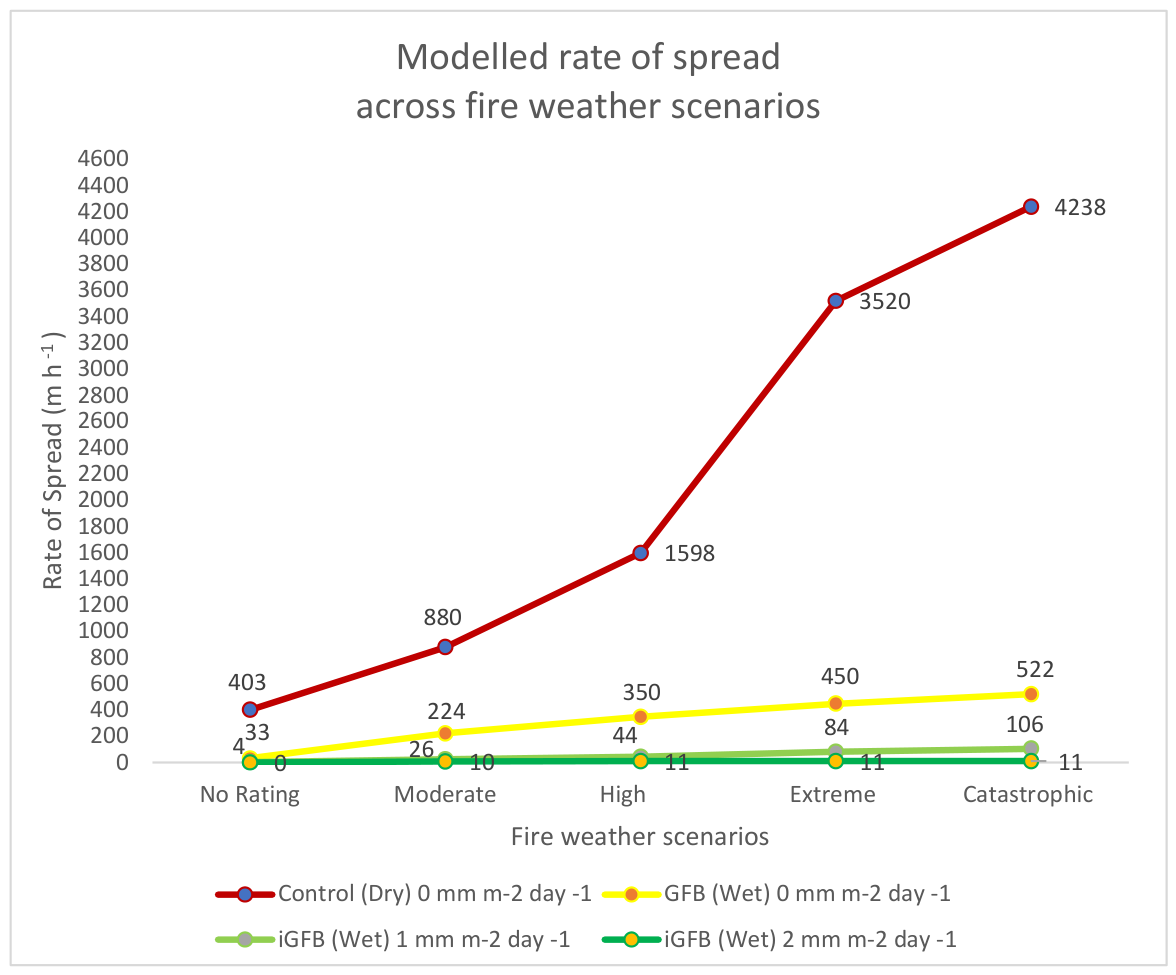
Figure 2.
Modelled fireline intensity across fire-weather scenarios for the dry eucalypt control, non-irrigated green firebreak (GFB), and irrigated green firebreak (iGFB) scenarios. Values were predicted using AMICUS Vesta Mk2 under no rating, moderate, high, extreme, and catastrophic fire-weather conditions. The dry eucalypt control showed the highest predicted spread rates across all fire-weather classes, while the iGFB scenarios remained substantially lower, with the 2 mm day⁻¹ irrigation treatment producing the lowest predicted fireline intensity.
Figure 2.
Modelled fireline intensity across fire-weather scenarios for the dry eucalypt control, non-irrigated green firebreak (GFB), and irrigated green firebreak (iGFB) scenarios. Values were predicted using AMICUS Vesta Mk2 under no rating, moderate, high, extreme, and catastrophic fire-weather conditions. The dry eucalypt control showed the highest predicted spread rates across all fire-weather classes, while the iGFB scenarios remained substantially lower, with the 2 mm day⁻¹ irrigation treatment producing the lowest predicted fireline intensity.
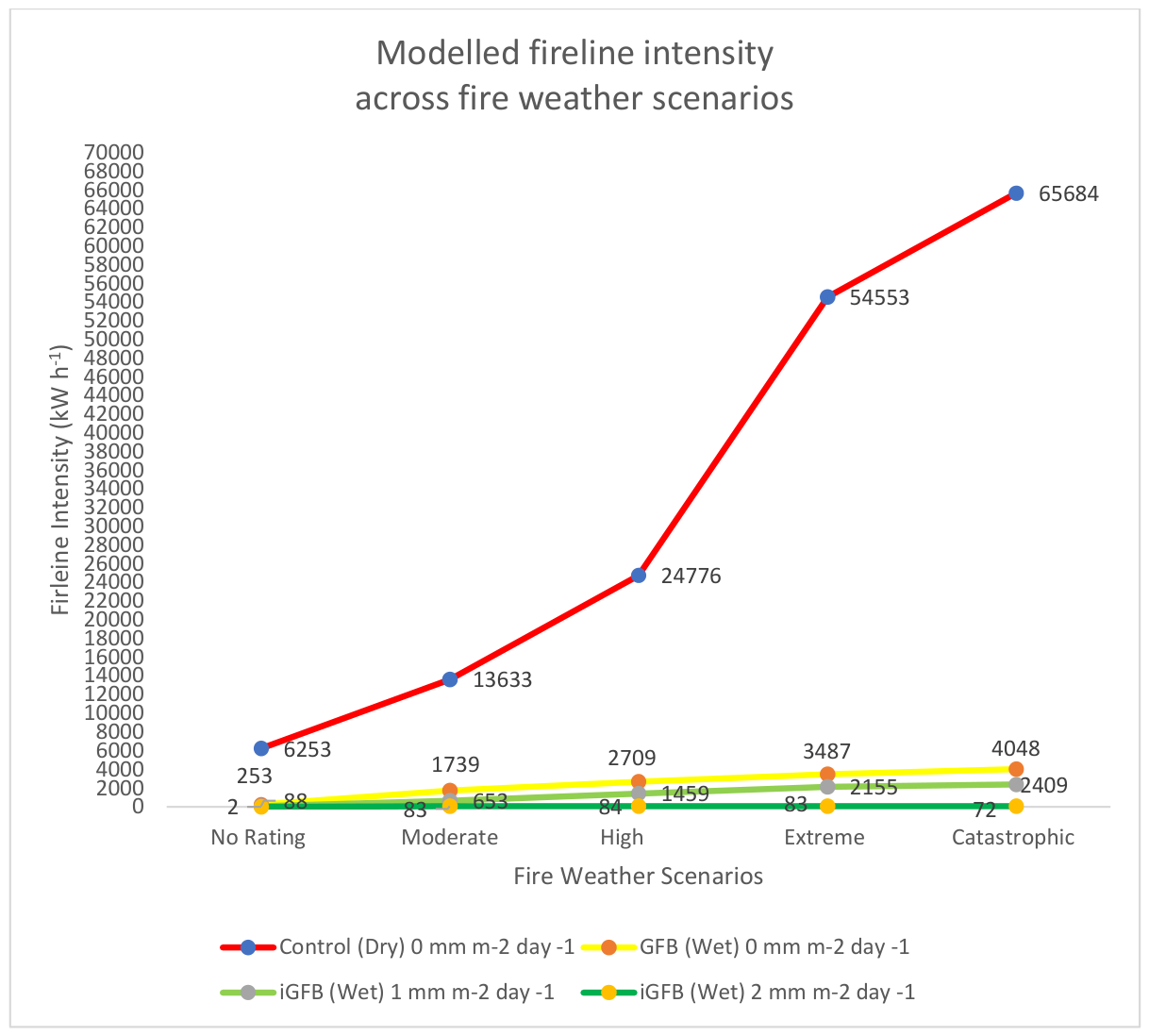
Table 1.
Conceptual overview of the three configurations used in the AMICUS Vesta Mk2 modelling framework: (1) dry eucalypt under drought conditions as the control, (2) non-irrigated green firebreak (GFB) represented by wet eucalypt vegetation, and (3) irrigated green firebreak (iGFB) represented by wet eucalypt vegetation receiving 1 or 2 mm day⁻¹ of irrigation. All scenarios were evaluated across five fire-weather classes, from no rating to catastrophic, and compared using predicted rate of fire spread and fireline intensity.
Table 1.
Conceptual overview of the three configurations used in the AMICUS Vesta Mk2 modelling framework: (1) dry eucalypt under drought conditions as the control, (2) non-irrigated green firebreak (GFB) represented by wet eucalypt vegetation, and (3) irrigated green firebreak (iGFB) represented by wet eucalypt vegetation receiving 1 or 2 mm day⁻¹ of irrigation. All scenarios were evaluated across five fire-weather classes, from no rating to catastrophic, and compared using predicted rate of fire spread and fireline intensity.
| Scenarios | Control-Dry Forest in drought | GFB - Wet Forest in drought | Design 1 - iGFB Wet Forest | Design 2 - iGFB Wet Forest | ||
| Vegetation (Vesta Mk 2) | Dry eucalypt | Wet eucalypt | ||||
| Irrigation estimates | 0 mm m⁻2 day⁻¹ | 1 mm m⁻2 day⁻¹ | 2 mm m⁻2 day⁻¹ | |||
| Purpose | Predicted conditions under drought | Represents green firebreak proxy without irrigation | Green firebreaks with different rates of irrigation | |||
| Assumption | Reduced fuel moisture increases fire risk | Higher moisture decreases fire risk relative to control | Maintaining higher fuel moisture, with irrigation, decreases fire spread and intensity | |||
| Fire Weather Parameters (AFDRS aligned) | No Rating | Moderate | High | Extreme | Severe | Catastrophic |
| Model Outputs - AMICUS Vesta Mk2 | Fire Spread (m h1 ) | |||||
| Fireline Intensity (kW h1 ) | ||||||
| Design scenarios (Control, GFB, iGFB1, & iGFB2) are compared across increasing fire weather to assess relative fire behaviour and the effectiveness of irrigation. | ||||||
Table 2.
AMICUS parameters used to represent increasing fire weather potential.
| Fire Weather Potential | No Rating | Moderate | High | Extreme | Catastrophic |
| Air Temperature (C0) | 20 | 25 | 30 | 35 | 40 |
| Wind Speed (km h-1) | 10 | 20 | 30 | 40 | 60 |
| Relative Humidity (%) | 60 | 50 | 40 | 20 | 10 |
Table 3.
Moisture parameters for the control (dry eucalypt forest), non-irrigated GFBs, and iGFBs scenarios.
Table 3.
Moisture parameters for the control (dry eucalypt forest), non-irrigated GFBs, and iGFBs scenarios.
| Moisture Parameters |
Control 0 mm |
GFB 0 mm |
iGFB 1 mm |
iGFB 2 mm |
| Fuel Moisture Content (%) | 7 | 10 | 12 | 14 |
| Last Rainfall (mm) | 20 | 20 | 1 | 1 |
| Time Since Last Rain (days) | 60 | 60 | 1 | 1 |
| Soil Dryness (mm) | 200 | 175 | 100 | 50 |
| Calculated Drought Factor (1-10) | 10 | 10 | 6.9 | 4.4 |
Table 4.
Sensitivity parameters with baseline, altered setting and rationale.
| Sensitivity Parameters | Baseline | Alteration | Rationale |
| Fuel type (vegetation) | Control - Dry eucalypt | Wet eucalypt | To consider the impact of vegetation |
| iGFB 2 - Wet eucalypt | Dry eucalypt | ||
| Fuel load (t ha-1) | Control - 30 | 10 | To consider the impact of fuel load |
| iGFB 2 - 15 | 30 | ||
| Fuel moisture content (%) | Control - 7% | 20% | To consider the impact of fuel moisture |
| iGFB 2 - 14% | 7% | ||
| Drought factor (1 to 10) | Control - 10 | 2 | To consider the impact of drought sensitivity |
| iGFB 2 - 2 | 10 | ||
| Wind adjustment factor (2-10) | Control - 6 | 10 | To consider the impact of wind |
| iGFB 2 - 9 | 2 |
Table 5.
Rate of fire spread predicted using AMICUS 0.7.1 beta with Vesta Mk2 vegetation.
| Rate of Spread (m h⁻¹) across fire weather | No Rating | Moderate | High | Extreme | Catastrophic |
| Control (Dry) 0 mm m-2 day -1 | 403 | 880 | 1598 | 3520 | 4238 |
| GFB (Wet) 0 mm m-2 day -1 | 33 | 224 | 350 | 450 | 522 |
| iGFB (Wet) 1 mm m-2 day -1 | 4 | 26 | 44 | 84 | 106 |
| iGFB (Wet) 2 mm m-2 day -1 | 0 | 10 | 11 | 11 | 11 |
Disclaimer/Publisher’s Note: The statements, opinions and data contained in all publications are solely those of the individual author(s) and contributor(s) and not of MDPI and/or the editor(s). MDPI and/or the editor(s) disclaim responsibility for any injury to people or property resulting from any ideas, methods, instructions or products referred to in the content. |
© 2026 by the authors. Licensee MDPI, Basel, Switzerland. This article is an open access article distributed under the terms and conditions of the Creative Commons Attribution (CC BY) license (http://creativecommons.org/licenses/by/4.0/).
Copyright: This open access article is published under a Creative Commons CC BY 4.0 license, which permit the free download, distribution, and reuse, provided that the author and preprint are cited in any reuse.


