

Submitted:
02 July 2026
Posted:
03 July 2026
You are already at the latest version
Abstract
Background
Bloodstream infection (BSI) complicates 20–50% of ICU sepsis cases and independently increases mortality. Conventional biomarkers — procalcitonin and C-reactive protein — lose discriminative power amid the high background inflammation of critical illness. Cell population data (CPD) from automated hematology analyzers offer morphological neutrophil metrics at no added cost. We evaluated NE-WY (neutrophil side scatter width) and NE-SFL (neutrophil fluorescence intensity) for confirmed BSI identification in ICU patients.
Methods
This STARD 2015-compliant prospective study enrolled 72 adult ICU patients at Dr. Soetomo General Academic Hospital, Surabaya. The primary analysis compared G1 (Sepsis-3 criteria, NHSN LCBI-confirmed BSI; n=26) against G2 (SOFA < 2, negative culture; n=21). NE-WY and NE-SFL were measured on Sysmex XN-3000; MDW on Beckman Coulter DxH 900. ROC analysis with DeLong AUC comparison assessed diagnostic accuracy. A pre-specified sensitivity analysis included G1 versus G2 plus 25 suspected-sepsis patients with non-diagnostic cultures (n=72).
Results
NE-WY was higher in G1 (median 789.5 [IQR 758.8–867.3]) than G2 (686.0 [IQR 650.0–747.0]; p=0.001, r=0.47). At cutoff 766, NE-WY AUC was 0.775 (95%CI 0.632–0.917): sensitivity 73.1% (95%CI 53.9–86.3%), specificity 85.7% (95%CI 65.3–95.0%), PPV 86.4%, NPV 72.0%, and accuracy 78.7%. NE-WY outperformed MDW (AUC 0.533; DeLong p=0.047). In the sensitivity analysis (n=72), NE-WY AUC fell to 0.620 (95%CI 0.485–0.756), indicating that performance depends on comparator composition.
Conclusions
NE-WY identifies confirmed BSI against non-septic ICU controls with AUC=0.775 and specificity 85.7%, outperforming MDW. Performance falls to AUC=0.620 against a mixed comparator that includes suspected-sepsis patients. Future studies should compare culture-confirmed BSI against culture-negative Sepsis-3 patients to isolate the bacteraemia-specific signal.
Keywords:
bloodstream infection
; cell population data
; diagnostic accuracy
; intensive care unit
; NE-WY
; neutrophil activation
; STARD 2015
1. Introduction
Sepsis affects an estimated 49 million people annually and accounts for 11 million deaths worldwide [1,2]. In the ICU, bloodstream infection (BSI) complicates 20–50% of sepsis episodes and independently increases mortality two- to fourfold compared with non-bacteraemic sepsis [3]. Blood culture — the diagnostic reference standard — requires 24–72 hours to yield a result; during this interval, empirical broad-spectrum antimicrobial treatment proceeds without microbiological guidance.
Conventional biomarkers — procalcitonin (PCT) and C-reactive protein (CRP) — improve early infection detection, but lose discriminative power in the ICU, where systemic inflammation from non-infectious causes generates elevations indistinguishable from bacterial BSI [4]. A point-of-care parameter derived from a standard complete blood count would reduce diagnostic delay without added cost.
Cell population data (CPD) are morphological metrics generated automatically during routine CBC analysis on modern hematology analyzers [5,6]. On the Sysmex XN series, NE-WY (neutrophil side scatter width) quantifies granular complexity heterogeneity in the WDF channel; it rises during neutrophil degranulation in response to bacterial pathogens [5,7,8]. NE-SFL (neutrophil fluorescence intensity) captures cytoplasmic RNA and nuclear complexity, reflecting neutrophil immaturity shifts during infection [5,9,10]. Related extended hematology parameters — immature granulocyte fractions, delta neutrophil index, neutrophil-to-lymphocyte ratio, and immature platelet fraction — have each demonstrated diagnostic value across adult and neonatal infection contexts [11,12,13,14,15,16].
Park et al. established NE-WY reference intervals on the Sysmex XN platform and demonstrated elevation in inflammatory states [5]. Subsequent studies confirmed higher NE-WY in bacteraemia [7,8], in liver disease [9], and in bacteraemic versus non-bacteraemic infection [10]. Machine-learning models incorporating Sysmex XN-3000 parameters achieved AUC 0.92 for bacteremia prediction [17], and an extended-parameter panel discriminated early ICU sepsis from non-infectious SIRS [18]. Prospective data specifically pairing NE-WY with confirmed BSI in mixed ICU populations remain limited.
Monocyte Distribution Width (MDW), FDA-cleared and CE-marked for sepsis screening, is measured on the Beckman Coulter DxH 900 [19,20,21,22,23,24,25,26,27,28,29]. Published AUC values in ED and ICU settings range from 0.74 to 0.88 [24], making MDW the current CPD reference benchmark for sepsis biomarker comparison. Head-to-head evaluation of NE-WY against MDW in a BSI-confirmed ICU cohort has not been reported.
This study evaluated the diagnostic accuracy of NE-WY and NE-SFL, measured at ICU admission, for confirmed BSI (positive blood culture by NHSN LCBI criteria) compared with non-sepsis states. Secondary objectives were: to compare NE-WY against MDW, PCT, and CRP; to assess NE-WY as an independent predictor of BSI; and to estimate diagnostic performance when suspected-sepsis patients with non-diagnostic cultures are included as comparators.
2. Methods
2.1. Study Design, Setting, and Reporting
This prospective observational study was conducted in the general ICU of Dr. Soetomo General Academic Hospital, Surabaya, Indonesia — a tertiary referral centre affiliated with Universitas Airlangga. The study is reported per the Standards for Reporting of Diagnostic Accuracy Studies (STARD) 2015; the completed checklist is provided as Supplementary Table S1. Ethics approval: No. 0085/LOE/301.4.2/I/2024, Faculty of Medicine, Universitas Airlangga / Dr. Soetomo General Academic Hospital. The study was conducted in accordance with the Declaration of Helsinki. All patients or their legal guardians provided written informed consent.
2.2. Participants
Adults admitted to the ICU were screened consecutively. Inclusion criteria: age ≥18 years, ICU stay ≥24 hours, and complete blood count obtained within 24 hours of admission. Exclusion criteria: prior antibiotic therapy >48 hours before ICU admission, haematological malignancy, immunosuppressive therapy equivalent to prednisolone >20 mg/day, and incomplete CPD data.
2.3. Patient Classification
Enrolled patients were allocated to three groups at ICU admission. Group 1 (G1, Sepsis+BSI) comprised patients meeting Sepsis-3 criteria (SOFA ≥2) [1,30] with a positive blood culture for a non-contaminant organism by NHSN LCBI definition. Twenty-five patients with suspected sepsis but negative or indeterminate blood cultures were enrolled and appear in the study flow diagram; they were excluded from the primary analysis because this group could not be cleanly classified as bacteraemic or non-bacteraemic, and are included in the pre-specified sensitivity analysis. Group 2 (G2, Non-Sepsis) included patients with SOFA <2 and negative or commensal blood culture. The primary analysis compared G1 versus G2 (n=47).
2.4. Laboratory Measurements and Timing
Two sets of blood cultures (aerobic and anaerobic) were obtained from separate venipunctures at ICU admission per institutional protocol. Blood cultures were incubated in the BACTEC FX400 system (Becton Dickinson, NJ, USA) and monitored for five days. Organisms meeting NHSN LCBI definitions were classified as pathogens; common skin commensals (coagulase-negative staphylococci, Bacillus spp., Corynebacterium spp., Propionibacterium spp., viridans streptococci) in a single culture set were classified as contaminants.
The complete blood count — from which NE-WY and NE-SFL were extracted — was drawn before or within one hour of blood culture collection, as part of the routine ICU admission workup. NE-WY and NE-SFL values were not reported to clinicians during the study period; they were extracted retrospectively from archived Sysmex XN-3000 analyser records, ensuring that clinical management decisions were independent of these CPD parameters.
NE-WY and NE-SFL were measured on the Sysmex XN-3000 (Sysmex Corp., Kobe, Japan) from the WDF channel. The published healthy-adult reference range for NE-WY on the Sysmex XN series is approximately 550–680 arbitrary units (a.u.) [31]. MDW was measured on the Beckman Coulter UniCel DxH 900 (Beckman Coulter Inc., Brea, CA, USA); results were unavailable for 13/72 patients (18.1%) owing to monocyte percentage <4.5%, the technical threshold for MDW reporting on this platform [19]. PCT was measured by electrochemiluminescence immunoassay (ECLIA, Roche Diagnostics); CRP by immunoturbidimetry. All measurements were from ICU admission samples.
2.5. Statistical Analysis
Data are reported as median (interquartile range, IQR) for continuous variables and as count (percentage) for categorical variables. Normality was assessed by Shapiro-Wilk test; NE-WY and NE-SFL in G1 were non-normal (both p<0.001). Mann-Whitney U test compared G1 and G2; effect size was r=Z/sqrt(N). Three-group comparisons used Kruskal-Wallis with Dunn post-hoc Bonferroni correction. ROC curves were constructed and AUC values compared by the DeLong method. The Youden index determined optimal cutoffs. Binary logistic regression assessed independent predictors of BSI; variables with p<0.05 at univariate analysis entered the multivariate model. SOFA caused complete separation in the logistic model and was excluded. Missing MDW data were not imputed; ROC analyses involving MDW used available cases (n=40). Confidence intervals for sensitivity, specificity, PPV, NPV, and accuracy were calculated by the Wilson score method. A post-hoc power calculation was performed using the Hanley-McNeil variance estimator for AUC, testing the observed AUC against a null value of 0.50 at two-sided alpha=0.05. A pre-specified sensitivity analysis included G1 versus G2 combined with the suspected-sepsis group (n=72) to estimate NE-WY performance in a clinically realistic population. All analyses were performed in R version 4.4.2 (R Foundation for Statistical Computing, Vienna, Austria) using the pROC, rstatix, and gtsummary packages.
3. Results
3.1. Patient Characteristics
Seventy-two patients were enrolled (Figure 1). After excluding the 25 patients with suspected sepsis but non-diagnostic cultures, 47 patients entered the primary analysis: G1 (Sepsis+BSI, n=26) and G2 (Non-Sepsis, n=21). Gram-positive organisms predominated in G1 (n=12, 46.2%) over Gram-negative (n=11, 42.3%), with three polymicrobial cases.
Patient characteristics are in Table 1. SOFA score differed between groups (G1: 5.92±2.98 vs G2: 0.33±0.48, p<0.001), consistent with classification criteria. ICU mortality was higher in G1 (73.1%) than G2 (33.3%, p=0.004). The 33.3% mortality in G2 reflects ICU admission for non-infectious reasons — predominantly post-operative monitoring and haemodynamic management — in which severity progressed despite low initial SOFA scores. Serum creatinine was higher in G1 (p=0.023), reflecting greater organ dysfunction.
3.2. CPD Neutrophil Parameters and Conventional Biomarkers
NE-WY was higher in G1 than G2 (median 789.5 [IQR 758.8–867.3] vs 686.0 [650.0–747.0]; Mann-Whitney U p=0.001, r=0.47). NE-SFL did not differ (54.85 [50.92–61.15] vs 52.30 [47.70–55.40]; p=0.164). MDW, PCT, and CRP showed no significant between-group difference (all p>0.05). Results are in Table 2 and Figure 2.
Three-group Kruskal-Wallis analysis (G1, suspected sepsis, G2) confirmed that NE-WY differed across groups (chi-squared=11.40, df=2, p=0.003). Post-hoc Dunn tests showed significant separation between G1 and G2 (p.adj=0.008) and between the suspected-sepsis group and G2 (p.adj=0.010), but not between G1 and the suspected-sepsis group (p.adj=1.0). This absence of discrimination between G1 and the suspected-sepsis group is the basis for the sensitivity analysis interpretation below.
3.3. Diagnostic Performance: Primary Analysis
In the primary ROC analysis (G1 vs G2, n=47), NE-WY yielded AUC=0.775 (95%CI 0.632–0.917). At the Youden-optimal cutoff of 766, NE-WY achieved sensitivity 73.1% (95%CI 53.9–86.3%), specificity 85.7% (95%CI 65.3–95.0%), PPV 86.4% (95%CI 66.7–95.3%), NPV 72.0% (95%CI 52.4–85.7%), and accuracy 78.7% (95%CI 65.1–88.0%). Post-hoc power using the Hanley-McNeil estimator confirmed 98.2% power (n1=26, n2=21, alpha=0.05). NE-WY outperformed MDW (AUC 0.533, DeLong p=0.047). Diagnostic performance for all biomarkers is in Table 3. ROC curves are in Figure 3.
3.4. Diagnostic Performance: Sensitivity Analysis
In the pre-specified sensitivity analysis (G1 vs G2 + suspected-sepsis, n=72), NE-WY yielded AUC=0.620 (95%CI 0.485–0.756) — substantially lower than the primary analysis. This attenuation is consistent with the Kruskal-Wallis finding that G1 and the suspected-sepsis group have similar NE-WY distributions (p.adj=1.0). When the comparator includes patients with suspected sepsis — who show neutrophil activation regardless of blood culture result — NE-WY no longer discriminates adequately. The primary AUC=0.775 represents performance in a population where infection status is maximally separated from non-infection.
3.5. Logistic Regression
At univariate logistic regression, NE-WY (OR 1.008 per unit, 95%CI 1.002–1.016, p=0.020) and serum creatinine (OR 1.339, 95%CI 1.075–1.992, p=0.048) were significant predictors of BSI. Expressed per 10-unit NE-WY increment, OR is 1.083 (95%CI 1.022–1.175); expressed per IQR of G1 (approximately 109 units), OR is 2.38 (95%CI 1.12–5.08), meaning a patient at the 75th percentile NE-WY of the BSI group has 2.38-fold higher odds of BSI than a patient at the 25th percentile. At multivariate analysis (NE-WY + creatinine, n=47), NE-WY showed a marginal trend (OR 1.007, 95%CI 1.001–1.014, p=0.064); creatinine was non-significant (OR 1.213, p=0.134). Hosmer-Lemeshow test: chi-squared=5.37, df=8, p=0.717.
4. Discussion
This study makes four observations. NE-WY discriminated confirmed BSI from non-sepsis in ICU patients with AUC=0.775, sensitivity 73.1%, and specificity 85.7% in the primary analysis. When the comparator included patients with suspected sepsis and non-diagnostic cultures, NE-WY AUC fell to 0.620 — an important caveat for clinical extrapolation. Conventional biomarkers — MDW, PCT, and CRP — provided no meaningful discrimination. NE-WY outperformed MDW (DeLong p=0.047).
The specificity of 85.7% at the optimal cutoff (766 a.u.) supports a 'rule-in' approach: NE-WY >766 provides meaningful probability increase for BSI and could prompt targeted antibiotic escalation while culture results are pending. The cutoff of 766 a.u. exceeds the published healthy-adult upper reference limit of approximately 680 a.u. on the Sysmex XN series [31], and falls within the range of published BSI-associated cutoffs (730–800 a.u.) reported by Miyajima et al. (2023) and Horie et al. (2025) [7,17], supporting biological plausibility. Analytical variation of NE-WY on the Sysmex XN-3000 is approximately 2–4% CV per manufacturer validation data, indicating that the difference between 766 and neighbouring values is analytically meaningful.
The biological basis of NE-WY elevation in BSI is neutrophil degranulation and cytoplasmic reorganisation in response to conserved bacterial structures — lipopolysaccharide, lipoteichoic acid, and peptidoglycan — via pattern recognition receptors [5,6]. Side scatter width reflects the distribution of these morphological changes; a broader distribution indicates greater heterogeneity, consistent with a subset of highly activated cells against a background of less-activated forms [5,6]. We did not formally test for differential NE-WY performance by Gram type. The balanced distribution of Gram-positive (46.2%) and Gram-negative (42.3%) organisms in G1 suggests that the neutrophil activation signal is not pathogen class-specific, consistent with recognition of shared bacterial structural motifs. Formal subgroup analysis by pathogen class would require a substantially larger sample.
Two limitations of the study design require explicit acknowledgement. First, the primary comparator groups differ not only in bacteraemia but in severity of organ dysfunction (G1 SOFA 5.92 vs G2 SOFA 0.33). NE-WY elevation in G1 may reflect the neutrophil response to severe sepsis — driven by cytokines, vasopressor use, and multi-organ stress — rather than bacteraemia specifically. The ideal test of BSI-specificity would compare patients who all meet Sepsis-3 criteria (SOFA ≥2), divided by blood culture result. Our cohort did not achieve this: the Kruskal-Wallis finding that NE-WY did not differ between G1 and the suspected-sepsis group (p.adj=1.0) is consistent with both groups showing similar neutrophil activation in the context of sepsis physiology, regardless of bacteraemia confirmation. Future studies should restrict enrolment to Sepsis-3 patients and compare culture-positive against culture-negative subgroups.
Second, the sensitivity analysis AUC=0.620 is the more clinically realistic performance estimate. Clinicians using NE-WY in practice will encounter patients from the full spectrum, including those with suspected sepsis and pending cultures. The primary AUC=0.775 should be interpreted as an upper-bound estimate obtained in a population where the two groups are maximally separated by disease severity. The sensitivity analysis result should inform clinical decision-making, particularly regarding the likelihood of false reassurance in suspected-sepsis patients with NE-WY below 766.
The absence of NE-SFL significance in our cohort contrasts with the landmark study by Park et al. (2014), where NE-SFL achieved AUC=0.909 in a sepsis-versus-SIRS general population (n>300) [5]. Two factors explain this discrepancy. Our comparator group was non-septic (SOFA <2), so both groups lacked the sustained cytokine milieu that drives RNA-related fluorescence changes in activated immature granulocytes. Additionally, the smaller sample (n=47 vs >300) limits power to detect a modest NE-SFL difference. Urrechaga et al. (2019) reported a similar attenuation of NE-SFL specificity in populations with elevated baseline inflammation [6].
The non-performance of MDW in our ICU cohort merits discussion. MDW is FDA-cleared based on emergency department data, achieving AUC 0.85–0.88 in meta-analysis [24]. In our cohort, both sepsis groups had elevated MDW medians (~25 fl), suggesting that the monocyte response to critical illness itself elevates MDW above the thresholds validated in emergency settings. Morales Indiano et al. (2025) made a similar observation in a broader ICU sepsis population [23]. The 18.1% missing rate for MDW (monocyte percentage below the DxH 900 technical threshold) also reduced statistical power for this comparison.
5. Limitations
Several limitations apply. The SOFA-confounded group comparison is the primary interpretive caveat, discussed above. The primary sample size of n=47 is modest, yielding wide AUC 95%CIs (0.632–0.917). The single-centre design limits generalisability to other ICU case mixes and microbial ecologies. Blood culture turnaround of 24–72 hours means that NE-WY and the reference standard were not contemporaneous for all patients. Corticosteroid use was not systematically recorded; ICU patients with septic shock frequently receive dexamethasone or hydrocortisone, which suppress neutrophil degranulation and could attenuate NE-WY elevation in G1 — biasing toward the null and potentially underestimating true discriminative value. The enrolment criterion of ICU stay ≥24 hours excluded patients who died or were transferred before blood culture, introducing survivor selection bias. NE-WY serial kinetics over the ICU course were not captured; dynamic changes may carry prognostic value independent of admission measurements.
6. Conclusions
NE-WY from routine Sysmex XN-3000 analysis identifies confirmed BSI against non-septic ICU controls with AUC=0.775 and specificity 85.7%, outperforming MDW, PCT, and CRP. Performance against suspected-sepsis comparators falls to AUC=0.620, indicating that severity confounding limits the BSI-specificity claim. Future validation studies should restrict enrolment to Sepsis-3 patients and compare culture-confirmed BSI against culture-negative sepsis to achieve a clinically definitive performance estimate.
Author Contributions
Conceptualization: PW. Data curation: ARW. Formal analysis: ARW. Funding acquisition: PW. Methodology: PW, YNI, BPS. Project administration: YNI, BPS. Visualization: ARW,BPS. Writing – original draft: ARW, PW. Writing – review & editing: PW, ARW, YNI, BPS.
Funding
This work was supported by PT Diastika Biotekindo (Grant No. 214/LEGAL/DB/X/2024).
Institutional Review Board Statement
Approved by the Research Ethics Committee of Dr. Soetomo General Academic Hospital / Faculty of Medicine, Universitas Airlangga (No. 0085/LOE/301.4.2/I/2024); Date: 3 December 2025.
Informed Consent Statement
Written informed consent obtained from all participants or their legal representatives.
Data Availability Statement
The data presented in this study are available on request from the corresponding author due to privacy.
Acknowledgments
The authors express their gratitude to the laboratory staff of the Clinical Pathology Department and the medical personnel of the intensive care unit at participating hospital for their technical assistance during sample collection and analysis. The authors also thank PT Diastika Biotekindo for financial support and provision of research facilities, and SAE LAB for proofreading assistance.
Conflicts of Interest
No potential conflict of interest relevant to this article was reported.
References
- Singer, M.; Deutschman, C.S.; Seymour, C.W.; et al. The Third International Consensus Definitions for Sepsis and Septic Shock (Sepsis-3). JAMA 2016, 315, 801–810. [Google Scholar] [CrossRef] [PubMed]
- Rhee, C.; Dantes, R.; Epstein, L.; et al. Incidence and trends of sepsis in US hospitals using clinical vs claims data, 2009-2014. JAMA 2017, 318, 1241–1249. [Google Scholar] [CrossRef] [PubMed]
- Timsit, J.F.; Ruppe, E.; Barbier, F.; et al. Bloodstream infections in critically ill patients: an expert statement. Intensive Care Med. 2020, 46, 266–284. [Google Scholar] [CrossRef] [PubMed]
- Bourika, V.; Rekoumi, E.A.; Giamarellos-Bourboulis, E.J. Biomarkers to guide sepsis management. Ann. Intensive Care 2025, 15, 103. [Google Scholar] [CrossRef] [PubMed]
- Park, S.H.; Park, C.J.; Lee, B.R.; et al. Establishment of reference intervals and decision values for neutrophil-related parameters of the Sysmex XN-2000 for assessing neutrophil morphology and activity in patients with sepsis. Int. J. Lab. Hematol. 2014, 36, 435–444. [Google Scholar]
- Urrechaga, E.; Boveda, M.O.; Aguirre, U. Differential diagnosis of infection and non-infectious systemic inflammatory response with biomarker neutrophil cell population data (CPD) and procalcitonin. Clin. Chem. Lab. Med. 2019, 57, 1059–1067. [Google Scholar]
- Miyajima, Y.; Hoshina, T.; Masunaga, K.; et al. Extended inflammatory parameters as markers of bacteremia. Front. Med. 2023, 10, 1156889. [Google Scholar]
- Kaneda, M.; Yaguchi, Y.; Nomura, T.; et al. Association between neutrophil fluorescence (NE-SFL) or side scatter (NE-WY) and blood bacterial DNA PCR in patients with suspected sepsis. J. Infect. Chemother. 2024, 30, 693–699. [Google Scholar]
- Buoro, S.; Seghezzi, M.; Vavassori, M.; et al. New parameters of sepsis in patients with liver disease measured by Sysmex XN hematological analyser. Ann. Transl. Med. 2016, 4, 418. [Google Scholar] [PubMed]
- Lemkus, L.; Dickens, C.; Cassim, B.; et al. Extended inflammatory parameters from a haematology analyser: a pilot study comparing results in patients with bacteraemia and non-bacteraemic infection. PLoS ONE 2022, 17, e0262938. [Google Scholar] [PubMed]
- Daix, T.; Jeannet, R.; Bourenne, J.; et al. Immature granulocytes are associated with bacterial sepsis in patients with COVID-19 admitted to intensive care unit. J. Intensive Care 2021, 9, 65. [Google Scholar]
- Alay, H.; Tekin, S.; Yildiz, O.; et al. Association of immature granulocyte percentage with mortality and disease severity in ARDS/COVID-19 patients. Niger. J. Clin. Pract. 2022, 25, 1287–1293. [Google Scholar]
- Unlu, O.; Gulcan Kersin, S.; Cevlik, T.; et al. The diagnostic value of neutrophil and monocyte cell population data obtained from a hematology analyzer in neonatal sepsis. Clin. Pediatr. 2025, 64, 987–995. [Google Scholar] [CrossRef]
- Peneva, P.; Lyubenova, A. The role of delta neutrophil index as a marker of sepsis in intensive care unit patients. Folia Med. 2021, 63, 648–654. [Google Scholar]
- Bhadade, R.; Naik, I.; Harde, M.; de Souza, R. Neutrophil-to-lymphocyte ratio as a marker for diagnosis and prognostication of sepsis. J. Assoc. Physicians India 2024, 72, 33–38. [Google Scholar] [PubMed]
- Choudhary, A.; Singh, P.; Gupta, A.; et al. Utility of IPF, IRF and IGP in the diagnosis of bacterial sepsis in ICU patients. Cureus 2026, 18, e105416. [Google Scholar] [PubMed]
- Horie, S.; Nakamura, M.; Kato, S.; et al. Machine learning-enhanced prediction of bacteremia using neutrophil parameters from Sysmex XN-3000 hematology analyzer. Crit. Care 2025, 29, 261. [Google Scholar]
- Mishra, P.; Varghese, M.K.; Garg, N.; et al. Role of extended inflammatory parameters in early detection of sepsis with bloodstream infection. BMC Infect. Dis. 2025, 25, 852. [Google Scholar]
- Piva, E.; Zuin, J.; Pelloso, M.; et al. Monocyte distribution width (MDW) parameter as a sepsis indicator in intensive care units. Clin. Chem. Lab. Med. 2021, 59, 1307–1314. [Google Scholar] [CrossRef] [PubMed]
- Agnello, L.; Ciaccio, A.M.; Del Ben, F.; et al. Monocyte distribution width (MDW) kinetic for monitoring sepsis in intensive care unit. Diagnosis 2024, 11, 422–429. [Google Scholar] [CrossRef] [PubMed]
- Lorubbio, M.; Tacconi, D.; Iannelli, G.; et al. The role of monocyte distribution width (MDW) in the prognosis and monitoring of COVID-19 patients. Clin. Biochem. 2022, 103, 29–31. [Google Scholar] [CrossRef] [PubMed]
- Cusinato, M.; Guadagnino, G.; Piccolo, A.; et al. Monocyte distribution width in the emergency department: diagnostic and prognostic value for infection and sepsis. Infection 2023, 51, 369–377. [Google Scholar]
- Morales Indiano, C.; Garcia-Tejedor, M.; Larraneta, L.; et al. Monocyte distribution width and procalcitonin for sepsis diagnosis in critically ill patients. Rev. Clin. Esp. 2025, 225, 502357. [Google Scholar] [PubMed]
- Agnello, L.; Giglio, R.V.; Bivona, G.; et al. The best sampling time for monocyte distribution width (MDW) to discriminate between septic and non-septic patients: a meta-analysis. Clin. Chem. Lab. Med. 2022, 60, 838–846. [Google Scholar]
- Wu, J.; Li, L.; Luo, J. Diagnostic and prognostic value of monocyte distribution width in sepsis. J. Inflamm. Res. 2022, 15, 4107–4117. [Google Scholar] [CrossRef] [PubMed]
- Arsenijevic, J.; Vucic, M.; Nikolic, M.; et al. Composite bioscore including monocyte distribution width for predicting 28-day mortality in ICU patients with sepsis. Biomedicines 2026, 14, 787. [Google Scholar] [PubMed]
- Levin, S.; Gibbons, J.; Siddiqui, A.; et al. The CBC sepsis index: a novel composite hematologic parameter for early sepsis identification. Crit. Care Explor. 2025, 7, e1194. [Google Scholar] [PubMed]
- Agnello, L.; Ciaccio, M.; Casuccio, A.; et al. Combined presepsin and monocyte distribution width to predict ICU mortality in patients with sepsis. Front. Med. 2024, 11, 1393843. [Google Scholar]
- Frugoli, A.; Ong, J.; Meyer, B.; et al. Monocyte distribution width predicts sepsis, respiratory failure, and death in COVID-19. Cureus 2023, 15, e50525. [Google Scholar] [CrossRef] [PubMed]
- Seymour, C.W.; Liu, V.X.; Iwashyna, T.J.; et al. Assessment of clinical criteria for sepsis: for the Third International Consensus Definitions for Sepsis and Septic Shock (Sepsis-3). JAMA 2016, 315, 762–774. [Google Scholar] [PubMed]
- Kobayashi, S.; Arai, K.; Itabashi, M.; et al. Reference value of cell population data reported by XN hematology analyzers from healthy Japanese adults. Int. J. Lab. Hematol. 2015, 37, 655–662. [Google Scholar]
Figure 1.
Study flow diagram (STARD 2015). Of 101 screened ICU admissions, 72 met inclusion criteria. Twenty-five patients with suspected sepsis but non-diagnostic cultures were excluded from the primary analysis; they are included in the pre-specified sensitivity analysis. The primary comparison comprised G1 (Sepsis+BSI, n=26) versus G2 (Non-Sepsis, n=21).
Figure 1.
Study flow diagram (STARD 2015). Of 101 screened ICU admissions, 72 met inclusion criteria. Twenty-five patients with suspected sepsis but non-diagnostic cultures were excluded from the primary analysis; they are included in the pre-specified sensitivity analysis. The primary comparison comprised G1 (Sepsis+BSI, n=26) versus G2 (Non-Sepsis, n=21).
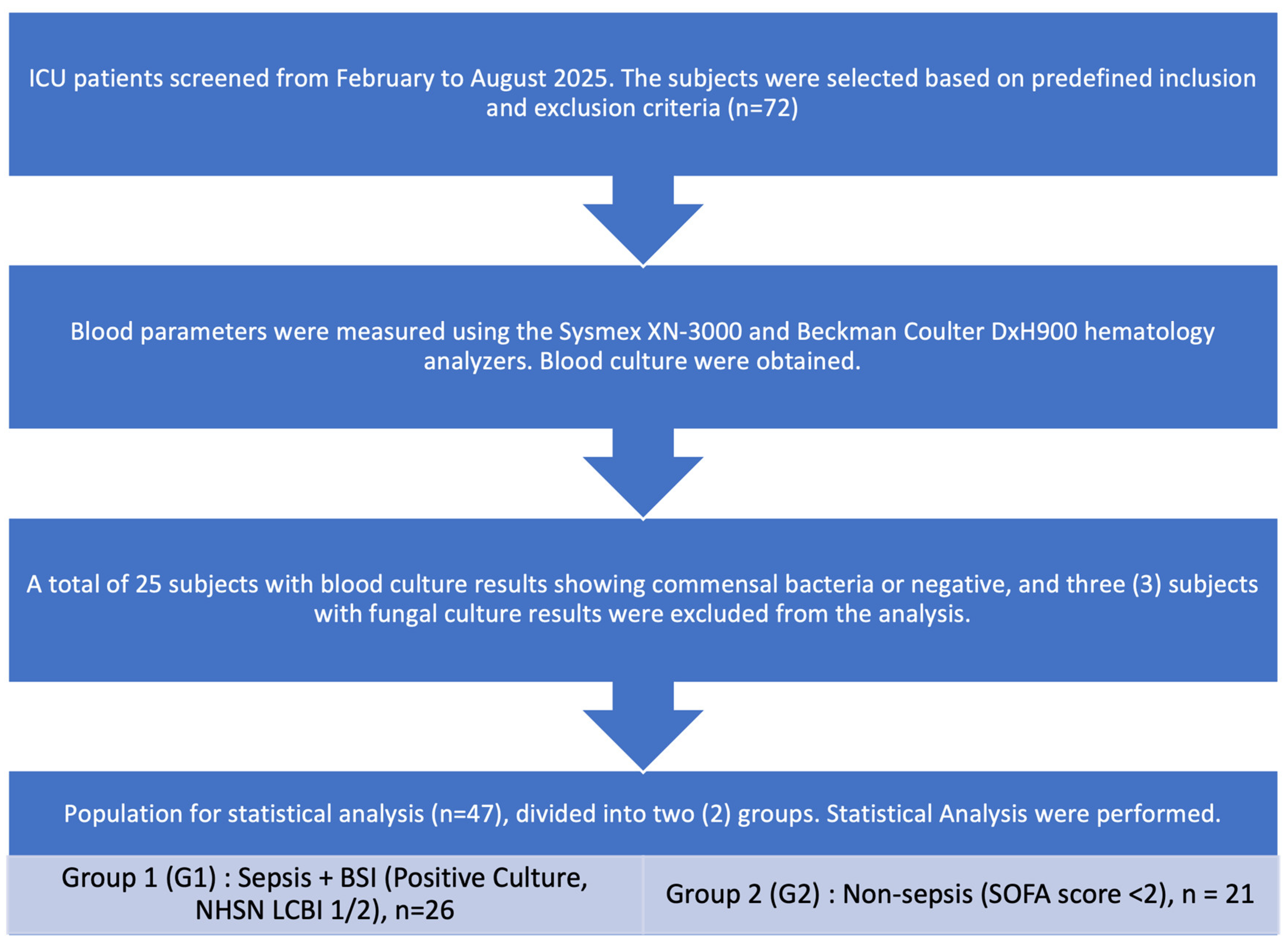
Figure 2.
Boxplots of CPD neutrophil parameters and conventional biomarkers by group (G1 Sepsis+BSI vs G2 Non-Sepsis). NE-WY was significantly higher in G1 (Mann-Whitney U p=0.001, r=0.47). NE-SFL, MDW, PCT, and CRP showed no significant difference. Boxes show IQR; horizontal line = median; whiskers = 1.5×IQR. ** p<0.01; ns = not significant.
Figure 2.
Boxplots of CPD neutrophil parameters and conventional biomarkers by group (G1 Sepsis+BSI vs G2 Non-Sepsis). NE-WY was significantly higher in G1 (Mann-Whitney U p=0.001, r=0.47). NE-SFL, MDW, PCT, and CRP showed no significant difference. Boxes show IQR; horizontal line = median; whiskers = 1.5×IQR. ** p<0.01; ns = not significant.
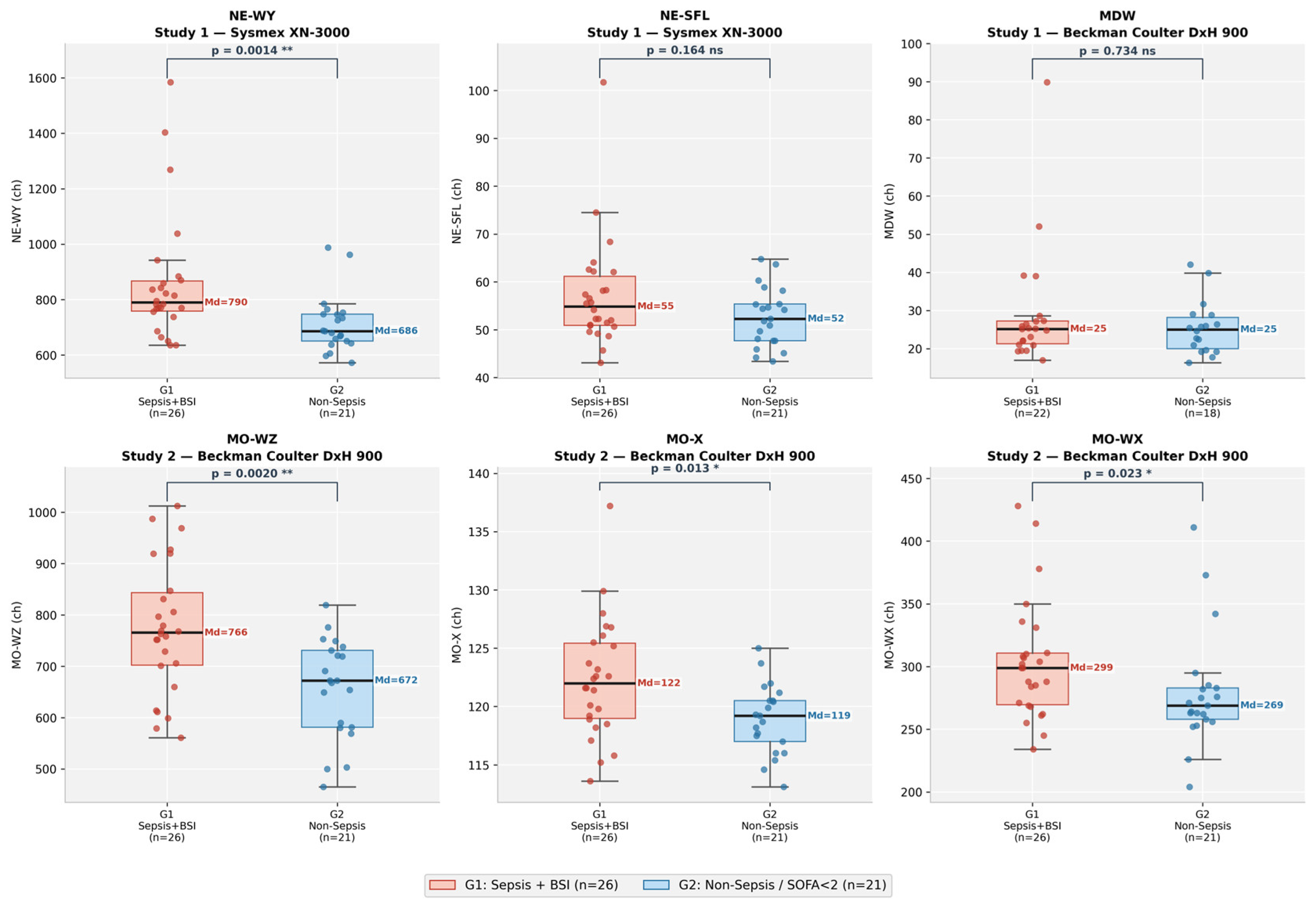
Figure 3.
ROC curves for NE-WY, NE-SFL, MDW, PCT, and CRP in the primary comparison (G1 vs G2, n=47). NE-WY AUC=0.775 (95%CI 0.632–0.917) was the best performer. Inset: sensitivity analysis (G1 vs G2+suspected sepsis, n=72) — NE-WY AUC=0.620 (95%CI 0.485–0.756), illustrating the performance difference when the comparator includes suspected-sepsis patients. Dashed diagonal = chance level (AUC=0.50).
Figure 3.
ROC curves for NE-WY, NE-SFL, MDW, PCT, and CRP in the primary comparison (G1 vs G2, n=47). NE-WY AUC=0.775 (95%CI 0.632–0.917) was the best performer. Inset: sensitivity analysis (G1 vs G2+suspected sepsis, n=72) — NE-WY AUC=0.620 (95%CI 0.485–0.756), illustrating the performance difference when the comparator includes suspected-sepsis patients. Dashed diagonal = chance level (AUC=0.50).
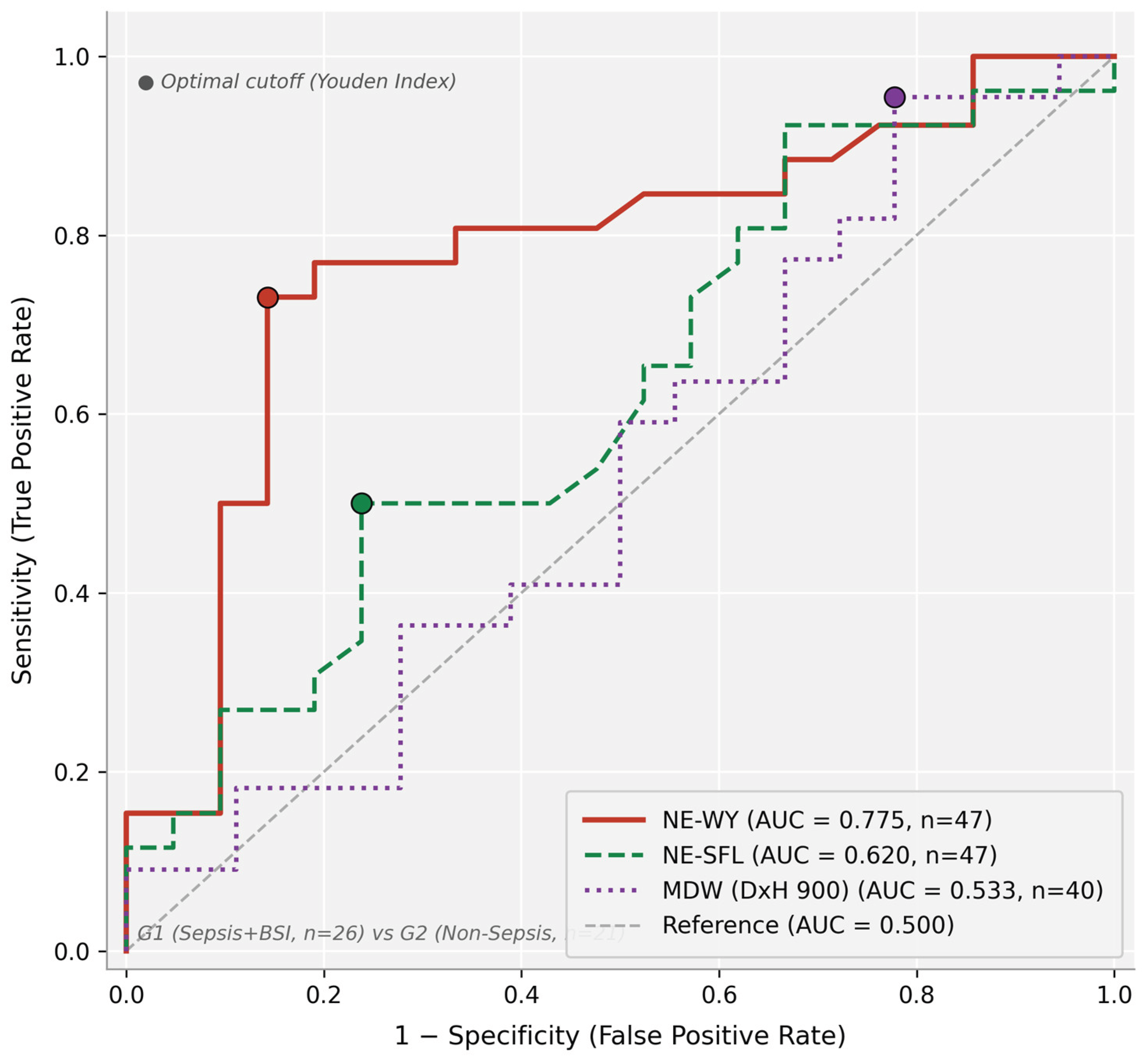

Table 1.
Baseline characteristics of study groups (n=47).
| Variable | G1 Sepsis+BSI (n=26) | G2 Non-Sepsis (n=21) | p-value |
| Age, years, mean (SD) | 53.1 (16.1) | 48.1 (13.7) | 0.410 |
| Male sex, n (%) | 14 (53.8) | 12 (57.1) | 0.757 |
| SOFA score, mean (SD) | 5.92 (2.98) | 0.33 (0.48) | <0.001 |
| MAP, mmHg, mean (SD) | 86.2 (14.7) | 87.3 (14.8) | 0.974 |
| ICU mortality, n (%)ᵃ | 19 (73.1) | 7 (33.3) | 0.004 |
| WBC, x10⁹/L, mean (SD) | 19.5 (17.5) | 17.4 (11.0) | 0.846 |
| Neutrophil, %, mean (SD) | 85.2 (9.4) | 87.7 (8.8) | 0.671 |
| Lymphocyte, x10⁹/L, mean (SD) | 0.98 (0.60) | 0.96 (0.47) | 0.451 |
| Platelet, x10⁹/L, mean (SD) | 211 (134) | 260 (135) | 0.517 |
| Haemoglobin, g/dL, mean (SD) | 10.5 (2.6) | 11.1 (2.9) | 0.488 |
| Creatinine, mg/dL, mean (SD) | 4.54 (5.43) | 1.30 (1.58) | 0.023 |
| NLR, mean (SD) | 24.6 (30.2) | 18.6 (11.0) | 0.619 |
| Gram-positive BSI, n (%) | 12 (46.2) | — | — |
| Gram-negative BSI, n (%) | 11 (42.3) | — | — |
| Polymicrobial BSI, n (%) | 3 (11.5) | — | — |
G1 = Sepsis + confirmed BSI (NHSN LCBI); G2 = Non-sepsis (SOFA <2, negative/commensal culture). MAP = mean arterial pressure; NLR = neutrophil-to-lymphocyte ratio. ᵃ G2 mortality reflects progression of non-infectious critical illness (post-operative complications, haemodynamic deterioration) despite low initial SOFA. p-values: independent t-test or Mann-Whitney U; chi-square for categorical.
Table 2.
Biomarker values by group and Mann-Whitney U test results.
| Biomarker |
G1 Sepsis+BSI Median [IQR] |
G2 Non-Sepsis Median [IQR] |
U statistic | p-value | Effect r |
| NE-WY | 789.5 [758.8–867.3] | 686.0 [650.0–747.0] | 423.0 | 0.001 | 0.47 |
| NE-SFL | 54.85 [50.92–61.15] | 52.30 [47.70–55.40] | 338.5 | 0.164 | 0.20 |
| MDWᵃ | 25.18 [21.28–27.26] | 25.04 [19.96–28.20] | 211.0 | 0.734 | 0.05 |
| PCT, ng/mLᵇ | 7.57 [0.60–32.27] | 3.08 [0.10–23.80] | 151.5 | 0.494 | 0.12 |
| CRP, mg/dLᶜ | 14.34 [8.65–21.21] | 24.12 [4.61–24.74] | 42.0 | 0.812 | 0.05 |
ᵃ MDW available in n=40 (22 G1, 18 G2). ᵇ PCT available in n=34. ᶜ CRP available in n=20. NE-WY and NE-SFL: arbitrary units (Sysmex XN-3000). MDW: femtolitres. Bold: p<0.05.
Table 3.
Diagnostic performance at Youden-optimal cutoffs: G1 vs G2 (n=47).
| Biomarker | n | AUC (95%CI) | Cut-off |
Sensitivity % (95%CI) |
Specificity % (95%CI) |
PPV % (95%CI) |
NPV % (95%CI) |
Accuracy % (95%CI) |
| NE-WY | 47 | 0.775 (0.632–0.917) | 766 |
73.1 (53.9–86.3) |
85.7 (65.3–95.0) |
86.4 (66.7–95.3) |
72.0 (52.4–85.7) |
78.7 (65.1–88.0) |
| NE-SFL | 47 | 0.620 (0.456–0.784) | 55.45 | 50.0 (31.9–68.1) |
76.2 (52.8–90.5) |
72.2 (46.5–88.5) |
55.2 (36.9–72.0) |
61.7 (47.4–74.5) |
| MDW | 40 | 0.533 (0.346–0.720) | 19.25 | 95.5 (77.2–99.2) |
22.2 (8.6–45.8) |
60.0 (43.0–74.9) |
80.0 (37.6–96.4) |
62.5 (46.7–76.0) |
| PCT | 34 | 0.574 (0.342–0.806) | 0.14 | 95.5 (77.2–99.2) |
33.3 (13.8–60.9) |
72.4 (52.8–85.9) |
80.0 (37.6–96.4) |
73.5 (56.0–85.9) |
| CRP | 20 | 0.538 (0.251–0.826) | 22.67 | 76.9 (49.7–91.8) |
57.1 (25.1–83.4) |
76.9 (49.7–91.8) |
57.1 (25.1–83.4) |
70.0 (47.1–86.0) |
AUC compared by DeLong method. NE-WY vs MDW: Z=2.015, p=0.047. All other pairwise p>0.10. 95%CIs for sensitivity, specificity, PPV, NPV, and accuracy: Wilson score method. Cutoff by Youden index. NE-WY row bold = best performer. Sensitivity analysis (G1 vs G2+suspected sepsis, n=72): NE-WY AUC=0.620 (95%CI 0.485–0.756). Post-hoc power for primary NE-WY comparison: 98.2% (Hanley-McNeil, alpha=0.05).
Disclaimer/Publisher’s Note: The statements, opinions and data contained in all publications are solely those of the individual author(s) and contributor(s) and not of MDPI and/or the editor(s). MDPI and/or the editor(s) disclaim responsibility for any injury to people or property resulting from any ideas, methods, instructions or products referred to in the content. |
© 2026 by the authors. Licensee MDPI, Basel, Switzerland. This article is an open access article distributed under the terms and conditions of the Creative Commons Attribution (CC BY) license (http://creativecommons.org/licenses/by/4.0/).
Copyright: This open access article is published under a Creative Commons CC BY 4.0 license, which permit the free download, distribution, and reuse, provided that the author and preprint are cited in any reuse.