

Submitted:
01 July 2026
Posted:
02 July 2026
You are already at the latest version
Abstract
Implementation of circular solutions in place of single-use plastic products requires stronger alliance between science and private sector. To investigate benefits of knowledge and strategy co-creation, this study applies common-pool resource theory in the design of a serious game. A total of 188 Polish biology and geography undergraduate students (researchers-to-be), divided into two teams, representing science and business actors with shared goals, participated in 20 facilitated game sessions. Two versions of the game were assessed – with a separation of the teams or with the personnel exchange. The results of the games were analyzed in relation to the structure of the shared social values as a differentiating co-factor. Science–business collaboration and environmental attitudes were evaluated with pre/post-questionnaires to assess the game’s potential as a science communication and educational tool. Results suggest that the successful resolution of the presented common-pool resource dilemma correlates with the introduced collaboration and the self-transcendence values. As hypothesized, we observed desirable changes in participants’ attitudes after the game sessions. Further investigation of gaming as a science communication tool and its long-term effects is recommended to facilitate implementation of the knowledge co-creation principles in practice.
Keywords:
circular economy
; common-pool resource
; knowledge co-creation
; game-based learning
; serious game
1. Introduction
1.1. Plastic Dilemma as a Common Pool Resource Problem
Single-use plastic products constitute 36.7% of global plastic production in 2021 — more than any other end-use category [1,2]. Such products are designed with the intent for a single use or for a short period before being disposed of [3]. Moreover, single-use plastics are technically difficult and costly to reprocess, and, in effect, only 9% is recycled, while the majority is incinerated [4,5]. The plastic lifecycle CO2 emissions will account for more than 12% of the remaining 1.5°C carbon budget by 2050 [6].
Responsibility for the pollution is dispersed and, despite some institutional control at various administration levels, plastic disposal remains largely unregulated [7]. With earth’s limited carrying capacity and open global plastic sinks in the form of faulty regulations and export to developing countries, this problem can be framed in terms of a common-pool resource [8]. This theory describes notoriously difficult-to-manage, subtractable, partially or non-renewable resources, understood either as material goods or more abstract environmental capacities that are a source of collective benefit. Due to the limited property rights, competitive consumption, and required collaboration, there is a risk that various stakeholders will engage in extraction of privatized profits, even if it results in substantial diminishment of common value generation [9].
Game theory, which is the theoretical underpinning of this concept, assumes equal rational motivation of the stakeholders to maximize expected utilities; therefore, refraining from participation in the commons is seen as giving ground to potential competitors [10,11]. A social dilemma arises where cooperation would yield more beneficial outcomes for all stakeholders but fails due to conflicting interests [12]. In the plastic crisis, the common goods, or in this context, so called common bads, represent externalized waste, which is often exported to countries that are willing to provide such services [13].
1.2. Knowledge Co-Creation as a Postulated Solution
Circular economy is one of the frameworks developed to manage the plastic waste problem [14]. It is a method of reaching a sustainable society by gradual product lifespan extension to strongly reduce necessary energy consumption and limit the amount of waste released into the environment [15]. Although this idea has been strongly promoted, circular economy advocacy focused on waste generation, resource use, and environmental impact, whereas the economic perspective and business incentives have been neglected, missing the concerns of key business stakeholders [16,17]. The academic world fostering innovative strategies in circular economy tends to engage in a linear mode of communication, where knowledge transfer is supposed to occur only in one way: from the academia to the public [18,19]. In particular, academia–business relations have been theorized as an ivory tower setting, where there is little initiative or incentive for bridging the gap between those groups [20,21]. To close the gap between the scientific and business communities, knowledge co-creation has been devised to facilitate knowledge sharing, cooperation between knowledge producers and knowledge users and creating important professional associations [18,22]
One of the methods to address these issues is to develop alternative ways of knowledge co-creation, which can be achieved using serious games designed to facilitate mutual and experiential learning [23,24]. Games are increasingly prevalent both as educational and research tools [25,26] and can help to explore social dilemmas by building on the game theory legacy [27]. This approach is especially valuable when dealing with groups with different incentives, as it has the “power to improve communication between competing stakeholders”[28].
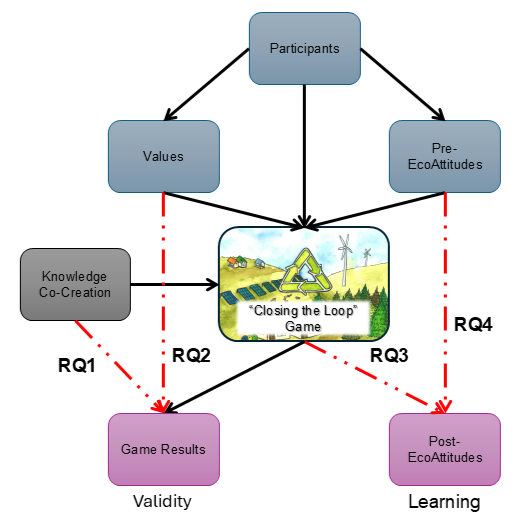
We designed Closing the Loop game, both to allow detailed observation of decision-making process and facilitate mutual and experiential learning of knowledge co-creation process in the context of circular economy of plastic products. The main aims of this study are to assess what are the conditions increasing chances of success in the proposed game and whether it changes attitudes towards science-business collaboration. These goals were achieved by performing a research that addressed the following research questions:
1) Does player exchange help to govern common-pool resources in Closing the Loop simulation game?
2) Do the values held by the participants affect the results of such a game?
3) Does participation in the game affect the attitudes of players towards collaboration between science and business in support of the circular economy?
4) Does the game affect environmentally oriented participants differently?
2. Materials and Methods
2.1. Game Model Design
The main inspiration for the game design was an investment game by Ostrom and her team [29]. This Nobel Prize–winning study demonstrated that people can abandon selfish behaviors in favor of a common goal when communication is introduced as a form of strategy co-creation and behavioral control. The following research design examined whether Closing the Loop reproduces similar dynamics, even when communication is restricted only between two physically separated teams.
The core of the game was based on the double circular industrial process proposed by Grodzińska-Jurczak [18]. Circular material processing is mediated there by a parallel cycle of knowledge generation, requiring synchronized implementation of non-linear schemes. Thus, two different disciplines must cooperate by supporting each other with multidirectional flows of knowledge and capital, set in the broader market context with the corresponding flow of resources.
To allow for experiential learning, players were meant to learn the rules through the gameplay itself. To make this possible, the complexity of the game had to be limited. Because the focal point of our research was social interaction, a physical board game design – printed cards and instructions – was adopted to encourage experiential learning [25].
2.2. Simplified Description of the Game
Players are divided into two equal teams of inventors and entrepreneurs which are located in two separate rooms. Each team is guided by different rules, but end goals are the same: either securing personal gains or investing in a common victory (or both). Inventors can buy random (but sequenced) invention cards – six distinct types that differ in environmental and economic effects. Each round, inventors have the option to (1) voluntarily share the cards with entrepreneurs, who can activate them for economic and/or environmental benefits, or (2) sell them to gain personal benefit. The latter option earns resources for the inventors but takes valuable time that could be used for further research (in each round inventors can perform only one action – either buy a new invention card or sell one they already own, sharing the cards does not demand the action).
Entrepreneurs, during each round may choose between (1) producing single-use plastics (which earns them resources), (2) engaging in slow recycling (which costs them resources), or (3) implementing invention cards, if they have received any from the inventors. Additionally, at the end of each round, entrepreneurs can pass resources to inventors, trusting that they will receive invention cards in return. The invention cards allow entrepreneurs to earn resources and/or to remove waste. Special circular economy cards can also be found; these are used to implement circular economy solutions – they constantly reduce waste levels and, when all are activated by entrepreneurs, no new waste is generated and the game ends with additional payoffs for all the players. They play a critical role in determining a positive outcome.
If players focus too much on individual goals, neglect cooperation, and the sharing of knowledge or resources with the other team, earth’s carrying capacity for plastic waste might be exceeded, resulting in a collective loss. However, if both groups focus on implementing invention cards, they can collectively win by closing the loop (by implementing all the circular economy cards) and replacing single-use products with circular solutions. Therefore, the game has three possible endings:
(1) negative – the waste limit is exceeded: no one wins prizes;
(2) neutral – the waste limit is not exceeded: prizes are distributed in relation to the resources acquired individually;
(3) positive – all the circular economy cards are implemented: prizes are distributed with an additional bonus for each participant of +1 per person.
There is an external, undisclosed time limit of 12 rounds for all games, which aims to evaluate how quickly players can comprehend the rules and how strongly invested they are in cooperation to achieve a circular economy as a form of common victory. There are two versions of the game with different scripted scenarios of communication between the players, named Knowledge Co-creation and Ivory Tower, representing two factor levels. The Ivory Tower scenario allows only for the transfer of resources and inventions from one team to the other, shared evenly between transferring players. In Knowledge Co-creation scenario, one player from each group changes rooms and switches the role. That player is also transferring the resources and inventions deciding whether to keep them or share with the others.
Participants were rewarded with 20 PLN (approx. 4,7 EUR) coupons for every 10 resources they collected in the case of a neutral ending, and an additional coupon for each participant in the case of a positive ending. The payoff matrix (Table 1) was created with an algorithmic game engine. Detailed rules are described in Supplementary Information - Materials; the game engine is provided in the form of flowchart (Figure 1) and in full version in Supplementary Information - Algorithm. The study began with a calibration of the scales in the form of eight pre-trial sessions with 60 participants experienced in board games. Following the implementation of all game design improvements, formal data collection began.
2.4. Model Evaluation
This study employed a mixed-methods design integrating qualitative and quantitative approaches. A total of 20 games (N = 20) were conducted, with an equal number assigned to each of the two factor levels. Participants were undergraduate and graduate students aged 18–27 from the Biology and Geography faculties at Jagiellonian University in Kraków, Poland. The research protocol was approved by the Jagiellonian University Ethics Committee for Social Research (opinion no. 1027.0041.3.2025). The games took place during selected classes in the 2024/25 academic year, after all participants had provided informed consent (see Supplementary Information – Materials). Participation in the study was voluntary, and choosing not to participate had no consequences for course attendance. Altogether, 188 students took part in the 20 game sessions. Game parameters were adjusted to the group size to maintain scalability. Since interactions in pairs differ from those in larger groups, each game included an even number of players, ranging from 6 to 14 [30,31].
2.4.1. Model Variables
The game’s outcomes were more complex than its three possible resolutions. They are expressed through the World State Coefficient (S), a composite variable derived by integrating three distinct scales: Waste Amount (W), Circular Economy Innovation Level (C), and Time Efficiency (T). Each variable contributes differently to the game’s final outcome: the Amount of Waste (W) indicates how close the group is to losing the game, the Circular Economy (C) represents the potential for winning, and Time Efficiency (T) captures how quickly a group reached an outcome (win or loss) relative to the fixed number of rounds. The Time Efficiency (T) scale influences the score only in the event of a positive or negative ending, by adjusting for the number of rounds remaining up to maximum 12. Each of the three scales was standardized to a range from 0 to 1. Because each circular economy card permanently reduces the amount of waste, these variables can be combined into a single coefficient as follows:
World State (S) = C - W + (-1sgn(ln(C)) * T)
Positive World State (S) values mean that Circular Economy (C) cards counterbalanced the Waste (W) in the common pool which can be achieved only in a neutral or positive ending. A single World State (S) value was calculated for each game session and treated as the dependent variable in the analysis to answer the first and second research questions. Although resources (R) are an essential part of the gaming model, they were not included directly in the calculations because of their instrumental role for players to manipulate the game state and no direct link to environmental outcomes.
2.4.2. Predictors
The World State (S) was the dependent variable and treatment was the independent variable: 0 for groups with limited communication and 1 for groups with knowledge co-creation. Before the game, participants completed the Polish version of the Revised Portrait Value Questionnaire (PVQ-RR) to assess the influence of personal values [32]; Supplementary Information – Materials). The scale was reduced to two dimensions—Self-Transcendence and Self-Enhancement—based on 27 items measuring values that may affect cooperative behavior.
To address the third and fourth research questions on the game’s educational value and its impact on attitudes, pre–post questionnaires were used. The questionnaire included 21 items on general awareness of the plastic problem and science–business cooperation, plus 5 post-hoc items on opinions about the game design and experience. Attitude change was tested by comparing all responses (ordinal dependent variable, 1–10: strongly disagree–strongly agree) to the 21 items (predictor factor) before and after the game (PrePost factor), in a model that also included Treatment (co-factor) and Person as a random effect.
2.4.3. Validation of the PVQ-RR Scale
Although the modified scale showed good internal consistency (α = 0.78), confirmatory factor analysis revealed significant imbalances, requiring questionnaire decomposition. A better-fitting measurement model was obtained by reducing the number of items per latent factor (Supplementary Information - Materials). New fit indices indicated good fit: CFI = 0.951, TLI = 0.94, RMSEA = 0.049, SRMR = 0.069. All standardized factor loadings were acceptable (0.4–1.00). The final model included two latent variables: Self-Enhancement (Enhancement), comprising Achievement, Power Dominance, and Power Resources; and Self-Transcendence (Transcendence), comprising Universalism Nature, Universalism Concern, and Universalism Tolerance. A weak negative correlation emerged between Transcendence and Enhancement (estimate = -0.257, SE = 0.099, p = 0.009). Scores for Enhancement and Transcendence were extracted and entered as covariates in the model. A two-level model with a nested group variable could not be estimated due to small group sizes, an important limitation given that the pre-existing groups may differ in intragroup dynamics [33].
2.5. Other Methods
All data, including covariates, were analyzed with R. Confirmatory factor analysis assessed the robustness of the PVQ-RR questionnaire. Using the lmer and lm functions, we built linear models and analyzed them with Anova tools. Pre/post-questionnaire results were modeled with a mixed cumulative link model and compared using the Emerson function. Additional qualitative observations of the game flow, based on observers’ notes, are briefly reported in the results section to further illuminate game dynamics.
2.6. Data Collection
The rules of the game were presented by a game facilitator in a standardized manner, followed by an open-question session. Instruction shortcuts were continuously made available throughout the session. Although facilitators were allowed to clarify rule-related ambiguities, they were prohibited from offering any suggestions regarding strategies. The total number of game rounds remained undisclosed; participants were only aware that the session would fit within a standard 90-minute class period. In cases of the odd number of participants, one individual was excluded from active participation, prohibited from interacting with other players, and assigned the role of observer, documenting behavioral patterns and subjective perceptions. Two initial “test” rounds introduced a buffer regarding the number of actions required for a successful outcome.
3. Results
3.1. Effects of Communication and Values on the Game Results (the World State)
Out of all the results, the only two positive endings were recorded as an effect of Knowledge Co-creation scenario and three negative endings as an effect of Ivory Tower. Statistical analysis strengthens the correlation thesis. Diagnostic statistics show that model residuals have a normal distribution (W = 0.93129, p-value = 0.1635) and fulfill the assumptions of homoscedasticity. Both Knowledge Co-Creation (Treatment) and the difference in the declared level of Self-Transcendence values (Transcendence) had significant effects on the outcome variable, which is a basis for rejecting null hypothesis (Table 2).
The best fit (adjusted R² = 0.633) results from removing all insignificant terms except the Treatment × Transcendence interaction (p = 0.160), indicating that a larger sample may reveal a significant effect. If confirmed, this would suggest that the Knowledge Co-creation scenario reduces the impact of values. Ivory Tower groups low in self-transcendence scored just above -1, indicating that the game is difficult for groups that are not altruistic and cannot communicate between teams. Transcendence had a more significant effect than Treatment but a slightly smaller impact on World State (0.497 vs. 0.595), and the interaction term in the reduced model had an estimated slope of -0.255 (Figure 2).
3.2. Experiential Learning Outcomes: Effects of Participation on Players’ Attitudes
A linear model with visual diagnostics showed homoscedasticity, but the residual Q–Q plot indicated substantial imbalance for the sample (n = 188). Consequently, a non-parametric cumulative link mixed model was used with a stricter significance threshold (p < 0.01). A contrasted pairs table was built to identify questions whose responses changed significantly between before and after, accounting for the categorical Treatment and random Person effects.
Because the sample (biology and geography students) already showed strong pro-environmental attitudes, questions on science funding, pace of environmental research, and circular economy knowledge (Q4, Q8, Q20) were expected to be positive; all others were expected to be negative. Results were standardized so all items were negatively oriented, so a negative estimated change matched the predicted direction.
To reduce inflated variance from limited room for improvement, the two lowest PRE scores and their corresponding POST scores were removed, and the reduced dataset was refit. Diagnostics showed a strong random Person effect (p < 2.2e-16), justifying its inclusion. The model revealed strong effects of the game session (PrePost) and its interaction with Question (Table 3), though even significant results were hard to interpret. Many filtered responses indicated participants were already fully convinced, while fewer responses reflected more diverse attitudes. Since it is less important to further reassure convinced participants than to shift negative views on knowledge co-creation and the circular economy, two additional models were fitted separately for responses on the positive and negative sides of the scale (agree/disagree).
All significant pre-post attitude changes aligned with the predicted item orientation. Of the 21 items, 12 changed significantly, no substantial differences between the treatment groups were detected. The greatest shift occurred for the separation of the disciplines of science and business (Q2, see Table 4 for full questions), where the groups showed a significant decrease in the attitude (estimate = -2.241 scale points), despite the skewed distribution. The second-largest change can be attributed to two items with an increase in self-reported knowledge of the circular economy (Q20) (estimate = -1.730 scale points) and attitudes towards the need for science communication (Q13), despite the highest number of significant filtered responses (115) for this item. All remaining items showed estimated changes within the 0.805–1.186 scale points. Participants’ support for active business involvement in addressing the plastic crisis increased, even when such involvement was not immediately profitable. The absolute right for science independence in setting its goals and strategies was less valued than engaging in collaboration. Items without statistically significant change included topics such as source of science funding, current state of sustainability research, free market of ideas (Q4, Q8, Q9, Q11, Q18) and items with highest number of filtered responses (Q6, Q15, Q17, Q19).
3.3. Differences in Response with Respect to Primary Attitude
Due to the sample consisting of Biology and Geography students, all items were skewed in accordance with their orientation, increasing the likelihood of a Type II error. The magnitude of the difference between Pre- and Post-questionnaires varied according to the primary Attitude (negative (“pro-environmental”): Pre- response 1-5 / positive (“anti-environmental”): Pre- response 6-10) of the respondent, the Question, as well as their interaction, depending slightly on the Question:Treatment (Table 5). The negative attitude was estimated to increase by 0.35 points and the positive attitude fell by 1.53 points according to the estimated marginal means test (z.ratio = 23.312, p<0.0001). Only 8 questions did not change significantly in respondents with “anti-environmental” attitudes, including questions about science funding, current effectiveness of science communication (Q4, Q8, Q9, Q10, Q18) and items with the highest number of filtered responses (Q15, Q17, Q19), while in the “pro-environmental” group only 6 questions did change, including statements about the time limit and industry commitment to addressing plastic crisis (Q7, Q10, Q16) and the questions with the highest estimates (Q2, Q13, Q20). The only response that did significantly change in the convinced group and did not in the unconvinced was with respect to the question about the current effectiveness of science communication. The results suggest that
3.4. Qualitative Observations
These remarks draw on debriefings, facilitator and observer notes, and first-hand observations. Clear differences emerged between groups with knowledge co-creation mechanisms and those with restricted communication. Participants in the Ivory Tower conditions showed more confusion, lower engagement, weaker forward planning, and more irrational decisions at both individual and group levels. Intergroup antagonism frequently appeared and seemed to rise with increasing waste. All three recorded game failures occurred only in Ivory Tower groups, usually due to passive play and the lack of a shared strategy. While no explicit hoarding of resources (R) for high-value rewards was seen, resources remained tightly controlled by individual players. In contrast, Knowledge Co-creation groups engaged more actively in intragroup information exchange. Although forced player transfers between rooms initially caused brief confusion, the group dynamic usually enabled quick onboarding. Groups that adopted the cycle of research, rotation, and innovation implementation early were more successful, but many ultimately ran out of time before fully executing their winning strategies.
Participants’ decisions were not always strategically optimal. At times, this was linked to explicitly stated anxiety or uncertainty about the consequences of their actions, even though the rules were available. In some cases, players chose not to act despite having a clear advantage in doing so, or they decided to follow others’ directions. This pattern suggests that the presence of a confident, strong leader among players may have been an important factor for achieving positive results, whereas an anxious leader could steer the team toward poorer outcomes.
Moreover, players seldom emphasized research intensity or recognized the relationship between greater research efforts and the likelihood of obtaining circular economy cards, which provide cumulative benefits and are crucial for winning. Instead, they frequently pursued immediate rewards and overlooked long-term strategies. The groups that performed best concentrated on keeping waste levels below a critical threshold, sometimes even reducing them further without an obvious economic or strategic rationale. This behavior points to a preference for alleviating environmental anxiety rather than for strictly optimizing problem-solving.
A common emergent pattern was the spontaneous establishment of a shared resource (R) pool, collectively used to finance common goals. While such actions are technically disallowed by the rules and the study’s assumptions, recognizing this behavior opens up a valuable line of inquiry for future research—namely, exploring the motivations and conditions that give rise to these collective problem-solving strategies and assessing whether they are actually more effective.
3.5. Participants’ Subjective Evaluation of the Game
Participants showed moderate enthusiasm: 61% would repeat the experience (Q22, score 8–10), 52% felt the game accurately represented scientific communication (Q23, 7–9), and 60% agreed it proposed viable science-business reforms (Q26, 8–10). Meanwhile, 47% were unsure whether the mechanics needed revision (Q24, 3–5) (Figure 3; full questions in Supplementary Information – Materials). Interest in acquiring the game differed significantly (p = 0.007), with higher commitment in the Knowledge Co-Creation group (Q25: 46% scoring 6–8 vs. 41% scoring 5–7).
4. Discussion
Several games address circular economies, but their outcomes are hard to compare with ours due to different methodologies. Whalen et al. [34] created In the Loop, which focuses on recycling and market prices for rare earth elements. While In the Loop deals with recoverable, reusable resources, Closing the Loop addresses single-use plastics with minimal recycling potential. In our game, engaging in “recycling practices” diverts attention from the main goal: replacing plastic with environmentally neutral materials. The games also differ in educational aims and mechanics: In the Loop is competitive with a single winner, whereas our model uses mixed incentives, letting players aim for personal or collective victory. Finally, In the Loop was assessed only through open-ended written reflections, which are not directly comparable to our quantitative pre/post questionnaires measuring attitude change.
Risk&RACE, developed by Manshoven & Gillabel [35], is a circular economy game focused on a business perspective. It explains how companies are affected by external pressures, how their sustainability varies with circular versus linear business models, and provides detailed insights into circular economy strategies using qualitative methods. The game involves teamwork and rivalry between groups. Like Whalen’s [34], it simulates a free market but does not address common pool resource issues or the value of knowledge co-creation for solving circular economy challenges.
Olejniczak et al. [36] take a different approach in their Knowledge Brokers game, integrating knowledge brokerage into a worker-placement mechanic. Players respond to unexpected events by assigning staff to tasks within socio-economic interventions [37]. Although it does not address environmental issues, the game also features a knowledge co-creation loop, enabling cooperation for better rule understanding and pursuit of a shared goal. This lets participants experience that brokering knowledge is an effective way to solve operational problems. Both games use time constraints to simulate external pressure for rapid action. Another key difference is the option of collective victory, as in Closing the Loop’s player-versus-game format. Knowledge Brokers, meanwhile, relies on qualitative player reflection for evaluation.
Knowledge co-creation remains a widely misunderstood concept, often perceived more as a data collection practice than a joint effort in producing unique insights. The advantages of knowledge co-creation extend beyond more detailed observations or more accurate descriptions of specific phenomena to include the adoption of common goals and acknowledgement of diverse needs and operational modes [22,38]. However, it is not without risk, as it can lead to conflicts of interest, as seen in the biomedical field [39]. Seemingly sustainable governance may serve as a pretext for the introduction of even more harmful substances or to obscure other unsustainable actions. Indirect funding streamed through independent institutions that promote business–science cooperation without creating co-dependence might mitigate this risk. The use of a common-pool resource game with a collective failure trigger in this study prevented such outcomes, highlighting the benefits of collaboration without associated drawbacks. However, implementing a more competitive game design could reveal interesting interdependencies.
Values play a significant role in resolving social dilemmas, even when only approximated at the group level. Although individual value profiles, like moral foundations, may seem secondary in large-scale problems, their impact on decision-makers remains important [40]. Environmentally oriented organizations might therefore incorporate value-based criteria when forming managerial teams. While values and deeply held attitudes are usually stable, they can be shaped by priming—creating memory links that increase their accessibility for behavior—or by other interventions, especially during adolescence [41]. Serious simulation games may be effective for such interventions among youth, particularly when used over time and/or in their direct social context [42]. We showed that Closing the Loop can influence attitudes, but its capacity to affect values remains uncertain.
4.1. Limitations
The main limitation of the study is that the dependent variable was the World State from a single game. This choice has benefits, such as showing how shared, averaged group values affect outcomes in a common-pool resource dilemma, but it reduces statistical power. Our sample consisted entirely of pre-existing student groups of similar age from a WEIRD population (white, educated, industrialized, rich, and democratic) [43]. Pre–Post question results confirmed this limitation. Two approaches could allow comparison with our findings: studying a more diverse population or examining the reactions and behavior of actual scientists and business representatives. A more robust design, such as the Solomon four-group method, could better assess how strongly the game influences attitudes and perceptions [44].
5. Conclusions
The aim of this study was to assess whether Closing the Loop has the potential to educate users about the value of knowledge co-creation and collaboration in addressing environmental and social dilemmas, such as single-use plastic pollution. The results indicate that the implemented personnel exchange mechanism helps address this issue through knowledge co-creation, in line with previous findings [29]. By providing real-time observable outcomes and rules that foster social learning, the game facilitates the construction of knowledge during gameplay [45]. Further research is needed to determine the persistence of this knowledge.
In this context, experiential learning is not only a process of acquiring testable knowledge but, more importantly, an insider’s exposure to systemic processes. Soft skills and deeply rooted attitudes are not easily influenced by knowledge-based interventions or direct confrontation unless a supportive setting is provided [46,47,48]. A serious simulation game like Closing the Loop can provide such conditions, encouraging individual reflection on one’s approach. As one participant noted: “If I were to play again, I would know what to do” — and hopefully this time the game will be for real.
Supplementary Materials
The following supporting information can be downloaded at: https://www.mdpi.com/article/doi/s1, SI – Materials, SI – Statistics, SI – Algorithm.
Author Contributions
Conceptualization, Dawid Rostankowski, Joanna Tusznio, Małgorzata Grodzińska-Jurczak; Data curation, Dawid Rostankowski, Joanna Tusznio, Małgorzata Grodzińska-Jurczak; Formal analysis, Dawid Rostankowski; Funding acquisition, Joanna Tusznio, Małgorzata Grodzińska-Jurczak; Investigation, Dawid Rostankowski, Joanna Tusznio; Methodology, Dawid Rostankowski, Joanna Tusznio, Małgorzata Grodzińska-Jurczak; Project administration, Joanna Tusznio, Małgorzata Grodzińska-Jurczak; Resources, Dawid Rostankowski, Joanna Tusznio, Małgorzata Grodzińska-Jurczak; Software, Dawid Rostankowski; Supervision, Joanna Tusznio, Małgorzata Grodzińska-Jurczak; Validation, Joanna Tusznio, Małgorzata Grodzińska-Jurczak; Visualization, Dawid Rostankowski; Writing – original draft, Dawid Rostankowski; Writing – review and editing, Dawid Rostankowski, Joanna Tusznio, Małgorzata Grodzińska-Jurczak.
Funding
This publication was supported by a grant from the National Science Centre, Poland (no. 2020/39/B/HS4/00264) and by the University’s subsidy for scientific activities (no. N18/DBS/000025).
Institutional Review Board Statement
The study was conducted in accordance with the Declaration of Helsinki. Research design for this study was approved by the Human Research Ethics Committee of the Jagiellonian University. (No 1027.0041.3.2025).
Informed Consent Statement
“Informed consent was obtained from all subjects involved in the study.”.
Data Availability Statement
The data that support the findings of this study are openly available in Rodbuk at https://doi.org/10.57903/UJ/P9GNNP and in the supplementary material of this article.
Conflicts of Interest
The authors declare no conflicts of interest.
References
- Charles, D.; Kimman, L.; Saran, N. The Plastic Waste Makers Index 2023; Minderoo Foundation Pty Ltd, 2023; Available online: https://cdn.minderoo.org/content/uploads/2023/02/04205527/Plastic-Waste-Makers-Index-2023.pdf.
- OECD. Global Plastics Outlook: Policy Scenarios to 2060; OECD Publishing: Paris, 2022. [Google Scholar] [CrossRef]
- Directive 2019/904. Directive (EU) 2019/904 of the European Parliament and of the Council of 5 June 2019 on the reduction of the impact of certain plastic products on the environment. Available online: http://data.europa.eu/eli/dir/2019/904/oj.
- Geyer, R.; Jambeck, J. R.; Law, K. L. Production, use, and fate of all plastics ever made. Sci. Adv. 2017, 3(7). [Google Scholar] [CrossRef] [PubMed]
- Houssini, K.; Li, J.; Tan, Q. Complexities of the global plastics supply chain revealed in a trade-linked material flow analysis. Commun. Earth Environ. 2025, 6(1). [Google Scholar] [CrossRef]
- Hamilton, L.; Feit, S. Plastic & Climate: The hidden costs of a plastic planet, CIEL; Switzerland, 2019; Available online: https://coilink.org/20.500.12592/qctxbd.
- Knoblauch, D.; Mederake, L. Government policies combatting plastic pollution. Curr. Opin. Toxicol. 2021, 28, 87–96. [Google Scholar] [CrossRef]
- Vince, J.; Hardesty, B. D. Governance solutions to the tragedy of the Commons that marine plastics have become. Front. Mar. Sci. 2018, 5. [Google Scholar] [CrossRef]
- Ostrom, E. Governing the commons: The evolution of institutions for collective action; Cambridge University Press, 1990. [Google Scholar]
- Gardner, R.; Ostrom, E.; Walker, J. M. The nature of common-pool resource problems. Ration. Soc. 1990, 2(3), 335–358. [Google Scholar] [CrossRef]
- Von Neumann, J.; Morgenstern, O. Theory of games and Economic Behavior; Princeton University Press, 1944. [Google Scholar]
- Sandler, T. Collective action: Fifty Years Later. Public Choice 2015, 164(3–4), 195–216. [Google Scholar] [CrossRef]
- Schuch, E.; Nhim, T.; Richter, A. Coordinating on good and bad outcomes in threshold games – evidence from an artefactual field experiment in Cambodia. Ecol. Econ. 2025, 232, 108547. [Google Scholar] [CrossRef]
- OECD. Preventing single-use plastic waste . In OECD Environment Working Papers; 2021. [Google Scholar] [CrossRef]
- Stahel, W. R. The Product-Life Factor. In An Inquiry Into the Nature of Sustainable Societies: The Role of the Private Sector; essay, HARC, 1983; pp. 72–104. [Google Scholar]
- Lieder, M.; Rashid, A. Towards circular economy implementation: A comprehensive review in context of manufacturing industry. J. Clean. Prod. 2016, 115, 36–51. [Google Scholar] [CrossRef]
- Rizos, V.; Behrens, A.; Van der Gaast, W.; Hofman, E.; Ioannou, A.; Kafyeke, T.; Flamos, A.; Rinaldi, R.; Papadelis, S.; Hirschnitz-Garbers, M.; Topi, C. Implementation of circular economy business models by small and medium-sized enterprises (smes): Barriers and enablers. Sustainability 2016, 8(11), 1212. [Google Scholar] [CrossRef]
- Grodzińska-Jurczak, M.; Krawczyk, A.; Akhshik, A.; Dedyk, Z.; Strzelecka, M. Contradictory or complementary? stakeholders’ perceptions of a circular economy for single-use plastics. Waste Manag. 2022, 142, 1–8. [Google Scholar] [CrossRef] [PubMed]
- Karhunmaa, K. Performing a linear model: The Professor Group on Energy Policy. Environ. Sci. Policy 2020, 114, 587–594. [Google Scholar] [CrossRef]
- Caplan, N. The two-communities theory and knowledge utilization. Am. Behav. Sci. 1979, 22(3), 459–470. [Google Scholar] [CrossRef]
- Krawczyk, A.; Jaguszewska, N.; Ziółkiewicz, W.; Grodzińska-Jurczak, M. The Ivory Tower of academia in the era of climate change: European scientists’ engagement in science popularization related to single-use plastics. Environ. Sci. Policy 2023, 146, 185–202. [Google Scholar] [CrossRef]
- Oliver, T. H.; Benini, L.; Borja, A.; Dupont, C.; Doherty, B.; Grodzińska-Jurczak, M.; Iglesias, A.; Jordan, A.; Kass, G.; Lung, T.; Maguire, C.; McGonigle, D.; Mickwitz, P.; Spangenberg, J. H.; Tarrason, L. Knowledge architecture for the wise governance of sustainability transitions. Environ. Sci. Policy 2021, 126, 152–163. [Google Scholar] [CrossRef]
- Kolb, A.; Kolb, D. A. Kolb Learning Style Inventory: LSI Workbook; HayGroup, 2013. [Google Scholar]
- Schwägele, S. Gaming – An Environment for Learning and Transfer. In Back to the future of gaming;essay; W. Bertelsmann Verlag, 2014; pp. 242–255. [Google Scholar]
- Fjællingsdal, K. S.; Klöckner, C. A. Green across the board: Board games as tools for dialogue and simplified environmental communication. Simul. Gaming 2020, 51(5), 632–652. [Google Scholar] [CrossRef]
- Zhonggen, Y. A meta-analysis of use of serious games in education over a decade. Int. J. Comput. Games Technol. 2019, 2019, 1–8. [Google Scholar] [CrossRef]
- Diekert, F. K. The tragedy of the Commons from a game-theoretic perspective. Sustainability 2012, 4(8), 1776–1786. [Google Scholar] [CrossRef]
- Duke, R. D. Origin and evolution of policy simulation: A personal journey. Simul. Gaming 2011, 42(3), 342–358. [Google Scholar] [CrossRef]
- Ostrom, E.; Gardner, R. J.; Walker, J. Rules, games, and common-pool resources; University of Michigan Press, 1994. [Google Scholar]
- Simmel, G.; Wolff, K. H. The sociology of Georg Simmel; Free Press, 1964. [Google Scholar]
- Harada, T. Three heads are better than two: Comparing learning properties and performances across individuals, dyads, and triads through a computational approach. PLoS ONE 2021, 16(6). [Google Scholar] [CrossRef] [PubMed]
- Schwartz, S. H.; Cieciuch, J. Measuring the refined theory of individual values in 49 cultural groups: Psychometrics of the revised portrait value questionnaire. Assessment 2021, 29(5), 1005–1019. [Google Scholar] [CrossRef] [PubMed]
- Hogg, M. A.; Williams, K. D. From I to we: Social Identity and the collective self. Group Dyn. Theory Res. Pract. 2000, 4(1), 81–97. [Google Scholar] [CrossRef]
- Whalen, K. A.; Berlin, C.; Ekberg, J.; Barletta, I.; Hammersberg, P. ‘all they do is win’: Lessons learned from use of a serious game for circular economy education. Resour. Conserv. Recycl. 2018, 135, 335–345. [Google Scholar] [CrossRef]
- Manshoven, S.; Gillabel, J. Learning through play: A serious game as a tool to support circular economy education and Business Model Innovation. Sustainability 2021, 13(23), 13277. [Google Scholar] [CrossRef]
- Olejniczak, K.; Kupiec, T.; Widawski, I. Knowledge Brokers in Action: A Game-Based Approach for Strengthening Evidence-Based Policies. In Simulation and Gaming in the Network Society; Kaneda, T., Kanegae, H., Toyoda, Y., Rizzi, P., Eds.; Springer, 2016; pp. 427–441. [Google Scholar] [CrossRef]
- Worker Placement | Board Game Mechanic | BoardGameGeek. n.d. Available online: https://boardgamegeek.com/boardgamemechanic/2082/worker-placement.
- Krawczyk, A.; Salas, B. O.; Grodzińska-Jurczak, M. Plastic detectives are watching us: Citizen science towards alternative single-use-plastic-related behaviour. Recycling 2025, 10(1), 4. [Google Scholar] [CrossRef]
- Bekelman, J. E.; Li, Y.; Gross, C. P. Scope and impact of financial conflicts of interest in biomedical research. JAMA 2003, 289(4), 454. [Google Scholar] [CrossRef] [PubMed]
- Ertör-Akyazi, P.; Akçay, Ç. Moral intuitions predict pro-social behaviour in a Climate Commons game. Ecol. Econ. 2021, 181, 106918. [Google Scholar] [CrossRef]
- Russo, C.; Danioni, F.; Zagrean, I.; Barni, D. Changing personal values through value-manipulation tasks: A systematic literature review based on Schwartz’s theory of basic human values. Eur. J. Investig. Health Psychology Educ.> 2022, 12(7), 692–715. [Google Scholar] [CrossRef] [PubMed]
- Bilancini, E.; Boncinelli, L.; Di Paolo, R. Game-based education promotes practices supporting sustainable water use. Ecol. Econ. 2023, 208, 107801. [Google Scholar] [CrossRef]
- Henrich, J.; Heine, S. J.; Norenzayan, A. The weirdest people in the world? SSRN Electron. J. 2010. [Google Scholar] [CrossRef]
- Bingham, R. D.; Felbinger, C. L. Evaluation in practice: A methodological approach; Chatham House Publishers/Seven Bridges Press, 2001. [Google Scholar]
- Demssie, Y. N.; Biemans, H. J. A.; Wesselink, R.; Mulder, M. Fostering students’ systems thinking competence for sustainability by using multiple real-world learning approaches. Environ. Educ. Res. 2023, 29(2), 261–286. [Google Scholar] [CrossRef]
- AlAfnan, M. A.; Dishari, S. ESD goals and soft skills competencies through constructivist approaches to teaching: An integrative review. J. Educ. Learn. (EduLearn) 2024, 18(3), 708–718. [Google Scholar] [CrossRef]
- Albarracin, D.; Shavitt, S. Attitudes and attitude change. Annu. Rev. Psychol. 2018, 69(1), 299–327. [Google Scholar] [CrossRef] [PubMed]
- Laker, D. R.; Powell, J. L. The differences between hard and soft skills and their relative impact on training transfer. Hum. Resour. Dev. Q. 2011, 22(1), 111–122. [Google Scholar] [CrossRef]
Figure 1.
Flowchart of the algorithmic game engine with boxes for operations, decisions, and conditional steps. Yellow rhombi (inventors) and blue rhombi (entrepreneurs) depend on participants; grey rhombi depend on the facilitator. The flowchart treats players collectively and assumes sufficient resources and cards move between teams to enable all actions each turn. P is the number of players (participants in the game); W is the amount of waste in the pool (red); T is the number of rounds (starting at 0); R is the number of resources gathered by players; CE is the number of active circular economy cards (green). Based on SI – Materials & SI - Algorithm.
Figure 1.
Flowchart of the algorithmic game engine with boxes for operations, decisions, and conditional steps. Yellow rhombi (inventors) and blue rhombi (entrepreneurs) depend on participants; grey rhombi depend on the facilitator. The flowchart treats players collectively and assumes sufficient resources and cards move between teams to enable all actions each turn. P is the number of players (participants in the game); W is the amount of waste in the pool (red); T is the number of rounds (starting at 0); R is the number of resources gathered by players; CE is the number of active circular economy cards (green). Based on SI – Materials & SI - Algorithm.
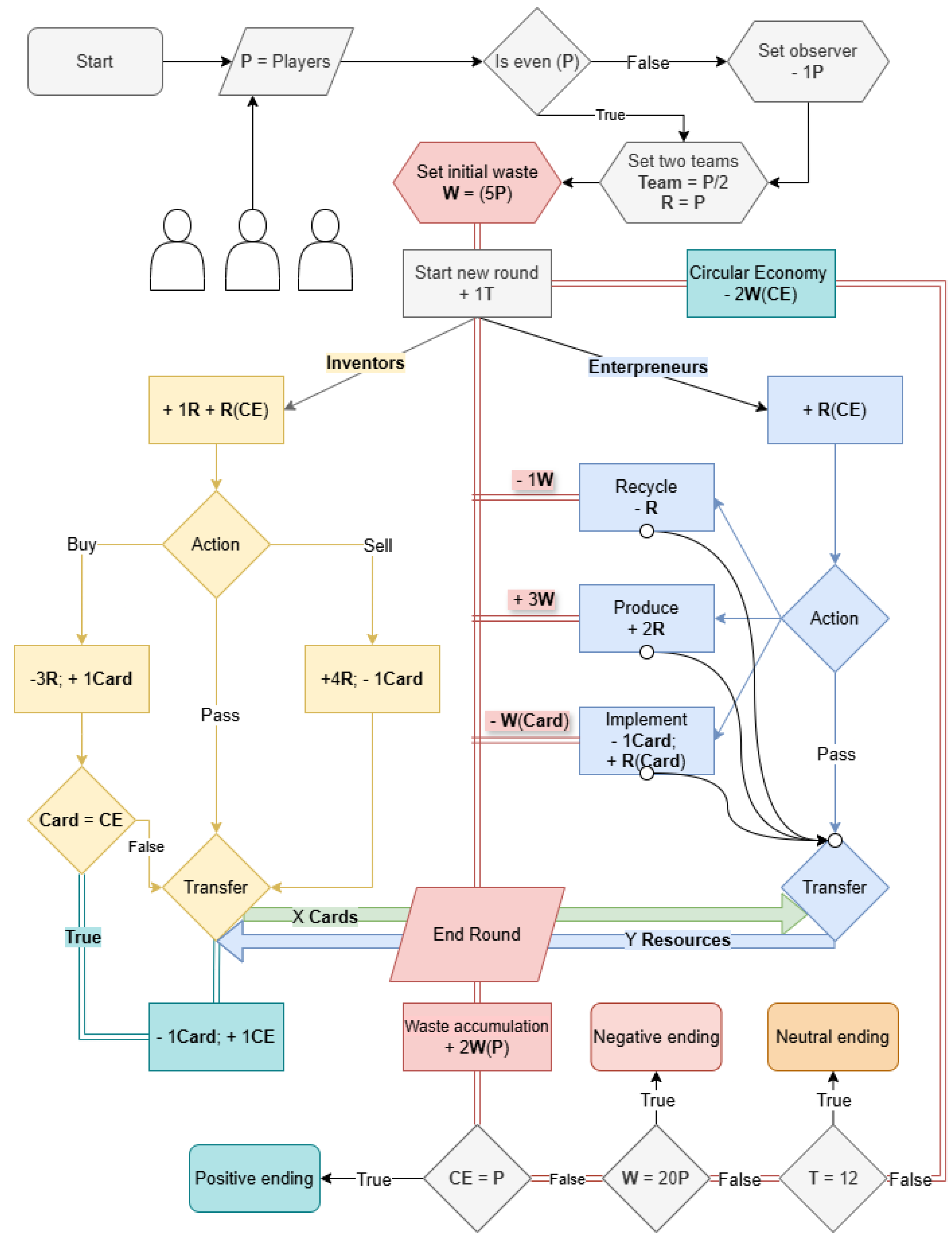
Figure 2.
Influence of Treatment (nominal, two levels: 0, red – Ivory Tower, no communication; 1, blue – Knowledge Co-Creation, with communication) and Self-Transcendence (interval, X axis – group mean of the latent variable from confirmatory factor analysis) on World State (Y axis, where negative values indicate more waste produced than removed) as the interval dependent variable representing the game’s final outcome.
Figure 2.
Influence of Treatment (nominal, two levels: 0, red – Ivory Tower, no communication; 1, blue – Knowledge Co-Creation, with communication) and Self-Transcendence (interval, X axis – group mean of the latent variable from confirmatory factor analysis) on World State (Y axis, where negative values indicate more waste produced than removed) as the interval dependent variable representing the game’s final outcome.
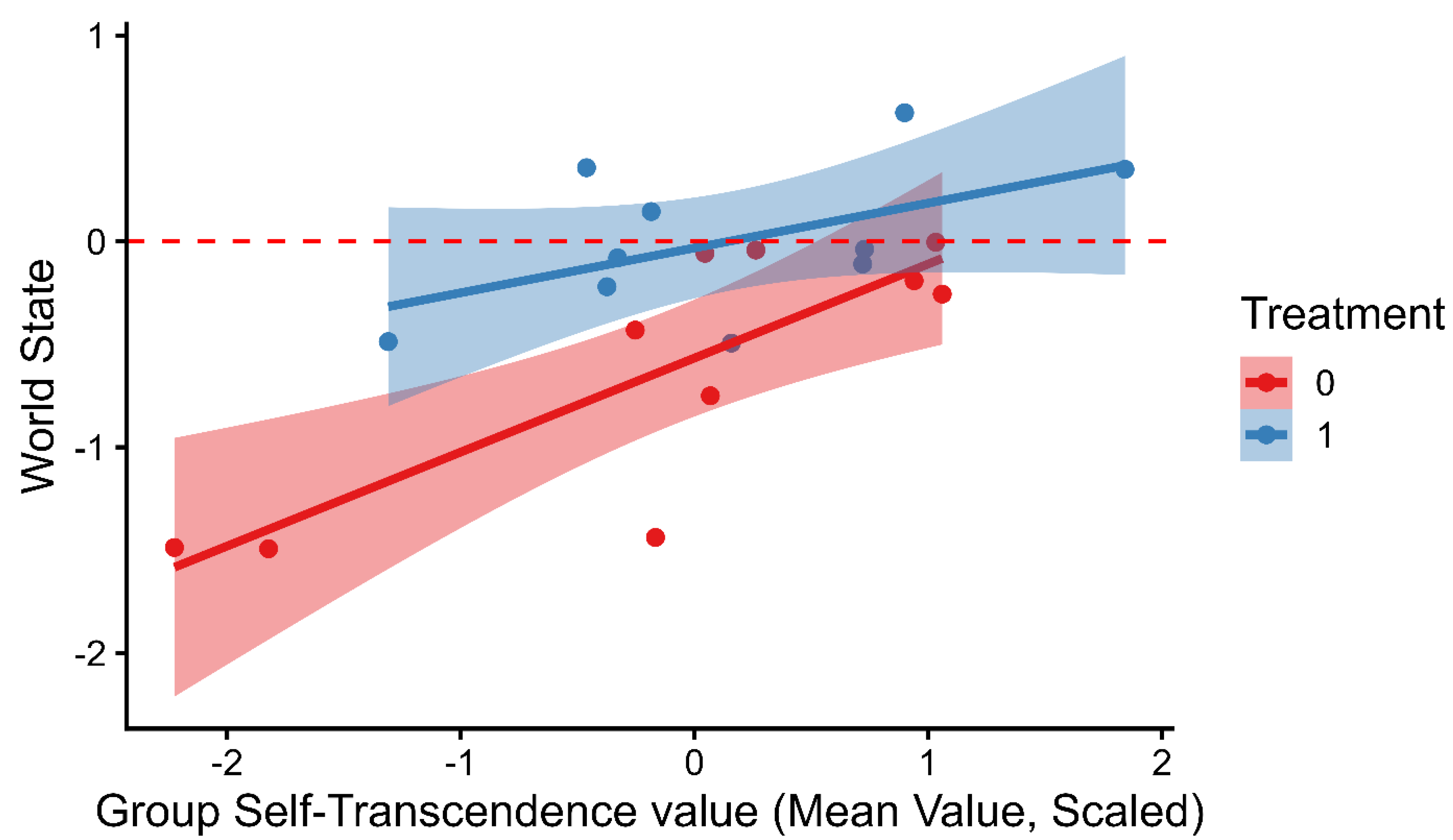
Figure 3.
Histograms of responses to each evaluation question (participant rating on the X-axis, ordinal scale 1–10, from “I strongly disagree” to “I strongly agree”; full questions in Supplementary Information – Materials).
Figure 3.
Histograms of responses to each evaluation question (participant rating on the X-axis, ordinal scale 1–10, from “I strongly disagree” to “I strongly agree”; full questions in Supplementary Information – Materials).
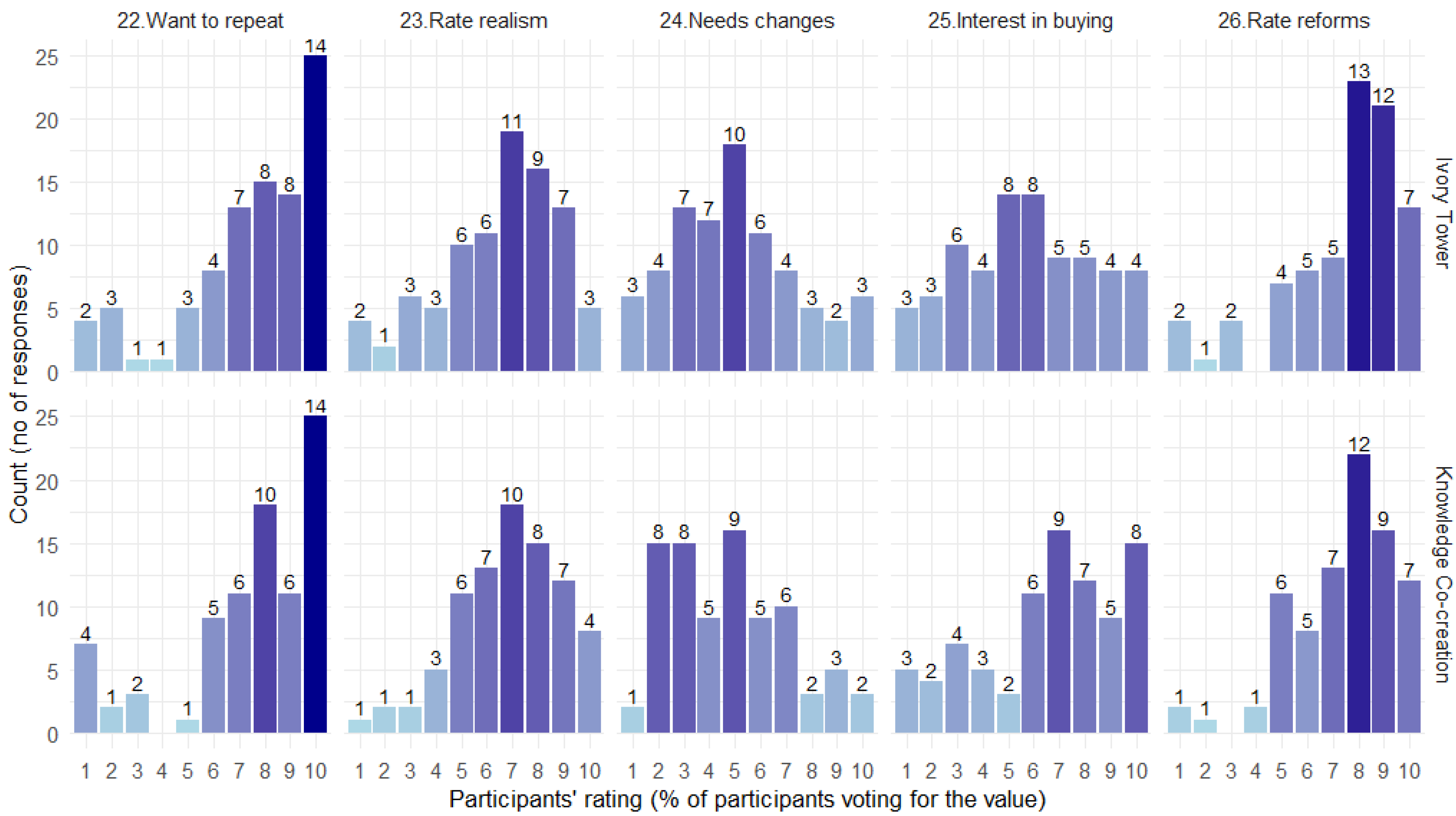

Table 1.
Payoff matrix as presented to players (left), and as simulated with algorithm (right), based on Supplementary Information - Algorithm. The numbers represent the number of prizes possible to win in each scenario. “A” means “as many prizes as resources you collect during the game”.
Table 1.
Payoff matrix as presented to players (left), and as simulated with algorithm (right), based on Supplementary Information - Algorithm. The numbers represent the number of prizes possible to win in each scenario. “A” means “as many prizes as resources you collect during the game”.
| Entrepreneurs | Accumulatee | Investe | Entrepreneurs | Accumulatee | Investe | ||||
| Inventors | 0 | 0 | Ain | 0 | Inventors | 0 | 0 | 2 | 0 |
| Accumulatei | Accumulatei | ||||||||
| Investi | 0 | Aen | 1+Ain | 1+Aen | Investi | 0 | 2 | 1 | 5 |
Table 2.
ANOVA-like table for the influence of different factors on the result of the game represented as the World State dependent variable (interval). Intercept (nominal) for Ivory Tower, Treatment (nominal) for introduced Knowledge Co-Creation, Transcendence (interval) for mean declarations of self-transcendence values per group (scaled towards the group total). Enhancement (interval) for mean declarations of self-transcendence values per group (scaled towards the group total). Null hypothesis: predictors do not influence the World State coefficient significantly. Levels of significance:*** = p < 0.001; ** = p < 0.01; * = p < 0.05. For further statistical output see Supplementary Information - Statistics.
Table 2.
ANOVA-like table for the influence of different factors on the result of the game represented as the World State dependent variable (interval). Intercept (nominal) for Ivory Tower, Treatment (nominal) for introduced Knowledge Co-Creation, Transcendence (interval) for mean declarations of self-transcendence values per group (scaled towards the group total). Enhancement (interval) for mean declarations of self-transcendence values per group (scaled towards the group total). Null hypothesis: predictors do not influence the World State coefficient significantly. Levels of significance:*** = p < 0.001; ** = p < 0.01; * = p < 0.05. For further statistical output see Supplementary Information - Statistics.
| Term | stimate | std.error | F statistic | 2.5% | 97.5% | p.value | sig |
| (Intercept) | -0.595 | 0.118 | -5.024 | -0.847 | -0.343 | 0.000 | *** |
| Treatment | 0.595 | 0.175 | 3.400 | 0.222 | 0.968 | 0.004 | ** |
| Transcendence | 0.497 | 0.115 | 4.329 | 0.252 | 0.742 | 0.001 | *** |
| Enhancement | 0.094 | 0.097 | 0.960 | -0.114 | 0.301 | 0.352 | |
| Treatment:Transcendence | -0.255 | 0.173 | -1.478 | -0.623 | 0.113 | 0.160 |
Table 3.
ANOVA-like table for a cumulative link mixed model testing the effect of game session (PrePost: Pre/Post) on Attitude towards knowledge co-creation and plastic crises (ordinal 1–10), with Treatment (two-level) and Question (21-level) as fixed factors and Person as a random effect. Null hypothesis: none of these factors significantly affect the response. Significance levels: *** p < 0.0001; ** p < 0.001; * p < 0.01. Additional statistical results are provided in Supplementary Information – Statistics.
Table 3.
ANOVA-like table for a cumulative link mixed model testing the effect of game session (PrePost: Pre/Post) on Attitude towards knowledge co-creation and plastic crises (ordinal 1–10), with Treatment (two-level) and Question (21-level) as fixed factors and Person as a random effect. Null hypothesis: none of these factors significantly affect the response. Significance levels: *** p < 0.0001; ** p < 0.001; * p < 0.01. Additional statistical results are provided in Supplementary Information – Statistics.
| Term | df | chi-square | p.value | sig |
| Question | 20 | 228.332 | 0.000 | *** |
| Treatment | 1 | 1.922 | 0.166 | |
| PrePost | 1 | 18.810 | 0.000 | *** |
| Question:Treatment | 20 | 31.823 | 0.045 | |
| Question:PrePost | 20 | 102.299 | 0.000 | *** |
Table 4.
ANOVA-like table for a cumulative link mixed model testing the effect of game session (PrePost: Pre/Post) on Attitude towards knowledge co-creation and plastic crises (ordinal 1–10), with Treatment (two-level) and Question (21-level) as fixed factors and Person as a random effect. Null hypothesis: none of these factors significantly affect the response. Significance levels: *** p < 0.0001; ** p < 0.001; * p < 0.01. Additional statistical results are provided in Supplementary Information – Statistics.
Table 4.
ANOVA-like table for a cumulative link mixed model testing the effect of game session (PrePost: Pre/Post) on Attitude towards knowledge co-creation and plastic crises (ordinal 1–10), with Treatment (two-level) and Question (21-level) as fixed factors and Person as a random effect. Null hypothesis: none of these factors significantly affect the response. Significance levels: *** p < 0.0001; ** p < 0.001; * p < 0.01. Additional statistical results are provided in Supplementary Information – Statistics.
| Question | contrast | Filtered responses | estimate | SE | asymp.LCL | asymp.UCL | p.value | sig |
| 1. Current free-market principles promote the flow of knowledge from scientists to entrepreneurs. | POST - PRE | 10.64% | -0.848 | 0.196 | -1.2312 | -0.4638 | 0.0000 | *** |
| 2. Scientists should focus on acquiring knowledge, the free market will make the best ideas come to life. | POST - PRE | 43.09% | -2.241 | 0.262 | -2.7554 | -1.7267 | 0.0000 | *** |
| 3. Entrepreneurs will find out on their own which scientific discoveries are worth implementing. | POST - PRE | 31.38% | -1.089 | 0.241 | -1.5605 | -0.6165 | 0.0000 | *** |
| 4. Financing science should be the domain of the state. | PRE - POST | 39.89% | -0.002 | 0.245 | -0.4831 | 0.4788 | 0.9930 | |
| 5. Innovation should primarily serve economic prosperity. | POST - PRE | 10.64% | -1.145 | 0.199 | -1.5343 | -0.7556 | 0.0000 | *** |
| 6. It is enough to develop economic potential and the free market will solve the waste problem. | POST - PRE | 45.74% | -0.513 | 0.252 | -1.0061 | -0.0189 | 0.0419 | |
| 7. We have enough time to solve the waste problem. | POST - PRE | 43.62% | -1.090 | 0.265 | -1.6092 | -0.5703 | 0.0000 | *** |
| 8. There are already many scientific discoveries that could solve many environmental problems if someone implemented them. | PRE - POST | 26.06% | 0.032 | 0.217 | -0.3936 | 0.4568 | 0.8843 | |
| 9. Scientists should focus on acquiring knowledge; the free market will ensure that the best ideas are implemented. | POST - PRE | 32.98% | -0.418 | 0.218 | -0.8456 | 0.01 | 0.0556 | |
| 10. Scientific discoveries are communicated effectively enough. | POST - PRE | 34.04% | -0.804 | 0.227 | -1.2488 | -0.3592 | 0.0004 | ** |
| 11. Science is primarily the domain of universities and colleges. | POST - PRE | 13.30% | -0.413 | 0.2009 | -0.8063 | -0.0187 | 0.0400 | |
| 12. Entrepreneurs, when introducing new technologies, should above all consider whether they can earn profits from them. | POST - PRE | 42.02% | -1.073 | 0.254 | -1.5703 | -0.5758 | 0.0000 | *** |
| 13. Scientists should not engage in communication with the public or business. | POST - PRE | 61.17% | -1.730 | 0.329 | -2.375 | -1.0844 | 0.0000 | *** |
| Question | contrast | Filtered responses | estimate | SE | asymp.LCL | asymp.UCL | p.value | sig |
| 14. Science should be independent and set its own goals | POST - PRE | 7.45% | -1.185 | 0.204 | -1.5848 | -0.7851 | 0.0000 | *** |
| 15. Science should focus on the most profitable areas | POST - PRE | 55.32% | -0.579 | 0.286 | -1.1386 | -0.0194 | 0.0426 | |
| 16. The only commitment of the industry towards the environment is ecological neutrality | POST - PRE | 32.45% | -1.132 | 0.228 | -1.5782 | -0.6859 | 0.0000 | *** |
| 17. Since you cannot make money from ecology, entrepreneurs shouldn’t deal with it too much. | POST - PRE | 76.60% | -0.784 | 0.428 | -1.6234 | 0.0547 | 0.0669 | |
| 18. Science will sooner or later solve the problem of plastic waste on its own. | POST - PRE | 42.55% | -0.624 | 0.253 | -1.1183 | -0.1286 | 0.0135 | . |
| 19. Recycling is a sufficient form of dealing with plastic waste. | POST - PRE | 60.11% | -0.388 | 0.3 | -0.9761 | 0.201 | 0.1968 | |
| 20. I know well what the circular economy is. | PRE - POST | 13.83% | -1.730 | 0.222 | -2.1658 | -1.2942 | 0.0000 | *** |
| 21. Plastic waste is not one of the most urgent problems. | POST - PRE | 41.49% | -0.804 | 0.257 | -1.3068 | -0.3015 | 0.0017 | * |
Table 5.
ANOVA-like table for a cumulative link mixed model showing how game session ratings (ordinal 1–10) are influenced by preceding Attitude (two levels: positive/negative, responses standardized toward negative item orientation), Treatment (two levels), and Question (21-level factor), with Person as a random effect. Significance levels: *** p < 0.0001; ** p < 0.001; * p < 0.01. Additional statistical details are in Supplementary Information – Statistics.
Table 5.
ANOVA-like table for a cumulative link mixed model showing how game session ratings (ordinal 1–10) are influenced by preceding Attitude (two levels: positive/negative, responses standardized toward negative item orientation), Treatment (two levels), and Question (21-level factor), with Person as a random effect. Significance levels: *** p < 0.0001; ** p < 0.001; * p < 0.01. Additional statistical details are in Supplementary Information – Statistics.
| Term | df | chi-square | p.value | sig |
| Question | 20 | 92.282 | 0.000 | *** |
| Attitude | 1 | 147.259 | 0.000 | *** |
| Treatment | 1 | 1.109 | 0.292 | |
| Question:Attitude | 20 | 61.941 | 0.000 | *** |
| Question:Treatment | 20 | 36.386 | 0.0139 | . |
Disclaimer/Publisher’s Note: The statements, opinions and data contained in all publications are solely those of the individual author(s) and contributor(s) and not of MDPI and/or the editor(s). MDPI and/or the editor(s) disclaim responsibility for any injury to people or property resulting from any ideas, methods, instructions or products referred to in the content. |
© 2026 by the authors. Licensee MDPI, Basel, Switzerland. This article is an open access article distributed under the terms and conditions of the Creative Commons Attribution (CC BY) license (http://creativecommons.org/licenses/by/4.0/).
Copyright: This open access article is published under a Creative Commons CC BY 4.0 license, which permit the free download, distribution, and reuse, provided that the author and preprint are cited in any reuse.


