
Submitted:
02 July 2026
Posted:
03 July 2026
You are already at the latest version
Abstract
Background/Objectives: The supraclavicular foramen (SCF) is a rare anatomical variant formed when a branch of the supraclavicular nerve traverses the clavicle through a complete transclavicular canal. Published studies differ substantially in study material, denominators, and reporting of side-specific and bilateral data, so bilateral anatomy is often synthesized as if pairing were irrelevant. This study aimed to describe SCF in a Greek osteological sample and to apply a meta-analytic framework distinguishing per-clavicle prevalence, marginal laterality, paired laterality, and separately observed bilateral prevalence. Methods: We examined 115 dry clavicles of Greek origin for SCF frequency, size, and topography. Measurements were obtained independently by two observers using stainless-steel wires and digital calipers, with inter-rater agreement assessed by intraclass correlation coefficients. A systematic review and meta-analysis were then conducted according to PRISMA 2020. Quantitative synthesis included pooled per-clavicle prevalence, conventional marginal left-versus-right comparison, and feasibility-based paired laterality analysis under explicit dependence assumptions when bilateral information was incomplete. Observed bilateral prevalence was analyzed separately using only studies with directly reported body-level bilateral counts. Study quality was assessed using AQUA and CATAM. Results: Complete transclavicular canals, identified by paired supraclavicular foramina representing entrance and exit openings, were present in 3/115 clavicles (2.4%), with a mean patency diameter of 1.5 ± 0.8 mm and a mean relative acromial position of 0.44 ± 0.12. Inter-rater reliability was excellent. Pooled per-clavicle prevalence was 2.2% (95% CI: 1.4–3.0%; I² = 71%). Conventional marginal laterality showed significant left-sided predominance (OR = 1.76, 95% CI: 1.16–2.66; I² = 0%), while feasibility-based paired laterality yielded a stronger effect (paired OR = 2.26, 95% CI: 1.30–3.94). The main observed bilateral-prevalence model yielded 0.95% (95% CI: 0.33–2.70%). Minor small-study effects were suggested by the Doi/LFK framework. Conclusions: SCF is an uncommon developmental variant with consistent left-sided predominance. Bilateral anatomical variants should not be synthesized as if all observations were unpaired; separating per-clavicle prevalence, marginal laterality, paired laterality, and observed bilateral prevalence provides a more transparent and biologically meaningful synthesis.
Keywords:
supraclavicular nerve
; transclavicular canal
; anatomical variation
; clavicle morphology
; intraosseous nerve canal
; prevalence
; laterality
; meta-analysis
1. Introduction
The supraclavicular nerves consist of three cutaneous branches—medial, intermediate, and lateral—arising from the C3 and C4 spinal nerves of the cervical plexus [1,2]. After emerging beneath the posterior border of the sternocleidomastoid muscle, they descend superficially to supply sensation to the skin over the clavicle, shoulder, and upper thoracic region (Figure 1). Because of their superficial course, they are vulnerable to injury during clavicular and shoulder surgery or following trauma to the neck and upper thorax [3].
Marked anatomical variability has been described in the origin, course, branching pattern, and clavicular relationships of the supraclavicular nerves [1,2]. These variations carry important clinical implications, influencing surgical exposure, anesthetic blocks, and postoperative sensory outcomes. A thorough understanding of these patterns is therefore essential to reduce iatrogenic complications and improve regional anesthesia success.
Normally, the clavicle contains a single nutrient canal on its inferior surface, transmitting the main nutrient artery and terminating blindly without an external opening [4]. In rare cases, however, a complete transclavicular canal may be present. This osseous passage traverses the full thickness of the clavicle and typically transmits a branch of the supraclavicular nerve—most commonly the intermediate branch—giving rise to two external openings, referred to here as supraclavicular foramina (SCF) [5]. Thus, transclavicular canal denotes the complete intraosseous passage, whereas supraclavicular foramen denotes either external opening of that passage. Such a course contrasts with the typical pattern, in which the nerves cross superficially over the clavicle.
The formation of these transclavicular canals is thought to result from entrapment of a nerve branch during clavicular ossification. Because these canals do not have the structure of the perforating canals of Volkmann, the supraclavicular nerves are unlikely to have pierced fully formed bone and were more probably enclosed during later bone formation [6]. They usually occur within the midshaft of the bone and only rarely near the acromial end. Their depth and configuration may vary, and bony bridges can occasionally form, creating a roof over the nerve’s trajectory. As a result, an entrapped nerve may be susceptible to injury in cases of clavicular fractures [7].
Although uncommon, supraclavicular nerve entrapment syndrome should be considered among the causes of anterior shoulder girdle pain. Entrapment may occur due to anomalous bone structures, fibrous bands, or muscular variations [8]. When the nerve passes through an intraosseous canal, symptoms such as pain or numbness most frequently involve the intermediate branch. Surgical decompression may provide symptom relief. Thus, despite its rarity, clinicians should include intraclavicular supraclavicular nerve entrapment in the differential diagnosis of shoulder pain [9,10].
Because transclavicular canal is the term most often used in the anatomical and radiological literature, it is retained here for the complete osseous passage, whereas supraclavicular foramen is used for the external opening and as the preferred general term for the variant.
The present study addresses SCF at three inferential levels that are often conflated in anatomical research. First, we evaluate per-clavicle prevalence, which answers how often a clavicle bears a complete transclavicular canal. Second, we assess marginal laterality, which compares the frequency of SCF in left versus right clavicles using observed side-specific counts. Third, we examine individual-level paired laterality, which cannot be inferred directly from side-specific marginals alone when bilateral occurrence is incompletely reported and therefore requires explicit assumptions about within-individual dependence. In parallel, directly observed bilateral prevalence is analyzed separately when body-level bilateral data are available. By presenting all these approaches side by side, the study aims not only to characterize SCF as an anatomical variant, but also to demonstrate a broader methodological principle: bilateral anatomical data should not be synthesized as if pairing were irrelevant when the underlying biological structure is inherently paired.
2. Materials and Methods
2.1. Present Observational Study
2.1.1. Specimen Selection
This investigation assessed the frequency, size, and anatomical position of supraclavicular foramina in 115 dry human clavicles (60 right, 55 left) of Greek origin. The skeletal material was archived at the Anatomy Laboratory, Department of Medicine, Democritus University of Thrace, Greece. Information on age and sex was unavailable. Clavicles with fractures, deformities, or erosive lesions were excluded. Because the material derived solely from cadaveric collections, institutional ethics approval was not required.
2.1.2. Measurements
Each clavicle was inspected under direct light for the presence of a complete transclavicular canal, identified by two external supraclavicular foramina corresponding to the entrance and exit of the nerve branch through the bone. The primary objectives were to determine canal patency diameter, opening dimensions, and canal position relative to the sternal and acromial ends of the clavicle.
Canal patency diameter was assessed primarily by passage of flexible stainless-steel wires (0.2–1.2 mm; UA218893, Zhejiang, China) through the complete canal, following previously described procedures [11]. Openings smaller than 0.2 mm were not recorded. When a wire could not pass through, the diameter was recorded as the next smaller available wire size, yielding a maximum absolute measurement error of 0.1 mm.
In canals with two external openings, the dimensions of both the entrance and the exit foramina were additionally measured with a Mitutoyo digimatic caliper (Mitutoyo Co., Japan; accuracy 0.01 mm). Canal length was defined as the distance between the two openings. Canal location was summarized by the midpoint of the two openings, and foraminal position was expressed relative to the acromial and sternal ends of the clavicle and to total clavicular length. An approximate projected canal obliquity () was calculated from the longitudinal displacement of the two openings along the clavicular axis. Specifically, if denotes the entrance–exit distance (canal length) and the absolute difference between the sternal distances of the entrance and exit openings, then the projected obliquity was defined by , and therefore . This formulation expresses the angle of the canal relative to a purely anteroposterior course in its projected clavicular plane and was used as a descriptive geometric estimate rather than as a true three-dimensional angular measurement. Representative caliper-based measurement of SCF dimensions is shown in Supplementary Figure S1.
All measurements were obtained independently by two observers, and inter-rater agreement was quantified using the intraclass correlation coefficient (ICC).
2.1.3. Statistical Analysis of the Observational Sample
Continuous variables are reported as mean ± standard deviation (SD). Categorical variables are reported as counts and percentages. Owing to the rarity of the variant, the observational component was interpreted primarily descriptively. Statistical analyses were performed using SPSS version 26.0 (IBM Corp., Armonk, NY, USA).
2.2. Systematic Review and Meta-Analysis
2.2.1. Study Selection
The systematic review adhered to the Preferred Reporting Items for Systematic Reviews and Meta-Analyses (PRISMA 2020) guidelines [12]. Two independent reviewers conducted a literature search in PubMed and Scopus using the terms “supraclavicular foramen” and “transclavicular canal”. The PubMed query was “(supraclavicular foramen) OR (transclavicular canal)”, whereas the Scopus query was “(supraclavicular AND foramen) OR (transclavicular AND canal)”. The final search was performed on 11 April 2026. An additional Google Scholar search yielded one further relevant publication.
After duplicate removal and screening by title and abstract, eligible full-text articles were assessed for inclusion. Studies describing the frequency, morphology, or topography of supraclavicular foramina or complete transclavicular canals in dry clavicles, cadaveric material, or radiological investigations (plain radiography or CT) were considered eligible.
2.2.2. Data Extraction and Study Classification
From each included study, two reviewers independently extracted the following information: first author, year, country, study material (dry bones, cadaveric tissue, radiography, or CT), total number of clavicles, right/left distribution where available, number of clavicles with transclavicular canals, and body-level bilateral information where explicitly reported. Morphometric variables, such as foraminal diameter and location relative to clavicular ends, were also recorded when available. For historical studies reporting only case-wise measurements or range summaries, morphometric data were additionally abstracted in a form suitable for descriptive reconstruction.
Because studies differed in whether they reported clavicle-level, side-specific, or body-level data, the evidence base was classified according to the inferential information each study could support. Specifically, studies were categorized according to their contribution to i) per-clavicle prevalence, ii) conventional marginal laterality, iii) feasibility-based paired laterality, and iv) main observed bilateral prevalence.
As shown in Table 1, studies with side-specific right/left counts were eligible for laterality analysis, whereas known body-level denominators and observed bilateral counts were incorporated only when explicitly reported. A list of full-text studies excluded after eligibility assessment, with reasons for exclusion, is provided in Supplementary Table S1.
2.2.3. Quality Appraisal
Methodological quality and risk of bias were assessed independently by two reviewers using the Anatomical Quality Assessment (AQUA) tool [13]. Each AQUA domain was rated as low, unclear, or high risk of bias, whereas an overall methodological quality rating was assigned separately for summary appraisal as reported elsewhere [14]. The overall robustness of the present review was additionally evaluated using the Critical Appraisal Tool for Anatomical Meta-Analyses (CATAM) [15]. In light of recent psychometric evidence indicating that CATAM total-score reliability is inadequate for a single rater but acceptable when ratings are aggregated across four independent raters, CATAM was applied independently by four reviewers (V.P., V.T., A.N., and A.M.) [16]. Each reviewer scored the manuscript separately, and domain scores were then compared across raters. Because CATAM was applied to the present manuscript as a single object of appraisal, inter-rater reproducibility was summarized descriptively by exact agreement rather than by an intraclass correlation coefficient.
2.2.4. Descriptive Synthesis of Morphometric Data
Morphometric data on transclavicular canals were synthesized separately from the main meta-analytic models. Because the available studies reported sparse canal-level measurements with heterogeneous definitions and incomplete person-level linkage, no formal random-effects meta-analysis was performed for canal location or size. Instead, canal-count-weighted descriptive data were summarized in an appropriate table.
When directly comparable mean ± SD values were available, these were extracted as reported. For historical studies that provided only ranges or grouped summaries, approximate mean and SD values were reconstructed under an assumption of approximate normality. In Santos (1927), which described 30 complete canals, the sample mean of a variable reported only by its minimum and maximum was approximated by the mid-range, and the SD was estimated using the range-based method of Wan et al.:
where is the sample size and is the standard normal quantile function [17,18]. This approach was applied to Santos-derived canal length and acromial-distance summaries.
Because Santos reported distances from the acromial end to the anterior and posterior canal orifices rather than a standardized canal-margin measure, the distance from the acromial end to the anterior (closest) orifice was used as the best available approximation of lateral distance. The lateral distance / total clavicle length ratio was then derived from Santos’ grouped clavicle-length and anterior-orifice-distance summaries. For the ratio, SD was approximated heuristically from the reconstructed range under the same approximate-normality framework. Santos’ reported orifice diameters were not entered into the modern canal-width column because they are not directly comparable with later studies reporting maximum canal diameter [17].
Potential within-individual dependence of canal-level morphometric observations was examined in a sensitivity analysis. In Santos (1927), three bilateral skeletons were reported, implying six potentially correlated canal observations among the 30 complete canals [17]. Those six observations were downweighted using an effective-sample-size correction
with , consistent with the midpoint attenuation approach proposed for repeated-measures settings when the true correlation is unobserved [19]. The remaining 24 canals retained full weight. Because person-level linkage was unavailable for the other morphometric datasets, no study-specific correction could be justified for them; morphometric summaries were therefore interpreted descriptively, and the pairing-adjusted calculation was retained as a sensitivity analysis only.
2.2.5. Statistical Synthesis of Prevalence, Marginal Laterality, Paired Laterality, and Bilateral Prevalence
Because SCF has been studied in dry clavicles, cadaveric series, radiographs, and computed tomography datasets with variable or incompletely reported pairing, quantitative synthesis was structured on distinct inferential scales. The first scale was per-clavicle prevalence, treating the clavicle as the anatomical unit of analysis. The second was conventional marginal laterality, comparing the observed frequency of SCF in left versus right clavicles without modeling within-individual dependence. The third was paired individual-level laterality, targeting unilateral left-only versus right-only occurrence under a feasibility-based reconstruction of the unobserved joint left-right distribution when studies reported side-specific marginals but not complete bilateral counts. In parallel, observed bilateral prevalence was analyzed separately using only studies with directly reported body-level bilateral data. This separation was prespecified to distinguish what was directly observed from what was reconstructed under explicit assumptions.
All quantitative syntheses were conducted under a random-effects framework to account for between-study heterogeneity in population characteristics, material type (dry bones, cadavers, CT, radiography), and methodological design.
2.2.6. Per-Clavicle Prevalence
The overall prevalence of supraclavicular foramen was estimated using a random-effects model with restricted maximum likelihood (REML). Because SCF is a rare anatomical variant, prevalence proportions were variance-stabilized using the Freeman–Tukey double-arcsine transformation prior to pooling. Results were then back-transformed to the original proportion scale for interpretation. Between-study heterogeneity was quantified using Cochran’s Q and the I² statistic, interpreted as the proportion of total variability attributable to true differences rather than sampling error [20]. Subgroup analyses were conducted according to study material (dry clavicles, cadaveric dissections, CT imaging, and radiography).
2.2.7. Conventional Marginal Laterality
For studies reporting separate right and left clavicular counts, conventional laterality was examined using odds ratios (ORs) comparing left versus right clavicles. This analysis treats clavicles as independent units and does not account for within-individual pairing. Pooled ORs were calculated using a random-effects model.
2.2.8. Feasibility-Based Paired Laterality
Several studies reported right- and left-sided counts but did not specify the number of bilateral cases. Because left and right clavicles belong to the same individual, marginal side counts do not uniquely determine the true paired distribution (left-only, right-only, bilateral, neither). To preserve the observed side-specific frequencies while reconstructing the unknown joint distribution, we applied a feasibility-based model parameterized by ():
where is the prevalence in left clavicles, is the prevalence in right clavicles, and is bilateral prevalence. Here, denotes independence of sides, maximal feasible concordance, and the midpoint assumption. From this reconstructed joint distribution, we derived:
where is left-only prevalence and is right-only prevalence.
The paired odds ratio for unilateral laterality was then defined as:
This quantity compares the probability of left-only versus right-only SCF within individuals. When bilateral counts were explicitly reported, those observed values were used directly and took precedence over reconstruction. When the true body-level denominator was known, it was entered directly; otherwise, the effective paired denominator was conservatively set to the smaller of the right- and left-side sample sizes [21].
Papadatos’ study was excluded from paired laterality because laterality and bilateralism were not reported, despite the paired nature of the cadaveric material [6]. Santos’ study was retained for paired laterality based on side-specific clavicle counts, but its reported bilateral skeletons were not incorporated into the main paired model because they refer only to the identified 80-skeleton subset rather than to the full 450-clavicle mixed sample [17].
Although Parsons (1916) reported two bilateral cases, that study was not eligible for the main bilateral-prevalence model because bilateral occurrence was mentioned within a 286-clavicle series without a directly reported body-level denominator [22].
2.2.9. main Observed Bilateral Prevalence Model
Observed bilateral prevalence was analyzed separately from the paired laterality reconstruction. Only studies that explicitly reported both the number of examined bodies and the number of bilateral cases were included in the main bilateral-prevalence model. Accordingly, the primary body-level bilateral analysis included four studies [5,23,24,25].
2.2.10. Sensitivity Analyses
Sensitivity analyses were performed at two levels. First, the pooled paired odds ratio was recalculated across the full admissible range of ( to ) to assess the robustness of the laterality conclusion under different plausible within-individual dependence structures. Second, a separate bilateral-prevalence sensitivity analysis was performed by adding Santos’ study as a distinct datapoint based on the identified 80-skeleton subset only (3 bilateral cases among 80 individuals) [17]. This sensitivity analysis was kept separate from the main bilateral-prevalence model because the bilateral information from Santos does not correspond to the full 450-clavicle sample used for prevalence and marginal laterality analyses.
2.2.11. Small-Study Effects and Reporting Bias
Small-study effects and reporting bias were assessed primarily using the Doi plot and the corresponding Luis Furuya-Kanamori (LFK) index, interpreted according to the standard framework in which transformed study effect sizes are plotted on the x-axis against software-derived absolute values reflecting study precision on the y-axis [26,27]. LFK values < 1 were interpreted as indicating no asymmetry, values between 1 and 2 as minor asymmetry, and values > 2 as major asymmetry. Because conventional significance-based tests may be underpowered in meta-analyses with a limited number of studies, Egger’s and Begg’s tests were treated as supplementary rather than primary asymmetry diagnostics. Galbraith and trim-and-fill analyses were additionally performed as secondary sensitivity checks.
The pooled maximum reporting bias, attributable to the prevalence meta-analysis of rare anatomic variants and potentially affected by unregistered or small-sample studies, was quantified using the sample-size adjustment proposed elsewhere [28]. The maximum reporting bias was calculated as:
where denotes the number of observed supraclavicular foramina in each study. The standard error of bias () was calculated as:
where denotes study sample size. This expression corresponds to the variance-stabilized approximation commonly used for arcsine-based transformations of binomial proportions and was therefore also applied to Freeman–Tukey-transformed prevalence estimates.
2.2.12. Tools and Reproducibility
Different estimands required different analytical tools. Rare-variant prevalence was pooled using single-arm proportion methods; conventional left-versus-right marginal laterality used standard comparative meta-analysis of side-specific clavicle counts; paired laterality required custom feasibility-based reconstruction of the unobserved joint left-right distribution in a dedicated R workflow using random-effects models; and observed bilateral prevalence was analyzed separately at the body level using studies with directly extractable bilateral counts. This multi-tool strategy was chosen to match each model to its inferential scale rather than force all outcomes into a single generic framework. The custom paired-analysis code, study-level extraction logic, and sensitivity analyses are available from the corresponding author upon reasonable request. All figures were generated in STATA 19 BE or Python using Matplotlib v3.10.8.
No external financial support was received. The review was performed in accordance with a prespecified protocol. Registration in PROSPERO was not feasible because prevalence meta-analyses are currently not eligible for registration.
3. Results
3.1. Prevalence, Size, and Location of Supraclavicular Foramina in the Present Observational Study
A total of 115 dry clavicles (60 right and 55 left) were examined. Complete transclavicular canals, each identified by paired supraclavicular foramina corresponding to entrance and exit openings, were present in 3 of 115 clavicles (2.4%) (Figure 2). Two affected clavicles were located on the left side and one on the right. The detected canals had a mean patency diameter of 1.5 ± 0.8 mm, a mean lateral-distance/total-length ratio of 0.441 ± 0.012, and corresponding mean absolute distances of 60.0 ± 5.2 mm from the acromial end and 73.4 ± 9.5 mm from the sternal end. The mean entrance–exit distance, taken as canal length, was 5.9 ± 2.4 mm. Using the projected-obliquity calculation described in the Methods section, the canals showed a mean projected obliquity of 24.3 ± 8.8°, indicating a non-perpendicular course across the bone. Caliper-based measurements further showed that the entrance and exit openings were typically oval, indicating that wire-based patency estimates and external opening dimensions captured complementary aspects of canal morphology.
In both left clavicles, a stainless-steel wire of 0.4 mm in diameter could be passed easily through the canal, confirming complete transosseous patency. In contrast, in the right clavicle, passage was possible only with a 0.2 mm wire, suggesting a much narrower canal (Figure 3). This finding suggests that transmission of a typical supraclavicular nerve branch through the right-sided canal may be less likely, given that supraclavicular nerves typically measure at least 0.5 mm in diameter [29].
Inter-rater reliability was excellent, with an intraclass correlation coefficient (ICC) of 0.999 for diameter, 0.988 for acromial distance, and 0.986 for sternal distance.
3.2. Meta-Analysis
3.2.1. Study Selection
A total of 51 publications were identified through database searches: 17 from PubMed and 34 from Scopus. One additional record was located via Google Scholar, and four were retrieved through citation tracking. Following screening and eligibility assessment, ten studies met the inclusion criteria for qualitative and quantitative synthesis. The PRISMA flow diagram outlining the full selection process is shown in Figure 4.
The characteristics of the included studies, together with the availability of side-specific and body-level information relevant to each inferential level, are summarized in Table 1.
3.2.2. Quality Assessment
Using the Anatomical Quality Assessment (AQUA) tool, Domain 1 (Objectives and subject characteristics) showed the greatest vulnerability to bias, primarily because many studies lacked information on cadaveric sex, age, and medical background. The remaining domains—Study Design, Methodological Characterization, Descriptive Anatomy, and Reporting of Results—were generally more robust. The study-level AQUA judgments are presented in Table 2.
To distinguish directly observed specimen-level findings from reconstructed individual-level outcomes, the meta-analytic results were organized into four inferential levels: per-clavicle prevalence, conventional marginal laterality, feasibility-based paired laterality, and observed body-level bilateral prevalence. These analyses are complementary rather than interchangeable because they address different anatomical questions and operate on different sampling scales.
3.2.3. Morphometric Characteristics of Supraclavicular Canals
Morphometric data were too sparse and definitionally heterogeneous for formal meta-analysis; Table 3 therefore presents descriptive synthesis only.
Across the available morphometric datasets, the canal-count-weighted descriptive mean medial distance from the sternal end was 69.7 ± 10.6 mm, the mean lateral distance from the acromial end was 60.8 ± 11.5 mm, and the mean acromial ratio was 0.440 ± 0.063. The weighted descriptive mean canal length was 6.4 ± 2.3 mm. For directly comparable modern canal-width measurements, the weighted descriptive mean was 1.94 ± 0.63 mm. In a sensitivity analysis that downweighted the six bilaterally paired Santos canals using an effective-sample-size correction assuming r = 0.75, these descriptive means changed only trivially (lateral distance 60.8 mm, acromial ratio 0.441, canal length 6.3 mm).
3.2.4. Per-Clavicle Prevalence
The pooled analysis showed that supraclavicular foramen was present in 2.2% of clavicles (95% CI: 1.4–3.0%; I² = 71%) (Figure 5).
Subgroup analysis demonstrated significant differences (p < 0.001) in prevalence according to study material, with pooled estimates of 4.0% (95% CI: 1.7–7.2%) for CT studies, 1.0% (95% CI: 0.2–2.1%) for cadaveric studies, 3.2% (95% CI: 2.3–4.3%) for dry-bone studies, and 0.8% (95% CI: 0.4–1.1%) for radiographic studies (Figure 6).
3.2.5. Conventional Marginal Laterality
For studies reporting separate right- and left-sided clavicular counts, conventional marginal laterality analysis showed a significant left-sided predominance. The pooled odds ratio for the presence of a supraclavicular foramen in left versus right clavicles was 1.76 (95% CI: 1.16–2.66; I² = 0%) (Figure 7). This analysis reflects the conventional clavicle-level comparison and does not account for within-individual pairing.
3.2.6. Paired Laterality
In the feasibility-based paired analysis, the pooled odds ratio for left-only versus right-only occurrence was 2.26 (95% CI: 1.30–3.94), indicating that unilateral SCF was more than twice as likely to occur on the left side as on the right (Figure 8). This estimate incorporated known body-level denominators and observed bilateral counts where available, while reconstructing the bilateral joint distribution only for studies lacking direct bilateral information. Between-study heterogeneity for the paired laterality effect was minimal.
3.2.7. Main Observed Bilateral Prevalence
The main observed bilateral-prevalence model, restricted to studies with directly reported body-level bilateral data, yielded a pooled bilateral prevalence of 0.95% (95% CI: 0.33–2.70%) under the primary logit random-effects model (Figure 9).
A supplementary reanalysis of the same four datasets using the Freeman–Tukey double-arcsine transformation yielded a lower pooled estimate (0.14%, 95% CI: 0.00–0.87%). Because the inverse Freeman–Tukey transformation is sample-size dependent and may be unstable in sparse single-proportion meta-analysis, the logit-based estimate was retained as the primary result.
Parsons (1916) was not entered into this model despite reporting two bilateral cases, because the denominator was reported only as 286 clavicles rather than as a defined number of examined bodies [22]. Nathe (2011) was not entered into this model because no explicit body-level bilateral count was reported for the TCC endpoint, despite the cadaveric denominator being known [2].
3.2.8. Bilateral Sensitivity Analysis
Adding the identified 80-skeleton subset from Santos (1927) in a separate sensitivity analysis (3 bilateral cases among 80 individuals) increased the pooled observed bilateral prevalence from 0.95% (95% CI: 0.33–2.70%) to 1.52% (95% CI: 0.53–4.26%), without changing the conclusion that bilateral SCF is uncommon. This analysis was kept separate because the bilateral data from Santos apply only to the identified paired subset, not to the full 450-clavicle mixed sample [17].
3.2.9. Sensitivity Analysis for λ
Across the admissible range of λ, the pooled paired odds ratio remained consistently greater than 1, indicating persistent left-sided predominance under all feasible dependence structures for studies lacking explicit bilateral counts (Figure 10). Near λ = 1, the curve showed the expected boundary instability associated with vanishing discordant counts under strong concordance, but this did not reverse the direction of the effect. Thus, the qualitative conclusion of left-sided unilateral predominance was robust to the dependence assumption.
3.2.10. Small Study-Effects and Reporting Bias
Evidence of small-study effects was suggested by the Doi plot, which showed minor asymmetry with an LFK index of 1.22 (Figure 11). In the present prevalence meta-analysis, the Doi plot/LFK framework was considered the primary asymmetry assessment, whereas Egger’s and Begg’s tests were interpreted as supplementary because of their limited power in meta-analyses with relatively few studies.
Supplementary visual diagnostics were directionally consistent with this finding: the Galbraith plot suggested small-study effects (Supplementary Figure S2), the funnel plot displayed visible asymmetry, and the trim-and-fill analysis imputed one additional study on the left side (Supplementary Figure S3). However, both Egger’s and Begg’s tests were non-significant (p = 0.281 and p = 0.846, respectively). Accordingly, the overall pattern was interpreted as suggestive but not definitive evidence of asymmetry.
The maximum reporting bias was estimated at 6% (95% CI: 2–15%; I² = 100%) (Supplementary Figure S4).
3.2.11. Critical Appraisal of the Present Meta-Analysis
Application of the Critical Appraisal Tool for Anatomical Meta-Analyses (CATAM) was performed independently by four reviewers (V.P., V.T., A.N., and A.M.). All four raters assigned identical CATAM scores across all domains, indicating complete exact agreement; therefore, no adjudication or consensus rescoring was required. The final CATAM scores for the present study were as follows: Title, 2 points; Abstract, 4 points; Introduction, 6 points; Methods, 14 points (Search strategy = 4; Selection criteria = 2; Data extraction = 2; Quality assessment = 4; Statistical analysis = 2); Results, 12 points (Search results = 2; Characteristics of included studies = 2; Outcomes = 8); Discussion, 6 points; Conclusion, 4 points; References, 2 points.
4. Discussion
4.1. Anatomical and Morphometric Interpretation of Supraclavicular Foramina
The present study contributes at two complementary levels. Anatomically, it confirms that the supraclavicular foramen is an uncommon clavicular variant relevant to clavicular surgery, regional anesthesia, and radiological interpretation. In the present Greek osteological sample, both prevalence and morphology were consistent with the broader literature. Meta-analytically, the study showed low per-clavicle prevalence, significant left-sided predominance, and material-dependent variation, with higher detection rates in dry bones than in cadaveric material and in computed tomography (CT) than in plain radiography. Part of this material-dependent variation may reflect differential detectability rather than biology alone, because recent radiological-anatomical work suggests that CT readily identifies complete bony canals but may fail to register finer clavicular grooves, especially when no fully ossified roof is present [35]. Methodologically, these findings also show why bilateral anatomical variants should not be synthesized as if all observations were unpaired. In the SCF literature, some datasets are clearly paired, others are clearly unpaired, and many are mixed or incompletely reported. Accordingly, per-clavicle prevalence, marginal laterality, paired unilateral laterality, and observed bilateral prevalence should be interpreted as distinct estimands.
The structure described is not currently included in the Terminologia Anatomica. Previous authors have used several descriptive terms, including “foramen for the supraclavicular nerve,” which emphasizes its presumed neural content [32]. In the present manuscript, transclavicular canal is reserved for the complete osseous passage, whereas supraclavicular foramen is used for either external opening and as the preferred general term for the variant; groove denotes an incomplete canal lacking a bony roof. In some specimens, however, a groove may be functionally converted into a fibro-osseous tunnel by a bridging fibrous band, indicating that grooves and complete canals may represent related variants along the same anatomical spectrum rather than entirely separate entities [5,30,35,36]. This distinction is not merely semantic: Olivier’s historical clavicular study described the perforation as a true traversing canal extending from the posterior border to the anterior surface at the junction of the middle and lateral thirds, and explicitly noted that some authors may have failed to report such cases or may have confused them with nutrient foramina [33]. Additionally, the literature has occasionally conflated the rare supraclavicular nerve foramen/transclavicular canal with the much more common clavicular nutrient foramen under broader labels such as ‘neurovascular foramina’, despite their clear differences in frequency, topography, and likely transmitted structures [37]. Historical observations also help explain why the lesion has sometimes been confused with the ordinary nutrient foramen. Parsons noted that, in all seven of his perforated clavicles, the supraclavicular perforation shared a common posterior opening with the nutrient foramen, even though the canal itself represented a distinct transosseous passage [22]. A representative specimen from the present collection further illustrates this distinction by showing a true supraclavicular canal together with separate blind-ending nutrient foramina (Supplementary Figure S5).
Radiographically, canal direction may provide the most practical discriminator: unlike the blind-ending nutrient canal, the transclavicular canal typically has two external openings and follows a characteristic oblique course from the posterior/dorsal edge toward the superior or anterior aspect of the clavicle [5,32]. Consistent with this, the canals in the present series showed a mean projected obliquity of 24.3 ± 8.8°, further supporting that their course is directional rather than perpendicular or randomly oriented. A further differential consideration is provided by the congenital clavicular variant described by Viciano et al., in which large medial diaphyseal foramina and a connecting canal were interpreted as resulting from vascular inclusion during ossification rather than passage of a supraclavicular nerve; this entity should not be confused with the much smaller and typically more lateral supraclavicular foramen/transclavicular canal considered in the present review [38].
The occurrence of a supraclavicular foramen represents a developmental variation of the clavicle with potential clinical implications. The clavicle begins ossifying early and uniquely combines intramembranous and endochondral ossification. During this process, the intermediate supraclavicular nerve—normally superficial to the clavicle—may occasionally become enclosed within the developing mesenchymal condensation. Subsequent ossification then produces an intraosseous canal or a complete bony foramen transmitting the nerve. This is a developmental anomaly rather than a pathological lesion, but its configuration may predispose the nerve to later compression or entrapment [6,25].
The available morphometric data further support the interpretation that the transclavicular canal most commonly accommodates the intermediate supraclavicular branch. In the studies reporting directly comparable modern canal-width measurements, the mean transclavicular canal width ranged from 1.5 ± 0.8 mm in the present study to 2.0 ± 0.6 mm in Khadanovich et al., with a canal-count-weighted descriptive mean of 1.94 mm [35]. These values overlap well with the diameters of the main supraclavicular nerve branches reported in the cadaveric safe-zone study, namely approximately 1.1 mm for the medial branch, 1.2 mm for the intermediate branch, and 1.6 mm for the lateral branch [39]. They also fall within the previously reported 1–2 mm range of the major supraclavicular nerve branches described by Sommerlad and Boorman [23]. Accordingly, the observed canal widths appear anatomically compatible with transmission of an intermediate supraclavicular nerve branch.
Historical morphometric data from Santos (1927), reconstructed from published range summaries, further extend this picture [17]. In that series of 30 complete canals, the derived mean canal length was approximately 7.5 ± 2.2 mm, and the canal/orifice complex lay about 61.0 ± 4.9 mm from the acromial end, corresponding to an approximate acromial ratio of 0.42. Santos also reported that the posterior orifice usually lay on the posterior border and the anterior orifice on the superior face, with the canal typically oriented from posterior to anterior and from medial to lateral, although multiple canals and incomplete grooves could also occur in the same clavicle. These observations indicate that the anomaly has a reproducible osseous geometry rather than representing a minute random perforation. Olivier likewise placed the perforation at the junction of the middle and lateral thirds of the clavicle, supporting the view that this variant tends to occupy a reproducible mid-to-lateral corridor rather than an arbitrary site [33]. Moreover, Papadatos’ classic cadaveric series is concordant with this interpretation: although it did not provide pooled morphometric measurements, it described abnormal branches traversing true intraosseous canals that were usually located in the central part of the clavicle, only rarely near the acromial end, and variably superficial or deep, with bony bridges or arcades often present. Several of the illustrated cases were situated near the junction of the middle and outer thirds, and some canals were explicitly described as wide or oval, features that are again consistent with accommodation of a nerve branch rather than a minute incidental aperture [6].
The morphometric location of SCF also appears consistent with the established course of the intermediate supraclavicular branch. In the safe-zone study, the intermediate branch crossed the clavicle at approximately 51.2–60.5% of clavicular length from the sternoclavicular joint, whereas the midshaft safe zones lay outside this interval [39]. In the present synthesis, the available morphometric data place SCF in approximately the same corridor: about 56.4% from the sternoclavicular joint in Chanda, 53.2% in Khadanovich, approximately 56% in the present study after conversion from the acromial ratio, and approximately 58% in Santos after complementing the derived acromial ratio of 0.42 [17,34,35]. In the present observational study, this relative position corresponded to mean absolute distances of 60.0 ± 5.2 mm from the acromial end and 73.4 ± 9.5 mm from the sternal end, further supporting a reproducible mid-to-lateral topographic corridor rather than a random osseous perforation. This interpretation is further supported by the recent Khadanovich heatmap analysis, in which both canals and grooves clustered along the course of the intermediate supraclavicular nerve and occupied similar topographic coordinates, although complete canals appeared more frequent than grooves [35]. Papadatos’ case descriptions further reinforce this pattern, since most canals were reported in the central clavicle or around the transition between the middle and lateral thirds, with only occasional acromial examples [6]. Taken together, these observations support the view that the transclavicular canal most often corresponds to an entrapped intermediate supraclavicular branch rather than to a random osseous anomaly. Related grooves have likewise been described as uncommon variants in a similar topographic corridor, although complete canals appear to be identified more consistently than grooves in current imaging-based studies, further supporting the view that the two forms are related manifestations along the course of the intermediate supraclavicular nerve [6,25,35]. Notably, the safe-zone study did not report any transclavicular course or supraclavicular foramen, which is at least consistent with the rarity of SCF in the general population. These morphometric summaries should nevertheless be interpreted descriptively, because the historical and modern studies did not provide fully harmonized definitions of canal position and did not allow complete identification of within-individual pairing at the canal level.
4.2. Clinical Relevance and Entrapment Implications
The entrapment risk of the typically intermediate, and only occasionally lateral, supraclavicular nerve arises from its confinement within a rigid, noncompliant canal [5,25]. Direct anatomical support for this mechanism was provided by Georgiev and Jelev, who described a bilateral case in which the intermediate supraclavicular branch passed through osseous canals of the clavicle and emphasized this arrangement as a possible substrate for nerve compression [36]. Under normal circumstances, the nerve traverses mobile subcutaneous tissue superficial to the clavicle; when enclosed within bone, it may lose that mobility and become vulnerable to chronic irritation even in the absence of fracture [2,5]. When enclosed within a bony passage, however, alterations in clavicular shape or dimension—whether due to trauma, callus formation, periosteal thickening, or degenerative remodeling—may cause mechanical irritation or compression of the enclosed nerve fibers. Clinically, this could present as localized pain, paresthesia, or numbness in the upper thoracic and deltoid regions corresponding to the cutaneous distribution of the nerve. Conversely, the absence of overt numbness does not exclude clinically relevant irritation or injury, because overlap among the supraclavicular branches may provide redundant cutaneous innervation [2]. Although overt neuropathy related to this variation has rarely been reported, subclinical irritation or altered sensation may occur and remain underrecognized [5].
Rare muscular variants may produce similar symptoms through supraclavicular nerve entrapment; for example, a supraclavicularis proprius muscle was described, forming a tunnel-like space over the clavicle through which the supraclavicular nerve passed, thereby creating another potential site of compression [40]. Mechanical irritation may also occur secondarily after fracture healing, as illustrated by Jupiter and Leibman, who reported two patients with supraclavicular neuropathy caused by clavicular fracture callus; in both, surgical neurolysis relieved symptoms [41].
From a clinical standpoint, awareness of the supraclavicular foramen is important for surgeons and anesthetists operating in the supraclavicular or infraclavicular regions. Nathe et al. identified a clavicular danger zone extending approximately 2.7 cm from the sternoclavicular joint and 1.9 cm from the acromioclavicular joint in which the course of the supraclavicular branches is especially variable and therefore susceptible to operative injury [2]. Although often clinically silent, nerve passage through an osseous clavicular tunnel has been discussed as a potential substrate for entrapment neuropathy and shoulder or neck pain, particularly after repetitive stress or trauma [10,25]. Misinterpretation of this foramen on radiographs or computed tomography as a lytic lesion, or inadvertent intraoperative nerve injury, could have avoidable consequences [8]. When conservative treatment fails, surgical decompression may relieve symptoms, as illustrated by the two patients reported by Omokawa et al. [10]. The operative relevance of this variant is further illustrated by Giddie et al., who identified a transosseous supraclavicular nerve during clavicle fracture fixation; the branch had to be divided to permit plate placement, leaving postoperative incisional numbness and underscoring the importance of preoperative awareness and patient counseling [7]. In addition to rendering the nerve vulnerable when fracture occurs, the canal itself may modestly weaken the clavicle at an already mechanically vulnerable region and thereby contribute to fracture susceptibility [25,34]. Recognition of this variation may also help explain some otherwise idiopathic cases of supraclavicular neuralgia. Any resulting paresthesia may involve a relatively broad sensory territory and may be particularly troublesome in daily life when it extends toward the upper chest or breast, including discomfort with clothing straps or cosmetic concerns [39].
4.3. Laterality and Methodological Implications
The observation that the supraclavicular foramen occurs more frequently on the left side adds an additional dimension to its interpretation [17,35]. This asymmetry may reflect hand dominance, with greater mechanical loading of the right clavicle in predominantly right-handed individuals favoring cortical remodeling and progressive obliteration of small developmental canals, whereas the relatively less loaded left clavicle may permit their persistence [42]. However, Voisin emphasized that the supraclavicular nerve foramen may occur even in fetuses and young individuals and argued for a substantial genetic basis; he also highlighted the unusually high frequency reported in Lapita-period Oceanian skeletons, consistent with amplification of a developmentally determined trait in relatively isolated populations [43]. Thus, the genetic and biomechanical explanations are not mutually exclusive: SCF may represent a developmentally and partly genetically mediated variant whose side-specific expression is further modulated by postnatal mechanical adaptation.
A central implication of the present work is that bilateral anatomical data cannot always be synthesized adequately with a single generic meta-analytic tool. Rare-variant prevalence, side-specific marginal laterality, paired unilateral laterality, and directly observed bilateral prevalence are related but distinct estimands, each requiring a model matched to its unit of analysis and information structure. In the present synthesis, this meant prevalence models for rare proportions, comparative models for marginal side differences, feasibility-based paired reconstruction for incomplete left-right joint information, and separate body-level models for directly observed bilateral occurrence. By making the inferential scale explicit at every step, the study shows how apparently similar anatomical counts can support different conclusions depending on whether the analysis is performed at the clavicle level, the marginal side-specific level, or the individual paired level. This distinction is especially important in osteological and historical material, where bilateral provenance is often incomplete.
4.4. Limitations
Several limitations of the present synthesis should be acknowledged. One methodological issue concerns transformation choice in rare-event prevalence meta-analysis. Although the Freeman–Tukey double-arcsine transformation has historically been widely used, later work has shown that its inverse transformation depends on sample size and may yield misleading pooled proportions when events are sparse and study sizes differ. In the present body-level bilateral model, which included only four datasets and zero-event studies, Freeman–Tukey reanalysis produced a lower pooled estimate than the primary logit model. We therefore report the Freeman–Tukey result as a transformation-sensitivity analysis but retain the logit-based estimate as the primary bilateral-prevalence result because it avoids the sample-size-dependent inverse transformation and is more straightforward to interpret in this sparse-data setting.
A further methodological issue concerns the assessment of small-study effects. Although the Doi plot and LFK index were prioritized as the primary visual asymmetry framework in the present prevalence meta-analysis, recent methodological clarification has emphasized that their validity depends on correct construction and cautious interpretation, particularly when the number of studies is small or heterogeneity is substantial [26]. Therefore, the minor asymmetry observed here was interpreted as suggestive of small-study effects rather than as definitive evidence of publication bias.
These limitations do not negate the main findings, but they support cautious interpretation of the pooled estimates and reinforce the need for more completely reported bilateral anatomical datasets.
5. Conclusions
Supraclavicular foramina are uncommon developmental variants of the clavicle with consistent left-sided predominance and only occasional bilateral occurrence. Awareness of their morphology and frequency remains clinically relevant for surgery, regional anesthesia, and radiological interpretation. More broadly, the present study shows that bilateral anatomical data should not be synthesized as if all observations were unpaired when the underlying biology is inherently paired. Transparent synthesis requires explicit separation of clavicle-level prevalence, marginal laterality, paired unilateral laterality, and directly observed bilateral prevalence, with statistical tools matched to each estimand. This framework may improve the precision, interpretability, and reproducibility of future meta-analyses of bilateral anatomical variants.
Supplementary Materials
The following supporting information can be downloaded at: https://www.mdpi.com/article/doi/s1, Figure S1: Representative use of a digital caliper to measure supraclavicular foramen dimensions in a dry clavicle; Figure S2: Galbraith plot; Figure S3: Trim-and-fill analysis; Figure S4: Maximum reporting bias; Figure S5: Representative dry clavicle showing a true supraclavicular canal and separate nutrient foramina. The supraclavicular canal is seen superiorly, with two external openings connected by a complete transosseous passage. Inferiorly, two smaller nutrient foramina are visible; unlike the supraclavicular canal, these are blind-ending vascular openings and do not form a complete traversing canal. The image illustrates the morphological distinction between supraclavicular canals and ordinary nutrient foramina. Scale in centimeters; Table S1: Full-text studies excluded after eligibility assessment, with reasons for exclusion.
Author Contributions
Conceptualization, V.P. and A.F.; methodology, V.P. and A.F.; software, V.P.; validation, V.P. and P.S.; formal analysis, V.P.; investigation, V.P., V.T., A.N., and A.M.; resources, V.P., V.T., A.N., and A.M.; data curation, V.P., V.T., A.N., A.M., and P.S.; writing—original draft preparation, V.P. and V.T.; writing—review and editing, V.P., V.T., A.N., A.M., and P.S.; visualization, V.P.; supervision, A.F.; project administration, A.F.. All authors have read and agreed to the published version of the manuscript.
Funding
This research received no external funding.
Institutional Review Board Statement
Ethical approval was not required because this study used archived cadaveric dry mandibles from the permanent osteological collection of the Laboratory of Anatomy, Department of Medicine, Democritus University of Thrace, and involved no living participants or identifiable personal data. According to institutional and national regulations, the use of archived anatomical specimens in this way does not require ethics committee approval.
Informed Consent Statement
Not applicable, because the study used archived cadaveric dry bones from an institutional osteological collection and no identifiable donor information was available.
Data Availability Statement
The original contributions presented in this study are included in the article and Supplementary Material. Further inquiries can be directed to the corresponding author.
Acknowledgments
During the preparation of this manuscript, the authors used ChatGPT 5.4 (OpenAI) for editorial assistance, including language refinement, text restructuring, and improvement of clarity and consistency. The authors reviewed and edited the output and take full responsibility for the content of this publication.
Conflicts of Interest
The authors declare no conflicts of interest.
Abbreviations
The following abbreviation is used in this manuscript:
| SCF | Supraclavicular foramen |
References
- Decater, T.; Tubbs, R.S. The supraclavicular nerve. In Surgical Anatomy of the Cervical Plexus and Its Branches; Tubbs, R.S., Loukas, M., Martinez-Pereira, M.A., Cejas, C., Bui, C.J., Reina, M.A., Iwanaga, J., Eds.; Elsevier: Amsterdam, The Netherlands, 2022; pp. 25–30. [Google Scholar]
- Nathe, T.; Tseng, S.; Yoo, B. The anatomy of the supraclavicular nerve during surgical approach to the clavicular shaft. Clin. Orthop. Relat. Res. 2011, 469, 890–894. [Google Scholar] [PubMed]
- Labronici, P.J.; Segall, F.S.; Martins, B.A.; Franco, J.S.; Labronici, G.J.; Silva, B.A.; Rocha, L.R.D. Clavicle fractures—incidence of supraclavicular nerve injury. Rev. Bras. Ortop. 2013, 48, 317–321. [Google Scholar] [PubMed]
- Leschinger, T.; Krane, F.; Hackl, M.; van Tongel, A.; Scaal, M.; Müller, L.P.; Wegmann, K. The dominant nutrient foramen at the clavicular midshaft: An anatomical study. Surg. Radiol. Anat. 2019, 41, 361–364. [Google Scholar] [PubMed]
- Jelev, L.; Surchev, L. Study of variant anatomical structures (bony canals, fibrous bands, and muscles) in relation to potential supraclavicular nerve entrapment. Clin. Anat. 2007, 20, 278–285. [Google Scholar] [PubMed]
- Papadatos, D. Nerfs supraclaviculaires perforant la clavicule Etude sur 10 cas [Supraclavicular nerves perforating the clavicle. Study of 10 cases]. Anat. Anz. 1980, 147, 371–381. [Google Scholar] [PubMed]
- Giddie, J.; Fisher, R.; White, A. A rare anatomical variant: Transosseous supraclavicular nerve identified during clavicle fracture fixation. J. Surg. Case Rep. 2017, 2017, rjx230. [Google Scholar] [CrossRef] [PubMed]
- Douchamps, F.; Courtois, A.C.; Bruyère, P.J.; Crielaard, J.M. Supraclavicular nerve entrapment syndrome. Jt. Bone Spine 2012, 79, 88–89. [Google Scholar] [CrossRef]
- Tubbs, R.S.; Salter, E.G.; Oakes, W.J. Anomaly of the supraclavicular nerve: Case report and review of the literature. Clin. Anat. 2006, 19, 599–601. [Google Scholar] [PubMed]
- Omokawa, S.; Tanaka, Y.; Miyauchi, Y.; Komei, T.; Takakura, Y. Traction neuropathy of the supraclavicular nerve attributable to an osseous tunnel of the clavicle. Clin. Orthop. Relat. Res. 2005, 431, 238–240. [Google Scholar] [CrossRef]
- Thomaidi, Z.M.; Tsatsarelis, C.; Papadopoulos, V. Accessory mental foramina in dry mandibles: An observational study along with systematic review and meta-analysis. Dent. J. 2025, 13, 94. [Google Scholar] [CrossRef]
- Page, M.J.; McKenzie, J.E.; Bossuyt, P.M.; Boutron, I.; Hoffmann, T.C.; Mulrow, C.D.; Shamseer, L.; Tetzlaff, J.M.; Akl, E.A.; Brennan, S.E.; Chou, R.; Glanville, J.; Grimshaw, J.M.; Hróbjartsson, A.; Lalu, M.M.; Li, T.; Loder, E.W.; Mayo-Wilson, E.; McDonald, S.; McGuinness, L.A.; Stewart, L.A.; Thomas, J.; Tricco, A.C.; Welch, V.A.; Whiting, P.; Moher, D. The PRISMA 2020 statement: An updated guideline for systematic reviews. BMJ 2021, 372, n71. [Google Scholar] [CrossRef] [PubMed]
- Henry, B.M.; Tomaszewski, K.A.; Ramakrishnan, P.K.; Roy, J.; Vikse, J.; Loukas, M.; Tubbs, R.S.; Walocha, J.A. Development of the anatomical quality assessment (AQUA) tool for the quality assessment of anatomical studies included in meta-analyses and systematic reviews. Clin. Anat. 2017, 30, 6–13. [Google Scholar] [PubMed]
- Malkidou, N.; Papadopoulos, V.; Fiska, A. Anatomical variations of the infrahyoid muscles and ansa cervicalis: A systematic review and an updated classification system for the omohyoid muscle. Anat. Cell Biol. 2025, 58, 322–333. [Google Scholar] [CrossRef] [PubMed]
- D'Antoni, A.V.; Tubbs, R.S.; Patti, A.C.; Higgins, Q.M.; Tiburzi, H.; Battaglia, F. The Critical Appraisal Tool for Anatomical Meta-analysis: A framework for critically appraising anatomical meta-analyses. Clin. Anat. 2022, 35, 323–331. [Google Scholar] [PubMed]
- Papadopoulos, V.; Malkidou, N.; Kogias, D.; Kogias, C.; Fiska, A. Sources of Measurement Error in the Critical Appraisal Tool for Anatomical Meta-Analysis: An Item-Level and Generalizability-Theory Evaluation. Clin. Anat. 2026. [Google Scholar] [PubMed]
- Santos, E. Le canalicule claviculaire. Folia Anat. Univ. Conimbr. 1927, 2, 1–21. [Google Scholar]
- Wan, X.; Wang, W.; Liu, J.; Tong, T. Estimating the sample mean and standard deviation from the sample size, median, range and/or interquartile range. BMC Med. Res. Methodol. 2014, 14, 135. [Google Scholar] [CrossRef] [PubMed]
- Papadopoulos, V. On the Appropriateness of Fixed Correlation Assumptions in Repeated-Measures Meta-Analysis: A Monte Carlo Assessment. Stats 2025, 8, 72. [Google Scholar]
- Borenstein, M. How to understand and report heterogeneity in a meta-analysis: The difference between I-squared and prediction intervals. Integr. Med. Res. 2023, 12, 101014. [Google Scholar] [PubMed]
- Papadopoulos, V.; Fiska, A. Meta-Analysis of Paired Binary Data with Unobserved Dependence: Insights from Laterality and Bilateralism in Anatomy. Stats 2026, 9, 27. [Google Scholar] [CrossRef]
- Parsons, F.G. On the Proportions and Characteristics of the Modern English Clavicle. J. Anat. 1916, 51, 71–93. [Google Scholar] [PubMed]
- Sommerlad, B.C.; Boorman, J.G. An innervated flap, incorporating supraclavicular nerves for reconstruction of major hand injuries. Hand 1981, 13, 5–11. [Google Scholar] [CrossRef] [PubMed]
- Chung, M.S.; Suh, K.J.; Chung, H.C.; Joo, K. Variations of the accessory structures of the clavicle: Findings at chest radiographs and dry bones. J. Korean Radiol. Soc. 1995, 32, 587–590. [Google Scholar] [CrossRef]
- Natsis, K.; Totlis, T.; Chorti, A.; Karanassos, M.; Didagelos, M.; Lazaridis, N. Tunnels and grooves for supraclavicular nerves within the clavicle: Review of the literature and clinical impact. Surg. Radiol. Anat. 2016, 38, 687–691. [Google Scholar] [PubMed]
- Furuya-Kanamori, L.; Barendregt, J.J.; Doi, S.A.R. A new improved graphical and quantitative method for detecting bias in meta-analysis. Int. J. Evid. Based. Healthc. 2018, 16, 195–203. [Google Scholar] [CrossRef] [PubMed]
- Papadopoulos, V. On the construction and interpretation of the Doi plot in prevalence meta-analyses. Anat. Sci. Int. 2026. [Google Scholar] [CrossRef] [PubMed]
- Papadopoulos, V.; Filippou, D.; Fiska, A. Prevalence of rare anatomic variants—publication bias due to selective reporting in meta-analyses studies. Folia Med. 2024, 66, 795–817. [Google Scholar]
- Li, T.; He, J.; Wu, J.; Qian, G.; Geng, L.; Huang, H.; Wang, M. Supraclavicular nerves protection during open reduction and internal fixation. Int. J. Clin. Exp. Med. 2017, 10, 8558–8565. [Google Scholar]
- Pühringer, K. Über Nervenkanäle des Schlüsselbeins. Sitz. Akad. Wiss. Wien. 1920, 129, 83–92. [Google Scholar]
- Ahlborg, O. Eine seltene Anomalie des Nervus supraclavicularis (Perforation des Schliisselbeines). Upsala Läkareförenings Forh. 1931–1932, 37, 307. [Google Scholar]
- Skarby, H.G. Das Foramen nervi clavicularis im Röntgenbild. Acta Radiol. 1936, 17, 397–402. [Google Scholar] [CrossRef]
- Olivier, G. Anthropologie de la clavicule (III. La clavicule du francais). Bull. Mém. Soc. Anthropol. Paris 1951, 10, 121–157. [Google Scholar]
- Chanda, C.; Sandhya, K.; Prasad, R. Study of neural bony canal in human clavicle of Jharkhand population and its clinical significance. Glob. J. Res. Anal. 2014, 3, 171–175. [Google Scholar]
- Khadanovich, A.; Kamlerova, J.; Havlikova, S.; Benes, M.; Fulin, P.; Kachlik, D.; Kunc, V. Canals and grooves for the supraclavicular nerves revisited: Anatomical and radiological study outlining their topography for clinical practice. Ann. Anat. 2025, 263, 152742. [Google Scholar] [CrossRef] [PubMed]
- Georgiev, G.P.; Jelev, L. Supraclavicular nerve passing through an osseous canal of the clavicle: Case report. Bul. J. Orthop. Trauma 2009, 46, 147–149. [Google Scholar]
- Sowmiya, G.; Sundarapandian, S.; Nithya, V. Neurovascular foramina of the human clavicle and their clinical significance. Res. J. Pharm. Biol. Chem. Sci. 2016, 7, 2634–2640. [Google Scholar]
- Viciano, J.; Urbani, V.; D'Anastasio, R. Congenital anatomical variant of the clavicle. Anat. Rec. 2017, 300, 1401–1408. [Google Scholar] [CrossRef]
- Lorsuwannarat, N.; Jirangkul, P. Safe zone of supraclavicular nerve during clavicle fixation and its anatomical variations, a cadaveric study. Arch. Orthop. Trauma Surg. 2023, 143, 5677–5685. [Google Scholar] [CrossRef] [PubMed]
- Ottone, N.E.; Medan, C. A rare muscle anomaly: The supraclavicularis proprius muscle. Folia Morphol. (Warsz.) 2009, 68, 55–57. [Google Scholar] [PubMed]
- Jupiter, J.B.; Leibman, M.I. Supraclavicular nerve entrapment due to clavicular fracture callus. J. Shoulder Elb. Surg. 2007, 16, e13–e14. [Google Scholar] [CrossRef]
- Takeuchi, S. [Morphological transformation of limb bones with growth]. Kaibogaku Zasshi 2000, 75, 207–214. [Google Scholar] [PubMed]
- Voisin, J.L. Les caractères discrets des membres supérieurs: Un essai de synthèse des données. Bull. Mém. Soc. Anthropol. Paris 2012, 24, 107–130. [Google Scholar]
Figure 1.
Supraclavicular nerves and area innervated by the intermediate supraclavicular nerve (adjusted from Skarby).
Figure 1.
Supraclavicular nerves and area innervated by the intermediate supraclavicular nerve (adjusted from Skarby).
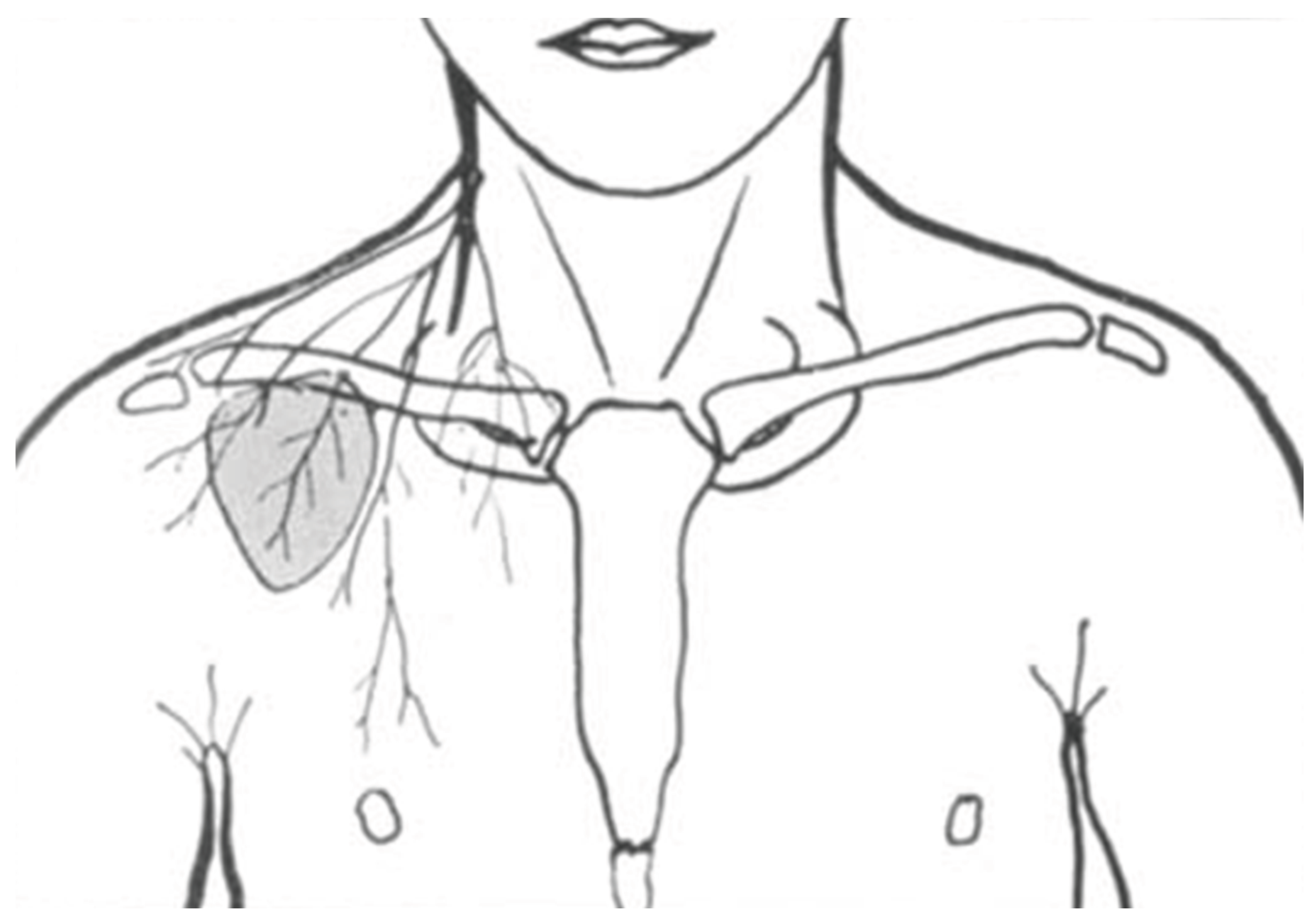
Figure 2.
Supraclavicular foramen.
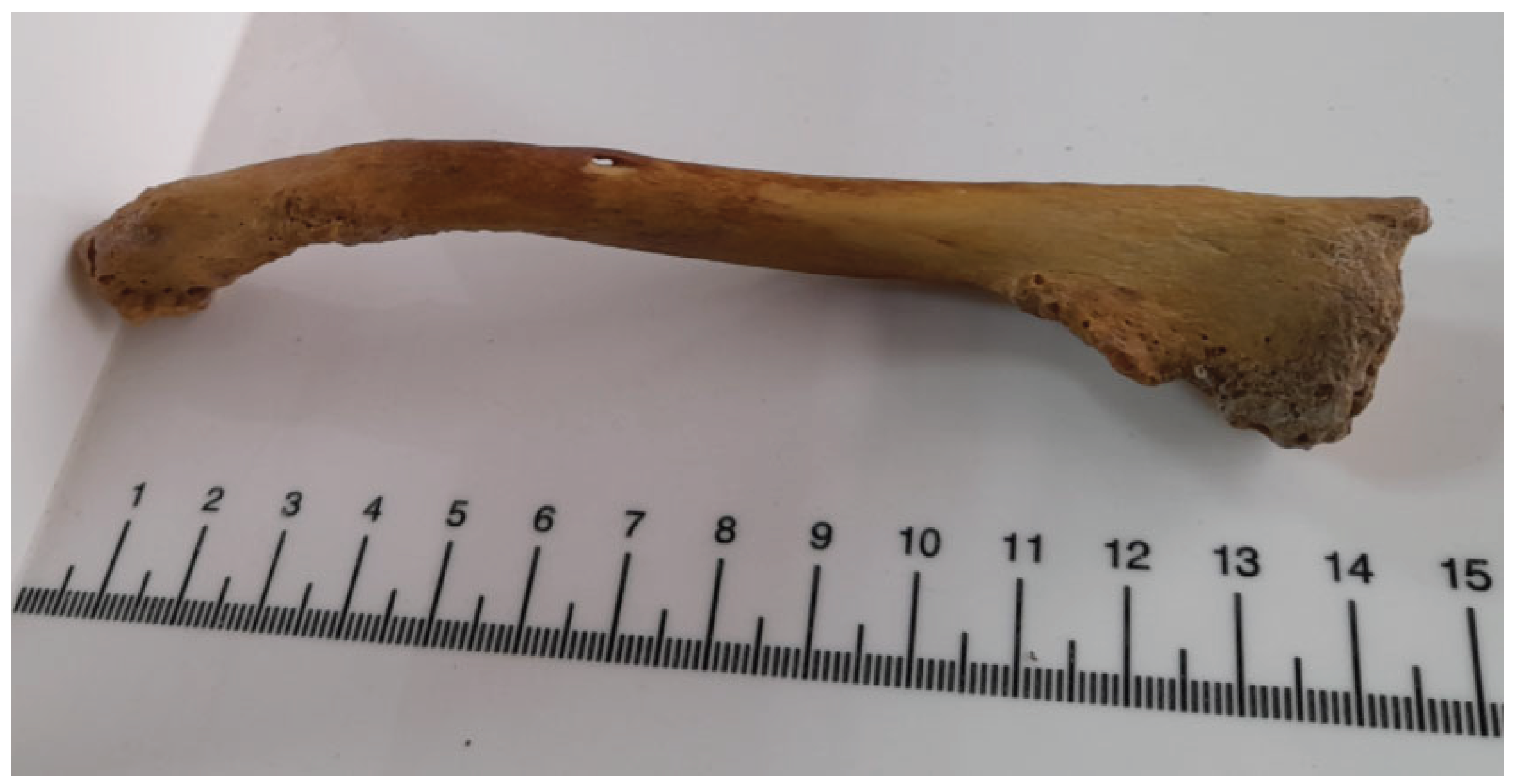
Figure 3.
Three clavicles showing complete transclavicular canals identified by paired supraclavicular foramina. The clavicle on the right shows a markedly narrower canal; the largest wire that could be passed through it measured 0.2 mm, suggesting that transmission of a typical supraclavicular nerve branch may be less likely.
Figure 3.
Three clavicles showing complete transclavicular canals identified by paired supraclavicular foramina. The clavicle on the right shows a markedly narrower canal; the largest wire that could be passed through it measured 0.2 mm, suggesting that transmission of a typical supraclavicular nerve branch may be less likely.
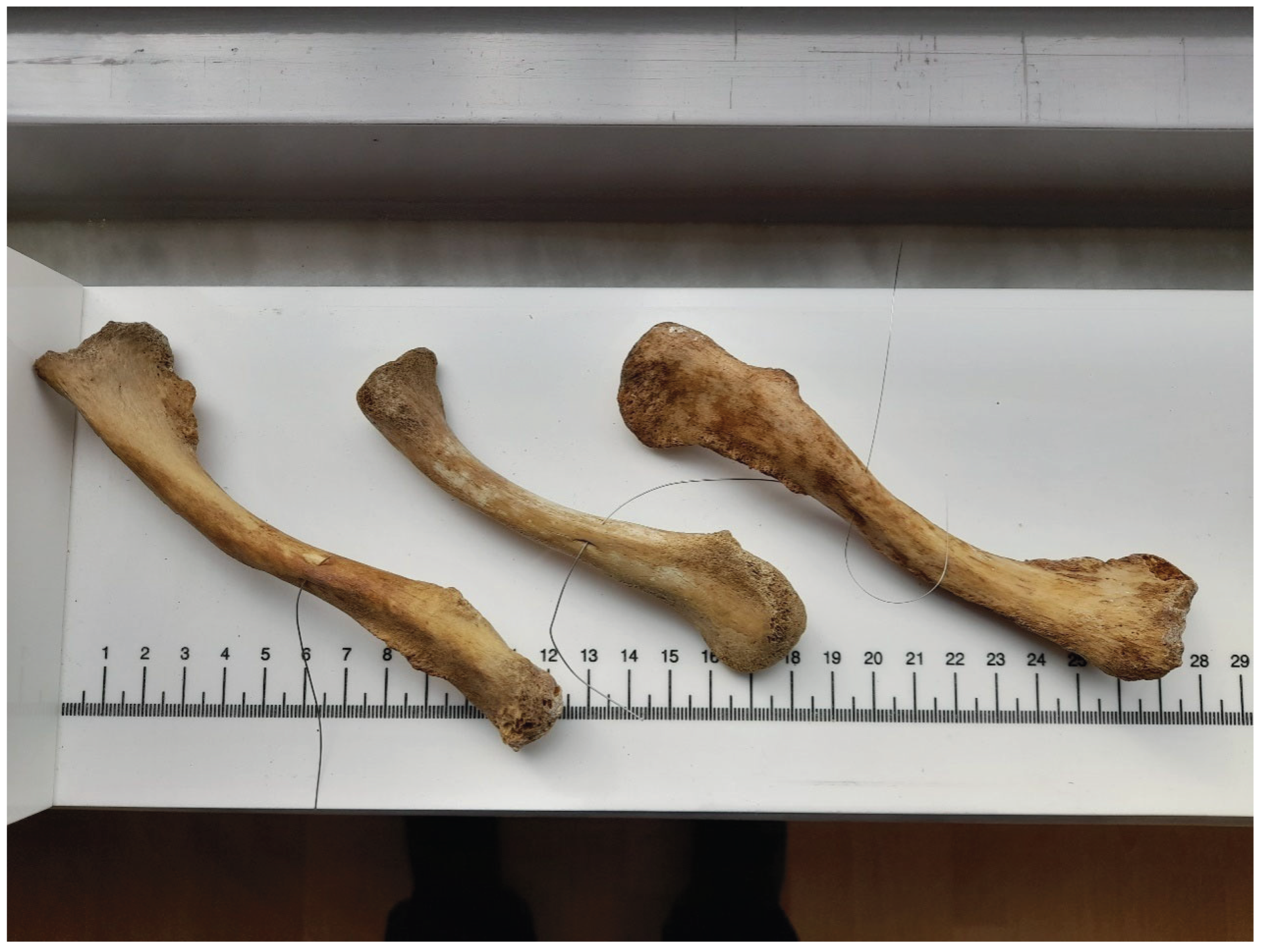
Figure 4.
PRISMA flow diagram.
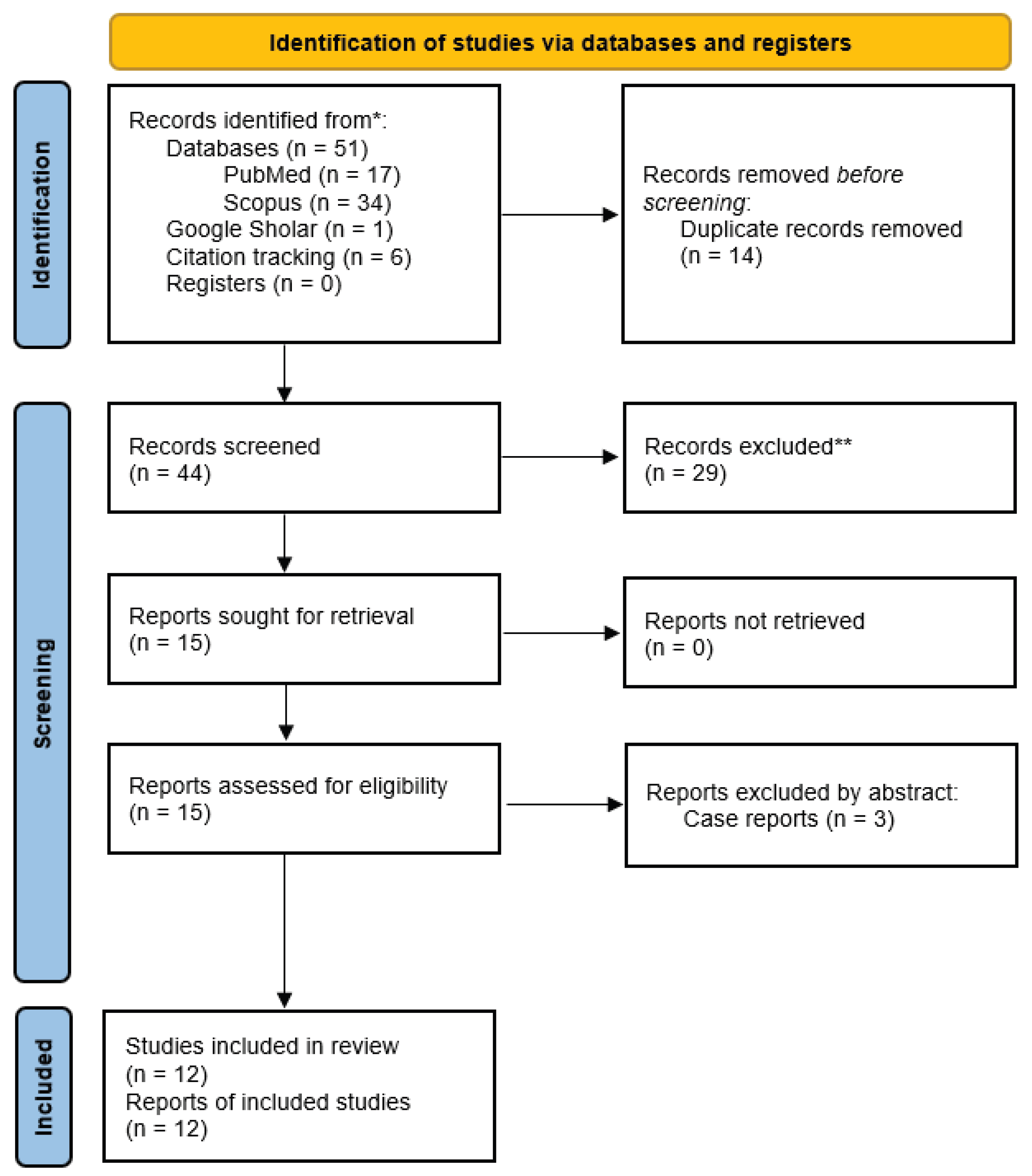
Figure 5.
Pooled prevalence of supraclavicular foramen (2.2%; 95% CI: 1.4–3.0%; I² = 71%).
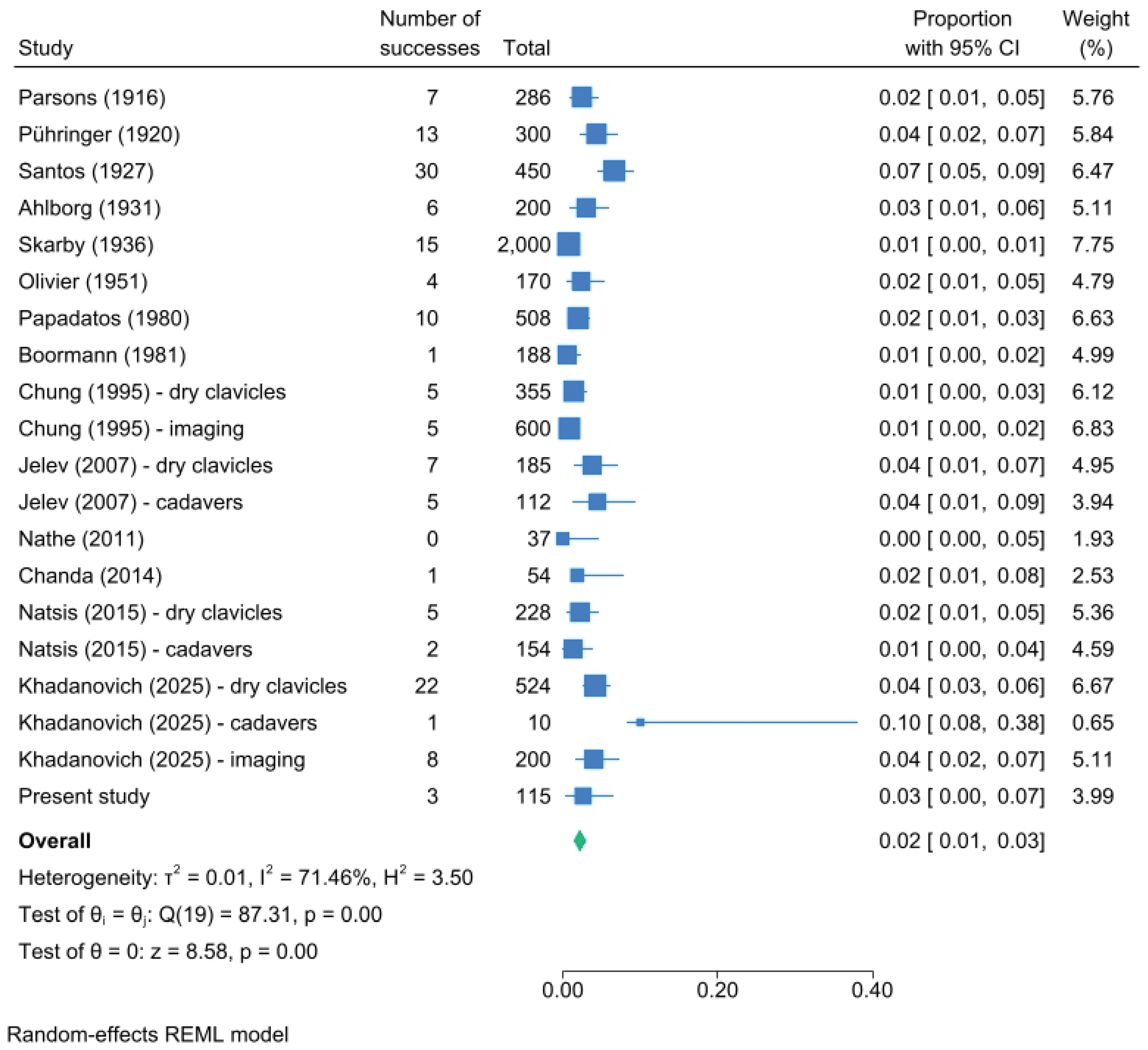
Figure 6.
Subgroup analysis of supraclavicular foramen prevalence according to study material.
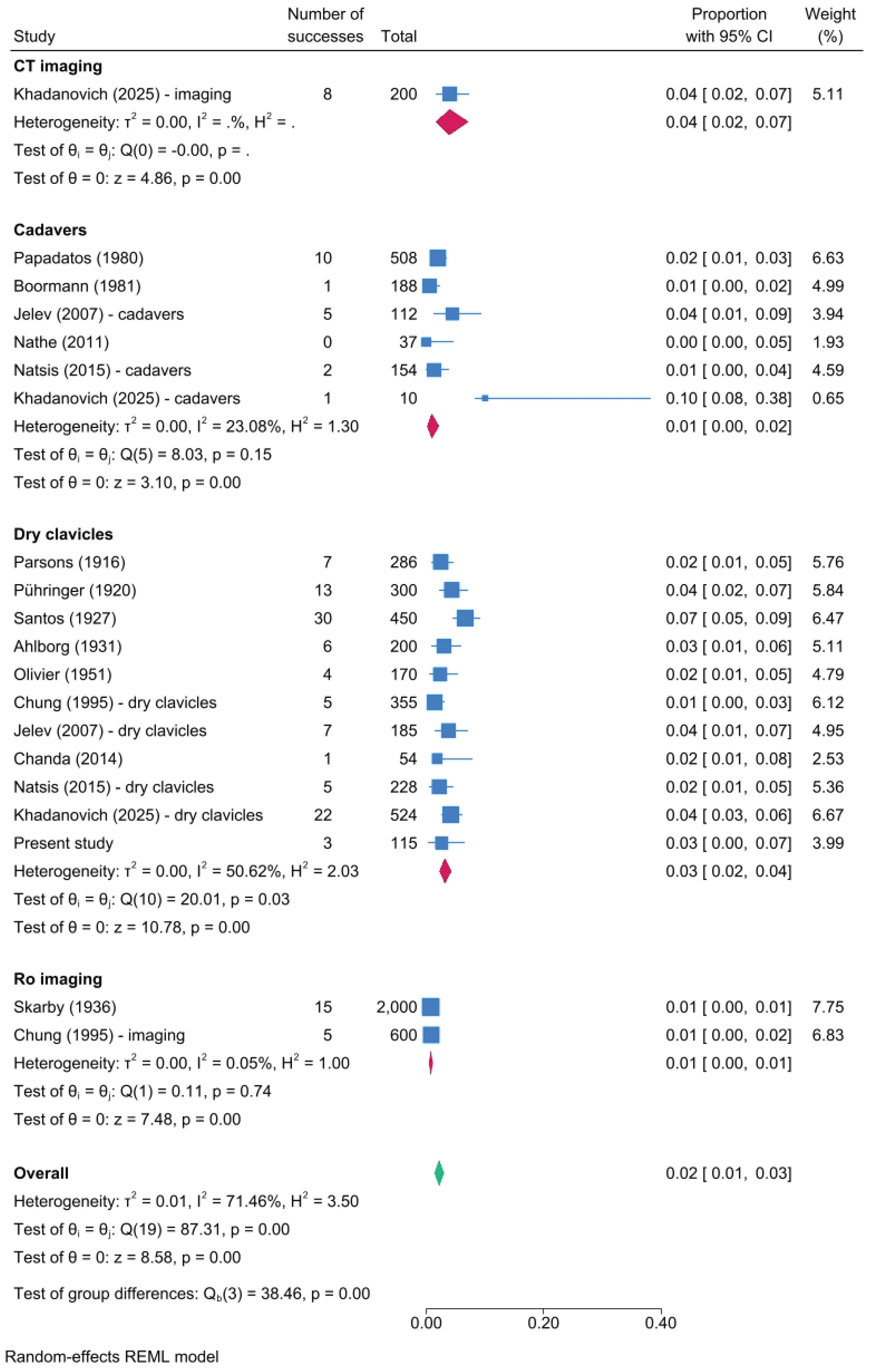
Figure 7.
Pooled OR for presence of supraclavicular foramen in the left versus right clavicle (1.76; 95% CI: 1.16–2.66).
Figure 7.
Pooled OR for presence of supraclavicular foramen in the left versus right clavicle (1.76; 95% CI: 1.16–2.66).
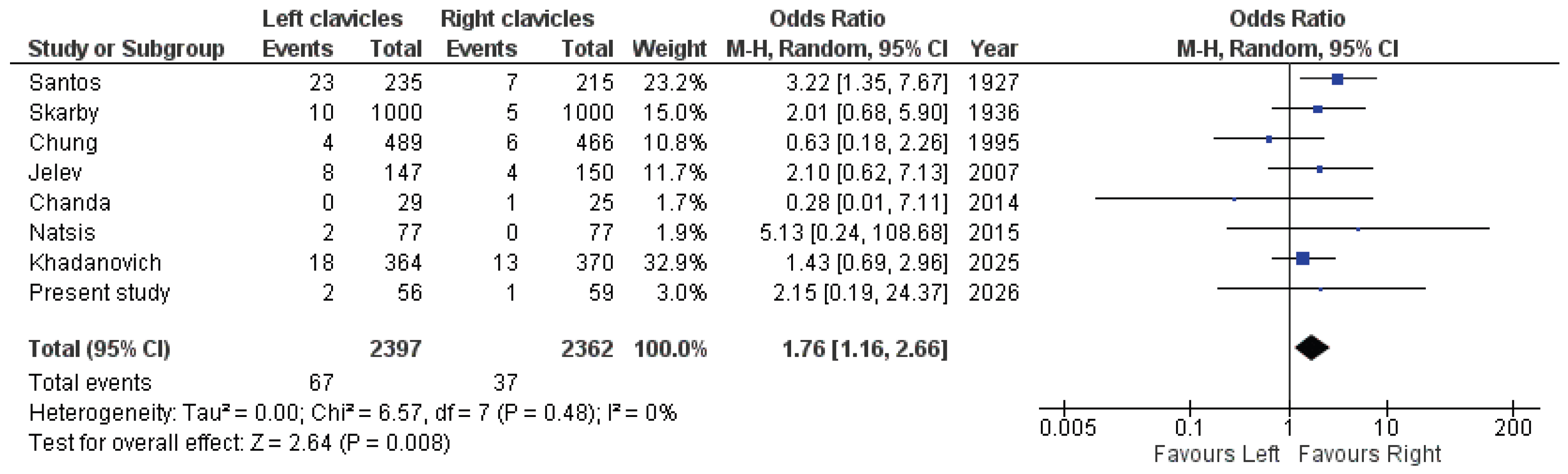
Figure 8.
Feasibility-based paired laterality analysis of supraclavicular foramen. Forest plot of the pooled paired odds ratio (OR) for left-only versus right-only occurrence. Studies with directly reported bilateral counts are shown separately from studies requiring reconstruction; reconstruction was applied only when bilateral counts were unavailable, using the midpoint feasibility assumption (λ = 0.5). Values greater than 1 indicate left-sided predominance.
Figure 8.
Feasibility-based paired laterality analysis of supraclavicular foramen. Forest plot of the pooled paired odds ratio (OR) for left-only versus right-only occurrence. Studies with directly reported bilateral counts are shown separately from studies requiring reconstruction; reconstruction was applied only when bilateral counts were unavailable, using the midpoint feasibility assumption (λ = 0.5). Values greater than 1 indicate left-sided predominance.
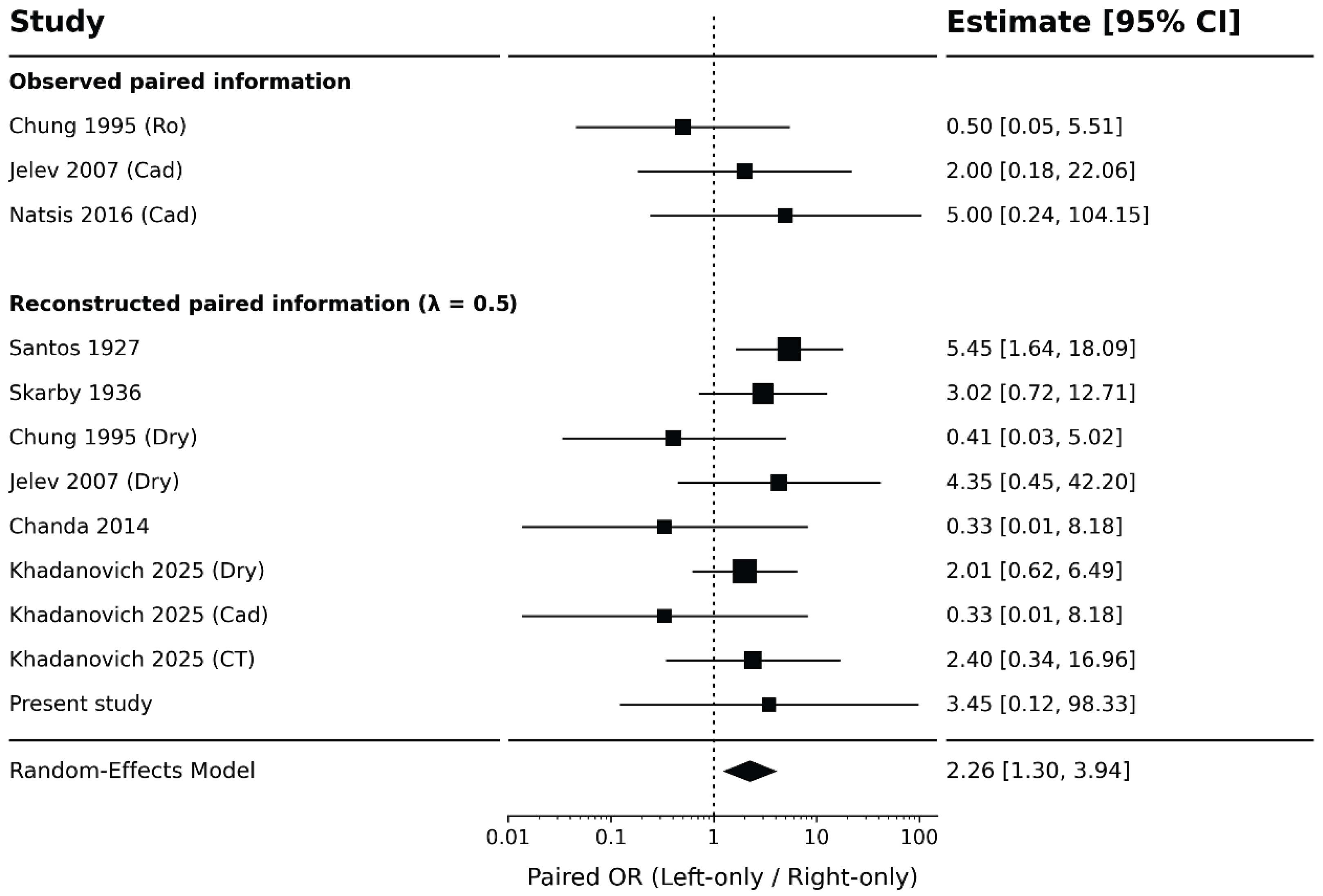
Figure 9.
Forest plot of the main observed bilateral prevalence of supraclavicular foramen (SCF) at the individual level. Pooled estimates were obtained with the primary logit random-effects model with continuity correction.
Figure 9.
Forest plot of the main observed bilateral prevalence of supraclavicular foramen (SCF) at the individual level. Pooled estimates were obtained with the primary logit random-effects model with continuity correction.
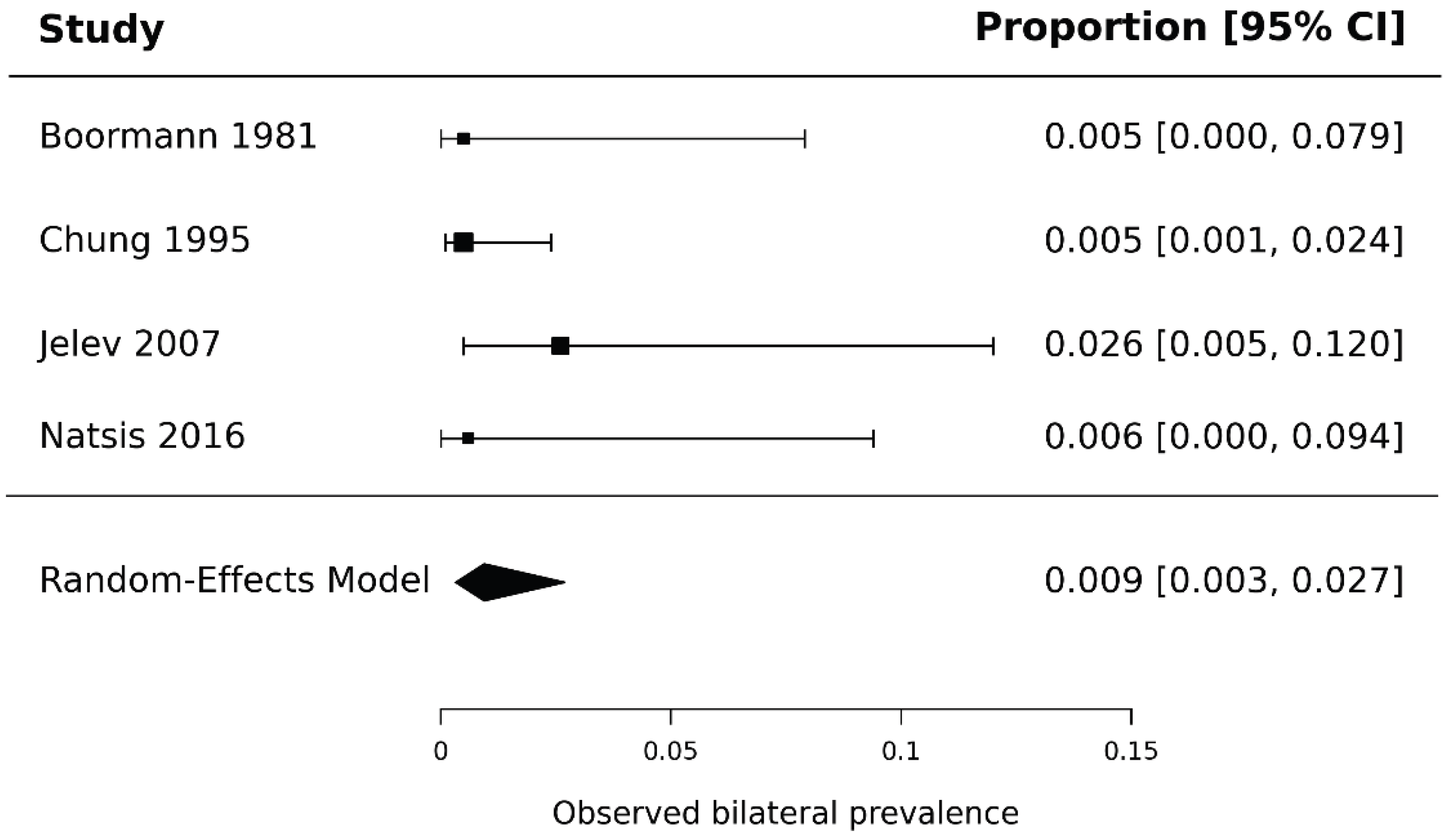
Figure 10.
Sensitivity of the pooled paired laterality estimate across the admissible dependence range. The solid line shows the pooled paired odds ratio (OR) for left-only versus right-only supraclavicular foramen (SCF) as the feasibility parameter λ varies from 0 (independence) to 1 (maximal feasible concordance) for studies lacking directly observed bilateral counts; studies with observed bilateral counts were held fixed. Dashed lines indicate the 95% confidence interval, and the horizontal dotted line marks the null value (OR = 1). Across the admissible range, the pooled estimate remains greater than 1, supporting persistent left-sided predominance.
Figure 10.
Sensitivity of the pooled paired laterality estimate across the admissible dependence range. The solid line shows the pooled paired odds ratio (OR) for left-only versus right-only supraclavicular foramen (SCF) as the feasibility parameter λ varies from 0 (independence) to 1 (maximal feasible concordance) for studies lacking directly observed bilateral counts; studies with observed bilateral counts were held fixed. Dashed lines indicate the 95% confidence interval, and the horizontal dotted line marks the null value (OR = 1). Across the admissible range, the pooled estimate remains greater than 1, supporting persistent left-sided predominance.
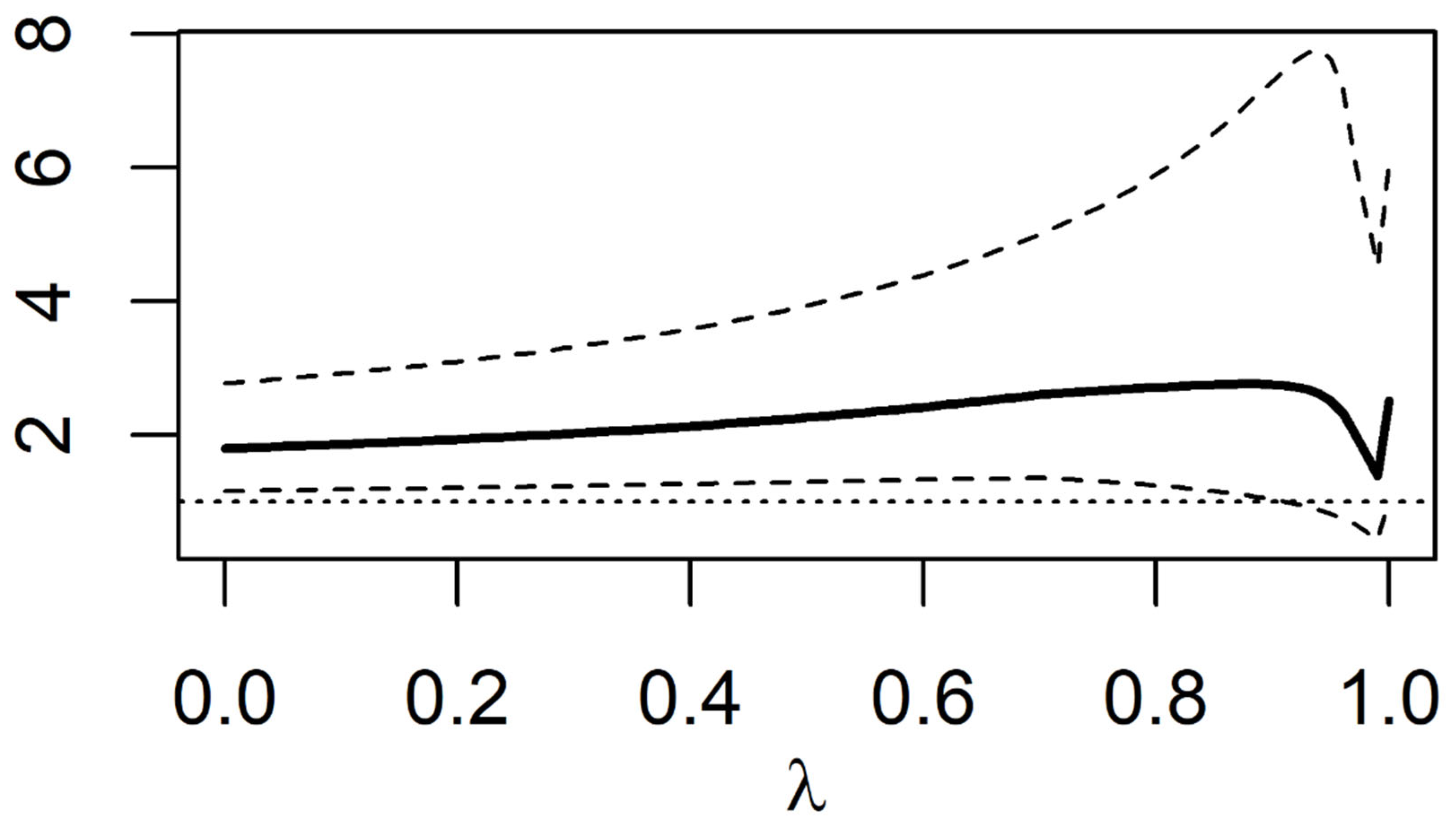
Figure 11.
Doi plot and LFK index indicating minor asymmetry.
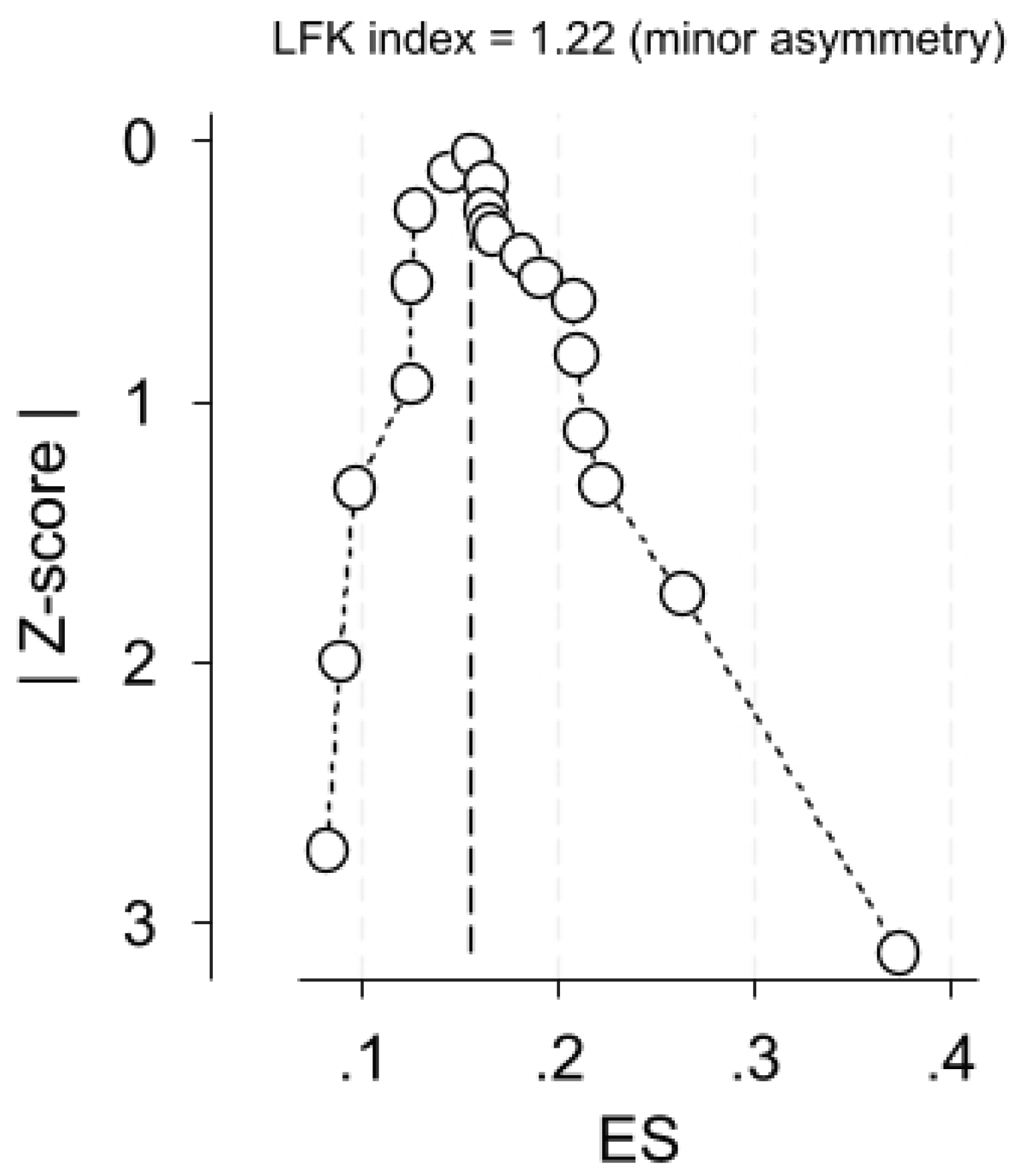

Table 1.
Characteristics of included studies.
| Study | Origin | Type | Explicit joint left–right information | Total CL | Right CL | Left CL | Total CL with canal | Right CL with canal | Left CL with canal | Total bodies | Bilateral canal |
| Parsons (1916) [22] ¶¶ | UK | Dry CL | No | 286 | NR | NR | 7 | NR | NR | NR | 2 |
| Pühringer (1920) [30] | Austria | Dry CL | No | 300 | NR | NR | 13 | NR | NR | NR | NR |
| Santos (1927) [17] | Portugal | Dry CL | Partially¶ | 450 | 215 | 235 | 30 | 7 | 23 | 80§ | 3§ |
| Ahlborg (1931) [31] | Sweden | Dry CL | No | 200 | NR | NR | 6 | NR | NR | NR | NR |
| Skarby (1936) [32] | Germany | Ro imaging | Yes | 2000 | 1000 | 1000 | 15 | 5 | 10 | 1000 | NR |
| Olivier (1951) [33] | France | Dry CL | No | 170 | NR | NR | 4 | NR | NR | NR | NR |
| Papadatos (1980) [6] | France | Cadavers | No | 508 | 254 | 254 | 10⁂ | NR | NR | 254 | NR |
| Sommerlad (1981) [24] | UK | Cadavers | Yes | 188 | 94 | 94 | 1 | NR | NR | 94 | 0 |
| Chung (1995) [25] | Korea | Ro imaging | Yes | 600 | 300 | 300 | 5 | 3 | 2 | 300 | 1 |
| Chung (1995) [25] | Korea | Dry CL | No | 347⁑ | 166 | 189 | 5 | 3 | 2 | NR | NR |
| Jelev (2007) [5] | Bulgaria | Dry CL | No | 185 | 94 | 91 | 7‡ | 2 | 5 | NR | NR |
| Jelev (2007) [5] | Bulgaria | Cadavers | Yes | 112 | 56 | 56 | 5 | 2 | 3 | 56 | 1 |
| Nathe (2011) [2]# | USA | Cadavers | Yes | NR | NR | NR | 0 | 0 | 0 | 37 | NR |
| Chanda (2014) [34] | India | Dry CL | No | 54 | 25 | 29 | 1 | 1 | 0 | NR | NR |
| Natsis (2016) [25] | Greece | Cadavers | Yes | 154 | 77 | 77 | 2 | 0 | 2 | 77 | 0 |
| Natsis (2016) [25] | Greece | Dry CL | No | 228 | NR | NR | 5 | NR | NR | NR | NR |
| Khadanovich (2025) [35] | Czech | Dry CL | No | 524 | 265 | 259 | 22† | 9 | 13 | NR | NR |
| Khadanovich (2025) [35] | Czech | Cadavers | Yes | 10 | 5 | 5 | 1 | 1 | 0 | 5 | NR |
| Khadanovich (2025) [35] | Czech | CT imaging | Yes | 200 | 100 | 100 | 8 | 3 | 5 | 100 | NR |
| Present study | Greece | Dry CL | No | 115 | 60 | 55 | 3 | 1 | 2 | NR | NR |
CL, clavicles; TCC, transclavicular canal; Ro, radiographic; CT, computed tomography; NR, not reported. † A double canal was observed in two cases (right). ‡ A double canal was observed in one case (right). § Santos (1927) body-level information refers only to the identified 80-skeleton subset; the 3 bilateral skeletons were used only in sensitivity analyses and were not assigned to the full 450-clavicle mixed sample. ¶ “Partially” indicates that side-specific clavicle counts were extractable and a paired skeleton subset existed, but bilateral information did not apply to the full mixed sample. ⁂ Papadatos (1980): the primary paper reported 10 positive individuals among 254 cadavers, but laterality and bilateralism were not reported; accordingly, person-level positivity was not treated as side-specific clavicle-level information. ⁑ Chung (1995) dry-bone series: 355 clavicles were available, but 347 were evaluable for this specific feature in the primary report. # Nathe (2011): Thirty-seven cadavers were dissected and no TCC cases were reported. Because the study did not explicitly report a body-level bilateral count and clavicle-level denominators were not directly extractable for the TCC endpoint, Nathe was not entered into the main bilateral-prevalence model. ¶¶ Parsons (1916): seven perforated clavicles were reported among 286 examined bones, and two cases were described as bilateral; however, the number of examined individuals was not reported, and the author explicitly noted that many observations were based on single recovered clavicles. Accordingly, Parsons was not included in the body-level bilateral-prevalence model.
Table 2.
Quality assessment of the included studies using the AQUA tool. “Low”, “Unclear”, and “High” refer to risk-of-bias judgments.
Table 2.
Quality assessment of the included studies using the AQUA tool. “Low”, “Unclear”, and “High” refer to risk-of-bias judgments.
| Study | Domain 1: Objectives and study characteristics | Domain 2: Study design | Domain 3: Methodology characterization | Domain 4: Descriptive anatomy | Domain 5: Reporting of results | Overall methodological quality |
|---|---|---|---|---|---|---|
| Parsons (1916) [22] | Unclear | Low | Unclear | Low | Low | Medium |
| Pühringer (1920) [30] | Unclear | Low | Unclear | Low | Low | Medium |
| Santos (1927) [17] | Low | Low | Low | Low | Unclear | Medium |
| Ahlborg (1931) [31] | Unclear | Low | Unclear | Low | Low | Medium |
| Skarby (1936) [32] | Low | Low | Unclear | Low | Low | Medium |
| Papadatos (1980) [6] | Unclear | Low | Low | Low | Low | Medium |
| Sommerlad (1981) [23] | Unclear | Low | Unclear | Low | Low | Medium |
| Jelev (2007) [5] | Low | Low | Low | Low | Low | High |
| Natsis (2016) [25] | Low | Low | Low | Low | Low | High |
| Nathe (2011) [2] | Low | Low | Low | Low | Low | High |
| Chanda (2014) [34] | Unclear | Low | Unclear | Low | Low | Medium |
| Khadanovich (2025) [35] | Low | Low | Low | Low | Low | High |
| Present study | Low | Low | Low | Low | Low | High |
AQUA domains are reported as risk-of-bias judgments (low, unclear, or high risk of bias), whereas the final column summarizes the overall methodological quality of each study.
Table 3.
Morphometric characteristics of transclavicular canals. Values are reported as extracted from the original studies where available. For Santos (1927), approximate mean ± SD values were derived from published range summaries under an assumption of approximate normality. Positional variables may refer either to the closest canal margin, the canal center, or the nearest canal orifice, depending on the source study; derived ratios are indicated in footnotes. Summary values are canal-count-weighted descriptive means rather than formal meta-analytic pooled estimates because the source studies reported sparse morphometric data with incompletely identifiable pairing.
Table 3.
Morphometric characteristics of transclavicular canals. Values are reported as extracted from the original studies where available. For Santos (1927), approximate mean ± SD values were derived from published range summaries under an assumption of approximate normality. Positional variables may refer either to the closest canal margin, the canal center, or the nearest canal orifice, depending on the source study; derived ratios are indicated in footnotes. Summary values are canal-count-weighted descriptive means rather than formal meta-analytic pooled estimates because the source studies reported sparse morphometric data with incompletely identifiable pairing.
| Study | Number of canals | Medial distance (mean±SD) | Lateral distance (mean±SD) | Lateral distance / total clavicle length | Canal length (mean±SD) | Canal width (mean±SD)⁋ |
| Santos (1927) [17]⁂ | 30 | NR | 61.0 ± 4.9 | 0.42 ± 0.04⁑ | 7.5 ± 2.2 | NR* |
| Chanda (2014) [34] | 1 | 84 | 65 | 0.436† | NR | NR |
| Khadanovich (2025) [35] | 22 | 68.6 ± 10.6 | 60.4 ± 17.6 | 0.468 ± 0.082 | 4.9 ± 1.6 | 2.0 ± 0.6 |
| Present study | 3 | 73.4 ± 9.5 | 60.0 ± 5.2 | 0.441 ± 0.012 | 5.9 ± 2.4 | 1.5 ± 0.8 |
| Descriptive summary of available data | - | 69.7 ± 10.6 | 60.8 ± 11.5 | 0.440 ± 0.063‡ | 6.4 ± 2.3 | 1.94 ± 0.63 |
NR: not reported. † Derived as lateral distance / (medial distance + lateral distance) from the reported mean distances. ‡ Canal-count-weighted descriptive summaries only; see Methods for derivation details. ⁂ Santos-derived estimate reconstructed from published summaries; see Methods. ⁑ Approximate acromial ratio derived from Santos’ grouped clavicle-length and orifice-distance summaries; see Methods. * Santos reports orifice diameters, which were not entered into the modern canal-width column.
Disclaimer/Publisher’s Note: The statements, opinions and data contained in all publications are solely those of the individual author(s) and contributor(s) and not of MDPI and/or the editor(s). MDPI and/or the editor(s) disclaim responsibility for any injury to people or property resulting from any ideas, methods, instructions or products referred to in the content. |
© 2026 by the authors. Licensee MDPI, Basel, Switzerland. This article is an open access article distributed under the terms and conditions of the Creative Commons Attribution (CC BY) license (http://creativecommons.org/licenses/by/4.0/).
Copyright: This open access article is published under a Creative Commons CC BY 4.0 license, which permit the free download, distribution, and reuse, provided that the author and preprint are cited in any reuse.


