

Submitted:
01 July 2026
Posted:
02 July 2026
You are already at the latest version
Abstract
Loneliness is a well-established risk factor for poor mental health in later life. However, less is known about whether different forms of loneliness have distinct implications for psychological well-being, particularly in non-Western cultural contexts. Drawing on multidimensional models of loneliness and attachment-based perspectives, the present study examined the unique associations of romantic, familial, and social loneliness with depression, anxiety, and stress among married Turkish middle-aged and older adults (N = 484; aged 50 years and older).
Participants were recruited from Istanbul using a stratified sampling strategy. Bivariate analyses showed that all loneliness dimensions were positively associated with depression, anxiety, and stress. However, when their unique contributions were examined simultaneously, the findings diverged from expectations. Social loneliness emerged as the most consistent predictor, showing significant positive associations with depression, anxiety, and stress. Familial loneliness was independently associated with depression and anxiety, whereas romantic loneliness was not uniquely associated with any mental health outcome after controlling for overlap among loneliness dimensions.
These findings challenge the assumption that deficits in close attachment relationships are necessarily the most consequential form of loneliness for psychological well-being in later life. In this sample, broader social disconnection appeared more strongly linked to mental health than either familial or romantic loneliness. The results underscore the importance of conceptualizing loneliness as a multidimensional construct and suggest that social integration may play a particularly important role in the mental health of older adults, even in cultural contexts where close family relationships are highly valued.
Keywords:
loneliness
; depression
; anxiety
; stress
; aging
; non-WEIRD populations
1. Introduction
Loneliness has been rising exponentially worldwide and has even been described as an “epidemic” (Ng, 2024; Office of the Surgeon General, 2023). One major concern underlying this increase is its harmful impact on human health, as loneliness is associated with a 26% higher risk of mortality (Holt-Lunstad et al., 2015). This elevated risk is linked to multiple factors, including poorer mental health outcomes (Ng, 2024). Meta-analytic evidence indicates that individuals experiencing loneliness face an increased risk of mental health problems, most notably depression, but also anxiety and self-harm (Mann et al., 2022). The prevalence of loneliness follows a “U-shaped” distribution, with higher levels observed among both younger and older adults (Lasgaard et al., 2016). Given that the global population is aging (United Nations, 2024), loneliness among older adults is becoming an increasingly important public health concern. Given these demographic shifts, it is critical to understand how loneliness affects mental health in older populations.
Loneliness is described as the unpleasant experience that arises when there is a discrepancy between the desired and the actual state of a person’s social relations, either in terms of quantity or quality (Peplau & Perlman, 1982). While temporary feelings of loneliness can serve as an adaptive human response, chronic loneliness can be harmful with both immediate and long-term mental and physical health consequences (Cacioppo et al., 2011; Holt-Lunstad, 2024; Wang et al., 2018). Loneliness is increasingly prevalent among the elderly population worldwide (Surkalim et al., 2022). A systematic review and meta-analysis reported that in high-income countries, approximately 25.9% of older adults experience moderate loneliness, while 7.9% experience severe loneliness (Chawla et al., 2021).
Conceptually, loneliness has been framed as both a unidimensional and multidimensional construct. From the unidimensional perspective, loneliness is viewed as a single continuum of intensity, often linked to relationship failures (Russell, 1996). In contrast, the multidimensional perspective suggests that loneliness experienced in different dimensions of relationships can differ qualitatively, though they all stem from the same underlying construct. Weiss (1973) distinguished between social loneliness—the absence of broader affiliations such as friendships and workplace ties—and emotional loneliness, which arises from unmet attachment needs. Emotional loneliness can further be divided into family loneliness, associated with the absence of close family connections, and romantic loneliness, linked to intimate romantic connections (DiTommaso & Spinner, 1997). Recent research supports the multidimensional nature of loneliness, showing that its distinct dimensions—social, family, and romantic—are linked to different relational and psychological correlates (DiTommaso et al., 2004; Giletta et al., 2012; Thompson & Pollet, 2024). Notably, each dimension is closely tied to mental health outcomes, underscoring the need to consider these nuances when studying loneliness.
It is increasingly recognized that loneliness is strongly associated with negative mental health outcomes in older adults (Leigh-Hunt et al., 2017), with anxiety and depression being among the most common problems in this age group (Domènech-Abella et al., 2019; Jalali et al., 2024). A meta-analysis estimated that the global prevalence of depression among older adults is 19.2%, while the prevalence of anxiety disorders and stress is 16.5% and 13.9%, respectively (Jalali et al., 2024). These problems may be exacerbated by limited support systems, as loneliness can amplify stress responses and weaken coping capacities (Steptoe et al., 2004). Some studies suggest that emotional forms of loneliness may be especially detrimental to mental health because close relationships serve important functions related to security, emotional regulation, and support across the lifespan (Peerenboom et al., 2015). In early life, this role is fulfilled by parental attachment figures (Bowlby, 1969), but across development, the primary attachment figure often shifts to a romantic partner in young adulthood and typically remains so through midlife and later life (Hazan & Shaver, 1987). This shift becomes particularly salient in older age, when access to parental support is diminished due to advanced age or loss (Luanaigh & Lawlor, 2008). In this context, spousal or romantic relationships can take on heightened importance as a primary source of emotional security. Consistent with this perspective, a 19-year longitudinal study found that emotional loneliness increased the risk of all-cause mortality in older adults living alone (O'Súilleabháin et al., 2019).
At the same time, there are reasons to expect broader social relationships to play an increasingly important role in psychological well-being during later life. Aging is often accompanied by shrinking social networks, reduced mobility, retirement, and diminished participation in community activities (Puyané et al. 2025). These changes may increase the importance of maintaining meaningful social connections beyond the family (Dykstra & Fokkema, 2007; Tiikkainen & Heikkinen, 2005). Consequently, social loneliness may represent a distinct source of vulnerability for older adults, even when close family or romantic relationships are available. Taken together, these perspectives suggest that different dimensions of loneliness may show distinct associations with mental health outcomes, but the relative importance of romantic, familial, and social loneliness remains unclear.
Despite the growing literature on loneliness and mental health, most research has been conducted in WEIRD (Western, Educated, Industrialized, Rich, and Democratic) populations (Mann et al., 2022). Cultural contexts may shape how loneliness is experienced and managed, highlighting the need for research in underrepresented populations. Turkey provides a particularly relevant context, as its population is rapidly aging (Turkish Statistical Institute, 2023), yet research on loneliness and mental health among older adults remains limited. Existing evidence indicates that loneliness is substantial in this population, with one study reporting that 46.9% of Turkish older adults experience moderate to severe loneliness (Öztürk Haney et al., 2017).
The present study examines the association between loneliness and mental health outcomes in married Turkish middle-aged and older adults (≥50 years). Loneliness is examined multidimensionally through social, familial, and romantic loneliness, while mental health outcomes include depression, anxiety, and stress. We hypothesize that higher levels of loneliness will be associated with greater psychological distress. Furthermore, guided by the attachment-based models (Bowlby, 1969; Mikulincer & Shaver, 2019) and the previous findings (O'Súilleabháin et al., 2019), we expected romantic and familial loneliness to show stronger associations with depression, anxiety, and stress than social loneliness. Focusing on married individuals provides a useful context for examining whether perceived deficits in romantic relationships remain more strongly associated with mental health than deficits in family or broader social relationships when a spouse is present.
The present study also distinguished between loneliness and social isolation. Whereas social isolation refers to the objective absence of social contacts, loneliness reflects the subjective perception that one's social relationships are insufficient (Cacioppo et al., 2014; Leigh-Hunt et al., 2017). Because loneliness can occur even in the presence of social ties (Luanaigh & Lawlor, 2008), social network size was included as a control variable to isolate the unique contribution of loneliness.
2. Method
2.1. Participants & Procedure
The sample included 484 married adults (223 women) aged 50 years and older (M = 58.54, SD = 6.39) residing in Istanbul, Turkey. The data was collected in July and August 2024 as part of a larger study on the connection of neighborhood, personality, and health. The study also included questions on demographics, mental health, loneliness, and social network. Participant selection was done by stratified random sampling method. It was aimed to reach a representative sample of Istanbul, Turkey according to municipalities and gender. To improve representativeness, more participants were recruited from larger municipalities, while fewer were selected from smaller ones. The eligibility criterion was to be aged 50 years old or above. The target sample size was 650. Participants were reached in their homes, by the survey interviewers. Participating in the study was voluntary. Before beginning the survey, participants were informed about the study. After participants provided their consent, face-to-face interviews were conducted. The interviewer asked the questions to the participants and noted verbal responses the participants provided. The interviews lasted approximately 20 minutes. The study was approved by the Intuitional Review Board of the authors university (Date: 08.05.2024, Reference Number: 1858).
2.2. Measures
2.2.1. Mental Health
The Turkish version of the short-form of the Depression Anxiety Stress Scale (Henry & Crawford, 2005; Yılmaz et al., 2017) was used to assess depression (e.g., “I felt that I had nothing to look forward to”; α = .86), anxiety (e.g., “I felt I was close to panic”; α = .86), and stress (e.g., “I found myself getting agitated”; α = .82). The scale includes a total of twenty-one items, each subscale consisting of 7-items. Participants rated their experiences over the past week using a scale ranging from 0 (did not apply to me) to 3 (applied to me very much). Mean scores were computed for each sub-scale ranging from 0 to 3. Higher scores indicated greater levels of depression, anxiety, and stress.
2.2.2. Loneliness
The Turkish version of the short-form of the Social and Emotional Loneliness Scale for Adults (Akgül, 2020; DiTommaso et al. 2004;) was used to assess social loneliness (e.g., “I do not have any friends who understand me, but I wish I did”; α = .86), familial loneliness (e.g., “I feel alone when I am with my family”; α = .87), and romantic loneliness (e.g., “I wish I had a more satisfying romantic relationship”; α = .89). The scale includes a total of fifteen items, each subscale consisting of five items. Participants rated their overall experiences using a scale ranging from 1 (strongly disagree) to 5 (strongly agree). Mean scores were computed for each sub-scale ranging from 1 to 5. Higher scores indicated greater levels of social, familial, and romantic loneliness.
2.2.3. Social Network Composition
Social network size was assessed using four adapted items from the Health and Retirement Study (Smith et al., 2017), capturing the presence of immediate family, friends, and living children. Affirmative responses were summed to create a social network size score.
2.2.4. Demographics
Participants reported their age, gender, relationship status, education level, working status, monthly family income, and subjective socioeconomic status (SES).
3. Results
Descriptive statistics and bivariate correlations for age, gender, social network, loneliness subscales (i.e., social, familial, and romantic), and mental health indicators (depression, anxiety, and stress) are presented in Table 1. Pearson correlation analyses revealed significant positive associations between the three loneliness subscales and the three mental health indicators. Higher loneliness scores were associated with higher levels of depression, anxiety, and stress, with effect sizes ranging from medium to large (r’s = .43 – .55).
To examine the unique associations between loneliness subscales and mental health indicators, a multivariate multiple regression was conducted within a structural equation modeling framework (see Figure 1 for the conceptual model). Loneliness subscales were entered as the primary predictor variables, while age, gender, and social network size were included as covariates. Mental health indicators were entered as outcome variables. Because the model was just-identified (df = 0), overall model fit indices were not informative. The analysis was conducted using the R package “lavaan” (Rosseel, 2012).
Social loneliness was significantly associated with depression (β = .29, p < .001), anxiety (β = .20, p = .001), and stress (β = .35, p < .001). Familial loneliness was significantly associated with depression (β = .27, p = .001) and anxiety (β = .19, p = .017), but not with stress (β = .09, p = .271). Romantic loneliness was not significantly associated with depression (β = .04, p = .638), anxiety (β = .15, p = .067), or stress (β = .06, p = .468).
Among the control variables, age was positively associated with depression (β = .09, p = .010), anxiety (β = .10, p = .004), and stress (β = .09, p = .011); gender was associated with anxiety (β = −.18, p < .001); and social network size was associated with stress (β = .06, p = .044). The model explained 33% of the variance in depression and anxiety and 26% in stress.
4. Discussion
The present study investigated the associations between multidimensional loneliness and mental health outcomes among married middle-aged and older adults in Turkey. Consistent with previous research across diverse cultural contexts (Dahlberg et al., 2022), the findings indicate that loneliness is an important correlate of mental health in the aging Turkish population, explaining a substantial proportion of variance in depression, anxiety, and stress. Bivariate correlations showed that higher levels of social, familial, and romantic loneliness were each associated with greater depression, anxiety, and stress, with large effect sizes. To further examine the unique contributions of each dimension, a multivariate multiple regression analysis was conducted, controlling for their shared variance. Contrary to expectations derived from the attachment framework, more proximal relationship domains did not show stronger associations with mental health outcomes. Instead, social loneliness emerged as the most consistent and robust predictor across outcomes, even after accounting for social network size.
Unexpectedly, romantic loneliness was not significantly associated with any mental health outcomes when other dimensions of loneliness were taken into account. This diverges from the theoretical expectations that the closest relational context exerts the strongest psychological impact— namely, that humans are fundamentally oriented toward emotional connection, and that close relationships serve as primary sources of security, support, and affect regulation (Bowlby, 1969; Mikulincer & Shaver, 2019).
One possible explanation is that, within a sample of married individuals, romantic relationships may be relatively stable and basic attachment needs are at least partially met, resulting in lower variability and reduced explanatory power for mental health outcomes. Under such circumstances, differences in psychological well-being may depend less on the availability of a romantic attachment figure and more on the quality and availability of broader social connections. In midlife and older adulthood, friendships and wider social networks may become increasingly important sources of companionship, support, and social engagement, and have been shown to contribute substantially to emotional well-being and mental health (Ng et al., 2021). Consistent with this perspective, social loneliness emerged as the strongest and most consistent correlate of depression, anxiety, and stress in the present study. This finding aligns with previous research linking social support and friendship quality to psychological well-being in later life (Santini et al., 2020).
The prominence of social loneliness is particularly noteworthy given that the study was conducted in Turkey, where family relationships are often viewed as a central source of social support and belonging (Ayçiçeği-Dinn & Caldwell-Harris, 2013; Kalaycıoğlu & Rittersberger-Tılıç, 2001). Despite the availability and cultural importance of family ties, broader social connections emerged as the strongest correlate of depression, anxiety, and stress. This finding suggests that meaningful engagement beyond the family may play an important role in psychological well-being during later life. Friendships and wider social networks may provide opportunities for companionship, reciprocity, and social participation that are not fully captured by family and marital relationships alone. They may also offer a distinct space for autonomy and identity expression, allowing individuals to engage in social roles and relationships that extend beyond family-based expectations and responsibilities (Adams & Blieszner, 1995). When these social connections are absent, older adults may lose vital outlets for self-expression and mutual support, potentially exacerbating feelings of isolation and diminishing self-worth. Taken together, these findings suggest that interventions in Turkey should not only strengthen family and marital ties but also foster opportunities for meaningful friendships, which may serve as vital protective resources in later life. Future research should incorporate cross-cultural comparisons to examine how cultural norms shape experiences of different forms of loneliness, as these patterns may vary across societies.
This study contributes to the growing literature on multidimensional loneliness by demonstrating that social, familial, and romantic loneliness suggest distinct associations with depression, anxiety, and stress in later life. By examining these relationships in a Turkish sample, it also extends existing evidence beyond the predominantly WEIRD populations in which much of the loneliness literature has been developed. Future research should investigate the mechanisms through which social loneliness influences psychological well-being, including the roles of social support quality, coping resources, and resilience. A key strength of the study is its representative urban sample from Istanbul, enhancing the generalizability of the findings to urban Turkey. However, the findings may not extend to rural populations, where community structures and family dynamics may differ (Sunar & Fişek, 2005). In addition, the cross-sectional design precludes causal inferences. Longitudinal studies are needed to clarify the directionality of associations between loneliness dimensions and mental health.
5. Conclusion
Overall, the findings suggest that loneliness should not be treated as a unitary construct in research on aging and mental health. Among married middle-aged and older adults, social loneliness emerged as a more consistent correlate of depression, anxiety, and stress than either familial or romantic loneliness. These findings highlight the importance of maintaining broader social integration in later life and suggest that the presence of a spouse alone may not be sufficient to protect against psychological distress when meaningful social connections beyond the family are lacking.
Author Contributions
Conceptualization, B.S. and F.Ö.; methodology, B.S. and F.Ö.; software, B.S. and F.Ö.; validation, B.S.; formal analysis, B.S.; data curation, G.B.; writing—original draft preparation, B.S. and F.Ö.; writing—review and editing, B.S., G.B. and F.Ö.; supervision, B.S. and F.Ö. All authors contributed to the manuscript. All authors have read and agreed to the published version of the manuscript.
Funding
This study was supported by the MEF University Scientific Research Projects Grant (MEF AAP 026).
Institutional Review Board Statement
The study was approved by the Institutional Review Board of MEF University (Date: 08.05.2024, Reference Number: 1858).
Informed Consent Statement
This study used human participants and each participant provided with informed consent.
Data Availability Statement
The data is available upon request by emailing the corresponding author.
Conflicts of Interest
The authors declare no conflicts of interest.
References
- Adams, R. G.; Blieszner, R. Aging well with friends and family. Am. Behav. Sci. 1995, 39(2), 209–224. [Google Scholar] [CrossRef]
- Akgül, H. Yetişkinler için sosyal ve duygusal yalnızlık ölçeği’nin (SELSA-S) Türk kültürüne uyarlaması: Geçerlilik ve güvenirlik çalışması [Adapting social and emotional loneliness scale (SELSA-S) to Turkish culture: Relevance and reliability]. Yalova Sos. Bilim. Derg. 2020, 10(21), 54–69. Available online: https://izlik.org/JA66HP95LS.
- Ayçiçeği-Dinn, A.; Caldwell-Harris, C. L. Vertical collectivism, family-consciousness and urbanization in Turkey. Elektron. Sos. Bilim. Derg. 2013, 12(47), 232–251. Available online: https://izlik.org/JA82GX42EZ.
- Bowlby, J. Attachment and loss. In Attachment; Basic Books, 1969; Vol. 1. [Google Scholar]
- Cacioppo, J. T.; Hawkley, L. C.; Norman, G. J.; Berntson, G. G. Social isolation. Ann. N. Y. Acad. Sci. 2011, 1231(1), 17–22. [Google Scholar] [CrossRef] [PubMed]
- Cacioppo, S.; Capitanio, J. P.; Cacioppo, J. T. Toward a neurology of loneliness. Psychol. Bull. 2014, 140(6), 1464–1504. [Google Scholar] [CrossRef] [PubMed]
- Chawla, K.; Kunonga, T. P.; Stow, D.; Barker, R.; Craig, D.; Hanratty, B. Prevalence of loneliness amongst older people in high-income countries: A systematic review and meta-analysis. PLoS ONE 2021, 16(7), Article e0255088. [Google Scholar] [CrossRef] [PubMed]
- Dahlberg, L.; McKee, K. J.; Frank, A.; Naseer, M. A systematic review of longitudinal risk factors for loneliness in older adults. Aging Ment. Health 2022, 26(2), 225–249. [Google Scholar] [CrossRef] [PubMed]
- DiTommaso, E.; Brannen, C.; Best, L. A. Measurement and validity characteristics of the short version of the social and emotional loneliness scale for adults. Educ. Psychol. Meas. 2004, 64(1), 99–119. [Google Scholar] [CrossRef]
- DiTommaso, E.; Spinner, B. Social and emotional loneliness: A re-examination of Weiss' typology of loneliness. Personal. Individ. Differ. 1997, 22(3), 417–427. [Google Scholar] [CrossRef]
- Domènech-Abella, J.; Mundó, J.; Haro, J. M.; Rubio-Valera, M. Anxiety, depression, loneliness, and social network in the elderly: Longitudinal associations from The Irish Longitudinal Study on Ageing (TILDA). J. Affect. Disord. 246 2019, 82–88. [Google Scholar] [CrossRef] [PubMed]
- Dykstra, P.A.; Fokkema, T. Social and emotional loneliness among divorced and married men and women: Comparing the deficit and cognitive perspectives. Basic Appl. Soc. Psychol. 2007, 29(1), 1–12. [Google Scholar] [CrossRef]
- Giletta, M.; Scholte, R. H.; Engels, R. C.; Ciairano, S.; Prinstein, M. J. Adolescent non-suicidal self-injury: A cross-national study of community samples from Italy, the Netherlands, and the United States. Psychiatry Res. 2012, 197(1–2), 66–72. [Google Scholar] [CrossRef] [PubMed]
- Hazan, C.; Shaver, P. Romantic love conceptualized as an attachment process. J. Personal. Soc. Psychol. 1987, 52(3), 511–524. [Google Scholar] [CrossRef] [PubMed]
- Henry, J. D.; Crawford, J. R. The short-form version of the Depression Anxiety Stress Scales (DASS-21): Construct validity and normative data in a large non-clinical sample. Br. J. Clin. Psychol. 2005, 44(2), 227–239. [Google Scholar] [CrossRef] [PubMed]
- Holt-Lunstad, J. Social connection as a critical factor for mental and physical health: Evidence, trends, challenges, and future implications. World Psychiatry 2024, 23(3), 312–332. [Google Scholar] [CrossRef] [PubMed]
- Holt-Lunstad, J.; Smith, T. B.; Baker, M.; Harris, T.; Stephenson, D. Loneliness and social isolation as risk factors for mortality: A meta-analytic review. Perspect. Psychol. Sci. 2015, 10(2), 227–237. [Google Scholar] [CrossRef] [PubMed]
- Jalali, A.; Ziapour, A.; Karimi, Z.; Rezaei, M.; Emami, B.; Kalhori, R. P.; Khosravi, F.; Sameni, J. S.; Kazeminia, M. Global prevalence of depression, anxiety, and stress in the elderly population: A systematic review and meta-analysis. BMC Geriatr. 2024, 24(1), 809. [Google Scholar] [CrossRef] [PubMed]
- Kalaycıoğlu, S.; Rittersberger-Tılıç, H. Intergenerational solidarity networks of instrumental and cultural transfers within migrant families in Turkey. Ageing Soc. 2000, 20(5), 523–542. [Google Scholar] [CrossRef]
- Lasgaard, M.; Friis, K.; Shevlin, M. “Where are all the lonely people?” A population-based study of high-risk groups across the life span. Soc. Psychiatry Psychiatr. Epidemiol. 2016, 51, 1373–1384. [Google Scholar] [CrossRef] [PubMed]
- Leigh-Hunt, N.; Bagguley, D.; Bash, K.; Turner, V.; Turnbull, S.; Valtorta, N.; Caan, W. An overview of systematic reviews on the public health consequences of social isolation and loneliness. Public Health 152 2017, 157–171. [Google Scholar] [CrossRef] [PubMed]
- Luanaigh, C. Ó.; Lawlor, B. A. Loneliness and the health of older people. Int. J. Geriatr. Psychiatry 2008, 23(12), 1213–1221. [Google Scholar] [CrossRef] [PubMed]
- Mann, F.; Wang, J.; Pearce, E.; Ma, R.; Schlief, M.; Lloyd-Evans, B.; Ikhtabi, S.; Johnson, S. Loneliness and the onset of new mental health problems in the general population. Soc. Psychiatry Psychiatr. Epidemiol. 2022, 57(11), 2161–2178. [Google Scholar] [CrossRef] [PubMed]
- Mikulincer, M.; Shaver, P. R. Attachment orientations and emotion regulation. Curr. Opin. Psychol. 2019, 25, 6–10. [Google Scholar] [CrossRef] [PubMed]
- Ng, I. K. The ‘loneliness’ epidemic: A new social determinant of health? Intern. Med. J. 2024, 54(3), 365–367. [Google Scholar] [CrossRef] [PubMed]
- Ng, Y. T.; Huo, M.; Gleason, M. E.; Neff, L. A.; Charles, S. T.; Fingerman, K. L. Friendships in old age: Daily encounters and emotional well-being. J. Gerontol. Ser. B 2021, 76(3), 551–562. [Google Scholar] [CrossRef] [PubMed]
- Office of the Surgeon General. Our epidemic of loneliness and isolation: The U.S. Surgeon General’s advisory on the healing effects of social connection and community. U.S. Department of Health and Human Services. 2023. Available online: https://www.hhs.gov/sites/default/files/surgeon-general-social-connection-advisory.pdf.
- O'Súilleabháin, P. S.; Gallagher, S.; Steptoe, A. Loneliness, living alone, and all-cause mortality: The role of emotional and social loneliness in the elderly during 19 years of follow-up. Psychosom. Med. 2019, 81(6), 521–526. [Google Scholar] [CrossRef] [PubMed]
- Öztürk Haney, M.; Bahar, Z.; Beşer, A.; Açıl, D.; Yardımcı, T.; Çömez, S. Factors related to loneliness among the elderly living at home in Turkey. Turk. J. Fam. Med. Prim. Care 2017, 11(2), 71–78. [Google Scholar] [CrossRef]
- Peerenboom, L.; Collard, R. M.; Naarding, P.; Comijs, H. C. The association between depression and emotional and social loneliness in older persons and the influence of social support, cognitive functioning and personality: A cross-sectional study. J. Affect. Disord. 182 2015, 26–31. [Google Scholar] [CrossRef] [PubMed]
- Peplau, L. A.; Perlman, D. Perspectives on loneliness. In Loneliness: A sourcebook of current theory, research and therapy; Peplau, L. A., Perlman, D., Eds.; John Wiley & Sons, 1982; pp. 1–20. [Google Scholar]
- Puyané, M.; Chabrera, C.; Camón, E.; Cabrera, E. Uncovering the impact of loneliness in ageing populations: A comprehensive scoping review. BMC Geriatr. 2025, 25(1), 244. [Google Scholar] [CrossRef] [PubMed]
- Rosseel, Y. lavaan: An R package for structural equation modeling. J. Stat. Softw. 2012, 48, 1–36. [Google Scholar] [CrossRef]
- Russell, D. W. UCLA Loneliness Scale (Version 3): Reliability, validity, and factor structure. J. Personal. Assess. 1996, 66(1), 20–40. [Google Scholar] [CrossRef] [PubMed]
- Santini, Z. I.; Jose, P. E.; Cornwell, E. Y.; Koyanagi, A.; Nielsen, L.; Hinrichsen, C.; Meilstrup, C.; Madsen, K. R.; Koushede, V. Social disconnectedness, perceived isolation, and symptoms of depression and anxiety among older Americans (NSHAP): A longitudinal mediation analysis. Lancet Public Health 2020, 5(1), e62–e70. [Google Scholar] [CrossRef] [PubMed]
- Smith, J.; Ryan, L.; Sonnega, A.; Weir, D.; HRS Psychosocial Working Group. Psychosocial and lifestyle questionnaire 2006–2016 documentation report: Core section LB. Survey Research Center, Institute for Social Research, University of Michigan. 2017. Available online: https://hrs.isr.umich.edu/sites/default/files/biblio/HRS%202006-2016%20SAQ%20Documentation_07.06.17.pdf.
- Steptoe, A.; Owen, N.; Kunz-Ebrecht, S. R.; Brydon, L. Loneliness and neuroendocrine, cardiovascular, and inflammatory stress responses in middle-aged men and women. Psychoneuroendocrinology 2004, 29(5), 593–611. [Google Scholar] [CrossRef] [PubMed]
- Sunar, D.; Fişek, G. O. Contemporary Turkish families. In Families in global perspective; Roopnarine, J. L., Gielen, U. P., Eds.; Allyn & Bacon, 2005; pp. 169–183. [Google Scholar]
- Surkalim, D. L.; Luo, M.; Eres, R.; Gebel, K.; Van Buskirk, J.; Bauman, A.; Ding, D. The prevalence of loneliness across 113 countries: Systematic review and meta-analysis. BMJ 2022, 376, e067068. [Google Scholar] [CrossRef] [PubMed]
- Thompson, A.; Pollet, T. V. An exploratory psychometric network analysis of loneliness scales in a sample of older adults. Curr. Psychol. 2024, 43(6), 5428–5442. [Google Scholar] [CrossRef] [PubMed]
- Tiikkainen, P.; Heikkinen, R.L. Associations between loneliness, depressive symptoms and perceived togetherness in older people. Aging Ment. Health 2005, 9(6), 526–534. [Google Scholar] [CrossRef] [PubMed]
- Turkish Statistical Institute (TÜİK). Nüfus projeksiyonları 2023–2100 [Population projections 2023–2100]. TÜİK. 2023. Available online: https://data.tuik.gov.tr/Bulten/Index?p=Nufus-Projeksiyonlari-2023-2100-53699.
- United Nations; Department of Economic and Social Affairs; Population Division. World population prospects 2024: Summary of results; United Nations, 2024; Available online: https://population.un.org/wpp.
- Wang, J.; Mann, F.; Lloyd-Evans, B.; Ma, R.; Johnson, S. Associations between loneliness and perceived social support and outcomes of mental health problems: A systematic review. BMC Psychiatry 2018, 18, 156. [Google Scholar] [CrossRef] [PubMed]
- Weiss, R. S. Loneliness: The experience of emotional and social isolation.; The MIT Press, 1973. [Google Scholar]
- Yılmaz, Ö.; Boz, H.; Arslan, A. Depresyon anksiyete stres ölçeğinin (DASS 21) Türkçe kısa formunun geçerlilik-güvenilirlik çalışması [The validity and reliability of depression, stress, and anxiety scale (DASS 21) Turkish short form]. Finans Ekon. Ve Sos. Araştırmalar Derg. 2017, 2(2), 78–91. Available online: https://izlik.org/JA37HJ44EE.
Figure 1.
The conceptual SEM model used for the multivariate multiple regression analysis. Note. Age, gender, and social network size were entered into the model as control variables.
Figure 1.
The conceptual SEM model used for the multivariate multiple regression analysis. Note. Age, gender, and social network size were entered into the model as control variables.
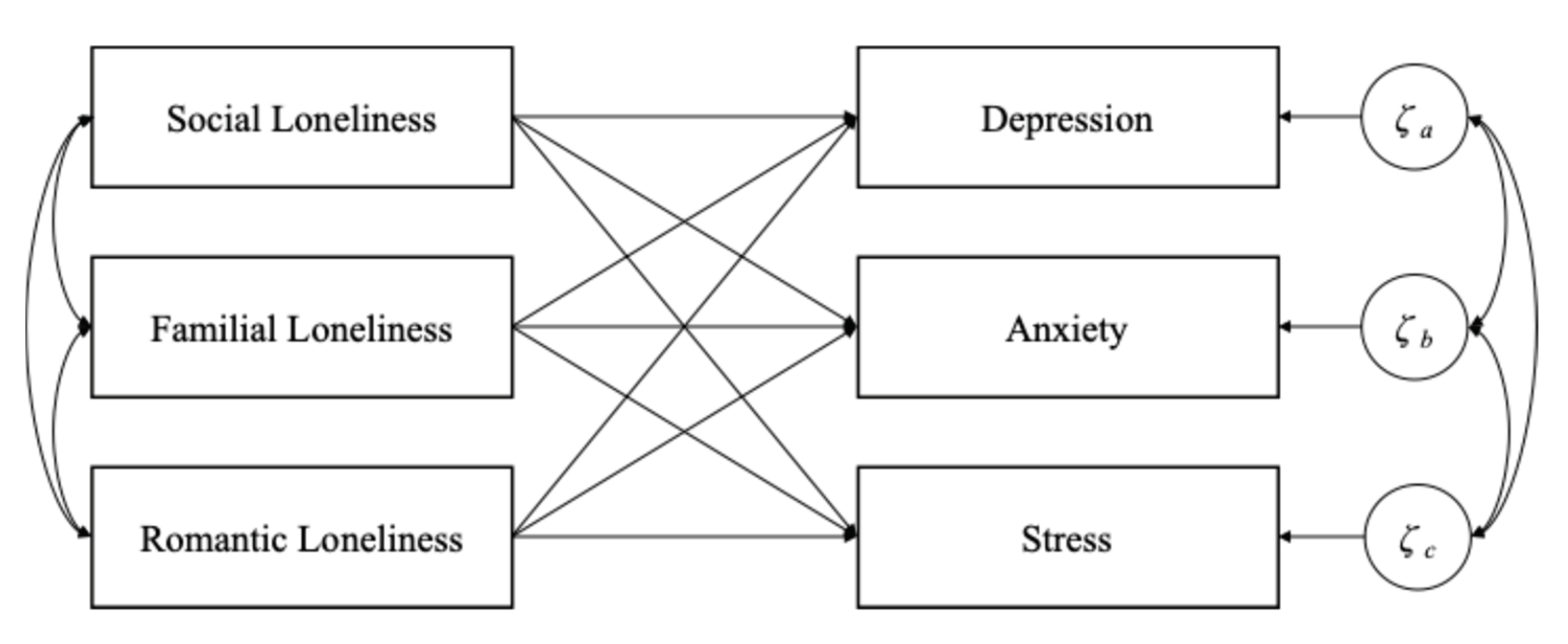

Table 1.
Descriptive statistics and bivariate correlations among study variables.
| 1. | 2. | 3. | 4. | 5. | 6. | 7. | 8. | 9. | |
| 1. Age | - | ||||||||
| 2. Gender | .13** | - | |||||||
| 3. SN | .11* | .00 | - | ||||||
| 4. Social L. | .00 | -.20*** | .00 | - | |||||
| 5. Familial L. | .05 | -.22*** | -.03 | .77*** | - | ||||
| 6. Romantic L. | .02 | -.28*** | .04 | .79*** | .85*** | - | |||
| 7. Depression | .10* | -.15** | -.04 | .53*** | .54*** | .50*** | - | ||
| 8. Anxiety | .09 | -.28*** | .04 | .50*** | .51*** | .52*** | .81*** | - | |
| 9. Stress | .09* | -.14** | .07 | .49*** | .43*** | .44*** | .79*** | .70*** | - |
| M(SD) | 58.54 (6.39) | - | 2.96 (0.18) | 2.32 (0.92) | 1.79 (0.82) | 2.21 (1.00) | 0.72 (0.59) | 0.69 (0.60) | 0.95 (0.60) |
| Range | 49-86 | - | 0-3 | 1-5 | 1-5 | 1-5 | 0-3 | 0-3 | 0-3 |
| Cronbach’s α | - | - | - | .85 | .85 | .87 | .85 | .86 | .81 |
Note. Gender is coded as Women = 0, Men = 1. SN = Social Network Size, L. = Loneliness * p<.05, ** p < .01, *** p < .001.
Disclaimer/Publisher’s Note: The statements, opinions and data contained in all publications are solely those of the individual author(s) and contributor(s) and not of MDPI and/or the editor(s). MDPI and/or the editor(s) disclaim responsibility for any injury to people or property resulting from any ideas, methods, instructions or products referred to in the content. |
© 2026 by the authors. Licensee MDPI, Basel, Switzerland. This article is an open access article distributed under the terms and conditions of the Creative Commons Attribution (CC BY) license.
Copyright: This open access article is published under a Creative Commons CC BY 4.0 license, which permit the free download, distribution, and reuse, provided that the author and preprint are cited in any reuse.