

Submitted:
30 June 2026
Posted:
02 July 2026
You are already at the latest version
Abstract
SrAl2O4: Eu2+, Dy+3 polymeric composites are the reference photoluminescent materials in passive signaling due to their high emission intensity and long luminescent persistence. But their real long-term outdoor durability is still poorly understood. This study analyzes a strontium aluminate polymer composite exposed to real weathering for 15 years to evaluate its degradation threshold, exceeding the frameworks of accelerated tests. Using FTIR, Raman, FE-SEM, colorimetry and phosphorescence decay, the weathered material was compared with its reference material. Results show that the luminescent composite retains the structural properties, optical functionality improving its mechanical properties (increases the flexural strength between 23-64% and microhardness between 136-164%), suffering only a small yellowing suggesting a longer service life than expected. Finally, it was established that the loss in the optical performance is not due to irreversible degradation of the polymer or pigment but is caused by the accumulation of surface dust and the formation of an opaque outer layer. The application of a mechanical surface polishing removes this polluting layer, restoring optical transmittance and effectively recovering almost the original luminosity of the photoluminescent system.
Keywords:
natural weathering
; indoor
; outdoor
; luminescence
; strontium aluminate
; functional stability
1. Introduction
Photoluminescent materials with a long persistence have acquired increasing relevance in materials science, civil engineering, safe mobility and urban energy efficiency strategies due to their ability to store light energy and re-emit it in a delayed manner (minutes or hours), allowing visible passive signaling without continuous electrical input [1,2].
The first long-persistence commercial luminescent materials were based on doped zinc sulfides (ZnS:Cu). However, the outdoor application was severely limited by its low emission intensity, low persistence and poor chemical stability against moisture and CO₂ [3,4]. These limitations encouraged the development of new synthesis routes or alternative crystal phases, although their applicability continued to be essentially restricted to dark signaling systems with moderate performance [5,6].
A turning point in this field occurred in the mid-1990s with the introduction of rare earth aluminates, in particular the SrAl₂O₄:Eu²⁺,Dy³⁺ system. This material showed a substantially higher luminescence and clearly longer persistence times than those observed in ZnS:Cu systems, until it was consolidated as the reference luminescent within persistent photoluminescent materials. Its high initial brightness, brightness times of the order of 10-20 h, greater stability against humidity and high quantum efficiency explain why it continues to be considered a phosphor benchmark against other families, including silicates and other aluminates [7,8,9,10]. At the same time, new compositions and surface coatings focused on increasing water resistance and extending the afterglow duration continue to be developed, thus reinforcing the central role of this system in advanced persistent luminescent technologies [11,12].
The strontium aluminate co-doped with europium and dysprosium, SrAl₂O₄:Eu²⁺,Dy³⁺ stands out for its high emission intensity and extended afterglow, attributable to the presence of energy-appropriate entrapment defects, which favor the storage and delayed release of charge carriers [13,14]. As result, they have established themselves among the most widely used commercial luminescent in safety signage and as coatings [2,10,13,15].
Its technological applicability has been particularly relevant in the field of road infrastructure and urban signage. Studies have shown that they can improve nighttime visibility and contribute to the reduction of vehicle speed at pedestrian crossings, highways, and railway crossings, even in the absence of conventional electric lighting [2,16,17,18,19]. In this context, formulations based on paints, mortars, bituminous mixtures and epoxy resins incorporating SrAl₂O₄:Eu²⁺,Dy³⁺ and glass microspheres have shown high luminance, along with adequate mechanical durability and environmental resistance, supporting their potential in high-performance road marking and passive signaling applications[2,16,19,20].
For implementation in weathered architectural and urban environments, strontium aluminate particles must be incorporated into polymeric matrices capable of acting as a barrier against moisture and other aggressive media, as well as improving the processability of the material and facilitating its forming as a coating, sheet or precast element [21,22,23,24]. Among the available matrices, thermoset polyester resins have received special attention due to their favorable balance between cost, ease of processing, optical transparency in the excitation/emission region, and satisfactory mechanical properties [25,26,27,28]. The combination of a polyester matrix with strontium aluminate particles leads to hybrid composites that integrate the processing versatility of the polymer with the optical performance of the inorganic pigment [14,25,26,28,29].
However, despite these advantages, the long-term durability of these composites under real environmental conditions remains one of the most critical and least resolved problems in functional materials for outdoor use [30,31,32,33]. During exposure to the elements, these systems are subjected to the synergistic action of ultraviolet radiation, seasonal thermal fluctuations, relative humidity, precipitation, and atmospheric pollutants, such as NOx and SOx, factors that can simultaneously accelerate photooxidative aging, hydrolysis, and interfacial degradation processes [24,32,33,34,35,36].
Recent literature has described in detail the mechanisms of photochemical, thermal and hydrolytic degradation of polyester resins, especially in unsaturated polyesters and aromatic copolyesters. UV irradiation can induce photolysis, photooxidation, chain cleavage in ester bonds, and concurrent photo-crosslinking processes, resulting in yellowing, generation of carbonyl groups and other conjugated chromophores, as well as loss of mechanical properties and increased surface fragility [37,38,39]. In addition, SrAl₂O₄:Eu²⁺,Dy³⁺ has a marked susceptibility to hydrolysis. In the presence of liquid water or high humidity, the luminescent phase can hydrate and decompose, causing the progressive destruction of the active crystal lattice and a rapid loss of green phosphorescence. This degradation is associated with the transformation of aluminate into non-luminescent hydrated products and the deactivation of emitting sites, although it can be mitigated by protective organic or inorganic coatings [12,40,41,42].
The prediction of the useful life of these composites is typically based on accelerated aging tests carried out in climatic chambers with UV radiation, temperature and humidity control by UVA lamps or xenon arcs, in accordance with ASTM/ISO standards, such as ASTM G155, ASTM G154, ISO 4892 and IEC 62788. Such protocols allow obtaining comparative information on photodegradation in times of 500-3000 h on photodegradation, mechanical deterioration and optical changes that would be impracticable to obtain by natural exposure in reasonable times [43,44,45,46]. However, these approaches have inherent limitations, as they simplify the actual interaction between heat, oxygen, water, and radiation, reducing the robustness of extrapolation to service conditions [44,47,48,49]. Furthermore, they do not always accurately reproduce the thermal relaxation of the polymer, the diffusion and absorption kinetics of moisture (often non-linear and sometimes dual) or the processes of surface fouling and particle deposition that progressively degrade reflectance and optical transmittance in the long term [50,51,52].
Consequently, there is still a substantial knowledge gap about the behavior of these materials under real environmental exposure in the very long term. Recent reviews indicate that most studies of natural or accelerated aging are limited to time scales ranging from days to a few years, while experimental data beyond 5–10 years is rare [48,53,54,55]. In this scenario, the extrapolation of results obtained in short periods to predict performance over 15-20 year horizons (minimum useful life in civil works elements and road signage) continues to be supported by insufficiently validated models and, therefore, associated with significant uncertainties in both mechanical properties and design safety margins[54,55,56].
The present study directly addresses this gap through the exhaustive analysis of a composite based on polyester resin and strontium aluminate continuously exposed to real outdoor conditions for 15 years. Because most of the available studies are limited to short exposure times (days or months) or accelerated protocols, this timescale is a rare and highly scientifically valuable experimental opportunity to assess the actual limit of durability of both the polymeric matrix and the confined luminescent phase, beyond the ranges usually covered by accelerated ageing trials or by short-term natural exposure studies [23,57,58].
The hypothesis of this work states that, after 15 years of environmental exposure, the composite will have undergone differential degradation but coupled between its two constituent phases. On the one hand, the optical transmittance of the system will have been reduced due to photo-yellowing, generation of oxidative species and microcracking of the polyester resin [23,58,59]. On the other hand, the diffusion of water and the hydrothermal action continued through the matrix over a decade and a half will have favored hydrolysis and degradation processes at the resin-particle interface, compromising the structural stability of strontium aluminate, whose sensitivity to moisture and need for encapsulation have been widely recognized [24,43,60,61].
In order to test this hypothesis and quantify the impact of natural aging, this work carries out a direct comparison between the material exposed during 15 years in service and its corresponding reference material in the initial state, following approaches similar to those applied in recent studies comparing aged and unaged specimens through mechanical tests and chemical and morphological characterization techniques [62,63,64,65]. The research is articulated from a multiscale and multidisciplinary approach, trying to correlate the macroscopic response of the material (mechanical resistance, fatigue or creep behavior and structural integrity) with the microstructural and chemical alterations identified by advanced characterization techniques, in line with works that integrate micro/macro analysis and modeling of damage in polymers and composites subjected to environmental aging [43,62,63,66,67].
First, the chemical degradation of the matrix and the formation of by-products are evaluated by Fourier Transform Infrared (FTIR) and Raman spectroscopies. Secondly, surface morphological degradation, appearance of microcracks and the phenomena of segregation or interfacial deterioration by means of Field-Emission Scanning Electron Microscopy (FE-SEM). And finally, the optical and luminescent properties by analyzing light decay curves (afterglow), in order to determine the net loss of emissive efficiency and the possible alterations in the mechanisms of entrapment and release of charge carriers.
The original materials were synthesized in a previous study 15 years ago and have remained exposed to the elements since then. Consequently, the present work focuses on the evaluation of the aging of the original formulations.
2. Materials and Methods
2.1. Preparation of Composites
The luminescent materials were synthesized from SrAl2O4 strontium aluminate powders: Eu2+, Dy+3, with a formula Sr0.95 Eu0.062 Dy0.03 Al2O4, with particle size of 11 microns, supplied by Sigma-Aldrich, with a density of 4.2 gcm-3, and their maximum luminescence at 575 nm. A thermoset polyester resin (Crystic 446 PALV) was used as the matrix. The procedure followed consisted of direct mixing (40% luminescent pigment) and deaeration by stirring, followed by curing at 20ºC for 6 hours, and post-curing at 40ºC for 16 hours.
2.2. Natural Aging
The obtained specimens (approximately 5 mm thick) were placed in two different environments, one outdoors located in Fresnedillas de la Oliva, Madrid (40º29'10" N and 4º10'27" W), under real climatic conditions and the other in an indoor room exposed to constant temperature and humidity (Figure 1).
2.3. Specimen Preparation and Structural/Morphological Characterization
The original luminescent specimens (L0) were characterized directly after being removed from the mold. However, the indoor (Lin) and outdoor (Lout) aged specimens were gently cleaned to remove dust or adhered particles without altering their surface prior to characterization. All of them were studied by Fourier Transform Infrared (FTIR) and Raman spectroscopies as well as FE-SEM.
The infrared spectra were obtained in a Perkin-Elmer Fourier transform infrared spectrophotometer Spectrum One model using the Total Attenuated Reflectance (ATR) method with a resolution of 4 cm-1. Each spectrum corresponds to the average of 16 scans in the spectral region between 4000-600 cm-1.
The Raman spectra were performed on a Renishaw Raman spectrometer, model inVia. The calibration of the equipment was carried out by recording the Raman spectrum of a monolithic silicon sample, which has its absorption band centered at 520 cm-1. The laser used was 785 nm.
The microscopic study was carried out under a HITACHI S-4700 FE-SEM microscope, electron acceleration (20KV), resolving power (70Å) and current intensity (60μA).
2.4. Flexural Strength and Microhardness
The evaluation of the mechanical properties of the synthesized strontium aluminate samples was carried out by means of three-point flexural strength tests. The mechanical test was carried out at room temperature using a universal Microtest testing machine, model EM2/200/FR, equipped with a calibrated load cell of 1000 N and a speed of 5 mm/min. A minimum of 5 specimens were tested to obtain statistical representativeness. The breaking stress was calculated from the maximum load recorded and the specimen dimensions (width and thickness).
The microhardness tests were carried out on a Universal Indentation and Scratch Tester Model APEX-1 equipment with Berkovich tip on the surface of luminescent materials previously polished to a scratch-free metallographic finish, and with a roughness of less than 0.1 μm Ra.
2.5. Luminescent Characterization (Intensity, Persistence, and Color)
A 100 W bulb was used as the excitation source. The original (L0) and aged (Lin and Lout) samples were placed inside a dark chamber to avoid any interference from ambient light. The bulb was positioned at a fixed distance from the sample and perpendicular to the beam, ensuring homogeneous illumination of the exposed surface, receiving an intensity of 1000 lm measured by a digital lux meter. The samples were irradiated at different saturation times (1, 2, 5 and 10 minutes).
Luminescence persistence (afterglow) was carried out through decay curves by continuously measuring the intensity of the emission immediately after turning off the excitation source (defined as t = 0 min), and up to 30 min. The half-life of the luminescent emission is determined by representing the experimental data of the emission intensity as a function of time. A Perkin-Elmer Lambda 40 UV-Vis spectrophotometer at the wavelength of 575 nm was used to record the emission intensity as indicated by the product supplier.
Color changes on the surface of the aged luminescent materials were determined using a Konica-Minolta colorimeter model CM-3600. All measurements were made at room temperature, under identical geometric conditions and loading times to allow direct comparison of initial intensity, decay slope and chromatic coordinates between different formulations or treatments of the aluminate.
2.6. Surface Recovery by Polishing
A rigorous evaluation of aging requires to know if the loss of optical properties is due to intrinsic processes of photooxidation or a layer of dust, dirt or other contaminants deposited on its surface over time. For this reason, the aged luminescent specimens were subjected to a mechanical polishing process using P4000 sandpaper, ensuring the homogeneous removal of the surface shell but without altering the structural integrity of the interior. The samples were then washed with distilled water and ethanol in an ultrasound bath for 10 minutes to remove polishing residues and dried under nitrogen flow. After polishing, a structural analysis (FTIR, Raman), luminescence and colorimetry were carried out, to check if the original functionality is recovered.
3. Results and Discussions
3.1. Chemical and Structural Degradation (FTIR/Raman)
3.1.1. FTIR Study
The surface chemical modification of luminescent composites before and after natural aging was analyzed by FTIR spectroscopy. Figure 3 shows the infrared spectra corresponding to all the samples studied (L0, Lin and Lout) in the wavenumber range 4000-600 cm-1.
The IR spectrum of the original sample (L0) reveals the characteristic absorption bands of the structural matrix. In particular, the band located at 1723 cm⁻¹ is consistent with the tension vibration of the carbonyl group (C=O), a typical signal of polyester resins and unsaturated polyesters[69]. Similarly, signals in the region 1120–1040 cm⁻¹ agree with C–O tension vibrations of ester or ether bonds, since in polymers with C–O bonds this zone typically appears between 1300–1000 cm⁻¹, and in polyester materials bands close to 1150, 1135, 1092, 1047 and 1042 cm⁻¹ [70]. Also, the bands at 740 and 700 cm⁻¹ can be assigned to deformations outside the plane of the C–H groups of the aromatic ring, in accordance with the aromatic polymer literature, where these vibrations are generally located in the range 670–900 cm⁻¹ [71].
The spectrum of the sample aged under indoor conditions, an incipient band at 1644 cm⁻¹ is identified, which can be attributed to the scissor bending, δ(HOH), of adsorbed water molecules, in agreement with FT-IR polymer studies showing that this signal increases with relative humidity and reflects the concentration of adsorbed water [72]. This band undergoes a notable increase in intensity and widening in the outside sample which is consistent with an adsorption of ambient moisture and with the formation of more distributed and heterogeneous hydrogen bonding environments on the polymeric surface [72]. This interpretation is reinforced by the simultaneous increase in the broadband located at about 3500 cm⁻¹, attributable to the O–H stretching of adsorbed water and/or surface hydroxyl groups, the intensity of which increases with humidification and with the environmental aging of weathered polymeric materials [73]. Overall, the behavior of both bands suggests that the outdoor exposure favored a greater hydration and surface hydroxylation of the resin than that observed in the sample aged indoors.
Another spectral difference in the outdoor sample is the band lying at 1320 cm-1. The absence of this band in the indoor sample is attributed to environmental and/or chemical degradation factors when the material ages outdoors. This band is due to secondary reactions between air pollution, dust and microbial biofilms when oxalic acid in the atmosphere reacts with calcium carbonate in atmospheric dust, or to the activity of microorganisms (bacteria, fungi and lichens) when forming a microscopic biofilm that colonizes the surface, creating an organic microlayer that is difficult to remove only with water [74,75]. Photooxidation of the polyester matrix is less probable, because no highly oxidized polar compounds or nitro bonds derived from combustion gases of vehicles or another kind of gases have been detected.
3.1.2. Raman Study
Figure 4 compares the Raman spectra of the original resin and of the aged samples indoors and outdoors. The spectrum of the original sample shows the characteristic bands of a polyester resin: 1740 cm⁻¹ (C=O), 1606 and 1591 cm⁻¹ (aromatic ring), 1460 cm⁻¹ (saturated C–H flexion), 1170 cm⁻¹ (ester group), 1046 cm⁻¹ (C–O tension), 1005 cm⁻¹ (mono benzene and meta-substituted), and 651–620 cm⁻¹ (C–H para-substituted) [76].
As observed in the IR study, the sample aged indoors does not show any noticeable structural changes, i.e., in the absence of intense photochemical conditions, polyesters can maintain high overall chemical stability, although they present small changes in the conformational distribution or in the relative intensity of bands. Thus, the change in the relative intensity of the 1046 and 1005 cm⁻¹ bands could be interpreted as a local reorganization of C-O/aromatic contributions rather than as a major structural transformation of the polymer Similarly, the presence of a weak band located at 2470 cm⁻¹ is compatible with the incipient appearance of new surface species, rather than with a massive degradation of the matrix [70].
On the other hand, the sample aged outdoors shows more marked changes, consistent with the fact that weathering accelerates surface photochemistry, the cleavage of ester bonds and the generation of new chromophores or oxidation products in polyesters exposed to light, oxygen and water. The strong increase in the band located at 2470 cm⁻¹ suggests that this signal responds to an adhered surface component or a shell developed during exposure, rather than to a main vibration of the main resin. This interpretation is also consistent with the fact that external aging favors mineralogical differences between protected and exposed areas, as well as the stratified accumulation of complex surface films [70]. The presence of a small band at 2185 cm-1 is directly associated with external environmental degradation, since in the 2100-2250 cm-1 Raman region, polymer or aluminate do no present any vibration. As extreme photochemical degradation has not been observed in IR, but the presence of calcium oxalate CaC2O4 was detected, it is logical to consider that it crystallizes and forms complex crusts in the open air, and this vibration is due to secondary combination bands [77].
3.2. Characterization of the Surface Morphological Changes (FE-SEM)
The small chemical and structural changes observed in aged materials are barely reflected in the microstructure. Although the literature reports localized mass losses within the polyester matrix when the materials have been exposed to weathering [78,79,80,81], no significant surface changes have been found in the aged samples, with respect to the original material.
Figure 5 shows the FE-SEM photographs of the surface of the luminescent materials aged indoors and outdoors at different magnifications. Both surfaces are globally smooth, compact and continuous, with no evidence of massive delamination, cracks or signs of significant deterioration over the years. Even the detachment of the strontium aluminate grains is not observed, which is consistent with the protective behavior played by the polymeric matrix that has been described in the literature for this type of composites [24].
The generation of cracks or microcracks has been widely studied in composites subjected to thermocycling [82,83,84], caused by the difference between the coefficients of thermal expansion of the polyester matrix and the inorganic filler. However, in the studied materials, no microcracks are observed around the strontium aluminate particles, despite the fact that the sample aged outdoor was exposed year after year to harsh winters and very hot summers, so it was subjected to numerous cycles of thermal expansion/compression.
The FE-SEM study of the weathered outdoor material confirmed the formation of a microscopic biofilm that colonizes the surface, as indicated in the IR study by attributing the band located at 1320 cm-1 to the activity of microorganisms.
3.3. Impact of Natural Aging on Mechanical Properties
3.3.1. Flexural Strength
The stress-strain curves corresponding to the bending test of the original sample and the aged ones (Figure 6) show a linear behavior throughout the analysis interval, breaking catastrophically in a single stage, characteristic of brittle materials.
The literature has shown that the mechanical response of polymeric composites is closely linked to their degree of aging [64,85,86]. Consequently, it would be reasonable to anticipate that the deterioration of mechanical properties in bending and microhardness would constitute a direct indicator of structural stability and fatigue resistance during life service. However, in this study the tensile strength (MOR) of the materials subjected to natural aging increases, while the modulus of elasticity (Young modulus) remains practically unchanged (Table 1). This decoupled response has been attributed to the fact that MOR and Young's modulus are governed by distinct degradation mechanisms, in line with what has been previously described for other polymeric matrix systems [84,87,88].
The increase in tensile strength observed in indoor aged specimens (from 44 to 72 MPa) can be related to the post-curing and densification of the matrix and/or to an internal rearrangement that leads to the partial closure of microdefects (pores), favoring greater cohesion and resistance and reducing the trend to cracking under in-service loads, without appreciably modifying the overall elastic stiffness (3.9-3.6 GPa). The sample exposed outdoors follows a similar trend, although less marked, due to the additional deterioration associated with water and UV radiation, which can induce changes in the crystallinity of the polymer phase, hardening the microstructure and raising the MOR value [89,90]. In fact, numerous studies report this type of decoupled behavior, in which Young's modulus is hardly affected by aging, despite appreciable variations in flexural strength [91,92,93].
3.3.2. Microhardness
The observed increase in microhardness after the aging process (Table 1) suggests the existence of a post-curing phenomenon and a consequent increase in the crosslinking density of the surface zone due to the progressive elimination of residual monomers [61,94].
During aging, the combined action of time, temperature and UV radiation is capable of promoting additional matrix cross-linking, although this mechanism coexists in parallel with competing processes of photooxidation and polymer chain cleavage [95,96].
The fact that the weathered sample exhibits a slightly higher microhardness than the indoor weathered sample (0.37 GPa vs. 0.33 GPa) supports the formation of a highly cross-linked surface layer due to direct exposure to environmental factors, especially UV radiation, thermal shock, and oxygen [41,59,97]. However, in the studied samples, this localized hardening does not imply an improvement in the overall mechanical integrity of the material, coinciding with other studies that found that environmental aging can induce marked surface deterioration, increase brittleness, and reduce flexural strength, even when the hardness at the periphery remains high or increasing [55,98].
3.4. Light Performance and Colorimetry
3.4.1. Decay Mechanisms
The decay curves (Figure 7) show that in these materials, the aging hardly modifies the light attenuation kinetics, showing a very rapid drop in the first minutes followed by a slower decay. These curves are typical of luminescent strontium aluminate materials with trap centers of varying depths, with defects controlling decay and afterglow [23,99,100,101].
The fit of the intensities obtained from the decay curves to a second-order exponential function [102], provides the effective lifetimes, t1 and t2, which indicate the speed at which the light signal is turned off [103,104]. Table 2 summarizes the parameters obtained from the setting for an excitation time of 10 minutes. The similarity found for t1 and t2 in the aged samples with respect to the original one, demonstrate that the luminescent materials maintain their internal consistency and stability against adverse external conditions, with reproducible kinetics after 15 years of life in service. The t1 does not vary from the original sample (1.12 min) to the aged samples (1.05-1.03 min), indicating that the processes of rapid de-excitation associated with shallow traps or emitting centers (Eu²⁺) have hardly been affected by aging in the polymer[105,106]. The small increases in t₂ (from 6.97 to 7.31-7.34 min) suggest a conservation and even small stabilization of the deep traps responsible for the afterglow, consistent with the high chemical stability of SrAl₂O₄:Eu²⁺,Dy³⁺ in suitable matrices [29,99].
However, the light intensity is affected by ageing, reducing by 11% in the indoor sample and almost twice in the outdoor sample. Havasi et al., [107] noted that the stability of the time constants (t1, t2) after potential decades of use, suggests that the eventual loss of brightness observed in real applications is mainly to the decrease in the number of emitting centers or surface changes, rather than to a modification of the decay mechanism. Studies in other polymeric luminescent systems show that weathering usually affects intensity primarily, while time constants can remain relatively stable if the array protects the luminophore phase [108,109,110].
3.4.2. Colorimetry
The evolution of color after 15 years of life in service was analyzed using CIELAB coordinates, since it is the usual method to study aging in strontium aluminate materials [25,27,28]. Table 3 shows these values, where L* represents the light from white to black, a* is the red (+)/green (-) chromatic trend and b* the blue (-)/yellow (+) trend. The drop of 8 units of L* in the indoor sample and 3 in the outdoor sample indicates a darkening in both environments, although more pronounced indoors. This pattern does not necessarily indicate greater aging, but rather that the environmental conditions to which they have been exposed have affected their final appearance differently [27].
The small change shown in a* suggests a shift towards greener tones, consistent with the usual chromatic identity of SrAl2O4: Eu²⁺,Dy³⁺, whose typical emission around 515–575 nm reported for photoluminescent polyesters with SrAl₂O₄: Eu²⁺,Dy³⁺, and visible perception, are described in the literature as green, green-yellow or yellow-greenish, depending on the composition, microstructure and state of excitation [22,27,111]. The clearest indication of visible aging is the change observed in b*, which shows more intense yellowing outdoors, corroborating the results obtained from FTIR and Raman.
The observed color changes, darkening in the indoor sample and yellowing in the outdoor one, do not imply a total loss of their optical functionality since they have preserved their overall visual response reasonably well without total failure in the appearance of the material (luminescence continues).
3.5. Surface Restoration by Polishing
3.5.1. Structural Recovery (IR, Raman)
The FTIR spectra of the polished surface (Figure 8) show an almost complete match with the spectrum of the original luminescent sample (L0), along with the decrease or disappearance of bands attributable to exogenous surface contamination. FTIR allows us to distinguish surface chemical changes, but its interpretation requires to separate signals of polymer oxidation from signals due to adsorbed contaminants or surface biomass [71,112].
The combined reduction in the intensities of the bands located at 3500 and 1644 cm⁻¹ after polishing indicates that these signals do not evidence an intrinsic degradation caused by UV radiation, but are compatible with surface species retained in the layer of adsorbed dust or moisture. This type of ambiguity is a known problem in FTIR of oxidized polymers, because O–H, C–O, and C=O bands can come from both oxidation of the material and surface biological or atmospheric contamination [112].
The IR study showed the presence of calcium oxalate by the band at 1320 cm-1, due to the symmetrical stretching of the carboxyl group O-C=O. The disappearance after polishing is compatible with the removal of surface deposits rather than with a structural transformation of the polymer [113,114]. As mentioned above, this compound is frequently detected in materials subjected to weathering, either by reactions between atmospheric species and deposited mineral particles, or by the activity of microorganisms capable of generating surface biofilms.
The Raman study (Figure 9) reveals that after polishing, the signals associated with exogenous contamination disappear, demonstrating that chemical degradation and dust accumulation were strictly confined to a surface micrometer layer, keeping the internal chemical structure of the matrix intact [70].
3.5.2. Recovery of Light and Color Properties
Table 4 shows the reflectance values of the samples aged indoor and outdoor after polishing, as well as of the original sample. The decrease in reflectance observed in aged samples (from 64% in the original sample to 57% and 49% indoors or outdoors, respectively) is a clear indication that environmental exposure significantly deteriorates the optical behavior of the polymer. This reduction is more pronounced outdoors, as the specimens were exposed to an unprotected external environment and directly exposed to dust, dirt or other environmental contaminants. The literature indicates that an outdoor environment offers favorable conditions for a more severe optical loss than indoors because deposition depends on local factors such as atmospheric pollution, humidity, wind, rain, roughness and surface orientation [115], and that this reduction is directly proportional to the amount of the deposit [116].
The recovery of reflectance after polishing, 7% in the indoor sample and 10% in the outdoor sample, suggests that the dirt adhered to the surface acts in both cases as a physical filter that blocks both the excitation and the luminescent emission of the active centers of Eu+2 and Dy+3 (optical screening effect). The fact that the inner pigment remains active after polishing, ratifies the protective barrier that the polyester matrix uses against ambient humidity, preventing its hydrolysis.
The incomplete recovery in the outdoor sample (reflectance remains below the original value after polishing) suggests that dirtying alone does not explain the loss of functionality, so that outdoor exposure will have incorporated some additional component of degradation associated with UV radiation, moisture, gaseous contaminants and/or surface morphological changes. It follows that a significant fraction of optical deterioration is reversible by the removal of one micron of the superficial layer rather than by deep structural damage [117].
The colorimetric analysis supports that the ambient dust causes a certain chromatic deviation towards values of greater yellowing and a loss of luminosity. The colorimetric results (Table 4) indicate that the polishing produced measurable changes in the CIELAB coordinates of the samples exhibited indoors and outdoors. In the interior sample, the increase in L* from 37.7 to 39.3 suggests an optically brighter surface after polishing, in agreement with studies showing that the reduction of surface roughness increases light reflection and raises apparent luminosity [118,119]. The variation of a* towards more negative values (from -3.7 to -4.45) suggests a slight accentuation of the green component while the slight increase of b* (from 11.1 to 11.4) indicates a minimal variation towards yellow. However, these chromatic modifications are small compared to the dominant change in luminosity, which coincides with the evidence that surface texture especially affects the L* value [118].
The increase in L* (42 to 43), accompanied by the decrease in b* (14.8 to 13.9) suggests that polishing favored a partial recovery of luminosity. This finding is consistent with studies showing that a surface treatment at the micron level can reverse perceptible colorimetric changes and simultaneously improve roughness and optical transmittance [119], even though some of the color change comes from within the composite [120,121].
4. Conclusions
From the obtained results, it can be concluded that the luminescent materials analyzed after their natural aging in indoor and outdoor conditions, satisfactorily preserve their structural, mechanical and optical functionality properties, without evidence of general failure.
Both mechanical strength and hardness increase after aging, although the modulus of elasticity remains constant. This means that the passage of time does not compromise the overall rigidity of the materials, although it does seem to favor certain resistant parameters, probably as a result of physical or structural readjustments of the polymer matrix.
The reduction of light intensity and gradual loss of brightness are expected results after a decade and a half of exposure to the elements, but this does not imply the disappearance of the luminescent capacity, but a partial decrease in its performance, compatible with the preservation of the essential optical performance of the system. However, the similarity of the t1 and t2 kinetic parameters between the original sample and the aged ones suggests that the mechanisms of energy trapping and release linked to europium (Eu) ions remain substantially unchanged after aging. This is a particularly relevant result, as it demonstrates that the functional core responsible for persistent luminescence has not been significantly altered by the time or by the environmental conditions of exposure.
Sample aged indoor has a greater darkening, although polishing allows the luminosity to be partially restored. Similarly, sample aged outdoor show more intense yellowing, which also does not completely disappear after polishing. These results reinforce the idea that the chromatic alteration of the material induced by aging is not limited exclusively to the surface layer, but also extends to deeper areas of the matrix.
With the polishing of the surface, it has been possible to separate the "noise" of contamination from the actual damage to the luminescent polyester, since the loss of brightness and clarity is not exclusively due to an intrinsic degradation of the polyester resin, but also to the presence of a surface contaminating shell layer. However, the incomplete optical recovery in the outdoor sample evidences the coexistence with intrinsic irreversible chemical transformations linked to exposure to weathering.
Overall, the findings show that, despite the modifications induced by 15 years of natural aging, these materials maintain their structural integrity, mechanical response and optical-luminescent functionality. Therefore, it can be said that the system was adequately designed, both in the choice of matrix and in the concentration of pigment selected, and that these materials have sufficient durability to anticipate an additional extension of their useful life in service.
Author Contributions
Conceptualization, M.A, R.G. and F., R.A.; methodology M.A, R.G. and F., R.A.; validation M.A, R.G. and F., R.A.; formal analysis M.A, R.G. and F., R.A.; investigation, M.A, R.G. and F., R.A.; resources, M.A., R.G. and F., R.A. ; data curation, M.A, R.G., N., D.R., M., R.C. and F., R.A.; writing—original draft preparation, M.A, R.G. and F., R.A; writing—review and editing, M.A, R.G., N., D.R., M., R.C. and F., R.A; supervision, M.A, R.G. and F., R.A.; project administration, M.A, R.G. ; funding acquisition, M.A, R.G. All authors have read and agreed to the published version of the manuscript.
Funding
This study was co-financed at 85% by the European Union, European Regional Development Fund, and Regional Government of Extremadura (Junta de Extremadura). Managing Authority. Ministry of Finance. File number: GR24153.
Data Availability Statement
Data will be made available on request.
Acknowledgments
We gratefully acknowledge the financial support received from the Regional Government of Extremadura.
Conflicts of Interest
The authors declare no conflicts of interest.
References
- Zhang, F.; Xie, Y.; Zhao, X.; He, Y.; Pei, J.; Xing, Y.; Wang, S.; Zhang, J. Aluminate Long Afterglow Luminescent Materials in Road Marking Field Research Progress and Development: A Review. Buildings 2024, 14, 2152. [Google Scholar] [CrossRef]
- Mateo Sanguino, T.D.J.; Redondo González, M.J.; Davila Martin, J.M.; Lozano Domínguez, J.M. Enhanced Road Safety with Photoluminescent Pedestrian Crossings in Urban Contexts. Infrastructures 2024, 9, 60. [Google Scholar] [CrossRef]
- Delgado, T.; Afshani, J.; Hagemann, H. Spectroscopic Study of a Single Crystal of SrAl2 O4:Eu2+:Dy3+. J. Phys. Chem. C 2019, 123, 8607–8613. [Google Scholar] [CrossRef]
- Poulose, A.M.; Anis, A.; Shaikh, H.; Alhamidi, A.; Siva Kumar, N.; Elnour, A.Y.; Al-Zahrani, S.M. Strontium Aluminate-Based Long Afterglow PP Composites: Phosphorescence, Thermal, and Mechanical Characteristics. Polymers 2021, 13, 1373. [Google Scholar] [CrossRef] [PubMed]
- Prasad, K.A.K.D.; Puranjay, S.; Rakshita, M.; Sharma, A.A.; Pradhan, P.P.; Kumar, K.U.; Kumar, R.R.; Haranath, D. Simple and Cost-Effective Synthesis of a Rare-Earth Free Long Afterglow Phosphor for Dark Visual Markings. J. Fluoresc. 2024, 35, 867–875. [Google Scholar] [CrossRef] [PubMed]
- Bierwagen, J.; Delgado, T.; Jiranek, G.; Yoon, S.; Gartmann, N.; Walfort, B.; Pollnau, M.; Hagemann, H. Probing Traps in the Persistent Phosphor SrAl2O4:Eu2+,Dy3+,B3+ - A Wavelength, Temperature and Sample Dependent Thermoluminescence Investigation. J. Lumin. 2020, 222, 117113. [Google Scholar] [CrossRef]
- Vitola, V.; Millers, D.; Bite, I.; Smits, K.; Spustaka, A. Recent Progress in Understanding the Persistent Luminescence in SrAl2 O4:Eu,Dy. Mater. Sci. Technol. 2019, 35, 1661–1677. [Google Scholar] [CrossRef]
- Poelman, D.; Van Der Heggen, D.; Du, J.; Cosaert, E.; Smet, P.F. Persistent Phosphors for the Future: Fit for the Right Application. J. Appl. Phys. 2020, 128, 240903. [Google Scholar] [CrossRef]
- Fernández-Rodríguez, L.; Durán, A.; Pascual, M.J. Silicate-Based Persistent Phosphors. Open Ceram. 2021, 7, 100150. [Google Scholar] [CrossRef]
- Van Der Heggen, D.; Joos, J.J.; Feng, A.; Fritz, V.; Delgado, T.; Gartmann, N.; Walfort, B.; Rytz, D.; Hagemann, H.; Poelman, D.; et al. Persistent Luminescence in Strontium Aluminate: A Roadmap to a Brighter Future. Adv. Funct. Mater. 2022, 32, 2208809. [Google Scholar] [CrossRef]
- Tayebi, M.; Ostad Movahed, S.; Ahmadpour, A. The Effect of the Surface Coating of a Strontium Mono-Aluminate Europium Dysprosium-Based (SrAl2 O4:Eu2+,Dy3+ ) Phosphor by Polyethylene (PE), Polystyrene (PS) and Their Dual System on the Photoluminescence Properties of the Pigment. RSC Adv. 2019, 9, 38703–38712. [Google Scholar] [CrossRef] [PubMed]
- Shen, X.; Li, M.; Liu, Q.; Hu, H.; Zhang, L. Water-Resistant SrAl2 O4:Eu2+, Dy3+ Phosphor with Extended Afterglow Duration. Adv. Funct. Mater. 2026, 36, e15541. [Google Scholar] [CrossRef]
- Chiatti, C.; Fabiani, C.; Cotana, F.; Pisello, A.L. Exploring the Potential of Photoluminescence for Urban Passive Cooling and Lighting Applications: A New Approach towards Materials’ Optimization. Energy 2021, 231, 120815. [Google Scholar] [CrossRef]
- Martínez, A.H.; López-Montero, T.; Miró, R.; Puig, R. Photoluminescent Applications for Urban Pavements. Sustainability 2023, 15, 15078. [Google Scholar] [CrossRef]
- Bonneel, L.; Geisler, F.; Létard, J.-F.; Villa, C. LuminoKrom®: Photoluminescent Road Marking for Safe Mobility at Night. Transp. Res. Procedia 2023, 72, 3754–3761. [Google Scholar] [CrossRef]
- Bite, I.; Krieke, G.; Zolotarjovs, A.; Laganovska, K.; Liepina, V.; Smits, K.; Auzins, K.; Grigorjeva, L.; Millers, D.; Skuja, L. Novel Method of Phosphorescent Strontium Aluminate Coating Preparation on Aluminum. Mater. Des. 2018, 160, 794–802. [Google Scholar] [CrossRef]
- Villa, C.; Bremond, R.; Eymond, F.; Saint-Jacques, E. CHARACTERISATION OF LUMINESCENT ROAD MARKINGS. In Proceedings of the Proceedings of the Conference CIE 2021; International Commission on Illumination, CIE: Online (hosted by NC Malaysia), December 6 2021; pp. 22–31. [Google Scholar]
- Chiatti, C.; Rosso, F.; Fabiani, C.; Pisello, A.L. Integrated Energy Performance of an Innovative Translucent Photoluminescent Building Envelope for Lighting Energy Storage. Sustain. Cities Soc. 2021, 75, 103234. [Google Scholar] [CrossRef]
- Fabiani, C.; Chiatti, C.; Pisello, A.L. Development of Photoluminescent Composites for Energy Efficiency in Smart Outdoor Lighting Applications: An Experimental and Numerical Investigation. Renew. Energy 2021, 172, 1–15. [Google Scholar] [CrossRef]
- Liang, L.; Chen, J.; Shao, K.; Qin, X.; Pan, Z.; Liu, X. Controlling Persistent Luminescence in Nanocrystalline Phosphors. Nat. Mater. 2023, 22, 289–304. [Google Scholar] [CrossRef] [PubMed]
- Bogiatzidis, C.; Zoumpoulakis, L. Thermoset Polymer Matrix Composites of Epoxy, Unsaturated Polyester, and Novolac Resin Embedding Construction and Demolition Wastes Powder: A Comparative Study. Polymers 2021, 13, 737. [Google Scholar] [CrossRef] [PubMed]
- Poulose, A.M.; Anis, A.; Shaikh, H.; Alhamidi, A.; Siva Kumar, N.; Elnour, A.Y.; Al-Zahrani, S.M. Strontium Aluminate-Based Long Afterglow PP Composites: Phosphorescence, Thermal, and Mechanical Characteristics. Polymers 2021, 13, 1373. [Google Scholar] [CrossRef] [PubMed]
- Poulose, A.M.; Shaikh, H.; Anis, A.; Alhamidi, A.; Kumar, N.S.; Elnour, A.Y.; Al-Zahrani, S.M. Effect of Compatibilizer on the Persistent Luminescence of Polypropylene/Strontium Aluminate Composites. Polymers 2022, 14, 1711. [Google Scholar] [CrossRef] [PubMed]
- Poulose, A.M.; Shaikh, H.; Anis, A.; Alhamidi, A.; Kumar, N.S.; Elnour, A.Y.; Al-Zahrani, S.M. Long Persistent Luminescent HDPE Composites with Strontium Aluminate and Their Phosphorescence, Thermal, Mechanical, and Rheological Characteristics. Materials 2022, 15, 1142. [Google Scholar] [CrossRef] [PubMed]
- Abumelha, H.M. Simple Production of Photoluminescent Polyester Coating Using Lanthanide-doped Pigment. Luminescence 2021, 36, 1024–1031. [Google Scholar] [CrossRef] [PubMed]
- Hsissou, R.; Seghiri, R.; Benzekri, Z.; Hilali, M.; Rafik, M.; Elharfi, A. Polymer Composite Materials: A Comprehensive Review. Compos. Struct. 2021, 262, 113640. [Google Scholar] [CrossRef]
- Al-Qahtani, S.D.; Alshareef, M.; Aljohani, M.; Alhasani, M.; Felaly, R.; Habeebullah, T.M.; El-Metwaly, N.M. Simple Preparation of Photoluminescent and Color-Tunable Polyester Resin Blended with Alkaline-Earth-Activated Aluminate Nanoparticles. ACS Omega 2022, 7, 10599–10607. [Google Scholar] [CrossRef] [PubMed]
- Abdu, M.T.; Khattab, T.A.; Abdelrahman, M.S. Development of Photoluminescent and Photochromic Polyester Nanocomposite Reinforced with Electrospun Glass Nanofibers. Polymers 2023, 15, 761. [Google Scholar] [CrossRef] [PubMed]
- Khattab, T.A.; Abd El-Aziz, M.; Abdelrahman, M.S.; El-Zawahry, M.; Kamel, S. Development of Long-persistent Photoluminescent Epoxy Resin Immobilized with Europium (II)-doped Strontium Aluminate. Luminescence 2020, 35, 478–485. [Google Scholar] [CrossRef] [PubMed]
- Chang, B.P.; Mohanty, A.K.; Misra, M. Studies on Durability of Sustainable Biobased Composites: A Review. RSC Adv. 2020, 10, 17955–17999. [Google Scholar] [CrossRef] [PubMed]
- Krauklis, A.E.; Karl, C.W.; Rocha, I.B.C.M.; Burlakovs, J.; Ozola-Davidane, R.; Gagani, A.I.; Starkova, O. Modelling of Environmental Ageing of Polymers and Polymer Composites—Modular and Multiscale Methods. Polymers 2022, 14, 216. [Google Scholar] [CrossRef] [PubMed]
- Barreira-Pinto, R.; Carneiro, R.; Miranda, M.; Guedes, R.M. Polymer-Matrix Composites: Characterising the Impact of Environmental Factors on Their Lifetime. Materials 2023, 16, 3913. [Google Scholar] [CrossRef] [PubMed]
- Andrady, A.L.; Heikkilä, A.M.; Pandey, K.K.; Bruckman, L.S.; White, C.C.; Zhu, M.; Zhu, L. Effects of UV Radiation on Natural and Synthetic Materials. Photochem Photobiol. Sci. 2023, 22, 1177–1202. [Google Scholar] [CrossRef] [PubMed]
- Brebu, M. Environmental Degradation of Plastic Composites with Natural Fillers—A Review. Polymers 2020, 12, 166. [Google Scholar] [CrossRef] [PubMed]
- Smoleń, J.; Olesik, P.; Nowacki, B.; Godzierz, M.; Kurtyka, K.; Chaber, P.; Czakiert, J.; Kozioł, M. The Influence of UV Radiation on the Properties of GFRP Laminates in Underwater Conditions. Sci. Rep. 2024, 14, 7446. [Google Scholar] [CrossRef] [PubMed]
- Pfohl, P.; Santizo, K.; Sipe, J.; Wiesner, M.; Harrison, S.; Svendsen, C.; Wohlleben, W. Environmental Degradation and Fragmentation of Microplastics: Dependence on Polymer Type, Humidity, UV Dose and Temperature. Micropl.&Nanopl. 2025, 5, 7. [Google Scholar] [CrossRef]
- Arangdad, K.; Detwiler, A.; Cleven, C.D.; Burk, C.; Shamey, R.; Pasquinelli, M.A.; Freeman, H.; El-Shafei, A. Photodegradation of Copolyester Films: A Mechanistic Study. J. Appl. Polym. Sci. 2019, 136, 47148. [Google Scholar] [CrossRef]
- Gok, A.; Fagerholm, C.L.; French, R.H.; Bruckman, L.S. Temporal Evolution and Pathway Models of Poly(Ethylene-Terephthalate) Degradation under Multi-Factor Accelerated Weathering Exposures. PLoS ONE 2019, 14, e0212258. [Google Scholar] [CrossRef] [PubMed]
- Lou, S.; Bao, Y.; Wang, G. Enhancement of Water Resistance of SrAl2O4:Eu2+, Dy3+ Phosphors via SiO2/KH570 Composite Coating and Application in Transparent Anti-Counterfeiting Coatings. Opt. Mater. 2026, 174, 117962. [Google Scholar] [CrossRef]
- Nance, J.; Sparks, T.D. Comparison of Coatings for SrAl2O4:Eu2+,Dy3+ Powder in Waterborne Road Striping Paint under Wet Conditions. Prog. Org. Coat. 2020, 144, 105637. [Google Scholar] [CrossRef]
- Shi, M.; Lu, B.; Jin, Y.; Ge, M. Surface Organic Modification of SrAl2O4: Eu2+, Dy3+ via Coupling Agents to Enhance Hydrolysis Resistance. J. Mater. Sci. Mater. Electron 2021, 32, 20804–20816. [Google Scholar] [CrossRef]
- Karacaoglu, E.; Sun, L.; Losego, M.D. Luminescence Properties and Aqueous Degradation of Eu2+/3+-Activated (Zn,Sr)Al2O4 Phosphors. Appl. Phys. A 2022, 128, 1082. [Google Scholar] [CrossRef]
- Nzimande, M.C.; Mtibe, A.; Tichapondwa, S.; John, M.J. A Review of Weathering Studies in Plastics and Biocomposites—Effects on Mechanical Properties and Emissions of Volatile Organic Compounds (VOCs). Polymers 2024, 16, 1103. [Google Scholar] [CrossRef] [PubMed]
- Lukachevskaia, I.G.; Kychkin, A.; Kychkin, A.K.; Vasileva, E.D.; Markov, A.E. Effect of 2000-Hour Ultraviolet Irradiation on Surface Degradation of Glass and Basalt Fiber-Reinforced Laminates. Polymers 2025, 17, 1980. [Google Scholar] [CrossRef] [PubMed]
- Haider, I.; Khan, M.A.; Aziz, S.; Jaffery, S.H.I.; Faraz, M.I.; Gul, I.H.; Jung, D.-W.; Saidani, T.; Shewakh, W.M. Exploring the Weathering and Accelerated Environmental Aging of Wave-Transparent Reinforced Composites. Polymers 2025, 17, 357. [Google Scholar] [CrossRef] [PubMed]
- Das, S.C.; Srivastava, C.; Grammatikos, S. Accelerated Aging of Natural Fiber Composites (NFCs), Their Fabrication Methods, Industrial Applications, Challenges, and Future Directions: An Overview. J. Nat. Fibers 2025, 22, 2540480. [Google Scholar] [CrossRef]
- Maraveas, C.; Kyrtopoulos, I.V.; Arvanitis, K.G.; Bartzanas, T. The Aging of Polymers under Electromagnetic Radiation. Polymers 2024, 16, 689. [Google Scholar] [CrossRef] [PubMed]
- Qin, G.; Fan, Q.; Mi, P.; Li, M.; Mu, W.; Na, J. Review of Aging Mechanisms, Mechanical Properties, and Prediction Models of Fiber-reinforced Composites in Natural Environments. Polym. Compos. 2024, 45, 14448–14474. [Google Scholar] [CrossRef]
- Zeng, B.; Wu, S.; Yao, S. Machine Learning-Driven Paradigm for Polymer Aging Lifetime Prediction: Integrating Multi-Mechanism Coupling and Cross-Scale Modeling. Polymers 2025, 17, 2991. [Google Scholar] [CrossRef] [PubMed]
- Heidrich, R.; Barretta, C.; Mordvinkin, A.; Pinter, G.; Oreski, G.; Gottschalg, R. UV Lamp Spectral Effects on the Aging Behavior of Encapsulants for Photovoltaic Modules. Sol. Energy Mater. Sol. Cells 2024, 266, 112674. [Google Scholar] [CrossRef]
- Hassanpour, B.; Karbhari, V.M. Characteristics and Models of Moisture Uptake in Fiber-Reinforced Composites: A Topical Review. Polymers 2024, 16, 2265. [Google Scholar] [CrossRef] [PubMed]
- Penavayre, C.; Fitoussi, J.; Richaud, E.; Papin, P.; Bouneb, J.; Hochstetter, G.; Shirinbayan, M. Long-Term Behavior of Carbon Fiber-Reinforced Thermoplastic Composites for Type V Hydrogen Storage Tanks: Effects of Hygrothermal Aging on Physicochemical and Mechanical Properties. Polym. Compos. 2026, 47, 1484–1497. [Google Scholar] [CrossRef]
- Ishida, T.; Kitagaki, R. Mathematical Modeling of Outdoor Natural Weathering of Polycarbonate: Regional Characteristics of Degradation Behaviors. Polymers 2021, 13, 820. [Google Scholar] [CrossRef] [PubMed]
- Starkova, O.; Gagani, A.I.; Karl, C.W.; Rocha, I.B.C.M.; Burlakovs, J.; Krauklis, A.E. Modelling of Environmental Ageing of Polymers and Polymer Composites—Durability Prediction Methods. Polymers 2022, 14, 907. [Google Scholar] [CrossRef] [PubMed]
- Kim, S.; Lee, Y.; Kim, C.; Choi, S. Analysis of Mechanical Property Degradation of Outdoor Weather-Exposed Polymers. Polymers 2022, 14, 357. [Google Scholar] [CrossRef] [PubMed]
- Ottersböck, B.; Oreski, G.; Pinter, G. How to Accelerate Natural Weathering of Polymeric Photovoltaic Backsheets – A Comparison with Standardized Artificial Aging. Sol. Energy Mater. Sol. Cells 2022, 244, 111819. [Google Scholar] [CrossRef]
- Wang, W.; Zhang, Q. Preparation and Characterization of Fluorescent Wood-Plastic Composite 3D Printing Substrates. Polym. Compos. 2026, 47, 6389–6401. [Google Scholar] [CrossRef]
- Rizzo-Sierra, J.A.; Montoya-Santiyanes, L.A.; Isaza, C.; Anaya, K.; Ramirez-Gutierrez, C.F.; Zavala De Paz, J.P. Multi-Statistical Pragmatic Framework to Study UV Exposure Effects via VIS Reflectance in Automotive Polymer Components. Polymers 2025, 17, 2849. [Google Scholar] [CrossRef] [PubMed]
- Hu, J.Y.; Liu, M.X.; Lan, Y.; Tao, G.M.; Zhang, S.S. Challenges and Opportunities for Aging of Fiber-Reinforced Polymer Under Intensive Solar Radiation. Polym. Compos. 2026, 47, 3039–3057. [Google Scholar] [CrossRef]
- Morse, J.; Thuis, M.; Holsapple, D.; Willis, R.; Kempe, M.D.; Miller, D.C. Degradation in Photovoltaic Encapsulant Transmittance: Results of the Second PVQAT TG5 Artificial Weathering Study. Prog. Photovolt. 2022, 30, 763–783. [Google Scholar] [CrossRef]
- Huang, Z.; Chen, B.; Ren, B.; Tu, D.; Wang, Z.; Wang, C.; Zheng, Y.; Li, X.; Wang, D.; Ren, Z.; et al. Smart Mechanoluminescent Phosphors: A Review of Strontium-Aluminate-Based Materials, Properties, and Their Advanced Application Technologies. Adv. Sci. 2023, 10, 2204925. [Google Scholar] [CrossRef] [PubMed]
- Salim, M.S.; Ariawan, D.; Ahmad Rasyid, M.F.; Mat Taib, R.; Ahmad Thirmizir, M.Z.; Mohd Ishak, Z.A. Accelerated Weathering and Water Absorption Behavior of Kenaf Fiber Reinforced Acrylic Based Polyester Composites. Front. Mater. 2020, 7, 26. [Google Scholar] [CrossRef]
- Elkori, R.; Lamarti, A.; El Had, K.; Hachim, A.; Yamari, I. Evaluation of the Impact of Natural Weathering on the Properties of High-density Polyethylene Bottles by Experimental Approach. Polym. Eng. Sci. 2024, 64, 2975–2987. [Google Scholar] [CrossRef]
- Xu, B.; Van Den Hurk, B.; Liu, T.; Blok, R.; Teuffel, P. Effect of UV-water Weathering on the Mechanical Properties of flax-fiber -reinforced Polymer Composites. Polym. Compos. 2024, 45, 4266–4280. [Google Scholar] [CrossRef]
- Schall, J.W.; Glaws, A.; Doumon, N.Y.; Silverman, T.J.; Owen-Bellini, M.; Terwilliger, K.; Uddin, M.A.; Rana, P.; Berry, J.J.; Huang, J.; et al. Accelerated Stress Testing of Perovskite Photovoltaic Modules: Differentiating Degradation Modes with Electroluminescence Imaging. Sol. RRL 2023, 7, 2300229. [Google Scholar] [CrossRef]
- Fajardo Cabrera De Lima, L.D.P.; Santana, R.M.C.; Chamorro Rodríguez, C.D. Influence of Coupling Agent in Mechanical, Physical and Thermal Properties of Polypropylene/Bamboo Fiber Composites: Under Natural Outdoor Aging. Polymers 2020, 12, 929. [Google Scholar] [CrossRef] [PubMed]
- Pai, Y.; Pai K, D.; Kini, M.V. Experimental Investigations on the Moisture Absorption and Mechanical Behaviour of Basalt-Aramid/Epoxy Hybrid Interply Composites under Different Ageing Environments. Cogent Eng. 2022, 9, 2080354. [Google Scholar] [CrossRef]
- Meteorología, A.E. de Agencia Estatal de Meteorología - AEMET. Gobierno de España. Available online: https://www.aemet.es/es/portada (accessed on 26 June 2026).
- Jero, D.; Wärnheim, A.; Caussé, N.; LeBozec, N.; Pébère, N.; Persson, D.; Thierry, D. Degradation of Polyester Coil-Coated Materials by Accelerated Weathering Investigated by FTIR-ATR Chemical Imaging and Impedance Analysis. Prog. Org. Coat. 2025, 199, 108953. [Google Scholar] [CrossRef]
- Makki, H.; Adema, K.N.S.; Peters, E.A.J.F.; Laven, J.; Van Der Ven, L.G.J.; Van Benthem, R.A.T.M.; De With, G. Quantitative Spectroscopic Analysis of Weathering of Polyester-Urethane Coatings. Polym. Degrad. Stab. 2015, 121, 280–291. [Google Scholar] [CrossRef]
- Nandiyanto, A.B.D.; Ragadhita, R.; Fiandini, M. Interpretation of Fourier Transform Infrared Spectra (FTIR): A Practical Approach in the Polymer/Plastic Thermal Decomposition. Indones. J. Sci. Technol. 2022, 8, 113–126. [Google Scholar] [CrossRef]
- Sawada, R.; Liu, H.; Ando, S. Vibrational Spectroscopic Analysis of Water Absorption in Polyimides and the Correlation with Dielectric Properties at 10 GHz. J. Phys. Chem. B 2025, 129, 10928–10943. [Google Scholar] [CrossRef] [PubMed]
- Campanale, C.; Savino, I.; Massarelli, C.; Uricchio, V.F. Fourier Transform Infrared Spectroscopy to Assess the Degree of Alteration of Artificially Aged and Environmentally Weathered Microplastics. Polymers 2023, 15, 911. [Google Scholar] [CrossRef] [PubMed]
- Singh, M.R.; Yadav, R. Formation of Calcium Oxalate Patinas as Protective Layer on Basaltic Stone Surfaces of 17th Century Raigad Hill Fort, India. Heritage 2023, 6, 5374–5392. [Google Scholar] [CrossRef]
- Vasileva, T.I.; Legostaeva, Y.B. Calcium Oxalates in Soils within Disturbed Landscapes and Rock on the Territory of Yakutia (Russia), Formation Conditions in a Sharply Continental Cryoarid Climate. Minerals 2023, 13, 659. [Google Scholar] [CrossRef]
- Chang, C.; Feng, L.-F.; Gu, X.-P.; Zhang, C.-L.; Dai, L.-K.; Chen, X.; Hu, G.-H. In Situ Raman Spectroscopy Real-Time Monitoring of a Polyester Polymerization Process for Subsequent Process Optimization and Control. Ind. Eng. Chem. Res. 2022, 61, 17993–18003. [Google Scholar] [CrossRef]
- Conti, C.; Aliatis, I.; Colombo, C.; Greco, M.; Possenti, E.; Realini, M.; Castiglioni, C.; Zerbi, G. μ-Raman Mapping to Study Calcium Oxalate Historical Films. J. Raman Spectrosc. 2012, 43, 1604–1611. [Google Scholar] [CrossRef]
- Pinlova, B.; Nowack, B. From Cracks to Secondary Microplastics - Surface Characterization of Polyethylene Terephthalate (PET) during Weathering. Chemosphere 2024, 352, 141305. [Google Scholar] [CrossRef] [PubMed]
- Stark, N.M.; Matuana, L.M. Characterization of Weathered Wood–Plastic Composite Surfaces Using FTIR Spectroscopy, Contact Angle, and XPS. Polym. Degrad. Stab. 2007, 92, 1883–1890. [Google Scholar] [CrossRef]
- Ainali, N.M.; Bikiaris, D.N.; Lambropoulou, D.A. Physicochemical Alterations on UV Aged Polymers Leading to Microplastics Formation: A Multi-Tiered Study of Polyester, Polycarbonate and Polyamide. Polym. Degrad. Stab. 2024, 222, 110692. [Google Scholar] [CrossRef]
- Chen, Q.; Wang, Q.; Zhang, C.; Zhang, J.; Dong, Z.; Xu, Q. Aging Simulation of Thin-Film Plastics in Different Environments to Examine the Formation of Microplastic. Water Res. 2021, 202, 117462. [Google Scholar] [CrossRef] [PubMed]
- Liao, J.; Yang, L.; Chen, Z.; Guan, T.; Liu, T. Effect of Thermal Cycling on Microstructure and Mechanical Properties of Cf /SiC–Al Composites. Adv. Eng. Mater. 2023, 25, 2201603. [Google Scholar] [CrossRef]
- Meng, J.; Wang, Y.; Yang, H.; Wang, P.; Lei, Q.; Shi, H.; Lei, H.; Fang, D. Mechanical Properties and Internal Microdefects Evolution of Carbon Fiber Reinforced Polymer Composites: Cryogenic Temperature and Thermocycling Effects. Compos. Sci. Technol. 2020, 191, 108083. [Google Scholar] [CrossRef]
- Xu, J.J.; Zhang, Y.H.; Rutqvist, J.; Hu, M.S.; Wang, Z.Z.; Tang, X.H. Thermally Induced Microcracks in Granite and Their Effect on the Macroscale Mechanical Behavior. JGR Solid Earth 2023, 128, e2022JB024920. [Google Scholar] [CrossRef]
- Yılmaz Atalı, P.; Doğu Kaya, B.; Manav Özen, A.; Tarçın, B.; Şenol, A.A.; Tüter Bayraktar, E.; Korkut, B.; Bilgin Göçmen, G.; Tağtekin, D.; Türkmen, C. Assessment of Micro-Hardness, Degree of Conversion, and Flexural Strength for Single-Shade Universal Resin Composites. Polymers 2022, 14, 4987. [Google Scholar] [CrossRef] [PubMed]
- Islam, M.S.; Pickering, K.L.; Foreman, N.J. Influence of Accelerated Ageing on the Physico-Mechanical Properties of Alkali-Treated Industrial Hemp Fibre Reinforced Poly(Lactic Acid) (PLA) Composites. Polym. Degrad. Stab. 2010, 95, 59–65. [Google Scholar] [CrossRef]
- Marovic, D.; Par, M.; Macan, M.; Klarić, N.; Plazonić, I.; Tarle, Z. Aging-Dependent Changes in Mechanical Properties of the New Generation of Bulk-Fill Composites. Materials 2022, 15, 902. [Google Scholar] [CrossRef] [PubMed]
- González-Alenda, E.; Baracco, B.; Perdigão, J.; Jiménez-Díez, D.; Garrido, M.Á.; Álvarez-Lloret, P.; Ceballos, L.; Fuentes, V. Physicomechanical Properties and Morphological Characterization of Several Universal Resin Composites After Different Aging Procedures. J. Esthet. Restor. Dent. 2025, 37, 2533–2545. [Google Scholar] [CrossRef] [PubMed]
- Hatami Naderloo, S.; Mohebby, B.; Kazemi Najafi, S. Effect of Natural Weathering on Performance of Wood Flour-Recycled Polypropylene Composites. Drv. ind. (Online) 2024, 75, 131–142. [Google Scholar] [CrossRef]
- Bakshi, P.; Pappu, A.; Bharti, D.K.; Patidar, R. Accelerated Weathering Performance of Injection Moulded PP and LDPE Composites Reinforced with Calcium Rich Waste Resources. Polym. Degrad. Stab. 2021, 192, 109694. [Google Scholar] [CrossRef]
- Golewski, P.; Sadowski, T.; Kneć, M.; Budka, M. The Effect of Thermal Aging Degradation of CFRP Composite on Its Mechanical Properties Using Destructive and Non-Destructive Methods and the DIC System. Polym. Test. 2023, 118, 107902. [Google Scholar] [CrossRef]
- Ghabezi, P.; Harrison, N.M. Hygrothermal Deterioration in Carbon/Epoxy and Glass/Epoxy Composite Laminates Aged in Marine-Based Environment (Degradation Mechanism, Mechanical and Physicochemical Properties). J. Mater. Sci. 2022, 57, 4239–4254. [Google Scholar] [CrossRef]
- Singer, G.; Sinn, G.; Schwendtner, K.; Lichtenegger, H.C.; Wan-Wendner, R. Time-Dependent Changes of Mechanical Properties of Polymer-Based Composite Materials for Adhesive Anchor Systems. Compos. Struct. 2018, 196, 155–162. [Google Scholar] [CrossRef]
- Aktug Karademir, S.; Atasoy, S.; Akarsu, S.; Karaaslan, E. Effects of Post-Curing Conditions on Degree of Conversion, Microhardness, and Stainability of 3D Printed Permanent Resins. BMC Oral Health 2025, 25, 304. [Google Scholar] [CrossRef] [PubMed]
- Mohammadi, H.; Morovati, V.; Korayem, A.-E.; Poshtan, E.; Dargazany, R. Constitutive Modeling of Elastomers during Photo- and Thermo-Oxidative Aging. Polym. Degrad. Stab. 2021, 191, 109663. [Google Scholar] [CrossRef]
- Mahmudzade, R.; Nikaeen, P.; Chirdon, W.; Khattab, A.; Depan, D. Photodegradation Mechanisms and Physico-Chemical Properties of EPON-IPD Epoxy-Based Polymers. React. Funct. Polym. 2022, 178, 105351. [Google Scholar] [CrossRef]
- Lin, Y.; Yin, F.; Liu, Y.; Wang, L.; Zhao, Y.; Farzaneh, M. Effect of ultraviolet-A Radiation on Surface Structure, Thermal, and Mechanical and Electrical Properties of Liquid Silicone Rubber. J. Appl. Polym. Sci. 2019, 136, 47652. [Google Scholar] [CrossRef]
- Naser Alavi, F.; Ghavami-Lahiji, M.; Habibi, P. Mechanical Performance of a Conventional Resin Composite and Its Bulk-Fill Restorative Counterpart after Long-Term Accelerated Aging. Dent. Med. Probl. 2023, 60, 641–647. [Google Scholar] [CrossRef] [PubMed]
- Li, X.; Jin, B.C.; Tsotsis, T.K.; Nutt, S. Thermo-Oxidative Aging and Thermal Cycling of PETI-340M Composites. High Perform. Polym. 2022, 34, 33–43. [Google Scholar] [CrossRef]
- Suda, Y.; Okuno, T.; Takeda, T.; Takahashi, K.; Hirosaki, N. The Decay Curves of Luminescence from Eu2+ in β -SiAlON Are Effectively Analyzed Using the General-Order Kinetics Formula. J. Phys. D. Appl. Phys. 2024, 57, 185101. [Google Scholar] [CrossRef]
- Yeşilay Kaya, S.; Karacaoglu, E.; Karasu, B. Effect of Al/Sr Ratio on the Luminescence Properties of SrAl2O4:Eu2+, Dy3+ Phosphors. Ceram. Int. 2012, 38, 3701–3706. [Google Scholar] [CrossRef]
- Zhu, Y.; Zheng, M.; Zeng, J.; Xiao, Y.; Liu, Y. Luminescence Enhancing Encapsulation for Strontium Aluminate Phosphors with Phosphate. Mater. Chem. Phys. 2009, 113, 721–726. [Google Scholar] [CrossRef]
- Tsai, C.-Y.; Lin, J.-W.; Huang, Y.-P.; Huang, Y.-C. Experimental Modeling and Evaluation of the Afterglow Phosphors Using Multiple Single Exponential Equations. Neurocomputing 2015, 148, 326–331. [Google Scholar] [CrossRef]
- Guo, X.; Zhang, K.; Ge, M. The Luminous Mechanism of Eu2+ and Dy3+ Co-Doped Long Persistent Luminous Fiber. Text. Res. J. 2019, 89, 3601–3609. [Google Scholar] [CrossRef]
- Sawan, S.E.A.; Hamdy, Y.M.; Khattab, R.M. Investigation of the Phosphorescence, Persistent Decay and Structure Properties of Eu2+: Strontium Aluminate Doped with Nd3+, B3+ or Dy3+. BMC Chem. 2025, 19, 304. [Google Scholar] [CrossRef] [PubMed]
- Swart, H.C.; Terblans, J.J.; Ntwaeaborwa, O.M.; Kroon, R.E.; Mothudi, B.M. PL and CL Degradation and Characteristics of SrAl2O4: Eu2+,Dy3+ Phosphors. Phys. B Condens. Matter 2012, 407, 1664–1667. [Google Scholar] [CrossRef]
- Havasi, V.; Tátrai, D.; Szabó, G.; Varga, E.; Erdőhelyi, A.; Sipos, G.; Kónya, Z.; Kukovecz, Á. On the Effects of Milling and Thermal Regeneration on the Luminescence Properties of Eu2+ and Dy3+ Doped Strontium Aluminate Phosphors. J. Lumin. 2020, 219, 116917. [Google Scholar] [CrossRef]
- Terricabres-Polo, R.; De Bruin, T.A.; Kaul, A.; Van Sark, W.G.J.H.M.; Donega, C.D.M. Durable Quantum Dot-Based Luminescent Solar Concentrators Enabled by a Photoactive Block Copolymer. Adv. Energy Mater. 2024, 14, 2402375. [Google Scholar] [CrossRef]
- Essahili, O.; Ouafi, M.; Ilsouk, M.; Lakbita, O.; Duhayon, C.; Mahi, L.; Moudam, O. Photoluminescence Lifetime Stability Studies of Β-diketonate Europium Complexes Based Phenanthroline Derivatives in Poly(Methyl Methacrylate) Films. ChemistryOpen 2024, 13, e202300192. [Google Scholar] [CrossRef] [PubMed]
- De Bruin, T.A.; Terricabres-Polo, R.; Kaul, A.; Zawacka, N.K.; Prins, P.T.; Gietema, T.F.J.; De Waal, A.C.; De Boer, D.K.G.; Vanmaekelbergh, D.A.M.; Leblans, P.; et al. Analysis of the 1 Year Outdoor Performance of Quantum Dot Luminescent Solar Concentrators. Sol. RRL 2023, 7, 2201121. [Google Scholar] [CrossRef]
- Al-Qahtani, S.D.; Attia, Y.A.; Al-Senani, G.M. Development of Strontium Aluminate-printed Nonwoven Fabric from Recycled Cotton Cellulose for Smart Wearable Photochromic Applications. Luminescence 2024, 39, e4903. [Google Scholar] [CrossRef] [PubMed]
- Sandt, C.; Waeytens, J.; Deniset-Besseau, A.; Nielsen-Leroux, C.; Réjasse, A. Use and Misuse of FTIR Spectroscopy for Studying the Bio-Oxidation of Plastics. Spectrochim. Acta Part A Mol. Biomol. Spectrosc. 2021, 258, 119841. [Google Scholar] [CrossRef] [PubMed]
- Persson, D.; Heydari, G.; Edvinsson, C.; Sundell, P.E. Depth-Resolved FTIR Focal Plane Array (FPA) Spectroscopic Imaging of the Loss of Melamine Functionality of Polyester Melamine Coating after Accelerated and Natural Weathering. Polym. Test. 2020, 86, 106500. [Google Scholar] [CrossRef]
- Krieg, T.; Mazzon, C.; Gómez-Sánchez, E. Material Analysis and a Visual Guide of Degradation Phenomena in Historical Synthetic Polymers as Tools to Follow Ageing Processes in Industrial Heritage Collections. Polymers 2021, 14, 121. [Google Scholar] [CrossRef] [PubMed]
- Jaszczur, M.; Teneta, J.; Styszko, K.; Hassan, Q.; Burzyńska, P.; Marcinek, E.; Łopian, N. The Field Experiments and Model of the Natural Dust Deposition Effects on Photovoltaic Module Efficiency. Env. Sci. Pollut. Res. 2019, 26, 8402–8417. [Google Scholar] [CrossRef] [PubMed]
- Younis, A.; Cotfas, P.A.; Cotfas, D.T. Systematic Indoor Experimental Practices for Simulating and Investigating Dust Deposition Effects on Photovoltaic Surfaces: A Review. Energy Strategy Rev. 2024, 51, 101310. [Google Scholar] [CrossRef]
- Hassan, G.; Sami Yilbas, B.; Al-Sharafi, A.; Al-Sulaiman, F.; Abdulhamid Abubakar, A. Dust Mitigation Strategies Concerning Solar Energy Applications: A Comprehensive Review. Sol. Energy 2024, 277, 112728. [Google Scholar] [CrossRef]
- Kim, H.-K.; Kim, S.-H.; Lee, J.-B.; Han, J.-S.; Yeo, I.-S. Effect of Polishing and Glazing on the Color and Spectral Distribution of Monolithic Zirconia. J. Adv. Prosthodont 2013, 5, 296. [Google Scholar] [CrossRef] [PubMed]
- Brescansin, F.N.; Prochnow, C.; Guilardi, L.F.; Kleverlaan, C.J.; Bacchi, A.; Valandro, L.F.; Pereira, G.K.R. Effect of Different Surface Treatments on Optical, Colorimetric, and Surface Characteristics of a Lithium Disilicate Glass–Ceramic. J. Esthet. Restor. Dent. 2021, 33, 1017–1028. [Google Scholar] [CrossRef] [PubMed]
- Reiß, L.; Prestel, T.; Giering, S. The Light Aging Behavior of Daylight Fluorescent Paints: A Colorimetric, Photographic, Raman Spectroscopic and Fluorescence Spectroscopic Study. Herit. Sci. 2022, 10, 171. [Google Scholar] [CrossRef] [PubMed]
- Huang, J.; Fu, P.; Li, W.; Xiao, L.; Chen, J.; Nie, X. Influence of Crosslinking Density on the Mechanical and Thermal Properties of Plant Oil-Based Epoxy Resin. RSC Adv. 2022, 12, 23048–23056. [Google Scholar] [CrossRef] [PubMed]
Figure 1.
Specimens subjected to natural aging; L0 (original), Lin (indoor), Lout (outdoor).
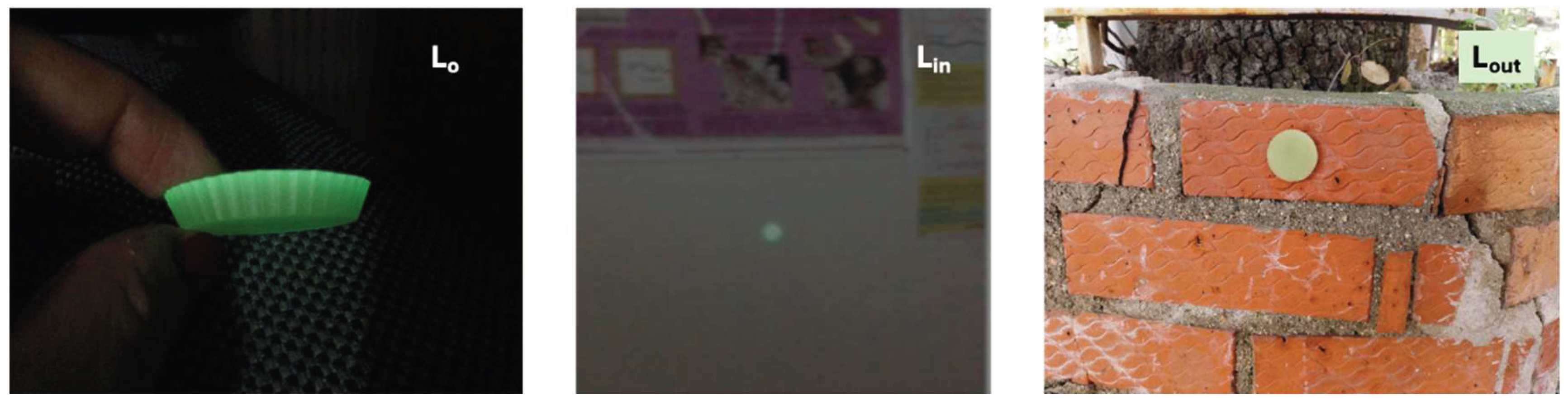
Figure 2.
Evolution of climatic variables (maximum/minimum temperatures, precipitation and humidity) over the period of exposure to the weather (15 years).
Figure 2.
Evolution of climatic variables (maximum/minimum temperatures, precipitation and humidity) over the period of exposure to the weather (15 years).
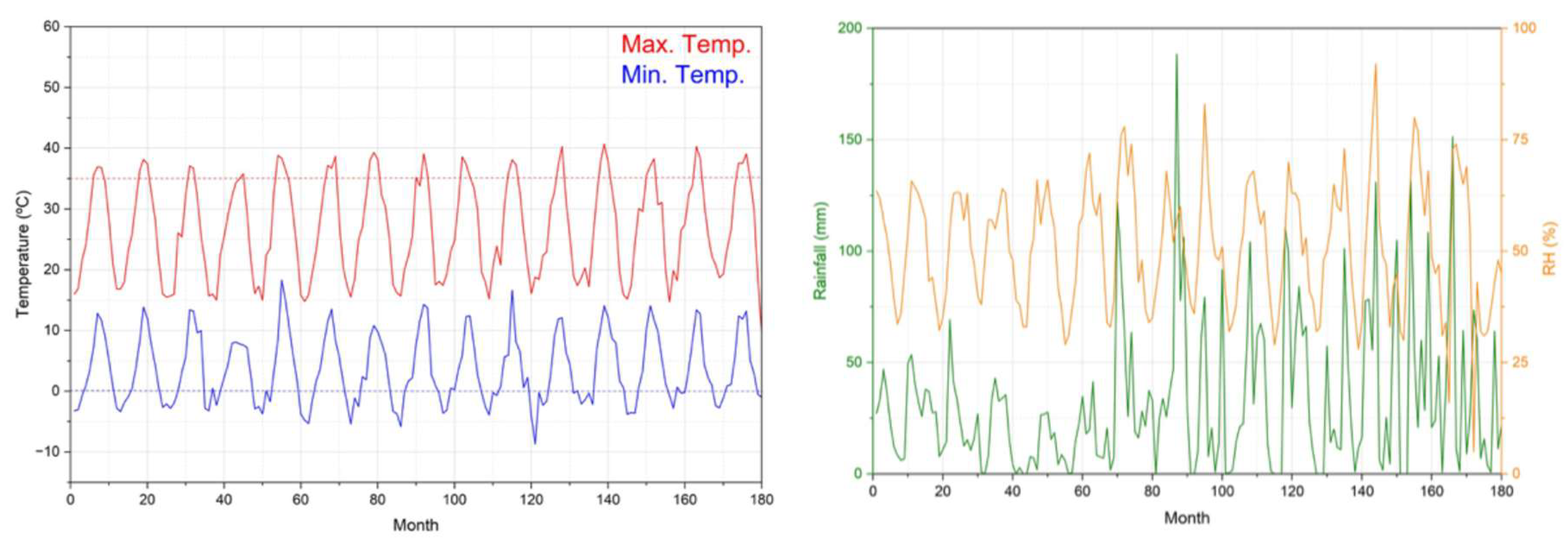
Figure 3.
FTIR spectra of original and aged luminescent materials.
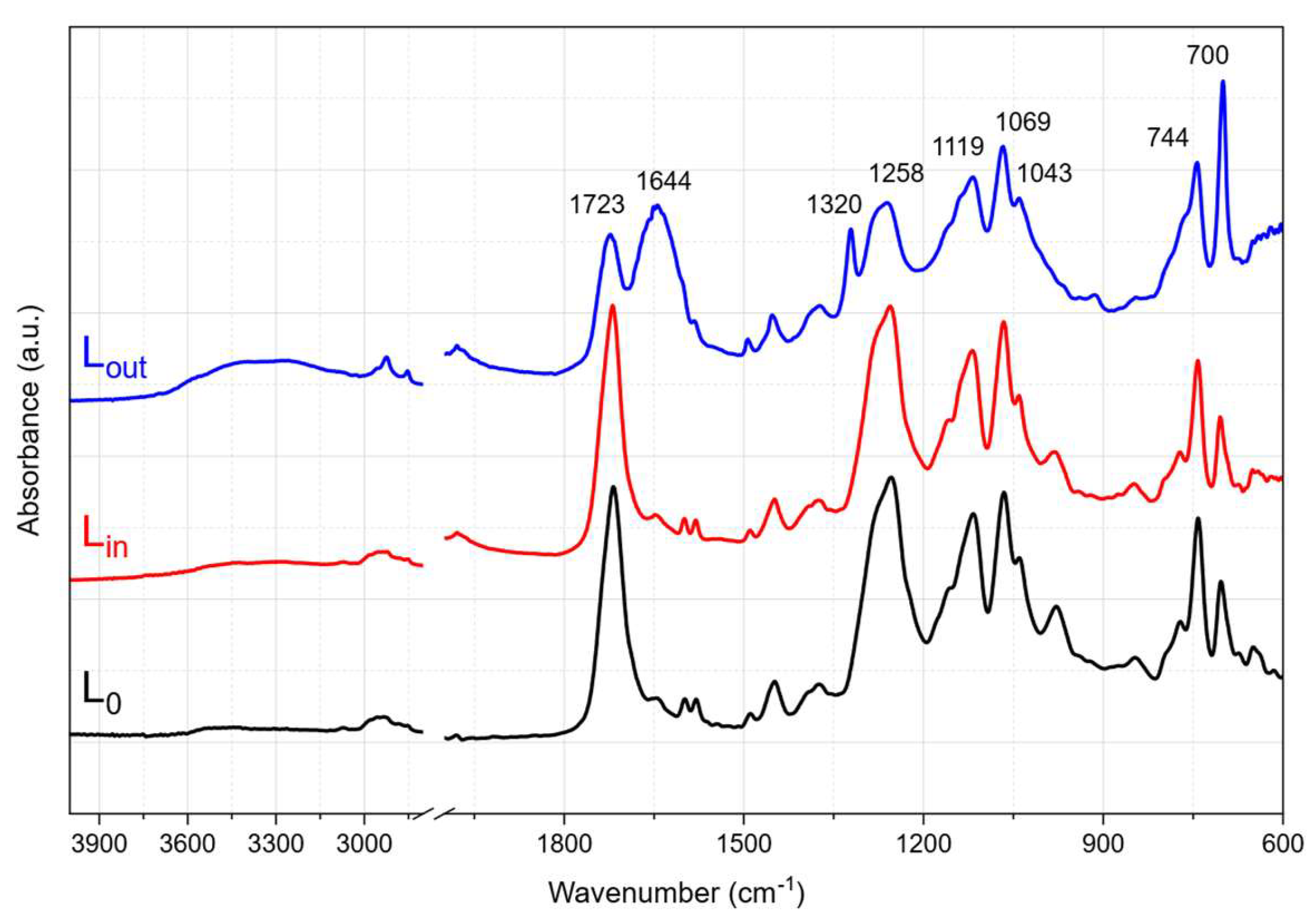
Figure 4.
Raman spectra of original and aged luminescent materials.
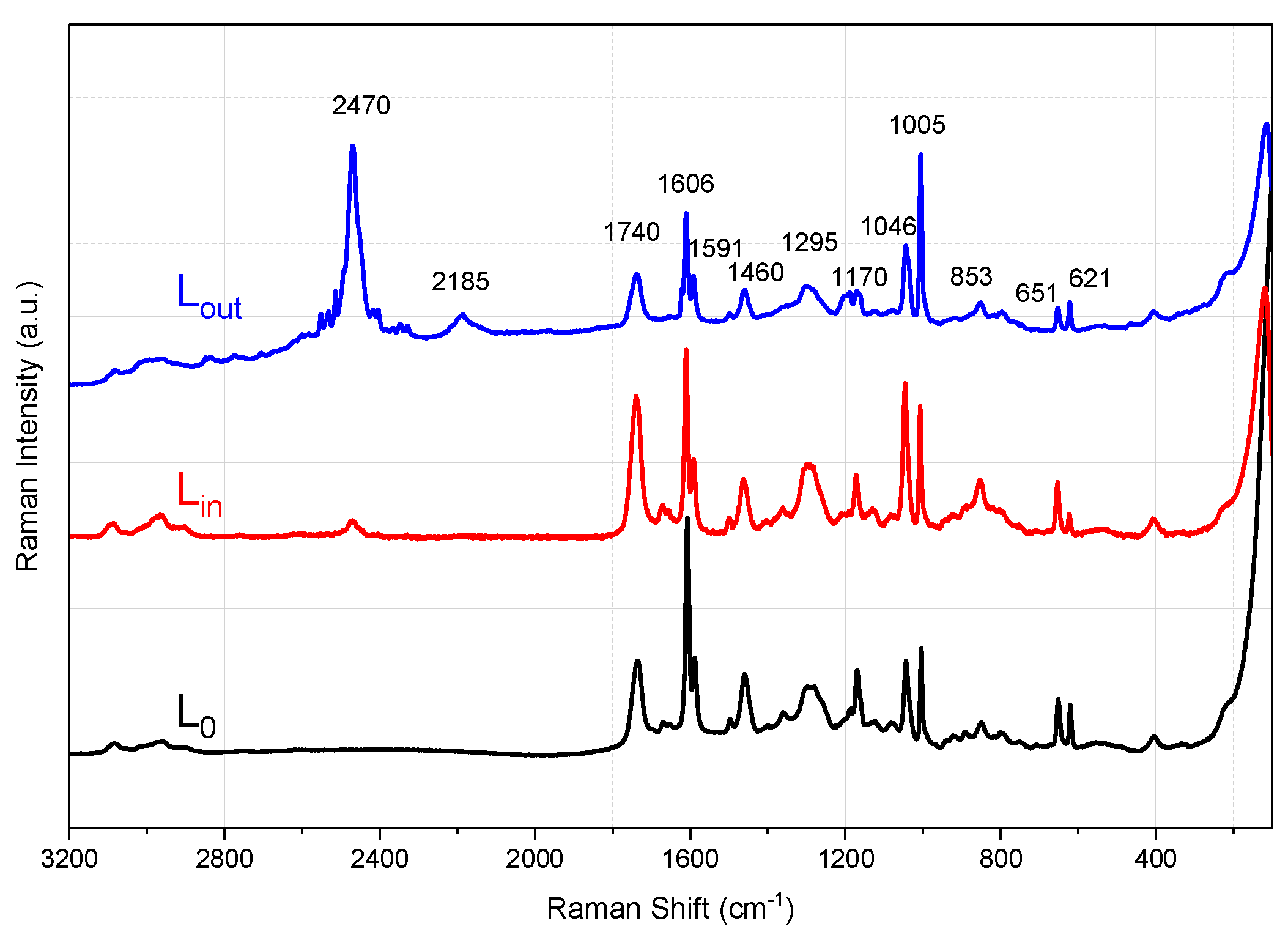
Figure 5.
FE-SEM pictures of samples Lin and Lout, at different magnifications.
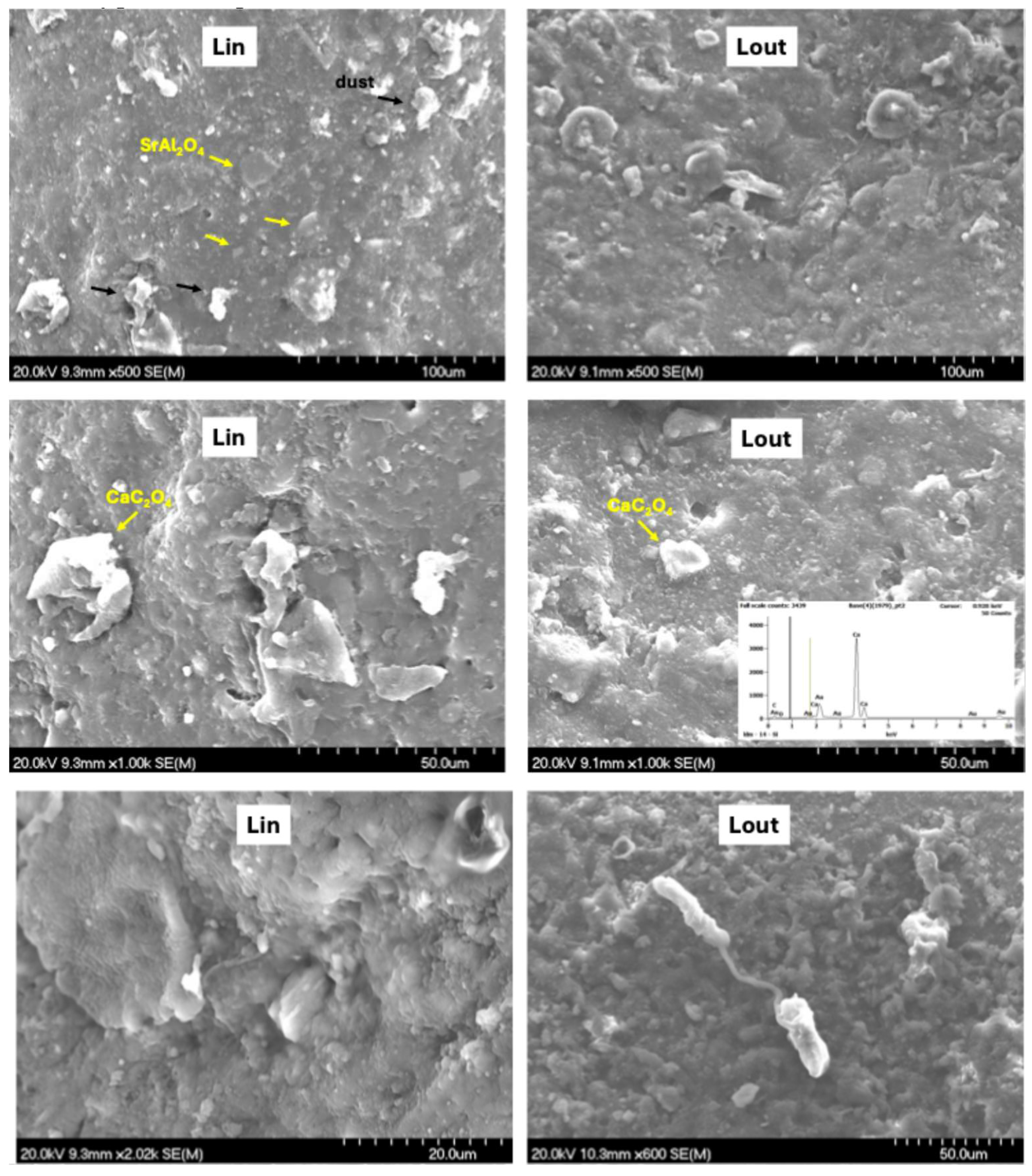
Figure 6.
Flexural strength curves of the studied luminescent materials.
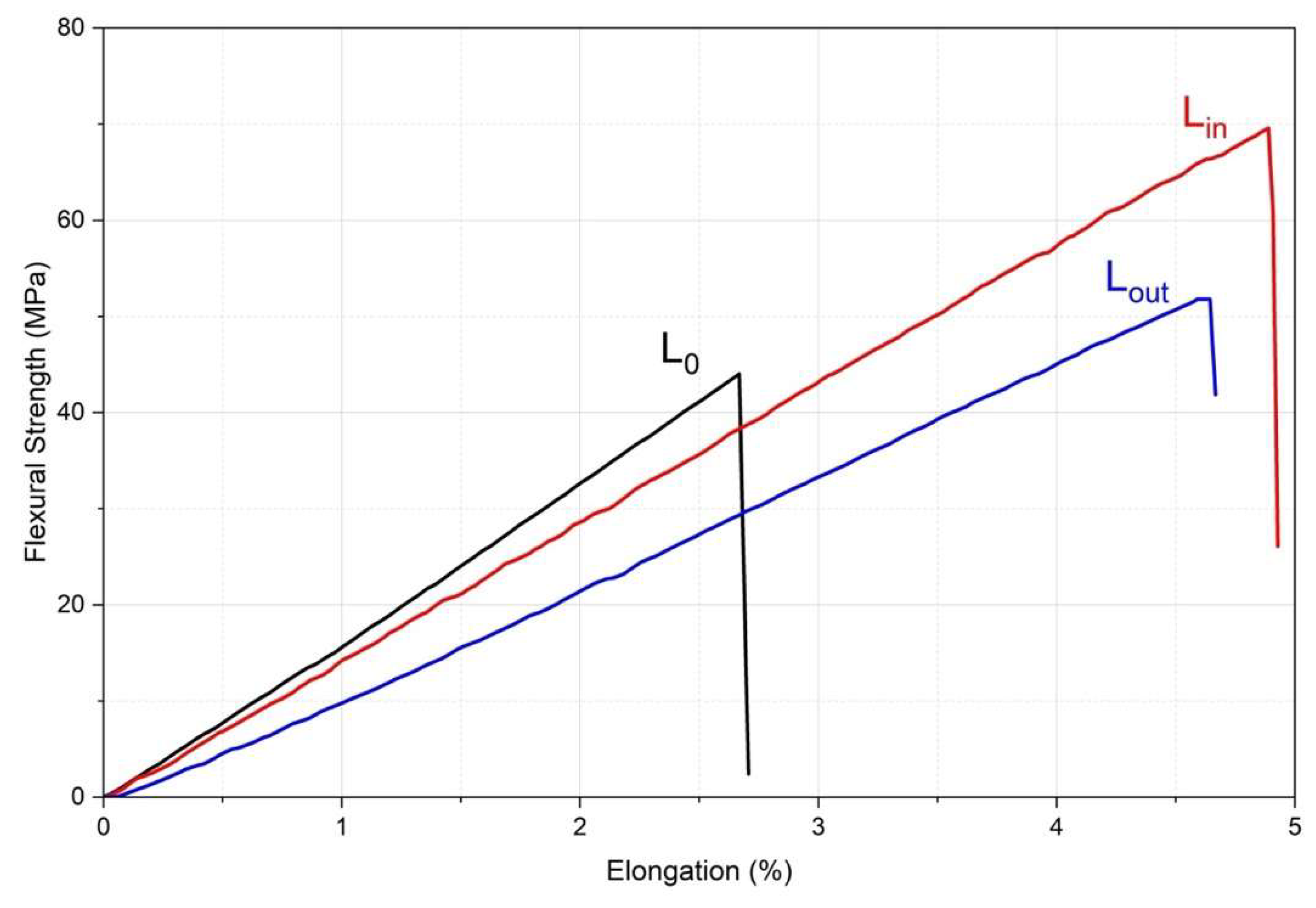
Figure 7.
The phosphorescence intensity decay with time for L0, Lin and Lout after 10 minutes of light stimulation.
Figure 7.
The phosphorescence intensity decay with time for L0, Lin and Lout after 10 minutes of light stimulation.
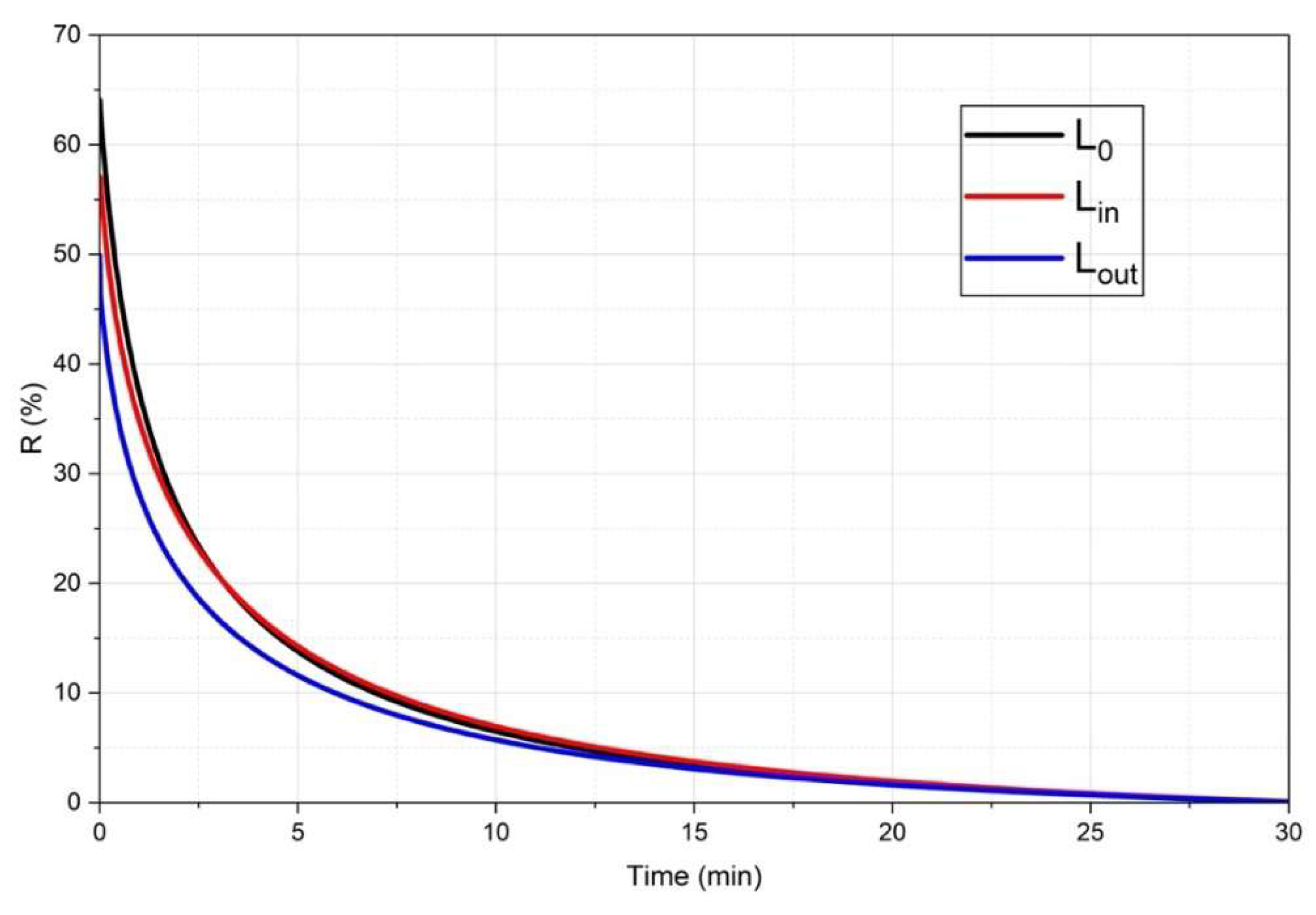
Figure 8.
FTIR spectra exterior aged luminescent polished and unpolished.
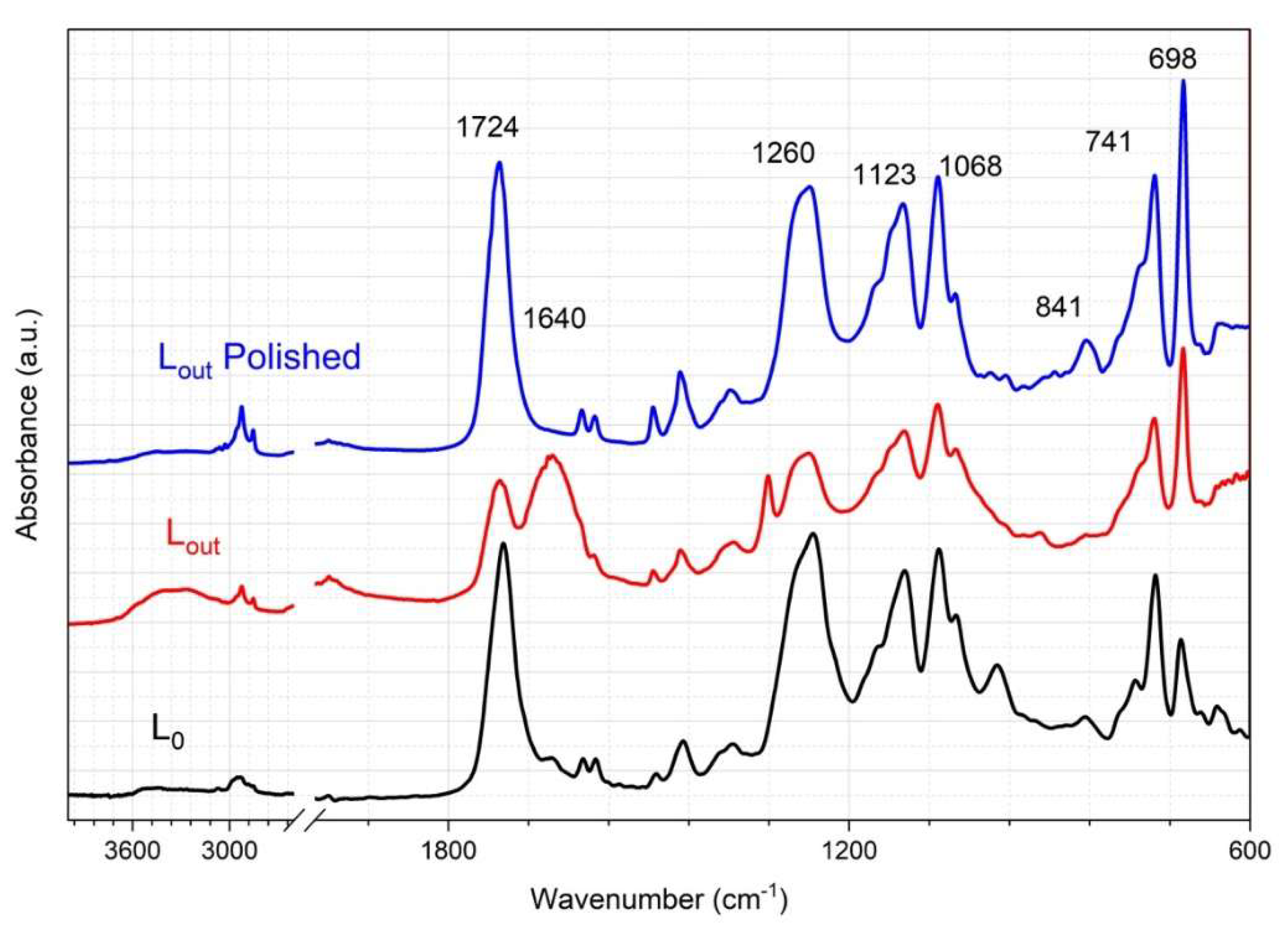
Figure 9.
Raman spectra exterior aged luminescent polished and unpolished.
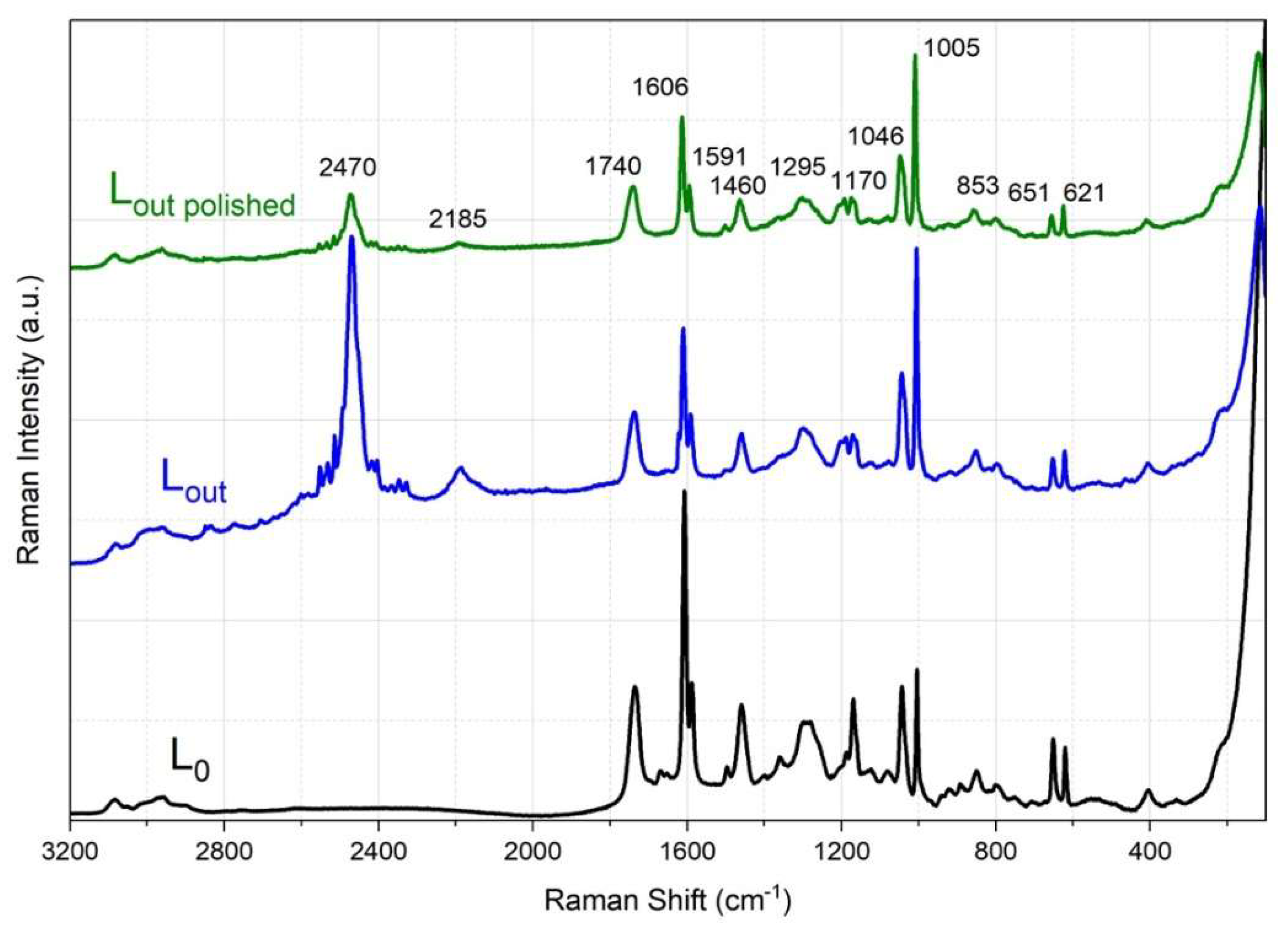

Table 1.
Data of tensile strength, modulus of elasticity and microhardness.
| MOR (MPa) | Young (GPa) | Microhardness (GPa) | |
|---|---|---|---|
| L0 | 44 ± 2 | 3.9 ± 0.1 | 0.14 ± 0.01 |
| Lin | 72 ± 4 | 3.6 ± 0.1 | 0.33 ± 0.01 |
| Lout | 54 ± 3 | 3.8 ± 0.1 | 0.37 ± 0.01 |
Table 2.
Parameters obtained from exponential fit.
| I0 | A1 | t1 (min) | A2 | t2 (min) | |
|---|---|---|---|---|---|
| L0 | 64 | 33.98 | 1.121 ± 0.008 | 27.62 | 6.97 ± 0.03 |
| Lin | 57 | 26.97 | 1.105 ± 0.008 | 27.93 | 7.31 ± 0.03 |
| Lex | 50 | 22.35 | 1.034 ± 0.008 | 22.84 | 7.34 ± 0.04 |
Table 3.
CIELAB color coordinates of luminescent aged materials.
| Coordinates | Polyester resin | Lin | Lout |
|---|---|---|---|
| L* | 46.3 | 37.71 | 42.63 |
| a* | -3.10 | -3.73 | -3.78 |
| b* | 9.91 | 11.17 | 14.86 |
Table 4.
CIELAB color coordinates of luminescent aged materials.
| Coordinates | Polyester resin | Lin | Lout | Lin | Lout |
|---|---|---|---|---|---|
| Unpolished | Polished | ||||
| L* | 46.3 | 37.71 | 42.63 | 39.3 | 43.5 |
| a* | -3.10 | -3.73 | -3.78 | -4.45 | -3.8 |
| b* | 9.91 | 11.17 | 14.86 | 11.4 | 13.9 |
Disclaimer/Publisher’s Note: The statements, opinions and data contained in all publications are solely those of the individual author(s) and contributor(s) and not of MDPI and/or the editor(s). MDPI and/or the editor(s) disclaim responsibility for any injury to people or property resulting from any ideas, methods, instructions or products referred to in the content. |
© 2026 by the authors. Licensee MDPI, Basel, Switzerland. This article is an open access article distributed under the terms and conditions of the Creative Commons Attribution (CC BY) license (http://creativecommons.org/licenses/by/4.0/).
Copyright: This open access article is published under a Creative Commons CC BY 4.0 license, which permit the free download, distribution, and reuse, provided that the author and preprint are cited in any reuse.


