
Submitted:
01 July 2026
Posted:
01 July 2026
You are already at the latest version
Abstract
The root development strategies of individual varieties are key factors in adaptability. In our experiment, the root morphological characteristics of three winter wheat varieties were examined at soil depths of 30, 60, and 90 cm throughout the growing season using the CI-600 in situ root scanner. Plants were grown under optimal water supply and simulated drought conditions. After maturity, a complete biomass and yield analysis was conducted, and the connection between the root structure and production biology parameters was evaluated. There were significant differences in the root structure among the varieties. The root length of the Mv-Kolompos remained stable in the upper and middle soil layers even under water shortage. Mv-Verbunkos had an extensive root system, but the roots were concentrated in the upper soil layers and showed growth in this layer under drought conditions. The root length and surface of the Aura variety were lower than those of the other two varieties; however, the lateral roots of this genotype rapidly reached the deeper soil layers. However, even with regulated root development, this variety was unable to offset the negative effects of drought, and both biomass production and yield decreased significantly as a result of water shortage.
Keywords:
rooting habit
; water shortage
; climate change
; sustainable crop production
; CI-600 in situ root scanner
1. Introduction
The rising temperatures and shifting precipitation patterns associated with climate change are well-known global phenomena. The frequency and intensity of drought have increased in almost all agricultural areas, resulting in reduced crop yields and increased uncertainty in this strategic sector [1]. Wheat (Triticum aestivum L.) is considered one of the most significant staple foods on a global scale. Its grains possess a high degree of versatility, serving as a raw material for a variety of end uses in human nutrition and animal feed. The straw's potential applications include incorporation into the soil as a carbon source, utilisation as mulch to mitigate evaporation, and use as fodder or a substrate for cultivated fungi production. In 2024, the global area dedicated to wheat cultivation exceeded 220 million hectares. The total harvested yield was 787 million tons, with an average yield of 3.6 tons per hectare [2]. In 2024, the "EU-27" countries contributed 15.1% of the global wheat grain production, with an average yield of 5.3 tons per hectare [2].
The adverse effects of climate change have had a harmful impact on wheat production in numerous regions worldwide [3]. The frequency and intensity of extreme droughts are increasing, and in conjunction with rising average temperatures and the occurrence of heat waves. These factors can substantially diminish wheat productivity. Shifts in climatic conditions have led to changes in agronomic practices, which may result in earlier sowing-to-ripening, shortened grain filling under heat stress, which may result in lower grain yield and quality. In the Pannonian lowlands (comprising Hungary, parts of Serbia, Romania, southern Slovakia, and western Ukraine), an anticipated escalation in summer heat and drought has been identified. This phenomenon, if left unaddressed through adaptation measures, will pose an augmented risk of yield losses [4]. Early-maturing wheat cultivars have been developed, exhibiting heat and drought tolerance. These cultivars have the potential to enhance water management strategies when applicable [5].
Wheat is among the most extensively studied crops. Numerous studies have examined the adverse effects of water scarcity on crop productivity and water utilisation efficiency [6,7]. A significant number of publications prioritise the aboveground biomass, the characteristics of biomass components, yield, and the quantity and quality of yield [8,9,10,11]. A substantial body of research has been dedicated to understanding the physiological processes that contribute to the drought and heat stress tolerance of wheat plants [12,13]. However, there is a lack of information regarding the role of the root system and its development during the vegetation period. Roots have been demonstrated to play a pivotal role in the adaptation potential of wheat varieties to water-limited environments [14]. Consequently, it is imperative to examine how genotypes respond to water scarcity through the analysis of rooting strategy, root depth, and root morphological parameters [15].
The accurate examination of belowground plant organs in vivo poses a significant challenge. Conventional destructive methods, such as soil coring or standard mini rhizotrons, are limited in scope due to their inability to repeatedly measure root development and turnover [16]. These methods also face challenges in covering the complete growth cycle of plants and ensuring the reliability of measurements in undisturbed plant stands. It is important to note that alternative non-destructive methods possess considerable limitations. For instance, impedance spectroscopy is capable of capturing only a few general parameters [17]. Moreover, MRI and CT technologies are prohibitively expensive and largely restricted to small pot experiments [18]. Another potential limitation of these studies is that they frequently permit examination of the roots of only a few plants. However, these approaches are unable to take into account plant-to-plant interactions. Conversely, in situ root scanning technology that utilises transparent polycarbonate tubes permits continuous, repeated monitoring of root habits in the same positions from planting to harvest [19]. At the HUN-REN Centre for Agricultural Research, a sophisticated experimental system was developed that can be operated in greenhouses under controlled environmental conditions. This system can simulate real field conditions regarding the plant density.
The objectives of the present experimental study were threefold: (1) to screen the rooting strategy of wheat varieties exhibiting different levels of drought tolerance; (2) to examine the differences in root development at various soil layers during the vegetation period; and (3) to analyse the correlation between specific root parameters and production-related parameters under conditions of optimum watering and drought stress.
2. Materials and Methods
2.1. Plant Material and Growth Conditions
The study was conducted from February 1 to June 6, 2025, in the experimental greenhouse of the Agricultural Institute, HUN-REN Centre for Agricultural Research, Hungary. The experiment involved the testing of three winter wheat (Triticum aestivum L.) varieties (Mv-Kolompos, Mv-Verbunkos, Aura) showing different drought tolerances and root biomass in previous experiments [20,21] (Table 1).
In the preliminary experiment, a large variety assessment was exposed to polyethene glycol (PEG) addition in hydroponic conditions, and Aura demonstrated a good adaptation ability to drought, exhibiting a moderate degree of root length reduction. Mv-Kolompos has a large root system; however, under osmotic stress conditions, its root system underwent a significant reduction. Mv-Verbunkos demonstrated sensitivity to drought, and the same patterns of osmotic stress were identified in terms of root parameters as were observed for Mv-Kolompos.
Germinated seedlings with uniform vigour were planted in peat blocks and vernalized at a temperature of 4°C for six weeks. The seedlings were planted in plastic containers measuring 120 cm × 90 cm × 100 cm, which contained approximately 1,000 litres of a homogeneous mixture of soil, sand, and humus in a 3:1:1 (v/v) ratio. Water-soluble fertiliser (14% N, 7% P2O5, 21% K2O, 1% Mg, 1% B, Cu, Mn, Fe, Zn; Volldünger Classic; Kwizda Agro Ltd., Vienna, Austria) was supplied in accordance with the manufacturer's instructions. The plant density was set at 450 plants per square meter, which aligns with the prevailing local agricultural practice (Figure 1 and Figure 2).
The air temperature and the additional light intensity in the greenhouse chambers were regulated automatically. The air temperature was elevated from an initial range of 10–12°C to 24–26°C over a period of 16 weeks. Concurrently, the air humidity was maintained within the range of 60% to 80%, a target that was achieved through the regulation of the greenhouse chambers' air circulation [22]. At the onset of the vegetation period, the intensity of natural light was augmented by artificial illumination to 500 μmol m–2s–1. This intensity was then incrementally elevated to 700 μmol m–2s–1. Two applications of Thiovit Jet fungicide (Syngenta AG, Basel, Switzerland) (active ingredient: sulfur) and Karate 2.5 WG insecticide (Syngenta AG, Basel, Switzerland) (active ingredient: lambda-cyhalothrin) were made against powdery mildew and aphids, respectively. These applications were made at stages 23 and 37 of the BBCH scale [23].
The containers were separated into two equal parts (optimum watered and drought-stressed) by using water-insulating PVC foil (thickness 0.3 mm) [16]. Each treatment consisted of eight rows, with each row containing 28 plants, resulting in a total of 224 plants per treatment.
The water-holding capacity of the soil was determined by employing the gravimetric method before the initiation of the experiment. The control treatments were irrigated during the study until reaching an optimal level (60% of maximum soil water-holding capacity). The water content of the soil was monitored by 5TE sensors (Decagon Devices Ltd., USA) in three depths (30, 60, and 90 centimetres). Drought stressed palnts did not receive additional irrigation after planting until the soil volumetric water content decreased to below 10–12% (mean of the three depths). The plants in the drought stress treatment were irrigated initially at the BBCH 51 stage, 68 days after planting. Subsequently, half-strength water doses were administered to the stress-treated stands, in comparison to the control group. During the re-watering period, the average soil volumetric water content in the control treatment was 18-20 v/v%, while in the drought-stressed treatment, 10-12 v/v%.
2.2. Measurements
In order to create an experimental apparatus, three transparent polycarbonate tubes were installed in the containers. The tubes were arranged in a horizontal position at soil depths of 30, 60, and 90 centimetres, respectively (Figure 2). The root development/turnover was monitored every two weeks in the same positions of the tubes by a CI-600 in situ root imager (CID-Bioscience Ltd., USA). Each polycarbonate tube contained both control and stress-treated samples, so four measurements (two control and two stress-treated) could be taken from a single tube. The dimensions of the container and the scanner parameters (200 mm measurement length) allowed for two parallel measurements to be taken in a single tube within the segment corresponding to the same treatment. The plant phenophases were ranked according to the BBCH-scale (Table 2) [23].
The RootSnap software (CID-Bioscience Ltd., USA) was utilised for image processing and determining root parameters, including root length, root diameter, and root surface area. Concurrently, the temperature and moisture content of the soil were monitored in the three layers using 5TE sensors and EM50 data loggers (Decagon Devices Ltd., USA).
Upon attaining full ripeness, the entire plant population was manually harvested in a systematic, eight-replication manner (one row was one replication), and the two lateral rows were excluded from the statistical analysis. The total aboveground biomass and grain weight were measured using a digital balance (accuracy: 0.001 g) (model ME 1002E, Mettler-Toledo Ltd., USA). The harvest index (Equation 1) was subsequently calculated.
2.3. Statistical Analysis
The experimental design consists of three varieties, two watering levels, and three soil layers. To ascertain the disparities in root development, the mean of the two parallel measurements was utilised. The impact of the genotypes and the watering levels on biomass, yield, and harvest index was determined by two-way ANOVA, and the means were compared by Tukey's HSD test (p≤ 0.05). The data were processed using the Microsoft Excel software. For the statistical analysis, the R (version 3.4.1) [24] statistical environment was applied. The Agricolae package [25] was utilised for the analysis of variance (ANOVA) and subsequent post hoc tests. The generation of plots was accomplished by employing the ggplot2 [26] package.
3. Results
3.1. Root Length
The root length was influenced by three factors: genotype, soil depth, and water regime throughout the experimental period. Across treatments, root length exhibited a negative correlation with soil depth, suggesting that root development is concentrated in the upper soil layers. Under well-watered conditions, the highest average root length was observed in Mv-Kolompos (1,342 millimetres), followed by Mv-Verbunkos (1,216 millimetres) and Aura (1,168 millimetres). Across all genotypes, root length exhibited a maximum at a depth of 30 centimetres and subsequently diminished in a progressive manner toward the 90-centimetre depth (Figure 3).
The response to drought stress exhibited variation among genotypes. In Mv-Kolompos, it was observed that at the 30-centimetre and 60-centimetre depths, there was only a slight reduction in root length, with a decrease of −9.3% and −1.6%, respectively. However, at the 90-centimetre depth, a substantial decrease was noted, with a loss of −45.3% in root length. The results indicate that the root system exhibits relative stability in the upper and middle soil layers. However, it demonstrates a limited capacity to sustain root growth in deeper soil layers under conditions of water deficit. The genotype's adaptability is primarily attributable to its robust rooting capacity, which establishes a strong rooting habit between the soil's surface and a depth of 60 centimetres.
Conversely, Mv-Verbunkos demonstrated a noticeable stimulatory reaction to drought in the upper soil layer. Under drought stress, at 30 centimetres soil depth, an increase in root length was observed (30%) in comparison with the control treatment. The mean root length of Mv-Verbunkos exhibited minimal variability at 60 cm soil depth throughout the vegetation period, with no significant differences observed among the various watering levels. However, an average of 40.4% reduction in root length was recorded at 90 cm. The enhanced root development in the upper soil layer may be indicative of an adaptive strategy intended to enhance water acquisition under water-limited conditions. The efficacy of this strategy is contingent upon the recovery of the water supply during the vegetation period. However, given the predominance of shallow roots, this genotype has the capacity to rapidly utilise the available water in the upper soil layer.
A comprehensive examination revealed that Aura exhibited the most compact root system among the varieties examined. In contrast to the findings observed in the Mv-Kolompos and Mv-Verbunkos, the root length of Aura exhibited a notable reduction in root length in the upper soil layer (0-30 cm) between the BBCH 37 and BBCH 69 stages when the water demand of the plant is at the highest level. Nevertheless, a more significant decrease was identified in the 30-60 cm layer (31% compared to the control), indicating a distinct pattern of variation in root length distribution across varying soil depths. However, a decline in root length was evident after the sixth week of the experiment in the 60–90 centimetre depth (Figure 3).
Temporal dynamics revealed a gradual increase in root length throughout the experimental period in most genotype × treatment combinations. The divergence between the control plants and those subjected to drought stress became more pronounced during subsequent measurement dates. This finding suggests that the cumulative effects of water deficit intensified over time. Although variability between replications was generally low to moderate, larger standard deviations were occasionally observed in specific sampling dates. These results suggest the presence of genotype-dependent differences in root growth responses.
Overall, Mv-Kolompos exhibited the most robust root length retention across the various treatments, while Mv-Verbunkos demonstrated the most pronounced adaptive response to drought stress within the upper soil layer. In contrast, Aura demonstrated the most significant sensitivity to water limitation in the middle soil layer and exhibited the least reaction in root length between 60 and 90 centimetres under drought-stressed conditions compared with the control.
3.2. Root Surface Area
The root surface area exhibited a significant response to genotype, soil depth, and water regime. An analysis of the data revealed a general trend of decreasing root surface with increasing soil depth. This phenomenon was particularly pronounced at the 90-centimetre depth. This finding suggests that the majority of root development becomes apparent between the soil's surface and a depth of 60 centimetres. It is most obvious in the upper soil layers, especially under drought stress conditions. In the well-irrigated control treatment, on average of the vegetation period, Mv-Verbunkos demonstrated the biggest mean root surface area (approximately 4000 mm² at 30 cm depth), with Mv-Kolompos and Aura following closely behind (3705 mm² and 3383 mm², respectively). For all genotypes, the root surface exhibited a tendency to decrease from 30 centimetres toward 90 centimetres of depth, although the magnitude of this decrease differed among cultivars (Figure 4).
In the case of Mv-Kolompos, a different impact of drought stress on the root surface area in relation to soil depth was observed. At 30 centimetres depth, a reduction in root surface area was observed in response to drought stress, representing a 6.4% decrease compared to the control treatment. In contrast, no significant differences in root surface area were observed at 60 centimetres. However, a significant reduction was observed in root surface area (an average of the measurements) from the sixth week of the experiment at 90 centimetres, with a decrease of 46.8%.
Mv-Verbunkos exhibited the most pronounced positive response to drought stress in the upper soil layer. The root surface exhibited an increase from 4,086 mm², as measured in the fourth week under control conditions, to 5,248 mm² in the tenth week under optimal watering conditions. After this period, root destruction became evident. At a measurement of 60 centimetres, no significant differences were observed in the root surface area between the two watering treatments. The investigation revealed that the root surface at 90 centimetres did not exhibit differences for Mv-Verbunkos until the sixth week. However, following that period, a significantly larger root surface area was observed under optimal irrigation. The results indicate that drought stimulates root proliferation near the soil surface; however, there is a negative response in the deeper soil layers.
Aura showed the highest sensitivity to drought stress. The root surface exhibited a decline of approximately 10.1%, 29.4%, and 12.1% at 30-, 60-, and 90-centimetre depths, respectively, in comparison to the control treatment (Figure 4). In the upper soil layer, a slight reduction in root surface area was detected between the flag leaf stage and the end of flowering. However, no visible differences were observed between the two treatments at the termination of the vegetation period. The most noticeable negative response to water shortage was observed at the 60-centimetre depth, where drought resulted in a nearly one-third reduction in root surface area compared to the control treatment. It was observed that the roots of the Aura reached the deeper layer more quickly under drought conditions than under optimum watering. However, after the beginning of heading (BBCH 51), the root surface of Aura decreased significantly. The results of the study indicate a limited capacity of Aura to maintain root expansion under conditions of water limitation.
The root surface exhibited an increase that was progressive during the growing period in the majority of genotype × treatment combinations. Subsequent sampling dates revealed increasingly noticeable differences between the control and drought-stressed treatments, indicative of the cumulative impacts caused by prolonged water limitation. The error bars indicated a general moderate variation between replications, although variability increased at the later measurement dates, particularly in treatments exhibiting vigorous root growth.
3.3. Root Diameter
The plant developmental stages were the primary factor influencing root diameter, with the other factors under consideration generally exhibiting comparatively minor effects in relation to that observed for root length and root surface. Across all treatments, the mean root diameter ranged from approximately 0.50 to 0.92 millimetres. The largest root diameters were documented at depths of 30 and 60 centimetres. Conversely, smaller root diameters were observed at a depth of 90 centimetres, where the prevalence of fine roots was predominant. In contrast to the effects of drought stress on root length and root surface area, root diameter exhibited a reduced sensitivity to these environmental pressures.
The treatment effects remain relatively minor, indicating that drought primarily influenced root architecture through alterations in root proliferation and elongation rather than through significant modifications in root thickness. Among the cultivars investigated, Mv-Kolompos exhibited the most consistent stability in root diameter across varying soil depths. Mv-Verbunkos, despite its favourable responses in root length and root surface traits, demonstrated a reduction in root diameter at 90 centimetres depth under conditions of drought stress (Figure 5). The temporal trends in root diameter demonstrate that the thick main roots initially extend to the various soil layers. The significant decrease in root diameter indicates that the proportion of fine roots diminishes as time progresses. The 90-centimetre soil layer was penetrated by the roots of Mv-Kolompos until the heading time under well-watered conditions. Roots were first observed in this layer during the flag leaf stage. A similar pattern was detected for Mv-Verbunkos, but in the case of this genotype, the data indicate that even the thick main roots reach this layer during the tillering stage, but only under well-watered conditions. Aura was the only genotype in which roots reached the deepest layer earlier in the drought stress treatment than under control conditions. A notable distinction was identified at a soil depth of 60 centimetres among the genotypes during the initial phases of vegetation. In the case of Mv-Kolompos and Mv-Verbunkos, the proportion of thicker roots is dominant until the tillering stage under drought-stressed conditions. In contrast, the average root diameter of Aura was significantly smaller until this phanophase. These results suggest that the water shortage resulted in the drought mitigation strategy of Aura reaching the deeper soil layers more rapidly, while Mv-Kolompos and Mv-Verbunkos developed an extensive root structure in the upper and middle soil layers.
3.4. Aboveground Biomass
Two-way ANOVA revealed significant effects of genotype (F1,30 = 43.75, p < 0.001) and watering treatment (F1,30 = 423.30, p < 0.001) on biomass production. The genotype × treatment interaction was also significant (F2,30= 4.10, p = 0.048) (Table 3).
The maximum aboveground biomass was recorded in Mv-Verbunkos under control conditions (38.28 ± 2.10 g), which did not differ significantly from the biomass of Mv-Kolompos (35.60 ± 3.22 g) (Table 4). However, a significantly lower biomass production was observed for Aura (27.85 ± 2.98 g) in comparison with the other two genotypes under optimum watering. The lowest grain yield was observed in Aura under drought stress (10.60 ± 2.58 g). The drought treatment significantly reduced the biomass production in all genotypes. The smallest reduction in biomass under water-limited conditions was determined for Mv-Kolompos (43.82%), while the largest was observed for Aura (61.9%), compared to the well-watered control. In the context of drought stress, Tukey's HSD test revealed no statistically significant differences in the biomass of Mv-Kolompos (20.00 ± 2.50 g) and Mv-Verbunkos (17.50 ± 2.05) (Table 4). However, within this treatment, the biomass production of Aura remained significantly lower than that of the other two genotypes.
3.5. Grain Yield
Two-way ANOVA confirmed significant effects of genotype (F1,30 = 35.79, p < 0.001), watering treatment (F1,30 = 486.13, p < 0.001), and genotype × treatment interaction (F2,30 = 4.02, p = 0.028) on grain yield (Table 5).
Under optimum watering, the highest grain yield was recorded for Mv-Verbunkos (17.2±1.29g), which was in pair with Mv-Kolompos (16.48±1.92g). As illustrated by the trends described in the evaluation of biomass production, Aura produces a significantly lower yield (11.77 ± 1.67 g) in comparison to the other two varieties (Table 6).
The impact of drought stress on grain yield was found to be genotype-dependent, with significant variations observed among the different cultivars. This outcome underscores the importance of considering genotype as a crucial factor in understanding and mitigating the effects of abiotic stress on crop productivity. Under drought stress conditions, Mv-Kolompos exhibited the highest grain yield (6.75 ± 1.30 g), which did not differ significantly from that of the Mv-Verbunkos (4.72 ± 1.07 g). The grain yield of Aura was found to be 2.28 grams, with a standard deviation of 1.21 grams. This value was significantly lower than the grain yield of Mv-Verbunkos (3.2 grams); however, no significant differences can be confirmed between the grain yield of Aura and Mv-Verbunkos (Table 6).
3.6. Harvest Index
The two-way ANOVA revealed a significant genotype effect (F1,30 = 17.57, p 0.001), a significant watering treatment effect (F1,30 = 217.75, p 0.001), and a significant genotype × watering interaction effect (F2,30 = 4.94, p = 0.014) on the harvest index. The interaction of the two factors was found to be significant, indicating that the genotypes exhibited divergent responses to drought stress (Table 7).
Under control conditions, no significant differences were detected among the three genotypes according to Tukey's HSD test. The highest harvest index was observed for Mv-Kolompos (46.23), while the lowest was for Aura (42.14) (Table 8). Drought stress significantly reduced the harvest index in all cultivars, indicating that the decrease in grain yield was considerably greater than the rate of reduction in byproducts, such as leaves and stems. However, the extent of the reduction in harvest index varied among the genotypes. The most significant decline in the harvest index was documented in Aura, where it was 51.83% lower under conditions of drought stress compared to the well-watered control. The observed decrease in the harvest index was moderate for Mv-Verbunkos (40.5% compared to the control), while the most favourable trends in the changes of the harvest index were determined for Mv-Kolompos, which experienced a 27.52% reduction in the harvest index under drought stress compared with the control (Table 8).
3.7. Complex Evaluation of Rooting Habits and Their Responses to Drought Stress Tolerance
The findings of this study indicate that the observed relationship between root pattern and yield/biomass is predominantly attributable to root development in the deeper soil layers (60–90 cm). A decline in yield and biomass was observed in all varieties due to water scarcity. The yield of the Mv-Kolompos variety exhibited the least decrease (6.75 g), despite demonstrating significant root length in the 60-cm layer, even under dry conditions. A significant proportion of the Mv-Verbunkos root system was concentrated in the top 30 centimetres, and root length in the 90-centimetre layer exhibited a substantial decrease under drought stress treatment. Concurrently, the variety's yield underwent a substantial decline. In the case of Aura, total root length was found to be lower than that measured for the other two varieties, which was accompanied by the lowest yield and biomass. A more extensive total root system has generally been associated with higher yields and biomass. In the context of drought conditions, deeper rooting (60–90 cm) emerged as a particularly prominent strategy, as these layers have been shown to retain available water for extended periods. Notably, even under conditions of drought, Mv-Kolompos exhibited the capacity to develop and maintain a pronounced root system in the 60-centimetre layer, thereby mitigating the decline in yield and biomass. In conditions of drought, the root system of Mv-Verbunkos exhibited a marked tendency to concentrate in the upper soil layer. This phenomenon is likely to have exerted a detrimental effect on the water supply, thereby compromising the stability of crop yield. Aura exhibited a less developed and smaller root system, which resulted in diminished yields under both control and drought stress conditions.
4. Discussion
Drought stress is among the most significant environmental factors determining wheat productivity on a global scale, primarily by affecting root development, biomass accumulation, and grain formation. Water deficit has been demonstrated to result in a reduction of photosynthetic activity, assimilate production, and reproductive success, which ultimately leads to significant yield losses [27]. The present study confirmed significant genotype-dependent differences in root system architecture and drought adaptation among the three winter wheat cultivars, highlighting the vital role of rooting depth and root distribution in maintaining productivity under water-limited conditions.
Across all genotypes, root length and root surface area decreased with increasing soil depth, confirming that the majority of root development occurred within the upper 60 centimetres of the soil profile. A similar vertical root distribution has been reported in wheat and other cereal crops, where the majority of roots are concentrated in the upper soil layers due to greater nutrient availability and lower soil mechanical resistance [28]. However, the capacity to maintain active roots in deeper soil layers has been linked to enhanced drought tolerance, as deeper soil layers exhibit prolonged moisture retention during progressive drying [29,30]. In accordance with this concept, Mv-Kolompos demonstrated the largest root system in the 60–90 cm layers under drought stress and exhibited the highest grain yield and harvest index under water-limited conditions.
The divergent responses exhibited by Mv-Kolompos and Mv-Verbunkos exemplify two discrete drought adaptation strategies. Mv-Kolompos demonstrated relatively stable root length and root surface area in the upper and middle soil layers under drought stress, with substantial reductions occurring only at 90 cm depth. This stability was reflected in superior biomass retention and grain yield performance. As demonstrated in prior research, deep and persistent rooting has been shown to enhance water extraction during grain filling [31,32]. This phenomenon can significantly mitigate the adverse effects of terminal drought stress in wheat [33]. Passioura proposed that access to deeper water reserves is one of the most significant factors in the adaptation of cereal crops to drought, particularly in environments characterised by intermittent or terminal drought [34]. The findings obtained for Mv-Kolompos provide substantial evidence that verifies these hypotheses.
Conversely, Mv-Verbunkos exhibited an adaptive response to drought, characterised by an increase in root length and root surface area in the upper soil layer. This plasticity may be indicative of an adaptive response intended to optimise the capture of transient water resources following precipitation events. A similar drought-induced proliferation of shallow roots has been reported in wheat genotypes adapted to environments where water availability is concentrated near the soil surface [35]. However, this strategy may become disadvantageous under prolonged drought conditions, as shallow soil water reserves are known to be depleted rapidly. Consequently, although Mv-Verbunkos exhibited vigorous root development in the 0–30-centimetre layer, the substantial decline in root growth at 90 centimetres was accompanied by a distinct reduction in grain yield and harvest index. This feature is beneficial in environments with short showers. This strategy allows water to be absorbed quickly before the soil dries out. These findings suggest that root distribution throughout the soil profile is more important than total root length alone, corroborating previous observations [29,30].
Aura demonstrated the greatest sensitivity to drought among the cultivars examined. Despite reaching deeper soil layers earlier under drought conditions, the genotype maintained the smallest overall root system and experienced the strongest reductions in root surface area, particularly within the 30–60 cm soil layer. This limited root development was accompanied by the lowest biomass production, grain yield, and harvest index. Numerous studies on wheat have documented a correlation between reduced root system size and reduced drought tolerance [28,36]. The findings of this study suggest that the beginning of root penetration, in the absence of augmented overall root growth and augmented resource acquisition capacity, is inadequate to enhance drought adaptation.
In contrast to the observed effects on root length and root surface area, the impact of drought stress on root diameter appeared to be comparatively modest. Temporal variation exerted a more substantial influence on root diameter than did genotype or water regime, suggesting that root developmental stage was the primary determinant of this trait. According to the findings of previous investigations, drought-induced modifications in wheat root systems are generally driven by changes in root number, branching intensity, and elongation rather than by substantial alterations in root thickness [37,38]. The high proportion of finer roots in deeper soil layers, as observed in the present study, may contribute to enhanced water uptake efficiency. This is due to the fact that fine roots possess a larger absorptive surface area relative to their biomass investment.
The substantial genotype × treatment interactions observed for biomass, grain yield, and harvest index further underscore the pivotal role of root traits in determining drought responses. A substantial decline in biomass production was observed among all cultivars under drought stress conditions. However, the reduction observed in Mv-Kolompos was the least massive, while Aura exhibited the most pronounced decrease. Similar trends were observed for grain yield and harvest index, suggesting that the maintenance of root functionality under drought directly supports carbon assimilation and reproductive development. As Blum underscored, the evaluation of drought tolerance should be predicated on yield maintenance instead of vegetative growth alone [39]. In this respect, Mv-Kolompos exhibited the most favourable balance between root development and grain production under water deficit.
The combined analysis of root characteristics and agronomic performance clearly suggests that drought tolerance is more closely associated with root persistence in deeper soil layers than with augmented root proliferation near the soil surface [40]. This finding aligns with recent breeding efforts that identify deep rooting as a promising target for enhancing drought resilience in wheat. The enhanced performance exhibited by Mv-Kolompos seems to be associated with its capacity to sustain an active root system in soil layers where water remained accessible during prolonged periods of drought. In contrast, the drought response strategy of Mv-Verbunkos was marked by intensive exploitation of the upper soil layer, while Aura exhibited generally insufficient root development throughout the soil profile.
5. Conclusions
The results demonstrate that genotypic variation in root architecture plays a central role in determining drought adaptation. Among the cultivars that were studied, Mv-Kolompos exhibited the most effective combination of root traits for maintaining biomass accumulation, grain yield, and harvest index under conditions of water limitation. In contrast, Mv Verbunkos follows a different type of strategy, which also helps to postpone the appearance of the harmful physiological consequences caused by drought. These findings align with the rising consensus that selective breeding for enhanced root system development, characterised by increased depth and persistence, holds considerable potential in enhancing the drought resilience of wheat under future climate scenarios, which are projected to be marked by rising water deficits in frequency and intensity. Identifying genotypes with different rooting strategies can aid in plant breeding for drought tolerance and offers the possibility of combining individual root development strategies. As a result, by selecting genotypes that develop deep roots as well as extensive root systems in the upper soil layer, breeding lines can be produced that efficiently utilise water reserves stored in the soil, and are also capable of absorbing moisture that arrives in the form of precipitation during the generative growth stage but penetrates only shallowly into the soil.
Author Contributions
Conceptualization, B.V. and M.Gy.; methodology, B.V.; software, A.M.; validation, K.M., A.M.; formal analysis, B.V.; investigation, B.V.; resources, K.M.; data curation, M.Gy.; writing—original draft preparation, B.V.; writing—review and editing, K.M.; visualization, M.Gy.; supervision, K.M.; project administration, B.V.; funding acquisition, B.V. All authors have read and agreed to the published version of the manuscript.
Funding
This research was funded by MINISTRY OF INNOVATION AND TECHNOLOGY OF HUNGARY FROM THE NATIONAL RESEARCH, DEVELOPMENT AND INNOVATION FUND, grant number: TKP-2021-NKTA-06 and by the HUNGARIAN ACADEMY OF SCIENCES, grant number: BO/00384/23/4.
Data Availability Statement
The original contributions presented in this study are included in the article. Further inquiries can be directed to the corresponding author.
Conflicts of Interest
The authors declare no conflicts of interest. The funders had no role in the design of the study; in the collection, analyses, or interpretation of data; in the writing of the manuscript or in the decision to publish the results.
References
- Malhi, G.S.; Kaur, M.; Kaushik, P. Impact of climate change on agriculture and its mitigation strategies: A review. Sustain. 2021, 13(3), 1–21. [Google Scholar] [CrossRef]
- FAO. Food Outlook – Biannual report on global food markets. Food Outlook, November 2024. Rome. 2024.
- Farhad, M.; Kumar, U.; Tomar, V.; Bhati, P.K.; Krishnan, J. N.; Kishowar-E-Mustarin; et al. Heat stress in wheat: a global challenge to feed billions in the current era of the changing climate. Front Sustain Food Syst. 2023, 7(July), 1–24. [Google Scholar]
- Bueechi, E.; Fischer, M.; Crocetti, L.; Trnka, M.; Grlj, A.; Zappa, L.; et al. Crop yield anomaly forecasting in the Pannonian basin using gradient boosting and its performance in years of severe drought. Agric. Meteorol. [Internet] 2023, 340(May), 109596. [Google Scholar] [CrossRef]
- Varga, B.; Farkas, Z.; György, M.; Varga-László |, Emese; Veisz |, Ottó. Journal of Agronomy and Crop Science Combined Effects of Water Shortage and CO2 Enrichment on Yield and Water Use Properties of Barley (Hordeum vulgare L.) Genotypes. J. Agron. Crop Sci. [Internet] 2026, 212, 70215. [Google Scholar] [CrossRef]
- Zia, R.; Nawaz, M.S.; Siddique, M.J.; Hakim, S.; Imran, A. Plant survival under drought stress: Implications, adaptive responses, and integrated rhizosphere management strategy for stress mitigation. Microbiol. Res. 2021, 242, 126626. [Google Scholar] [CrossRef] [PubMed]
- Dong, B.; Shi, L.; Shi, C.; Qiao, Y.; Liu, M.; Zhang, Z. Grain yield and water use efficiency of two types of winter wheat cultivars under different water regimes. Agric. Water Manag [Internet] 2011 Nov [cited 2015 Oct 20], 99(1), 103–10. Available online: http://www.scopus.com/inward/record.url?eid=2-s2.0-80052722414&partnerID=tZOtx3y1.
- Lan, Y.; Chawade, A.; Kuktaite, R.; Johansson, E. Climate Change Impact on Wheat Performance-Effects on Vigour, Plant Traits and Yield from Early and Late Drought Stress in Diverse Lines. Int. J. Mol. Sci. [Internet] 2022, 2022, 3333. [Google Scholar] [CrossRef] [PubMed]
- Ortiz-Bobea, A.; Ault, T.R.; Carrillo, C.M.; Chambers, R.G.; Lobell, D.B. Anthropogenic climate change has slowed global agricultural productivity growth. Nat. Clim. Chang [Internet] 2021, 11, 306–12. [Google Scholar] [CrossRef]
- Liu, X.; Ma, Q.; Yu, H.; Li, Y.; Zhou, L.; He, Q.; et al. Responses of plant biomass and yield component in rice, wheat, and maize to climatic warming: a meta-analysis. Planta [Internet] 1, 90. [CrossRef] [PubMed]
- Ekele, J.U.; Webster, R.; Perez de Heredia, F.; Lane, K.E.; Fadel, A.; Symonds, R.C. Current impacts of elevated CO2 on crop nutritional quality: a review using wheat as a case study. Stress Biol. [Internet] 2025, 5(1). [Google Scholar] [CrossRef] [PubMed]
- Williams, D.G.; Gempko, V.; Fravolini, A.; Leavitt, S.W.; Wall, G.W.; Kimball, B a.; et al. Carbon isotope discrimination by Sorghum bicolor under CO2 enrichment and drought. New Phytol. 2001, 150(2), 285–93. [Google Scholar] [CrossRef]
- Gbadegesin, A.; Pande, C.; Vidyapeeth, P.K.; Sami, I.; Milan, G.; Orimoloye, I.R. Agricultural Drought and Its Potential Impacts: Enabling Decision-Support for Food Security in Vulnerable Regions. 2022, 6, 838824. Available online: www.frontiersin.org. [CrossRef]
- Nyaupane, S.; Poudel, M.R.; Panthi, B.; Dhakal, A.; Paudel, H.; Bhandari, R. Drought stress effect, tolerance, and management in wheat–a review. Cogent Food Agric. [Internet] 2024, 10(1). [Google Scholar] [CrossRef]
- Kou, X.; Han, W.; Kang, J. Responses of root system architecture to water stress at multiple levels: A meta-analysis of trials under controlled conditions. 2022. Available online: www.webofscience.com/.
- Varga, B.; Farkas, Z.; Varga-László, E.; Vida, G.; Veisz, O. Elevated Atmospheric CO2 Concentration Influences the Rooting Habits of Winter-Wheat (Triticum aestivum L.) Varieties. Sustain 2022, 14(6). [Google Scholar] [CrossRef]
- Liu, Y.; Li, D.; Qian, J.; Di, B.; Zhang, G.; Ren, Z. Electrical impedance spectroscopy (EIS) in plant roots research: a review. Available online: http://creativecommons.org/licenses/by/4.0/.TheCreativeCommonsPublicDomainDedicationwaiver.
- Metzner, R.; Eggert, A.; van Dusschoten, D.; Pflugfelder, D.; Gerth, S.; Schurr, U.; et al. Direct comparison of MRI and X-ray CT technologies for 3D imaging of root systems in soil: potential and challenges for root trait quantification. 2012. [Google Scholar] [PubMed]
- Odone, A.; Thorup-Kristensen, K. Can rhizotron tube studies predict deep rooting in the field? A comparison of root phenotyping methods. F. Crop Res. 2025, 326. [Google Scholar] [CrossRef]
- Gyorgy, M.; Farkas, A.; Farkas, Z.; Molnar, I.; Anda, A.; Varga, B. Effects of osmotic stress on root development in winter wheat (Triticum aestivum L.) genotypes with diverse drought tolerance. J. Cent. Eur. Agric. 2025, 26(4), 1034–42. [Google Scholar] [CrossRef]
- Horváth, Á.; Kiss, T.; Berki, Z.; Horváth, Á.; Balla, K.; Cseh, A.; et al. Effects of genetic components of plant development on yield-related traits in wheat (Triticum aestivum L.) under stress-free conditions. Front Plant Sci. 2023. [Google Scholar] [PubMed]
- Tischner, T.; Kőszegi, B.; Veisz, O. Climatic programmes used in the Martonvásár phytotron most frequently in recent years. Acta Agron. Hung. 1997, 45, 85–104. [Google Scholar]
- Uwe, M. German Federal Biological Research Centre for Agriculture and Forestry - Growth stages of mono-and dicotyledonous plants. BBCH Monogr [Internet]. 2001, 115. Available online: http://pub.jki.bund.de/index.php/BBCH/article/view/515%0Ahttp://pub.jki.bund.de/index.php/BBCH/article/download/515/464%0Ahttp://pub.jki.bund.de/index.php/BBCH/article/view/515/464.
- R Development Core Team R. R: A Language and Environment for Statistical Computing [Internet]. Team RDC, editor. R Foundation for Statistical Computing. R Foundation for Statistical Computing. R Found. Stat. Comput. 2011, vol. 1, 409. Available online: http://www.r-project.org.
- Mendiburu, F. agricolae: Statistical Procedures for Agricultural Research. R package version 1.2-8. 2017. Available online: https://cran.r-project.org/package=agricolae.
- Kassambara, A. ggpubr: “ggplot2” Based Publication Ready Plots. R package version 0.4.0. 2020. Available online: https://cran.r-project.org/package=ggpubr.
- Santini, M.; Noce, S.; Antonelli, M.; Caporaso, L. Complex drought patterns robustly explain global yield loss for major crops. 123AD. [CrossRef]
- Lynch, J.P. Steep, cheap and deep: an ideotype to optimize water and N acquisition by maize root systems. Ann. Bot. 112(2), 347–57. [CrossRef] [PubMed]
- Manschadi, A.; Christopher, J.; DeVoil, P.; Hammer, G. The role of root architectural traits in adaptation of wheat to water-limited environments. Funct. Plant Biol. 2006, 33(9), 823–37. [Google Scholar] [CrossRef] [PubMed]
- Wasson, A.P.; Richards, R.A.; Chatrath, R.; Misra, S.C.; Prasad, S.V.S.; Rebetzke, G.J.; et al. Traits and selection strategies to improve root systems and water uptake in water-limited wheat crops. J. Exp. Bot. [Internet] 2012, 63(9), 3485–98. Available online: https://academic.oup.com/jxb/article-abstract/63/9/3485/583306/. [CrossRef] [PubMed]
- Lopes, M.S.; Reynolds, M.P. Partitioning of assimilates to deeper roots is associated with cooler canopies and increased yield under drought in wheat. Funct. Plant Biol. [Internet] 2010, 37(2), 147–56. [Google Scholar] [CrossRef]
- Uga, Y.; Sugimoto, K.; Ogawa, S.; Rane, J.; Ishitani, M.; Hara, N.; et al. Control of root system architecture by DEEPER ROOTING 1 increases rice yield under drought conditions. 2013. [Google Scholar] [CrossRef] [PubMed]
- Jiang, P.; Yan, J.; Liu, R.; Zhang, X.; Fan, S.; Zheng, Y.; et al. Patterns of deep fine root and water utilization amongst trees, shrubs and herbs in subtropical pine plantations with seasonal droughts OPEN ACCESS EDITED BY REVIEWED BY. Front Plant Sci. 2023, 14, 1275464. [Google Scholar] [PubMed]
- Passioura, J.B. Drought and drought tolerance. Plant Growth Regul. [Internet] 1996, 20(2), 79–83. Available online: http://www.scopus.com/inward/record.url?eid=2-s2.0-0030470640&partnerID=tZOtx3y1. [CrossRef]
- Comas, L.H.; Becker, S.R.; Cruz, M. V.; Byrne, P.F.; Dierig, D.A. Root traits contributing to plant productivity under drought. 2013. Available online: www.frontiersin.org.
- Richards, A.; Rebetzke, G.J.; Watt, M.; Condon, A.G.; Spielmeyer, W.; Dolferus, R. Breeding for improved water productivity in temperate cereals: phenotyping, quantitative trait loci, markers and the selection environment. Funct. Plant Biol. [Internet] 2010, 37, 85. Available online: https://ui.adsabs.harvard.edu/abs/2010FunPB..37...85R. [CrossRef]
- Riedelsberger, J.; Rellán-Álvarez, R.; Fotopoulos, V.; Testerink, C.; Koevoets, I.T.; Henk Venema, J.; et al. Roots Withstanding their Environment: Exploiting Root System Architecture Responses to Abiotic Stress to Improve Crop Tolerance. 2016. Available online: www.frontiersin.org.
- Tang, K.; An, C.; Li, L.; Sun, T.; Song, J.; Zhao, J. Effects of drought and salt stress on the root phenotype of wheat seedlings and underlying gene expression analysis. 2024. [Google Scholar] [CrossRef] [PubMed]
- Blum, A. Plant Breeding for water-limited environments. Springer Science + Buisness Media, LCC 233, Spring Street, New York, NY 10013 USA; 2011.
- Gao, W.; Hodgkinson, L.; Jin, K.; Watts, C.; Ashton, R.; Shen, J.; et al. Deep roots and soil structure. Plant Cell Environ. 2016, 39(8), 1662–8. [Google Scholar] [PubMed]
Figure 1.
The wheat plants growing in the containers after planting.
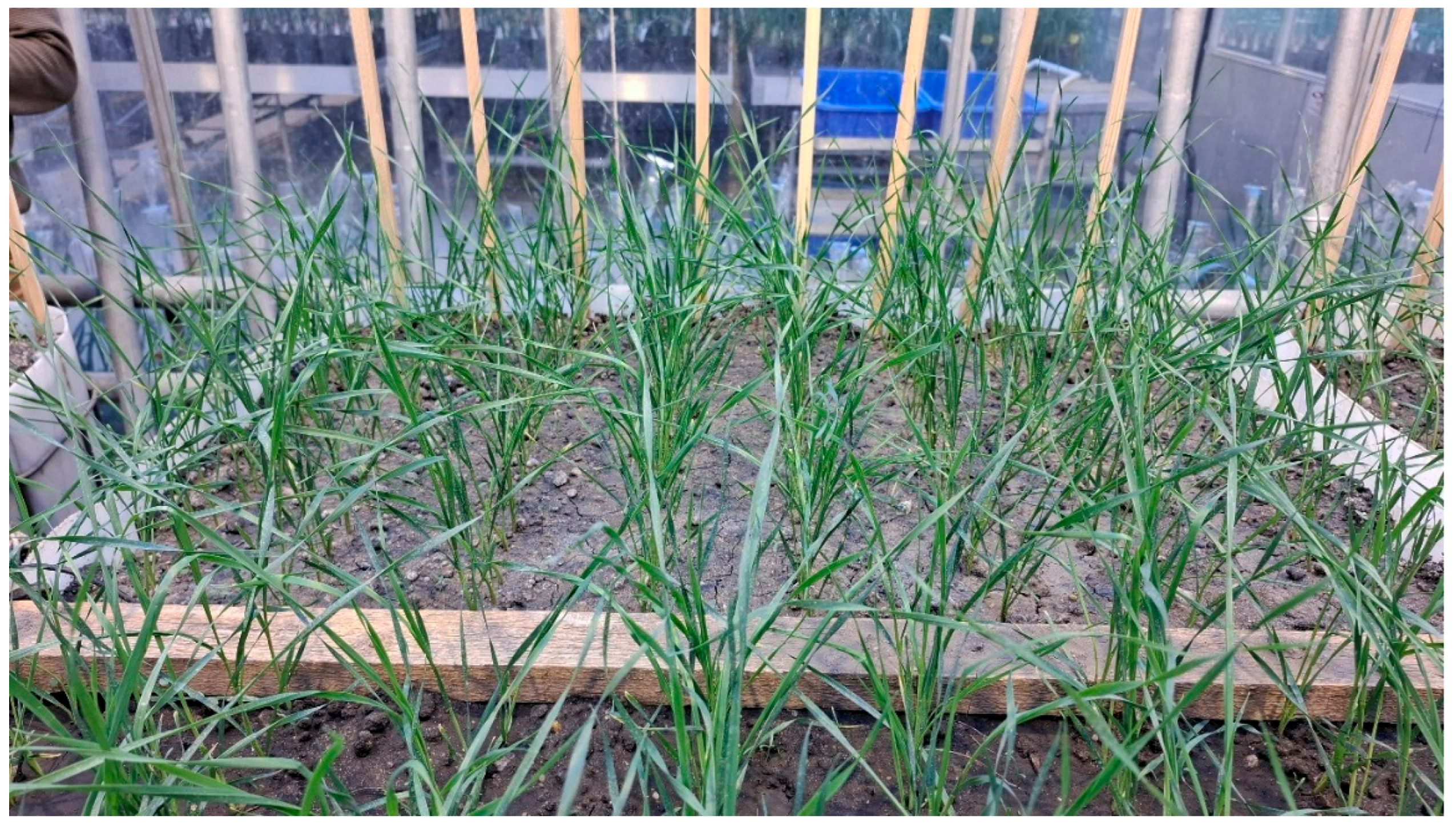
Figure 2.
The experimental design (The tubes with the black end caps are the polycarbonate tubes for scanning the root system).
Figure 2.
The experimental design (The tubes with the black end caps are the polycarbonate tubes for scanning the root system).
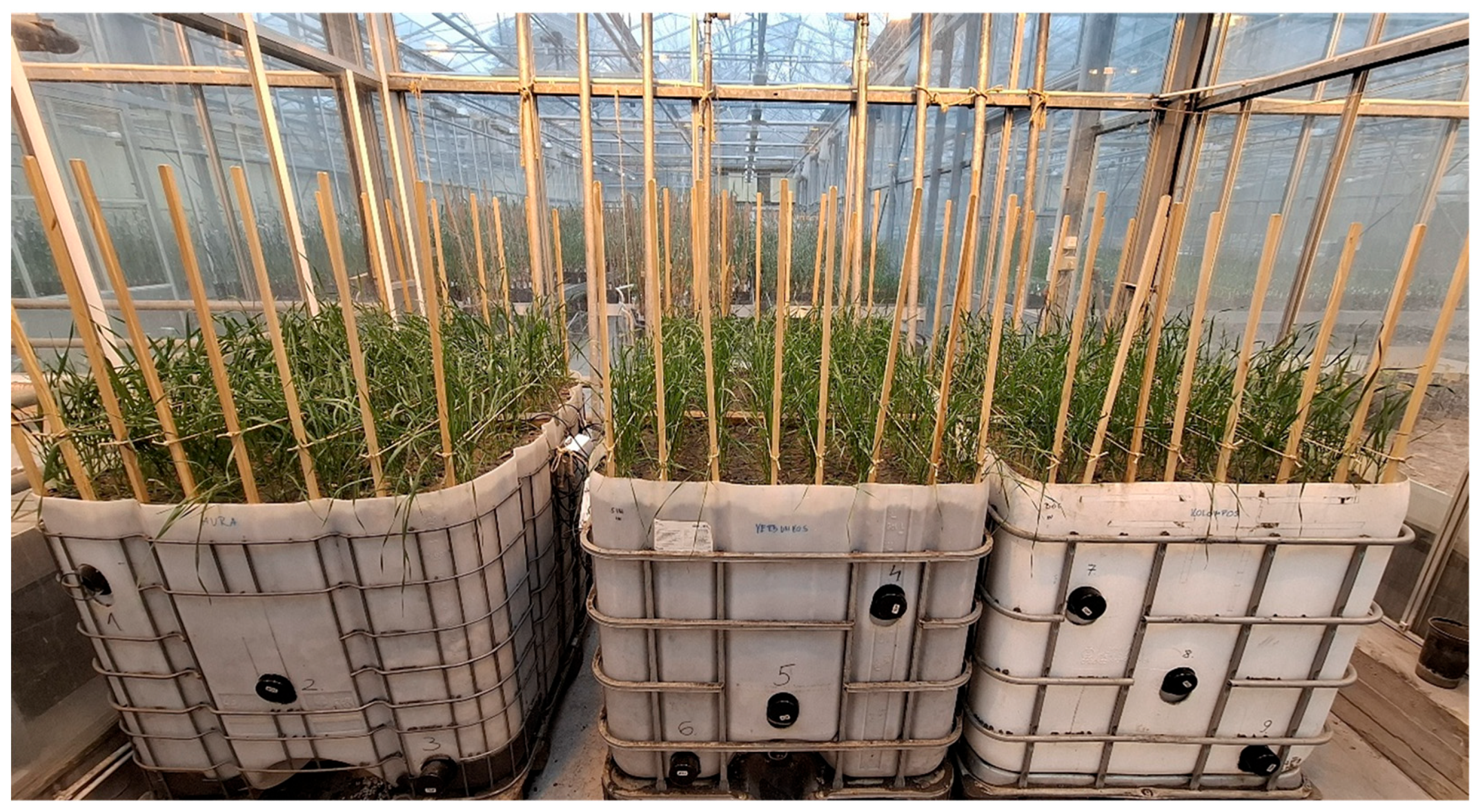
Figure 3.
Root length development of three winter wheat genotypes (Mv-Kolompos, Mv-Verbunkos, and Aura) between 14th of February and 15th of May at 30 cm, 60 cm and 90 cm soil depths.
Figure 3.
Root length development of three winter wheat genotypes (Mv-Kolompos, Mv-Verbunkos, and Aura) between 14th of February and 15th of May at 30 cm, 60 cm and 90 cm soil depths.
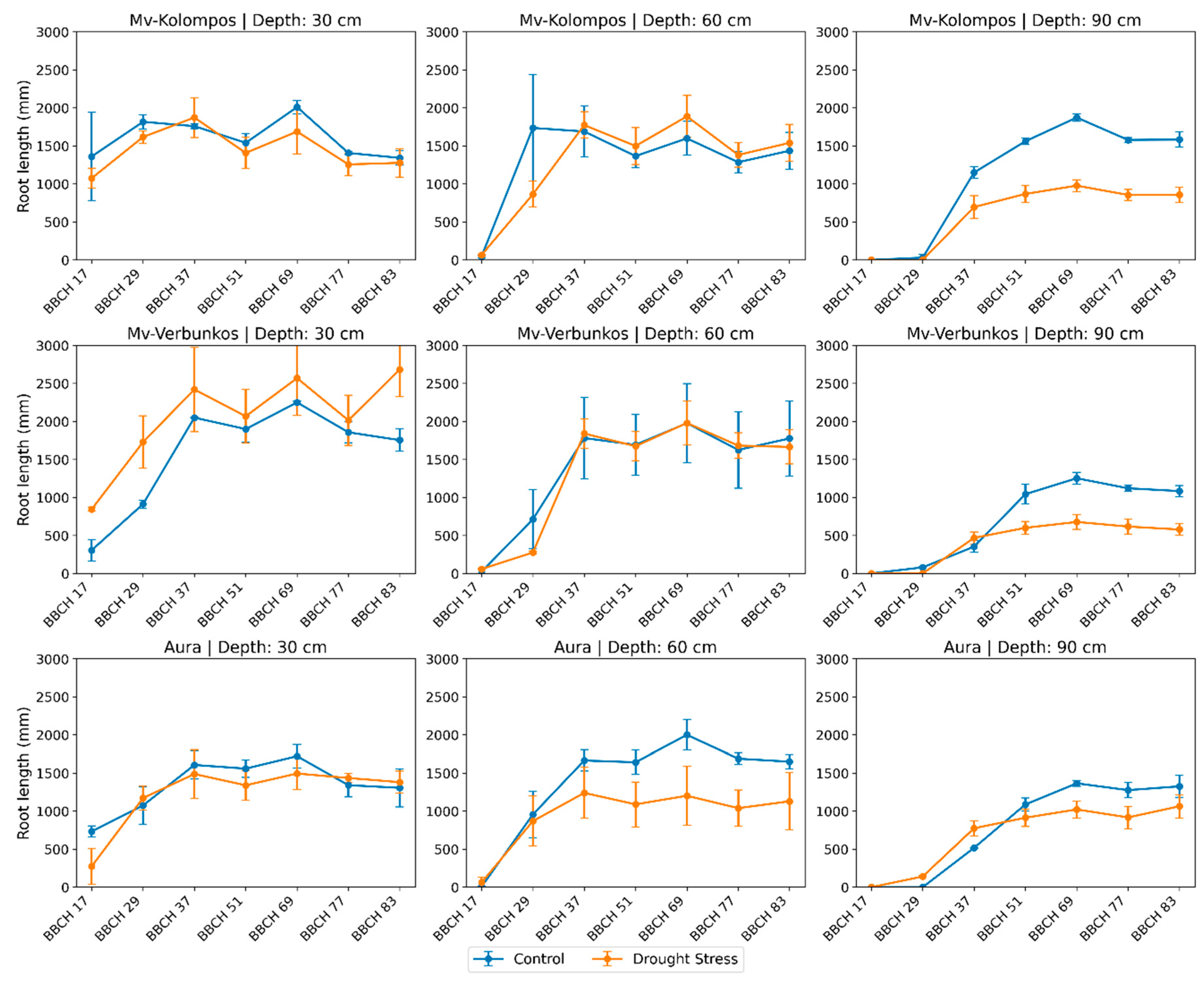
Figure 4.
Temporal changes in root surface area of three winter wheat genotypes (Mv-Kolompos, Mv-Verbunkos, and Aura) between 14th of February and 15th of May at 30 cm, 60 cm and 90 cm soil depths.
Figure 4.
Temporal changes in root surface area of three winter wheat genotypes (Mv-Kolompos, Mv-Verbunkos, and Aura) between 14th of February and 15th of May at 30 cm, 60 cm and 90 cm soil depths.
Figure 5.
Temporal changes in root diameter of three winter wheat genotypes (Mv-Kolompos, Mv-Verbunkos, and Aura) between 14th of February and 15th of May at 30 cm, 60 cm and 90 cm soil depths.
Figure 5.
Temporal changes in root diameter of three winter wheat genotypes (Mv-Kolompos, Mv-Verbunkos, and Aura) between 14th of February and 15th of May at 30 cm, 60 cm and 90 cm soil depths.
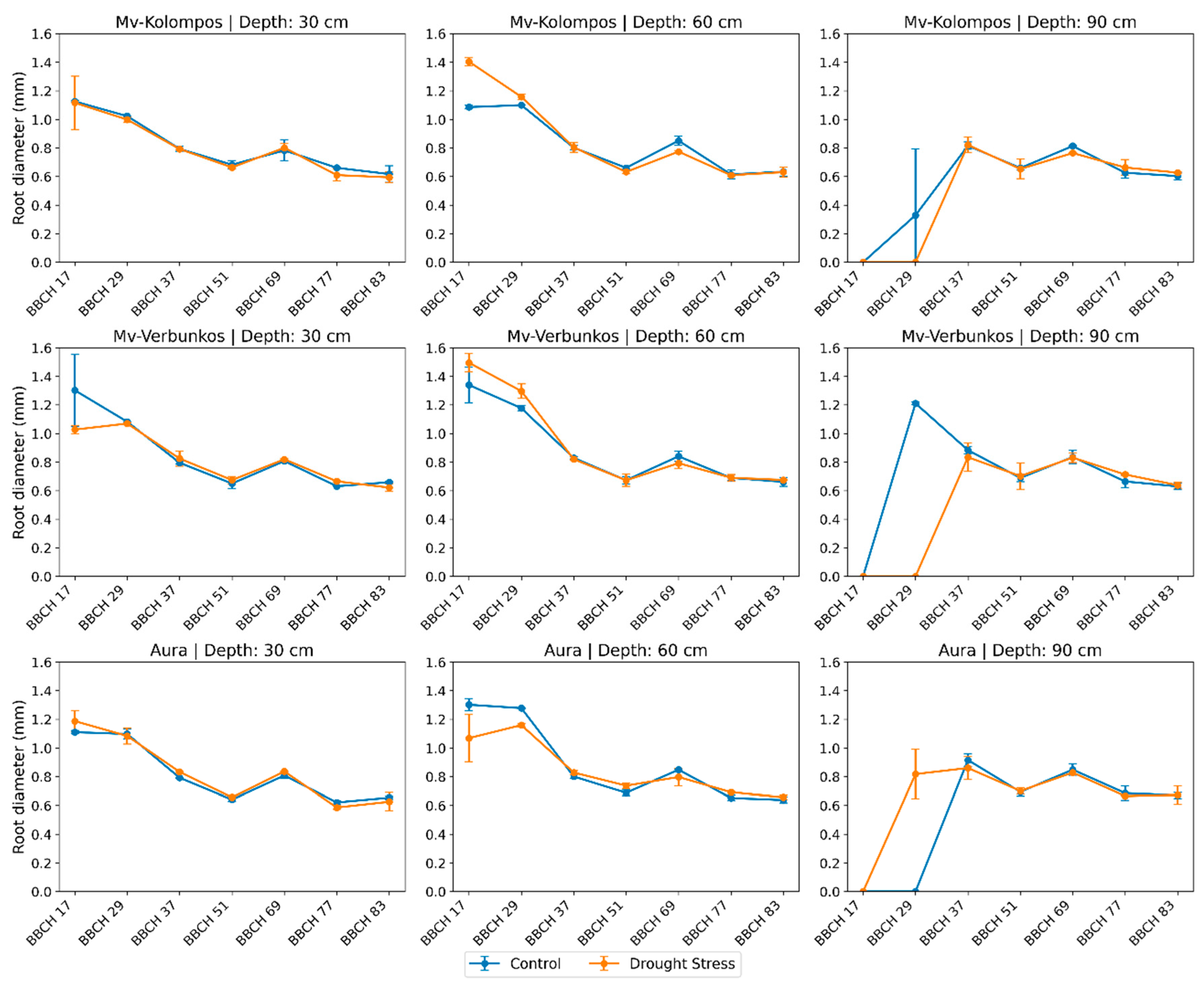

Table 1.
Origin and ripening classification of the studied genotypes [21].
Table 1.
Origin and ripening classification of the studied genotypes [21].
| Genotype | Origin | Accumulated temperature to heading (°C) |
Drought tolerance |
|---|---|---|---|
| Aura | Romania | 436.1 | Early ripening, drought-sensitive |
| Mv-Kolompos | Hungary | 456.1 | Late ripening, drought-tolerant |
| Mv-Verbunkos | Hungary | 478.1 | Late ripening, drought-sensitive |
Table 2.
List of phenophases when the root length measurements were carried out [23].
Table 2.
List of phenophases when the root length measurements were carried out [23].
| BBCH codes | Days after planting | Expalination |
|---|---|---|
| BBCH 17 | 14-16 | Leaf development, 7 or more leaves unfolded |
| BBCH 29 | 26-29 | End of tillering, the maximum number of tillers detectable |
| BBCH 37 | 41-45 | Flag leaf just visible, still rolled |
| BBCH 51 | 54-58 | Beginning of heading: the tip of the inflorescence emerged from the sheath, the first spikelet just visible |
| BBCH 69 | 67-72 | End of flowering: all spikelets have completed flowering, but some dehydrated anthers may remain |
| BBCH 77 | 80-86 | Late milk stage |
| BBCH 83 | 92-98 | Ripening, early dough |
Table 3.
Effects of the genotype and watering, as well as their interaction, on the total aboveground biomass.
Table 3.
Effects of the genotype and watering, as well as their interaction, on the total aboveground biomass.
| Source | Type III Sum of Squares | df | Mean Square | F-values | p-values |
|---|---|---|---|---|---|
| Corrected Model | 3513.209 | 5 | 702.642 | 103.399 | 0.000 |
| Intercept | 22450.028 | 1 | 22450.028 | 3303.688 | 0.000 |
| Genotype | 594.601 | 2 | 297.300 | 43.750 | 0.000 |
| Treatment | 2876.534 | 1 | 2876.534 | 423.303 | 0.000 |
| Genotype * Treatment | 42.074 | 2 | 21.037 | 4.096 | 0.048 |
| Error | 203.863 | 30 | 6.795 |
Table 4.
The total aboveground biomass of the examined genotypes under optimum watering and drought-stressed conditions (n=6; p<0.05).
Table 4.
The total aboveground biomass of the examined genotypes under optimum watering and drought-stressed conditions (n=6; p<0.05).
| Treatments | Biomass (g) mean+sd |
|---|---|
| Aura control | 27.85±2.98b |
| Aura drought stress | 10.60±2.58d |
| Mv-Kolompos control | 35.60±3.22a |
| Mv-Kolompos drought stress | 20.00±2.50c |
| Mv-Verbunkos control | 38.28±2.10a |
| Mv-Verbunkos drought stress | 17.50±2.05c |
Table 5.
Effects of the genotype and watering, as well as their interaction, on the grain yield.
| Source | Type III Sum of Squares | df | Mean Square | F-values | p-values |
|---|---|---|---|---|---|
| Corrected Model | 1169.467 | 5 | 233.893 | 113.150 | 0.000 |
| Intercept | 3504.640 | 1 | 3504.640 | 1695.429 | 0.000 |
| Genotype | 147.952 | 2 | 73.976 | 35.787 | 0.000 |
| Treatment | 1004.890 | 1 | 1004.890 | 486.133 | 0.000 |
| Genotype * Treatment | 16.625 | 2 | 8.312 | 4.021 | 0.028 |
| Error | 62.013 | 30 | 2.067 |
Table 6.
The grain yield of the examined genotypes under optimum watering and drought-stressed conditions (n=6; p<0.05).
Table 6.
The grain yield of the examined genotypes under optimum watering and drought-stressed conditions (n=6; p<0.05).
| Treatments | Grain yield (g) mean+sd |
|---|---|
| Aura control | 11.77±1.67b |
| Aura drought stress | 2.28±1.21d |
| Mv-Kolompos control | 16.48±1.92a |
| Mv-Kolompos drought stress | 6.75±1.30c |
| Mv-Verbunkos control | 17.2±1.29a |
| Mv-Verbunkos drought stress | 4.72±1.07cd |
Table 7.
Effects of the genotype and watering, as well as their interaction, on the harvest index.
| Source | Type III Sum of Squares | df | Mean Square | F-values | p-values |
|---|---|---|---|---|---|
| Corrected Model | 3359.447 | 5 | 671.889 | 52.555 | 0.000 |
| Intercept | 45705.502 | 1 | 45705.502 | 3575.038 | 0.000 |
| Genotype | 449.165 | 2 | 2783.899 | 17.567 | 0.000 |
| Treatment | 2783.889 | 1 | 63.192 | 217.754 | 0.000 |
| Genotype * Treatment | 126.383 | 2 | 12.785 | 4.943 | 0.014 |
| Error | 383.539 | 30 |
Table 8.
The harvest index of the examined genotypes under optimum watering and drought-stressed conditions (n=6; p<0,05).
Table 8.
The harvest index of the examined genotypes under optimum watering and drought-stressed conditions (n=6; p<0,05).
| Treatments | Harvest index mean+sd |
|---|---|
| Aura control | 42.14±2.11a |
| Aura drought stress | 20.30±6.90d |
| Mv-Kolompos control | 46.23±1.86a |
| Mv-Kolompos drought stress | 33.51±2.48b |
| Mv-Verbunkos control | 44.90±1.38a |
| Mv-Verbunkos drought stress | 26.71±3.63c |
Disclaimer/Publisher’s Note: The statements, opinions and data contained in all publications are solely those of the individual author(s) and contributor(s) and not of MDPI and/or the editor(s). MDPI and/or the editor(s) disclaim responsibility for any injury to people or property resulting from any ideas, methods, instructions or products referred to in the content. |
© 2026 by the authors. Licensee MDPI, Basel, Switzerland. This article is an open access article distributed under the terms and conditions of the Creative Commons Attribution (CC BY) license (http://creativecommons.org/licenses/by/4.0/).
Copyright: This open access article is published under a Creative Commons CC BY 4.0 license, which permit the free download, distribution, and reuse, provided that the author and preprint are cited in any reuse.


