
Submitted:
30 June 2026
Posted:
02 July 2026
You are already at the latest version
Abstract
Background/Objectives: Cyberbullying is a growing public health concern among university students, yet robust psychometric evidence for its assessment in Latin American higher education remains scarce. This study evaluated the factorial structure, reliability, validity, and sex invariance of the European Cyberbullying Intervention Project Questionnaire (ECIPQ) in Chilean university students. Methods: A sample of 750 students (M = 21.6 years; SD = 5.59) completed the ECIPQ. Confirmatory factor analyses using WLSMV estimation tested alternative models. Reliability was assessed with omega coefficients, convergent and discriminant validity with AVE and HTMT, and measurement invariance by sex through multigroup CFA. Results: A correlated two-factor model of cybervictimization and cyberaggression showed the best fit (CFI = 0.995, RMSEA = 0.077, SRMR = 0.084). Both subscales demonstrated satisfactory reliability (ω = 0.836 and 0.908) and convergent validity (AVE > 0.50), while HTMT supported discriminant validity. The high latent correlation (φ = 0.908) indicated substantial overlap between cybervictimization and cyberaggression. Configural, threshold, and metric invariance by sex were confirmed. Conclusions: The ECIPQ is a valid and reliable instrument for assessing cyberbullying in Chilean higher education. The strong interdependence between cybervictimization and cyberaggression suggests that these dimensions should be interpreted jointly rather than as independent roles. The findings support the use of the ECIPQ for early detection, monitoring, and integrated prevention strategies targeting cyberbullying and its impacts on student mental health and academic well-being.
Keywords:
cyberbullying
; ECIPQ
; prevention
; public health
; confirmatory factor analysis
; higher education
; cybervictimization
; cyberaggression
1. Introduction
Cyberbullying is widely recognized as a distinct form of peer violence emerging in digital environments, maintaining the classic criteria of intentionality, repetition, and power imbalance [1,2,3]. However, the transposition of these criteria to online contexts has generated conceptual and methodological challenges, particularly regarding the empirical delimitation of roles and the operationalization of power imbalance in interactions marked by technological mediation, anonymity, and high reciprocity [4,5]. These challenges are especially relevant for public health, as cyberbullying has significant implications for mental health, psychosocial functioning, and well-being across childhood, adolescence, and emerging adulthood.
In higher education, these issues become more salient. Emerging adulthood is characterized by greater autonomy, intensive digital engagement, and the centrality of social networks. Cyberbullying does not disappear during this stage; instead, it adopts forms embedded in complex relational dynamics [6,7,8]. A defining feature in university populations is the frequent coexistence of roles: students reporting cybervictimization often report cyberaggression, and vice versa. Systematic reviews confirm role overlaps in adolescents [9], while university studies document strong mutual predictability between roles using regression-based approaches [10]. Cross-cultural moderation analyses further show that campus climate and cultural context shape how consistently cybervictimization translates into cyberaggression [11]. These patterns suggest that victim and aggressor roles may constitute poles of a dynamic relational process rather than discrete categories.
Recent evidence reinforces the relevance of this relational perspective for health and well-being. Cyberbullying involvement has been associated with depressive symptoms, anxiety, emotional dysregulation, low life satisfaction, peer difficulties, and psychosocial maladjustment [12,13,14]. Protective factors such as gratitude, emotional intelligence, and positive self-concept buffer the negative consequences of cybervictimization [13,14,15,16]. Cyberbullying also co-occurs with other risky online behaviors (problematic internet use, sexting, cybergossip, cyberhate, gaming toxicity, gambling, and contact with strangers) forming a broader ecosystem of digital risks requiring integrated prevention strategies [17,18,19,20]. These findings align with the priorities of public health, which frames cyberbullying as a public health concern requiring coordinated responses across educational, clinical, and community systems.
To address these challenges, a consolidated line of research has approached cyberbullying from a behavioral perspective focused on measuring specific cybervictimization and cyberaggression behaviors. Within this framework, the European Cyberbullying Intervention Project Questionnaire (ECIPQ) was developed to assess participation in both roles through parallel behavioral items [3,21]. Importantly, the ECIPQ conceptualizes roles as relational dimensions, allowing empirical modeling of behavioral interdependence. The elevated latent correlation between its two-factors has been interpreted as a structural reflection of cyberbullying rather than a psychometric weakness [22].
The robustness of this two-dimensional model has been widely supported internationally. Multinational studies and validations in European countries confirm factor stability, reliability, and invariance by sex, consolidating the ECIPQ as a reference instrument [21,23,24]. Latin American adaptations replicate these findings, demonstrating cross-cultural applicability [25,26], including validations in Ecuador [27]. Validations in Turkey, China, Colombia, and Portugal further reinforce its relevance for screening, prevention, and psychoeducational intervention [25,28,29,30]. Beyond structural validation, the ECIPQ has supported explanatory models linking cyberbullying with problematic internet use, sexting, cybergossip, cyberhate, gaming toxicity, and other digital risks [17,18,19,20,31].
Despite this evidence, structural modeling of the interdependence between cybervictimization and cyberaggression using latent-variable methods in Latin American university populations remains unaddressed. In Chile, recent research has characterized cyberbullying in higher education through role-based classifications and prevalence estimates [32], aligning with international findings linking involvement to depressive symptoms, anxiety, emotional dysregulation, and psychosocial difficulties [12,13,14]. However, these studies rely on categorical frameworks distinguishing discrete roles rather than relational models conceptualizing cybervictimization and cyberaggression as continuous, interdependent dimensions. Evidence from adolescents suggests frequent co-occurrence and reciprocal dynamics [13,16], yet this relational perspective has not been examined through latent-variable approaches in university populations, despite calls for more sophisticated modeling [6,7].
Validating the ECIPQ in Chilean university populations thus represents a relevant contribution. While role coexistence is well established [9,10,11], international evidence shows reciprocal patterns rather than isolated roles [12,16,33]. Emotional and cognitive correlates further highlight shared pathways involving depressive symptoms, anxiety, maladaptive cognitive strategies, and socioemotional vulnerabilities [13,14]. However, the magnitude of this overlap as captured by latent-variable models remains unknown in Chilean university students, as does the replication of the ECIPQ factor structure and measurement equivalence across sexes. Structural equation modeling with robust estimators is particularly pertinent for ordinal data and university samples, where asymmetric distributions and low-frequency behaviors may compromise simpler factorial solutions [6,7].
Demonstrating factor invariance by sex is essential to ensure equivalent measurement across men and women. Evidence on gender differences in cyberbullying participation is inconsistent, making invariance testing crucial for valid interpretations [32,33]. International studies also report mixed patterns, suggesting contextual and socioemotional moderators [12,16]. Establishing invariance ensures that observed differences reflect substantive variation rather than measurement artifacts.
Integrating international evidence with validation in Chilean university students advances a more robust understanding of cyberbullying in higher education. This approach complements descriptive studies [9,10,11] and provides a psychometrically sound tool for analyzing behavioral interdependence in digital contexts. The relational nature of cyberbullying, characterized by reciprocal dynamics and shared emotional correlates [13,14], reinforces the need for validated instruments supporting early detection, prevention, and coordinated interventions across educational and health systems.
Based on the above, this study aimed to analyze the psychometric properties of the ECIPQ in Chilean university students, evaluating its factorial structure, the relationship between cybervictimization and cyberaggression, and measurement equivalence by sex.
2. Materials and Methods
To empirically examine the psychometric performance of the ECIPQ in Chilean higher education, a methodological strategy was implemented that combined a cross-sectional design, standardized behavioral measurement, and robust latent-variable modeling. The following section details the study design, participant characteristics, instruments, analytical procedures, and ethical safeguards that guided the evaluation of the factorial structure, reliability, validity, and measurement invariance of the ECIPQ in a university context.
2.1. Design and Participants
The study was conducted with a cross-sectional design in higher education students in Chile. The sample consisted of 750 participants, with ages ranging from 18 to 70 years (M = 21.6; SD = 5.59). While the mean and standard deviation of age reflect a predominantly young sample (P90 = 25 years; P95 = 31 years), 40 participants older than 30 years (5.3%) were observed, with ages reaching up to 70 years. No exclusions were made based on age, as this variable was not used as a segmentation criterion or as a predictor in the analysis. A sensitivity analysis comparing the means of the 22 ECIPQ items between the full sample and the subsample of participants aged 30 years or younger (n = 715) showed differences below 0.033 across all items, confirming that the inclusion of these cases does not materially affect the psychometric results reported.
Participants were contacted in the classroom via QR code and belonged to three universities in Santiago Metropolitan Region of Chile. The sample included students from the programs of Psychology, Industrial Engineering, Business, Accounting/Auditing, and Law. Program selection was carried out by convenience, based on high-enrolled academic programs and researchers' access to the institutions, without probabilistic sampling procedures. All participants provided informed consent and had complete data for the variables used in the psychometric analyses of the instrument.
2.2. Instruments
Cyberbullying participation was assessed using the European Cyberbullying Intervention Project Questionnaire (ECIPQ) [3,21], a widely used self-report instrument for the behavioral measurement of cybervictimization and cyberaggression in educational contexts. The ECIPQ comprises 22 items describing specific cyberbullying behaviors mediated by digital technologies, organized symmetrically into two subscales: eleven cybervictimization items, and eleven cyberaggression items (See ECIPQ Scale in Table A1, Appendix A).
The cybervictimization subscale assesses the frequency with which participants have experienced aggressive behaviors in digital environments, such as receiving insults or offensive messages online, being threatened online, being excluded or ignored in social networks or chat rooms, or suffering identity theft through unauthorized access to personal accounts (e.g., "Someone said nasty things to me or called me names using texts or online messages"; "Someone hacked into my account and pretended to be me"). The cyberaggression subscale assesses the frequency with which participants have carried out those same behaviors toward others, including insulting or threatening someone online, spreading rumors on the internet, or creating fake accounts to impersonate another person (e.g., "I said nasty things to someone or called them names using texts or online messages"; "I created a fake account, pretending to be someone else").
Responses to items are recorded on a five-point ordinal Likert scale indicating the frequency of occurrence of each behavior during a specified reference period, ranging from "never" to "several times a week", following the original format of the instrument. This structure allows the assessment of cyberbullying participation from a behavioral perspective, explicitly differentiating between victimization and aggression experiences, and recognizing the possible coexistence of both roles in a single individual.
The ECIPQ was originally developed within the framework of a European multicenter project and validated in a large sample of secondary school students from six European countries (Spain, Germany, Italy, Poland, the United Kingdom, and Greece). The original validation provided strong evidence for a two-dimensional factorial structure comprising correlated cybervictimization and cyberaggression factors, with adequate fit indices in confirmatory factor analysis (χ2[208] = 1484.15, CFI = 0.993, TLI = 0.993, RMSEA = 0.030, SRMR = 0.080), high levels of internal consistency (αtotal = 0.96, αagr = 0.93, αvict = 0.97), and evidence of cross-cultural robustness. In that study, both factors showed substantial factor loadings (λ > 0.56) and a moderate-to-high latent correlation (φ = 0.70), interpreted as reflecting the relational and dynamic nature of the cyberbullying phenomenon rather than a lack of discrimination between dimensions [21].
In the present study, the Spanish version of the ECIPQ was used, maintaining the original wording of the items and their conceptual correspondence with the behaviors assessed in the original instrument.
2.3. Data Analysis
Given the ordinal nature of the responses (5-point Likert scale) and the presence of categorical variables, the analytical strategy was based on the use of Structural Equation Modeling (SEM) for Confirmatory Factor Analysis (CFA) [34,35], implemented in the lavaan package version 0.6.21 in R version 4.5.2. The Diagonally Weighted Least Squares with Mean and Variance adjustment estimator (WLSMV) was employed, which is the recommended approach when data are ordinal and multivariate normality violations are anticipated, as Maximum Likelihood (ML) estimation tends to inflate the chi-square statistic (χ2) and increase Type I error rates under normality violations [36,37,38]. The choice of WLSMV is justified because it does not assume multivariate normality and bases its analysis on the polychoric correlation matrix, designed to estimate the linear relationship between latent variables from observed ordinal data [39,40,41].
Model fit evaluation was based on the analysis of multiple indices, given the sensitivity of the chi-square statistics to sample size [35,42]. The following robust indices were used [43]:
- Incremental fit indices: The Comparative Fit Index (CFI) and the Tucker-Lewis Index (TLI). Values > 0.95 were considered indicative of excellent fit.
- Absolute fit indices: The Root Mean Square Error of Approximation (RMSEA) and the Standardized Root Mean Square Residual (SRMR). Values < 0.06 for RMSEA indicate excellent fit, and values < 0.08 for SRMR indicate good fit [43]. These criteria were applied flexibly, considering the ordinal nature of the data, the WLSMV estimation method, and empirical evidence showing that RMSEA tends to penalize correctly specified models in this context [44]. Notably, SRMR is recognized for its robustness to the choice of estimation method (WLSMV vs. ML) at the population level, making it a reliable indicator of model misfit regardless of the challenges posed by data ordinality [44,45].
Construct reliability was evaluated using McDonald's Omega coefficient (ω) [46] and Zumbo et al.'s ordinal alpha (αord) [47], with values > 0.70 considered acceptable, and the Average Variance Extracted (AVE), using Fornell and Larcker's criterion of AVE > 0.50 to establish convergent validity [48].
In the event of insufficient fit of the base model, standardized residuals and modification indices were examined as auxiliary criteria to identify sources of misfit, incorporating residual covariances only when they had substantial theoretical justification relative to item content. This procedure, referred to in the literature as theoretically anchored data-driven specification, implies that the adjusted model should be considered partially exploratory and requires replication in independent samples [49].
Factorial invariance by sex was evaluated using a hierarchical multigroup confirmatory factor analysis strategy, sequentially considering configural, threshold, and metric invariance (equality of factor loadings). The invariance evaluation was based primarily on changes in incremental and absolute fit indices between nested models, specifically the change in the Comparative Fit Index (ΔCFI) and the Root Mean Square Error of Approximation (ΔRMSEA), following current methodological recommendations for models with ordinal variables estimated using robust methods. Complementarily, the chi-square difference between nested models was examined as additional evidence and not as the sole decisional criterion [37,50].
2.4. Ethical Considerations
The study was conducted in accordance with the Declaration of Helsinki and approved by the Institutional Ethics Committee. All participants provided informed consent prior to their inclusion in the study, were informed of the voluntary nature of their participation and their right to withdraw at any time without consequence and were guaranteed the confidentiality and anonymity of their responses. No personal identifying information was collected.
3. Results
The following results present the empirical evaluation of the ECIPQ in Chilean university students, examining the adequacy of its factorial structure, the reliability and validity of its dimensions, and the equivalence of measurement across sexes. Analyses were conducted sequentially, beginning with the comparison of alternative factorial models, followed by the assessment of convergent and discriminant validity, and concluding with the evaluation of factorial invariance. Together, these findings provide a comprehensive psychometric characterization of the instrument in this population.
3.1. Comparison of Factorial Models
Two factorial models were initially estimated using CFA with WLSMV estimation. The unidimensional model (1F), in which all 22 items loaded on a single factor, showed unsatisfactory fit, χ2(209) = 2994.695, CFI = 0.984, TLI = 0.982, RMSEA = 0.133 (90% CI [0.129, 0.137]), SRMR = 0.141.
The correlated two-factor model (2F), which differentiated between the Victimization and Aggression factors, showed superior fit, χ2(208) = 2386.832, CFI = 0.987, TLI = 0.986, RMSEA = 0.118 (90% CI [0.114, 0.122]), SRMR = 0.127. The comparison of fit indices showed consistent improvements in favor of the two-dimensional structure, supporting the empirical differentiation between digital victimization and aggression. The correlation between the Victimization and Aggression latent factors was φ = 0.861, indicating a substantial association, consistent with the ECIPQ literature [22]. However, the overall fit of the base model was insufficient, suggesting that the original structure of the instrument does not fully capture the response patterns in this population.
In the 2F base model, ω = 1.009 for Victimization and ω = 0.981 for Aggression. The value ω = 1.009 in the Victimization subscale constitutes a Heywood case, that is, an estimator outside the admissible parameter space (implicit negative variance), an unequivocal signal of model misspecification. This type of inadmissible solution typically indicates local overdetermination, multicollinearity among items, or unmodeled residual covariances [35]. The Average Variance Extracted (AVE) was 0.679 and 0.789, respectively. Although both AVE values exceeded the 0.50 threshold, indicating adequate convergent validity [48], given the insufficient fit of the base model and the presence of this inadmissible parameter, an adjusted model was tested based on the examination of standardized residuals and, complementary, modification indices.
The examination of standardized residuals and Modification Indices (MI) revealed elevated residual covariances, the most notable being between pairs of items with high semantic similarity (e.g., items Vict01~~ Vict02 with MI = 398.269, and items Agres01 ~~ Agres02 with MI = 283.988), as will be explained in the Discussion section.
An adjusted two-factor model was then estimated incorporating six theoretically justified within-factor residual covariances (Figure 1). This model showed significantly improved fit: χ2(202) = 1105.518, CFI = 0.995, TLI = 0.994, RMSEA = 0.077 (90% CI [0.073, 0.081]), SRMR = 0.084. The incorporation of residual covariances reduced RMSEA (from 0.118 to 0.077) and SRMR (from 0.127 to 0.084), reaching thresholds considered acceptable for model fit. In the adjusted model, the latent correlation between the Victimization and Aggression factors increased to φ = 0.908 (SE = 0.015, p < .001), compared to φ = 0.861 in the base model, reflecting the reallocation of local item dependencies to residual covariances and their removal from the interfactorial association estimate. It should be noted that, although the incorporation of these residual covariances was guided by theoretical criteria regarding item content, their initial identification relied on modification indices derived from the same data. Therefore, the adjusted model should be interpreted with the caution appropriate to a partially exploratory procedure. (See Figure 1).
The adjusted two-factor model was compared with a bifactor model (orthogonal general factor and specific factors) and a second-order model. The bifactor model showed acceptable but not superior fit indices compared to the adjusted model, χ2(187) = 1274.194, RMSEA = 0.088, SRMR = 0.099. The second-order model was mathematically equivalent to the two-factor base model, χ2(207) = 2386.832, and was significantly inferior to the adjusted model, suggesting that the adjusted two-factor solution offered better absolute fit and a clearer substantive interpretation than the alternatives (See Table 1). Although the bifactor model showed acceptable absolute fit indices, it did not improve upon the adjusted correlated model, nor offer an interpretative advantage that would justify its additional complexity. The adjusted two-factor solution was therefore retained as the final model for subsequent analyses.
3.2. Convergent Validity of the Adjusted Model
To evaluate convergent validity, factor loadings, the internal consistency of each of the two model subscales, and the AVE were considered. The factor loadings of the adjusted model were generally high. In the cybervictimization subscale, factor loading values ranged from 0.542 to 0.946, while in the cyberaggression subscale, these values ranged from 0.688 to 0.985. Regarding internal consistency, the cybervictimization subscale yielded satisfactory omega coefficients (ω = 0.836), together with a high ordinal alpha coefficient (αord = 0.943), indicating adequate measurement precision given the ordinal nature of the items. Similarly, the cyberaggression subscale showed high values for both omega (ω = 0.908) and ordinal alpha (αord = 0.969), suggesting high internal consistency of the indicators comprising the construct. Together, these results support the convergent validity of the ECIPQ for assessing cybervictimization and cyberaggression behaviors in university students. Finally, the Average Variance Extracted (AVE) exceeded the recommended threshold of 0.50 in both subscales (Victimization = 0.603; Aggression = 0.770), supporting the adequate representation of the construct by its indicators (See Table 2).
The observed discrepancy between omega and ordinal alpha, especially in the cybervictimization subscale (ω = 0.836 vs. αord = 0.943), does not reflect a measurement problem but a structural difference between both coefficients. Ordinal alpha is calculated directly from the observed polychoric correlations and does not incorporate information from the SEM model and therefore remains invariant with the inclusion of residual covariances. Omega, in contrast, estimates the reliability of the latent factor by discounting the shared residual variance among semantically similar items that is explicitly modeled through residual covariances. Consequently, omega constitutes the most appropriate estimator in this context, while ordinal alpha overestimate’s reliability by attributing to the factor variance that in fact corresponds to local dependencies among items.
3.3. Discriminant Validity of the Adjusted Model
Discriminant validity was evaluated by inspecting the latent correlations between factors and the heterotrait-monotrait ratio (HTMT). The obtained value was HTMT = 0.785, which falls below the commonly recommended thresholds for indicating adequate empirical differentiation between constructs (HTMT < 0.85) [51], suggesting that both constructs are empirically distinguishable. In parallel, the latent correlation estimated in the final model was high (φ = 0.908; SE = 0.015; p < 0.001), suggesting high communality between dimensions. Considered jointly, these results indicate that, although Victimization and Aggression present substantial overlap at the latent level, the association patterns among their indicators are sufficiently differentiable to support discriminant validity. Additionally, the superiority of the two-dimensional model over the unidimensional and bifactor solutions provides convergent structural evidence of discriminant validity.
3.4. Factorial Invariance by Sex
Factorial invariance of the ECIPQ by sex was evaluated using multigroup confirmatory factor analysis with ordinal indicators, using the WLSMV estimator and delta parameterization, sequentially contrasting configural, threshold, and metric invariance models (simultaneous equality of thresholds and factor loadings). The configural model showed adequate fit (CFI = 0.996, RMSEA = 0.079, SRMR = 0.089), indicating that the two-dimensional structure of the instrument is equivalent in both groups. The imposition of threshold equality did not deteriorate model fit (CFI = 0.996, RMSEA = 0.074, SRMR = 0.089), with null changes in CFI and a reduction in RMSEA (ΔCFI < 0.001; ΔRMSEA = -0.005). Consistently, the metric model maintained equivalent fit levels (CFI = 0.996, RMSEA = 0.072, SRMR = 0.089), with negligible changes compared to the previous model (ΔCFI < 0.001; ΔRMSEA = -0.001). In all cases, SRMR remained practically invariant across models. Following current recommendations for models with ordinal variables estimated using WLSMV, the invariance evaluation was based on changes in incremental and absolute fit indices rather than chi-square difference tests. Together, these results provide robust evidence of configural, threshold, and metric invariance of the ECIPQ by sex, supporting the measurement equivalence of the cybervictimization and cyberaggression dimensions between men and women in university populations.
4. Discussion
The results of the present study provide evidence that the ECIPQ is consistent with a correlated two-dimensional structure in Chilean university populations, differentiating between cybervictimization and cyberaggression in a manner consistent with the original theoretical model [21] and with accumulated evidence in international contexts [25,26,27]. However, the magnitude of the findings demands going beyond technical validation: the data suggest that, in university students, victimization experiences and digital aggression behaviors tend to manifest in a highly interdependent manner, with direct consequences for how the instrument should be interpreted and used.
The most relevant finding from an applied perspective is not model fit, but the high latent correlation between the cybervictimization and cyberaggression factors (φ = 0.908). This value indicates that students who report having been victims of cyberbullying tend, in a high proportion, to also report aggressive behaviors toward others, and vice versa. Although both dimensions are empirically distinguishable (the two-dimensional model consistently outperformed the unidimensional and bifactor solutions, and HTMT values fell below recommended cut-off thresholds), this statistical distinction does not equate to functional independence. Although HTMT = 0.785 falls below the conventional threshold of 0.85, its combination with the magnitude of the latent correlation indicates that the distinction between both dimensions may be limited in practical terms.
This overlap is consistent with international evidence showing that cyberbullying often unfolds as a reciprocal relational process rather than a unilateral pattern of harm. Studies with adolescents and university students have documented mutual prediction between victimization and aggression [9,10], cross-lagged continuity between traditional bullying and cyberbullying [52,53], and the influence of contextual factors such as campus climate and cultural norms [11]. The present study adds a latent-variable estimate of this interdependence in a Chilean university sample, quantifying its structural magnitude under a psychometrically rigorous model. This contribution is particularly relevant for public health, as reciprocal cyberbullying dynamics have been associated with depressive symptoms, anxiety, emotional dysregulation, low life satisfaction, and psychosocial difficulties [12,13,14,33].
Beyond its psychometric implications, the high association between cybervictimization and cyberaggression suggests that cyberbullying in higher education may often emerge from escalating peer conflicts, retaliation, reputational disputes, or ambiguous online exchanges in which students alternate between experiencing and enacting aggression. This does not imply symmetrical responsibility for harm, but it does indicate that framing cyberbullying exclusively in terms of discrete victim and aggressor roles may obscure the relational complexity of the phenomenon in this population [22]. University well-being programs, mental health services, and coexistence units should therefore avoid if victims and aggressors constitute clearly separated groups. Instead, interventions should consider the broader relational context, including conflict history, perceived provocation, peer audience dynamics, and continuity between online and offline interactions [4].
This relational pattern aligns with developmental differences in emerging adulthood [54], where digital interactions are more horizontal, less supervised, and more dynamic. International studies show that cyberbullying in this stage co-occurs with other digital risk behaviors: problematic internet use, sexting, cybergossip, cyberhate, online gaming toxicity, gambling, and contact with strangers [17,18,19,20]. These behaviors share common vulnerabilities and often cluster within the same individuals, reinforcing the need for integrated prevention strategies that address multiple digital risks simultaneously. Protective factors such as gratitude, emotional intelligence, and positive self-concept have shown buffering effects on cybervictimization and its emotional consequences [13,14,15,16], suggesting that interventions in higher education should incorporate socioemotional competencies alongside digital literacy.
The need to incorporate intrafactorial residual covariances to achieve adequate fit is also informative. The poor fit of the base model indicates that the original structure of the ECIPQ does not fully capture the response patterns in this population, and that certain items present semantic and phenomenological similarities that generate local dependencies not modeled in the original version. These dependencies do not invalidate the factorial structure of the instrument, but reinforce the idea that the ECIPQ, applied in the university context, requires more careful interpretation than in its original validation populations. This is consistent with findings from Chinese, Turkish, Portuguese, Colombian, and Spanish adaptations, which have shown that cultural and developmental factors influence item functioning and response patterns [25,28,29,30].
The identification of a subcluster of severe cyberaggression behaviors (account hacking, posting compromising material, identity manipulation) has direct implications for prevention and institutional response. These behaviors are infrequent but highly covariant, suggesting that a small subgroup of students engages in technically sophisticated and potentially illegal digital aggression. This pattern requires differentiated detection and intervention protocols: while verbal aggression or exclusion can be addressed through psychoeducational strategies, severe cyberaggression may require coordinated responses involving mental health services, disciplinary procedures, and legal channels. This aligns with the priorities of public health, which emphasize coordinated, multisectoral responses to cyberbullying involving schools, families, and health systems.
The demonstration of factorial invariance by sex ensures that these interpretations are valid for both men and women, broadening the applicability of the instrument in differential assessment contexts. However, given that the adjusted model was derived from the same sample in which the poor fit of the base model was identified, its parameters should be interpreted with caution and require cross-validation in independent samples before generalizing the adopted adjustment solutions.
From a public health perspective, the present findings reinforce the need for early detection, integrated interventions, and coordinated institutional responses. The ECIPQ can support university mental health services, coexistence units, and digital well-being programs by identifying students immersed in reciprocal cyberbullying dynamics, detecting severe aggression profiles, and informing prevention strategies that address socioemotional competencies, digital literacy, and relational conflict management. Given the co-occurrence of cyberbullying with other digital risks, prevention programs should adopt comprehensive approaches that include parental monitoring [55], physical activity and school climate [12,56,57], and socioemotional training [13,14].
In summary, the ECIPQ constitutes a valid tool for assessing cyberbullying participation in Chilean higher education, but its results should be interpreted recognizing that, in this population, cybervictimization and cyberaggression are distinguishable but not independent dimensions. Consequently, the instrument should not be used as a discrete role classification tool in this population: its most useful applied use lies in identifying students immersed in cyberbullying dynamics where both roles coexist, and in guiding interventions that address this pattern in an integrated, health-oriented manner.
5. Conclusions
The present study provides robust evidence supporting the validity of the ECIPQ for assessing cyberbullying in Chilean university students, confirming a correlated two-factor structure, adequate reliability, convergent and discriminant validity, and factorial invariance by sex. Beyond its psychometric contributions, the study reveals that cybervictimization and cyberaggression operate as highly interdependent dimensions in this population, suggesting that cyberbullying in higher education often unfolds as a reciprocal relational process rather than a unilateral pattern of harm.
This finding has direct implications for prevention and public health. University well-being programs, mental health services, and coexistence units should interpret ECIPQ scores jointly, recognizing that high victimization often co-occurs with aggression and that “pure” roles may not reflect behavioral reality. Interventions should adopt integrated approaches that address relational dynamics, socioemotional competencies, digital literacy, and conflict management. Severe cyberaggression behaviors: identity compromise, hacking, and dissemination of compromising material, require differentiated detection and coordinated institutional responses.
Aligned with the priorities of public health, the present study underscores the need for validated instruments that support early detection, guide prevention strategies, and facilitate coordinated responses across educational and health systems. Future research should replicate the adjusted model in independent samples, examine developmental differences across age groups, and explore the integration of ECIPQ-based screening into university mental health and digital well-being programs.
Overall, the ECIPQ offers a psychometrically sound and health-relevant tool for understanding cyberbullying in higher education, supporting evidence-based prevention and contributing to safer, healthier digital environments for young people.
Supplementary Materials
The following supporting information can be downloaded at the website of this paper posted on Preprints.org, Table S1: Dataset_ECIPQ.xlsx.
Author Contributions
Conceptualization, A.V.-M., J.B.-G. and D.C.-H.; methodology, A.V.-M., B.S. and D.C.-H.; software, D.C.-H.; validation, A.V.-M., J.B.-G. and G.S.-S.; formal analysis, A.V.-M. and D.C.-H.; investigation, A.V.-M. and G.S.-S.; resources, A.V.-M.; data curation, A.V.-M. and D.C.-H.; writing-original draft preparation, A.V.-M., B.S., D.C.-H., J.B.-G. and G.S.-S.; writing-review and editing, A.V.-M., B.S., D.C.-H., J.B.-G. and G.S.-S.; visualization, A.V.-M. and D.C.-H.; supervision, B.S. and J.B.-G.; project administration, A.V.-M.; funding acquisition, A.V.-M., D.C.-H. and G.S.-S. All authors have read and agreed to the published version of the manuscript.
Funding
This research was funded by Agencia Nacional de Investigación y Desarrollo (ANID-Chile), grant numbers: Fondecyt Regular 1231574 and Fondecyt Initiation 11250568. The APC was funded by Universidad Arturo Prat (Code: APC2026), Universidad Central de Chile (Code: APC2026), Universidad Católica de la Santísima Concepción (Code: APC2026), and Universidad de Las Américas (Code: APC2026).
Institutional Review Board Statement
The study was conducted in accordance with the Declaration of Helsinki and approved by the Scientific Ethics Committee of Universidad Central de Chile (protocol code 146-2023 and date of approval 30 November 2023).
Informed Consent Statement
Informed consent was obtained from all subjects involved in the study.
Data Availability Statement
The original contributions presented in this study are included in the Supplementary Material. Further inquiries can be directed at the corresponding authors.
Acknowledgments
During the preparation of this manuscript, the authors used Microsoft Copilot, version 2026.06, for the purpose of improving writing and proofreading. The authors have reviewed and edited the output and take full responsibility for the content of this publication.
Conflicts of Interest
The authors declare no conflicts of interest.
Abbreviations
The following abbreviations are used in this manuscript:
| AVE | Average Variance Extracted |
| CFA | Confirmatory Factor Analysis |
| CFI | Comparative Fit Index |
| ECIPQ | European Cyberbullying Intervention Project Questionnaire |
| HTMT | Heterotrait – Monotrait |
| M | Mean |
| MI | Modification Indices |
| QR | Quick Response |
| RMSEA | Root Mean Square Error of Approximation |
| SD | Standard Deviation |
| SEM | Structural Equation Modeling |
| SRMR | Standardized Root Mean Square Residual |
| TLI | Tucker–Lewis Index |
| WLSMV | Weighted Least Squares Mean and Variance |
Appendix A
This appendix shows ECIPQ Scale in English and Spanish version.

Table A1.
ECIPQ items in English and Spanish.
| Title 1 | English items | Spanish items |
| Vic_01 | Someone said nasty things to me or called me names using texts or online messages. | Alguien me ha dicho palabras inapropiadas o me ha insultado usando internet. |
| Vic_02 | Someone said nasty things about me to others either online or through text messages. | Alguien ha dicho a otros, palabras inapropiadas sobre mí usando internet. |
| Vic_03 | Someone threatened me through texts or online messages. | Alguien me ha amenazado a través de mensajes en internet. |
| Vic_04 | Someone hacked into my account and stole personal information. | Alguien ha pirateado mi cuenta de correo y ha sacado mi información personal. |
| Vic_05 | Someone hacked into my account and pretended to be me. | Alguien ha pirateado mi cuenta y se ha hecho pasar por mí. |
| Vic_06 | Someone created a fake account, pretending to be me. | Alguien ha creado una cuenta falsa para hacerse pasar por mí. |
| Vic_07 | Someone posted personal information about me online. | Alguien ha publicado información personal sobre mí en internet. |
| Vic_08 | Someone posted embarrassing videos or pictures of me online. | Alguien ha publicado videos o fotos comprometedoras mías en internet. |
| Vic_09 | Someone altered pictures or videos of me that I had posted online. | Alguien ha retocado fotos mías que yo había publicado en internet. |
| Vic_10 | I was excluded or ignored by others in a social networking site or internet chat room. | He sido excluido o ignorado de una red social o de chat. |
| Vic_11 | Someone spread rumors about me on the internet. | Alguien ha difundido rumores sobre mí en internet. |
| Agr_01 | I said nasty things to someone or called them names using texts or online messages. | He dicho palabras inapropiadas a alguien o le he insultado usando internet. |
| Agr_02 | I said nasty things about someone to other people either online or through text messages. | He dicho palabras inapropiadas sobre alguien a otras personas en mensajes por internet. |
| Agr_03 | I threatened someone through texts or online messages. | He amenazado a alguien a través de mensajes en internet. |
| Agr_04 | I hacked into someone’s account and stole personal information. | He pirateado la cuenta de correo de alguien y he robado su información personal. |
| Agr_05 | I hacked into someone’s account and pretended to be them. | He pirateado la cuenta de alguien y me he hecho pasar por él/ella. |
| Agr_06 | I created a fake account, pretending to be someone else. | He creado una cuenta falsa para hacerme pasar por otra persona. |
| Agr_07 | I posted personal information about someone online. | He publicado información personal de alguien en internet. |
| Agr_08 | I posted embarrassing videos or pictures of someone online. | He publicado videos o fotos comprometidas de alguien en internet. |
| Agr_09 | I altered pictures or videos of another person that had been posted online. | He retocado fotos o videos de alguien que estaban publicados en internet. |
| Agr_10 | I excluded or ignored someone in a social networking site or internet chat room. | He excluido o ignorado a alguien en una red social o chat. |
| Agr_11 | I spread rumors about someone on the internet. | He difundido rumores sobre alguien en internet. |
References
- Olweus, D. Cyberbullying: An overrated phenomenon? Eur. J. Dev. Psychol. 2012, 9, 520-538. [CrossRef]
- Smith, P.K., Mahdavi, J., Carvalho, M., Fisher, S., Russell, S., Tippett, N. Cyberbullying: Its nature and impact in secondary school pupils. J. Child Psychol. Psychiatry 2008, 49, 376-385. [CrossRef]
- Ortega-Ruiz, R., Del Rey, R., Casas, J.A. Evaluar el bullying y el ciberbullying: Validación española del EBIP-Q y del ECIP-Q. Psicología Educativa 2016, 22, 71-79. [CrossRef]
- Tokunaga, R.S. Following you home from school: A critical review and synthesis of research on cyberbullying victimization. Comput. Hum. Behav. 2010, 26, 277-287. [CrossRef]
- Sticca, F., Perren, S. Is cyberbullying worse than traditional bullying? Examining the differential roles of medium, publicity, and anonymity for the perceived severity of bullying. J. Youth Adolescence 2013, 42, 739-750. [CrossRef]
- Francisco, S.M., Veiga Simão, A.M.V., Costa, P., das Dore, M.J. Cyberbullying: The hidden side of college students. Comput. Hum. Behav. 2015, 43, 167-182. [CrossRef]
- Watts, L.K., Wagner, J., Velasquez, B., Behrens, P.I. Cyberbullying in higher education: A literature review. Comput. Hum. Behav. 2017, 69, 268-274. [CrossRef]
- Heiman, T., Olenik-Shemesh, D. Cyber-victimization experience among higher education students: Effects of social support, loneliness, and self-efficacy. Int. J. Environ. Res. Public Health 2022, 19, 7395. [CrossRef]
- Estévez, E., Cañas, E., Estévez, J.F., Povedano, A. Continuity and overlap of roles in victims and aggressors of bullying and cyberbullying in adolescence: A systematic review. Int. J. Environ. Res. Public Health 2020, 17, 7452. [CrossRef]
- Méndez, I., Ruiz Esteban, C., Martínez, J.P., Cerezo, F. Ciberacoso según características sociodemográficas y académicas en estudiantes universitarios. Revista Española de Pedagogía 2019, 77, 261–276. [CrossRef]
- Souza, S.B., Veiga Simão, A.M., Ferreira, A.I., Costa Ferreira, P. University students’ perceptions of campus climate, cyberbullying and cultural issues: Implications for theory and practice. Stud. High. Educ. 2017, 44, 169–181. [CrossRef]
- Ragusa, A.; Núñez-Rodríguez, S.; Vaz, P.; Silva, J.; Caliciotti, V.; González-Bernal, J.J.; López-Rivero, A.J.; Petrillo, E.; Gatto, M.; Obregón-Cuesta, A.; González-Santos, J. Impact of Cyberbullying on Academic Performance and Psychosocial Well-Being of Italian Students. Children-Basel 2024, 11, 943. [CrossRef]
- Chamizo-Nieto, M.T.; Rey, L. Cybervictimisation and depressive symptoms among adolescents: A moderated mediation model. Curr. Psychol. 2023, 42, 11475-11485. [CrossRef]
- Chamizo-Nieto, M.T.; Rey, L. Gratitude as a Protective Factor for Cybervictimisation and Anxiety Symptomatology: A Prospective Study. Appl. Res. Qual. Life 2023, 18, 1057-1071. [CrossRef]
- Chamizo-Nieto, M.T.; Rey, L.; Pellitteri, J. Gratitude and Emotional Intelligence as Protective Factors against Cyber-Aggression: Analysis of a Mediation Model. Int. J. Environ. Res. Public Health 2020, 17, 4475. [CrossRef]
- Rojo-Ramos, J.; Gomez-Paniagua, S.; Castillo-Paredes, A.; Galán-Arroyo, C. Inclusion and adolescence: Attitudes towards students with disabilities and cyberbullying behavior in physical education. Espiral 2024, 17, 62-75. [CrossRef]
- Feijóo, S., Foody, M., O'Higgins Norman, J., Pichel, R., Rial, A. Ciberacosados, ciberacosadores y uso problemático de Internet: algunos parecidos razonables. Psicothema 2021, 33, 198-205. [CrossRef]
- López-Pradas, I.C.; Romera, E.M.; Casas, J.A.; Ortega-Ruiz, R. Cybergossip and cyberbullying during primary school years. Psicol. Educ. 2017, 23, 73-80. [CrossRef]
- Castano-Pulgarin, S.A.; Tang, J.F.C.; Tilano-Vega, L.M.; Herrera-López, M. Design and Validation of a Cyberhate Scale (ECO) in Colombian University Students. Electron. J. Res. Educ. Psychol. 2022, 21, 397-420.
- Díaz-Moreno, A.; Bonilla, I.; Chamarro, A. Gaming Toxicity Scale (GTOX): an assessment tool of toxic behaviours within online video games. Behav. Inf. Technol. 2026, 45, 1136-1152. [CrossRef]
- Del Rey, R., Casas, J.A., Ortega-Ruiz, R., Schultze-Krumbholz, A., Scheithauer, H., Smith, P., ... Plichta, P. Structural validation and cross-cultural robustness of the European Cyberbullying Intervention Project Questionnaire. Comput. Hum. Behav. 2015, 50, 141-147. [CrossRef]
- Elipe, P., Ortega-Ruiz, R., Del Rey, R. Validation of the Cybervictimization Emotional Impact Scale (CVEIS). Int. J. Environ. Res. Public Health 2017, 14, 1546. [CrossRef]
- Brighi, A., Ortega, R., Pyzalski, J., Scheithauer, H., Smith, P. K., Tsormpatzoudis, H., Tsorbatzoudis, H. European Cyberbullying Intervention Project Questionnaire (ECIPQ) [Database record]. APA PsycTests 2012. [CrossRef]
- Álvarez-Marín, I., Pérez-Albéniz, A., Lucas-Molina, B., Martínez-Valderrey, V., Fonseca-Pedrero, E. Assessing cyberbullying in adolescence: New evidence for the Spanish version of the European Cyberbullying Intervention Project Questionnaire (ECIP-Q). Int. J. Environ. Res. Public Health 2022, 19, 14196. [CrossRef]
- Monteiro, A.P., Fonseca, D., Correia, E. Adaptação e validação da escala European Cyberbullying Intervention Project Questionnaire numa amostra de adolescentes portugueses. Rev. Electron. Educ. 2025, 29, 1-19. [CrossRef]
- Zych, I., Ortega-Ruiz, R., Marín-López, I. Cyberbullying: A systematic review of research, its prevalence and assessment issues in Spanish studies. Psicología Educativa 2016, 22, 5-18. [CrossRef]
- Cuesta-Andaluz, E., Moreta-Herrera, R., Lascano-Arias, G., Pino-Falconí, M., Moreno-Montero, E. Propiedades psicométricas del European Bullying Intervention Project Questionnaire (EBIPQ) y el European Cyberbullying Intervention Project Questionnaire (ECIPQ) en una muestra de adolescentes del Ecuador. Suma Psicológica 2025, 32, 54-64. [CrossRef]
- Gözütok, A.S.; Akçil, S.; Ulus, I.C. (2024). Turkish Adaptation of the European Cyberbullying Intervention Project Questionnaire (ECIPQ). J. Learn. Teach. Digit. Age 2024, 9, 80-87. [CrossRef]
- Zhu, Y.H.; Wu, S.Y.; Marsiglia, F.F.; Wu, Q.; Chen, Q.Q. Adaptation and validation of the European cyberbullying intervention project questionnaire with and for Chinese adolescents. Health Soc. Care Community 2022, 30, 1363-1372. [CrossRef]
- Herrera-López, M.; Casas, J.A.; Romera, E.M.; Ortega-Ruiz, R.; Del Rey, R. Validation of the European Cyberbullying Intervention Project Questionnaire for Colombian Adolescents. Cyberpsychology Behav. Soc. Netw. 2017, 20, 117-125. [CrossRef]
- Rial, A., Gómez, P., Isorna, M., Araujo, M., Varela, J. PIUS-a: Problematic Internet Use Scale in adolescents. Development and psychometric validation. Adicciones 2015, 27, 47-63. [CrossRef]
- Souza, S.B., Pardo-Gonzalez, E., Paulino, P., Francisco, S.M., Fredes-Montero, J., Herrera, H.A. Measuring and characterizing cyberbullying among Chilean university students. Current Psychol. 2024, 43, 17416-17431. [CrossRef]
- Sidera, F; Serrat, E; Rostan, C. Effects of Cybervictimization on the Mental Health of Primary School Students. Front. Public Health 2021, 9, 588209. [CrossRef]
- Brown, T.A. Confirmatory factor analysis for applied research, 2nd ed.; Guilford Press: New York, NY, USA, 2015.
- Kline, R.B. Principles and practice of structural equation modeling, 4th ed.; The Guilford Press: New York, NY, USA, 2016.
- Muthén, B.O., Kaplan, D. A comparison of some methodologies for the factor analysis of non-normal Likert variables: A note on the size of the model. Br. J. Math. Stat. Psychol. 1992, 45, 19-30. [CrossRef]
- Curran, P.J., West, S.G., Finch, J. F. The robustness of test statistics to nonnormality and specification error in confirmatory factor analysis. Psychol. Methods 1996, 1, 16-29. [CrossRef]
- Savalei, V., Rhemtulla, M. The performance of robust test statistics with categorical data. Br. J. Math. Stat. Psychol. 2013, 66, 201-223. [CrossRef]
- Muthén, B.O., Kaplan, D. A comparison of some methodologies for the factor analysis of non-normal Likert variables. Br. J. Math. Stat. Psychol. 1985, 38, 171-189. [CrossRef]
- Flora, D.B., Curran, P.J. An empirical evaluation of alternative methods of estimation for confirmatory factor analysis with ordinal data. Psychol. Methods 2004, 9, 466-491. [CrossRef]
- Jöreskog, K.G. (2005). Structural equation modeling with ordinal variables using LISREL; Scientific Software International: Chicago, IL, USA, 2005.
- MacCallum, R.C., Browne, M.W., Sugawara, H.M. Power analysis and determination of sample size for covariance structure modeling. Psychol. Methods 1996, 1, 130-149. [CrossRef]
- Hu, L., Bentler, P. M. Cutoff criteria for fit indexes in covariance structure analysis: Conventional criteria versus new alternatives. Structural Equation Modeling: A Multidisciplinary J. 1999, 6, 1-55. [CrossRef]
- Xia, Y., Yang, Y. RMSEA, CFI, and TLI in structural equation modeling with ordered categorical data: The story they tell depends on the estimation methods. Behav. Res. Methods 2019, 51, 409-428. [CrossRef]
- Shi, D., Maydeu-Olivares, A. The effect of estimation methods on SEM fit indices. Educ. Psychol. Measurement 2020, 80, 421-445. [CrossRef]
- McDonald, R. P. Test theory: A unified treatment; Lawrence Erlbaum: Mahwah, NJ / London, USA / UK, 1999.
- Zumbo, B., Gadermann, A., Zeisser, C. Ordinal versions of coefficients alpha and theta for Likert rating scales. J. Modern Applied Stat. Methods 2007, 6, 21-29. [CrossRef]
- Fornell, C., Larcker, D.F. Evaluating structural equation models with unobservable variables and measurement error. J. Mark. Res. 1981, 18, 39-50. [CrossRef]
- MacCallum, R.C., Roznowski, M., Necowitz, L.B. Model modifications in covariance structure analysis: The problem of capitalization on chance. Psychol. Bulletin 1992, 111, 490-504. [CrossRef]
- Satorra, A., Bentler, P.M. (1994). Corrections to test statistics and standard errors in covariance structure analysis. In Latent variable analysis: Applications to developmental research; von Eye, A., Clogg, C.C., Eds.; Sage: New York, NY, USA, 1994; pp. 399-419.
- Henseler, J., Ringle, C.M., Sarstedt, M. A new criterion for assessing discriminant validity in variance-based structural equation modeling. J. Acad. Mark. Sci. 2015, 43, 115-135. [CrossRef]
- Del Rey, R.; Elipe, P.; Ortega-Ruiz, R. Bullying and cyberbullying: Overlapping and predictive value of the co-occurrence. Psicothema 2012, 24, 608-613.
- Ojeda, M.; Del Rey, R.; Hunter, SC. Longitudinal relationships between sexting and involvement in both bullying and cyberbullying. J. Adolesc. 2019, 77, 81-89. [CrossRef]
- Arnett, J.J. Emerging adulthood: A theory of development from the late teens through the twenties. Am. Psychol. 2000, 55, 469–480. [CrossRef]
- Vejmelka, L.; Matkovic, R.; Rajter, M. Cyberbullying in COVID-19 Pandemic Decreases? Research of Internet Habits of Croatian Adolescents. Information 2022, 13, 586. [CrossRef]
- Benítez-Sillero, J.D; Corredor-Corredor, D; Córdoba-Alcaide, F; Calmaestra, J. Intervention programme to prevent bullying in adolescents in physical education classes (PREBULLPE): a quasi-experimental study. Phys. Educ. Sport Pedag. 2021, 26, 36-50. [CrossRef]
- Benítez-Sillero, J.D; Crespo, J.M.A; Córdoba, ER; Raya-Gonzalez, J. Relationship between Amount, Type, Enjoyment of Physical Activity and Physical Education Performance with Cyberbullying in Adolescents. Int. J. Environ. Res. Public Health 2021, 18, 2038. [CrossRef]
Figure 1.
Adjusted factorial model.
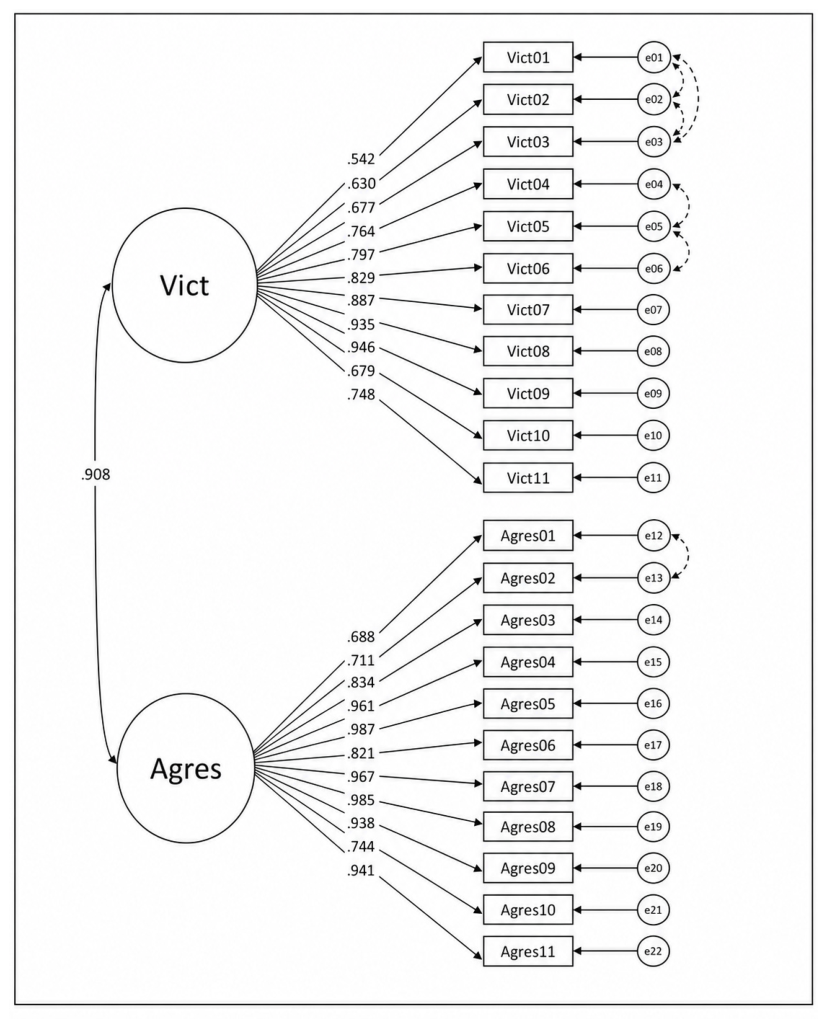
Table 1.
Goodness-of-fit indices of the ECIPQ factorial models.
| Model 1 | χ² | df | CFI | TLI | RMSEA | 90% CI | SRMR |
| Unidimensional (1F) | 2994.695 | 209 | 0.984 | 0.982 | 0.133 | [0.129, 0.137] | 0.141 |
| Two-factor base (2F) | 2386.832 | 208 | 0.987 | 0.986 | 0.118 | [0.114, 0.122] | 0.127 |
| Bifactor | 1274.194 | 187 | 0.994 | 0.992 | 0.088 | [0.083, 0.092] | 0.099 |
| Two-factor adjusted (2F + residual covariances) |
1105.518 | 202 | 0.995 | 0.994 | 0.077 | [0.073, 0.081] | 0.084 |
1 Models were estimated using confirmatory factor analysis with ordinal variables. The adjusted two-factor model incorporates six theoretically justified intrafactorial residual covariances. CFI = Comparative Fit Index; TLI = Tucker-Lewis Index; RMSEA = Root Mean Square Error of Approximation; SRMR = Standardized Root Mean Square Residual.
Table 2.
Convergent validity of the ECIPQ.
| Factor |
Number of Items |
McDonald's Omega (ω) |
Ordinal Alpha (αord) |
Average Variance Extracted (AVE) |
Item |
Standardized Factor Loading (λ) |
| Cybervictimization | 11 | 0.836 | 0.943 | 0.603 | Vic_01 | 0.542 |
| Vic_02 | 0.630 | |||||
| Vic_03 | 0.677 | |||||
| Vic_04 | 0.764 | |||||
| Vic_05 | 0.797 | |||||
| Vic_06 | 0.829 | |||||
| Vic_07 | 0.887 | |||||
| Vic_08 | 0.935 | |||||
| Vic_09 | 0.946 | |||||
| Vic_10 | 0.679 | |||||
| Vic_11 | 0.748 | |||||
| Cyberaggression | 11 | 0.908 | 0.969 | 0.770 | Agr_01 | 0.688 |
| Agr_02 | 0.711 | |||||
| Agr_03 | 0.834 | |||||
| Agr_04 | 0.961 | |||||
| Agr_05 | 0.987 | |||||
| Agr_06 | 0.821 | |||||
| Agr_07 | 0.967 | |||||
| Agr_08 | 0.985 | |||||
| Agr_09 | 0.938 | |||||
| Agr_10 | 0.744 | |||||
| Agr_11 | 0.941 |
Disclaimer/Publisher’s Note: The statements, opinions and data contained in all publications are solely those of the individual author(s) and contributor(s) and not of MDPI and/or the editor(s). MDPI and/or the editor(s) disclaim responsibility for any injury to people or property resulting from any ideas, methods, instructions or products referred to in the content. |
© 2026 by the authors. Licensee MDPI, Basel, Switzerland. This article is an open access article distributed under the terms and conditions of the Creative Commons Attribution (CC BY) license (http://creativecommons.org/licenses/by/4.0/).
Copyright: This open access article is published under a Creative Commons CC BY 4.0 license, which permit the free download, distribution, and reuse, provided that the author and preprint are cited in any reuse.


