

Submitted:
30 June 2026
Posted:
01 July 2026
You are already at the latest version
Abstract
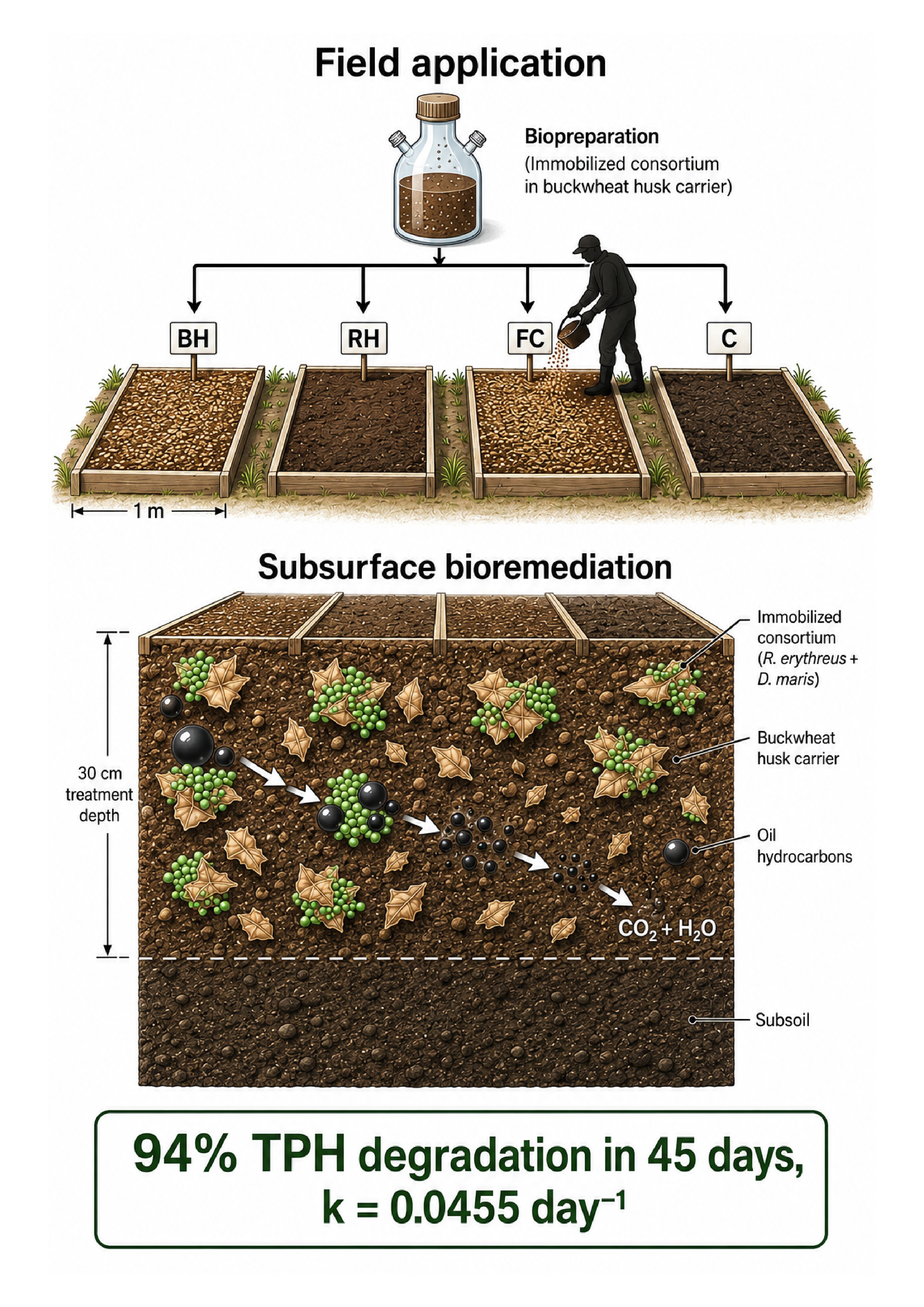
Oil contamination of soils in arid regions of Kazakhstan is a critical environmental problem, as extreme temperatures, low humidity and salinity limit traditional bioremediation. A pilot-scale 45-day field experiment at the Karazhanbas oil field (Mangistau Region, Kazakhstan) provided a first field validation of an adsorption-immobilisation bioremediation technology. A consortium of Rhodococcus erythropolis AT7 and Dietzia maris 22K was immobilised on buckwheat and rice husk carriers. Four treatments were tested on 1 × 1 m plots (initial petroleum products 3725 mg/kg): the consortium immobilised on buckwheat husks, on rice husks, free cells, and an untreated control. Petroleum products were measured by FTIR spectroscopy on days 0, 15, 30 and 45. The buckwheat husk variant showed the highest efficiency — 94.0 ± 0.5% (3725 to 223 ± 18 mg/kg) — 1.6 times higher than rice husk (57.9%) and 1.7 times higher than free cells at the standard dose (54.6%). Degradation followed first-order kinetics (k = 0.0455 day⁻¹; t1/2 = 15.3 days), and hydrocarbon-oxidising microorganisms reached 10⁸ CFU/g. The superiority of buckwheat husks is primarily attributable to their lower lignin content and more favourable structural and nutritional properties, with the antioxidant rutin as a plausible additional factor. These pilot results provide a basis for larger-scale validation in Western Kazakhstan.
Keywords:
bioremediation
; oil-contaminated soil
; immobilisation of microorganisms
; Rhodococcus erythropolis
; Dietzia maris
; buckwheat husks
; field experiment
; arid climate
; Kazakhstan
; hydrocarbon-oxidising microorganisms
1. Introduction
Oil contamination of soils is a critical environmental problem in oil-producing regions worldwide, causing damage to terrestrial ecosystems, agricultural productivity and public health [1,2,3]. Kazakhstan, one of the world’s largest oil producers (84.2 million tonnes in 2022) [4], has over 180,000 hectares of land contaminated with petroleum products, of which more than 60% is concentrated in the Mangistau and Atyrau regions [5]. The situation is exacerbated by the arid climate of Western Kazakhstan: extreme temperatures (up to +45 °C), low humidity (30–40%) and soil salinisation hinder the natural recovery of ecosystems, prolonging the degradation of hydrocarbons by 20–30 years or more [6,7].
Existing remediation methods are classified as physico-chemical and biological [8,9]. Physico-chemical methods—soil removal and disposal (270–460 USD/t) and thermal treatment (23–330 USD/t)—provide rapid remediation with an efficiency of >95%, but irreversibly destroy soil structure and microbial communities [10,11]. Biological methods—landfarming (30–50% over 6–12 months) and phytoremediation (20–40% over 2–5 years)—are environmentally safe and cost-effective (21–119 USD/t), but demonstrate limited effectiveness under extreme climatic conditions [12,13,14]. Recent reviews emphasise that traditional bioremediation strategies often require a comprehensive approach to eliminate residual toxicity and assess the impact on soil biota [15,16].
The immobilisation of oil-degrading microorganisms on solid substrates represents a promising strategy for overcoming these limitations [17,18,19]. This approach ensures: (i) protection of cells from environmental stresses; (ii) a 100–1,000-fold increase in active biomass density; (iii) prolonged cell viability (up to 90 days); (iv) targeted delivery of degraders to contamination sites [20,21,22]. Organic carriers based on agro-industrial waste attract particular attention due to their low cost, biodegradability and ability to serve as an additional carbon source [23,24,25]. Thus, Yang et al. (2023) demonstrated that immobilised Gordonia alkanivorans W33 cells significantly outperformed free cells in terms of bioremediation efficiency of oil-contaminated soils [26], whilst Wang et al. (2025) reported 97.1% oil degradation within 72 hours using an immobilised consortium in combination with Sudan grass [27].
Bacteria of the genera Rhodococcus and Dietzia (Actinomycetota) are recognised as benchmark degraders of aliphatic (C10–C35) and aromatic hydrocarbons, possessing thermotolerance and halotolerance, the ability to produce biosurfactants, and the presence of multiple alkane hydroxylase and dioxygenase genes [28,29,30,31,32]. It is of fundamental importance that strains isolated from local contaminated ecosystems demonstrate excellent adaptation to regional conditions: studies of oil-degrading strains isolated from Kazakhstani oil fields confirm their effective degradation of hydrocarbons and adaptation to the extreme climatic conditions of Central Asia [33].
Despite an extensive laboratory infrastructure, field validation of immobilised bioremediation technologies—particularly in arid regions with extreme temperatures and saline soils—remains insufficient [34,35,36,37,38,39,40]. A key debate in the literature concerns whether immobilisation increases or decreases the effectiveness of bioremediation under real field conditions. A number of studies report a loss of the advantage of immobilised cells in the field due to diffusion limitations and carrier degradation [41,42]; others point to the superiority of properly designed systems due to synergism with the indigenous microbiota [26,27,43]. This debate remains unresolved due to a lack of rigorous comparative field studies under extreme climatic conditions.
The present study addresses this gap through a pilot-scale field validation of a bioremediation technology using a consortium of Rhodococcus erythropolis AT7 and Dietzia maris 22K, immobilised on carriers made from agro-industrial waste (buckwheat and rice husks), at the Karazhanbas oil field (Mangistau Region, Kazakhstan). Specific research objectives were: (1) to assess the degradation efficiency of the immobilised consortium compared to free cells under field conditions; (2) to compare two organic carriers with different biochemical properties; (3) to quantitatively assess microbiological and biochemical parameters of soil remediation; (4) to identify factors explaining the observed differences in efficiency; and (5) to assess the economic feasibility for practical implementation. Given the pilot, proof-of-concept nature of this study, the experiment was designed to establish the fundamental field efficacy of the technology and to identify the most promising carrier, rather than to provide a fully powered statistical comparison; the latter is the objective of subsequent larger-scale trials.
2. Materials and Methods
2.1. Characteristics of the Study Site
2.1.1. Field Trial Site
Field trials were conducted at the bioremediation site of Kazekoservice LLP within the Karazhanbas oil field (Mangistau Region, Republic of Kazakhstan; 43°45′ N, 52°18′ E). Climatic conditions during the experiment (September–October 2025) were: air temperature +22…+28 °C; soil temperature +25…+32 °C; relative air humidity 35–45%; no precipitation. These conditions correspond to the typical arid climate of Western Kazakhstan in the autumn.
2.1.2. Characteristics of the Contaminated Soil
Soil from the Karazhanbas field, which has historically been contaminated with oil, was used for the experiment. Soil type: light chestnut, sandy loam; particle size distribution: sand 62%, silt 26%, clay 12%; organic matter content 2.1%; pH 7.8 (slightly alkaline). The initial concentration of petroleum products was determined by IR spectrometry (see Section 2.4.1) and amounted to 3725 mg/kg of dry soil. The contamination is long-standing (weathered oil, >5 years).
2.2. Microorganisms and Biological Preparation
2.2.1. Microorganism Strains
A consortium of hydrocarbon-oxidising bacteria was used: Rhodococcus erythropolis AT7 (registration number B-RKM-0769) and Dietzia maris 22K (registration number B-RKM-0768). The strains were isolated from oil-contaminated soils in Western Kazakhstan, patented and adapted to the climate of Kazakhstan [44]. They are characterised by their ability to degrade aliphatic (C10–C35) and aromatic hydrocarbons, thermotolerance (activity up to +42 °C), halotolerance (growth at NaCl concentrations up to 10%) and belonging to the 4th pathogenicity group (non-pathogenic) [28].
2.2.2. Preparation of Organic Carriers
Agricultural by-products were used as carriers: buckwheat hulls (Fagopyrum esculentum) – a by-product of buckwheat groats production; and rice husks (Oryza sativa) – a by-product of rice production. Pre-treatment was carried out sequentially: washing with distilled water (removal of dust and water-soluble impurities); treatment with a 1% NaOH solution (30 min, removal of waxes); treatment with a 1% HCl solution (30 min, increase in porosity); three-fold washing with distilled water until pH neutral; drying at 60 °C to constant weight; and grinding to a particle size of 2–5 mm.
2.2.2.1. Characterisation of the Carriers
The chemical composition of the substrates was previously characterised [45] using standard analytical methods: moisture content was determined gravimetrically by drying at 105 °C; ash content by ashing in a muffle furnace at 550 °C; protein content by the Kjeldahl method; fat content by the Soxhlet method; fibre content (cellulose, pentosans) and lignin content by the Van Soest method; starch content by an enzymatic method; and rutin and vitamins A, B1, B2, E content by high-performance liquid chromatography (HPLC) with UV and fluorescence detection. Functional groups on the surface of the carriers were identified by Fourier transform infrared spectroscopy (FTIR) in the range 4000–400 cm⁻¹. The key components explaining the differences in bioremediation efficiency are shown in Table 1.
2.2.3. Immobilisation of Microorganisms
Immobilisation was carried out by adsorption. A bacterial suspension was prepared by culturing the strains in liquid nutrient medium (glucose 10 g/L, peptone 5 g/L, yeast extract 3 g/L, mineral salts) at +28 °C and 150 rpm for 72 hours, followed by centrifugation (5000 g, 15 min) and resuspension of the cells in saline to a concentration of 10⁹ CFU/mL. Immobilisation was carried out at a carrier:suspension ratio of 1:5 (mass/volume), incubating at +28 °C with periodic stirring for 24 hours; the liquid phase was then separated and the immobilised cells were dried at room temperature to a moisture content of ~30%.
The immobilisation efficiency (η) was calculated using Equation (1):
where N₀ is the initial number of cells in the suspension (CFU) and Nₛ is the number of cells in the supernatant after immobilisation (CFU). The immobilisation efficiency was 92.3 ± 2.1% for buckwheat husks and 87.6 ± 2.8% for rice husks.
η = [(N₀ − Nₛ)/N₀] × 100%
2.3. Field Experiment Design
2.3.1. Experimental Treatments
This study was designed as a pilot-scale, proof-of-concept field trial intended to establish the fundamental efficacy of the technology under real arid-zone conditions and to guide the design of future larger-scale experiments. The field experiment comprised four treatments (Table 2). Each treatment was carried out on three independent plots measuring 1 × 1 m (n = 3 biological replicates), which were spatially separated to rule out any mutual influence. The number of replicates was selected as appropriate for a pilot trial under field logistic constraints; accordingly, the statistical outcomes are interpreted as indicative trends to be confirmed in subsequent fully powered studies.
2.3.2. Preparation of Experimental Plots
Plot size was 1 × 1 m, treatment depth 0.3 m, and mass of treated soil 100–150 kg per plot (depending on soil density); the distance between plots was at least 1 m (to prevent cross-contamination). Contaminated soil from the Karazhanbas field, with an initial concentration of petroleum products of 3725 mg/kg, was evenly distributed over each plot.
2.3.3. Application of the Biological Agent
Application rate (pilot scale): immobilised biological agent — 10% of soil mass (10–15 kg of agent per plot); free cells (Treatment 4) — bacterial suspension with a concentration of 10⁹ CFU/mL, 1 litre per plot. The biological preparation was spread evenly over the surface of the plot, mixed with the soil to a depth of 30 cm (by hand) and moistened to 60–70% of full moisture capacity.
It should be noted that the treatments involving immobilised (1, 2) and free (4) cells were administered in accordance with the standard application rate for the biological product and differed in terms of the absolute number of cells applied per plot. Accordingly, the variant with free cells reflects the traditional method of applying the suspension at the standard dose, rather than a control group strictly matched to the immobilised variants in terms of cell count.
Note: A high application rate (10%) was used during the pilot phase to validate the method’s fundamental effectiveness. When scaling up, the rate can be reduced to 0.00013–0.00038% of the soil mass by using a suspension application method (2–3 L/m² at a concentration of 0.33–0.5 g/L).
2.3.4. Experimental Conditions
The duration of the experiment was 45 days (September–October 2025). Moisture was maintained at 60–70% by periodic watering (every 3–5 days); aeration was provided by loosening the soil 2–3 times a week to a depth of 15–20 cm; and air and soil temperatures (at a depth of 15 cm) were recorded daily.
2.4. Analytical Methods
2.4.1. Determination of Petroleum Product Content
The concentration of total petroleum hydrocarbons (TPH) was determined by infrared spectrometry using an FTIR spectrometer (IRAffinity-1S, Shimadzu, Kyoto, Japan). Calibration was performed using eight concentration points in the range 0–1000 mg/L (R² ≥ 0.998). Soil samples were collected using the envelope method (5 spot samples from the plot, combined sample ~500 g), dried at 60 °C, ground and extracted with n-hexane (20 mL) in an ultrasonic bath (30 min, 40 kHz). The fractional composition of hydrocarbons was determined by characteristic absorption bands: BTEX — 3030–3100 cm⁻¹ (aromatic C–H); alkanes — 2850–2960 cm⁻¹ (aliphatic C–H); PAHs — 1600 and 1500 cm⁻¹ (aromatic C=C).
Degradation efficiency was calculated using the formula E = [(C₀ − Cₜ)/C₀] × 100%, where C₀ is the initial concentration of petroleum products (mg/kg) and Cₜ is the concentration at time t (mg/kg). Samples were taken on days 0 (initial state), 15, 30 and 45.
2.4.2. Microbiological Analysis
The population of hydrocarbon-oxidising microorganisms (HOM) was determined by the serial dilution method followed by plating onto Raymond’s agarised mineral medium containing crude oil (0.5% v/v) as the sole source of carbon and energy. Composition of the medium (g/L): Na₂HPO₄ — 1.25; KH₂PO₄ — 1.25; NH₄NO₃ — 1.0; MgSO₄·7H₂O — 0.2; FeCl₃ — 0.05; agar — 15.0. Soil samples (1 g) were suspended in 9 mL of sterile saline solution, tenfold serial dilutions (10⁻¹–10⁻⁸) were prepared, and 0.1 mL was inoculated onto Petri dishes in three analytical replicates. The cultures were incubated at +28 °C for 7–14 days, after which the colonies that had grown were counted and the count expressed as CFU/g of dry soil. Samples were taken on days 0, 15, 30 and 45.
2.4.3. Soil Biochemical Parameters
Catalase activity was determined by the gasometric method based on the volume of oxygen released during the decomposition of hydrogen peroxide [46]. To 1 g of soil, 2 mL of a 3% H₂O₂ solution was added, and the volume of O₂ released over 3 minutes at room temperature was measured using a graduated gas-measuring tube. Activity was expressed in mL of O₂ per 1 g of soil over 3 minutes.
Dehydrogenase activity was determined using the method of Casida et al. [47] based on the reduction of 2,3,5-triphenyltetrazolium chloride (TTC) to triphenylformazan (TFF). A TTC solution was added to 5 g of soil, incubated at +30 °C for 24 h in the dark, the resulting TFF was extracted with ethanol, and the optical density was measured at λ = 485 nm. Activity was expressed in mg TFF per 1 g of soil per day (mg TFF/(g·day)). Enzymatic activity was determined on days 15, 30 and 45 in triplicate.
2.4.4. Kinetic Analysis
The degradation of petroleum hydrocarbons was described by a first-order kinetic model: Cₜ = C₀ · e⁻ᵏᵗ, where Cₜ is the concentration of petroleum products at time t (mg/kg), C₀ is the initial concentration (mg/kg), k is the degradation rate constant (day⁻¹) and t is time (days). The kinetic parameters (k, t₁/₂, R², 95% confidence interval) were determined using non-linear regression (GraphPad Prism 9, first-order exponential decay model) with fixed parameters Y₀ = 3725 mg/kg and plateau = 0. The half-life was calculated using the formula t₁/₂ = ln2/k.
2.5. Statistical Analysis
Statistical analysis was performed on the mean values of the plots (n = 3 plots per treatment; analytical subsamples were first averaged across the plot). Data are presented as the mean ± standard deviation (M ± SD). Normality of distribution was tested using the Shapiro–Wilk test, and homogeneity of variances using Levene’s test. One-way analysis of variance (ANOVA) with Tukey’s post-hoc test was used for multiple comparisons; the significance level was p < 0.05. Kinetic parameters were calculated using GraphPad Prism 9 (GraphPad Software, San Diego, CA, USA).
Given the pilot design and the limited number of field replicates (n = 3 per treatment), the tests for normality (Shapiro–Wilk) and homogeneity of variances (Levene) have limited statistical power; therefore, the results of the inferential tests are reported as indicative rather than definitive, and the between-treatment differences should be interpreted as preliminary trends requiring confirmation in larger-scale trials.
3. Results
3.1. Dynamics of Petroleum Hydrocarbon Degradation Under Field Conditions
3.1.1. Bioremediation Efficiency by Treatment
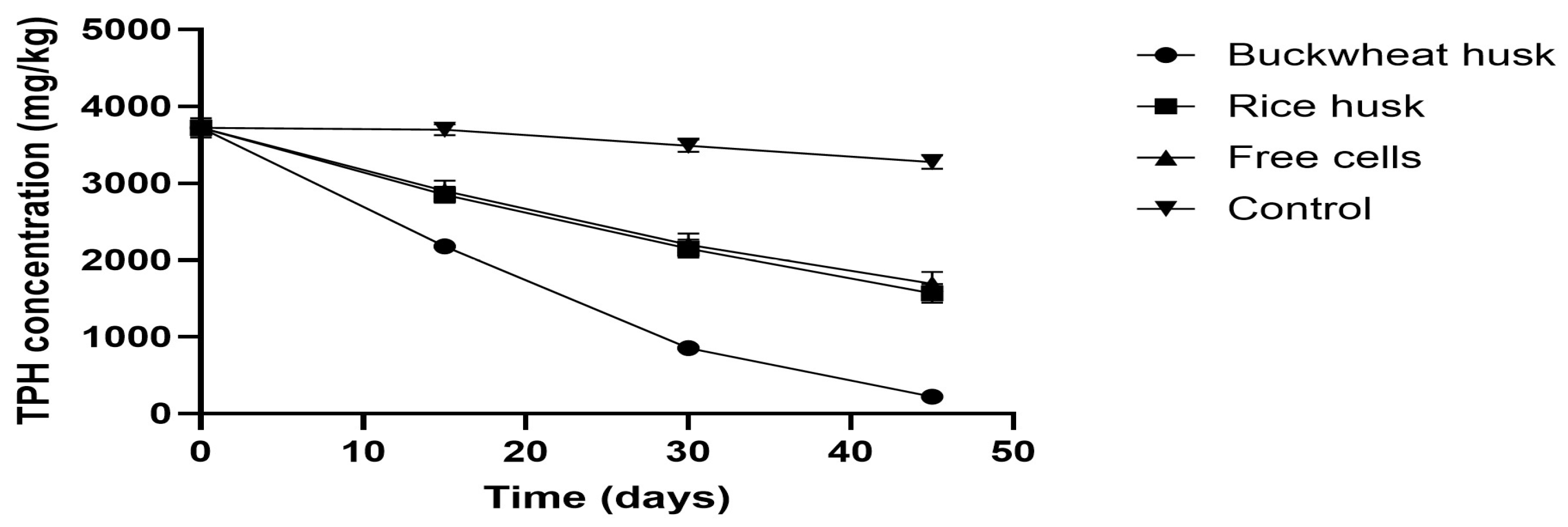
The results of the 45-day field experiment are presented in Table 3. In all variants where the biopreparation was applied, a statistically significant reduction in the concentration of petroleum products was recorded compared with the control (p < 0.001).
Treatment 1 (immobilised on buckwheat husks) showed the highest degradation efficiency — 94.0 ± 0.5% — reducing the concentration of petroleum products from 3725 to 223 ± 18 mg/kg, and statistically significantly outperformed all other variants (p < 0.001). Treatment 2 (rice husks) achieved a degradation rate of 57.9 ± 3.3%, which is 36.1 percentage points lower than the buckwheat husk variant (p < 0.001). Treatment 4 (free cells) showed an efficacy comparable to that of rice husks — 54.6 ± 4.2% (p > 0.05 relative to rice husks) — which is 1.7 times lower than that of the immobilised consortium on buckwheat husks. In the control variant, the reduction in concentration was only 12.0% and was statistically significantly lower than in all variants with the biopreparation (p < 0.001); this residual reduction is due to abiotic processes and the activity of the background soil microflora.
Figure 1.
Dynamics of TPH concentration in soil over the 45-day field experiment. Data are presented as means ± SD (n = 3 plots).
Figure 1.
Dynamics of TPH concentration in soil over the 45-day field experiment. Data are presented as means ± SD (n = 3 plots).
3.2. Biodegradation Kinetics
The degradation of petroleum hydrocarbons in all variants is satisfactorily described by first-order kinetics. The kinetic parameters, calculated using non-linear regression (GraphPad Prism 9), are presented in Table 4.
The degradation rate constant for buckwheat husks (k = 0.0455 day⁻¹; 95% CI: 0.0402–0.0515) was 2.4 times higher than that for rice husks (0.0187 day⁻¹; 95% CI: 0.0175–0.0199) and 2.6 times higher than that for free cells (0.0174 day⁻¹; 95% CI: 0.0160–0.0189). Accordingly, the half-life (t₁/₂) for buckwheat husks was 15.3 days — 2.4 times shorter than for rice husks (37.2 days) and 2.6 times shorter than for free cells (39.8 days). In the control variant, the rate constant was extremely low (k = 0.0024 day⁻¹; t₁/₂ ≈ 283 days), confirming the insignificance of natural degradation under arid conditions. The high values of the coefficient of determination for the active variants (R² = 0.977–0.986) confirm the applicability of the first-order model.
3.3. Microbiological Parameters
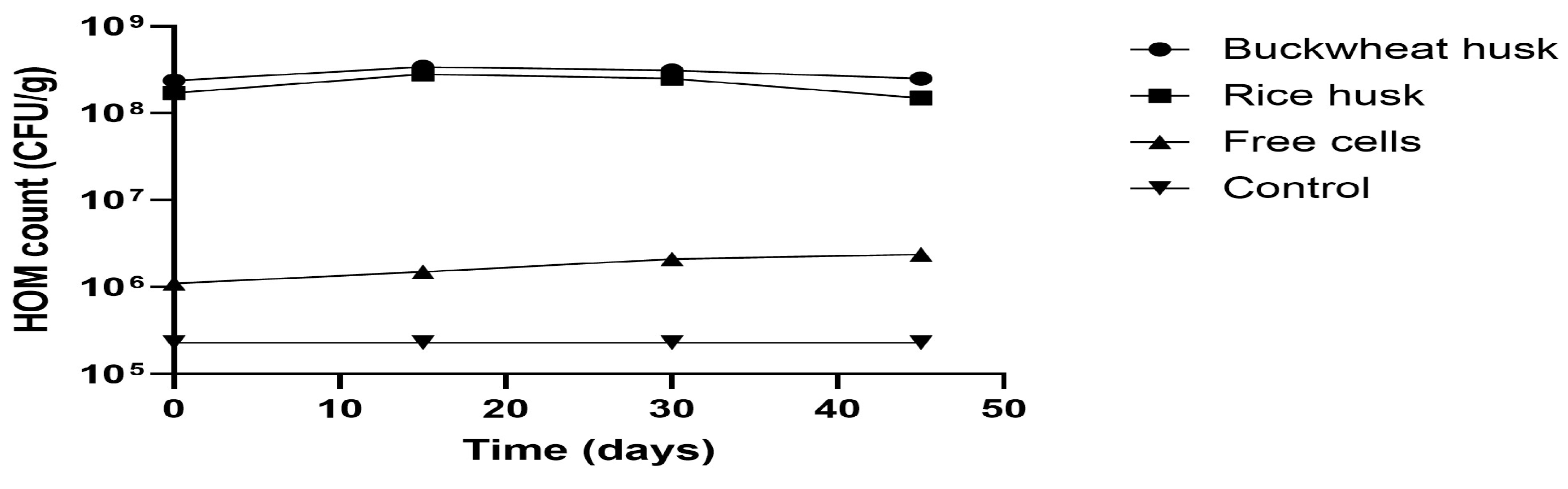
The background population of hydrocarbon-oxidising microorganisms (HOM) in the soil prior to the application of the biological preparation was 2.3 × 10⁵ CFU/g. In the treatments with the immobilised consortium, the HOM population was significantly higher throughout the experiment. In the buckwheat hulls treatment, the population reached a maximum by day 15 (3.4 × 10⁸ CFU/g) and remained at a high level with a slight decrease by day 45 (2.5 × 10⁸ CFU/g). A similar trend was observed for rice husks (peak of 2.8 × 10⁸ CFU/g on day 15). In the variant with free cells, the HOM population was two orders of magnitude lower (1.1–2.3 × 10⁶ CFU/g), reflecting the absence of the carrier’s protective effect. In the control variant, the HOM population remained at background levels (2.3 × 10⁵ CFU/g) throughout the experiment.
Figure 2.
Changes in the number of hydrocarbon-oxidising microorganisms (HOM) in soil during the 45-day field experiment. The Y-axis is on a logarithmic scale. Data are presented as means ± SD (n = 3 plots).
Figure 2.
Changes in the number of hydrocarbon-oxidising microorganisms (HOM) in soil during the 45-day field experiment. The Y-axis is on a logarithmic scale. Data are presented as means ± SD (n = 3 plots).
3.4. Biochemical Parameters of Soil
3.4.1. Enzymatic Activity
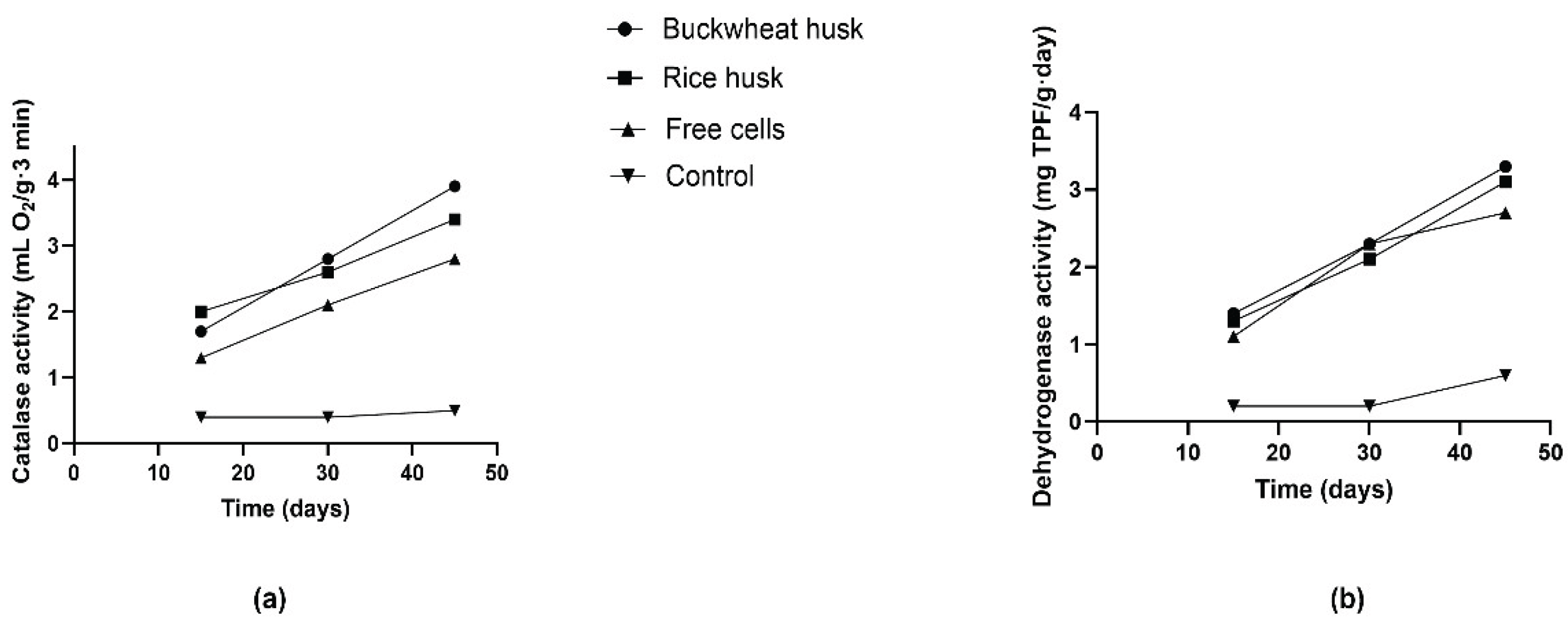
Soil enzymatic activity is an integral indicator of its biological condition. Catalase and dehydrogenase activity in all treatments with the biological preparation increased progressively throughout the experiment, indicating active microbial metabolism. By day 45, catalase activity in the buckwheat hull variant reached 3.9 mL O₂/(g·3 min), exceeding the control (0.5 mL O₂/(g·3 min)) by a factor of 7.8 (p < 0.001); dehydrogenase activity was 3.3 units compared with 0.6 in the control (5.5 times higher, p < 0.001). The hierarchy of enzymatic activity (buckwheat husks > rice husks > free cells > control) is consistent with the efficiency of petroleum product degradation and the dynamics of HOM abundance.
Figure 3.
Dynamics of soil enzymatic activity during the 45-day field experiment: (a) catalase activity; (b) dehydrogenase activity. Data are means ± SD (n = 3 plots).
Figure 3.
Dynamics of soil enzymatic activity during the 45-day field experiment: (a) catalase activity; (b) dehydrogenase activity. Data are means ± SD (n = 3 plots).
3.4.2. Water-Holding Capacity
The application of organic carriers increased the soil’s water-holding capacity. By the end of the experiment, soil moisture was maintained at 55% in the buckwheat husk treatment, whereas in the control it was only 38%. The improvement in water-holding properties is of particular significance for the arid conditions of the Mangistau region, where moisture availability is a limiting factor in bioremediation, and may partly explain the higher efficiency of immobilised systems.
4. Discussion
4.1. Mechanisms Underlying the Superiority of Buckwheat Husks over Rice Husks
The results of the field trials demonstrate that buckwheat husks provide significantly higher bioremediation efficiency (94.0%) compared to rice husks (57.9%) — a difference of 36.1 percentage points. This effect is explained by a combination of structural and biochemical factors.
4.1.1. Structural and Nutrient Properties of the Carriers
The superiority of buckwheat husks is largely determined by the composition of their lignocellulosic matrix. Buckwheat husks are characterised by a significantly lower lignin content (8.0–15.0%) compared to rice husks (19.2–47.0%) (Table 1) [45]. Lignin is the most recalcitrant and dense component of the cell wall, limiting substrate availability and surface colonisation; its lower content in buckwheat hulls ensures better microbial accessibility and a looser, more porous structure of the carrier [23,43]. Furthermore, buckwheat husks contain more protein (3.3–7.0%) with a significantly lower ash content; rice husks, by contrast, are characterised by a high ash content (up to 31.78%) due to a significant silica (SiO₂) content, which is biochemically inert and reduces the mass fraction of bioavailable organic components [25].
4.1.2. Antioxidant Protection: The Proposed Role of Rutin
Buckwheat husks also contain markedly higher levels of the flavonoid rutin (28.8 mg/100 g) than rice husks (15.0 mg/100 g; Table 1) [45]. Since the catabolism of petroleum hydrocarbons via monooxygenase pathways is known to generate reactive oxygen species that can impair degradative activity [48,49], polyphenolic antioxidants released during partial biodegradation of the carrier matrix may plausibly mitigate this oxidative stress and contribute to the longer persistence of active biomass observed in the buckwheat husk variant. Antioxidant compounds have been shown to mitigate oxidative stress and improve the activity of hydrocarbon-degrading bacteria [50,51]. However, oxidative stress markers were not assessed in the present study, and the contribution of rutin cannot be quantified or distinguished from the structural and nutritional factors discussed above. This mechanism is therefore proposed as a hypothesis warranting targeted investigation in future work, rather than as an established explanation.
4.2. Advantages of Immobilisation over Free Cells
The immobilised consortium on buckwheat husks outperformed free cells by a factor of 1.7 (94.0% versus 54.6%). This superiority is due to several factors. Firstly, the organic carrier creates a micro-niche protective effect [20,21]: the porous structure shields the cells from external stresses (temperature fluctuations of +25…+32 °C, drying of the upper soil layers, competition with indigenous microflora, toxic metabolites), whilst capillary forces retain moisture within the carrier. Secondly, immobilisation ensures a high local cell density, promoting cooperative hydrocarbon degradation by the consortium [18,23]. Thirdly, immobilised cells remain active throughout the entire bioremediation period [25,27]. By day 45, the HOM count in the free cell variant was 2.3 × 10⁶ CFU/g, whereas in the buckwheat husk variant it was 2.5 × 10⁸ CFU/g — approximately two orders of magnitude higher.
It should be noted that the variants with immobilised and free cells differed in the absolute number of cells introduced; therefore, the observed advantage of immobilisation reflects the cumulative effect of the technology (protection by the carrier, moisture retention, high local biomass density), rather than the isolated contribution of immobilisation at equal cell loading. Quantifying the contributions of immobilisation and inoculum dose requires further studies with an equalised number of cells introduced.
Within the field system itself, several factors plausibly contribute to the high observed efficacy: synergism of the introduced consortium with the indigenous microflora; the activating effect of diurnal temperature fluctuations; and the favourable substrate properties of weathered oil, which lacks the toxic light fractions that can inhibit microbial activity in fresh spills. Each of these is discussed in turn below.
4.3. Factors Contributing to High Field Efficiency and Comparison with Laboratory Data
A previously published laboratory study with the same immobilised consortium on buckwheat husks reported 58.4% degradation over 45 days on artificially contaminated model soil, whereas the present field trial yielded 94.0% on naturally weathered contamination [45]. It must be emphasised that these two studies are not directly comparable and the difference in the reported efficiency values should not be interpreted as a field-versus-laboratory improvement of the technology as such. The two systems differ in several first-order factors that independently affect biodegradation kinetics: (i) the nature of the contamination — fresh oil added to a sterile model matrix in the laboratory versus weathered oil residing in the natural soil for several years, which has already lost its volatile and most toxic light fractions; (ii) the initial concentration and contamination history — a single short-term spike in the laboratory versus a long-term, partly stabilised contamination in the field; (iii) the soil matrix itself — a sterile model substrate versus a natural soil hosting an established indigenous microbial community; and (iv) the physical environment — controlled constant laboratory conditions versus diurnal temperature fluctuations, natural aeration and a heterogeneous moisture regime. Accordingly, the 94.0% value should be interpreted as the absolute field efficacy of the technology on aged Karazhanbas contamination, rather than as evidence that the technology is more efficient in the field than in the laboratory. A direct field-versus-laboratory comparison would require matched contamination type, concentration and matrix, and is beyond the scope of the present pilot trial.
4.3.1. Synergy with the Indigenous Microflora
The number of viable microorganisms in the variants with the biopreparation reached 10⁸ CFU/g, reflecting both the introduced biomass of the consortium and the stimulation of microbial activity in the contaminated soil. It is assumed that synergy with indigenous degraders is achieved through the complementarity of degradation pathways, the exchange of intermediate metabolites (cross-feeding) and the cooperative formation of mixed biofilms [14,37]. The identification of specific taxa within the indigenous microbial community requires molecular analysis and is the subject of further research.
4.3.2. Temperature Cycles
Daily fluctuations in soil temperature under field conditions (+25…+32 °C) may have contributed to the activation of adaptive mechanisms in the microorganisms — the induction of heat shock proteins, increased expression of alkane hydroxylase and dioxygenase genes, accelerated metabolism with rising temperature (temperature coefficient Q₁₀ ≈ 2) and improved oxygen solubility during night-time cooling [2].
4.3.3. Pollution Characteristics
High concentrations of fresh oil containing light fractions cause substrate inhibition and toxic stress [16]. Weathered oil from the Karazhanbas field (3725 mg/kg), devoid of volatile toxic components and consisting predominantly of medium- and high-molecular-weight C17–C35 hydrocarbons, does not exert a pronounced inhibitory effect and serves as a favourable substrate for Rhodococcus and Dietzia [28].
4.4. Economic Aspects and Prospects for Application
Bioremediation using immobilised microorganisms on agro-industrial waste is one of the most cost-effective approaches to cleaning up oil-contaminated soils. Physico-chemical methods cost approximately 270–460 USD/t (soil removal and disposal) and 23–330 USD/t (thermal treatment); biological methods (landfarming, biopiling) fall within approximately 20–120 USD/t [10,11]. Bioremediation using agro-industrial carriers lies at the lower end of this price range, as buckwheat and rice husks are readily available agricultural waste. Kazakhstan produces 28–36 thousand tonnes of buckwheat husks and 38–45 thousand tonnes of rice husks annually [3], ensuring the availability of carriers for scaling up without significant additional costs.
4.5. Adaptation to an Arid Climate
The technology is adapted to the extreme conditions of Western Kazakhstan. The strains R. erythropolis AT7 and D. maris 22K remain active at temperatures up to +42 °C, which corresponds to summer soil temperatures in the Mangistau region. The immobilised consortium remains active at NaCl concentrations of up to 10%, which is important for saline oil-producing soils, where most biological preparations lose their effectiveness at 3–5% [6]. Furthermore, organic carriers (particularly buckwheat husks) increase the soil’s water-holding capacity (from 38% to 55%), which is critical under conditions of low air humidity (30–40%).
4.6. Limitations and Directions for Further Research
As this work was conceived as a pilot-scale, proof-of-concept field study, it has a number of limitations that define the scope of its conclusions. The primary limitation is the small number of replicates (n = 3 plots per treatment), inherent to pilot field trials, which limits the statistical power of the inferential analyses; the reported differences should therefore be regarded as preliminary trends. Pilot trials were conducted on plots of 1 m²; validation on a larger scale is required to assess the logistics of application. Long-term monitoring (1–2 years) of residual concentrations and vegetation recovery is required. The previously reported laboratory value of 58.4% degradation [45] and the present field value of 94.0% refer to systems that differ in contamination type (fresh versus weathered oil), initial concentration, soil matrix (sterile model substrate versus natural soil) and environmental conditions; these values therefore characterise two distinct experimental contexts and cannot be used to quantify a field-versus-laboratory improvement of the technology.
Furthermore, the variants with free and immobilised cells were not matched in terms of the absolute number of cells applied. A direct assessment of oxidative stress markers confirming the presumed antioxidant role of rutin was not carried out. Confirmation of the results by GC-MS and analysis of the microbial community by 16S rRNA sequencing are priority tasks for further research.
5. Conclusions
When applied at the standard rate of the biopreparation, the immobilised-carrier formulation on buckwheat husks outperformed the conventional free-cell suspension by a factor of 1.7 (94.0% versus 54.6%) and maintained a high HOM count in the buckwheat husk variant (2.5 × 10⁸ CFU/g by day 45). Since the formulations were not matched for the absolute number of cells applied, this advantage should be attributed to the immobilised-carrier preparation as a complete applied technology — combining cell protection, moisture retention and a high local biomass density — rather than to immobilisation as an isolated factor; disentangling these contributions at an equalised cell load is a task for subsequent studies. Degradation in all variants followed first-order kinetics; the rate constant for buckwheat husks (k = 0.0455 day⁻¹; t₁/₂ = 15.3 days) was 2.4–2.6 times higher than for rice husks and free cells. Catalase activity increased 7.8-fold, and dehydrogenase activity 5.5-fold relative to the control (p < 0.001); water-holding capacity increased from 38% to 55%. As a pilot-scale, proof-of-concept field validation, this study establishes the fundamental efficacy of the technology under arid conditions and provides a solid basis for subsequent larger-scale trials with increased replication, GC-MS confirmation and molecular characterisation of the microbial community.
6. Patents
Khozhanepessova, F.M.; Serikbayeva, A.K. Method for Immobilising Oil-Oxidising Microorganisms on a Buckwheat Husk Carrier. Patent of the Republic of Kazakhstan for Utility Model No. 11908, 13 March 2026.
Author Contributions
Conceptualisation, F.K. and A.S.; methodology, F.K.; formal analysis, F.K. and A.D.; investigation, F.K.; resources, F.K.; data curation, F.K.; writing—original draft preparation, F.K.; writing—review and editing, A.S. and A.D.; visualisation, F.K.; project administration, F.K.; funding acquisition, F.K. All authors have read and agreed to the published version of the manuscript.
Funding
This research was funded by the Science Committee of the Ministry of Science and Higher Education of the Republic of Kazakhstan, Grant No. AP25796069 (2025–2027). The APC was funded by the same grant.
Institutional Review Board Statement
Not applicable.
Informed Consent Statement
Not applicable.
Data Availability Statement
The data presented in this study are available on request from the corresponding author. The data are not publicly available due to ongoing related research.
Acknowledgments
The authors thank Kazekoservice LLP for providing access to the bioremediation site at the Karazhanbas oil field. The bacterial consortium (Rhodococcus erythropolis AT7 and Dietzia maris 22K), formulated as the “KazBioRem” preparation, was used with the permission of the patent holder, Ecostandard.kz LLP; the strains and the preparation are described in Patent of the Republic of Kazakhstan for Utility Model No. 3721 [44]. The immobilisation method on a buckwheat husk carrier developed in the present work is protected by Utility Model Patent of the Republic of Kazakhstan No. 11908 (Khozhanepessova, F.M.; Serikbayeva, A.K.; granted on 13 March 2026).
Conflicts of Interest
The authors declare no conflicts of interest. The funders had no role in the design of the study; in the collection, analyses or interpretation of data; in the writing of the manuscript; or in the decision to publish the results.
Abbreviations
The following abbreviations are used in this manuscript:
| ANOVA | Analysis of Variance |
| BTEX | Benzene, Toluene, Ethylbenzene, Xylenes |
| CFU | Colony Forming Unit |
| FTIR | Fourier Transform Infrared Spectroscopy |
| GC-MS | Gas Chromatography–Mass Spectrometry |
| HOM | Hydrocarbon-Oxidising Microorganisms |
| HPLC | High-Performance Liquid Chromatography |
| PAH | Polycyclic Aromatic Hydrocarbon |
| ROS | Reactive Oxygen Species |
| TFF | Triphenylformazan |
| TPH | Total Petroleum Hydrocarbons |
| TTC | 2,3,5-Triphenyltetrazolium Chloride |
References
- Saeed, M.; Ilyas, N.; Bibi, F.; Shabir, S.; Jayachandran, K.; Sayyed, R.Z.; et al. Soil health, its degradation, and management. Chemosphere 2023, 318, 138311. [Google Scholar] [CrossRef] [PubMed]
- Chen, W.; Li, J.; Sun, X.; Min, J.; Hu, X. High efficiency degradation of alkanes in petroleum by bacterial consortium at low temperature. Int. Biodeterior. Biodegrad. 2017, 118, 110–117. [Google Scholar] [CrossRef]
- National Statistics Bureau of the Republic of Kazakhstan. Agriculture, Forestry and Fisheries of Kazakhstan: Statistical Yearbook. National Statistics Bureau: Nur-Sultan, Kazakhstan, 2020. Available online: https://stat.gov.kz/en/industries/business-statistics/stat-forrest-village-hunt-fish/ (accessed on 15 February 2026).
- Funtikova, T.V.; Akhmetov, L.I.; Puntus, I.F.; Mikhailov, P.A.; Appazov, N.O.; Narmanova, R.A.; et al. Bioremediation of oil-contaminated soil of the Republic of Kazakhstan using a new biopreparation. Microorganisms 2023, 11, 522. [Google Scholar] [CrossRef] [PubMed]
- Chicca, I.; Becarelli, S.; Di Gregorio, S. Petroleum contamination of soils and biodegradation approaches. Environments 2022, 9, 123. [Google Scholar] [CrossRef]
- Ebadi, A.; Khoshkholgh Sima, N.A.; Olamaee, M.; Hashemi, M.; Ghorbani Nasrabadi, R. Effective bioremediation of a petroleum-polluted saline soil by a surfactant-producing Pseudomonas aeruginosa consortium. J. Adv. Res. 2017, 8, 627–633. [Google Scholar] [CrossRef]
- Li, Z.; Cabana, H.; Lecka, J.; Brar, S.K.; Galvez, R.; Bellenger, J.P. Degradation of hydrocarbons in arid soils. Biodegradation 2021, 32, 563–576. [Google Scholar] [CrossRef] [PubMed]
- Han, T.; Zhao, Z.; Bartlam, M.; Wang, Y. Combination of biochar amendment and phytoremediation for hydrocarbon removal. Environ. Sci. Pollut. Res. 2016, 23, 21219–21228. [Google Scholar] [CrossRef] [PubMed]
- Huesemann, M.H. Predictive model for estimating the extent of petroleum hydrocarbon biodegradation in contaminated soils. Environ. Sci. Technol. 1995, 29, 768–775. [Google Scholar] [CrossRef] [PubMed]
- Dadrasnia, A.; Usman, M.M.; Alinejad, T.; Motesharezadeh, B.; Mousavi, S.M. Hydrocarbon Degradation Assessment: Biotechnical Approaches Involved. In Microbial Action on Hydrocarbons; Springer: Singapore, 2019. [Google Scholar] [CrossRef]
- Strizhenok, A.V.; Korelskiy, D.S.; Choi, Y. Technologies for restoration of oil-contaminated land. J. Ecol. Eng. 2021, 22, 66–77. [Google Scholar] [CrossRef]
- Zhang, X.; Xu, X.; Li, C.; Guo, Q.; Ma, Y.; Wang, X.; et al. Remediation of petroleum hydrocarbon-contaminated soil by biostimulation and bioaugmentation. Chemosphere 2019, 226, 586–594. [Google Scholar] [CrossRef] [PubMed]
- Hamoudi-Belarbi, L.; Drouiche, N.; Aoudj, S.; Otmane, B.; Ghaffour, N. Bioremediation of polluted water using microorganisms. J. Environ. Manag. 2018, 210, 189–197. [Google Scholar] [CrossRef] [PubMed]
- Zhang, C.; Wu, D.; Ren, H. Bioremediation of oil-contaminated soil using agricultural wastes via microbial consortium. Sci. Rep. 2020, 10, 9188. [Google Scholar] [CrossRef] [PubMed]
- Azubuike, C.C.; Chikere, C.B.; Okpokwasili, G.C. Bioremediation techniques—classification based on site of application: principles, advantages, limitations and prospects. World J. Microbiol. Biotechnol. 2016, 32, 180. [Google Scholar] [CrossRef] [PubMed]
- Kuppusamy, S.; Maddela, N.R.; Megharaj, M.; Venkateswarlu, K. Total Petroleum Hydrocarbons: Environmental Fate, Toxicity, and Remediation; Springer: Cham, Switzerland, 2020. [Google Scholar] [CrossRef]
- Valizadeh, S.; Enayatizamir, N.; Nadian, H.; Motamedi, H.; Khalili Moghadam, B.; et al. Immobilized microorganism-based bioremediation. J. Geophys. Res. Biogeosci. 2024, 129, e2023JG007874. [Google Scholar] [CrossRef]
- Xu, X.; Liu, W.; Tian, S.; Wang, W.; Qi, Q.; Jiang, P.; et al. Petroleum hydrocarbon-degrading bacteria for the remediation of oil pollution under aerobic conditions: a perspective analysis. Front. Microbiol. 2018, 9, 2885. [Google Scholar] [CrossRef] [PubMed]
- Rong, Z.; Ding, Z.H.; Wu, Y.H.; Xu, X.W. Immobilized microorganism-based bioremediation technology. Sci. Total Environ. 2024, 907, 167993. [Google Scholar] [CrossRef] [PubMed]
- Covizzi, L.G.; et al. Cell immobilization and its applications in biotechnology: current state and future trends. Semin. Ciênc. Exatas Tecnol. 2007, 28, 143–160. [Google Scholar]
- Hesnawi, R.M.; Adbeib, M.M. Effect of nutrient source on indigenous and bioaugmented hydrocarbon-degrading bacteria during soil bioremediation. APCBEE Procedia 2013, 5, 557–561. [Google Scholar]
- Sarin, Ch.; Sarin, S. Removal of petroleum hydrocarbon compounds by immobilized bacteria. EnvironmentAsia 2010, 3, 49–53. [Google Scholar]
- Madu, J.O.; Agboola, B.O. Bioethanol production from lignocellulosic biomass: an overview. 3 Biotech. 2018, 8, 15. [Google Scholar] [PubMed]
- Hassan, N.S.; Alqudsi, A.M.; Alhani, M.F.; et al. Bioremediation using immobilized microbial cells. Remediat. J. 2025, 35, e70036. [Google Scholar]
- Ikhena, G.G.; Azat, S.; Aimbetova, I.; Soltabayev, B.; Telkov, S.; et al. Rice husk-derived silica: adsorption properties. Molecules 2021, 26, 1770. [Google Scholar] [CrossRef] [PubMed]
- Yang, Y.; Xu, M.; Goh, E.B.; An, T.; Sul, W.J. Immobilized Gordonia alkanivorans W33 cells for enhanced bioremediation. Environ. Sci. Technol. 2023, 57, 17445–17453. [Google Scholar] [CrossRef] [PubMed]
- Wang, Y.; Liu, X.; Zhang, L.; et al. Combined bioremediation and phytoremediation with immobilized consortium. Toxics 2025, 13, 599. [Google Scholar] [PubMed]
- Khozhanepessova, F.; Serikbayeva, A.; Amankeshuly, D.; et al. Bioremediation potential of Rhodococcus and Dietzia strains from Western Kazakhstan. Ecol. Montenegrina 2025, 85, 141–149. [Google Scholar]
- Akhmetzyanova, L.G.; Kuritsyn, I.N.; Selivanovskaya, S.Yu. Bioremediation of oil-contaminated soils using microbial preparations. Adv. Environ. Biol. 2014, 8, 117–121. [Google Scholar]
- Bajagain, R.; Gautam, P.; Jeong, S.W. Bioremediation of petroleum-contaminated soil using composting. Sci. Total Environ. 2020, 734, 139452. [Google Scholar] [CrossRef] [PubMed]
- Wei, Y.; Shen, D.; Ramzan, M.N.; et al. Enhanced bioremediation using biosurfactants. Int. Biodeterior. Biodegrad. 2024, 191, 105792. [Google Scholar]
- Maletić, S.; Dalmacija, B.; Rončević, S. Petroleum Hydrocarbon Biodegradability in Soil—Implications for Bioremediation. In Hydrocarbon; InTech: Rijeka, Croatia, 2013; pp. 43–64. [Google Scholar]
- Akhmetov, L.I.; Puntus, I.F.; Narmanova, R.A.; et al. Recent advances in creating biopreparations to fight oil spills in soil ecosystems in the sharply continental climate of the Republic of Kazakhstan. Processes 2022, 10, 549. [Google Scholar] [CrossRef]
- Diplock, E.E.; Mardlin, D.P.; Killham, K.S.; Paton, G.I. Predicting bioremediation of hydrocarbons: laboratory to field scale. Environ. Pollut. 2009, 157, 1831–1840. [Google Scholar] [CrossRef] [PubMed]
- Gómez-Brandón, M.; Riding, M.J.; Sherwood-Johnson, K.; et al. Bioremediation of oil-contaminated soils: a global challenge. Environ. Sci. Pollut. Res. 2024, 31, 32916. [Google Scholar]
- Guarino, C.; Spada, V.; Sciarrillo, R. Assessment of three approaches for in situ bioremediation of an aged hydrocarbon polluted soil. Chemosphere 2017, 170, 10–16. [Google Scholar] [CrossRef] [PubMed]
- Faqin, D.; Ying, H.; Zhenzhen, L.; et al. Synergistic bioremediation of oil-contaminated soil. J. Environ. Chem. Eng. 2025, 13, 115632. [Google Scholar]
- Li, J.; Ma, N.; Hao, B.; et al. Phytoremediation of oil-contaminated soil. Int. J. Phytoremediation 2023, 25, 706–716. [Google Scholar] [PubMed]
- Bekins, B.A.; Warren, E.; Godsy, E.M. A comparison of zero-order, first-order, and Monod biotransformation models. Ground Water 1998, 36, 261–268. [Google Scholar] [CrossRef]
- Huang, X.D.; El-Alawi, Y.; Gurska, J.; et al. A multi-process phytoremediation system for decontamination of persistent total petroleum hydrocarbons. Microchem. J. 2005, 81, 139–147. [Google Scholar] [CrossRef]
- Ikeura, H.; Kawasaki, Y.; Kaimi, E.; et al. Screening of plants for phytoremediation of oil-contaminated soil. Int. J. Phytoremediation 2016, 18, 460–466. [Google Scholar] [PubMed]
- Gómez-Brandón, M.; Riding, M.J.; Sherwood-Johnson, K.; et al. Field-scale bioremediation limitations. Environ. Technol. Innov. 2023, 31, 103207. [Google Scholar]
- Shchemelinina, T.N.; Gömze, L.A.; Kotova, O.B.; et al. Carrier-based immobilized microorganisms for bioremediation. Építőanyag—J. Silic. Based Compos. Mater. 2019, 71, 136–140. [Google Scholar]
- Moldagulova, N.B.; Sarsenova, A.S.; Ayupova, A.Zh.; Khassenova, E.Zh.; Berdimuratova, K.T.; Bayakenov, D.A.; Nurlybekov, A.N. Biological Method for the Remediation of Oil-Contaminated Soils. Patent of the Republic of Kazakhstan for Utility Model No. 3721, 1 March 2019. [Google Scholar]
- Khozhanepessova, F.; Serikbayeva, A.; Dadrasnia, A.; Myrzabekova, A. Enhanced oil biodegradation using immobilised Rhodococcus–Dietzia consortium on agricultural waste. Ecol. Chem. Eng. S 2025, 32, 387–402. [Google Scholar] [CrossRef]
- Johnson, J.L.; Temple, K.L. Some Variables Affecting the Measurement of “Catalase Activity” in Soil. Soil Sci. Soc. Am. J. 1964, 28, 207–209. [Google Scholar] [CrossRef]
- Casida, L.E., Jr.; Klein, D.A.; Santoro, T. Soil Dehydrogenase Activity. Soil Sci. 1964, 98, 371–376. [Google Scholar] [CrossRef]
- Rojo, F. Degradation of Alkanes by Bacteria. Environ. Microbiol. 2009, 11, 2477–2490. [Google Scholar] [CrossRef] [PubMed]
- Sazykin, I.S.; Sazykina, M.A.; Khmelevtsova, L.E.; Seliverstova, E.Yu.; Karchava, K.Sh.; Zhuravleva, M.V. Antioxidant Enzymes and Reactive Oxygen Species Level of the Achromobacter xylosoxidans Bacteria during Hydrocarbons Biotransformation. Arch. Microbiol. 2018, 200, 1057–1065. [Google Scholar] [CrossRef] [PubMed]
- Ponce, B.L.; Latorre, V.K.; González, M.; Seeger, M. Antioxidant Compounds Improved PCB-Degradation by Burkholderia xenovorans Strain LB400. Enzym. Microb. Technol. 2011, 49, 509–516. [Google Scholar] [CrossRef] [PubMed]
- Kang, Y.-S.; Lee, Y.; Jung, H.; Jeon, C.O.; Madsen, E.L.; Park, W. Overexpressing Antioxidant Enzymes Enhances Naphthalene Biodegradation in Pseudomonas sp. Strain As1. Microbiology 2007, 153, 3246–3254. [Google Scholar] [CrossRef] [PubMed]

Table 1.
Content of major organic components and vitamins in buckwheat and rice husks (according to [45]).
Table 1.
Content of major organic components and vitamins in buckwheat and rice husks (according to [45]).
| Component | Buckwheat husks | Rice husks |
| Moisture content, % by mass | 8.0–14.0 | 3.75–24.08 |
| Ash content, % by mass | 2.7–4.0 | 11.86–31.78 |
| Pentosans, % by mass | 12.5 | 4.52–37.00 |
| Cellulose, % by mass | 20.0–27.0 | 34.32–43.12 |
| Lignin, % by mass | 8.0–15.0 | 19.20–46.97 |
| Protein, % by mass | 3.3–7.0 | 1.21–8.75 |
| Fat, % by mass | 2.2 | 0.30–6.62 |
| Starch, % by mass | 0.6 | 9.76 |
| Vitamin A, mg/100 g | 0.003 | 0.04 |
| Vitamin B1, mg/100 g | 0.16 | 0.45 |
| Vitamin B2, mg/100 g | 0.084 | 0.1 |
| Vitamin P (rutin), mg/100 g * | 28.8 | 15.0 |
| Vitamin E, mg/100 g | 2.3 | 1.6 |
* The rutin content is a key parameter explaining the differences in the antioxidant protection of the carriers. Values taken from [45] and presented as ranges or individual values as in the source.
Table 2.
Experimental treatments in the field trial.
| Treatment | Description | Sample reg. no. |
| 1 | Biopreparation on buckwheat husks | 976-1, 976-2, 976-3 |
| 2 | Biopreparation on rice husks | 977-1, 977-2, 977-3 |
| 3 | Control (untreated) | 978-1, 978-2, 978-3 |
| 4 | Free cells (without immobilisation) | 979-1, 979-2, 979-3 |
Table 3.
Residual petroleum product content and degradation efficiency under field conditions (45 days, n = 3).
Table 3.
Residual petroleum product content and degradation efficiency under field conditions (45 days, n = 3).
| Treatment | Number of plots | Initial concentration, mg/kg | Residual concentration (45 days), mg/kg | Efficiency, % |
| Buckwheat husks | 3 | 3725 ± 12 | 223 ± 18 ᵃ | 94.0 ± 0.5 ᵃ |
| Rice husks | 3 | 3725 ± 12 | 1570 ± 124 ᵇ | 57.9 ± 3.3 ᵇ |
| Free cells | 3 | 3725 ± 12 | 1692 ± 156 ᵇ | 54.6 ± 4.2 ᵇ |
| Control | 3 | 3725 ± 12 | 3278 ± 89 ᶜ | 12.0 ± 3.2 ᶜ |
Data are presented as M ± SD (n = 3 plots). Different superscripts (a, b, c) indicate statistically significant differences between treatments on day 45 (p < 0.05, Tukey’s post-hoc test).
Table 4.
Kinetic parameters of TPH degradation (first-order model).
| Treatment | k (day⁻¹) | t₁/₂ (days) | R² |
| Buckwheat husk | 0.0455 (0.0402–0.0515) | 15.3 | 0.977 |
| Rice husk | 0.0187 (0.0175–0.0199) | 37.2 | 0.986 |
| Free cells | 0.0174 (0.0160–0.0189) | 39.8 | 0.977 |
| Control | 0.0024 (0.0018–0.0031) | 283.5 | 0.781 |
Parameters were determined using non-linear regression with fixed Y₀ = 3725 mg/kg and plateau = 0 (first-order exponential decay model, GraphPad Prism 9; n = 3 plots). The 95% confidence interval (profile likelihood) is given in brackets. t₁/₂ = ln2/k.
Disclaimer/Publisher’s Note: The statements, opinions and data contained in all publications are solely those of the individual author(s) and contributor(s) and not of MDPI and/or the editor(s). MDPI and/or the editor(s) disclaim responsibility for any injury to people or property resulting from any ideas, methods, instructions or products referred to in the content. |
© 2026 by the authors. Licensee MDPI, Basel, Switzerland. This article is an open access article distributed under the terms and conditions of the Creative Commons Attribution (CC BY) license (http://creativecommons.org/licenses/by/4.0/).
Copyright: This open access article is published under a Creative Commons CC BY 4.0 license, which permit the free download, distribution, and reuse, provided that the author and preprint are cited in any reuse.


