
Submitted:
30 June 2026
Posted:
01 July 2026
You are already at the latest version
Abstract
Classical evolutionary game theory assumes that an actor holds a definite strategy, pure or classically randomized, before interaction, a premise that excludes the interference and context effects documented in behavioral choice. We model an economic actor prior to market entry as a strategic superposition of pure strategies in a Hilbert space, and treat the moment of interaction as a measurement that collapses this state onto a realized strategy with Born-rule probabilities. Populations are described by a density operator whose diagonal carries strategy frequencies and whose off-diagonal coherences encode maintained superposition, evolving under a strategic master equation that combines coherent deliberation, decoherence in the strategy basis, and a replicator selection superoperator. We derive a square-root (amplitude) representation that places quantum normalization and evolutionary selection on a common geometric footing, and prove that the classical replicator equation emerges as the strong-decoherence limit, with an explicit error bound. Strategy realization is shown to be basis-dependent through interference terms that no classical mixture reproduces. In a two-strategy market game, coherent coupling displaces the evolutionary equilibrium from the classical evolutionarily stable strategy by order Δ²/γ, recovering it as decoherence dominates. The construction formalizes constitutive self-opacity and links bounded rationality to quantum interference.
Keywords:
quantum decision theory
; evolutionary game theory
; replicator dynamics
; strategic superposition
; decoherence
; evolutionarily stable strategy
; density operator
; bounded rationality
; behavioral economics
1. Introduction
Evolutionary game theory inherited from its biological origins a sharp ontology of strategy. An actor either plays a pure strategy, drawn from a finite repertoire, or plays a mixed strategy understood as a classical probability distribution over that repertoire [1,2]. Population-level change is then described by the replicator equation, which raises the frequency of strategies whose payoff exceeds the population average [3,4,5]. In both the pure and the mixed reading, the actor is taken to hold a strategy before interaction occurs. Randomization, where present, is a classical lottery: the actor possesses a definite probability vector, and the only uncertainty concerns which sample is realized.
A growing body of behavioral evidence sits uneasily with this picture. Choices display order effects, disjunction effects, and framing effects that violate the axioms of classical probability and expected utility [6,7]. Quantum decision theory responds by replacing classical probability with the probability calculus of quantum mechanics, in which amplitudes rather than probabilities are the primitive objects and interference between alternatives becomes possible [8,9,10,11,12,13,14]. In parallel, the quantum games program quantizes the act of play itself, allowing actors to select unitary operations on entangled qubits and studying the resulting equilibria [15,16,17,18].
Neither line of work addresses the question this paper takes up. Quantum decision theory models the single choice of a single agent and stops at the moment of decision. The quantum games program quantizes strategies and payoffs but works with equilibrium concepts rather than population dynamics, and it does not treat the pre-decision state of an actor as an evolving object subject to selection. What is missing is a framework in which (a) an actor is genuinely undecided before interaction, in the strong sense that no definite strategy exists rather than the weak sense that an existing strategy is unknown; (b) interaction collapses this indeterminate state onto a realized strategy; and (c) the distribution of realized strategies, together with the underlying amplitudes, is reshaped over evolutionary time by differential fitness.
This paper supplies that framework. We model the firm before market entry as a superposition of pure strategies, treat market interaction as a measurement that collapses the superposition, and couple the resulting frequencies to replicator dynamics through a density-operator master equation. The construction has three payoffs beyond unification. First, it gives an exact sense in which classical evolutionary dynamics is a limiting regime of a more general quantum strategic dynamics, recovered when interaction with the environment is strongly decohering. Second, it predicts that the realized strategy distribution of a superposed firm depends on the context, or measurement basis, in which the interaction is framed, a dependence that no classical mixed strategy with the same marginals can reproduce. Third, it formalizes the notion of constitutive self-opacity that anchors the Homo Evolutivus program: the firm’s strategy is constitutively indefinite, not merely hidden from observers or from the firm itself, and superposition is the natural mathematics of that indefiniteness.
2. Materials and Methods
2.1. The Strategy Hilbert Space and Basis States
Let an actor face a finite set of pure strategies We associate with a complex Hilbert space and a distinguished orthonormal basis the strategy basis, with . A committed actor playing the pure strategy is in the basis state . The strategy basis plays the role of the pointer basis in the measurement theory of open systems: it is the set of outcomes that interaction with the market renders definite [19].
2.2. Superposition, the Born Rule, and Collapse at Interaction
An actor who has not committed to a pure strategy is in a superposition
The complex numbers are probability amplitudes. They carry more information than a classical probability vector, since each amplitude has a modulus and a phase, with . The squared moduli reproduce a classical distribution over strategies, while the phases encode relations between strategies that have no classical counterpart and become observable only under a change of measurement context or under entanglement.
When the actor interacts with the market in the strategy basis, the realized strategy is with probability given by the Born rule [20],
We write for the realization probability of . The normalization guarantees that is a point of the probability simplex .
The conceptual core of the model is the identification of the moment of interaction with a measurement. Before the firm enters the market, plays the game, or commits resources, its strategic state is the superposition . Entry is an observation in the strategy basis, described by the projective (von Neumann) measurement with projectors [21]. The interaction yields outcome with probability , and the post-interaction state collapses to the corresponding basis state, with probability . The realized strategy then earns the payoff determined by the game. Two features deserve emphasis. The strategy that is realized is created at the moment of interaction; it is not read off a value the firm secretly held. And the probabilities that govern realization are exactly the squared amplitudes, so the act of collapse generates the very frequencies whose population-level evolution the replicator dynamics will govern.
Projective measurement is an idealization in which interaction extracts complete information and produces full commitment. Markets frequently do less. A firm may signal partial intent, leak partial information, or commit gradually. The appropriate generalization is a positive operator-valued measur, a family of positive operators with [22]. Outcome occurs with probability , and the post-interaction state is fixed by an associated set of Kraus operators with , via . Projective measurement is the special case . Positive operator-valued measure’s let the model represent weak or noisy interactions in which superposition is only partly resolved, a flexibility we use when discussing decoherence in Section 3.2.
2.3. Density-Operator Representation and Decoherence
A single firm in a pure superposition is described by the density operator . To represent a population of firms in various states, or a single firm whose phase information has partly degraded, we use a general density operator
a positive semidefinite operator with unit trace. In the strategy basis its entries split into two kinds with distinct economic meaning. The diagonal entries are the populations: is the share of the population that would realize strategy upon interaction, the quantity that feeds replicator dynamics. The off-diagonal entries with are the coherences: they measure the degree to which the population maintains genuine superposition between strategies and , as opposed to a classical mixture in which firms have already settled. A purely diagonal density operator is mathematically identical to a classical probability distribution over pure strategies. Nonzero coherences are the signature of unresolved strategic superposition at the population level.
Interaction with an environment, including observation by competitors and the partial commitments of a market, suppresses coherences while leaving populations intact. This is decoherence, and in the theory of open quantum systems it is generated by a dissipator of Gorini–Kossakowski–Sudarshan–Lindblad form [23,24,25]. Taking the jump operators to be the strategy projectors with rates ,
a direct computation using gives for and for . Decoherence therefore acts as pure dephasing in the strategy basis: populations are untouched and each coherence decays at rate . Under alone, relaxes to its diagonal part , a classical distribution. The quantum-to-classical transition of a market is exactly this loss of strategic superposition: firms that maintain coherence keep their options open across strategies, while firms that have decohered have committed to a definite strategy in all but the sampling. The strategy basis is selected as the pointer basis precisely because it is the basis the environment monitors [19].
2.4. Replicator Preliminaries
Let be the payoff matrix of a symmetric game, with the payoff to strategy against strategy . For a population state , the fitness of strategy is , and the mean fitness is . The replicator equation is
2.5. The Strategic Master Equation
The full dynamics on the density operator combines three processes acting on potentially different timescales [25]. The first is coherent deliberation, an internal weighing of options that preserves superposition and is generated by a Hermitian deliberation Hamiltonian through the von Neumann term . The second is decoherence in the strategy basis, defined in Section 2.3, which suppresses coherences while leaving populations intact. The third is selection, which reshapes the population frequencies according to differential fitness. We represent selection by a replicator superoperator , defined in the strategy basis by
with and the fitness and mean fitness of Section 2.4. The off-diagonal form assigns to each coherence the average of the two selection gradients, , which is the Hermitian lift of the replicator field consistent with the amplitude dynamics introduced above.
Combining the three contributions, the strategic master equation governing the joint evolution of populations and coherences is
Here generates coherent deliberation and interference, drives the quantum-to-classical transition toward the strategy (pointer) basis, and implements evolutionary selection. The dynamics is nonlinear.
3. Results
3.1. Amplitude Representation of the Replicator Field
The first result places quantum normalization and evolutionary selection on a single geometric footing. Writing the amplitude moduli as , the replicator equation on the simplex is carried to a flow on the positive orthant of the unit sphere ,
and the correspondence is a bijection between simplex and sphere trajectories that preserves (Proposition 1). The map is, up to a constant factor, the isometry between the simplex with the Shahshahani metric and the sphere with the round metric, since [4,28,29]. For games with symmetric payoff matrix the amplitude flow is the Shahshahani gradient ascent. The economic content is that selection acts directly on the quantum amplitudes constrained to the normalization sphere, with fitter strategies acquiring larger amplitude, while the phases remain inert under population-level selection.
3.2. Structural Properties of the Replicator Superoperator
The selection superoperator reproduces the classical replicator field on the diagonal, , preserves Hermiticity, and annihilates the trace, so the density operator retains unit trace. Its action on coherences is the natural Hermitian lift of the replicator field, consistent with the amplitude dynamics of Section 3.1. Physical admissibility holds in the decoherence-present regime and fixes the validity domain of the model, a property confirmed numerically in Section 3.6.
3.3. Emergence of Classical Replicator Dynamics in the Decoherence Limit
The central analytical result is that classical evolutionary dynamics is the strong-decoherence limit of the strategic master equation. With , adiabatic elimination of the coherences yields, to leading order, the closed replicator equation for the populations,
(Theorem 1).
3.4. Stability of Evolutionarily Stable Strategies
For an interior ESS [2], the cross-entropy is a strict local Lyapunov function for the replicator dynamics. By Theorem 1 this Lyapunov function governs the diagonal of the strategic master equation in the strong-decoherence regime, so interior ESS attract the population once decoherence dominates. The natural candidate for the full quantum dynamics is the quantum relative entropy , which reduces to on diagonal states and is monotone nonincreasing under the decoherence part of the dynamics by Lindblad’s theorem [30]; the nonlinear selection term is left for separate treatment.
3.5. Context Dependence and Interference
Strategy realization is shown to be basis sensitive. For a rotated measurement basis the realized outcome probabilities are
where the first sum is the classical prediction and the second is an interference term depending on the relative phases of the amplitudes (Proposition 2). No classical mixture over pure strategies with the same marginals reproduces for all rotations. This is the formal counterpart of framing and context effects [7] and of the order and disjunction effects that motivate quantum decision theory [6,9], and it is a feature classical evolutionary game theory cannot represent.
3.6. Numerical Results for the Two-Strategy Market Game
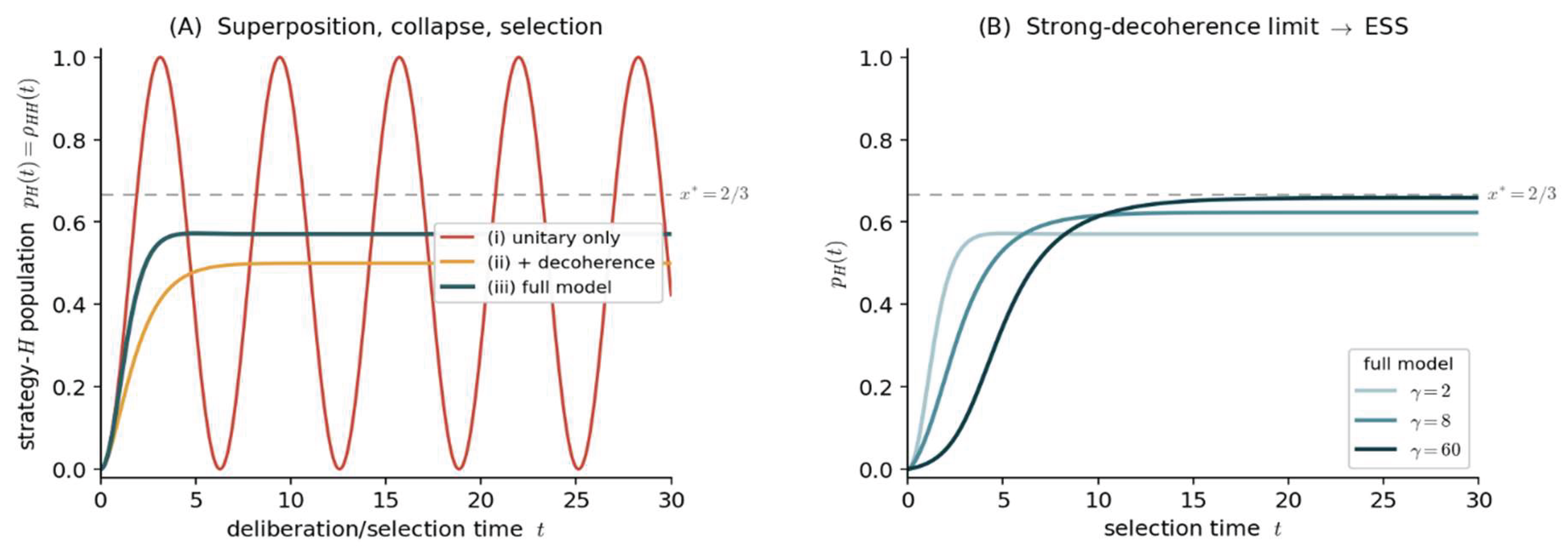
For the Hawk–Dove game with , the reduced qubit system was integrated under three settings (Figure 1a). Under coherent deliberation alone the population oscillates and never settles; adding decoherence damps the oscillation to the fitness-blind value ; and the full model is driven toward the evolutionarily stable strategy. Increasing the decoherence rate drives the stationary population toward the classical ESS (Figure 1b), confirming Theorem 1.
4. Discussion
Quantum effects are transient and corrective, except in a coherence-sustained regime. The results draw a clean line. In the decoherence-dominated regime, long-run population outcomes are classical evolutionarily stable strategies (Theorem 1 and Section 3.4), and quantumness appears only as transient, individual-level deliberation and as a finite- correction to equilibria. But the correction is real, and it grows as coherent coupling strengthens relative to decoherence and to the selection gradients. When that ratio is large, the classical ESS can be substantially displaced or destabilized, and the population can sustain coherent, oscillatory behavior rather than relaxing to a classical rest point.
The construction is complementary to, and distinct from, both established lines. The quantum games program quantizes the act of play, with actors choosing unitary operations on entangled states and the analysis centered on quantum equilibria [15,16,17]. The present model keeps payoffs and the act of play classical and locates the novelty earlier, in the pre-commitment strategic state and its collapse at interaction, then couples that collapse to population dynamics. Quantum decision theory models the single choice of a single agent and explains anomalies of individual choice through interference [8,9,10,11,12,13,14]. The present model embeds that machinery in evolutionary dynamics, so that interference at the decision layer propagates into selection at the population layer, as Proposition 2 makes explicit.
Strategic superposition gives a formal model of an indeterminate pre-decision state that does not require positing a hidden optimum the actor approximates. This complements the bounded-rationality tradition [31], which abandons the optimizing ideal without supplying a positive account of the unsettled state that precedes choice. Within the Homo Evolutivus program, the superposition is the mathematical content of constitutive self-opacity: the firm’s strategy is constitutively indefinite, and selection operates on the squared amplitudes that collapse produces, reshaping the distribution of strategic indeterminacy over evolutionary time.
Four limitations are salient. The selection superoperator is phenomenological, and a complete characterization of its complete-positivity domain remains open. The model treats a single population; entanglement between interacting firms, which would let strategic choices be correlated in ways no independent mixture allows. The payoff structure is classical, so the framework does not address quantized payoffs. And the empirical identification of the decoherence rate and the deliberation Hamiltonian from market data is an open measurement problem, though the order displacement of equilibria suggests where to look.
5. Conclusions
We have constructed a mathematical foundation that integrates quantum decision theory with evolutionary game theory and replicator dynamics. An economic actor before market entry is modeled as a superposition of pure strategies in a Hilbert space; the moment of interaction is a measurement that collapses the superposition onto a realized strategy with Born-rule probabilities; and these probabilities, carried by the diagonal of a density operator, evolve under a strategic master equation whose three superoperators represent coherent deliberation, decoherence in the strategy basis, and replicator selection. The amplitude representation places quantum normalization and evolutionary selection on a common geometric footing through the square-root map to the sphere. The decoherence-limit theorem shows that classical replicator dynamics is the strong-decoherence limit of the quantum strategic dynamics, with an explicit error bound. Context dependence distinguishes superposed strategies from any classical mixture with the same marginals. And the worked two-strategy game demonstrates that coherent coupling displaces the evolutionary equilibrium from the classical evolutionarily stable strategy by a quantity of order , recovering the stable strategy as decoherence dominates. The construction formalizes constitutive self-opacity and connects bounded rationality to the interference structure of quantum probability. The bifurcation between the decohered-classical regime and the coherence-sustained regime, together with entanglement between firms, defines the agenda for the installments that follow.
Funding
This research received no external funding
Institutional Review Board Statement
Not applicable.
Data Availability Statement
No data were used for the research described in the article.
Acknowledgments
During the preparation of this manuscript/study, the author used Claude Opus 4.8 for the purposes of the construction of the figures and to strengthen the overall structure of the manuscript. The author has reviewed and edited the output and takes full responsibility for the content of this publication.
Conflicts of Interest
The author declares no conflicts of interest
Appendix A
This appendix collects the formal statements of the two propositions and the theorem used in the main text, together with their proofs. The notation is that of Section 2 and Section 3.
Proposition 1 (Amplitude Representation). Letsolve the replicator equation, and define the amplitude moduli. Thenlies on the positive orthant of the unit sphereand satisfies
Conversely, any solution of this equation withprojects, via, to a solution of the replicator equation, andis preserved.
Proof of Proposition 1. From we have . Substituting the replicator right-hand side gives , hence wherever ; the boundary is invariant because the corresponding simplex face is invariant. Normalization follows from . The converse reverses these steps. ∎
Theorem 1 (Decoherence Limit).
Fixand, and write. As, adiabatic elimination of the coherences in the strategic master equation yields, to leading order, the closed replicator equation for the populations,
Classical replicator dynamics is thus recovered exactly in the limit of strong decoherence.
Proof of Theorem 1. Split into its diagonal part and its off-diagonal part. For , the coherence obeys
The part of sourced by the diagonal is . Setting and retaining the dominant source gives the quasi-steady coherence
The diagonal obeys , where is the replicator term. The Hamiltonian contribution to the diagonal is , which is real and, since each by the quasi-steady-state estimate, is of order . Hence . ∎
Proposition 2 (Context Dependence).Letwith realization probabilitiesin the strategy basis. Suppose interaction occurs instead in a rotated basiswithfor a unitary. Then the realized outcome probabilities are
The second sum is an interference term that depends on the relative phases of the amplitudes. No classical mixture over pure strategies with the same marginalsreproducesfor all rotations.
Proof of Proposition 2. Since , we have , so that after relabeling the summation indices. Separating the diagonal from the off-diagonal gives , the classical mixing of the marginals through the weights , plus the interference term , whose summands depend on the relative phases through . A classical mixture over pure strategies is determined entirely by its marginals and yields only the diagonal term for every ; hence no such mixture reproduces for all rotations . ∎
References
- Maynard Smith, J.; Price, G.R. The logic of animal conflict. Nature 1973, 246, 15–18. [Google Scholar] [CrossRef]
- Maynard Smith, J. Evolution and the Theory of Games; Cambridge University Press: Cambridge, UK, 1982. [Google Scholar]
- Taylor, P.D.; Jonker, L.B. Evolutionarily stable strategies and game dynamics. Math. Biosci. 1978, 40, 145–156. [Google Scholar]
- Hofbauer, J.; Sigmund, K. Evolutionary Games and Population Dynamics; Cambridge University Press: Cambridge, UK, 1998. [Google Scholar]
- Weibull, J.W. Evolutionary Game Theory; MIT Press: Cambridge, MA, USA, 1995. [Google Scholar]
- Tversky, A.; Shafir, E. The disjunction effect in choice under uncertainty. Psychol. Sci. 1992, 3, 305–309. [Google Scholar] [CrossRef]
- Tversky, A.; Kahneman, D. The framing of decisions and the psychology of choice. Science 1981, 211, 453–458. [Google Scholar] [CrossRef] [PubMed]
- Busemeyer, J.R.; Bruza, P.D. Quantum Models of Cognition and Decision; Cambridge University Press: Cambridge, UK, 2012. [Google Scholar]
- Pothos, E.M.; Busemeyer, J.R. A quantum probability explanation for violations of “rational” decision theory. Proc. R. Soc. B 2009, 276, 2171–2178. [Google Scholar] [CrossRef] [PubMed]
- Pothos, E.M.; Busemeyer, J.R. Can quantum probability provide a new direction for cognitive modeling? Behav. Brain Sci. 2013, 36, 255–274. [Google Scholar] [CrossRef] [PubMed]
- Yukalov, V.I.; Sornette, D. Decision theory with prospect interference and entanglement. Theory Decis. 2011, 70, 283–328. [Google Scholar]
- Aerts, D. Quantum structure in cognition. J. Math. Psychol. 2009, 53, 314–348. [Google Scholar] [CrossRef]
- Khrennikov, A. Ubiquitous Quantum Structure: From Psychology to Finance; Springer: Berlin/Heidelberg, Germany, 2010. [Google Scholar]
- Haven, E.; Khrennikov, A. Quantum Social Science; Cambridge University Press: Cambridge, UK, 2013. [Google Scholar]
- Meyer, D.A. Quantum strategies. Phys. Rev. Lett. 1999, 82, 1052–1055. [Google Scholar] [CrossRef]
- Eisert, J.; Wilkens, M.; Lewenstein, M. Quantum games and quantum strategies. Phys. Rev. Lett. 1999, 83, 3077–3080. [Google Scholar] [CrossRef]
- Marinatto, L.; Weber, T. A quantum approach to static games of complete information. Phys. Lett. A 2000, 272, 291–303. [Google Scholar] [CrossRef]
- Piotrowski, E.W.; Sładkowski, J. An invitation to quantum game theory. Int. J. Theor. Phys. 2003, 42, 1089–1099. [Google Scholar] [CrossRef]
- Zurek, W.H. Decoherence, einselection, and the quantum origins of the classical. Rev. Mod. Phys. 2003, 75, 715–775. [Google Scholar] [CrossRef]
- Born, M. Zur Quantenmechanik der Stoßvorgänge. Z. Phys. 1926, 37, 863–867. [Google Scholar]
- von Neumann, J. Mathematical Foundations of Quantum Mechanics; Princeton University Press: Princeton, NJ, USA, 1955. [Google Scholar]
- Nielsen, M.A.; Chuang, I.L. Quantum Computation and Quantum Information, 10th anniversary ed.; Cambridge University Press: Cambridge, UK, 2010. [Google Scholar]
- Gorini, V.; Kossakowski, A.; Sudarshan, E.C.G. Completely positive dynamical semigroups of N-level systems. J. Math. Phys. 1976, 17, 821–825. [Google Scholar] [CrossRef]
- Lindblad, G. On the generators of quantum dynamical semigroups. Commun. Math. Phys. 1976, 48, 119–130. [Google Scholar] [CrossRef]
- Breuer, H.-P.; Petruccione, F. The Theory of Open Quantum Systems; Oxford University Press: Oxford, UK, 2002. [Google Scholar]
- Hofbauer, J.; Sigmund, K. Evolutionary game dynamics. Bull. Am. Math. Soc. 2003, 40, 479–519. [Google Scholar] [CrossRef]
- Sandholm, W.H. Population Games and Evolutionary Dynamics; MIT Press: Cambridge, MA, USA, 2010. [Google Scholar]
- Shahshahani, S. A New Mathematical Framework for the Study of Linkage and Selection . In Memoirs of the American Mathematical Society; American Mathematical Society: Providence, RI, USA, 1979; Vol. 211. [Google Scholar]
- Akin, E. The Geometry of Population Genetics . In Lecture Notes in Biomathematics; Springer: Berlin/Heidelberg, Germany, 1979; Vol. 31. [Google Scholar]
- Lindblad, G. Completely positive maps and entropy inequalities. Commun. Math. Phys. 1975, 40, 147–151. [Google Scholar] [CrossRef]
- Simon, H.A. A behavioral model of rational choice. Q. J. Econ. 1955, 69, 99–118. [Google Scholar] [CrossRef]
Figure 1.
Joint evolution of strategic superposition, collapse, and selection in the two-strategy market game . (a) With the deliberation Hamiltonian, coherent deliberation alone without commitment; adding decoherence settles at the fitness-blind value ; the full model is pulled toward the ESS. (b) The full model for increasing decoherence rate converges to the classical ESS, illustrating Theorem 1, with the finite- equilibrium displaced below by order . The convergence is quantitative. Adiabatic elimination gives the effective fixed point so coherent coupling displaces the evolutionary equilibrium below the classical ESS by a quantity of order.
Figure 1.
Joint evolution of strategic superposition, collapse, and selection in the two-strategy market game . (a) With the deliberation Hamiltonian, coherent deliberation alone without commitment; adding decoherence settles at the fitness-blind value ; the full model is pulled toward the ESS. (b) The full model for increasing decoherence rate converges to the classical ESS, illustrating Theorem 1, with the finite- equilibrium displaced below by order . The convergence is quantitative. Adiabatic elimination gives the effective fixed point so coherent coupling displaces the evolutionary equilibrium below the classical ESS by a quantity of order.
Disclaimer/Publisher’s Note: The statements, opinions and data contained in all publications are solely those of the individual author(s) and contributor(s) and not of MDPI and/or the editor(s). MDPI and/or the editor(s) disclaim responsibility for any injury to people or property resulting from any ideas, methods, instructions or products referred to in the content. |
© 2026 by the authors. Licensee MDPI, Basel, Switzerland. This article is an open access article distributed under the terms and conditions of the Creative Commons Attribution (CC BY) license (http://creativecommons.org/licenses/by/4.0/).
Copyright: This open access article is published under a Creative Commons CC BY 4.0 license, which permit the free download, distribution, and reuse, provided that the author and preprint are cited in any reuse.


