
Submitted:
30 June 2026
Posted:
01 July 2026
You are already at the latest version
Abstract
Healthcare systems face increasing pressure from demographic, technological, and organizational changes that intensify psychosocial risks and threaten both healthcare workers’ well-being and patient safety. This study investigates whether burnout medi-ates the relationship between psychosocial risk factors and patient safety culture in healthcare settings. A cross-sectional study was conducted with 220 Portuguese healthcare workers using three validated instruments: the Psychosocial Risk Factors Scale (INSAT_ERPS), the Burnout Assessment Tool (BAT-23), and the Hospital Survey on Patient Safety Culture (HSOPSC). Descriptive statistics, Pearson correlations, and mediation analyses were performed using SPSS and the PROCESS macro. Results showed a moderately strong positive association between psychosocial risks and burnout, and a significant negative association between burnout and patient safety culture. Psychosocial risks were not directly associated with patient safety culture; however, burnout fully mediated this relationship, indicating that adverse working conditions impair safety perceptions primarily through their impact on psychological strain. These findings highlight burnout as a key mechanism linking unsustainable working conditions to unsafe care, indicating the relevance of the psychosocial envi-ronment. Targeted interventions to reduce psychosocial risks are thus fundamental to improving patient safety culture and promoting the sustainable functioning of healthcare systems.
Keywords:
burnout
; psychosocial risks
; patient safety culture
; healthcare workers
; sustainable health systems
1. Introduction
The demand for care and the structure of health systems are changing globally due to external and internal factors. Demographic and climate change, and the intensification of digitalization on health services are increasing pressure on healthcare available resources [1,2,3,4]. Alongside, resilience and performance of health systems are further conditioned by internal organizational obstacles such as inadequate leadership, poor communication, deficient safety culture, as well as by the increasing complexity of care procedures [5,6]. The operationalization of healthcare became increasingly demanding: the advanced technologies, the enlarged cognitive demands, the human resource shortages, and the persistent problems related to antimicrobial resistance and healthcare-associated infections input high pressure in the daily work in healthcare organizations [3,7,8]. These conditions not only affect the quality and continuity of care but also have a profound impact on the safety and well-being of both healthcare workers and patients. The International Labour Organization (ILO) has emphasized that unsafe and unhealthy working conditions are critical threats to sustainable development, mainly in high-demand sectors such as healthcare [9]. Likewise, the World Health Organization (WHO) has highlighted the central role of a sustainable workforce in healthcare to ensure the delivery of effective, efficient, equitable, and safe care [10]. In this context, the sustainability of health systems cannot be understood solely in terms of financial or structural factors; the incorporation of the human dimension is crucial. The psychological and cognitive demands of healthcare workers in high-pressure and complex conditions must be considered to understand the sustainability of health systems. Within this complex scenario, psychosocial risk factors at the workplace (PSR) can impact on the well-being and performance of healthcare workers.
Psychosocial risks at the workplace (PSR) encompass a variety of less obvious aspects of work that impact health and well-being, such as work intensity and pace, working hours, conflicts in social relationships at work, work relationships, emotional demands, and work-related values [11,12]. Therefore, workplace dynamics and quality of work life play a crucial role in predicting mental health problems. Work relationships, emotional demands, and ethical and value conflicts appear as significant predictors of mental health problems among healthcare workers, highlighting the psychological strain between personal resources and organizational demands [13,14,15].
The psychosocial risk factors in healthcare settings are theoretically understood through well-established occupational health models that describe how work environments affect workers' performance and well-being. Several models can be used to analyze these relations, but the Job Demands–Resources Model (JD-R) is one of the most popular frameworks. It suggests that high job demands, such as workload, emotional demands, and time pressure, cause physical and psychological strain, when is a lack of resources to lead with them [16,17]. Considering this perspective, high demands are important indicators of exhaustion, burnout, and poor cognitive and emotional functioning, with a negative and high impact on organizations. The Demand-Control Model [18], emphasizes the importance of the relationship between job demands and workers’ decision latitude: stressful work environments emerge when workers face intense workloads while having limited autonomy to influence how tasks are performed. Taken together, these models offer strong theoretical evidence for understanding how psychosocial working conditions in healthcare settings can undermine both professional well-being and patient safety.
The exposure to stressful working conditions is a predictor of burnout and psychological distress, reducing the well-being of healthcare workers. But, from a sustainable perspective, these problems should not be seen as merely individual issues; rather, they reflect underlying psychosocial risk factors (PSR) in healthcare work systems [2,19]. Among the various mental health outcomes observed in occupational settings, burnout has emerged as a significant problem, prompting urgent calls to action in healthcare systems [20].
Burnout in the healthcare sector is increasingly acknowledged as a public and occupational health issue requiring immediate attention [21]. The consequences of burnout impacted not only healthcare workers’ health and well-being but also at organizational level, promoting lower productivity and raising the risk of errors, endangering patient safety and care quality [22]. For example, research has connected higher levels of burnout among doctors and nurses to worse patient satisfaction and more medical errors [23,24,25].
Healthcare workers' functional ability plays a major role in mediating the effects of psychological risk factors on patient safety. Adverse working conditions not only impact individual mental health but also shape how workers perceive and engage in organizational culture and processes that ensure safe clinical practice and patient safety [26]. In addition to having an impact on individual performance, these impairments also have an impact on how safety is seen and implemented inside organizations. Effective communication, teamwork, and situational awareness are essential components of patient safety culture, based on values, beliefs, and norms held by healthcare workers and other staff that shape their actions and behaviors [27]. These elements are all susceptible to the negative impacts of psychological strain. Patient Safety Culture (PSC) has been associated with improved error reporting, better teamwork and safer clinical outcomes across diverse health systems [28,29,30]. Teamwork, Open communication, leadership support, a non-punitive response to error, and learning methods that enable continuous improvement are all linked to a stronger PSC. Several studies show that PSC varies significantly across institutions and is influenced by contextual factors, affecting safety procedures in hospital settings, including staffing, teamwork, safety climate, and leadership participation. PSC is also sensitive to the psychosocial and emotional states of healthcare workers. Psychological strain and stress can affect how workers view safety standards and engage in critical behaviors such as communication, incident reporting, and teamwork. In this way, PSC may be a partial reflection of employees' psychological states, linking individual functioning to organizational climate [28,31,32].
This study emphasizes that enhancing working conditions is crucial for both safeguarding the health of employees and maintaining secure and long-lasting healthcare systems by showing that burnout mediates the association between psychosocial risks and patient safety culture. Based on the above, the objective of this study is to analyze whether burnout mediates the impact of psychosocial risks on patient safety culture.
2. Materials and Methods
2.1. Study Design and Ethics
In this cross-sectional study, the sample was collected among Portuguese healthcare workers from various public and private hospitals. Participants were contacted through personal networks who consented to share the research with healthcare workers at hospitals on social media platforms, such as WhatsApp and LinkedIn. Data were gathered online by sharing a questionnaire through Google Forms from February 6, 2025, to November 15, 2025. The questionnaire has a cover page with the study’s objectives and a brief explanation. For the present study, the protocol included 3 distinct scales to assess specific dimensions: the Psychosocial Risk Factors Scale (INSAT_ERPS), the Burnout Assessment Tool (BAT-23), and the Patient Safety Culture Version 1.0. (HSOPSC).
The criteria for participation were voluntary involvement and confidentiality, and informed consent was authorized by the participants. Participants completed the questionnaire only after providing their informed consent. A total of 220 healthcare workers completed the full questionnaire for the subscales of interest. All items from the questionnaires are marked as mandatory, so the data collected includes complete responses for every item in the study protocol. All the healthcare workers with missing responses were eliminated from the sample. The estimated time required to complete the full questionnaire was approximately 15 min.
This study received approval from the Ethics Committee of the Faculty of Human and Social Sciences of the University of Fernando Pessoa (protocol code, Ref. FCHS/PI—475/23-4; date of approval, 20 March 2024, Porto, Portugal) and adhered to all procedures outlined in the Declaration of Helsinki.
2.2. Participants
The sample of this study consisted of 220 healthcare workers from various public (57.3%) and private (42.7%) hospitals, 86.4% of whom were female, with participant age varying from 20 to 72 years old (mean = 42.51, median = 43, SD = 11.088), with the majority reporting being married or in a de facto union (65.5%), the rest single (26.4%), and divorced (8.2%). When analyzed the education degree 4.5% held an ungraduated degree, 59.5% held a graduate university degree, 30.9% a master’s degree and 5.0% a PhD level. The participants were employed under permanent work contracts (79.5%) and temporary contracts (20.5%).
2.3. Instruments
This study included the Psychosocial Risk Factors Scale (INSAT_ERPS), the Burnout Assessment Tool (BAT-23), and AHRQ Hospital Survey on Patient Safety Culture V1.0 (HSOPSC).
The Psychosocial Risk Factors Scale (INSAT_ERPS) is a self-reported questionnaire that measures working conditions and risk factors [33]. This instrument was created on the tenet that work analysis must be the foundation for risk assessment and prevention. This method comprises comprehending psychosocial risks within a contextualized framework and admitting that the choice of items was influenced by both empirical research and a review of the literature [11,34,35]. The INSAT_ERPS comprises forty-four items distributed across seven categories with varying numbers of items: high demands and work intensity (WI: eleven items; e.g., “Frequent interruptions”), working hours (WH: six items; e.g., “Exceeding normal working hours”), lack of autonomy and initiative (AI: four items; e.g., “Not being able to participate in decisions regarding my work”), social work relations (SWR: eight items; e.g., “Needing help from colleagues and not having it”), employment relations (ER: six items; e.g., “I feel exploited most of the time”), emotional demands (ED: five items; e.g., “Being exposed to the difficulties and/or suffering of other people”), and work value conflicts (WV: four items; e.g., “My professional conscience is undermined”). All items were measured on a 6-point Likert scale ranging from 0 (not being exposed) to 5 (being exposed with high discomfort). The Cronbach’s alpha value for this sample is 0.894.
The Burnout Assessment Tool (BAT-23) [36] is a self-report questionnaire that conceptualizes burnout as a syndrome assessed with 23 items, distributed within four core dimensions—exhaustion, mental distance, emotional impairment, and cognitive impairment. All items are rated on a five-point Likert scale ranging from 1 (“Never”) to 5 (“Always”) [36,37]. The four dimensions of the BAT evaluated: (a) Exhaustion (eight items; e.g.,"At work, I feel mentally exhausted"), that indicates a significant energy depletion leading to both physical (e.g., tiredness, weakness) and mental (e.g., feeling drained and worn out) fatigue; (b) Emotional impairment (five items; e.g., "At work, I feel unable to control my emotions"), which indicates strong emotional responses and feelings of emotional overload; (c) Cognitive impairment (five items; e.g., "At work, I have trouble staying focused"), which includes decreased cognitive performance as well as issues with memory, focus, and attention; (d) Mental distance (five items; e.g., "I struggle to find any enthusiasm for my work"), as a sign of psychological disengagement from work and is frequently manifested as a strong dislike or reluctance to participate in work-related activities. The Cronbach’s alpha value for this sample is 0.915.
The AHRQ Hospital Survey on Patient Safety Culture V1.0 (HSOPSC) [38], translated and culturally adapted to the Portuguese population, was used to evaluate the patient safety culture in hospitals [39]. The instrument has fifty items, six for sociodemographic characterization and forty-four related to patient safety culture. These items are grouped in twelve categories and grouped by: 1) the safety culture within the unit (teamwork in the unit (TwU: four Items), expectations and actions to promote patient safety of the supervisor/manager (ExpS; four Items), organizational learning and continuous improvement (OrgI; three items), feedback and communication regarding errors (FcE; three items), openness to communications (OpC; three items), staff (Stf; four items) and non-punitive responses to errors (NpE; three items)); 2) the safety culture within the hospital organization (support from hospital management for patient safety (SpPS: three items), teamwork between hospital units (TwH; four items), internal transfers and on-call shifts (ITr; four items)); 3) outcomes (general perception of patient safety (GpPS; four items), frequency of reported events (FrE; three items); finally, two questions to assess the global patient safety, and the number of events reported by workers in the last 12 months. The Cronbach’s alpha value for this sample is 0.891.
Internal consistency analysis indicated good to excellent reliability for all variables, with Cronbach’s alpha coefficients ranging between 0.891 and 0.915. Reliability analyses at the dimensional level also showed acceptable to high internal consistency values (Supplementary Table S1).
2.4. Data Analysis
Data analysis was conducted using the IBM SPSS statistical program for Windows, version 31.0 (SPSS Inc., Chicago, IL, USA). A descriptive statistical analysis of all variables assessed was performed. Frequency and percentage analyses were performed on the sociodemographic characteristics of the participants. Descriptive analysis, including range, mean, standard deviation, skewness, and kurtosis, was performed on the scores of psychosocial risk factors scale, burnout scale, and patient safety culture scale. Subsequently, a correlation analysis with the Pearson coefficient was performed to analyze the existing correlations, based on Cohen’s criteria [40].
Finally, the statistical tool PROCESS macro was applied, bias-corrected bootstrap confidence intervals (95%) were estimated using 5000 resamples, and heteroscedasticity-consistent standard errors (HC3) were used, to analyze whether burnout mediates the relationship between psychosocial risks and patient safety outcomes, explained by the underlying mechanisms (Model 4): (a) the effect of psychosocial risks on burnout; (b) the effect of burnout on patient safety culture; (c) the total effect of psychosocial risks on patient safety culture; (d) the direct effect between psychosocial risk s and patient safety when controlling for burnout; and (e) the indirect effect corresponding to the multiplication of paths a and b. The research produced trustworthy confidence intervals using 5000 bias-corrected bootstrap samples, verifying the general structure of the suggested model and demonstrating the relevance of the serial indirect impact. A linked psychological organizational mechanism by which psychosocial risks ultimately influence behaviors crucial to patient safety is well supported empirically by the presented results.
G*Power software (Version 3.1.9.6—Mac OS X version, Heinrich Heine University Düsseldorf, Germany) was used to perform a post hoc power analysis, to determine whether the sample size was sufficient for analysis [41]. For model 4 (two predictors), a power of 0.99 was obtained. These results demonstrate that the sample size of 220 individuals was adequate to identify medium effects with high confidence, assuming the F-test family (linear multiple regression – R2 deviation from zero), with α = 0.05, desired power of 0.80 and a medium effect size (Cohen’s f2 = 0.10).
3. Results
3.1. Descriptive analysis
The descriptive analysis for each scale from this study is presented in Table 1. Means and standard deviations, skewness, and kurtosis of the distributions are presented.
Table 1 shows that all variables were approximately normally distributed, with skewness indices (|γ1|) and kurtosis indices (|γ2|) within ±2, meeting the recommended thresholds for normality [42].
A deeper analysis shows that burnout displayed moderate levels with greater dispersion, while psychosocial risk variables showed moderate levels with very little variability. Significant variability was observed in patient safety culture (M = 43.16, SD = 21.25), which may be attributable to both individual differences and contextual variation within healthcare organizations. Descriptive analysis for each subscale is presented in the supplementary material (Supplementary Table S2).
3.1. Correlation Analysis
A correlation analysis, using the Pearson coefficient, was applied between (1) INSAT_ERPS and BAT-23 scales to show if psychosocial risk factors are associated with burnout; (2) INSAT_ERPS and HSOPSC scales to show if psychosocial risk factors are associated with patient safety culture; (3) BAT-23 and HSOPSC scales to show if burnout is associated with patient safety culture (Table 2). The correlation between psychosocial risk factors (total mean score) and patient safety culture (total mean score) was - 0.117 (p = 0.084), which is considered weak but acceptable for mediation.
Data show a statistically significant, moderate-to-strong positive correlation (r = 0.482, p < 0.001) between psychosocial risks and burnout, based on Cohen’s criteria. This means that higher psychosocial risks are strongly associated with a high level of burnout (exhaustion, mental distance, cognitive impairment and emotional impairment). When analyzing the correlations between patient safety culture and burnout, data show a weak negative correlation (r = - 0.271, p < 0.001), based on Cohen’s criteria, but acceptable for mediation. This means that a better patient safety culture is associated with a low level of burnout. The correlation between psychosocial risk factors and patient safety culture was negative but not statistically significant (r = − 0.117, p = 0.054).
3.1. Mediation Analysis
The mediation analysis, using PROCESS macro (model 4), was conducted to examine whether burnout mediates the relationship between psychosocial risk factors and the patient safety culture (Table 3).
The results showed that burnout was positively correlated with psychosocial risk factors (B = 0.83, SE = 0.12, p < 0.001) and negatively correlated with patient safety culture (B = − 8.57, SE = 2.20, p < 0.001). Both the overall impact of psychosocial risk factors on patient safety culture (B = − 6.18, p = 0.077) and the direct effect after adjusting for burnout (B = 0.93, p = 0.797) were not statistically significant. The association between psychosocial risk factors and patient safety culture is totally mediated by burnout, as evidenced by the considerable indirect effect (B = − 7.11, 95% CI (−11.53, −3.32).
Figure helps to better visualize the mediation role of burnout on the relation between psychosocial risks and patient safety culture.
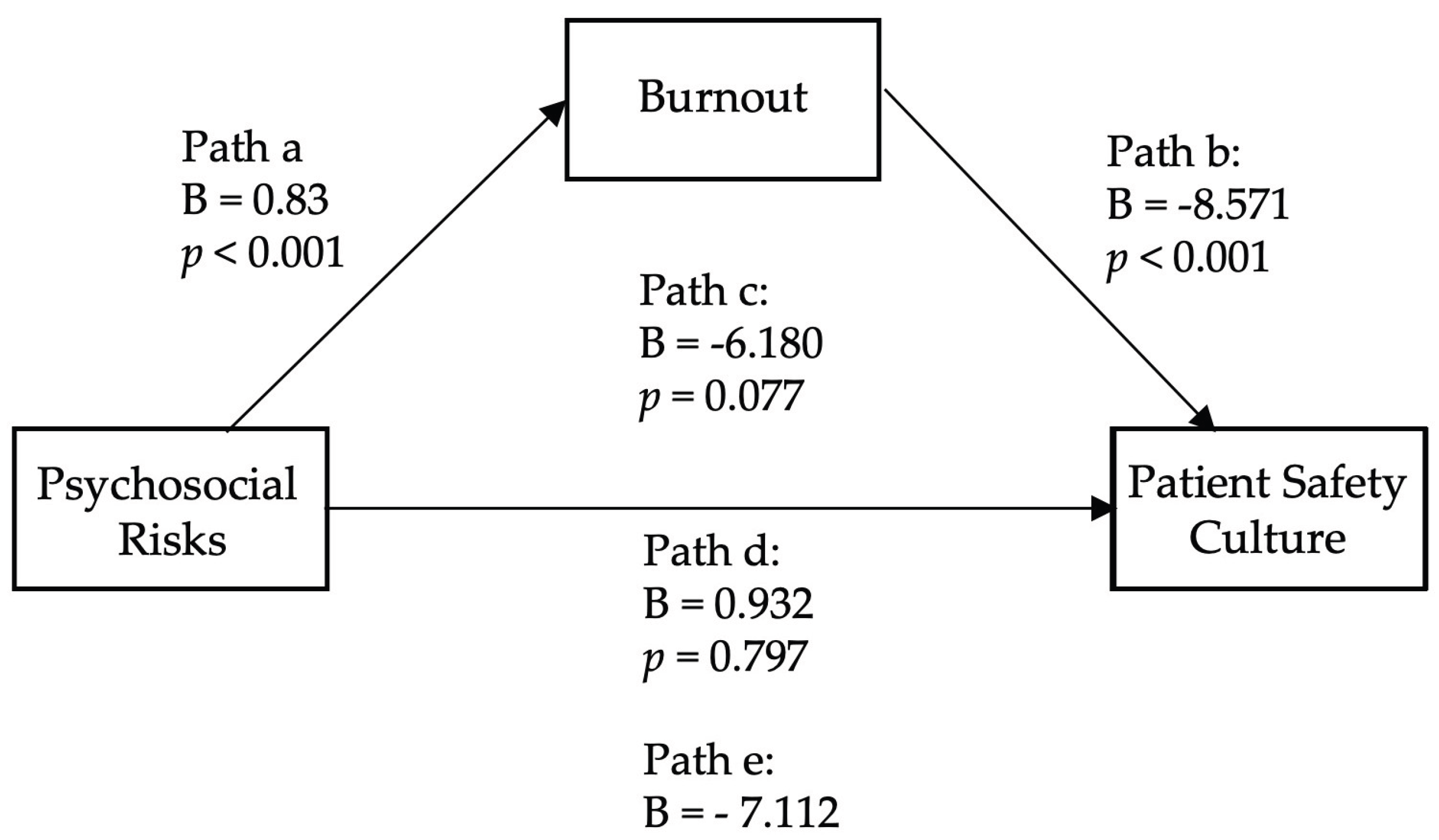
Figure 1.
Mediation Model: Burnout as mediator between Psychosocial Risks and Patient Safety Culture.
Figure 1.
Mediation Model: Burnout as mediator between Psychosocial Risks and Patient Safety Culture.
4. Discussion
This study’s aim was to analyze the role of burnout as a mediating mechanism in the association between psychosocial risk factors and patient safety culture in healthcare settings. The results obtained empirically support a model in which the impact of psychosocial risks on patient safety outcomes is not direct but operates through the psychological strain experienced by healthcare workers.
The findings specifically highlight burnout as a key explanatory pathway linking adverse working conditions to lower patient safety perceptions. This pattern is aligned with modern occupational health frameworks, which emphasize the importance of understanding how work-related stressors affect employee well-being and thus organizational outcomes [17,43]. These findings contribute to the evidence that sustainability and safety of healthcare systems are intrinsically dependent on the psychological functioning of the workforce.
4.1. Association Between Psychosocial Risks and Burnout (Path a)
In line with the correlation results between Psychosocial risks and Burnout, the analysis showed a robust and statistically significant positive association between psychosocial risk and burnout (path a). These results confirm that exposure to adverse psychosocial working conditions by healthcare workers is closely associated with increased levels of burnout. The Job Demands–Resources (JD-R) paradigm, which holds that high job demands cause psychological strain and energy depletion, is theoretically consistent with these results [16,17]. High workloads, emotional demands, and organizational pressures have been repeatedly associated with burnout in healthcare settings, highlighting the critical role that psychosocial risks play in causing occupational strain [44,45].
4.2. Association Between Burnout and Patient Safety Culture (Path b)
In accordance with the observed correlation, burnout was found to significantly and negatively predict patient safety culture (route b). This indicates that lower perceptions of safety in healthcare organizations are linked to higher levels of burnout. This result is in accordance with earlier studies that highlight how burnout undermines teamwork, attention, and decision-making—all of which are crucial to safe clinical practice [46]. From the perspective of human factors, decreased psychological and cognitive functioning associated with burnout compromises organizational procedures and safety-related behaviors [47]. Burnout can therefore be considered as a crucial factor that links strain at the human level to safety results at the system level.
4.3. Total Effect of Psychosocial Risks on Patient Safety Culture (Path c)
In accordance with the weak and non-significant correlation between these variables, the overall impact of psychosocial risk factors on patient safety culture (path c) was negative but not statistically significant. This suggests that there is no consistent or significant association between psychosocial risks and patient safety culture. Psychosocial risks tend to contribute to safety outcomes only through intermediate psychological processes, not directly through them. This pattern is in accordance with previous studies, which demonstrate that employee well-being acts frequently as a mediator in the indirect association between work-related stressors and patient safety outcomes [43].
4.4. Direct Effect Between Psychosocial Risks and Patient Safety Culture (Path d)
The results showed that when burnout was included in the model (path d), the direct effect of psychosocial risk factors on patient safety culture became apparently non-significant, demonstrating the absence of an independent relationship between these variables. This result suggests that burnout can explain the association, since the is no significant correlation between psychosocial risks and patient safety culture. According to the JD-R theory, rather than directly influencing organizational outcomes, job demands primarily affect psychological strain [17]. Therefore, psychosocial risks do not appear to influence safety culture independently of burnout.
4.5. Indirect Effect Between Psychosocial Risks and Patient Safety Culture mediated by Burnout (Path e)
With confidence intervals clearly excluding zero, the mediation analysis showed a statistically significant indirect effect of psychosocial risk factors on patient safety culture through burnout (route e). This result consolidates and explains the observed correlation pattern, which demonstrates that there is no direct relationship between psychosocial risks and safety culture, but burnout is significantly connected with patient safety culture and psychosocial risks are strongly associated with burnout. This configuration is representative of a full (indirect-only) mediation model, since the mediator entirely transmits the effect of the independent variable on the outcome [48].
Employee well-being has been shown to mediate the relationship between working conditions and safety outcomes, which is consistent with previous studies [43,46]. The main mechanism by which psychosocial risk variables influence perceptions of organizational safety in this context is burnout. Importantly, this research shows that unfavorable working conditions undermine safety culture indirectly by weakening healthcare workers’ psychological well-being.
4.6. General Discussion and Limitations
The combined pattern of correlations and mediation results indicates that psychosocial risk is not directly associated with patient safety culture. Instead, their impact is fully conducted through burnout, which represents the key mechanism linking adverse working conditions to safety-related outcomes. In fact, these findings reveal that burnout act as a lever through which psychosocial risks translate into unsafe care. In other words, psychosocial risks do not directly undermine patient safety culture; instead, they indirectly erode the psychological well-being of healthcare workers. Following this, patient safety culture, as an organizational result, is influenced by how healthcare workers behave psychologically. Psychosocial risk factors are closely linked to mental health outcomes, such as psychological distress and burnout, which in turn affect safety-related behaviors, communication, and perceptions of safety. Psychosocial risk factors such as emotional demands, workload, and organizational constraints have been identified as important predictors of psychological strain and burnout in healthcare settings [49,50]. Maintaining safe practices and a strong safety culture depends on cognitive functioning, attention, and collaboration, all of which are compromised by this psychological burden [51]. As burnout has been shown to affect patient safety culture, emotional strain may decrease involvement, communication openness, and participation in safety activities.
Finally, the present findings contribute to a broader international agenda: SDG 3, which prioritizes health and patient safety, and SDG 8, which highlights the importance of safe, healthy, and sustainable working environments [2,9]. Patient safety, as a core component of SDG 3, depends fundamentally on the functional capacity of healthcare workers, which can be compromised by psychosocial risks and burnout. In fact, healthcare workers’ mental health has become a global concern, with numerous studies showing that they are more vulnerable to psychological distress than the general population. These conditions not only affect workers’ well-being but also have measurable consequences for the quality and safety of care [45,52].
This reinforces the idea that interventions targeting burnout prevention are not only beneficial for workers but also essential for strengthening safety culture. Reducing psychosocial risks and preventing burnout are not merely organizational priorities—they are public health imperatives that contribute to safer, more resilient, and more sustainable healthcare systems. Strategies such as improving staffing adequacy, enhancing leadership support, promoting open communication, and implementing evidence-based well-being programs can help protect both workers and patients [30,31,32,46].
Several limitations to this study should be considered. First, any causal conclusions about the relationships between psychosocial risks, burnout, and patient safety culture are precluded by the cross-sectional methodology. The temporal direction of these correlations cannot be conclusively determined, although the mediation study that was done. Second, the use of self-reported measures could inflate the observed associations by introducing social desirability effects and common method bias. Third, while the sample's inclusion of healthcare workers from various organizations improves generalizability, it also introduces contextual variability that was not specifically modelled (for example, through multilevel analysis), which might have affected how patient safety culture was perceived. Fourth, the research focused on global composite scores, which may mask more subtle associations at the dimensional level, even though other aspects of psychosocial risk and safety culture were evaluated. Finally, even though the study showed strong mediation effects and sufficient statistical power, other potentially important factors—like organizational leadership, emotional intelligence, or aspects of the workplace—were left out and could help to explain the associations that were found. Future studies should consider multi-level strategies, longitudinal designs, and more comprehensive models that include more organizational and individual elements.
5. Conclusions
This study provides empirical evidence that the relationship between psychosocial risks and patient safety culture operates exclusively through burnout, underscoring the central role of healthcare workers’ psychological well-being in shaping safety-related outcomes. Although psychosocial risks and patient safety culture both reflect aspects of the work environment, they represent conceptually distinct levels of analysis. Psychosocial risks concern individual experiences of job demands, whereas patient safety culture is a collective organizational construct shaped by leadership, staffing policies, and communication systems. This distinction clarifies why no direct association was observed between the two constructs and reinforces the relevance of burnout as the pathway through which adverse working conditions translate into safety-related perceptions and behaviors. From a policy and organizational governance perspective, these findings underscore the need for integrated strategies that simultaneously address individual-level psychosocial exposures and system-level determinants of safety culture. Reducing psychosocial risks requires structural interventions - such as adequate staffing, workload regulation, supportive supervision, and participatory management - that mitigate chronic job demands and strengthen workers’ psychological well-being. At the same time, improving patient safety culture demands organizational policies that promote transparent communication, effective leadership, and team-based safety practices. These findings advance theoretical understanding by reinforcing the relevance of occupational health frameworks that position burnout as a pivotal pathway linking adverse working conditions to organizational performance. Moreover, the results align with the broader sustainability agenda, demonstrating that safeguarding workers’ mental health is essential for ensuring safe, resilient, and sustainable healthcare environments. measures, with direct implications for patient safety, workforce sustainability, and long-term system performance.
Author Contributions
For research articles with several authors, a short paragraph specifying their individual contributions must be provided. The following statements should be used “Conceptualization, P.B and C.B.; methodology, P.B and C.B.; software, P.B.; investigation, P.B. and C.B.; writing—original draft preparation, P.B. and C.B.; writing—review and editing, P.B. and C.B.; All authors have read and agreed to the published version of the manuscript.
Funding
This research received no external funding
Institutional Review Board Statement
The study was conducted in accordance with the Declaration of Helsinki and approved on 20 March 2024 by the Ethics Committee of Fernando Pessoa University, with the reference FCHS/PI 475/23-4.
Informed Consent Statement
All participants provided informed consent to participate in this study, and issues associated with confidentiality and anonymity were ensured, keeping in mind the Data Protection Law Regulation (EU) 2016/679 (General Data Protection Regulation).
Data Availability Statement
Data availability under request to the authors.
Conflicts of Interest
The authors declare no conflicts of interest.
Abbreviations
The following abbreviations are used in this manuscript:
| PSC | Patient Safety Culture |
| PSR | Psychosocial Risks |
References
- Intergovernmental Panel on Climate Change. Climate Change 2021 – The Physical Science Basis: Working Group I Contribution to the Sixth Assessment Report of the Intergovernmental Panel on Climate Change; Cambridge University Press: Cambridge, UK, 2021. [Google Scholar]
- World Health Organization. State of the World’s Nursing 2020: Investing in Education, Jobs and Leadership; WHO Press: Geneva, Switzerland, 2020. [Google Scholar]
- World Health Organization Science Council. Advancing the Responsible Use of Digital Technologies in Global Health: A Report of the World Health Organization Science Council; World Health Organization: Geneva, Switzerland, 2025. [Google Scholar]
- International Labour Organization; Occupational Safety and Health Administration; Branch, Working Environment. Revolutionizing Health and Safety: The Role of AI and Digitalization at Work: Global Report; ILO: Geneva, Switzerland, 2025. [Google Scholar]
- Holden, R.J.; Carayon, P.; Gurses, A.P.; Hoonakker, P.; Hundt, A.S.; Ozok, A.A.; Rivera-Rodriguez, A.J. SEIPS 2.0: A Human Factors Framework for Studying and Improving the Work of Healthcare Professionals and Patients. Ergonomics 2013, 56, 1669–1686. [Google Scholar] [CrossRef] [PubMed]
- Institute of Medicine (US) Committee on Quality of Health Care in America. To Err Is Human: Building a Safer Health System. In To Err Is Human: Building a Safer Health System; Kohn, L., Corrigan, J.M., Donaldson, M.S., Eds.; National Academies Press (US): Washington, DC, 2000. [Google Scholar]
- World Health Organization. Framework and Toolkit for Infection Prevention and Control Outbreak Preparedness, Readiness and Response: Implementation Manual; WHO: Geneva, Switzerland, 2025. [Google Scholar]
- Organization of Economic Cooperation and Development; European Commission. Health at a Glance: Europe 2024: State of Health in the EU Cycle; OECD Publishing: Paris, France, 2024. [Google Scholar]
- International Labour Organization. Safety and Health at the Heart of the Future of Work: Building on 100 Years of Experience; International Labour Organization: Geneva, Switzerland, 2019. [Google Scholar]
- World Health Organization. Health and Care Workforce. Global Strategy on Human Resources for Health: Workforce 2030. Report by the Director-General; World Health Organization: Geneva, Switzerland, 2024. [Google Scholar]
- Barros, C.; Baylina, P. Disclosing Strain: How Psychosocial Risk Factors Influence Work-Related Musculoskeletal Disorders in Healthcare Workers Preceding and during the COVID-19 Pandemic. Int. J. Env. Res. Public Health 2024, 21. [Google Scholar] [CrossRef] [PubMed]
- European Agency for Safety and Health at Work. Psychosocial Risks and Mental Health at Work; Publications Office of the European Union: Luxembourg, 2023. [Google Scholar]
- Baylina, P.; Fernandes, C.; Barros, C. The Impact of Psychosocial Risks on Burnout: Tracing the Pathways to Professional Exhaustion. In Occupational and Environmental Safety and Health VI; Baptista, J.S., Melo, R.B., Carneiro, P., Castelo Branco, J., Costa, N., Duarte, J., Guedes, J.C., Perestrelo, G., Eds.; Springer Nature Switzerland: Cham, Switzerland, 2025; Volume 2, pp. 157–167. [Google Scholar] [CrossRef]
- Conceoção, A.; Palma-Moreira, A. The Relationship Between Occupational Stress, Burnout, and Perceived Performance: The Moderating Role of Work Regime. Adm. Sci. 2025, 15. [Google Scholar] [CrossRef]
- Popucza, T.Z.; Eriksson, L.; Eriksson, M. Emotional Demands, Burnout, and Mental Wellbeing in Healthcare, Care, and Service Work: The Mediating Role of Surface Acting Across Age. Front. Psychol. 2025, 3, 42015. [Google Scholar] [CrossRef]
- Demerouti, E.; Bakker, A.B.; Nachreiner, F.; Schaufeli, W.B. The Job Demands–Resources Model of Burnout. J. Appl. Psychol. 2001, 86, 499–512. [Google Scholar] [CrossRef]
- Bakker, A.B.; Demerouti, E. Job Demands–Resources Theory: Taking Stock and Looking Forward. J. Occup. Health Psychol. 2017, 22, 273–285. [Google Scholar] [CrossRef] [PubMed]
- Karasek, R.A. Job Demands, Job Decision Latitude, and Mental Strain: Implications for Job Redesign. Adm. Sci. Q. 1979, 24, 285–308. [Google Scholar] [CrossRef]
- Barros, C.; Baylina, P. Pre-Pandemic Versus Pandemic Times: The Impact of Psychosocial Risk Factors on Work-Related Musculoskeletal Disorders in Healthcare Workers. In Occupational and Environmental Safety and Health V; Arezes, P.M., Melo, R.B., Carneiro, P., Castelo Branco, J., Colim, A., Costa, N., Costa, S., Duarte, J., Guedes, J.C., Perestrelo, G., et al., Eds.; Springer Nature Switzerland: Cham, Switzerland, 2024; pp. 557–565. [Google Scholar] [CrossRef]
- Mohr, D.C.; Elnahal, S.; Marks, M.L.; Derickson, R.; Osatuke, K. Burnout Trends Among US Health Care Workers. JAMA Netw. Open 2025, 8, e255954. [Google Scholar] [CrossRef] [PubMed]
- Gonçalves, F.; Gaudêncio, M. Burnout and Quality of Life in Portuguese Healthcare Professionals Working in Oncology and Palliative Care—A Preliminary Study. BMC Palliat. Care 2023, 22, 155. [Google Scholar] [CrossRef] [PubMed]
- Shanafelt, T.D.; Balch, C.M.; Bechamps, G.; Russell, T.; Dyrbye, L.; Satele, D.; Collicott, P.; Novotny, P.J.; Sloan, J.; Freischlag, J. Burnout and Medical Errors Among American Surgeons. Ann. Surg. 2010, 251, 995–1000. [Google Scholar] [CrossRef] [PubMed]
- Cimiotti, J.P.; Aiken, L.H.; Sloane, D.M.; Wu, E.S. Nurse Staffing, Burnout, and Healthcare Associated Infection. Am. J. Infect. Control 2012, 40, 486–490. [Google Scholar] [CrossRef] [PubMed]
- Li, L.Z.; Yang, P.; Singer, S.J.; Pfeffer, J.; Mathur, M.B.; Shanafelt, T. Nurse Burnout and Patient Safety, Satisfaction, and Quality of Care: A Systematic Review and Meta-Analysis. JAMA Netw. Open 2024, 7, e2443059. [Google Scholar] [CrossRef] [PubMed]
- Welp, A.; Meier, L.L.; Manser, T. Emotional Exhaustion and Workload Predict Clinician-Rated and Objective Patient Safety. Front. Psychol. 2014, 5, 1574. [Google Scholar] [CrossRef] [PubMed]
- Lu, L.; Ko, Y.-M.; Chen, H.-Y.; Chueh, J.-W.; Chen, P.-Y.; Cooper, C.L. Patient Safety and Staff Well-Being: Organizational Culture as a Resource. Int. J. Environ. Res. Public Health 2022, 19, 3722. [Google Scholar] [CrossRef] [PubMed]
- Sorra, J.; Gray, L.; Streagle, S.; Famolaro, T.; Yount, N.; Behm, J. AHRQ Hospital Survey on Patient Safety Culture: User’s Guide (Prepared by Westat, under Contract No. HHSA290201300003C); Agency for Healthcare Research and Quality: Rockville, MD, USA, 2018. [Google Scholar]
- Alabdullah, H.; Karwowski, W. Patient Safety Culture in Hospital Settings Across Continents: A Systematic Review. Appl. Sci. 2024, 14, 8496. [Google Scholar] [CrossRef]
- Davis, T.R.; Straatmann, K.; Snyder, N.; Shiner, D.; Evans, A.; Caruso, C.; Alton, M. Using the Principles of Just Culture to Improve Transparency and Risk Reporting in the Hospital Setting. Patient Saf. 2025, 7, 137737. [Google Scholar] [CrossRef]
- Singer, S.J.; Vogus, T.J. Reducing Hospital Errors: Interventions That Build Safety Culture. Annu. Rev. Public Health 2013, 34, 373–396. [Google Scholar] [CrossRef] [PubMed]
- Althobaiti, F.M. The Effects of Leadership on Patient Safety Culture in Health Care: A Systematic Review. BMC Nurs. 2026, 25, 125. [Google Scholar] [CrossRef] [PubMed]
- Finn, M.; Walsh, A.; Rafter, N.; Mellon, L.; Chong, H.Y.; Naji, A.; O’Brien, N.; Williams, D.J.; McCarthy, S.E. Effect of Interventions to Improve Safety Culture on Healthcare Workers in Hospital Settings: A Systematic Review of the International Literature. BMJ Open Qual. 2024, 13, e002506. [Google Scholar] [CrossRef] [PubMed]
- Barros, C.; Cunha, L.; Rocha, A.; Baylina, P. The Psychosocial Risk Factors Scale: Factorial Validity and Reliability Analysis. Int. J. Occup. Saf. Ergon. 2025, 1–15. [Google Scholar] [CrossRef] [PubMed]
- Cunha, L.; Silva, D.; Macedo, M. Different Shades of Green: An Analysis of the Occupational Health and Safety Risks Faced by Wind Farm Workers. Sustainability 2024, 16, 3012. [Google Scholar] [CrossRef]
- Yarmolyuk-Kröck, K. A Case for an EU Directive Addressing Work-Related Psychological Risks: An Eastern European Perspective (Cheng & Cheng). In Policy Brief; ISSN 2031-8782: Brussels, Belgium; European Trade Union Institute, 2022. [Google Scholar]
- Schaufeli, W.B.; Desart, S.; De Witte, H. Burnout Assessment Tool (BAT)—Development, Validity, and Reliability. Int. J. Environ. Res. Public Health 2020, 17, 9495. [Google Scholar] [CrossRef] [PubMed]
- Sinval, J.; Vazquez, A.C.S.; Hutz, C.S.; Schaufeli, W.B.; Silva, S. Burnout Assessment Tool (BAT): Validity Evidence from Brazil and Portugal. Int. J. Environ. Res. Public Health 2022, 19, 1344. [Google Scholar] [CrossRef] [PubMed]
- Agency for Healthcare Research and Quality. Hospital Survey on Patient Safety Culture; Agency for Healthcare Research and Quality: Rockville, MD, USA, March 2009. [Google Scholar]
- Eiras, M.; Escoval, A.; Monteiro Grillo, I.; Silva-Fortes, C. The Hospital Survey on Patient Safety Culture in Portuguese Hospitals: Instrument Validity and Reliability. Int. J. Health Care Qual. Assur. 2014, 27, 111–122. [Google Scholar] [CrossRef] [PubMed]
- Cohen, J. Statistical Power Analysis for the Behavioral Sciences, 2nd ed.; Lawrence Erlbaum Associates: Hillsdale, NJ, USA, 1988. [Google Scholar]
- Kang, H. Sample Size Determination and Power Analysis Using the G*Power Software. J. Educ. Eval. Health Prof. 2021, 18. [Google Scholar] [CrossRef] [PubMed]
- George, D.; Mallery, M. SPSS for Windows Step by Step: A Simple Guide and Reference, 17.0 Update, 10th ed.; Pearson: Boston, MA, USA, 2010. [Google Scholar]
- Nahrgang, J.D.; Morgeson, F.P.; Hofmann, D.A. Safety at Work: A Meta-Analytic Investigation of the Link Between Job Demands, Job Resources, Burnout, Engagement, and Safety Outcomes. J. Appl. Psychol. 2011, 96, 71–94. [Google Scholar] [CrossRef] [PubMed]
- Salvagioni, D.A.J.; Melanda, F.N.; Mesas, A.E.; González, A.D.; Gabani, F.L.; Andrade, S.M.d. Physical, Psychological and Occupational Consequences of Job Burnout: A Systematic Review of Prospective Studies. PLoS ONE 2017, 12, e0185781. [Google Scholar] [CrossRef] [PubMed]
- Hodkinson, A.; Zhou, A.; Johnson, J.; Geraghty, K.; Riley, R.; Panagopoulou, E.; Chew-Graham, C.A.; Peters, D.; Esmail, A.; et al. Associations of Physician Burnout with Career Engagement and Quality of Patient Care: Systematic Review and Meta-Analysis. BMJ 2022, 378, e070442. [Google Scholar] [CrossRef] [PubMed]
- Hall, L.H.; Johnson, J.; Watt, I.; Tsipa, A.; O’Connor, D.B. Healthcare Staff Wellbeing, Burnout, and Patient Safety: A Systematic Review. PLoS ONE 2016, 11, e0159015. [Google Scholar] [CrossRef] [PubMed]
- Carayon, P.; Wood, K. Patient Safety: The Role of Human Factors and Systems. Stud. Health Technol. Inform. 2010, 153, 23–46. [Google Scholar] [PubMed]
- Hayes, A.F. Introduction to Mediation, Moderation, and Conditional Process Analysis: A Regression-Based Approach, 3rd ed.; The Guilford Press: New York, NY, USA, 2022. [Google Scholar]
- Fernandes, C.; Barros, C.; Baylina, P. Burnout Among Healthcare Workers: Insights for Holistic Well-Being. Healthcare 2025, 13, 3298. [Google Scholar] [CrossRef] [PubMed]
- Dūdiņa, K.; Martinsone, B. Psychosocial Risks and Protective Factors for Healthcare Worker Burnout During the Post-Acute Phase of the COVID-19 Pandemic. Eur. J. Investig. Health Psychol. Educ. 2025, 15, 186. [Google Scholar] [CrossRef] [PubMed]
- Garcia, C.D.; Abreu, L.C.; Ramos, J.L.; Castro, C.F.; Smiderle, F.R.; Santos, J.A.; Bezerra, I.M. Influence of Burnout on Patient Safety: Systematic Review and Meta-Analysis. Medicina 2019, 55, 553. [Google Scholar] [CrossRef] [PubMed]
- Daneshvar, E.; Otterbach, S. Workplace Stressors and Burnout Among Healthcare Professionals: Insights from the Pandemic and Implications for Future Public Health Crises. Sci. Rep. 2025, 15, 42015. [Google Scholar] [CrossRef] [PubMed]

Table 1.
Descriptive analyses for Psychosocial Risks, Patient Safety Culture, and Burnout scales.
| Dimensions | Min | Max | Mean | SD | Skewness | Kurtosis | ||
| γ1 | SE | γ2 | SE | |||||
| Psychosocial Risks (ERPS) | ||||||||
| Psychosocial Risks’ total mean score | 1.87 | 3.83 | 2.73 | 0.402 | 0.133 | 0.164 | -0.226 | 0.327 |
| Patient Safety Culture (HSOPSC) | ||||||||
| Patient Safety Culture’s mean score | 0 | 89.58 | 43.16 | 21.246 | 0.184 | 0.164 | -0.758 | 0.327 |
| Burnout (BAT-23) | ||||||||
| Burnout total mean score | 1.00 | 4.70 | 2.25 | 0.692 | 0.90 | 0.16 | 1.09 | 0.327 |
| Legend: SD—standard deviation; SE—standard error; γ — gamma squared. | ||||||||
Table 2.
Pearson’s correlations between psychosocial risks and mental health dimensions, and patient safety culture and mental health dimensions.
Table 2.
Pearson’s correlations between psychosocial risks and mental health dimensions, and patient safety culture and mental health dimensions.
| Psychosocial risk factors (ERPS) | Patient safety culture (HSOPSC) | Burnout (BAT-23) |
|
| Psychosocial risk factors (INSAT_ERPS) | - | ||
| Patient safety culture (HSOPSC) | - 0.117 (0.054) | - | |
| Burnout (BAT-23) | 0.482 (<0.001) | -0.271 (<0.001) | - |
Table 3.
Mediation analysis considering Psychosocial Risks (PSR) and Patient Safety Culture (PSC), mediated by Burnout.
Table 3.
Mediation analysis considering Psychosocial Risks (PSR) and Patient Safety Culture (PSC), mediated by Burnout.
| Path | B | SE | t | p | 95% CI |
| a) (PSR → Burnout) | 0.830 | 0.117 | 7.098 | < 0.001 | (0.599; 1.060) |
| b) (Burnout → PSC) | -8.571 | 2.201 | -3.894 | < 0.001 | (-12.909; -4.233) |
| c) Total effect | -6.180 | 3.473 | -1.779 | 0.077 | (-13.030; 0.670) |
| d) (direct effect) (PSR → PSC) | 0.932 | 3.627 | 0.257 | 0.797 | (-6.217; 8.081) |
| e) Indirect effect (a × b) (PSR → Burnout→ PSC) | -7.112 | 2.057 | — | — | (-11.527; -3.320) |
Legend: CI—confidence interval; SE – Standard error.
Disclaimer/Publisher’s Note: The statements, opinions and data contained in all publications are solely those of the individual author(s) and contributor(s) and not of MDPI and/or the editor(s). MDPI and/or the editor(s) disclaim responsibility for any injury to people or property resulting from any ideas, methods, instructions or products referred to in the content. |
© 2026 by the authors. Licensee MDPI, Basel, Switzerland. This article is an open access article distributed under the terms and conditions of the Creative Commons Attribution (CC BY) license (http://creativecommons.org/licenses/by/4.0/).
Copyright: This open access article is published under a Creative Commons CC BY 4.0 license, which permit the free download, distribution, and reuse, provided that the author and preprint are cited in any reuse.


