

Submitted:
30 June 2026
Posted:
01 July 2026
You are already at the latest version
Abstract
Artificial intelligence (AI) is increasingly embedded in the technical, managerial, and operational activities of firms in the embodied intelligence industry. However, limited evidence explains how distinct AI embedding activities jointly relate to balanced firm competitiveness. This study examines R&D innovation embedding, decision-support embedding, organizational-coordination embedding, and scenario-development embedding in relation to enterprise core competitiveness, defined as the joint achievement of technological, ecosystem, and rule-based competitiveness. Survey data from 390 Chinese firms were analyzed using an integrative multi-method design. Necessary condition analysis examined capability-floor constraints; fuzzy-set qualitative comparative analysis identified configurations associated with high competitiveness; and tree-based machine learning with SHAP analysis assessed predictive differentiation across the continuous competitiveness range. All four dimensions showed significant bottleneck effects, although none was globally necessary. High competitiveness was associated with overlapping configurations in which three of the four dimensions reached high levels. Decision-support and scenario-development embedding provided the strongest incremental predictive information, with partial overlap at high levels. The findings suggest that balanced competitiveness is associated with a broad AI embedding base, selective high-level integration, and the conversion of AI-enabled information and scenario feedback into organizational learning.
Keywords:
artificial intelligence embedding
; embodied intelligence industry
; enterprise core competitiveness
; necessary condition analysis
; fsQCA
; machine learning
; SHAP
1. Introduction
Artificial intelligence (AI) is no longer confined to prediction, automation, and information processing in digital settings. In emerging industries, AI is increasingly embedded in products, engineering systems, organizational routines, and real-world operations. This shift is particularly visible in the embodied intelligence industry, where algorithms interact with sensors, actuators, robotic bodies, control systems, and physical scenarios. Research on embodied AI, embodied multimodal models, and vision-language-action systems shows how AI can connect perception, reasoning, and action in heterogeneous physical environments [1,2,3]. For firms operating in this industry, competitive performance is therefore unlikely to depend solely on algorithmic performance or manufacturing capacity. It is also associated with how AI is embedded in technical development, managerial judgement, organizational coordination, and scenario-based learning.
Management research has shown that AI can shape innovation, decision making, organizational learning, and firm-level outcomes [4,5,6,7,8,9]. However, the strategic value of AI does not arise simply from possessing data, algorithms, or computing infrastructure. It depends on how these resources are combined with human expertise, organizational routines, managerial judgement, and complementary assets [5,6,10,11]. AI may augment rather than replace managerial work, reshape opportunity evaluation, and alter the sources of competitive advantage [4,12,13,14]. Yet empirical research often represents AI through broad constructs such as adoption, AI capability, digital transformation, or investment intensity. These approaches are useful for identifying general associations between AI and organizational outcomes, but they provide less insight into how AI becomes embedded across distinct organizational activities and how those activities jointly relate to firm competitiveness.
This limitation is especially relevant in the embodied intelligence industry. Firms must combine AI models with hardware systems, sensing devices, engineering delivery, physical environments, and feedback from real-world deployment. Their competitiveness is associated not only with technical reliability, but also with the coordination of complementary actors and the ability to access interfaces, standards, data arrangements, and application scenarios. Ecosystem and platform research shows that value creation depends on interdependence, complementor alignment, governance arrangements, and a focal firm’s position within a broader value structure [15,16,17,18,19]. Research on appropriability and control points further indicates that value capture may depend on complementary assets, key interfaces, platform rules, and strategic ecosystem positions [20,21,22].
These perspectives suggest that enterprise competitiveness in embodied intelligence should not be treated as a single financial or operational outcome. Instead, it can be understood as a balanced system outcome that combines technological competitiveness, ecosystem competitiveness, and rule-based competitiveness. Technological competitiveness reflects a firm’s ability to develop, integrate, and iteratively improve embodied intelligence systems. Ecosystem competitiveness reflects its ability to mobilize complementary resources, coordinate partners, and support deployment and scaling. Rule-based competitiveness reflects its relative position in standards, interfaces, data arrangements, platform access, and scenario-entry mechanisms. These three dimensions are analytically distinct but practically interdependent. Strong technical capability may not be sufficient for scalable value creation without ecosystem access, while broad ecosystem participation may not be sustainable without reliable technical systems or viable value-capture positions.
This perspective raises a systems-oriented analytical problem. AI embedding in embodied intelligence firms is not a unitary organizational capability. Rather, it is distributed across several functionally differentiated activities. AI may be embedded in R&D innovation to support technical search, simulation, testing, and product iteration; in managerial decision support to assist opportunity evaluation, project selection, and resource allocation; in organizational coordination to connect specialized work across functions; and in scenario development to identify application opportunities and convert deployment feedback into organizational learning. These activities are distinct, but they are not fully independent or substitutable. A firm may possess strong AI-supported R&D capability but still exhibit limited competitiveness when decision processes, cross-functional coordination, or scenario learning remain underdeveloped.
Accordingly, this study conceptualizes AI embedding as an interdependent organizational capability system comprising four dimensions: R&D innovation embedding (RIE), decision-support embedding (DSE), organizational-coordination embedding (OCE), and scenario-development embedding (SDE). Rather than treating AI embedding as a single aggregate antecedent, the study examines how these four activities are associated with balanced enterprise core competitiveness (ECC). ECC is operationalized as the joint achievement of technological, ecosystem, and rule-based competitiveness. The purpose is not to claim that every firm must develop the same AI embedding profile. Instead, the study examines whether different AI embedding activities play different structural roles in relation to balanced competitiveness.
Conventional net-effect approaches are useful for estimating average associations between explanatory variables and outcomes. However, they provide limited insight into three issues that are central to an interdependent capability system. First, they do not show whether a serious shortfall in one AI embedding activity constrains the upper range of competitiveness. Second, they do not show whether firms can reach high competitiveness through alternative combinations of AI embedding activities. Third, they provide limited evidence on which activities most strongly differentiate firms across the continuous range of competitiveness after the remaining activities are considered.
This study therefore employs an integrative multi-method analytical design. The methods are not used as interchangeable tests of the same proposition, nor are they used to establish causal proof. Instead, they examine different structural properties of the same AI embedding capability system. Necessary condition analysis (NCA) examines capability-floor constraints by assessing whether insufficient levels of RIE, DSE, OCE, or SDE restrict the observed upper range of ECC [23,26,30]. Fuzzy-set qualitative comparative analysis (fsQCA) examines configurational sufficiency by identifying combinations of AI embedding activities associated with high ECC [24,25,31]. Tree-based machine-learning analysis and SHAP interpretation then examine predictive differentiation by assessing which AI embedding activities provide the greatest incremental predictive information across the continuous ECC range [27,28,29,32].
The analytical logic is therefore organized as follows. NCA identifies the AI embedding activities that firms cannot afford to leave seriously underdeveloped. fsQCA identifies the high-level combinations through which firms may be associated with balanced competitiveness. Machine-learning and SHAP analysis identify the activities that most strongly differentiate firms across the observed competitiveness distribution. Together, these analyses distinguish capability-floor constraints, configurational sufficiency, and predictive differentiation. This distinction is important because an AI embedding activity may constrain the upper range of competitiveness even when it does not provide the largest incremental predictive contribution, and a condition may be non-high within one configuration without being strategically irrelevant.
Using survey data from 390 firms operating in China’s embodied intelligence industry, this study investigates the association between four AI embedding activities and balanced enterprise core competitiveness. The enterprise is the intended unit of analysis, and respondents were selected because they were familiar with their firms’ AI application, R&D, product development, scenario deployment, ecosystem cooperation, or strategic management. The study interprets the findings as associations between respondent-reported AI embedding practices and respondent-reported relative competitiveness. It does not infer temporal ordering or causal effects from the cross-sectional data.
The study addresses the following research questions:
RQ1. Which AI embedding activities impose capability-floor constraints on balanced enterprise core competitiveness?
RQ2. What combinations of R&D innovation embedding, decision-support embedding, organizational-coordination embedding, and scenario-development embedding are associated with high balanced enterprise core competitiveness?
RQ3. Which AI embedding activities provide the strongest incremental predictive information across the continuous range of enterprise core competitiveness?
This study makes three contributions. First, it moves beyond aggregate representations of AI adoption or AI capability by conceptualizing AI embedding as a distributed organizational capability system. It distinguishes AI embedding in R&D innovation, decision support, organizational coordination, and scenario development, each of which performs a different function in the development, deployment, and improvement of embodied intelligence solutions. Second, the study conceptualizes enterprise core competitiveness as a balanced system outcome rather than as a single performance indicator. By combining technological competitiveness, ecosystem competitiveness, and rule-based competitiveness, it captures the interdependence between technical capability, ecosystem participation, and value-capture positions in the embodied intelligence industry. Third, the study develops an integrative evidence logic for examining AI-enabled competitiveness. NCA identifies capability-floor constraints, fsQCA identifies configurational sufficiency, and machine-learning analysis identifies predictive differentiation. The contribution of this design lies in analytical differentiation rather than stronger causal proof. It provides a systems-oriented account of how functionally differentiated AI embedding activities are associated with balanced enterprise core competitiveness.
The remainder of this paper is organized as follows. Section 2 reviews research on AI in organizational activities, the strategic foundations of competitiveness in embodied intelligence, and empirical approaches beyond net effects. Section 3 develops the theoretical background and analytical propositions. Section 4 describes the research design, data, measures, and analytical procedures. Section 5 reports the empirical findings. Section 6 discusses the theoretical and practical implications. Section 7 concludes the study.
2. Literature Review
2.1. Artificial Intelligence in Organizational Activities
Research on artificial intelligence in management and strategy has moved beyond a narrow focus on technology adoption. Earlier studies commonly treated AI as a tool for automation, prediction, data processing, or digital infrastructure. More recent research emphasizes that AI becomes strategically relevant only when it is embedded in organizational activities, routines, decision processes, and complementary resource arrangements [4,5,6]. AI may automate selected tasks while also extending managerial judgement and organizational action [4]. Its organizational consequences therefore depend not only on the availability of algorithms, data, and computing resources, but also on how firms combine these resources with human expertise, routines, authority structures, and complementary assets [5,6]. This perspective has shifted attention from whether firms adopt AI to where and how AI becomes embedded in recurrent organizational work.
One stream of research examines AI in innovation and technological development. AI can support search, idea generation, simulation, testing, engineering problem solving, and the organization of innovation activities [33]. Firm-level evidence links AI use with industrial innovation, productivity, product innovation, and growth, although the observed relationships vary across technologies and application contexts [7,8,9]. Research on AI-enabled business-model innovation further highlights feedback loops and co-evolutionary learning as important conditions for scaling AI applications [10]. Similarly, implementation research suggests that AI-related benefits depend on the integration of technical systems with organizational processes and their extension across operational settings [11]. Taken together, this literature indicates that AI may become embedded in R&D innovation through technical search, experimentation, design iteration, simulation, and product improvement.
A second stream focuses on AI-supported managerial decision making. AI can assist organizations in processing complex information, identifying patterns, evaluating alternatives, and allocating attention under uncertainty [12]. However, algorithmic outputs do not remove the need for managerial judgement. Organizations must still determine how decision rights are allocated, how recommendations are interpreted, and how accountability is assigned when AI is used in strategic or operational decisions [13]. Research on professionals working with opaque AI systems similarly shows that domain knowledge remains important for evaluating outputs and determining whether, when, and how algorithmic recommendations should be used [34]. In this sense, AI embedding in decision support concerns more than the use of analytical tools; it concerns the integration of AI-generated information into opportunity evaluation, project selection, resource allocation, and strategic judgement.
AI also has implications for organizational coordination. By increasing the visibility, circulation, and processing of information, AI can support knowledge sharing, workflow integration, project coordination, and collaboration among specialized functions. Yet these potential benefits depend on whether AI is incorporated into organizational routines, coordination mechanisms, authority structures, and accountability arrangements [4,5,34]. This issue is particularly important in firms that must coordinate R&D, product development, engineering delivery, manufacturing, market development, and service activities. In such settings, AI is not merely a technical input; it may function as part of the organizational infrastructure through which specialized knowledge and interdependent tasks are integrated.
A related technical literature provides the background for AI embedding in embodied intelligence. Embodied AI systems perceive, reason, and act through interaction with physical environments rather than through static data analysis alone [1]. Embodied multimodal models and vision-language-action systems integrate language, perception, robotic control, and real-world task execution [2,3]. Although this literature is primarily technological, it highlights the importance of physical deployment, environmental variation, and operational feedback. For firms in the embodied intelligence industry, AI applications are therefore closely connected with products, sensors, robotic bodies, control systems, engineering delivery, customer tasks, and real-world scenarios.
Overall, the literature suggests that AI embedding can be understood as a distributed organizational phenomenon. AI may be embedded in R&D innovation, managerial decision support, organizational coordination, and scenario-based learning. These activities are analytically distinct because they serve different organizational functions. However, they are also interdependent because technical learning, managerial choices, cross-functional coordination, and deployment feedback must be connected before AI-related resources can be translated into sustained organizational outcomes. This distinction provides the basis for examining R&D innovation embedding, decision-support embedding, organizational-coordination embedding, and scenario-development embedding as four functionally differentiated elements of an AI embedding capability system.
2.2. Balanced Firm Competitiveness in the Embodied Intelligence Industry
Embodied intelligence lies at the intersection of artificial intelligence, robotics, sensing, control, and human–environment interaction. Unlike conventional digital AI applications, embodied systems must perceive changing conditions, process multimodal information, make decisions, and execute actions in physical environments [1,2,3]. Their development and deployment depend on the integration of algorithms, sensors, actuators, control architectures, hardware configurations, engineering capabilities, and feedback from real-world operation. This technological architecture creates a distinctive strategic setting: the competitiveness of embodied intelligence firms cannot be inferred from algorithmic performance or isolated product attributes alone.
Dynamic-capability research provides one basis for understanding this setting. Sustained advantage depends on a firm’s ability to sense opportunities, seize them through resource commitment, and reconfigure assets and routines as conditions change [35,36]. In technology-intensive settings, the returns from innovation also depend on appropriability conditions and access to complementary assets rather than on technological invention alone [20]. Business-model research similarly emphasizes that firms must combine technological resources, organizational capabilities, and market-facing arrangements to create and capture value [37]. For embodied intelligence firms, technical knowledge becomes commercially relevant only when it can be connected with hardware integration, engineering delivery, manufacturing, customer access, service support, and iterative deployment.
Innovation-ecosystem research further shows that value creation often depends on technological interdependence and complementary innovation [15]. Ecosystems can be understood as alignment structures in which interdependent actors and activities must be coordinated for a focal value proposition to materialize [16]. They are also shaped by modularity, complementarities, and the coordination of legally independent participants [17]. These insights are particularly relevant to embodied intelligence because firms frequently depend on model providers, component suppliers, equipment manufacturers, system integrators, platform organizations, scenario owners, customers, and service partners. A firm’s competitive position is therefore associated not only with its internal technical capabilities but also with its ability to access, organize, and mobilize complementary resources.
Platform and digital-ecosystem research adds a related insight. Industry platforms can organize technological architectures, complementor participation, and governance arrangements [18]. Platform architecture, governance, and environmental dynamics may coevolve over time [41], while firms may manage ecosystem value through the selective promotion of complements [19]. More broadly, platform competition involves strategic choices that extend beyond conventional product-market rivalry [21,42]. Integrative research on technological platforms and digital ecosystems further emphasizes the importance of interfaces, governance rules, and actor positions in shaping value creation and appropriation [43,44].
A complementary appropriability perspective focuses on the conditions under which firms capture value from innovation. Firms may benefit from technological innovation through complementary assets and appropriability regimes [20]. In digital business ecosystems, control points can emerge from technological, strategic, and institutional positions that influence access, bargaining power, and value capture [22]. Such positions may involve technical standards, interfaces, data arrangements, platform access, testing requirements, or scenario-entry mechanisms. In the embodied intelligence industry, these positions matter because value is distributed across software, hardware, systems integration, physical deployment, and application access.
These literature streams do not imply that dynamic capabilities, ecosystem orchestration, platform governance, and control points are separate explanatory variables in the present study. Rather, they clarify why firm competitiveness in the embodied intelligence industry is multidimensional. A firm may possess strong technical capabilities but face difficulties in scaling when ecosystem access is limited. It may participate extensively in an ecosystem but struggle to sustain its position without reliable technical systems. It may create and deploy value but capture only a limited share when it lacks access to relevant standards, interfaces, data arrangements, or scenario-entry mechanisms.
Accordingly, this study conceptualizes enterprise core competitiveness as a balanced system outcome comprising technological competitiveness, ecosystem competitiveness, and rule-based competitiveness. Technological competitiveness refers to a firm’s ability to develop, integrate, adapt, and iteratively improve embodied intelligence systems. Ecosystem competitiveness refers to its ability to mobilize complementary resources, coordinate partners, and support deployment and scaling in an interdependent value structure. Rule-based competitiveness refers to its relative ability to participate in, adapt to, or benefit from standards, interfaces, data arrangements, platform access, and scenario-entry mechanisms. These three dimensions are analytically distinct but practically complementary. Their joint consideration provides a more suitable representation of competitiveness in the embodied intelligence industry than a single financial, operational, or technological indicator.
2.3. Analytical Perspectives on AI-Enabled Competitiveness
Research on AI-enabled organizational outcomes has traditionally relied on regression-based, panel-data, survey-based, or structural-equation approaches to estimate average associations between AI use, AI capability, innovation, productivity, and firm performance. Firm-level studies have examined the associations between AI use and industrial innovation, productivity, product innovation, and growth [7,8,9]. Experimental research has also examined the productivity implications of generative AI in task-based work [45]. This body of work provides important evidence on average organizational outcomes associated with AI. However, average-effect approaches are less suited to examining whether a serious shortfall in one organizational activity constrains the upper range of an outcome, whether alternative combinations of activities are associated with similar outcomes, or whether the predictive contribution of one activity depends on the levels of others.
Configurational research provides one response to these limitations. Set-theoretic approaches examine how multiple conditions may jointly relate to an outcome rather than assuming that all cases follow one additive path. Fuzzy-set qualitative comparative analysis assesses degrees of membership in empirically meaningful sets and can identify combinations of conditions associated with an outcome [24]. It has been used to examine organizational configurations and typologies [25], while subsequent research has further developed configurational theorizing around conjunctural causation, equifinality, and causal asymmetry [46,47]. Methodological guidance has also clarified the appropriate use of qualitative comparative analysis in strategy and organization research [31]. This perspective is useful when high outcomes may be associated with more than one coherent combination of organizational activities.
Necessary condition analysis provides a different analytical perspective. Rather than assessing average associations or sufficient combinations, NCA examines whether an insufficient level of a condition constrains the level of an outcome that can be observed [23]. It is particularly relevant when a capability shortfall may create an upper-bound limitation even though the condition is not globally necessary across all successful cases. Research has highlighted the complementarity of NCA and fsQCA, as well as the distinction between necessity in kind and necessity in degree [26,30]. In the present context, this perspective is relevant because a firm may have strong AI embedding in some activities but still face a competitiveness constraint when another activity remains seriously underdeveloped.
Machine-learning approaches provide a third perspective. Flexible machine-learning methods can capture nonlinearities, heterogeneity, and conditional patterns that may not be represented well by prespecified linear forms [27,48]. Tree-based methods, including random forests and gradient-boosting algorithms, are widely used in prediction-oriented analysis because they can model complex relationships without requiring a fixed functional form [28,49]. Explainable AI approaches such as SHAP make fitted tree-based models more interpretable by decomposing predictions into feature-level contributions and interaction patterns [29,32]. These methods can identify which variables provide incremental predictive information in a fitted model, but such importance measures should not be interpreted as causal effects.
Taken together, the literature points to three analytically distinct properties of AI-enabled organizational capability systems. First, some AI embedding activities may function as capability floors: when they remain insufficiently developed, the upper range of firm competitiveness may be constrained. Second, high competitiveness may be associated with alternative but coherent combinations of AI embedding activities rather than a single universal profile. Third, the four activities may not contribute equally to continuous variation in competitiveness after the remaining activities are considered.
These distinctions are particularly important for the embodied intelligence industry. R&D innovation embedding, decision-support embedding, organizational-coordination embedding, and scenario-development embedding may each contribute to balanced competitiveness in different ways. A capability may be important because its absence constrains the upper range of competitiveness, even when it does not provide the largest incremental predictive contribution. Similarly, an activity may not need to reach high-set membership within one high-competitiveness configuration without being strategically unimportant. The present study therefore uses NCA, fsQCA, and prediction-oriented machine learning as complementary analytical lenses rather than interchangeable methods or competing tests of the same relationship.
Section 3 builds on this literature to develop the theoretical background and analytical propositions. It specifies how the four AI embedding activities are expected to relate to balanced enterprise core competitiveness through capability-floor constraints, configurational sufficiency, and predictive differentiation.
3. Theoretical Background and Analytical Propositions
3.1. Study Positioning: AI Embedding as an Interdependent Capability System
Section 2 showed that AI becomes strategically relevant when it is embedded in organizational activities rather than treated solely as a technological input. It also showed that competitiveness in the embodied intelligence industry cannot be represented adequately by a single technological, financial, or operational indicator. However, three theoretical issues remain.
First, aggregate constructs such as AI adoption, AI capability, digital transformation, and AI investment provide limited insight into the specific organizational activities through which AI becomes embedded in firms [4,6,14]. They are useful for identifying broad organizational associations, but they do not distinguish whether AI is primarily used to support technical search, managerial decision making, cross-functional coordination, or scenario-based learning. Second, conventional performance measures do not fully capture the combined technological, ecosystem, and rule-based requirements of firms operating in the embodied intelligence industry. Third, conventional net-effect approaches are less suitable for examining whether serious shortfalls in particular AI embedding activities constrain competitiveness, whether alternative activity combinations are associated with similar competitive outcomes, and whether some activities provide stronger predictive differentiation than others.
This study addresses these issues by conceptualizing AI embedding as an interdependent organizational capability system. The system comprises four functionally differentiated activities: R&D innovation embedding, decision-support embedding, organizational-coordination embedding, and scenario-development embedding. These activities are distinct because they operate in different parts of organizational work. They are also interdependent because technical learning, managerial choice, cross-functional integration, and deployment feedback must be connected before AI-related resources can be translated into sustained competitive outcomes.
Dynamic-capability research provides the primary theoretical logic for this argument. Dynamic capabilities concern a firm’s ability to sense opportunities, seize them through resource commitments, and reconfigure assets and routines as conditions change [35,36]. In the present context, R&D innovation embedding supports technical search, experimentation, simulation, testing, and iterative development. Decision-support embedding supports the interpretation of information, project selection, resource allocation, and strategic judgement. Organizational-coordination embedding supports the integration of specialized activities across R&D, product development, manufacturing, deployment, and service. Scenario-development embedding connects technical solutions with real operating environments and incorporates deployment feedback into subsequent learning and adaptation.
This interpretation does not treat the four AI embedding dimensions as direct measures of the microfoundations of dynamic capabilities. Nor does it assume that they operate through a fixed sequential process. Instead, the dynamic-capability perspective clarifies why AI-related resources are unlikely to generate sustained strategic value when they remain isolated within one organizational activity. AI becomes more consequential when firms can connect technical experimentation, managerial decisions, organizational integration, and scenario-based learning.
Ecosystem and control-point research provides a complementary basis for defining the outcome of this capability system. Ecosystem research explains why value creation depends on the alignment of interdependent actors, complementary assets, and coordinated activities [15,16,17]. Appropriability and control-point research explains why value capture may also depend on access to complementary assets, interfaces, standards, data arrangements, platform rules, and scenario-entry mechanisms [20,21,22]. These perspectives are not introduced as separate explanatory variables in the present study. Rather, they explain why competitiveness in the embodied intelligence industry should be treated as a balanced outcome comprising technological, ecosystem, and rule-based dimensions.
Accordingly, the central analytical claim of this study is deliberately bounded. It does not claim that AI embedding causes enterprise competitiveness. Instead, it examines how four functionally differentiated AI embedding activities are associated with balanced enterprise core competitiveness and whether these activities display different structural roles in relation to that outcome.
3.2. AI Embedding and Balanced Enterprise Core Competitiveness
3.2.1. Functional Differentiation and Interdependence in AI Embedding
AI embedding refers to the extent to which AI becomes incorporated into recurrent organizational activities rather than being used as a disconnected technical tool. In the embodied intelligence industry, AI embedding is particularly relevant because firms must combine algorithms with robotic bodies, sensors, control systems, engineering delivery, application scenarios, and real-world operational feedback. The strategic relevance of AI therefore depends on how it is embedded across distinct but connected organizational activities.
R&D innovation embedding refers to the use of AI in technological search, simulation, technical testing, engineering problem solving, design iteration, and product improvement. It expands the range and speed of technical experimentation, allowing firms to search for solutions, evaluate alternatives, and refine embodied intelligence products or systems [6,33]. However, technical experimentation alone does not guarantee that firms will select viable opportunities, coordinate implementation, or obtain usable feedback from deployment.
Decision-support embedding refers to the integration of AI into opportunity evaluation, project selection, resource allocation, operational management, and strategic judgement. AI may assist firms in processing complex information and identifying patterns, but organizational value depends on how algorithmic information is interpreted and incorporated into managerial decisions [4,12,13]. Decision-support embedding is therefore relevant to whether firms can convert technical and market information into timely and informed organizational choices.
Organizational-coordination embedding refers to the use of AI in information sharing, workflow integration, project collaboration, knowledge coordination, and human–AI work arrangements. Embodied intelligence firms often require the simultaneous coordination of technical development, product design, hardware integration, manufacturing, deployment, and service activities. AI-supported coordination may help firms connect these specialized tasks, but its role depends on whether AI is integrated into organizational routines and authority structures rather than applied in a fragmented manner [4,5,34].
Scenario-development embedding refers to the use of AI in identifying, developing, evaluating, and improving real-world application scenarios. In embodied intelligence, products and systems are tested and refined through interaction with physical environments, users, tasks, and operating conditions. Scenario-development embedding therefore concerns whether firms can use deployment data, task feedback, and practical experience to improve products, algorithms, solutions, and subsequent decisions [1,2,3].
The four activities are functionally differentiated but mutually dependent. R&D innovation embedding may provide technical options, but decision-support embedding is needed to prioritize those options and commit resources. Decision-support embedding may improve strategic choices, but organizational-coordination embedding is needed to convert choices into integrated action. Scenario-development embedding may generate valuable feedback, but firms must possess sufficient technical and organizational capacity to incorporate that feedback into subsequent development and deployment. The relevant theoretical expectation is therefore neither that one activity is universally dominant nor that all activities must play identical roles. Rather, AI-enabled competitiveness is likely to be associated with the joint adequacy, combination, and differentiated contribution of these four activities.
3.2.2. Enterprise Core Competitiveness as a Balanced System Outcome
Enterprise core competitiveness refers to a firm’s relative ability to develop, scale, and appropriate value in the embodied intelligence industry. In this study, it is conceptualized as a balanced system outcome comprising technological competitiveness, ecosystem competitiveness, and rule-based competitiveness.
Technological competitiveness concerns the ability to develop, integrate, adapt, and iteratively improve embodied intelligence systems. It includes the capacity to connect algorithms, software, hardware, engineering capabilities, and real-world task requirements into reliable and deliverable solutions. Ecosystem competitiveness concerns the ability to mobilize complementary resources, coordinate partners, access deployment opportunities, and sustain a viable position in an interdependent value structure. Rule-based competitiveness concerns a firm’s relative ability to participate in, adapt to, or benefit from standards, technical specifications, interfaces, data arrangements, platform access, and scenario-entry mechanisms.
These three dimensions are analytically distinct but practically complementary. A firm may develop technically capable products but struggle to scale when it cannot access partners, customers, platforms, or deployment scenarios. A firm may participate widely in an ecosystem but face difficulties in sustaining its position when its technical systems are unreliable or difficult to integrate. A firm may create and deploy value but capture only a limited share when it lacks access to standards, interfaces, data arrangements, or relevant entry points. Therefore, strong performance in one dimension should not be assumed to fully offset a serious weakness in another.
This balanced view is consistent with dynamic-capability research, which emphasizes the combination and reconfiguration of resources rather than isolated resource ownership [35,36]. It is also consistent with ecosystem research, which emphasizes coordinated complementarities in value creation [15,16,17], and appropriability research, which emphasizes complementary assets and strategic positions in value capture [20,21,22]. The present study therefore treats ECC as a system-level outcome that reflects the joint condition of technological capability, ecosystem participation, and rule-based value capture.
3.3. Analytical Propositions
3.3.1. Capability-Floor Constraints
The interdependence of AI embedding activities suggests that a substantial shortfall in any one activity may constrain the upper range of balanced enterprise core competitiveness. R&D innovation embedding provides technical search, experimentation, and iterative development. Decision-support embedding helps firms evaluate opportunities and allocate resources. Organizational-coordination embedding connects specialized tasks and organizational functions. Scenario-development embedding links technical solutions with deployment feedback and real-world learning.
When one of these activities remains seriously underdeveloped, strengths in the other activities may be difficult to translate into balanced competitiveness. For example, AI-supported R&D may produce promising technical options, but firms may be unable to derive sustained competitive value when they lack sufficient decision support for resource allocation, organizational coordination for implementation, or scenario development for feedback-based refinement. Similarly, access to extensive scenario feedback may have limited strategic relevance when firms cannot integrate that feedback into technical iteration and coordinated organizational action.
This is a level-dependent necessity argument rather than a claim of global necessity. It does not imply that every high-competitiveness firm must display the same dominant AI embedding activity. Instead, it suggests that insufficient levels of a specific activity may limit the level of balanced competitiveness that can be observed. NCA is appropriate for examining this type of bottleneck relationship because it assesses whether a condition constrains the upper range of an outcome [23,26,30].
Proposition 1. Insufficient levels of R&D innovation embedding, decision-support embedding, organizational-coordination embedding, or scenario-development embedding are expected to impose level-dependent capability-floor constraints on balanced enterprise core competitiveness.
3.3.2. Configurational Sufficiency
Although the four AI embedding activities are interdependent, high enterprise core competitiveness need not be associated with one fixed organizational profile. Firms in the embodied intelligence industry differ in technological specialization, product architecture, organizational structure, ecosystem position, and scenario strategy. These differences may shape how firms combine technical learning, managerial decision making, organizational coordination, and scenario-based feedback.
For example, firms focused primarily on technological development may rely more strongly on the connection between R&D innovation embedding, decision-support embedding, and organizational coordination. Firms closer to systems integration or application deployment may place greater emphasis on the combination of technical development, coordination, and scenario learning. These examples do not imply that any particular activity is dispensable. Rather, they illustrate why high competitiveness may be associated with more than one coherent high-level combination of AI embedding activities.
Configurational research emphasizes that complex organizational outcomes may emerge through multiple conjunctural pathways rather than through one universally dominant combination of conditions [24,25,46,47]. In this study, a non-high condition within a sufficient configuration would not imply that lower levels of that activity improve competitiveness. It would indicate only that the activity does not need to reach high-set membership within that particular combination when other activities are jointly developed.
Proposition 2. High balanced enterprise core competitiveness is expected to be associated with multiple alternative configurations of R&D innovation embedding, decision-support embedding, organizational-coordination embedding, and scenario-development embedding.
3.3.3. Predictive Differentiation and Non-Additivity
The four AI embedding activities perform different organizational functions and may therefore provide unequal predictive information across the continuous range of ECC. R&D innovation embedding may establish an important technical basis for embodied intelligence firms. Organizational-coordination embedding may determine whether technical knowledge, managerial decisions, and deployment feedback can be converted into integrated organizational action. Decision-support embedding may be especially relevant when firms must evaluate competing technological and commercial opportunities. Scenario-development embedding may be especially relevant when competitiveness depends on learning from physical deployment, customer tasks, and changing operating conditions.
These differentiated functions suggest that the four activities need not contribute equally to the prediction of continuous competitiveness. Their joint contributions may also be non-additive. At lower or moderate levels, the development of one activity may enhance the predictive relevance of another because firms need connected technical, decision, coordination, and feedback processes. At higher levels, some activities may provide overlapping information because they operate on related organizational processes. Such overlap should not be interpreted as evidence that stronger AI embedding reduces competitiveness. Rather, it may indicate diminishing incremental predictive information once related activities are already highly developed.
Tree-based machine-learning methods are suitable for examining these predictive patterns because they can capture nonlinear and conditional relationships without imposing a predetermined functional form [28,49]. SHAP analysis can then identify feature-level contributions and model-based interaction patterns in the fitted model [29,32]. These analyses are predictive rather than causal. They do not estimate conventional moderation effects or establish that one AI embedding activity has a universally superior causal effect.
Proposition 3. R&D innovation embedding, decision-support embedding, organizational-coordination embedding, and scenario-development embedding are expected to provide unequal and potentially non-additive predictive information for continuous enterprise core competitiveness.
3.4. Research Framework
Figure 1 presents the research framework. R&D innovation embedding, decision-support embedding, organizational-coordination embedding, and scenario-development embedding are treated as four functionally differentiated but interdependent elements of an AI embedding capability system. Enterprise core competitiveness is treated as a balanced system outcome comprising technological competitiveness, ecosystem competitiveness, and rule-based competitiveness.
The framework does not specify a single linear causal path from AI embedding to competitiveness. Nor does it treat the four AI embedding activities as interchangeable indicators of one latent capability. Instead, it organizes the empirical analysis around three structural properties of the same capability system.
The first analytical layer examines capability-floor constraints. It considers whether insufficient levels of individual AI embedding activities restrict the observed upper range of ECC. The second layer examines configurational sufficiency. It considers whether high ECC is associated with alternative high-level combinations of RIE, DSE, OCE, and SDE. The third layer examines predictive differentiation. It considers which AI embedding activities provide the greatest incremental predictive information across the continuous competitiveness distribution and whether their predictive contributions are non-additive.
Accordingly, the framework links theory and method without treating different methods as interchangeable or mutually validating tests. NCA addresses capability adequacy; fsQCA addresses configurational sufficiency; and machine-learning analysis with SHAP interpretation addresses predictive differentiation. Together, these analytical lenses provide a systems-oriented account of how different AI embedding activities are associated with balanced enterprise core competitiveness in the embodied intelligence industry.
4. Methods
4.1. Research Design
This study employs an integrative multi-method analytical design to examine how four AI embedding activities are associated with balanced enterprise core competitiveness in the embodied intelligence industry. The design does not treat necessary condition analysis (NCA), fuzzy-set qualitative comparative analysis (fsQCA), and machine-learning analysis as interchangeable tests of the same proposition. Instead, the methods examine different structural properties of one AI embedding capability system.
NCA examines capability-floor constraints by assessing whether insufficient levels of R&D innovation embedding, decision-support embedding, organizational-coordination embedding, or scenario-development embedding restrict the observed upper range of enterprise core competitiveness. fsQCA examines configurational sufficiency by identifying combinations of AI embedding activities associated with high competitiveness. Tree-based machine-learning analysis, out-of-sample permutation importance, and SHAP interpretation then examine predictive differentiation across the continuous competitiveness range.
The analytical design therefore distinguishes three questions. NCA identifies AI embedding activities that firms cannot afford to leave seriously underdeveloped. fsQCA identifies high-level combinations of activities associated with balanced competitiveness. Machine-learning and SHAP analysis identify which activities provide the greatest incremental predictive information after the remaining activities are considered. The methods are complementary analytical lenses rather than sequential causal tests. Given the cross-sectional survey design, the findings are interpreted as associations and predictive patterns rather than evidence of temporal ordering or causal effects.
4.2. Data Collection and Sample
This study used a targeted firm-level survey of enterprises operating in the embodied intelligence industry. The questionnaire was distributed through enterprise directories, industrial parks, industry associations, platform organizations, and professional business networks. The survey focused primarily on Hangzhou, Suzhou, Shanghai, and other Yangtze River Delta cities, while also accepting responses from related firms in other regions.
The questionnaire was administered between April and May 2026. A total of 400 questionnaires were distributed, and 390 were returned, corresponding to a response rate of 97.5%. The survey was designed to obtain firm-level assessments from respondents familiar with their firms’ AI application, R&D, product development, scenario deployment, ecosystem cooperation, or strategic management. Respondents included senior executives, R&D leaders, product or project managers, digital or data managers, market or ecosystem cooperation managers, and operations or supply-chain managers. They were asked to assess their firms’ practices and relative competitive positions during the preceding three years.
All 390 returned questionnaires were retained in the final analytical sample. The focal items contained no missing values, and no imputation was required. In the final analytical file, respondent IDs were unique and no two records displayed identical responses across all 21 focal items. These checks do not eliminate all sources of survey error, but they indicate that the final dataset did not contain missing-value problems, duplicate identifiers, or fully duplicated response patterns.
4.3. Measures, Measurement Quality, and Outcome Construction
All focal items were assessed on seven-point Likert-type scales ranging from 1 = strongly disagree to 7 = strongly agree. Respondents evaluated their firms’ actual practices and relative competitive positions during the preceding three years.
The measurement strategy has two levels. First, the broader AI embedding (AIE) and enterprise core competitiveness (ECC) item pools were assessed for internal consistency, convergent validity, discriminant validity, and indicator collinearity. Second, the empirical analyses used theory-guided, practice-based composite indices. This distinction is important because the study does not estimate a single latent-variable structural model. Instead, it examines how four functionally differentiated AI embedding activities are associated with a balanced competitiveness outcome.
4.3.1. AI Embedding Dimensions
AI embedding was operationalized through four practice-based composite indices: R&D innovation embedding (RIE), decision-support embedding (DSE), organizational-coordination embedding (OCE), and scenario-development embedding (SDE).
RIE captured AI use in R&D, product development, design iteration, simulation, testing, and technical optimization. It was calculated as the arithmetic mean of AIE1–AIE3. DSE captured AI use in market and scenario sensing, resource allocation, project selection, operational management, and strategic judgement. It was calculated as the arithmetic mean of AIE4–AIE6. OCE captured AI use in cross-functional coordination, knowledge sharing, project collaboration, workflow optimization, and human–machine collaboration. It was calculated as the arithmetic mean of AIE7–AIE9. SDE captured AI use in identifying, developing, and improving real-world application scenarios, including the use of scenario feedback for product, algorithm, and solution improvement. It was calculated as the arithmetic mean of AIE10–AIE12.
The four indices represent related but functionally differentiated organizational activities. They were therefore retained as separate analytical conditions rather than collapsed into a single AI embedding score for the NCA, fsQCA, and machine-learning analyses.
4.3.2. Enterprise Core Competitiveness
Enterprise core competitiveness was operationalized as a balanced outcome comprising technological competitiveness (TEC), ecosystem competitiveness (ECO), and rule-based competitiveness (RUC). TEC, ECO, and RUC were calculated as the arithmetic means of EC1–EC3, EC4–EC6, and EC7–EC9, respectively.
The overall ECC score was constructed as an equal-weight geometric mean:
ECC = (TEC × ECO × RUC)1/3
The geometric mean reflects the theoretical assumption that the three competitiveness dimensions are complementary rather than fully substitutable. Strong performance in one domain should not fully offset a serious weakness in another. A firm with strong technological capability but weak ecosystem access may face difficulties in scaling, while a firm with broad ecosystem participation but limited rule-based value-capture capacity may create value without securing a proportionate competitive position. Table 1 summarizes the operationalization, score construction, and descriptive statistics of the practice-based composite indices used in the subsequent analyses.
4.3.3. Measurement Quality, Composite Construction, and Common-Source Considerations
Measurement quality was first assessed for the two overarching questionnaire domains: AI embedding (AIE; 12 items) and enterprise core competitiveness (ECC; 9 items). As reported in Table 2, the AIE item pool showed strong internal consistency, with Cronbach’s alpha of 0.931, rho_A of 0.935, and composite reliability of 0.941. Its average variance extracted (AVE) was 0.572. The ECC item pool also showed strong internal consistency, with Cronbach’s alpha of 0.932, rho_A of 0.933, and composite reliability of 0.943. Its AVE was 0.649.
These values indicate adequate internal consistency and convergent validity for the two broad questionnaire domains. The heterotrait–monotrait ratio between AIE and ECC was 0.570, indicating that the two overarching domains remained empirically distinguishable.
Indicator collinearity was also assessed. The indicator-level VIF values for the 12 AIE items ranged from 1.338 to 1.679, while the VIF values for the nine ECC items ranged from 1.456 to 1.664. These values indicate no material redundancy among the indicators used to represent the two broader domains.
The measurement-quality diagnostics do not imply that the four AI embedding dimensions are interchangeable reflective indicators of a single undifferentiated capability. RIE, DSE, OCE, and SDE represent distinct organizational activity domains and were retained as separate practice-based composite conditions in the empirical analyses. Similarly, the ECC item pool was assessed as a coherent broad competitiveness domain, whereas the analytical ECC outcome was constructed as the geometric mean of TEC, ECO, and RUC to reflect balanced competitiveness across technological, ecosystem, and rule-based dimensions.
All focal variables were reported by knowledgeable firm respondents in the same cross-sectional survey. Common-source association cannot therefore be fully excluded. The findings are interpreted as associations between respondent-reported AI embedding practices and respondent-reported relative competitiveness. No single statistical diagnostic is used to claim that common-method bias has been eliminated, and this limitation is considered when interpreting the findings.
4.4. Analytical Procedures
The analytical procedures correspond to the three structural properties specified in the research framework. NCA examines capability-floor constraints, fsQCA examines configurational sufficiency, and tree-based machine learning with SHAP interpretation examines predictive differentiation. All analyses use the practice-based composite indices described in Section 4.3.
4.4.1. Necessary Condition Analysis
Necessary condition analysis (NCA) was used to assess whether insufficient levels of the four AI embedding dimensions constrained the observed upper range of enterprise core competitiveness (ECC) [23]. Statistical significance of NCA effect sizes was assessed using permutation tests [50].
Let denote the score of firm on AI embedding condition , where RIE, DSE, OCE, SDE , and let denote its ECC score. NCA evaluates whether the feasible upper boundary of the outcome is restricted by a condition:
where represents the estimated ceiling line for condition . Under the primary CR-FDH specification, the ceiling line was represented as:
A positive slope indicates that a higher outcome level requires a sufficiently high level of the relevant condition.
The NCA effect size was calculated as the proportion of the theoretical scope occupied by the ceiling zone:
where is the area of the ceiling zone for condition , and is the total area of the specified scope. Larger values of indicate a stronger bottleneck constraint [23].
NCA was conducted using the original uncalibrated composite scores on the seven-point response scale. The theoretical scope for both the conditions and ECC was specified as 1–7. CR-FDH was used as the primary ceiling-line technique, while CE-FDH was used as a sensitivity specification [23]. Statistical significance was assessed using 5000 permutation replications.
For a selected ECC target level , the minimum required level of condition was obtained by inverting the estimated CR-FDH ceiling line:
The resulting bottleneck table reports the minimum levels of RIE, DSE, OCE, and SDE associated with selected ECC target levels. These values are interpreted as observed capability-floor requirements rather than average marginal effects.
4.4.2. Fuzzy-Set Qualitative Comparative Analysis
Fuzzy-set qualitative comparative analysis (fsQCA) was used to identify combinations of AI embedding dimensions associated with high ECC [24,25,31]. Direct calibration transformed the original composite scores into fuzzy-set membership scores ranging from 0 to 1:
where denotes the direct-calibration function, and 2, 4.5, and 6 represent the anchors for full non-membership, the crossover point, and full membership, respectively. The crossover point of 4.5 represents the transition between neutral and positive endorsement on the original seven-point scale [24].
Before the sufficiency analysis, necessity screening was conducted for each condition and its negation. For a condition (X) and outcome (Y), necessity consistency was calculated as:
A consistency threshold of 0.90 was used to identify potential globally necessary conditions [24,31].
For the sufficiency analysis, each configuration was expressed as a conjunction of high and non-high condition memberships. For example, the membership score of a configuration containing high RIE, high DSE, high OCE, and non-high SDE was calculated as:
Sufficiency consistency for configuration (C) was calculated as:
The proportional reduction in inconsistency (PRI) was calculated as:
The truth-table frequency threshold was set to five cases, the consistency threshold was set to 0.90, and the PRI threshold was set to 0.60 [24,31]. The reported results are based on these primary settings. As a frequency robustness check, the threshold was increased from five to ten cases [25,31].
The fsQCA results are interpreted as set-theoretic associations between AI embedding configurations and high ECC. A non-high condition within a configuration does not indicate that lower levels of that activity improve competitiveness; it indicates only that the condition did not need to reach high-set membership within that particular sufficient combination.
4.4.3. Machine-Learning and SHAP Analysis
The second analytical stage assessed the joint predictive information of RIE, DSE, OCE, and SDE for continuous ECC. Let the predictor vector for firm (i) be:
A tree-based prediction model estimates continuous ECC as:
where denotes the fitted model with hyperparameters . Five tree-based algorithms were compared: Decision Tree, Random Forest, Extra Trees, Gradient Boosting, and XGBoost [28,49,51]. A dummy regressor was included as a non-informative benchmark.
Model performance was evaluated using repeated nested cross-validation. The outer procedure used five folds repeated five times, producing 25 held-out test folds. Within each outer training fold, model hyperparameters were tuned using three-fold randomized search. Root mean squared error (RMSE) was used as the primary model-selection criterion:
Mean absolute error (MAE) was calculated as:
Out-of-sample predictive performance was also assessed using:
where denotes the mean ECC value in the corresponding held-out test fold.
For the selected model, out-of-sample permutation importance was estimated by randomly permuting one predictor at a time within each held-out test fold [28]. For feature (j), outer fold (k), and permutation repetition (b), the importance value was calculated as:
where denotes the test-fold feature matrix after randomly permuting feature . Each feature was permuted 30 times within each held-out test fold. The mean importance of feature was calculated as:
The normalized predictive contribution was reported as:
Because the four AI embedding dimensions were moderately correlated, permutation importance was interpreted as conditional incremental predictive information rather than a causal importance ranking.
SHAP analysis was used to interpret the final Extra Trees model [29,32]. The explanatory model was tuned through repeated cross-validation on the full sample and then refitted using all observations. This explanatory model was used to interpret fitted prediction patterns and was not used to claim out-of-sample performance.
For each observation , SHAP decomposes the model prediction into a baseline value and feature-specific contributions:
where is the expected model output and is the SHAP contribution of feature for observation . Global SHAP importance was calculated as:
Pairwise SHAP interaction values were computed for all six two-way combinations of RIE, DSE, OCE, and SDE [32]. The global strength of the interaction between features and was summarized as:
where denotes the SHAP interaction contribution for the feature pair . These interaction values were interpreted as model-based non-additive predictive patterns rather than causal interaction effects.
NCA and fsQCA were conducted in R using the NCA and QCA packages. Machine-learning estimation, nested cross-validation, permutation importance, and SHAP analysis were conducted in Python using scikit-learn and SHAP.
5. Results
The empirical results are organized around the three structural properties of the AI embedding capability system specified in the research framework. Section 5.1 examines capability-floor constraints using NCA. Section 5.2 examines configurational sufficiency using fsQCA. Section 5.3 examines predictive differentiation using tree-based machine learning, out-of-sample permutation importance, and SHAP interpretation. These analyses address different properties of the same system and are not interpreted as interchangeable tests or as evidence of causal effects.
5.1. Capability-Floor Constraints: Necessary Condition Analysis
NCA was conducted using the original uncalibrated composite scores on the seven-point response scale. The theoretical scope for the four AI embedding conditions and ECC was specified as 1–7. CR-FDH was used as the primary ceiling-line technique, CE-FDH was used as a sensitivity specification, and statistical significance was assessed through 5000 permutation replications.
Table 3 reports the NCA results. Under the CR-FDH specification, all four AI embedding dimensions displayed statistically significant bottleneck effects on ECC. OCE showed the largest effect size ((d = 0.218)), followed by DSE ((d = 0.202)), SDE ((d = 0.192)), and RIE ((d = 0.184)). The corresponding permutation-test p-values were below 0.05 for all four conditions. The CE-FDH specification produced the same significance pattern, indicating that the observed bottleneck relationships were not dependent on the choice of ceiling-line technique.
These estimates should not be interpreted as average net effects or as rankings of causal importance. Rather, they indicate that serious shortfalls in any of the four AI embedding activities were associated with a restriction in the observed upper range of ECC. In other words, high levels of balanced competitiveness were less likely to be observed when RIE, DSE, OCE, or SDE remained insufficiently developed.
Table 4 provides a more concrete interpretation by reporting the minimum condition levels associated with selected ECC targets. The required condition levels increased as the ECC target increased. For example, an ECC target of 6.0 was associated with minimum levels of 3.987 for RIE, 4.194 for DSE, 4.168 for OCE, and 3.986 for SDE. At an ECC target of 6.5, the corresponding levels increased to 4.766, 4.970, 4.784, and 4.669. These results are consistent with a capability-floor interpretation: firms associated with higher levels of balanced competitiveness generally require a sufficiently developed base across technical innovation, decision support, organizational coordination, and scenario development.
The NCA findings should be distinguished from set-theoretic necessity. Before the fsQCA sufficiency analysis, necessity screening was conducted for high ECC. None of the four conditions reached the conventional necessity-consistency threshold of 0.90. DSE showed the highest consistency value (0.811), followed by RIE (0.805), OCE (0.800), and SDE (0.799). Thus, no individual AI embedding activity was globally necessary across all firms with high membership in the ECC set. Taken together, the NCA and fsQCA necessity results indicate that all four activities displayed level-dependent capability-floor relevance, although none was universally present at a high level across all high-ECC cases.
5.2. Configurational Sufficiency: Triadic High-Embedding Architectures
The fsQCA analysis examined combinations of RIE, DSE, OCE, and SDE associated with high ECC. Direct calibration used 2, 4.5, and 6 as the anchors for full non-membership, the crossover point, and full membership, respectively. The primary truth-table analysis applied a frequency threshold of five cases, a consistency threshold of 0.90, and a PRI threshold of 0.60.
Table 5 presents four configurations associated with high ECC. Each configuration exceeded the specified row-consistency threshold and PRI requirement. P1 combined high RIE, DSE, and OCE with membership in the non-high SDE set. P2 combined high RIE, DSE, and SDE with membership in the non-high OCE set. P3 combined high RIE, OCE, and SDE with membership in the non-high DSE set. P4 combined high DSE, OCE, and SDE with membership in the non-high RIE set.
The central result is not the existence of four independent organizational types. Instead, the configurations form an overlapping family of triadic high-embedding architectures. Across all four configurations, high ECC was associated with high membership in three of the four AI embedding dimensions, together with membership in the complement of the remaining dimension. The non-high status of one condition in a given configuration should not be interpreted as evidence that lower levels of that activity improve competitiveness. It indicates only that the condition was not part of the high-membership conjunction associated with high ECC in that particular configuration.
The coverage results reinforce this interpretation. The raw coverage of the four configurations ranged from 0.418 to 0.432, whereas their unique coverage ranged from 0.039 to 0.048. Thus, the configurations shared substantial empirical coverage. The results are therefore better interpreted as evidence of conditional flexibility within a broadly strong AI embedding system than as evidence of four mutually exclusive routes to competitiveness. The overall solution consistency was 0.890 and the overall solution coverage was 0.607, indicating that the configuration family accounted for 60.7% of membership in the high-ECC set.
A frequency robustness check increased the truth-table frequency threshold from five to ten cases. The four configurations and the overall solution remained unchanged. The reported pattern was therefore not driven by low-frequency truth-table rows.
5.3. Predictive Differentiation: Machine-Learning and SHAP Analysis
The final analytical stage examined the joint predictive information of RIE, DSE, OCE, and SDE for continuous ECC. This analysis does not replace the NCA or fsQCA results. Rather, it assesses which AI embedding activities provided the greatest conditional incremental predictive information after the remaining activities were considered.
Five tree-based algorithms and a dummy benchmark were evaluated using repeated nested cross-validation. The outer procedure used five folds repeated five times, producing 25 held-out test folds. As reported in Table 6, Extra Trees achieved the lowest mean RMSE (0.7653) and MAE (0.5899), as well as the highest mean out-of-sample (R^2) (0.2029). It was therefore selected as the final prediction model.
The performance differences among Extra Trees, Random Forest, Gradient Boosting, and XGBoost were modest. Accordingly, Extra Trees was selected because it achieved the lowest average prediction error, not because it was assumed to be categorically superior to all alternative ensemble models. All tree-based models outperformed the dummy benchmark. The out-of-sample results indicate that the four AI embedding dimensions provided meaningful but partial predictive information about continuous ECC.
Out-of-sample permutation importance was then estimated for the Extra Trees model. Each feature was permuted 30 times within each held-out test fold. A larger increase in RMSE indicates a greater deterioration in predictive accuracy after the relevant feature is disrupted. As shown in Table 7, DSE provided the largest mean conditional incremental contribution to out-of-sample prediction, followed by SDE, OCE, and RIE. DSE displayed positive importance in all 25 outer test folds. The corresponding proportions were 0.96 for SDE, 0.92 for OCE, and 0.84 for RIE.
SHAP analysis was subsequently conducted to explain how the final Extra Trees model used the four AI embedding dimensions in predicting ECC. Figure 2 shows that SDE and DSE formed a leading predictive tier, with mean absolute SHAP values of 0.1068 and 0.1055, respectively. OCE ranked third, with a mean absolute SHAP value of 0.0833, followed by RIE, with a value of 0.0651. The SHAP ranking is broadly consistent with the permutation-importance results, although the relative ordering of DSE and SDE is nearly indistinguishable in the SHAP analysis. The more stable conclusion is that DSE and SDE jointly provide the strongest predictive information for continuous ECC, followed by OCE and RIE.
These results should be interpreted as conditional predictive contributions rather than causal importance rankings. Because the four AI embedding dimensions were moderately correlated, the permutation results indicate the incremental information retained by each dimension after the remaining dimensions were included in the fitted model. The results suggest that DSE and SDE were especially informative for distinguishing firms across the continuous ECC distribution, whereas OCE and RIE retained smaller but positive incremental predictive information.
SHAP analysis was subsequently used to interpret the fitted Extra Trees model. Figure 2 shows that SDE and DSE formed the leading predictive tier, with mean absolute SHAP values of 0.1068 and 0.1055, respectively. OCE ranked third, with a mean absolute SHAP value of 0.0833, followed by RIE, with a value of 0.0651. This pattern is broadly consistent with the permutation-importance results. Although the precise ordering of DSE and SDE differs slightly across the two diagnostic approaches, both indicate that these two activities provided the strongest predictive information for continuous ECC.
Pairwise SHAP interaction analysis was conducted as a supplementary examination of non-additive predictive patterns. The interaction values represent the extent to which the joint model contribution of two features differs from the sum of their separate contributions. The largest mean absolute SHAP interaction was observed for DSE × SDE (0.0141), followed by DSE × OCE (0.0104) and OCE × SDE (0.0102). The interactions involving RIE were weaker, ranging from 0.0082 to 0.0093.
As illustrated in Figure 3, the interaction patterns were nonlinear rather than uniformly positive. For the DSE × SDE pair, interaction contributions were generally more positive at lower-to-moderate joint levels and became negative when both conditions were simultaneously high. Similar but weaker patterns appeared for DSE × OCE and OCE × SDE. These results do not indicate that jointly high levels of AI embedding reduce ECC. Instead, they suggest that, after the model accounts for the separate predictive information of the two dimensions, their additional joint predictive information is lower than a strictly additive model would imply.
The interaction estimates are modest relative to the main SHAP contributions and are therefore treated as supplementary evidence of non-additivity rather than as a stand-alone substantive result. Given the correlations among the four conditions, the interaction patterns are interpreted as model-based predictive overlap or saturation, not as causal interactions or conventional moderation effects.
5.4. Synthesis of Evidence Across Analytical Lenses
The three analyses reveal complementary features of the AI embedding capability system. NCA indicates that all four AI embedding activities displayed capability-floor relevance: serious shortfalls in any one activity were associated with a lower observed upper range of ECC. fsQCA indicates that high ECC was associated with an overlapping family of triadic high-embedding configurations rather than a single universal profile. Machine-learning and SHAP analyses indicate that DSE and SDE provided the strongest conditional predictive information across the continuous ECC range, while OCE and RIE retained positive but comparatively smaller incremental predictive contributions.
These findings should not be read as mutually validating causal claims. Instead, they distinguish three roles within the same organizational capability system: capability adequacy, configurational sufficiency, and predictive differentiation. Section 6 interprets these roles in relation to AI-enabled competitiveness in the embodied intelligence industry.
6. Discussion
6.1. Interpreting the Findings: Capability Floors, Configurational Sufficiency, and Predictive Differentiation
The central finding is not that one form of AI embedding is universally more important than the others. Rather, balanced enterprise core competitiveness in the embodied intelligence industry was associated with an interdependent capability system characterized by three features: capability-floor relevance, configurational flexibility, and unequal predictive differentiation.
First, the NCA and fsQCA necessity results should be interpreted as complementary rather than contradictory. NCA showed that insufficient RIE, DSE, OCE, or SDE restricted the observed upper range of ECC. OCE displayed the largest CR-FDH bottleneck effect, followed by DSE, SDE, and RIE. However, none of the four conditions reached the fsQCA necessity-consistency threshold of 0.90. These findings address different analytical questions. NCA assesses whether a condition must reach a sufficient level for increasingly high outcome levels to be observed, whereas fsQCA necessity analysis assesses whether membership in a condition is present across nearly all cases with high outcome membership [23,26,30].
The combined evidence therefore supports a capability-floor interpretation. High ECC was not associated with one universally dominant AI embedding activity, but serious shortfalls in any one activity were associated with a lower observed upper range of balanced competitiveness. In embodied intelligence firms, RIE supports technical search, experimentation, and system improvement; DSE supports the conversion of information into resource-allocation and strategic choices; OCE connects specialized organizational activities; and SDE links deployment feedback with iterative learning. A weakness in any one area may limit the extent to which strengths in other areas can be translated into scalable and appropriable value.
The comparatively strong bottleneck role of OCE is particularly notable. Embodied intelligence commercialization requires the integration of heterogeneous knowledge bases and interdependent tasks across technical development, product design, hardware integration, manufacturing, deployment, and service. AI-supported coordination may therefore be especially important for preventing fragmentation between technical innovation, organizational execution, and scenario deployment [5,16,17]. This finding does not imply that OCE has the strongest average effect or the greatest predictive importance. Rather, it indicates that insufficient organizational coordination may be particularly restrictive when firms seek to attain high levels of balanced competitiveness.
Second, the fsQCA results qualify the capability-floor interpretation by showing that high ECC was associated with an overlapping family of triadic high-embedding architectures. Each high-ECC configuration contained high membership in three of the four AI embedding dimensions, while the remaining condition did not need to reach high-set membership within that specific combination. This result should not be interpreted as evidence that one capability can be abandoned or that lower levels of a condition improve competitiveness. It indicates only that, once firms possess a broadly strong AI embedding base, high ECC may be associated with conditional flexibility in the precise combination of RIE, DSE, OCE, and SDE.
The substantial overlap among the four configurations is theoretically important. The evidence is stronger for a shared three-of-four high-embedding pattern than for four fully separate organizational types. High competitiveness was therefore associated with a broad and coherent capability base, but not with a single universal best-practice profile. This interpretation is consistent with configurational research, which emphasizes that complex organizational outcomes may be associated with more than one combination of conditions [24,25,46,47].
This flexibility is plausible in the embodied intelligence industry. Firms differ in technical specialization, product architecture, organizational structure, ecosystem position, and access to application scenarios. A firm focused on core technology development may rely more heavily on the integration of RIE, DSE, and OCE. A firm closer to systems integration or scenario deployment may place greater emphasis on the connection between technical development, organizational coordination, and scenario learning. The present analysis does not assign individual configurations to specific industry-chain positions. Nevertheless, the overlapping configurations are consistent with the view that firms can organize comparable competitiveness through different combinations of embedded AI activities.
Third, the machine-learning results indicate that the four AI embedding activities did not provide equal predictive information across the continuous ECC range. DSE and SDE formed the leading predictive tier in both the permutation-importance and SHAP analyses. OCE retained intermediate predictive relevance, whereas RIE provided smaller but positive incremental predictive information after the remaining conditions were considered.
This pattern does not imply that RIE is strategically unimportant. The NCA results show that insufficient RIE can still constrain the upper range of ECC. A more appropriate interpretation is that RIE may function primarily as a baseline technical capability, whereas DSE and SDE more strongly differentiate firms once a basic level of technical embedding has been established. AI-supported R&D may improve search, simulation, testing, and technical iteration. However, firms may create greater competitive differentiation when they can use AI to decide which opportunities to pursue, where to allocate scarce resources, and how to incorporate feedback from real operating environments.
DSE and SDE can therefore be interpreted as two connected elements of a decision–scenario learning loop. DSE concerns the conversion of AI-enabled information into organizational choices, including project selection, resource allocation, and strategic judgement. SDE concerns the conversion of physical-world deployment experience into product refinement, technical adaptation, and subsequent organizational learning. Together, these activities allow firms to identify opportunities, deploy solutions, capture feedback, revise technical and commercial decisions, and initiate the next iteration cycle.
The SHAP interaction findings provide supplementary evidence for this interpretation. The strongest interaction was observed between DSE and SDE, followed by DSE × OCE and OCE × SDE. These patterns were nonlinear rather than uniformly synergistic. When DSE and SDE were both highly developed, their joint incremental predictive contribution was lower than a strictly additive model would imply. This should not be interpreted as evidence that jointly high embedding reduces ECC. Instead, it suggests partial predictive overlap or saturation after the model has accounted for the separate information provided by each dimension [32].
The interaction estimates were modest relative to the main SHAP contributions and should not be treated as the principal substantive result. Their value lies in reinforcing the broader interpretation that AI-enabled competitiveness is not achieved by mechanically accumulating isolated AI applications across organizational functions. It is associated with the integration of technical learning, managerial judgement, organizational coordination, and scenario feedback into a coherent capability system.
Overall, the results provide a more differentiated account of AI-enabled competitiveness. High ECC was associated neither with one universally dominant AI capability nor with a simple additive accumulation of AI applications. Instead, it was associated with a broad capability floor, overlapping high-embedding configurations, and the effective conversion of AI-enabled information and deployment feedback into organizational learning. Competition in embodied intelligence is therefore not solely a technology-adoption problem; it is also an organizational integration, ecosystem participation, and value-capture problem.
6.2. Theoretical Implications
This study offers three theoretical implications for research on AI-enabled competitiveness in emerging technology industries.
First, the study reframes AI embedding as a distributed organizational capability system. Previous research has commonly examined AI through broad constructs such as AI adoption, AI capability, digital transformation, or AI investment [4,6,14]. These constructs are useful for explaining general differences in innovation, productivity, and firm performance. However, they may obscure where AI is embedded in organizational work and how its strategic relevance differs across activities.
The present findings indicate that AI embedding should not be treated as a single firm-level resource. Instead, it can be understood as distributed across R&D innovation, managerial decision support, organizational coordination, and scenario development. These activities perform different functions: RIE supports technical search and experimentation; DSE supports opportunity evaluation and resource allocation; OCE supports the integration of specialized work; and SDE links solutions with physical deployment and feedback-based learning.
The four activities were jointly relevant but not interchangeable. All four displayed capability-floor relevance, but they differed in their incremental predictive contribution and appeared in alternative high-ECC configurations. This shifts the theoretical question from whether a firm possesses AI capability to how AI becomes embedded in the recurrent activities through which firms develop, coordinate, deploy, and improve embodied intelligence solutions.
This perspective also extends dynamic-capability reasoning. Dynamic capabilities concern sensing opportunities, seizing them through resource commitment, and reconfiguring assets and routines as conditions change [35,36]. The findings suggest that AI embedding may provide one organizational basis through which these processes are enacted. RIE is related to technical sensing and experimentation; DSE is related to opportunity evaluation and resource commitment; OCE is related to the integration and reconfiguration of specialized activities; and SDE is related to feedback-based adaptation. The contribution is not to claim that AI itself constitutes a dynamic capability. Rather, AI becomes strategically consequential when it is embedded in organizational activities that support sensing, seizing, coordination, and reconfiguration.
Second, the study develops a balanced systems view of enterprise core competitiveness in the embodied intelligence industry. Research on AI-related firm outcomes often focuses on innovation, productivity, growth, or broad performance indicators [7,8,9]. These outcomes are important but do not fully represent the strategic challenge faced by embodied intelligence firms. Such firms must develop reliable technical systems, coordinate complementary actors, access deployment settings, and establish positions through which they can capture value from innovation.
By operationalizing ECC as the geometric combination of technological competitiveness, ecosystem competitiveness, and rule-based competitiveness, this study treats competitiveness as a balanced system outcome. This approach is consistent with research showing that innovation returns depend on complementary assets and appropriability conditions [20], that focal value propositions depend on ecosystem alignment [16,17], and that value capture may depend on interfaces, platforms, standards, and governance positions [21,22].
The geometric construction reflects a substantive theoretical assumption: strength in one competitive domain should not fully compensate for a serious weakness in another. Firms with strong technical capabilities but weak ecosystem access may struggle to scale. Firms with broad ecosystem participation but limited technical reliability may struggle to sustain their position. Firms that can develop and deploy solutions but lack access to relevant standards, interfaces, data arrangements, or scenario-entry mechanisms may create value without capturing an adequate share of it.
This balanced perspective offers a firm-level account of competition in embodied intelligence. It suggests that competitive advantage depends not only on technical superiority, but also on whether firms can connect technical capability, ecosystem participation, and rule-based value capture.
Third, the study contributes an analytical evidence logic for examining complex AI-enabled organizational outcomes. NCA, fsQCA, and machine-learning analysis are frequently used separately. When combined, they are sometimes presented as competing tests of the same relationship or as a way to claim stronger causal validity. The present study adopts a different position: each method addresses a distinct structural property of the same AI embedding capability system.
NCA identifies whether capability shortfalls constrain the observed upper range of an outcome [23]. fsQCA identifies combinations of conditions associated with high outcome membership and allows for equifinality [24,25,31]. Machine-learning analysis assesses conditional predictive information and can reveal nonlinear or overlapping patterns among predictors [27,28,29,32]. These are not interchangeable analytical questions.
The results illustrate why this distinction matters. RIE retained capability-floor relevance even though DSE and SDE provided stronger conditional predictive information across the continuous ECC range. Similarly, no individual AI embedding dimension was globally necessary, yet all four appeared within a broader capability-floor logic. A condition may therefore matter because its absence constrains high competitiveness, because it participates in a sufficient configuration, or because it differentiates firms in a continuous prediction task. Treating these roles separately provides a more precise basis for theorizing about AI-enabled organizational capability systems.
The contribution is analytical differentiation rather than causal proof. The data remain cross-sectional, and each method retains its own assumptions and limitations. However, separating capability adequacy, configurational sufficiency, and predictive differentiation provides a clearer framework for examining complex organizational outcomes than treating all capability variables as additive predictors in a single net-effect model.
6.3. Managerial Implications
The findings provide three practical implications for managers in the embodied intelligence industry.
First, firms should identify capability floors before concentrating on advanced AI optimization. The NCA results indicate that RIE, DSE, OCE, and SDE may each constrain the upper range of ECC when they remain insufficiently developed. Managers should therefore not evaluate AI investment solely by counting tools adopted, projects launched, or isolated short-term returns. They should first assess whether the firm has a material weakness in technical development, decision support, organizational coordination, or scenario learning.
For example, a firm may invest heavily in AI-assisted R&D but still face a competitiveness ceiling when project selection and resource allocation remain weak. It may have access to substantial scenario data but derive limited value when deployment feedback is not incorporated into product iteration or cross-functional coordination. The practical objective is not to make all four dimensions identical. It is to remove serious weak links that prevent other AI investments from generating broader strategic value.
Second, firms should build a coherent capability portfolio rather than follow a universal AI embedding template. The fsQCA results indicate that high ECC was associated with several overlapping combinations of high AI embedding activities. Firms should therefore avoid assuming that the same AI embedding profile is optimal across all technical and ecosystem positions.
A firm focused on algorithms, components, or technical architecture may need to emphasize the connection between RIE, DSE, and OCE. A system integrator or scenario-service firm may need to place greater emphasis on the combination of technical capability, organizational coordination, and scenario development. Firms should align their AI embedding portfolio with their own technical role, organizational structure, access to complementary assets, and scenario strategy.
This implication does not justify underinvestment in any one capability. The NCA results show that substantial weakness remains risky. Rather, after establishing a broad capability floor, firms can choose a high-embedding configuration that fits their strategic position rather than attempting to replicate an industry-wide best practice.
Third, firms should establish an integrated decision–scenario learning loop. DSE and SDE provided the strongest predictive information for continuous ECC. Their practical importance lies not in isolated investment in decision tools or scenario platforms, but in their connection. AI-enabled decision support should inform project screening, technology-route selection, resource allocation, risk assessment, and product-priority decisions. Scenario development should inform application opportunity identification, pilot testing, deployment feedback, and solution refinement.
Managers should create routines through which scenario data and customer feedback are translated into technical adjustments, resource decisions, and subsequent deployment choices. The goal is to use AI to identify and evaluate opportunities, deploy solutions in real operating settings, capture structured feedback, revise technical and commercial decisions, and feed the resulting learning into the next development cycle.
OCE remains necessary to connect this loop. Decision support and scenario feedback cannot generate sustained value when R&D, product, manufacturing, deployment, and partner-facing activities remain poorly integrated. Managers should therefore treat organizational coordination as the enabling mechanism through which technical learning, managerial decision making, and scenario feedback operate as a coherent capability system.
Overall, the findings suggest an ordered managerial logic: remove major capability shortfalls, build a configuration that fits the firm’s strategic position, and institutionalize a decision–scenario learning loop that converts AI applications into repeated organizational improvement.
6.4. Limitations and Future Research
This study has several limitations.
First, the study relies on cross-sectional survey data. The findings identify associations among AI embedding, ECC, capability-floor constraints, configurations, and predictive patterns; they do not establish causal effects or temporal ordering. AI embedding and competitiveness may also reinforce one another over time. Firms with stronger competitive positions may have greater resources to invest in AI-enabled R&D, decision support, organizational coordination, and scenario development. Future research should use longitudinal designs, repeated firm observations, event-based data, or quasi-experimental settings to examine how AI embedding and competitiveness coevolve.
Second, all focal variables were reported by knowledgeable firm respondents in the same survey. Although the items were framed around distinct organizational practices and competitive manifestations, recall error, perceptual bias, and common-source association cannot be fully excluded. Future research should combine survey evidence with more heterogeneous sources, including patent and software-release records, product launches, engineering-delivery data, standards participation, ecosystem partnership records, scenario-deployment information, financing outcomes, and operational performance indicators.
Third, the analysis pools firms occupying different positions in China’s embodied intelligence industry. Firms related to algorithms and software, core components, robot bodies and intelligent equipment, systems integration, and scenario applications may face different technical constraints, commercialization cycles, ecosystem dependencies, and opportunities to access scenarios or control points. The present study identifies overlapping high-ECC configurations but does not attribute specific configurations to particular industry-chain positions. Future research should compare firms across these positions and examine whether regional innovation systems, industrial policies, platform structures, and institutional environments alter capability-floor requirements or the viability of different configurations.
Fourth, the study focuses on four forms of AI embedding and explains only part of continuous variation in ECC. The strongest prediction model achieved a mean out-of-sample (R^2) of approximately 0.20, indicating that AI embedding provides meaningful but incomplete predictive information about firm competitiveness. Other factors may shape how AI embedding is associated with competitive outcomes, including data and computing resources, technical talent, capital availability, intellectual-property protection, ecosystem position, institutional support, and scenario openness.
Future studies could investigate these conditions as antecedents, boundary conditions, or additional elements of broader capability configurations. They could also examine whether the relative relevance of RIE, DSE, OCE, and SDE changes across stages of technology development, commercialization, ecosystem maturation, and market diffusion.
These limitations define the scope of the study rather than negate its contribution. The findings provide evidence that four AI embedding activities are associated with balanced enterprise core competitiveness in a specific industrial context. Future research can extend this framework by examining temporal dynamics, objective competitive outcomes, industry-chain heterogeneity, and the broader organizational and institutional conditions under which AI-enabled competitiveness develops.
7. Conclusions
This study examined how four functionally differentiated AI embedding activities—R&D innovation embedding, decision-support embedding, organizational-coordination embedding, and scenario-development embedding—are associated with balanced enterprise core competitiveness in China’s embodied intelligence industry. Using survey data from 390 firms, the study applied necessary condition analysis, fuzzy-set qualitative comparative analysis, and prediction-oriented machine-learning analysis to examine three distinct properties of the same AI embedding capability system: capability-floor constraints, configurational sufficiency, and predictive differentiation.
The findings indicate that all four AI embedding activities displayed capability-floor relevance. When any activity remained seriously underdeveloped, the observed upper range of enterprise core competitiveness was restricted. However, no individual activity was globally necessary across all firms with high membership in the ECC set. High ECC was instead associated with an overlapping family of configurations in which three of the four AI embedding activities reached high-set membership. This pattern suggests that firms require a broadly developed AI embedding base, while retaining conditional flexibility in the precise capability combination associated with high competitiveness.
The predictive analysis further indicated that decision-support embedding and scenario-development embedding provided the strongest conditional incremental predictive information across the continuous ECC range. Organizational-coordination embedding and R&D innovation embedding also retained positive predictive information, although their incremental contribution was smaller after the remaining activities were considered. The model-based interaction analysis suggested partial predictive overlap among highly developed dimensions, particularly between decision-support embedding and scenario-development embedding. This pattern should not be interpreted as a negative effect of joint capability development; rather, it indicates that high competitiveness is not explained by the simple additive accumulation of isolated AI applications.
The study contributes a systems-oriented account of AI-enabled competitiveness in the embodied intelligence industry. AI embedding is not adequately represented by technology adoption, aggregate AI capability, or the number of AI tools deployed. Its strategic relevance depends on how AI becomes embedded in technical innovation, managerial decision making, organizational coordination, and scenario-based learning. Enterprise competitiveness likewise cannot be reduced to an isolated technical or financial outcome. It reflects the balanced joint condition of technological competitiveness, ecosystem competitiveness, and rule-based competitiveness.
Accordingly, the central conclusion is that AI-enabled competitiveness is associated with a coherent organizational capability system. Firms need to avoid serious capability shortfalls, develop an AI embedding portfolio that fits their technical and ecosystem position, and establish routines that connect AI-enabled information, deployment feedback, organizational decisions, and iterative improvement. Given the cross-sectional and common-source design, these conclusions concern observed associations and predictive patterns rather than causal effects. Even so, they provide a structured basis for future research on the organizational, ecosystem, and rule-based foundations of competitiveness in embodied intelligence.
8. Patents and Software Copyrights
The author holds the software copyright for Explainable Machine Learning Intelligent Digital Algorithm System V1.0 (Registration No. 2026SR0388142, registered on 6 March 2026, China).
Author Contributions
Conceptualization, Jiangshan Zhu; methodology, Jiangshan Zhu; software, Jiangshan Zhu; validation, Jiangshan Zhu; formal analysis, Jiangshan Zhu; investigation, Jiangshan Zhu; resources, Jiangshan Zhu, Jinguo Xin; data curation, Jiangshan Zhu; writing—original draft preparation, Jiangshan Zhu; writing—review and editing, Jiangshan Zhu; visualization, Jiangshan Zhu; supervision, Jiangshan Zhu; project administration, Jiangshan Zhu. All authors have read and agreed to the published version of the manuscript.
Funding
This research received no external funding.
Informed Consent Statement
Informed consent was obtained from all participants involved in the study. Before participation, respondents were informed about the purpose of the research, the voluntary nature of their involvement, and the confidentiality of their responses. The study involved no sensitive personal data and was conducted in full compliance with the ethical principles outlined in the Declaration of Helsinki (2013 revision).
Data Availability Statement
The data are not publicly available because they contain firm-level survey responses collected under confidentiality commitments. The data may be made available from the corresponding author upon reasonable request.
Acknowledgments
The authors thank the scholars and industry experts who provided comments during the questionnaire design and revision process. The authors also thank the participating firms and respondents for their support in the survey.
Conflicts of Interest
The authors declare that they have no conflicts of interest.
Abbreviations
The following abbreviations are used in this manuscript:
| AI | Artificial intelligence |
| ECC | Enterprise core competitiveness |
| RIE | R&D innovation embedding |
| DSE | Decision-support embedding |
| OCE | Organizational-coordination embedding |
| SDE | Scenario-development embedding |
| TEC | Technological competitiveness |
| ECO | Ecosystem competitiveness |
| RUC | Rule-based competitiveness |
| NCA | Necessary condition analysis |
| fsQCA | Fuzzy-set qualitative comparative analysis |
| CR-FDH | Ceiling regression–free disposal hull |
| CE-FDH | Ceiling envelopment–free disposal hull |
| PRI | Proportional reduction in inconsistency |
| SHAP | Shapley additive explanations |
| RMSE | Root mean squared error |
| MAE | Mean absolute error |
| XGBoost | Extreme gradient boosting |
Appendix A. Survey Questionnaire
Appendix A.1. Questionnaire on AI Embedding and Enterprise Competitiveness in the Embodied Intelligence Industry
Dear respondent,
Thank you for participating in this survey. This questionnaire aims to understand the actual situation of firms related to the embodied intelligence industry in terms of AI embedding, competitive structure changes, and the formation of enterprise competitiveness. The questionnaire is used only for academic research. All data will be analyzed anonymously, and no firm-level or personal information will be disclosed.
This questionnaire takes the firm as the unit of analysis. In principle, only one valid questionnaire will be retained for each firm. It is recommended that the questionnaire be completed by a person who is familiar with the firm’s AI application, technology R&D, product development, scenario expansion, ecosystem cooperation, or strategic management. Please answer mainly based on the actual situation of your firm over the past three years. There are no right or wrong answers. Please make your judgment according to the actual situation of your firm.
The estimated completion time is approximately 10–12 minutes. Thank you for your support.
A. Core Measurement Items
The following items use a seven-point Likert scale. Please select the option that best reflects the actual situation of your firm over the past three years.
1 = Strongly disagree
2 = Relatively disagree
3 = Slightly disagree
4 = Neutral/uncertain
5 = Slightly agree
6 = Relatively agree
7 = Strongly agree
A.1. AI Embedding Intensity
AI embedding intensity refers to the extent to which AI is integrated into key firm activities such as R&D innovation, business decision-making, organizational coordination, and scenario development.
A.1.1. R&D Innovation Embedding
AIE1. Over the past three years, AI has been used in the core R&D or product development activities of our firm.
AIE2. Our firm uses AI to assist the design and iteration of algorithms, software–hardware systems, or product solutions.
AIE3. Our firm uses AI for simulation testing, prototype validation, performance optimization, or technical trial and error.
A.1.2. Decision-Support Embedding
AIE4. Our firm uses AI to assist in identifying market demand, customer demand, or scenario opportunities.
AIE5. Our firm uses AI to support resource allocation, project selection, operations management, or risk assessment.
AIE6. AI has become an important supporting tool for our firm in judging technology routes, product routes, or market directions.
A.1.3. Organizational Coordination Embedding
AIE7. Our firm uses AI to improve information coordination among R&D, product, production, sales, and service departments.
AIE8. Our firm uses AI to support knowledge sharing, project collaboration, or internal process optimization.
AIE9. Our firm has formed a certain mode of human–AI collaboration, rather than only using AI tools in a scattered manner.
A.1.4. Scenario-Development Embedding
AIE10. Our firm uses AI to identify, develop, or evaluate real application scenarios.
AIE11. Our firm can use scenario data feedback to improve products, algorithms, or solutions.
AIE12. The AI applications of our firm have been integrated with specific industry scenarios, customer scenarios, or on-site tasks.
B.1. Enterprise Competitiveness
Enterprise competitiveness refers to the relative advantages that a firm develops compared with its main competitors in technology development and iteration, ecosystem cooperation and resource connection, and rule participation and value capture.
B.1.1. Technological Competitiveness
EC1. Compared with major competitors, our firm has stronger capabilities in key algorithms, software–hardware integration, or system performance.
EC2. Compared with major competitors, our firm can complete technology iteration, engineering optimization, and product upgrading more quickly.
EC3. Compared with major competitors, our firm is more capable of integrating algorithms, hardware, software, and real scenario demand into deliverable solutions.
B.1.2. Ecosystem Competitiveness
EC4. Compared with major competitors, our firm is more capable of attracting suppliers, customers, platforms, scenario owners, or research institutions to participate in cooperation.
EC5. Compared with major competitors, our firm has stronger resource-connection capability and cooperation-organization capability in the industrial ecosystem.
EC6. Compared with major competitors, our firm is more capable of achieving product implementation, market expansion, and continuous iteration through ecosystem cooperation.
B.1.3. Rule-Based Competitiveness
EC7. Compared with major competitors, our firm is more capable of participating in or influencing industry standards, technical specifications, interface rules, or application rules.
EC8. Compared with major competitors, our firm has a more favorable position in key data, platform interfaces, scenario entry points, or customer entry points.
EC9. Compared with major competitors, our firm is more capable of obtaining value from standards, interfaces, platforms, data, or scenario entry points.
C. Closing Statement
Thank you for your support. All information in this questionnaire will be used only for academic research. The research results will be presented in an anonymous statistical form, and no firm-level or personal identity information will be disclosed. If you would like to receive a summary of the research results, you may leave your contact information separately on the questionnaire submission page. Contact information will be stored separately from the questionnaire data and will not be included in the statistical analysis.
References
- Duan, J.; Yu, S.; Tan, H.L.; Zhu, H.; Tan, C. A survey of embodied AI: From simulators to research tasks. IEEE Trans. Emerg. Top. Comput. Intell. 2022, 6, 230–244. [Google Scholar]
- Driess, D.; Xia, F.; Sajjadi, M.S.M.; Lynch, C.; Chowdhery, A.; Ichter, B.; Wahid, A.; Tompson, J.; Vuong, Q.; Yu, T.; et al. PaLM-E: An embodied multimodal language model. In Proceedings of the 40th International Conference on Machine Learning, Honolulu, HI, USA, 23–29 July 2023; Proceedings of Machine Learning Research; PMLR: 2023; Volume 202, pp. 8469–8488. [Google Scholar]
- Zitkovich, B.; Yu, T.; Xu, S.; Xu, P.; Xiao, T.; Xia, F.; Wu, J.; Wohlhart, P.; Welker, S.; Wahid, A.; et al. RT-2: Vision-language-action models transfer web knowledge to robotic control. In Proceedings of the 7th Conference on Robot Learning, Atlanta, GA, USA, 6–9 November 2023; Proceedings of Machine Learning Research; PMLR: 2023; Volume 229, pp. 2165–2183. [Google Scholar]
- Raisch, S.; Krakowski, S. Artificial intelligence and management: The automation–augmentation paradox. Acad. Manag. Rev. 2021, 46, 192–210. [Google Scholar] [CrossRef]
- Berente, N.; Gu, B.; Recker, J.; Santhanam, R. Managing artificial intelligence. MIS Q. 2021, 45, 1433–1450. [Google Scholar] [CrossRef]
- Mikalef, P.; Gupta, M. Artificial intelligence capability: Conceptualization, measurement calibration, and empirical study on its impact on organizational creativity and firm performance. Inf. Manag. 2021, 58, 103434. [Google Scholar] [CrossRef]
- Rammer, C.; Fernández, G.P.; Czarnitzki, D. Artificial intelligence and industrial innovation: Evidence from German firm-level data. Res. Policy 2022, 51, 104555. [Google Scholar] [CrossRef]
- Czarnitzki, D.; Fernández, G.P.; Rammer, C. Artificial intelligence and firm-level productivity. J. Econ. Behav. Organ. 2023, 211, 188–205. [Google Scholar] [CrossRef]
- Babina, T.; Fedyk, A.; He, A.X.; Hodson, J. Artificial intelligence, firm growth, and product innovation. J. Financ. Econ. 2024, 151, 103745. [Google Scholar] [CrossRef]
- Sjödin, D.; Parida, V.; Palmié, M.; Wincent, J. How AI capabilities enable business model innovation: Scaling AI through co-evolutionary processes and feedback loops. J. Bus. Res. 2021, 134, 574–587. [Google Scholar] [CrossRef]
- Haefner, N.; Parida, V.; Gassmann, O.; Wincent, J. Implementing and scaling artificial intelligence: A review, framework, and research agenda. Technol. Forecast. Soc. Change 2023, 197, 122878. [Google Scholar] [CrossRef]
- Jarrahi, M.H. Artificial intelligence and the future of work: Human–AI symbiosis in organizational decision making. Bus. Horiz. 2018, 61, 577–586. [Google Scholar] [CrossRef]
- Shrestha, Y.R.; Ben-Menahem, S.M.; von Krogh, G. Organizational decision-making structures in the age of artificial intelligence. Calif. Manag. Rev. 2019, 61, 66–83. [Google Scholar]
- Krakowski, S.; Luger, J.; Raisch, S. Artificial intelligence and the changing sources of competitive advantage. Strateg. Manag. J. 2023, 44, 1425–1452. [Google Scholar] [CrossRef]
- Adner, R.; Kapoor, R. Value creation in innovation ecosystems: How the structure of technological interdependence affects firm performance in new technology generations. Strateg. Manag. J. 2010, 31, 306–333. [Google Scholar] [CrossRef]
- Adner, R. Ecosystems as structure: An actionable construct for strategy. J. Manag. 2017, 43, 39–58. [Google Scholar] [CrossRef]
- Jacobides, M.G.; Cennamo, C.; Gawer, A. Towards a theory of ecosystems. Strateg. Manag. J. 2018, 39, 2255–2276. [Google Scholar] [CrossRef]
- Gawer, A.; Cusumano, M.A. Industry platforms and ecosystem innovation. J. Prod. Innov. Manag. 2014, 31, 417–433. [Google Scholar] [CrossRef]
- Rietveld, J.; Schilling, M.A.; Bellavitis, C. Platform strategy: Managing ecosystem value through selective promotion of complements. Organ. Sci. 2019, 30, 1232–1251. [Google Scholar] [CrossRef]
- Teece, D.J. Profiting from technological innovation: Implications for integration, collaboration, licensing and public policy. Res. Policy 1986, 15, 285–305. [Google Scholar] [CrossRef]
- Cennamo, C. Competing in digital markets: A platform-based perspective. Acad. Manag. Perspect. 2021, 35, 265–291. [Google Scholar] [CrossRef]
- Bohnsack, R.; Rennings, M.; Block, C.; Bröring, S. Profiting from innovation when digital business ecosystems emerge: A control point perspective. Res. Policy 2024, 53, 104961. [Google Scholar]
- Dul, J. Necessary condition analysis (NCA): Logic and methodology of “necessary but not sufficient” causality. Organ. Res. Methods 2016, 19, 10–52. [Google Scholar] [CrossRef]
- Ragin, C.C. Redesigning Social Inquiry: Fuzzy Sets and Beyond; University of Chicago Press: Chicago, IL, USA, 2008. [Google Scholar] [CrossRef]
- Fiss, P.C. Building better causal theories: A fuzzy set approach to typologies in organization research. Acad. Manag. J. 2011, 54, 393–420. [Google Scholar] [CrossRef]
- Vis, B.; Dul, J. Analyzing relationships of necessity not just in kind but also in degree: Complementing fsQCA with NCA. Sociol. Methods Res. 2018, 47, 872–899. [Google Scholar] [CrossRef]
- Mullainathan, S.; Spiess, J. Machine learning: An applied econometric approach. J. Econ. Perspect. 2017, 31, 87–106. [Google Scholar] [CrossRef]
- Breiman, L. Random forests. Mach. Learn. 2001, 45, 5–32. [Google Scholar] [CrossRef]
- Lundberg, S.M.; Lee, S.-I. A unified approach to interpreting model predictions. In Advances in Neural Information Processing Systems; Guyon, I., von Luxburg, U., Bengio, S., Wallach, H., Fergus, R., Vishwanathan, S., Garnett, R., Eds.; Curran Associates, Inc.: Red Hook, NY, USA, 2017; Volume 30, pp. 4765–4774. [Google Scholar]
- Dul, J. Identifying single necessary conditions with NCA and fsQCA. J. Bus. Res. 2016, 69, 1516–1523. [Google Scholar] [CrossRef]
- Greckhamer, T.; Furnari, S.; Fiss, P.C.; Aguilera, R.V. Studying configurations with qualitative comparative analysis: Best practices in strategy and organization research. Strateg. Organ. 2018, 16, 482–495. [Google Scholar] [CrossRef]
- Lundberg, S.M.; Erion, G.G.; Chen, H.; DeGrave, A.J.; Prutkin, J.M.; Nair, B.; Katz, R.; Himmelfarb, J.; Bansal, N.; Lee, S.-I. From local explanations to global understanding with explainable AI for trees. Nat. Mach. Intell. 2020, 2, 56–67. [Google Scholar] [CrossRef] [PubMed]
- Haefner, N.; Wincent, J.; Parida, V.; Gassmann, O. Artificial intelligence and innovation management: A review, framework, and research agenda. Technol. Forecast. Soc. Change 2021, 162, 120392. [Google Scholar] [CrossRef]
- Lebovitz, S.; Lifshitz-Assaf, H.; Levina, N. To engage or not to engage with AI for critical judgments: How professionals deal with opacity when using AI for medical diagnosis. Organ. Sci. 2022, 33, 126–148. [Google Scholar] [CrossRef]
- Teece, D.J.; Pisano, G.; Shuen, A. Dynamic capabilities and strategic management. Strateg. Manag. J. 1997, 18, 509–533. [Google Scholar]
- Teece, D.J. Explicating dynamic capabilities: The nature and microfoundations of sustainable enterprise performance. Strateg. Manag. J. 2007, 28, 1319–1350. [Google Scholar] [CrossRef]
- Teece, D.J. Business models and dynamic capabilities. Long. Range Plan. 2018, 51, 40–49. [Google Scholar] [CrossRef]
- Granstrand, O.; Holgersson, M. Innovation ecosystems: A conceptual review and a new definition. Technovation 2020, 90–91, 102098. [Google Scholar] [CrossRef]
- Reiter, A.; Stonig, J.; Frankenberger, K. Managing multi-tiered innovation ecosystems. Res. Policy 2024, 53, 104905. [Google Scholar] [CrossRef]
- Baldwin, C.Y.; Bogers, M.L.A.M.; Kapoor, R.; West, J. Focusing the ecosystem lens on innovation studies. Res. Policy 2024, 53, 104949. [Google Scholar] [CrossRef]
- Tiwana, A.; Konsynski, B.; Bush, A.A. Platform evolution: Coevolution of platform architecture, governance, and environmental dynamics. Inf. Syst. Res. 2010, 21, 675–687. [Google Scholar] [CrossRef]
- Rietveld, J.; Schilling, M.A. Platform competition: A systematic and interdisciplinary review of the literature. J. Manag. 2021, 47, 1528–1563. [Google Scholar] [CrossRef]
- Gawer, A. Bridging differing perspectives on technological platforms: Toward an integrative framework. Res. Policy 2014, 43, 1239–1249. [Google Scholar] [CrossRef]
- Gawer, A. Digital platforms and ecosystems: Remarks on the dominant organizational forms of the digital age. Innov. Organ. Manag. 2022, 24, 1–15. [Google Scholar] [CrossRef]
- Noy, S.; Zhang, W. Experimental evidence on the productivity effects of generative artificial intelligence. Science 2023, 381, 187–192. [Google Scholar] [CrossRef] [PubMed]
- Misangyi, V.F.; Greckhamer, T.; Furnari, S.; Fiss, P.C.; Crilly, D.; Aguilera, R.V. Embracing causal complexity: The emergence of a neo-configurational perspective. J. Manag. 2017, 43, 255–282. [Google Scholar] [CrossRef]
- Furnari, S.; Crilly, D.; Misangyi, V.F.; Greckhamer, T.; Fiss, P.C.; Aguilera, R.V. Capturing causal complexity: Heuristics for configurational theorizing. Acad. Manag. Rev. 2021, 46, 778–799. [Google Scholar] [CrossRef]
- Athey, S.; Imbens, G.W. Machine learning methods that economists should know about. Annu. Rev. Econ. 2019, 11, 685–725. [Google Scholar] [CrossRef]
- Chen, T.; Guestrin, C. XGBoost: A scalable tree boosting system. In Proceedings of the 22nd ACM SIGKDD International Conference on Knowledge Discovery and Data Mining, San Francisco, CA, USA, 13–17 August 2016; Association for Computing Machinery: New York, NY, USA, 2016; pp. 785–794. [Google Scholar] [CrossRef]
- Dul, J.; van der Laan, E.; Kuik, R. A statistical significance test for necessary condition analysis. Organ. Res. Methods 2020, 23, 385–395. [Google Scholar]
- Geurts, P.; Ernst, D.; Wehenkel, L. Extremely randomized trees. Mach. Learn. 2006, 63, 3–42. [Google Scholar] [CrossRef]
Figure 1.
Analytical framework of AI embedding capability system and balanced enterprise core competitiveness.
Figure 1.
Analytical framework of AI embedding capability system and balanced enterprise core competitiveness.
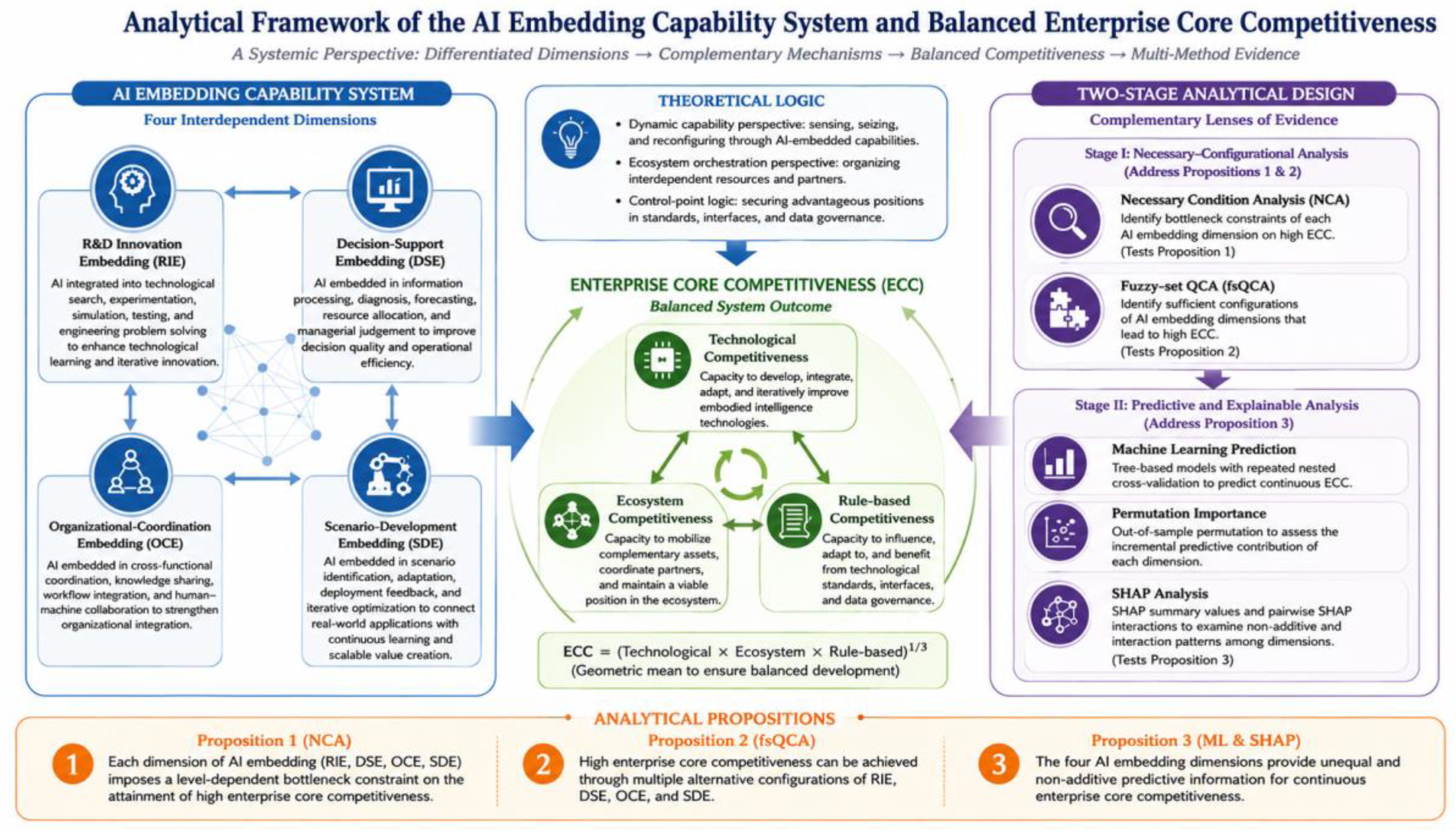
Figure 2.
SHAP summary plot for predicting continuous enterprise core competitiveness from AI embedding dimensions.
Figure 2.
SHAP summary plot for predicting continuous enterprise core competitiveness from AI embedding dimensions.
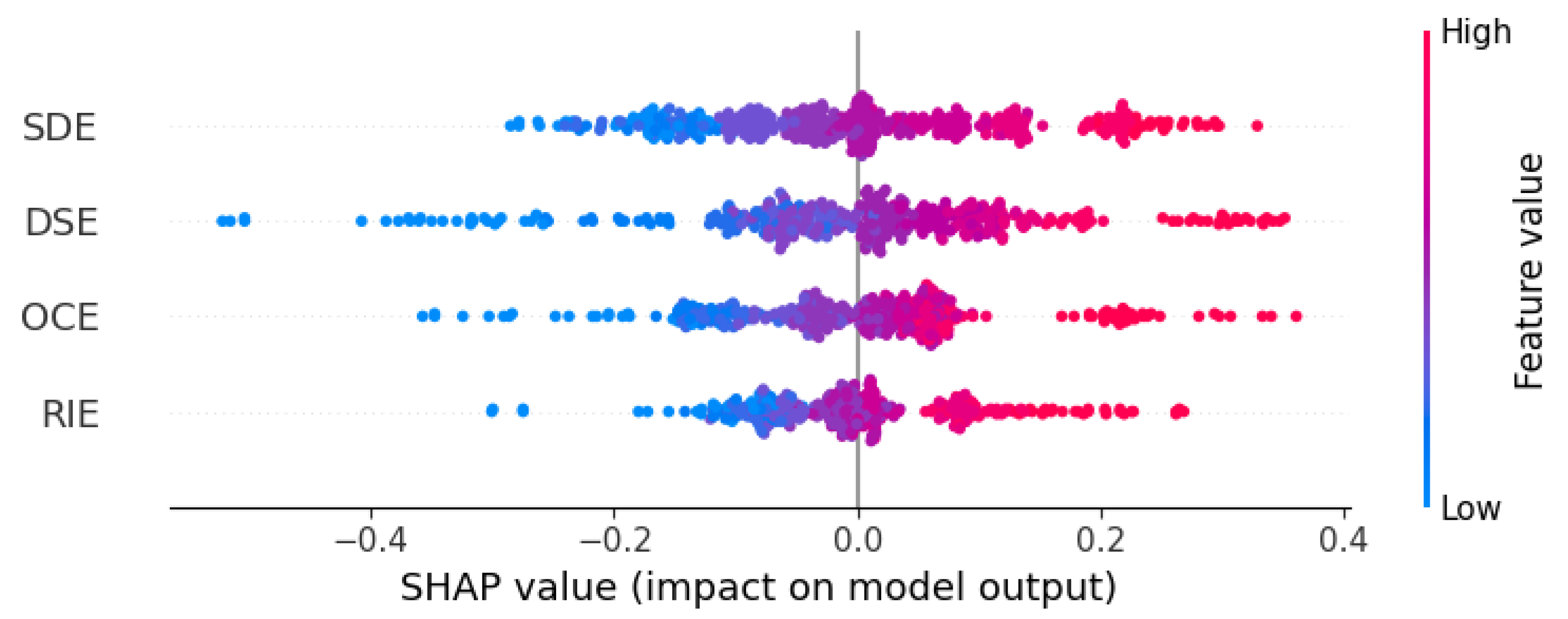
Figure 3.
Pairwise SHAP interaction patterns among AI embedding dimensions.
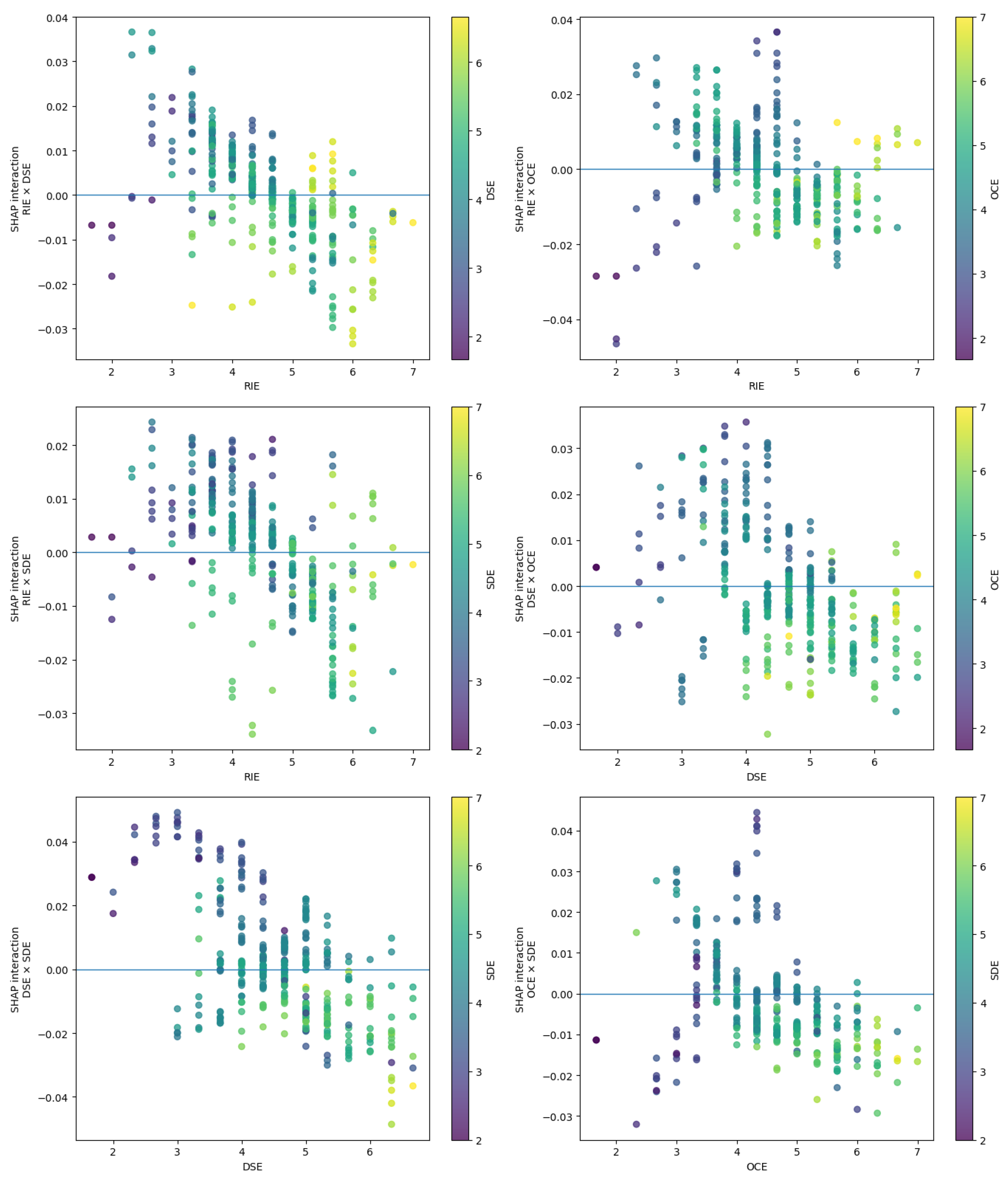

Table 1.
Operationalization and Descriptive Statistics of the Practice-Based Composite Indices.
| Construct | Abbreviation | Analytical role | Questionnaire items | Score construction | Mean | SD |
| R&D innovation embedding | RIE | Condition | AIE1–AIE3 | Arithmetic mean of AIE1–AIE3 | 4.526 | 0.924 |
| Decision-support embedding | DSE | Condition | AIE4–AIE6 | Arithmetic mean of AIE4–AIE6 | 4.563 | 0.937 |
| Organizational-coordination embedding | OCE | Condition | AIE7–AIE9 | Arithmetic mean of AIE7–AIE9 | 4.539 | 0.931 |
| Scenario-development embedding | SDE | Condition | AIE10–AIE12 | Arithmetic mean of AIE10–AIE12 | 4.493 | 0.907 |
| Technological competitiveness | TEC | Component of ECC | EC1–EC3 | Arithmetic mean of EC1–EC3 | 4.538 | 0.972 |
| Ecosystem competitiveness | ECO | Component of ECC | EC4–EC6 | Arithmetic mean of EC4–EC6 | 4.501 | 0.943 |
| Rule-based competitiveness | RUC | Component of ECC | EC7–EC9 | Arithmetic mean of EC7–EC9 | 4.518 | 0.997 |
| Enterprise core competitiveness | ECC | Outcome | TEC, ECO, and RUC | (ECC = (TEC ECO RUC)^{1/3}) | 4.496 | 0.866 |
Note: All values are based on uncalibrated scores on the original seven-point scale. The full questionnaire items are provided in Appendix A.
Table 2.
Internal Consistency, Convergent Validity, and Indicator Collinearity Diagnostics
| Construct | Number of indicators | Cronbach’s alpha | rho_A | Composite reliability | AVE | Indicator VIF range |
| AI embedding | 12 | 0.931 | 0.935 | 0.941 | 0.572 | 1.338–1.679 |
| Enterprise core competitiveness | 9 | 0.932 | 0.933 | 0.943 | 0.649 | 1.456–1.664 |
Note: Internal consistency and convergent-validity diagnostics were assessed for the two broader questionnaire domains. Indicator VIF values assess collinearity among items within each domain. The HTMT ratio between AI embedding and enterprise core competitiveness was 0.570.
Table 3.
Capability-floor constraints of AI embedding dimensions for enterprise core competitiveness.
Table 3.
Capability-floor constraints of AI embedding dimensions for enterprise core competitiveness.
| Condition | CR-FDH effect size | CR-FDH p-value | CE-FDH effect size | CE-FDH p-value |
| RIE | 0.184 | 0.014 | 0.256 | 0.002 |
| DSE | 0.202 | <0.001 | 0.283 | <0.001 |
| OCE | 0.218 | <0.001 | 0.287 | <0.001 |
| SDE | 0.192 | 0.003 | 0.287 | <0.001 |
Table 4.
CR-FDH bottleneck levels of AI embedding dimensions at selected ECC targets.
| Target ECC level | RIE minimum | DSE minimum | OCE minimum | SDE minimum |
| 5.5 | 3.209 | 3.419 | 3.551 | 3.302 |
| 6.0 | 3.987 | 4.194 | 4.168 | 3.986 |
| 6.5 | 4.766 | 4.970 | 4.784 | 4.669 |
| 7.0 | 5.544 | 5.746 | 5.401 | 5.353 |
Table 5.
Triadic high-embedding configurations associated with high enterprise core competitiveness.
Table 5.
Triadic high-embedding configurations associated with high enterprise core competitiveness.
| Configurational variant | RIE | DSE | OCE | SDE | Cases | Consistency | PRI | Raw coverage | Unique coverage |
| P1 | ● | ● | ● | ⊗ | 19 | 0.913 | 0.609 | 0.432 | 0.047 |
| P2 | ● | ● | ⊗ | ● | 18 | 0.926 | 0.652 | 0.431 | 0.048 |
| P3 | ● | ⊗ | ● | ● | 17 | 0.917 | 0.607 | 0.418 | 0.039 |
| P4 | ⊗ | ● | ● | ● | 19 | 0.927 | 0.647 | 0.424 | 0.041 |
| Overall solution | 0.890 | 0.638 | 0.607 | — |
Notes: ● indicates membership in the high-condition set. ⊗ indicates membership in the non-high-condition set. The non-high status of a condition does not imply that a lower level of that condition improves ECC; rather, it indicates that the condition does not need to reach high-set membership within that specific configuration.
Table 6.
Repeated nested cross-validation performance for predicting continuous enterprise core competitiveness.
Table 6.
Repeated nested cross-validation performance for predicting continuous enterprise core competitiveness.
| Model | Mean RMSE | SD RMSE | Mean MAE | SD MAE | Mean out-of-sample R2 | SD of out-of-sample R2 |
| Extra Trees | 0.7653 | 0.0592 | 0.5899 | 0.0511 | 0.2029 | 0.0617 |
| Random Forest | 0.7719 | 0.0624 | 0.5966 | 0.0531 | 0.1891 | 0.0697 |
| Gradient Boosting | 0.7731 | 0.0569 | 0.5973 | 0.0499 | 0.1855 | 0.0711 |
| XGBoost | 0.7783 | 0.0608 | 0.6011 | 0.0516 | 0.1750 | 0.0753 |
| Decision Tree | 0.8134 | 0.0664 | 0.6351 | 0.0583 | 0.0979 | 0.0976 |
| Dummy benchmark | 0.8661 | 0.0594 | 0.6634 | 0.0545 | -0.0197 | 0.0248 |
Table 7.
Out-of-sample permutation importance of AI embedding dimensions in the Extra Trees model.
| Feature | Mean increase in RMSE (ΔRMSE) | SD | Positive-fold proportion | Normalized predictive contribution (%) |
| DSE | 0.0382 | 0.0143 | 1.00 | 42.87 |
| SDE | 0.0242 | 0.0111 | 0.96 | 27.11 |
| OCE | 0.0194 | 0.0104 | 0.92 | 21.75 |
| RIE | 0.0074 | 0.0105 | 0.84 | 8.27 |
Disclaimer/Publisher’s Note: The statements, opinions and data contained in all publications are solely those of the individual author(s) and contributor(s) and not of MDPI and/or the editor(s). MDPI and/or the editor(s) disclaim responsibility for any injury to people or property resulting from any ideas, methods, instructions or products referred to in the content. |
© 2026 by the author. Licensee MDPI, Basel, Switzerland. This article is an open access article distributed under the terms and conditions of the Creative Commons Attribution (CC BY) license.
Copyright: This open access article is published under a Creative Commons CC BY 4.0 license, which permit the free download, distribution, and reuse, provided that the author and preprint are cited in any reuse.


