
Submitted:
29 June 2026
Posted:
01 July 2026
You are already at the latest version
Abstract
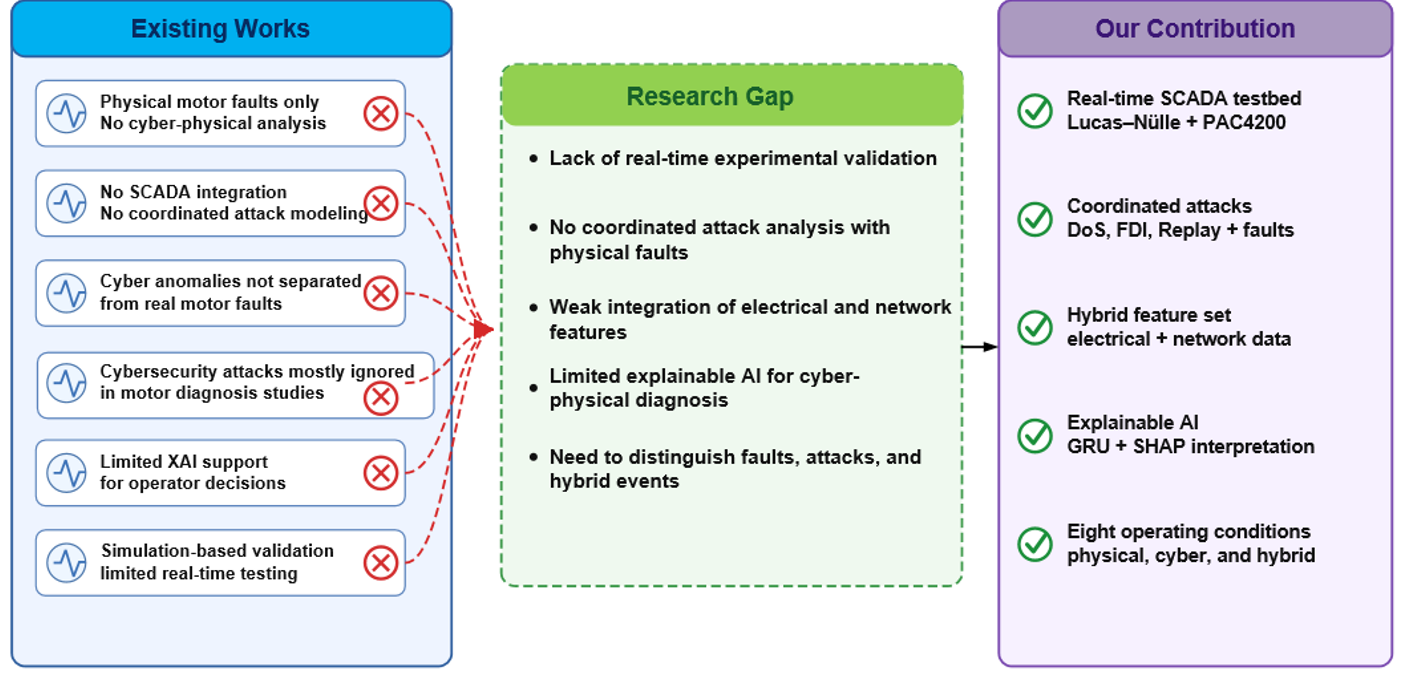
The convergence of industrial communication networks and electric drive systems has increased the range of risks associated with induction motor operation, with abnormal motor operation potentially arising from either physical motor faults or malicious cyber operations. This study examines the impact of coordinated network attacks on a three-phase induction motor drive system in a real-time laboratory environment through a PLC–SCADA controlled environment. The following operating conditions were investigated experimentally: normal operation, stator disturbance, rotor abnormalities, false data injection attack, replay-based communication manipulation, and cyber-physical events. In the attack scenarios, significant differences were observed in motor speed, electromagnetic torque, stator current distortion, and communication latency compared with normal operating conditions. To differentiate between actual machine failures and cyber-induced anomalies, an explainable AI-based diagnostic framework was introduced that employs both electrical and network-layer features. Experimental results revealed that the proposed model achieved an overall classification accuracy of 93.17%, with precision and recall> 97% across most operating classes. When subjected to a coordinated attack, communication latency rose from 4.8ms under normal operation to 37.6ms, and the current THD increased from 3.2% to 14.7%. The proposed framework also successfully distinguished cyber-attack-induced abnormal behavior from genuine motor faults at a 96.9% detection rate, which is lower than that of conventional AI classifiers. Explainability analysis also showed that the top features that affect the diagnostic decision process were packet delay, stator current distortion, torque oscillation, and rotor speed deviation. The results demonstrate the necessity of incorporating cybersecurity awareness into intelligent fault diagnosis systems for modern induction motors in industrial cyber-physical environments.
Keywords:
cyber physical system
; SCADA
; induction motor
; explainable AI
; network attack
Copyright: This open access article is published under a Creative Commons CC BY 4.0 license, which permit the free download, distribution, and reuse, provided that the author and preprint are cited in any reuse.


