
Submitted:
29 June 2026
Posted:
30 June 2026
You are already at the latest version
Abstract
In this work, we present a method for correcting attitude-dependent fluctuations in fixed-bias Langmuir probe ion density measurements from small, spin-stabilized sounding rocket dropsondes. The approach resolves dropsonde attitude using three-axis magnetometer data, observations from the Langmuir probe itself, and an analytical model of the sonde’s rotational motion. Together, these inputs constrain the dropsonde’s angular momentum vector in inertial space and enable reconstruction of its time-resolved attitude without requiring prior knowledge of the sonde’s orientation at deployment. The derived attitude solution is then used to correct the Langmuir probe ion density measurements for orientation-dependent changes in collection geometry caused by the sonde’s precessional motion. This technique is applied to data from the August 2022 Sporadic E Electrondynamics Demonstration (SpEED Demon) sounding rocket campaign, in which four dropsondes were ejected. Validation is performed by comparing attitude-corrected dropsonde ion density measurements to those of the main payload in a near-coincident measurement regime. The corrected data show strong agreement with the main payload observations, demonstrating that this technique can recover physically consistent ion density profiles from spin-stabilized dropsonde measurements.
Keywords:
attitude correction
; Langmuir probe
; magnetometer
1. Introduction
During several recent NASA-funded sounding rocket campaigns, small form-factor ejectable dropsonde subpayloads have been deployed to collect spatially-distributed in-situ measurements of local electrodynamic and plasma quantities in Earth’s ionosphere [1,2,3,4]. These low Size, Weight, and Power (SWaP) devices are ejected from a main payload and serve to augment the capabilities of single-trajectory, instrumented sounding rocket platforms. The use of dropsondes enables simultaneous, multi-point measurements in the ionosphere without incurring significant additional financial or logistical strain on the host program [5]. One such campaign, the Sporadic E Electrodynamics Demonstration mission (SpEED Demon), launched from NASA’s Wallops Flight Facility on 24 August 2022 and deployed a suite of four ejectable dropsonde subpayloads to collect distributed ion density and magnetic field measurements. The combined purpose of the instrumented main payload and subpayloads was to observe and characterize vertically narrow regions of enhanced plasma density in the lower ionosphere. These enhancements, known as Sporadic E, are common in the middle-latitude summer post-sunset ionosphere below 130 km and are generally associated with strong vertical shears in the neutral wind [6,7,8]. The use of dropsonde subpayloads on SpEED Demon provided a unique opportunity to resolve small-scale (<1 km) horizontal structures within one such layer during a single rocket flight [5].
A notable challenge encountered when analyzing data for this campaign was the sensitivity of dropsonde ion density measurements to each spacecraft’s attitude. The SpEED Demon dropsondes were spin stabilized and employed no active attitude control systems (ACS). Furthermore, data dropouts and an anomalous main payload ACS response during the dropsonde deployment prevented accurate initial estimates of subpayload orientation from being obtained, thus precluding the use of many standard attitude determination methods. For these reasons, novel and accurate attitude determination and correction techniques were required in order to accurately evaluate and compare observational data from the dropsondes.
For low-cost, ejectable sounding rocket dropsondes, attitude determination sensor availability is severely limited. Star trackers are too large and expensive for this application, and sun sensors are not applicable for nighttime launches, such as SpEED Demon. Classical attitude determination methods, such as the TRIAD algorithm, require two or more linearly independent reference vectors to fully constrain the payload orientation in an inertial reference frame [9]. More general nonlinear attitude estimation methods can combine gyroscope propagation with vector measurements [10]; however, these approaches require adequate initial attitude estimates, sufficiently stable gyroscope measurements, and enough measurement history for convergence. In the case of SpEED Demon, data dropouts, the main payload ACS anomaly, and inadequate gyroscope stability prevented reliable propagation from a known initial attitude.
The primary dropsonde attitude sensor was the PNI RM3100 three-axis magnetometer. This alone is insufficient for complete instantaneous attitude determination because a single magnetic-field vector constrains only two attitude degrees of freedom, leaving rotation about the magnetic-field direction unresolved. Magnetometer-only attitude determination methods do exist [11,12], but these generally rely on measurements of the magnetic field vector and its derivatives over the course of one or more Earth orbits. Since SpEED Demon observed minimal variation in the magnetic field along its short suborbital trajectory, this technique was not viable for the presented case. Roberts et al. [13] approached this same problem for a similar set of dropsondes flown on an October 2015 sounding rocket test flight. The authors successfully developed an attitude solution using magnetometer data, but their method relied on accurate initial knowledge of dropsonde orientation in an Earth-fixed reference frame. Since this information was not available in the case of SpEED Demon, a modified approach is required.
In this article, we present a novel method of attitude determination and measurement correction for the SpEED Demon dropsondes that does not require specific knowledge of the initial payload orientation. Using three-axis magnetometer data and Langmuir probe current measurement variations that correspond to the ion ram direction, an accurate solution is obtained. The approach is validated by comparing the attitude-corrected plasma density measurements for each SpEED Demon dropsonde to the known absolute density acquired from the main payload during the upleg sporadic E altitude regime where all payloads provided near-coincident measurements.
2. The SpEED Demon Dropsondes
Figure 1 depicts the main rocket payload and one of four ejectable dropsondes flown on the SpEED Demon sounding rocket mission. Each dropsonde was composed of an instrumentation segment and a NASA-provided telemetry and power segment. All hardware was contained within a 33.5 cm (length) by 8.6 cm (diameter) cylindrical housing, and rifling pins were used to spin-stabilize each dropsonde about its long axis on deployment. The dropsondes were each stored in a spring-loaded tube on the main payload and ejected 60 seconds after liftoff with a horizontal velocity of approximately 4 m/s. In addition to power and telemetry, the NASA segment included a 9 degree-of-freedom inertial measurement unit (LSM9DS1), which contained a gyroscope, magnetometer, and accelerometer. The primary instrumentation suite consisted of a PNI RM3100 three-axis magnetometer, an Analog Devices ADXL355 three-axis accelerometer, and a Positive Ion Probe (PIP) developed by the Space and Atmospheric Instrumentation Lab. The PIP is a fixed-bias Langmuir probe designed to measure relative changes in ion density throughout the flight (see [5,14,15]). The sensor (shown in Figure 1) is a gold-plated flexible printed circuit board (PCB) that wraps around the payload cylinder and collects an electric current from the plasma, which — in a first-order approximation — is proportional to the local ion density. For large, ion-collecting sensors such as the ones installed on the dropsondes, a substantial — or in many cases, dominant — source of current to the instrument is produced by the ram velocity of the plasma in the sensor-fixed reference frame. This is primarily a consequence of the payload’s velocity through the plasma ( km/s for sounding rocket flights), which significantly exceeds the thermal velocity of ions in the local environment (typically < 400 m/s for altitudes below 120 km). The ram component of the collected current varies according to the orientation of the sensor and is given by the following expression:
where is the ion species charge, is the ion number density, is the ion ram velocity, is the cross-sectional area of the sensor as viewed from a radial axis of the dropsonde cylinder, and is the angle between the long axis of the payload and the ram direction as depicted in Figure 2. It is more traditional to express equation 1 in terms of the cosine of the angle between the ram direction and the sensor surface normal [14]; but given the axial symmetry of this probe, the complementary angle is more convenient since the collected current is invariant under a rotation about the dropsonde’s long axis. The ram velocity vector, , is taken to be the payload velocity as determined by Global Positioning System (GPS) measurements.
The SpEED Demon attitude control system was supposed to arrest the angular velocity of the spin-stabilized main payload prior to horizontally ejecting the dropsondes; however, a staging anomaly resulted in deviations from the expected mass distribution. Although the payload was able to orient itself vertically, the ACS did not completely stop its rotation and the residual motion coupled with frictional forces within the deployment tubes imposed momentary, lateral torques on the dropsondes during ejection. These torques induced a precession — or “coning” motion — for each dropsonde that persisted throughout the flight trajectory. This motion led to periodic fluctuations in the measured PIP signal. Per equation 1, the collected current depends on the foreshortened area of the sensor that is exposed to the ram direction. Thus, as the dropsonde precesses, the resulting shape of the current variation is uniquely determined by the angle between the ram direction and the cylindrical body, as shown in Figure 2. Given that the vertical component of the dropsonde velocity is greatest at low altitudes, the dropsondes were ejected horizontally in order to maximize sensor exposure to ram during critical measurement regimes. However, precessional motions combined with slow changes in the ram direction due to the parabolic trajectory of the dropsondes caused measurement variations which need to be accounted for when interpreting probe data to resolve local ion densities. Therefore, an accurate attitude determination and correction method is required.
3. Dropsonde Attitude Determination
3.1. Magnetometer Calibration and Alignment To Spin Axis
In solving for the dropsonde attitudes in an Earth-fixed reference frame, we begin by performing an in-flight magnetometer calibration and alignment for each dropsonde. This process is described thoroughly by Roberts et al. [13], so we provide only a cursory treatment here and refer the interested reader to their paper for further details. The magnetometer calibration is accomplished by scaling and offsetting the observed magnetic field measurements to match the output of an International Geomagnetic Reference Field (IGRF) model run [16] obtained for the full, time-stamped trajectories of the SpEED Demon dropsondes. We then apply a transformation to these magnetometer measurements that improves alignment between the y component of the magnetic field data and the long axis of the dropsonde. This corrects for any small alignment errors in the mounting orientation of the magnetometer. The calibrated and aligned magnetic field data can then be used to provide an accurate measure of the angle between the dropsonde’s long axis, henceforth referred to as the y axis, and the magnetic field direction (shown for dropsonde 1 in Figure 4). Knowledge of this time-varying angle, in addition to the IGRF magnetic field vector in the local east-north-up coordinate frame, yields an attitude solution for each dropsonde up to a rotation about the magnetic field vector. In other words, the angle between the dropsonde and the magnetic field direction is known at all times during flight, but the attitude is not fully constrained because the magnetometer measurement is invariant under a rotation of the dropsonde about an axis that aligns with the magnetic field.
3.2. Modeling the System
To fully constrain the attitude of each dropsonde, we present an analytical model of its rotational motion and relate this to the magnetic field and ram directions in the Earth-fixed frame. Although the dropsonde inertia matrices were not directly computed or measured, the mass distribution was mostly symmetric about the y axis, so it is reasonable to approximate the equations of motion as those of a prolate, cylindrical rigid body under torque-free rotation [17]:
where is the angular velocity of the cylinder in the body-frame and the moment of inertia tensor is given by
is the moment of inertia about the long axis of the dropsonde and is the moment of inertia about any radial axis. For a prolate cylinder, . The solution to equation 2 is represented graphically in Figure 3. Following its ejection from the main payload, each dropsonde cylinder undergoes constant-rate rotation about its long axis and constant-rate precession about its angular momentum vector . Drag forces remain negligible above ∼90 km, so minimal torques are present and the angular momentum vector is assumed to be fxied in inertial space. The vertical axis of our chosen reference frame is thus assigned to coincide with the unit vector as depicted in order to simplify calculations. Obtaining the direction of in addition to the amplitude and phase of the dropsonde precessional motion is sufficient to determine its orientation in inertial space for all timestamps and provide the necessary attitude corrections to accurately interpret ion density measurements.
3.3. Constraining with Magnetometer Measurements
Combining this model with magnetometer measurements for a given dropsonde allows us to constrain the possible solution space for . Figure 3 depicts the angular relationships between the dropsonde spin axis , the angular momentum vector , and an additional unit vector — which we will first take to represent the magnetic field vector. Using this diagram, we geometrically derive the following expression which describes the angle, , between the spin axis and :
where is the precession rate of the spin axis, t is time of flight, and is the precession phase argument. and are the precession amplitude and angular difference between and as depicted. In the case that represents the magnetic field direction, we will use the subscript “B” for all angles associated with this vector. (Later in our analysis, will be used to represent the payload velocity direction and we will use the subscript “v”). Applying a nonlinear regression in the form of equation 4 to the measured angle between the dropsonde spin axis and the magnetic field yields solutions for the values of , , , and — most notably — . The regression performed on data from dropsonde 1 is shown in Figure 4. As stated, represents the magnetic field direction in this case, so provides an angle between and the known magnetic field vector, which is essentially constant throughout the flight. Thus, the direction of is constrained to a cone of possible vectors which form a constant angle with the external magnetic field, , and we are able to parameterize it as follows:
where is a free parameter, and the unit vectors and represent any arbitrarily selected pair of orthogonal basis vectors that lie within the plane perpendicular to . Visually, the term traces out a circular path around the magnetic field vector.
3.4. Constraining with Instrument Measurements
To this point, has been determined to within a single degree of freedom, but more information is required to fully specify its direction. In the work by Roberts et al. [13], the initial orientation of the dropsonde is obtained through a relative transformation of the main payload’s attitude at time of ejection. In the case of SpEED Demon, this technique is not reliable due to the aforementioned ACS issues and data dropouts experienced during flight. Instead, we specify the final direction of by considering the particular shape of measured ram current variations in the PIP data.
Figure 5 (blue curve) shows the attitude-induced current fluctuations observed by dropsonde 1 in the otherwise smooth density region above ∼130 km. A detrending operation was applied to remove any long-scale measurement variations caused by changes in ion density, spacecraft charging or dropsonde velocity magnitude. The shape of this curve directly relates to the time-varying angle between the ram vector and the dropsonde y axis as specified by equation 1 and depicted in Figure 2. Therefore, in order to fully constrain , we perform a nonlinear optimization to obtain a value of the free parameter that minimizes the difference between the observed current variation and that which is predicted by our attitude solution.
The optimization problem details are as follows: Selecting a value of between 0 and 2 specifies the vector according to equation 5. The angle between and the dropsonde GPS velocity direction is then computed from the dot product of those two vectors. The angle between and is determined using equation 4 where , and are reused from the previous fit of the magnetometer data (see Figure 4), and is allowed to vary as a fit parameter to ensure phase alignment with the PIP measurements. The estimated current fluctuations over the selected interval (the orange curve in Figure 5) are then obtained by
where the constant coefficients and are optimization variables, and a velocity term is unnecessary because the measured data have been detrended. The final optimization algorithm seeks to minimize the difference between the measured current fluctuations (blue curve in Figure 5) and the estimated current fluctuations (from equation 6) by varying , , , and . The resulting value of specifies a direction for the angular momentum vector that is physically consistent with the measured current data. combines with the previously acquired values of , , and from the magnetometer data to fully specify as a function of time in the Earth-fixed frame. Hence, the dropsonde attitude is determined to within a rotation about its long axis. The remaining degree of freedom could easily be constrained using magnetometer data; nevertheless, we neglect to do so as the rotation of the dropsonde about its y axis has no effect on the measured current and is therefore not relevant to the present analysis.
4. Attitude Correction and Validation
To validate the acquired attitude solution and ensure accurate measurement corrections, we consider the dropsonde current observations shortly after deployment. At ∼102 km altitude (83 seconds flight time), all dropsondes were within 70 m of the main payload and flew through a sporadic E plasma density enhancement. On account of their relative proximity, it is reasonable to assume that the density profile encountered by each dropsonde should be roughly consistent with that of the other dropsondes and the main payload in this region. The SpEED Demon main payload instrumentation provides accurate in-situ observations of ion and electron densities and is not subject to the substantial attitude-induced modulations seen in the dropsonde data. We therefore take the main payload measurements to be the “ground truth” in our analysis and assume that all dropsonde density measurements should approximately match this profile shortly after ejection. If this is shown to be the case after attitude-dependent corrections are applied to the dropsonde current measurements, the derived attitude solutions and attitude correction technique will have been validated.
The dropsonde PIP instrument provides only relative ion density measurements. For this reason, the measured currents must be normalized and scaled to match an absolute density reference from the SpEED Demon main payload. This is shown in the left panel of Figure 6 where the data from each dropsonde were scaled to match the main payload density before entering the sporadic E layer at 101.2 km and upon reaching the layer peak at 102.2 km. The resulting profiles clearly show the effect of attitude-induced modulation in this critical measurement regime as the measurements quickly diverge above the selected scaling points.
To account for attitude-driven ram current variations in the dropsonde PIP data, a time-dependent additive correction factor is obtained by differencing equation 1 with itself for the cases of maximum possible ram current () and expected ram current (computed using our attitude solution). Performing this operation, we have:
When added to the measured PIP data, this correction factor yields the current that would be observed if the PIP sensor were perfectly ram-facing throughout the entirety of the flight; thus, removing the attitude-dependent current modulations. The dependence of equation 7 on ion density is problematic given that is the target observable of this instrument and is therefore unknown ahead of time. Again, we assume that the measured current and ion density are directly proportional in a first-order approximation, so we replace with the measured current I in equation 7 and drop the constant terms in favor of the following proportionality:
In applying the additive correction term described in equation 8, the linear scale factor is computed for each dropsonde, which results in density profiles that best fit the main payload density data shortly after ejection. Figure 6 shows the densities for all four dropsondes and the main payload, before and after attitude corrections were applied within the enhanced-density sporadic E layer encountered on the upleg of the flight. The resulting profiles show excellent agreement with the main payload in a near-coincident altitude regime, providing validation of the attitude estimation and measurement correction process that was developed using data from 140 - 280 seconds flight time, but applied to the enhanced density layer between 83 and 87 seconds. The integrated effect of otherwise negligible drag forces throughout the flight led to slight deviations in phase between the rotational model and measured data. Since attitude solutions were only required in a few, narrow regions of the SpEED Demon altitude profile corresponding to the detected sporadic E layers, these phase differences were corrected for by manually shifting the estimated current curve to match the observed variations near the upleg and downleg sporadic E measurement regimes.
4.1. Discussion of Uncertainty
Given the complex, multi-stage fitting methodology required to obtain the dropsonde attitude corrections, we choose to evaluate and bound the uncertainties associated with this data through a simple analysis of the presented validation case. Prior to correction, the dropsonde profiles exhibit clear attitude-dependent deviations from the main payload absolute density profile (as shown in the left panel of Figure 6). The precession frequency of each dropsonde was approximately 0.1 Hz, corresponding to a vertical spatial period of roughly 8 km. Over the altitude range depicted in Figure 6, the measurements include approximately one half rotation of each dropsonde about its angular momentum vector, and the largest relative errors in the uncorrected density data are expected just above 105 km, one half of a spatial period above the sporadic E peak where all dropsonde measurements were scaled to match the main payload.
The percent root mean squared error (RMSE) between each dropsonde profile and the main payload profile was computed before and after applying attitude corrections. These values are summarized in Table 1. The uncorrected upleg profiles had percent RMSE values ranging from (11.4%) to (15.8%). After correction, the corresponding RMSE values were reduced to (3.9%)–(7.5%), and the density profiles visually collapse to the main payload in Figure 6, indicating that the attitude-dependent modulation was substantially reduced.
Although the dropsonde and main payload measurements were nearly coincident within the upleg sporadic E layer, the sampled density volumes were surely not identical given the dynamic and potentially turbulent nature of low-altitude sporadic E layers [18]. Nevertheless, the upleg comparison indicates that attitude-induced errors in the uncorrected dropsonde measurements were no larger than approximately 16% in RMS and were reduced to 8% or less after correction.
5. Discussion and Conclusions
We have presented a method of attitude determination and ion density measurement correction for small, spin-stabilized sounding rocket dropsondes using a combination of magnetometer data and Langmuir probe current measurements. The primary advantage of this technique is its lack of dependence on an initial knowledge of the spacecraft’s attitude during deployment. Nonlinear regression and optimization algorithms were applied to constrain the angular momentum vector in a manner that is physically consistent with measured data, and a model of the system was used to derive the attitude as a function of time. Data from the SpEED Demon sounding rocket campaign were analyzed and the resulting attitude solutions were validated by comparing processed density measurements between four independent dropsondes and the main payload, which does not experience significant attitude-dependent current modulations.
In this work, we did not explicitly resolve the dropsonde orientation about its long axis as the measurements of our axially symmetric Langmuir probes do not depend on the angle of this rotation. Roberts et al. [13] have previously achieved a determination of this angle using magnetometer measurements, so we neglect to repeat it here. Furthermore, in this particular application, a full attitude solution was only required for narrow measurement regions of the sounding rocket flight (in the vicinity of the sporadic E density enhancements shown in Figure 6), so these altitude regimes were prioritized in the validation process. It is likely that slight phase adjustments would be necessary to ensure a consistently accurate attitude solution throughout the entire flight. The addition of a Kalman filter [19], which combines the rotational model of the dropsonde with magnetometer and current measurements, may be useful in this regard.
Potential limitations of this technique include the presence of bulk ion velocities that could skew the ram direction (these are unlikely to be present under the conditions observed for SpEED Demon) as well as increased drag forces at lower altitudes. A region of smoothly-varying plasma density is likely required to easily isolate the measurement variations caused by the dropsonde coning motion. This method of attitude determination and measurement correction is especially valuable when no knowledge of the initial payload orientation is available, and extensions of this technique could be applied to existing magnetometer-only methods to improve overall accuracy. Although the procedures discussed in this work were developed with Langmuir probe data, the approach may be generally applied to other instruments whose measurements depends on payload attitude in a similar manner.
Author Contributions
Conceptualization, H.V., J.M., and A.B.; methodology, H.C. and J.M.; software, H.V. and J.M.; validation, H.V.; formal analysis, H.V.; investigation, H.V. and J.M.; resources, A.B. and R.C..; data curation, N.G. and H.V.; writing—original draft preparation, H.V.; writing—review and editing, H.V., A.B. and J.M.; visualization, H.V.; supervision, A.B. and R.C.; project administration, A.B.; funding acquisition, A.B. All authors have read and agreed to the published version of the manuscript.
Funding
Funding and support for this work were provided under NASA Grant 80NSSC19K0773, as well as the Center for Space and Atmospheric Research at ERAU.
Institutional Review Board Statement
Not applicable.
Informed Consent Statement
Not applicable.
Data Availability Statement
Acknowledgments
We are grateful to the team at Dartmouth College, under the leadership of Dr. Kristina Lynch, for their previous work on this subject and their continued collaboration in developing Swarm instrumentation for sounding rocket missions. We further acknowledge the invaluable support of the NASA Sounding Rocket Operations Contract and their Swarm team.
Conflicts of Interest
The authors declare no conflicts of interest.
References
- Giono, G.; Ivchenko, N.; Sergienko, T.; Brändström, U. Multi-point measurements of the plasma properties inside an aurora from the SPIDER sounding rocket. Journal of Geophysical Research: Space Physics 2021, 126, e2021JA029204. [CrossRef]
- Fraunberger, M.; Lynch, K.; Clayton, R.; Roberts, T.M.; Hysell, D.; Lessard, M.; Reimer, A.; Varney, R. Auroral ionospheric plasma flow extraction using subsonic retarding potential analyzers. Review of Scientific Instruments 2020, 91. [CrossRef]
- Roberts, T.M.; Lynch, K.; Clayton, R.; Weiss, J.; Hampton, D. A small spacecraft for multipoint measurement of ionospheric plasma. Review of Scientific Instruments 2017, 88. [CrossRef]
- Lundberg, E.; Kintner, P.; Powell, S.; Lynch, K.A. Multipayload interferometric wave vector determination of auroral hiss. Journal of Geophysical Research: Space Physics 2012, 117. [CrossRef]
- Valentine, H.C. Developing Fixed-Bias Langmuir Probes for Multi-Point Constellation Deployments. PhD thesis, Embry-Riddle Aeronautical University, Daytona Beach, FL, USA, 2025.
- Haldoupis, C. Midlatitude sporadic E. A typical paradigm of atmosphere-ionosphere coupling. Space science reviews 2012, 168, 441–461. [CrossRef]
- Mathews, J. Sporadic E: Current views and recent progress. Journal of atmospheric and solar-terrestrial physics 1998, 60, 413–435. [CrossRef]
- Whitehead, J. Recent work on mid-latitude and equatorial sporadic-E. Journal of atmospheric and terrestrial physics 1989, 51, 401–424. [CrossRef]
- SHUSTER, M.D.; OH, S.D. Three-axis attitude determination from vector observations. Journal of Guidance and Control 1981, 4, 70–77. [CrossRef]
- Crassidis, J.L.; Markley, F.L.; Cheng, Y. Survey of Nonlinear Attitude Estimation Methods. Journal of Guidance, Control, and Dynamics 2007, 30, 12–28. [CrossRef]
- Psiaki, M.L. Global Magnetometer-Based Spacecraft Attitude and Rate Estimation. Journal of Guidance, Control, and Dynamics 2004, 27, 240–250. [CrossRef]
- Challa, M.; Natanson, G.; Ottenstein, N. Magnetometer-only attitude and rate estimates for spinning spacecraft. In Proceedings of the Astrodynamics Specialist Conference, 2000, p. 4241. [CrossRef]
- Roberts, T.M.; Lynch, K.A.; Clayton, R.E.; Disbrow, M.E.; Hansen, C.J. Magnetometer-Based Attitude Determination for Deployed Spin-Stabilized Spacecraft. Journal of Guidance, Control, and Dynamics 2017, 40, 2941–2947. [CrossRef]
- Barjatya, A. Langmuir probe measurements in the ionosphere. PhD thesis, Utah State Univ., Logan, UT, USA, 2007.
- Brace, L.H., Measurement techniques in space plasmas: Particles; American Geophysical Union: Washington, D.C., USA, 1998; Vol. 102, chapter Langmuir probe measurements in the ionosphere, pp. 23–35. [CrossRef]
- Alken, P.; Thébault, E.; Beggan, C.D.; Aubert, J.; Baerenzung, J.; Bondar, T.; Brown, W.J.; Califf, S.; Chulliat, A.; Civet, F.; et al. International Geomagnetic Reference Field: The Thirteenth Generation. Earth, Planets and Space 2021, 73, 49. [CrossRef]
- Hughes, P.C. Spacecraft Attitude Dynamics; John Wiley & Sons: New York, 1986.
- Larsen, M.F. Winds and shears in the mesosphere and lower thermosphere: Results from four decades of chemical release wind measurements. Journal of Geophysical Research: Space Physics 2002, 107, SIA–28. [CrossRef]
- Lefferts, E.J.; Markley, F.L.; Shuster, M.D. Kalman Filtering for Spacecraft Attitude Estimation. Journal of Guidance, Control, and Dynamics 1982, 5, 417–429. [CrossRef]
- Valentine, H.; Barjatya, A. SpEED DEMON: Mission Data Products, 2026. [CrossRef]
Figure 1.
(Left) The SpEED Demon sounding rocket main payload with four ejectable dropsondes being released. (Right) One of the SpEED Demon dropsondes. The dropsonde dimensions are 33.5 cm (length) by 8.6 cm (diameter). The gold-plated Langmuir probe sensor collects ion current from the plasma. The black structure is a stand used to protect the sensor during integration.
Figure 1.
(Left) The SpEED Demon sounding rocket main payload with four ejectable dropsondes being released. (Right) One of the SpEED Demon dropsondes. The dropsonde dimensions are 33.5 cm (length) by 8.6 cm (diameter). The gold-plated Langmuir probe sensor collects ion current from the plasma. The black structure is a stand used to protect the sensor during integration.
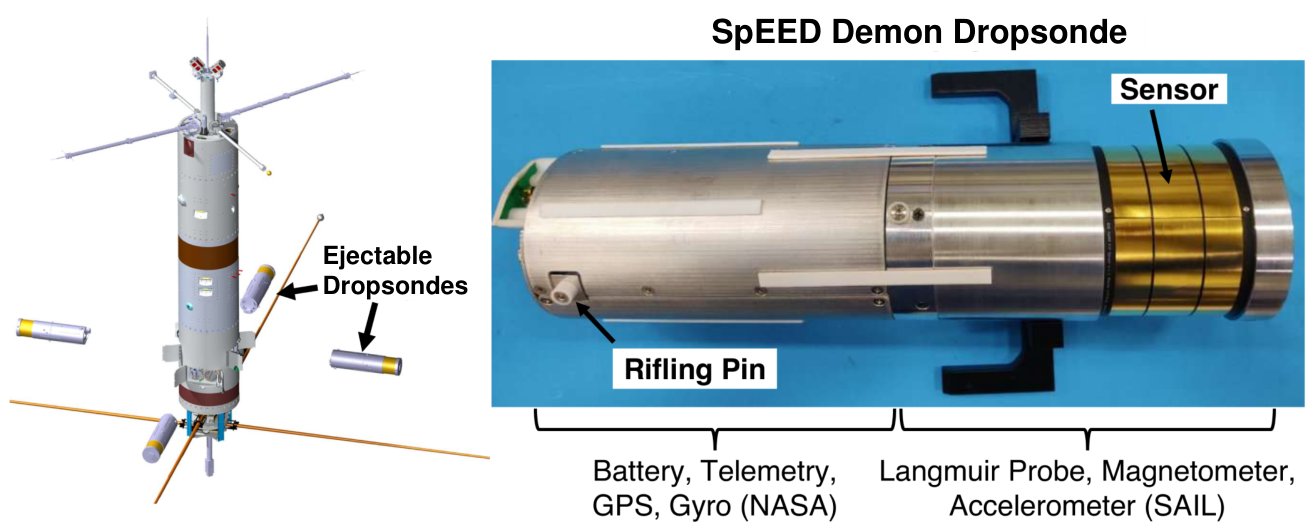
Figure 2.
Variation in collected current for the Positive Ion Probes (PIP) caused by the precession or “coning” motion of the dropsondes. The particular shape of this variation (lower plot) can be used to constrain the dropsondes’s attitude solution given a model of the system’s motion and accurate knowledge of the ram direction from Global Positioning System (GPS) velocity measurements.
Figure 2.
Variation in collected current for the Positive Ion Probes (PIP) caused by the precession or “coning” motion of the dropsondes. The particular shape of this variation (lower plot) can be used to constrain the dropsondes’s attitude solution given a model of the system’s motion and accurate knowledge of the ram direction from Global Positioning System (GPS) velocity measurements.
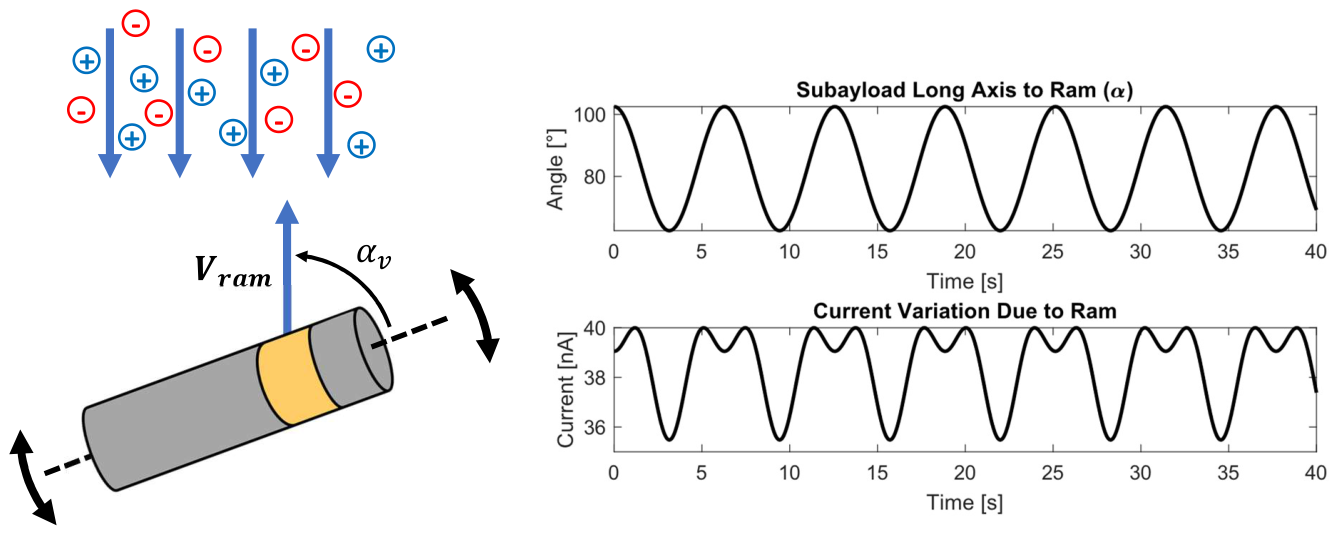
Figure 3.
Rotational motion of a SpEED Demon dropsonde in an inertial reference frame. The constant angular momentum vector is chosen as an axis for convenience. Angular relationships between the dropsonde’s long axis , , and an arbitrary vector are depicted. is taken to represent the magnetic field direction or the payload velocity direction during different stages of this analysis.
Figure 3.
Rotational motion of a SpEED Demon dropsonde in an inertial reference frame. The constant angular momentum vector is chosen as an axis for convenience. Angular relationships between the dropsonde’s long axis , , and an arbitrary vector are depicted. is taken to represent the magnetic field direction or the payload velocity direction during different stages of this analysis.
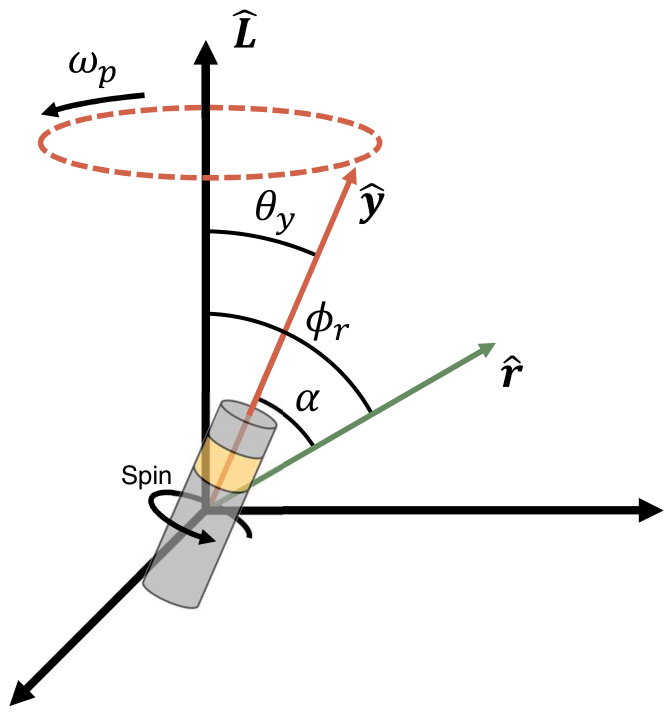
Figure 4.
A nonlinear regression fit applied to the measured angle between the dropsonde spin axis and the magnetic field direction for dropsonde 1. The regression model is described in equation 4 and the fit yields values for , , , and the precession frequency as depicted in Figure 3. Dropsonde ejection occurs at approximately 75 km on the upleg and drag forces begin to induce tumbling below 85 km on the downleg.
Figure 4.
A nonlinear regression fit applied to the measured angle between the dropsonde spin axis and the magnetic field direction for dropsonde 1. The regression model is described in equation 4 and the fit yields values for , , , and the precession frequency as depicted in Figure 3. Dropsonde ejection occurs at approximately 75 km on the upleg and drag forces begin to induce tumbling below 85 km on the downleg.
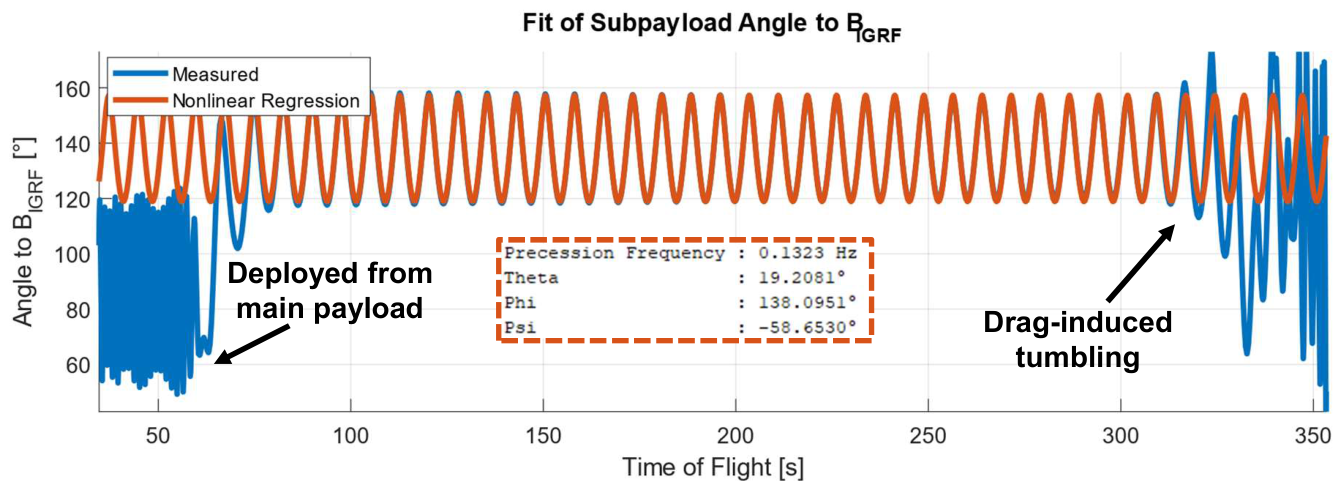
Figure 5.
(Blue curve) Measured PIP current data which have been detrended to remove any dependence on dropsonde velocity magnitude and plasma density. Data shown are for the smoothly-varying density region above ∼130 km. (Orange curve) The results of a nonlinear optimization algorithm that varies parameters within our model of dropsonde rotation and current collection to best fit the measured data. The optimization yields a value for the free parameter which fully specifies the dropsonde angular momentum vector according to equation 5.
Figure 5.
(Blue curve) Measured PIP current data which have been detrended to remove any dependence on dropsonde velocity magnitude and plasma density. Data shown are for the smoothly-varying density region above ∼130 km. (Orange curve) The results of a nonlinear optimization algorithm that varies parameters within our model of dropsonde rotation and current collection to best fit the measured data. The optimization yields a value for the free parameter which fully specifies the dropsonde angular momentum vector according to equation 5.
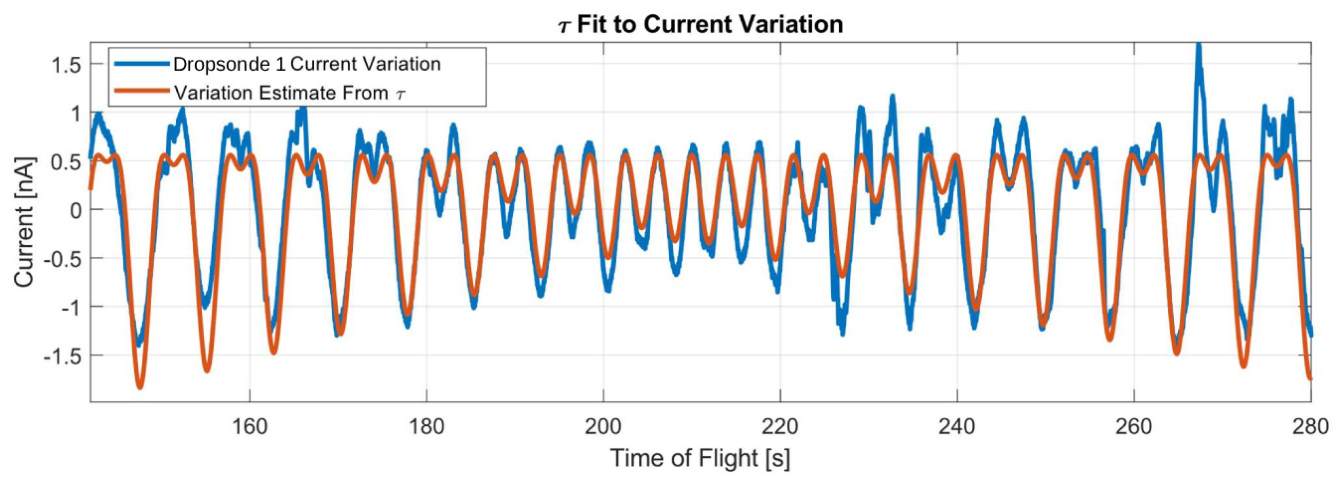
Figure 6.
SpEED Demon dropsonde and main payload ion density measurements in an enhanced plasma layer shown before (left) and after (right) attitude corrections were applied. A discontinuity, appearing in the main payload data just below 104 km is associated with a staging anomaly and is non-physical. The dropsondes were within 70 m of the main payload at this time, so the “collapsing” of the dropsonde density measurements to match those of the main payload validate the accuracy of our attitude solutions.
Figure 6.
SpEED Demon dropsonde and main payload ion density measurements in an enhanced plasma layer shown before (left) and after (right) attitude corrections were applied. A discontinuity, appearing in the main payload data just below 104 km is associated with a staging anomaly and is non-physical. The dropsondes were within 70 m of the main payload at this time, so the “collapsing” of the dropsonde density measurements to match those of the main payload validate the accuracy of our attitude solutions.
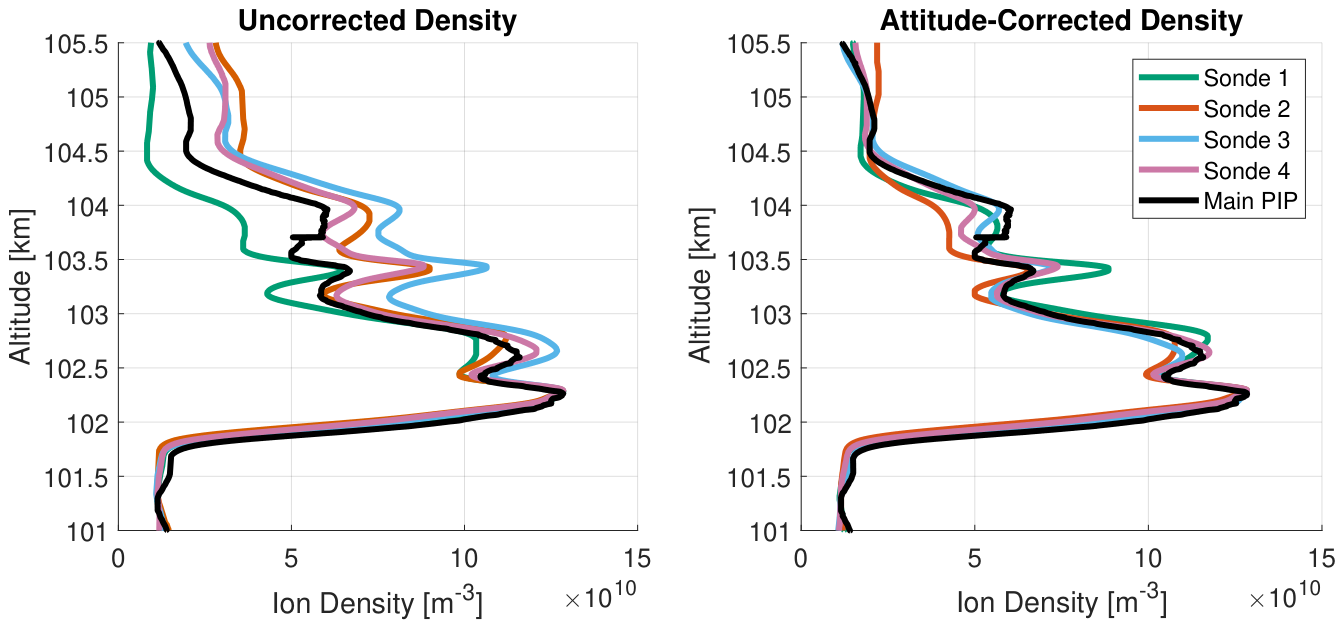

Table 1.
Percent RMSE between the upleg dropsonde density profiles and the main payload density profile before and after attitude correction.
Table 1.
Percent RMSE between the upleg dropsonde density profiles and the main payload density profile before and after attitude correction.
| Dropsonde | Uncorrected RMSE | Corrected RMSE |
| 1 | 13.5% | 6.4% |
| 2 | 15.1% | 7.5% |
| 3 | 15.8%% | 3.9% |
| 4 | 11.4% | 5.2% |
Disclaimer/Publisher’s Note: The statements, opinions and data contained in all publications are solely those of the individual author(s) and contributor(s) and not of MDPI and/or the editor(s). MDPI and/or the editor(s) disclaim responsibility for any injury to people or property resulting from any ideas, methods, instructions or products referred to in the content. |
© 2026 by the authors. Licensee MDPI, Basel, Switzerland. This article is an open access article distributed under the terms and conditions of the Creative Commons Attribution (CC BY) license (http://creativecommons.org/licenses/by/4.0/).
Copyright: This open access article is published under a Creative Commons CC BY 4.0 license, which permit the free download, distribution, and reuse, provided that the author and preprint are cited in any reuse.


