

Submitted:
26 June 2026
Posted:
30 June 2026
You are already at the latest version
Abstract
Accurate measurement of attenuation during acoustic wave propagation in viscoelastic solid media is of theoretical and practical significance. Conventional studies primarily rely on analogies to models of electromagnetic wave attenuation in non-ideal media. Although there are similarities between acoustic and electromagnetic waves, conventional models overlook their fundamental physical differences and neglect the influence of particle-vibration damping in viscoelastic media. Additionally, in applications with a single-transmitter and dual-receiver configuration, the effects of specific characteristics on the measurement of the acoustic attenuation coefficient are eliminated in both the electric-acoustic conversion of the transmitting transducer and the acoustic-electric conversion of the receiving transducer. The discrepancies in geometric parameters (size and shape) between the two measurement modules lead to inconsistent frequency responses, thereby introducing measurement errors in acoustic attenuation. To address these issues, we investigate the coupling mechanism between particle vibration damping and wave propagation attenuation, derive an analytical expression for the acoustic attenuation coefficient that accounts for this coupling, and propose a new method for accurately measuring acoustic attenuation in viscoelastic solid media. The experimental results validate the theoretical predictions of acoustic attenuation.
Keywords:
acoustic attenuation
; longitudinal waves
; damping attenuation
; wave propagation attenuation
; spring oscillator
1. Introduction
Acoustic waves involve the particle vibration in a medium, resulting in wave propagation. Particle vibration damping and wave-propagation attenuation are two fundamental physical concepts that describe energy loss of acoustic waves in the medium. Vibration damping is the phenomenon in which the amplitude of particle vibration decreases over time, mainly due to dissipative factors such as internal friction and viscous resistance within the medium, and it reflects the time-domain energy dissipation. In propagation attenuation, the amplitude of a wave gradually decreases due to energy dissipation arising from the medium’s viscoelastic properties, which is reflected in the spatial domain. In nature, media have certain viscosity and thermal conductivity, whether in fluids or solids, which cause damping attenuation of particle vibration in the time domain and attenuation of wave propagation in the spatial domain. So, the attenuation of acoustic wave propagation in viscoelastic media is composed of the damping of particle vibration in the time domain and the attenuation of wave propagation in the spatial domain.
Several major factors affect acoustic attenuation in media, including viscosity, heat conduction, acoustic scattering by tiny particles (or pores) within the medium, and geometric diffusion. When the pore size in the medium is much smaller than the wavelength, the effect of acoustic scattering on acoustic attenuation is negligible. In petroleum exploration, the wavelengths of seismic and acoustic logging signals are usually much larger than the tiny particles and pores within dense, continuous rock layers, so their effects on acoustic attenuation can be disregarded.
Many researchers have conducted extensive theoretical and experimental studies from both macroscopic and microscopic perspectives in understanding the mechanism of acoustic attenuation. Attenborough [1], Qian [2], and Challis [3] used the dense-suspension acoustic wave attenuation model to investigate the influence of pore-induced acoustic scattering on acoustic attenuation. Considering viscosity and the presence of pore particles in rock layers, Babick and Richter analyzed the influence of the coupling between viscosity and inertia [4]. Verma et al. [5] investigated the influence of thermal conductivity. For many underground rock formations, thermal conductivity is low, leading to minimal acoustic energy dissipation from temperature gradients. So, this factor may be ignored. In the far-field region, acoustic waves can be approximately treated as plane waves (neglecting geometric attenuation). Under these conditions, acoustic attenuation is mainly due to the medium’s viscosity.
Geophysicists also studied acoustic attenuation caused by complex underground geological structures. Yang [6], Long [7], Hefner [8], and Jiang [9] experimentally studied acoustic attenuation in seafloor sediments; Zheng et al. [10] investigated acoustic attenuation in gassy sediments; Wang et al. [11] experimentally studied acoustic speed and attenuation in gas-bearing sediments; Meyer et al. [12] examined glacier attenuation in the frequency range of 2–35 kHz; Cooper [13] studied energy loss and attenuation of seismic waves propagating in viscoelastic rocks; Zou et al. [14] proposed a method to calculate the attenuation of head waves from acoustic signals propagating in seafloor sediments; Zimmer et al. [15] experimentally measured the frequency-dependent relationship of acoustic attenuation coefficients in seafloor sands and gravels over the frequency range of 1 kHz to 400 kHz; Wan et al. [16] measured the attenuation of long-distance broadband acoustic signals under seabed conditions.
The study and measurement of acoustic attenuation mentioned above rarely accounted for the influence of particle vibration damping on acoustic attenuation, nor did they consider the effect of the electrical-acoustic/acoustic-electrical conversion on the characteristics of the measured acoustic wave signals. In the following discussion, we refer to particles, micro-particles, and minute-volume elements as “particles”. In a non-ideal medium with nonzero electrical conductivity, electromagnetic waves possess energy but no mass. There is no transient transition process or damping attenuation at any spatial point; only spatial-domain propagation attenuation occurs. Part of the energy radiated by the acoustic source is used to compensate for thermal losses caused by propagation attenuation, and the remaining energy provides the energy for the forward propagation of the electromagnetic wave.
Auld [17] employed an analogy between acoustic and electromagnetic waves to study wave attenuation during propagation in viscoelastic solids and derived an analytical expression for the acoustic attenuation coefficient. However, that expression does not account for the effect of particle vibration damping on the acoustic attenuation coefficient. In reality, vibrating particles within a viscoelastic medium possess energy, mass, and inertia. Therefore, for acoustic waves propagating in a viscoelastic medium, there exists both particle vibration damping in the time domain and wave propagation attenuation in the spatial domain.
Part of the energy radiated by the acoustic source is used to compensate for the thermal loss caused by particle vibration damping, another part compensates for the thermal loss caused by wave propagation attenuation, and the remaining part provides the energy for the forward propagation of the acoustic wave. Fa and Zhao et al. [18,19] reported the difference between the acoustic attenuation coefficient of viscoelastic media and the electromagnetic wave attenuation coefficient of non-ideal media, and attempted to conduct a theoretical derivation for this phenomenon. Although progress was made, their analytical expression was still incomplete and failed to comprehensively describe the attenuation mechanism of acoustic waves in viscoelastic media from a physical perspective. Based on the principle of energy conservation, the coupling mechanism between particle vibration damping and wave attenuation was explored, and the physical basis of acoustic attenuation was thoroughly explained [17,18,19,20,21].
From the constitutive relationship of viscoelastic media, a new analytical expression for the acoustic attenuation coefficient was derived [21]. This expression accounts for both the damping effect of particle vibration in the time domain and the attenuation of wave propagation in the spatial domain. Furthermore, based on previous reports on the characteristics of piezoelectric transducers [22,23], an improved method for measuring the acoustic attenuation coefficient was proposed, effectively eliminating the influence of the transducer’s electric-acoustic/acoustic-electric conversion characteristics on the measurement results. Both numerical calculations and experimental verification results indicate that the proposed analytical expression for acoustic attenuation has excellent accuracy and reliability, and that the developed measurement method is also effective.
2. Physics Model
If energy losses from acoustic scattering and thermal conduction are neglected, the essence of acoustic attenuation stems from thermal losses due to frictional resistance acting on the particles. Damping attenuation is the physical phenomenon in which the amplitude of particle vibration decreases over time. It is mainly caused by dissipative factors, such as internal frictional resistance within the medium, and it reflects the time-decay characteristic of the vibration system. Propagation attenuation decreases the amplitude of those particles due to viscous resistance, resulting in a decrease in vibrational amplitude as the propagation distance increases, reflecting the spatial decay characteristic of the wave.
An acoustic source continuously radiates sine waves of a fixed frequency into the surrounding medium. Along the propagation path of the acoustic wave, each particle within the medium undergoes a transient process from rest to steady-state sine vibration. After all particles in the region of interest have entered the steady-state sine vibration state, the acoustic energy continuously radiated by the source exactly compensates for the energy lost due to thermal dissipation caused by frictional resistance acting on the particles within the medium, thereby maintaining their steady-state sine vibration.
From the surface phenomenon, at this time, only wave-propagation attenuation in the spatial domain occurs. However, in essence, this is the actual attenuation caused by the propagation of acoustic waves in a viscoelastic medium. This attenuation is composed of particle vibration damping and wave-propagation attenuation due to energy dissipation during wave propagation, and is called single-frequency acoustic attenuation. The energy radiated by a single-frequency sine acoustic source outward is partly used to compensate for the energy loss caused by particle vibration damping, another part is used to compensate for the heat loss caused by wave propagation attenuation, and the remaining part is used to provide the energy required for the forward propagation of the acoustic wave.
2.1. Vibration Damping of Internal Particles Within a Viscoelastic Solid
When an object moves through a viscous fluid, it experiences a frictional force due to the fluid’s viscosity. Taking a small sphere ball moving at a constant velocity in a uniform viscous fluid medium as an example [20], the frictional resistance force it experiences can be expressed as
The physical quantities in equation (1) are the radius (r) of the small sphere ball, the frictional resistance (), the viscosity coefficient (η) of the medium, and the speed (v) of the small sphere ball. The frictional resistance force (f ) is linearly proportional to the small ball movement speed and the frictional resistance.
Assuming that the internal particles in the viscoelastic solid medium are very small balls, the frictional resistance they experience during vibration also follows the relationship described by formula (1). We extend this linear damping model of a viscous fluid to the analysis of the motion of internal particles within a viscoelastic solid.
Shear waves only cause a change in the shape of a small volume element within the medium without causing a change in its volume, while longitudinal waves, which propagate in solid media as a form of extensional or compressive strain, cause both a change in the shape of the small volume element and variations in its geometric dimensions and local density. In the following, we use the spring oscillator model shown in Figure 1(a) to study the propagation behavior of longitudinal waves. When a particle in a viscoelastic solid medium vibrates, the second-order differential equation describing the motion of the particle can be obtained:
The corresponding mechanical network shown in Figure 1(b) was thus established.
In Figure 1(a), the fixed end represents the constraint condition. We also have the spring oscillator stiffness coefficient () of the and the mass () of the particle. In Figure 1(b), we have the compliance (), the force (f) acting on the particle, the particle displacement (u(t)), and the particle velocity (v(t) = du(t)/dt). This model provides a clear physical picture for understanding the dynamic response of particles during the propagation of longitudinal waves in a dissipative medium. If we change the time-domain mechanical network shown in Figure 1(b) into an s-domain network, we solve algebraic equations instead of differential equations.
Using the residue theorem, the impulse response and the system function of the particle vibration system are obtained as follows
The variables in equations (3)-(6) are the imaginary unit (), the unit step function (), the parameter describing the vibration damping () of the particle under the influence of only spring force and viscous resistance, the angular frequency of the damping vibration (), the amplitude (), and the initial phase angle (). Equations (3)-(4) indicate that the physical parameters of the viscoelastic solid medium determine the mechanical impulse response and system function of the particle vibration system.
We note that the initial displacement of the particles within the medium is nonzero (i.e., the initial state is nonzero). It is subjected only to viscous resistance and elastic force, resulting in damped oscillation (i.e., zero-input response; see Figure 2), with the damping attenuation coefficient given by equation (5).
2.2. Wave Propagation Attenuation
Vibrating particles in a viscoelastic medium cause adjacent particles to vibrate via internal stress, and this process repeats sequentially, leading to the propagation of acoustic waves through the medium. Since the internal stress in a viscoelastic medium is a tensor, the dynamic acoustic field equations in solid acoustics should be used to replace equation (2) to study wave propagation attenuation. Below, we will analyze, discuss, and explore the case of an isotropic solid medium as an example.
We use strain as an analogy to the particle displacement in the above “spring oscillator physical model”, the stiffness coefficient as an analogy to the spring constant, and the derivative of strain with respect to time as an analogy to the velocity of the volume element (particle) vibration. By modifying the constitutive relationship of ideal elastic solid media, we obtain the damping elastic constitutive relationship for viscoelastic solids as follows
Equation (7) expresses that the stress acting on the adjacent particle accounts for both the elastic force in the “spring oscillator” model and the frictional resistance force resulting from the viscosity of the solid medium during particle vibration. The symbol “:” represents the double dot product operator of matrices, indicating summation over full-angle indices. The bold upright symbols (T and S) denote the stress tensor and the strain tensor, respectively. The other two factors are the stiffness coefficient matrix (c) and the viscosity coefficient matrix (η) of the solid medium.
Similar to the Auld derivation of the shear wave attenuation coefficient [17], we can analyze and discuss the propagation attenuation of longitudinal waves in isotropic viscoelastic solid media. The following stiffness coefficient matrix can describe the elasticity of isotropic viscoelastic solid media,
(8)
In the matrix, where ,and contain two independent components.
Similar to the stiffness matrix of a viscoelastic isotropic solid medium, the viscosity coefficient matrix can be used to describe the viscosity characteristics of an isotropic solid medium. The mathematical expression of this matrix can be represented as
In this expression, there is a relationship similar to the stiffness matrix elements (), where each of the stiffness elements of the isotropic solid contains two independent components.
Now consider the wave-propagation attenuation of the sine longitudinal wave in a viscoelastic solid. That is, the acoustic source continuously radiates longitudinal sine waves outward, and the entire region under study reaches a steady-state sine vibration state after the transient transition. The equation (7) can be rewritten as
In the equation, and represent the components of the stress and strain tensors on the xx, yy, zz, yz, xz, and xy planes. They are the abbreviated index forms of the elements of the stress and strain tensor matrices. The subscripts {J}= [1,2,3,4,5,6].
Therefore, the corresponding stress components can be written as:
Let the sine longitudinal wave propagate along the x-direction on the x-z plane. For the lossless case, the complex expression for the displacement of the vibrating particle can be written as
For a viscoelastic solid, viscosity causes thermal losses, and the complex expression for the sine longitudinal wave propagating in the x-direction on the x-z plane can be rewritten as:
In equations (17) and (18), we have the propagation attenuation factor () and the wave number (k). Since we are discussing sine waves, we have
Expanding the relationship between strain and particle displacement () yields
According to equation (20), uy=uz=0 leads to S2=S3=S4=S5=S6=0 and. Therefore,
Substituting equation (21) into equations (11) to (16), we obtain the dissipative elastic constitutive relationship between the stress components and strain components of the viscoelastic solid medium as:
Substituting equation (21) into equation (22), the stress components corresponding to the sine longitudinal wave propagating along the x-axis direction on the x-z plane are obtained as follows:
In the absence of body forces, the dynamic equation of the acoustic field can be simplified as :
Since the particle displacement of the corresponding longitudinal wave exists only in the x-axis direction, it follows from Eq. (27) that:
Therefore:
By substituting Eqs. (18) and (26) into the above equation, the dispersion relation can be obtained as follows:
Expand the above equation and make the real and imaginary parts on both sides of the equation equal to each other, resulting in the following two equations:
Equations (31)- (32) can be rewritten as:
By eliminating k from equations (33)-(34), the propagation attenuation coefficient of the longitudinal wave is obtained as:
Substituting equation (35) into (34) yields the expression for the wave number:
Therefore, the phase velocity of the longitudinal wave can be expressed as:
2.3. Single-Frequency Acoustic Attenuation
According to the law of conservation of energy, when the sine force acting on particles within a viscoelastic medium suddenly ceases, the energy dissipated during the subsequent damped oscillation—i.e., the transient process from steady-state sine vibration to static state—should equal the energy previously supplied by the continuous sine force that had driven the particles into steady-state sine vibration. Thus, we derived a new sine steady-state acoustic attenuation coefficient that accounts for both the damping attenuation of particle vibration in the time domain and the attenuation of wave propagation in the space domain. The sine force acting on the particles within the viscoelastic medium must counteract the frictional resistance force caused by viscosity to enable the particles to maintain a stable sine vibration state.
If the time required for a sine longitudinal wave to propagate from the origin of the coordinate system to the spatial position x in a viscoelastic solid is t, then, based on formulas (5) and (35), the displacement of the particle at the spatial position x where the acoustic wave reaches at time t can be expressed as
When the sine force acting on the particle is suddenly removed, the system enters a damping oscillation process. The energy consumed during this process is equal to the energy input when the continuous sine force previously forced the particle to perform steady-state sine vibration. Based on this energy equivalence relationship, the damping attenuation characteristic of the particle in the time domain can be equivalently regarded as an additional term in the attenuation of the wave propagation in the spatial domain (i.e., ). Therefore, Eq. (38) can be rewritten as
Equation (40) is the acoustic attenuation coefficient.
Equation (40) ensures that, under the continuous steady-state sine external force, any particle in any spatial position will, after undergoing a transient process from rest to steady-state sine vibration, vibrate according to the sine pattern, that is, enter the steady-state sine vibration state, and its amplitude will no longer change with time. However, for particles distributed at different spatial positions in a viscoelastic medium, their amplitudes will decrease exponentially with the increase in the propagation distance of the acoustic wave. In other words, the amplitude of the steady-state sine acoustic wave propagating in a viscoelastic solid decreases only with the increase of the propagation distance.
The acoustic attenuation coefficient described by formula (40) takes into account both the energy loss caused by the damping of particle vibration and the energy loss resulting from the wave propagation attenuation. The mass of the particle is equal to the product of its volume and the density of the medium, and the frictional force is proportional to the viscosity of the medium. Under the condition that the geometric parameters of the particle remain unchanged, formula (40) indicates that: the greater the viscosity of the medium, the smaller both the mass of the particle and the propagation speed of the acoustic wave. The greater the additional propagation attenuation, the greater the impact on the amplitude of the steady-state sine acoustic wave propagating in the viscoelastic medium; conversely, the impact will be reduced.
2.4. The Electric-Acoustic and Acoustic-Electric Conversion
Let’s discuss the electric-acoustic (for acoustic source) and acoustic-electric (for receiver) conversion characteristics of the transducers.
The time-domain and s-domain equivalent circuits for the electric-acoustic conversion of the acoustic source transducer are shown in Figure 3 [21]:
Figure 3(a) shows the time-domain electric-mechanical equivalent circuit of the source transducer, and Figure 3(b) shows its frequency-domain electric-mechanical equivalent circuit. Based on the s-domain electric-mechanical equivalent circuit, the impulse function, system function, and oscillation frequency that characterize the electric-acoustic conversion process can be expressed by
where, , , , , (Mechanical-electrical conversion coefficient), , , , , , , , , , , , ,
The above characteristics reflect the conversion relationship between the voltage driving signal (i.e., the excitation) applied to the acoustic source transducer and its surface vibration velocity. It should be noted that the input of the acoustic source transducer is the voltage driving signal (excitation), and the output is the vibration velocity of the transducer’s surface (response). The system function is the mathematical expression that describes the transducer’s electric-to-acoustic conversion characteristic from voltage excitation to surface vibration velocity.
Similarly, the time-domain and s-domain equivalent circuits for the acoustic-electric conversion of the receiving transducer are shown in Figure 4:
The impulse function, system function, and oscillation frequency that characterize the acoustic-electric conversion process, describing how the particle displacement velocity (excitation signal ) acting on the receiving transducer is converted into a voltage signal, can be written as:
where, , , , , , , , , , ,, , , , ,, ,
The formula for calculating the time delay caused by the electric-acoustic/acoustic-electric conversions of the acoustic source/receiving transducers can be written as:
where 360°is the angle corresponding to one complete cycle of a sine signal with angular frequency ω; the phase shift angle is a function of frequency, with the subscripts {l}={1, 3} corresponding to the phase shift of the acoustic source transducer during the electric-acoustic conversion process, and the phase shift of the receiving transducer during the acoustic-electric conversion process, respectively.
3. Results and Discussion
3.1. Acoustic Attenuation
Plexiglas, T-sandstone, and Shale are selected as the propagation media for simulation and analysis. Table 3.1 lists the relevant physical parameters of plexiglas, T-sandstone, and Shale [24].

Table 1.
Physical parameters of plexiglas, T-sandstone, and Shale. T-sandstone is an abbreviation for Taylor sandstone.
Table 1.
Physical parameters of plexiglas, T-sandstone, and Shale. T-sandstone is an abbreviation for Taylor sandstone.
| rock medium | |||
| plexiglas | 2730 | 1180 | |
| T-sandstone | 3368 | 2500 | |
| shale | 2745 | 2340 |
Plexiglas is an artificial homogeneous material, whereas T-sandstone and Shale, as typical natural rock media, possess complex internal structures. When acoustic waves propagate through rocks, in addition to viscous dissipation within the solid, energy is lost due to pore structures and microcracks. Therefore, the equivalent viscosity coefficient of rocks is generally significantly higher than that of artificial homogeneous materials. Based on this difference, to ensure that the model results not only reflect the true attenuation characteristics of the media but also remain interpretable, the viscosity coefficient for each medium is selected from its reasonable parameter range. Specifically, the viscosity coefficient of plexiglas is selected as , , and, respectively; the viscosity coefficients of T-sandstone and Shale are selected as , , and , respectively, to study the influence of different viscosity parameters on the acoustic attenuation characteristics of plexiglas and the two rock media.
The acoustic attenuation coefficients of different viscoelastic media differ significantly in amplitude. If the maximum values of each are used directly for normalization, it will weaken the contrast in attenuation intensities across different media. Therefore, in this paper, the plexiglas and the rock are normalized separately.
Based on the above parameter settings, using formulas (35) and (40), respectively, the relationships between the acoustic attenuation coefficient and frequency for different viscosity coefficients were calculated, as shown in Figure 5, Figure 6 and Figure 7. Among them, for plexiglass, the maximum acoustic attenuation coefficient corresponding to its maximum viscosity coefficient is used to normalize the calculation results, as shown in Figure 5; for T-sandstone and Shale, the maximum attenuation coefficient corresponding to the maximum viscosity coefficient of Shale is used to normalize the calculation results of the two types of rocks, as shown in Figure 6 and Figure 7. It should be noted here that in Figure 5, Figure 6 and Figure 7, α represents the acoustic attenuation coefficient for two cases of considering damping attenuation and not considering damping attenuation, and αmax represents the maximum value of the acoustic attenuation coefficient in the above two cases; the dotted line is the normalized curve of the acoustic attenuation coefficient versus frequency for only considering the attenuation of wave propagation [i.e., α1 in formula (40)]. In contrast, the solid line is the normalized curve of the acoustic attenuation coefficient versus frequency, accounting for both wave-propagation attenuation and particle-vibration damping [i.e., α in formula (40)].
The calculation results in Figure 5 and Figure 6 and 7 indicate: (i) The solid line values are always greater than the dashed line values, and the higher the frequency, the more significant the difference between the two; (ii) The acoustic attenuation coefficient corresponding to the solid line is greater than that corresponding to the dashed line, that is, when considering the damping of particle vibration, the calculated acoustic attenuation is larger; (iii) For acoustic waves propagating in viscoelastic solids, the amplitude attenuation is jointly determined by wave propagation attenuation and particle vibration damping; (iv) The viscosity coefficient of the viscoelastic medium is greater, and the acoustic attenuation coefficient is also greater; (v) The stiffness coefficient, density and acoustic propagation speed of the medium are greater, and the acoustic attenuation coefficient is smaller; (vi) The acoustic attenuation coefficient increases with the increase of frequency.
3.2. Electric-Acoustic/Acoustic-Electric Conversion Characteristics of Piezoelectric Transducers
The acoustic source piezoelectric transducer and the receiving piezoelectric transducer used in this study are identical. Both are made of the piezoelectric material PZT, with a radius of 1.5 cm and a thickness of 0.15 cm, and are polarized in the thickness direction, as shown in Figure 8. The relevant physical parameters of the piezoelectric material PZT are listed in Table 2.
According to Equations (41-47) as well as the geometric dimensions, physical parameters, and piezoelectric constants of the thickness-polarized disk transducer shown in Table 2, the calculated electric-acoustic impulse response, amplitude spectrum, phase spectrum, generated time delay, derivative of phase shift with respect to frequency, and derivative of time delay with respect to frequency for the acoustic source transducer, as well as the acoustic-electric impulse response, amplitude spectrum, phase spectrum, generated time delay, derivative of phase shift with respect to frequency, and derivative of time delay with respect to frequency for the receiving transducer, are shown in Figure 9 and Figure 10, respectively.
The calculation results in Figure 9 and Figure 10 show: (i) When the transducer acts as an acoustic source, the center frequency is =123.500 KHz, and when it acts as a receiver, the center frequency is = 325.500 KHz. The former has a slightly lower center frequency than the latter; (ii) Regardless of whether the transducer is as the acoustic source or a receiver, the phase shifts and produced by it change with the frequency f in a basically consistent pattern, and the time delays t1 and t3 also change with the frequency f in a basically consistent pattern; (iii) Within all frequency ranges, the derivatives d/df and d/df of the phase shift with respect to frequency are both greater than zero, so the phase shifts and increase monotonically with the increase of frequency f; (iv) In most frequency ranges, the derivatives dt1/df and dt3/df of the time delay with respect to frequency are negative values, and the time delays t1 and t3 decrease with the increase of frequency f, indicating that the phase shift and the time delay change with frequency show an opposite relationship; (v) However, in the regions near the center frequencies of the transducer, that is, within the frequency range of 298.500 - 354.500 KHz for the acoustic source transducer and within the frequency range of 310.500 - 344.500 KHz for the receiving transducer, the derivatives dt1/df and dt3/df of the time delay change to positive values. At this time, the time delays t1 and t3 show a positive relationship with the phase shift as a function of frequency; that is, as frequency increases, both the phase shift and the time delays increase.
4. Acoustic Attenuation Measurement Methods and Experimental Validation
The block diagram of the experimental measurement setup is shown in Figure 11. The system consists of a standard signal generator, an acoustic source transducer, a receiving transducer, and a digital storage oscilloscope. A plexiglas cylinder with a diameter of 120 mm and a length of 260 mm was used as the test module. As illustrated in Figure 8, the two transducers were placed in close contact with the two cylindrical cross-sections of the test module. The standard signal generator outputs a constant-amplitude sine voltage signal with a peak-to-peak value of 20 V, which excites the acoustic source transducer. Following a transient transition process, the vibration generated by the acoustic source transducer radiates a steady-state sine acoustic wave outward. Similarly, all particles in the test module reach a steady-state sine-vibration state after the transient transition. Once the sine wave signals have passed through the test module and the entire measurement system (including the receiving transducer) has reached steady-state sine vibration, the acoustic waves are converted into steady-state sine electrical signals by the receiving transducer. These signals are then recorded and displayed using a digital storage oscilloscope. During the experiment, the frequency of the sine excitation voltage signal output by the standard signal generator is gradually varied while the amplitude is kept constant.
When the entire system reaches a stable sine-vibration state, the electrical output signal from the receiving transducer is measured, and both the amplitude of the steady-state sine signal and its corresponding frequency are recorded. By sequentially repeating this measurement process, the relationships of both the amplitude and phase for the measured steady-state sine signal versus the frequency are obtained—that is, the electrical signal output from the electrical terminals of the receiving transducer (i.e., the measured acoustic signal).
In the figure, let the steady-state sine excitation voltage signal output by the TFG6025A have an angular frequency;andare the vibration velocity and displacement of all particles inside the acoustic source transducer;andare the displacement and vibration velocity of the particles at the receiving transducer location after all particles inside the test module have reached steady-state sine vibration following the acoustic wave emission from the source;is the steady-state sine voltage signal output from the electrical terminal of the receiving transducer. Furthermore, we have the parameters of the electric-acoustic conversion impulse response () of the acoustic source transducer and the acoustic-electric conversion impulse response () of the receiving transducer.
A sine signal with an amplitude of A and an angular frequency of ω, after passing through a system with a system function of H(jω), its output remains a sine periodic signal of the same frequency, with only the amplitude and phase changing, which can be expressed as:
Let the acoustic source transducer be located at the origin of the coordinate system.
During the measurement process, we applied sine excitation voltage signals with a constant amplitude of A to the acoustic source transducer at a fixed frequency interval, and conducted N measurements. According to formula (48) and the acoustic measurement process shown in Figure 11, the sine excitation voltage signal corresponding to the ith measurement (i = 1, 2, 3, ..., N) can be expressed as:
Then, the steady-state sine vibration velocity at the surface of the acoustic source transducer can be expressed as:
where, andare the electric-acoustic conversion function and the phase shift angle corresponding toat the frequency, respectively.
The vibration velocity of the acoustic source transducer, as given by equation (50), can be converted to the corresponding displacement by integration.
Suppose a sine acoustic wave with frequency propagates from the acoustic source transducer located at the coordinate origin to the observation point (i.e., the spatial position of the receiving transducer), with the distance between them being x. Combining the real part of formula (39) with formula (51), the displacement of the vibrating particle at the observation point x can be expressed as:
Because the input signal (excitation) at the mechanical end of the receiving transducer is the particle displacement velocity,it is converted to particle displacement velocity by a differentiator. That is,
The particle displacement velocity v2i(x, t) is used as the excitation signal and is input to the mechanical end of the receiving transducer. After it reaches the steady-state sine working state, the signal output from the electric end of the transducer remains a steady-state sine voltage signal (that is, the measured steady-state sine acoustic wave signal), which can be expressed as:
During the measurement process, the source distance (the distance between the acoustic source and the receiver) x is fixed, with time t as the variable. The amplitude of the steady-state sine voltage signal is measured. Therefore, according to formula (54), we can obtain:
Taking the logarithm of both sides yields the acoustic attenuation coefficient of the sine acoustic wave with angular frequency as follows:
We keep the amplitude of the sine excitation voltage signal constant and continuously change its frequency step by step, measure the amplitude spectrum of the sine acoustic wave signal (electrical signal) output from the electrical end of the receiving transducer, and then, according to equation (56), we can invert the relationship between the acoustic attenuation of the propagation medium (i.e., viscoelastic solid) and the frequency.
In the experimental measurement, a plexiglas cylinder with a length of 260 mm and a diameter of 120 mm was selected as the test module, and the measurement frequency range was from 100 kHz to 510 kHz. A sine voltage excitation signal with constant amplitude (peak-to-peak value of 20 V) was applied to the acoustic source transducer by increasing the frequency in steps of 1 kHz. Each time the acoustic source transducer was excited with a sine voltage signal at a given frequency, the entire system reached a steady-state sine vibration condition, and the measurement was performed.
Figure 12(a) and (b) present the experimentally measured amplitude and phase spectra, respectively, of the electrical output voltage signal from the receiving transducer.
Figure 12(c) compares three normalized amplitude spectra: the blue dashed-curve corresponds to the theoretically predicted spectrum accounting solely for propagation attenuation (ignoring particle vibration damping), with a central frequency of 363 kHz; the pink dashed-curve represents the theoretical spectrum incorporating both propagation attenuation and particle vibration damping, yielding a central frequency of 335 kHz; and the black solid-curve is an empirical fit to the measured amplitude spectrum shown in Figure 12(a), exhibiting a central frequency of 350 kHz. All three curves in Figure 12(c) are normalized to the peak amplitude of the undamped theoretical spectrum (i.e., the blue dashed curve). Figure 12(d) displays the theoretically derived, normalized phase spectrum of the same electrical output voltage signal, computed under the damping-inclusive model.
Figure 12 shows that the center frequency of the electrical output signal’s amplitude spectrum from the receiving transducer varies significantly under different conditions. When considering damping attenuation, the theoretically calculated value and the experimentally measured fitting value are 335 kHz and 350 kHz, respectively; whereas without damping attenuation, the theoretical value is 363 kHz. It can be seen that the latter is significantly higher than the former, indicating that damping attenuation has a significant pulling-down effect on the center frequency.
Based on formula (56) and the amplitude and phase spectra shown in Figure 12, the relationships between the inverted acoustic attenuation coefficients and frequency are depicted in Figure 13. Where αn represents the acoustic attenuation coefficient; the subscript {n}={1, 2} represents the relationship curve between the acoustic attenuation coefficient and frequency calculated theoretically without considering damping attenuation (blue dotted line) and that with considering damping attenuation (red dashed line); the subscript {n} = {3, 4} represents the relationship curve of the acoustic attenuation coefficient versus frequency obtained by inversion using measurement data (small circles) and that fitted by using measurement data (black solid line); α4max represents the maximum value of the acoustic attenuation coefficient after fitting processing.
In this study, measurements and comparisons were conducted within the frequency band range of 100 kHz to 500 kHz. It was mainly because when the frequency deviated from this range, the amplitude of the steady-state sinusoidal electrical signal measured at the electrical end of the receiving transducer significantly decreased, and it might even be drowned out by background noise, making it difficult to reliably acquire the effective signal.
A total of 398 frequency points were selected for data collection in both experimental measurements and theoretical calculations. Using the amplitude spectrum fitted from the measured voltage signal at the electrical output of the receiving transducer as a reference, the average error between the theoretical amplitude spectrum and the fitted measured amplitude spectrum was calculated under two conditions: with and without considering damping attenuation. The results show that the average error is
This indicates that incorporating damping attenuation significantly improves the consistency between theoretical calculations and experimental measurements.
Both theoretical calculations and experimental inversion results, accounting for wave-propagation attenuation and particle-vibration damping, indicate that the acoustic attenuation coefficients obtained, whether predicted by theoretical models or inverted from measured data, are greater than those derived theoretically when only propagation attenuation is considered.
5. Conclusions
This work presented an improved analytical expression for the acoustic attenuation coefficient, incorporating the damping mechanism of particle vibration within the medium and the attenuation mechanism of wave propagation. It provides a new theoretical framework for describing acoustic attenuation in viscoelastic media.
Considering the inertial effect of particles in viscoelastic solid media (i.e., the mass effect), a new method for inverting the acoustic attenuation coefficient from measurement data is proposed, effectively eliminating the influence of characteristics introduced during the electrical-acoustic and acoustic-electrical conversion processes of the acoustic source transducer and the receiving transducer, thereby improving the objectivity and reliability of the inversion results.
A new method is proposed to invert the acoustic attenuation coefficient from measured data, eliminating the influence of the electro-acoustic/acoustic-electrical conversion characteristics of the acoustic source/receiving transducer.
Theoretical calculations and inversion results based on experimental data show that the obtained acoustic attenuation coefficients are significantly greater than the traditional theoretical values that account only for propagation attenuation, indicating that the physical mechanism by which particle vibrations and wave propagation jointly determine the attenuation of acoustic waves propagating in viscoelastic media.
Author Contributions
L.F. and M.Z. designed the project, performed theoretical derivation, and wrote and proofread the paper. J.L., H.Y., Y.X., and H.Z. programmed the software and performed calculations. X.F. and N.S. performed the experimental measurement and anlysis. All authors have read and agreed to the published version of the manuscript.
Funding
This work was supported in part by the National Natural Science Foundation of China (grant no. 41974130), by the Physical Sciences Division at The University of Chicago and by the Shaanxi Provincial Natural Science Foundation of China (Grant No. 2023-JC-YB-538).
Conflicts of Interest
The authors declare no conflict of interest.
References
- Attenborough, K.; Wang, Q.; Woodhead, S. New models and measurements concerning acoustic attenuation in concentrated airborne suspensions. J. Acoust. Soc. Am. 2000, 107((5_) Supplement, 2846–2846. [Google Scholar]
- Qian, Z.W. Concentrated suspension theory of acoustic attenuation in marine sediments: acoustic-and viscous-waves interactions. J. Acoust. Vib. 1986, 108(1), 147–156. [Google Scholar]
- Challis, R.E.; Pinfield, V.J. Ultrasonic wave propagation in concentrated slurries-the modelling problem. Ultrasonics 2014, 54(7), 1737–1744. [Google Scholar] [PubMed]
- Babick, F.; Richter, A. acoustic attenuation by small spheroidal particles due to visco-inertial coupling. J. Acoust. Soc. Am. 2006, 119(3), 1441–1448. [Google Scholar] [CrossRef]
- Verma, A.K.; Yadav, N.; Singh, S.P.; Dey, K.K.; Singh, D.; Yadav, R.R. Study of Ultrasonic Attenuation and Thermal Conduction in Bimetallic Gold/Platinum Nanofluids: Effect of thermal conductivity on ultrasonic attenuation of gold and gold/platinum nanofluids. Johns. Matthey Technol. Rev. 2021, 65(4), 556–567. [Google Scholar]
- Yang, J.; Tang, D. Direct measurements of sediment acoustic speed and attenuation in the frequency band of 2–8 kHz at the target and reverberation experiment site. IEEE J. Ocean. Eng. 2017, 42(4), 1102–1109. [Google Scholar]
- Long, J. Experimental Studies of acoustic Attenuation in Seabed Sediments on Column Sample Length Scale. Mar. Georesources Geotechnol. 2013, 31(2), 176–189. [Google Scholar]
- Hefner, B.T.; Jackson, D.R. Attenuation of acoustic in sand sediments due to porosity fluctuations. J. Acoust. Soc. Am. 2014, 136(2), 583–595. [Google Scholar] [PubMed]
- Jiang, Y.M.; Chapman, N.R. Measurement of low-frequency acoustic attenuation in marine sediment. IEEE J. Ocean. Eng. 2010, 35(1), 70–78. [Google Scholar] [CrossRef]
- Zheng, G.Y.; Huang, Y.W.; J.; Hua, J. Sound speed, attenuation, and reflection in gassy sediments. J. Acoust. Soc. Am. 2017, 142(2), 530–539. [Google Scholar] [CrossRef] [PubMed]
- Wang F.; Huang Y. Comparison of acoustic speed and attenuation measurements to the corrected effective density fluid model for gassy sediments. The journal of the acoustical society of America, 2018. 144(3): p. EL203-EL208. Eliseev D.; Heinen D.; Linder P.; Scholz F.; Weinstock L.S.; Christopher W.; Simon Z. Alexander Meyer A.; , Dmitry Eliseev, Dirk Heinen, Peter Linder, Franziska Scholz, Lars Steffen Weinstock, Christopher Wiebusch, and Simon Zierk. 144, 3.
- Meyer, A.; Eliseev, D.; Heinen, D.; Linder, P.; Scholz, F.; Weinstock, L.S.; Christopher, W.; Simon, Z. Attenuation of acoustic in glacier ice from 2 to 35 kHz. The Cryosphere 2019, 13(4), 1381–1394. [Google Scholar]
- Cooper, R.F. Seismic wave attenuation: Energy dissipation in viscoelastic crystalline solids. Rev. Mineral. Geochem. 2002, 51(1), 253–290. [Google Scholar] [CrossRef]
- Zou, D.; Luo, W.; Zheng, H. First arrival cycle-based calculation methods of in situ acoustic speed and attenuation in sediments. Mar. Georesources Geotechnol. 2017, 35(1), 98–103. [Google Scholar]
- Zimmer, M.A.; Bibee, L.D.; Richardson, M.D. measurement of the frequency dependence of the acoustic speed and attenuation of seafloor sands from 1 to 400 kHz. IEEE J. Ocean. Eng. 2010, 35(3), 538–557. [Google Scholar]
- Wan, L.; Zhou, J.; Rogers, P.H. Low-frequency acoustic speed and attenuation in sandy seabottom from long-range broadband acoustic measurements. J. Acoust. Soc. Am. 2010, 128(2), 578–589. [Google Scholar] [PubMed]
- Auld, B.A. Acoustic fields and waves in solids; Wiley, 1972. [Google Scholar]
- Fan, Y.L.; Zhang, G.H.; Zhao, X.D.; Sun, Q.C.; Zhang, P.; Hou, Z.J. Measurements of acoustic speed, attenuation and nonlinear acoustic response of wet glass bead samples under vertical loads. ACTA Acust. 2023, 48(2), 366–372. [Google Scholar] [CrossRef]
- Li, X.C.; Gao, W.; Fa, L. The viscosity coefficient of fluid was measured by laser at different temperatures. Univ. Phys. 1984, 5, 28–29. [Google Scholar]
- Fa, L.; Yang, H.T.; Fa, Y.X.; Meng, S.S.; Bai, J.R.; Zhang, Y.D.; Fang, X.R.; Zou, X.; Cui, X.H.; Wang, Y.L.; Zhao, M.S. Progress in acoustic measurements and geoacoustic applications. AAPPS Bull. 2024, 34(1), 23. [Google Scholar] [CrossRef]
- Fa, L.; Li, L.L.; Gong, H.; Chen, W.H.; Jiang, J.; You, G.Q.; Liang, J.F.; Zhang, Y.D.; Zhao, M.S. Investigation of the physical mechanism of acoustic attenuation in viscous isotropic solids. Micromachines 2022, 13, 1526. [Google Scholar] [CrossRef] [PubMed]
- Fa, L.; Liu, D.N.; Gong, H.; Chen, W.H.; Zhang, Y.D.; Wang, Y.M.; Liang, R.; Wang, B.N.; Shi, G.Q.; Fang, X.R.; Li, Y.X.; Zhao, M.S. A frequency-dependent dynamic electric–mechanical network for thin-wafer piezoelectric transducers polarized in the thickness direction: physical model and experimental confirmation. Micromachines 2023, 14(8), 1641. [Google Scholar] [PubMed]
- Wang, H.W.; Hui, H.; Rong, T. A high sensitive piezoelectric planar underwater transducer. ACTA Acust. 2022, 47(3), 364–371. [Google Scholar]
- Thomson, L. Weak anisotropy. Geophysics 1986, 51, 1954–1966. [Google Scholar] [CrossRef]
Figure 1.
A mechanical analogy model for damped particle vibration in longitudinal wave propagation.
Figure 1.
A mechanical analogy model for damped particle vibration in longitudinal wave propagation.
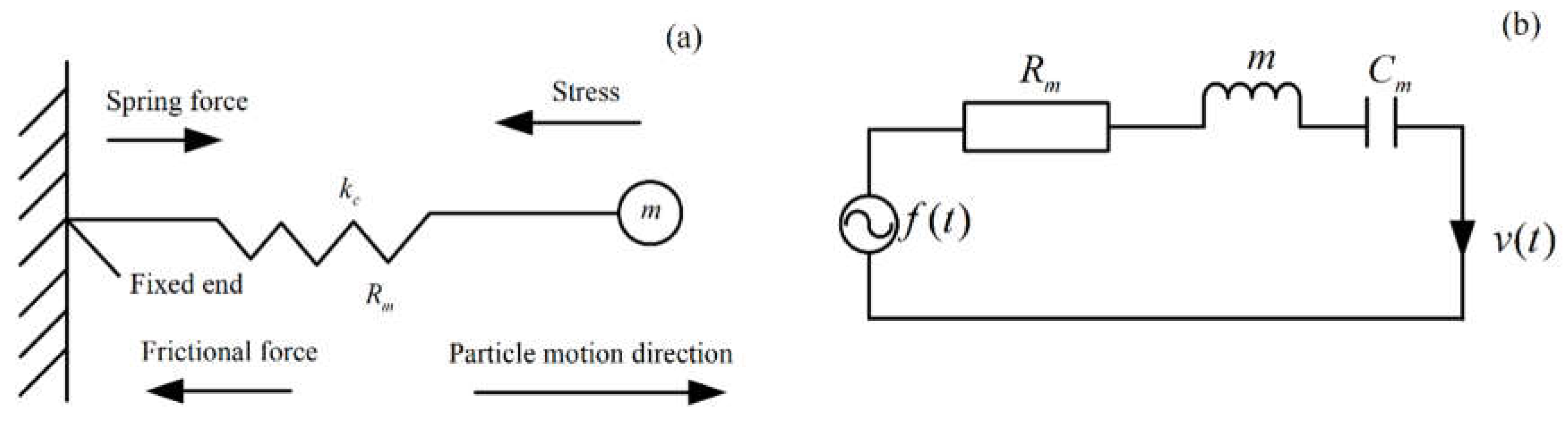
Figure 2.
An equivalent mechanical network describing the motion state of a particle with a nonzero initial displacement, subjected only to elastic force and viscous resistance.
Figure 2.
An equivalent mechanical network describing the motion state of a particle with a nonzero initial displacement, subjected only to elastic force and viscous resistance.
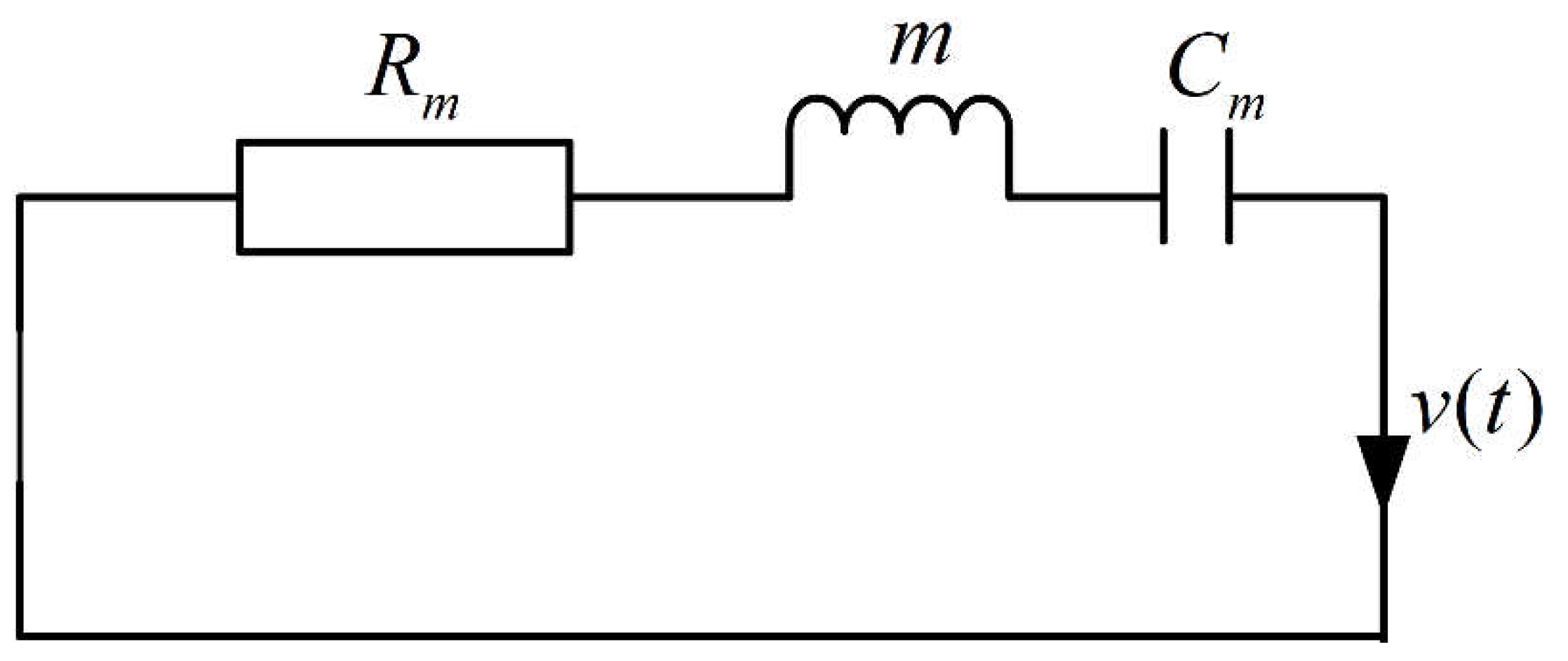
Figure 3.
Electric-mechanical equivalent circuit of a thin-disk source transducer.
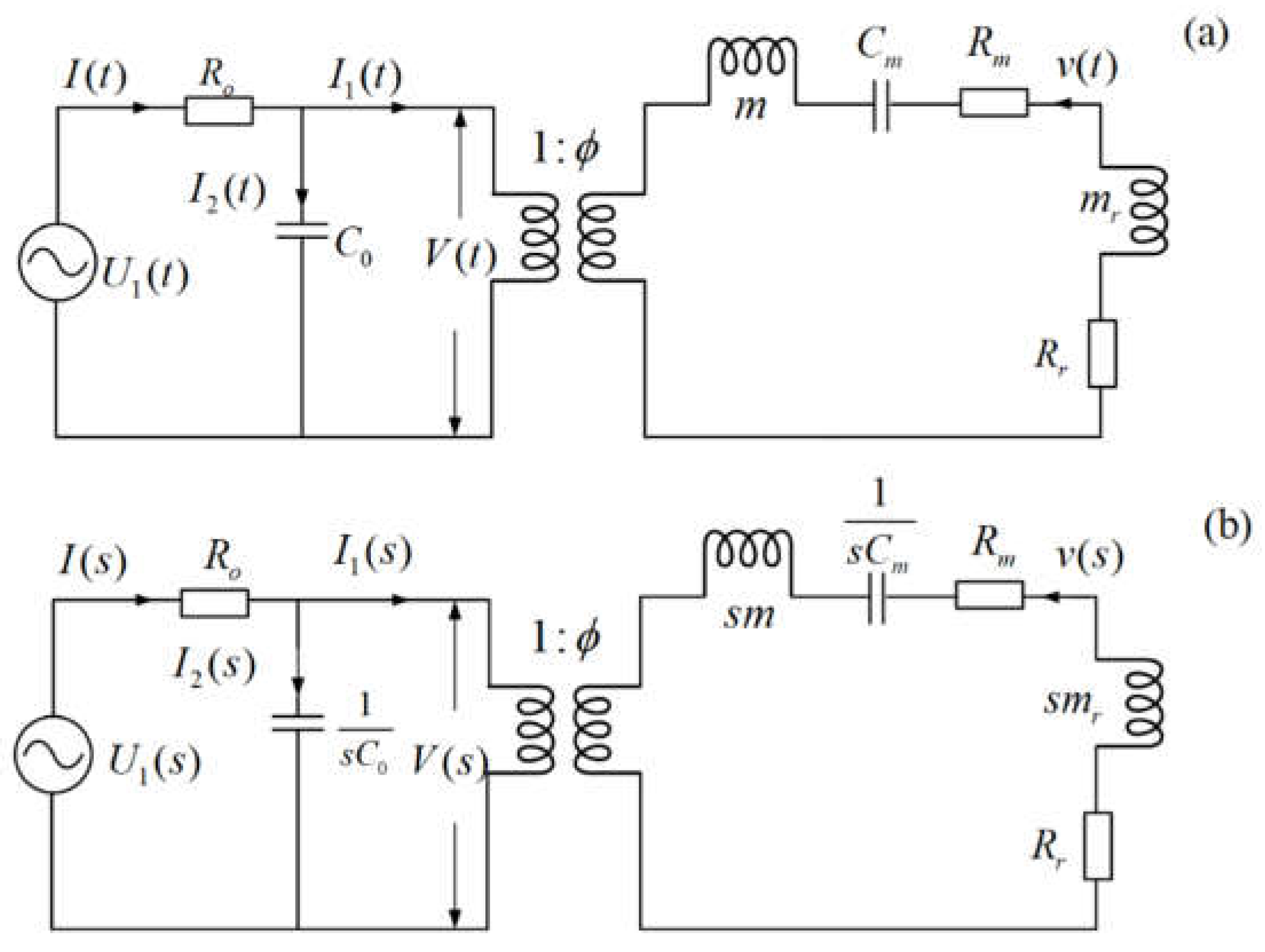
Figure 4.
Electric-mechanical equivalent circuit of a thin-disk receiving transducer.
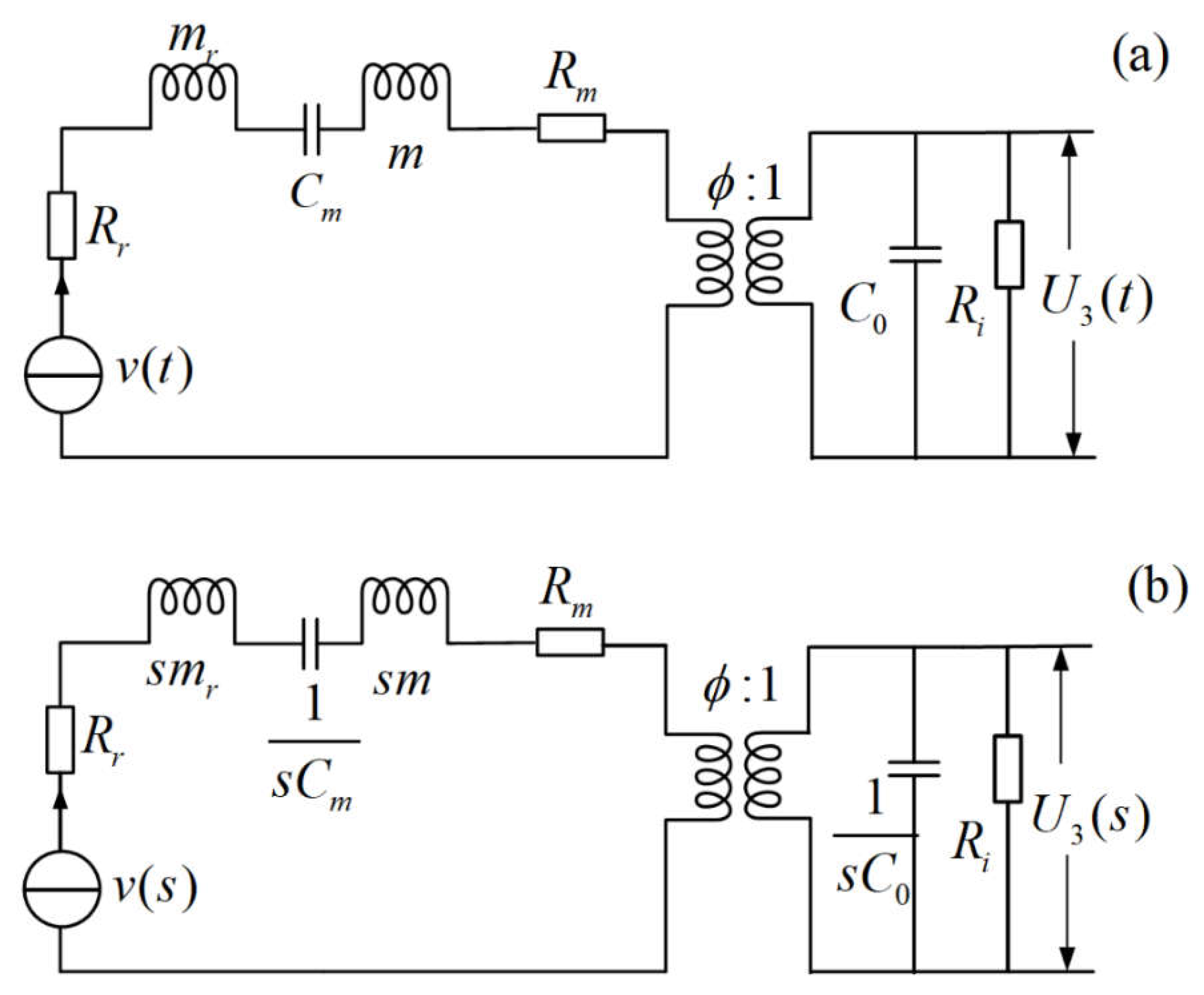
Figure 5.
The relationship between α and f for plexiglas with different viscosity coefficients: (a); (b) ; (c); (d)
Figure 5.
The relationship between α and f for plexiglas with different viscosity coefficients: (a); (b) ; (c); (d)
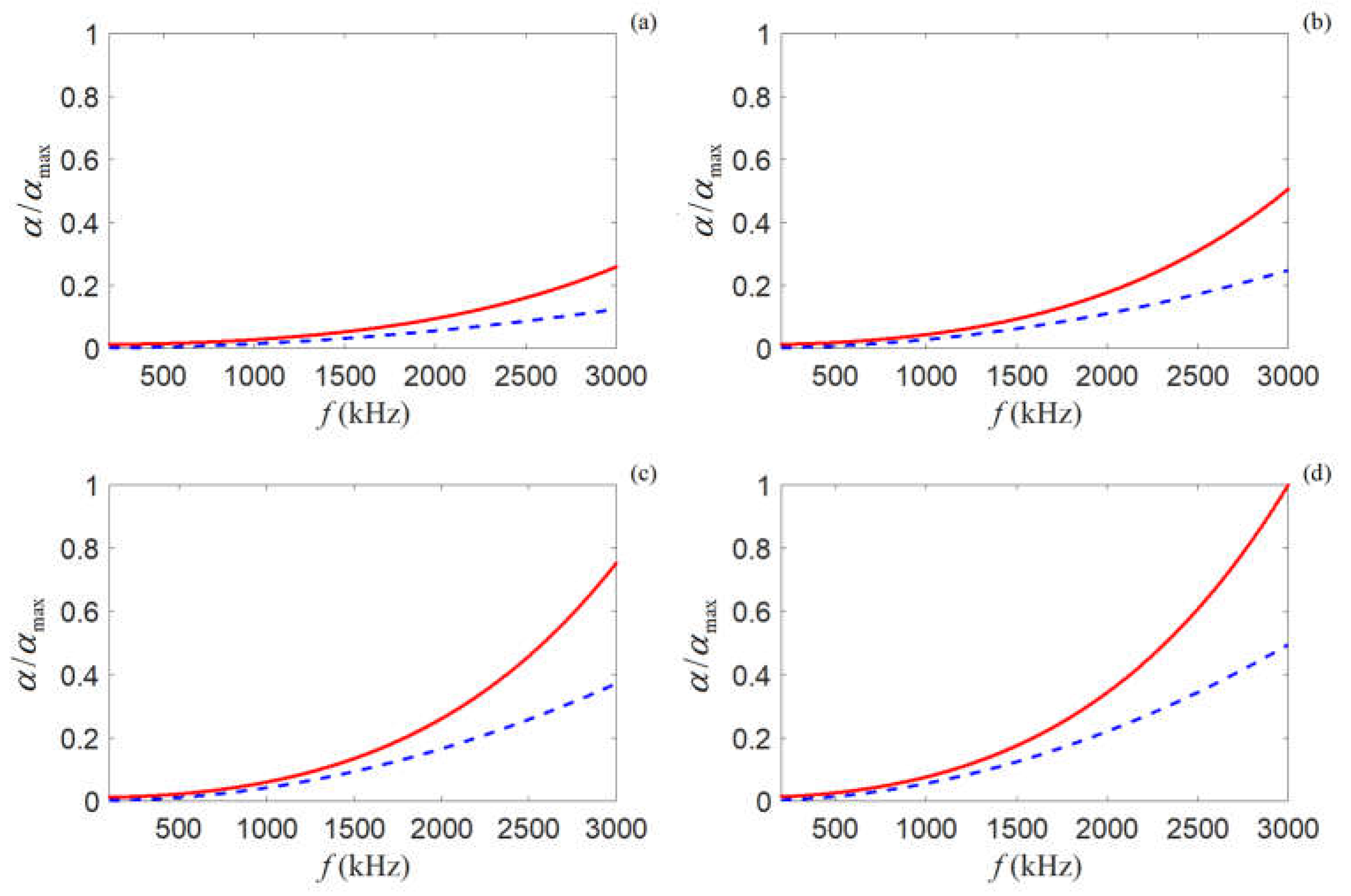
Figure 6.
The relationship between α and f for T-sandstone with different viscosity coefficients:(a); (b); (c); (d)
Figure 6.
The relationship between α and f for T-sandstone with different viscosity coefficients:(a); (b); (c); (d)
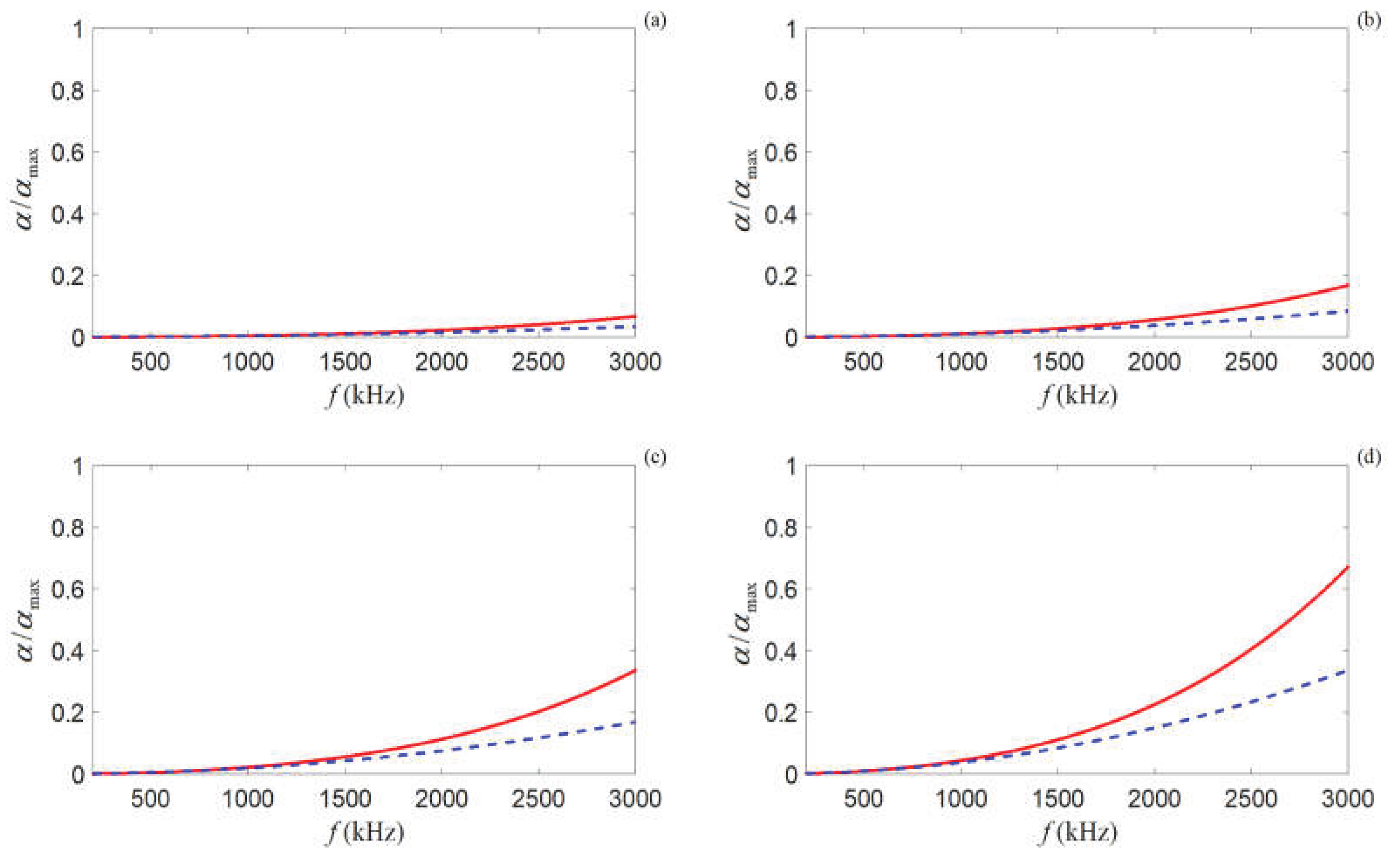
Figure 7.
The relationship between α and f for Shale with different viscosity coefficients(a); (b); (c); (d)
Figure 7.
The relationship between α and f for Shale with different viscosity coefficients(a); (b); (c); (d)
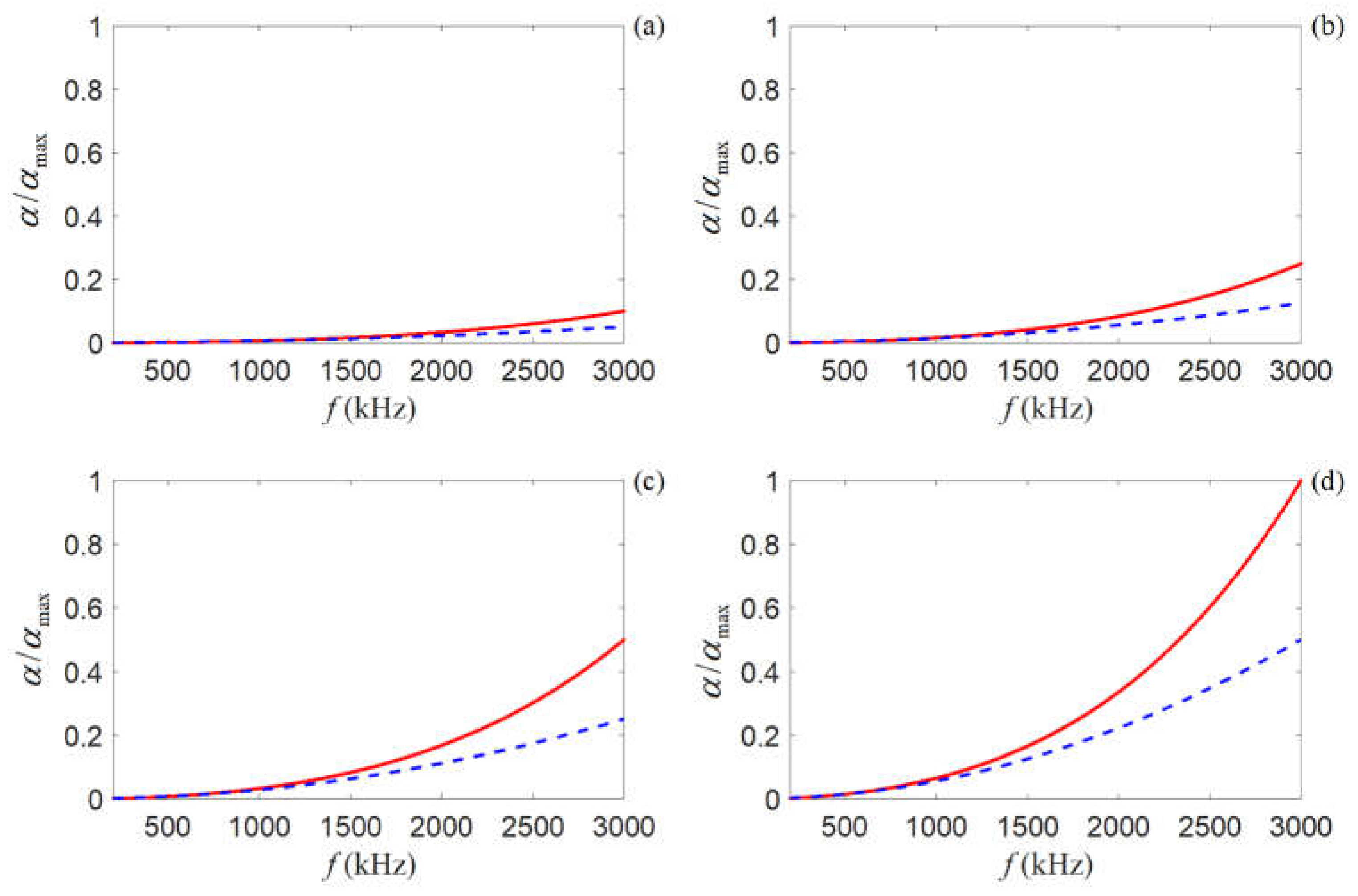
Figure 8.
Physical image of the source transducer and receiving transducer.
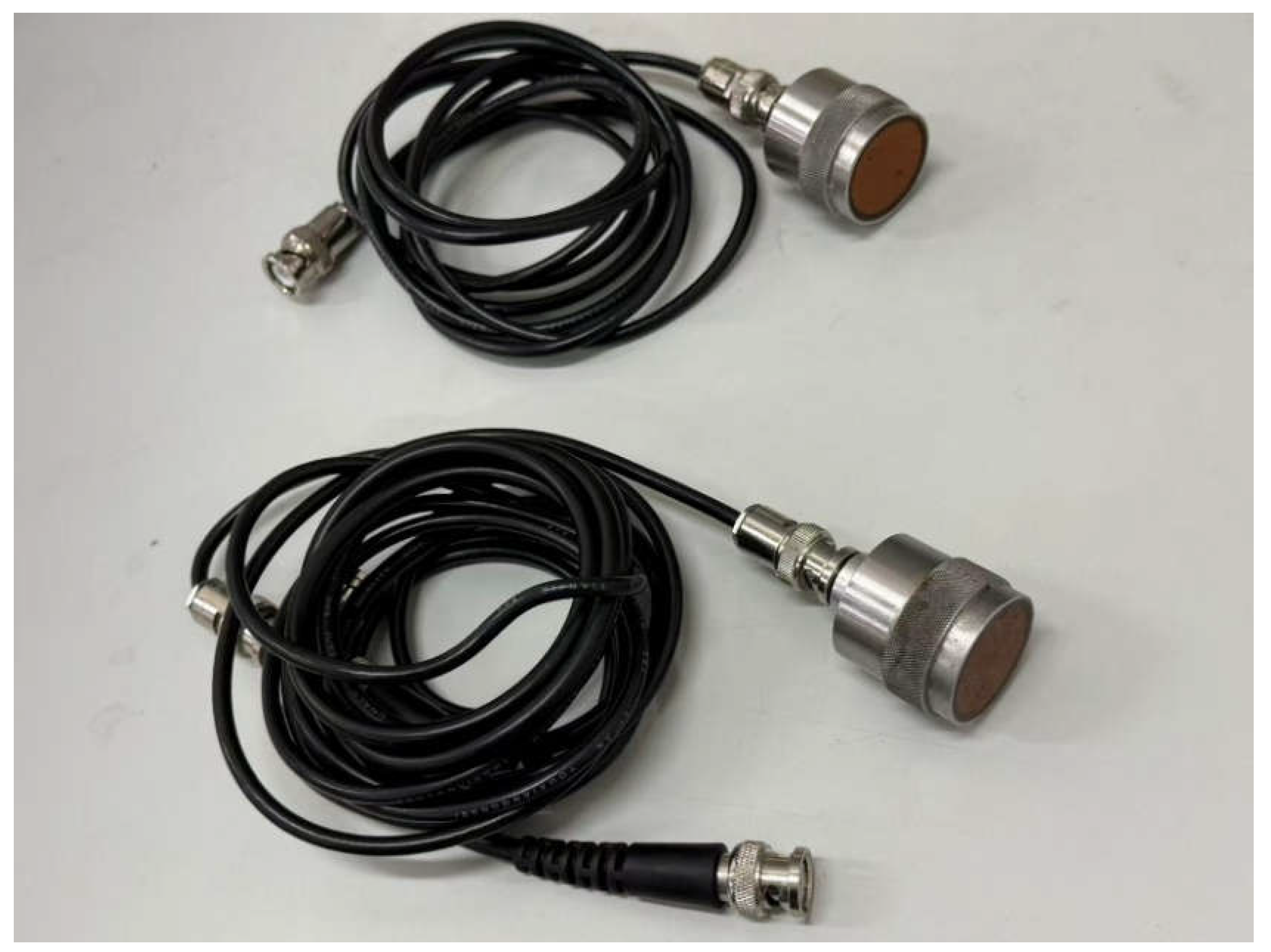
Figure 9.
Electric-acoustic conversion characteristics of a thin-disk transducer: (a) Impulse response; (b) Amplitude spectrum; (c) Phase spectrum; (d) Time delay; (e) Derivative of phase with respect to frequency; (f) Derivative of time delay with respect to frequency.
Figure 9.
Electric-acoustic conversion characteristics of a thin-disk transducer: (a) Impulse response; (b) Amplitude spectrum; (c) Phase spectrum; (d) Time delay; (e) Derivative of phase with respect to frequency; (f) Derivative of time delay with respect to frequency.
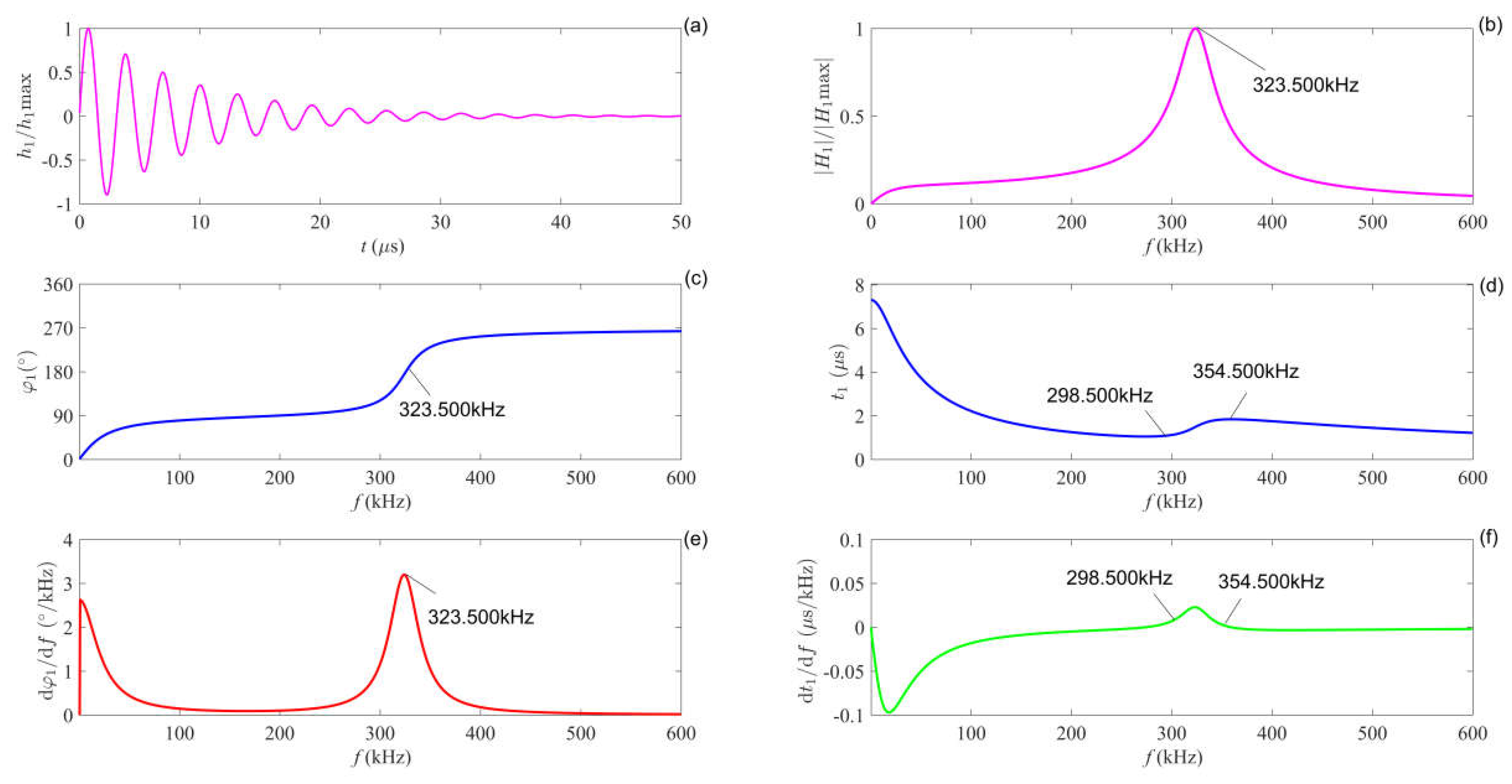
Figure 10.
Acoustic-electric conversion characteristics of the thin-disc transducer: (a) Impulse response; (b) Amplitude spectrum; (c) Phase spectrum; (d) Time delay; (e) Derivative of phase angle with respect to frequency; (f) Derivative of time delay with respect to frequency.
Figure 10.
Acoustic-electric conversion characteristics of the thin-disc transducer: (a) Impulse response; (b) Amplitude spectrum; (c) Phase spectrum; (d) Time delay; (e) Derivative of phase angle with respect to frequency; (f) Derivative of time delay with respect to frequency.
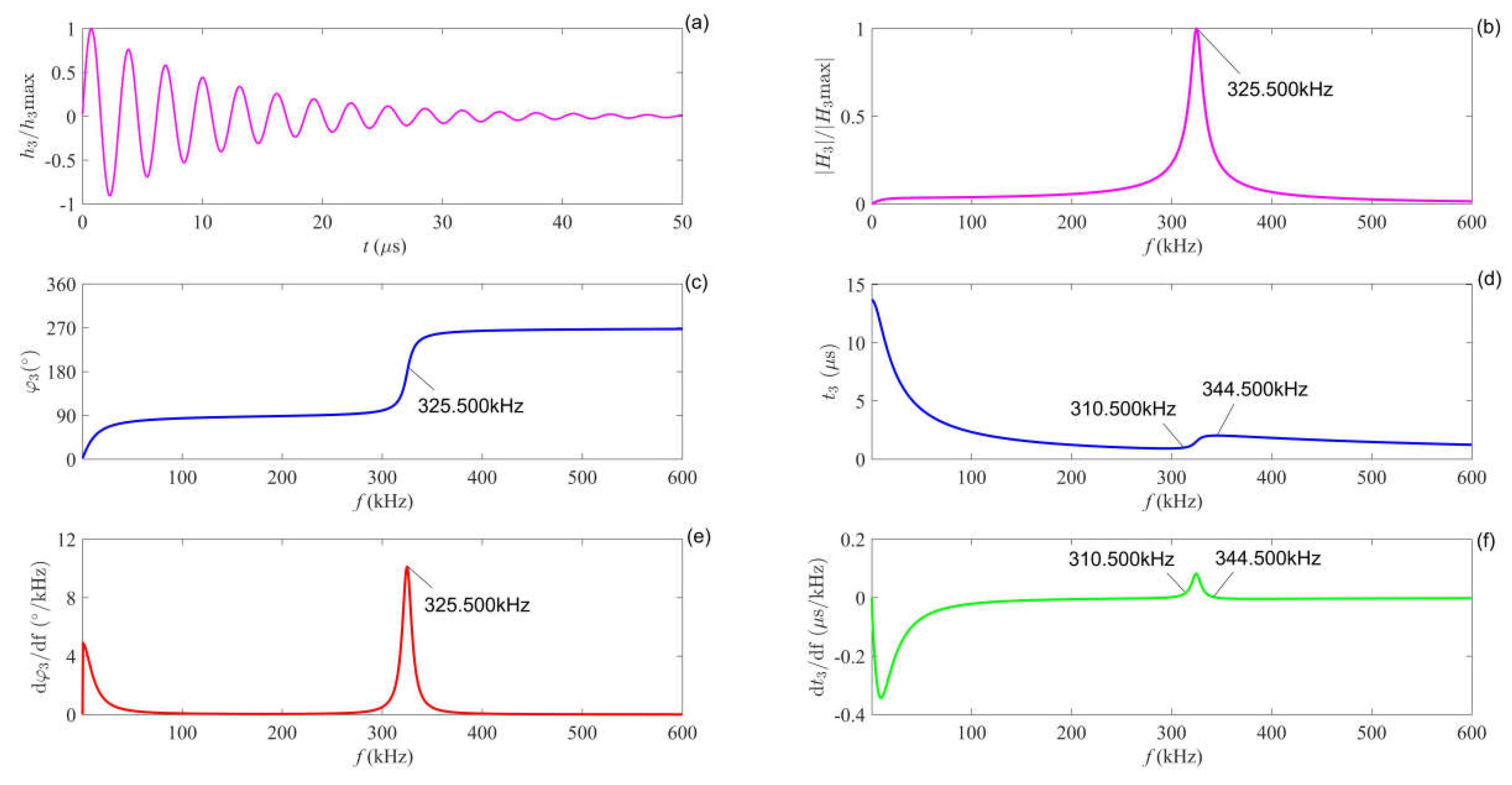
Figure 11.
Block diagram of the experimental measurement setup.
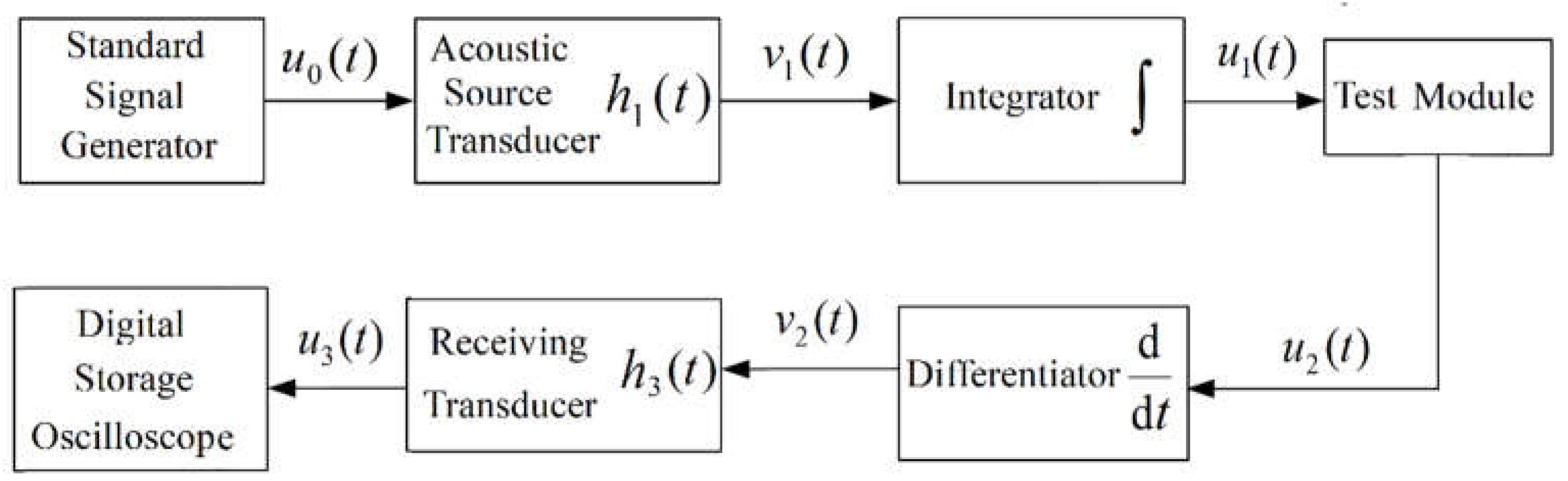
Figure 12.
Relationships of both the amplitude and phase shift of the steady-state sine voltage signal at the electrical end of the receiving transducer versus the frequency: (a) Measured amplitude-frequency characteristic; (b) Measured phase-frequency characteristic; (c) Comparison of amplitude-frequency characteristics; (d) Theoretical calculated phase-frequency characteristic.
Figure 12.
Relationships of both the amplitude and phase shift of the steady-state sine voltage signal at the electrical end of the receiving transducer versus the frequency: (a) Measured amplitude-frequency characteristic; (b) Measured phase-frequency characteristic; (c) Comparison of amplitude-frequency characteristics; (d) Theoretical calculated phase-frequency characteristic.
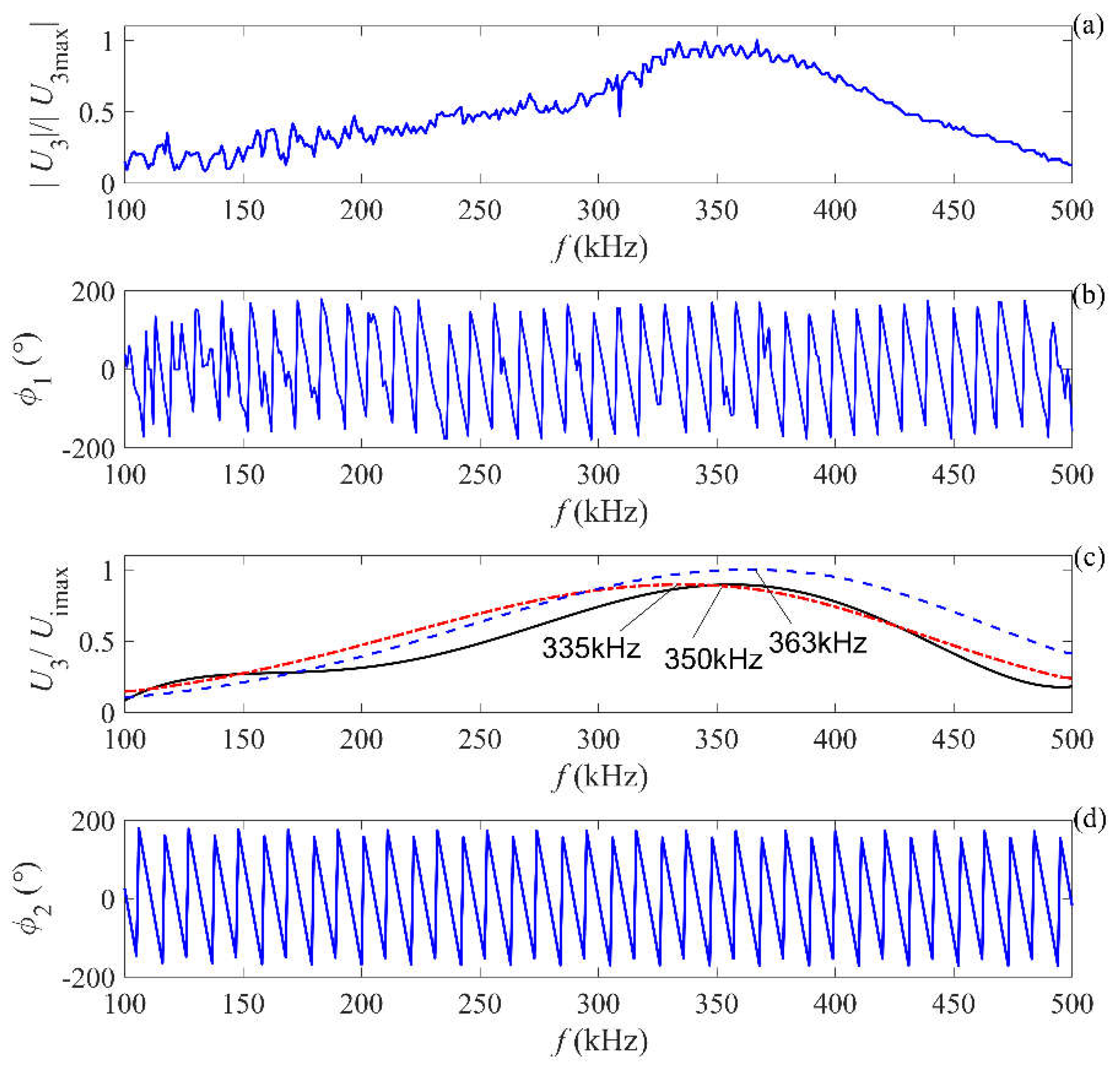
Figure 13.
Frequency dependence of sound attenuation coefficient: Comparison of inversion values with theoretical values.
Figure 13.
Frequency dependence of sound attenuation coefficient: Comparison of inversion values with theoretical values.
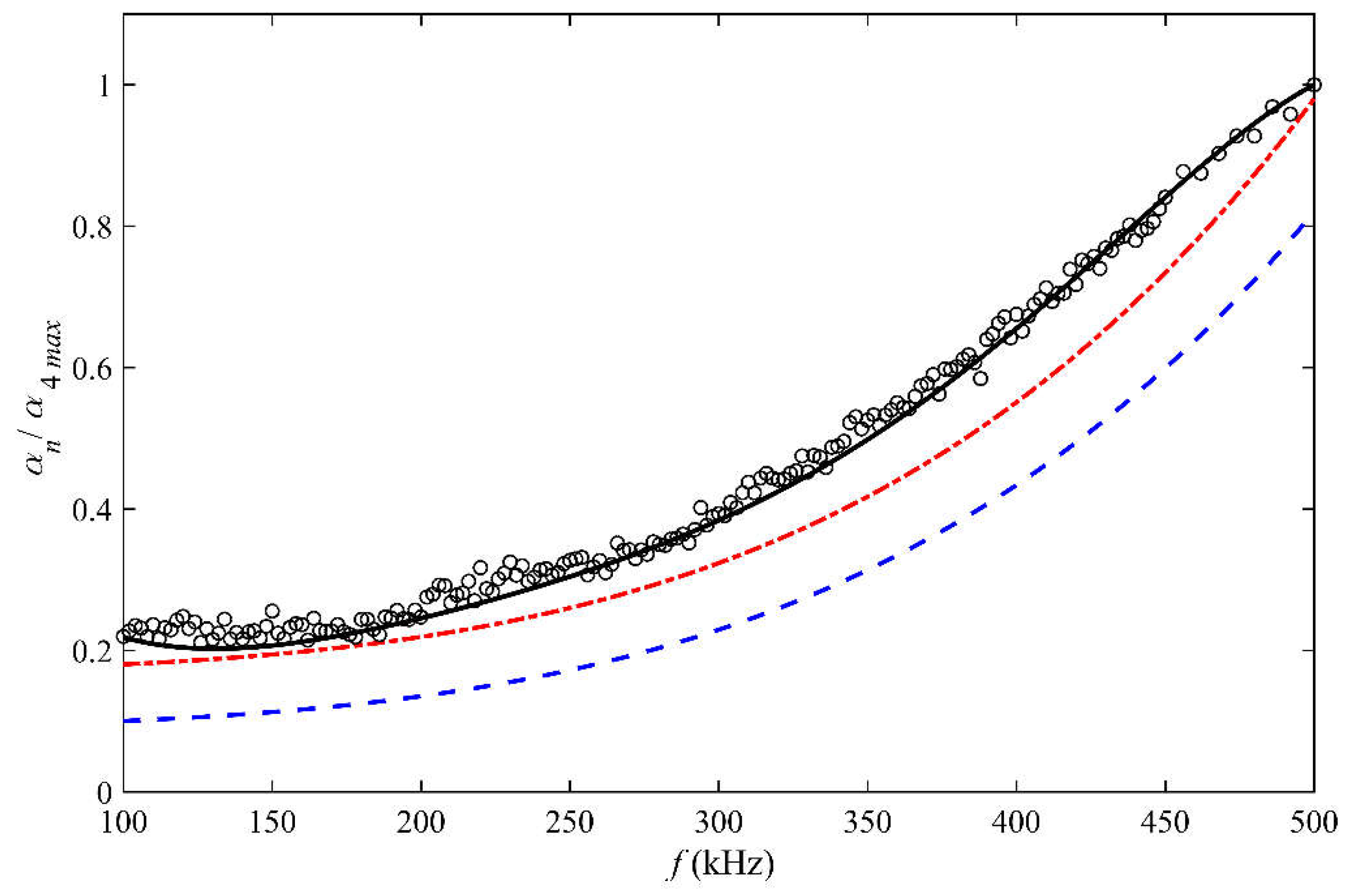
Table 2.
Physical parameters of piezoelectric material PZT.
| Physical parameters | ||||
| Numerical value |
Disclaimer/Publisher’s Note: The statements, opinions and data contained in all publications are solely those of the individual author(s) and contributor(s) and not of MDPI and/or the editor(s). MDPI and/or the editor(s) disclaim responsibility for any injury to people or property resulting from any ideas, methods, instructions or products referred to in the content. |
© 2026 by the authors. Licensee MDPI, Basel, Switzerland. This article is an open access article distributed under the terms and conditions of the Creative Commons Attribution (CC BY) license (http://creativecommons.org/licenses/by/4.0/).
Copyright: This open access article is published under a Creative Commons CC BY 4.0 license, which permit the free download, distribution, and reuse, provided that the author and preprint are cited in any reuse.