
Submitted:
27 June 2026
Posted:
30 June 2026
You are already at the latest version
Abstract
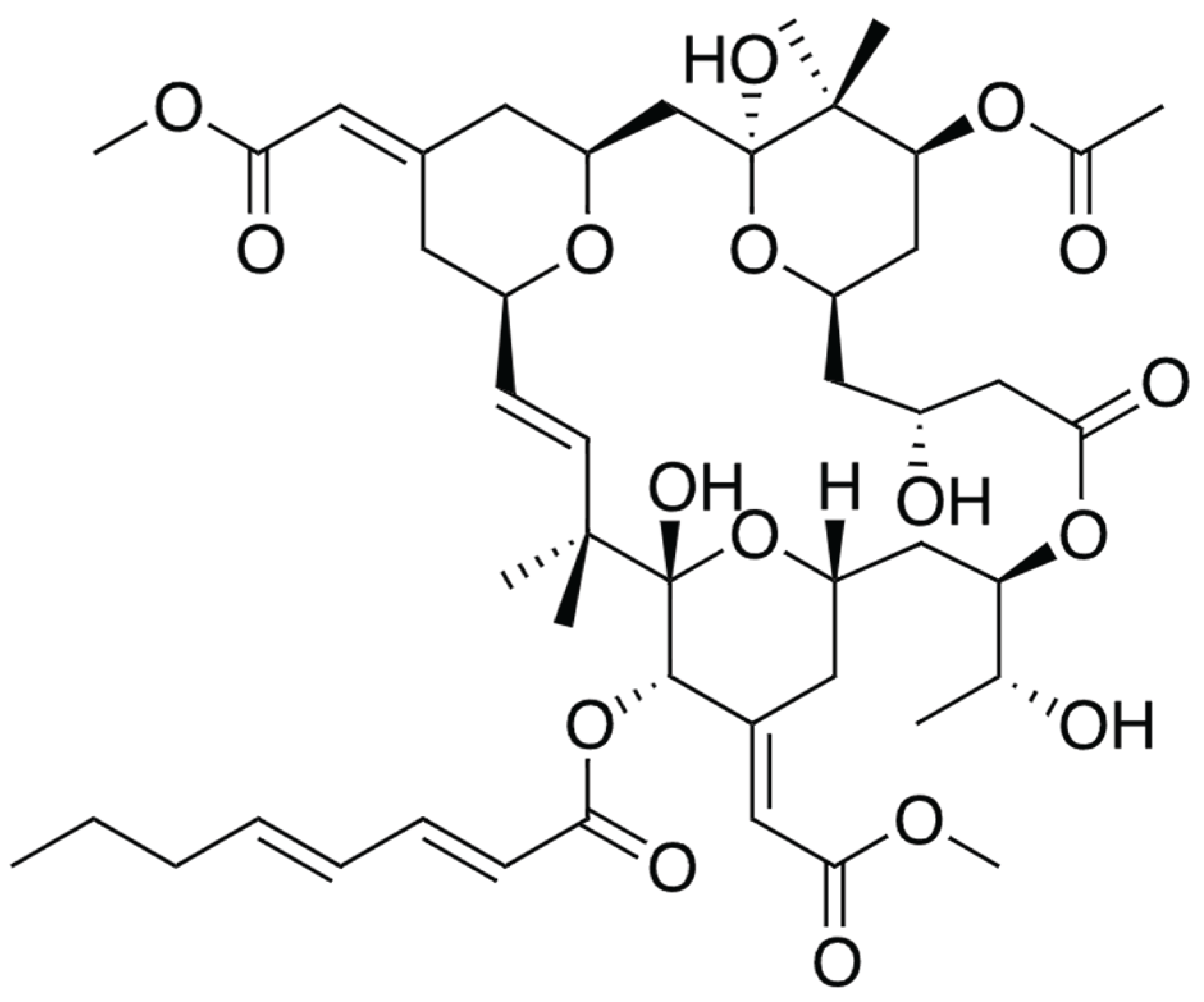
Bryostatin is a marine natural marine product that was originally extracted from the sessile invertebrate Bugula nerintina. There is a marine bacterium, (Candidatus Endobugula sertula) that has a symbiotic relationship with Bugula that produces bryostatin. In the first large scale collection of Bugula, it took 14 tons of the obscure bryozoan to isolate 18 grams of the drug. This study focuses on isolating bryostatin from a material designed to attract and grow bacterium in the marine environment. Fourier transform Ion Cyclotron Resonance Spectrometer (FT-ICR) is used to identify bryostatins, bryostatin, fragments, and adducts that are present in the matrix. Data is divided into two groups; 1. Calculated exact molar masses, using the NIST Isotope Tables, for the bryostatins 0-21, adducts, fragments and dimers of bryrostatins. These values are correlated with the data from the FT-ICR with possible structure identification. 2. The FT-ICR data acquired from the extracts of the samples. This data is matched with the calculated values to identify specific empirical formulas. For bryostatin-1, the five most common isotopic variations and their natural abundance); would be: M; C47H68O17Na, 927.43487 (2) M+1 (+1 × 13C) 928.43823 (3) M+2 (+2 13C) 929.44158 (4) M+3 × 13C (930.44494) (5) M + 4 (+2 × 13C + 18O, 931.44583.
Keywords:
1. Introduction
2. Results

| Ion Type | Empirical Formula (Adduct Form) | Exact Mass (Da) |
| [M − H]− | C47H67O17− | 903.4378 |
| [M + F]− | C47H68O17F− | 923.4441 |
| [M + Cl]− | C47H68O17Cl− | 939.4145 |
| [M + OH]− | C47H69O18− | 921.4484 |
| Fragment Assignment | Formula (Adduct Form) | Δ Mass (Da) | Exact m/z |
| [M + Na]+ (parent) | C47H68O17Na+ | — | 927.435 |
| −H2O | C47H66O16Na+ | −18.010565 | 909.425 |
| −2H2O | C47H64O15Na+ | −36.021130 | 891.414 |
| −CH3 | C46H65O17Na+ | −15.023475 | 912.412 |
| −OCH3 | C46H65O16Na+ | −31.018390 | 896.417 |
| −CO | C46H68O16Na+ | −28.010565 | 899.425 |
| −CO2 | C46H68O15Na+ | −44.009500 | 883.426 |
| −Acetyl (CH3CO) | C45H65O16Na+ | −43.018390 | 884.417 |
| −Acetic acid (CH3COOH) | C45H64O15Na+ | −60.021130 | 867.414 |
| Negative Ion Mode | |||
| Fragment Assignment | Formula | Δ Mass (Da) | Exact m/z |
| [M − H]− | C47H67O17− | — | 903.437825 |
| −H2O | C47H65O16− | −18.01 0565 | 885.42726 |
| −CH3 | C46H64O17− | −15.023475 | 888.41435 |
| −CO2 | C46H67O15− | −44.009500 | 859.428325 |
| −Acetic acid | C45H66O16− | −60.021130 | 843.416695 |
| [M + Cl]− | Cl adduct | 34.968853 | 939.414503 |
| [M + OH]− | Hydroxide adduct | 17.00274 | 921.44839 |
| # | [M+H]+ | [M+Na]+ | [M+K]+ | −H2O (Na) | −CH3 (Na) | −AcOH (Na) |
| 0 | 891.437 | 913.42 | 929.394 | 895.409 | 898.396 | 853.399 |
| 1 | 905.453 | 927.435 | 943.409 | 909.425 | 912.412 | 867.414 |
| 2 | 863.442 | 885.425 | 901.399 | 867.414 | 870.401 | 825.404 |
| 3 | 889.422 | 911.404 | 927.378 | 893.394 | 896.381 | 851.383 |
| 4 | 895.469 | 917.451 | 933.425 | 899.441 | 902.428 | 857.43 |
| 5 | 867.437 | 889.42 | 905.394 | 871.409 | 874.396 | 829.399 |
| 6 | 853.422 | 875.404 | 891.378 | 857.394 | 860.381 | 815.383 |
| 7 | 825.39 | 847.373 | 863.347 | 829.362 | 832.349 | 787.352 |
| 8 | 881.453 | 903.435 | 919.409 | 885.425 | 888.412 | 843.414 |
| 9 | 853.422 | 875.404 | 891.378 | 857.394 | 860.381 | 815.383 |
| 10 | 809.432 | 831.415 | 847.389 | 813.404 | 816.391 | 771.394 |
| 11 | 767.385 | 789.368 | 805.342 | 771.357 | 774.344 | 729.347 |
| 12 | 933.484 | 955.467 | 971.441 | 937.456 | 940.443 | 895.446 |
| 13 | 795.416 | 817.398 | 833.372 | 799.388 | 802.375 | 757.377 |
| 14 | 825.427 | 847.409 | 863.383 | 829.397 | 832.385 | 787.387 |
| 15 | 921.448 | 943.43 | 959.404 | 925.42 | 928.407 | 883.409 |
| 16 | 791.416 | 813.399 | 829.373 | 795.388 | 798.375 | 753.378 |
| 17 | 791.416 | 813.399 | 829.373 | 795.388 | 798.375 | 753.378 |
| 18 | 809.432 | 831.415 | 847.389 | 813.404 | 816.391 | 771.394 |
| 19 | 837.427 | 859.409 | 875.383 | 841.398 | 844.386 | 799.388 |
| 20 | 851.442 | 873.425 | 889.399 | 855.414 | 858.401 | 813.404 |
| 21 | 865.458 | 887.44 | 903.414 | 869.43 | 872.417 | 827.419 |
3. Discussion
- (1)
- Methods: Fourier transform ion cyclotron resonance mass spectrometry (FT-ICR MS) offers unique advantages for marine natural product analysis by combining ultrahigh mass resolving power with sub ppm mass accuracy, resulting in a confident elemental formula assignment in extracts containing thousands of overlapping molecular features[21,22]. This capability is particularly critical for marine matrices, where high salt content, metal adduction, and extensive isobaric congestion frequently confound lower resolution mass analyzers. FT-ICR provides exceptional dynamic range and nondestructive ion detection via image current measurement, supporting repeated acquisitions, an isotopic fine structure analysis. Electrospray ionization FT-ICR mass spectrometry exhibits ultra-high sensitivity, with detection limits reported in the attomole range under optimized nano ESI conditions. However, for neutral, moderate hydrophobic macrolides such as the bryostatins (MW ~900 Da), practical limits of detection are typically in the femtomole to low-picomole range, depending on ionization efficiency, adduct formation, and matrix complexity. In marine extracts, ion suppression (Na+, K+, etc.) and chemical background can elevate the limits of detection, with reliable detection generally achieved at ≥0.1–1 picomole levels. Positive ion mode is generally more effective for bryostatins, as these neutral, oxygen-rich macrolides preferentially form stable cations such as [M+Na]+, [M+Li]+, and [M+K]+, which can give strong, well-resolved FT-ICR signals with high mass accuracy. Alkali metal adducts, especially Na+ and Li+, often enhance signal intensity and reproducibility, but they also distribute ion current across multiple adduct peaks, which can reduce sensitivity for any single species. Transition metal adducts (e.g., Fe+2) are less common and may complicate spectra due to coordination chemistry and isotopic patterns. In contrast, negative ion mode is generally less sensitive for bryostatins because they lack strongly acidic functional groups, making [M–H]− formation inefficient under typical ESI conditions. However, negative mode can still be useful for detecting specific adducts such as [M+Cl]− or for probing minor acidic impurities, degradation products, or conjugates.[23,24] Overall, positive ion mode provides higher sensitivity and cleaner detection for bryostatins, whereas negative ion mode offers complementary information but typically at the cost of lower signal intensity and more limited ionization pathways.
4. Materials and Methods
Acknowledgments
References
- Newman, D. J.; Cragg, G. M. Natural products as sources of new drugs over the nearly four decades. J. Nat. Prod. 2020, 83(3), 770–803. [Google Scholar] [CrossRef] [PubMed]
- Patridge, E.; et al. An analysis of FDA-approved drugs from natural products. Drug Discov. Today 2016, 21, 204–207. [Google Scholar] [CrossRef] [PubMed]
- Blunt, J. W.; et al. Marine natural products. Nat. Product. Rep. 2018, 35, 8–53. [Google Scholar] [CrossRef]
- Pettit, G. R.; et al. Isolation and structure of bryostatin-1. J. Am. Chem. Soc. 1982, 104, 6846–6848. [Google Scholar]
- Rudloe, J. Gulf Specimen Marine Laboratory and marine research access. Fla. Sci. 1984, 47, 145–152. [Google Scholar]
- Kazanes, D. M.; et al. ACS Chem. Biol. 2014, 9, 1241–1252.
- Sun, M. K.; Alkon, D. L. Curr. Alzheimer Res. 2014, 11, 473–482.
- Wender, P. A.; et al. PNAS 2011, 108, 6721–6726. [PubMed]
- Clamp, A.; et al. Investig. New Drugs 2014, 32, 941–948.
- Gutiérrez, M.; et al. Clin. Cancer Res. 2016, 22, 5198–5206.
- Pettit, G. R.; et al. Anti-Cancer Drug Des. 1996, 11, 961–978.12.
- Nelson, T.J.; Sun, M.-K.; Lim, C.; Sen, A.; Khan, T.; Chirila, F.V.; Alkon, D.L. Bryostatin effects on cognitive function and PKCε in Alzheimer’s disease: Phase IIa and expanded access trials. J. Alzheimer’s Dis. 2017, 58, 521–535. [Google Scholar]
- Thompson, R.E.; Tuchman, A.J.; Alkon, D.L. Bryostatin placebo-controlled trials indicate cognitive restoration above baseline for advanced Alzheimer’s disease in the absence of memantine. J. Alzheimer’s Dis. 2022, 86, 1221–1229. [Google Scholar]
- Alkon, D.L.; Sun, M.-K.; Tuchman, A.J.; Thompson, R.E. Advanced Alzheimer’s disease patients show safe, significant, and persistent benefit in 6-month bryostatin trial. J. Alzheimer’s Dis. 2023, in press. [Google Scholar] [CrossRef]
- Cogram, P.; Alkon, D.L.; Crockford, D.; Deacon, R.M.J.; Hurley, M.J.; Altimiras, F.; Sun, M.K.; Tranfaglia, M. Chronic bryostatin-1 rescues autistic and cognitive phenotypes in the fragile X mice. Sci. Rep. 2020, 10(1), 18058. [Google Scholar] [CrossRef] [PubMed]
- Tian, Z.; Lu, X.-T.; Jiang, X.; Tian, J. Bryostatin-1: A promising compound for neurological disorders. Front. Pharmacol. 2023, 14, 1187411. [Google Scholar] [CrossRef] [PubMed]
- Wender, P. A.; Hardman, C. T.; Ho, S.; Jeffreys, M. S.; Maclaren, J. K.; Quiroz, R. V.; Ryckbosch, S. M.; Shimizu, A. J.; Sloane, J. L.; Stevens, M. C. Scalable synthesis of bryostatin 1 and analogs, adjuvant leads against latent HIV. Science 2017, 358(6360), 218–223. [Google Scholar] [CrossRef] [PubMed]
- Rinehart, K.L. “Antitumor compounds from tunicates”. Med. Res. Rev. 2000, 20(1), 1–27. [Google Scholar] [PubMed]
- Manning, T.; et al. Pharmaceutical Aquaculture in the Marine Environment: A Green Technology Approach to Synthesis and Discovery. J. Ocean Technol. 2022. [Google Scholar]
- Manning, T. J.; Land, M.; Rhodes, E.; Loftis, R.; Cooper, H. J.; Lam, T. T.; Marshall, A. G.; Phillips, D. R.; Rudloe, J. Analysis of ulmic acid by mass spectrometry. Ga. J. Sci. 2005, 63(2), 97–115. [Google Scholar]
- Marshall, A. G.; Hendrickson, C. L.; Jackson, G. S. Fourier transform ion cyclotron resonance mass spectrometry: A primer. Mass Spectrom. Rev. 1998, 17(1), 1–35. [Google Scholar] [CrossRef] [PubMed]
- Cochran, D.; Powers, R. Fourier transform ion cyclotron resonance mass spectrometry applications for metabolomics. Biomedicines 2024, 12(8), 1786. [Google Scholar] [CrossRef] [PubMed]
- Nelson, T. J.; Sen, A.; Alkon, D. L.; Sun, M. K. Adduct formation in liquid chromatography–triple quadrupole mass spectrometric measurement of bryostatin-1. J. Chromatogr. B 2013, 944, 55–62. [Google Scholar]
- Kamga, A. W.; Behar, F.; Hatcher, P. G. Quantitative analysis of long-chain fatty acids present in a Type I kerogen using electrospray ionization Fourier transform ion cyclotron resonance mass spectrometry compared with BF3/MeOH methylation/GC-FID. J. Am. Soc. Mass Spectrom. 2014, 25, 880–890. [Google Scholar] [PubMed]
- Cochran, D.; Powers, R. Fourier transform ion cyclotron resonance mass spectrometry applications for metabolomics. Biomedicines 2024, 12(8), 1786. [Google Scholar] [CrossRef] [PubMed]
- McIndoe, J. S.; Vikse, K. L. Assigning the ESI mass spectra of organometallic and coordination compounds. J. Mass Spectrom. 2019. [Google Scholar] [CrossRef] [PubMed]
- Wender, P. A.; Hardman, C. T.; Ho, S.; Jeffreys, M. S.; Maclaren, J. K.; Quiroz, R. V.; Ryckbosch, S. M.; Shimizu, A. J.; Sloane, J. L.; Stevens, M. C. Scalable synthesis of bryostatin 1 and analogs, adjuvant leads against latent HIV. Science 2017, 358(6360), 218–223. [Google Scholar] [CrossRef] [PubMed]
- Tian, Z.; Lu, X.-T.; Jiang, X.; Tian, J. Bryostatin-1: A promising compound for neurological disorders. Front. Pharmacol. 2023, 14, 1187411. [Google Scholar] [CrossRef] [PubMed]
- Nelson, T.J.; Sun, M.-K.; Lim, C.; Sen, A.; Khan, T.; Chirila, F.V.; Alkon, D.L. Bryostatin effects on cognitive function and PKCε in Alzheimer’s disease: Phase IIa and expanded access trials. J. Alzheimer’s Dis. 2017, 58, 521–535. [Google Scholar]
- Thompson, R.E.; Tuchman, A.J.; Alkon, D.L. Bryostatin placebo-controlled trials indicate cognitive restoration above baseline for advanced Alzheimer’s disease in the absence of memantine. J. Alzheimer’s Dis. 2022, 86, 1221–1229. [Google Scholar]
- Alkon, D.L.; Sun, M.-K.; Tuchman, A.J.; Thompson, R.E. Advanced Alzheimer’s disease patients show safe, significant, and persistent benefit in 6-month bryostatin trial. J. Alzheimer’s Dis. 2023, in press. [Google Scholar] [CrossRef]
| Bryostatin | Mode | Ion / Adduct | Empirical Formula | Theoretical m/z | Observed m/z | Error (ppm) | S/N |
| Bryo-1 | Negative | [M–H]− | C47H67O17− | 904.5306 | 904.5303 | −0.3 | 47 |
| Bryo-1 | Negative | [M+Cl]− | C47H68O17Cl− | 940.5103 | 940.5108 | 0.5 | 18 |
| Bryo-1 | Positive | [M+Na]+ | C47H68O17Na+ | 928.5288 | 928.5307 | 2 | 23 |
| Bryo-1 | Positive | [M+K]+ | C47H68O17K+ | 944.5027 | 944.505 | 2.4 | 14 |
| Bryo-1 | Positive | [M+Li]+ | C47H68O17Li+ | 912.5458 | 912.5464 | 0.7 | 20 |
| Bryo-2/8† | Negative | [M–H]− | C45H65O16− | 885.5048 | 885.5054 | 0.7 | 24 |
| Bryo-2/8† | Positive | [M+Na]+ | C45H66O16Na+ | 909.5029 | 909.5046 | 1.9 | 19 |
| Bryo-5 | Negative | [M–H]− | C48H69O17− | 930.497 | 930.4964 | −0.6 | 16 |
| Bryo-5 | Positive | [M+Na]+ | C48H70O17Na+ | 954.4951 | 954.497 | 2 | 17 |
| Bryo-6 | Negative | [M–H]− | C46H67O16− | 919.4897 | 919.4892 | −0.6 | 16 |
| Bryo-10 | Positive | [M+Na]+ | C47H70O16Na+ | 952.5101 | 952.512 | 2 | 15 |
| Bryostatin | Assigned Ion | Obs. m/z | Error (ppm) | S/N | Evidence |
| Bryostatin 1 | [M–H]− | ~905.515 | −0.7 ppm | ~29 | Strong parent peak |
| Bryostatin 2 / 8 | [M–H]− | ~885.504 | −0.6 ppm | ~24 | Isobaric pair indistinguishable at MS1 |
| Bryostatin 5 | [M–H]− | ~931.505 | −0.6 ppm | ~16 | Clear parent ion |
| Bryostatin 6 | [M–H]− | ~919.489 | −0.5 ppm | ~16 | Clear parent ion |
| Bryostatin 10 | [M–H]− | ~929.489 | −0.3 ppm | ~15 | Clear parent ion |
| Parent | Fragment Type | Neutral Loss | Formula | Theoretical m/z | Observed m/z | Error (ppm) | S/N |
| Bryo 1 | –CH3 | −14.01565 | C46H65O17 | 891.5 | 891.515 | −1.8 | 15 |
| Bryo 1 | –H2O | −18.01056 | C47H66O16 | 887.505 | 887.514 | −1.6 | 14 |
| Bryo 5 | –H2O | −18.01056 | C48H68O16 | 913.495 | 913.494 | −1.0 | 11 |
| Bryo 6 | –CH3 | −14.01565 | C45H65O16 | 905.474 | 905.474 | −0.2 | 12 |
| Bryo 10 | –H2O | −18.01056 | C47H68O15 | 911.479 | 911.479 | −0.2 | 10 |
| Bryostatin | Mode | Ion / Adduct | Empirical Formula | Theoretical m/z | Observed m/z | Error (ppm) | S/N |
| Bryo-1 | Negative | [M–H]− | C47H67O17− | 904.531 | 904.53 | −0.3 | 47 |
| Bryo-1 | Negative | [M+Cl]− | C47H68O17Cl− | 940.51 | 940.511 | 0.5 | 18 |
| Bryo-1 | Positive | [M+Na]+ | C47H68O17Na+ | 928.529 | 928.531 | 2 | 23 |
| Bryo-1 | Positive | [M+K]+ | C47H68O17K+ | 944.503 | 944.505 | 2.4 | 14 |
| Bryo-1 | Positive | [M+Li]+ | C47H68O17Li+ | 912.546 | 912.546 | 0.7 | 20 |
| Bryo-5 | Negative | [M–H]− | C48H69O17− | 930.497 | 930.496 | −0.6 | 16 |
| Bryo-5 | Positive | [M+Na]+ | C48H70O17Na+ | 954.495 | 954.497 | 2 | 17 |
| Bryo-6 | Negative | [M–H]− | C46H67O16− | 919.49 | 919.489 | −0.6 | 16 |
| Bryo-10 | Positive | [M+Na]+ | C47H70O16Na+ | 952.51 | 952.512 | 2 | 15 |
| Ion Type | Empirical Formula (Adduct Form) | Exact Mass (Da) |
| [M + H]+ | C47H69O17+ | 905.453 |
| [M + Li]+ | C47H68O17Li+ | 911.462 |
| [M + Na]+ | C47H68O17Na+ | 927.435 |
| [M + K]+ | C47H68O17K+ | 943.409 |
| [M + Fe]+ | C47H68O17Fe+ | 960.381 |
| [M + Ca]2+ | C47H68O17Ca2+ | 472.204 |
| (m/z, z = +2) | ||
| [M + H3O]+ | C47H71O18+ | 923.464 |
Disclaimer/Publisher’s Note: The statements, opinions and data contained in all publications are solely those of the individual author(s) and contributor(s) and not of MDPI and/or the editor(s). MDPI and/or the editor(s) disclaim responsibility for any injury to people or property resulting from any ideas, methods, instructions or products referred to in the content. |
© 2026 by the authors. Licensee MDPI, Basel, Switzerland. This article is an open access article distributed under the terms and conditions of the Creative Commons Attribution (CC BY) license (http://creativecommons.org/licenses/by/4.0/).


