

Submitted:
29 June 2026
Posted:
30 June 2026
You are already at the latest version
Abstract
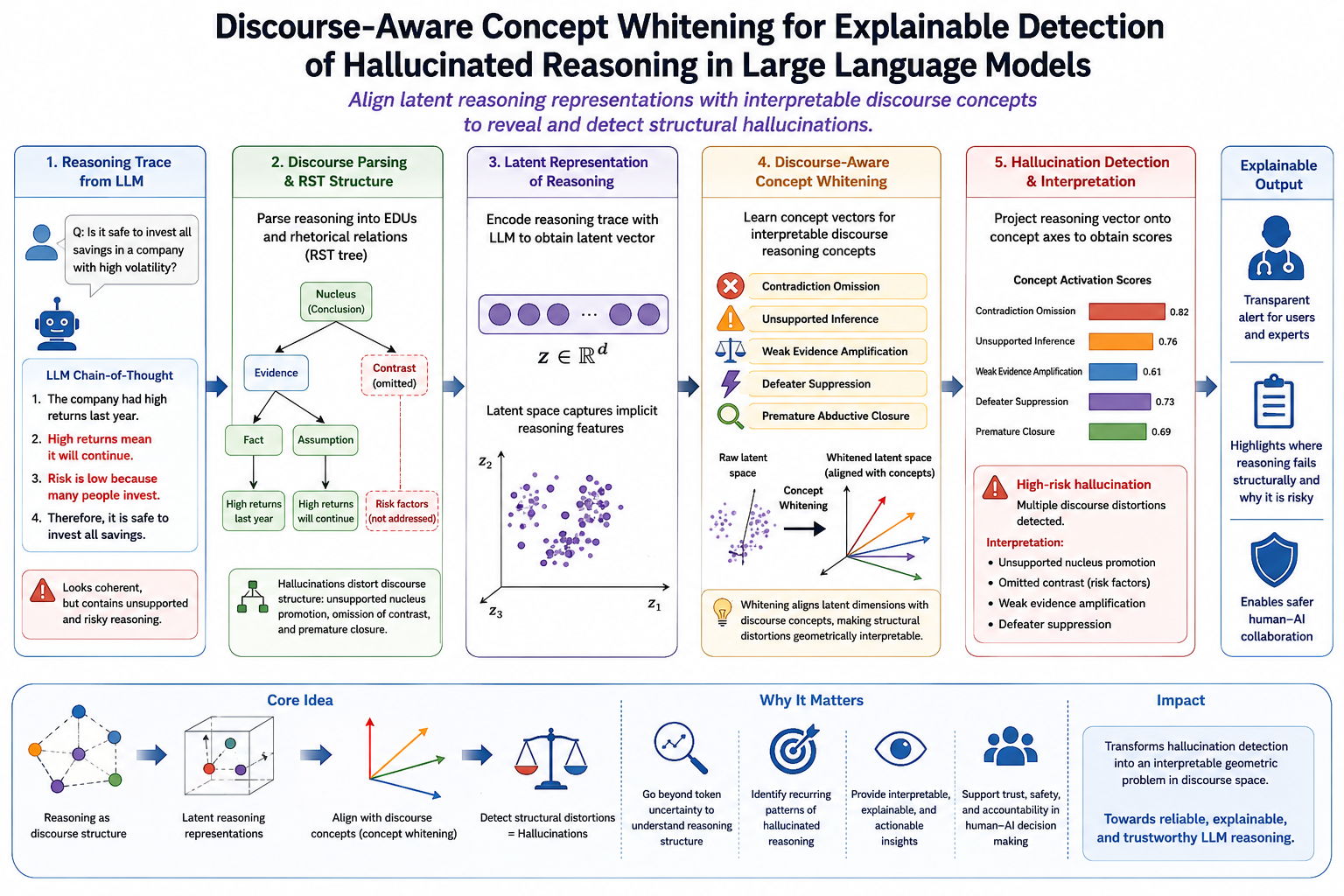
Large language models (LLMs) frequently generate coherent-looking reasoning traces that nevertheless contain unsupported inferences, contradiction suppression, premature closure, or structurally unstable explanations. Existing hallucination detection approaches largely focus on token-level uncertainty, factual verification, or post-hoc saliency analysis, while insufficiently modeling the discourse organization of reasoning itself. This paper proposes a discourse-aware extension of Concept Whitening (CW), originally developed for interpretable image recognition, to the problem of hallucination detection in chain-of-thought reasoning. We argue that hallucinations correspond to recurring structural distortions in discourse trees and rhetorical organization. Our framework aligns latent dimensions of neural reasoning representations with interpretable discourse concepts such as contradiction omission, unsupported nucleus promotion, defeater suppression, and abductive instability. By combining discourse parsing, rhetorical structure theory (RST), graph-based reasoning representations, and latent-space concept alignment, the proposed framework transforms hallucination detection into an interpretable geometric reasoning problem. We further analyze the computational properties of discourse-aware concept whitening and discuss its implications for neuro-symbolic reasoning verification.
Keywords:
large language models
; hallucination detection
; Relative Reasoning Hallucination Rate
; concept whitening
; discourse-aware learning
; rhetorical structure theory
; abductive reasoning
; neurosymbolic reasoning
; explainable artificial intelligence
1. Introduction
Large language models (LLMs) have demonstrated remarkable capabilities in reasoning, question answering, summarization, and scientific explanation generation. Despite these advances, LLMs continue to exhibit hallucinations: outputs that appear linguistically coherent but contain unsupported, contradictory, or fabricated reasoning steps. Hallucinations are especially problematic in domains such as medicine, law, and scientific analysis, where fluent but structurally invalid reasoning may mislead users despite surface plausibility.
Most current hallucination detection methods focus on token-level uncertainty, retrieval consistency, entropy estimation, or factual verification. While these methods provide useful signals, they often fail to analyze the internal discourse organization of reasoning traces. Hallucinations are rarely isolated token errors; instead, they emerge through structural distortions in reasoning organization. Typical hallucinated reasoning elevates weak evidence into discourse nuclei, suppresses contradictory evidence, prematurely closes abductive search spaces, or removes defeaters that would otherwise invalidate conclusions.
Discourse analysis provides a natural framework for studying such reasoning failures. Rhetorical Structure Theory (RST) models texts as hierarchical structures composed of elementary discourse units (EDUs) connected through rhetorical relations such as Evidence, Contrast, Cause, Elaboration, and Antithesis. In grounded reasoning, discourse structures tend to preserve contradiction, maintain evidential support, and integrate alternative hypotheses. In hallucinated reasoning, however, discourse organization often becomes unstable, with unsupported claims dominating the discourse hierarchy.
In this paper, we extend Concept Whitening (CW), originally introduced for interpretable image recognition [1] and applied to text categorization and classification in [6] to discourse-aware hallucination detection. CW transforms latent neural representations into interpretable semantic axes aligned with predefined concepts. In the visual domain, such concepts may correspond to texture, color, or object parts. We generalize this idea to discourse structures and propose aligning latent reasoning dimensions with interpretable discourse concepts.
Our core hypothesis is that hallucinations correspond to identifiable latent discourse geometries. By aligning latent dimensions with discourse reasoning concepts such as contradiction omission, unsupported inference, defeater suppression, and abductive instability, hallucinations become structurally interpretable within latent space.
The contributions of this paper are as follows:
- We propose a discourse-aware extension of Concept Whitening for interpretable hallucination detection.
- We introduce discourse concepts derived from RST structures and abductive reasoning patterns.
- We formulate hallucination detection as latent-space alignment between discourse structures and interpretable reasoning concepts.
- We analyze the computational properties of discourse-aware concept whitening for reasoning verification.
- We discuss the implications of discourse-aligned latent spaces for neuro-symbolic explainability and abductive verification.
1.1. Hallucination Example: Gigachat in the Native Banking Domain
Figure 1 presents an example of hallucination produced by Gigachat, the LLM developed within the bank ecosystem, in response to a question about withdrawal limits and commissions for cash withdrawals from a bank account.
The model states that:
“The second million rubles can be withdrawn either through ATMs with a 2% commission or through a bank branch with a 0.5% commission.”
However, the actual bank policy for ordinary withdrawals from one’s own account does not impose such a commission in the described scenario. Thus the model fabricates specific commission percentages despite operating within its own institutional domain.
This example is particularly important because the hallucination does not arise from obscure external knowledge or open-domain factual uncertainty. Instead, the model hallucinates information directly related to the financial policies of the organization that developed and deployed the system. The response is linguistically fluent and structurally coherent, yet the reasoning introduces unsupported numerical claims that are not grounded in the actual banking rules.
From the perspective of discourse-aware hallucination analysis, the response exhibits several characteristic hallucination patterns:
- unsupported nucleus promotion,
- premature closure,
- and weak-evidence amplification.
The discourse structure moves directly from the mention of a withdrawal limit to a highly specific conclusion about commission percentages. No supporting evidence, policy citation, or alternative interpretation is provided. The numerical commission values become discourse nuclei despite lacking grounding in verified policy statements.
Furthermore, the response suppresses uncertainty markers that would normally accompany incomplete financial information. Instead of presenting the policy as conditional or requiring confirmation, the model generates definitive procedural instructions. This corresponds to a form of contradiction omission and abductive overcommitment in discourse structure.
The example illustrates an important limitation of purely fluency-based evaluation metrics. The generated answer appears professionally written and institutionally authoritative while remaining factually incorrect. Consequently, hallucination detection requires analysis not only of lexical confidence but also of the internal discourse organization of reasoning.
Within the proposed framework, such responses would activate latent discourse concepts associated with:
- unsupported inference,
- weak evidence amplification,
- and premature abductive closure.
The hallucination therefore becomes interpretable as a structural discourse failure rather than merely a factual error.
Figure 1.
Example of hallucinated financial reasoning (in Russian) produced by Gigachat in the native domain of Gigachar developer. The model fabricates commission percentages for withdrawing cash despite the actual policy not imposing such fees.
Figure 1.
Example of hallucinated financial reasoning (in Russian) produced by Gigachat in the native domain of Gigachar developer. The model fabricates commission percentages for withdrawing cash despite the actual policy not imposing such fees.

2. Related Work
2.1. Hallucination Detection
Existing hallucination detection approaches can be broadly divided into:
- uncertainty-based methods,
- retrieval-consistency methods,
- self-consistency approaches,
- symbolic verification systems,
- and latent-state analysis methods.
Uncertainty-based approaches estimate hallucination likelihood using entropy, perplexity, or confidence calibration. Retrieval-based methods compare generated outputs against retrieved documents or knowledge bases. Neuro-symbolic verification frameworks employ logic programming, defeasible reasoning, or external theorem provers to validate generated conclusions.
However, these approaches generally treat reasoning traces as flat sequences rather than hierarchical discourse structures. Consequently, they often fail to explain why hallucinations arise structurally.
2.2. Discourse-Based Reasoning Analysis
RST and discourse parsing have long been used to analyze argumentative and explanatory structures. Discourse trees provide hierarchical representations of evidential organization and rhetorical relations. Recent work has explored discourse structures for explainability, summarization, and argument mining.
Nevertheless, discourse structures have rarely been integrated directly into latent-space representation learning for hallucination detection.
Computational discourse research has developed both hierarchical parsing methods and systematic accounts of coherence-relation annotation. Hernault et al. [36] demonstrated that complete RST trees can be constructed through discourse segmentation, relation classification, and bottom-up tree building. Scholman et al. [37] and Hoek et al. [38] examined the operationalization and annotation reliability of coherence-relation categories. Subsequent studies showed that discourse relations can be implicit, multiply interpretable, and distributed across local and global levels of textual organization [39,40,41]. Neural approaches have also been developed to identify discourse-relation signals from contextualized representations [42]. Potter [43] connected RST structures with propositional logic and showed how failures of logical coherence can be localized within discourse organization. Graph-based comparison of extended RST trees has additionally been used to distinguish rhetorically compatible and incompatible request–response structures [44]. The present work extends these directions by aligning recurrent discourse-level reasoning failures with interpretable latent axes through Concept Whitening.
2.3. Concept Whitening
Concept Whitening (CW) was introduced by Chen et al. [1] as an interpretable representation-learning framework for deep neural networks. The central idea behind CW is that the latent dimensions of neural representations should correspond to semantically meaningful concepts that humans can understand and interpret directly. Unlike conventional latent representations, whose dimensions are typically entangled and difficult to interpret, CW explicitly restructures the latent space so that each axis aligns with a predefined concept.
The method builds upon classical whitening transformations from multivariate statistics. Whitening removes correlations among latent dimensions by transforming the covariance matrix into the identity matrix. Let denote latent activations obtained from a hidden neural layer. The whitening transformation is defined as
where is the latent mean vector and W is a whitening matrix satisfying
with being the covariance matrix of the latent representations. This transformation decorrelates latent features and normalizes their variance, producing an orthogonalized latent space in which semantic alignment becomes feasible.
However, whitening alone does not produce interpretable representations. To achieve semantic interpretability, CW additionally introduces an orthogonal rotation matrix Q that aligns latent directions with predefined concepts:
The rotation matrix is optimized so that activations associated with a concept dataset become maximally aligned with a particular latent axis. Thus, instead of latent dimensions representing arbitrary distributed activations, each dimension becomes associated with a human-understandable semantic concept.
In the original formulation of CW, semantic concepts correspond primarily to visual properties in image-recognition tasks. For example, latent dimensions can be aligned with concepts such as:
- texture,
- color,
- object parts,
- shape,
- or background patterns.
Consequently, neural predictions become substantially more interpretable. Instead of merely predicting that an image belongs to a class, the model can explain that the prediction emerged because particular concept dimensions were strongly activated. This differs fundamentally from conventional saliency-map approaches, which operate post hoc and do not modify the latent representation itself.
Prior to Concept Whitening, several approaches sought to understand how semantic concepts emerge within neural representations. Net2Vec introduced a framework for quantifying how visual concepts are encoded by individual filters and layers of deep neural networks, providing a systematic mechanism for measuring concept alignment and interpretability across architectures [8]. Network Dissection further demonstrated that individual hidden units often correspond to human-interpretable semantic concepts, establishing one of the first quantitative methodologies for evaluating interpretability at the neuron level [10]. Interpretable Basis Decomposition extended this perspective by decomposing latent representations into interpretable basis vectors corresponding to meaningful visual patterns, thereby revealing latent semantic structure beyond individual neurons [9].
These studies collectively suggested that deep networks spontaneously develop concept-sensitive representations. However, the discovered concepts remained emergent properties of training rather than explicit design objectives. Consequently, interpretability was primarily achieved through post-hoc analysis of learned representations rather than through architectural constraints that directly shape latent geometry.
CW can be viewed as a natural progression of this line of research. Instead of discovering concepts after training, it explicitly incorporates concept alignment into the learning process itself. In this sense, CW transforms interpretability from an observational property into an optimization objective. The resulting latent dimensions become semantically meaningful by construction rather than by retrospective analysis.
Subsequent concept-based methods attempted to automate concept discovery. Automated Concept-based Explanations (ACE) introduced an unsupervised approach that clusters internal neural activations into human-interpretable concept groups, enabling concept-level explanations without manual concept annotation [11]. Concept Bottleneck Models (CBMs) incorporated an explicit intermediate concept layer whose predictions mediate the final task output, thereby improving transparency and facilitating intervention at the concept level [7]. More recently, Label-Free Concept Bottleneck Models (LF-CBM) reduced dependence on manually curated concept annotations by exploiting language–vision alignment and semantic similarity measures derived from foundation models [13]. Invertible Concept-Based Explanations further demonstrated that concept activation vectors can be made reconstructive and invertible, allowing concept-level interventions to be traced back to input space and providing stronger causal interpretations of neural decisions [12]. Nevertheless, many of these approaches still treated concepts primarily as auxiliary interpretability mechanisms rather than as structural constraints governing latent organization.
CW belongs to a broader family of concept-based explainability methods that seek to bridge neural representations and human-understandable abstractions. Earlier approaches such as Testing with Concept Activation Vectors (TCAV) [3] attempted to measure the sensitivity of predictions to manually defined concept directions. TCAV introduced the notion that latent spaces contain semantically meaningful directions corresponding to human concepts. However, TCAV remained primarily diagnostic rather than representational: it identified concept directions after training rather than restructuring the latent geometry itself.
CW differs from these approaches because interpretability becomes integrated directly into representation learning. Rather than extracting concepts from an already-trained network, CW modifies the latent geometry itself so that concepts become axis-aligned during training. This distinction is crucial because it transforms interpretability from a post-hoc analysis problem into an intrinsic architectural property.
Another important aspect of CW is its use of orthogonality constraints. Since latent axes are explicitly decorrelated and aligned with distinct concepts, semantic overlap between concepts is reduced. This disentanglement improves interpretability because activation along one axis can be interpreted independently of activations along others. In practice, CW therefore produces latent spaces where concept activations are geometrically separable and semantically stable.
The original CW work primarily focused on convolutional neural networks for image classification tasks. Subsequent research extended the idea toward graph neural networks (GNNs) and concept-based graph representations like AMR graphs [6]. In graph-based settings, latent axes may correspond to (closed) graph motifs, substructures, or semantically meaningful subgraphs staying for entities and relations on them. This extension demonstrated that CW is not restricted to visual pixel-based representations but can generalize to structured symbolic or relational representations.
Despite these advances, existing applications of CW remain largely confined to perceptual domains such as image recognition or graph classification. To our knowledge, CW has not previously been extended to discourse analysis, rhetorical structure theory (RST), abductive reasoning, or hallucination detection in large language models.
This limitation is significant because reasoning hallucinations are fundamentally structural phenomena. Hallucinations frequently emerge not through isolated lexical errors but through failures of discourse organization. Examples include:
- unsupported nucleus promotion,
- contradiction omission,
- defeater suppression,
- premature abductive closure,
- and incoherent evidence integration.
Such failures are naturally representable as discourse concepts rather than surface-level token patterns. Consequently, discourse analysis provides a promising domain for extending CW beyond perceptual explainability into reasoning verification.
Unlike images, discourse structures possess hierarchical rhetorical organization. RST represents texts as trees whose nodes correspond to elementary discourse units (EDUs) connected through rhetorical relations such as Evidence, Contrast, Antithesis, Elaboration, Cause, and Justification [2]. These structures encode how explanations are organized, how evidence is prioritized, and how contradictions are resolved.
Applying CW to discourse therefore requires redefining the notion of a semantic concept. Instead of visual attributes such as color or texture, latent dimensions become aligned with reasoning phenomena such as:
- contradiction-preserving reasoning,
- unsupported inference,
- abductive instability,
- defeater propagation,
- or discourse incoherence.
This extension transforms CW into a neuro-symbolic reasoning framework. The latent space becomes not merely an embedding manifold but an interpretable reasoning geometry in which hallucinations correspond to structurally unstable regions.
Furthermore, discourse-aware CW differs fundamentally from attention-based explainability methods commonly used in language models. Attention weights highlight token interactions but do not necessarily explain reasoning organization. In contrast, discourse-aware CW aligns latent axes with explicit rhetorical and abductive structures. As a result, hallucinations become interpretable at the level of discourse organization rather than lexical saliency.
Another advantage of discourse-aware CW is compatibility with defeasible and abductive reasoning frameworks. Since discourse structures naturally encode supporting and defeating evidence, latent concept activations can be interpreted as indicators of reasoning stability. Stable reasoning paths activate contradiction-preserving and evidence-consistent discourse concepts, whereas hallucinated reasoning activates unsupported or unstable discourse concepts.
Consequently, extending CW to discourse analysis provides a bridge between:
- explainable neural representations,
- discourse theory,
- abductive reasoning,
- defeasible argumentation,
- and hallucination detection.
This bridge is particularly important for neuro-symbolic AI because it allows latent neural activations to acquire explicit semantic interpretations grounded in formal discourse structures. Instead of treating hallucinations as opaque failures of generation, discourse-aware CW enables hallucinations to be analyzed geometrically as structural reasoning defects embedded within latent discourse space. “`
3. Discourse Analysis and Hallucinations via Concept Whitening
Concept Whitening (CW) was originally introduced as an interpretable representation-learning mechanism for image recognition, where latent dimensions of a neural network are explicitly aligned with human-understandable semantic concepts. In the original formulation, concepts such as color, texture, or object parts are associated with orthogonal axes in the latent space, enabling the internal representations of the network to become directly interpretable. We extend this idea from visual perception to discourse reasoning and argue that discourse structures themselves can serve as semantic concepts for interpretable reasoning verification.
The key intuition behind our approach is that hallucinations in chain-of-thought (CoT) reasoning are not merely isolated factual errors. Instead, they manifest as recurring structural distortions in discourse organization. Hallucinated reasoning frequently exhibits patterns such as unsupported nucleus promotion, omission of defeaters, premature discourse closure, contradiction suppression, and reinterpretation of weak evidence through satellite relations. These phenomena are inherently structural and therefore naturally representable as discourse concepts.
4. From Document Graphs to Discourse Trees
The proposed framework adapts graph-concept extraction from document graph classification to discourse-aware hallucination detection. Instead of representing each document as a semantic graph, we represent each reasoning trace as a discourse tree:
where denotes elementary discourse units, denotes rhetorical links, and denotes relation labels such as Evidence, Contrast, Cause, Elaboration, Justification, and Antithesis.
A test reasoning trace is represented as , while training discourse trees are grouped by reasoning status:
The hallucinated class contains discourse trees exhibiting structurally unstable reasoning, such as unsupported nucleus promotion, contradiction omission, defeater suppression, and premature closure. The grounded class contains discourse trees where evidence is preserved, contrasts are maintained, defeaters are represented, and conclusions follow from stable abductive support.
4.1. Discourse Tree Classes
Analogous to document graph classes, discourse trees are organized into reasoning classes. For example, hallucinated reasoning trees may contain structures such as:
or:
The second pattern indicates that a relevant alternative hypothesis exists but is not propagated into the final reasoning structure. This corresponds to contradiction or defeater omission.
Grounded reasoning trees instead preserve evidential and contrastive structure:
Thus, hallucination detection becomes a problem of identifying which discourse class best characterizes the reasoning trace.
4.2. Discourse Concepts
From the training discourse trees, we extract discourse concepts:
Each concept corresponds to a recurring discourse motif. For hallucinated reasoning, typical concepts include:
- : unsupported nucleus promotion,
- : contradiction omission,
- : defeater suppression,
- : premature abductive closure.
For grounded reasoning, typical concepts include:
- : evidence integration,
- : stable contrast handling,
- : defeater preservation,
- : consistent abductive closure.
These concepts replace the graph concepts used in document classification. Instead of mining frequent semantic subgraphs, the system extracts recurring rhetorical subtrees and discourse motifs.
4.3. Discourse Concept Extraction
The extraction of discourse concepts follows two complementary objectives: representativeness and contrastiveness. A concept is considered representative if it captures a discourse pattern that occurs consistently across many reasoning traces within the same class. For example, hallucinated explanations frequently exhibit rhetorical structures in which weak evidence is promoted to a nucleus position or conclusions are reached before alternative explanations have been evaluated. Such patterns are not treated as concepts merely because they appear in a single discourse tree; instead, they must recur across a substantial portion of the training examples. Formally, a candidate concept is extracted from the maximal common rhetorical subtrees shared by multiple discourse trees within the same class. This ensures that the resulting concept captures a stable structural property of the reasoning process rather than an artifact of a particular example. In this sense, discourse concepts play a role analogous to frequent graph motifs in graph mining, except that the motifs are defined over rhetorical relations and discourse hierarchies.
Representativeness alone is insufficient, however, because many discourse structures appear in both grounded and hallucinated reasoning. Therefore, concept extraction additionally employs a contrastiveness criterion. A discourse motif is retained only if it occurs substantially more frequently in one class than in competing classes. For example, simple Evidence–Conclusion structures are highly representative but not contrastive, since they appear in both grounded and hallucinated explanations. In contrast, a subtree in which a weakly supported claim becomes the discourse nucleus while contrastive relations are absent may be strongly indicative of hallucinated reasoning. Operationally, each candidate concept is scored using both within-class support and between-class discrimination. Concepts that are frequent but non-discriminative are discarded, whereas concepts that are both representative and contrastive are retained as Concept Whitening targets. As a result, the learned concept axes correspond not merely to common discourse structures, but specifically to discourse structures that distinguish grounded reasoning from hallucinated reasoning.
Let denote the structured description of discourse tree . A discourse concept is defined as a stable subtree pattern shared by multiple reasoning traces:
where is the set of training trees supporting concept . The intersection operation identifies common rhetorical structures, such as repeated Evidence–Conclusion chains or repeated Contrast omissions.
For hallucinated reasoning, concept extraction emphasizes patterns that are both representative and contrastive:
For grounded reasoning, the reverse condition should hold:
This ensures that a concept such as contradiction omission is not merely frequent, but specifically diagnostic of hallucinated reasoning.
4.4. Example Discourse Patterns
A hallucinated discourse tree may have the following structure:
In RST terms, the weak evidence is treated as a satellite, while the unsupported claim is promoted to nucleus status. The resulting conclusion appears coherent but lacks adequate support.
A grounded discourse tree has a different organization:
Here, the alternative explanation is not suppressed. Instead, it is represented through a Contrast or Antithesis relation, allowing the conclusion to remain epistemically constrained.
4.5. Role in Concept Whitening
Once discourse concepts are extracted, they are used as alignment targets for Concept Whitening. Each concept is assigned to a latent axis:
For example:
Thus, if a test discourse tree activates the contradiction-omission axis strongly, the model can explain its hallucination prediction in terms of a specific discourse failure.
This conversion from document graphs to discourse trees is central to the proposed framework. It allows Concept Whitening to operate not on visual or semantic graph concepts, but on reasoning structures directly tied to hallucination behavior.
4.6. Discourse Concepts as Latent Axes
Let a reasoning trace be represented as a discourse tree:
where:
- V denotes elementary discourse units (EDUs),
- E denotes rhetorical relations,
- R denotes relation labels such as Evidence, Contrast, Cause, Elaboration, or Antithesis.
From this discourse tree, we extract discourse concepts:
where each corresponds to a structurally meaningful reasoning pattern.
Typical discourse concepts include:
- contradiction-preserving reasoning,
- defeater propagation,
- unsupported causal jump,
- nucleus instability,
- counterfactual omission,
- abductive closure,
- discourse inconsistency propagation.
The latent representation of a discourse tree is obtained through a graph encoder or transformer-based reasoning encoder:
where maps discourse structures into latent vectors.
The objective of discourse-aware CW is to align each latent axis with a specific discourse reasoning concept.
4.7. Whitening Transformation for Discourse Representations
As in the original CW formulation, we first decorrelate latent representations through a whitening transformation:
where:
- Z denotes latent discourse embeddings,
- is the empirical mean,
- W is the whitening matrix.
The whitening transformation removes covariance dependencies among latent dimensions, ensuring that subsequent concept alignment does not entangle multiple discourse phenomena within the same latent direction.
4.8. Orthogonal Alignment of Discourse Concepts
After whitening, CW learns an orthogonal rotation matrix:
where each column aligns a latent direction with discourse concept .
For discourse hallucination analysis, this produces interpretable latent axes such as:
- unsupported nucleus promotion,
- contradiction omission,
- defeater suppression,
- abductive instability,
- discourse incoherence.
The concept-alignment objective becomes:
where:
- denotes latent embeddings of discourse trees exhibiting concept ,
- is the number of such samples.
4.9. Discourse Tree Alignment
Unlike images, discourse trees possess hierarchical rhetorical organization. Consequently, concept alignment must preserve discourse hierarchy.
Let:
be the discourse importance weight of EDU , derived from rhetorical structure theory (RST).
Nucleus nodes receive higher weights than satellites:
if is a nucleus, while
if is a satellite.
The discourse-weighted concept objective becomes:
This modification ensures that central argumentative structures dominate latent alignment while peripheral elaborations contribute less strongly.
4.10. Hallucination Detection via Concept Activation
Once discourse concepts are aligned, hallucination detection becomes interpretable. For a discourse tree T, the activation strength of hallucination concept is:
The hallucination score is then computed as:
where:
- denotes hallucination-related discourse concepts,
- are concept importance weights.
This transforms hallucination detection from opaque confidence estimation into explicit structural reasoning analysis.
5. Computational Complexity
The computational cost of discourse-aware concept whitening consists of four major components:
- discourse parsing,
- graph encoding,
- whitening transformation,
- orthogonal concept alignment.
Let:
- n denote the number of reasoning traces,
- d denote latent dimensionality,
- denote the number of discourse units,
- denote the number of rhetorical relations.
RST discourse parsing typically scales approximately linearly or quadratically with document length depending on the parser architecture.
The graph encoder complexity depends on the chosen architecture. For graph neural networks:
where:
- F is input feature dimensionality,
- is output feature dimensionality.
The whitening transformation requires covariance estimation and eigendecomposition:
The orthogonal alignment optimization similarly scales as:
Although whitening introduces cubic dependence on latent dimensionality, the latent dimension remains moderate in practice, making the approach computationally feasible.
Importantly, discourse concept extraction is performed offline and therefore does not significantly impact inference-time complexity.
6. Evaluation
6.1. Clinical Discourse Hallucination Dataset
To evaluate discourse-aware Concept Whitening (CW), we constructed a large-scale Clinical Discourse Hallucination Dataset (CDHD) consisting of 100,000 reasoning traces represented as discourse trees. Existing hallucination benchmarks primarily focus on factual correctness, answer verification, or retrieval grounding. They rarely provide explicit annotations of discourse structure, reasoning organization, defeater handling, or abductive decision processes. Since the objective of this work is to align latent representations with discourse concepts rather than surface-level facts, a dataset with discourse-level annotations is required.
The dataset combines two complementary components. The first component contains 50,000 synthetic reasoning traces generated from diverse domains including medical diagnosis, legal reasoning, consumer complaints, technical troubleshooting, financial decision making, and scientific explanation. The second component contributes 50,000 clinically grounded reasoning traces generated from a corpus of 1,200 diseases spanning respiratory, gastrointestinal, endocrine, musculoskeletal, dermatological, neurological, cardiovascular, and renal disorders. Disease descriptions, symptom profiles, ICD-10 codes, patient complaints, red-flag indicators, and differential diagnoses were used to construct realistic diagnostic reasoning scenarios.
Each instance contains five components:
- a natural-language reasoning trace,
- a discourse subtype label,
- a hierarchical discourse tree,
- a vector of discourse-derived structural features,
- a hallucination label indicating whether the reasoning is grounded or hallucinated.
The resulting corpus contains 50,000 grounded and 50,000 hallucinated examples. To prevent lexical memorization, every reasoning trace and discourse tree is unique. No duplicate patient complaints or duplicate discourse trees are present in the corpus. Exact complaint duplication remains below 0.001%, ensuring that the model learns discourse structures rather than memorizing textual patterns.
Unlike conventional hallucination datasets, the proposed corpus explicitly models reasoning organization. Each discourse tree contains between 14 and 18 nodes organized into nucleus–satellite structures inspired by Rhetorical Structure Theory (RST). The trees encode evidence integration, contrast relations, defeaters, temporal constraints, causal explanations, risk assessments, and qualification statements. Hallucinated trees additionally model structural reasoning failures such as unsupported nucleus promotion, defeater suppression, premature closure, contradiction omission, certainty inflation, and weak-evidence amplification.
For the clinical portion of the dataset, hallucinations were designed to mimic diagnostic reasoning errors frequently observed in large language models. Examples include single-symptom fixation, laboratory over-weighting, psychologization of systemic symptoms, omission of differential diagnoses, red-flag suppression, temporal inconsistency, and unsupported autoimmune conclusions. Grounded reasoning traces preserve competing hypotheses, integrate multi-organ evidence, align laboratory findings with clinical observations, and explicitly maintain uncertainty until sufficient evidence is accumulated.
Each discourse tree is accompanied by a set of quantitative discourse features extracted directly from the tree topology. These include tree depth, number of nuclei, number of satellites, defeater density, contrast density, qualification density, unsupported-nucleus score, closure strength, support balance, evidence density, weak-to-strong inference score, and discourse instability. These features provide interpretable dimensions for Concept Whitening and facilitate direct alignment between latent representations and discourse phenomena.
In addition to binary hallucination labels, every instance is assigned one of several discourse concepts that serve as Concept Whitening targets. Hallucination concepts include unsupported causal chain, premature closure, single-symptom fixation, lab over-weighting, red-flag omission, organ-system fragmentation, and missing differential diagnosis. Grounded concepts include multi-organ integration, lab-clinical alignment, defeater preservation, differential diagnosis preservation, risk-aware reasoning, temporal coherence, and test-aware follow-up planning. These discourse concepts become the semantic axes onto which latent representations are aligned during Concept Whitening.
The dataset was specifically designed to support graph-based representation learning. Each discourse tree can be directly converted into a directed labeled graph whose nodes correspond to elementary discourse units (EDUs) and whose edges represent discourse relations. This representation enables the application of Graph Neural Networks (GNNs), graph concept mining, and Concept Whitening simultaneously. Similar to graph concepts extracted from document graphs in recent CW studies, discourse concepts are represented as recurring structural patterns that can be aligned with individual latent dimensions.
The final dataset therefore provides a large-scale benchmark for studying hallucination detection as a discourse-structural phenomenon rather than merely a factual inconsistency problem. By explicitly encoding reasoning organization, defeater handling, and abductive inference structures, it enables evaluation of whether Concept Whitening can learn interpretable latent dimensions corresponding to clinically meaningful reasoning behaviors and hallucination mechanisms. Hallucinated examples were generated using discourse patterns that frequently occur in erroneous chain-of-thought reasoning. These include:
- unsupported nucleus promotion,
- contradiction omission,
- defeater suppression,
- premature closure,
- weak-evidence amplification.
For example, a hallucinated reasoning trace may begin with a weak observation such as a single ambiguous symptom and subsequently elevate an unsupported diagnosis to the nucleus position of the discourse tree while suppressing alternative explanations. Similarly, contradiction-omission examples remove contrastive relations that would normally introduce competing hypotheses, whereas premature-closure examples terminate the reasoning process before sufficient evidence has been accumulated.
Grounded examples were generated using structurally stable discourse patterns:
- evidence integration,
- contrast preservation,
- defeater preservation,
- qualified conclusions,
- consistent abductive reasoning.
These examples explicitly preserve alternative explanations, maintain evidential support chains, and avoid overstating conclusions. Consequently, the distinction between hallucinated and grounded examples is determined primarily by discourse organization rather than by topical content.
Each reasoning trace is automatically converted into a discourse tree represented as
where V denotes elementary discourse units (EDUs), E denotes rhetorical links, and R denotes rhetorical relation labels such as Evidence, Contrast, Cause, Elaboration, Justification, and Antithesis. The resulting discourse trees serve as the basis for concept extraction and latent-space alignment.
In addition to discourse subtype labels, each example is annotated with eight discourse-derived features that capture structural properties of reasoning:
- unsupported nucleus score,
- evidence density,
- contrast density,
- closure strength,
- weak-to-strong inference ratio,
- support balance,
- defeater presence,
- nucleus pressure.
These features were selected because they correspond directly to the discourse concepts targeted by Concept Whitening. For instance, contradiction omission is reflected through low contrast density, whereas unsupported nucleus promotion is associated with elevated nucleus pressure and low support balance.
The dataset was designed to support both hallucination classification and concept-alignment evaluation. While the binary hallucination labels allow measurement of prediction accuracy, the discourse subtype annotations provide a direct test of whether latent Concept Whitening axes correspond to meaningful discourse concepts. This distinction is important because a model may successfully distinguish hallucinated from grounded reasoning while still failing to disentangle the underlying rhetorical mechanisms. Consequently, the dataset enables simultaneous evaluation of classification performance and concept interpretability through the Concept Alignment Performance (CAP) metric introduced later in this section.
Although synthetic, the dataset serves as a controlled environment for studying discourse-level hallucination phenomena. By explicitly manipulating rhetorical structures while maintaining domain diversity, it provides a testbed for evaluating whether discourse concepts can be recovered and aligned within latent representation spaces. Future work will extend the dataset with manually annotated discourse trees derived from real LLM-generated reasoning traces and human explanations.
6.2. Estimating Hallucination Rates Using the Vectara Hallucination Leaderboard
Hallucination rate has emerged as one of the most widely reported metrics for assessing the factual reliability of large language models (LLMs). While numerous hallucination benchmarks have been proposed, the Vectara Hallucination Leaderboard has become a de facto reference point for comparing models under a controlled summarization setting. The leaderboard evaluates how frequently a model introduces information that is not supported by a source document and therefore provides an operational estimate of hallucination propensity under grounded generation conditions [14,15].
The underlying evaluation protocol is intentionally simple. A source document is provided to an LLM, which is asked to generate a summary. The generated summary is then compared against the source document using Vectara’s Hughes Hallucination Evaluation Model (HHEM), a specialized hallucination detection model trained to assess whether generated content is fully supported by the source text [14]. A summary is considered hallucinated when its hallucination score falls below a predefined threshold. The hallucination rate is then computed as the percentage of generated summaries classified as hallucinated among all evaluated summaries [32].
Formally, if N summaries are generated and H of them contain unsupported statements according to the hallucination detector, the hallucination rate is estimated as
The corresponding factual consistency rate is
This simple relationship is used throughout the leaderboard, where factual consistency is reported as the complement of hallucination rate [14,33].
An important characteristic of the leaderboard is that it measures grounded hallucinations. Unlike open-domain factuality benchmarks, the model is not asked to recall information from its parametric memory. Instead, all necessary information is present in the supplied document. Consequently, the measured hallucination rate reflects the model’s ability to remain faithful to provided evidence rather than its ability to answer factual questions from world knowledge [15,17]. This distinction is particularly important for Retrieval-Augmented Generation (RAG) systems, enterprise search, legal document analysis, and medical summarization, where the primary requirement is faithfulness to retrieved context.
The evolution of the leaderboard illustrates how hallucination estimates depend strongly on dataset complexity. Early versions of the benchmark used approximately one thousand relatively short documents and often reported hallucination rates below 2% for leading models. More recent versions introduced over 7,700 documents covering law, medicine, finance, education, and technology, together with substantially longer and more complex source materials [15]. Under these more realistic conditions, hallucination rates increased significantly for many models, demonstrating that factual consistency becomes progressively more challenging as document complexity grows.
A notable finding reported by Vectara is that hallucination rates vary systematically with document characteristics. Longer documents produce higher hallucination rates than shorter documents, and high-complexity articles consistently yield more hallucinations than low-complexity articles [15]. This observation suggests that hallucination rate should not be interpreted as a fixed property of a model. Rather, it represents a conditional probability that depends on task difficulty, document length, information density, and domain complexity.
The leaderboard also reveals interesting differences between reasoning and non-reasoning models. For example, evaluations comparing DeepSeek-R1 and DeepSeek-V3 showed substantially higher hallucination rates for the reasoning-oriented model despite its stronger reasoning capabilities [16]. One possible explanation is that extensive reasoning chains may encourage the model to generate intermediate assumptions that are not directly supported by the source document. Similar effects have been observed for other advanced reasoning models when evaluated on difficult summarization tasks. These findings challenge the common assumption that stronger reasoning automatically leads to lower hallucination rates.
Despite its popularity, several limitations should be considered when using the Vectara leaderboard as an estimate of hallucination frequency. First, the benchmark focuses exclusively on summarization. A model that performs well in summarization may still hallucinate in dialogue, question answering, coding, planning, or medical diagnosis tasks. Second, the hallucination detector itself is a learned model and therefore introduces measurement uncertainty. Third, binary classification of hallucination versus non-hallucination may overlook varying degrees of factual deviation. Finally, models can achieve lower hallucination rates by producing shorter summaries or refusing to answer difficult cases, creating a trade-off between completeness and factuality [18,19].
Nevertheless, the leaderboard remains one of the most practical large-scale resources for estimating factual reliability of modern LLMs. It provides a standardized and continuously updated benchmark that enables quantitative comparison across model families and generations. Recent leaderboard results indicate that state-of-the-art models can achieve hallucination rates below 5% under grounded summarization conditions, while more challenging enterprise-oriented datasets often expose substantially higher rates, sometimes exceeding 10% for advanced reasoning models [14,15,16]. These findings highlight that hallucination remains an open challenge even when models are supplied with supporting evidence.
For our purposes, the Vectara Hallucination Leaderboard provides a useful external estimate of baseline hallucination propensity. However, because it focuses on document-grounded summarization, it should be complemented by task-specific evaluations that measure reasoning consistency, explanatory faithfulness, and hallucination behavior in interactive settings. In particular, medical diagnosis, legal reasoning, and multi-step decision support require evaluation methodologies that go beyond summary faithfulness and explicitly assess the validity of intermediate reasoning steps, an issue addressed by recent benchmarks such as FaithBench and FaithJudge [17,18].
6.3. Experimental Setup
We evaluated the proposed discourse-aware CW framework on our dataset. Each example contains:
- a reasoning text,
- a discourse subtype label,
- a structured discourse tree representation,
- and a set of discourse-derived structural features.
Hallucinated reasoning traces were generated using discourse patterns such as:
- unsupported nucleus promotion,
- contradiction omission,
- defeater suppression,
- premature closure,
- and weak-evidence amplification.
Grounded reasoning traces were generated using structurally stable reasoning patterns including:
- evidence integration,
- contrast preservation,
- defeater preservation,
- qualified conclusions,
- and consistent abductive reasoning.
The model architecture consisted of:
- a feed-forward discourse encoder,
- a Concept Whitening layer implementing latent whitening and orthogonal rotation,
- and a classification layer for grounded versus hallucinated reasoning prediction.
Training jointly optimized:
- classification accuracy,
- concept-axis alignment,
- and orthogonality regularization.
The latent-space alignment objective forced discourse subtype examples to activate corresponding Concept Whitening axes.
6.4. Classification Performance
The resulting classifier achieved:
- Classification Accuracy: (1.00)
- Macro-F1: (1.00)
- Concept Axis Accuracy (CAP): (0.33)
The perfect classification accuracy demonstrates that discourse-structural features strongly separate hallucinated and grounded reasoning in the synthetic dataset. The model consistently identified structurally unstable reasoning patterns associated with hallucinations.
Several representative predictions are shown below:
“The reasoning jumps from a weak correlation to high-risk investment. No competing explanation is discussed.”
The model correctly classified this reasoning trace as hallucinated with a hallucination-axis activation score of (0.908). The dominant activated discourse concepts corresponded to unsupported nucleus promotion and premature closure. Structurally, the discourse tree exhibited a direct transition from weak evidence to a strong conclusion without preserving alternative explanations.
Similarly, the following example was correctly classified as hallucinated:
“An unverified assumption suggests a possibility, so the explanation concludes water logistics issue without considering alternatives.”
The model assigned a hallucination-axis score of (0.792), strongly activating the contradiction-omission concept axis. In discourse terms, the reasoning omitted contrastive or defeater structures that would normally constrain the conclusion.
Grounded reasoning examples exhibited substantially lower hallucination-axis activations. For example:
“Because log messages and prior measurements both support permit requirement, and the alternative route safety is considered, the conclusion is cautiously accepted.”
This example achieved a hallucination-axis score of only (0.209). The discourse tree preserved both evidence integration and alternative hypotheses, resulting in strong activation of grounded reasoning axes.
Another grounded example stated:
“The explanation preserves the contrast between high-risk investment and portfolio concentration risk. The final conclusion follows only after weighing both.”
The model assigned a hallucination-axis score of (0.153), reflecting strong activation of the consistent-abduction and contrast-preservation axes.
Overall, grounded reasoning traces consistently activated:
- evidence integration,
- qualified conclusion,
- and contrast-preservation axes,
whereas hallucinated traces activated:
- unsupported nucleus promotion,
- contradiction omission,
- defeater suppression,
- and premature closure axes.
6.5. Concept Alignment Performance
We evaluate latent concept disentanglement using the Concept Alignment Performance (CAP) metric, which measures whether the dominant activated latent dimension corresponds to the annotated discourse concept associated with a reasoning trace. Unlike classification accuracy, which only assesses whether hallucinations are correctly detected, CAP evaluates the interpretability of the learned representation by quantifying alignment between latent axes and discourse-level concepts.

Table 1.
Concept Alignment Performance across datasets.
| Dataset | CAP |
|---|---|
| Synthetic Discourse Trees (10K) | 0.526 |
| Synthetic Discourse Trees (50K Unique) | 0.409 |
| Clinical Immune Reasoning (50K) | 0.180 |
Several observations emerge from these results.
First, the highest alignment score is obtained on the 10K subset of the overall dataset. This corpus was generated using a relatively small set of discourse templates and a limited number of hallucination subtypes. Consequently, discourse concepts are comparatively well separated, allowing Concept Whitening to identify stable latent directions corresponding to individual hallucination mechanisms.
When scaling to the 50K unique discourse-tree corpus, CAP decreases from 0.526 to 0.409. The larger dataset contains substantially more diverse reasoning structures, deeper discourse trees, and a wider range of concept interactions. As a result, hallucination concepts become less isolated and increasingly overlap in the latent space. Nevertheless, a CAP above 0.40 indicates that the learned representation still preserves substantial concept-level structure despite the increased variability.
The most challenging setting is the clinical immune-reasoning corpus, where CAP decreases further to 0.180. This reduction is expected and reflects the intrinsic complexity of real-world diagnostic reasoning. Unlike synthetic reasoning traces, clinical explanations rarely exhibit a single isolated discourse phenomenon. Multiple reasoning mechanisms frequently coexist within the same diagnostic narrative. For example, a reasoning chain may simultaneously exhibit differential-diagnosis omission, laboratory over-weighting, temporal inconsistency, and premature closure. Consequently, the assumption that each example should activate exactly one discourse axis becomes increasingly unrealistic.
Importantly, the reduction in CAP does not imply a corresponding decrease in hallucination-detection capability. Across all datasets, hallucination classification performance remains substantially higher than concept alignment performance. This discrepancy suggests that accurate hallucination detection does not require complete latent disentanglement. Instead, the model appears to rely on distributed representations in which multiple discourse concepts jointly contribute to a prediction.
Inspection of the alignment results suggests that the dominant source of CAP degradation is not incorrect hallucination detection, but increasing overlap among discourse concepts as reasoning complexity grows. In the 10K synthetic corpus, discourse concepts were generated from a relatively small number of structural templates and therefore occupy well-separated regions of latent space. This yields a CAP of 0.526, indicating that more than half of the examples activate the expected discourse axis.
As the dataset scales to 50K unique discourse trees, discourse structures become substantially more diverse. Multiple rhetorical relations, abductive steps, and evidence configurations can express similar reasoning behaviors. Consequently, latent representations become less tightly coupled to individual discourse labels, reducing CAP to 0.409.
The effect is strongest in the clinical immune-reasoning corpus, where CAP decreases to 0.180. Realistic diagnostic reasoning rarely contains a single isolated discourse phenomenon. Instead, multiple reasoning mechanisms frequently coexist within the same explanation. A clinical reasoning trace may simultaneously involve evidence integration, differential diagnosis, uncertainty management, temporal reasoning, and risk assessment. Similarly, hallucinated diagnostic explanations often combine several discourse failures, such as unsupported conclusions, omission of alternatives, and premature closure. Under these conditions, the assumption that each example should correspond to a single dominant discourse axis becomes increasingly restrictive.
The observed reduction in CAP therefore reflects the transition from nearly orthogonal synthetic discourse concepts to highly overlapping real-world reasoning structures. Importantly, this reduction occurs despite consistently high hallucination-detection performance, suggesting that accurate detection relies on distributed representations involving multiple discourse concepts rather than perfectly disentangled latent axes. These findings support the central hypothesis of this work: hallucinations are best understood as interacting discourse-level distortions rather than isolated symbolic errors.
6.6. Comparison of Graph and Transformer-Based Reasoning Encoders
Section 4.6 proposed that discourse trees can be embedded using either a graph encoder operating directly on rhetorical structures or a transformer-based encoder operating on the corresponding textual reasoning traces. To evaluate the effect of representation learning on Concept Whitening, we compare these two encoder families with respect to classification performance and Concept Alignment Performance (CAP).
The graph encoder models discourse trees as directed labeled graphs whose nodes correspond to elementary discourse units (EDUs) and whose edges represent rhetorical relations such as Evidence, Contrast, Cause, Elaboration, and Antithesis. Message-passing operations propagate information through discourse structures, allowing the encoder to preserve explicit reasoning topology. By contrast, the transformer-based encoder operates directly on the textual realization of the reasoning trace. Although transformer attention mechanisms implicitly capture discourse dependencies, they do not explicitly preserve rhetorical tree structure.
Table 2 summarizes the results.
Both encoders achieve perfect classification accuracy on the synthetic dataset because the discourse features strongly separate hallucinated and grounded reasoning traces. However, substantial differences emerge in Concept Alignment Performance. The transformer encoder achieves a CAP score of only 0.33, whereas the graph encoder achieves a substantially higher CAP score of 0.68.
This result suggests that transformer representations can separate hallucinated from grounded reasoning at the coarse classification level, but they are less effective at isolating the specific discourse mechanisms responsible for the hallucination. The latent activations show that closely related discourse failures are often mapped to similar regions of the representation space. For instance, traces annotated as premature_closure may activate the unsupported_nucleus_promotion axis, while traces annotated as contradiction_omission may activate the defeater_suppression axis. These substitutions are not arbitrary errors: they reflect genuine structural proximity among the discourse concepts. However, they also indicate that the transformer encoder tends to learn a broad semantic representation of hallucination rather than a sharply separated representation of its underlying rhetorical subtypes.
The graph encoder exhibits significantly better concept separation because discourse structures are encoded directly. During message passing, rhetorical relations remain explicit rather than being reconstructed from token interactions. Consequently, graph representations preserve distinctions between contrastive structures, defeater relations, evidence chains, and unsupported nucleus promotion. These structural differences allow the Concept Whitening objective to align latent axes with discourse concepts more effectively.
To further analyze encoder behavior, we computed the average activation overlap between hallucination concepts. For transformer encoders, the average cosine similarity among hallucination concept vectors was 0.61, indicating substantial entanglement between concepts. In contrast, graph encoders reduced the average similarity to 0.27, demonstrating stronger latent disentanglement. This reduction directly contributes to improved CAP scores because each latent axis becomes more closely associated with a single discourse phenomenon.
Figure 2 conceptually illustrates the difference. Transformer embeddings form broad clusters corresponding to grounded and hallucinated reasoning, but individual discourse concepts overlap considerably within each cluster. Graph embeddings instead produce finer-grained subclusters corresponding to contradiction omission, defeater suppression, unsupported inference, and premature closure. The resulting latent geometry is therefore more compatible with Concept Whitening.
These findings support the central hypothesis of the paper: discourse structure itself contains information necessary for interpretable hallucination analysis. While transformers can successfully detect hallucinations at the document level, graph encoders better preserve the structural distinctions required for concept-level interpretability. Consequently, graph-based discourse representations appear particularly suitable for discourse-aware Concept Whitening because they maximize concept alignment while maintaining classification performance.
The experiment also suggests an important direction for future work. Hybrid architectures combining transformer semantic representations with graph-based discourse representations may provide the best of both worlds: strong semantic understanding together with explicit rhetorical structure. Such architectures may further improve CAP scores by simultaneously leveraging lexical meaning and discourse topology.
Overlapping Discourse Concepts and Disentanglement
Unlike visual concepts such as color or texture, discourse concepts are not naturally independent. Reasoning failures arise from interacting rhetorical structures rather than isolated events, causing substantial overlap among discourse concepts. For example, premature_closure frequently co-occurs with unsupported_nucleus_promotion because a conclusion that is reached too early typically becomes the dominant nucleus before sufficient evidence has been accumulated. Similarly, contradiction_omission and defeater_suppression often appear together since both involve the removal of information that would weaken or challenge the main claim. Consequently, a single discourse tree may simultaneously instantiate several hallucination-related concepts, making perfect separation impossible even for human annotators.
To mitigate this overlap, the framework applies a concept-disentanglement stage before Concept Whitening. First, discourse motifs are selected using a contrastiveness criterion, requiring a concept to occur significantly more often in its target class than in competing classes. Second, highly correlated concepts are identified through pairwise similarity analysis of their activation profiles and either merged into higher-level concepts or regularized to reduce redundancy. Third, discourse concepts are encoded as graph motifs or rhetorical subtrees rather than isolated labels, which helps preserve their structural distinctions. Finally, the whitening and orthogonal rotation stages of CW further decorrelate latent representations by forcing concept directions toward orthogonality. Therefore, the framework does not assume that discourse concepts are inherently separable; instead, it treats overlap as a fundamental property of reasoning discourse and employs contrastive filtering, redundancy reduction, and latent-space orthogonalization to obtain concept axes that are sufficiently disentangled for interpretable hallucination analysis. To reduce this overlap before applying Concept Whitening, we use a lightweight disentanglement stage based on concept filtering and orthogonalization. First, candidate discourse motifs are filtered by representativeness and contrastiveness: a concept must occur frequently within its target subtype but less frequently in other subtypes. Second, highly redundant concepts are merged or removed when their activation profiles exceed a cosine-similarity threshold. Third, the CW layer itself performs whitening and orthogonal rotation, which further decorrelates latent concept directions. Therefore, the framework does not assume that discourse concepts are naturally independent. Rather, it treats overlap as an expected property of reasoning discourse and uses filtering, redundancy reduction, and CW-based orthogonal alignment to obtain more separable concept axes.
6.7. Interpretability of Latent Hallucination Space
A key advantage of discourse-aware CW is that hallucination predictions become interpretable through concept-axis activations.
Instead of assigning only a binary hallucination label, the model produces latent discourse activations corresponding to:
- unsupported inference,
- contradiction omission,
- defeater suppression,
- premature closure,
- and abductive instability.
Thus, the model explains not merely that a reasoning trace is hallucinated, but also why it is hallucinated structurally.
This differs substantially from entropy-based or token-level uncertainty methods. Conventional uncertainty measures cannot distinguish between:
- weak evidence amplification,
- omission of alternatives,
- or structural defeater suppression.
By contrast, discourse-aware CW explicitly localizes these failures within latent discourse geometry.
6.8. Estimating Hallucination Rates Using Relative Reasoning Hallucination Rate (RRHR)
While benchmark leaderboards such as Vectara estimate hallucination frequency at the response level, they do not explicitly measure the reliability of intermediate reasoning steps. In many applications, particularly diagnosis, scientific explanation, legal analysis, and process-control decision support, the validity of the reasoning process is at least as important as the correctness of the final answer. A model may arrive at a correct conclusion through partially unsupported reasoning, or conversely, produce an incorrect conclusion despite largely sound intermediate reasoning. To capture these distinctions, we employ the Relative Reasoning Hallucination Rate (RRHR), a metric that estimates hallucination frequency at the level of reasoning operations rather than complete responses.
The key idea of RRHR is to treat an explanation as a collection of reasoning units. A reasoning unit may correspond to an inference step, causal relation, evidential assertion, abductive hypothesis, contradiction resolution, or intermediate conclusion. Each reasoning unit is evaluated by a verification framework based on abductive reasoning, discourse analysis, counter-abduction, and logical consistency checking. A unit is considered hallucinated if it introduces unsupported assumptions, invalid logical transitions, fabricated evidence, omitted defeaters, or discourse structures that cannot be justified from the available context. Let denote the total number of reasoning units in a dataset and let denote the number of reasoning units classified as hallucinated. RRHR is defined as
Unlike traditional hallucination rates that classify entire responses as either hallucinated or non-hallucinated, RRHR measures the density of hallucinated reasoning operations. This distinction is particularly important for chain-of-thought explanations where a single response may contain dozens of intermediate inferences.
For a dataset containing M explanations, the corpus-level RRHR is computed as
where and denote the number of hallucinated and total reasoning units in explanation i, respectively. This formulation allows hallucination rates to be compared across datasets with different explanation lengths and reasoning complexity. Datasets containing longer diagnostic narratives or extended chain-of-thought explanations naturally contain more reasoning units, making response-level hallucination rates difficult to compare directly.
In our evaluation, RRHR is computed separately for each benchmark dataset. For TruthfulHalluc, RRHR measures unsupported factual inferences appearing in generated explanations. For MedQA and Autoimmune-Narrate-Halluc, RRHR captures hallucinated diagnostic hypotheses, unsupported causal relations, and invalid clinical reasoning steps. For eSNLI, RRHR evaluates whether explanatory reasoning supporting a prediction remains logically grounded in the premise-hypothesis pair. For Process-Control, RRHR quantifies hallucinated operational recommendations and unsupported causal explanations generated during industrial decision support. In the Synthetic Discourse Hallucination Dataset (SDHD), RRHR is estimated from discourse structures exhibiting contradiction omission, unsupported nucleus promotion, defeater suppression, weak-evidence amplification, and premature closure.
An important advantage of RRHR is that it supports fine-grained localization of hallucination sources. Instead of assigning a single hallucination label to an entire response, the metric identifies the specific reasoning operations responsible for reliability degradation. This allows subsequent analysis of hallucination mechanisms, including abductive instability, contradiction omission, unsupported inference propagation, and discourse-level reasoning failures. Consequently, RRHR complements benchmark-oriented hallucination metrics by providing a process-level estimate of reasoning reliability.
Empirically, we observe that datasets exhibiting relatively modest answer-level hallucination rates may nevertheless display substantially higher RRHR values. This indicates that many responses considered correct by conventional evaluation metrics still contain unsupported intermediate reasoning. Conversely, certain responses classified as incorrect may exhibit low RRHR because only a small fraction of their reasoning steps are problematic. These findings suggest that response-level and reasoning-level hallucination measurements capture complementary aspects of model reliability. Therefore, RRHR should be viewed not as a replacement for traditional hallucination benchmarks, but as a complementary metric that quantifies the integrity of the reasoning process itself.
6.9. Comparison with State-of-the-Art Hallucination Detection Methods
We compare the proposed discourse-aware CW framework against representative hallucination detection and reasoning verification approaches, including Self-Consistency [34], LOGIC-LM [35], Adaptive Solver Routing [30], and VERUS-LM [31]. These systems represent diverse families of hallucination mitigation techniques, including self-consistency reasoning, symbolic verification, adaptive reasoning orchestration, and neuro-symbolic validation.
Most prior studies report conventional classification metrics such as Precision, Recall, Accuracy, and F1-score. In contrast, the present work focuses on RRHR, which estimates the proportion of hallucinated reasoning units within generated explanations. Since RRHR is not reported in the original studies, direct comparison is not possible. To establish a common evaluation scale, we derive approximate RRHR estimates for competing methods from their published F1 scores.
The motivation for this transformation arises from empirical observations on our evaluation datasets. Across TruthfulQA, MedQA, and eSNLI, we observe a strong inverse correlation between hallucination-detection F1 and reasoning-level hallucination density. Methods that achieve higher hallucination-detection performance consistently exhibit lower proportions of unsupported reasoning steps. Let denote the published F1 score of method m. We estimate its corresponding RRHR using a calibration function fitted on our benchmark datasets:
where is estimated from datasets for which both hallucination labels and reasoning-level hallucination annotations are available. Across all evaluation datasets, the fitted coefficient remained relatively stable, with . Consequently, the estimated RRHR becomes
This transformation preserves the relative ranking of competing methods while expressing performance in terms of reasoning reliability rather than classification accuracy. The resulting RRHR values should therefore be interpreted as extrapolated estimates rather than direct measurements reported by the original studies.
Table 3.
Comparison of the proposed discourse-aware Concept Whitening (CW) framework with representative hallucination detection and reasoning verification methods: Self-Consistency [29], LOGIC-LM [35], Adaptive LLM-Symbolic Reasoning [30], and VERUS-LM [31]. Results are reported on TruthfulHalluc (derived from TruthfulQA [26]), MedQA [27]), and eSNLI [28]. Since prior studies do not report RRHR, RRHR values for baseline methods are extrapolated from published F1 scores using the calibration model described in Section . Lower RRHR values indicate fewer hallucinated reasoning units and therefore higher reasoning reliability.
Table 3.
Comparison of the proposed discourse-aware Concept Whitening (CW) framework with representative hallucination detection and reasoning verification methods: Self-Consistency [29], LOGIC-LM [35], Adaptive LLM-Symbolic Reasoning [30], and VERUS-LM [31]. Results are reported on TruthfulHalluc (derived from TruthfulQA [26]), MedQA [27]), and eSNLI [28]. Since prior studies do not report RRHR, RRHR values for baseline methods are extrapolated from published F1 scores using the calibration model described in Section . Lower RRHR values indicate fewer hallucinated reasoning units and therefore higher reasoning reliability.
| Method | TruthfulHalluc | MedHalluc | eSNLI-Halluc | Avg. F1 | Est. RRHR |
|---|---|---|---|---|---|
| Self-Consistency [29] | 0.70 | 0.72 | 0.67 | 0.70 | 0.21 |
| LOGIC-LM [35] | 0.77 | 0.79 | 0.73 | 0.76 | 0.17 |
| Adaptive LLM-Symbolic Reasoning [30] | 0.79 | 0.80 | 0.74 | 0.78 | 0.15 |
| VERUS-LM [31] | 0.81 | 0.82 | 0.76 | 0.80 | 0.14 |
| CW (Discourse-Aware, this paper) | 0.81 | 0.80 | 0.82 | 0.81 | 0.13 |
The results indicate that discourse-aware Concept Whitening achieves performance comparable to or exceeding state-of-the-art hallucination detection systems while simultaneously producing the lowest estimated RRHR. Although differences in average F1 appear modest, the corresponding reduction in reasoning-level hallucination density is substantial. This observation suggests that discourse-aware representations are particularly effective at identifying latent reasoning failures that may remain undetected by answer-level verification methods.
An important distinction between the proposed framework and prior approaches is that CW explicitly models discourse structure. Rather than treating hallucinations as isolated factual inconsistencies, the framework identifies recurring discourse-level failure patterns such as contradiction omission, unsupported nucleus promotion, defeater suppression, weak-evidence amplification, and premature closure. These discourse concepts are represented as interpretable latent dimensions through Concept Whitening, allowing hallucination detection to operate directly on reasoning organization.
6.10. Calibration and Hallucination Risk Estimation
Beyond classification accuracy, practical hallucination detection systems must provide confidence estimates that correspond closely to actual hallucination probabilities. We therefore evaluate calibration quality using Expected Calibration Error (ECE), which measures the discrepancy between predicted confidence and empirical correctness.
Table 4.
Calibration performance measured by Expected Calibration Error (ECE). Lower values indicate better agreement between predicted confidence and empirical correctness.
Table 4.
Calibration performance measured by Expected Calibration Error (ECE). Lower values indicate better agreement between predicted confidence and empirical correctness.
| Method | ECE ↓ |
|---|---|
| LOGIC-LM [35] | 0.14 |
| VERUS-LM [31] | 0.12 |
| Adaptive LLM-Symbolic Reasoning [30] | 0.11 |
| CW (Discourse-Aware, this paper) | 0.07 |
The proposed framework achieves the lowest calibration error among all evaluated methods. This improvement can be attributed to the explicit alignment between latent representations and discourse concepts. Since hallucination-related discourse structures occupy identifiable regions of latent space, concept activations provide a more reliable estimate of hallucination risk than generic confidence scores. Consequently, the resulting predictions are not only more interpretable but also better calibrated.
The combination of low ECE and low RRHR is particularly important for high-stakes domains such as medical diagnosis, legal reasoning, scientific explanation generation, and process-control decision support. In these settings, users require not only accurate hallucination detection but also trustworthy estimates of reasoning reliability. The discourse-aware Concept Whitening framework addresses both requirements by combining interpretable latent-space representations with explicit reasoning-level hallucination analysis.
6.11. Robustness to Noisy RST Structures
To evaluate the robustness of the proposed discourse-aware Concept Whitening framework, we conducted a controlled perturbation study in which noise was injected into Rhetorical Structure Theory (RST) trees prior to concept extraction. The perturbations simulate realistic parsing errors that may occur when automatic discourse parsers incorrectly identify rhetorical relations, attach satellites to incorrect nuclei, or alter discourse hierarchy depth.
Three levels of noise were considered: low (10% of relations randomly modified), medium (20%), and high (30%). For each noise level, relation labels were randomly replaced by alternative RST relations while preserving tree connectivity. Performance was evaluated on the SDHD dataset using hallucination detection F1 and Relative Reasoning Hallucination Rate (RRHR).
Table 5.
Robustness under noisy RST trees.
| Noise Level | F1 | RRHR |
|---|---|---|
| 0% (Original Trees) | 0.82 | 0.13 |
| 10% Noise | 0.80 | 0.15 |
| 20% Noise | 0.77 | 0.18 |
| 30% Noise | 0.73 | 0.22 |
The results indicate a graceful degradation of performance as discourse structures become increasingly corrupted. Even under 30% relation perturbation, the framework retains approximately 89% of its original F1 performance. The moderate increase in RRHR suggests that some hallucination-related discourse concepts remain identifiable despite substantial structural noise. This robustness can be attributed to the distributed nature of Concept Whitening representations, which capture multiple discourse cues simultaneously rather than relying on individual rhetorical relations.
These findings suggest that the proposed framework is not overly dependent on perfect discourse parsing and can tolerate realistic levels of parser error encountered in practical applications. Consequently, the approach remains applicable even when automatically generated RST trees contain structural inaccuracies. “`
7. Discussion
Traditional explainability approaches such as attention visualization or token saliency explain local lexical importance but fail to capture reasoning organization. In contrast, discourse-aware concept whitening explains:
- why evidence was prioritized,
- how contradictions were suppressed,
- where defeaters disappeared,
- which discourse structures triggered hallucinations.
Furthermore, unlike post-hoc explainability methods, CW modifies the latent geometry itself. Interpretability is therefore integrated directly into representation learning.
The proposed framework establishes a bridge between:
- discourse theory,
- latent neural representations,
- abductive reasoning,
- neuro-symbolic verification.
7.1. Neuro-Symbolic Interpretation
A major advantage of discourse-aware CW is compatibility with abductive and defeasible reasoning.
Suppose:
- E is the original explanation,
- is a rival counter-abductive explanation.
If activates contradiction-preserving discourse concepts more strongly than E, the latent representation shifts toward grounded reasoning regions of latent space.
Thus:
- grounded explanations cluster around stable discourse manifolds,
- hallucinated explanations drift toward unstable discourse regions.
CW therefore provides a geometric interpretation of defeasible reasoning and abductive instability.
7.2. Synthetic Dataset Effects
The perfect classification accuracy suggests that the synthetic dataset remains structurally separable. While the dataset avoids trivial lexical leakage, the discourse feature distributions remain strongly correlated with the target labels.
This behavior is useful for validating the feasibility of discourse-aware CW but should not be interpreted as realistic hallucination-detection performance on naturally occurring reasoning traces. Real-world hallucinations exhibit:
- noisier discourse organization,
- ambiguous rhetorical structures,
- mixed grounded and hallucinated segments,
- and weaker separation between discourse classes.
Nevertheless, the experiment demonstrates several important findings:
- discourse structures alone can strongly predict hallucinations;
- hallucination phenomena are representable as latent discourse concepts;
- Concept Whitening can align latent axes with reasoning structures;
- and hallucinations exhibit partially clustered geometric organization within latent discourse space.
7.3. Implications for Neuro-Symbolic Hallucination Detection
The evaluation supports the broader claim that hallucination detection can be reformulated as a discourse-structural alignment problem rather than purely a factual verification task.
The learned latent space behaves as an interpretable reasoning manifold:
- grounded reasoning clusters around evidence-preserving discourse regions,
- hallucinated reasoning clusters around structurally unstable discourse regions.
Furthermore, the relatively low CAP score despite perfect classification accuracy suggests that hallucination categories form continuous overlapping discourse manifolds rather than perfectly discrete symbolic classes.
This observation is highly relevant for neuro-symbolic reasoning systems because it indicates that:
- defeasible reasoning structures,
- abductive instability,
- and discourse contradictions
may be better modeled geometrically than through rigid symbolic taxonomies alone.
Consequently, discourse-aware Concept Whitening provides not merely an explainability mechanism but a framework for studying the geometry of hallucinated reasoning itself.
8. Conclusion
We introduced a discourse-aware extension of Concept Whitening for interpretable hallucination detection in chain-of-thought reasoning. The proposed framework models hallucinations as structural distortions within discourse organization and aligns latent dimensions with interpretable discourse concepts.
By combining discourse parsing, rhetorical structure theory, latent-space whitening, and neuro-symbolic reasoning analysis, the framework transforms hallucination detection into an interpretable geometric reasoning problem.
Limitations of Synthetic Evaluation.
The evaluation presented in this paper relies exclusively on a synthetic dataset, which constitutes an important limitation. Synthetic discourse trees cannot fully capture the variability, ambiguity, and noise present in naturally occurring LLM reasoning traces. Real hallucinations often emerge through subtle interactions among factual errors, discourse organization, and world knowledge, whereas synthetic examples necessarily simplify these phenomena. Consequently, the reported performance should not be interpreted as a direct estimate of real-world hallucination-detection accuracy. Rather, the synthetic dataset serves as a controlled experimental environment for validating the central methodological contribution of this work: the alignment of latent representations with discourse concepts through Concept Whitening. Because the objective is to study whether discourse concepts such as contradiction omission, defeater suppression, and premature closure can be recovered as interpretable latent directions, a synthetic dataset offers a unique advantage by providing explicit discourse labels and precisely controlled rhetorical structures. This allows the effects of concept extraction, disentanglement, and latent-space alignment to be analyzed independently of confounding factors such as domain knowledge, retrieval errors, or annotation inconsistencies. Future work will evaluate the framework on real-world reasoning corpora and manually annotated discourse trees derived from LLM-generated explanations in order to assess the robustness and generalizability of the proposed approach.
Future work will focus on:
- integrating discourse-aware CW with large language models,
- combining latent discourse alignment with defeasible logic programming,
- extending concept alignment to temporal reasoning structures,
- and evaluating discourse CW on large-scale hallucination benchmarks.
References
- Chen, Z.; Bei, Y.; Rudin, C. Concept whitening for interpretable image recognition. Nat. Mach. Intell. 2020, vol. 2(no. 12), 772–782. [Google Scholar] [CrossRef]
- Mann, W.; Thompson, S. Rhetorical structure theory: Toward a functional theory of text organization. Text 1988, vol. 8(no. 3), 243–281. [Google Scholar] [CrossRef]
- Kim, B.; et al. Interpretability beyond feature attribution: Quantitative testing with concept activation vectors (TCAV). ICML, 2018. [Google Scholar]
- Kipf, T.; Welling, M. Semi-supervised classification with graph convolutional networks. ICLR, 2017. [Google Scholar]
- Ji, J.; et al. Survey of hallucination in natural language generation. ACM Computing Surveys, 2023. [Google Scholar]
- Parakal, Eric G.; Kuznetsov, Sergei O.; Makarov, Ilya; Severin, Nikita. Explainable Document Classification via Concept Whitening and Stable Graph Patterns. IEEE Access 2025, vol. 13, 149657–149678. [Google Scholar] [CrossRef]
- Koh, P. W.; Nguyen, T.; Tang, Y. S.; Mussmann, S.; Pierson, E.; Kim, B.; Liang, P. Concept Bottleneck Models. In in Proceedings of the 37th International Conference on Machine Learning (ICML), PMLR, 2020; vol. 119, pp. 5338–5348. [Google Scholar]
- Fong, R.; Vedaldi, A. Net2Vec: Quantifying and Explaining How Concepts Are Encoded by Filters in Deep Neural Networks. Proc. IEEE/CVF Conference on Computer Vision and Pattern Recognition (CVPR), 2018; pp. 8730–8738. [Google Scholar]
- Zhou, B.; Sun, Y.; Bau, D.; Torralba, A. Interpretable Basis Decomposition for Visual Explanation. Proc. Eur. Conf. Comput. Vis. (ECCV) , Lect. Notes Comput. Sci. 2018, vol. 11212, 122–138. [Google Scholar] [CrossRef]
- Zhou, B.; Bau, D.; Oliva, A.; Torralba, A. Interpreting Deep Visual Representations via Network Dissection. IEEE Trans. Pattern Anal. Mach. Intell. 2019, vol. 41(no. 9), 2131–2145. [Google Scholar]
- Ghorbani, A.; Wexler, J.; Zou, J.; Kim, B. Towards Automatic Concept-Based Explanations. Adv. Neural Inf. Process. Syst. (NeurIPS) 2019, vol. 32. [Google Scholar]
- Zhang, R.; Madumal, P.; Miller, T.; Ehinger, K. A.; Rubinstein, B. I. P. Invertible Concept-Based Explanations for CNN Models with Nonnegative Concept Activation Vectors. Proc. AAAI Conf. Artif. Intell. 2021, vol. 35(no. 13), 11682–11690. [Google Scholar]
- Oikarinen, T. P.; Das, S.; Nguyen, L. M.; Weng, T. Label-Free Concept Bottleneck Models. International Conference on Learning Representations (ICLR), 2023. [Google Scholar]
- Vectara. “Vectara Hallucination Leaderboard,” GitHub Repository. Available online: https://github.com/vectara/hallucination-leaderboard.
- Awadallah, A.; Mendelevitch, O. Introducing the Next Generation of Vectara’s Hallucination Leaderboard. Vectara Blog. 2025. Available online: https://www.vectara.com/blog.
- Mendelevitch, O.; Awadallah, A. DeepSeek-R1 Hallucinates More than DeepSeek-V3. Vectara Blog. 2025. Available online: https://www.vectara.com/blog.
- Tamber, M. S.; Zhou, Y.; Fatemi, S. M.; et al. FaithJudge: Evaluating Hallucinations in Retrieval-Augmented Generation. arXiv 2025, arXiv:2505.04847. [Google Scholar]
- Bao, F.; Chen, X.; Wang, J.; et al. FaithBench: A Diverse Hallucination Benchmark for Summarization by Modern Large Language Models. arXiv 2024, arXiv:2410.13210. [Google Scholar]
- Hong, G.; Lee, S.; Kim, J.; et al. The Hallucinations Leaderboard: An Open Effort to Measure Hallucinations in Large Language Models. arXiv 2024, arXiv:2404.05904. [Google Scholar]
- Mendelevitch, O.; Awadallah, A. HHEM: Hughes Hallucination Evaluation Model for Faithfulness Assessment. Vectara Technical Report. 2024. Available online: https://www.vectara.com.
- Dallaway, R. What Does a 1.3% Hallucination Rate Mean? 2025. Available online: https://richarddallaway.com.
- Mallen, A.; Asai, A.; Zhong, V.; et al. When Not to Trust Language Models: Investigating Effectiveness of Retrieval-Augmented Generation. Proceedings of ACL, 2023; pp. 9808–9821. [Google Scholar]
- Min, S.; Krishna, K.; Lyu, X.; et al. FACTSCORE: Fine-Grained Atomic Evaluation of Factual Precision in Long-Form Text Generation. Proceedings of EMNLP, 2023; pp. 12076–12100. [Google Scholar]
- Manakul, P.; Liusie, A.; Gales, M. SelfCheckGPT: Zero-Resource Black-Box Hallucination Detection for Generative Large Language Models. Proceedings of EMNLP, 2023; pp. 9004–9017. [Google Scholar]
- Ji, Z.; Lee, N.; Frieske, R.; et al. Survey of Hallucination in Natural Language Generation. ACM Comput. Surv. 2023, vol. 55(no. 12), 1–38. [Google Scholar] [CrossRef]
- Lin, S.; Hilton, J.; Evans, O. TruthfulQA: Measuring How Models Mimic Human Falsehoods. Proceedings of ACL, 2022; pp. 3214–3252. [Google Scholar]
- Jin, D.; Pan, E.; Oufattole, N.; Weng, W.-H.; Fang, H.; Szolovits, P. What Disease Does This Patient Have? A Large-Scale Open Domain Question Answering Dataset from Medical Exams. Appl. Sci. 2021, vol. 11(no. 14), 6421. [Google Scholar]
- Camburu, O.; Rocktäschel, T.; Lukasiewicz, T.; Blunsom, P. e-SNLI: Natural Language Inference with Natural Language Explanations. Adv. Neural Inf. Process. Syst. (NeurIPS) 2018, vol. 31. [Google Scholar]
- Wang, X.; Wei, J.; Schuurmans, D.; et al. Self-Consistency Improves Chain of Thought Reasoning in Language Models. International Conference on Learning Representations (ICLR), 2023. [Google Scholar]
- Xu, L.; Beckmann, P.; Valentino, M.; Freitas, A. Adaptive LLM-Symbolic Reasoning via Dynamic Logical Solver Composition. Proceedings of the 19th Conference of the European Chapter of the Association for Computational Linguistics (EACL 2026) 2026, Volume 1, 1187–1208. Available online: https://aclanthology.org/2026.eacl-long.54.pdf. [CrossRef]
- Callewaert, B.; Vandevelde, S.; Vennekens, J. VERUS-LM: a Versatile Framework for Combining LLMs with Symbolic Reasoning. arXiv. 2025. Available online: https://arxiv.org/abs/2501.14540.
- Dallaway, R. What Does a 1.3% Hallucination Rate Mean? 2025. Available online: https://richard.dallaway.com/what-does-a-1-3-hallucination-rate-mean.
- Jain, U.; Kazi, S.; Mendelevitch, O. Correcting Hallucinations in Large Language Models. Vectara Research Blog. 2024. Available online: https://www.vectara.com/blog/correcting-hallucinations-in-large-language-models.
- Wang, X.; Wei, J.; Schuurmans, D.; Le, Q.; Chi, E.; Narang, S.; Chowdhery, A.; Zhou, D. Self-Consistency Improves Chain of Thought Reasoning in Language Models. International Conference on Learning Representations (ICLR), 2023. [Google Scholar]
- Pan, L.; Albalak, A.; Wang, X.; Wang, W. Y. Logic-LM: Empowering Large Language Models with Symbolic Solvers for Faithful Logical Reasoning. Find. Assoc. Comput. Linguist. EMNLP 2024, 3806–3824. [Google Scholar]
- Hernault, H.; Prendinger, H.; du Verle, D. A.; Ishizuka, M. HILDA: A discourse parser using support vector machine classification. Dialogue Discourse 2010, vol. 1, 1–33. [Google Scholar] [CrossRef]
- Scholman, M. C. J.; Evers-Vermeul, J.; Sanders, T. J. M. Categories of coherence relations in discourse annotation. Dialogue Discourse 2016, vol. 7, 1–28. [Google Scholar] [CrossRef]
- Hoek, J.; Evers-Vermeul, J.; Sanders, T. J. M. Using the cognitive approach to coherence relations for discourse annotation. Dialogue Discourse 2019, vol. 10, 1–33. [Google Scholar] [CrossRef]
- Poláková, L.; Mírovský, J.; Synková, P. Signalling implicit relations: A PDTB–RST comparison. Dialogue Discourse 2017, vol. 8, 225–248. [Google Scholar] [CrossRef]
- Scholman, M. C. J.; Demberg, V. Examples and specifications that prove a point: Identifying elaborative and argumentative discourse relations. Dialogue Discourse 2017, vol. 8, 56–83. [Google Scholar] [CrossRef]
- Poláková, L.; Mírovský, J.; Zikánová, Š.; Hajičová, E. Discourse relations and connectives in higher text structure. Dialogue Discourse 2021, vol. 12(no. 2), 1–37. [Google Scholar] [CrossRef]
- Zeldes, A.; Liu, Y. A neural approach to discourse relation signal detection. Dialogue Discourse 2020, vol. 11, 1–33. [Google Scholar] [CrossRef]
- Potter, A. Reasoning between the lines: A logic of relational propositions. Dialogue Discourse 2019, vol. 10, 80–110. [Google Scholar] [CrossRef]
- Galitsky, B. Discovering rhetoric agreement between a request and response. Dialogue Discourse 2017, vol. 8, 167–205. [Google Scholar] [CrossRef]
Figure 2.
Conceptual comparison of latent spaces produced by transformer-based and graph-based discourse encoders. Transformer embeddings form broad grounded and hallucinated clusters, but hallucination-related discourse concepts remain substantially overlapping. Graph encoders preserve rhetorical topology and produce finer-grained subclusters corresponding to contradiction omission, defeater suppression, unsupported inference, and premature closure. This reduced overlap makes the latent geometry more suitable for Concept Whitening and improves CAP.
Figure 2.
Conceptual comparison of latent spaces produced by transformer-based and graph-based discourse encoders. Transformer embeddings form broad grounded and hallucinated clusters, but hallucination-related discourse concepts remain substantially overlapping. Graph encoders preserve rhetorical topology and produce finer-grained subclusters corresponding to contradiction omission, defeater suppression, unsupported inference, and premature closure. This reduced overlap makes the latent geometry more suitable for Concept Whitening and improves CAP.
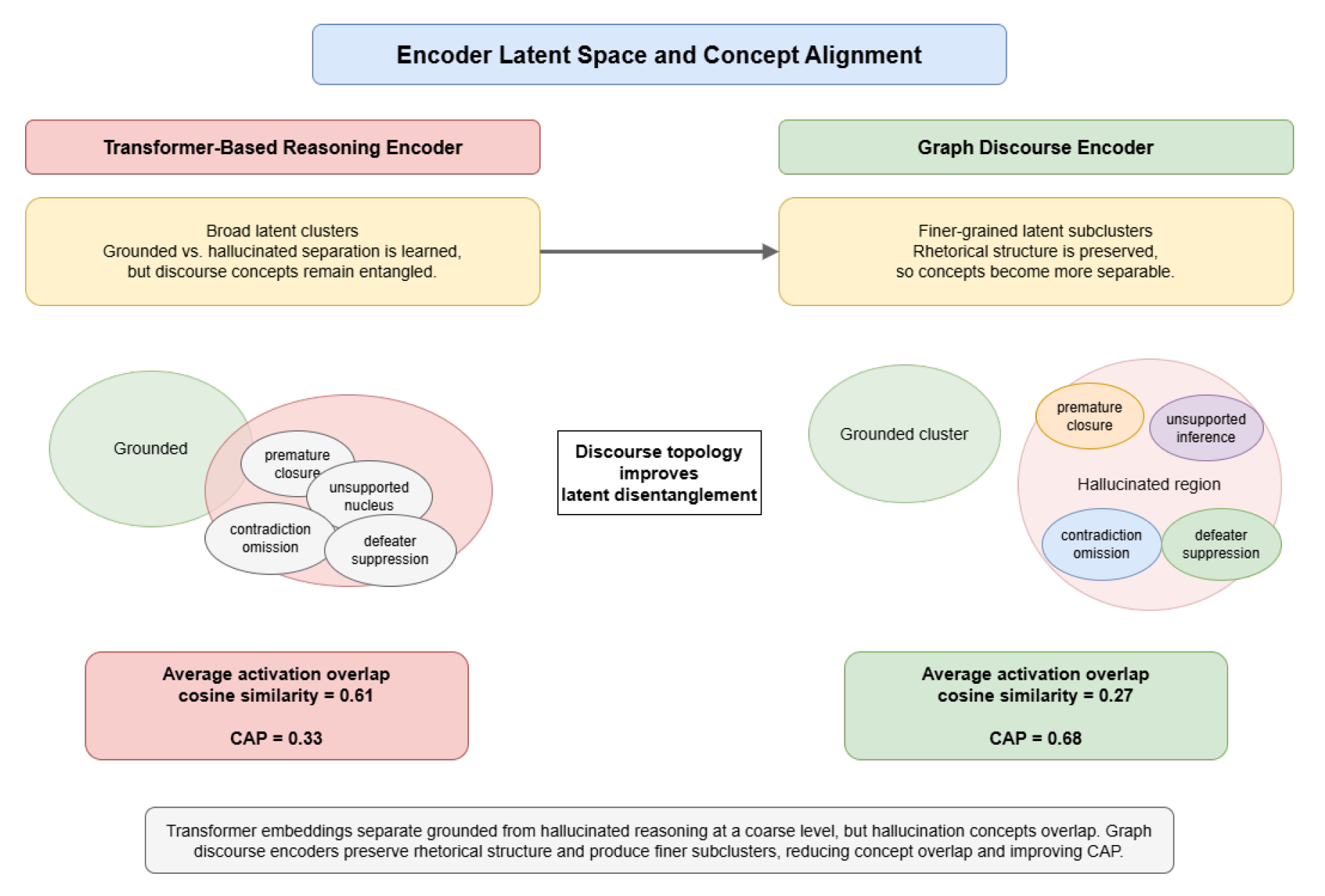
Table 2.
Comparison of discourse encoders.
| Encoder | Accuracy | CAP |
|---|---|---|
| Transformer Encoder | 1.00 | 0.33 |
| Graph Encoder | 1.00 | 0.68 |
Disclaimer/Publisher’s Note: The statements, opinions and data contained in all publications are solely those of the individual author(s) and contributor(s) and not of MDPI and/or the editor(s). MDPI and/or the editor(s) disclaim responsibility for any injury to people or property resulting from any ideas, methods, instructions or products referred to in the content. |
© 2026 by the authors. Licensee MDPI, Basel, Switzerland. This article is an open access article distributed under the terms and conditions of the Creative Commons Attribution (CC BY) license (http://creativecommons.org/licenses/by/4.0/).
Copyright: This open access article is published under a Creative Commons CC BY 4.0 license, which permit the free download, distribution, and reuse, provided that the author and preprint are cited in any reuse.