
Submitted:
28 June 2026
Posted:
30 June 2026
You are already at the latest version
Abstract
Physical education (PE) is commonly justified through its contributions to physical fitness, motor skill development, sport participation, and health-enhancing physical activity. These aims remain important, but they do not fully capture PE’s potential within the broader landscape of lifestyle behavior and neurobehavioral well-being. This narrative review examines PE as a curriculum-based lifestyle learning environment through which movement experiences may be linked with motivation, stress regulation, emotional regulation, resilience, sleep and recovery awareness, nutrition-related awareness, and lifestyle self-regulation in adolescents and young adults. Using a narrative review design with structured literature mapping, the review integrates evidence and concepts from PE pedagogy, physical literacy, health literacy, Self-Determination Theory, stress and emotion regulation, self-efficacy, resilience, self-regulated learning, sleep, recovery, nutrition-related education, and school and university health-promoting frameworks. The review argues that PE should not be understood only as a setting for activity delivery, fitness testing, or sport-skill instruction. Rather, PE may provide repeated educational opportunities for students to connect embodied movement experiences with everyday lifestyle regulation. The proposed framework does not claim that PE automatically improves mental health or directly produces neurobiological change. Instead, it positions PE as one distinctive educational context in which movement, reflection, social interaction, and health-related learning can be integrated to support neurobehavioral well-being. Future research should examine curriculum mechanisms, teaching strategies, transfer processes, implementation conditions, and measurement indicators for PE-based lifestyle learning.
Keywords:
curriculum-based health learning
; self-regulation
; stress coping
; recovery awareness
; nutrition-related education
; health psychology
1. Introduction
Physical education (PE) has long been justified through its contributions to physical fitness, motor skill development, sport participation, and the promotion of health-enhancing physical activity. These aims remain important. PE is one of the few formal educational settings in which most students can encounter structured movement learning, health-related knowledge, and repeated opportunities for embodied participation. International guidance on quality physical education similarly emphasizes that PE should contribute not only to movement competence, but also to inclusive learning, lifelong participation, health, and personal development [1]. Yet the current educational and health context makes a narrow fitness- or activity-delivery rationale increasingly insufficient. Adolescents and young adults now navigate a cluster of lifestyle-related pressures, including psychological stress, unstable motivation, sleep disruption, sedentary academic routines, social comparison, and uneven capacity for health-related self-regulation. These conditions suggest that PE should be reconsidered not only as a site for activity delivery, but also as a curriculum space in which students may learn to interpret bodily experience and connect movement with lifestyle regulation and well-being [1].
A substantial body of review evidence has already examined links between physical activity, sport, PE provision, and mental health outcomes in young people. Systematic reviews suggest that school-based PE, physical activity, and sport provision may be associated with well-being, self-esteem, self-efficacy, depression, anxiety, and life satisfaction; however, the strength of these findings remains uneven across study designs, populations, intervention characteristics, and outcome measures [2]. Broader reviews of physical activity in children and adolescents report generally favorable associations with mental health, but they also caution that study quality, heterogeneity, and causal interpretation remain persistent limitations [3,4]. In tertiary education settings, physical literacy and physical activity have also been associated with mental well-being, resilience, life satisfaction, and lower psychological distress [5]. This evidence base is valuable, but much of it remains organized around an outcome question: whether physical activity, PE, sport, or physical literacy is associated with psychological indicators. Less attention has been given to the more educationally specific question of how PE curriculum, pedagogy, and assessment may help students develop transferable forms of lifestyle self-regulation [2,3,5].
This distinction matters because lifestyle behaviors relevant to neurobehavioral well-being are not isolated exposures. Physical activity, sleep, diet, sedentary time, and recovery patterns interact within daily routines, particularly during adolescence and young adulthood, when students gradually assume greater responsibility for their own health behaviors. Recent review evidence on physical activity, diet, and sleep in adolescents reinforces the need to view these lifestyle domains as connected rather than separate educational concerns [6]. Movement behavior guidelines for children and youth also integrate physical activity, sedentary behavior, and sleep within a 24-hour framework, which reinforces the idea that student health depends on daily behavioral organization rather than on single-session activity exposure alone [7]. For PE, this creates a specific educational opportunity. PE lessons, curricula, and teaching strategies may provide embodied entry points through which students learn to connect movement, fatigue, recovery, sleep, energy, mood, motivation, and everyday decision-making [1,6,7].
To develop this broader argument, PE needs to be connected with behavioral science concepts rather than treated only as a form of exercise exposure. Motivation is a central starting point. Self-Determination Theory proposes that autonomy, competence, and relatedness are basic psychological needs that shape motivation, development, and well-being [8]. In physical activity contexts, autonomous motivation has been linked with more sustained engagement and behavioral persistence [9]. In PE specifically, evidence informed by Self-Determination Theory suggests that need-supportive teaching can shape student motivation, engagement, and adaptive outcomes [10]. These findings point to a curriculum issue that is sometimes overlooked: the same movement task may carry different neurobehavioral meanings depending on whether students experience choice, competence, social connection, mastery, pressure, exclusion, or repeated failure [8,9,10].
Stress and emotional regulation provide a second important pathway. Emotional regulation refers to the processes through which individuals influence which emotions they have, when they have them, and how these emotions are experienced and expressed [11]. Adolescents and young adults routinely encounter academic, social, and identity-related stressors. PE may intensify these pressures when it is competitive, exclusionary, or narrowly evaluative; alternatively, it may provide structured experiences of coping, mastery, cooperation, and body awareness. Similarly, self-efficacy theory emphasizes that beliefs about one’s capability influence effort, persistence, and behavioral change [12]. When PE is designed around progressive challenge, meaningful feedback, and inclusive success experiences, it may contribute to students’ confidence in regulating effort, movement participation, and related lifestyle behaviors. Resilience research further suggests that adaptive development often emerges from ordinary processes embedded in relationships, structured opportunities, competence-building, and supportive environments [13]. PE therefore has potential relevance not only as a physical activity setting, but also as a recurring educational context in which students may practice adaptive regulation through movement [11,12,13].
This perspective is also grounded in PE curriculum and pedagogy scholarship. Health-based PE models have argued that PE should move beyond narrow fitness testing or sport technique instruction toward forms of learning that help students understand and enact health in contextually meaningful ways [14]. Related conceptual work has challenged the assumption that health in PE is a fixed outcome to be delivered, arguing instead that students can learn health through situated, embodied, and reflective experiences [15]. From this viewpoint, PE becomes educationally significant when curriculum design, teaching climate, assessment, peer interaction, and reflective tasks are aligned with students’ developing capacity to interpret bodily experience and make health-related decisions [14,15]. This argument is consistent with broader health literacy frameworks, which define health literacy not as the passive receipt of information, but as the ability to access, understand, appraise, and use health information in everyday contexts [16]. Taken together, these perspectives support a reframing of PE as a curriculum-based context for movement, health learning, and behavioral self-regulation [1,14,15,16].
The present narrative review therefore shifts the focus from the broad question, “Does PE or physical activity improve student mental health?” to a more curriculum-oriented and lifestyle behavior science question: “How can PE be reframed as a lifestyle learning environment for neurobehavioral well-being in adolescents and young adults?” We argue that PE should not be understood only as a school or university setting for fitness development, sport-skill instruction, or physical activity accumulation. It can also be conceptualized as a structured learning environment in which students connect movement experiences with motivation, stress regulation, emotional regulation, resilience, sleep and recovery awareness, nutrition-related awareness, self-efficacy, and self-regulation [8,11,12,13]. By integrating movement, sleep/recovery awareness, nutrition-related awareness, motivation, stress and emotion regulation, resilience, and lifestyle self-regulation, this review develops a conceptual framework for PE-based lifestyle learning and identifies curriculum, teaching, and research implications for supporting neurobehavioral well-being in adolescents and young adults.
2. Narrative Review with Structured Literature Mapping
This article was designed as a narrative review with structured literature mapping and conceptual framework development. The review was not intended to estimate pooled effects, evaluate intervention efficacy, or provide an exhaustive systematic review of all studies on physical education, physical activity, or student mental health. Its purpose was more specific: to bring together conceptually relevant bodies of literature and use them to develop an integrative framework for understanding physical education as a lifestyle learning environment for neurobehavioral well-being in adolescents and young adults. Narrative reviews are appropriate when the aim is to integrate diverse theoretical and empirical literatures, clarify conceptual relationships, and develop arguments that cannot be reduced to a single intervention question or effect-size estimate [17,18]. To strengthen transparency, the review also followed a structured mapping logic, recognizing that different review types vary in their methodological aims, evidence coverage, and synthesis strategies [19,20].
The literature mapping was organized around eight interrelated domains. These included physical education curriculum and pedagogy; physical education, physical activity, sport, and student mental health; physical literacy, health literacy, and mental health literacy; motivation and Self-Determination Theory in physical education and physical activity contexts; stress regulation, emotional regulation, resilience, self-efficacy, and self-regulation; sleep, recovery, and nutrition-related awareness in adolescents and young adults; school- and university-based health and wellness frameworks; and review methodology for narrative and conceptual synthesis. These domains were not selected as separate topic silos. Rather, they were chosen because each contributes to the central argument of the review: physical education should be considered not only as activity delivery or sport-skill instruction, but also as a structured educational setting in which students may learn lifestyle self-regulation capacities relevant to neurobehavioral well-being.
Relevant literature was identified through iterative searches of PubMed, Scopus, Web of Science, SPORTDiscus, ERIC, and publisher databases. Search terms were combined across the following concepts: “physical education,” “physical education curriculum,” “physical education teaching,” “physical education pedagogy,” “physical literacy,” “health literacy,” “mental health literacy,” “student well-being,” “adolescents,” “young adults,” “university students,” “motivation,” “Self-Determination Theory,” “stress regulation,” “emotion regulation,” “resilience,” “self-efficacy,” “self-regulation,” “sleep,” “recovery,” “nutrition education,” “lifestyle,” and “health promotion.” Priority was given to peer-reviewed systematic reviews, scoping reviews, meta-analyses, umbrella reviews, conceptual articles, theory papers, measurement validation studies, and high-relevance empirical studies. Official guidelines and standards were also included when they provided authoritative support for physical education, movement behavior, physical literacy, or educational health frameworks. The final literature search and reference verification were completed on 20 June 2026.
Because this article was designed as a narrative review with structured literature mapping rather than a systematic review or scoping review, no PRISMA flow diagram, risk-of-bias assessment, or protocol registration was undertaken. The selection process was guided by conceptual relevance to the review question rather than by formal inclusion and exclusion criteria typical of systematic reviews. Literature was retained when it helped serve one or more of four manuscript functions: defining the existing review landscape, identifying remaining knowledge gaps, supporting the neurobehavioral pathways proposed in the review, or informing the conceptual framework and curriculum implications. Studies or reviews focused primarily on clinical exercise therapy, elite athletic performance, older adult cognitive decline, or specialized nutrition and sleep medicine were not prioritized unless they directly informed the educational framing of physical education. This boundary was important because the review aimed to examine PE as a curriculum-based learning environment, not to summarize all evidence on exercise, nutrition, sleep, or mental health.
During synthesis, the included literature was read comparatively across domains rather than treated as a single homogeneous evidence base. Particular attention was given to where different literatures converged, where they used different terminology for related constructs, and where outcome-oriented evidence did not yet explain the curricular or pedagogical mechanisms through which PE might support lifestyle self-regulation. Caution was used throughout to avoid overclaiming causal or neurological effects. The resulting framework was developed by integrating evidence and concepts across curriculum, pedagogy, motivation, stress and emotion regulation, lifestyle learning, and student well-being literatures.
3. Existing Review Landscape and Knowledge Gap
A central challenge for this narrative review is that the relationship between physical activity, PE, sport, and student mental health is already well represented in the review literature. This is not a weakness of the field. Rather, it requires the present review to be positioned carefully so that it does not simply restate an already established outcome-oriented literature. Reviews have examined typical school provision of PE, physical activity, and sport in relation to adolescent mental health and well-being, including outcomes such as depression, anxiety, self-esteem, self-efficacy, life satisfaction, and general well-being [2]. Earlier review work also summarized the broader educational, social, physical, and affective benefits of PE and school sport, indicating that PE has long been discussed as more than a setting for physical performance alone [21]. Broader reviews and meta-analyses have evaluated associations of physical activity and sedentary behavior with mental health outcomes among children and adolescents, while other reviews have examined physical activity in relation to wider health indicators among school-aged youth [3,4,22,23]. In tertiary education, the relationship between perceived physical literacy and mental health has also been synthesized, with evidence linking physical literacy to well-being, resilience, life satisfaction, and lower psychological distress [5]. These reviews provide an important foundation, but their main emphasis is generally on whether participation, exposure, or literacy-related constructs are associated with psychological or health outcomes.
This outcome-oriented emphasis leaves a different question underdeveloped. If PE is viewed primarily as activity exposure, the central concern becomes whether students move enough or whether participation predicts psychological benefits. If PE is viewed as curriculum and teaching, however, the question changes. The key issue becomes how PE creates learning conditions through which students interpret movement experiences, develop motivation, manage stress, regulate emotions, understand recovery, and transfer health-related learning into everyday life. Existing PE pedagogy scholarship has already argued that PE can move beyond narrow fitness testing, sport technique, and activity delivery toward health-based and meaningful learning experiences [14,15]. Lifestyle-oriented and meaningful PE perspectives similarly suggest that students’ movement experiences should be connected with personal relevance, enjoyment, identity, and lifelong participation rather than treated only as short-term activity promotion [24]. Recent review work on pedagogical models in PE further shows that curriculum design, teaching models, and learning processes are central to how PE is experienced and what students learn [25]. Literature on meaningful experiences in PE and youth sport also highlights that student engagement is shaped by factors such as enjoyment, challenge, social interaction, motor competence, personal relevance, and delight [26]. These perspectives support the present review’s shift from PE as activity provision to PE as a lifestyle learning environment.
A second adjacent body of literature concerns physical literacy, health literacy, and mental health literacy. Physical literacy has become a major concept in PE and physical activity research because it emphasizes motivation, confidence, physical competence, knowledge, and understanding for lifelong participation [27]. Conceptual models have linked physical literacy with physical activity and health, while measurement reviews have shown that physical literacy is multidimensional and difficult to reduce to a single behavioral indicator [28,29]. Earlier conceptual work on observed physical literacy also supports the idea that physical literacy should be understood through multiple interacting attributes rather than treated as simple movement proficiency [30]. Health literacy frameworks are also relevant because they emphasize that health-related learning involves the capacity to access, understand, appraise, and apply information in everyday contexts [16,31]. These literatures are highly relevant to PE, but they do not fully capture the specific integration proposed in this review. In particular, physical literacy and health literacy do not by themselves explain how PE might connect movement experiences with stress regulation, emotional regulation, recovery awareness, sleep, nutrition-related awareness, and broader neurobehavioral well-being.
A third relevant review domain involves motivation and need-supportive teaching. Self-Determination Theory has been widely applied in physical activity and PE research, and reviews indicate that autonomous motivation and need-supportive environments are associated with more adaptive engagement and behavior [8,9,10]. This literature is essential for understanding PE as a learning environment, but it is often discussed as a motivation framework rather than as part of a broader lifestyle self-regulation model. In the present review, motivation is not treated as a stand-alone outcome. Instead, it is positioned as one pathway through which PE teaching climates may influence students’ capacity to internalize movement, health, and lifestyle-related values.
A fourth relevant domain concerns diet, sleep, recovery, and daily lifestyle organization. Recent scoping review evidence has examined relationships among physical activity, diet, and sleep in adolescents, and 24-hour movement guidelines further suggest that physical activity, sedentary behavior, and sleep should be understood together rather than separately [6,7]. Review evidence on sleep timing and health indicators in children and adolescents also supports the need to consider sleep and daily routines as part of youth health rather than as separate lifestyle concerns [32]. However, these lifestyle literatures are usually not framed through PE curriculum and teaching. The question is therefore not whether PE should become a specialized nutrition or sleep education program. Rather, the issue is whether PE can provide embodied learning opportunities through which students begin to understand how movement, fatigue, recovery, energy, mood, and daily routines are connected.
Taken together, existing reviews offer strong but fragmented foundations. They show that PE, physical activity, sport, physical literacy, motivation, sleep, diet, and mental health have all been studied in relation to young people’s well-being. What remains less developed is an integrative account of how PE curriculum and pedagogy may connect these domains as part of lifestyle learning. This gap is the focus of the present review: to examine how PE can be reframed as a lifestyle learning environment for neurobehavioral well-being in adolescents and young adults. Table 1 summarizes the main review domains, their contributions, remaining gaps, and how the present review is positioned.
This mapping indicates that the present review should not duplicate existing review questions. Its contribution is not to re-evaluate whether PE or physical activity improves mental health. Rather, it asks how PE can be conceptualized as a curriculum-based environment in which movement experiences, motivational climate, stress regulation, emotional regulation, recovery awareness, nutrition-related awareness, and self-regulation are integrated to support neurobehavioral well-being. This reframing is especially relevant for adolescents and young adults because these groups are developing greater autonomy over daily routines, health decisions, academic demands, social relationships, and identity-related pressures. The next section therefore develops the conceptual foundation for understanding PE as a lifestyle learning environment.
4. Physical Education as a Lifestyle Learning Environment
Reframing physical education as a lifestyle learning environment requires a shift in how PE is understood. In many educational and public health discussions, PE is valued because it offers structured opportunities for movement, contributes to physical activity accumulation, and supports motor skill development. These aims remain legitimate, but they do not fully capture the educational potential of PE. Quality PE is expected to support learning, inclusion, lifelong participation, health, and personal development, rather than only immediate activity time [1]. Professional standards similarly emphasize that students should develop competence, confidence, knowledge, responsible participation, and the capacity to value physical activity across life contexts [33]. From this perspective, PE should not be reduced to a scheduled period in which students are made physically active. It is better understood as a structured educational setting in which students learn how bodily experience, motivation, health knowledge, social interaction, and daily routines are connected.
This distinction between activity delivery and lifestyle learning is central to the present review. Activity delivery focuses mainly on what students do during class: whether they move, how intensely they move, and whether activity-related recommendations are met. Lifestyle learning asks a different question: what students come to understand, value, regulate, and transfer from PE into everyday life. Earlier public health arguments for PE emphasized its contribution to population-level physical activity and health promotion [34]. Health-based PE scholarship, however, has argued that PE should move beyond narrow fitness testing and sport technique toward pedagogies that help students understand and enact health in personally meaningful ways [14,35]. Quennerstedt’s argument that students can learn health through PE further supports this view, because health is not treated as a fixed outcome delivered by teachers, but as something learned through embodied, social, and reflective experiences [15].
A lifestyle learning environment also depends on curriculum design. Pedagogical models in PE provide different ways of organizing learning tasks, student roles, assessment, responsibility, and teacher–student interaction [25]. This matters because PE does not become educationally meaningful simply because students are active. Students may participate in PE while feeling excluded, anxious, bored, over-evaluated, or disconnected from their daily lives. Conversely, PE can become meaningful when students experience challenge, enjoyment, social connection, motor competence, personal relevance, and opportunities for reflection [26]. Lifestyle-oriented PE perspectives similarly emphasize that activities should be experienced as personally meaningful and connected with forms of participation that students may sustain beyond formal schooling [24]. These features are important because lifestyle behavior is rarely sustained by information or external instruction alone. It is shaped by whether students experience movement as worthwhile, manageable, socially supported, and connected with their own identities and routines.
Physical literacy provides one foundation for this broader view of PE. Consensus definitions describe physical literacy as involving motivation, confidence, physical competence, knowledge, and understanding that support engagement in physical activity across the life course [27]. Conceptual models similarly link physical literacy with health, physical activity, and broader developmental outcomes [28]. Additional international physical literacy statements reinforce that physical literacy should be understood as a lifelong and person-centered capability rather than as a narrow measure of fitness or motor proficiency [36]. However, the present review does not treat physical literacy as the whole framework. Rather, physical literacy is one component of a wider lifestyle learning environment. A student may develop movement competence and confidence, yet still struggle to regulate stress, sleep, recovery, energy, emotion, or motivation across daily contexts. Measurement reviews also show that physical literacy is multidimensional and difficult to capture through simple indicators [29]. This reinforces the need to position PE within a broader learning model that includes, but extends beyond, physical competence and activity participation.
Health literacy offers another conceptual bridge. Health literacy has been defined as the ability to access, understand, appraise, and apply health-related information in daily life [16,31]. Applied to PE, this means that students should not only receive messages about being active or healthy. They should also learn how to interpret bodily cues, evaluate health information, make decisions about movement and recovery, and connect classroom experiences with daily routines. For example, an aerobic activity lesson can become a lifestyle learning experience when students are guided to notice effort, breathing, fatigue, mood, hydration, sleep, and recovery. A fitness unit can become more than performance testing when it helps students set realistic goals, monitor progress, reflect on barriers, and understand how activity choices fit into daily stress and energy management. In this sense, PE can serve as an embodied context for health literacy, not merely as a delivery channel for health information.
The concept of a lifestyle learning environment also requires attention to student agency. Adolescents and young adults are developing greater responsibility for their own routines, including physical activity, sedentary behavior, sleep, nutrition-related choices, social relationships, and academic demands. PE can support this transition when teaching practices encourage autonomy, competence, reflection, and responsibility. Self-Determination Theory suggests that learning environments supporting autonomy, competence, and relatedness are more likely to foster internalized motivation and adaptive engagement [8]. Self-efficacy theory similarly suggests that students’ beliefs about their capability influence effort, persistence, and behavior change [12]. Therefore, PE curriculum should not only ask whether students complete activities, but also whether they learn to make sense of their capabilities, regulate effort, and apply movement-related knowledge outside class.
This reframing is also relevant beyond school PE. In higher education, students often face irregular schedules, sedentary study demands, academic stress, reduced structured activity, and increasing responsibility for health behaviors. Whole-system approaches to healthy universities emphasize that higher education settings can shape health, learning, and well-being through coordinated environments, policies, curricula, and student support [37]. PE or wellness-oriented university courses should therefore not be treated only as optional activity classes. They may also serve as structured settings in which young adults reflect on movement, stress, recovery, and lifestyle self-management. This extension must remain bounded. PE should not replace clinical care, nutrition counseling, or sleep medicine. Rather, it can provide developmentally appropriate learning opportunities that connect movement experience with self-knowledge and practical regulation.
This understanding changes the educational question. The question is not only whether PE increases activity minutes or improves fitness scores, but whether it helps students develop transferable capacities for lifestyle self-regulation. These capacities include interpreting bodily signals, setting realistic movement goals, coping with stress, regulating emotions, understanding recovery, recognizing the role of sleep and nutrition-related behaviors, and sustaining motivation. In this sense, PE may contribute to neurobehavioral well-being by organizing repeated, embodied, and socially supported opportunities for students to practice regulation through movement. This does not imply that PE alone can solve students’ mental health or lifestyle challenges. Rather, it suggests that PE occupies a distinctive educational position: it can connect physical experience, health learning, motivation, and self-regulation in ways that few other school or university subjects can. This conceptual logic is summarized in Figure 1, which integrates PE curriculum and pedagogy, physical literacy and health literacy, motivational processes, emotional regulation, self-efficacy, resilience, and lifestyle-related awareness into a curriculum-based framework [1,8,11,12,13,14,15,16,24,25,26,27,28,29,30,31,32,33,34,35,36,37].
For the purposes of this review, PE as a lifestyle learning environment refers to a curriculum-based context in which movement experiences, teaching climate, peer interaction, reflection, and health-related learning are intentionally aligned to support students’ lifestyle self-regulation and neurobehavioral well-being. This definition provides the conceptual foundation for the next section, which examines the neurobehavioral pathways through which PE may support motivation, stress regulation, emotional regulation, resilience, self-efficacy, and self-regulation.
5. Neurobehavioral Pathways: Motivation, Stress Regulation, Emotional Regulation, and Resilience
If PE is reframed as a lifestyle learning environment, its contribution to student well-being cannot be explained only by the amount of physical activity performed during class. A more adequate account requires attention to the pathways through which students experience movement, interpret bodily states, interact with peers and teachers, regulate emotions, and connect PE learning with daily life. In this review, the term “neurobehavioral pathways” is used cautiously. It does not imply that ordinary PE lessons directly produce clinical neurological change. Rather, it refers to educational and behavioral processes that link movement experiences with motivation, stress appraisal, emotional regulation, resilience, self-efficacy, and self-regulation. These processes are central to how adolescents and young adults learn to manage effort, challenge, fatigue, social comparison, and health-related decisions.
Motivation is the first pathway because students’ experiences in PE can shape whether movement is perceived as meaningful, threatening, imposed, enjoyable, or personally relevant. Self-Determination Theory proposes that autonomy, competence, and relatedness are basic psychological needs that support motivation, development, and well-being [8]. The theory also explains why the internalization of goals and values matters for sustained behavior, rather than short-term compliance alone [38]. In physical activity research, autonomous forms of motivation have been associated with more sustained engagement and behavioral persistence [9]. In PE, reviews grounded in Self-Determination Theory indicate that need-supportive teaching is associated with adaptive motivational and learning outcomes [10]. This matters because PE can either support or undermine students’ relationship with movement. A teacher-centered, comparison-heavy, or performance-only climate may intensify pressure and disengagement for some students. By contrast, autonomy-supportive instruction, optimal challenge, inclusive feedback, and peer connection may help students internalize movement as part of a personally meaningful lifestyle [8,9,10,38].
Motivation should therefore be understood not simply as enthusiasm during class, but as one pathway toward lifestyle self-regulation. Adolescents and young adults are gradually assuming greater responsibility for organizing activity, sleep, study, social life, and recovery. Future-oriented motivation and self-regulation perspectives suggest that students’ present actions are shaped by how they connect current effort with future goals, possible selves, and personally valued outcomes [39]. PE can contribute to this developmental transition when students are given opportunities to make choices, set realistic goals, monitor progress, reflect on barriers, and experience competence without excessive public comparison. This is consistent with the broader argument that PE is not only about movement exposure, but also about the development of transferable capacities. Meaningful PE experiences, such as challenge, enjoyment, social interaction, personal relevance, and perceived competence, may strengthen the connection between classroom activity and later lifestyle engagement [26]. Conversely, negative PE experiences may teach students to avoid movement, distrust their bodies, or associate physical activity with embarrassment. Thus, motivational climate is not a peripheral teaching issue; it is one of the central pathways through which PE may influence students’ later relationship with movement and well-being.
A second pathway involves stress regulation. Stress is not only a physiological response, but also a process of appraisal and coping. Classic stress and coping theory emphasizes that individuals evaluate demands, resources, and possible responses in stressful encounters [40]. PE can become a setting in which students repeatedly encounter manageable forms of challenge, including physical effort, unfamiliar skills, competition, cooperation, feedback, and social visibility. These experiences can be appraised either as threat or as challenge, depending on the teaching climate, peer context, and perceived competence. When PE is organized around progressive mastery, safety, and reflection, students may learn that effort, discomfort, and temporary failure can be interpreted and managed. When it is organized around humiliation, rigid comparison, or exclusion, the same activities may become stress-amplifying. This distinction is important because reviews of physical activity and mental health show promising but heterogeneous evidence, suggesting that the context and meaning of activity may matter as much as activity exposure itself [2,3,4,22].
Movement experiences can also interact with stress outside the PE classroom. A review of stress and physical activity indicates that stress can reduce physical activity participation, while physical activity may also influence stress-related processes [41]. For students, this relationship is educationally important. If PE teaches only compliance with activity tasks, its transfer into daily life may be limited. If PE helps students recognize how movement, breathing, fatigue, attention, and mood are related, it can become an embodied context for learning coping strategies. This does not require PE teachers to become mental health clinicians. It requires PE pedagogy to create structured opportunities for students to notice bodily signals, reflect on effort, and connect movement experiences with everyday stress management.
A third pathway involves emotional regulation. Emotion regulation refers to the processes through which individuals influence the emotions they have, when they have them, and how these emotions are experienced and expressed [11]. PE is emotionally charged because it involves public performance, bodily exposure, peer comparison, success, failure, competition, cooperation, and feedback. These conditions may trigger anxiety, pride, shame, frustration, enjoyment, or belonging. Research on individual differences in emotion regulation also shows that strategies such as cognitive reappraisal and expressive suppression are associated with different affective and social outcomes [42]. PE can therefore be understood as a setting in which students learn, implicitly or explicitly, how to respond to emotional experiences associated with bodily challenge and social evaluation.
Exercise-related evidence also suggests possible links between movement and emotion regulation. Experimental and observational work has examined whether aerobic exercise may help individuals cope with emotion regulation difficulties or buffer the relationship between stress and emotional well-being [43,44]. Such findings should not be generalized uncritically to all PE contexts. They do, however, support the plausibility of connecting movement experience with emotional regulation processes. In PE, the educational question is not whether a single lesson changes emotion regulation as a clinical trait. Rather, the question is whether repeated, reflective, and socially supported movement experiences can help students practice adaptive responses to discomfort, frustration, excitement, social comparison, and achievement. This perspective fits the broader thesis of PE as lifestyle learning: students are not only learning sports or exercises; they are also learning how to regulate themselves in embodied and social situations.
A fourth pathway concerns self-efficacy and resilience. Self-efficacy theory emphasizes that beliefs about one’s capability influence effort, persistence, and adaptation [12]. PE can shape self-efficacy through mastery experiences, feedback, modeling, and the interpretation of bodily states. Students who repeatedly experience movement as failure or public judgment may develop low confidence and avoidance. Students who experience achievable challenge, visible progress, and supportive feedback may develop greater confidence in their ability to engage with movement and manage effort. This self-efficacy pathway is especially relevant for students who do not identify as athletic, who have prior negative PE experiences, or who experience anxiety in performance-oriented settings. Evidence linking physical fitness, resilience, and self-efficacy further supports the plausibility of considering self-efficacy as a mediating resource in the relationship between physical capacities and stress resilience [45].
Resilience adds another developmental layer. Resilience is not simply an individual trait; it involves adaptive processes that occur through relationships, competence-building, supportive environments, and opportunities to respond constructively to challenge [13,46]. PE can contribute to such processes when it provides structured experiences of effort, persistence, cooperation, role responsibility, and recovery after mistakes. Models such as Teaching Personal and Social Responsibility have been used in PE to promote responsibility, respect, effort, self-direction, and transfer beyond the gym [47]. Systematic review and meta-analytic evidence suggests that responsibility-based PE programs may support emotional and social outcomes, although effects depend on implementation quality and context [48]. These approaches are relevant to the present review because they show how PE can be intentionally designed to connect movement with social-emotional learning and life skills.
Finally, these pathways converge in self-regulation. Self-regulated learning involves setting goals, monitoring progress, adapting strategies, and reflecting on outcomes [49]. In PE, self-regulation may include pacing effort, managing frustration, choosing appropriate activity goals, responding to feedback, recognizing fatigue, planning recovery, and transferring movement-related learning into daily routines. Broader behavior change frameworks also suggest that sustained behavior depends on interacting processes such as capability, opportunity, motivation, intention, planning, self-efficacy, and action control [50,51,52]. These frameworks should not be imported into PE mechanically, but they help clarify why participation alone is not enough. A lifestyle learning environment should cultivate not only physical competence, but also students’ ability to make informed and adaptive decisions about their bodies and behaviors.
This convergence also raises the issue of transfer. Life skills research in youth sport and physical activity contexts indicates that skills such as goal setting, self-direction, responsibility, emotional control, and social cooperation do not automatically transfer to other settings unless transfer is made explicit, practiced, and reflected upon [53]. Motivation, stress regulation, emotional regulation, resilience, self-efficacy, and self-regulation should therefore not be treated as separate outcomes. They are interrelated processes through which PE may support neurobehavioral well-being when curriculum design intentionally connects movement experiences with everyday life.
Taken together, these pathways suggest that PE may contribute to student well-being when movement experiences are organized as meaningful, autonomy-supportive, emotionally safe, progressively challenging, and reflective. The strongest defensible claim from the current literature is not that PE automatically improves mental health, nor that ordinary PE lessons directly produce neurobiological change. Rather, PE may provide repeated educational opportunities for adolescents and young adults to practice embodied forms of motivation, coping, emotional regulation, resilience, self-efficacy, and self-regulation. This interpretation prepares the ground for the next section, which considers how sleep, recovery, and nutrition-related awareness can be incorporated as supportive lifestyle modules without displacing PE’s central educational purpose.
Table 2 translates these pathways into curriculum components, teaching strategies, lifestyle learning processes, neurobehavioral targets, possible indicators, and supporting literature. The table draws on prior work on quality PE, health-based PE pedagogy, physical literacy, health literacy, motivation, stress and emotion regulation, resilience, self-efficacy, self-regulated learning, behavior change, and responsibility-based PE [1,8,9,10,11,12,13,14,15,16,24,25,26,27,28,29,30,31,33,34,35,36,37,38,39,40,41,42,43,44,45,46,47,48,49,50,51,52,53].
6. Sleep, Recovery, and Nutrition-Related Awareness as Supportive Lifestyle Modules
The previous section argued that PE may support neurobehavioral well-being through motivational, emotional, stress-regulatory, resilience-related, self-efficacy, and self-regulatory pathways. These pathways, however, do not operate in isolation from students’ daily routines. Motivation, emotional regulation, stress appraisal, and engagement with movement are also shaped by sleep, recovery, sedentary behavior, hydration, and nutrition-related choices. For this reason, a lifestyle learning environment in PE should include sleep, recovery, and nutrition-related awareness as supportive modules. These modules should not displace PE’s central focus on movement, learning, and pedagogy. Rather, they can help students understand why movement experiences are connected with energy, fatigue, mood, attention, effort, recovery, and everyday decision-making.
Sleep is particularly relevant for adolescents and young adults because it is closely linked with learning, emotion, behavior, and daily functioning. Movement behavior guidelines already conceptualize physical activity, sedentary behavior, and sleep as interdependent components of youth health rather than as separate behavioral categories [7]. Review evidence also indicates that sleep duration is associated with multiple health indicators in school-aged children and youth, including emotional and behavioral outcomes [54]. Consensus recommendations on sleep duration further reinforce that adolescents and young adults have developmentally specific sleep needs, even though many students experience irregular sleep patterns, academic demands, evening screen use, and social routines that interfere with adequate recovery [55]. Evidence on sleep timing also suggests that sleep should be understood not only in terms of duration, but also in relation to daily scheduling and health indicators among children and adolescents [32]. School start time research further illustrates how sleep, learning, and adolescent functioning are shaped by educational environments and daily routines [56]. For PE, these findings do not mean that teachers should provide clinical sleep counseling. Instead, they suggest that PE can help students connect sleep with bodily readiness, perceived exertion, attention, mood, injury-prevention awareness, motivation, and recovery after effort.
Recovery awareness provides a practical bridge between movement and lifestyle learning. In many PE settings, recovery is treated as something that occurs after class or outside the curriculum. Yet students regularly experience fatigue, soreness, breathlessness, frustration, or changes in mood during and after movement tasks. These experiences can become learning opportunities when teachers help students interpret them constructively. For example, cool-down activities, reflection prompts, perceived exertion scales, recovery logs, or brief discussions of sleep and rest can help students recognize that adaptation is not only a matter of effort, but also of regulation. This is consistent with self-regulated learning theory, which emphasizes goal setting, monitoring, strategy adjustment, and reflection [49]. It also aligns with self-efficacy theory, because students who understand how to manage effort and recovery may become more confident in their ability to participate in physical activity without feeling overwhelmed or discouraged [12].
Nutrition-related awareness should be handled with similar caution. The present review does not argue that PE should become a specialized nutrition education course. Rather, PE can provide embodied contexts in which students learn how energy, hydration, meal timing, fatigue, concentration, and recovery relate to movement experiences. Recent scoping review evidence suggests that physical activity and diet are both associated with sleep quality and duration in adolescents, supporting the idea that these lifestyle behaviors should be considered together [6]. School-based food and nutrition education interventions have also been reviewed in relation to adolescent food consumption, indicating that educational settings can influence nutrition-related knowledge and behaviors, although effects vary across program design and implementation [57]. An umbrella review of school-based healthy eating interventions similarly suggests that adolescent nutrition behaviors are shaped by school context, program components, and broader health-promoting environments [58]. Additional review evidence on school-based healthy eating interventions indicates that nutrition-related outcomes depend on intervention content, implementation quality, and the extent to which educational messages are connected with students’ lived contexts [59]. School-based interventions that combine nutrition and physical activity components also reinforce the educational relevance of addressing movement and nutrition-related behaviors together, although such evidence should be translated cautiously into PE curriculum contexts [60]. For PE, the implication is not that every lesson should include nutrition content, but that selected PE units can integrate nutrition-related awareness when it directly supports movement, recovery, and self-regulation.
These lifestyle modules are most useful when they are embedded in PE learning rather than added as disconnected health messages. A fitness lesson, for example, can ask students to compare how sleep, hydration, or meal timing may influence perceived exertion and concentration. A games-based unit can include reflection on fatigue, recovery between efforts, and emotional responses to competition. A personal fitness or wellness unit can help students set activity goals while also considering sleep routines, recovery needs, and realistic nutrition-related decisions. In each case, the learning target is not expert knowledge of physiology, dietetics, or sleep medicine. The target is lifestyle awareness: the ability to notice, interpret, and apply everyday information about the body in ways that support well-being.
This approach also helps avoid a common limitation in health education: presenting lifestyle behaviors as abstract recommendations detached from students’ lived experiences. Health literacy frameworks emphasize the ability to access, understand, appraise, and use health information in daily contexts [16,31]. PE is well positioned to make such information experiential. Students can feel the effects of effort, notice changes in mood and attention, experience the consequences of poor preparation, and reflect on how daily routines shape movement quality. When combined with autonomy-supportive teaching, these experiences may support more internalized motivation and more realistic self-regulation [8,9,10,38]. When combined with emotionally safe and meaningful pedagogy, they may also reduce the risk that lifestyle messages become moralizing, body-shaming, or overly performance-oriented [14,15,24,25,26].
Nevertheless, the inclusion of sleep, recovery, and nutrition-related awareness must remain developmentally appropriate and educationally bounded. PE teachers should not be expected to diagnose sleep problems, prescribe diets, or manage clinical mental health conditions. Instead, PE can help students develop foundational awareness of how lifestyle behaviors interact with movement and well-being. For adolescents, this may involve learning how sleep, screen time, meals, hydration, and activity influence school-day energy and mood. For young adults, particularly those in university settings, PE or wellness-oriented courses may also support reflection on stress, irregular routines, sedentary study patterns, and independent lifestyle decisions. In both groups, the value of PE lies in connecting movement experience with self-knowledge and practical regulation. This transition from participation during PE to transferable lifestyle self-regulation is summarized in Figure 2, which integrates movement behavior, motivation, health literacy, recovery awareness, nutrition-related awareness, and self-regulated learning processes [6,7,8,9,10,12,16,31,38,49,54,55,56,57,58,59,60].
Thus, sleep, recovery, and nutrition-related awareness should be viewed as supportive lifestyle modules within PE, not as competing curriculum domains. They strengthen the broader argument that PE can contribute to neurobehavioral well-being when it helps students connect bodily experience, motivation, emotion, stress, recovery, and daily routines. This prepares the foundation for the next section, which integrates these elements into curriculum implications and future research directions.
7. Curriculum Implications and Future Research
The preceding sections developed the argument that PE can be reframed as a lifestyle learning environment when curriculum design, teaching climate, movement experiences, reflection, and health-related learning are intentionally connected. This reframing does not require PE to abandon its established goals of movement competence, physical activity participation, motor skill development, or fitness. Rather, it expands the educational meaning of these goals. PE may support neurobehavioral well-being when students are helped to understand how movement relates to motivation, stress regulation, emotional regulation, resilience, self-efficacy, sleep, recovery, nutrition-related awareness, and self-regulation [8,11,12,13,14,15,16].
The first curriculum implication is that PE should not be evaluated only by whether students are active during class. Activity time, fitness performance, and sport-skill development remain important, but they are incomplete indicators of PE’s educational value. If PE is understood as a lifestyle learning environment, curriculum design should also ask whether students are learning to interpret bodily signals, regulate effort, manage emotions, cope with challenge, understand recovery, and connect movement with daily routines. This means that PE should include not only movement tasks, but also structured opportunities for reflection, goal setting, feedback, social interaction, and developmentally appropriate lifestyle awareness.
Teachers can support lifestyle learning by designing tasks that combine movement with choice, feedback, reflection, and personal relevance. Autonomy-supportive strategies may include offering meaningful choices, explaining the purpose of learning tasks, acknowledging student difficulties, and reducing unnecessary public comparison [8,9,10,38]. Competence-supportive strategies may include progressive challenge, differentiated tasks, mastery-oriented feedback, and opportunities for students to track progress without reducing self-worth to performance scores. Relatedness-supportive strategies may include cooperative learning, peer encouragement, inclusive grouping, and emotionally safe classroom climates. These strategies should not be treated merely as motivational techniques. They shape whether PE is experienced as pressure, exclusion, compliance, or meaningful lifestyle learning.
Future research should test and refine this framework rather than simply add more studies on whether PE is associated with mental health. A first priority is to examine PE curriculum mechanisms. Studies should identify which design inputs, such as autonomy-supportive teaching, reflective tasks, responsibility-based models, inclusive assessment, or recovery-focused learning, are associated with motivation, stress regulation, emotional regulation, resilience, self-efficacy, and self-regulation. Pedagogical model reviews and responsibility-based PE research suggest that curriculum structure and implementation quality matter [25,47,48]. Implementation research in school-based physical activity interventions also indicates that scalability, adoption, fidelity, reach, and maintenance should be considered when moving from promising designs to real educational systems [61]. Future PE research should therefore include not only outcome evaluation, but also process evaluation that examines how curriculum design is enacted and experienced.
A second priority is transfer beyond PE. Life skills research indicates that skills learned in sport or physical activity settings do not automatically transfer to other life contexts unless transfer is explicitly discussed, practiced, and reflected upon [53]. Positive youth development research in sport similarly suggests that social, emotional, and behavioral outcomes depend on program structure, relational climate, and intentional learning processes rather than participation alone [62]. This is highly relevant to PE as a lifestyle learning environment. If students are expected to use PE learning to regulate stress, recovery, motivation, or lifestyle behaviors outside class, curriculum must make transfer visible. Teachers can ask students to connect class experiences with study routines, sleep, commuting, recreation, social stress, and personal goals. Such practices should be studied through longitudinal and mixed-method designs, because short-term outcome measures may miss whether students actually apply lifestyle learning in daily life.
A third priority is measurement. If PE is reframed as a lifestyle learning environment, researchers need indicators that go beyond activity minutes and fitness outcomes. Measures of mental well-being, perceived stress, resilience, emotional regulation, self-efficacy, engagement, sleep awareness, recovery planning, and lifestyle self-regulation may be useful, depending on study aims. The Warwick-Edinburgh Mental Well-being Scale has been developed and validated for mental well-being, including validation work with teenage school students [63,64]. The Perceived Stress Scale remains a widely used measure of perceived stress [65], while resilience can be assessed using established instruments such as the Connor-Davidson Resilience Scale [66]. Broader well-being measures, including the PERMA-Profiler and flourishing-related indicators, may also help researchers capture positive psychological functioning rather than only distress reduction [67,68]. Student well-being reviews further show that well-being is multidimensional and shaped by personal, relational, educational, and institutional conditions [69]. Recent scoping review evidence also highlights the roles of student voice, school environments, and educational conditions in promoting student well-being, reinforcing the need to study PE-based lifestyle learning within broader educational contexts [70]. Measurement should therefore be matched to the specific mechanism being tested rather than treated as a generic outcome battery.
Student engagement is another important measurement domain because PE-based lifestyle learning depends on students’ behavioral, emotional, and cognitive involvement in learning. Engagement research has emphasized that students’ participation, emotional investment, and cognitive engagement are distinct but related dimensions of educational experience [71]. In higher education, engagement has also been conceptualized as an educational interface shaped by students, teachers, curriculum, and institutional context [72,73]. This is particularly relevant for university PE or wellness-oriented courses, where young adults may experience irregular routines, sedentary study demands, academic stress, and uneven motivation for structured activity. Higher education engagement measures may therefore be useful when PE-based lifestyle learning is studied in university settings [74]. Recent scoping review evidence on university student well-being further suggests that student well-being is shaped by psychological, social, institutional, and lifestyle-related factors [75]. Structural approaches to health-promoting learning environments in higher education also indicate that student mental health and well-being are influenced by institutional design, learning environments, and coordinated supports rather than by isolated individual-level strategies alone [76].
A fourth priority is implementation within school and university health systems. Whole-school and whole-community models emphasize that student health and learning are shaped by coordinated environments, policies, relationships, and services [77]. More recent work applying whole-school health frameworks to mental health support also suggests that student well-being requires coordinated systems rather than isolated classroom-level strategies [78]. In higher education, health-promoting university frameworks and charters similarly emphasize that student well-being is shaped by institutional culture, learning environments, policy, and community conditions [37,76,79]. PE can contribute to such systems, but it should not carry the entire burden of student well-being. Instead, PE should be understood as one distinctive curriculum space where movement, body awareness, social interaction, and lifestyle learning can be integrated. Future research should therefore examine how PE connects with broader school and university wellness systems while preserving its unique educational identity.
Table 3 summarizes future research priorities and possible measurement indicators for PE-based neurobehavioral well-being. The table draws on prior work on PE pedagogy, motivation, self-regulation, stress and emotion regulation, resilience, mental well-being, student engagement, implementation science, life skills transfer, positive youth development, and school and university health-promoting frameworks [8,9,10,22,25,31,38,47,48,49,50,51,52,53,61,62,63,64,65,66,67,68,69,70,71,72,73,74,75,76,77,78,79].
Overall, the proposed framework positions PE as education for movement and education through movement. Its contribution is not to claim that PE alone can prevent mental distress or solve lifestyle problems. Rather, PE can provide structured, recurring, and developmentally meaningful opportunities for students to practice lifestyle self-regulation. This framework provides the basis for interpreting PE as a lifestyle learning environment for neurobehavioral well-being in adolescents and young adults.
8. Conclusions
This narrative review reframed physical education as more than a setting for fitness development, sport-skill instruction, or physical activity accumulation. These aims remain central to PE, but they do not fully capture its potential as a curriculum-based lifestyle learning environment. The review argues that PE may support neurobehavioral well-being when movement experiences are intentionally connected with motivation, stress regulation, emotional regulation, resilience, self-efficacy, sleep and recovery awareness, nutrition-related awareness, and lifestyle self-regulation.
The main contribution of this review is a shift in the guiding question. Rather than asking only whether PE or physical activity is associated with student mental health, the review asks how PE curriculum and teaching may help adolescents and young adults develop transferable capacities for everyday regulation. This shift matters because student well-being is shaped not only by activity exposure, but also by how students interpret bodily experience, manage effort and emotion, recover from stress, and connect health-related learning with daily routines.
The proposed framework should be interpreted cautiously. It does not claim that PE alone can prevent mental distress, replace clinical care, or resolve broader lifestyle challenges. Rather, it positions PE as a distinctive educational space in which movement, reflection, social interaction, and health learning can be integrated. Future research should examine the curriculum mechanisms, teaching strategies, implementation conditions, and measurement indicators through which PE-based lifestyle learning may support neurobehavioral well-being. By moving beyond fitness and skills without abandoning them, PE can be understood as education for movement and education through movement.
Supplementary Materials
Not applicable.
Author Contributions
Conceptualization, B.Z., X.L. and J.Z.; methodology, B.Z. and J.Z.; literature search and screening, B.Z. and N.W.; literature synthesis, B.Z., N.W. and J.Z.; writing—original draft preparation, B.Z.; writing—review and editing, N.W., X.L. and J.Z.; visualization, B.Z. and N.W.; supervision, X.L. and J.Z.; project administration, J.Z. All authors have read and agreed to the published version of the manuscript.
Funding
This research was funded by the National Social Science Fund of China (Late-stage Funded Project), grant number 24FTYB021.
Institutional Review Board Statement
Not applicable.
Informed Consent Statement
Not applicable.
Data Availability Statement
Not applicable.
Acknowledgments
Not applicable.
Conflicts of Interest
The authors declare no conflicts of interest.
Abbreviations
The following abbreviations are used in this manuscript:
| PE | Physical education |
| SDT | Self-Determination Theory |
| TPSR | Teaching Personal and Social Responsibility |
| PA | Physical activity |
| WEMWBS | Warwick-Edinburgh Mental Well-being Scale |
| PSS | Perceived Stress Scale |
| CD-RISC | Connor–Davidson Resilience Scale |
| HESES | Higher Education Student Engagement Scale |
| RE-AIM | Reach, Effectiveness, Adoption, Implementation, and Maintenance |
| WSCC | Whole School, Whole Community, Whole Child |
References
- UNESCO. Quality Physical Education: Guidelines for Policy-Makers; UNESCO Publishing: Paris, France, 2015; Available online: https://unesdoc.unesco.org/ark:/48223/pf0000231101 (accessed on 22 June 2026).
- Rocliffe, P.; Adamakis, M.; O’Keeffe, B.T.; Walsh, L.; Bannon, A.; Garcia-Gonzalez, L.; Chambers, F.; Stylianou, M.; Sherwin, I.; Mannix-McNamara, P.; et al. The impact of typical school provision of physical education, physical activity and sports on adolescent mental health and wellbeing: A systematic literature review. Adolesc. Res. Rev. 2024, 9, 339–364. [Google Scholar] [CrossRef]
- Fu, Q.; Li, L.; Li, Q.; Wang, J. The effects of physical activity on the mental health of typically developing children and adolescents: A systematic review and meta-analysis. BMC Public Health 2025, 25, 1514. [Google Scholar] [CrossRef] [PubMed]
- Biddle, S.J.H.; Asare, M. Physical activity and mental health in children and adolescents: A review of reviews. Br. J. Sports Med. 2011, 45, 886–895. [Google Scholar] [CrossRef] [PubMed]
- Leung, W.K.C.; Sum, R.K.W.; Lam, S.C. Relationships between perceived physical literacy and mental health in tertiary education students: A scoping review. BMC Public Health 2025, 25, 117. [Google Scholar] [CrossRef] [PubMed]
- Cruz, J.; Llodio, I.; Iturricastillo, A.; Yanci, J.; Sánchez-Díaz, S.; Romaratezabala, E. Association of physical activity and/or diet with sleep quality and duration in adolescents: A scoping review. Nutrients 2024, 16, 3345. [Google Scholar] [CrossRef] [PubMed]
- Tremblay, M.S.; Carson, V.; Chaput, J.-P.; Connor Gorber, S.; Dinh, T.; Duggan, M.; Faulkner, G.; Gray, C.E.; Gruber, R.; Janson, K.; et al. Canadian 24-hour movement guidelines for children and youth: An integration of physical activity, sedentary behaviour, and sleep. Appl. Physiol. Nutr. Metab. 2016, 41, S311–S327. [Google Scholar] [CrossRef] [PubMed]
- Ryan, R.M.; Deci, E.L. Self-determination theory and the facilitation of intrinsic motivation, social development, and well-being. Am. Psychol. 2000, 55, 68–78. [Google Scholar] [CrossRef] [PubMed]
- Teixeira, P.J.; Carraça, E.V.; Markland, D.; Silva, M.N.; Ryan, R.M. Exercise, physical activity, and self-determination theory: A systematic review. Int. J. Behav. Nutr. Phys. Act. 2012, 9, 78. [Google Scholar] [CrossRef] [PubMed]
- Vasconcellos, D.; Parker, P.D.; Hilland, T.; Cinelli, R.; Owen, K.B.; Kapsal, N.; Lee, J.; Antczak, D.; Ntoumanis, N.; Ryan, R.M.; et al. Self-determination theory applied to physical education: A systematic review and meta-analysis. J. Educ. Psychol. 2020, 112, 1444–1469. [Google Scholar] [CrossRef]
- Gross, J.J. Emotion regulation: Affective, cognitive, and social consequences. Psychophysiology 2002, 39, 281–291. [Google Scholar] [CrossRef] [PubMed]
- Bandura, A. Self-efficacy: Toward a unifying theory of behavioral change. Psychol. Rev. 1977, 84, 191–215. [Google Scholar] [CrossRef] [PubMed]
- Masten, A.S. Ordinary magic: Resilience processes in development. Am. Psychol. 2001, 56, 227–238. [Google Scholar] [CrossRef] [PubMed]
- Haerens, L.; Kirk, D.; Cardon, G.; De Bourdeaudhuij, I. Toward the development of a pedagogical model for health-based physical education. Quest 2011, 63, 321–338. [Google Scholar] [CrossRef]
- Quennerstedt, M. Healthying physical education—On the possibility of learning health. Phys. Educ. Sport Pedagog. 2019, 24, 1–15. [Google Scholar] [CrossRef]
- Sørensen, K.; Van den Broucke, S.; Fullam, J.; Doyle, G.; Pelikan, J.; Slonska, Z.; Brand, H. Health literacy and public health: A systematic review and integration of definitions and models. BMC Public Health 2012, 12, 80. [Google Scholar] [CrossRef] [PubMed]
- Green, B.N.; Johnson, C.D.; Adams, A. Writing narrative literature reviews for peer-reviewed journals: Secrets of the trade. J. Chiropr. Med. 2006, 5, 101–117. [Google Scholar] [CrossRef] [PubMed]
- Baumeister, R.F.; Leary, M.R. Writing narrative literature reviews. Rev. Gen. Psychol. 1997, 1, 311–320. [Google Scholar] [CrossRef]
- Snyder, H. Literature review as a research methodology: An overview and guidelines. J. Bus. Res. 2019, 104, 333–339. [Google Scholar] [CrossRef]
- Grant, M.J.; Booth, A. A typology of reviews: An analysis of 14 review types and associated methodologies. Health Info. Libr. J. 2009, 26, 91–108. [Google Scholar] [CrossRef] [PubMed]
- Bailey, R. Physical education and sport in schools: A review of benefits and outcomes. J. Sch. Health 2006, 76, 397–401. [Google Scholar] [CrossRef] [PubMed]
- Rodriguez-Ayllon, M.; Cadenas-Sánchez, C.; Estévez-López, F.; Muñoz, N.E.; Mora-Gonzalez, J.; Migueles, J.H.; Molina-García, P.; Henriksson, H.; Mena-Molina, A.; Martínez-Vizcaíno, V.; et al. Role of physical activity and sedentary behavior in the mental health of preschoolers, children and adolescents: A systematic review and meta-analysis. Sports Med. 2019, 49, 1383–1410. [Google Scholar] [CrossRef] [PubMed]
- Poitras, V.J.; Gray, C.E.; Borghese, M.M.; Carson, V.; Chaput, J.-P.; Janssen, I.; Katzmarzyk, P.T.; Pate, R.R.; Connor Gorber, S.; Kho, M.E.; et al. Systematic review of the relationships between objectively measured physical activity and health indicators in school-aged children and youth. Appl. Physiol. Nutr. Metab. 2016, 41, S197–S239. [Google Scholar] [CrossRef] [PubMed]
- Wintle, J. Physical education and physical activity promotion: Lifestyle sports as meaningful experiences. Educ. Sci. 2022, 12, 181. [Google Scholar] [CrossRef]
- Fernández-Río, J.; Iglesias, D.; García-González, L.; Fernández-Espínola, C.; Sevil-Serrano, J. What do we know about pedagogical models in physical education so far? An umbrella review. Phys. Educ. Sport Pedagog. 2024, 29, 190–205. [Google Scholar] [CrossRef]
- Beni, S.; Fletcher, T.; Ní Chróinín, D. Meaningful experiences in physical education and youth sport: A review of the literature. Quest 2017, 69, 291–312. [Google Scholar] [CrossRef]
- Tremblay, M.S.; Costas-Bradstreet, C.; Barnes, J.D.; Bartlett, B.; Dampier, D.; Lalonde, C.; Leidl, R.; Longmuir, P.; McKee, M.; Patton, R.; et al. Canada’s Physical Literacy Consensus Statement: Process and outcome. BMC Public Health 2018, 18, 1034. [Google Scholar] [CrossRef] [PubMed]
- Cairney, J.; Dudley, D.; Kwan, M.; Bulten, R.; Kriellaars, D. Physical literacy, physical activity and health: Toward an evidence-informed conceptual model. Sports Med. 2019, 49, 371–383. [Google Scholar] [CrossRef] [PubMed]
- Edwards, L.C.; Bryant, A.S.; Keegan, R.J.; Morgan, K.; Cooper, S.-M.; Jones, A.M. Measuring physical literacy and related constructs: A systematic review of empirical findings. Sports Med. 2018, 48, 659–682. [Google Scholar] [CrossRef] [PubMed]
- Dudley, D.A. A conceptual model of observed physical literacy. Phys. Educ. 2015, 72, 236–260. [Google Scholar] [CrossRef]
- Nutbeam, D. Health literacy as a public health goal: A challenge for contemporary health education and communication strategies into the 21st century. Health Promot. Int. 2000, 15, 259–267. [Google Scholar] [CrossRef]
- Dutil, C.; Walsh, J.J.; Featherstone, R.B.; Gunnell, K.E.; Tremblay, M.S.; Gruber, R.; Weiss, S.K.; Cote, K.A.; Sampson, M.; Chaput, J.-P. Sleep timing and health indicators in children and adolescents: A systematic review. Health Promot. Chronic Dis. Prev. Can. 2022, 42, 150–169. [Google Scholar] [CrossRef] [PubMed]
- SHAPE America—Society of Health and Physical Educators. National Physical Education Standards, 4th ed.; Human Kinetics: Champaign, IL, USA, 2024. [Google Scholar]
- Sallis, J.F.; McKenzie, T.L. Physical education’s role in public health. Res. Q. Exerc. Sport 1991, 62, 124–137. [Google Scholar] [CrossRef] [PubMed]
- Fernández-Río, J. Health-based physical education: A model for educators. J. Phys. Educ. Recreat. Dan. 2016, 87, 5–7. [Google Scholar] [CrossRef]
- International Physical Literacy Association. Defining Physical Literacy. Available online: https://www.physical-literacy.org.uk/defining-physical-literacy/ (accessed on 20 June 2026).
- Dooris, M.; Farrier, A.; Doherty, S.; Holt, M.; Monk, R.; Powell, S. The UK Healthy Universities Self-Review Tool: Whole system impact. Health Promot. Int. 2018, 33, 448–457. [Google Scholar] [CrossRef] [PubMed]
- Deci, E.L.; Ryan, R.M. The “what” and “why” of goal pursuits: Human needs and the self-determination of behavior. Psychol. Inq. 2000, 11, 227–268. [Google Scholar] [CrossRef]
- Miller, R.B.; Brickman, S.J. A model of future-oriented motivation and self-regulation. Educ. Psychol. Rev. 2004, 16, 9–33. [Google Scholar] [CrossRef]
- Folkman, S.; Lazarus, R.S.; Dunkel-Schetter, C.; DeLongis, A.; Gruen, R.J. Dynamics of a stressful encounter: Cognitive appraisal, coping, and encounter outcomes. J. Pers. Soc. Psychol. 1986, 50, 992–1003. [Google Scholar] [CrossRef] [PubMed]
- Stults-Kolehmainen, M.A.; Sinha, R. The effects of stress on physical activity and exercise. Sports Med. 2014, 44, 81–121. [Google Scholar] [CrossRef] [PubMed]
- Gross, J.J.; John, O.P. Individual differences in two emotion regulation processes: Implications for affect, relationships, and well-being. J. Pers. Soc. Psychol. 2003, 85, 348–362. [Google Scholar] [CrossRef] [PubMed]
- Bernstein, E.E.; McNally, R.J. Acute aerobic exercise helps overcome emotion regulation deficits. Cogn. Emot. 2017, 31, 834–843. [Google Scholar] [CrossRef] [PubMed]
- Bernstein, E.E.; McNally, R.J. Exercise as a buffer against difficulties with emotion regulation: A pathway to emotional wellbeing. Behav. Res. Ther. 2018, 109, 29–36. [Google Scholar] [CrossRef] [PubMed]
- Neumann, R.J.; Ahrens, K.F.; Kollmann, B.; Goldbach, N.; Chmitorz, A.; Weichert, D.; Fiebach, C.J.; Wessa, M.; Kalisch, R.; Plichta, M.M.; et al. The impact of physical fitness on resilience to modern life stress and the mediating role of general self-efficacy. Eur. Arch. Psychiatry Clin. Neurosci. 2022, 272, 679–692. [Google Scholar] [CrossRef] [PubMed]
- Southwick, S.M.; Bonanno, G.A.; Masten, A.S.; Panter-Brick, C.; Yehuda, R. Resilience definitions, theory, and challenges: Interdisciplinary perspectives. Eur. J. Psychotraumatol. 2014, 5, 25338. [Google Scholar] [CrossRef] [PubMed]
- Pozo, P.; Grao-Cruces, A.; Pérez-Ordás, R. Teaching personal and social responsibility model-based programmes in physical education: A systematic review. Eur. Phys. Educ. Rev. 2018, 24, 56–75. [Google Scholar] [CrossRef]
- Aygun, Y.; Boke, H.; Yildiz, N.O.; Turgut, M.; Varol, Y.K. Emotional and social outcomes of the Teaching Personal and Social Responsibility model in physical education: A systematic review and meta-analysis. Children 2024, 11, 459. [Google Scholar] [CrossRef] [PubMed]
- Zimmerman, B.J. Becoming a self-regulated learner: An overview. Theory Pract. 2002, 41, 64–70. [Google Scholar] [CrossRef] [PubMed]
- Michie, S.; van Stralen, M.M.; West, R. The behaviour change wheel: A new method for characterising and designing behaviour change interventions. Implement. Sci. 2011, 6, 42. [Google Scholar] [CrossRef] [PubMed]
- Ajzen, I. The theory of planned behavior. Organ. Behav. Hum. Decis. Process. 1991, 50, 179–211. [Google Scholar] [CrossRef]
- Schwarzer, R.; Lippke, S.; Luszczynska, A. Mechanisms of health behavior change in persons with chronic illness or disability: The Health Action Process Approach (HAPA). Rehabil. Psychol. 2011, 56, 161–170. [Google Scholar] [CrossRef] [PubMed]
- Bean, C.; Kramers, S.; Forneris, T.; Camiré, M. The implicit/explicit continuum of life skills development and transfer. Quest 2018, 70, 456–470. [Google Scholar] [CrossRef]
- Chaput, J.-P.; Gray, C.E.; Poitras, V.J.; Carson, V.; Gruber, R.; Olds, T.; Weiss, S.K.; Connor Gorber, S.; Kho, M.E.; Sampson, M.; et al. Systematic review of the relationships between sleep duration and health indicators in school-aged children and youth. Appl. Physiol. Nutr. Metab. 2016, 41, S266–S282. [Google Scholar] [CrossRef] [PubMed]
- Hirshkowitz, M.; Whiton, K.; Albert, S.M.; Alessi, C.; Bruni, O.; DonCarlos, L.; Hazen, N.; Herman, J.; Katz, E.S.; Kheirandish-Gozal, L.; et al. National Sleep Foundation’s sleep time duration recommendations: Methodology and results summary. Sleep Health 2015, 1, 40–43. [Google Scholar] [CrossRef] [PubMed]
- Wahlstrom, K.L.; Owens, J.A. School start time effects on adolescent learning and academic performance, emotional health and behaviour. Curr. Opin. Psychiatry 2017, 30, 485–490. [Google Scholar] [CrossRef] [PubMed]
- de Medeiros, G.C.B.S.; de Azevedo, K.P.M.; Garcia, D.; Oliveira Segundo, V.H.; da Mata, Á.N.S.; Fernandes, A.K.P.; Santos, R.P.; Trindade, D.D.B.B.; de Oliveira, A.G.R.C.; Piuvezam, G. Effect of school-based food and nutrition education interventions on the food consumption of adolescents: A systematic review and meta-analysis. Int. J. Environ. Res. Public Health 2022, 19, 10522. [Google Scholar] [CrossRef] [PubMed]
- Samad, N.; Bearne, L.; Noor, F.M.; Akter, F.; Parmar, D. School-based healthy eating interventions for adolescents aged 10–19 years: An umbrella review. Int. J. Behav. Nutr. Phys. Act. 2024, 21, 117. [Google Scholar] [CrossRef] [PubMed]
- Chaudhary, A.; Sudzina, F.; Mikkelsen, B.E. Promoting healthy eating among young people—A review of the evidence of the impact of school-based interventions. Nutrients 2020, 12, 2894. [Google Scholar] [CrossRef] [PubMed]
- Adom, T.; Puoane, T.; De Villiers, A.; Kengne, A.P. School-based interventions targeting nutrition and physical activity, and body weight status of African children: A systematic review. Nutrients 2020, 12, 95. [Google Scholar] [CrossRef] [PubMed]
- Kennedy, S.G.; Sanders, T.; Estabrooks, P.A.; Smith, J.J.; Lonsdale, C.; Foster, C.E.M.; Lubans, D.R. Implementation at-scale of school-based physical activity interventions: A systematic review utilizing the RE-AIM framework. Obes. Rev. 2021, 22, e13184. [Google Scholar] [CrossRef] [PubMed]
- Holt, N.L.; Neely, K.C.; Slater, L.G.; Camiré, M.; Côté, J.; Fraser-Thomas, J.; MacDonald, D.; Strachan, L.; Tamminen, K.A. A grounded theory of positive youth development through sport based on results from a qualitative meta-study. Int. Rev. Sport Exerc. Psychol. 2017, 10, 1–49. [Google Scholar] [CrossRef] [PubMed]
- Tennant, R.; Hiller, L.; Fishwick, R.; Platt, S.; Joseph, S.; Weich, S.; Parkinson, J.; Secker, J.; Stewart-Brown, S. The Warwick-Edinburgh Mental Well-being Scale (WEMWBS): Development and UK validation. Health Qual. Life Outcomes 2007, 5, 63. [Google Scholar] [CrossRef] [PubMed]
- Clarke, A.; Friede, T.; Putz, R.; Ashdown, J.; Martin, S.; Blake, A.; Adi, Y.; Parkinson, J.; Flynn, P.; Platt, S.; et al. Warwick-Edinburgh Mental Well-being Scale (WEMWBS): Validated for teenage school students in England and Scotland. A mixed methods assessment. BMC Public Health 2011, 11, 487. [Google Scholar] [CrossRef] [PubMed]
- Cohen, S.; Kamarck, T.; Mermelstein, R. A global measure of perceived stress. J. Health Soc. Behav. 1983, 24, 385–396. [Google Scholar] [CrossRef]
- Connor, K.M.; Davidson, J.R.T. Development of a new resilience scale: The Connor-Davidson Resilience Scale (CD-RISC). Depress. Anxiety 2003, 18, 76–82. [Google Scholar] [CrossRef] [PubMed]
- Butler, J.; Kern, M.L. The PERMA-Profiler: A brief multidimensional measure of flourishing. Int. J. Wellbeing 2016, 6, 1–48. [Google Scholar] [CrossRef]
- Diener, E.; Wirtz, D.; Tov, W.; Kim-Prieto, C.; Choi, D.-W.; Oishi, S.; Biswas-Diener, R. New well-being measures: Short scales to assess flourishing and positive and negative feelings. Soc. Indic. Res. 2010, 97, 143–156. [Google Scholar] [CrossRef]
- Hossain, S.; O’Neill, S.; Strnadová, I. What constitutes student well-being: A scoping review of students’ perspectives. Child Indic. Res. 2023, 16, 447–483. [Google Scholar] [CrossRef] [PubMed]
- Murray, C.; Gabriel, F.; Kennedy, J. Factors that promote student well-being in schools: A scoping review of Australian and Aotearoa New Zealand literature. Humanit. Soc. Sci. Commun. 2024, 11, 1542. [Google Scholar] [CrossRef]
- Fredricks, J.A.; Blumenfeld, P.C.; Paris, A.H. School engagement: Potential of the concept, state of the evidence. Rev. Educ. Res. 2004, 74, 59–109. [Google Scholar] [CrossRef]
- Kahu, E.R. Framing student engagement in higher education. Stud. High. Educ. 2013, 38, 758–773. [Google Scholar] [CrossRef]
- Kahu, E.R.; Nelson, K. Student engagement in the educational interface: Understanding the mechanisms of student success. High. Educ. Res. Dev. 2018, 37, 58–71. [Google Scholar] [CrossRef]
- Zhoc, K.C.H.; Webster, B.J.; King, R.B.; Li, J.C.H.; Chung, T.S.H. Higher Education Student Engagement Scale (HESES): Development and psychometric evidence. Res. High. Educ. 2019, 60, 219–244. [Google Scholar] [CrossRef]
- Gilmore, A.H.; McNeilage, A.G.; Ashton-James, C.E. A scoping review of factors associated with Australian university student wellbeing. Int. J. Wellbeing 2025, 15, 1–45. [Google Scholar] [CrossRef]
- Olsson, T.M.; Broberg, M.; Frisk, S.; Wackenhut, A.F.; Kjellin, D.; Gullstrand, S.; Rost, S.; Skoog, T. Health-promoting learning environments in higher education: A scoping review of structural interventions to protect student mental health. Eur. J. Educ. 2024, 59, e12772. [Google Scholar] [CrossRef]
- Lewallen, T.C.; Hunt, H.; Potts-Datema, W.; Zaza, S.; Giles, W. The Whole School, Whole Community, Whole Child model: A new approach for improving educational attainment and healthy development for students. J. Sch. Health 2015, 85, 729–739. [Google Scholar] [CrossRef] [PubMed]
- Lever, N.; Orenstein, S.; Jaspers, L.; Bohnenkamp, J.; Chung, J.; Hager, E. Using the Whole School, Whole Community, Whole Child model to support mental health in schools. J. Sch. Health 2024, 94, 200–203. [Google Scholar] [CrossRef] [PubMed]
- International Conference on Health Promoting Universities and Colleges. Okanagan Charter: An International Charter for Health Promoting Universities and Colleges; University of British Columbia: Kelowna, BC, Canada, 2015; Available online: https://open.library.ubc.ca/cIRcle/collections/53926/items/1.0132754 (accessed on 20 June 2026).
Figure 1.
Physical education as a lifestyle learning environment for neurobehavioral well-being. This figure presents a curriculum-based conceptual framework in which PE design inputs—curriculum content, teaching climate, movement tasks, assessment design, peer interaction, and reflective learning—shape lifestyle learning processes, including motivation, body awareness, stress and recovery awareness, sleep literacy, and nutrition-related awareness. These learning processes are proposed to support neurobehavioral self-regulation, including emotional regulation, resilience, self-efficacy, coping flexibility, and behavioral self-regulation, which may in turn contribute to student well-being outcomes such as mental well-being, engagement, healthy lifestyle maintenance, cognitive readiness, and social-emotional functioning. The framework should not be interpreted as a simple linear causal model. Rather, it illustrates recurring educational pathways through which PE may help adolescents and young adults connect embodied movement experiences with daily lifestyle regulation. The figure was developed by the authors based on prior work on quality PE, health-based PE pedagogy, PE standards, physical literacy, health literacy, motivation, emotional regulation, self-efficacy, resilience, meaningful PE, and health-promoting educational settings [1,8,11,12,13,14,15,16,24,25,26,27,28,29,30,31,32,33,34,35,36,37].
Figure 1.
Physical education as a lifestyle learning environment for neurobehavioral well-being. This figure presents a curriculum-based conceptual framework in which PE design inputs—curriculum content, teaching climate, movement tasks, assessment design, peer interaction, and reflective learning—shape lifestyle learning processes, including motivation, body awareness, stress and recovery awareness, sleep literacy, and nutrition-related awareness. These learning processes are proposed to support neurobehavioral self-regulation, including emotional regulation, resilience, self-efficacy, coping flexibility, and behavioral self-regulation, which may in turn contribute to student well-being outcomes such as mental well-being, engagement, healthy lifestyle maintenance, cognitive readiness, and social-emotional functioning. The framework should not be interpreted as a simple linear causal model. Rather, it illustrates recurring educational pathways through which PE may help adolescents and young adults connect embodied movement experiences with daily lifestyle regulation. The figure was developed by the authors based on prior work on quality PE, health-based PE pedagogy, PE standards, physical literacy, health literacy, motivation, emotional regulation, self-efficacy, resilience, meaningful PE, and health-promoting educational settings [1,8,11,12,13,14,15,16,24,25,26,27,28,29,30,31,32,33,34,35,36,37].
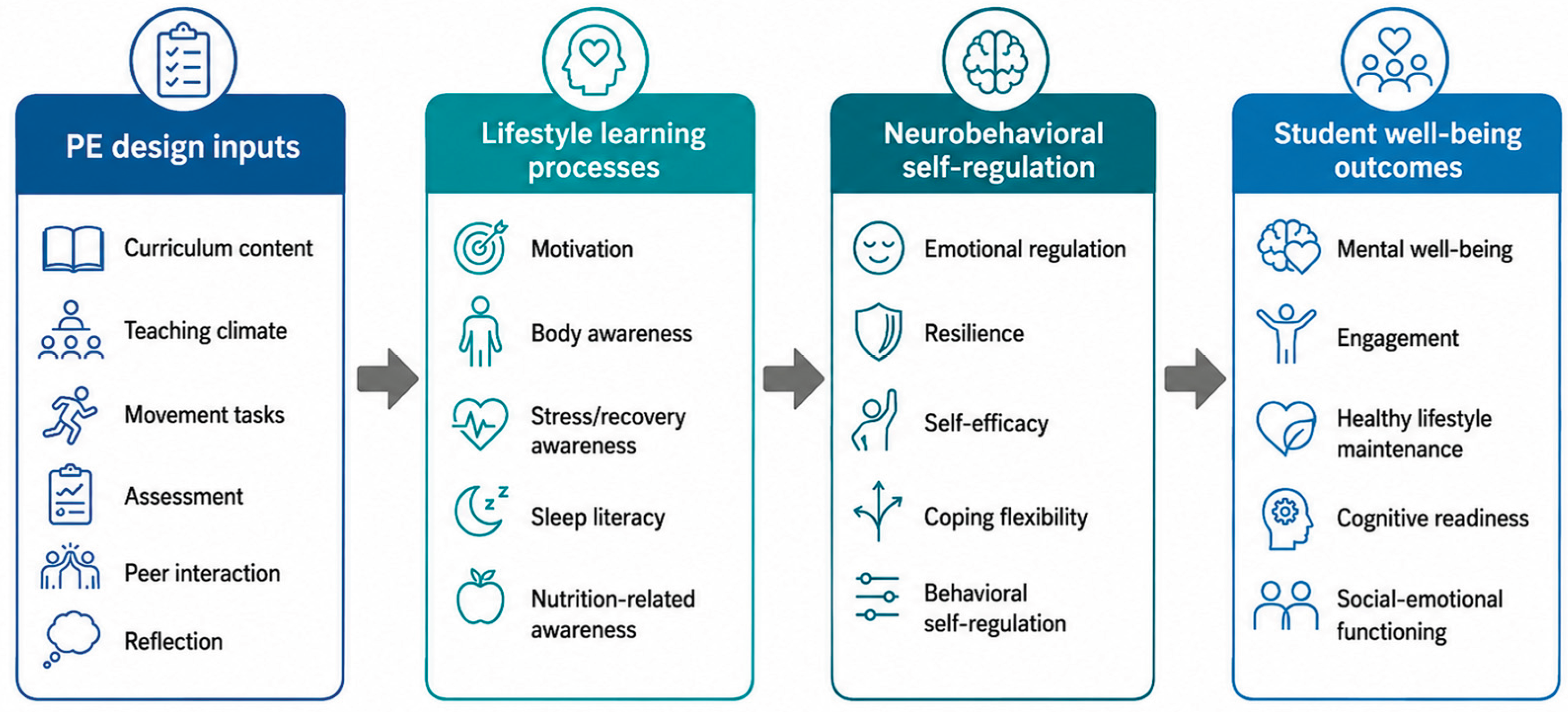
Figure 2.
From physical education participation to lifestyle self-regulation. This figure illustrates a proposed educational transition from conventional PE participation indicators to transferable lifestyle self-regulation capacities. Conventional indicators include attendance, activity time, fitness testing, sport-skill performance, and participation frequency. The central educational bridge consists of reflective and autonomy-supportive PE learning, including goal setting, feedback, meaningful choice, body awareness, recovery reflection, and peer support. Transferable capacities include effort regulation, emotional regulation, stress coping, sleep and recovery planning, nutrition-related decision-making, activity planning, and long-term movement engagement. The model emphasizes that transfer beyond PE does not occur automatically. Rather, it depends on explicit reflection, supportive teaching, and opportunities for students to connect movement experiences with everyday routines. The figure was developed by the authors based on prior work on movement behavior integration, motivation, health literacy, self-efficacy, self-regulated learning, sleep and recovery awareness, and school-based nutrition and lifestyle education [6,7,8,9,10,12,16,31,38,49,54,55,56,57,58,59,60].
Figure 2.
From physical education participation to lifestyle self-regulation. This figure illustrates a proposed educational transition from conventional PE participation indicators to transferable lifestyle self-regulation capacities. Conventional indicators include attendance, activity time, fitness testing, sport-skill performance, and participation frequency. The central educational bridge consists of reflective and autonomy-supportive PE learning, including goal setting, feedback, meaningful choice, body awareness, recovery reflection, and peer support. Transferable capacities include effort regulation, emotional regulation, stress coping, sleep and recovery planning, nutrition-related decision-making, activity planning, and long-term movement engagement. The model emphasizes that transfer beyond PE does not occur automatically. Rather, it depends on explicit reflection, supportive teaching, and opportunities for students to connect movement experiences with everyday routines. The figure was developed by the authors based on prior work on movement behavior integration, motivation, health literacy, self-efficacy, self-regulated learning, sleep and recovery awareness, and school-based nutrition and lifestyle education [6,7,8,9,10,12,16,31,38,49,54,55,56,57,58,59,60].
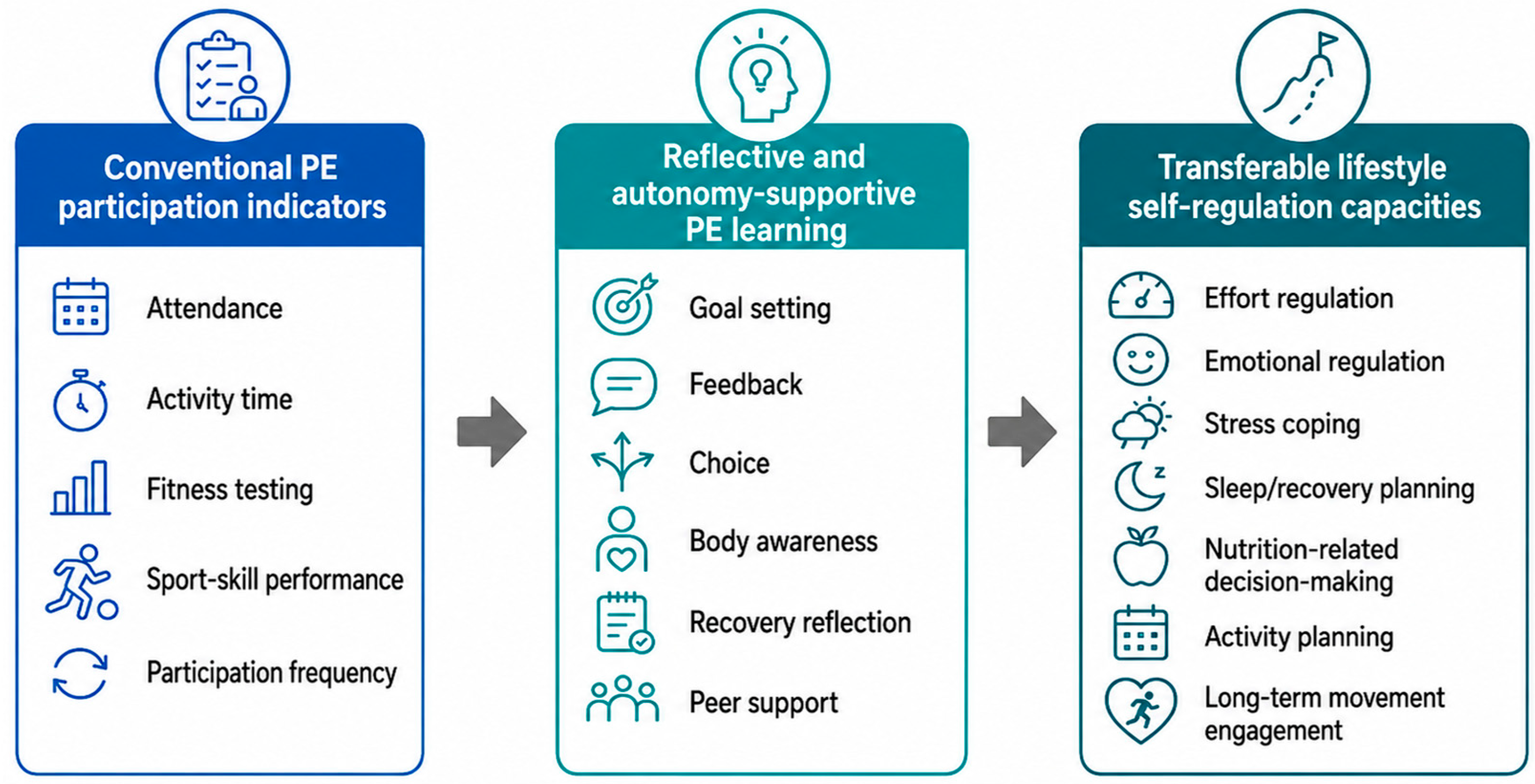

Table 1.
Existing review landscape and remaining gaps.
| Existing review domain | What existing reviews have mainly addressed | Remaining gap | Contribution of the present review |
|---|---|---|---|
| PE, physical activity, sport, and adolescent mental health | Whether PE, school sport, or physical activity provision is associated with depression, anxiety, self-esteem, self-efficacy, life satisfaction, general well-being, and broader youth health indicators [2,3,4,21,22,23] | Reviews are often outcome-oriented and give less attention to PE curriculum and teaching as learning mechanisms | Reframes PE as a lifestyle learning environment rather than only an activity or intervention setting |
| Physical activity and mental health in tertiary education | Associations among physical activity, physical literacy, well-being, resilience, life satisfaction, and psychological distress in university or tertiary students [5] | Young adults are often studied as activity participants rather than learners within structured PE or wellness education contexts | Extends the framework to adolescents and young adults, including school and university PE contexts |
| PE curriculum, pedagogy, and meaningful experience | PE as health-based pedagogy, meaningful learning, curriculum design, pedagogical models, and student experience [14,15,24,25,26] | These discussions are not always linked with neurobehavioral constructs such as stress regulation, emotional regulation, sleep, recovery, and self-regulation | Connects PE pedagogy with lifestyle learning and neurobehavioral well-being pathways |
| Physical literacy and health literacy | Motivation, confidence, competence, knowledge, and health-related understanding for lifelong participation and health decisions [16,27,28,29,30,31] | Literacy frameworks may not fully integrate diet, sleep, recovery, emotion regulation, and stress regulation within PE learning | Positions physical literacy and health literacy as foundations within a broader lifestyle learning framework |
| Motivation and Self-Determination Theory in PE and physical activity | Autonomy, competence, relatedness, autonomous motivation, engagement, and behavioral persistence [8,9,10] | Motivation is often discussed separately from broader lifestyle self-regulation | Links motivational climate to movement, coping, self-efficacy, recovery awareness, and lifestyle self-regulation |
| Physical activity, diet, sleep, and lifestyle behaviors | Interactions among physical activity, diet, sedentary behavior, sleep duration, sleep timing, and sleep quality [6,7,32] | Lifestyle behaviors are usually discussed outside PE curriculum and teaching | Treats sleep, recovery, and nutrition-related awareness as supportive lifestyle modules within PE and health-related learning |
Table 2.
Physical education curriculum components, neurobehavioral learning targets, and supporting literature.
Table 2.
Physical education curriculum components, neurobehavioral learning targets, and supporting literature.
| PE curriculum component | Teaching strategy | Lifestyle learning process | Neurobehavioral target | Possible indicators | Key supporting literature |
|---|---|---|---|---|---|
| Movement skill and fitness learning | Progressive challenge, mastery feedback, differentiated tasks | Body awareness, competence, effort interpretation | Self-efficacy, persistence, confidence | Perceived competence, self-efficacy, persistence after failure | Quality PE, health-based PE, physical literacy, and self-efficacy literature [1,12,14,15,24,25,26,27,28,29,33,34,35] |
| Autonomy-supportive instruction | Meaningful choices, rationale, student voice | Internalization of movement value | Autonomous motivation, engagement | Autonomous motivation, class engagement, intention for future activity | Self-Determination Theory and PE motivation literature [8,9,10,38,39] |
| Reflective movement tasks | Movement journals, goal reflection, perceived exertion reflection | Self-monitoring and interpretation of bodily cues | Self-regulation, coping flexibility | Goal-setting quality, self-monitoring, adaptive strategy use | Health literacy, self-regulated learning, and behavior-related regulation literature [16,31,40,41,49,50,51,52] |
| Cooperative and responsibility-based activities | Peer roles, group problem-solving, responsibility transfer | Social connection, empathy, shared regulation | Relatedness, resilience, social-emotional functioning | Peer support, responsibility behaviors, cooperation quality | Meaningful PE, resilience, responsibility-based PE, and life skills transfer literature [13,26,46,47,48,53] |
| Stress and emotion awareness activities | Cool-down reflection, breathing awareness, challenge appraisal | Recognition of stress and emotional responses | Emotional regulation, stress coping | Emotion regulation strategy use, perceived stress, coping confidence | Stress appraisal, physical activity and stress, and emotion regulation literature [11,40,41,42,43,44] |
| Recovery and lifestyle modules | Sleep/recovery logs, hydration prompts, energy reflection | Recovery awareness, sleep and nutrition-related awareness | Lifestyle self-regulation | Sleep awareness, recovery planning, nutrition-related decision-making | Health literacy, 24-hour movement, lifestyle behavior, and self-regulation literature [6,7,16,31,49,50,51,52] |
Table 3.
Future research agenda, measurement indicators, and supporting literature for PE-based neurobehavioral well-being.
Table 3.
Future research agenda, measurement indicators, and supporting literature for PE-based neurobehavioral well-being.
| Research priority | Suggested study focus | Target constructs | Possible indicators | Key supporting literature |
|---|---|---|---|---|
| Curriculum mechanisms | Compare PE units with and without reflective lifestyle learning components | Motivation, self-regulation, self-efficacy | Autonomous motivation, goal setting, perceived competence, self-efficacy | Refs. [8,9,10,12,25,47,48,49,50] |
| Teaching climate | Examine autonomy-supportive, competence-supportive, and relatedness-supportive teaching | Need satisfaction, engagement, well-being | Basic psychological need satisfaction, student engagement, enjoyment, perceived competence | Refs. [8,9,10,26,38,71,72,73,74] |
| Stress and emotion regulation | Study PE tasks that include challenge appraisal, cool-down reflection, breathing awareness, or emotion reflection | Stress coping, emotional regulation, resilience | Perceived stress, reappraisal, coping confidence, resilience | Refs. [11,40,41,42,43,44,45,46,65,66] |
| Recovery and lifestyle awareness | Integrate sleep, recovery, hydration, energy reflection, or nutrition-related awareness into selected PE units | Sleep awareness, recovery planning, nutrition-related awareness, lifestyle self-regulation | Sleep awareness, recovery logs, perceived energy, self-reported lifestyle planning | Refs. [6,7,16,31,49,54,55,56,57,58,59,60] |
| Transfer beyond PE | Follow students after PE units or courses to examine whether learning is applied outside class | Lifestyle self-regulation, activity maintenance, coping transfer | Activity planning, self-monitoring, intention, behavior maintenance, transfer reflection | Refs. [50,51,52,53,62] |
| Measurement development | Test whether PE-based lifestyle learning requires combined quantitative and qualitative indicators | Well-being, stress, resilience, engagement, self-regulation | WEMWBS, PSS, CD-RISC, PERMA-related measures, engagement indicators, qualitative reflection | Refs. [63,64,65,66,67,68,69,70,71,72,73,74,75] |
| Implementation and equity | Examine feasibility across schools, universities, and diverse student groups | Reach, adoption, fidelity, inclusion, sustainability | RE-AIM indicators, student voice, participation equity, implementation fidelity | Refs. [37,61,76,77,78,79] |
Disclaimer/Publisher’s Note: The statements, opinions and data contained in all publications are solely those of the individual author(s) and contributor(s) and not of MDPI and/or the editor(s). MDPI and/or the editor(s) disclaim responsibility for any injury to people or property resulting from any ideas, methods, instructions or products referred to in the content. |
© 2026 by the authors. Licensee MDPI, Basel, Switzerland. This article is an open access article distributed under the terms and conditions of the Creative Commons Attribution (CC BY) license (http://creativecommons.org/licenses/by/4.0/).
Copyright: This open access article is published under a Creative Commons CC BY 4.0 license, which permit the free download, distribution, and reuse, provided that the author and preprint are cited in any reuse.


